Edited Book Open Access Full access
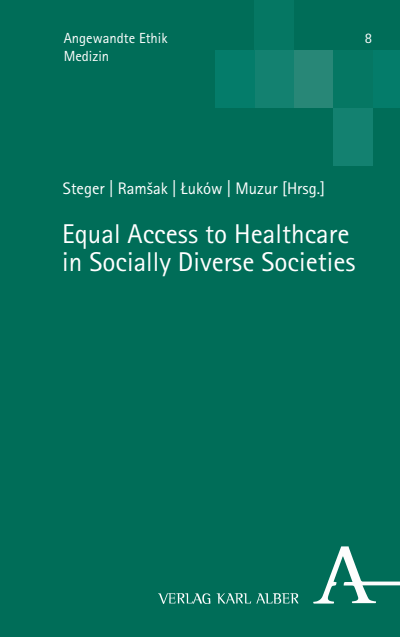
Equal Access to Healthcare in Socially Diverse Societies
- Editors:
- | | |
- Series:
- Angewandte Ethik, Volume 8
- Publisher:
- 2023
Summary
With the changing composition of societies, there is growing consideration of questions of social diversity and equal access to healthcare for minority groups. Despite raised attention to this topic in recent years, there are still debates regarding implementation of healthcare equality in practice. Therefore, the aim of the contributions presented in this volume is a better understanding of the phenomenon of inequity and discrimination of minority groups in accessing healthcare from interdisciplinary perspectives of medical ethics, public health, and law. Such an understanding can lead to the determination of minorities’ special needs concerning healthcare and barriers precluding them from benefitting from existing opportunities.
Keywords
Search publication
Bibliographic data
- Copyright Year
- 2023
- ISBN-Print
- 978-3-495-99788-8
- ISBN-Online
- 978-3-495-99789-5
- Publisher
- Karl Alber, Baden-Baden
- Series
- Angewandte Ethik
- Volume
- 8
- Language
- English
- Pages
- 290
- Product Type
- Edited Book
Table of contents
ChapterPages
- Titelei/InhaltsverzeichnisPages 1 - 10 Download chapter (PDF)
- Authors:Download chapter (PDF)
- 1. Introduction
- 2.1. Systematic literature review
- 2.2. Non-systematic documentary evaluation
- 3.1.1. Level one: implementation, concrete observation, evaluation
- 3.1.2. Level two: meta level – underlying mechanisms, dynamics, interactions
- 3.1.3. Level three: conceptual level – re-assessing concepts, terms and definitions
- 3.2. Research on Social Diversity and Minority Health: The relevance of Patient Autonomy and Informed Consent
- 3.3.1. Autonomy as individual right to rational decision making: defying paternalism
- 3.3.2. Kantian autonomy as an inherent status sui generis
- 4.1. Patient Autonomy and Informed Consent in individual medical encounters
- 4.2. Re-definition of Minority Groups in the light of the findings
- 4.3. Expanding the results to systematic problems of access to public healthcare
- 4.4. The significance of Informed Consent for justice in public healthcare: a critical revision
- 5. Limitations
- 6. Conclusion
- Authors:Download chapter (PDF)
- 1. Introduction
- 2. Method
- 3. Differences in health systems
- 4.1. Croatia
- 4.2. Germany
- 4.3. Poland
- 4.4. Slovenia
- 5. Access to reproductive healthcare during COVID-19 pandemic
- 6. Conclusion
- Authors: |Download chapter (PDF)
- 1. Introduction – Vulnerability of children
- 2. Method and materials
- 3. Participation of children
- 4. Participation of children in healthcare
- 5. Relationship between protection and participation of children
- 6. International researches in participation of children in healthcare
- 7. Participation of children in healthcare in Croatia
- 8. Conclusion and recommendations
- Authors: |Download chapter (PDF)
- 1.1. Heteronormativity as a theoretical framework
- 1.2. Heteronormativity in the German healthcare system
- 2.1 Types of interviews and their analysis
- 2.2. Sample
- 3.1. Asexual people’s experiences in healthcare
- 3.2. Trans people’s experiences in healthcare
- 4. Discussion
- 5. Conclusion
- Authors:Download chapter (PDF)
- 1. Background
- 2. Autoethnographic narrative as a method
- 3.1. Doubts and fears related to reproduction decisions – before it all began
- 3.2. Getting knowledge – stepping into the underworld
- 3.3. Clinical support in Poland – being a stranger
- 3.4. The Danish experience – a breath of fresh air
- 3.5. Labor and birth – the bitter-sweet taste of privilege
- 4. The privileged
- 5. The lesson
- Authors:Download chapter (PDF)
- 1.1. Migration and dementia
- 1.2. Provision of and access to dementia care for and by culturally diverse populations
- 1.3. Culture’s role in healthcare ethics
- 2.1. Recruitment process
- 2.2. Study design
- 2.3. Data collection and analysis
- 3.1. There is a need for support, guidance and information
- 3.2. The disease is not well-known
- 3.3. Being a foreigner had led to a sense of discrimination
- 3.4. Living and working conditions have an impact on the initiation of the disease
- 3.5. The care is offered by the family members
- 4.1. Need for culturally sensitive care to promote better access and provision of healthcare
- 4.2. Culture’s role in shaping one’s health-related phenomena
- 4.3. Impact of migration experience on one’s mental health
- 4.4. Willingness to care for the family
- 5. Limitations
- 6. Conclusion
- Authors: |Download chapter (PDF)
- 1. Introduction
- 2. Patients and Methods
- 3. Results
- 4. Discussion
- 5. Conclusion
- Authors: |Download chapter (PDF)
- 1. Introduction
- 2. Materials and method
- 3.1 Roma access to the healthcare system in the Republic of Croatia
- 3. Conclusion
- Authors: | |Download chapter (PDF)
- 1. Theoretical background
- 2. Objectives
- 3.1. Sample
- 4. Results
- 5. Discussion
- 6. Conclusion
- Authors: | |Download chapter (PDF)
- 1. Background
- 2. Methods and materials
- 3. Results
- 4. Discussion
- 5. Conclusion
- Authors: |Download chapter (PDF)
- 1. Introduction
- 2. Methods and Materials
- 3. Results
- 4. Discussion
- 5. Conclusion
- Authors: |Download chapter (PDF)
- 1. Introduction
- 2. Methods and Materials
- 3.1.1. Foreigners
- 3.1.2. Roma minority
- 3.2. Perception of working with patients from diverse cultural background
- 3.3.1. Good access to healthcare
- 3.3.2. Social works access to patients and patients’ access to social workers
- 3.4.1. Getting to know the patient
- 3.4.2. Developing the helping relationship with patient and family members
- 3.4.3. Administrative and formal tasks and procedures
- 3.4.4. Bridge between hospital, patient and professionals in other institution
- 3.5.1. Lack of procedure and protocols
- 3.5.2. Time
- 3.5.3. Language barriers
- 3.6. Examples of good practice
- 4. Discussion
- 5. Limitations
- 6. Conclusion
- Addresses for correspondencePages 285 - 290 Download chapter (PDF)