, to see if you have full access to this publication.
Monograph No access
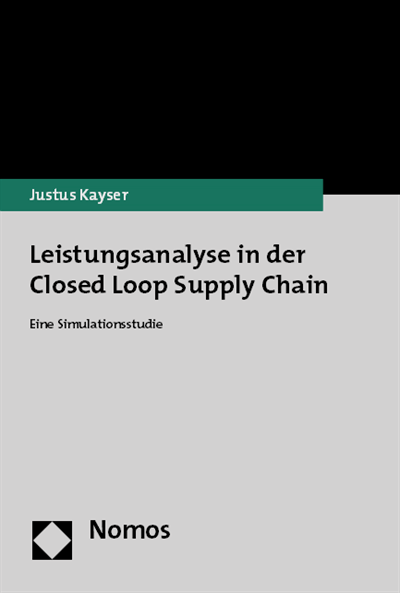
Leistungsanalyse in der Closed Loop Supply Chain
Eine Simulationsstudie- Authors:
- Publisher:
- 2016
Search publication
Bibliographic data
- Edition
- 1/2016
- Copyright Year
- 2016
- ISBN-Print
- 978-3-8487-3569-3
- ISBN-Online
- 978-3-8452-7932-9
- Publisher
- Nomos, Baden-Baden
- Language
- German
- Pages
- 240
- Product Type
- Monograph
Table of contents
ChapterPages
- Titelei/Inhaltsverzeichnis No access Pages 1 - 20
- Abkürzungsverzeichnis No access Pages 21 - 22
- Variablenverzeichnis No access Pages 23 - 24
- 1.1 Motivation No access
- 1.2 Ziele No access
- 1.3 Aufbau der Arbeit No access
- 2.1.1 Wiederverwendungsmöglichkeiten No access
- 2.1.2 Unsicherheiten und Probleme in der Wiederaufbereitung No access
- 2.1.3 Closed Loop Supply Chain Management No access
- 2.2.1 Auswirkungen No access
- 2.2.2 Ursachen No access
- 2.2.3 Gegenmaßnahmen No access
- 2.3.1 Bullwhip-Effekt No access
- 2.3.2 Lagerbestand No access
- 2.3.3 Fehlbestand No access
- 2.3.4 Kosten No access
- 3.1 Aufbau No access
- 3.2 Annahmen No access
- 3.3.1 Lagerbestände No access
- 3.3.2 Lagereingänge No access
- 3.3.3 Lagerausgänge No access
- 3.3.4 Unterwegsbestände No access
- 3.3.5 Bestelleingänge No access
- 3.3.6 Fehlbestände No access
- 3.3.7 Bestellte, aber noch nicht eingetroffene Produkte No access
- 3.3.8 Bestellausgänge No access
- 3.3.9 Unterwegsbestellungen No access
- 3.3.10 Bullwhip-Effekt No access
- 3.3.11 Durchschnittliche Lagerbestände No access
- 3.3.12 Durchschnittliche Fehlbestände No access
- 4.1 Die Simulation als Lösungsmethode No access
- 4.2.1 Wahl der Parameter No access
- 4.2.2 Festlegung der erforderlichen Länge der Einschwingphase No access
- 4.2.3 Festlegung der Länge eines Simulationslaufs No access
- 4.2.4 Festlegung der erforderlichen Anzahl an Simulationsläufen No access
- 4.2.5 Fazit zur Planung des Simulationsexperiments No access
- 4.3.1 Verifizierung des Simulationsmodells No access
- 4.3.2.1 Schätzung des Regressionsmodells No access
- 4.3.2.2 Prüfung des Regressionsmodells No access
- 4.3.2.3 Prüfung der Regressionskoeffizienten No access
- 4.3.3 Fazit zur Analyse der Outputdaten No access
- 4.4 Weitere Vorgehensweise No access
- 5.1 Problembeschreibung No access
- 5.2 Literaturüberblick No access
- 5.3 Ableitung der Forschungsfragen No access
- 5.4.1 Beschränkte Wiederaufbereitbarkeit der Sekundärrohstoffe No access
- 5.4.2 Beschränkte Lagerkapazität für zurückgenommene Sekundärrohstoffe No access
- 5.5.1 Beantwortung von Forschungsfrage 5-1 No access
- 5.5.2 Beantwortung von Forschungsfrage 5-2 No access
- 5.6 Fazit No access
- 6.1 Problembeschreibung No access
- 6.2 Literaturüberblick No access
- 6.3 Ableitung der Forschungsfrage No access
- 6.4 Spezifizierung des Simulationsexperiments No access
- 6.5 Ergebnisse des Simulationsexperiments No access
- 6.6 Fazit No access
- 7.1 Problembeschreibung No access
- 7.2 Literaturüberblick No access
- 7.3 Ableitung der Forschungsfrage No access
- 7.4 Spezifizierung des Simulationsexperiments No access
- 7.5 Ergebnisse des Simulationsexperiments No access
- 7.6 Fazit No access
- 8.1 Problembeschreibung No access
- 8.2 Literaturüberblick No access
- 8.3 Ableitung der Forschungsfragen No access
- 8.4.1 Information Sharing der Endkundennachfrage No access
- 8.4.2 Information Sharing des Lagerbestands des Sortierers No access
- 8.4.3 Zweifaches Information Sharing No access
- 8.5.1 Beantwortung von Forschungsfrage 8-1 No access
- 8.5.2 Beantwortung von Forschungsfrage 8-2 No access
- 8.5.3 Beantwortung von Forschungsfrage 8-3 No access
- 8.5.4 Beantwortung von Forschungsfrage 8-4 No access
- 8.6 Fazit No access
- 9.1 Zusammenfassung No access
- 9.2 Ausblick No access
- 10 Anhang No access Pages 225 - 232
- Quellenverzeichnis No access Pages 233 - 240
Bibliography (100 entries)
No match found. Try another term.
- Quellenverzeichnis Open Google Scholar DOI: 10.5771/9783845279329
- Adenso-Diaz, B./Moreno, P./Gutierrez, E./Lozano, S. (2012): An Analysis of the Main Factors Affecting Bullwhip in Reverse Supply Chains. In: International Journal of Production Economics, 135, S. 917-928. Open Google Scholar DOI: 10.5771/9783845279329
- Backhaus, K./Erichson, B./Plinke, W./Weiber, R. (2011): Multivariate Analysemethoden – Eine anwendungsorientierte Einführung. 13. Auflage, Springer, Berlin, Heidelberg. Open Google Scholar DOI: 10.5771/9783845279329
- Banks, J./Carson II, J. S./Nelson, B. L./Nicol, D. M. (2005): Discrete-Event System Simulation. 4. Auflage, Prentice Hall, New Jersey. Open Google Scholar DOI: 10.5771/9783845279329
- Bassok, Y./Anupindi, R. (1997): Analysis of Supply Contracts with Total Minimum Commitment. In: IIE Transactions, 29, S. 373-381. Open Google Scholar DOI: 10.5771/9783845279329
- Bassok, Y./Anupindi, R. (2008): Analysis of Supply Contracts with Commitments and Flexibility. In: Naval Research Logistics, 55, S. 459-477. Open Google Scholar DOI: 10.5771/9783845279329
- Biehl, M./Prater, E./Realff, M. J. (2007): Assessing Performance and Uncertainty in Developing Carpet Reverse Logistics Systems. In: Computers & Operations Research, 34, S. 443-463. Open Google Scholar DOI: 10.5771/9783845279329
- Blackburn, J. D./Guide Jr., V. D. R./Souza, G. C./Van Wassenhove, L. N. (2004): Reverse Supply Chains for Commercial Returns. In: California Management Review, 46 (2), S. 6-22. Open Google Scholar DOI: 10.5771/9783845279329
- Cachon, G. P. (1999): Managing Supply Chain Demand Variability with Scheduled Ordering Policies. In: Management Science, 45 (6), S. 834-856. Open Google Scholar DOI: 10.5771/9783845279329
- Cachon, G. P./Fisher, M. (2000): Supply Chain Inventory Management and the Value of Shared Information. In: Management Science, 46 (8), S. 1032-1048. Open Google Scholar DOI: 10.5771/9783845279329
- Chatfield, D. C./Kim, J. G./Harrison, T. P./Hayya, J. C. (2004): The Bullwhip Effect – Impact of Stochastic Lead Time, Information Quality, and Information Sharing: A Simulation Study. In: Production and Operations Management, 13 (4), S. 340-353. Open Google Scholar DOI: 10.5771/9783845279329
- Chen, F./Samroengraja, R. (2004): Order Volatility and Supply Chain Costs. In: Operations Research, 52 (5), S. 707-722. Open Google Scholar DOI: 10.5771/9783845279329
- Chen, F. Y./Drezner, Z./Ryan, J. K./Simchi-Levi, D. (2000): Quantifying the Bullwhip Effect in a Simple Supply Chain – The Impact of Forecasting, Lead Times and Information. In: Management Science, 46 (3), S. 436-443. Open Google Scholar DOI: 10.5771/9783845279329
- Chen, F. Y./Krass, D. (2001): Analysis of Supply Contracts with Total Order Quantity Commitments and Non-Stationary Demands. In: European Journal of Operational Research, 131, S. 309-323. Open Google Scholar DOI: 10.5771/9783845279329
- Das, D./Dutta, P. (2012): A Simulation Study of Bullwhip Effect in a Closed-Loop Supply Chain with Fuzzy Demand and Fuzzy Collection Rate under Possibility Constraints. In: World Academy of Science, Engineering and Technology, 64, S. 1245-1252. Open Google Scholar DOI: 10.5771/9783845279329
- DB Schenker (2011): Reverse Logistics. In: logistics, 1, S. 42-43, DB Mobility Logistics AG (Hrg.), Berlin. Open Google Scholar DOI: 10.5771/9783845279329
- Dejonckheere, J./Disney, S. M./Lambrecht, M.R./Towill, D.R. (2003): Measuring and Avoiding the Bullwhip Effect: A Control Theoretic Approach. In: European Journal of Operational Research, 147, S. 567-590. Open Google Scholar DOI: 10.5771/9783845279329
- Dejonckheere, J./Disney, S. M./Lambrecht, M.R./Towill, D.R. (2004): The Impact of Information Enrichment on the Bullwhip Effect in Supply Chains: A Control Engineering Perspective. In: European Journal of Operational Research, 153, S. 727-750. Open Google Scholar DOI: 10.5771/9783845279329
- Dekker, R./Fleischmann, M./Inderfurth, K./Van Wassenhove, L. N. (2004): Reverse Logistics – Quantitative Models for Closed-Loop Supply Chains. Springer-Verlag, Berlin, Heidelberg. Open Google Scholar DOI: 10.5771/9783845279329
- Denizel, M./Ferguson, M./Souza, G. C. (2010): Multiperiod Remanufacturing Planning With Uncertain Quality of Inputs. In: IEEE Transactions on Engineering Management, 57 (3), S. 394-404. Open Google Scholar DOI: 10.5771/9783845279329
- Disney, S. M./Towill, D. R. (2003): The Effect of Vendor Managed Inventory (VMI) Dynamics on the Bullwhip Effect in Supply Chains. In: International Journal of Production Economics, 85, S. 199-215. Open Google Scholar DOI: 10.5771/9783845279329
- Dyckhoff, H./Souren, R./Keilen, J. (2004): The Expansion of Supply Chains to Closed Loop Systems: A Conceptual Framework and the Automotive Industry’s Point of View. In: Dyckhoff, H./Lackes, R./ Reese, J. (2004): Supply Chain Management and Reverse Logistics. Springer , Berlin, Heidelberg. Open Google Scholar DOI: 10.5771/9783845279329
- Emshoff, J. R./Sisson, R.L. (1972): Simulation mit dem Computer. Verlag Moderne Industrie, München. Open Google Scholar DOI: 10.5771/9783845279329
- Ferguson, M./Guide Jr., V. D./Koca, E./Souza, G. C. (2009): The Value of Quality Grading in Remanufacturing. In: Production and Operations Management, 18 (3), S. 300-314. Open Google Scholar DOI: 10.5771/9783845279329
- Ferguson, M./Souza, G. C. (2010): Closed Loop Supply Chain: New Developments to Improve the Sustainability of Business Practices. CRC Press, Boca Raton, London, New York. Open Google Scholar DOI: 10.5771/9783845279329
- Ferrer, G./Ketzenberg, M. E. (2004): Value of Information in Remanufacturing Complex Products. In: IEE Transactions, 36, S. 265–277. Open Google Scholar DOI: 10.5771/9783845279329
- Fiala, P. (2005): Information Sharing in Supply Chains. In: Omega – OR and its Applications, 33 (5), S. 419-423. Open Google Scholar DOI: 10.5771/9783845279329
- Flapper, S. D. P./Van Nunen, J. A. E. E./Van Wassenhove, L. N. (2005): Managing Closed-Loop Supply Chains. Springer, Berlin, Heidelberg. Open Google Scholar DOI: 10.5771/9783845279329
- Fleischmann, M./Bloemhof-Ruwaard, J. M./Dekker, R./Van der Laan, E./Van Nunen, J. A. E. E./Van Wassenhove, L. N. (1997): Quantitative Models for Reverse Logistics: A Review. In: European Journal of Operational Research, 103 (1), S. 1-17. Open Google Scholar DOI: 10.5771/9783845279329
- Forrester, J. W. (1958): Industrial Dynamics: A Major Breakthrough for Decision Makers. In: Harvard Business Review, 36 (4), S. 37-66. Open Google Scholar DOI: 10.5771/9783845279329
- Forrester, J. W. (1961): Industrial Dynamics. MIT Press, Cambridge, 1961. Open Google Scholar DOI: 10.5771/9783845279329
- Galbreth, M. R./Blackburn, J. D. (2006): Optimal Acquisition and Sorting Policies for Remanufacturing. In: Production and Operations Management 15 (3), S. 384-392. Open Google Scholar DOI: 10.5771/9783845279329
- Galbreth, M. R./Blackburn, J. D. (2010): Optimal Acquisition Quantities in Remanufacturing with Condition Uncertainty. In: Production and Operations Management 19 (1), S. 61-69. Open Google Scholar DOI: 10.5771/9783845279329
- Geary, S./Disney, S. M./ Towill, D. R. (2006): On Bullwhip in Supply Chains. Historical Review, Present Practice and Expected Future Impact. In: International Journal of Production Economics, 101 (1), S. 2-18. Open Google Scholar DOI: 10.5771/9783845279329
- Georgiadis, P./Besiou, M. (2008): Sustainability in Electrical and Electronic Equipment Closed-Loop Supply Chains: A System Dynamics Approach. In: Journal of Cleaner Production, 16, S. 1665-1678. Open Google Scholar DOI: 10.5771/9783845279329
- Georgiadis, P./Vlachos, D. (2003): Analysis of the Dynamic Impact of Environmental Policies on Reverse Logistics. In: Operational Research. An International Journal, 3 (2), S. 123-135. Open Google Scholar DOI: 10.5771/9783845279329
- Georgiadis, P./Vlachos, D. (2004a): Decision Making in Reverse Logistics using System Dynamics. In: Yugoslav Journal of Operations Research, 14 (2), S. 259-272. Open Google Scholar DOI: 10.5771/9783845279329
- Georgiadis, P./Vlachos, D. (2004b): The Effect of Environmental Parameters on Product Recovery. In: European Journal of Operational Research, 157, S. 449-464. Open Google Scholar DOI: 10.5771/9783845279329
- Georgiadis, P./Vlachos, D./Tagaras, G. (2006): The Impact of Product Lifecycle on Capacity Planning of Closed-Loop Supply Chains with Remanufacturing. In: Production and Operations Management, 15 (4), S. 514-527. Open Google Scholar DOI: 10.5771/9783845279329
- Guide Jr., V. D. R./Van Wassenhove, L. N. (2001): Managing Product Returns for Remanufacturing. In: Production and Operations Management, 10 (2), S. 142-155. Open Google Scholar DOI: 10.5771/9783845279329
- Guide Jr., V. D. R./Van Wassenhove, L. N. (2002): The Reverse Supply Chain. In: Harvard Business Review, 2, S. 25-26. Open Google Scholar DOI: 10.5771/9783845279329
- Guide Jr., V. D. R./Van Wassenhove, L. N. (2006): Closed-Loop Supply Chains: An Introduction to the Feature Issue (Part 2). In: Production and Operations Management, 15 (4), S. 471-472. Open Google Scholar DOI: 10.5771/9783845279329
- Guide Jr., V. D. R./Van Wassenhove, L. N. (2009): The Evolution of Closed-Loop Supply Chain Research. In: Operations Research, 57 (1), S. 10-18. Open Google Scholar DOI: 10.5771/9783845279329
- Guide Jr., V. D. R./Harrison, T. P./Van Wassenhove, L. N. (2003): The Challenge of Closed-Loop Supply Chains. In: Interfaces, 33 (6), S. 3-6. Open Google Scholar DOI: 10.5771/9783845279329
- Guide Jr., V. D. R./Jayaraman, V./Srivastava, R./Benton, W. C. (2000): Supply-Chain Management for Recoverable Manufacturing Systems. In: Interfaces, 30 (3), S. 125-142. Open Google Scholar DOI: 10.5771/9783845279329
- Hall, D. C./Yaygin, C. (2012): Impact of Information Sharing on Supply Chain Performance. In: International Journal of Advanced Manufacturing Technology, 58, S- 397-409. Open Google Scholar DOI: 10.5771/9783845279329
- Holland, W./Sodhi, M.S. (2003): Quantifying the Effect of Batch Size and Order Errors on the Bullwhip Effect using Simulation. In: Proceedings of the 8th Logistics Research Network Conference, London, 11.-12. September, S. 188-195. Open Google Scholar DOI: 10.5771/9783845279329
- Huang, L./Liu, Y. (2008): Supply Chain Dynamics under the Sustainable Development. In: 4th International Conference on Wireless Communications, Networking and Mobile Computing, 12.-14. Oktober, S. 1-4. Open Google Scholar DOI: 10.5771/9783845279329
- Hussain, M./Drake, P. R. (2011): Analysis of the Bullwhip Effect with Order Batching in Multi-Echelon Supply Chains. In: International Journal of Physical Distribution & Logistics Management, 41 (10), S. 972-990. Open Google Scholar DOI: 10.5771/9783845279329
- Iken, J. (2012): Schwer dranzukommen. In: Recycling – Sonderbeilage der Financial Times Deutschland, S. A2, Financial Times Deutschland, Hamburg. Open Google Scholar DOI: 10.5771/9783845279329
- Janzing, B. (2012): Goldrausch mit Elektromüll. In: Recycling – Sonderbeilage der Financial Times Deutschland, S. A3, Financial Times Deutschland, Hamburg. Open Google Scholar DOI: 10.5771/9783845279329
- Jayaraman, V./Guide Jr., V. D. R./Srivastava, R. (1999): A Closed-Loop Logistics Model for Remanufacturing. In: Journal of the Operational Research Society, 50 (5), S. 497-508. Open Google Scholar DOI: 10.5771/9783845279329
- Kayser, J. (2011): Die Simulation als Analyse-Instrument betriebswirtschaftlicher Fragestellungen – dargestellt am Beispiel der Abwrackprämie und ihrer Auswirkungen auf die Ersatzteillogistik in der Kraftfahrzeugindustrie. In: Productivity Management, 16 (1), 53-56. Open Google Scholar DOI: 10.5771/9783845279329
- Ketzenberg, M. E./Van der Laan, E./Teunter, R. H. (2006): Value of Information in Closed Loop Supply Chains. In: Production and Operations Management, 15 (3), S. 393-406. Open Google Scholar DOI: 10.5771/9783845279329
- Ketzenberg, M. E. (2009): The Value of Information in a Capacitated Closed Loop Supply Chain. In: European Journal of Operational Research, 198 (2), S. 491-503. Open Google Scholar DOI: 10.5771/9783845279329
- Kleijnen, J. P. C. (2008): Design and Analysis of Simulation Experiments. Springer Science + Business Media, New York. Open Google Scholar DOI: 10.5771/9783845279329
- Krüger, S. (1975): Simulation – Grundlagen, Techniken, Anwendungen. Walter de Gruyter, Berlin. Open Google Scholar DOI: 10.5771/9783845279329
- Küll, R./Stähly, P. (1999): Zur Planung und effizienten Abwicklung von Simulationsexperimenten. In: Biethan, J./Hummeltenberg, W./Schmidt, B./Stähly, P./Witte, T. (Hrsg.): Simulation als betriebliche Entscheidungshilfe: State of the Art und neuere Entwicklungen. Physica, Heidelberg. Open Google Scholar DOI: 10.5771/9783845279329
- Law, A. M. (2007): Simulation Modeling and Analysis. 4. Auflage, McGraw Hill, New York. Open Google Scholar DOI: 10.5771/9783845279329
- Lee, H. L./Padmanabhan, V./Whang, S. (1997): Information Distortion in a Supply Chain: The Bullwhip Effect. In: Management Science, 43 (4), S. 546-558. Open Google Scholar DOI: 10.5771/9783845279329
- Lee, H. L./Whang, S. (2000): Information Sharing in a Supply Chain. In: International Journal of Technology Management, 20 (3-4), S. 373-387. Open Google Scholar DOI: 10.5771/9783845279329
- Lee, H. L./So, K. C./Tang, C. S. (2000): The Value of Information Sharing in a Two-Level Supply Chain. In: Management Science, 46 (5), S. 626-643. Open Google Scholar DOI: 10.5771/9783845279329
- Lian, Z./Deshmukh, A. (2009): Analysis of Supply Contracts with Quantity Flexibility. In: European Journal of Operational Research, 196 (2), S. 526–533. Open Google Scholar DOI: 10.5771/9783845279329
- Ma, L./Chai, Y. (2014): Dynamics Modeling of Bullwhip Effect in Remanufacturing Closed-loop Supply Chain based on Third-party Recycler. In: Information Technology Journal 13 (13), S. 2137-2144. Open Google Scholar DOI: 10.5771/9783845279329
- Moyaux, T./Chaib-draa, B./D’Amours, S. (2007): Information Sharing as a Coordination Mechanism for Reducing the Bullwhip Effect in a Supply Chain. In: IEEE Transactions on Systems, Man, and Cybernatics – Part C: Applications and Reviews, 37 (3), S. 396-409. Open Google Scholar DOI: 10.5771/9783845279329
- Naylor, T. H. (1971): Computer Simulation Experiments with Models of Economic Systems. John Wiley & Sons, New York. Open Google Scholar DOI: 10.5771/9783845279329
- Nepal, B./Murat, A./Chinman, R. B. (2012): The Bullwhip Effect in Capacitated Supply Chains with Consideration for Product Life-Cycle Aspects. In: International Journal of Production and Economics, 136, S. 318-331. Open Google Scholar DOI: 10.5771/9783845279329
- Ouyang, Y. (2007): The Effect of Information Sharing on Supply Chain Stability and the Bullwhip Effect. In: European Journal of Operational Research, 182, S. 1107-1121. Open Google Scholar DOI: 10.5771/9783845279329
- O.V. (2010a): Zurück für die Zukunft. In: LOG.Kompass, 12, S. 6-9, DVV Media Group GmbH, Hamburg. Open Google Scholar DOI: 10.5771/9783845279329
- O.V. (2010b): Rohstofflager Handy. In: LOG.Kompass, 12, S. 18-19, DVV Media Group GmbH, Hamburg. Open Google Scholar DOI: 10.5771/9783845279329
- Paik, S.-K./Bagchi, P. K. (2007): Understanding the Causes of the Bullwhip Effect in a Supply Chain. In: International Journal of Retail & Distribution Management, 35 (4), S. 308-324. Open Google Scholar DOI: 10.5771/9783845279329
- Pati, R. K./Vart, P./Kumar, P. (2010): Quantifying Bullwhip Effect in a Closed Loop Supply Chain. In: OPSEARCH, 47 (4), S. 231-253. Open Google Scholar DOI: 10.5771/9783845279329
- Potter, A./Disney, S. M. (2006): Bullwhip and Batching: An Exploration. In: International Journal of Production Economics, 104, S. 408-418. Open Google Scholar DOI: 10.5771/9783845279329
- Rösch, F. (2012): Wege aus der Rohstoffklemme. In: BIP – Best in Procurement (Hrg.), S. 14-19, BME e.V., Frankfurt. Open Google Scholar DOI: 10.5771/9783845279329
- Qingli, D./Hao, S./Hui, Z. (2008): Simulation of Remanufacturing in Reverse Supply Chain based on System Dynamics. In: International Conference on Service Systems and Service Management (2008), S. 1-6. Open Google Scholar DOI: 10.5771/9783845279329
- Reese, J. (2012): Supply Chain Management – Eine experimentelle Studie. 1. Auflage, Nomos, Baden-Baden. Open Google Scholar DOI: 10.5771/9783845279329
- Reese, J. (2013): Operations Management – Optimale Gestaltung von Wertschöpfungsprozessen im Unternehmen. 1. Auflage, Vahlen, München. Open Google Scholar DOI: 10.5771/9783845279329
- Reese, J./Kayser, J. (2014): Closed-Loop Supply Chain Management – Eine Simulationsstudie. In: Gössinger, R./Zäpfel, G. (2014): Management integrativer Leistungserstellung. Festschrift für Hans Corsten. Duncker & Humblot, Berlin. Open Google Scholar DOI: 10.5771/9783845279329
- Riddals, C. E./Bennet, S. (2001): The Optimal Control of Batched Production and its Effect on Demand Amplification. In: International Journal of Production Economics, 72, S. 159-168. Open Google Scholar DOI: 10.5771/9783845279329
- Robinson, S. (2004): Simulation: The Practice of Model Development and Use. John Wiley & Sons Ltd, England. Open Google Scholar DOI: 10.5771/9783845279329
- Sokolowski, J. A./Banks, C. M. (2009): Principles of Modeling and Simulation. John Wiley & Sons Ltd, England. Open Google Scholar DOI: 10.5771/9783845279329
- Spengler, T./Schröter, M. (2003): Management of Spare Parts in Closed-Loop Supply Chains: A System Dynamics Approach. In: Interfaces, 33 (6), S. 7-17. Open Google Scholar DOI: 10.5771/9783845279329
- Spengler, T./Schröter, M. (2005): Konzeption eines System Dynamics Modells zur strategischen Planung von Closed-Loop Supply Chains. In: ZfB-Special Issue, 3, S. 1-29. Open Google Scholar DOI: 10.5771/9783845279329
- Sterman, J. D. (1989): Modeling Managerial Behavior: Misperceptions of Feedback in a Dynamic Decision Making Experiment. In: Management Science, 35 (3), S. 321-339. Open Google Scholar DOI: 10.5771/9783845279329
- Sterman, J. D. (2006): Operational and Behavioral Causes of Supply Chain Instability. In: Carranza Torres, O. A./Villegas Moran, F. A. (Hrsg.): The Bullwhip Effect in Supply Chains. A Review of Methods, Components and Cases. Basingstoke, S. 17-56. Open Google Scholar DOI: 10.5771/9783845279329
- Su, C.-T./Wong, J.-T. (2008): Design of a Replenishment System for a Stochastic Dynamic Production/Forecast Lot-Sizing Problem under Bullwhip Effect. In: Expert System with Applications, 34, S. 173-180. Open Google Scholar DOI: 10.5771/9783845279329
- Tsay, A. A./Lovejoy, W. S. (1999): Quantity Flexibility Contracts and Supply Chain Performance. In: Manufacturing & Service Operations Management, 1 (2), S. 89-111. Open Google Scholar DOI: 10.5771/9783845279329
- Turrisi, M./Bruccoleri, M./Cannella, S. (2013): Impact of Reverse Logistics on Supply Chain Performance. In: International Journal of Physical Distribution & Logistics Management, 43 (7), S. 564-585. Open Google Scholar DOI: 10.5771/9783845279329
- Tversky, A./Kahneman, D. (1974): Judgment under Uncertainty: Heuristics and Biases. In: Science, 185, S. 1124-1131. Open Google Scholar DOI: 10.5771/9783845279329
- Urban, T. L. (2000): Supply Contracts with Periodic, Stationary Commitment. In: Production and Operations Management, 9 (4), S. 400-413. Open Google Scholar DOI: 10.5771/9783845279329
- Van der Laan, E./Dekker, R./Salomon, M. (1996): Product Remanufacturing and Disposal: A Numerical Comparison of Alternative Control Strategies. In: International Journal of Production Economics, 45, S. 489-498. Open Google Scholar DOI: 10.5771/9783845279329
- Vlachos, D./Georgiadis, P./Iakovou, E. (2007): A System Dynamics Model for Dynamic Capacity Planning of Remanufacturing in Closed-Loop Supply Chains. In: Computers & Operations Research, 34, S. 367-394. Open Google Scholar DOI: 10.5771/9783845279329
- Waage, M. (2012): Koordination von Supply Chains durch Mengenbindungsvereinbarungen. Ein Instrument zur Senkung des Bullwhip-Effekts. 1. Auflage, Gabler Research, Wiesbaden. Open Google Scholar DOI: 10.5771/9783845279329
- Wilke, J. (2011): Supply Chain Koordination durch Lieferverträge mit rollierender Mengenflexibilität. Eine Simulationsstudie am Beispiel von Lieferketten der deutschen Automobilindustrie. Gabler, Wiesbaden. Open Google Scholar DOI: 10.5771/9783845279329
- Witthaut, M./Hellingrath, B. (2009): Simulation von SCM-Strategien. In: Buchholz, P./Clausen, U. (Hrsg.): Große Netze der Logistik. Springer, Berlin, S. 59-74. Open Google Scholar DOI: 10.5771/9783845279329
- Zanoni, S./Ferretti, I./Tang, O. (2006): Cost Performance and Bullwhip Effect in a Hybrid Manufacturing and Remanufacturing System with Different Control Policies. In: International Journal of Production Research, 44 (18-19), S. 3847-3862. Open Google Scholar DOI: 10.5771/9783845279329
- Zhang, X./Wu, O./Tian, Z. (2011): Bullwhip Effect Reduction in Closed-Loop Supply Chains Using H-Infinity Control. In: Management Science and Industrial Engineering (International Conference), S. 659-663. Open Google Scholar DOI: 10.5771/9783845279329
- Zhao, X./Xie, J./Zhang, W. J. (2002): The Impact of Information Sharing and Ordering Co-ordination on Supply Chain Performance. In: Supply Chain Management: An International Journal, 7 (1), S. 24-60. Open Google Scholar DOI: 10.5771/9783845279329
- Zikopoulos, C./Tagaras, G. (2008): On the Attractiveness of Sorting before Disassembly in Remanufacturing. In: IIE Transactions, 40, S. 313-323. Open Google Scholar DOI: 10.5771/9783845279329
- Zhou, L./Disney, S. M. (2006): Bullwhip and Inventory Variance in a Closed Loop Supply Chain. In: OR Spectrum, 28, S. 127-149. Open Google Scholar DOI: 10.5771/9783845279329