, to see if you have full access to this publication.
Monograph No access
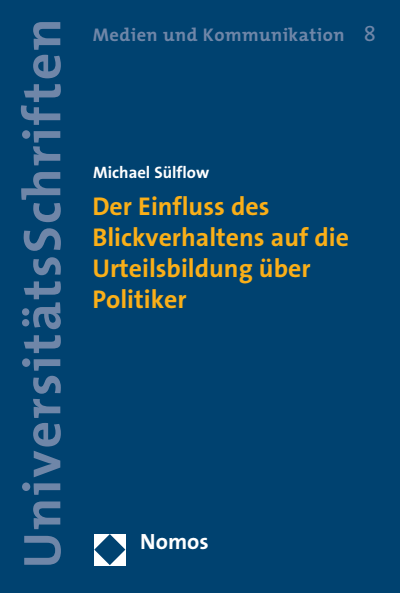
Der Einfluss des Blickverhaltens auf die Urteilsbildung über Politiker
- Authors:
- Series:
- Nomos Universitätsschriften - Medien und Kommunikation, Volume 8
- Publisher:
- 2020
Search publication
Bibliographic data
- Edition
- 1/2020
- Copyright Year
- 2020
- ISBN-Print
- 978-3-8487-5060-3
- ISBN-Online
- 978-3-8452-9232-8
- Publisher
- Nomos, Baden-Baden
- Series
- Nomos Universitätsschriften - Medien und Kommunikation
- Volume
- 8
- Language
- German
- Pages
- 444
- Product Type
- Monograph
Table of contents
ChapterPages
- Titelei/Inhaltsverzeichnis No access Pages 1 - 18
- 1 Einführung No access Pages 19 - 24
- 2.1 Definition und Vermittlung nonverbaler Kommunikation No access
- 2.2 Bedeutung visueller Kommunikation aus evolutionsbiologischer und soziokultureller Perspektive No access
- 2.3 Wahrnehmung und Verarbeitung von Gesichtern und Körpern No access
- 2.4 Zwischenfazit No access
- 3.1 Wirkung der Mimik No access
- 3.2 Wirkung des Blickverhaltens No access
- 3.3 Wirkung der Gestik No access
- 3.4 Wirkung von Mimik, Blickverhalten und Gestik in Kombination und im Vergleich No access
- 3.5 Wirkung emotionaler Ausdrücke No access
- 3.6 Zwischenfazit No access
- 4.1.1 Grundlagen der Methode No access
- 4.1.2 Gütekriterien der Eye-Tracking-Messung No access
- 4.1.3.1 Aufmerksamkeitsverteilung bei der Personenwahrnehmung No access
- 4.1.3.2.1 Einflüsse der visuellen Kommunikation No access
- 4.1.3.2.2 Einflüsse der Verfügbarkeit von Informationen No access
- 4.1.3.2.3 Einflüsse von Aufgabenstellungen No access
- 4.1.3.3 Einflüsse der Aufmerksamkeitsverteilung auf die Personenwahrnehmung No access
- 4.1.4 Herausforderungen der Erforschung visueller Kommunikation mittels Eye-Tracking No access
- 4.1.5 Zwischenfazit No access
- 4.2.1 Grundlagen der Methode No access
- 4.2.2 Gütekriterien der RTR-Messung No access
- 4.2.3 Forschungsstand zur Wirkung visueller Kommunikation mittels RTR-Messung No access
- 4.2.4 Herausforderungen der Erforschung visueller Kommunikation mittels RTR-Messung No access
- 4.2.5 Zwischenfazit No access
- 5 Kombination von Eye-Tracking und RTR-Messung zur Erforschung der Wahrnehmung und Wirkung visueller Kommunikation No access Pages 165 - 169
- 6 Forschungsleitende Fragen und Hypothesen No access Pages 170 - 178
- 7.1 Untersuchungsdesign No access
- 7.2.1 Identifikation der dargestellten Emotionen und Datenaufbereitung No access
- 7.2.2 Identifikation von Lächeln, Blickkontakt, Gestik und Datenaufbereitung No access
- 7.3.1 Datenerfassung und -aufbereitung No access
- 7.3.2 Datenbereinigung No access
- 7.4.1 Datenerfassung und -aufbereitung No access
- 7.4.2 Datenbereinigung No access
- 7.5 Aufbau des Fragebogens No access
- 7.6 Durchführung No access
- 7.7 Stichprobenbeschreibung, Datenbereinigung und Vergleichbarkeit der Gruppen No access
- 7.8.1 Einflüsse der rezeptionsbegleitenden Methoden(kombination) auf die Bewertung No access
- 7.8.2 Einflüsse der rezeptionsbegleitenden Methoden(kombination) auf das Blickverhalten No access
- 7.8.3 Selbsteinschätzung zur Handhabung und den Einflüssen rezeptionsbegleitender Methoden(kombinationen) No access
- 7.8.4 Fazit und Implikationen der Befunde No access
- 8.1.1 Visuelle Aufmerksamkeitsverteilung bei der Politikerwahrnehmung No access
- 8.1.2.1 Einfluss der Emotionen auf das Blickverhalten No access
- 8.1.2.2 Einfluss des Lächelns auf das Blickverhalten No access
- 8.1.2.3 Einfluss der Blickrichtung auf das Blickverhalten No access
- 8.1.2.4 Einfluss der Gestik auf das Blickverhalten No access
- 8.2.1 Spontane Eindrücke der Politiker im Zeitverlauf: Einfluss verbaler und visueller Informationen No access
- 8.2.2 Einfluss visueller Kommunikation auf die spontanen Eindrücke No access
- 8.2.3 Gesamturteile über die Politiker No access
- 8.3.1 Einfluss der situativen Aufmerksamkeitsverteilung bei der Politikerwahrnehmung auf die spontanen Eindrücke No access
- 8.3.2 Einfluss der situativen Zuwendung zu visuellen Kommunikationselementen auf die spontanen Eindrücke No access
- 8.3.3 Einfluss der Aufmerksamkeitsverteilung bei der Politikerwahrnehmung auf den Gesamteindruck No access
- 8.3.4 Einfluss der Zuwendung zu visuellen Kommunikationselementen auf den Gesamteindruck No access
- 9.1 Zusammenfassung und Diskussion der Befunde No access
- 9.2 Methodenreflexion und Implikationen für weiterführende Forschung No access
- 10 Literaturverzeichnis No access Pages 399 - 444
Bibliography (633 entries)
No match found. Try another term.
- Abele, A. (1981). Acquaintance and visual behaviour between two interactants: Their communicative function for the impression formation of an observer. European Journal of Social Psychology, 11 (4), 409–425. doi: 10.1002/ejsp.2420110405 Open Google Scholar DOI: 10.5771/9783845292328
- Abrams, R. A., Meyer, D. E. & Kornblum, S. (1989). Speed and accuracy of saccadic eye movements: Characteristics of impulse variability in the oculomotor system. Journal of Experimental Psychology: Human Perception and Performance, 15 (3), 529–543. doi: 10.1037/0096-1523.15.3.529 Open Google Scholar DOI: 10.5771/9783845292328
- Adams, R. B., Jr. & Franklin, R. G., Jr. (2009). Influence of emotional expression on the processing of gaze direction. Motivation and Emotion, 33 (2), 106-112. Open Google Scholar DOI: 10.5771/9783845292328
- Adams, R. B., Jr., Gordon, H. L., Baird, A. A., Ambady, N. & Kleck, R. E. (2003). Effects of gaze on amygdala sensitivity to anger and fear faces. Science, 300 (5625), 1536. doi: 10.1126/science.1082244 Open Google Scholar DOI: 10.5771/9783845292328
- Adams, R. B., Jr. & Kleck, R. E. (2003). Perceived gaze direction and the processing of facial displays of emotion. Psychological Science, 14 (6), 644–647. doi: 10.1046/j.0956-7976.2003.psci_1479.x Open Google Scholar DOI: 10.5771/9783845292328
- Adams, R. B., Jr. & Kleck, R. E. (2005). Effects of direct and averted gaze on the perception of facially communicated emotion. Emotion, 5 (1), 3–11. doi: 10.1037/1528-3542.5.1.3 Open Google Scholar DOI: 10.5771/9783845292328
- Adams, R. B., Jr., Nelson, A. J. & Purring, K. (2013). Eye behavior. In J. A. Hall & M. L. Knapp (Hrsg.), Nonverbal communication (S. 229–262). Berlin & Boston: de Gruyter Mouton. Open Google Scholar DOI: 10.5771/9783845292328
- Adolphs, R., Tranel, D. & Damasio, A. R. (1998). The human amygdala in social judgment. Nature, 393 (6684), 470–474. doi: 10.1038/30982 Open Google Scholar DOI: 10.5771/9783845292328
- Adolphs, R., Tranel, D., Hamann, S., Young, A.W., Calder, A.J., Phelps, E.A. et al. (1999). Recognition of facial emotion in nine individuals with bilateral amygdala damage. Neuropsychologia, 37 (10), 1111–1117. doi: 10.1016/S0028-3932(99)00039-1 Open Google Scholar DOI: 10.5771/9783845292328
- Aguillon-Hernandez, N., Roche, L., Bonnet-Brilhault, F., Roux, S., Barthelemy, C. & Martineau, J. (2016). Eye movement monitoring and maturation of human face exploration. Medical Principles and Practice, 25 (6), 548–554. doi: 10.1159/000447971 Open Google Scholar DOI: 10.5771/9783845292328
- Albert, W. & Tedesco, D. (2010). Reliability of self-reported awareness measures based on eye tracking. Journal of Usability Studies, 5 (2), 50–64. Open Google Scholar DOI: 10.5771/9783845292328
- Ambadar, Z., Schooler, J. W. & Cohn, J. F. (2005). Deciphering the enigmatic face: The importance of facial dynamics in interpreting subtle facial expressions. Psychological Science, 16 (5), 403–410. doi: 10.1111/j.0956- Open Google Scholar DOI: 10.5771/9783845292328
- Ambady, N. & Rosenthal, R. (1993). Half a minute: Predicting teacher evaluations from thin slices of nonverbal behavior and physical attractiveness. Journal of Personality and Social Psychology, 64 (3), 431–441. doi: 10.1037/0022-3514.64.3.431 Open Google Scholar DOI: 10.5771/9783845292328
- Amoruso, L., Couto, B. & Ibáñez, A. (2011). Beyond extrastriate body drea (EBA) and fusiform body area (FBA): Context integration in the meaning of actions. Frontiers in human neuroscience, 5, 1–3. doi: 10.3389/fnhum.2011.00124 Open Google Scholar DOI: 10.5771/9783845292328
- Amso, D., Haas, S. & Markant, J. (2014). An eye tracking investigation of developmental change in bottom-up attention orienting to faces in cluttered natural scenes. PloS one, 9 (1), 1-7. doi: 10.1371/journal.pone.0085701 Open Google Scholar DOI: 10.5771/9783845292328
- Anderson, J. R. (2007). Kognitive Psychologie (6. Aufl.). Heidelberg: Spektrum. Open Google Scholar DOI: 10.5771/9783845292328
- Ansorge, U. & Leder, H. (2017). Wahrnehmung und Aufmerksamkeit (2. Aufl.). Wiesbaden: VS Verlag für Sozialwissenschaften. Open Google Scholar DOI: 10.5771/9783845292328
- App, B., Reed, C. L. & McIntosh, D. N. (2012). Relative contributions of face and body configurations: Perceiving emotional state and motion intention. Cognition & emotion, 26 (4), 690–698. doi: 10.1080/02699931.2011.588688 Open Google Scholar DOI: 10.5771/9783845292328
- Argyle, M. & Dean, J. (1965). Eye-contact, distance and affiliation. Sociometry, 28 (3), 289–304. doi: 10.2307/2786027 Open Google Scholar DOI: 10.5771/9783845292328
- Argyle, M., Ingham, R., Alkema, F. & McCallin, M. (1973). The different functions of gaze. Semiotica, 7 (1), 19–32. doi: 10.1515/semi.1973.7.1.19 Open Google Scholar DOI: 10.5771/9783845292328
- Argyle, M., Lefebvre, L. & Cook, M. (1974). The meaning of five patterns of gaze. European Journal of Social Psychology, 4 (2), 125–136. doi: 10.1002/ejsp.2420040202 Open Google Scholar DOI: 10.5771/9783845292328
- Arizpe, J., Kravitz, D. J., Yovel, G. & Baker, C. I. (2012). Start position strongly influences fixation patterns during face processing: Difficulties with eye movements as a measure of information use. PloS one, 7 (2), 1–17. doi: 10.1371/journal.pone.0031106 Open Google Scholar DOI: 10.5771/9783845292328
- Auyeung, B., Lombardo, M. V., Heinrichs, M., Chakrabarti, B., Sule, A., Deakin, J. B. et al. (2015). Oxytocin increases eye contact during a real-time, naturalistic social interaction in males with and without autism. Translational psychiatry, 5, 1–6. doi: 10.1038/tp.2014.146 Open Google Scholar DOI: 10.5771/9783845292328
- Aviezer, H., Hassin, R. R., Ryan, J., Grady, C., Susskind, J., Anderson, A. et al. (2008). Angry, disgusted, or afraid? Studies on the malleability of emotion perception. Psychological Science, 19 (7), 724–732. doi: 10.1111/j.1467-9280.2008.02148.x. Open Google Scholar DOI: 10.5771/9783845292328
- Aviezer, H., Trope, Y. & Todorov, A. (2012a). Body cues, not facial expressions, discriminate between intense positive and negative emotions. Science, 338 (6111), 1225–1229. doi: 10.1126/science.1224313 Open Google Scholar DOI: 10.5771/9783845292328
- Aviezer, H., Trope, Y. & Todorov, A. (2012b). Holistic person processing: Faces with bodies tell the whole story. Journal of Personality and Social Psychology, 103 (1), 20–37. doi: 10.1037/a0027411 Open Google Scholar DOI: 10.5771/9783845292328
- Babad, E. (1999). Preferential treatment in television interviewing: Evidence from nonverbal behavior. Political Communication, 16 (3), 337–358. doi: 10.1080/105846099198668 Open Google Scholar DOI: 10.5771/9783845292328
- Bache, C., Springer, A., Noack, H., Stadler, W., Kopp, F., Lindenberger, U. et al. (2017). 10-Month-Old Infants Are Sensitive to the Time Course of Perceived Actions: Eye-Tracking and EEG Evidence. Frontiers in Psychology, 8, 1–18. doi: 10.3389/fpsyg.2017.01170 Open Google Scholar DOI: 10.5771/9783845292328
- Bachl, M. (2013a). Die Wahrnehmung des TV-Duells. In M. Bachl, F. Brettschneider & S. Ottler (Hrsg.), Das TV-Duell in Baden-Württemberg 2011. Inhalte, Wahrnehmungen und Wirkungen (S. 135–169). Wiesbaden: Springer VS. Open Google Scholar DOI: 10.5771/9783845292328
- Bachl, M. (2013b). Die Wirkung des TV-Duells auf die Bewertung der Kandidaten und die Wahlabsicht. In M. Bachl, F. Brettschneider & S. Ottler (Hrsg.), Das TV-Duell in Baden-Württemberg 2011. Inhalte, Wahrnehmungen und Wirkungen (S. 171–198). Wiesbaden: Springer VS. Open Google Scholar DOI: 10.5771/9783845292328
- Bachl, M. (2014). Analyse rezeptionsbegleitend gemessener Kandidatenbewertungen in TV-Duellen. Erweiterung etablierter Verfahren und Vorschlag einer Mehrebenenmodellierung. Berlin: epubli. Open Google Scholar DOI: 10.5771/9783845292328
- Banning, S. & Coleman, R. (2009). Louder than words: A content analysis of presidential candidates' televised nonverbal communication. Visual Communication Quarterly, 16 (1), 4–17. doi: 10.1080/15551390802620464 Open Google Scholar DOI: 10.5771/9783845292328
- Baringer, D. K. & McCroskey, J. C. (2000). Immediacy in the classroom: Student immediacy. Communication Education, 49 (2), 178–186. doi: 10.1080/03634520009379204 Open Google Scholar DOI: 10.5771/9783845292328
- Barrett, A. W. & Barrington, L. W. (2005). Is a picture worth a thousand words? Newspaper photographs and voter evaluations of political candidates. The Harvard International Journal of Press/Politics, 10 (4), 98–113. doi: 10.1177/1081180X05281392 Open Google Scholar DOI: 10.5771/9783845292328
- Bayliss, A. P., Murphy, E., Naughtin, C. K., Kritikos, A., Schilbach, L. & Becker, S. I. (2013). "Gaze leading": Initiating simulated joint attention influences eye movements and choice behavior. Journal of Experimental Psychology General, 142 (1), 76–92. doi: 10.1037/a0029286 Open Google Scholar DOI: 10.5771/9783845292328
- Beattie, G. & Shovelton, H. (1999). Mapping the range of information contained in the iconic hand gestures that accompany spontaneous speech. Journal of Language and Social Psychology, 18 (4), 438–462. doi: 10.1177/0261927X99018004005 Open Google Scholar DOI: 10.5771/9783845292328
- Beattie, G., Webster, K. & Ross, J. (2010). The fixation and processing of the iconic gestures that accompany talk. Journal of Language and Social Psychology, 29 (2), 194–213. doi: 10.1177/0261927X09359589 Open Google Scholar DOI: 10.5771/9783845292328
- Beebe, S. A. (1976). Effects of eye contact and vocal inflection upon credibility and comprehension, ERIC. Verfügbar unter https://files.eric.ed.gov/fulltext/ED144121.pdf Open Google Scholar DOI: 10.5771/9783845292328
- BeGaze. (2014). BeGaze Manual. Open Google Scholar DOI: 10.5771/9783845292328
- Belopolsky, A. V., Devue, C. & Theeuwes, J. (2011). Angry faces hold the eyes. Visual cognition, 19 (1), 27–36. doi: 10.1080/13506285.2010.536186 Open Google Scholar DOI: 10.5771/9783845292328
- Bente, G. (2004). Erfassung und Analyse des Blickverhaltens. In R. Mangold, P. Vorderer & G. Bente (Hrsg.), Lehrbuch der Medienpsychologie (S. 297–324). Göttingen: Hogrefe. Open Google Scholar DOI: 10.5771/9783845292328
- Bente, G., Eschenburg, F. & Krämer, N. C. (2007). Virtual gaze. A pilot study on the effects of computer simulated gaze in avatar-based conversations. In R. Shumaker (Hrsg.), Virtual Reality. Second international conference, ICVR 2007, held as part of HCI International 2007, Beijing, China, July 22 – 27, 2007; proceedings (Bd. 4563, S. 185–194). Berlin/Heidelberg: Springer. doi: 10.1007/978-3-540-73335-5_21 Open Google Scholar DOI: 10.5771/9783845292328
- Bente, G. & Krämer, N. C. (2011). Virtual gestures: Embodiment and nonverbal behavior in computer-mediated communication. In A. Kappas & N. C. Krämer (Hrsg.), Face-to-face communication over the Internet. Emotions in a web of culture, language, and technology (S. 176–210). Cambridge: Cambridge University Press. Open Google Scholar DOI: 10.5771/9783845292328
- Bente, G., Krämer, N. C., Petersen, A. & de Ruiter, J. P. (2001). Computer animated movement and person perception: Methodological advances in nonverbal behavior research. Journal of Nonverbal Behavior, 25 (3), 151–166. doi: 10.1023/A:1010690525717 Open Google Scholar DOI: 10.5771/9783845292328
- Berggren, N., Jordahl, H. & Poutvaara, P. (2010). The looks of a winner: Beauty and electoral success. Journal of Public Economics, 94 (1-2), 8–15. doi: 10.1016/j.jpubeco.2009.11.002 Open Google Scholar DOI: 10.5771/9783845292328
- Bindemann, M., Burton, A. M., Langton, S. R., Schweinberger, S. R. & Doherty, M. J. (2007). The control of attention to faces. Journal of Vision, 7 (10), 1–8. doi: 10.1167/7.10.15 Open Google Scholar DOI: 10.5771/9783845292328
- Bindemann, M. (2010). Scene and screen center bias early eye movements in scene viewing. Vision research, 50 (23), 2577–2587. doi: 10.1016/j.visres.2010.08.016 Open Google Scholar DOI: 10.5771/9783845292328
- Biocca, F., David, P. & West, M. (1994). Continuous response measurement (CRM): A computerized tool for research on the cognitive processing of communication messages. In A. Lang (Hrsg.), Measuring psychological responses to media messages (S. 15–64). Hillsdale, N.J.: Lawrence Erlbaum Associates. Open Google Scholar DOI: 10.5771/9783845292328
- Birkwald, M. W. (2015). Rede im Deutschen Bundestag am 01.10.2015. Stenografischer Bericht, 127. Sitzung. Plenarprotokoll 18/127 (S. 12388). Zugriff am 17.03.2016. Verfügbar unter http://dipbt.bundestag.de/doc/btp/18/18127.pdf Open Google Scholar DOI: 10.5771/9783845292328
- Birmingham, E., Bischof, W. & Kingstone, A. (2007). Why do we look at people's eyes? Journal of Eye Movement Research, 1 (1), 1–6. doi: 10.16910/jemr.1.1.1 Open Google Scholar DOI: 10.5771/9783845292328
- Birmingham, E., Bischof, W. F. & Kingstone, A. (2008a). Gaze selection in complex social scenes. Visual cognition, 16 (2-3), 341–355. doi: 10.1080/13506280701434532 Open Google Scholar DOI: 10.5771/9783845292328
- Birmingham, E., Bischof, W. F. & Kingstone, A. (2008b). Social attention and real-world scenes: The roles of action, competition and social content. The Quarterly Journal of Experimental Psychology, 61 (7), 986–998. doi: 10.1080/17470210701410375 Open Google Scholar DOI: 10.5771/9783845292328
- Birmingham, E., Bischof, W. F. & Kingstone, A. (2009a). Get real! Resolving the debate about equivalent social stimuli. Visual Cognition, 17 (6-7), 904–924. doi: 10.1080/13506280902758044 Open Google Scholar DOI: 10.5771/9783845292328
- Birmingham, E., Bischof, W. F. & Kingstone, A. (2009b). Saliency does not account for fixations to eyes within social scenes. Vision research, 49 (24), 2992–3000. doi: 10.1016/j.visres.2009.09.014 Open Google Scholar DOI: 10.5771/9783845292328
- Blais, C., Fiset, D., Roy, C., Saumure Régimbald, C. & Gosselin, F. (2017). Eye fixation patterns for categorizing static and dynamic facial expressions. Emotion, 17 (7), 1107–1119. doi: 10.1037/emo0000283 Open Google Scholar DOI: 10.5771/9783845292328
- Blais, C., Jack, R. E., Scheepers, C., Fiset, D. & Caldara, R. (2008). Culture shapes how we look at faces. PloS one, 3 (8), 1–8. doi: 10.1371/journal.pone.0003022 Open Google Scholar DOI: 10.5771/9783845292328
- Blais, C., Roy, C., Fiset, D., Arguin, M. & Gosselin, F. (2012). The eyes are not the window to basic emotions. Neuropsychologia, 50 (12), 2830–2838. doi: 10.1016/j.neuropsychologia.2012.08.010 Open Google Scholar DOI: 10.5771/9783845292328
- Blake, C. (2013). Eye-Tracking: Grundlagen und Anwendungsfelder. In W. Möhring & D. Schlütz (Hrsg.), Handbuch standardisierte Erhebungsverfahren in der Kommunikationswissenschaft (S. 367–387). Wiesbaden: Springer VS. doi: 10.1007/978-3-531-18776-1_20 Open Google Scholar DOI: 10.5771/9783845292328
- Blanco, I., Serrano-Pedraza, I. & Vazquez, C. (2017). Don't look at my teeth when I smile: Teeth visibility in smiling faces affects emotionality ratings and gaze patterns. Emotion, 17 (4), 640–647. doi: 10.1037/emo0000260 Open Google Scholar DOI: 10.5771/9783845292328
- Blascheck, T., Kurzhals, K., Raschke, M., Burch, M., Weiskopf, D. & Ertl, T. (2014). State-of-the-art of visualization for eye tracking data. Vortrag auf der Eurographics Conference on Visualization, Swansea. Zugriff am 20.02.2018. Verfügbar unter https://pdfs.semanticscholar.org/7638/c0dd4dbc791ec64b009467db7733ecf19d98.pdf Open Google Scholar DOI: 10.5771/9783845292328
- Blignaut, P., Holmqvist, K., Nyström, M. & Dewhurst, R. (2014). Improving the accuracy of video-based eye tracking in real time through post-calibration regression. In M. Horsley, M. Eliot, B. A. Knight & R. Reilly (Hrsg.), Current Trends in Eye Tracking Research (S. 77–100). Cham: Springer International Publishing. Open Google Scholar DOI: 10.5771/9783845292328
- Blignaut, P. & Wium, D. (2014). Eye-tracking data quality as affected by ethnicity and experimental design. Behavior Research Methods, 46 (1), 67–80. doi: 10.3758/s13428-013-0343-0 Open Google Scholar DOI: 10.5771/9783845292328
- Blumenberg, J. N., Hohmann, D. & Vollnhals, S. (2017). And the winner is…?! Die Entstehung des Siegerbildes bei der TV-Debatte 2013. In T. Faas, J. Maier, Maier & M. (Hrsg.), Merkel gegen Steinbrück. Analysen zum TV-Duell vor der Bundestagswahl 2013 (S. 59–73). Wiesbaden: Springer VS. Open Google Scholar DOI: 10.5771/9783845292328
- Böcker, F. & Schwerdt, A. (1981). Die Zuverlässigkeit von Messungen mit dem Blickaufzeichnungsgerät NAC-Eye-Mark Recorder 4 – Eine Mehrmethodenstudie auf experimenteller Grundlage. Zeitschrift für experimentelle und angewandte Psychologie, 28 (3), 353–373. Open Google Scholar DOI: 10.5771/9783845292328
- Bol, N., Boerman, S. C., Romano Bergstrom, J. C. & Kruikemeier, S. (2016). An overview of how eye tracking is used in communication research. In M. Antona & C. Stephanidis (Hrsg.), Universal access in human-computer interaction. Methods, techniques, and best practices (S. 421–429). Cham: Springer International Publishing. doi: 10.1007/978-3-319-40250-5_40 Open Google Scholar DOI: 10.5771/9783845292328
- Boucher, J. D. & Carlso, G. E. (1980). Recognition of facial expression in three cultures. Journal of Cross-Cultural Psychology, 11 (3), 263–280. doi: 10.1177/0022022180113003 Open Google Scholar DOI: 10.5771/9783845292328
- Boucher, J. D. & Ekman, P. (1975). Facial areas and emotional information. Journal of Communication, 25 (2), 21–29. doi: 10.1111/j.1460-2466.1975.tb00577.x Open Google Scholar DOI: 10.5771/9783845292328
- Boutet, I., Lemieux, C. L., Goulet, M.-A. & Collin, C. A. (2017). Faces elicit different scanning patterns depending on task demands. Attention, perception & psychophysics, 79 (4), 1050–1063. doi: 10.3758/s13414-017-1284-y Open Google Scholar DOI: 10.5771/9783845292328
- Brosius, H.-B. & Birk, M. (1994). Text-Bild-Korrespondenz und Informationsvermittlung durch Fernsehnachrichten. Rundfunk und Fernsehen, 42 (2), 171–183. Open Google Scholar DOI: 10.5771/9783845292328
- Buchan, J. N., Paré, M. & Munhall, K. G. (2007). Spatial statistics of gaze fixations during dynamic face processing. Social neuroscience, 2 (1), 1–13. doi: 10.1080/17470910601043644 Open Google Scholar DOI: 10.5771/9783845292328
- Bucher, H.-J. (2012). Intermodale Effekte in der audio-visuellen Kommunikation: Blickaufzeichnungsstudie zur Rezeption von zwei Werbespots. In H.-J. Bucher & P. Schumacher (Hrsg.), Interaktionale Rezeptionsforschung. Theorie und Methode der Blickaufzeichnung in der Medienforschung (S. 257–296). Wiesbaden: Springer VS. Open Google Scholar DOI: 10.5771/9783845292328
- Bucher, H.-J. & Schumacher, P. (2006). The relevance of attention for selecting news content. An eye-tracking study on attention patterns in the reception of print and online media. Communications, 31 (3), 347–368. doi: 10.1515/COMMUN.2006.022 Open Google Scholar DOI: 10.5771/9783845292328
- Bucher, H.-J. & Schumacher, P. (2012). Aufmerksamkeit und Informationsselektion: Blickdaten als Schlüssel zur Aufmerksamkeitssteuerung. In H.-J. Bucher & P. Schumacher (Hrsg.), Interaktionale Rezeptionsforschung. Theorie und Methode der Blickaufzeichnung in der Medienforschung (S. 83–107). Wiesbaden: Springer VS. Open Google Scholar DOI: 10.5771/9783845292328
- Bucy, E. P. (2016). The look of losing, then and now: Nixon, Obama, and nonverbal indicators of opportunity lost. American Behavioral Scientist, 60 (14), 1772–1798. doi: 10.1177/0002764216678279 Open Google Scholar DOI: 10.5771/9783845292328
- Bucy, E. P. & Bradley, S. D. (2004). Presidential expressions and viewer emotion: Counterempathic responses to televised leader displays. Social Science Information, 43 (1), 59–94. doi: 10.1177/05390184040689 Open Google Scholar DOI: 10.5771/9783845292328
- Bucy, E. P. & Grabe, M. E. (2008). "Happy warriors" revisited: Hedonic and agonic display repertoires of presidential candidates on the evening news. Politics and the life sciences, 27 (1), 78–98. doi: 10.2990/27_1_78 Open Google Scholar DOI: 10.5771/9783845292328
- Bucy, E. P. & Newhagen, J. E. (1999). The micro‐ and macrodrama of politics on television: Effects of media format on candidate evaluations. Journal of Broadcasting & Electronic Media, 43 (2), 193–210. doi: 10.1080/08838159909364484 Open Google Scholar DOI: 10.5771/9783845292328
- Bull, P. (1986). The use of hand gesture in political speeches: Some case studies. Journal of Language and Social Psychology, 5 (2), 103–118. doi: 10.1177/0261927X8652002 Open Google Scholar DOI: 10.5771/9783845292328
- Bull, P. & Doody, J. P. (2013). Gesture and body movement. In J. A. Hall & M. L. Knapp (Hrsg.), Nonverbal communication (S. 205–228). Berlin & Boston: de Gruyter Mouton. Open Google Scholar DOI: 10.5771/9783845292328
- Burgoon, J. K., Birk, T. & Pfau, M. (1990). Nonverbal behaviors, persuasion, and credibility. Human Communication Research, 17 (1), 140–169. doi: 10.1111/j.1468-2958.1990.tb00229.x Open Google Scholar DOI: 10.5771/9783845292328
- Burgoon, J. K., Buller, D. B., Hale, J. L. & de Turck, M. A. (1984). Relational messages associated with nonverbal behaviors. Human Communication Research, 10 (3), 351–378. doi: 10.1111/j.1468-2958.1984.tb00023.x Open Google Scholar DOI: 10.5771/9783845292328
- Burgoon, J. K., Dunbar, N. E. & Segrin, C. (2002). Nonverbal Influence. In J. P. Dillard & M. Pfau (Hrsg.), The persuasion handbook. Developments in theory and practice (S. 445–473). Thousand Oaks, CA: Sage Publications. Open Google Scholar DOI: 10.5771/9783845292328
- Burgoon, J. K., Guerrero, L. K. & Floyd, K. (2016). Nonverbal communication (2. Aufl.). London: Routledge, Taylor & Francis Group. Open Google Scholar DOI: 10.5771/9783845292328
- Burgoon, J. K., Manusov, V., Mineo, P. & Hale, J. L. (1985). Effects of gaze on hiring, credibility, attraction and relational message interpretation. Journal of Nonverbal Behavior, 9 (3), 133–146. doi: 10.1007/BF01000735 Open Google Scholar DOI: 10.5771/9783845292328
- Burgoon, J. K. & Saine, T. (1978). The unspoken dialogue: An introduction to nonverbal communication. Boston: Houghton Mifflin. Open Google Scholar DOI: 10.5771/9783845292328
- Caldara, R. (2107). Culture reveals a flexible system for face processing. Current Directions in Psychological Science, 26 (3), 249–255. doi: 10.1177/9863721317710036 Open Google Scholar DOI: 10.5771/9783845292328
- Caldara, R. & Miellet, S. (2011). iMap: A novel method for statistical fixation mapping of eye movement data. Behavior research methods, 43 (3), 864–878. doi: 10.3758/s13428-011-0092-x Open Google Scholar DOI: 10.5771/9783845292328
- Calder, A. J., Young, A. W., Keane, J. & Dean, M. (2000). Configural information in facial expression perception. Journal of Experimental Psychology: Human Perception and Performance, 26 (2), 527–551. doi: 10.1037//0096-1523.26.2.527 Open Google Scholar DOI: 10.5771/9783845292328
- Calvo, M. G. & Fernández-Martín, A. (2013). Can the eyes reveal a person’s emotions? Biasing role of the mouth expression. Motivation and Emotion, 37 (1), 202–211. doi: 10.1007/s11031-012-9298-1 Open Google Scholar DOI: 10.5771/9783845292328
- Calvo, M. G., Krumhuber, E. G. & Fernández-Martín, A. (2019). Visual attention mechanisms in happiness versus trustworthiness processing of facial expressions. Quarterly journal of experimental psychology (2006), 72 (4), 729–741. doi: 10.1177/1747021818763747 Open Google Scholar DOI: 10.5771/9783845292328
- Cangöz, B., Altun, A., Aşkar, P., Baran, Z. & Mazman, S. G. (2013). Examining the visual screening patterns of emotional facial expressions with gender, age and lateralization. Journal of Eye Movement Research, 6 (4), 1–15. doi: 10.16910/jemr.6.4.3 Open Google Scholar DOI: 10.5771/9783845292328
- Carli, L. L., LaFleur, S. J. & Loeber, C. C. (1995). Nonverbal behavior, gender, and influence. Journal of Personality and Social Psychology, 68 (6), 1030–1041. Open Google Scholar DOI: 10.5771/9783845292328
- Castelhano, M. S. & Henderson, J. M. (2008). Stable individual differences across images in human saccadic eye movements. Canadian journal of experimental psychology, 62 (1), 1–14. doi: 10.1037/1196-1961.62.1.1 Open Google Scholar DOI: 10.5771/9783845292328
- Castelhano, M. S., Mack, M. L. & Henderson, J. M. (2009). Viewing task influences eye movement control during active scene perception. Journal of Vision, 9 (3), 1–15. doi: 10.1167/9.3.6 Open Google Scholar DOI: 10.5771/9783845292328
- Cazzato, V., Liuzza, M. T., Caprara, G. V., Macaluso, E. & Aglioti, S. M. (2015). The attracting power of the gaze of politicians is modulated by the personality and ideological attitude of their voters: a functional magnetic resonance imaging study. The European journal of neuroscience, 42 (8), 2534–2545. doi: 10.1111/ejn.13038 Open Google Scholar DOI: 10.5771/9783845292328
- Cerf, M., Frady, E. P. & Koch, C. (2009). Faces and text attract gaze independent of the task: Experimental data and computer model. Journal of Vision, 9 (12), 1–15. doi: 10.1167/9.12.10 Open Google Scholar DOI: 10.5771/9783845292328
- Chan, C. Y. H., Chan, A. B., Lee, T. M. C. & Hsiao, J. H. (2015). Eye movement pattern in face recognition is associated with cognitive decline in the elderly, The 37th Annual Conference of the Cognitive Science Society. Zugriff am 06.03.2017. Verfügbar unter https://mindmodeling.org/cogsci2015/papers/0065/paper0065.pdf Open Google Scholar DOI: 10.5771/9783845292328
- Chen, F. S., Minson, J. A., Schöne, M. & Heinrichs, M. (2013). In the eye of the beholder: Eye contact increases resistance to persuasion. Psychological Science, 24 (11), 2254–2261. doi: 10.1177/0956797613491968 Open Google Scholar DOI: 10.5771/9783845292328
- Chuk, T., Chan, A. B. & Hsiao, J. H. (2014). Understanding eye movements in face recognition using hidden Markov models. Journal of Vision, 14 (11), 1–14. doi: 10.1167/14.11.8 Open Google Scholar DOI: 10.5771/9783845292328
- Chuk, T., Chan, A. B. & Hsiao, J. H. (2017). Is having similar eye movement patterns during face learning and recognition beneficial for recognition performance? Evidence from hidden Markov modeling. Vision research, 141, 204–216. doi: 10.1016/j.visres.2017.03.010 Open Google Scholar DOI: 10.5771/9783845292328
- Circelli, K. S., Clark, U. S. & Cronin-Golomb, A. (2013). Visual scanning patterns and executive function in relation to facial emotion recognition in aging. Neuropsychology, development, and cognition. Section B, Aging, neuropsychology and cognition, 20 (2), 148–173. doi: 10.1080/13825585.2012.675427 Open Google Scholar DOI: 10.5771/9783845292328
- Coetzee, V., Greeff, J. M., Stephen, I. D. & Perrett, D. I. (2014). Cross-cultural agreement in facial attractiveness preferences. The role of ethnicity and gender. PloS one, 9 (7), 1-8. doi: 10.1371/journal.pone.0099629 Open Google Scholar DOI: 10.5771/9783845292328
- Coronel, J. C. & Sweitzer, M. D. (2018). Remembering political messages in dynamic information environments: Insights from eye movements. Human Communication Research, 44 (4), 374–398. doi: 10.1093/hcr/hqy006 Open Google Scholar DOI: 10.5771/9783845292328
- Coutrot, A., Binetti, N., Harrison, C., Mareschal, I. & Johnston, A. (2016). Face exploration dynamics differentiate men and women. Journal of Vision, 16 (14), 1–19. doi: 10.1167/16.14.16 Open Google Scholar DOI: 10.5771/9783845292328
- Coutrot, A. & Guyader, N. (2014). How saliency, faces, and sound influence gaze in dynamic social scenes. Journal of Vision, 14 (8), 1–17. doi: 10.1167/14.8.5 Open Google Scholar DOI: 10.5771/9783845292328
- Cunningham, M. R. (1986). Measuring the physical in physical attractiveness: Quasi-experiments on the sociobiology of female facial beauty. Journal of Personality and Social Psychology, 50 (5), 925–935. doi: 10.1037/0022-3514.50.5.925 Open Google Scholar DOI: 10.5771/9783845292328
- Dalrymple, K. A., Wall, N., Spezio, M., Hazlett, H. C., Piven, J. & Elison, J. T. (2018). Rapid face orienting in infants and school-age children with and without autism: Exploring measurement invariance in eye-tracking. PloS one, 13 (8), 1-13. doi: 10.1371/journal.pone.0202875 Open Google Scholar DOI: 10.5771/9783845292328
- Danner, L., Sidorkina, L., Joechl, M. & Duerrschmid, K. (2014). Make a face! Implicit and explicit measurement of facial expressions elicited by orange juices using face reading technology. Food Quality and Preference, 32, 167–172. doi: 10.1016/j.foodqual.2013.01.004 Open Google Scholar DOI: 10.5771/9783845292328
- Darwin, C. (2009). The expression of the emotions in man and animals (Neue Ausgabe). London: Penguin. Open Google Scholar DOI: 10.5771/9783845292328
- De Gelder, B. (2009). Why bodies? Twelve reasons for including bodily expressions in affective neuroscience. Philosophical transactions of the Royal Society, B: Biological Sciences, 364 (1535), 3475–3484. doi: 10.1098/rstb.2009.0190 Open Google Scholar DOI: 10.5771/9783845292328
- De Gelder, B., de Borst, A. W. & Watson, R. (2015). The perception of emotion in body expressions. Wiley interdisciplinary reviews. Cognitive science, 6 (2), 149–158. doi: 10.1002/wcs.1335 Open Google Scholar DOI: 10.5771/9783845292328
- De Gelder, B., van den Stock, J., Meeren, H. K. M., Sinke, C. B. A., Kret, M. E. & Tamietto, M. (2010). Standing up for the body. Recent progress in uncovering the networks involved in the perception of bodies and bodily expressions. Neuroscience and biobehavioral reviews, 34 (4), 513–527. doi: 10.1016/j.neubiorev.2009.10.008 Open Google Scholar DOI: 10.5771/9783845292328
- De Wijk, R. A., Kooijman, V., Verhoeven, R. H.G., Holthuysen, N. T.E. & de Graaf, C. (2012). Autonomic nervous system responses on and facial expressions to the sight, smell, and taste of liked and disliked foods. Food Quality and Preference, 26 (2), 196–203. doi: 10.1016/j.foodqual.2012.04.015 Open Google Scholar DOI: 10.5771/9783845292328
- DeAngelus, M. & Pelz, J. B. (2009). Top-down control of eye movements: Yarbus revisited. Visual cognition, 17 (6-7), 790–811. doi: 10.1080/13506280902793843 Open Google Scholar DOI: 10.5771/9783845292328
- DePaulo, B. M., Lindsay, J. J., Malone, B. E., Muhlenbruck, L., Charlton, K. & Cooper, H. (2003). Cues to deception. Psychological Bulletin, 129 (1), 74–118. doi: 10.1037/0033-2909.129.1.74 Open Google Scholar DOI: 10.5771/9783845292328
- Deutsch, F. M., LeBaron, D. & Fryer, M. M. (1987). What is in a Smile? Psychology of Women Quarterly, 11 (3), 341–352. doi: 10.1111/j.1471-6402.1987.tb00908.x Open Google Scholar DOI: 10.5771/9783845292328
- Döring, N. (2003). Sozialpsychologie des Internet. Die Bedeutung des Internet für Kommunikationsprozesse, Identitäten, soziale Beziehungen und Gruppen (2., vollst. überarb. und erw. Aufl.). Göttingen: Hogrefe. Open Google Scholar DOI: 10.5771/9783845292328
- Dovidio, J. F. & Ellyson, S. L. (1982). Decoding visual dominance: Attributions of power based on relative percentages of looking while speaking and looking while listening. Social Psychology Quarterly, 45 (2), 106–113. doi: 10.2307/3033933 Open Google Scholar DOI: 10.5771/9783845292328
- Dovidio, J. F., Ellyson, S. L., Keating, C. F., Heltman, K. & Brown, C. E. (1988). The relationship of social power to visual displays of dominance between men and women. Journal of Personality and Social Psychology, 54 (2), 233–242. doi: 10.1037/0022-3514.54.2.233 Open Google Scholar DOI: 10.5771/9783845292328
- Droney, J. M. & Brooks, C. I. (1993). Attributions of self-esteem as a function of duration of eye contact. The Journal of social psychology, 133 (5), 715–722. doi: 10.1080/00224545.1993.9713927 Open Google Scholar DOI: 10.5771/9783845292328
- Drost, R., Trobec, J., Steffke, C. & Libarkin, J. (2015). Eye Tracking: Evaluating the impact of gesturing during televised weather forecasts. Bulletin of the American Meteorological Society, 96 (3), 387–392. doi: 10.1175/BAMS-D-13-00217.1 Open Google Scholar DOI: 10.5771/9783845292328
- Duchowski, A. T. (2007). Eye tracking methodology. Theory and practice (2. Aufl.). London: Springer. Open Google Scholar DOI: 10.5771/9783845292328
- Dumitrescu, D., Gidengil, E. & Stolle, D. (2015). Candidate Confidence and Electoral Appeal. An Experimental Study of the Effect of Nonverbal Confidence on Voter Evaluations. Political Science Research and Methods, 3 (01), 43–52. doi: 10.1017/psrm.2014.16 Open Google Scholar DOI: 10.5771/9783845292328
- Duncan, S. & Barrett, L. F. (2007). The role of the amygdala in visual awareness. Trends in Cognitive Sciences, 11 (5), 190–192. doi: 10.1016/j.tics.2007.01.007 Open Google Scholar DOI: 10.5771/9783845292328
- Duque, A. & Vázquez, C. (2015). Double attention bias for positive and negative emotional faces in clinical depression: Evidence from an eye-tracking study. Journal of behavior therapy and experimental psychiatry, 46, 107–114. doi: 10.1016/j.jbtep.2014.09.005 Open Google Scholar DOI: 10.5771/9783845292328
- Edinger, J. A. & Patterson, M. L. (1983). Nonverbal involvement and social control. Psychological Bulletin, 93 (1), 30–56. doi: 10.1037/0033-2909.93.1.30 Open Google Scholar DOI: 10.5771/9783845292328
- Eisenbarth, H. & Alpers, G. W. (2011). Happy mouth and sad eyes: Scanning emotional facial expressions. Emotion, 11 (4), 860–865. doi: 10.1037/a0022758 Open Google Scholar DOI: 10.5771/9783845292328
- Ekman, P. (1979). About brows: Emotional and conversational signals. In M. v. Cranach, K. Foppa, W. Lepenis & D. Ploog (Hrsg.), Human ethology: Claims and limits of a new discipline: Contributions to the Colloquium (S. 169–202). Cambridge: Cambridge University Press. Open Google Scholar DOI: 10.5771/9783845292328
- Ekman, P. (1994). All emotions are basic. In P. Ekman & R. J. Davidson (Hrsg.), The nature of emotion: Fundamental questions (S. 15–19). New York: Oxford Univ. Press. Open Google Scholar DOI: 10.5771/9783845292328
- Ekman, P. (1999). Basic Emotions. In T. Dalgleish & M. J. Power (Hrsg.), Handbook of cognition and emotion (S. 45–60). Chichester: Wiley. Open Google Scholar DOI: 10.5771/9783845292328
- Ekman, P. (2004). Emotional and Conversational Nonverbal Signals. In J. M. Larrazabal & L. A. P. Miranda (Hrsg.), Language, Knowledge, and Representation. Proceedings of the Sixth International Colloquium on Cognitive Science (ICCS-99) (S. 39–50). Dordrecht: Springer Netherlands. Open Google Scholar DOI: 10.5771/9783845292328
- Ekman, P., Davidson, R. J. & Friesen, W. V. (1990). The duchenne smile: Emotional expression and brain physiology: II. Journal of Personality and Social Psychology, 58 (2), 342–353. doi: 10.1037/0022-3514.58.2.342 Open Google Scholar DOI: 10.5771/9783845292328
- Ekman, P. & Friesen, W. V. (1972). Hand movements. Journal of Communication, 22 (4), 353–374. doi: 10.1111/j.1460-2466.1972.tb00163.x Open Google Scholar DOI: 10.5771/9783845292328
- Ekman, P. & Friesen, W. V. (1978). Facial action coding system: A technique for the measurement of facial movement. Palo Alto, CA: Consulting Psychologists Press. Open Google Scholar DOI: 10.5771/9783845292328
- Ekman, P. & Friesen, W. V. (1982a). Measuring facial movement with the facial action coding system. In P. Ekman (Hrsg.), Emotion in the human face (2. Aufl., S. 178–211). Cambridge: Cambridge Univ. Press [u.a.]. Open Google Scholar DOI: 10.5771/9783845292328
- Ekman, P. & Friesen, W. V. (1982b). Felt, false, and miserable smiles. Journal of Nonverbal Behavior, 6 (4), 238–252. doi: 10.1007/BF00987191 Open Google Scholar DOI: 10.5771/9783845292328
- Ekman, P. & Friesen, W. V. (1984). Handbewegungen. In K. R. Scherer & H. G. Wallbott (Hrsg.), Nonverbale Kommunikation. Forschungsberichte zum Interaktionsverhalten (2. Aufl., S. 108–123). Weinheim und Basel: Beltz. Open Google Scholar DOI: 10.5771/9783845292328
- Ekman, P. & Friesen, W. V. (2003). Unmasking the face: A guide to recognizing emotions from facial clues. Cambridge,MA: Malor Books. Open Google Scholar DOI: 10.5771/9783845292328
- Ekman, P., Friesen, W. V. & Ancoli, S. (1980). Facial signs of emotional experience. Journal of Personality and Social Psychology, 39 (6), 1125–1134. doi: 10.1037/h0077722 Open Google Scholar DOI: 10.5771/9783845292328
- Ekman, P., Friesen, W. V., O'Sullivan, M., Chan, A., Diacoyanni-Tarlatzis, I., Heider, K. et al. (1987). Universals and cultural differences in the judgments of facial expressions of emotion. Journal of Social Psychology, 53 (4), 712–717. doi: 10.1037/0022-3514.53.4.712 Open Google Scholar DOI: 10.5771/9783845292328
- Ekman, P. & Keltner, D. (1997). Universal facial expressions of emotion: An old controversy and new findings. In U. Segerstråle & P. Molnár (Hrsg.), Nonverbal communication: Where nature meets culture (S. 27–46). Mahwah, NJ: Erlbaum. Open Google Scholar DOI: 10.5771/9783845292328
- Ekman, P. & Oster, H. (1982). Review of research, 1970-1980. In P. Ekman (Hrsg.), Emotion in the human face (2. Aufl., S. 147–174). Cambridge: Cambridge Univ. Press [u.a.]. Open Google Scholar DOI: 10.5771/9783845292328
- Ekman, P., Sorenson, E. R. & Friesen, W. V. (1969). Pan-cultural elements in facial displays of emotion. Science, 164 (3875), 86–88. doi: 10.1126/science.164.3875.86 Open Google Scholar DOI: 10.5771/9783845292328
- Ellsworth, P. C., Carlsmith, J. M. & Henson, A. (1972). The stare as a stimulus to flight in human subjects: A series of field experiments. Journal of Personality and Social Psychology, 21 (3), 302–311. doi: 10.1037/h0032323 Open Google Scholar DOI: 10.5771/9783845292328
- Ellsworth, P. C. & Langer, E. J. (1976). Staring and approach: An interpretation of the stare as a nonspecific activator. Journal of Personality and Social Psychology, 33 (1), 117–122. doi: 10.1037/0022-3514.33.1.117 Open Google Scholar DOI: 10.5771/9783845292328
- Ellsworth, P. C. & Ludwig, L. M. (1984). Visuelles Verhalten in der sozialen Interaktion. In K. R. Scherer & H. G. Wallbott (Hrsg.), Nonverbale Kommunikation. Forschungsberichte zum Interaktionsverhalten (2. Aufl., S. 64–86). Weinheim und Basel: Beltz. Open Google Scholar DOI: 10.5771/9783845292328
- Ellysion, S. L. & Dovidio, J. F. (1985). Power, dominance, and nonverbal behavior: Basic concepts and issues. In S. L. Ellyson & J. F. Dovidio (Hrsg.), Power, dominance, and nonverbal behavior (S. 1–27). New York: Springer. Open Google Scholar DOI: 10.5771/9783845292328
- Erlhofer, S. (2012). Gibt es universelle Rezeptionsmuster für Internetseiten? Eine empirische Studie zur Wahrnehmung von Google-Trefferseiten. In H.-J. Bucher & P. Schumacher (Hrsg.), Interaktionale Rezeptionsforschung. Theorie und Methode der Blickaufzeichnung in der Medienforschung (S. 299–309). Wiesbaden: Springer VS. Open Google Scholar DOI: 10.5771/9783845292328
- Esser, F. (2008). Dimensions of political news cultures: Sound bite and image bite news in France, Germany, Great Britain, and the United States. The International Journal of Press/Politics, 13 (4), 401–428. doi: 10.1177/1940161208323691 Open Google Scholar DOI: 10.5771/9783845292328
- Everaert, J. & Koster, E. H. W. (2015). Interactions among emotional attention, encoding, and retrieval of ambiguous information: An eye-tracking study. Emotion, 15 (5), 539–543. doi: 10.1037/emo0000063 Open Google Scholar DOI: 10.5771/9783845292328
- Ewing, L., Rhodes, G. & Pellicano, E. (2010). Have you got the look? Gaze direction affects judgements of facial attractiveness. Visual Cognition, 18 (3), 321–330. doi: 10.1080/13506280902965599 Open Google Scholar DOI: 10.5771/9783845292328
- Exline, R. V. (1985). Multichannel transmission of nonverbal behavior and the perception of powerful men: The presidential debates 1976. In S. L. Ellyson & J. F. Dovidio (Hrsg.), Power, dominance, and nonverbal behavior (S. 183–206). New York: Springer. Open Google Scholar DOI: 10.5771/9783845292328
- Exline, R. V., Ellyson, S. L. & Long, B. (1975). Visual behavior as an aspect of power role relationships. In P. Pliner, L. Krames & T. Alloway (Hrsg.), Nonverbal communication of aggression (S. 21–52). New York: Plenum. Open Google Scholar DOI: 10.5771/9783845292328
- Faas, M. & Maier, J. (2004). Schröder Stimme, Stoibers Lächeln. Wahrnehmungen von Gerhard Schröder und Edmund Stoiber bei Sehern und Hörern der Fernsehdebatten im Vorfeld der Bundestagswahl 2002. In T. Knieper & M. G. Müller (Hrsg.), Visuelle Wahlkampfkommunikation (S. 186–209). Köln: Herbert von Halem. Open Google Scholar DOI: 10.5771/9783845292328
- Fahr, A. (2008). Politische Talkshows aus Zuschauersicht: Informiertheit und Unterhaltung im Kontext der Politikvermittlung. München: R. Fischer. Open Google Scholar DOI: 10.5771/9783845292328
- Fahr, A. & Fahr, A. (2009). Reactivity of real-time response measurement: The influence of employing rtr techniques on processing media content. In J. Maier, M. Maier, M. Maurer, C. Reinemann & V. Meyer (Hrsg.), Real-time response measurement in the social sciences. Methodological perspectives and applications (S. 45–62). Frankfurt, M.: Verlag Peter Lang. Open Google Scholar DOI: 10.5771/9783845292328
- Fahr, A. & Früh, H. (2012). Danach ist nicht dabei. Zur Bedeutung rezeptionsbegleitender Prozessmessungen und Methodenkombinationen in der Rezeptionsforschung. In W. Loosen & A. Scholl (Hrsg.), Methodenkombinationen in der Kommunikationswissenschaft. Methodologische Herausforderungen und empirische Praxis (S. 210–228). Köln: Herbert von Halem. Open Google Scholar DOI: 10.5771/9783845292328
- Fanti, K. A., Kyranides, M. N. & Panayiotou, G. (2017). Facial reactions to violent and comedy films: Association with callous-unemotional traits and impulsive aggression. Cognition & emotion, 31 (2), 209–224. doi: 10.1080/02699931.2015.1090958 Open Google Scholar DOI: 10.5771/9783845292328
- Farroni, T., Csibra, G., Simion, F. & Johnson, M. H. (2002). Eye contact detection in humans from birth. Proceedings of the National Academy of Sciences of the United States of America, 99 (14), 9602–9605. doi: 10.1073/pnas.152159999 Open Google Scholar DOI: 10.5771/9783845292328
- Favelle, S., Tobin, A., Piepers, D., Burke, D. & Robbins, R. A. (2015). Dynamic composite faces are processed holistically. Vision research, 112, 26–32. doi: 10.1016/j.visres.2015.05.002 Open Google Scholar DOI: 10.5771/9783845292328
- Feit, A. M., Williams, S., Toledo, A., Paradiso, A., Kulkarni, H., Kane, S. et al. (2017). Toward everyday gaze input: Accuracy and precision of eye tracking and implications for design. In Proceedings of the 2017 CHI conference on human factors in computing systems (S. 1118–1130). New York: ACM. doi: 10.1145/3025453.3025599 Open Google Scholar DOI: 10.5771/9783845292328
- Fenwick, I. & Rice, M. D. (1991). Reliability of continuous measurement copy-testing methods. Journal of Advertising Research, 31 (1), 23–29. Open Google Scholar DOI: 10.5771/9783845292328
- Ferguson, S. & Ferguson, S. D. (1978). Proxemics and television: The politician's dilemma. Canadian Journal of Communication, 4 (4), 26–35. doi: 10.22230/cjc.1978v4n4a189 Open Google Scholar DOI: 10.5771/9783845292328
- Feuß, S. (2013). Auf den ersten Blick. Wie Medieninhalte wahrgenommen und rezipiert werden. Wiesbaden: Springer VS. Open Google Scholar DOI: 10.5771/9783845292328
- Fischer, A. & Hess, U. (2017). Mimicking emotions. Current opinion in psychology, 17, 151–155. doi: 10.1016/j.copsyc.2017.07.008 Open Google Scholar DOI: 10.5771/9783845292328
- Flaisch, T., Schupp, H. T., Renner, B. & Junghofer, M. (2009). Neural systems of visual attention responding to emotional gestures. NeuroImage, 45 (4), 1339–1346. doi: 10.1016/j.neuroimage.2008.12.073 Open Google Scholar DOI: 10.5771/9783845292328
- Floyd, K. (2006). An evolutionary approach to understanding nonverbal communication. In V. Manusov & M. L. Patterson (Hrsg.), The SAGE handbook of nonverbal communication (S. 139–157). Thousand Oaks, CA: Sage Publications. Open Google Scholar DOI: 10.5771/9783845292328
- Foulsham, T., Cheng, J. T., Tracy, J. L., Henrich, J. & Kingstone, A. (2010). Gaze allocation in a dynamic situation: Effects of social status and speaking. Cognition, 117 (3), 319–331. doi: 10.1016/j.cognition.2010.09.003 Open Google Scholar DOI: 10.5771/9783845292328
- Foulsham, T. & Sanderson, L. A. (2013). Look who's talking? Sound changes gaze behaviour in a dynamic social scene. Visual cognition, 21 (7), 922–944. doi: 10.1080/13506285.2013.849785 Open Google Scholar DOI: 10.5771/9783845292328
- Foulsham, T. & Underwood, G. (2008). What can saliency models predict about eye movements? Spatial and sequential aspects of fixations during encoding and recognition. Journal of Vision, 8 (2), 1-17. doi: 10.1167/8.2.6 Open Google Scholar DOI: 10.5771/9783845292328
- Foulsham, T., Walker, E. & Kingstone, A. (2011). The where, what and when of gaze allocation in the lab and the natural environment. Vision research, 51 (17), 1920–1931. doi: 10.1016/j.visres.2011.07.002 Open Google Scholar DOI: 10.5771/9783845292328
- Freedman, D. G. (1964). Smiling in blind infants and the issue of innate vs. acquired. Journal of Child Psychology and Psychiatry, 5 (3-4), 171–184. doi: 10.1111/j.1469-7610.1964.tb02139.x Open Google Scholar DOI: 10.5771/9783845292328
- Freeth, M., Foulsham, T. & Kingstone, A. (2013). What affects social attention? Social presence, eye contact and autistic traits. PloS one, 8 (1), 1–10. doi: 10.1371/journal.pone.0053286 Open Google Scholar DOI: 10.5771/9783845292328
- Frey, S. (1999). Die Macht des Bildes. Der Einfluß der nonverbalen Kommunikation auf Kultur und Politik. Bern [u.a.]: Hans Huber. Open Google Scholar DOI: 10.5771/9783845292328
- Fridin, M., Barliya, A., Schechtman, E., de Gelder, B. & Flash, T. (2009). Computational model and the human perception of emotional body language (EBL). In Proceeding of the symposium on mental states, emotions and their embodiment (S. 16–19). Edinburgh. Open Google Scholar DOI: 10.5771/9783845292328
- Frijda, N. H. (1986). The emotions. Cambridge [u.a.]: Cambridge University Press. Open Google Scholar DOI: 10.5771/9783845292328
- Fu, B., Noy, N. F. & Storey, M.-A. (2017). Eye tracking the user experience -An evaluation of ontology visualization techniques. Semantic Web, 8 (1), 23–41. doi: 10.3233/SW-140163 Open Google Scholar DOI: 10.5771/9783845292328
- Funke, G., Greenlee, E., Carter, M., Dukes, A., Brown, R. & Menke, L. (2016). Which eye tracker is right for your research? Performance evaluation of several cost variant eye trackers. Proceedings of the Human Factors and Ergonomics Society Annual Meeting, 60 (1), 1240–1244. doi: 10.1177/1541931213601289 Open Google Scholar DOI: 10.5771/9783845292328
- Gabriel, O. W. & Masch, L. (2017). Displays of emotion and citizen support for Merkel and Gysi. Politics and the life sciences, 36 (2), 80–103. doi: 10.1017/pls.2017.15 Open Google Scholar DOI: 10.5771/9783845292328
- Gallay, M., Baudouin, J.-Y., Durand, K., Lemoine, C. & Lécuyer, R. (2006). Qualitative differences in the exploration of upright and upside-down faces in four-month-old infants: An eye-movement study. Child development, 77 (4), 984–996. doi: 10.1111/j.1467-8624.2006.00914.x. Open Google Scholar DOI: 10.5771/9783845292328
- Garza, R., Heredia, R. R. & Cieślicka, A. B. (2017). An eye tracking examination of men's attractiveness by conceptive risk women. Evolutionary psychology, 15 (1), 1-11. doi: 10.1177/1474704917690741 Open Google Scholar DOI: 10.5771/9783845292328
- Geise, S. (2011a). Eyetracking in der Kommunikations- und Medienwissenschaft: Theorie, Methode und kritische Reflexion. Studies in Communication (2), 149–263. Open Google Scholar DOI: 10.5771/9783845292328
- Geise, S. (2011b). Vision that matters. Die Funktions- und Wirkungslogik Visueller Politischer Kommunikation am Beispiel des Wahlplakats. Wiesbaden: VS Verlag für Sozialwissenschaften. Open Google Scholar DOI: 10.5771/9783845292328
- Geise, S. & Brettschneider, F. (2010). Die Wahrnehmung und Bewertung von Wahlplakaten: Ergebnisse einer Eyetracking-Studie. In T. Faas, K. Arzheimer & S. Roßteutscher (Hrsg.), Information – Wahrnehmung – Emotion. Politische Psychologie in der Wahl- und Einstellungsforschung (S. 71–95). Wiesbaden: VS Verlag für Sozialwissenschaften. doi: 10.1007/978-3-531-92336-9_5 Open Google Scholar DOI: 10.5771/9783845292328
- Geise, S. & Schumacher, P. (2011). Eyetracking. In T. Petersen & C. Schwender (Hrsg.), Die Entschlüsselung der Bilder. Methoden zur Erforschung visueller Kommunikation. Ein Handbuch (S. 349–371). Köln: Herbert von Halem. Open Google Scholar DOI: 10.5771/9783845292328
- Gendron, M., Roberson, D., van der Vyver, J. M. & Barrett, L. F. (2014). Perceptions of emotion from facial expressions are not culturally universal: Evidence from a remote culture. Emotion, 14 (2), 251–262. doi: 10.1037/a0036052. Open Google Scholar DOI: 10.5771/9783845292328
- Gibson, J. J. & Pick, A. D. (1963). Perception of another person's looking behavior. The American Journal of Psychology, 76 (3), 386–394. doi: 10.2307/1419779 Open Google Scholar DOI: 10.5771/9783845292328
- Gironzetti, E., Attardo, S. & Pickering, L. (2016). Smiling, gaze, and humor in conversation: A pilot study. In L. Ruiz-Gurillo (Hrsg.), Metapragmatics of humor. Current research trends (S. 235–254). Amsterdam/Philadelphia: John Benjamins Publishing Company. Open Google Scholar DOI: 10.5771/9783845292328
- Gobel, M. S., Kim, H. S. & Richardson, D. C. (2015). The dual function of social gaze. Cognition, 136, 359–364. doi: 10.1016/j.cognition.2014.11.040 Open Google Scholar DOI: 10.5771/9783845292328
- Godijn, R. & Theeuwes, J. (2003). The relationship between exogenous and endogenous saccades and attention. In J. Hyönä, R. Radach & H. Deubel (Hrsg.), The mind's eye: Cognitive and applied aspects of eye movement research (S. 3–26). Amsterdam: Elsevier. Open Google Scholar DOI: 10.5771/9783845292328
- Goldberg, J. H. & Helfman, J. I. (2010). Comparing information graphics: A critical look at eye tracking. In Proceedings of the 3rd BELIV'10 workshop: Beyond time and errors: Novel evaluation methods for information visualization (S. 71-78). New York, NJ: ACM. doi: 10.1145/2110192.2110203 Open Google Scholar DOI: 10.5771/9783845292328
- Goldberg, J. H. & Wichansky, A. M. (2003). Eye tracking in usability evaluation: A practitioner's guide. In J. Hyönä, R. Radach & H. Deubel (Hrsg.), The mind's eye: Cognitive and applied aspects of eye movement research (S. 493–516). Amsterdam: Elsevier. Open Google Scholar DOI: 10.5771/9783845292328
- Goldin-Meadow, S. & Wagner, S. M. (2005). How our hands help us learn. Trends in Cognitive Sciences, 9 (5), 234–241. doi: 10.1016/j.tics.2005.03.006 Open Google Scholar DOI: 10.5771/9783845292328
- Gong, Z. H. & Bucy, E. P. (2016). When style obscures substance: Visual attention to display appropriateness in the 2012 presidential debates. Communication Monographs, 83 (3), 349–372. doi: 10.1080/03637751.2015.1119868 Open Google Scholar DOI: 10.5771/9783845292328
- Gosselin, F., Adolphs, R. & Schyns, P. G. (2003). Recognition of emotion in facial expressions with and without the amygdala. Journal of Vision, 3 (9), 301. doi: 10.1167/3.9.301 Open Google Scholar DOI: 10.5771/9783845292328
- Grabe, M. E. & Bucy, E. P. (2009). Image bite politics. News and the visual framing of elections. Oxford: Oxford University Press. Open Google Scholar DOI: 10.5771/9783845292328
- Graber, D. A. (1988). Processing the news. How people tame the information tide (2. Aufl.). New York: Longman. Open Google Scholar DOI: 10.5771/9783845292328
- Graber, D. A. (1990). Seeing is remembering: How visuals contribute to learning from television news. Journal of Communication, 40 (3), 134–156. doi: 10.1111/j.1460-2466.1990.tb02275.x Open Google Scholar DOI: 10.5771/9783845292328
- Graham, J. A. & Argyle, M. (1975). The effects of different patterns of gaze combined with different facial expressions, on impression formation. Journal of Human Movement Studies, 1 (4), 178–182. Open Google Scholar DOI: 10.5771/9783845292328
- Graham, R. & LaBar, K. S. (2007). Garner interference reveals dependencies between emotional expression and gaze in face perception. Emotion, 7 (2), 296–313. doi: 10.1037/1528-3542.7.2.296 Open Google Scholar DOI: 10.5771/9783845292328
- Grainger, S. A., Henry, J. D., Phillips, L. H., Vanman, E. J. & Allen, R. (2017). Age deficits in facial affect recognition: The influence of dynamic cues. The Journals of Gerontology Series B: Psychological Sciences and Social Sciences, 72 (4), 622–632. doi: 10.1093/geronb/gbv100 Open Google Scholar DOI: 10.5771/9783845292328
- Granot, Y., Caliendo, S. M., McIlwain, C. D. & Balcetis, E. (2016). Effects of Intergroup Language on Eye-Tracking and Moment-to-Moment Responses in Race-Based Political Messages. Vortrag auf der National Conference of Black Political Scientists Annual Meeting, Jackson (Mississippi). Zugriff am 01.10.2018. Verfügbar unter https://papers.ssrn.com/sol3/papers.cfm?abstract_id=2674635 Open Google Scholar DOI: 10.5771/9783845292328
- Gregory, N. J., López, B., Graham, G., Marshman, P., Bate, S. & Kargas, N. (2015). Reduced gaze following and attention to heads when viewing a "live" social scene. PloS one, 10 (4), 1–21. doi: 10.1371/journal.pone.0121792 Open Google Scholar DOI: 10.5771/9783845292328
- Grill-Spector, K., Knouf, N. & Kanwisher, N. (2004). The fusiform face area subserves face perception, not generic within-category identification. Nature neuroscience, 7 (5), 555–562. doi: 10.1038/nn1224 Open Google Scholar DOI: 10.5771/9783845292328
- Grzyb, K. R., Rösker, A., Rockstroh, J., Bartel, T., Quint & G. (2016). Eye Tracking in Usability-Tests: Ein Mehrwert auch in rein qualitativen Studien. In S. Hess & H. Fischer (Hrsg.), Mensch und Computer 2016 – Usability Professionals (S. 1–10). Aachen: Gesellschaft für Informatik e.V. und die German UPA e.V. Open Google Scholar DOI: 10.5771/9783845292328
- Gscheidle, C., Geese, S. & Gerhard, H. (2017). Berichterstattung zur Bundestagswahl 2017 aus Sicht der Zuschauer. Ergebnisse einer Repräsentativbefragung und des AGF-Fernsehpanels. Media Perspektiven (12), 594–606. Open Google Scholar DOI: 10.5771/9783845292328
- Guerrero, L. K. (2014). Interpersonal functions of nonverbal communication. In C. R. Berger (Hrsg.), Interpersonal communication (S. 53–76). Berlin: de Gruyter Mouton. Open Google Scholar DOI: 10.5771/9783845292328
- Gullberg, M. & Holmqvist, K. (1999). Keeping an eye on gestures: Visual perception of gestures in face-to-face communication. Pragmatics & Cognition, 7 (1), 35–63. doi: 10.1075/pc.7.1.04gul Open Google Scholar DOI: 10.5771/9783845292328
- Gullberg, M. & Holmqvist, K. (2006). What speakers do and what addressees look at. Visual attention to gestures in human interaction live and on video. Pragmatics & Cognition, 14 (1), 53–82. doi: 10.1075/pc.14.1.05gul Open Google Scholar DOI: 10.5771/9783845292328
- Gullberg, M. & Kita, S. (2009). Attention to speech-accompanying gestures: Eye movements and information uptake. Journal of Nonverbal Behavior, 33 (4), 251–277. doi: 10.1007/s10919-009-0073-2 Open Google Scholar DOI: 10.5771/9783845292328
- Gunnery, S. D. & Ruben, M. A. (2016). Perceptions of duchenne and non-duchenne smiles: A meta-analysis. Cognition & emotion, 30 (3), 501–515. doi: 10.1080/02699931.2015.1018817 Open Google Scholar DOI: 10.5771/9783845292328
- Guo, K. (2012). Holistic gaze strategy to categorize facial expression of varying intensities. PloS one, 7 (8), 1-10. doi: 10.1371/journal.pone.0042585 Open Google Scholar DOI: 10.5771/9783845292328
- Guo, K., Liu, C. H. & Roebuck, H. (2011). I know you are beautiful even without looking at you: Discrimination of facial beauty in peripheral vision. Perception, 40 (2), 191–195. doi: 10.1068/p6849 Open Google Scholar DOI: 10.5771/9783845292328
- Guo, K., Smith, C., Powell, K. & Nicholls, K. (2012). Consistent left gaze bias in processing different facial cues. Psychological research, 76 (3), 263–269. doi: 10.1007/s00426-011-0340-9 Open Google Scholar DOI: 10.5771/9783845292328
- Haidt, J. & Keltner, D. (1999). Culture and facial expression: Open-ended methods find more expressions and a gradient of recognition. Cognition & emotion, 13 (3), 225–266. doi: 10.1080/026999399379267 Open Google Scholar DOI: 10.5771/9783845292328
- Hall, J. K., Hutton, S. B. & Morgan, M. J. (2010). Sex differences in scanning faces: Does attention to the eyes explain female superiority in facial expression recognition? Cognition & emotion, 24 (4), 629–637. doi: 10.1080/02699930902906882 Open Google Scholar DOI: 10.5771/9783845292328
- Hall, J. A., Coats, E. J. & LeBeau, L. S. (2005). Nonverbal behavior and the vertical dimension of social relations: A meta-analysis. Psychological Bulletin, 131 (6), 898–924. doi: 10.1037/0033-2909.131.6.898 Open Google Scholar DOI: 10.5771/9783845292328
- Hannula, D. E., Althoff, R. R., Warren, D. E., Riggs, L., Cohen, N. J. & Ryan, J. D. (2010). Worth a glance: Using eye movements to investigate the cognitive neuroscience of memory. Frontiers in human neuroscience, 4, 1–16. doi: 10.3389/fnhum.2010.00166 Open Google Scholar DOI: 10.5771/9783845292328
- Hansen, C. H. & Hansen, R. D. (1988). Finding the face in the crowd: An anger superiority effect. Journal of Personality and Social Psychology, 54 (6), 917–924. doi: 10.1037/0022-3514.54.6.917 Open Google Scholar DOI: 10.5771/9783845292328
- Hareli, S., Shomrat, N. & Hess, U. (2009). Emotional versus neutral expressions and perceptions of social dominance and submissiveness. Emotion, 9 (3), 378–384. doi: 10.1037/a0015958 Open Google Scholar DOI: 10.5771/9783845292328
- Harezlak, K., Kasprowski, P. & Stasch, M. (2014). Towards accurate eye tracker calibration – Methods and procedures. Procedia Computer Science, 35, 1073–1081. doi: 10.1016/j.procs.2014.08.194 Open Google Scholar DOI: 10.5771/9783845292328
- Harper, R. G. (1985). Power, dominance, and nonverbal Behavior: An overview. In S. L. Ellyson & J. F. Dovidio (Hrsg.), Power, dominance, and nonverbal behavior (S. 29–48). New York: Springer. Open Google Scholar DOI: 10.5771/9783845292328
- Harrigan, J. A. (2008). Proxemics, kinesics and, gaze. In J. A. Harrigan, R. Rosenthal & K. R. Scherer (Hrsg.), The new handbook of methods in nonverbal behavior research (S. 137–198). Oxford: Oxford Univ. Press. Open Google Scholar DOI: 10.5771/9783845292328
- Harrigan, J. A. & O'Connell, D. M. (1996). How do you look when feeling anxious? Facial displays of anxiety. Personality and Individual Differences, 21 (2), 205–212. doi: 10.1016/0191-8869(96)00050-5 Open Google Scholar DOI: 10.5771/9783845292328
- Harris, C. S., Thackray, R. I. & Shoenberger, R. W. (1966). Blink rate as a function of induced muscular tension and manifest anxiety. Perceptual and Motor Skills, 22 (1), 155–160. doi: 10.2466/pms.1966.22.1.155 Open Google Scholar DOI: 10.5771/9783845292328
- Haumer, F. & Donsbach, W. (2009). The rivalry of nonverbal cues on the perception of politicians by television viewers. Journal of Broadcasting & Electronic Media, 53 (2), 262–279. doi: 10.1080/08838150902907918 Open Google Scholar DOI: 10.5771/9783845292328
- Heath, R. G., Nairn, A. C. & Bottomley, P. A. (2009). How effective is creativity? Emotive content in TV advertising does not increase attention. Journal of Advertising Research, 49 (4), 450–463. doi: 10.2501/S0021849909091077 Open Google Scholar DOI: 10.5771/9783845292328
- Heering, A., Rossion, B., Turati, C. & Simion, F. (2008). Holistic face processing can be independent of gaze behaviour: Evidence from the composite face illusion. Journal of Neuropsychology, 2 (1), 183–195. doi: 10.1348/174866407X251694 Open Google Scholar DOI: 10.5771/9783845292328
- Henderson, J. M., Pollatsek, A. & Rayner, K. (1989). Covert visual attention and extrafoveal information use during object identification. Perception & Psychophysics, 45 (3), 196–208. doi: 10.3758/BF03210697 Open Google Scholar DOI: 10.5771/9783845292328
- Henderson, J. M., Williams, C. C. & Falk, R. J. (2005). Eye movements are functional during face learning. Memory & Cognition, 33 (1), 98–106. doi: 10.3758/BF03195300 Open Google Scholar DOI: 10.5771/9783845292328
- Henss, R. (1992). "Spieglein, Spieglein an der Wand": Geschlecht, Alter und physische Attraktivität. Weinheim: Psychologie Verlags Union. Open Google Scholar DOI: 10.5771/9783845292328
- Herrington, J. D., Taylor, J. M., Grupe, D. W., Curby, K. M. & Schultz, R. T. (2011). Bidirectional communication between amygdala and fusiform gyrus during facial recognition. NeuroImage, 56 (4), 2348–2355. doi: 10.1016/j.neuroimage.2011.03.072 Open Google Scholar DOI: 10.5771/9783845292328
- Hess, U. & Fischer, A. (2014). Emotional mimicry: Why and when we mimic emotions. Social and personality psychology compass, 8 (2), 45–57. doi: 10.1111/spc3.12083 Open Google Scholar DOI: 10.5771/9783845292328
- Hessels, R. S., Andersson, R., Hooge, I. T. C., Nyström, M. & Kemner, C. (2015). Consequences of eye color, positioning, and head movement for eye-tracking data quality in infant research. Infancy, 20 (6), 601–633. doi: 10.1111/infa.12093 Open Google Scholar DOI: 10.5771/9783845292328
- Hessels, R. S., Benjamins, J. S., Cornelissen, T. H. W. & Hooge, I. T. C. (2018). A Validation of Automatically-Generated Areas-of-Interest in Videos of a Face for Eye-Tracking Research. Frontiers in Psychology, 9, 1–8. doi: 10.3389/fpsyg.2018.01367 Open Google Scholar DOI: 10.5771/9783845292328
- Hessels, R. S., Cornelissen, T. H. W., Hooge, I. T. C. & Kemner, C. (2017). Gaze behavior to faces during dyadic interaction. Canadian journal of experimental psychology, 71 (3), 226–242. doi: 10.1037/cep0000113 Open Google Scholar DOI: 10.5771/9783845292328
- Hessels, R. S., Kemner, C., van den Boomen, C. & Hooge, I. T. C. (2016a). The area-of-interest problem in eyetracking research: A noise-robust solution for face and sparse stimuli. Behavior research methods, 48 (4), 1694–1712. doi: 10.3758/s13428-015-0676-y Open Google Scholar DOI: 10.5771/9783845292328
- Hessels, R. S., Kemner, C., van den Boomen, C. & Hooge, I. T. C. (2016b). The area-of-interest problem in eyetracking research: A noise-robust solution for face and sparse stimuli. Behavior research methods, 48 (4), 1694–1712. doi: 10.3758/s13428-015-0676-y Open Google Scholar DOI: 10.5771/9783845292328
- Hewig, J., Trippe, R. H., Hecht, H., Straube, T. & Miltner, W. H. R. (2008). Gender differences for specific body regions when looking at men and women. Journal of Nonverbal Behavior, 32 (2), 67–78. doi: 10.1007/s10919-007-0043-5 Open Google Scholar DOI: 10.5771/9783845292328
- Hietanen, J. K., Helminen, T. M., Kiilavuori, H., Kylliäinen, A., Lehtonen, H. & Peltola, M. J. (2018). Your attention makes me smile: Direct gaze elicits affiliative facial expressions. Biological psychology, 132, 1–8. doi: 10.1016/j.biopsycho.2017.11.001 Open Google Scholar DOI: 10.5771/9783845292328
- Higgins, E., Leinenger, M. & Rayner, K. (2014). Eye movements when viewing advertisements. Frontiers in Psychology, 5, 1–15. doi: 10.3389/fpsyg.2014.00210 Open Google Scholar DOI: 10.5771/9783845292328
- Hillmann, T. E., Kempkensteffen, J. & Lincoln, T. M. (2015). Visual attention to threat-related faces and delusion-proneness: An eye tracking study using dynamic stimuli. Cognitive Therapy and Research, 39 (6), 808–815. doi: 10.1007/s10608-015-9699-z Open Google Scholar DOI: 10.5771/9783845292328
- Hinsz, V. B. & Tomhave, J. A. (1991). Smile and (half) the world smiles with you, frown and you frown alone. Personality and Social Psychology Bulletin, 17 (5), 586–592. doi: 10.1177/0146167291175014 Open Google Scholar DOI: 10.5771/9783845292328
- Hirvenkari, L., Ruusuvuori, J., Saarinen, V.-M., Kivioja, M., Peräkylä, A. & Hari, R. (2013). Influence of turn-taking in a two-person conversation on the gaze of a viewer. PloS one, 8 (8), 1-6. doi: 10.1371/journal.pone.0071569 Open Google Scholar DOI: 10.5771/9783845292328
- Hofer, N. & Mayerhofer, W. (2010). Die Blickregistrierung in der Werbewirkungsforschung: Grundlagen und Ergebnisse. der markt, 49 (3-4), 143–169. doi: 10.1007/s12642-010-0039-2 Open Google Scholar DOI: 10.5771/9783845292328
- Hofer, N., Radler, V. & Bermoser, K. (2010). Wahrnehmung und Wirkung von TV-Spots. Eine Blickregistrierungsstudie. Wien: facultas.wuv. Open Google Scholar DOI: 10.5771/9783845292328
- Hölig, S. & Hasebrink, U. (2018). Nachrichtennutzung und soziale Medien: Befunde aus dem Reuters Institute Digital News Survey 2018. Media Perspektiven, 12, 574–582. Open Google Scholar DOI: 10.5771/9783845292328
- Holland, E., Wolf, E. B., Looser, C. & Cuddy, A. (2017). Visual attention to powerful postures: People avert their gaze from nonverbal dominance displays. Journal of Experimental Social Psychology, 68, 60–67. doi: 10.1016/j.jesp.2016.05.001 Open Google Scholar DOI: 10.5771/9783845292328
- Holler, J. (2013). Experimental methods in co-speech gesture research. In C. Müller, A. Cienki, E. Fricke, S. H. Ladewig, D. McNeill & S. Tessendorf (Hrsg.), Body – Language – Communication. An international handbook on multimodality in human interaction (S. 837–856). Band 1. Berlin: de Gruyter. Open Google Scholar DOI: 10.5771/9783845292328
- Holmqvist, K., Nyström, M., Andersson, R., Dewhurst, R., Jarodzka, H. & van de Weijer, J. (2011). Eye tracking: A comprehensive guide to methods and measures. Oxford, New York: Oxford University Press. Open Google Scholar DOI: 10.5771/9783845292328
- Holmqvist, K., Nyström, M. & Mulvey, F. (2012). Eye tracker data quality: what it is and how to measure it. In Proceedings of the symposium on eye tracking research and applications, ETRA '12 (S. 45–52). New York, NY: ACM. Open Google Scholar DOI: 10.5771/9783845292328
- Holmqvist, K. & Wartenberg, C. (2005). The role of local design factors for newspaper reading behaviour – an eye-tracking perspective. Lund University Cognitive Studies, 127 (S. 1–21). Zugriff am 01.02.2016. Verfügbar unter http://www.lucs.lu.se/LUCS/127/LUCS.127.pdf Open Google Scholar DOI: 10.5771/9783845292328
- Holtz-Bacha, C. & Koch, T. (2008). Das Auge wählt mit: Bildberichterstattung über Angela Merkel. In C. Holtz-Bacha (Hrsg.), Frauen, Politik und Medien (S. 104–121). Wiesbaden: VS Verlag für Sozialwissenschaften. Open Google Scholar DOI: 10.5771/9783845292328
- Hood, B. M., Macrae, C. N., Cole-Davies, V. & Dias, M. (2003). Eye remember you. The effects of gaze direction on face recognition in children and adults. Developmental Science, 6 (1), 67–71. doi: 10.1111/1467-7687.00256 Open Google Scholar DOI: 10.5771/9783845292328
- Horiuchi, Y., Komatsu, T. & Nakaya, F. (2012). Should candidates smile to win elections? An application of automated face recognition technology. Political Psychology, 33 (6), 925–933. doi: 10.1111/j.1467-9221.2012.00917.x Open Google Scholar DOI: 10.5771/9783845292328
- Horley, K., Williams, L. M., Gonsalvez, C. & Gordon, E. (2004). Face to face: Visual scanpath evidence for abnormal processing of facial expressions in social phobia. Psychiatry Research, 127 (1-2), 43–53. doi: 10.1016/j.psychres.2004.02.016 Open Google Scholar DOI: 10.5771/9783845292328
- Hornof, A. J. & Halverson, T. (2002). Cleaning up systematic error in eye-tracking data by using required fixation locations. Behavior Research Methods, Instruments, & Computers, 34 (4), 592–604. doi: 10.3758/BF03195487 Open Google Scholar DOI: 10.5771/9783845292328
- Hostetter, A. B. (2011). When do gestures communicate? A meta-analysis. Psychological Bulletin, 137 (2), 297–315. doi: 10.1037/a0022128 Open Google Scholar DOI: 10.5771/9783845292328
- Höflich, J. R. (1997). Ansätze zu einer Theorie der technisch vermittelten Kommunikation. Zeitschrift für Semiotik, 19 (3), 203-228. Open Google Scholar DOI: 10.5771/9783845292328
- Hsiao, J. H.-w. & Cottrell, G. (2008). Two fixations suffice in face recognition. Psychological Science, 19 (10), 998–1006. doi: 10.1111/j.1467-9280.2008.02191.x Open Google Scholar DOI: 10.5771/9783845292328
- Huang, S.-L., Chang, Y.-C. & Chen, Y.-J. (2011). Task-irrelevant angry faces capture attention in visual search while modulated by resources. Emotion, 11 (3), 544–552. doi: 10.1037/a0022763 Open Google Scholar DOI: 10.5771/9783845292328
- Hughes, S. R. & Bucy, E. P. (2017). Moments of partisan divergence in presidential debates: Indicators of verbal and nonverbal influence. In D. Schill, R. Kirk & A. E. Jasperson (Hrsg.), Political communication in real time. Theoretical and applied research approaches (S. 249–273). New York, NY: Routledge. Open Google Scholar DOI: 10.5771/9783845292328
- Huis In 't Veld, E. M. J., van Boxtel, G. J. M. & de Gelder, B. (2014). The body action coding system II: Muscle activations during the perception and expression of emotion. Frontiers in behavioral neuroscience, 8, 1–13. doi: 10.3389/fnbeh.2014.00330 Open Google Scholar DOI: 10.5771/9783845292328
- Hutcherson, C. A., Goldin, P. R., Ochsner, K. N., Gabrieli, J. D., Barrett, L. F. & Gross, J. J. (2005). Attention and emotion. Does rating emotion alter neural responses to amusing and sad films? NeuroImage, 27 (3), 656–668. doi: 10.1016/j.neuroimage.2005.04.028 Open Google Scholar DOI: 10.5771/9783845292328
- Imada, A. S. & Hakel, M. D. (1977). Influence of nonverbal communication and rater proximity on impressions and decisions in simulated employment interviews. Journal of Applied Psychology, 62 (3), 295–300. doi: 10.1037/0021-9010.62.3.295 Open Google Scholar DOI: 10.5771/9783845292328
- Imhoff, R., Schmidt, A. F., Nordsiek, U., Luzar, C., Young, A. W. & Banse, R. (2010). Viewing time effects revisited: Prolonged response latencies for sexually attractive targets under restricted task conditions. Archives of sexual behavior, 39 (6), 1275–1288. doi: 10.1007/s10508-009-9595-2 Open Google Scholar DOI: 10.5771/9783845292328
- Incoul, A., Ooms, K. & De Maeyer, P. (2015). Comparing paper and digital topographic maps using eye tracking. In J. Brus, A. Vondrakova & V. Vozenilek (Hrsg.), Modern Trends in Cartography. Selected Papers of CARTOCON 2014 (S. 339–356). Cham: Springer International Publishing. Open Google Scholar DOI: 10.5771/9783845292328
- Isaac, L., Vrijsen, J. N., Rinck, M., Speckens, A. & Becker, E. S. (2014). Shorter gaze duration for happy faces in current but not remitted depression: Evidence from eye movements. Psychiatry Research, 218 (1-2), 79–86. doi: 10.1016/j.psychres.2014.04.002 Open Google Scholar DOI: 10.5771/9783845292328
- Isaacowitz, D. M., Wadlinger, H. A., Goren, D. & Wilson, H. R. (2006). Selective preference in visual fixation away from negative images in old age? An eye-tracking study. Psychology and aging, 21 (1), 40–48. doi: 10.1037/0882-7974.21.1.40 Open Google Scholar DOI: 10.5771/9783845292328
- Itier, R. J. & Batty, M. (2009). Neural bases of eye and gaze processing: The core of social cognition. Neuroscience and biobehavioral reviews, 33 (6), 843–863. doi: 10.1016/j.neubiorev.2009.02.004 Open Google Scholar DOI: 10.5771/9783845292328
- Itier, R. J., Villate, C. & Ryan, J. D. (2007). Eyes always attract attention but gaze orienting is task-dependent: Evidence from eye movement monitoring. Neuropsychologia, 45 (5), 1019–1028. doi: 10.1016/j.neuropsychologia.2006.09.004 Open Google Scholar DOI: 10.5771/9783845292328
- Jack, R. E., Blais, C., Scheepers, C., Schyns, P. G. & Caldara, R. (2009). Cultural confusions show that facial expressions are not universal. Current biology, 19 (18), 1543–1548. doi: 10.1016/j.cub.2009.07.051 Open Google Scholar DOI: 10.5771/9783845292328
- Jack, R. E., Garrod, O. G. B., Yu, H., Caldara, R. & Schyns, P. G. (2012). Facial expressions of emotion are not culturally universal. Proceedings of the National Academy of Sciences of the United States of America, 109 (19), 7241–7244. doi: 10.1073/pnas.1200155109. Open Google Scholar DOI: 10.5771/9783845292328
- Jackob, N., Petersen, T. & Roessing, T. (2008). Strukturen der Wirkung von Rhetorik: Ein Experiment zum Wirkungsverhältnis von Text, Betonung und Körpersprache. Publizistik, 53 (2), 215–230. doi: 10.1007/s11616-008-0076-8 Open Google Scholar DOI: 10.5771/9783845292328
- Jackob, N., Roessing, T. & Petersen, T. (2011). The effects of verbal and nonverbal elements in persuasive communication: Findings from two multi-method experiments. Communications, 36 (2), 245–271. doi: 10.1515/comm.2011.012 Open Google Scholar DOI: 10.5771/9783845292328
- Jacob, R. J. K. & Karn, K. S. (2003). Commentary on section 4. Eye tracking in human-computer interaction and usability research: Ready to deliver the promises. In J. Hyönä, R. Radach & H. Deubel (Hrsg.), The mind's eye: Cognitive and applied aspects of eye movement research (S. 573–605). Amsterdam: Elsevier. Open Google Scholar DOI: 10.5771/9783845292328
- Janik, S. W., Wellens, A. R., Goldberg, M. L. & Dell'Osso, L. F. (1978). Eyes as the center of focus in the visual examination of human faces. Perceptual and Motor Skills, 47 (3), 857–858. doi: 10.2466/pms.1978.47.3.857 Open Google Scholar DOI: 10.5771/9783845292328
- Jenkins, L. (2017). Angry faces may capture attention but do they hold it. Madridge Journal of Neuroscience, 1 (1), 7–16. Open Google Scholar DOI: 10.5771/9783845292328
- Johnson, E. K., Fields, H. W., Jr., Beck, F. M., Firestone, A. R. & Rosenstiel, S. F. (2017). Role of facial attractiveness in patients with slight-to-borderline treatment need according to the aesthetic component of the index of orthodontic treatment need as judged by eye tracking. American journal of orthodontics and dentofacial orthopedics, 151 (2), 297–310. doi: 10.1016/j.ajodo.2016.06.037 Open Google Scholar DOI: 10.5771/9783845292328
- Jones, B. C., Debruine, L. M., Little, A. C., Conway, C. A. & Feinberg, D. R. (2006). Integrating gaze direction and expression in preferences for attractive faces. Psychological Science, 17 (7), 588–591. doi: 10.1111/j.1467-9280.2006.01749.x Open Google Scholar DOI: 10.5771/9783845292328
- Joos, M., Rötting, M. & Velichkovsky, B. M. (2003). Die Bewegungen des menschlichen Auges: Fakten, Methoden, innovative Anwendungen. In G. Rickheit, T. Herrmann & W. Deutsch (Hrsg.), Psycholinguistik / Psycholinguistics. Ein internationales Handbuch / An International Handbook (S. 142–168). Berlin & New York: de Gruyter. Open Google Scholar DOI: 10.5771/9783845292328
- Jost, P. B., Sülflow, M. & Maurer, M. (2015). „Das können Sie morgen in der Zeitung lesen“: Wie die Massenmedien über die Generaldebatten im Bundestag berichten und wie die Politik darauf reagiert. Publizistik, 60 (1), 5–20. doi: 10.1007/s11616-015-0225-9 Open Google Scholar DOI: 10.5771/9783845292328
- Just, M. A. & Carpenter, P. A. (1980). A theory of reading: From eye fixations to comprehension. Psychological Review, 87 (4), 329–354. doi: 10.1037/0033-295X.87.4.329 Open Google Scholar DOI: 10.5771/9783845292328
- Kaisler, R. E. & Leder, H. (2016). Trusting the looks of others: Gaze effects of faces in social settings. Perception, 45 (8), 875–892. doi: 10.1177/0301006616643678 Open Google Scholar DOI: 10.5771/9783845292328
- Kaisler, R. E. & Leder, H. (2017). Combined effects of gaze and orientation of faces on person judgments in social situations. Frontiers in psychology, 8, 1–10. doi: 10.3389/fpsyg.2017.00259 Open Google Scholar DOI: 10.5771/9783845292328
- Kampe, K. K., Frith, C. D., Dolan, R. J. & Frith, U. (2001). Reward value of attractiveness and gaze. Nature, 413 (6856), 589. doi: 10.1038/35098149 Open Google Scholar DOI: 10.5771/9783845292328
- Kanwisher, N., McDermott, J. & Chun, M. M. (1997). The fusiform face area: A module in human extrastriate cortex specialized for face perception. Journal of Neuroscience, 17 (11), 4302–4311. doi: 10.1523/JNEUROSCI.17-11-04302.1997 Open Google Scholar DOI: 10.5771/9783845292328
- Kappas, A., Krumhuber, E. & Küster, D. (2013). Facial behavior. In J. A. Hall & M. L. Knapp (Hrsg.), Nonverbal communication (S. 131–166). Berlin & Boston: de Gruyter Mouton. Open Google Scholar DOI: 10.5771/9783845292328
- Keating, C. F. (1985). Human dominance signals: The primate in us. In S. L. Ellyson & J. F. Dovidio (Hrsg.), Power, dominance, and nonverbal behavior (S. 89–108). New York: Springer. Open Google Scholar DOI: 10.5771/9783845292328
- Keating, C. F., Mazur, A. & Segall, M. H. (1977). Facial gestures which influence the perception of status. Sociometry, 40 (4), 374–378. doi: 10.2307/3033487 Open Google Scholar DOI: 10.5771/9783845292328
- Keil, M. S. (2009). "I look in your eyes, honey": Internal face features induce spatial frequency preference for human face processing. PLoS computational biology, 5 (3), 1–13. doi: 10.1371/journal.pcbi.1000329 Open Google Scholar DOI: 10.5771/9783845292328
- Keller, C., Kreuzmair, C., Leins-Hess, R. & Siegrist, M. (2014). Numeric and graphic risk information processing of high and low numerates in the intuitive and deliberative decision modes: An eye-tracker study. Judgment and Decision Making, 9 (5), 420–432. Open Google Scholar DOI: 10.5771/9783845292328
- Kellough, J. L., Beevers, C. G., Ellis, A. J. & Wells, T. T. (2008). Time course of selective attention in clinically depressed young adults: An eye tracking study. Behaviour research and therapy, 46 (11), 1238–1243. doi: 10.1016/j.brat.2008.07.004 Open Google Scholar DOI: 10.5771/9783845292328
- Kelly, E. W., Jr. (1978). Effects of counselor's eye contact on student-clients' perceptions. Perceptual and Motor Skills, 46 (2), 627–632. doi: 10.2466/pms.1978.46.2.627 Open Google Scholar DOI: 10.5771/9783845292328
- Kempter, G. & Möller, C. (2000). Beurteilung einzelner Stimuli des Ausdrucksverhaltens ohne ihre entsprechenden Kontext- und Begleitmerkmale. Zeitschrift für Sozialpsychologie, 31 (2), 102–112. doi: 10.1024//0044-3514.31.2.102 Open Google Scholar DOI: 10.5771/9783845292328
- Kendon, A. (1980). Gesticulation and speech: Two aspects of the process of utterances. In M. R. Key (Hrsg.), The Relationship of Verbal and Nonverbal Communication (S. 207–227). The Hague: Mouton. Open Google Scholar DOI: 10.5771/9783845292328
- Kendon, A. (1994). Do gestures communicate? A review. Research on Language & Social Interaction, 27 (3), 175–200. doi: 10.1207/s15327973rlsi2703_2 Open Google Scholar DOI: 10.5771/9783845292328
- Kendon, A. (2010). Gesture: Visible action as utterance (4. Aufl.). Cambridge: Cambridge University Press. Open Google Scholar DOI: 10.5771/9783845292328
- Kendon, A. & Cook, M. (1969). The consistency of gaze patterns in social interaction. British Journal of Psychology, 60 (4), 481–494. doi: 10.1111/j.2044-8295.1969.tb01222.x Open Google Scholar DOI: 10.5771/9783845292328
- Kepplinger, H. M. (1987). Darstellungseffekte: Experimentelle Untersuchungen zur Wirkung von Pressefotos und Fernsehfilmen. Freiburg & München: Alber. Open Google Scholar DOI: 10.5771/9783845292328
- Kepplinger, H. M., Brosius, H.-B. & Dahlem, S. (1994). Charakter oder Sachkompetenz von Politikern: Woran orientieren sich die Wähler? In H.-D. Klingemann & M. Kaase (Hrsg.), Wahlen und Wähler. Analysen aus Anlaß der Bundestagswahl 1990 (S. 472–505). Opladen: Westdeutscher Verlag. Open Google Scholar DOI: 10.5771/9783845292328
- Kepplinger, H. M. & Maurer, M. (2005). Abschied vom rationalen Wähler. Warum Wahlen im Fernsehen entschieden werden. Freiburg & München: Alber. Open Google Scholar DOI: 10.5771/9783845292328
- Kercher, J., Bachl, M., Vögele, C. & Vohle, F. (2012). The “MediaLiveTracker”. A New Online Tool for Real-Time-Response- Measurement. Vortrag auf der 14. Jahrestagung der Deutschen Gesellschaft für Onlineforschung (GOR), Mannheim. Zugriff am 10.09.2016. Verfügbar unter https://www.uni-hohenheim.de/fileadmin/einrichtungen/komm/PDFs/Komm/Publikationen/Vortrag_MediaLiveTracker_GOR_2012.pdf Open Google Scholar DOI: 10.5771/9783845292328
- Kilgo, D. K., Boulter, T. & Coleman, R. (2015). What Does Moral Look Like? A Second-Level Agenda-Setting Study Linking Nonverbal Behavior to Character Traits in Politicians. Vortrag auf der Tagung der Association for Education in Journalism and Mass Communication, San Francisco. Zugriff am 04.03.2016. Verfügbar unter http://www.academia.edu/15364043/What_does_moral_look_like_Linking_nonverbal_behaviors_to_character_traits_in_politicians Open Google Scholar DOI: 10.5771/9783845292328
- Kilgo, D., Boulter, T. R. & Coleman, R. (2018). Face Value: Linking Nonverbal Cues to Character Traits in Impression Formation of Politicians. International Journal of Communication, 12, 4205–4228. Open Google Scholar DOI: 10.5771/9783845292328
- Kim, M. J., Mattek, A. M., Bennett, R. H., Solomon, K. M., Shin, J. & Whalen, P. J. (2017). Human amygdala tracks a feature-based valence signal embedded within the facial expression of surprise. The Journal of neuroscience, 37 (39), 9510–9518. doi: 10.1523/JNEUROSCI.1375-17.2017 Open Google Scholar DOI: 10.5771/9783845292328
- King, A. J., Bol, N., Cummins, R. G. & John, K. K. (2019). Improving Visual Behavior Research in Communication Science: An Overview, Review, and Reporting Recommendations for Using Eye-Tracking Methods. Communication Methods and Measures, 13 (3), 149–177. doi: 10.1080/19312458.2018.1558194 Open Google Scholar DOI: 10.5771/9783845292328
- Kinnebrock, S. & Knieper, T. (2008). Männliche Angie und weiblicher Gerd? Visuelle Geschlechter- und Machtkonstruktionen auf Titelseiten von politischen Nachrichtenmagazinen. In C. Holtz-Bacha (Hrsg.), Frauen, Politik und Medien (S. 83–103). Wiesbaden: VS Verlag für Sozialwissenschaften. Open Google Scholar DOI: 10.5771/9783845292328
- Kleck, R. E. & Nuessle, W. (1968). Congruence between the indicative and communicative functions of eye contact in interpersonal relations. British Journal of Social and Clinical Psychology, 7 (4), 241–246. doi: 10.1111/j.2044-8260.1968.tb00565.x Open Google Scholar DOI: 10.5771/9783845292328
- Klein, M. & Rosar, U. (2005). Physische Attraktivität und Wahlerfolg. Eine empirische Analyse am Beispiel der Wahlkreiskandidaten bei der Bundestagswahl 2002. Politische Vierteljahresschrift, 46 (2), 263–287. doi: 10.1007/s11615-005-0249-2 Open Google Scholar DOI: 10.5771/9783845292328
- Kleinke, C. L. (1986). Gaze and eye contact. A research review. Psychological Bulletin, 100 (1), 78–100. doi: 10.1037/0033-2909.100.1.78 Open Google Scholar DOI: 10.5771/9783845292328
- Kleinke, C. L., Bustos, A. A., Meeker, F. B. & Staneski, R. A. (1973). Effects of self-attributed and other-attributed gaze on interpersonal evaluations between males and females. Journal of Experimental Social Psychology, 9 (2), 154–163. doi: 10.1016/0022-1031(73)90007-3 Open Google Scholar DOI: 10.5771/9783845292328
- Klin, A., Jones, W., Schultz, R., Volkmar, F. & Cohen, D. (2002). Visual fixation patterns during viewing of naturalistic social situations as predictors of social competence in individuals with autism. Archives of General Psychiatry, 59 (9), 809–816. doi: 10.1001/archpsyc.59.9.809 Open Google Scholar DOI: 10.5771/9783845292328
- Knapp, M. L. (1978). Nonverbal communication in human interaction (2. Aufl.). New York [u.a.]: Holt, Rinehart und Winston. Open Google Scholar DOI: 10.5771/9783845292328
- Knapp, M. L. (1980). Essentials of nonverbal communication. New York [u.a.]: Holt, Rinehart und Winston. Open Google Scholar DOI: 10.5771/9783845292328
- Knoeferle, P. & Crocker, M. W. (2006). The coordinated interplay of scene, utterance, and world knowledge: Evidence from eye tracking. Cognitive science, 30 (3), 481–529. doi: 10.1207/s15516709cog0000_65 Open Google Scholar DOI: 10.5771/9783845292328
- Knutson, B. (1996). Facial expressions of emotion influence interpersonal trait inferences. Journal of Nonverbal Behavior, 20 (3), 165–182. doi: 10.1007/BF02281954 Open Google Scholar DOI: 10.5771/9783845292328
- Kohler, C. G., Turner, T., Stolar, N. M., Bilker, W. B., Brensinger, C. M., Gur, R. E. et al. (2004). Differences in facial expressions of four universal emotions. Psychiatry Research, 128 (3), 235–244. doi: 10.1016/j.psychres.2004.07.003 Open Google Scholar DOI: 10.5771/9783845292328
- Koppensteiner, M. & Grammer, K. (2010). Motion patterns in political speech and their influence on personality ratings. Journal of Research in Personality, 44 (3), 374–379. doi: 10.1016/j.jrp.2010.04.002 Open Google Scholar DOI: 10.5771/9783845292328
- Koppensteiner, M. & Grammer, K. (2011). Body movements of male and female speakers and their influence on perceptions of personality. Personality and Individual Differences, 51 (6), 743–747. doi: 10.1016/j.paid.2011.06.014 Open Google Scholar DOI: 10.5771/9783845292328
- Koppensteiner, M., Stephan, P. & Jäschke, J. P. M. (2015a). From body motion to cheers: Speakers' body movements as predictors of applause. Personality and Individual Differences, 74, 182–185. doi: 10.1016/j.paid.2014.10.019 Open Google Scholar DOI: 10.5771/9783845292328
- Koppensteiner, M., Stephan, P. & Jäschke, J. P. M. (2015b). More than words: Judgments of politicians and the role of different communication channels. Journal of Research in Personality, 58, 21–30. doi: 10.1016/j.jrp.2015.05.006 Open Google Scholar DOI: 10.5771/9783845292328
- Koppensteiner, M., Stephan, P. & Jäschke, J. P. M. (2016). Moving speeches. Dominance, trustworthiness and competence in body motion. Personality and Individual Differences, 94, 101–106. doi: 10.1016/j.paid.2016.01.013 Open Google Scholar DOI: 10.5771/9783845292328
- Kozlowski, L. T. & Cutting, J. E. (1977). Recognizing the sex of a walker from a dynamic point-light display. Perception & Psychophysics, 21 (6), 575–580. doi: 10.3758/BF03198740 Open Google Scholar DOI: 10.5771/9783845292328
- Kraines, M. A., Kelberer, L. J. A. & Wells, T. T. (2017). Sex differences in attention to disgust facial expressions. Cognition & emotion, 31 (8), 1692–1697. doi: 10.1080/02699931.2016.1244044 Open Google Scholar DOI: 10.5771/9783845292328
- Kramer, R. S. S., Arend, I. & Ward, R. (2010). Perceived health from biological motion predicts voting behaviour. Quarterly Journal of Experimental Psychology, 63 (4), 625–632. doi: 10.1080/17470210903490977 Open Google Scholar DOI: 10.5771/9783845292328
- Krämer, N. C. (2008). Soziale Wirkungen virtueller Helfer. Gestaltung und Evaluation von Mensch-Computer-Interaktion. Stuttgart: Kohlhammer. Open Google Scholar DOI: 10.5771/9783845292328
- Krauss, R. M., Apple, W., Morency, N., Wenzel, C. & Winton, W. (1981). Verbal, vocal, and visible factors in judgments of another's affect. Journal of Personality and Social Psychology, 40 (2), 312–320. doi: 10.1037/0022-3514.40.2.312 Open Google Scholar DOI: 10.5771/9783845292328
- Krauss, R. M., Morrel-Samuels, P. & Colasante, C. (1991). Do conversational hand gestures communicate? Journal of Personality and Social Psychology, 61 (5), 743–754. doi: 10.1037/0022-3514.61.5.743 Open Google Scholar DOI: 10.5771/9783845292328
- Kraut, R. E. & Johnston, R. E. (1979). Social and emotional messages of smiling: An ethological approach. Journal of Personality and Social Psychology, 37 (9), 1539–1553. doi: 10.1037//0022-3514.37.9.1539 Open Google Scholar DOI: 10.5771/9783845292328
- Kret, M. E., Stekelenburg, J. J., de Gelder, B. & Roelofs, K. (2017). From face to hand: Attentional bias towards expressive hands in social anxiety. Biological psychology, 122, 42–50. doi: 10.1016/j.biopsycho.2015.11.016 Open Google Scholar DOI: 10.5771/9783845292328
- Kret, M. E., Stekelenburg, J. J., Roelofs, K. & de Gelder, B. (2013). Perception of face and body expressions using electromyography, pupillometry and gaze measures. Frontiers in Psychology, 4, 1–12. doi: 10.3389/fpsyg.2013.00028 Open Google Scholar DOI: 10.5771/9783845292328
- Kreysa, H., Kessler, L. & Schweinberger, S. R. (2016). Direct Speaker Gaze Promotes Trust in Truth-Ambiguous Statements. PloS one, 11 (9), 1-15. doi: 10.1371/journal.pone.0162291 Open Google Scholar DOI: 10.5771/9783845292328
- Kruikemeier, S., Lecheler, S. & Boyer, M. M. (2018). Learning from news on different media platforms: An eye-tracking experiment. Political Communication, 35 (1), 75–96. doi: 10.1080/10584609.2017.1388310 Open Google Scholar DOI: 10.5771/9783845292328
- Krumhuber, E., Manstead, A. S. R., Cosker, D., Marshall, D. & Rosin, P. L. (2009). Effects of dynamic attributes of smiles in human and synthetic faces: A simulated job interview setting. Journal of Nonverbal Behavior, 33 (1), 1–15. doi: 10.1007/s10919-008-0056-8 Open Google Scholar DOI: 10.5771/9783845292328
- Krumhuber, E., Manstead, A. S. R. & Kappas, A. (2007). Temporal aspects of facial displays in person and expression perception: The effects of smile dynamics, head-tilt, and gender. Journal of Nonverbal Behavior, 31 (1), 39–56. doi: 10.1007/s10919-006-0019-x Open Google Scholar DOI: 10.5771/9783845292328
- Krumhuber, E. G. & Scherer, K. R. (2016). The look of fear from the eyes varies with the dynamic sequence of facial actions. Swiss Journal of Psychology, 75 (1), 5–14. doi: 10.1024/1421-0185/a000166 Open Google Scholar DOI: 10.5771/9783845292328
- Kuhn, G., Tatler, B. W. & Cole, G. G. (2009). You look where I look! Effect of gaze cues on overt and covert attention in misdirection. Visual cognition, 17 (6-7), 925–944. doi: 10.1080/13506280902826775 Open Google Scholar DOI: 10.5771/9783845292328
- Kuzmanovic, B., Georgescu, A. L., Eickhoff, S. B., Shah, N. J., Bente, G., Fink, G. R. et al. (2009). Duration matters: Dissociating neural correlates of detection and evaluation of social gaze. NeuroImage, 46 (4), 1154–1163. doi: 10.1016/j.neuroimage.2009.03.037 Open Google Scholar DOI: 10.5771/9783845292328
- LaCrosse, M. B. (1975). Nonverbal behavior and perceived counselor attractiveness and persuasiveness. Journal of Counseling Psychology, 22 (6), 563–566. doi: 10.1037/0022-0167.22.6.563 Open Google Scholar DOI: 10.5771/9783845292328
- LaFrance, M. & Hecht, M. A. (1995). Why smiles generate leniency. Personality and Social Psychology Bulletin, 21 (3), 207–214. Open Google Scholar DOI: 10.5771/9783845292328
- Laidlaw, K. E. W., Risko, E. F. & Kingstone, A. (2012). A new look at social attention: Orienting to the eyes is not (entirely) under volitional control. Journal of Experimental Psychology: Human Perception and Performance, 38 (5), 1132–1143. doi: 10.1037/a0027075 Open Google Scholar DOI: 10.5771/9783845292328
- Langlois, J. H., Kalakanis, L., Rubenstein, A. J., Larson, A., Hallam, M. & Smoot, M. (2000). Maxims or myths of beauty? A meta-analytic and theoretical review. Psychological Bulletin, 126 (3), 390–423. doi: 10.1037//0033-2909.126.3.390 Open Google Scholar DOI: 10.5771/9783845292328
- Langton, S. R.H., Watt, R. J. & Bruce, V. (2000). Do the eyes have it? Cues to the direction of social attention. Trends in Cognitive Sciences, 4 (2), 50–59. doi: 10.1016/S1364-6613(99)01436-9 Open Google Scholar DOI: 10.5771/9783845292328
- Lansing, C. R. & McConkie, G. W. (1999). Attention to facial regions in segmental and prosodic visual speech perception tasks. Journal of Speech Language and Hearing Research, 42 (3), 526–539. doi: 10.1044/jslhr.4203.526 Open Google Scholar DOI: 10.5771/9783845292328
- Lansing, C. R. & McConkie, G. W. (2003). Word identification and eye fixation locations in visual and visual-plus-auditory presentations of spoken sentences. Perception & Psychophysics, 65 (4), 536–552. doi: 10.3758/BF03194581 Open Google Scholar DOI: 10.5771/9783845292328
- Lawson, R. (2015). I just love the attention. Implicit preference for direct eye contact. Visual cognition, 23 (4), 450–488. doi: 10.1080/13506285.2015.1039101 Open Google Scholar DOI: 10.5771/9783845292328
- Le Grand, R., Mondloch, C. J., Maurer, D. & Brent, H. P. (2004). Impairment in holistic face processing following early visual deprivation. Psychological Science, 15 (11), 762–768. doi: 10.1111/j.0956-7976.2004.00753.x Open Google Scholar DOI: 10.5771/9783845292328
- LeCompte, W. F. & Rosenfeld, H. M. (1971). Effects of minimal eye contact in the instruction period on impressions of the experimenter. Journal of Experimental Social Psychology, 7 (2), 211–220. doi: 10.1016/0022-1031(71)90067-9 Open Google Scholar DOI: 10.5771/9783845292328
- Leder, H., Tinio, P. P. L., Fuchs, I. M. & Bohrn, I. (2010). When attractiveness demands longer looks: The effects of situation and gender. Quarterly Journal of Experimental Psychology, 63 (9), 1858–1871. doi: 10.1080/17470211003605142 Open Google Scholar DOI: 10.5771/9783845292328
- Leppanen, J. M. (2016). Using eye tracking to understand infants' attentional bias for faces. Child development perspectives, 10 (3), 161–165. doi: 10.1111/cdep.12180 Open Google Scholar DOI: 10.5771/9783845292328
- Leven, W. (1991). Blickverhalten von Konsumenten. Grundlagen, Messung und Anwendung in der Werbeforschung. Heidelberg: Physica. doi: 10.1007/978-3-642-52390-8 Open Google Scholar DOI: 10.5771/9783845292328
- Lewinski, P. (2015). Automated facial coding software outperforms people in recognizing neutral faces as neutral from standardized datasets. Frontiers in Psychology, 6, 1–6. doi: 10.3389/fpsyg.2015.01386 Open Google Scholar DOI: 10.5771/9783845292328
- Lewinski, P., den Uyl, T. M. & Butler, C. (2014). Automated facial coding: Validation of basic emotions and FACS AUs in FaceReader. Journal of Neuroscience, Psychology, and Economics, 7 (4), 227–236. doi: 10.1037/npe0000028 Open Google Scholar DOI: 10.5771/9783845292328
- Liang, C.-W., Tsai, J.-L. & Hsu, W.-Y. (2017). Sustained visual attention for competing emotional stimuli in social anxiety: An eye tracking study. Journal of behavior therapy and experimental psychiatry, 54, 178–185. doi: 10.1016/j.jbtep.2016.08.009 Open Google Scholar DOI: 10.5771/9783845292328
- Liang, K.-Y. & Zeger, S. L. (1986). Longitudinal data analysis using generalized linear models. Biometrika, 73 (1), 13–22. doi: 10.2307/2336267 Open Google Scholar DOI: 10.5771/9783845292328
- Lim, N. (2016). Cultural differences in emotion. Differences in emotional arousal level between the east and the west. Integrative medicine research, 5 (2), 105–109. doi: 10.1016/j.imr.2016.03.004 Open Google Scholar DOI: 10.5771/9783845292328
- Liuzza, M. T., Cazzato, V., Vecchione, M., Crostella, F., Caprara, G. V. & Aglioti, S. M. (2011). Follow my eyes: The gaze of politicians reflexively captures the gaze of ingroup voters. PloS one, 6 (9), 1-7. doi: 10.1371/journal.pone.0025117 Open Google Scholar DOI: 10.5771/9783845292328
- Liuzza, M. T., Vecchione, M., Dentale, F., Crostella, F., Barbaranelli, C., Caprara, G. V. et al. (2013). A look into the ballot box: Gaze following conveys information about implicit attitudes toward politicians. Quarterly Journal of Experimental Psychology, 66 (2), 209–216. doi: 10.1080/17470218.2012.754909 Open Google Scholar DOI: 10.5771/9783845292328
- Lobinger, K. & Brantner, C. (2015). Likable, funny or ridiculous? A Q-sort study on audience perceptions of visual portrayals of politicians. Visual Communication, 14 (1), 15–40. doi: 10.1177/1470357214554888 Open Google Scholar DOI: 10.5771/9783845292328
- Lobmaier, J. S., Bölte, J., Mast, F. W. & Dobel, C. (2010). Configural and featural processing in humans with congenital prosopagnosia. Advances in cognitive psychology, 6, 23–34. doi: 10.2478/v10053-008-0074-4 Open Google Scholar DOI: 10.5771/9783845292328
- Löffel, M. (2015). Zeitungswebsites. Der Einfluss von Usability und Design auf den Werbeerfolg. Wiesbaden: Springer Gabler. doi: 10.1007/978-3-658-10369-9 Open Google Scholar DOI: 10.5771/9783845292328
- Loftus, G. R. (1972). Eye Fixations and Recognition Memory for Pictures. Cognitive Psychology, 3 (4), 525–551. doi: 10.1016/0010-0285(72)90021-7 Open Google Scholar DOI: 10.5771/9783845292328
- Loijens, L. & Krips, O. (2018). FaceReader Methodology Note. A white paper by Noldus Information Technology, Noldus. Zugriff am 16.02.2018. Verfügbar unter http://www.noldus.com/files/file_manager/downloads/whitepaper/FaceReader_Methodology.pdf Open Google Scholar DOI: 10.5771/9783845292328
- Loughland, C. M., Williams, L. M. & Gordon, E. (2002). Schizophrenia and affective disorder show different visual scanning behavior for faces: A trait versus state-based distinction? Biological Psychiatry, 52 (4), 338–348. doi: 10.1016/S0006-3223(02)01356-2 Open Google Scholar DOI: 10.5771/9783845292328
- Lourties, S., Léger, P.-M., Sénécal, S., Fredette, M. & Chen, S. L. (2018). Testing the Convergent Validity of Continuous Self-Perceived Measurment System:. In F. F.-H. Nah & B. S. Xiao (Hrsg.), HCI in Business, Government, and Organizations. 5th International Conference, HCIBGO 2018, Held as Part of HCI International 2018, Las Vegas, NV, USA, July 15-20, 2018, Proceedings (S. 132–144). Cham: Springer International Publishing. Open Google Scholar DOI: 10.5771/9783845292328
- Lundqvist, D., Esteves, F. & Öhman, A. (1999). The face of wrath: Critical features for conveying facial threat. Cognition & emotion, 13 (6), 691–711. doi: 10.1080/026999399379041 Open Google Scholar DOI: 10.5771/9783845292328
- Mackey, W. C. (1976). Parameters of the smile as a social signal. The Journal of Genetic Psychology, 129 (1), 125–130. doi: 10.1080/00221325.1976.10534019 Open Google Scholar DOI: 10.5771/9783845292328
- Macrae, C. N., Hood, B. M., Milne, A. B., Rowe, A. C. & Mason, M. F. (2002). Are you looking at me? Eye gaze and person perception. Psychological Science, 13 (5), 460–464. doi: 10.1111/1467-9280.00481 Open Google Scholar DOI: 10.5771/9783845292328
- Maier, J. (2012). Führt der Einsatz von Real-Time-Response-Technik zu einer anderen Wahrnehmung von Fernsehdebatten? Ergebnisse zweier Experimente zur externen Validität von Echtzeitmessungen. Politische Psychologie, 2 (1), 7–21. Open Google Scholar DOI: 10.5771/9783845292328
- Maier, J. (2013). Assessing reception and individual responses to media messages: Relevance, computer techniques, quality and analysis of Real-Time Response Measurements (rtr–m). Journal for Communication Studies, 6 (1), 169–184. Open Google Scholar DOI: 10.5771/9783845292328
- Maier, J. & Faas, T. (2009). Measuring spontaneous reactions to media messages the traditional way: Uncovering political information processing with push button devices. In J. Maier, M. Maier, M. Maurer, C. Reinemann & V. Meyer (Hrsg.), Real-time response measurement in the social sciences. Methodological perspectives and applications (S. 15–26). Frankfurt, M.: Verlag Peter Lang. Open Google Scholar DOI: 10.5771/9783845292328
- Maier, J., Hampe, J. F. & Jahn, N. (2016). Breaking out of the lab: Measuring real-time responses to televised political content in real-world settings. Public Opinion Quarterly, 80 (2), 542–553. doi: 10.1093/poq/nfw010 Open Google Scholar DOI: 10.5771/9783845292328
- Maier, J., Maurer, M., Reinemann, C. & Faas, T. (2007). Reliability and validity of real-time response measurement: A comparison of two studies of a televised debate in Germany. International Journal of Public Opinion Research, 19 (1), 53–73. doi: 10.1093/ijpor/edl002 Open Google Scholar DOI: 10.5771/9783845292328
- Maier, M. & Maier, J. (2009). Measuring the perception and the impact of verbal and visual content of televised political ads: Results from a study with young german voters in the run-up to the 2004 european parliamentary election. In J. Maier, M. Maier, M. Maurer, C. Reinemann & V. Meyer (Hrsg.), Real-time response measurement in the social sciences. Methodological perspectives and applications (S. 63–84). Frankfurt, M.: Verlag Peter Lang. Open Google Scholar DOI: 10.5771/9783845292328
- Malcolm, G. L., Lanyon, L. J., Fugard, A. J. B. & Barton, J. J. S. (2008). Scan patterns during the processing of facial expression versus identity: An exploration of task-driven and stimulus-driven effects. Journal of Vision, 8 (8), 1–9. doi: 10.1167/8.8.2 Open Google Scholar DOI: 10.5771/9783845292328
- Mandel, A., Helokunnas, S., Pihko, E. & Hari, R. (2015). Brain responds to another person's eye blinks in a natural setting-the more empathetic the viewer the stronger the responses. The European journal of neuroscience, 42 (8), 2508–2514. doi: 10.1111/ejn.13011 Open Google Scholar DOI: 10.5771/9783845292328
- Mandell, L. M. & Shaw, D. L. (1973). Judging people in the news — unconsciously. Effect of camera angle and bodily activity. Journal of Broadcasting, 17 (3), 353–362. doi: 10.1080/08838157309363698 Open Google Scholar DOI: 10.5771/9783845292328
- Maricchiolo, F., Gnisci, A., Bonaiuto, M. & Ficca, G. (2009). Effects of different types of hand gestures in persuasive speech on receivers’ evaluations. Language and Cognitive Processes, 24 (2), 239–266. doi: 10.1080/01690960802159929 Open Google Scholar DOI: 10.5771/9783845292328
- Maricchiolo, F., Gnisci, A., Cerasuolo, M., Ficca, G. & Bonaiuto, M. (2016). Speaker’s hand gestures can modulate receiver’s negative reactions to a disagreeable verbal message. In A. Esposito & L. C. Jain (Hrsg.), Toward robotic socially believable behaving systems – Volume I. Modeling emotions (S. 133–146). Cham: Springer International Publishing. Open Google Scholar DOI: 10.5771/9783845292328
- Maricchiolo, F., Livi, S., Bonaiuto, M. & Gnisci, A. (2011). Hand gestures and perceived influence in small group interaction. The Spanish journal of psychology, 14 (2), 755–764. doi: 10.5209/rev_SJOP.2011.v14.n2.23 Open Google Scholar DOI: 10.5771/9783845292328
- Marquart, F., Matthes, J. & Rapp, E. (2016). Selective exposure in the context of political advertising: A behavioral approach using eye-tracking methodology. International Journal of Communication, 10, 2576–2595. Open Google Scholar DOI: 10.5771/9783845292328
- Marsh, K. L., Hart-O´Rourke, D. M. & Julka, D. L. (1997). The persuasive effects of verbal and nonverbal information in a context of value relevance. Personality and Social Psychology Bulletin, 23 (6), 563–579. Open Google Scholar DOI: 10.5771/9783845292328
- Martinez, L., Falvello, V. B., Aviezer, H. & Todorov, A. (2016). Contributions of facial expressions and body language to the rapid perception of dynamic emotions. Cognition & emotion, 30 (5), 939–952. doi: 10.1080/02699931.2015.1035229 Open Google Scholar DOI: 10.5771/9783845292328
- Mason, M. F., Hood, B. M. & Macrae, C. N. (2004). Look into my eyes: Gaze direction and person memory. Memory, 12 (5), 637–643. doi: 10.1080/09658210344000152 Open Google Scholar DOI: 10.5771/9783845292328
- Mason, M. F., Tatkow, E. P. & Macrae, C. N. (2005). The look of love: Gaze shifts and person perception. Psychological Science, 16 (3), 236–239. doi: 10.1111/j.0956-7976.2005.00809.x Open Google Scholar DOI: 10.5771/9783845292328
- Mast, M. S. & Cousin, G. (2013). Power, dominance, and persuasion. In J. A. Hall & M. L. Knapp (Hrsg.), Nonverbal communication (S. 613–635). Berlin & Boston: de Gruyter Mouton. Open Google Scholar DOI: 10.5771/9783845292328
- Masters, R. D. (1989). The nature of politics. New Haven: Yale University Press. Open Google Scholar DOI: 10.5771/9783845292328
- Masters, R. D. & Sullivan, D. G. (1989). Nonverbal displays and political leadership in France and the United States. Political Behavior, 11 (2), 123–156. doi: 10.1007/BF00992491 Open Google Scholar DOI: 10.5771/9783845292328
- Masters, R. D., Sullivan, D. G., Lanzetta, J. T., McHugo, G. J. & Englis, B. G. (1986). The facial displays of leaders: Toward an ethology of human politics. Journal of Social and Biological Systems, 9 (4), 319–343. Open Google Scholar DOI: 10.5771/9783845292328
- Matsumoto, D. (2006). Culture and nonverbal behavior. In V. Manusov & M. L. Patterson (Hrsg.), The SAGE handbook of nonverbal communication (S. 219–235). Thousand Oaks, CA: Sage Publications. Open Google Scholar DOI: 10.5771/9783845292328
- Matsumoto, D. & Ekman, P. (1989). American-Japanese cultural differences in intensity ratings of facial expressions of emotion. Motivation and Emotion, 13 (2), 143–157. doi: 10.1007/BF00992959 Open Google Scholar DOI: 10.5771/9783845292328
- Matsumoto, D., Kudoh, T., Scherer, K. & Wallbott, H. G. (1988). Antecedents of and reactions to emotions in the United States and Japan. Journal of Cross-Cultural Psychology, 19 (3), 267–286. doi: 10.1177/0022022188193001 Open Google Scholar DOI: 10.5771/9783845292328
- Maurer, D., Le Grand, R. & Mondloch, C. J. (2002). The many faces of configural processing. Trends in Cognitive Sciences, 6 (6), 255–260. doi: 10.1016/S1364-6613(02)01903-4 Open Google Scholar DOI: 10.5771/9783845292328
- Maurer, M. (2009). Sagen Bilder mehr als tausend Worte? Die Relevanz verbaler und visueller Informationen für die Urteilsbildung über Personen im Fernsehen. Medien & Kommunikationswissenschaft, 57 (2), 198–216. Open Google Scholar DOI: 10.5771/9783845292328
- Maurer, M. (2011). Zeitverlaufstudien: RTR, CRM. In T. Petersen & C. Schwender (Hrsg.), Die Entschlüsselung der Bilder. Methoden zur Erforschung visueller Kommunikation. Ein Handbuch (S. 334–348). Köln: Herbert von Halem. Open Google Scholar DOI: 10.5771/9783845292328
- Maurer, M. (2013). Real-Time Response Messung: Kontinuierliche Befragung in Echtzeit. In W. Möhring & D. Schlütz (Hrsg.), Handbuch standardisierte Erhebungsverfahren in der Kommunikationswissenschaft (S. 219–234). Wiesbaden: Springer VS. Open Google Scholar DOI: 10.5771/9783845292328
- Maurer, M. (2016a). Nonverbale politische Kommunikation. Wiesbaden: Springer VS. Open Google Scholar DOI: 10.5771/9783845292328
- Maurer, M. (2016b). Real-time responses to campaign communication. In W. L. Thompson (Hrsg.), Oxford Research Encyclopedia, Politics. Zugriff am 10.08.2017. Verfügbar unter http://politics.oxfordre.com/view/10.1093/acrefore/9780190228637.001.0001/acrefore-9780190228637-e-63 Open Google Scholar DOI: 10.5771/9783845292328
- Maurer, M. & Reinemann, C. (2003). Schröder gegen Stoiber. Nutzung, Wahrnehmung und Wirkung der TV-Duelle. Wiesbaden: Westdeutscher Verlag. Open Google Scholar DOI: 10.5771/9783845292328
- Maurer, M. & Reinemann, C. (2007). Warum TV-Duelle Wahlen entscheiden können. Befunde und Konsequenzen der TV-Duell-Studie 2005. In M. Maurer, C. Reinemann, J. Maier & M. Maier (Hrsg.), Schröder gegen Merkel. Wahrnehmung und Wirkung des TV-Duells 2005 im Ost-West-Vergleich (S. 229–246). Wiesbaden: VS Verlag für Sozialwissenschaften. Open Google Scholar DOI: 10.5771/9783845292328
- Maurer, M. & Reinemann, C. (2009). RTR Measurement in the Social Sciences: Applications, Benefits, and some Open Questions. In J. Maier, M. Maier, M. Maurer, C. Reinemann & V. Meyer (Hrsg.), Real-time response measurement in the social sciences. Methodological perspectives and applications (S. 1–14). Frankfurt, M.: Verlag Peter Lang. Open Google Scholar DOI: 10.5771/9783845292328
- Maurer, M. & Reinemann, C. (2015). Do uninvolved voters rely on visual message elements? A test of a central assumption of the ELM in the context of televised debates. Politische Psychologie, 4 (2), 235–251. Open Google Scholar DOI: 10.5771/9783845292328
- McAndrew, F. T. & Warner, J. E. (1986). Arousal seeking and the maintenance of mutual gaze in same and mixed sex dyads. Journal of Nonverbal Behavior, 10 (3), 168–172. doi: 10.1007/BF00987613 Open Google Scholar DOI: 10.5771/9783845292328
- McCain, T. A., Chilberg, J. & Wakshlag, J. (1977). The effect of camera angle on source credibility and attraction. Journal of Broadcasting, 21 (1), 35–46. doi: 10.1080/08838157709363815 Open Google Scholar DOI: 10.5771/9783845292328
- McConkie, G. (1981). Evaluating and reporting data quality in eye movement research. Behavior Research Methods & Instrumentation, 13 (2), 97–106. doi: 10.3758/BF03207916 Open Google Scholar DOI: 10.5771/9783845292328
- McHugo, G. J., Lanzetta, J. T., Sullivan, D. G., Masters, R. D. & Englis, B. G. (1985). Emotional reactions to a political leader's expressive displays. Journal of Personality and Social Psychology, 49 (6), 1513–1529. doi: 10.1037/0022-3514.49.6.1513 Open Google Scholar DOI: 10.5771/9783845292328
- McKinnon, L. M., Tedesco, J. C. & Kaid, L. L. (1993). The third 1992 presidential debate: Channel and commentary effects. Argumentation and Advocacy, 30 (2), 106–118. doi: 10.1080/00028533.1993.11951580 Open Google Scholar DOI: 10.5771/9783845292328
- McNeill, D. (2006). Gesture: a psycholinguistic approach. In K. Brown (Hrsg.), Encyclopedia of language & linguistics (2. Aufl., S. 58–66). Amsterdam & Boston: Elsevier. Open Google Scholar DOI: 10.5771/9783845292328
- Meeren, H. K. M., van Heijnsbergen, C. C. & de Gelder, B. (2005). Rapid perceptual integration of facial expression and emotional body language. Proceedings of the National Academy of Sciences of the United States of America, 102 (45), 16518–16523. doi: 10.1073/pnas.0507650102 Open Google Scholar DOI: 10.5771/9783845292328
- Mega, L. F. & Volz, K. G. (2017). Intuitive face judgments rely on holistic eye movement pattern. Frontiers in psychology, 8, 1–10. doi: 10.3389/fpsyg.2017.01005 Open Google Scholar DOI: 10.5771/9783845292328
- Mehoudar, E., Arizpe, J., Baker, C. I. & Yovel, G. (2014). Faces in the eye of the beholder: Unique and stable eye scanning patterns of individual observers. Journal of Vision, 14 (7), 1–11. doi: 10.1167/14.7.6 Open Google Scholar DOI: 10.5771/9783845292328
- Mehrabian, A. (1971). Silent messages. Belmont, CA: Wadsworth. Open Google Scholar DOI: 10.5771/9783845292328
- Mehrabian, A. (2007). Nonverbal communication. New Brunswick, NJ: Aldine Transaction. Open Google Scholar DOI: 10.5771/9783845292328
- Mehrabian, A. & Blum, J. S. (1997). Physical appearance, attractiveness, and the mediating role of emotions. Current Psychology, 16 (1), 20–42. doi: 10.1007/s12144-997-1013-0 Open Google Scholar DOI: 10.5771/9783845292328
- Mehrabian, A. & Ferris, S. R. (1967). Inference of attitudes from nonverbal communication in two channels. Journal of Consulting Psychology, 31 (3), 248–252. doi: 10.1037/h0024648 Open Google Scholar DOI: 10.5771/9783845292328
- Mehrabian, A. & Wiener, M. (1967). Decoding of inconsistent communications. Journal of Personality and Social Psychology, 6 (1), 109–114. doi: 10.1037/h0024532 Open Google Scholar DOI: 10.5771/9783845292328
- Mehu, M., Little, A. C. & Dunbar, R. I. M. (2007). Duchenne smiles and the perception of generosity and sociability in faces. Journal of Evolutionary Psychology, 5 (1-4), 183–196. doi: 10.1556/JEP.2007.1011 Open Google Scholar DOI: 10.5771/9783845292328
- Meltzer, C. E. (2017). Medienwirkung trotz Erfahrung. Der Einfluss von direkter und medial vermittelter Erfahrung eines Ereignisses. Wiesbaden: Springer VS. Open Google Scholar DOI: 10.5771/9783845292328
- Meng, M., Cherian, T., Singal, G. & Sinha, P. (2012). Lateralization of face processing in the human brain. Proceedings. Biological sciences, 279 (1735), 2052–2061. doi: 10.1098/rspb.2011.1784 Open Google Scholar DOI: 10.5771/9783845292328
- Mercer Moss, F. J., Baddeley, R. & Canagarajah, N. (2012). Eye movements to natural images as a function of sex and personality. PloS one, 7 (11), 1-9. doi: 10.1371/journal.pone.0047870 Open Google Scholar DOI: 10.5771/9783845292328
- Metz, T., Wagschal, U., Waldvogel, T., Bachl, M., Feiten, L. & Becker, B. (2016). Das Debat-O-Meter: Ein neues Instrument zur Analyse von TV-Duellen. Zeitschrift für Staats- und Europawissenschaften, 14 (1), 124–149. doi: 10.5771/1610-7780-2016-1-124 Open Google Scholar DOI: 10.5771/9783845292328
- Meyer, A. S., Sleiderink, A. M. & Levelt, W. J. M. (1998). Viewing and naming objects: Eye movements during noun phrase production. Cognition, 66 (2), 25-33. doi: 10.1016/S0010-0277(98)00009-2 Open Google Scholar DOI: 10.5771/9783845292328
- Mikos, L. (2015). Film- und Fernsehanalyse (3., überarbeitete und akualisierte Aufl.). Konstanz: UVK Verlagsgesellschaft mbH. Open Google Scholar DOI: 10.5771/9783845292328
- Millard, W. J. (1992). A history of handsets for direct measurement of audience response. International Journal of Public Opinion Research, 4 (1), 1–17. doi: 10.1093/ijpor/4.1.1 Open Google Scholar DOI: 10.5771/9783845292328
- Min, X., Zhai, G., Gu, K., Liu, J., Wang, S., Zhang, X. et al. (2017). Visual attention analysis and prediction on human faces. Information Sciences, 420, 417–430. doi: 10.1016/j.ins.2017.08.040 Open Google Scholar DOI: 10.5771/9783845292328
- Mirijovsky, J. & Popelka, S. (2016). Evaluation of color settings in aerial images with the use of eye-tracking user study. In The international archives of the photogrammetry, remote sensing and spatial information sciences, XLI-B3 (S. 763–767). doi: 10.5194/isprsarchives-XLI-B3-763-2016 Open Google Scholar DOI: 10.5771/9783845292328
- Moriarty, S. E. & Garramone, G. M. (1986). A study of newsmagazine photographs of the 1984 presidential campaign. Journalism Quarterly, 63 (4), 728–734. doi: 10.1177/107769908606300408 Open Google Scholar DOI: 10.5771/9783845292328
- Nagel, F. (2012). Die Wirkung verbaler und nonverbaler Kommunikation in TV-Duellen. Eine Untersuchung am Beispiel von Gerhard Schröder und Angela Merkel. Wiesbaden: VS Verlag für Sozialwissenschaften. Open Google Scholar DOI: 10.5771/9783845292328
- Nagel, F., Maurer, M. & Reinemann, C. (2012). Is there a visual dominance in political communication? How verbal, visual, and vocal communication shape viewers' impressions of political candidates. Journal of Communication, 62 (5), 833–850. doi: 10.1111/j.1460-2466.2012.01670.x Open Google Scholar DOI: 10.5771/9783845292328
- Nakano, T. & Kitazawa, S. (2010). Eyeblink entrainment at breakpoints of speech. Experimental brain research, 205 (4), 577–581. doi: 10.1007/s00221-010-2387-z Open Google Scholar DOI: 10.5771/9783845292328
- Napieralski, L. P., Brooks, C. I. & Droney, J. M. (1995). The effect of duration of eye contact on American college students' attributions of state, trait, and test anxiety. The Journal of social psychology, 135 (3), 273–280. doi: 10.1080/00224545.1995.9713957 Open Google Scholar DOI: 10.5771/9783845292328
- Nasiopoulos, E., Risko, E. F., Foulsham, T. & Kingstone, A. (2015). Wearable computing. Will it make people prosocial? British Journal of Psychology, 106 (2), 209–216. doi: 10.1111/bjop.12080 Open Google Scholar DOI: 10.5771/9783845292328
- Neal, T. M. S. & Brodsky, S. L. (2008). Expert witness credibility as a function of eye contact behavior and gender. Criminal Justice and Behavior, 35 (12), 1515–1526. Open Google Scholar DOI: 10.5771/9783845292328
- Neath, K. N. & Itier, R. J. (2014). Facial expression discrimination varies with presentation time but not with fixation on features: A backward masking study using eye-tracking. Cognition & emotion, 28 (1), 115–131. doi: 10.1080/02699931.2013.812557 Open Google Scholar DOI: 10.5771/9783845292328
- Neff, M., Wang, Y., Abbott, R. & Walker, M. (2010). Evaluating the effect of gesture and language on personality perception in conversational agents. In J. Allbeck, N. Badler, T. Bickmore, C. Pelachaud & A. Safonova (Hrsg.), Intelligent virtual agents (S. 222–235). Berlin, Heidelberg & New York: Springer. Open Google Scholar DOI: 10.5771/9783845292328
- Nelson, N. L. & Mondloch, C. J. (2017). Adults’ and children’s perception of facial expressions is influenced by body postures even for dynamic stimuli. Visual cognition, 25 (4-6), 563–574. doi: 10.1080/13506285.2017.1301615 Open Google Scholar DOI: 10.5771/9783845292328
- Nemrodov, D., Anderson, T., Preston, F. F. & Itier, R. J. (2014). Early sensitivity for eyes within faces. A new neuronal account of holistic and featural processing. NeuroImage, 97, 81–94. doi: 10.1016/j.neuroimage.2014.04.042 Open Google Scholar DOI: 10.5771/9783845292328
- Newman, R., Furnham, A., Weis, L., Gee, M., Cardos, R., Lay, A. et al. (2016). Non-verbal presence: How changing your behaviour can increase your ratings for persuasion, leadership and confidence. Psychology, 7 (4), 488–499. doi: 10.4236/psych.2016.74050 Open Google Scholar DOI: 10.5771/9783845292328
- Ngan, H. F. B. & Yu, C.-E. (2019). To smile or not to smile – an eye-tracking study on service recovery. Current Issues in Tourism, 22 (19), 2327–2332. doi: 10.1080/13683500.2018.1502260 Open Google Scholar DOI: 10.5771/9783845292328
- Nichols, K. A. & Champness, B. G. (1971). Eye gaze and the GSR. Journal of Experimental Social Psychology, 7 (6), 623–626. doi: 10.1016/0022-1031(71)90024-2 Open Google Scholar DOI: 10.5771/9783845292328
- Niemann, P. & Krieg, M. (2012). Bullet Points, Bilder & Co: Zur Rezeption wissenschaftlicher Präsentation mit Power Point. In H.-J. Bucher & P. Schumacher (Hrsg.), Interaktionale Rezeptionsforschung. Theorie und Methode der Blickaufzeichnung in der Medienforschung (S. 325–361). Wiesbaden: Springer VS. Open Google Scholar DOI: 10.5771/9783845292328
- Nivala, M., Cichy, A. & Gruber, H. (2018). How prior experience, cognitive skills and practice are related with eye-hand span and performance in video gaming. Journal of Eye Movement Research, 11 (3). doi: 10.16910/jemr.11.3.1 Open Google Scholar DOI: 10.5771/9783845292328
- Nobe, S., Hayamizu, S., Hasegawa, O. & Takahashi, H. (2000). Hand gestures of an anthropomorphic agent: Listeners' eye fixation and comprehension. Cognitive Studies, 7 (1), 86–92. doi: 10.11225/jcss.7.86 Open Google Scholar DOI: 10.5771/9783845292328
- Nyström, M., Andersson, R., Holmqvist, K. & van de Weijer, J. (2013). The influence of calibration method and eye physiology on eyetracking data quality. Behavior Research Methods, 45 (1), 272–288. doi: 10.3758/s13428-012-0247-4 Open Google Scholar DOI: 10.5771/9783845292328
- Nyström, M. & Holmqvist, K. (2010). An adaptive algorithm for fixation, saccade, and glissade detection in eyetracking data. Behavior research methods, 42 (1), 188–204. doi: 10.3758/BRM.42.1.188 Open Google Scholar DOI: 10.5771/9783845292328
- Oestreich, H. (1999). Let’s Dump the 55%, 38%, 7% Rule. Transitions, 7 (2), 11–14. Open Google Scholar DOI: 10.5771/9783845292328
- Ohno, T., Hara, K. & Inagaki, H. (2008). Simple-to-calibrate gaze tracking method. In R. I. Hammoud (Hrsg.), Passive eye monitoring. Algorithms, applications and experiments (S. 111–131). Berlin & Heidelberg: Springer. Open Google Scholar DOI: 10.5771/9783845292328
- Orquin, J. L., Ashby, N. J. S. & Clarke, A. D. F. (2016). Areas of interest as a signal detection problem in behavioral eye-tracking research. Journal of Behavioral Decision Making, 29 (2-3), 103–115. doi: 10.1002/bdm.1867 Open Google Scholar DOI: 10.5771/9783845292328
- Orquin, J. L. & Holmqvist, K. (2018). Threats to the validity of eye-movement research in psychology. Behavior research methods, 50 (4), 1645–1656. doi: 10.3758/s13428-017-0998-z Open Google Scholar DOI: 10.5771/9783845292328
- Otta, E., Folladore Abrosio, F. & Hoshino, R. L. (1996). Reading a smiling face: Messages conveyed by various forms of smiling. Perceptual and Motor Skills, 82 (3 Pt 2), 1111–1121. doi: 10.2466/pms.1996.82.3c.1111 Open Google Scholar DOI: 10.5771/9783845292328
- Otta, E., Lira, B. B., Delevati, N. M., Cesar, O. P. & Pires, C. S. (1994). The effect of smiling and of head tilting on person perception. The Journal of psychology, 128 (3), 323–331. doi: 10.1080/00223980.1994.9712736 Open Google Scholar DOI: 10.5771/9783845292328
- Ottler, S. (2013). RTR-Messung: Möglichkeiten und Grenzen einer sozialwissenschaftlichen Methode. In M. Bachl, F. Brettschneider & S. Ottler (Hrsg.), Das TV-Duell in Baden-Württemberg 2011. Inhalte, Wahrnehmungen und Wirkungen (S. 113–134). Wiesbaden: Springer VS. Open Google Scholar DOI: 10.5771/9783845292328
- Ottler, S., Mousa-Kazemi, R. & Resch, R. (2017). Measuring effects of candidates on voters in Germany: A methodological comparison between real-time-response measurment and facial coding. In D. Schill, R. Kirk & A. E. Jasperson (Hrsg.), Political communication in real time. Theoretical and applied research approaches (S. 128–142). New York, NY: Routledge. Open Google Scholar DOI: 10.5771/9783845292328
- Palanica, A. & Itier, R. J. (2012). Attention capture by direct gaze is robust to context and task demands. Journal of Nonverbal Behavior, 36 (2), 123–134. doi: 10.1007/s10919-011-0128-z Open Google Scholar DOI: 10.5771/9783845292328
- Palcu, J. & Florack, A. (2016). Eye-Tracking und reaktionszeitbasierte Verfahren zur Messung impliziter Kommunikationswirkungen. In F.-R. Esch, T. Langner & M. Bruhn (Hrsg.), Handbuch Controlling der Kommunikation. Grundlagen – innovative Ansätze – praktische Umsetzungen (2., vollständig überarbeitete und erweiterte Aufl., S. 251–273). Wiesbaden: Springer Gabler. Open Google Scholar DOI: 10.5771/9783845292328
- Papastefanou, G. (2013). Reliability and Validity of RTR Measurement Device. GESIS-Working Papers, 27, 1–26. GESIS – Leibniz-Institut für Sozialwissenschaften. Open Google Scholar DOI: 10.5771/9783845292328
- Papenmeier, F. & Huff, M. (2010). DynAOI: A tool for matching eye-movement data with dynamic areas of interest in animations and movies. Behavior Research Methods, 42 (1), 179–187. doi: 10.3758/BRM.42.1.179 Open Google Scholar DOI: 10.5771/9783845292328
- Patterson, M. L., Churchill, M. E., Burger, G. K. & Powell, J. L. (1992). Verbal and nonverbal modality effects on impressions of political candidates: Analysis from the 1984 presidential debates. Communication Monographs, 59 (3), 231–242. doi: 10.1080/03637759209376267 Open Google Scholar DOI: 10.5771/9783845292328
- Peelen, M. V. & Downing, P. E. (2005). Selectivity for the human body in the fusiform gyrus. Journal of neurophysiology, 93 (1), 603–608. doi: 10.1152/jn.00513.2004 Open Google Scholar DOI: 10.5771/9783845292328
- Peelen, M. V., Glaser, B., Vuilleumier, P. & Eliez, S. (2009). Differential development of selectivity for faces and bodies in the fusiform gyrus. Developmental science, 12 (6), 16-25. doi: 10.1111/j.1467-7687.2009.00916.x Open Google Scholar DOI: 10.5771/9783845292328
- Pelphrey, K. A., Sasson, N. J., Reznick, J. S., Paul, G., Goldman, B. D. & Piven, J. (2002). Visual scanning of faces in autism. Journal of Autism and Developmental Disorders, 32 (4), 249–261. doi: 10.1023/A:1016374617369 Open Google Scholar DOI: 10.5771/9783845292328
- Pérez-Moreno, E., Romero-Ferreiro, V. & García-Gutiérrez, A. (2016). Where to look when looking at faces: Visual scanning is determined by gender, expression and tasks demands. Psicológica, 37 (2), 127–150. Open Google Scholar DOI: 10.5771/9783845292328
- Peters, J. & Hoetjes, M. (2017). The effect of gesture on persuasive speech. In Proceedings of Interspeech 2017 (S. 659–663). Stockholm: ISCA. doi: 10.21437/Interspeech.2017-194 Open Google Scholar DOI: 10.5771/9783845292328
- Petersen, T. & Jandura, O. (2004). Der Test von Bildsignalen in Repräsentativumfragen und seine Verknüpfung mit Medieninhaltsanalysen im Bundestagswahlkampf 2002. In T. Knieper & M. G. Müller (Hrsg.), Visuelle Wahlkampfkommunikation (S. 148–167). Köln: Herbert von Halem. Open Google Scholar DOI: 10.5771/9783845292328
- Peterson, M. F. & Eckstein, M. P. (2012). Looking just below the eyes is optimal across face recognition tasks. Proceedings of the National Academy of Sciences of the United States of America, 109 (48), 3314–3323. doi: 10.1073/pnas.1214269109 Open Google Scholar DOI: 10.5771/9783845292328
- Peterson, M. F. & Eckstein, M. P. (2013). Individual differences in eye movements during face identification reflect observer-specific optimal points of fixation. Psychological Science, 24 (7), 1216–1225. doi: 10.1177/0956797612471684 Open Google Scholar DOI: 10.5771/9783845292328
- Peterson, M. F., Lin, J., Zaun, I. & Kanwisher, N. (2016). Individual differences in face-looking behavior generalize from the lab to the world. Journal of Vision, 16 (7), 1–18. doi: 10.1167/16.7.12. Open Google Scholar DOI: 10.5771/9783845292328
- Peterson, M. S., Kramer, A. F. & Irwin, D. E. (2004). Covert shifts of attention precede involuntary eye movements. Perception & Psychophysics, 66 (3), 398–405. doi: 10.3758/BF03194888 Open Google Scholar DOI: 10.5771/9783845292328
- Petty, R. E. & Cacioppo, J. T. (1986). Communication and persuasion. Central and peripheral routes to attitude change. New York: Springer. Open Google Scholar DOI: 10.5771/9783845292328
- Piepers, D. W. & Robbins, R. A. (2012). A review and clarification of the terms "holistic," "configural," and "relational" in the face perception literature. Frontiers in psychology, 3, 1–11. doi: 10.3389/fpsyg.2012.00559 Open Google Scholar DOI: 10.5771/9783845292328
- Pollick, F. E., Paterson, H. M., Bruderlin, A. & Sanford, A. J. (2001). Perceiving affect from arm movement. Cognition, 82 (2), 51–61. doi: 10.1016/S0010-0277(01)00147-0 Open Google Scholar DOI: 10.5771/9783845292328
- Pönkänen, L. M. & Hietanen, J. K. (2012). Eye contact with neutral and smiling faces: Effects on autonomic responses and frontal EEG asymmetry. Frontiers in human neuroscience, 6, 1–9. doi: 10.3389/fnhum.2012.00122 Open Google Scholar DOI: 10.5771/9783845292328
- Poole, A. & Ball, L. J. (2006). Eye tracking in human-computer interaction and usability research: Current status and future prospects. In C. Ghaoui (Hrsg.), Encyclopedia of human computer interaction (S. 211–219). Hershey, Pa.: Idea Group Reference. Open Google Scholar DOI: 10.5771/9783845292328
- Porciello, G., Liuzza, M. T., Minio-Paluello, I., Caprara, G. V. & Aglioti, S. M. (2016). Fortunes and misfortunes of political leaders reflected in the eyes of their electors. Experimental brain research, 234 (3), 733–740. doi: 10.1007/s00221-015-4496-1 Open Google Scholar DOI: 10.5771/9783845292328
- Porter, S. & Brinke, L. ten. (2008). Reading between the lies: identifying concealed and falsified emotions in universal facial expressions. Psychological Science, 19 (5), 508–514. doi: 10.1111/j.1467-9280.2008.02116.x Open Google Scholar DOI: 10.5771/9783845292328
- Posner, M. I. (1980). Orienting of attention. Quarterly Journal of Experimental Psychology, 32 (1), 3–25. doi: 10.1080/00335558008248231 Open Google Scholar DOI: 10.5771/9783845292328
- Preisig, B. C., Eggenberger, N., Cazzoli, D., Nyffeler, T., Gutbrod, K., Annoni, J.-M. et al. (2018). Multimodal Communication in Aphasia: Perception and Production of Co-speech Gestures During Face-to-Face Conversation. Frontiers in human neuroscience, 12, 1–12. doi: 10.3389/fnhum.2018.00200 Open Google Scholar DOI: 10.5771/9783845292328
- Preisig, B. C., Eggenberger, N., Zito, G., Vanbellingen, T., Schumacher, R., Hopfner, S. et al. (2015). Perception of co-speech gestures in aphasic patients: A visual exploration study during the observation of dyadic conversations. Cortex, 64, 157–168. doi: 10.1016/j.cortex.2014.10.013 Open Google Scholar DOI: 10.5771/9783845292328
- Prinsen, J., Bernaerts, S., Wang, Y., der Beukelaar, T. T., Cuypers, K., Swinnen, S. P. et al. (2017). Direct eye contact enhances mirroring of others' movements: A transcranial magnetic stimulation study. Neuropsychologia, 95, 111–118. doi: 10.1016/j.neuropsychologia.2016.12.011 Open Google Scholar DOI: 10.5771/9783845292328
- Pürer, H. (2014). Publizistik- und Kommunikationswissenschaft (2. Aufl.). Konstanz & München: UVK/UTB. Open Google Scholar DOI: 10.5771/9783845292328
- Rahman, A., Pellerin, D. & Houzet, D. (2014). Influence of number, location and size of faces on gaze in video. Journal of Eye Movement Research, 7 (2), 1–11. doi: 10.16910/jemr.7.2.5 Open Google Scholar DOI: 10.5771/9783845292328
- Raney, G. E., Campbell, S. J. & Bovee, J. C. (2014). Using eye movements to evaluate the cognitive processes involved in text comprehension. Journal of visualized experiments (83), 1-7. doi: 10.3791/50780 Open Google Scholar DOI: 10.5771/9783845292328
- Rauscher, F. H., Krauss, R. M. & Chen, Y. (1996). Gesture, speech, and lexical access: The role of lexical movements in speech production. Psychological Science, 7 (4), 226–231. doi: 10.1111/j.1467-9280.1996.tb00364.x. Open Google Scholar DOI: 10.5771/9783845292328
- Rayner, K. & Pollatsek, A. (1992). Eye movements and scene perception. Canadian Journal of Psychology, 46 (3), 342–376. doi: 10.1037/h0084328 Open Google Scholar DOI: 10.5771/9783845292328
- Rayner, K., Slattery, T. J. & Bélanger, N. N. (2010). Eye movements, the perceptual span, and reading speed. Psychonomic bulletin & review, 17 (6), 834–839. doi: 10.3758/PBR.17.6.834 Open Google Scholar DOI: 10.5771/9783845292328
- Reed, C. L., Stone, V. E., Bozova, S. & Tanaka, J. (2003). The body-inversion effect. Psychological Science, 14 (4), 302–308. doi: 10.1111/1467-9280.14431 Open Google Scholar DOI: 10.5771/9783845292328
- Reinemann, C., Maier, J., Faas, T. & Maurer, M. (2005). Reliabilität und Validität von RTR-Messungen: Ein Vergleich zweier Studien zur zweiten Fernsehdebatte im Bundestagswahlkampf 2002. Publizistik, 50 (1), 56–73. doi: 10.1007/s11616-005-0118-4 Open Google Scholar DOI: 10.5771/9783845292328
- Reinemann, C. & Maurer, M. (2005). Unifying or polarizing? Short-term effects and postdebate consequences of different rhetorical strategies in televised debates. Journal of Communication, 55 (4), 775–794. doi: 10.1111/j.1460-2466.2005.tb03022.x Open Google Scholar DOI: 10.5771/9783845292328
- Reinemann, C. & Maurer, M. (2007). Populistisch und unkonkret. Die unmittelbare Wahrnehmung des TV-Duells. In M. Maurer, C. Reinemann, J. Maier & M. Maier (Hrsg.), Schröder gegen Merkel. Wahrnehmung und Wirkung des TV-Duells 2005 im Ost-West-Vergleich (S. 53–89). Wiesbaden: VS Verlag für Sozialwissenschaften. Open Google Scholar DOI: 10.5771/9783845292328
- Reinemann, C. & Maurer, M. (2009). Is RTR biased towards verbal message components? An experimental test of the external validity of RTR-measurements. In J. Maier, M. Maier, M. Maurer, C. Reinemann & V. Meyer (Hrsg.), Real-time response measurement in the social sciences. Methodological perspectives and applications (S. 27–44). Frankfurt, M.: Verlag Peter Lang. Open Google Scholar DOI: 10.5771/9783845292328
- Reinemann, C., Maurer, M., Zerback, T. & Jandura, O. (2013). Die Spätentscheider. Medieneinflüsse auf kurzfristige Wahlentscheidungen. Wiesbaden: Springer VS. Open Google Scholar DOI: 10.5771/9783845292328
- Reis, H. T., Wilson, I. M., Monestere, C., Bernstein, S., Clark, K., Seidl, E. et al. (1990). What is smiling is beautiful and good. European Journal of Social Psychology, 20 (3), 259–267. doi: 10.1002/ejsp.2420200307 Open Google Scholar DOI: 10.5771/9783845292328
- Rice, A., Phillips, P. J., Natu, V., An, X. & O'Toole, A. J. (2013). Unaware person recognition from the body when face identification fails. Psychological Science, 24 (11), 2235–2243. doi: 10.1177/0956797613492986 Open Google Scholar DOI: 10.5771/9783845292328
- Richler, J. J., Mack, M. L., Palmeri, T. J. & Gauthier, I. (2011). Inverted faces are (eventually) processed holistically. Vision research, 51 (3), 333–342. doi: 10.1016/j.visres.2010.11.014 Open Google Scholar DOI: 10.5771/9783845292328
- Riedl, J., Plaier, A.-K. & Zips, S. (2017). Eye-Tracking zur empirischen Validierung von Celebrity Endorsements. In O. Gansser & B. Krol (Hrsg.), Moderne Methoden der Marktforschung. Kunden besser verstehen (S. 151–168). Wiesbaden: Springer Gabler. Open Google Scholar DOI: 10.5771/9783845292328
- Riggio, R. E. (2005). Business applications of nonverbal communication. In R. E. Riggio & R. S. Feldman (Hrsg.), Applications of nonverbal communication (S. 119–138). Mahwah, NJ: Lawrence Erlbaum. Open Google Scholar DOI: 10.5771/9783845292328
- Rimé, B., Boulanger, B. & d`Ydewalle, G. (1988, August). Visual attention to the communicator`s nonverbal behavior as a function of the intelligibity of the message. Vortrag auf dem Symposium on TV Behavior, 24th International Congress of Psychology, Sydney. Open Google Scholar DOI: 10.5771/9783845292328
- Rimé, B. & Schiaratura, L. (1991). Gesture and speech. In R. S. Feldman & B. Rimé (Hrsg.), Fundamentals of nonverbal behavior (S. 239–281). New York: Cambridge University Press. Open Google Scholar DOI: 10.5771/9783845292328
- Risko, E. F. & Kingstone, A. (2011). Eyes wide shut: Omplied social presence, eye tracking and attention. Attention, perception & psychophysics, 73 (2), 291–296. doi: 10.3758/s13414-010-0042-1 Open Google Scholar DOI: 10.5771/9783845292328
- Robbins, R. A. & Coltheart, M. (2012). Left-right holistic integration of human bodies. Quarterly Journal of Experimental Psychology, 65 (10), 1962–1974. doi: 10.1080/17470218.2012.674145 Open Google Scholar DOI: 10.5771/9783845292328
- Rodger, H., Blais, C. & Caldara, R. (2010). First fixation toward the geometric center of human faces is common across tasks and culture. Journal of Vision, 10 (7), 639. doi: 10.1167/10.7.639 Open Google Scholar DOI: 10.5771/9783845292328
- Rosenberg, S. W., Bohan, L., McCafferty, P. & Harris, K. (1986). The image and the vote: The effect of candidate presentation on voter preference. American Journal of Political Science, 30 (1), 108–127. doi: 10.2307/2111296 Open Google Scholar DOI: 10.5771/9783845292328
- Rosenberg, S. W. & McCafferty, P. (1987). The image and the vote: Manipulating voters' preferences. Public Opinion Quarterly, 51 (1), 31–47. doi: 10.1086/269012 Open Google Scholar DOI: 10.5771/9783845292328
- Rothkirch, M., Madipakkam, A. R., Rehn, E. & Sterzer, P. (2015). Making eye contact without awareness. Cognition, 143, 108–114. doi: 10.1016/j.cognition.2015.06.012 Open Google Scholar DOI: 10.5771/9783845292328
- Roy, C., Blais, C., Fiset, D. & Gosselin, F. (2010). Visual information extraction for static and dynamic facial expression of emotions. An eye-tracking experiment. Journal of Vision, 10 (7), 531. doi: 10.1167/10.7.531 Open Google Scholar DOI: 10.5771/9783845292328
- Rupp, H. A. & Wallen, K. (2007). Sex differences in viewing sexual stimuli: An eye-tracking study in men and women. Hormones and behavior, 51 (4), 524–533. doi: 10.1016/j.yhbeh.2007.01.008 Open Google Scholar DOI: 10.5771/9783845292328
- Russel, J. A. (1994). Is there universal recognition of emotion from facial expression? A review of the cross-cultural studies. Psychological Bulletin, 115 (1), 102–141. doi: 10.1037/0033-2909.115.1.102 Open Google Scholar DOI: 10.5771/9783845292328
- Ryan, J. D., Riggs, L. & McQuiggan, D. A. (2010). Eye movement monitoring of memory. Journal of visualized experiments (42), 1–4. doi: 10.3791/2108 Open Google Scholar DOI: 10.5771/9783845292328
- Sadr, J., Jarudi, I. & Sinha, P. (2003). The role of eyebrows in face recognition. Perception, 32 (3), 285–293. doi: 10.1068/p5027 Open Google Scholar DOI: 10.5771/9783845292328
- Saether, L., van Belle, W., Laeng, B., Brennen, T. & Overvoll, M. (2009). Anchoring gaze when categorizing faces' sex: Evidence from eye-tracking data. Vision research, 49 (23), 2870–2880. doi: 10.1016/j.visres.2009.09.001 Open Google Scholar DOI: 10.5771/9783845292328
- Salvucci, D. & Goldberg, J. H. (2000). Identifying fixations and saccades in eye-tracking protocols. In Proceedings of the Eye Tracking Research and Applications Symposium (S. 71–78). New York: ACM. doi: 10.1145/355017.355028 Open Google Scholar DOI: 10.5771/9783845292328
- Sammaknejad, N., Pouretemad, H., Eslahchi, C., Salahirad, A. & Alinejad, A. (2017). Gender classification based on eye movements: A processing effect during passive face viewing. Advances in cognitive psychology, 13 (3), 232–240. doi: 10.5709/acp-0223-1 Open Google Scholar DOI: 10.5771/9783845292328
- Sauter, D. A., Eisner, F., Ekman, P. & Scott, S. K. (2010). Cross-cultural recognition of basic emotions through nonverbal emotional vocalizations. Proceedings of the National Academy of Sciences of the United States of America, 107 (6), 2408–2412. doi: 10.1073/pnas.0908239106 Open Google Scholar DOI: 10.5771/9783845292328
- Schäfter, C. (2010). Die Beratungsbeziehung in der Sozialen Arbeit. Eine theoretische und empirische Annäherung. Wiesbaden: VS Verlag für Sozialwissenschaften. Open Google Scholar DOI: 10.5771/9783845292328
- Scharlemann, J. P.W., Eckel, C. C., Kacelnik, A. & Wilson, R. K. (2001). The value of a smile. Game theory with a human face. Journal of Economic Psychology, 22 (5), 617–640. doi: 10.1016/S0167-4870(01)00059-9 Open Google Scholar DOI: 10.5771/9783845292328
- Scheller, E., Büchel, C. & Gamer, M. (2012). Diagnostic features of emotional expressions are processed preferentially. PloS one, 7 (7), 1-15. doi: 10.1371/journal.pone.0041792 Open Google Scholar DOI: 10.5771/9783845292328
- Schemer, C., Wirth, W. & Matthes, J. (2012). Value resonance and value framing effects on voting intentions in direct-democratic campaigns. American Behavioral Scientist, 56 (3), 334–352. doi: 10.1177/0002764211426329 Open Google Scholar DOI: 10.5771/9783845292328
- Scherer, S., Layher, G., Kane, J., Neumann, H. & Campbell, N. (2012). An audiovisual political speech analysis incorporating eye-tracking and perception data. In Proceedings of the eight international conference on language resources and evaluation (S. 1114–1120). Open Google Scholar DOI: 10.5771/9783845292328
- Scherer, S. E. (1974). Influence of proximity and eye contact on impression formation. Perceptual and Motor Skills, 38 (2), 538. doi: 10.2466/pms.1974.38.2.538 Open Google Scholar DOI: 10.5771/9783845292328
- Schill, D. (2012). The visual image and the political image: A review of visual communication research in the field of political communication. Review of Communication, 12 (2), 118–142. doi: 10.1080/15358593.2011.653504 Open Google Scholar DOI: 10.5771/9783845292328
- Schill, D. (2017). The history, reliability, validity, and utility of real time response. In D. Schill, R. Kirk & A. E. Jasperson (Hrsg.), Political communication in real time. Theoretical and applied research approaches (S. 3–28). New York, NY: Routledge. Open Google Scholar DOI: 10.5771/9783845292328
- Schmidt, K. L., Bhattacharya, S. & Denlinger, R. (2009). Comparison of deliberate and spontaneous facial movement in smiles and eyebrow raises. Journal of Nonverbal Behavior, 33 (1), 35–45. doi: 10.1007/s10919-008-0058-6 Open Google Scholar DOI: 10.5771/9783845292328
- Schneider, F. M., Erben, J., Satzl, I., Altzschner, R.-S., Kockler, T. & Petzold, S. (2011). Die Übungssequenz macht den Meister…? Eine experimentelle Studie zu Kontext-Effekten von Übungsstimuli bei Real-Time-Response-Messungen. In Suckfüll, M., Schramm, H., & Wünsch, C. (Hrsg.), Rezeption und Wirkung in zeitlicher Perspektive (S. 253–270). Baden-Baden: Nomos. Open Google Scholar DOI: 10.5771/9783845292328
- Schnell, R., Hill, P. B. & Esser, E. (2008). Methoden der empirischen Sozialforschung (8., unveränd. Aufl.). München: Oldenbourg. Open Google Scholar DOI: 10.5771/9783845292328
- Schoen, H. & Rudnik, A. (2016). Wirkungen von Einstellungen zur europäischen Schulden- und Währungskrise auf das Wahlverhalten bei der Bundestagswahl 2013. In H. Schoen & B. Weßels (Hrsg.), Wahlen und Wähler. Analysen aus Anlass der Bundestagswahl 2013 (S. 135–160). Wiesbaden: Springer Fachmedien Wiesbaden. Open Google Scholar DOI: 10.5771/9783845292328
- Schulz, W. (2011). Politische Kommunikation. Theoretische Ansätze und Ergebnisse empirischer Forschung (3., überarbeitete Aufl.). Wiesbaden: VS Verlag für Sozialwissenschaften. Open Google Scholar DOI: 10.5771/9783845292328
- Schumacher, P. (2010). Blickaufzeichnung mit dynamischen Online-Inhalten: Methodische Probleme und Lösungsansätze. In N. Jackob, T. Zerback, O. Jandura & M. Maurer (Hrsg.), Das Internet als Forschungsinstrument und -gegenstand in der Kommunikationswissenschaft (S. 178–193). Köln: Herbert von Halem. Open Google Scholar DOI: 10.5771/9783845292328
- Schumacher, P. (2012). Blickaufzeichnung in der Rezeptionsforschung: Befunde, Probleme und Perspektiven. In H.-J. Bucher & P. Schumacher (Hrsg.), Interaktionale Rezeptionsforschung. Theorie und Methode der Blickaufzeichnung in der Medienforschung (S. 111–134). Wiesbaden: Springer VS. Open Google Scholar DOI: 10.5771/9783845292328
- Schurgin, M. W., Nelson, J., Iida, S., Ohira, H., Chiao, J. Y. & Franconeri, S. L. (2014). Eye movements during emotion recognition in faces. Journal of Vision, 14 (13), 1–16. doi: 10.1167/14.13.14 Open Google Scholar DOI: 10.5771/9783845292328
- Schwarzer, G., Huber, S. & Dümmler, T. (2005). Gaze behavior in analytical and holistic face processing. Memory & Cognition, 33 (2), 344–354. doi: 10.3758/BF03195322 Open Google Scholar DOI: 10.5771/9783845292328
- Schwarzlose, R. F., Baker, C. I. & Kanwisher, N. (2005). Separate face and body selectivity on the fusiform gyrus. The Journal of neuroscience, 25 (47), 11055–11059. doi: 10.1523/JNEUROSCI.2621-05.2005 Open Google Scholar DOI: 10.5771/9783845292328
- Schwedes, C. & Wentura, D. (2016). Through the eyes to memory. Fixation durations as an early indirect index of concealed knowledge. Memory & Cognition, 44 (8), 1244–1258. doi: 10.3758/s13421-016-0630-y Open Google Scholar DOI: 10.5771/9783845292328
- Schwerin, H. (1940). An exploratory study of the reliability of the "program analyzer". Journal of Applied Psychology, 24 (6), 742–745. doi: 10.1037/h0058363 Open Google Scholar DOI: 10.5771/9783845292328
- Sekiguchi, T. (2011). Individual differences in face memory and eye fixation patterns during face learning. Acta Psychologica, 137 (1), 1–9. doi: 10.1016/j.actpsy.2011.01.014 Open Google Scholar DOI: 10.5771/9783845292328
- Sekuler, A. B., Gaspar, C. M., Gold, J. M. & Bennett, P. J. (2004). Inversion leads to quantitative, not qualitative, changes in face processing. Current biology, 14 (5), 391–396. doi: 10.1016/j.cub.2004.02.028 Open Google Scholar DOI: 10.5771/9783845292328
- Senju, A. & Csibra, G. (2008). Gaze following in human infants depends on communicative signals. Current biology, 18 (9), 668–671. doi: 10.1016/j.cub.2008.03.059 Open Google Scholar DOI: 10.5771/9783845292328
- Senju, A. & Hasegawa, T. (2005). Direct gaze captures visuospatial attention. Visual cognition, 12 (1), 127–144. doi: 10.1080/13506280444000157 Open Google Scholar DOI: 10.5771/9783845292328
- SensoMotoric Instruments. (2014). BeGaze™ Manual. Version 3.4. Open Google Scholar DOI: 10.5771/9783845292328
- Shasteen, J. R., Sasson, N. J. & Pinkham, A. E. (2014). Eye tracking the face in the crowd task: Why are angry faces found more quickly? PloS one, 9 (4), 1–8. doi: 10.1371/journal.pone.0093914 Open Google Scholar DOI: 10.5771/9783845292328
- Shen, J. & Itti, L. (2012). Top-down influences on visual attention during listening are modulated by observer sex. Vision research, 65, 62–76. doi: 10.1016/j.visres.2012.06.001 Open Google Scholar DOI: 10.5771/9783845292328
- Shields, K., Engelhardt, P. E. & Ietswaart, M. (2012). Processing emotion information from both the face and body: An eye-movement study. Cognition & emotion, 26 (4), 699–709. doi: 10.1080/02699931.2011.588691 Open Google Scholar DOI: 10.5771/9783845292328
- Slaughter, V., Stone, V. E. & Reed, C. (2004). Perception of faces and bodies. Similar or different? Current Directions in Psychological Science, 13 (6), 219–223. doi: 10.1111/j.0963-7214.2004.00312.x Open Google Scholar DOI: 10.5771/9783845292328
- Smith, M. L., Cottrell, G. W., Gosselin, F. & Schyns, P. G. (2005). Transmitting and decoding facial expressions. Psychological Science, 16 (3), 184–189. doi: 10.1111/j.0956-7976.2005.00801.x Open Google Scholar DOI: 10.5771/9783845292328
- Sollberger, S., Bernauer, T. & Ehlert, U. (2017). Predictors of visual attention to climate change images. An eye-tracking study. Journal of Environmental Psychology, 51, 46–56. doi: 10.1016/j.jenvp.2017.03.001 Open Google Scholar DOI: 10.5771/9783845292328
- Song, G., Pellerin, D. & Granjon, L. (2013). Different types of sounds influence gaze differently in videos. Journal of Eye Movement Research, 6 (4), 1–13. doi: 10.16910/jemr.6.4.1 Open Google Scholar DOI: 10.5771/9783845292328
- Soria Bauser, D. A., Suchan, B. & Daum, I. (2011). Differences between perception of human faces and body shapes: Evidence from the composite illusion. Vision research, 51 (1), 195–202. doi: 10.1016/j.visres.2010.11.007 Open Google Scholar DOI: 10.5771/9783845292328
- Srofe, L. A. & Waters, E. (1976). The ontogenesis of smiling and laughter. A perspective on the organization of development in infancy. Psychological Review, 83 (3), 173–189. doi: 10.1037/0033-295X.83.3.173 Open Google Scholar DOI: 10.5771/9783845292328
- Stanley, J. T., Zhang, X., Fung, H. H. & Isaacowitz, D. M. (2013). Cultural differences in gaze and emotion recognition. Americans contrast more than Chinese. Emotion, 13 (1), 36–46. doi: 10.1037/a0029209 Open Google Scholar DOI: 10.5771/9783845292328
- Steinbrück, P. (2016). Rede im Deutschen Bundestag am 29.09.2016. Stenografischer Bericht, 193. Sitzung. Plenarprotokoll 18/193 (S. 19147–19149). Zugriff am 23.01.2018. Verfügbar unter http://dipbt.bundestag.de/doc/btp/18/18193.pdf Open Google Scholar DOI: 10.5771/9783845292328
- Stewart, P. A., Bucy, E. P. & Mehu, M. (2015). Strengthening bonds and connecting with followers. Politics and the life sciences, 34 (1), 73–92. doi: 10.1017/pls.2015.5 Open Google Scholar DOI: 10.5771/9783845292328
- Stewart, P. A. & Dowe, P. K. F. (2013). Interpreting president Barack Obama's facial displays of emotion: Revisiting the dartmouth group. Political Psychology, 34 (3), 369–385. doi: 10.1111/pops.12004 Open Google Scholar DOI: 10.5771/9783845292328
- Stewart, P. A. & Mosely, J. C. (2009). Politicians under the microscope: Eye blink rates during the first Bush-Kerry debate. White House Studies, 9 (4), 373–388. Open Google Scholar DOI: 10.5771/9783845292328
- Stewart, P. A., Salter, F. K. & Mehu, M. (2009). Taking leaders at face value: Ethology and the analysis of televised leader displays. Politics and the life sciences, 28 (1), 48–74. doi: 10.2990/28_1_48 Open Google Scholar DOI: 10.5771/9783845292328
- Stewart, P. A., Salter, F. K. & Mehu, M. (2011). The face as a focus of political communication: Evolutionary perspectives and the ethological method. In E. P. Bucy & R. L. Holbert (Hrsg.), The sourcebook for political communication research. Methods, measures, and analytical techniques (S. 165–193). New York, N.Y.: Routledge. Open Google Scholar DOI: 10.5771/9783845292328
- Stewart, P. A., Waller, B. M. & Schubert, J. N. (2009). Presidential speechmaking style: Emotional response to micro-expressions of facial affect. Motivation and Emotion, 33 (2), 125–135. doi: 10.1007/s11031-009-9129-1 Open Google Scholar DOI: 10.5771/9783845292328
- Stoesz, B. M. & Jakobson, L. S. (2014). Developmental changes in attention to faces and bodies in static and dynamic scenes. Frontiers in psychology, 5, 1–9. doi: 10.3389/fpsyg.2014.00193 Open Google Scholar DOI: 10.5771/9783845292328
- Streeck, J. (2008). Gesture in political communication: A case study of the democratic presidential candidates during the 2004 primary campaign. Research on Language & Social Interaction, 41 (2), 154–186. doi: 10.1080/08351810802028662 Open Google Scholar DOI: 10.5771/9783845292328
- Streiner, D. L. & Norman, G. R. (2006). "Precision" and "accuracy": Two terms that are neither. Journal of clinical epidemiology, 59 (4), 327–330. doi: 10.1016/j.jclinepi.2005.09.005 Open Google Scholar DOI: 10.5771/9783845292328
- Stroud, L. R., Glaser, J. & Salovey, P. (2005). The Effects of Partisanship and Candidate Emotionality on Voter Preference. Imagination, Cognition and Personality, 25 (1), 25–44. doi: 10.2190/22PC-5PK7-5KU0-DNCQ Open Google Scholar DOI: 10.5771/9783845292328
- Sülflow, M. & Esser, F. (2014a). Visuelle Gestaltungsmittel in der Wahlkampfberichterstattung amerikanischer und deutscher Fernsehnachrichten: Der Einsatz von Kameraperspektiven und Einstellungsgrößen. Studies in Communication and Media, 3 (1), 101–119. doi: 10.5771/2192-4007-2014-1-101 Open Google Scholar DOI: 10.5771/9783845292328
- Sülflow, M. & Esser, F. (2014b). Visuelle Kandidatendarstellung in Wahlkampfbeiträgen deutscher und amerikanischer Fernsehsender: Image Bites, Rollenbilder und nonverbales Verhalten. Publizistik, 59 (3), 285–306. doi: 10.1007/s11616-014-0209-1 Open Google Scholar DOI: 10.5771/9783845292328
- Sülflow, M., Jarolimek, S. & Jost, P. (2015, Mai). Directing or distracting? The influence of RTR Measurement and task allocation on gaze behavior. Vortrag auf der Preconference „Visual Methods” der International Communication Association (ICA), San Juan/Puerto Rico. Zugriff am 15.02.2016. Verfügbar unter http://visualmethods.net/abstract-suelflow/ Open Google Scholar DOI: 10.5771/9783845292328
- Sülflow, M., Schäfer, S. & Winter, S. (2019). Selective attention in the news feed: An eye-tracking study on the perception and selection of political news posts on Facebook. New Media & Society, 21 (1), 168–190. doi: 10.1177/1461444818791520 Open Google Scholar DOI: 10.5771/9783845292328
- Sullivan, D. G. (1996). Emotional responses to the nonverbal behavior of French and American political leaders. Political Behavior, 18 (3), 311–325. doi: 10.1007/BF01498604 Open Google Scholar DOI: 10.5771/9783845292328
- Sullivan, D. G. & Masters, R. D. (1988). "Happy Warriors": Leaders' facial displays, viewers' emotions, and political support. American Journal of Political Science, 32 (2), 345–368. doi: 10.2307/2111127 Open Google Scholar DOI: 10.5771/9783845292328
- Sullivan, S., Ruffman, T. & Hutton, S. B. (2007). Age differences in emotion recognition skills and the visual scanning of emotion faces. The Journals of Gerontology Series B: Psychological Sciences and Social Sciences, 62 (1), 53–60. doi: 10.1093/geronb/62.1.P53 Open Google Scholar DOI: 10.5771/9783845292328
- Sullivan, S., Campbell, A., Hutton, S. B. & Ruffman, T. (2017). What's good for the goose is not good for the gander: Age and gender differences in scanning emotion faces. The Journals of Gerontology Series B: Psychological Sciences and Social Sciences, 72 (3), 441–447. doi: 10.1093/geronb/gbv033 Open Google Scholar DOI: 10.5771/9783845292328
- Surakka, V. & Hietanen, J. K. (1998). Facial and emotional reactions to Duchenne and non-Duchenne smiles. International Journal of Psychophysiology, 29 (1), 23–33. doi: 10.1016/S0167-8760(97)00088-3 Open Google Scholar DOI: 10.5771/9783845292328
- Symons, L. A., Lee, K., Cedrone, C. C. & Nishimura, M. (2004). What are you looking at? Acuity for triadic eye gaze. Journal of General Psychology, 131 (4), 451–469. Open Google Scholar DOI: 10.5771/9783845292328
- Tanaka, J. W., Kaiser, M. D., Butler, S. & Le Grand, R. (2012). Mixed emotions: holistic and analytic perception of facial expressions. Cognition & emotion, 26 (6), 961–977. doi: 10.1080/02699931.2011.630933 Open Google Scholar DOI: 10.5771/9783845292328
- Tatler, B. W. (2007). The central fixation bias in scene viewing: Selecting an optimal viewing position independently of motor biases and image feature distributions. Journal of Vision, 7 (14), 1–17. doi: 10.1167/7.14.4 Open Google Scholar DOI: 10.5771/9783845292328
- Tatler, B. W., Baddeley, R. J. & Vincent, B. T. (2006). The long and the short of it: Spatial statistics at fixation vary with saccade amplitude and task. Vision research, 46 (12), 1857–1862. doi: 10.1016/j.visres.2005.12.005 Open Google Scholar DOI: 10.5771/9783845292328
- Tatler, B. W., Kirtley, C., Macdonald, R. G., Mitchell, K. M. A. & Savage, S. W. (2014). The Active Eye: Perspectives on Eye Movement Research. In M. Horsley, M. Eliot, B. A. Knight & R. Reilly (Hrsg.), Current Trends in Eye Tracking Research (S. 3–16). Cham: Springer International Publishing. Open Google Scholar DOI: 10.5771/9783845292328
- Tatler, B. W., Wade, N. J., Kwan, H., Findlay, J. M. & Velichkovsky, B. M. (2010). Yarbus, eye movements, and vision. i-Perception, 1 (1), 7–27. doi: 10.1068/i0382 Open Google Scholar DOI: 10.5771/9783845292328
- Taubert, J., Apthorp, D., Aagten-Murphy, D. & Alais, D. (2011). The role of holistic processing in face perception: evidence from the face inversion effect. Vision research, 51 (11), 1273–1278. doi: 10.1016/j.visres.2011.04.002 Open Google Scholar DOI: 10.5771/9783845292328
- Tecce, J. J. (2004). Body language in 2004 presidential debates. Zugriff am 17.02.2016. Verfügbar unter http://www.social-engineer.org/wiki/archives/EyeMovement/EyeMovement-2004ElectionAnalysis.htm Open Google Scholar DOI: 10.5771/9783845292328
- Thayer, S. (1969). The effect of interpersonal looking duration on dominance judgments. The Journal of social psychology, 79 (2), 285–286. doi: 10.1080/00224545.1969.9922427 Open Google Scholar DOI: 10.5771/9783845292328
- Theeuwes, J. (1993). Visual selective attention. A theoretical analysis. Acta Psychologica, 83 (2), 93–154. doi: 10.1016/0001-6918(93)90042-P Open Google Scholar DOI: 10.5771/9783845292328
- Tipples, J., Atkinson, A. P. & Young, A. W. (2002). The eyebrow frown. A salient social signal. Emotion, 2 (3), 288–296. doi: 10.1037//1528-3542.2.3.288 Open Google Scholar DOI: 10.5771/9783845292328
- Tobin, A., Favelle, S. & Palermo, R. (2016). Dynamic facial expressions are processed holistically, but not more holistically than static facial expressions. Cognition & emotion, 30 (6), 1208–1221. doi: 10.1080/02699931.2015.1049936 Open Google Scholar DOI: 10.5771/9783845292328
- Todorov, A. (2012). The role of the amygdala in face perception and evaluation. Motivation and emotion, 36 (1), 16–26. doi: 10.1007/s11031-011-9238-5 Open Google Scholar DOI: 10.5771/9783845292328
- Todorov, A., Mandisodza, A. N., Goren, A. & Hall, C. C. (2005). Inferences of competence from faces predict election outcomes. Science, 308 (5728), 1623–1626. doi: 10.1126/science.1110589 Open Google Scholar DOI: 10.5771/9783845292328
- Todorov, A., Pakrashi, M. & Oosterhof, N. N. (2009). Evaluating faces on trustworthiness after minimal time exposure. Social Cognition, 27 (6), 813–833. doi: 10.1521/soco.2009.27.6.813 Open Google Scholar DOI: 10.5771/9783845292328
- Tsai, J. L., Ang, J. Y. Z., Blevins, E., Goernandt, J., Fung, H. H., Jiang, D. et al. (2016). Leaders' smiles reflect cultural differences in ideal affect. Emotion, 16 (2), 183–195. doi: 10.1037/emo0000133 Open Google Scholar DOI: 10.5771/9783845292328
- Utz, S. & Carbon, C.-C. (2016). Is the Thatcher illusion modulated by face familiarity? Evidence from an eye tracking study. PloS one, 11 (10), 1-18. doi: 10.1371/journal.pone.0163933 Open Google Scholar DOI: 10.5771/9783845292328
- Valuch, C., Pflüger, L. S., Wallner, B., Laeng, B. & Ansorge, U. (2015). Using eye tracking to test for individual differences in attention to attractive faces. Frontiers in psychology, 6, 1–13. doi: 10.3389/fpsyg.2015.00042 Open Google Scholar DOI: 10.5771/9783845292328
- Van den Stock, J., Righart, R. & de Gelder, B. (2007). Body expressions influence recognition of emotions in the face and voice. Emotion, 7 (3), 487–494. doi: 10.1037/1528-3542.7.3.487 Open Google Scholar DOI: 10.5771/9783845292328
- Van der Laan, L. N., Hooge, I. T.C., de Ridder, D. T.D., Viergever, M. A. & Smeets, P. A.M. (2015). Do you like what you see? The role of first fixation and total fixation duration in consumer choice. Food Quality and Preference, 39, 46–55. doi: 10.1016/j.foodqual.2014.06.015 Open Google Scholar DOI: 10.5771/9783845292328
- Van der Lans, R., Wedel, M. & Pieters, R. (2011). Defining eye-fixation sequences across individuals and tasks: The binocular-individual threshold (BIT) algorithm. Behavior research methods, 43 (1), 239–257. doi: 10.3758/s13428-010-0031-2 Open Google Scholar DOI: 10.5771/9783845292328
- Vancil, D. L. & Pendell, S. D. (1987). The myth of viewer‐listener disagreement in the first Kennedy‐Nixon debate. Central States Speech Journal, 38 (1), 16–27. doi: 10.1080/10510978709368226 Open Google Scholar DOI: 10.5771/9783845292328
- Vansteenkiste, P., Cardon, G., Philippaerts, R. & Lenoir, M. (2015). Measuring dwell time percentage from head-mounted eye-tracking data--comparison of a frame-by-frame and a fixation-by-fixation analysis. Ergonomics, 58 (5), 712–721. doi: 10.1080/00140139.2014.990524 Open Google Scholar DOI: 10.5771/9783845292328
- Vassallo, S., Cooper, S. L. & Douglas, J. M. (2009). Visual scanning in the recognition of facial affect: Is there an observer sex difference? Journal of Vision, 9 (3), 1–10. doi: 10.1167/9.3.11 Open Google Scholar DOI: 10.5771/9783845292328
- Vatikiotis-Bateson, E., Eigsti, I.-M., Yano, S. & Munhall, K. G. (1998). Eye movement of perceivers during audiovisualspeech perception. Perception & Psychophysics, 60 (6), 926–940. doi: 10.3758/BF03211929 Open Google Scholar DOI: 10.5771/9783845292328
- Vervoort, T., Trost, Z., Prkachin, K. M. & Mueller, S. C. (2013). Attentional processing of other's facial display of pain: An eye tracking study. Pain, 154 (6), 836–844. doi: 10.1016/j.pain.2013.02.017 Open Google Scholar DOI: 10.5771/9783845292328
- Võ, M. L.-H., Smith, T. J., Mital, P. K. & Henderson, J. M. (2012). Do the eyes really have it? Dynamic allocation of attention when viewing moving faces. Journal of Vision, 12 (13), 1–14. doi: 10.1167/12.13.3 Open Google Scholar DOI: 10.5771/9783845292328
- Vögele, C., Brettschneider, F. & Bachl, M. (2013). Parteien, Massenmedien, Wähler und TV-Debatten in Landtagswahlkämpfen. In M. Bachl, F. Brettschneider & S. Ottler (Hrsg.), Das TV-Duell in Baden-Württemberg 2011. Inhalte, Wahrnehmungen und Wirkungen (S. 29–46). Wiesbaden: Springer VS. Open Google Scholar DOI: 10.5771/9783845292328
- Wade, N. J. (2010). Pioneers of eye movement research. i-Perception, 1 (2), 33–68. doi: 10.1068/i0389 Open Google Scholar DOI: 10.5771/9783845292328
- Waldvogel, T. & Metz, T. (2017). Real-Time-Response-Messungen. In S. Jäckle (Hrsg.), Neue Trends in den Sozialwissenschaften. Innovative Techniken für qualitative und quantitative Forschung (S. 307–331). Wiesbaden: Springer VS. Open Google Scholar DOI: 10.5771/9783845292328
- Walker-Smith, G. J., Gale, A. G. & Findlay, J. M. (1977). Eye movement strategies involved in face perception. Perception, 6 (3), 313–326. doi: 10.1068/p060313 Open Google Scholar DOI: 10.5771/9783845292328
- Wallbott, H. G. (1984a). Blickkontakt. Einführung. In K. R. Scherer & H. G. Wallbott (Hrsg.), Nonverbale Kommunikation. Forschungsberichte zum Interaktionsverhalten (2. Aufl., S. 59–63). Weinheim und Basel: Beltz. Open Google Scholar DOI: 10.5771/9783845292328
- Wallbott, H. G. (1984b). Gestik. In K. R. Scherer & H. G. Wallbott (Hrsg.), Nonverbale Kommunikation. Forschungsberichte zum Interaktionsverhalten (2. Aufl., S. 103–107). Weinheim und Basel: Beltz. Open Google Scholar DOI: 10.5771/9783845292328
- Wallbott, H. G. (1998). Bodily expression of emotion. European Journal of Social Psychology, 28 (6), 879–896. doi: 10.1002/(SICI)1099-0992(1998110)28:6<879::AID-EJSP901>3.0.CO;2-W Open Google Scholar DOI: 10.5771/9783845292328
- Wang, Q., Xu, Z., Cui, X., Wang, L. & Ouyang, C. (2017). Does a big duchenne smile really matter on e-commerce websites? An eye-tracking study in China. Electronic Commerce Research, 17 (4), 609–626. doi: 10.1007/s10660-016-9237-4 Open Google Scholar DOI: 10.5771/9783845292328
- Wang, R., Li, J., Fang, H., Tian, M. & Liu, J. (2012). Individual differences in holistic processing predict face recognition ability. Psychological Science, 23 (2), 169–177. doi: 10.1177/0956797611420575 Open Google Scholar DOI: 10.5771/9783845292328
- Wang, Z., Mao, H., Jessica Li, Y. & Liu, F. (2016). Smile big or not? Effects of smile intensity on perceptions of warmth and competence. Journal of Consumer Research, 43 (5), 787–805. doi: 10.1093/jcr/ucw062 Open Google Scholar DOI: 10.5771/9783845292328
- Wass, S. V., Forssman, L. & Leppänen, J. (2014). Robustness and precision: How data quality may influence key dependent variables in infant eye-tracker analyses. Infancy, 19 (5), 427–460. doi: 10.1111/infa.12055 Open Google Scholar DOI: 10.5771/9783845292328
- Wass, S. V., Smith, T. J. & Johnson, M. H. (2013). Parsing eye-tracking data of variable quality to provide accurate fixation duration estimates in infants and adults. Behavior research methods, 45 (1), 229–250. doi: 10.3758/s13428-012-0245-6 Open Google Scholar DOI: 10.5771/9783845292328
- Watanabe, K., Matsuda, T., Nishioka, T. & Namatame, M. (2011). Eye gaze during observation of static faces in deaf people. PloS one, 6 (2), 1–8. doi: 10.1371/journal.pone.0016919 Open Google Scholar DOI: 10.5771/9783845292328
- Wedel, M. & Pieters, R. (2000). Eye fixations on advertisements and memory for brands:. A model and findings. Marketing Science, 19 (4), 297–312. doi: 10.1287/mksc.19.4.297.11794 Open Google Scholar DOI: 10.5771/9783845292328
- Wedel, M. & Pieters, R. (2008). Eye tracking for visual marketing. Boston: Now Publishers Inc. Open Google Scholar DOI: 10.5771/9783845292328
- Werth, L. & Mayer, J. (2008). Sozialpsychologie. Berlin und Heidelberg: Spektrum. Open Google Scholar DOI: 10.5771/9783845292328
- Wichmann, W. & Geise, S. (2010, Juli). Campaigning in the 2009 federal election campaign in Germany. Vortrag auf der 28. Jahrestagung der IAMCR, Braga/Portugal. Zugriff am 15.02.2016. Verfügbar unter http://www.lasics.uminho.pt/ocs/index.php/iamcr/2010portugal/paper/view/2301 Open Google Scholar DOI: 10.5771/9783845292328
- Wieser, M. J., Pauli, P., Alpers, G. W. & Mühlberger, A. (2009). Is eye to eye contact really threatening and avoided in social anxiety? An eye-tracking and psychophysiology study. Journal of anxiety disorders, 23 (1), 93–103. doi: 10.1016/j.janxdis.2008.04.004 Open Google Scholar DOI: 10.5771/9783845292328
- Wilke, J. & Leidecker, M. (2010). Ein Wahlkampf, der keiner war? Die Presseberichterstattung zur Bundestagswahl 2009 im Langzeitvergleich. In C. Holtz-Bacha (Hrsg.), Die Massenmedien im Wahlkampf. Das Wahljahr 2009 (S. 339–372). Wiesbaden: VS Verlag für Sozialwissenschaften. Open Google Scholar DOI: 10.5771/9783845292328
- Wilke, J. & Reinemann, C. (2006). Die Normalisierung des Sonderfalls? Die Wahlkampfberichterstattung der Presse 2005 im Langzeitvergleich. In C. Holtz-Bacha (Hrsg.), Die Massenmedien im Wahlkampf. Die Bundestagswahl 2005 (S. 306–337). Wiesbaden: VS Verlag für Sozialwissenschaften. doi: 10.1007/978-3-531-90383-5_11 Open Google Scholar DOI: 10.5771/9783845292328
- Willems, S., Vrancken, L., Germeys, F. & Verfaillie, K. (2014). Holistic processing of human body postures: evidence from the composite effect. Frontiers in psychology, 5, 1–9. doi: 10.3389/fpsyg.2014.00618 Open Google Scholar DOI: 10.5771/9783845292328
- Williams, C. C. & Henderson, J. M. (2007). The face inversion effect is not a consequence of aberrant eye movements. Memory & Cognition, 35 (8), 1977–1985. doi: 10.3758/BF03192930 Open Google Scholar DOI: 10.5771/9783845292328
- Williams, L. M., Senior, C., David, A. S., Loughland, C. M. & Gordon, E. (2001). In search of the “duchenne smile”: Evidence from eye movements. Journal of Psychophysiology, 15 (2), 122–127. doi: 10.1027//0269-8803.15.2.122 Open Google Scholar DOI: 10.5771/9783845292328
- Wolf, B. (2010). Beurteilung politischer Kandidaten in TV-Duellen. Effekte rezeptionsbegleitender Fremdmeinungen auf Zuschauerurteile. Baden-Baden: Nomos. Open Google Scholar DOI: 10.5771/9783845292328
- Wong, B., Cronin-Golomb, A. & Neargarder, S. (2005). Patterns of visual scanning as predictors of emotion identification in normal aging. Neuropsychology, 19 (6), 739–749. doi: 10.1037/0894-4105.19.6.739 Open Google Scholar DOI: 10.5771/9783845292328
- Woodall, W. G., Burgoon, J. K. & Markel, N. N. (1980). The effects of facial‐head cue combinations on interpersonal evaluations. Communication Quarterly, 28 (3), 47–55. doi: 10.1080/01463378009369374 Open Google Scholar DOI: 10.5771/9783845292328
- Wörmann, V., Holodynski, M., Kärtner, J. & Keller, H. (2012). A cross-cultural comparison of the development of the social smile: A longitudinal study of maternal and infant imitation in 6- and 12-week-old infants. Infant behavior & development, 35 (3), 335–347. doi: 10.1016/j.infbeh.2012.03.002 Open Google Scholar DOI: 10.5771/9783845292328
- Xiao, N. G., Quinn, P. C., Liu, S., Ge, L., Pascalis, O. & Lee, K. (2015). Eye tracking reveals a crucial role for facial motion in recognition of faces by infants. Developmental psychology, 51 (6), 744–757. doi: 10.1037/dev0000019 Open Google Scholar DOI: 10.5771/9783845292328
- Xiao, R., Li, X., Li, L. & Wang, Y. (2016). Can we distinguish emotions from faces? Investigation of implicit and explicit processes of peak facial expressions. Frontiers in psychology, 7, 1–13. doi: 10.3389/fpsyg.2016.01330 Open Google Scholar DOI: 10.5771/9783845292328
- Yarbus, A. L. (1967). Eye Movements and vision. New York: Plenum Press. Open Google Scholar DOI: 10.5771/9783845292328
- Yingling, J. (2004). A lifetime of communication. Transformation through relational dialogues (LEA's series on personal relationships). Mahwah, N.J: Lawrence Erlbaum Associates. Open Google Scholar DOI: 10.5771/9783845292328
- Young, A. W., Aggleton, J. P., Hellawell, D. J., Johnson, M., Broks, P. & Hanley, J. R. (1995). Face processing impairments after amygdalotomy. Brain, 118 (1), 15–24. doi: 10.1093/brain/118.1.15 Open Google Scholar DOI: 10.5771/9783845292328
- Young, D. M. & Beier, E. G. (1977). The Role of Applicant Nonverbal Communication in the Employment Interview. Journal of Employment Counseling, 14 (4), 154–165. doi: 10.1002/j.2161-1920.1977.tb00660.x Open Google Scholar DOI: 10.5771/9783845292328
- Yu, C.-Y. & Ko, C.-H. (2017). Applying FaceReader to Recognize Consumer Emotions in Graphic Styles. Procedia CIRP, 60, 104–109. doi: 10.1016/j.procir.2017.01.014 Open Google Scholar DOI: 10.5771/9783845292328
- Zebrowitz, L. A., Montepare, J. M. & Strom, M. A. (2013). Face and body physiognomy: nonverbal cues for trait impressions. In J. A. Hall & M. L. Knapp (Hrsg.), Nonverbal communication (S. 263–294). Berlin & Boston: de Gruyter Mouton. Open Google Scholar DOI: 10.5771/9783845292328
- Zhang, Y. & Hornof, A. J. (2010). Using the Mean Shift Algorithm to Make Post Hoc Improvements to the Accuracy of Eye Tracking Data Based on Probable Fixation Locations. Zugriff am 29.11.2016. Verfügbar unter http://ix.cs.uoregon.edu/~hornof/downloads/CIS-TR-2010-04.pdf Open Google Scholar DOI: 10.5771/9783845292328
- Zhang, Y. & Hornof, A. J. (2011). Mode-of-disparities error correction of eye-tracking data. Behavior research methods, 43 (3), 834–842. doi: 10.3758/s13428-011-0073-0 Open Google Scholar DOI: 10.5771/9783845292328