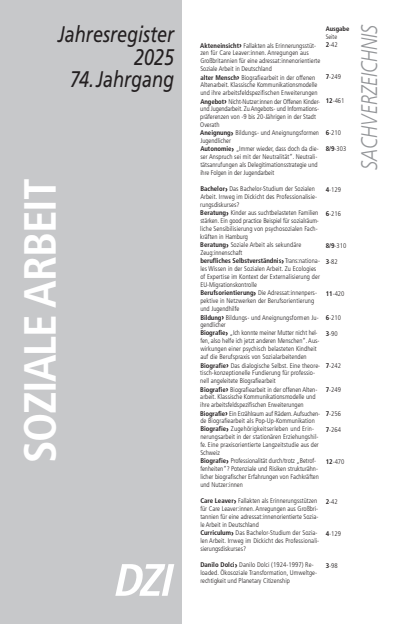
Soziale Arbeit, founded in 1951, is an independent academic journal which addresses developments in the context of social work. It is one of the most important publication media in its field and is read by teachers, students and researchers in social work and social pedagogy as well as by professionals and managers from associations and institutions. The journal’s aim is to promote professional development in social work fields by presenting methods and new concepts, in addition to subject-specific practical reports. In the ‘Rundschau’ (Review) section, information from all social fields is compiled. The ‘Tagungskalender’ (Conference Calendar) refers to important events, and the ‘Zeitschriftenbibliographie’ (Bibliography of Journals) lists current articles from professional journals. Soziale Arbeit is published 11 times a year with an annual focus issue published as a double issue. All scholarly articles submitted for publication in the journal undergo a double-blind peer review process. The editorial board is supported in an advisory capacity by a professional advisory board consisting of individuals from associations, universities, politics and administrative bodies. The journal cooperates with the academic societies of social work from Germany (DGSA) and Austria (OGSA). All social work contributions are indexed in the literature database DZI SoLit.
Against the backdrop of global ecological crises, there are also numerous contributions to the discussion in social work that take a stand on the necessary socio-ecological transformation of societies. Post-anthropocentric positions are theoretical...
Services in the field of Early Childhood Intervention should be made accessible to as many (expectant) parents as possible in a preventive and supportive manner. The use of technical means plays a rather subordinate role in this context, despite the...
Social work has developed into an important, independent actor in addiction counselling. Its contribution in the field of addiction counselling can be described in terms of action theory with the help of an anchor effect model. This can be used to...
What is the added value of student mobility in social work degree programs? We investigated this question in the Erasmus network Social Work and used a literature-based empirical study to ask former students from several countries about their...