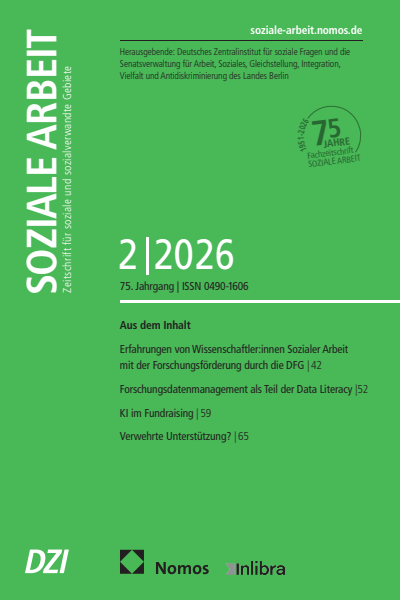
Soziale Arbeit, founded in 1951, is an independent academic journal which addresses developments in the context of social work. It is one of the most important publication media in its field and is read by teachers, students and researchers in social work and social pedagogy as well as by professionals and managers from associations and institutions. The journal’s aim is to promote professional development in social work fields by presenting methods and new concepts, in addition to subject-specific practical reports. In the ‘Rundschau’ (Review) section, information from all social fields is compiled. The ‘Tagungskalender’ (Conference Calendar) refers to important events, and the ‘Zeitschriftenbibliographie’ (Bibliography of Journals) lists current articles from professional journals. Soziale Arbeit is published 11 times a year with an annual focus issue published as a double issue. All scholarly articles submitted for publication in the journal undergo a double-blind peer review process. The editorial board is supported in an advisory capacity by a professional advisory board consisting of individuals from associations, universities, politics and administrative bodies. The journal cooperates with the academic societies of social work from Germany (DGSA) and Austria (OGSA). All social work contributions are indexed in the literature database DZI SoLit.
Against the backdrop of low approval rates, we examine the experiences of social work researchers with grant applications to the German Research Foundation. The survey results show that researchers face various disadvantages, with poor...
Research Data Management (RDM) refers to the systematic planning, collection, documentation, protection, storage, and publication of research data. Given the growing volume and complexity of this data, not only is effective RDM of central...
AI fundamentally changes fundraising: processes become efficient, targeting precise. Yet, predictive and generative AI bring risks like trust loss and information overload. Tech optimization isn’t enough. To stay competitive, organizations must...
Social service professionals can ease the financial burdens of benefit recipients by mediating access to welfare resources from both the state and civil society. However, the practices of professionals are characterized by marked differences. Within...