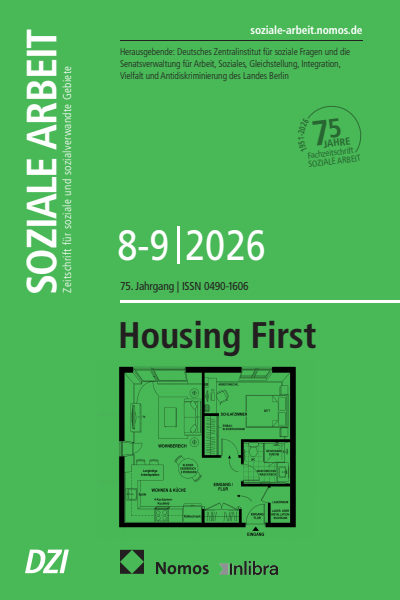
Soziale Arbeit, founded in 1951, is an independent academic journal which addresses developments in the context of social work. It is one of the most important publication media in its field and is read by teachers, students and researchers in social work and social pedagogy as well as by professionals and managers from associations and institutions. The journal’s aim is to promote professional development in social work fields by presenting methods and new concepts, in addition to subject-specific practical reports. In the ‘Rundschau’ (Review) section, information from all social fields is compiled. The ‘Tagungskalender’ (Conference Calendar) refers to important events, and the ‘Zeitschriftenbibliographie’ (Bibliography of Journals) lists current articles from professional journals. Soziale Arbeit is published 11 times a year with an annual focus issue published as a double issue. All scholarly articles submitted for publication in the journal undergo a double-blind peer review process. The editorial board is supported in an advisory capacity by a professional advisory board consisting of individuals from associations, universities, politics and administrative bodies. The journal cooperates with the academic societies of social work from Germany (DGSA) and Austria (OGSA). All social work contributions are indexed in the literature database DZI SoLit.
The journal Soziale Arbeit will celebrate its 75th anniversary in 2026. On this occasion, the editorial team takes the opportunity to examine the organization of scientific information infrastructure, which includes scholarly journals. The article...
The article explores the ambivalent role of visibility in social work, particularly in the context of right-wing, racist, and anti-Semitic violence. Visibility is understood as a political practice that can facilitate recognition and participation....
The paper provides a systematic overview of empowerment and power-sharing concepts in civic education and social work. Empowerment and power-sharing are regarded as key factors in enhancing educational opportunities and reducing barriers within the...
This article examines the use of generative artificial intelligence in report writing in social work, exploring the tension between efficiency and knowledge generation. It shows how large language models (LLMs) can support writing processes while...