, to see if you have full access to this publication.
Edited Book No access
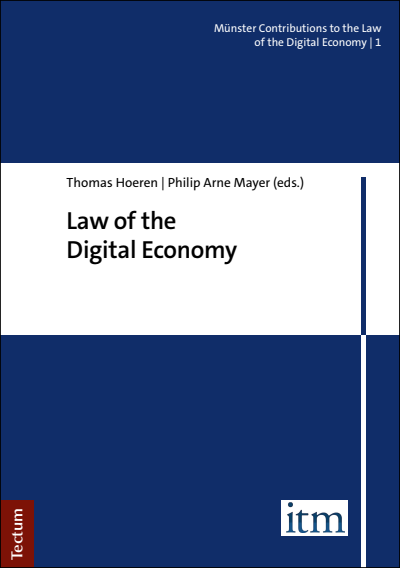
Law of the Digital Economy
- Editors:
- |
- Series:
- Münster Contributions to the Law of the Digital Economy, Volume 1
- Publisher:
- 2026
Summary
Anyone navigating digital law in practice is quickly confronted with a jungle of European legislative acts that frequently overlap and interact in complex ways. The contributions in this series take on specific questions of European data economy law, helping to clear a path through this thicket. They are aimed at legal practitioners seeking orientation in the European digital and data regulatory landscape, while at the same time contributing to the scholarly systematisation of this still emerging field of law.
Search publication
Bibliographic data
- Edition
- 1/2026
- Copyright Year
- 2026
- ISBN-Print
- 978-3-68900-590-0
- ISBN-Online
- 978-3-68900-591-7
- Publisher
- Tectum, Baden-Baden
- Series
- Münster Contributions to the Law of the Digital Economy
- Volume
- 1
- Language
- English
- Pages
- 154
- Product Type
- Edited Book
Table of contents
ChapterPages
- Preface No access
- Authors:
- A. Introduction No access
- I. Features of Digital Markets and Their Impact on Competition No access
- II. Limitations of Traditional Antitrust Approach in Digital Economy No access
- 1. Transition from Ex-post to Ex-ante Regulation No access
- 2. Concept of “Gatekeepers” and Asymmetric Regulation No access
- 1. Main Categories of Obligations for “Gatekeepers” No access
- 2. Sanctions System and Enforcement Mechanisms No access
- 1. Experience of Apple, Google and Meta No access
- 2. European Commission Response and Open Investigations No access
- 1. Differences in Legal Approaches and Institutional Mechanisms No access
- 2. Features of Enforcement Practice No access
- 1. Extraterritorial Impact of European Regulation No access
- 2. Spread of European Model in Other Jurisdictions No access
- 1. Antitrust Legislation and Digital Markets No access
- 2. Sectoral Regulation of Digital Services No access
- 1. Development of E-commerce and Digital Platforms No access
- 2. Need for Modernizing Regulatory Approaches No access
- 1. Creating Concept of “Significant Digital Platforms” No access
- 2. Introduction of Ex-ante Obligations for Large Platforms No access
- 1. Creating Specialized Digital Markets Regulator No access
- 2. Development of Expert Competencies and International Cooperation No access
- 1. Balancing Between Regulation and Innovation Stimulation No access
- 2. Phased Implementation Considering Digital Market Development Level No access
- I. Short-term Measures No access
- II. Medium-term Strategy No access
- III. Long-term Development Vision No access
- H. Conclusion No access
- Bibliography No access
- Authors:
- A. Introduction No access
- I. DSA Objectives: From Platform Liability to Systemic Accountability No access
- II. The Centrality of Recommender Systems in the Digital Ecosystem No access
- III. Legal Provisions Governing Recommender Systems No access
- IV. General-Purpose AI Models as a Regulatory Challenge No access
- 1. Defining “Recommender System” No access
- 2. Interpreting Key Terms in Article 27 No access
- 3. Practical Ambiguities and Implementation Gaps No access
- 1. GDPR No access
- 2. AI Act No access
- 3. Charter of Fundamental Rights of the EU No access
- III. Teleological Interpretation: Democratic Values and User Autonomy No access
- IV. Historical Interpretation: From Liability to Accountability No access
- 1. Inputs No access
- 2. Outputs No access
- 3. Feedback Loop No access
- II. Designing for Transparency: Legal Requirements in Practice No access
- I. From Open Ambitions to Practical Enforcement No access
- II. From Plain Language to Participatory Explanation No access
- III. Strengthening Public Oversight and Content Transparency No access
- IV. Building Capacity: A Media-Literacy Fund to Support Article 27 Rights No access
- Bibliography No access
- Authors:
- A. Introduction No access
- B. EU Copyright Framework No access
- C. Challenges Under Current EU Copyright Law No access
- D. EU Case Law and the AI Authorship Dilemma No access
- E. Recognizing AI as a Creative Agent No access
- F. Conclusion No access
- Bibliography No access
- Authors:
- A. Introduction No access
- I. The relationship between the right to erasure and the “right to be forgotten” No access
- 1. Art. 17 (1) (a) No access
- 2. Art. 17 (1) (b) No access
- 3. Art. 17 (1) (c) No access
- 4. Art. 17 (1) (d) No access
- 5. Art. 17 (1) (e) No access
- 6. Art. 17 (1) (f) No access
- III. Duty to provide information on published data in accordance with Art. 17 (2) No access
- 1. Art. 17 (3) (a) No access
- 2. Art. 17 (3) (b) No access
- 3. Art. 17 (3) (b) first alternative No access
- 4. Art. 17 (3) (b) second alternative No access
- 5. Art. 17 (3) (c) No access
- 6. Art. 17 (3) (d) No access
- 7. Art. 17 (3) (e) No access
- V. Art. 17 in comparison to the previous version of the Federal Data Protection Act (Bundesdatenschutzgesetz, BDSG) No access
- VI. Other exceptions No access
- VII. The right to erasure in connection with other data protection rights No access
- 1. The landmark decision in Google Spain (C-131/12) No access
- 2. ‘Google/CNIL’ (C-507/17) – Limitation of territorial scope No access
- 3. Significance of the two rulings No access
- C. The tension between Art. 17 and freedom of information and expression No access
- I. The Max Mosley case No access
- II. Critical assessment No access
- I. Problem areas in current practice No access
- II. Proposed solutions No access
- F. Conclusion No access
- Bibliography No access
- Authors:
- A. Introduction No access
- B. Data Localization No access
- C. The TikTok Challenge No access
- D. LinkedIn’s ban in Russia No access
- E. Impacts No access
- F. Summary No access
- Bibliography No access
- Authors:
- A. Introduction No access
- B. Theoretical Framework of Human-Centered AI Governance No access
- I. The AI Act as Regulatory Framework No access
- II. Implementation Experience and Challenges No access
- I. OECD and Council of Europe Initiatives No access
- II. Global Governance Developments No access
- I. Current Legal Framework and Strategy No access
- II. Institutional Gaps and Challenges No access
- I. Convergence and Divergence in Approaches No access
- II. Towards Human-Centered Framework for Uzbekistan No access
- G. Implementation Strategy and Recommendations No access
- H. Conclusion No access
- Bibliography No access
- Authors:
- I. Scope and Objectives of the Study No access
- II. General Thesis and Actuality No access
- III. Research Methodology No access
- I. Designation or Appointment No access
- 1. Monitoring Legal Compliance and Data Processing No access
- 2. Cooperation with the Supervisory Authority No access
- 3. Consultative Competencies No access
- 4. Other Contractual Functions No access
- III. Ethical Considerations and Core Principles No access
- I. Prohibition of the Conflict of Interest No access
- II. Violation of the Core Principles No access
- III. Dismissal No access
- D. Conclusion No access
- Bibliography No access
- Authors:
- A. Introduction No access
- I. Consent and Terminal Device Access: ePrivacy Directive No access
- 1. The Limits of Legitimate Interests under Article 6(1)(f) GDPR No access
- 2. Contractual Necessity under Article 6(1)(b) GDPR No access
- 3. Synthesis: Consent as the Legal Basis for Targeted Advertising under the GDPR No access
- III. Profiling: Art 22 GDPR No access
- IV. Interim Conclusion No access
- I. Power Imbalance in the GDPR: Recitals 42 and 43 No access
- II. Meta Platforms v. Bundeskartellamt: Market Power and Freely Given Consent No access
- III. Interaction between DMA and GDPR: Dual Thresholds for Consent No access
- IV. EDPB Opinion on VLOPs: Pay-or-Consent and Platform Dependency No access
- V. Interim Conclusion No access
- D. Pay-or-Consent Models: Economic Reality and Conclusion No access
- Bibliography No access