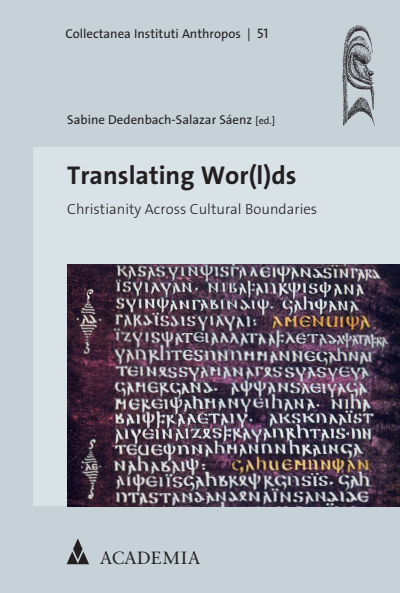
Translating Wor(l)ds
Christianity Across Cultural Boundaries- Editors:
- Series:
- Collectanea Instituti Anthropos, Volume 51
- Publisher:
- 2019
Summary
This book addresses the translation of culture in the context of religion. The contributions, which analyse texts in literary, ethnohistorical and/or linguistic terms, show how different cultural traditions and languages are communicated across boundaries. They include studies of the missionary context of the Early Middle Ages and of colonially dominated cultures in Latin America, India, China, Africa and Australia, from the 16th to the early 20th century; and they analyse literary works with respect to how they transmit and translate culture: one a Christian play in the context of Islam, the other one a novel of the Haitian diaspora in the USA; another contribution presents the challenges of how the concept of religion itself is conveyed in contemporary scholarly contexts. By using different methodological tools, the authors show the manifold and innovative ways in which this field of the translation of culture can be approached. With contributions byGwilym Colenso, Fiona Darroch, Sabine Dedenbach-Salazar Sáenz, Pär Eliasson, Sarah Irving, Alison Jasper, David Moore, Brian Murdoch, Richard H. Roberts, Frauke Sachse, Roxana Sarion.
Search publication
Bibliographic data
- Edition
- 1/2019
- Copyright Year
- 2019
- ISBN-Print
- 978-3-89665-794-7
- ISBN-Online
- 978-3-89665-795-4
- Publisher
- Academia, Baden-Baden
- Series
- Collectanea Instituti Anthropos
- Volume
- 51
- Language
- English
- Pages
- 333
- Product Type
- Edited Book
Table of contents
- Titelei/Inhaltsverzeichnis No access Pages 1 - 6
- 1 Presentation No access Pages 7 - 8
- 2.1 Translating God No access
- 2.2 Systems of knowledge No access
- 2.3 Empowerment No access
- 3.1 Religious experience re-created in fiction: empowering the author and the reader No access
- 3.2 Conscientisation No access
- References No access Pages 23 - 28
- Authors:
- Abstract No accessAuthors:
- 1 Introduction No accessAuthors:
- 2 The Goths and Wulfila’s Bible translation No accessAuthors:
- 3 Old High German No accessAuthors:
- 4 Conclusion No accessAuthors:
- References No accessAuthors:
- The Author No accessAuthors:
- Authors:
- Abstract No accessAuthors:
- 1 Introduction No accessAuthors:
- 2 The multivocalities of translation No accessAuthors:
- 3 Naming God No accessAuthors:
- 4 The Trinity No accessAuthors:
- 5 Conclusions No accessAuthors:
- References No accessAuthors:
- The Author No accessAuthors:
- Authors:
- Abstract No accessAuthors:
- 1 Introduction No accessAuthors:
- 2 Cristanchi Sastrazza Cathexismo in context No accessAuthors:
- Authors:
- 3.1 ʻTrue God’ and ʻtrue man’ No accessAuthors:
- 3.2 One person with two natures No accessAuthors:
- 3.3 Jesus Christ in the Eucharist No accessAuthors:
- 3.4 Jesus Christ in the Holy Trinity No accessAuthors:
- 4 Conclusions No accessAuthors:
- References No accessAuthors:
- The Author No accessAuthors:
- Authors:
- Abstract No accessAuthors:
- 1 Introduction No accessAuthors:
- 2 Maurician theology No accessAuthors:
- 3 Bishop Colenso’s adoption of uNkulunkulu as the Zulu God-name No accessAuthors:
- 4 Objections to uNkulunkulu – the Natal press and local missionaries No accessAuthors:
- 5 Objections to uNkulunkulu by Rev. Henry Callaway No accessAuthors:
- 6 The debate on uNkulunkulu continues into the twentieth century No accessAuthors:
- 7 Conclusion No accessAuthors:
- References No accessAuthors:
- The Author No accessAuthors:
- Authors:
- Abstract No accessAuthors:
- 1 Introduction No accessAuthors:
- 2 Beginnings: the Hermannsburg Mission No accessAuthors:
- Authors:
- 3.1 Pepa No accessAuthors:
- 3.2 ‘Sacred’ No accessAuthors:
- Authors:
- 4.1 Abstract nouns and nominalisations No accessAuthors:
- 4.2 The conversion of sacred terms No accessAuthors:
- 4.3 Sacred places No accessAuthors:
- Authors:
- 5.1 Collocations No accessAuthors:
- 5.2 Definitions and their limitations No accessAuthors:
- 5.3 Syntactic and semantic shift No accessAuthors:
- 5.4 Theological correctness No accessAuthors:
- 5.5 Missionary views No accessAuthors:
- 5.6 Aranda as a basis for other translations No accessAuthors:
- Authors:
- 6.1 The Luritja translation No accessAuthors:
- 6.2 The wanderings of tjukurrpa No accessAuthors:
- 7 Conclusion No accessAuthors:
- Glossary of linguistic abbreviations No accessAuthors:
- References No accessAuthors:
- The Author No accessAuthors:
- Authors:
- Abstract No accessAuthors:
- 1 Introduction No accessAuthors:
- 2 Diego González Holguín and his lexicographical work No accessAuthors:
- 3 The sacraments No accessAuthors:
- 4 Holy Communion No accessAuthors:
- 5 Extreme Unction No accessAuthors:
- 6 Conclusion No accessAuthors:
- References No accessAuthors:
- The Author No accessAuthors:
- Authors:
- Abstract No accessAuthors:
- 1 Matías Ruiz Blanco: his life and work No accessAuthors:
- Authors:
- 2.1 First attempts to evangelise the eastern coast of Venezuela No accessAuthors:
- 2.2 The Franciscan ‘reductions’ in the Province of Píritu No accessAuthors:
- 2.3 Translation methods No accessAuthors:
- 3 Ruiz Blancoʼs ʻdemonisationʼ of Carib narratives No accessAuthors:
- 4 Ruiz Blanco’s translation of the Doctrina No accessAuthors:
- 5 Conclusion No accessAuthors:
- References No accessAuthors:
- The Author No accessAuthors:
- Authors:
- Abstract No accessAuthors:
- 1 Introduction No accessAuthors:
- 2 Lucy (Farrar) Soothill (1857–1931) No accessAuthors:
- 3 Eleanor Harrison (1872–1930) No accessAuthors:
- 4 Mildred Cable (and the French sisters) (1878–1972) No accessAuthors:
- 5 Annie (Sharpe) Torrance (1883–1980) No accessAuthors:
- 6 Jessie Douglas (Cuthbert) Emslie (?–1973) No accessAuthors:
- 7 Conclusion No accessAuthors:
- References No accessAuthors:
- The Author No accessAuthors:
- Authors:
- Abstract No accessAuthors:
- 1 Introduction No accessAuthors:
- 2 Nathan der Weise No accessAuthors:
- 3 Elias Haddad and the Palestinian context No accessAuthors:
- 4 The translation: Nathan al-Hakim No accessAuthors:
- 5 Haddadʼs paratextual materials to Nathan al-Hakim No accessAuthors:
- 6 Translation and power No accessAuthors:
- 7 Awareness and reception of Haddadʼs translation No accessAuthors:
- 8 Conclusion No accessAuthors:
- References No accessAuthors:
- The Author No accessAuthors:
- Authors:
- Abstract No accessAuthors:
- 1 Introduction No accessAuthors:
- 2 A history of Haiti and locating the term ‘religion’ No accessAuthors:
- 3 Flight and Transcendence in “A Wall of Fire Rising” No accessAuthors:
- 4 “Ou libéré?” Sexual exploitation and possibilities of freedom: following the flight of Erzulie in Breath, Eyes, Memory No accessAuthors:
- 5 Conclusion No accessAuthors:
- References No accessAuthors:
- The Author No accessAuthors:
- Authors:
- Abstract No accessAuthors:
- 1 Introduction No accessAuthors:
- 2 The project of Religious Studies and its aporia No accessAuthors:
- 3 The wider context of knowledge production and reception No accessAuthors:
- 4 Theology, religious studies and the struggle for identity No accessAuthors:
- 5 Contemporary debate: “Theory in a Time of Excess” No accessAuthors:
- 6 Historical background: the ‘enlightened’ curriculum and the differentiation of the ‘human sciences’ No accessAuthors:
- 7 The quest for theory in a contested field No accessAuthors:
- 8 The secularisation paradigm and the quest for a unified field theory No accessAuthors:
- 9 An alternative approach? No accessAuthors:
- 10 Conclusion No accessAuthors:
- References No accessAuthors:
- The Author No accessAuthors: