, to see if you have full access to this publication.
Edited Book No access
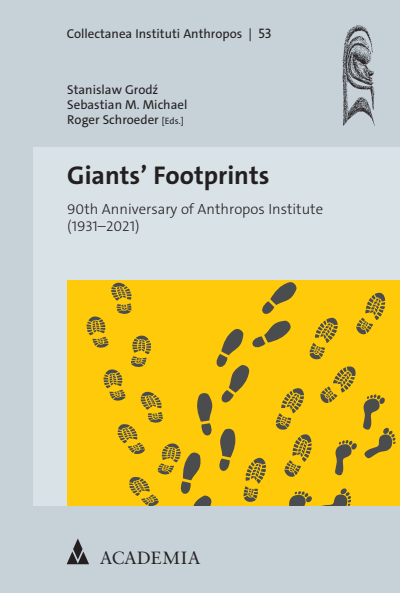
Giants’ Footprints
90th Anniversary of Anthropos Institute (1931–2021)- Editors:
- | |
- Series:
- Collectanea Instituti Anthropos, Volume 53
- Publisher:
- 2021
Summary
The volume contains the past and present story of Anthropos Institute, which grew around the journal Anthropos and its founder Wilhelm Schmidt. The book is divided into three sections. The first outlines the history of the Institute, presents the early co-workers of Schmidt, gives an insider’s perspective on the development of the journal and opens a new look at Schmidt’s leading concept. Section two introduces various local outreach efforts of the Institute in Japan, India, Brazil, Ghana and Papua New Guinea. Finally, some members present their current work. The collection is complemented by an outsider’s assessment of the Institute’s engagement. The Appendix includes a list of all the members of the Institute.
Keywords
Search publication
Bibliographic data
- Edition
- 1/2021
- Copyright Year
- 2021
- ISBN-Print
- 978-3-98572-014-9
- ISBN-Online
- 978-3-98572-015-6
- Publisher
- Academia, Baden-Baden
- Series
- Collectanea Instituti Anthropos
- Volume
- 53
- Language
- English
- Pages
- 358
- Product Type
- Edited Book
Table of contents
ChapterPages
- Titelei/Inhaltsverzeichnis No access Pages 1 - 8
- Authors: |
- Bibliography No accessAuthors: |
- Authors:
- 1 Chronological framework of the AI history No accessAuthors:
- 2 Relationship to the SVD No accessAuthors:
- 3 The staff – the AI members and their lay collaborators No accessAuthors:
- 4 Relevance of the AI for the SVD No accessAuthors:
- 5 Conclusion No accessAuthors:
- Bibliography No accessAuthors:
- Authors:
- Authors:
- 1.1 Curriculum vitae No accessAuthors:
- 1.2 Work at Anthropos No accessAuthors:
- 1.3 Teaching No accessAuthors:
- 1.4 Organizational activity No accessAuthors:
- Authors:
- 1.5.1 The cultural-historical method No accessAuthors:
- 1.5.2 Economy, family, and state No accessAuthors:
- 1.5.3 The original monotheism No accessAuthors:
- 1.5.4 The origin of China No accessAuthors:
- 1.5.5 History of the Indo-Europeans No accessAuthors:
- 1.5.6 The people of Tierra del Fuego No accessAuthors:
- 1.5.7 The Bhil in Central India No accessAuthors:
- 1.6 Conclusion No accessAuthors:
- Authors:
- 2.1 Curriculum vitae No accessAuthors:
- 2.2 Research trips No accessAuthors:
- 2.3 Conclusion No accessAuthors:
- Authors:
- 3.1 Curriculum vitae No accessAuthors:
- 3.2 Research trips No accessAuthors:
- Authors:
- 4.1 Curriculum vitae No accessAuthors:
- 4.2 Additional activities No accessAuthors:
- Authors:
- 5.1 Curriculum vitae No accessAuthors:
- 5.2 Ethnological interests No accessAuthors:
- Authors:
- 6.1 Curriculum vitae No accessAuthors:
- 6.2 Academic activity No accessAuthors:
- Bibliography No accessAuthors:
- Authors:
- 1 Introduction No accessAuthors:
- 2 “In the Beginning...” (or... in the “Lost Paradise”). Anthropos as a journal for (and by) missionaries (1906–1920) No accessAuthors:
- 3 Standing up to challenges (1921–1949) No accessAuthors:
- 4 Continuation years (1950–1969) No accessAuthors:
- 5 In the strange new world of postmodern “(dis)order” (1970–1999) No accessAuthors:
- 6 Into the new millennium (2000–2020) No accessAuthors:
- 7 Conclusion No accessAuthors:
- Bibliography No accessAuthors:
- Authors:
- 1 Method: between reduction and induction No accessAuthors:
- 2 Monotheism, “original monotheism” and Urkultur No accessAuthors:
- Authors:
- 3.1 Gift exchange No accessAuthors:
- 3.2 Concentric order No accessAuthors:
- 3.3 The non-Cartesian world orientation No accessAuthors:
- 4 Monotheism, transcendence and sin No accessAuthors:
- 5 Religion: a comprehensive term? No accessAuthors:
- Bibliography No accessAuthors:
- Authors:
- 1 The Ishikawa Archeological Institute and Museum No accessAuthors:
- 2 Research Institute for Anthropology and Ethnology – Nanzan University No accessAuthors:
- 3 Numazawa Kiichi No accessAuthors:
- 4 Fieldwork in Papua New Guinea No accessAuthors:
- 5 Nanzan Anthropological Museum No accessAuthors:
- 6 Asian Folklore Studies/Asian Ethnology No accessAuthors:
- 7 Recent developments No accessAuthors:
- 8 Conclusion No accessAuthors:
- Bibliography No accessAuthors:
- Authors: |
- 1 The Institute of Indian Culture No accessAuthors: |
- Authors: |
- 2.1 Ethnography – the basis of applied anthropology No accessAuthors: |
- 2.2 At the bottom of society – writings on marginalised and rebellious people No accessAuthors: |
- 3 Notable research contributions by other members of the Institute No accessAuthors: |
- 4 Branch institutes in India No accessAuthors: |
- 5 Conclusion No accessAuthors: |
- Bibliography No accessAuthors: |
- Authors:
- 1 Prehistory No accessAuthors:
- 2 The Institute No accessAuthors:
- 3 The Missionary Indian Council No accessAuthors:
- 4 The ideological conflict No accessAuthors:
- 5 Attempt at reorientation No accessAuthors:
- 6 Reactivation No accessAuthors:
- Bibliography No accessAuthors:
- Authors:
- 1 Historical background of the Anthropos Tradition No accessAuthors:
- 2 The founding generation No accessAuthors:
- 3 Research and publication No accessAuthors:
- 4 Internal development linked to our partners No accessAuthors:
- 5 External development No accessAuthors:
- 6 Development of programs No accessAuthors:
- 7 Past directors No accessAuthors:
- 8 Current director and staff No accessAuthors:
- 9 Concluding remarks and the future No accessAuthors:
- Authors:
- 1 Introduction No accessAuthors:
- 2 Anthropos Tradition No accessAuthors:
- 3 Origins of the Melanesian Institute No accessAuthors:
- 4 Promoting social science and mission No accessAuthors:
- 5 Strategic turns and directions No accessAuthors:
- 6 The Anthropos Tradition in a changing world No accessAuthors:
- Bibliography No accessAuthors:
- Authors:
- 1 Founding tradition of Anthropos Institute No accessAuthors:
- Authors:
- 2.1 Social sciences No accessAuthors:
- 2.2 Theology and missiology No accessAuthors:
- Authors:
- 3.1 Anthropos Tradition No accessAuthors:
- 3.2 Arnoldus family and interculturality No accessAuthors:
- 4 Anthropos Institute International and interculturality No accessAuthors:
- Bibliography No accessAuthors:
- Authors: |
- 1 Anthropology and the Society of the Divine Word No accessAuthors: |
- 2 Defining Medical Anthropology No accessAuthors: |
- 3 Medical Anthropology and the Anthropos Institute No accessAuthors: |
- 4 Religion, health, and wellbeing among the Karenni in Omaha No accessAuthors: |
- 5 Conclusions No accessAuthors: |
- Bibliography No accessAuthors: |
- Authors:
- 1 Setting for research in early music No accessAuthors:
- 2 Music, evangelization of the gentiles and extant written testimonies from the Spanish towns and from the missions No accessAuthors:
- 3 The most important findings and scientific achievements No accessAuthors:
- Select Works by the Author No accessAuthors:
- Authors:
- 1 Kalamkari iconography No accessAuthors:
- 2 Salvation through Krishna No accessAuthors:
- 3 Salvation through Jesus Christ No accessAuthors:
- 4 Kalamkari art and religious dialogue/communication No accessAuthors:
- Bibliography No accessAuthors:
- Authors:
- 1 Introductory background No accessAuthors:
- 2 Subjects and methods No accessAuthors:
- 3 Findings and discussion No accessAuthors:
- 4 Conclusion No accessAuthors:
- Bibliography No accessAuthors:
- Authors:
- 1 Introduction No accessAuthors:
- 2 Background No accessAuthors:
- 3 Research sites and sample subjects No accessAuthors:
- 4 Methods No accessAuthors:
- Authors:
- 5.1 Religious expression of Kakure Kirishitan practitioners today No accessAuthors:
- 5.2 Interactive influence between Kakure Kirishitan constructs No accessAuthors:
- 5.3 Urban religious festivals No accessAuthors:
- 6 Conclusion No accessAuthors:
- Bibliography No accessAuthors:
- Authors:
- 1 Terrain as a laboratory No accessAuthors:
- 2 Research in the city No accessAuthors:
- 3 Change of perspective No accessAuthors:
- Bibliography No accessAuthors:
- Authors:
- 1 Introduction No accessAuthors:
- 2 The setting: what is in a land No accessAuthors:
- Authors:
- 3.1 Gate keepers and navigating the policy of entry No accessAuthors:
- 3.2 Being consistent with personal identity and intention No accessAuthors:
- 3.3 Confronting challenges from a fieldwork methodology No accessAuthors:
- 3.4 Responding with culturally appropriate behaviour No accessAuthors:
- 3.5 Paying attention to the power of rumour No accessAuthors:
- 3.6 Cost of living among the people and sharing in their life No accessAuthors:
- Authors:
- 4.1 Paying attention to psychological harm to participants No accessAuthors:
- 4.2 Sharing results with the community No accessAuthors:
- 5 Concluding remarks No accessAuthors:
- Bibliography No accessAuthors:
- Authors:
- 1 Introduction No accessAuthors:
- 2 The Anthropos Institute No accessAuthors:
- 3 The Melanesian Institute No accessAuthors:
- 4 Anthropos journal No accessAuthors:
- 5 The world and mission No accessAuthors:
- 6 The future No accessAuthors:
- Bibliograpy No accessAuthors:
- Authors:
- Bibliography No accessAuthors:
- The AI membership No access
- Members of the Anthropos Institute No access Pages 329 - 346
- The members’ list in alphabetical order No access Pages 347 - 348
- Editors-in-Chief of Anthropos (1906–2020) No access Pages 349 - 354
- Directors of the Anthropos Institute (1931–2001) and Coordinators of Anthropos Institute International with their Councillors (2001–2021) No access Pages 355 - 358