, to see if you have full access to this publication.
Edited Book No access

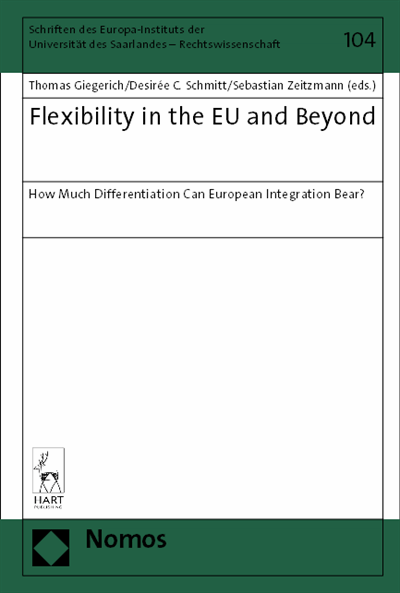
Flexibility in the EU and Beyond

How Much Differentiation Can European Integration Bear?
Editors:
Publisher:
 2017

Summary

The EU is going through a difficult phase: The euro and refugee crises are still unresolved, the solidarity between Member States is eroding, the UK stands on the brink of an exit, nationalist forces are gaining increasing support in many Member States, the support for European integration is diminishing and EU foreign policy is focused on combating crises.

The union appears too heterogeneous and the economic and political interests of the 28 Member States too diverse to be able to tackle these challenges as a whole. Does the concept of differentiated integration offer a possible solution? Can such differentiation offer the European integration project a better and more stable future? Which measures of diversity and flexibility can the “ever closer Union among the peoples of Europe” endure? Or will such differentiation ultimately damage the joint European project?

These questions and others were the focus of an international and interdisciplinary conference at the European Academy of Otzenhausen in April 2016 that was organized by Univ.-Prof. Dr. Thomas Giegerich. The results of this conference are contained in this volume.


Bibliographic data

Edition
1/2017
Copyright Year
2017
ISBN-Print
978-3-8487-3436-8
ISBN-Online
978-3-8452-7771-4
Publisher
Nomos, Baden-Baden
Series
Schriften des Europa-Instituts der Universität des Saarlandes - Rechtswissenschaft
Volume
104
Language
English
Pages
495
Product Type
Edited Book

Table of contents

ChapterPages
  1. Titelei/Inhaltsverzeichnis No access Pages 1 - 10
  2. List of Abbreviations No access Pages 11 - 14
    1. How to Reconcile the Forces of Enlargement and Consolidation in “an Ever Closer Union” No access Pages 15 - 58
      Authors:
    2. The Development of Flexible Integration in EC/EU Practice No access Pages 59 - 86
      Authors:
    3. A Rather Strange Animal, this “Enhanced Cooperation” – May it Serve as King of the European Zoonion? or: Is Enhanced Cooperation Anywhere Near a Constitutional Principle? No access Pages 87 - 106
      Authors:
    1. Comparing Opt-Outs: How Different is Differentiated Integration No access Pages 107 - 122
      Authors:
    2. Elements of Differentiation Within the Schengen Acquis and the Prüm Convention No access Pages 123 - 138
      Authors:
    3. The Common Foreign and Security Policy – A Pool of Flexibility Models No access Pages 139 - 160
      Authors:
    4. How Independence Movements Trigger Flexibility in the EU No access Pages 161 - 182
      Authors:
    5. Deepened Integration in the Eurozone? No access Pages 183 - 194
      Authors:
    6. The Treaty on Stability, Coordination and Governance and the ESM Treaty: Intergovernmental Arrangements Outside EU Law, but for the Benefit of the EMU? No access Pages 195 - 224
      Authors:
    7. How Much Flexibility Can European Integration Bear in Order to Face the Eurozone Crisis? Reflections on the EMU inter se International Agreements Between EU Member States No access Pages 225 - 250
      Authors:
    8. Rome III Regulation: Getting Divorced in Europe No access Pages 251 - 268
      Authors:
    9. The End to a Never-Ending Story? The Unitary Patent Regime No access Pages 269 - 282
      Authors:
    1. The Trials and Tribulations of the Benelux No access Pages 283 - 296
      Authors:
    2. The Swiss Way: 120 Agreements but no Perspective? No access Pages 297 - 314
      Authors:
    3. Differentiation and EU Neighbourhood Policy: A Need for Change? No access Pages 315 - 336
      Authors:
    4. An American Perspective on EU Flexibility and Differentiation No access Pages 337 - 348
      Authors:
    5. The Perception of Flexible Integration in Southeast Asia No access Pages 349 - 360
      Authors:
    6. What Does the German Basic Law Say on Flexible Integration? No access Pages 361 - 380
      Authors:
    7. Outside, but not that far: Strasbourg’s Perspective – The European Union and the Council of Europe No access Pages 381 - 406
      Authors:
    8. How Flexible Is the World Order? What We Can Learn from the United Nations No access Pages 407 - 430
      Authors:
    9. Variable Geometry in WTO Law and Policy: Lessons for the European Union No access Pages 431 - 448
      Authors:
    1. Within and Without “Ever Closer Union” No access Pages 449 - 460
      Authors:
    2. The Limits of Differentiated Integration in the EU and the Way Forward No access Pages 461 - 478
      Authors:
    3. Making a New Start on a Smaller European Basis: An Alternative to Differentiation No access Pages 479 - 492
      Authors:
  3. List of Authors and Editors No access Pages 493 - 495

Similar publications

from the series "Schriften des Europa-Instituts der Universität des Saarlandes - Rechtswissenschaft"