Monograph Open Access Full access
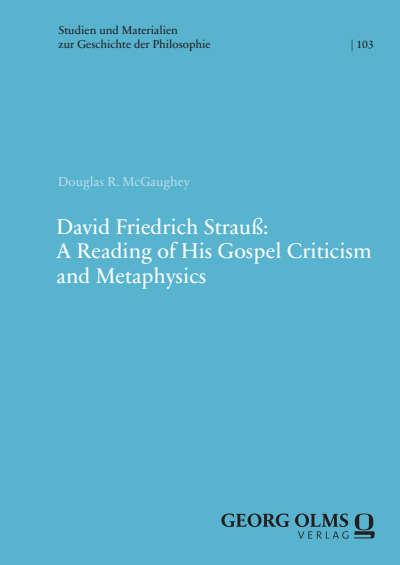
David Friedrich Strauß: A Reading of His Gospel Criticism and Metaphysics
Volume 1 + 2- Authors:
- Series:
- Studien und Materialien zur Geschichte der Philosophie, Volume 103
- Publisher:
- 2025
Summary
Shortly after the 150th anniversary of David Friedrich Strauß‘ death and the 300th anniversary of Kant’s birth, this study makes a close reading of their work and distorted reception down to this day. Strauß’ Life of Jesus (1835) led to political revolution in Zurich in 1839 and exclusion from the classroom. Although Strauß’ rejection of Hegel’s ‘science’ of Absolute Idealism occurred by 1838, it did not bring with it a re-examination of the anti-Kantian sentiment among his mentors (Hegel, Schleiermacher, F.C. Baur, etc.). The result was eclipsing Kant’s option to reductionist materialism that embraces ‘faith’ and ‘feeling’ at the core of all order, rational and moral, as the motor of creative, responsible (communal) agency in the world.
Keywords
Search publication
Bibliographic data
- Edition
- 1/2025
- Copyright Year
- 2025
- ISBN-Print
- 978-3-487-16690-2
- ISBN-Online
- 978-3-487-42449-1
- Publisher
- Georg Olms Verlag, Baden-Baden
- Series
- Studien und Materialien zur Geschichte der Philosophie
- Volume
- 103
- Language
- English
- Pages
- 1072
- Product Type
- Monograph
Table of contents
ChapterPages
- Titelei/InhaltsverzeichnisPages 1 - 18 Download chapter (PDF)
- Foreword: A Con-figured NarrativePages 19 - 32 Download chapter (PDF)
- PrefacePages 33 - 68 Download chapter (PDF)
- History or Falsehood?
- Two Aspects to Myth: ‘Husks‘ and ‘Kernels’ and The Genetic Mythical Principle
- The Erosion of Hegel’s Philosophy of Religion
- Strauß’ Historical Convictions
- The Glaubenslehre that Wasn’t
- Breaking the Theological Silence: Religion as Morality
- The Christ of Faith and the Jesus of History: Rejection of Perfect, Eminent Causality
- The Old and the New Faith: Nature ‘Turning In-ward’
- An Unrealized Kantian Option:
- Chapter Overview
- On Understanding as Three-fold Mimesis: A ‘Method’ for a Close and Deep Reading of Strauß
- Strauß from the Perspective of Subsequent Gospel Criticism
- History or Myth?: On the Role of Hegelianism in the Life of Jesus
- Strauß’ Understanding of Myth
- The ’Genetic Mythical Principle’
- Myth (‘Faith’) and ‘Science’
- History versus Myth: A False Dichotomy
- Speculative Metaphysics and Science
- ‘Criticism’ and ‘Critique’
- Neither Grace Nor Hegel’s Cunning of Reason
- Strauß’ Hegelianism Blocked Appreciation of Kant’s Paradigm Revolution
- Chapter Overview
- 1) A purely historical interest:
- 2) A dogmatic interest:
- B. Classification of the unlimited variety of readers of the gospels:
- C. On the differences in basic perspectives (Gesichtspunkte)
- D. The anonymous author concludes by expressing respect for the creative energy that the gospels have unleashed having clearly expressed her/his preference for the mythic character of the text:
- Mythic Epistemology is no Denial of Historical Factuality
- Mythic Embracing of the Text and Church Dogmatics?!
- Myth and Science are Compatible
- The Unstated Agenda: The Theology of the Exegete
- On the Mythic Reading’s Ancient, Classical Roots and Theology
- Strauß and ‘Mediating’ Theology
- Chapter Overview
- Two Academic Complaints, the Hegelians, and F. C. Baur
- Academic Controversy Based on Criticism (diairesis)
- Ferdinand Christian Baur’s Criticism of Strauß
- A Voice out of France: Edgar Quinet’s Criticism of Strauß
- Biblical ‘Criticism’ Does Not Mean Negative Destruction
- Strauß’ Ambivalent Relationship to the Hegelians
- Chapter Overview
- Strauß’ Opponents: Traditional Christian Theists, Hegelians, and Schleiermacher
- Schleiermacher mattered for Strauß
- Methodology
- An Olive Branch to the Schleiermachians and a Broken Lance
- If not knowledge or action, just what does Feeling Accomplish?
- A Fragile Edifice Built on the Sand of Feeling
- Defense of both Faith and Science: (‘Mediating’ Theology)
- On Schleiermacher’s ‘Subjectivity’ and Hegel’s ‘Objectivity’: A shared Theology of ‘Empty Abstractions’ with Differences in Christology
- Strauß’ Theological Position at the Conclusion of the Glaubenslehre: Schleiermacher’s Significance Overshadowed by Docetism and Sabellianism
- On the Role of Philosophy in Theology: Schleiermacher’s Shell Game
- Kant or Spinoza?
- The Gospels – True or False? The Wrong Question
- Schleiermacher on the Gospel of John as Eyewitness
- John’s Pre-Existent Logos and Schleiermacher’s New Creation:
- Schleiermacher Emphasizes Theological Tendency in the Synoptics but Ignores the TheologicalStrauß, D.On SchleiermacherIgnores the theological tendency of John, not just the Logos 1865 Tendency of the ...
- Christ as miracle worker:
- John speaks of resurrection and judgment – Schleiermacher did not:
- Conclusion
- A "Historical Reader” of Translated Materials from the 1839 Events
- Organization of the Historical Reader
- The Appointment of Strauß and Its Context
- The Spark in the Tinderbox
- Phase One: The Pensioning of Strauß
- Phase Two: The Fall of the Government and Firing of Scherr
- Comments by Schulthess [Editor of the Pamphlet]
- Attachment [never published, according to Schulteß’ report, see above, page 374]: Report from Lieutenant-Colonel Sal. Hirzel on his Orders from the 5th to the 6th of September [1839]
- The Meeting in Kloten
- The Wounded
- Deceased
- Translator’s Summary of Paulus’ Themes
- The Text
- Translator’s Summary of de Wette’s Themes
- Preface
- "Strauß Should Not Be Allowed into Our Country!”
- "No one is good but the one God”
- "Blessed are the meek, for they shall inherit the earth”
- "Test everything and hold onto the best”
- "Seek first the Kingdom of God and its justice”
- "Tested is superior to studied”
- Translator’s Summary of Strauß’ Themes
- Epistle to the People of Zurich From Professor Orelli
- Epistle From David Friedrich Strauss
- Translator’s Summary of Anonymous Authors’ Themes
- The Text
- Translator’s Summary of Henne’s Themes
- The Text
- Translator’s Summary of Meyer’s Themes
- The Text
- Translator’s Summary of Kottinger’s Themes
- The Text
- Foreword
- 1. First Emergence of Dr. Strauß
- 2. Persecution of Him
- 3. Judgment of Him
- 4. Strauß in Ludwigsburg
- 5. His Lectures Against His Enemies
- 6. His Private Life
- 7. Conclusion
- 1. "The Life of Jesus”
- 2. On the Content of the Book
- 3. Continuation
- 4. Defamations of Doctor Strauß
- 5. For What was Doctor Strauß Appointed?
- 6. Will He be a Reformer?
- 7. Who Called Doctor Strauß?
- Conclusion
- Translator’s Summary of Wirth’s Themes
- 1. The Person Dr. Strauß
- 2. The teaching of Dr. Strauß
- 3. The Call of Doctor Strauß
- 4. The Proper Fight Against Dr. Strauß
- Conclusion
- Translator’s Summary of Scherr’s Themes
- The Text
- Report on the Activity of the Aid Society for the Good of the Victims of 6 September 1839
- A Call for a Re-engagement of ‘Metaphysics but Not just any and all Metaphysics’
- Strauß’ Metaphysics
- Kant’s Defense of Metaphysics
- "The Moral View of the World”
- Hegel on "I should, but I can’t” in Contrast to Kant’s "If I should, I can”
- Understanding is not Merely Information and Causal Explanations. The Role of Metaphysics in Understanding
- Chapter Overview
- 1835 The Life of Jesus
- 1837 Polemical Writings
- 1838 "On the Transient and Permanent in Christianity”
- History: Constitutive or Merely a Place Holder of ‘Indifference’?
- Daub’s ‘Argument for God:’
- Strauß’ Criticism of Daub’s ‘Argument for God:’
- Significance of Baur’s work on Atonement for Understanding Church History
- On the Metaphysics of the Glaubenslehre
- 1864: The Life of Jesus Examined for the German People. ‘Natural’ Moral Duty
- No Ultimate, Infinite, Eminent Causality
- A bottom-up Grand Narrative of Materialism
- 1) Strauß’ commitment to the physical sciences is unequivocal here, but it is indicated, ironically, by a citation that he makes to Tertullian. Speaking of the ‘soul,’ Strauß writes:
- 2) Strauß is even more clear at the end of his life that, historically, little is known of Jesus:
- Strauß’ Ethics in 1872
- Chapter Overview
- Hegel and Strauß on ‘Theoretical Reason’
- Kant’s Critique is Discernment of Conditions for Understanding
- Strauß’ Metaphysics in the Glaubenslehre: The Dialectical Logic of Negation as Ultimate, Causal Explanation
- a) Theoretical Reason’s Anthropomorphic Analogy rather than Absolute KnowledgeHegel, G.W.F.Anthropomorphic analogyRather than Absolute Knowledge:
- b) A Flight of Fantasy in a Vacuum:
- c) Kant’s Reflecting judgment, not Hegelian Absolute Knowledge
- d) Hegel and Kant on Nature and Freedom
- Addendum: On 20th C ‘Critique’ and the ‘End of Metaphysics’
- Chapter Overview
- Kant’s Practical Reason: A Contrast To Hegel’s Account of Kant
- Hegel’s Issue with Sensuality in Contrast to Kant’s
- Hegel’s Account of ‘The Moral View of the World’ is not Kant’s Morality
- Hegel’s Deeper Conundrum than Ethical Failure
- Strauß on Kant in the LJ in Agreement with Hegel
- 1) Kant is an epistemological relativist:
- 2) Kant has an ontological gapHegel & early StraußKant's subjectivity2) Kant has an ontological gap between duty and ethical achievement between moral duty and ethical achievement:’
- 3) Strauß’ account of Kant’s ‘revolution of moral disposition’ profoundly distorts Kant’s ‘new creature:’Hegel & early StraußKant's subjectivity3) Kant’s moral disposition
- 4) Kant’s notion of the ‘moral improvement of the species is given a new meaning by Strauß.
- Kant: Ought comes not from ‘Holiness of the Law’ but Autonomous Freedom
- 1) Kant on Freedom
- 2) Kant on the Unity of Theoretical and Practical Reason
- Neither Autonomous Freedom nor Evil in Themselves are Determining Causes in Kant
- 1) Kant is no Consequentialist
- 2) Kant’s ‘Respect for the Law’
- 3) Kant on Future Prognostication
- Conclusion
- Chapter Overview
- The Pre-figured Reading that Shaped Strauß’ Understanding of Kant
- α) On Hegel’s singular, supposedly ‘objective’ and a priori, synthetic judgment:
- β) On Hegel’s Bifurcation of Theoretical and Practical Reason:
- 2) Strauß has no grasp of what Kant means by ‘critique’
- α) Hegel’s Athanasianism and Strauß’ Arianism: A Difference in ‘Level’ of Divinization
- Β) A Misreading of Kant’s Religion and Christology
- γ) Neither Happiness nor Pleasing God, but Worthiness of Happiness in History
- δ) The learly Strauß and Hegel: A Call out of History
- 4) Sensuousness is evil
- 5) Kant claimed no role for the resurrection and ascension of Christ.
- 6) Strauß misunderstands moral perfection in Kant
- 7) Kant’s exclusive focus was on the individual, not on the species
- 8) Kant: Claimed moral principles are derived from the scriptures but, actually, projected morality onto the past.
- 9) Kant provides no accounting for the rise of religion and scriptures
- 1) Kant the Despiser of Reason and Science:
- 2) Autonomous Freedom is Egocentric Desire and Self-Interest:
- 3) Kant’s Internal Contradictions according to Daub:
- III) Strauß’ View of Kant in the Life of Jesus Examined for the German People
- IV) Kant’s Aesthetic Judgment: Distorted by Hegel, Overlooked by Strauß
- Chapter Overview
- I) Hegel on Apperception and Apprehension
- II) Hegel on Beauty
- III) Hegel on the Sublime
- 1) On Theoretical and Metaphysical Principles
- 2) On the Place of Kant’s Reflections on Aesthetics in His Corpus
- 1) Beauty Grasped by means of the Four Moments of the ‘Logic of Judgment:’
- 2) On Beauty as Symbol of the Moral:
- 1) Sublime Grasped by Means of the Four Moments of the ‘Logic of Judgment:’
- 2) On the ‘Mathematical’ Sublime:
- 3) On the ‘Dynamical’ Sublime:
- 4) On the Relationship of Beauty and the Sublime to the Moral:
- VII) Hegel’s Reading of Kant on Beauty and the Sublime. Beauty and the Sublime are not Identical for Kant
- VIII) On Hegel’s Insistence that Kant’s Reason is ‘Weak,’ ‘Barbarous,’ and ‘Dogmatic’ or Hegel’s Erroneous Insistence on What Kant ‘Must Mean’ by Theoretical and Practical Reason
- The Significance of Strauß and Kant for Today:
- On the Value of Engaging Strauß: Gospel Criticism and Metaphysics
- Dewey’s Kant Reading Requires De-mythologizing. Just as the Gospels do for Strauß
- On Dewey’s Proposal of Kant’s Prophetic Role in the Rise of Hitler and National Socialism
- A Blind Spot in Dewey’s Hermeneutics The Unrecognized & Dangerous ‘Third Rail’
- On the Role of Nationalism in Dewey’s Reflections
- 1) On Kant’s purported "Two-Kingdom Thesis”
- 2) On Kant and the Protestant Reformation
- 3) On Dewey’s Anti-Intellectualism
- 4) On Kant’s Thing-in-itself
- 5) On Hegel’s influence on Dewey’s Kant Interpretation
- a) Hegel’s "The Moral View of the World”
- b) Hegel’s Reading of Kant as Freedom Conquering Nature & ‘Personality’
- c) On Humanity’s Moral Progress
- d) Hegel’s Invoking Fichte, not Kant, on the State
- e) ‘Ethics’ as Adjudicating among merely Self-interests
- 7) On Ignoring of Kant’s ‘Culture that Promotes the Moral Will’
- 8) On ‘Ideas’ and ‘Categorical Imperatives’ as Absolutes, Not arising out of Experience
- 9) On Consequentialism as the ‘Work of Reason’
- 10) Dewey suggest that "[a]n international judicial tribunalDewey, J.Nationalism will destroy any international judicial tribunal will break in the end upon the principle of national sovereignty.”
- 11) On Kant’s Influence as Professional, Not Human
- 12) On Kant’s ‘Pure’ Religion
- Introduction
- Likely Historical Elements of Jesus’ Life and Teaching
- Vol. II Appendix II: Annotated ‘First’ Testament Concordance to, and Classical Legend References in, the ‘Second’ Testament GospelsPages 983 - 1002 Download chapter (PDF)
- Strauß Ignored Kant’s Methodology of Skepticism
- Doubts raised by the Glaubenslehre
- Themes that Demonstrate Limits to Reason
- Appendix IV: Poems Published PosthumouslyPages 1013 - 1014 Download chapter (PDF)
- Strauß‘ Works
- Historical Reader in Volume I
- General Literature
- IndexPages 1031 - 1072 Download chapter (PDF)