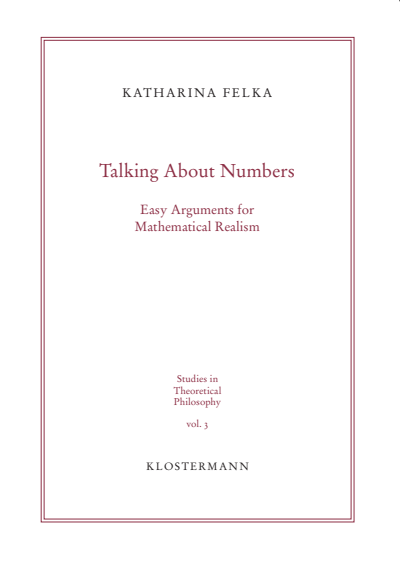
For thousands of years philosophers have discussed the question of whether numbers exist. Surprisingly, there are very easy arguments from commonly accepted truths that seem to decide the question. For instance, it is a commonly accepted truth that Obama has two hands. If Obama has two hands, then the number of Obama’s hands is two, and, thus, numbers exist. If such arguments were convincing, ontological disputes about the existence of numbers could be decided simply by pointing to Obama’s hands! The book offers a defense of the profoundness of traditional ontological questions by showing that the easy arguments in question are based on false linguistic assumptions. To do so it engages with recent linguistic research and develops analyses of the pertinent sentences that are of interest far beyond the metaontological question at hand.
Keywords
Search publication
Bibliographic data
Edition
1/2016
Copyright Year
2016
ISBN-Print
978-3-465-03879-5
ISBN-Online
978-3-465-13879-2
Publisher
Klostermann, Frankfurt am Main
Series
Studies in Theoretical Philosophy
Volume
3
Language
English
Pages
188
Product Type
Monograph
Table of contents
ChapterPages
Titelei/Inhaltsverzeichnis No access Pages 1 - 12
Chapter 1: Introduction No access Pages 13 - 18
2.1 Type Theory No access
2.2 Loaded Sentences and Innocent Counterparts No access
2.3 Sentences and Utterances of Sentences No access
Chapter 3: Introduction No access Pages 47 - 50
4.1 Preliminaries No access
4.2 The Tricky Question No access
4.3 Conditional Analyses No access
4.4 Application to Fictionalism No access
4.5 The Problem: An Impossible Fiction No access
4.6 Is Triviality Implausible? No access
4.7 Rejecting Triviality No access
4.8 Explicit Part No access
4.9 Conclusion No access
5.1 Presuppositions No access
5.2 An Intuitive Contrast No access
5.3 Yablo´s Account No access
5.4 Rebuttal of Yablo´s Account No access
5.5 Von Fintel´s Account No access
5.6 A Different Account No access
5.7 Conclusion No access
Chapter 6: Conclusion No access Pages 123 - 124
Chapter 7: Introduction No access Pages 127 - 128
8.1 Hofweber´s Account No access
8.2 Rebuttal of Hofweber´s Account No access
8.3 Conclusion No access
9.1 Against the Standard Analysis No access
9.2 Disguised Question-Answer Pairs No access
9.3 Applying QID No access
9.4 Conclusion No access
Chapter 10: Conclusion No access Pages 175 - 178
Bibliography No access Pages 179 - 186
Index No access Pages 187 - 188
Similar publications
from the series "Studies in Theoretical Philosophy"