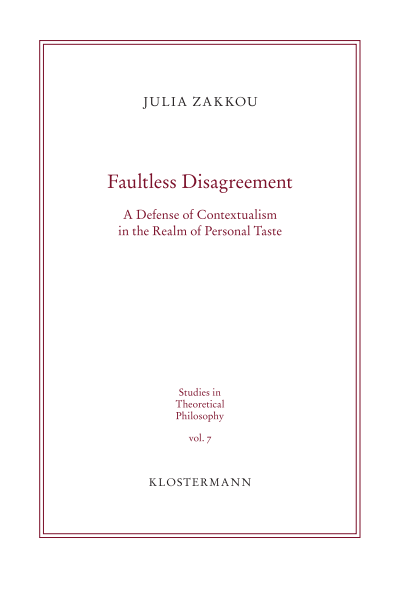
People disagree frequently, about both objective and subjective matters. But while at least one party must be wrong in a disagreement about objective matters, it seems that both parties can be right when it comes to subjective ones: it seems that there can be faultless disagreements. But how is this possible? How can people disagree with one another if they are both right? And why should they? In recent years, a number of philosophers and linguists have argued that we must become relativists about truth to understand faultless disagreements. This book shows that we can dispense with relativism. It combines a more standard semantics with a novel pragmatic theory to develop a superior approach. The book discusses both classic and recent literature in philosophy and linguistics. It provides a general introduction to the debate about the semantics and pragmatics of perspectival expressions, as well as an original contribution to the contemporary discussion.
Keywords
Search publication
Bibliographic data
Edition
1/2019
Copyright Year
2019
ISBN-Print
978-3-465-04347-8
ISBN-Online
978-3-465-14347-5
Publisher
Klostermann, Frankfurt am Main
Series
Studies in Theoretical Philosophy
Volume
7
Language
English
Pages
178
Product Type
Monograph
Table of contents
ChapterPages
Titelei/Inhaltsverzeichnis No access Pages I - X
Introduction No access Pages 1 - 12
1.1 The realm of personal taste No access
1.2 Other domains? No access
2.1 The standard semantic framework No access
2.2 Four options No access
2.3 Conclusion No access
2.4 Appendix No access
3.1 Semantic flexibility No access
3.2 The challenge No access
3.3 Individualism vs. communitarianism No access
3.4 Idealizing or generalizing No access
3.5 Consequences No access
4.1 Pragmatic flexibility No access
4.2 The paradigm case No access
4.3 More complicated cases No access
4.4 Conclusion No access
5.1 Pragmatic flexibility (again) No access
5.2 The paradigm case No access
5.3 More complicated cases No access
5.4 Further cases No access
5.5 Conclusion No access
6.1 The basic argument No access
6.2 The crucial premise No access
6.3 Ways to pragmatically convey No access
6.4 What denial devices can target No access
6.5 Conclusion No access
7.1 Semantic flexibility (again) No access
7.2 Defense: complex semantics No access
7.3 Pragmatic flexibility (again) No access
7.4 Defense: embedded pragmatics No access
7.5 Conclusion No access
Bibliography No access Pages 167 - 178
Similar publications
from the series "Studies in Theoretical Philosophy"