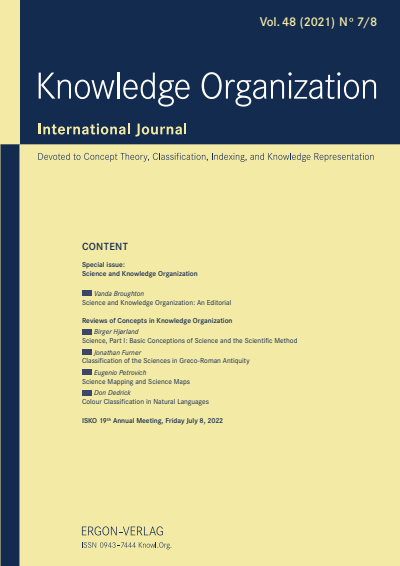
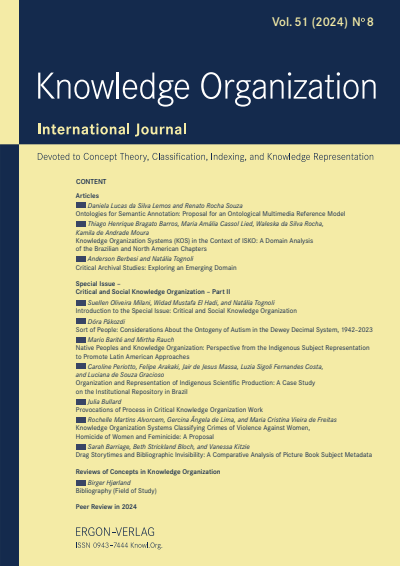
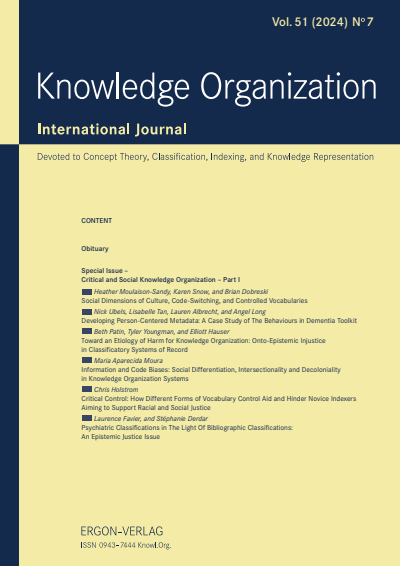
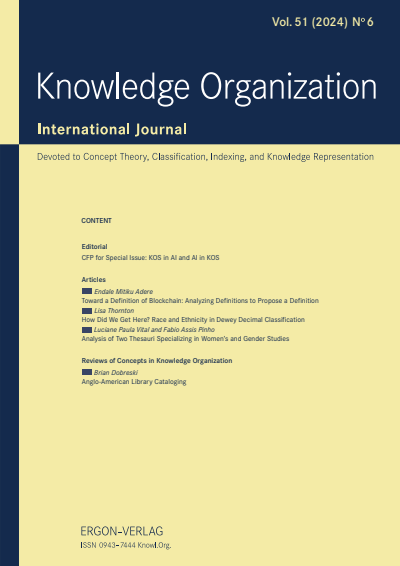
KNOWLEDGE ORGANIZATION is a forum for all those interested in the organization of knowledge on a universal or a domain-specific scale, using concept-analytical or concept-synthetical approaches, as well as quantitative and qualitative methodologies. KNOWLEDGE ORGANIZATION also addresses the intellectual and automatic compilation and use of classification systems and thesauri in all fields of knowledge, with special attention being given to the problems of terminology. KNOWLEDGE ORGANIZATION publishes original articles, reports on conferences and similar communications, as well as book reviews, letters to the editor, and an extensive annotated bibliography of recent classification and indexing literature. KNOWLEDGE ORGANIZATION should therefore be available at every university and research library of every country, at every information center, at colleges and schools of library and information science, in the hands of everybody interested in the fields mentioned above and thus also at every office for updating information on any topic related to the problems of order in our information-flooded times.
This article is the first in a trilogy about the concept “science”. Section 1 considers the historical development of the meaning of the term science and shows its close relation to the terms “knowledge” and “philosophy”. Section 2...
A review is undertaken of the contributions of 38 classical authors, from Pythagoras in the 6th century BCE to Isidore in the 6th century CE, to the classification of the sciences. Such classifications include some that are more theoretical in...
Science maps are visual representations of the structure and dynamics of scholarly knowledge. They aim to show how fields, disciplines, journals, scientists, publications, and scientific terms relate to each other. Science mapping is the body of...
Names for colours or colour-related properties are ubiquitous among natural languages, and this has made linguistic colour classification a topic of interest: are colour classifications in natural languages language-specific, or is there a more...