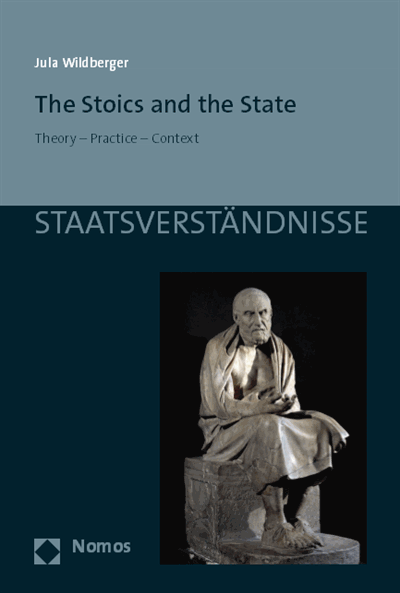
The Stoics and the State
Theory - Practice - Context- Autor:innen:
- Reihe:
- Staatsverständnisse, Band 105
- Verlag:
- 2018
Zusammenfassung
Was verstanden Stoiker unter einer polis und Staatlichkeit? Was passiert, wenn ihre Ideen unter wechselnden historischen Bedingungen gelebt und neu gedacht werden? The Stoics and the State verfolgt diese Fragen mit detaillierter, philologischer Quellenkritik, präziser Konzeptanalyse sowie weit ausholender thematischer und diachronischer Kontextualisierung. Der systematische Teil behandelt Definitionen, Aspekte der Staatlichkeit (Staatsgebiet, Institutionen, Volk und Staatsidee) und das für den stoischen Staat konstitutive Gemeinsame Gesetz. Die diachronische Darstellung von Zeno bis Marcus Aurelius zeigt die Anwendung der Theorie auf real existierende Gemeinwesen: ihre Bewertung, ihre Entstehung und die politische Praxis. Beispiele moderner Rezeption von Justus Lipsius bis Martha C. Nussbaum verdeutlichen die Eigenheiten der stoischen Staatstheorie, nicht zuletzt ihre Grundlegung in einem Menschbild, das unsere Natur nicht nur als politisch sondern als sozial und wohltätig begreift.
Publikation durchsuchen
Bibliographische Angaben
- Auflage
- 1/2018
- Copyrightjahr
- 2018
- ISBN-Print
- 978-3-8487-2843-5
- ISBN-Online
- 978-3-8452-7448-5
- Verlag
- Nomos, Baden-Baden
- Reihe
- Staatsverständnisse
- Band
- 105
- Sprache
- Englisch
- Seiten
- 263
- Produkttyp
- Monographie
Inhaltsverzeichnis
- Titelei/Inhaltsverzeichnis Kein Zugriff Seiten 1 - 12
- A State? Kein Zugriff
- The Analytical Grid Kein Zugriff
- The State of Our Sources Kein Zugriff
- Chrysostom: “Human Beings Administrated by Law” Kein Zugriff
- “Neither Expugnable nor Subjugable” Kein Zugriff
- The Wise State vs. the People as an Organized Group Kein Zugriff
- Cleanthes: A Construction for Refuge and Justice Kein Zugriff
- Arius Didymus: Dwelling and Organized Group Kein Zugriff
- Gymnasia Kein Zugriff
- Temples Kein Zugriff
- Justice and the Urban Center Kein Zugriff
- Expansional Social Attachment Kein Zugriff
- Essential Social Attachment Kein Zugriff
- The Cosmos as a Dwelling Made for Gods and Humans Kein Zugriff
- The Cosmic Home as a World State Kein Zugriff
- The Citizen of the Cosmos in Therapy and Exhortation Kein Zugriff
- A Cosmic Model-State Kein Zugriff
- Household Terminology in Stoicism Kein Zugriff
- Polis or Politeia? Kein Zugriff
- The Cosmic Disposition: Fate, Nature, and Providence Kein Zugriff
- The Cosmic Constitution and a Rational Animal’s End Kein Zugriff
- Law as a Prescriptive and Prohibitive Body Kein Zugriff
- Fate and Seed-Description (Logos Spermatikos) Kein Zugriff
- Justice and the Cosmic Disposition Kein Zugriff
- Are Stoic Laws Rules? Kein Zugriff
- Experience, Concepts, and Patterns in Nature Kein Zugriff
- Reason as a Prerequisite for Citizenship Kein Zugriff
- Hierarchies in the World State Kein Zugriff
- Is God a Citizen Too? Kein Zugriff
- Right Reason Kein Zugriff
- Reason Twisted Kein Zugriff
- Women Kein Zugriff
- Slaves Kein Zugriff
- Exiles, Rustics, and Feral Persons Kein Zugriff
- Children Kein Zugriff
- The Erotic Efforts of Sages Kein Zugriff
- Eros and Concord Kein Zugriff
- Becoming a Citizen: A Rational Animal’s End and the State Objective Kein Zugriff
- The Reality of the Common Law Kein Zugriff
- Individual Polities and the Primacy of the Law Kein Zugriff
- Objectives of Particular States and Best Constitutions Kein Zugriff
- The Earliest Humans: “Fresh from the Gods” Kein Zugriff
- Technology Kein Zugriff
- A Golden Age or a Lucky Age? Kein Zugriff
- Early Political Philosophy Kein Zugriff
- Tyrants and Legislation Kein Zugriff
- Is Zeno’s Society of Equals a Democracy? Kein Zugriff
- Historical Context and Theory Kein Zugriff
- Early Stoics in Politics Kein Zugriff
- Engagement with Monarchy and Monarchs Kein Zugriff
- Distance and Mediation Kein Zugriff
- Adaptive Agency Kein Zugriff
- In Defense of a Contemplative Life: The Evidence in Seneca Kein Zugriff
- Incurable Polities and Progressor Polities Kein Zugriff
- Just by Nature Kein Zugriff
- Philosophy as Legislation Kein Zugriff
- The Middle Stoics Kein Zugriff
- The Body Politic in Seneca’s De Clementia Kein Zugriff
- Epictetus on the Emperor as a Source of Enslaving Desires Kein Zugriff
- Marcus Conceptualizes His Status as Emperor Kein Zugriff
- A Sociable and Political Animal in the World State Kein Zugriff
- Ruling in Rome Kein Zugriff
- The Stoic Opposition and Marcus’ Political Dream Kein Zugriff
- A Change of Mind Kein Zugriff
- A New Start Kein Zugriff
- A New Elite of Equals: The Network of Progressor Friends Kein Zugriff
- Public Evils and Contingent Laws in De Constantia Kein Zugriff
- Human Selfishness and Protective State Power in the Politica Kein Zugriff
- Anthropology Kein Zugriff
- State, Law, and Institutions Kein Zugriff
- Human Dignity and Human Rights Kein Zugriff
- Capabilities vs. Functions: Chrysippus’ Modal Logic Kein Zugriff
- Quietistic Disregard for Human Vulnerability? Kein Zugriff
- The Common Law, Cultural Diversity, and Minimal Consensus Kein Zugriff
- In Conclusion: Radical Evil or Innate Love of Others? Kein Zugriff
- Literature Kein Zugriff Seiten 231 - 246
- Index of Primary Sources Cited Kein Zugriff Seiten 247 - 260
- Index of Selected Greek and Latin Terms Kein Zugriff Seiten 261 - 263
Literaturverzeichnis (286 Einträge)
Es wurden keine Treffer gefunden. Versuchen Sie einen anderen Begriff.
- Abel, K., 1964. Poseidonios und Senecas Trostschrift an Marcia (dial. 6,24,5 ff.). Rheinisches Museum, Vol. 107, pp. 221-260. Google Scholar öffnen doi.org/10.5771/9783845274485
- Alessandrelli, M. & Ranocchia, G., 2017. Scrittore stoico anonimo, Opera incerta: PHerc. 1020, coll. 104-112: Edizione, introduzione e commento. ILIESI-CNR: http://www.iliesi.cnr.it/pubblicazioni/Testi-01-Alessandrelli_Ranocchia.pdf. Google Scholar öffnen doi.org/10.5771/9783845274485
- Alesse, F., 1997. Panezio di Rodi: Testimonianze: Edizione, traduzione e commento. Napoli: Bibliopolis. Google Scholar öffnen doi.org/10.5771/9783845274485
- Algra, K., 2009. Stoic Philosophical Theology and Graeco-Roman Religion. In: R. Salles, ed. God and Cosmos in Stoicism. Oxford; New York: Oxford University Press, pp. 224-251. Google Scholar öffnen doi.org/10.5771/9783845274485
- Annas, J., 1989. Cicero on Stoic Moral Philosophy and Private Property. In: M. T. Griffin & J. Barnes, ed. Philosophia Togata. Oxford: Clarendon Press, pp. 151-173. Google Scholar öffnen doi.org/10.5771/9783845274485
- Armisen-Marchetti, M., 1989. Sapientiae facies: Étude sur les images de Sénèque. Paris: Les Belles Lettres. Google Scholar öffnen doi.org/10.5771/9783845274485
- Asmis, E., 2008. Cicero on Natural Law and the Laws of the State. Classical Antiquity, Vol. 27, pp. 1-33. Google Scholar öffnen doi.org/10.5771/9783845274485
- Auberger, J., 2016. Strabon d’Amasée. In: R. Goulet, ed. Dictionnaire des philosophes antiques: VI: De Sabinillus à Tyrsénos. Paris: CNRS Éditions, pp. 602-612. Google Scholar öffnen doi.org/10.5771/9783845274485
- Badian, E., 1958. Alexander the Great and the Unity of Mankind. Historia, Vol. 7, pp. 125-144. Google Scholar öffnen doi.org/10.5771/9783845274485
- Baldry, H. C., 1959. Zeno’s Ideal State. Journal of Hellenic Studies, Vol. 79, pp. 3-15. Google Scholar öffnen doi.org/10.5771/9783845274485
- Baldry, H. C., 1965. The Unity of Mankind in Greek Thought. Cambridge: Cambridge Uni¬versity Press. Google Scholar öffnen doi.org/10.5771/9783845274485
- Banateanu, A., 2001. La théorie stoïcienne de l’amitié: Essai de reconstruction. Fribourg: Éditions Universitaires Fribourg Suisse. Google Scholar öffnen doi.org/10.5771/9783845274485
- Bees, R., 2004. Die Oikeiosislehre der Stoa: I. Rekonstruktion ihres Inhalts. Würzburg: Königshausen & Neumann. Google Scholar öffnen doi.org/10.5771/9783845274485
- Bees, R., 2005. Die Kulturentstehungslehre des Poseidonios: Wege zu ihrer Rekonstruktion. Antike & Abendland, Vol. 51, pp. 13-29. Google Scholar öffnen doi.org/10.5771/9783845274485
- Bees, R., 2011. Zenons Politeia. Leiden; Boston: Brill. Google Scholar öffnen doi.org/10.5771/9783845274485
- Bénatouïl, T., 2009. Les stoïciens III: Musonius - Epictète - Marc Aurèle. Paris: Les Belles Lettres. Google Scholar öffnen doi.org/10.5771/9783845274485
- Bénatouïl, T., 2016. Stoicism and Twentieth-Century French Philosophy. In: J. Sellars, ed. The Routledge Handbook of the Stoic Tradition. Abingdon; New York: Routledge, pp. 360-373. Google Scholar öffnen doi.org/10.5771/9783845274485
- Benhabib, S., 2008. The Legitimacy of Human Rights. Daedalus, Vol. 137.3, pp. 94-104. Google Scholar öffnen doi.org/10.5771/9783845274485
- Bickel, E., 1959. Kant und Seneca: Der bestirnte Himmel über mir und das moralische Gesetz in mir. Rheinisches Museum für Philologie, Vol. 102, pp. 289-292. Google Scholar öffnen doi.org/10.5771/9783845274485
- Birley, A. R., 2000. Marcus Aurelius: A Biography. Rpt. of 2nd ed. 1987. London: Routledge. Google Scholar öffnen doi.org/10.5771/9783845274485
- Blom, H. & Winkel, L., 2001/2002. Grotius and the Stoa: Introduction. Grotiana, Vol. 22-23, pp. 3-20. Google Scholar öffnen doi.org/10.5771/9783845274485
- Bobzien, S., 1998. Determinism and Freedom in Stoic Philosophy. Oxford: Clarendon Press. Google Scholar öffnen doi.org/10.5771/9783845274485
- Bobzien, S., 1999. Logic: II The ‘Megarics’; III The Stoics (sections 1-7). In: K. Algra, J. Barnes, J. Mansfeld & M. Schofield, ed. The Cambridge History of Hellenistic Philoso¬phy. Cambridge: Cambridge University Press, pp. 83-157. Google Scholar öffnen doi.org/10.5771/9783845274485
- Boegehold, A. L. et al., 1995. The Athenian Agora, Vol. 28: The Lawcourts at Athens: Sites, Buildings, Equipment, Procedure, and Testimonia. Athens: The American School of Clas¬sical Studies at Athens. Google Scholar öffnen doi.org/10.5771/9783845274485
- Boeri, M. D. & Salles, R., 2014. Los Filósofos Estoicos: Ontología, Lógica, Física y Ética: Traducción, comentaria filosófico y edición anotada de los principales textos griegos y latinos. Sankt Augustin: Academia Verlag. Google Scholar öffnen doi.org/10.5771/9783845274485
- Bonazzi, M. & Helmig, C. ed., 2007. Platonic Stoicism – Stoic Platonism: The Dialogue between Platonism and Stoicism in Antiquity. Leuven: Leuven University Press. Google Scholar öffnen doi.org/10.5771/9783845274485
- Bonazzi, M. & Opsomer, J. ed., 2009. The Origins of the Platonic System: Platonisms of the Early Empire and their Philosophical Contexts. Paris; Louvain: Namur; Walpole: Éditions Peeters; Société des Études Classiques. Google Scholar öffnen doi.org/10.5771/9783845274485
- Borkenau, F., 1934. Der Übergang vom feudalen zum bürgerlichen Weltbild: Studien zur Geschichte der Philosophie der Manufakturperiode. Paris: Alcan. Google Scholar öffnen doi.org/10.5771/9783845274485
- Boys-Stones, G., 1998. Eros in Government: Zeno and the Virtuous City. Classical Quar¬terly, Vol. 48, pp. 168-174. Google Scholar öffnen doi.org/10.5771/9783845274485
- Boys-Stones, G., 2001. Post-Hellenistic Philosophy: A Study of Its Development from the Stoics to Origen. Oxford; New York: Oxford University Press. Google Scholar öffnen doi.org/10.5771/9783845274485
- Brandt, R., 2007. Die Bestimmung des Menschen bei Kant. Hamburg: Meiner. Google Scholar öffnen doi.org/10.5771/9783845274485
- Braund, S. M., 2009. Seneca, De clementia. Oxford; New York: Oxford University Press. Google Scholar öffnen doi.org/10.5771/9783845274485
- Brennan, T., 2005. The Stoic Life: Emotions, Duties, and Fate. Oxford and New York: Oxford University Press. Google Scholar öffnen doi.org/10.5771/9783845274485
- Brittain, C., 2005. Common Sense: Concepts, Definition and Meaning in and out of the Stoa. In: D. Frede & B. Inwood, ed. Language and Learning: Philosophy of Language in the Hellenistic Age. Cambridge: Cambridge University Press, pp. 164-209. Google Scholar öffnen doi.org/10.5771/9783845274485
- Brooke, C., 2012. Philosophic Pride: Stoicism and Political Thought from Lipsius to Rous¬seau. Princeton; Oxford: Princeton University Press. Google Scholar öffnen doi.org/10.5771/9783845274485
- Brouwer, R., 2011. On Law and Equity: The Stoic View. Zeitschrift der Savigny-Stiftung für Rechtsgeschichte, Vol. 128, pp. 17-38. Google Scholar öffnen doi.org/10.5771/9783845274485
- Brouwer, R., 2014. The Stoic Sage: The Early Stoics on Wisdom, Sagehood and Socrates. Cambridge; New York: Cambridge University Press. Google Scholar öffnen doi.org/10.5771/9783845274485
- Brown, E., 2006. Hellenistic Cosmpolitanism. In: M. L. Gill & P. Pellegrin, ed. A Companion to Ancient Philosophy. Malden; Oxford; Carlton: Blackwell, pp. 549-558. Google Scholar öffnen doi.org/10.5771/9783845274485
- Brown, E., 2009. The Emergence of Natural Law and the Cosmopolis. In: S. Salkever, ed. The Cambridge Companion to Ancient Greek Political Thought. Cambridge: Cambridge University Press, pp. 331-364. Google Scholar öffnen doi.org/10.5771/9783845274485
- Brown, G. W. & Held, D., 2010. The Cosmopolitanism Reader. Cambridge; Malden: Polity Press. Google Scholar öffnen doi.org/10.5771/9783845274485
- Brunschwig, J., 2005. Sur deux notions de l’éthique stoïcienne: De la ‘reserve’ au ‘renverse¬ment’. In: J. Gourinat & G. Romeyer-Dherbey, ed. Les stoïciens. Paris: Vrin, pp. 335-356. Google Scholar öffnen doi.org/10.5771/9783845274485
- Brunt, P. A., 2013. Studies in Stoicism. Oxford: Oxford University Press. Google Scholar öffnen doi.org/10.5771/9783845274485
- Cartledge, P. & Edge, M., 2009. ‘Rights,’ Individuals, and Communities in Ancient Greece. In: R. K. Balot, ed. A Companion to Greek and Roman Political Thought. Malden; Oxford; Chichester: Wiley-Blackwell, pp. 149-163. Google Scholar öffnen doi.org/10.5771/9783845274485
- Caspar, T. W., 2011. Recovering the Ancient View of Founding: A Commentary on Cicero’s De Legibus. Lanham: Lexington Books. Google Scholar öffnen doi.org/10.5771/9783845274485
- Christes, J., 2007. Populus und res publica in Ciceros Schrift ‘De re publica.’ In: E. Richter, R. Voigt & H. König, ed. Res Publica und Demokratie: Die Bedeutung von Cicero für das heutige Staatsverständnis. Baden-Baden: Nomos, pp. 85-104. Google Scholar öffnen doi.org/10.5771/9783845274485
- Cicero, 2001. On Moral Ends, ed. J. Annas; transl. R. Woolf. Cambridge: Cambridge Uni¬versity Press. Google Scholar öffnen doi.org/10.5771/9783845274485
- Colish, M. L., 2014. Seneca on Acting against Conscience. In: M. L. Colish & J. Wildberger, ed. Seneca Philosophus. Berlin; Boston: De Gruyter, pp. 95-110. Google Scholar öffnen doi.org/10.5771/9783845274485
- Costa, S., 2013. “Quod olim fuerat” – La rappresentazione del passato in Seneca prosatore. Hildesheim; Zürich; New York: Olms. Google Scholar öffnen doi.org/10.5771/9783845274485
- Daniélou, J., 2014. Philo of Alexandria. Cambridge: James Clarke & Co. (= Philon d’Alex¬andrie. Paris: Fayard, 1958). Google Scholar öffnen doi.org/10.5771/9783845274485
- Dawson, D., 1992. Cities of the Gods: Communist Utopias in Greek Thought. Oxford; New York: Oxford University Press. Google Scholar öffnen doi.org/10.5771/9783845274485
- De Pietro, M., 2014. Having the Right to Philosophize: A New Reading of Seneca, De Vita Beata 1.1.-6.2. In: M. L. Colish & J. Wildberger, ed. Seneca Philosophus. Berlin; Boston: De Gruyter, pp. 343-367. Google Scholar öffnen doi.org/10.5771/9783845274485
- Degl’Innocenti Pierini, R., 2004. Il cielo e il soffitto: Speculazione filosofica e realtà romana nell’epistola 90 di Seneca. In: L. de Finis, ed. Colloquio su Seneca. Trento: Trento Asso¬ciazione italiana di cultura classica, pp. 65-88. Google Scholar öffnen doi.org/10.5771/9783845274485
- Degl’Innocenti Pierini, R., 2014. Freedom in Seneca: Some Reflections on the Relationship between Philosophy and Politics, Public and Private Life. In: M. L. Colish & J. Wild¬berger, ed. Seneca Philosophus. Berlin; New York: De Gruyter, pp. 167-187. Google Scholar öffnen doi.org/10.5771/9783845274485
- Devine, F. E., 1970. Stoicism on the Best Regime. Journal of the History of Ideas, Vol. 31, pp. 323-336. Google Scholar öffnen doi.org/10.5771/9783845274485
- Dionigi, I., 1983. Lucio Anneo Seneca, De otio (Dial. VIII): Testo e apparato critico, con introduzione, versione e commento. Bescia: Paideia. Google Scholar öffnen doi.org/10.5771/9783845274485
- Dorandi, T., 1982. Filodemo. Gli Stoici (PHerc. 155 e 339). Cronache Ercolanesi, Vol. 12, pp. 91-133. Google Scholar öffnen doi.org/10.5771/9783845274485
- Dorandi, T., 1994. Storia dei filosofi: La Stoa da Zenone a Panezio (PHerc. 1018): Edizione, traduzione e commento. Leiden; New York; Köln: Brill. Google Scholar öffnen doi.org/10.5771/9783845274485
- Dorandi, T., 1999. Antigone de Caryste, Fragments: Texte établi et traduit. Paris: Les Belles Lettres. Google Scholar öffnen doi.org/10.5771/9783845274485
- Doyle, D. & Torralba, J. M., 2016. Kant and Stoic Ethics. In: J. Sellars, ed. The Routledge Handbook of the Stoic Tradition. Abingdon; New York: Routledge, pp. 270-284. Google Scholar öffnen doi.org/10.5771/9783845274485
- Dyck, A. R., 1996. A Commentary on Cicero, De Officiis. Ann Arbor: University of Michigan Press. Google Scholar öffnen doi.org/10.5771/9783845274485
- Dyck, A. R., 2004. A Commentary on Cicero, De Legibus. Ann Arbor: University of Michi¬gan Press. Google Scholar öffnen doi.org/10.5771/9783845274485
- Edelstein, L. & Kidd, I. G., 1989. Posidonius. I: The Fragments. 2nd ed. Cambridge: Cam¬bridge University Press. Google Scholar öffnen doi.org/10.5771/9783845274485
- Epictetus, 1995. The Discourses. The Handbook. Fragments, transl. E. Carter, revised by R. Hard. London; Vermont: Dent; Tuttle (Everyman). Google Scholar öffnen doi.org/10.5771/9783845274485
- Erler, M., 2007. Platon. Ueberweg Grundriss der Geschichte der Philosophie: Antike 2/2. Basel: Schwabe. Google Scholar öffnen doi.org/10.5771/9783845274485
- Erskine, A., 1990. The Hellenistic Stoa: Political Thought and Action. Ithaca: Cornell Uni¬versity Press. Google Scholar öffnen doi.org/10.5771/9783845274485
- Eusebius, 1987. Eusèbe de Césarée. La préparation évangelique, Livres XIV-XV: Introduc¬tion, texte grec, traduction et annotation, ed. and transl. E. des Places. Paris: Les éditions du CERF (Sources Chrétiennes 338). Google Scholar öffnen doi.org/10.5771/9783845274485
- Farquharson, A. S. L., 1944. The Meditations of the Emperor Marcus Antoninus: Edited with Translation and Commentary. Oxford: Clarendon Press. Google Scholar öffnen doi.org/10.5771/9783845274485
- Feldman, N., 2007. Cosmpolitan Law? The Yale Law Journal, Vol. 116, pp. 1022-1070. Google Scholar öffnen doi.org/10.5771/9783845274485
- Follet, S., 1994. Aristocréon. In: R. Goulet, ed. Dictionnaire des Philosophes Antiques I: Abam(m)on à Axiothéa. Paris: CNRS Éditions, pp. 386-389. Google Scholar öffnen doi.org/10.5771/9783845274485
- Fontanella, F., 2012. Politica e diritto naturale nel De legibus di Cicerone. Roma: Edizioni di Storia e Letteratura. Google Scholar öffnen doi.org/10.5771/9783845274485
- Ford, C. A., 1996. Preaching Propriety to Princes: Grotius, Lipsius, and Neo-Stoic Interna¬tional Law. Case Western Reserve Journal of International Law, Vol. 28, pp. 313-366. Google Scholar öffnen doi.org/10.5771/9783845274485
- Forschner, M., 2003. Philosophie und Politik: Dions philosophische Botschaft. In: H.-G. Nesselrath et al. Dion von Prusa, Menschliche Gemeinschaft und göttliche Ordnung: Die Borysthenes-Rede: Eingeleitet, übersetzt und mit interpretierenden Essays versehen. Darmstadt: Wissenschaftliche Buchgesellschaft, pp. 128-156. Google Scholar öffnen doi.org/10.5771/9783845274485
- Frede, M., 1999. Stoic Epistemology. In: K. Algra, J. Barnes, J. Mansfeld & M. Schofield, ed. The Cambridge History of Hellenistic Philosophy. Cambridge: Cambridge University Press, pp. 295-322. Google Scholar öffnen doi.org/10.5771/9783845274485
- Gaca, K. L., 2000. Early Stoic Eros: The Sexual Ethics of Zeno and Chrysippus and Their Evaluation of the Greek Erotic Tradition. Apeiron, Vol. 33, pp. 207-23. Google Scholar öffnen doi.org/10.5771/9783845274485
- Gaca, K. L., 2003. Making of Fornication: Eros, Ethics, and Political Reform in Greek Phi¬losophy and Early Christianity. Berkeley; Los Angeles; London: University of California Press. Google Scholar öffnen doi.org/10.5771/9783845274485
- Gauly, B. M., 2004. Senecas Naturales quaestiones: Naturphilosophie für die römische Kai¬serzeit. München: Beck. Google Scholar öffnen doi.org/10.5771/9783845274485
- Gerson, L. P. & Inwood, B., 1997. Hellenistic Philosophy: Introductory Readings. 2nd ed. Indianapolis and Cambridge: Hackett. Google Scholar öffnen doi.org/10.5771/9783845274485
- Giannantoni, G., 1988. Cinici e stoici su Alessandro Magno. In: G. Casertano, ed. I filosofi e il potere nella società e nella cultura antiche. Napoli: Guida, pp. 75-87. Google Scholar öffnen doi.org/10.5771/9783845274485
- Gill, C., 2000. Stoic Writers of the Imperial Era. In: C. Rowe & M. Schofield, ed. The Cam¬bridge History of Greek and Roman Political Thought. Cambridge: Cambridge University Press, pp. 597-615. Google Scholar öffnen doi.org/10.5771/9783845274485
- Gill, C., 2005. Competing Readings of Stoic Emotions. In: R. Salles, ed. Metaphysics, Soul, and Ethics in Ancient Thought: Themes from the Work of Richard Sorabji. Oxford: Clar¬endon Press, pp. 445-470. Google Scholar öffnen doi.org/10.5771/9783845274485
- Gill, C., 2006. The Structured Self in Hellenistic and Roman Thought. Oxford; New York: Oxford University Press. Google Scholar öffnen doi.org/10.5771/9783845274485
- Gloyn, E., 2016. The Ethics of the Family in Seneca. Cambridge; New York: Cambridge University Press. Google Scholar öffnen doi.org/10.5771/9783845274485
- Goeken, J., 2012. Aelius Aristide et la rhétorique de l’hymne en prose. Turnhout: Brepols. Google Scholar öffnen doi.org/10.5771/9783845274485
- Goulet-Gazé, M.-O., ed., 2011. Études sur la théorie stoïcienne de l’action. Paris: Vrin. Google Scholar öffnen doi.org/10.5771/9783845274485
- Gourinat, J.-B., 2011. Aëtius et Arius Didyme sources de Stobée. In: G. Reydams-Schils, ed. Thinking Through Excerpts: Studies on Stobaeus. Turnhout: Brepols, pp. 143-200. Google Scholar öffnen doi.org/10.5771/9783845274485
- Gourinat, J.-B., 2012. Persaïos de Kition. In: R. Goulet, ed. Dictionnaire des Philosophes Antiques: Va: De Paccius à Plotin. Paris: CRNS Éditions, pp. 234-243. Google Scholar öffnen doi.org/10.5771/9783845274485
- Gourinat, J.-B., ed., 2016. L’éthique du stoïcien Hiéroclès. Villeneuve d’Ascq: Presses Uni¬versitaires du Septentrion. Google Scholar öffnen doi.org/10.5771/9783845274485
- Graver, M. R., 2002. Cicero on the Emotions: Tusculan Disputations 3 and 4: Translated and with Commentary. Chicago; London: Chicago University Press. Google Scholar öffnen doi.org/10.5771/9783845274485
- Graver, M. R., 2007. Stoicism and Emotion. Chicago; London: Chicago University Press. Google Scholar öffnen doi.org/10.5771/9783845274485
- Graver, M. R., 2014. Honeybee Reading and Self-Scripting: Seneca’s 84th Epistle. In: M. L. Colish & J. Wildberger, ed. Seneca Philosophus. Berlin; New York: De Gruyter, pp. 269-293. Google Scholar öffnen doi.org/10.5771/9783845274485
- Graver, M. R., 2016a. Honor and the Honorable: Cato’s Discourse in De Finibus 3. In: J. Annas & G. Betegh, ed. Cicero’s De Finibus: Philosophical Approaches. Cambridge: Cam¬bridge University Press, pp. 118-146. Google Scholar öffnen doi.org/10.5771/9783845274485
- Graver, M. R., 2016b. The Emotional Intelligence of Epicureans: Doctrinalism and Adaptation in Seneca’s Epistles. In: G. D. Williams & K. Volk, ed. Roman Reflections: Studies in Latin Philosophy. Oxford; New York: Oxford University Press, pp. 192-210. Google Scholar öffnen doi.org/10.5771/9783845274485
- Griffin, M. T., 1992. Seneca: A Philosopher in Politics. 2nd ed. Oxford: Clarendon Press. Google Scholar öffnen doi.org/10.5771/9783845274485
- Griffin, M. T., 2013. Seneca on Society: A Guide to De Beneficiis. Oxford: Oxford University Press. Google Scholar öffnen doi.org/10.5771/9783845274485
- Guérard, C. & Goulet, R., 2016. Sphaïros le Borysthénite RE3. In: R. Goulet, ed. Dictionnaire des Philosophes Antiques VI: De Sabinillus à Tyrsénos. Paris: CNRS Éditions, pp. 540-545. Google Scholar öffnen doi.org/10.5771/9783845274485
- Gueye, C. M., 2006. Late Stoic Cosmopolitanism: Foundations and Relevance. Heidelberg: Winter. Google Scholar öffnen doi.org/10.5771/9783845274485
- Güremen, R., Hammerstaedt, J. & Morel, P.-M. ed., 2017. Diogenes of Oinoanda: Epicure¬anism and Philosophical Debate. Diogène d'Œnoanda: Épicurisme et controverses. Leu¬ven: Leuven University Press. Google Scholar öffnen doi.org/10.5771/9783845274485
- Haake, M., 2004. Documentary Evidence, Literary Forgery, or Manipulation of Historical Documents? Diogenes Laertius and an Athenian Honorary Decree for Zeno of Citium. Classical Quarterly, Vol. 54, pp. 470-483. Google Scholar öffnen doi.org/10.5771/9783845274485
- Haake, M., 2007. Der Philosoph in der Stadt: Untersuchungen zur öffentlichen Rede über Philosophen und Philosophie in den hellenistischen Poleis. München: C. H. Beck. Google Scholar öffnen doi.org/10.5771/9783845274485
- Haake, M., 2013. Illustrating, Documenting, Making-Believe: The Use of Psephismata in Hellenistic Biographers of Philosophers. In: P. Liddel & P. Low, ed. Inscriptions and Their Uses in Greek and Latin Literature. Oxford: Oxford University Press, pp. 79-124. Google Scholar öffnen doi.org/10.5771/9783845274485
- Habicht, C., 1994. Athen in hellenistischer Zeit. München: C. H. Beck. Google Scholar öffnen doi.org/10.5771/9783845274485
- Habicht, C., 1997. Athens from Alexander to Antony. Cambridge, Mass.; London: Harvard University Press. Google Scholar öffnen doi.org/10.5771/9783845274485
- Habinek, T., 1998. The Politics of Latin Literature: Writing, Identity, and Empire in Ancient Rome. Princeton: Princeton University Press. Google Scholar öffnen doi.org/10.5771/9783845274485
- Habinek, T., 2000. Seneca’s Renown: Gloria, Claritudo, and the Replication of the Roman Elite. Classical Antiquity, Vol. 19, pp. 264-303. Google Scholar öffnen doi.org/10.5771/9783845274485
- Hadas-Lebel, M., 2012. Philo of Alexandria: A Thinker in the Jewish Diaspora. Leiden; Bos¬ton: Brill (= Philon d’Alexandrie: un penseur en diaspora. Paris: Fayard, 2003). Google Scholar öffnen doi.org/10.5771/9783845274485
- Hadot, I., 2014. Getting to Goodness: Reflections on Chapter 10 of Brad Inwood, Reading Seneca. In: J. Wildberger & M. L. Colish, ed. Seneca Philosophus. Berlin; Boston: De Gruyter, pp. 9-41. Google Scholar öffnen doi.org/10.5771/9783845274485
- Hadot, P., 1992. Introduction aux ‘Pensées’ de Marc Aurèle: La citatelle intérieure. Paris: Fayard. Google Scholar öffnen doi.org/10.5771/9783845274485
- Hahm, D. E., 1990. The Ethical Doxography of Arius Didymus. Aufstieg und Niedergang der römischen Welt, Vol. II, 36.4, pp. 2935-3052. 3234-43. Google Scholar öffnen doi.org/10.5771/9783845274485
- Hahm, D. E., 1992a. Diogenes Laertius VII: On the Stoics. Aufstieg und Niedergang der römischen Welt, Vol. II, 36.6, pp. 4076-182. Google Scholar öffnen doi.org/10.5771/9783845274485
- Hahm, D. E., 1992b. A Neglected Stoic Argument for Human Responsibility. Illinois Classi¬cal Studies, Vol. 17, pp. 23-48. Google Scholar öffnen doi.org/10.5771/9783845274485
- Hammerstaedt, J. & Smith, M. F., 2014. The Epicurean Inscription of Diogenes of Oinoanda: Ten Years of New Discoveries and Research. Bonn: Habelt. Google Scholar öffnen doi.org/10.5771/9783845274485
- Harding, P. E., 2015. Athens Transformed, 404-262 BC: From Popular Sovereignty to the Dominion of the Elite. London: Routledge. Google Scholar öffnen doi.org/10.5771/9783845274485
- Harte, V., McCabe, M. M., Sharples, R. W. & Sheppard, A. ed., 2010. Aristotle and the Stoics Reading Plato. London: Institute of Classical Studies. Google Scholar öffnen doi.org/10.5771/9783845274485
- Hill, L., 2000. The Two Republicae of the Roman Stoics: Can a Cosmpolite Be a Patriot? Citizenship Studies, Vol. 4, pp. 65-79. Google Scholar öffnen doi.org/10.5771/9783845274485
- Hine, H. M., 2006. Rome, the Cosmos, and the Emperor in Seneca’s Natural Questions. Jour¬nal of Roman Studies, Vol. 96, pp. 42-72. Google Scholar öffnen doi.org/10.5771/9783845274485
- Horn, C., 2008. Kant und die Stoiker. In: B. Neymeyr, J. Schmidt & B. Zimmermann, ed. Stoizismus in der europäischen Philosophie, Literatur, Kunst und Politik. Berlin; New York: De Gruyter, Vol. 2, pp. 1081-1104. Google Scholar öffnen doi.org/10.5771/9783845274485
- Hülser, K., 1987. Die Fragmente zur Dialektik der Stoiker: Neue Sammlung der Texte mit deutscher Übersetzung und Kommentaren. Stuttgart-Bad Canstatt: Frommann-Holzboog. Google Scholar öffnen doi.org/10.5771/9783845274485
- Inwood, B., 1999. Rule and Reasoing in Stoic Ethics. In: K. Ierodiakonou, ed. Topics in Stoic Philosophy. Oxford: Clarendon Press, pp. 95-127. Google Scholar öffnen doi.org/10.5771/9783845274485
- Inwood, B., 2005. Reading Seneca: Stoic Philosophy at Rome. Oxford: Clarendon Press. Google Scholar öffnen doi.org/10.5771/9783845274485
- Inwood, B., 2007. Seneca. Selected Philosophical Letters: Translation with an Introduction and Commentary. Oxford; New York: Oxford University Press. Google Scholar öffnen doi.org/10.5771/9783845274485
- Inwood, B., 2014. Ethics After Aristotle. Cambridge, Mass.; London: Harvard University Press. Google Scholar öffnen doi.org/10.5771/9783845274485
- Inwood, B., 2016. The Voice of Nature. In: J. Annas & G. Betegh, ed. Cicero’s De Finibus: Philosophical Approaches. Cambridge: Cambridge University Press, pp. 147-166. Google Scholar öffnen doi.org/10.5771/9783845274485
- Jellinek, G., 1900. Allgemeine Staatslehre. Berlin: Häring. Google Scholar öffnen doi.org/10.5771/9783845274485
- Jessop, B., 2016. The State: Past, Present, Future. Cambridge: Polity. Google Scholar öffnen doi.org/10.5771/9783845274485
- Jones, M., 2014. Seneca’s Letters to Lucilius: Hypocrisy as a Way of Life. In: M. L. Colish & J. Wildberger, ed. Seneca Philosophus. Berlin; Boston: De Gruyter, pp. 393-429. Google Scholar öffnen doi.org/10.5771/9783845274485
- Jong, A. d., 2003. Dions Magierhymnen: Zoroastrischer Mythos oder griechische Phantasie? In: H.-G. Nesselrath et al. Dion von Prusa, Menschliche Gemeinschaft und göttliche Ord¬nung: Die Borysthenes-Rede: Eingeleitet, übersetzt und mit interpretierenden Essays versehen. Darmstadt: Wissenschaftliche Buchgesellschaft, pp. 157-178. Google Scholar öffnen doi.org/10.5771/9783845274485
- Kaufmann, S., 2008. Die stoisch-ciceronische Naturrechtslehre und ihre Rezeption bis Rous¬seau. In: B. Neyrmeyr, J. Schmidt & B. Zimmermann, ed. Stoizismus in der europäischen Philosophie, Literatur, Kunst und Politik. Berlin; New York: De Gruyter, Vol. 1, pp. 229-292. Google Scholar öffnen doi.org/10.5771/9783845274485
- Kidd, I. G., 1988. Posidonius: II. The Commentary. 2nd ed. Cambridge: Cambridge Univer¬sity Press. Google Scholar öffnen doi.org/10.5771/9783845274485
- Klessinger, H., 2008. Spinozas Stoizismus. In: B. Neymeyr, J. Schmidt & B. Zimmermann, ed. Stoizismus in der europäischen Philosophie, Literatur, Kunst und Politik: Eine Kul¬turgeschichte von der Antike bis zur Moderne. Berlin; New York: De Gruyter, Vol. 2, pp. 997-1016. Google Scholar öffnen doi.org/10.5771/9783845274485
- Konstan, D., 2009. Cosmopolitan Traditions. In: R. K. Balot, ed. A Companion to Greek and Roman Political Thought. Malden; Oxford; Chichester: Wiley-Blackwell, pp. 473-484. Google Scholar öffnen doi.org/10.5771/9783845274485
- Kühn, W., 2011. L’attachement à soi et aux autres. In: M. Goulet-Cazé, ed. Études sur la théorie stoïcienne de l’action. Paris: Vrin, pp. 237-366. Google Scholar öffnen doi.org/10.5771/9783845274485
- Küppers, J., 1996. ‘Kosmosschau’ und virtus in den Philosophica Senecas. Antike & Abendland, Vol. 42, pp. 57-75. Google Scholar öffnen doi.org/10.5771/9783845274485
- Lagrée, J., 2010. Le néostoïcisme. Paris: Vrin. Google Scholar öffnen doi.org/10.5771/9783845274485
- Lana, I., 1996. Pingue otium et arbitrium sui temporis … (Sénèque, epist. LXXIII, 10). In: J. André, ed. Les loisirs et l’héritage de la culture classique (Dijon, 27-31 août 1993). Brux¬elles: Latomus, pp. 425-433. Google Scholar öffnen doi.org/10.5771/9783845274485
- Laurand, V., 2005. La politique stoïcienne. Paris: Presses Universitaires de France. Google Scholar öffnen doi.org/10.5771/9783845274485
- Laurand, V., 2014. Stoïcisme et lien social: Enquête autour de Musonius Rufus. Paris: Classiques Garnier. Google Scholar öffnen doi.org/10.5771/9783845274485
- Lausberg, M., 1970. Untersuchungen zu Senecas Fragmenten. Berlin: De Gruyter. Google Scholar öffnen doi.org/10.5771/9783845274485
- Lee, M. V., 2006. Paul, the Stoics, and the Body of Christ. Cambridge: Cambridge University Press. Google Scholar öffnen doi.org/10.5771/9783845274485
- Lendon, J. E., 1997. Empire of Honour: The Art of Government in the Roman World. Oxford: Clarendon Press. Google Scholar öffnen doi.org/10.5771/9783845274485
- Lindberg, B., 2011. Stoicism in Political Humanism and Natural Law. In: E. De Bom, M. Janssens, T. Van Houdt & J. Papy, ed. (Un)masking the Realities of Power: Justus Lipsius and the Dynamics of Political Writing in Early Modern Europe. Leiden; Boston: Brill, pp. 73-93. Google Scholar öffnen doi.org/10.5771/9783845274485
- Lintott, A., 1997. The Theory of the Mixed Constitution at Rome. In: J. Barnes & M. T. Griffin, ed. Philosophia Togata II: Plato and Aristotle at Rome. Oxford: Clarendon Press, pp. 70-85. Google Scholar öffnen doi.org/10.5771/9783845274485
- Lipsius, J., 2004. Politica: Six Books of Politics or Political Instruction: Edited with Trans¬lation and Introduction, ed. and transl. J. Waszink. Assen: Royal Van Corcum. Google Scholar öffnen doi.org/10.5771/9783845274485
- Lipsius, J., 2011. Concering Constancy, ed. and transl. R. V. Young. Tempe: Arizona Center for Medieval and Renaissance Studies. Google Scholar öffnen doi.org/10.5771/9783845274485
- Long, A. A., ed., 1971. Problems in Stoicism. London: The Athlone Press. Google Scholar öffnen doi.org/10.5771/9783845274485
- Long, A. A., 2002. Epictetus: A Stoic and Socratic Guide to Life. Oxford: Clarendon Press. Google Scholar öffnen doi.org/10.5771/9783845274485
- Long, A. A., 2003. Stoicism in the Philosophical Tradition: Spinoza, Lipsius, Butler. In: B. Inwood, ed. The Cambridge Companion to the Stoics. Cambridge: Cambridge University Press, pp. 365-392. Google Scholar öffnen doi.org/10.5771/9783845274485
- Long, A. A., 2008a. Philo on Stoic Physics. In: F. Alesse, ed. Philo of Alexandria and Post-Aristotelian Philosophy. Leiden; Boston: Brill, pp. 121-140. Google Scholar öffnen doi.org/10.5771/9783845274485
- Long, A. A., 2008b. The Concept of the Cosmopolitan in Greek & Roman Thought. Daeda¬lus, Vol. 137.3, pp. 50-58. Google Scholar öffnen doi.org/10.5771/9783845274485
- Long, A. A., 2012. The Self in the Meditations. In: M. v. Ackeren, ed. A Companion to Mar¬cus Aurelius. Malden; Oxford; Chichester: Wiley-Blackwell, pp. 465-480. Google Scholar öffnen doi.org/10.5771/9783845274485
- Long, A. A. & Sedley, D., ed., 1987. The Hellenistic Philosophers. Cambridge: Cambridge University Press. Google Scholar öffnen doi.org/10.5771/9783845274485
- Lorenz, H., 2011. Posidonius on the Nature and Treatment of the Emotions. Oxford Studies in Ancient Philosophy, Vol. 40, pp. 189-211. Google Scholar öffnen doi.org/10.5771/9783845274485
- Malaspina, E., 2003. La teoria politica de De clementia: un inevitabile fallimento? In: A. De Vivo & E. Lo Cascio, ed. Seneca uomo politico e l’età di Claudio e di Nerone: Atti del Convegno internazionale (Capri 25-27 marzo 1999). Bari: Edipuglia, pp. 139-157. Google Scholar öffnen doi.org/10.5771/9783845274485
- Malaspina, E., 2004. L. Annaei Senecae De clementia libri duo: Prolegomeni, testo critico e commento. 2nd ed. Alessandria: D’Orso. Google Scholar öffnen doi.org/10.5771/9783845274485
- Malaspina, E., 2009. La Clemenza: Introduzione. In: L. de Biasi, A. Ferrero, E. Malaspina & D. Vottero, ed. Lucio Anneo Seneca: La Clemenza. Apocolocintosi. Epigrammi. Fram¬menti. Torino: UTET, pp. 9-101. Google Scholar öffnen doi.org/10.5771/9783845274485
- Malitz, J., 1983. Die Historien des Poseidonios. München: Beck. Google Scholar öffnen doi.org/10.5771/9783845274485
- Malitz, J., 1985. Helvidius Priscus und Vespasian: Zur Geschichte der ‘stoischen’ Senatsopposition. Hermes, Vol. 113, pp. 231-246. Google Scholar öffnen doi.org/10.5771/9783845274485
- Mann, C. & Scholz, P. ed., 2012. ‘Demokratie’ im Hellenismus: Von der Herrschaft des Volkes zur Herrschaft der Honoratioren? Mainz: Verlag Antike. Google Scholar öffnen doi.org/10.5771/9783845274485
- Mansfeld, J., 1983. Techne: A New Fragment of Chrysippus. Greek, Roman, and Byzantine Studies, Vol. 24, pp. 57-65. Google Scholar öffnen doi.org/10.5771/9783845274485
- Mansfeld, J., 1986. Diogenes Laertius on Stoic Philosophy. Elenchos, Vol. 7, pp. 295-382. Google Scholar öffnen doi.org/10.5771/9783845274485
- Mansfeld, J., 1999. Sources. In: K. Algra, J. Barnes, J. Mansfeld & M. Schofield, ed. The Cambridge History of Hellenistic Philosophy. Cambridge: Cambridge University Press, pp. 3-30. Google Scholar öffnen doi.org/10.5771/9783845274485
- Mansfeld, J., 2001. Plato, Pythagoras, Aristotle, the Peripatetics, the Stoics, and Thales and His Followers ‘On Causes’. In: A. Brancacci, ed. La filosofia in età imperiale: Le schuole e le tradizione filosofiche: Atti del colloquio, Roma, 17-19 Giugno 1999. Napoli: Biblio¬polis, pp. 16-68. Google Scholar öffnen doi.org/10.5771/9783845274485
- Marcus Aurelius, 1987. Ad se ipsum libri XII, ed. J. Dalfen. Leipzig: Teubner. Google Scholar öffnen doi.org/10.5771/9783845274485
- Marcus Aurelius, 2006. Meditations, transl. M. Hammond. Introduction and Comments by D. Clay. London: Penguin. Google Scholar öffnen doi.org/10.5771/9783845274485
- Marcus Aurelius, 2011. Meditations with Selected Correspondence, transl. R. Hard. Introduc¬tion and Notes by C. Gill. Oxford; New York: Oxford University Press. Google Scholar öffnen doi.org/10.5771/9783845274485
- McConnell, S., 2014. Philosophical Life in Cicero’s Letters. Cambridge: Cambridge Univer¬sity Press. Google Scholar öffnen doi.org/10.5771/9783845274485
- Mikeš, V., 2016. Le paradoxe stoïcien: Liberté de l’action déterminée. Paris: Vrin. Google Scholar öffnen doi.org/10.5771/9783845274485
- Miller, J., 2003. Stoics, Grotius, and Spinoza on Moral Deliberation. In: J. Miller & B. Inwood, ed. Hellenistic and Early Modern Philosophy. Cambridge: Cambridge University Press, pp. 116-140. Google Scholar öffnen doi.org/10.5771/9783845274485
- Miller, J., 2016. Spinoza and the Stoics. In: J. Sellars, ed. The Routledge Handbook of the Stoic Tradition. Abingdon; New York: Routledge, pp. 218-225. Google Scholar öffnen doi.org/10.5771/9783845274485
- Miller, P. N., 2002. Nazis and Neostoics: Otto Brunner and Gerhard Oestreich before and after the Second World War. Past & Present, Vol. 176, pp. 144-186. Google Scholar öffnen doi.org/10.5771/9783845274485
- Mitsis, P., 1999. The Stoic Origin of Natural Rights. In: K. Ierodiakonou, ed. Topics in Stoic Philosophy. Oxford: Clarendon Press, pp. 153-177. Google Scholar öffnen doi.org/10.5771/9783845274485
- Moles, J. L., 1996. Cynic Cosmopolitanism. In: R. B. Branham & M. Goulet-Gazé, ed. The Cynics. Berkeley; Los Angeles; London: University of California Press, pp. 105-120. Google Scholar öffnen doi.org/10.5771/9783845274485
- Morford, M., 1991. Stoics and Neostoics: Rubens and the Circle of Lipsius. Princeton: Prince¬ton University Press. Google Scholar öffnen doi.org/10.5771/9783845274485
- Morford, M., 1993. Tacitean Prudentia and the Doctrines of Justus Lipsius. In: T. J. Luce & A. J. Woodman, ed. Tacitus and the Tacitean Tradition. Princeton: Princeton University Press, pp. 129-151. Google Scholar öffnen doi.org/10.5771/9783845274485
- Nesselrath, H.-G., 2003. Einführung in die Schrift; Text und Übersetzung. In: H.-G. Nesselrath et al. Dion von Prusa, Menschliche Gemeinschaft und göttliche Ordnung: Die Borysthenes-Rede: Eingeleitet, übersetzt und mit interpretierenden Essays versehen. Darm¬stadt: Wissenschaftliche Buchgesellschaft, pp. 11-92. Google Scholar öffnen doi.org/10.5771/9783845274485
- Newmyer, S. T., 2017. The Animal and the Human in Ancient and Modern Thought: The ‘Man Alone of Animals’ Concept. New York; London: Routledge. Google Scholar öffnen doi.org/10.5771/9783845274485
- Nicols, J., 2014. Civic Patronage in the Roman Empire. Leiden; Boston: Brill. Google Scholar öffnen doi.org/10.5771/9783845274485
- Nikulin, D., 2016. Diogenes the Comic, or How to Tell the Truth in the Face of a Tyrant. In: C. Arruzza & D. Nikulin, ed. Philosophy and Politica Power in Antiquity. Leiden; Boston: Brill, pp. 114-133. Google Scholar öffnen doi.org/10.5771/9783845274485
- Nussbaum, M. C., 1997. Kant and Stoic Cosmopolitanism. The Journal of Political Philoso¬phy, Vol. 5.1, pp. 1-25. Google Scholar öffnen doi.org/10.5771/9783845274485
- Nussbaum, M. C., 2001. Upheavals of Thought: The Intelligence of Emotions. Cambridge; New York: Cambridge University Press. Google Scholar öffnen doi.org/10.5771/9783845274485
- Nussbaum, M. C., 2008. Toward a Globally Sensitive Patriotism. Daedalus, Vol. 137.3, pp. 78-93. Google Scholar öffnen doi.org/10.5771/9783845274485
- Nussbaum, M. C., 2011. Creating Capabilities: The Human Development Approach. Cam¬bridge, Mass.; London: Belknap Press. Google Scholar öffnen doi.org/10.5771/9783845274485
- Nussbaum, M. C., 2013. Political Emotions: Why Love Matters for Justice. Cambridge, Mass.; London: Belknap Press. Google Scholar öffnen doi.org/10.5771/9783845274485
- Nussbaum, M. C., 2016. Anger and Forgiveness: Resentment, Generosity, Justice. Oxford; New York: Oxford University Press. Google Scholar öffnen doi.org/10.5771/9783845274485
- Obbink, D., 1999. The Stoic Sage in the Cosmic City. In: K. Ierodiakonou, ed. Topics in Stoic Philosophy. Oxford: Clarendon Press, pp. 178-195. Google Scholar öffnen doi.org/10.5771/9783845274485
- Oestreich, G., 1956. Justus Lipsius als Theoretiker des neuzeitlichen Machtstaates: Zu seinem 350. Todestage (24. März 1606). Historische Zeitschrift, Vol. 181, pp. 31-78. Google Scholar öffnen doi.org/10.5771/9783845274485
- Oestreich, G., 1982. Neostoicism and the Early Modern State. Cambridge: Cambridge Uni¬versity Press. Google Scholar öffnen doi.org/10.5771/9783845274485
- Oestreich, G., 1989. Antiker Geist und moderner Staat bei Justus Lipsius (1547-1606): Der Neustoizismus als politische Bewegung. Göttingen: Vandenhoeck & Ruprecht. Google Scholar öffnen doi.org/10.5771/9783845274485
- Oestreich, G., 2008. Justus Lipsius und der politische Neustoizismus in Europa. In: B. Ney¬meyr, J. Schmidt & B. Zimmermann, ed. Stoizismus in der europäischen Philosophie, Lite¬ratur, Kunst und Politik. Berlin; New York: De Gruyter, Vol. 1, pp. 575-630. Google Scholar öffnen doi.org/10.5771/9783845274485
- Oliver, G. J., 2007. War, Food, and Politics in Early Hellenistic Athens. Oxford; New York: Oxford University Press. Google Scholar öffnen doi.org/10.5771/9783845274485
- Olivieri, M., 2011. Philo’s De Providentia: A Work between Two Traditions. In: P. Pontani & S. Mancini Lombardi, ed. Studies on the Ancient Armenian Version of Philo’s Works. Boston; Leiden: Brill, pp. 87-124. Google Scholar öffnen doi.org/10.5771/9783845274485
- Panksepp, J. & Biven, L., 2012. The Archaeology of Mind: Neuroevolutionary Origins of Human Emotions. New York; London: Norton. Google Scholar öffnen doi.org/10.5771/9783845274485
- Papy, J. 2011. Fate and Rule, Destiny and Dynasty: Lipsius’s Final Views on Superstition, Fate and Divination in the ‘Monita et Exempla Politica’ (1605). In: E. de Bom, M. Janssens, T van Houdt, & J. Papy, ed. (Un)masking the Realities of Power: Justus Lipsius and the Dynamics of Political Writing in Early Modern Europe. Leiden; Boston: Brill, pp. 195-205. Google Scholar öffnen doi.org/10.5771/9783845274485
- Pernot, L., 1994. Aristide (P. Aelius). In: R. Goulet, ed. Dictionnaire des philosophes antiques. Paris: CNRS Éditions, pp. 358-366. Google Scholar öffnen doi.org/10.5771/9783845274485
- Philo, 1973. Les Oeuvres de Philon d’Alexandrie 35: De providentia I et II: Introduction, traduction et notes, ed. and transl. M. Hadas-Lebel. Paris: Éditions du Cerf. Google Scholar öffnen doi.org/10.5771/9783845274485
- Pierik, R. & Wouter, W., 2010. Cosmopolitanism in Context: An Introduction. In: R. Pierik & W. Wouter, ed. Cosmopolitanism in Context: Perspectives from International Law and Political Theory. Cambridge: Cambridge University Press, pp. 1-15. Google Scholar öffnen doi.org/10.5771/9783845274485
- Pogge, T. W., 1992. Cosmopolitanism and Sovereignty. Ethics, Vol. 103.1, pp. 48-75. Google Scholar öffnen doi.org/10.5771/9783845274485
- Powell, J. G. F., 2013. The Embassy of the Three Philosophers to Rome in 155 BC. In: C. Kremmydas & K. Tempest, ed. Hellenistic Oratory: Continuity and Change. Oxford: Ox¬ford University Press, pp. 219-248. Google Scholar öffnen doi.org/10.5771/9783845274485
- Pradeau, J.-F., 2015. Gouverner avec le monde: Réflexions antiques sur la mondialisation: Entreprises et société. Paris: Manitoba; Les Belles Lettres. Google Scholar öffnen doi.org/10.5771/9783845274485
- Ramelli, I., 2006. Il “basileus” come ‘nomos empsychos’ tra diritto naturale e diritto divino: Spunti platonici del concetto e sviluppi di età imperiale e tardo-antica. Napoli: Bibliopo¬lis. Google Scholar öffnen doi.org/10.5771/9783845274485
- Ramelli, I., 2008. Stoici Romani minori: Saggi introduttivi, traduzione, note e apparati. Milano: Bompiani. Google Scholar öffnen doi.org/10.5771/9783845274485
- Ramelli, I., 2009. Hierocles the Stoic: Elements of Ethics, Fragments, and Excerpts. Transl. D. Konstan. Atlanta: Society of Biblical Literature. Google Scholar öffnen doi.org/10.5771/9783845274485
- Ramelli, I., 2016. Social Justice and the Legitimacy of Slavery: The Role of Philosophical Asceticism from Ancient Judaism to Late Antiquity. Oxford: Oxford University Press. Google Scholar öffnen doi.org/10.5771/9783845274485
- Reesor, M. E., 1951. The Political Theory of the Old and Middle Stoa. New York: J. J. Augustin Publisher. Google Scholar öffnen doi.org/10.5771/9783845274485
- Reydams-Schils, G., 2005a. The Roman Stoics: Self, Responsibility, and Affection. Chicago; London: Chicago University Press. Google Scholar öffnen doi.org/10.5771/9783845274485
- Reydams-Schils, G., 2005b. Le sage face à Zeus: Logique, éthique et physique dans le stoïcisme impérial. Revue de Métaphysique et de Morale. Vol. 4 (Les stoïciens et le monde), pp. 579-596. Google Scholar öffnen doi.org/10.5771/9783845274485
- Reydams-Schils, G., 2012. Social Ethics and Politics. In: M. van Ackeren, ed. A Companion to Marcus Aurelius. Malden: Wiley-Blackwell, pp. 437-452. Google Scholar öffnen doi.org/10.5771/9783845274485
- Reydams-Schils, G., 2016. Dio of Prusa and the Roman Stoics on How to Speak the Truth to Oneself and Power. In: C. Arruzza & D. Nikulin, ed. Philosophy and Political Power in Antiquity. Leiden; Boston: Brill, pp. 134-147. Google Scholar öffnen doi.org/10.5771/9783845274485
- Richter, D. S., 2011. Cosmopolis: Imagining Community in Late Classical Athens and the Early Roman Empire. Oxford; New York: Oxford University Press. Google Scholar öffnen doi.org/10.5771/9783845274485
- Roller, M., 2001. Constructing Autocracy: Aristocrats and Emperors in Julio-Claudian Rome. Princeton: Princeton University Press. Google Scholar öffnen doi.org/10.5771/9783845274485
- Rollinger, C., 2014. Amicitia sanctissime colenda: Freundschaft und soziale Netzwerke in der späten Republik. Heidelberg: Verlag Antike. Google Scholar öffnen doi.org/10.5771/9783845274485
- Roskam, G., 2005. On the Path to Virtue: The Stoic Doctrine of Moral Progress and Its Re¬ception in (Middle-)Platonism. Leuven: Leuven University Press. Google Scholar öffnen doi.org/10.5771/9783845274485
- Rutherford, R. B., 1989. The Meditations of Marcus Aurelius: A Study. Oxford: Clarendon Press. Google Scholar öffnen doi.org/10.5771/9783845274485
- Santozki, U., 2006. Die Bedeutung antiker Theorien für die Genese und Systematik von Kants Philosophie: Eine Analyse der drei Kritiken. Berlin; New York: De Gruyter. Google Scholar öffnen doi.org/10.5771/9783845274485
- Schafer, J., 2009. Ars Didactica: Seneca’s 94th and 95th Letters. Göttingen: Vandenhoeck & Ruprecht. Google Scholar öffnen doi.org/10.5771/9783845274485
- Schafer, J., 2011. Seneca’s Epistulae Morales as Dramatized Education. Classical Philology, Vol. 106, pp. 32-52. Google Scholar öffnen doi.org/10.5771/9783845274485
- Scheffler, S., 2008. Cosmopolitanism, Justice & Institutions. Daedalus, Vol. 137.3, pp. 68-77. Google Scholar öffnen doi.org/10.5771/9783845274485
- Schiesaro, A., 2015. Seneca and Epicurus: The Allure of the Other. In: S. Bartsch & A. Schiesaro, ed. The Cambridge Companion to Seneca. Cambridge; New York: Cambridge University Press, pp. 239-251. Google Scholar öffnen doi.org/10.5771/9783845274485
- Schmitz, P., 2014. ‘Cato Peripateticus’ – Stoische und Peripatetische Ethik im Dialog: Cic. ‘Fin.’ 3 und der Aristotelismus des Ersten Jh. v. Chr. (Xenarchos, Boethos und ‘Areios Didymos’). Berlin; Boston: De Gruyter. Google Scholar öffnen doi.org/10.5771/9783845274485
- Schofield, M., 1991. The Stoic Idea of the City. Cambridge: Cambridge University Press. Google Scholar öffnen doi.org/10.5771/9783845274485
- Schofield, M., 1999a. Epilogue: ‘Impossible Hypotheses’. In: The Stoic Idea of the City. Rpt. of 1st ed. 1991. Chicago; London: The University of Chicago Press, pp. 147-157. Google Scholar öffnen doi.org/10.5771/9783845274485
- Schofield, M., 1999b. Saving the City: Philosopher Kings and Other Classical Paradigms. London; New York: Routledge. Google Scholar öffnen doi.org/10.5771/9783845274485
- Scholz, P., 1998. Der Philosoph und die Politik: Die Ausbildung der philosophischen Lebens¬form und die Entwicklung des Verhältnisses von Philosophie und Politik im 4. und 3. Jh. v. Chr. Stuttgart: Steiner. Google Scholar öffnen doi.org/10.5771/9783845274485
- Scholz, P., 2004. Peripatetic Philosophers as Wandering Scholars: Some Remarks on the Socio-Political Conditions of Philosophizing in the Third Century BCE. In: W. W. Forten¬baugh & S. A. White, ed. Lyco of Troas and Hieronymus of Rhodes: Text, Translation, and Discussion. New Brunswick; London: Transaction Publishers, pp. 315-353, 476-480. Google Scholar öffnen doi.org/10.5771/9783845274485
- Scott, D., 1995. Recollection and Experience: Plato’s Theory of Learning and Its Successors. Cambridge: Cambridge University Press. Google Scholar öffnen doi.org/10.5771/9783845274485
- Sellars, J., 2016. The Routledge Handbook of the Stoic Tradition. London; New York: Routledge. Google Scholar öffnen doi.org/10.5771/9783845274485
- Seneca, 1965. L. Annaei Senecae ad Lucilium epistulae morales, ed. L. D. Reynolds. Oxford: Clarendon Press. Google Scholar öffnen doi.org/10.5771/9783845274485
- Seneca, 1977. Dialogorum libri duodecim, ed. L. D. Reynolds. Oxford: Oxford University Press. Google Scholar öffnen doi.org/10.5771/9783845274485
- Seneca, 2007. De ira: Über die Wut: Lateinisch/Deutsch, ed. and transl. J. Wildberger. Stuttgart: Reclam. Google Scholar öffnen doi.org/10.5771/9783845274485
- Seneca, 2010a. Anger, Mercy, Revenge, transl. R. A. Kaster and M. C. Nussbaum. Chicago; London: University of Chicago Press. Google Scholar öffnen doi.org/10.5771/9783845274485
- Seneca, 2010b. Natural Questions, transl. H. M. Hine. Chicago; London: University of Chi¬cago Press. Google Scholar öffnen doi.org/10.5771/9783845274485
- Seneca, 2011. On Benefits, transl. M. T. Griffin. Chicago; London: Chicago University Press. Google Scholar öffnen doi.org/10.5771/9783845274485
- Seneca, 2014. Hardship & Happiness, transl. E. Fantham, H. M. Hine, J. Ker, and G. D. Williams. Chicago; London: The University of Chicago Press. Google Scholar öffnen doi.org/10.5771/9783845274485
- Seneca, 2015. Letters on Ethics, transl. A. A. Long and M. R. Graver. Chicago; London: The University of Chicago Press. Google Scholar öffnen doi.org/10.5771/9783845274485
- Sommer, A. U., 2008. Das Leben als Krieg: Eine Leitmetapher bei Seneca und Lipsius. In: B. Neymeyr, J. Schmidt & B. Zimmermann, ed. Stoizismus in der europäischen Philoso¬phie, Literatur, Kunst und Politik. Berlin; New York: De Gruyter, Vol. 1, pp. 631-654. Google Scholar öffnen doi.org/10.5771/9783845274485
- Sonnabend, H., 1996. Die Freundschaften der Gelehrten und die zwischenstaatliche Politik im klassischen und hellenistischen Griechenland. Hildesheim; Zürich; New York: Olms. Google Scholar öffnen doi.org/10.5771/9783845274485
- Sorabji, R., 1993. Animal Minds and Human Morals: The Origins of the Western Debate. Ithaca: Cornell University Press. Google Scholar öffnen doi.org/10.5771/9783845274485
- Sorabji, R., 2012. Ghandi and the Stoics: Modern Experiments on Ancient Values. Chicago: The University of Chicago Press. Google Scholar öffnen doi.org/10.5771/9783845274485
- Spinelli, E., 2016. Stoic Utopia Reconsidered: Pyrrhonism, Ethics, and Politics. In: C. Arruzza & D. Nikulin, ed. Philosophy and Politica Power in Antiquity. Leiden; Boston: Brill, pp. 148-163. Google Scholar öffnen doi.org/10.5771/9783845274485
- Stanciu, D., 2011. Prudence in Lipsius’s Monita et exempla politica: Stoic Virtue, Aristotelian Virtue or not a Virtue at All? In: E. De Bom, M. Janssens, T. Van Houdt & J. Papy, ed. (Un)masking the Realities of Power: Justus Lipsius and the Dynamics of Political Writing in Early Modern Europe. Leiden; Boston: Brill, pp. 233-262. Google Scholar öffnen doi.org/10.5771/9783845274485
- Straumann, B., 2016. Crisis and Constitutionalism: Roman Political Thought from the Fall of the Republic to the Age of Revolution. Oxford; New York: Oxford University Press. Google Scholar öffnen doi.org/10.5771/9783845274485
- Striker, G., 1986. Origins of the Concept of Natural Law. Proceedings of the Boston Area Colloquium in Ancient Philosophy, Vol. 2, pp. 79-94 (rpt. in G. Striker. Essays on Hellen¬istic Epistemology and Ethics. Cambridge: Cambridge University Press, 1996, pp. 209-220). Google Scholar öffnen doi.org/10.5771/9783845274485
- Stroux, J., 1933. Die stoische Beurteilung Alexanders des Großen. Philologus, Vol. 88, pp. 222-240. Google Scholar öffnen doi.org/10.5771/9783845274485
- Summers, W. C., 1910. Select Letters of Seneca: Edited with Introduction and Explanatory Notes. London: Macmillan. Google Scholar öffnen doi.org/10.5771/9783845274485
- Tarn, W. W., 1933. Alexander the Great and the Unity of Mankind. Proceedings of the British Academy, Vol. 19, pp. 123-166. Google Scholar öffnen doi.org/10.5771/9783845274485
- Theiler, W., 1982. Poseidonios: Die Fragmente. Berlin; New York: De Gruyter. Google Scholar öffnen doi.org/10.5771/9783845274485
- Thom, J. C., 2005. Cleanthes’ Hymn to Zeus: Text, Translation, and Commentary. Tübingen: Mohr Siebek. Google Scholar öffnen doi.org/10.5771/9783845274485
- Thraede, K., 1980. Zwischen Gebrauchstext und Poesie: Zur Spannweite der antiken Gattung ‘Brief’. In: J. Veremans & F. Decreus, ed. Acta Colloquii didactici classici octavi: Amstelodami, DD. 8-11 m. apr. A.D. 1980. Gent: Decreus & Veremans (Didactica classica Gandensia), pp. 179-215. Google Scholar öffnen doi.org/10.5771/9783845274485
- Tieleman, T., 2003. Chrysippus’ On Affections: Reconstruction and Interpretation. Leiden; Boston: Brill. Google Scholar öffnen doi.org/10.5771/9783845274485
- Van Ackeren, M., 2011. Die Philosophie Marc Aurels. Berlin; Boston: De Gruyter. Google Scholar öffnen doi.org/10.5771/9783845274485
- Van Ackeren, M., ed., 2012. A Companion to Marcus Aurelius. Malden; Oxford; Chichester: Wiley-Blackwell. Google Scholar öffnen doi.org/10.5771/9783845274485
- Van Hooft, S., 2009. Cosmopolitanism: A Philosophy for Global Ethics. Stocksfield: Acu¬men. Google Scholar öffnen doi.org/10.5771/9783845274485
- Vander Waerdt, P. A., 1994. Zeno’s Republic and the Origins of Natural Law. In: P. A. Vander Waerdt, ed. The Socratic Movement. Ithaca; London: Cornell University Press, pp. 272-308. Google Scholar öffnen doi.org/10.5771/9783845274485
- Veillard, C., 2015. Les stoïciens II: Le stoïcisme intermédiaire (Diogène de Babylonie, Panétius de Rhodes, Posidonius d’Apamée). Paris: Les Belles Lettres. Google Scholar öffnen doi.org/10.5771/9783845274485
- Velayos Castelo, C., 1996. Reflections on Stoic Logocentrism. Environmental Ethics, Vol. 18, pp. 291-296. Google Scholar öffnen doi.org/10.5771/9783845274485
- Vogt, K. M., 2006. Plutarch über Zenons Traum. In: M. v. Ackeren & J. Müller, ed. Antike Philosophie Verstehen: Understanding Ancient Philosophy. Darmstadt: Wissenschaft¬liche Buchgesellschaft, pp. 196-217. Google Scholar öffnen doi.org/10.5771/9783845274485
- Vogt, K. M., 2008. Law, Reason, and the Cosmic City: Political Philosophy in the Early Stoa. Oxford; New York: Oxford University Press. Google Scholar öffnen doi.org/10.5771/9783845274485
- Voigt, R., 2014. Den Staat denken: Der Leviathan im Zeichen der Krise. 3rd ed. Baden-Baden: Nomos. Google Scholar öffnen doi.org/10.5771/9783845274485
- Voigt, R., 2015. Der moderne Staat. Wiesbaden: Springer. Google Scholar öffnen doi.org/10.5771/9783845274485
- Voigt, R., ed., 2016. Staatsdenken: Zum Stand der Staatstheorie heute. Baden-Baden: Nomos. Google Scholar öffnen doi.org/10.5771/9783845274485
- Volkmann, H., 1967. Die Basileia als ἐνδοξος δουλεία: Ein Beitrag zur Wortgeschichte der Duleia. Historia, Vol. 16, pp. 155-161. Google Scholar öffnen doi.org/10.5771/9783845274485
- Vottero, D., 1998. Lucio Annaeo Seneca: I frammenti. Bologna: Pàtron. Google Scholar öffnen doi.org/10.5771/9783845274485
- Wallace-Hadrill, A., ed., 1989. Patronage in Ancient Society. London: Routledge. Google Scholar öffnen doi.org/10.5771/9783845274485
- Wallace-Hadrill, A., 1994. Houses and Society in Pompeii and Herculaneum. Princeton: Princeton University Press. Google Scholar öffnen doi.org/10.5771/9783845274485
- Waszink, J. H., 1999. Virtuous Deception: The Politica and the Wars in the Low Countries and France, 1559-1589. In: G. Tournoy, J. De Landtsheer & J. Papy, ed. Iustus Lipsius Europae Lumen et Columen: Proceedings of the International Colloquium Leuven 17-19 September 1997. Leuven: Leuven University Press, pp. 248-267. Google Scholar öffnen doi.org/10.5771/9783845274485
- Waszink, J. H., 2004. Introduction. In: Politica: Six Books of Politics or Political Instruction: Edited with Translation and Introduction. Assen: Royal Van Corcum, pp. 3-215. Google Scholar öffnen doi.org/10.5771/9783845274485
- Wildberger, J., 2006. Seneca und die Stoa: Der Platz des Menschen in der Welt. Berlin; New York: De Gruyter. Google Scholar öffnen doi.org/10.5771/9783845274485
- Wildberger, J., 2008. Beast or God? – The Intermediate Status of Humans and the Physical Basis of the Stoic Scala Naturae. In: A. Alexandridis, M. Wild & L. Winkler-Horaček, ed. Mensch und Tier in der Antike: Grenzziehung und Grenzüberschreitung. Wiesbaden: Rei¬chert, pp. 47-70. Google Scholar öffnen doi.org/10.5771/9783845274485
- Wildberger, J., 2013a. Delimiting a Self by God in Epictetus. In: J. Rüpke & G. Woolf, ed. Religious Dimensions of the Self in the Second Century CE. Tübingen: Mohr Siebeck, pp. 23-45. Google Scholar öffnen doi.org/10.5771/9783845274485
- Wildberger, J., 2013b. Bodies, Predicates, and Fated Truths: Ontological Distinctions and the Terminology of Causation in Defenses of Stoic Determinism by Chrysippus and Seneca. In: F. G. Masi & S. Maso, ed. Fate, Change, and Fortune in Ancient Thought. Amsterdam: Hakkert, pp. 103-123. Google Scholar öffnen doi.org/10.5771/9783845274485
- Wildberger, J., 2014a. The Epicurus Trope and the Construction of a Letter Writer in Seneca’s Epistulae Morales. In: J. Wildberger & M. L. Colish, ed. Seneca Philosophus. Berlin; Boston: De Gruyter, pp. 431-465. Google Scholar öffnen doi.org/10.5771/9783845274485
- Wildberger, J., 2014b. Review of Giovanni Zago. Sapienza filosofica e cultura materiale: Posidonio e le altre fonti dell’Epistola 90 di Seneca. Bologna: Società editrice il Mulino, 2012. Gnomon, Vol. 86, pp. 119-123. Google Scholar öffnen doi.org/10.5771/9783845274485
- Wildberger, J., 2014c. Simus inter exempla! Formen und Funktionen beispielhafter Welt¬flucht in der frühen Kaiserzeit. In: H. Nesselrath & M. Rühl, ed. Der Mensch zwischen Weltflucht und Weltverantwortung: Lebensmodelle der paganen und der jüdisch-christ¬lichen Antike. Tübingen: Mohr Siebeck, pp. 85-109. Google Scholar öffnen doi.org/10.5771/9783845274485
- Wildberger, J., 2015. Senecan Progressor Friendship and the Characterization of Nero in Ta¬ci¬tus’ Annals. In: C. Kugelmeier, ed. Translatio humanitatis: Festschrift zum 60. Ge¬burts¬tag von Peter Riemer. St. Ingbert: Röhrig Universitätsverlag, pp. 471-492. Google Scholar öffnen doi.org/10.5771/9783845274485
- Wildberger, J., 2017a. Amicitia and Eros: Seneca’s Adaptation of a Stoic Concept of Friend¬ship for Roman Men in Progress. In: G. M. Müller & F. M. Zini, ed. Philosophie in Rom – Römische Philosophie?: Kultur-, literatur- und philosophiegeschichtliche Perspektiven. Berlin; Boston: De Gruyter, pp. 387-425. Google Scholar öffnen doi.org/10.5771/9783845274485
- Wildberger, J., 2017b. Antionomien des alternden Selbst im Stoizismus. In: A. C. Messner, A. Bihrer & H. Zimmermann, ed. Alter und Selbstbeschränkung: Beiträge aus der Histo¬ri¬schen Anthropologie. Wien; Köln; Weimar: Böhlau, pp. 187-200. Google Scholar öffnen doi.org/10.5771/9783845274485
- Wildberger, J., Forthcoming. Cosmic Beauty in Stoicism: A Foundation for an Environmental Ethic as Love of the Other? In: A. Hunt & H. Marlow, ed. Greening the Gods: Ecology and Theology in the Ancient World. London et al.: Bloomsbury Academic Publishing. Google Scholar öffnen doi.org/10.5771/9783845274485
- Williams, C. A., 2012. Reading Roman Friendship. Cambridge: Cambridge University Press. Google Scholar öffnen doi.org/10.5771/9783845274485
- Williams, G. D., 2003. Seneca, De Otio; De Brevitate Vitae. Cambridge: Cambridge Univer¬sity Press. Google Scholar öffnen doi.org/10.5771/9783845274485
- Williams, G. D., 2012. The Cosmic Viewpoint: A Study of Seneca’s Natural Questions. Oxford; New York: Oxford University Press. Google Scholar öffnen doi.org/10.5771/9783845274485
- Williams, G. D., 2014. Double Vision and Cross-Reading in Seneca’s Epistulae Morales and Naturales Quaestiones. In: J. Wildberger & M. L. Colish, ed. Seneca Philosophus. Berlin; Boston: De Gruyter, pp. 135-166. Google Scholar öffnen doi.org/10.5771/9783845274485
- Williams, G. D., 2016. Minding the Gap: Seneca, the Self, and the Sublime. In: G. D. Williams & K. Volk, ed. Roman Reflections: Studies in Latin Philosophy. Oxford; New York: Oxford University Press, pp. 172-191. Google Scholar öffnen doi.org/10.5771/9783845274485
- Willms, L., 2011. Epiktets Diatribe Über die Freiheit (4.1): Einleitung, Übersetzung, Kom¬mentar. Heidelberg: Winter. Google Scholar öffnen doi.org/10.5771/9783845274485
- Winkel, L., 2000. Les origines antiques de l’appetitus societatis de Grotius. Tijdschrift voor Rechtsgeschiedenis, Vol. 68, pp. 393-403. Google Scholar öffnen doi.org/10.5771/9783845274485
- Zago, G., 2012. Sapienza filosofica e cultura materiale: Posidonio e le altre fonti dell’Epis¬tola 90 di Seneca. Bologna: Società editrice il Mulino. Google Scholar öffnen doi.org/10.5771/9783845274485
- Zamfir, K., 2013. Men and Women in the Household of God: A Contextual Approach to Roles and Ministries in the Pastoral Epistles. Göttingen: Vandenhoeck & Ruprecht. Google Scholar öffnen doi.org/10.5771/9783845274485
- Zanker, P., 1996. The Mask of Socrates: The Image of the Intellectual in Antiquity. Berkeley; Los Angeles: Oxford: University of California, UC Press E-Books Collections, 1982-2004. Google Scholar öffnen doi.org/10.5771/9783845274485