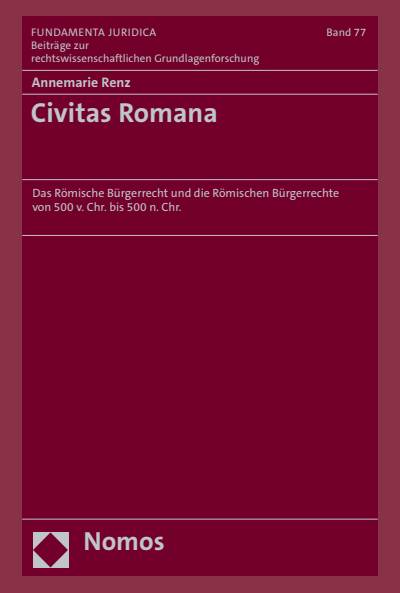
Civitas Romana
Das Römische Bürgerrecht und die Römischen Bürgerrechte von 500 v. Chr. bis 500 n. Chr.- Autor:innen:
- Reihe:
- Fundamenta Juridica, Band 77
- Verlag:
- 2023
Zusammenfassung
Das Buch ist die erste vollständige Darstellung des Römischen Bürgerrechts vom Beginn der Republik bis zum Ausklang der Antike aus der Feder einer Juristin. Sämtliche Voraussetzungen, die zum Erwerb des Bürgerrechts führten, wie Abstammung, Freilassung oder Bürgerrechtsverleihungen, werden im Rahmen historischer Abläufe erläutert. Gerade Migrationsbewegungen spielten in diesem Zusammenhang eine erhebliche Rolle. Als Grundlage wurden sämtliche juristische und literarische Texte neu interpretiert sowie zahlreiche Passagen aus Ciceros Reden zum Römischen Bürgerrecht neu übersetzt. Besondere Aufmerksamkeit wurde dem Aufbau des Römischen Staates gewidmet und der universellen Bürgerrechtsverleihung durch die Constitutio Antoniniana im Jahre 212 n. Chr. Die Schichtenspezifität des Römischen Bürgerrechts könnte der heutigen EU zum Vorbild dienen.
Schlagworte
Publikation durchsuchen
Bibliographische Angaben
- Copyrightjahr
- 2023
- ISBN-Print
- 978-3-7560-1126-1
- ISBN-Online
- 978-3-7489-4243-6
- Verlag
- Nomos, Baden-Baden
- Reihe
- Fundamenta Juridica
- Band
- 77
- Sprache
- Deutsch
- Seiten
- 909
- Produkttyp
- Monographie
Inhaltsverzeichnis
- Titelei/Inhaltsverzeichnis Kein Zugriff Seiten 1 - 22
- Einführung Kein Zugriff Seiten 23 - 26
- Zur Republik Kein Zugriff
- Zum Prinzipat Kein Zugriff
- 1.1 Quellen Kein Zugriff
- 1.2 Die Forschung Kein Zugriff
- 1.3 Historische Phasen Kein Zugriff
- 2.1.1 Abstammung Kein Zugriff
- 2.1.2 Recht und Gewohnheit Kein Zugriff
- 2.1.3 Gesetz und Magistrate Kein Zugriff
- 2.1.4 Freilassungen Kein Zugriff
- 2.2 Rechte und Pflichten der Staatsbürger Kein Zugriff
- 2.3 Ius civile Kein Zugriff
- 2.4 Die peregrini im Verhältnis zu den cives Kein Zugriff
- 3.1 Einführung Kein Zugriff
- 3.2.1.1 Commercium Kein Zugriff
- 3.2.1.2 Conubium Kein Zugriff
- 3.3.1.1 Einführung Kein Zugriff
- 3.3.1.2 Die „Entdeckung“ des Migrationsrechtes durch Niebuhr Kein Zugriff
- 3.3.1.3 Mommsen und das Migrationsrecht Kein Zugriff
- 3.3.1.4 Das Migrationsrecht in der romanistischen Forschung Kein Zugriff
- 3.3.1.5 Die Althistoriker und das Migrationsrecht Kein Zugriff
- 3.3.1.6 Das foedus Cassianum und die „Isopoliteia“ Kein Zugriff
- 3.3.1.7 Bewertung der Quelle Dionys von Halikarnass Kein Zugriff
- 3.3.1.8 Die Interpretation des bei Dionys überlieferten foedus Cassianum Kein Zugriff
- 3.3.1.9 Conclusionen zum foedus Cassianum Kein Zugriff
- 3.3.1.10 Conclusionen zum ius migrandi Kein Zugriff
- 3.3.2 Ius suffragii Kein Zugriff
- 4.1 Einführung Kein Zugriff
- 4.2 Municipia optimo iure Kein Zugriff
- 4.3 Civitates (municipia) sine suffragio Kein Zugriff
- 4.4 Municipia Latina Kein Zugriff
- 4.5.1 Einführung Kein Zugriff
- 4.5.2 Das Recht von Ariminum oder der zwölf Kolonien Kein Zugriff
- 4.6 Coloniae Civium Romanorum Kein Zugriff
- 4.7 Civitates foederatae Kein Zugriff
- 4.8 Eigenstaatlichkeit versus civitas Romana Kein Zugriff
- 5.1.1 Einführung Kein Zugriff
- 5.1.2 Die Maßnahmen des Jahres 187 v. Chr. Kein Zugriff
- 5.1.3.1 Das Migrationsgesetz Kein Zugriff
- 5.1.3.2 Die Umgehungsversuche des Migrationsgesetzes Kein Zugriff
- 5.1.3.3 Zur ratio legis des Migrationsgesetzes Kein Zugriff
- 5.1.3.4 Die Maßnahmen des Jahres 172 v. Chr. Kein Zugriff
- 5.1.3.5 Die Latiner aus Ferentinum Kein Zugriff
- 5.1.3.6 Migrationsströme aus der Poebene Kein Zugriff
- 5.1.3.7 Conclusionen Kein Zugriff
- 6.1 Marcus Iunius Pennus und Marcus Fulvius Flaccus Kein Zugriff
- 6.2 Zur provocatio ad populum Kein Zugriff
- 6.3.1 Einführung Kein Zugriff
- 6.3.2 Ursprung der Maßnahme Kein Zugriff
- 6.3.3 Die lex Acilia de repetundis: Der Text Kein Zugriff
- 6.3.4 Die lex Acilia und die Latiner Kein Zugriff
- 6.3.5 Das latinische Amt und das Römische Bürgerrecht Kein Zugriff
- 6.3.6 Conclusionen Kein Zugriff
- 6.4 Gaius Gracchus Kein Zugriff
- 6.5 Conclusionen Kein Zugriff
- 7.1 Einführung Kein Zugriff
- 7.2 Cicero und die lex Licinia Mucia Kein Zugriff
- 7.3 Die Quaestio und der Inhalt des Gesetzes Kein Zugriff
- 7.4 Das Repetundenverfahren auf der Grundlage der lex Servilia Kein Zugriff
- 7.5 Die ratio legis und die mögliche Vorgehensweise Kein Zugriff
- 7.6 Marcus Perperna (Perpenna) oder eine irrige Überlieferung zum Verlust des Bürgerrechts Kein Zugriff
- 8.1 Einführung Kein Zugriff
- 8.2 Der Kampf der italischen Bundesgenossen um das Römische Bürgerrecht Kein Zugriff
- 9.1 Einführung Kein Zugriff
- 9.2.1 Die lex Calpurnia Kein Zugriff
- 9.2.2 Gaius Marius und die Verleihung des Römischen Bürgerrechts durch den Feldherren Kein Zugriff
- 9.3.1 Einführung Kein Zugriff
- 9.3.2 Die Zielgruppe des Gesetzes Kein Zugriff
- 9.3.3 Zur Anwendung des Gesetzes Kein Zugriff
- 9.3.4 Die Einschreibung in die tribus Kein Zugriff
- 9.3.5 Einzelverleihungen durch Feldherren Kein Zugriff
- 9.4 Die lex Plautia Papiria Kein Zugriff
- 9.5 Weitere Bürgerrechtsverleihungen an die militärisch besiegten socii Kein Zugriff
- 9.6 Conclusionen Kein Zugriff
- 10.1 Der Fall Carteia Kein Zugriff
- 10.2 Die latinitas in Transpadanien Kein Zugriff
- 10.3 Das ius adipiscendae civitatis per magistratum ab der lex Pompeia Kein Zugriff
- 10.4 Weitere Übernahmen des ius Latii Kein Zugriff
- 10.5 Conclusionen Kein Zugriff
- 11.1 Transpadanien Kein Zugriff
- 11.2 Römische Bürgerkolonien Kein Zugriff
- 11.3.1 Die Gallia Narbonensis Kein Zugriff
- 11.3.2 Die hiberischen Provinzen Kein Zugriff
- 11.3.3 Utica in Nordafrika Kein Zugriff
- 11.3.4 Conclusionen Kein Zugriff
- 11.4 Sizilien Kein Zugriff
- 11.5 Individuelle Verleihungen an Einzelpersonen Kein Zugriff
- 11.6 Conclusionen Kein Zugriff
- 12.1.1 Einleitung Kein Zugriff
- 12.1.2.1 Die Verteidigungsstrategie Kein Zugriff
- 12.1.2.2 Die Argumente der Anklage Kein Zugriff
- 12.1.3.1 Die Bürgerrechtsverleihung durch Pompeius Kein Zugriff
- 12.1.3.2 Müssen verbündete Gemeinwesen Römische Gesetze in ihre Rechtsordnungen übernehmen? Das Problem des fundus fieri Kein Zugriff
- 12.1.3.3 Die Übernahme Römischer Gesetze durch die Latiner - Die Übernahme der lex Iulia de civitate durch die unmittelbar Betroffenen Kein Zugriff
- 12.1.3.4 Die Freiheit anderer Gemeinwesen, Römisches Recht zu übernehmen - Die Ausschließlichkeit der Kompetenz der Verleihung der Römischen Zivität durch Römische Amtsträger an wen auch immer zur Bel... Kein Zugriff
- 12.1.3.5 Die Freiwilligkeit des Wechsels des Bürgerrechts: Absolutes Erfordernis der Zustimmung des Neubürgers Kein Zugriff
- 12.1.3.6 Die rechtliche Unmöglichkeit der doppelten „Staatsbürgerschaft“ Kein Zugriff
- 12.1.3.7 Kein Zusammenhang zwischen dem foedus und dem Erwerb des Bürgerrechts - Wie kann ein Römer Bürger von Gades werden? Mehrfachbürgerrecht bei anderen Völkern Kein Zugriff
- 12.1.3.8 Das Mehrfachbürgerrecht bei den Griechen - Die Römer sind frei, das Bürgerrecht an wen auch immer zu verleihen Kein Zugriff
- 12.1.3.9 Die Unterschiede in den Rechtsordnungen als Begründung des Verbotes der Doppelstaatsbürgerschaft - Liberale Römische Praxis der Verleihung der Zivität Kein Zugriff
- 12.1.3.10 Ausschluss der Verleihung des Römischen Bürgerrechts in Verträgen mit manchen Völkerschaften. Da im Vertrag mit Gades davon keine Rede, so im Umkehrschluss völlige Freiheit der Römer, dieses... Kein Zugriff
- 12.1.3.11 Das foedus zwischen Rom und Gades war nie sakrosankt, da es nie in Form eines Volksbeschlusses bestätigt wurde Kein Zugriff
- 12.1.3.12 Foedus und Bürgerrecht Kein Zugriff
- 12.1.4.1.1 Einleitung Kein Zugriff
- 12.1.4.1.2 Das foedus zwischen Rom und Gades Kein Zugriff
- 12.1.4.1.3 Die Übernahme Römischen Rechts durch die Verbündeten Kein Zugriff
- 12.1.4.1.4 Hätte die lex Gellia Cornelia von Gades übernommen werden müssen? Kein Zugriff
- 12.1.4.1.5 Fundus fieri Kein Zugriff
- 12.1.4.2.1 Die Ausschließlichkeit des Römischen Bürgerrechts Kein Zugriff
- 12.1.4.2.2 Das Bürgerrecht in Griechenland Kein Zugriff
- 12.1.4.2.3 Die Geschichte des Römischen Bürgerrechts nach Cicero Kein Zugriff
- 12.1.4.2.4 Civitas Romana und ius civile Kein Zugriff
- 12.1.4.2.5 Die Ausschließlichkeit betreffend Rom und Gades Kein Zugriff
- 12.1.5 Conclusionen Kein Zugriff
- 12.2.1 Einführung Kein Zugriff
- 12.2.2.1 Eigentum und Besitz Kein Zugriff
- 12.2.2.2 Das Römische Bürgerrecht Kein Zugriff
- 12.2.3.1 Der Entzug des Römischen Bürgerrechts betreffend Volaterra Kein Zugriff
- 12.2.3.2 Zum Interdikt de vi armata Kein Zugriff
- 12.2.3.3 Zur Aberkennung des Römischen Bürgerrechts Kein Zugriff
- 12.2.4 Conclusionen Kein Zugriff
- 12.3.1 Einleitung Kein Zugriff
- 12.3.2 Juristische Einzelfragen aus der Rede gegliedert nach dem Aufbau der Rede Kein Zugriff
- 12.3.3.1 Einführung Kein Zugriff
- 12.3.3.2 Die lex Papia de peregrinis Kein Zugriff
- 12.3.3.3 Archias - ein adscriptus? Kein Zugriff
- 12.3.3.4 Lokaler und Römischer Zensus Kein Zugriff
- 12.3.3.5 Der Antrag beim Prätor Kein Zugriff
- 12.3.3.6 Konstitutive und deklaratorische Funktion der Eintragung in die Bürgerliste durch die Zensoren Kein Zugriff
- 12.3.4 Conclusionen Kein Zugriff
- 13.1 Die Ausschließlichkeit Kein Zugriff
- 13.2 Die Doppelbürgerschaft Kein Zugriff
- 13.3 Pomponius Atticus Kein Zugriff
- 13.4 Rhetorik und Staatsrecht Kein Zugriff
- 14.1 Einführung Kein Zugriff
- 14.2 Rechtsübernahme durch fundus fieri Kein Zugriff
- 14.3 Aulus Gellius „Noctes Atticae“ 16, 13, 1-5 Kein Zugriff
- 15. Das Exil Kein Zugriff
- 16.1 Einführung Kein Zugriff
- 16.2 Der Fall des griechischen Übersetzers Menandros Kein Zugriff
- 16.3 Das postliminium im Kriegsfall Kein Zugriff
- 16.4 Conclusionen Kein Zugriff
- 17. Der Erwerb des Römischen Bürgerrechts auf dem Wege der Freilassung Kein Zugriff
- 18.1.1 Einführung Kein Zugriff
- 18.1.2 Cicero und die Vorbehaltsklausel Kein Zugriff
- 18.1.3 Conclusionen Kein Zugriff
- 18.2 Camerinum Kein Zugriff
- 18.3 Individuelle Verleihungen an Einzelpersonen Kein Zugriff
- 19.1 Einführung Kein Zugriff
- 19.2 Cicero im Exil: Die lex Clodia und die interdictio Kein Zugriff
- 19.3 Verleihung und Entzug des Bürgerrechts Kein Zugriff
- 19.4 Sullas Gesetzgebung zum Bürgerrechtsentzug bezüglich Volaterra und Arretium Kein Zugriff
- 19.5 Conclusionen Kein Zugriff
- 20. Conclusionen zum ersten Teil Kein Zugriff
- 21.1 Quellen Kein Zugriff
- 21.2 Die Forschung Kein Zugriff
- 21.3.1 Einführung Kein Zugriff
- 21.3.2 Römische Bürgerkolonien Kein Zugriff
- 21.3.3 Das municipium in den Provinzen Kein Zugriff
- 21.3.4 Latinische Kolonien und Munizipien in den Provinzen Kein Zugriff
- 21.3.5.1 Einführung Kein Zugriff
- 21.3.5.2 Lauriacum Kein Zugriff
- 21.3.5.3 Troesmis Kein Zugriff
- 21.3.5.4 Conclusionen Kein Zugriff
- 21.3.6.1 Einführung Kein Zugriff
- 21.3.6.2 Peregrini in Ägypten Kein Zugriff
- 21.3.6.3 Peregrini dediticii Kein Zugriff
- 21.3.6.4 Der Codex Justinians Kein Zugriff
- 21.3.7 Conclusionen Kein Zugriff
- 21.4 Historische Abläufe Kein Zugriff
- 22.1.1 Seleukos von Rhosos Kein Zugriff
- 22.1.2 Das dritte Edikt von Kyrene Kein Zugriff
- 22.2 Die Doppelbürgerschaft ab Augustus Kein Zugriff
- 22.3.1 Einführung Kein Zugriff
- 22.3.2 Die Weiterentwicklung der territorialen latinitas Kein Zugriff
- 22.3.3 Das Latium maius Kein Zugriff
- 22.4.1 Einführung Kein Zugriff
- 22.4.2.1 Die Entstehung des Gesetzes und die ratio legis Kein Zugriff
- 22.4.2.2 Der Inhalt des Gesetzes Kein Zugriff
- 22.4.2.3 Altersgrenzen und Erwerb des latinischen Bürgerrechts Kein Zugriff
- 22.4.2.4 Das Alter des Freilassers Kein Zugriff
- 22.4.2.5 Die Bestimmungen betreffend den Erwerb des Römischen Bürgerrechts durch die Latini Aelinani Kein Zugriff
- 22.4.2.6 Das conubium und die lex Aelia Sentia Kein Zugriff
- 22.4.2.7 Die Rechte der weiblichen Freigelassenen Kein Zugriff
- 22.4.2.8 Das senatus consultum Hadrians Kein Zugriff
- 22.4.2.9 Die Tabula Herculanensis 89 Kein Zugriff
- 22.5 Conclusionen Kein Zugriff
- 23.1.1 Einführung Kein Zugriff
- 23.1.2 Zur Datierung der lex Iunia Norbana Kein Zugriff
- 23.1.3.1 Die prätorischen Freilassungen und die Latini Iuniani Kein Zugriff
- 23.1.3.2 Sklaven im bonitairschen Eigentum Kein Zugriff
- 23.1.4 Der Erwerb des Römischen Bürgerrechts durch iteratio oder beneficium principis Kein Zugriff
- 23.1.5.1 Das Erbrecht der Latini Iuniani Kein Zugriff
- 23.1.5.2 Commercium und conubium der Latini Iuniani Kein Zugriff
- 23.1.5.3 Der Senatsbeschluss unter den Konsuln Pegasus und Pusio Kein Zugriff
- 23.1.6 Die Kinder der Latini Iuniani Kein Zugriff
- 23.1.7 Conclusionen Kein Zugriff
- 23.2 Das senatus consultum Largianum Kein Zugriff
- 23.3 Trajan und Hadrian Kein Zugriff
- 23.4 Latini ex lege Aelia Sentia und Latini ex lege Iunia Norbana Kein Zugriff
- 23.5.1 Einführung Kein Zugriff
- 23.5.2 Militärdienst Kein Zugriff
- 23.5.3 Schiffsbau Kein Zugriff
- 23.5.4 Gebäudeerrichtungen in Rom Kein Zugriff
- 23.5.5 Das Bäckerhandwerk Kein Zugriff
- 23.6 Justinian Kein Zugriff
- 23.7 Conclusionen Kein Zugriff
- 24.1 Die Usurpation des Bürgerrechts Kein Zugriff
- 24.2 Die Bronzetafel von Cles und die Verleihung des Römischen Bürgerrechts an alpine Stämme Kein Zugriff
- 24.3.1 Einführung Kein Zugriff
- 24.3.2 Die Tabula Claudiana I - Der Fund Kein Zugriff
- 24.3.3 Der Bericht des Tacitus Kein Zugriff
- 24.3.4 Die Tabula Claudiana II - Der Text Kein Zugriff
- 24.3.5 Das ius honorum und das Bürgerrecht zweiter Klasse Kein Zugriff
- 24.3.6 Unmittelbare Aufnahme in den Senat oder in den Senatorenstand? Kein Zugriff
- 24.3.7 Conclusionen Kein Zugriff
- 24.4 Das Römische Bürgerrecht in Volubilis (Provinz Mauretanien) Kein Zugriff
- 25.1 Einführung Kein Zugriff
- 25.2 Die Militärdiplome Kein Zugriff
- 25.3 Besonderheiten der Verleihung Kein Zugriff
- 25.4 Die Veränderungen unter Antoninus Pius Kein Zugriff
- 25.5 Die Römischen Legionäre Kein Zugriff
- 25.6 Quantifizierung des Bürgerrechtserwerbs: Die Methode von Mylan Lavan Kein Zugriff
- 25.7.1 Statistik und soziale Tiefenwirkung Kein Zugriff
- 25.7.2 Die Verleihung des Bürgerrechts an die Kinder der Veteranen Kein Zugriff
- 25.8 Conclusionen Kein Zugriff
- 26.1 Einführung Kein Zugriff
- 26.2.1 Einführung Kein Zugriff
- 26.2.2 Der Erwerb der civitas Romana Kein Zugriff
- 26.2.3 Familienrechtliche Konsequenzen und Freilassungen Kein Zugriff
- 26.2.4 Die Rechtsprechung Kein Zugriff
- 26.2.5 Conclusionen Kein Zugriff
- 27.1 Plinius und Trajan Kein Zugriff
- 27.2 Das Römische Bürgerrecht in Ägypten Kein Zugriff
- 27.3 Spezielle Rechtsfragen zum Plinius-Brief Kein Zugriff
- 27.4 Bürgerrechtsfragen unter Hadrian Kein Zugriff
- 27.5 Bürgerrechtsfragen aus der Zeit des Antoninus Pius Kein Zugriff
- 28.1 Die Bürgerrechtsverleihung des Jahres 168/169 n. Chr. durch Marcus Aurelius und Lucius Verus Kein Zugriff
- 28.2 Die Bürgerrechtsverleihung des Jahres 177 n. Chr. durch Marcus Aurelius und Commodus Kein Zugriff
- 28.3 Die Tabula Banasitana und Justinians Novelle 78 Kein Zugriff
- 28.4 Conclusionen Kein Zugriff
- 29.1 Einführung Kein Zugriff
- 29.2.1 Iustum matrimonium und conubium Kein Zugriff
- 29.2.2 Römer und Peregrine Kein Zugriff
- 29.2.3 Römer und Latiner Kein Zugriff
- 29.2.4 Sklaven und capitis deminuti Kein Zugriff
- 29.3 Die Irrtumsproblematik Kein Zugriff
- 30.1 Einführung Kein Zugriff
- 30.2 „Tituli ex corpore Ulpiani“ (5, 8) und Gai Inst. 1, 77-79 Kein Zugriff
- 30.3 Die lex Minicia und das conubium Kein Zugriff
- 30.4.1 Textkritik Kein Zugriff
- 30.4.2 Hypothesen zur Nennung der Latiner Kein Zugriff
- 30.4.3 Conubium zwischen Latinern und Peregrinen Kein Zugriff
- 30.4.4 Huschkes Ergänzung von Gai Inst. 1, 79 und das conubium zwischen Römern und Latinern Kein Zugriff
- 30.4.5 Die bei Gaius genannten anderen (alios) Latiner Kein Zugriff
- 30.4.6 Der Tatbestand der lex Minicia bezüglich der Latiner Kein Zugriff
- 30.5 Zum Namen und zum Datum der lex Minicia Kein Zugriff
- 31.1 Römisches Bürgerrecht von Kindern Römischer Mütter Kein Zugriff
- 31.2 Peregrini und Latini Kein Zugriff
- 31.3 Lex Aelia Sentia und Peregrine Kein Zugriff
- 31.4 Bürgerrechtserwerb und patria potestas Kein Zugriff
- 31.5 Sonderfragen der Abstammung von Sklaven und Peregrinen Kein Zugriff
- 31.6 Conclusionen Kein Zugriff
- 32. Die Registrierung des Römischen Bürgerrechts Kein Zugriff
- 33.1 Einführung Kein Zugriff
- 33.2 Dion (Chrisostomos) von Prusa (etwa 40 bis 120 n. Chr.) Kein Zugriff
- 33.3 Aelius Aristides Kein Zugriff
- 33.4 Die Römische Staatsideologie der Elitenbildung im Osten im 2. Jhdt. n. Chr. Kein Zugriff
- 33.5 Cassius Dio und die Staatsideologie am Beginn des 3. Jhdts. n. Chr. Kein Zugriff
- 33.6 Sinn und Wert des Römischen Bürgerrechts Kein Zugriff
- 34. Polis und Imperium Kein Zugriff
- 35.1 Einführung Kein Zugriff
- 35.2 Römische Verwaltung in griechischen Provinzen - Sizilien, die erste (teilweise) griechische Provinz Kein Zugriff
- 35.3 Cicero in Kilikien Kein Zugriff
- 35.4 Die Tabula Contrebiensis Kein Zugriff
- 35.5.1 Die lateinische Sprache im Osten Kein Zugriff
- 35.5.2 Die Gerichtsbarkeit in den griechischen poleis Kein Zugriff
- 35.5.3 Ein IPR im Römischen Reich? Kein Zugriff
- 35.5.4 Der Fall Aphrodisias Kein Zugriff
- 35.5.5 Die Anwendung des lokalen griechischen Rechts Kein Zugriff
- 35.6.1 Grundsätzliches Kein Zugriff
- 35.6.2 Rechts- und Prozesswesen in Athen unter Marc Aurel Kein Zugriff
- 35.7 Die Römer in Judaea und das jüdische Recht Kein Zugriff
- 35.8 Ägypten Kein Zugriff
- 35.9 Conclusionen Kein Zugriff
- 36. Conclusionen zu Teil II - Das Römische Bürgerrecht von Augustus bis zur Constitutio Antoniniana Kein Zugriff
- 37.1 Einleitung Kein Zugriff
- 37.2 Die Urheberschaft der Constitutio Antoniniana Kein Zugriff
- 38.1 Einführung Kein Zugriff
- 38.2.1 An wen wurde das Bürgerrecht verliehen? Kein Zugriff
- 38.2.2 Die Ergänzung „χωρίς τῶν δεδειτικίων - choris ton dedeitikion“ Kein Zugriff
- 38.2.3 Die Ergänzung „μένοντος τοῦ δικαίου τῶν πολιτευμάτων - menontos tou dikaiou ton politeumaton“ Kein Zugriff
- 38.2.4 Die Ergänzung „ἀδδειτικίων - addeitikion“ Kein Zugriff
- 38.3 Die dediticii Kein Zugriff
- 38.4 Die Edikte des Papyrus Giessen Kein Zugriff
- 38.5 Übersetzung der Zeilen 1 bis 10 des Papyrus Giessen 40 I Kein Zugriff
- 39.1 Einführung Kein Zugriff
- 39.2 Kostas Buraselis: „Theia Dorea“ Kein Zugriff
- 39.3 Chiara Corbo: „Constitutio Antoniniana - Ius Philosophia Religio” Kein Zugriff
- 39.4 Clifford Ando und „Citizenship and Empire in Europe 200-1900“ Kein Zugriff
- 39.5 Alex Imrie und „The Antonine Constitution“ Kein Zugriff
- 39.6 Barbara Pferdehirt/Markus Scholz: „Bürgerrecht und Krise“ Kein Zugriff
- 39.7 Arnaud Besson: „Constitutio Antoniniana“ Kein Zugriff
- 39.8 Weitere Stellungnahmen Kein Zugriff
- 40.1 Cassius Dio und die Erhöhung der Erbschaftssteuer Kein Zugriff
- 40.2.1 Einführung Kein Zugriff
- 40.2.2 Plinius der Jüngere und die Erbschaftssteuer Kein Zugriff
- 40.3.1 Nahe Verwandte Kein Zugriff
- 40.3.2 Die Neubürger und das ius cognationis Kein Zugriff
- 40.4 Die Geringfügigkeitsgrenze Kein Zugriff
- 40.5 Die Testamentseröffnung Kein Zugriff
- 41.1 Einführung Kein Zugriff
- 41.2 Fiskalpolitische Maßnahme Kein Zugriff
- 41.3 Neuorganisation und Finanzierung des Militärs Kein Zugriff
- 41.4 Die Egalisierungstendenzen Kein Zugriff
- 41.5 Der geistige Hintergrund Kein Zugriff
- 41.6 Kaiser Caracallas persönliche Gründe Kein Zugriff
- 41.7 Conclusionen Kein Zugriff
- 42. Conclusionen zur Constitutio Antoniniana Kein Zugriff
- 43.1 Einführung Kein Zugriff
- 43.2 Lokale Gewohnheiten und Römisches Recht Kein Zugriff
- 43.3 Das Studium des Römischen Rechts in den griechischsprachigen Provinzen Kein Zugriff
- 43.4 Herennius Modestinus und das Recht von Chios Kein Zugriff
- 43.4 Ägypten Kein Zugriff
- 43.5 Conclusionen Kein Zugriff
- 44. Das Ende der Volksrechte Kein Zugriff
- 45.1 Einleitung Kein Zugriff
- 45.2 Die civis Romana im Römischen Privatrecht Kein Zugriff
- 45.3 Die civis Romana im öffentlichen Recht Kein Zugriff
- 45.4 Conclusionen Kein Zugriff
- 46.1 Einführung Kein Zugriff
- 46.2 Historischer Überblick zur Spätantike Kein Zugriff
- 46.3 Die Ansiedlung der Migranten Kein Zugriff
- 46.4 Das Römische Bürgerrecht Kein Zugriff
- 46.5 Peregrini Kein Zugriff
- 46.6 Eherecht Kein Zugriff
- 46.7 Die Migrationen zwischen Inklusion und Exklusion als Ursache des Niederganges des Römischen Staates Kein Zugriff
- 46.8 Conclusionen Kein Zugriff
- Zur Republik Kein Zugriff
- Zum Prinzipat Kein Zugriff
- Schlussbetrachtungen Kein Zugriff
- Abkürzungen Kein Zugriff Seiten 839 - 840
- Literaturverzeichnis Kein Zugriff Seiten 841 - 878
- I. Quelleneditionen Kein Zugriff
- II. Quellenregister Kein Zugriff
- 1. Juristische Quellen Kein Zugriff
- 2. Epigraphische Quellen und Papyri Kein Zugriff
- 3. Literarische Quellen Kein Zugriff
- 1. Moderne Autoren Kein Zugriff
- 2. Historische Persönlichkeiten Kein Zugriff
- Sach- und Ortsregister Kein Zugriff Seiten 901 - 909
Literaturverzeichnis (826 Einträge)
Es wurden keine Treffer gefunden. Versuchen Sie einen anderen Begriff.
- R. Orestano, L’appello civile in diritto Romano, Torino, 1966. Google Scholar öffnen doi.org/10.5771/9783748942436
- A. Pagden, Roman Citizenship, Empire and Challenges of Sovereignty, in: C. Ando, Citizenship and Empire in Europe, Stuttgart, 2016, 246f. Google Scholar öffnen doi.org/10.5771/9783748942436
- A. Palma, Civitas Romana, civitas mundi Saggio sulla cittadinanza romana, Torino, 2020. Google Scholar öffnen doi.org/10.5771/9783748942436
- S. Panciera, La condizione giuridica dei classiarii (e degli equites singulares) in età imperiale. Stato della questione e prospettive di ricerca, in: ders. Epigrafi, Epigrafia, Epigrafisti, II, Rome, 2006, 1411-1414. Google Scholar öffnen doi.org/10.5771/9783748942436
- T. Parsons, Politics and Social Structure, New York, 1969, 252-291. Google Scholar öffnen doi.org/10.5771/9783748942436
- Ch. G. Paulus, Das römische Bürgerrecht als begehrtes Privileg; Cicero verteidigt Aulus Licinius Archias und Cornelius Balbus, in: U. Manthe/J. v. Ungern-Sternberg (Hrsg.), Große Prozesse der römischen Antike, München, 1997, 100-114. Google Scholar öffnen doi.org/10.5771/9783748942436
- D. Peacock, The Roman Period (30 BC-AD 311), in: I. Shaw, The Oxford History of Ancient Egypt, Oxford-New York, 2000, 422-455. Google Scholar öffnen doi.org/10.5771/9783748942436
- L. Peppe, Civis Romana, Lecce, 2016. Google Scholar öffnen doi.org/10.5771/9783748942436
- B. Periñan Gomez, Apuntes sobre la lex Gellia Cornelia de civitate danda, in: B. Periñan Gomez, Derecho, persona y ciudadania, una experencia juridica comparada, Madrid-Barcelona-Buenos Aires, 2010. Google Scholar öffnen doi.org/10.5771/9783748942436
- B. Periñan Gomez, El Proceso contra Lucius Cornelius Balbus Maior. Estudio Juridico, Madrid, 2011. Google Scholar öffnen doi.org/10.5771/9783748942436
- G. Perl, Die Rede des Kaisers Claudius für die Aufnahme römischer Bürger aus Gallia Comata in den Senat (CIL 13, 1668), in: Philologus 140 (1996), 114-138. Google Scholar öffnen doi.org/10.5771/9783748942436
- A. Petrucci, Colonie romane e latine nel V e IV sec.a. C.: i problemi, in: F. Serrao (Hrsg.), Legge e società nella repubblica romana, II, Napoli, 2000, 8-10, 14f, 152-177. Google Scholar öffnen doi.org/10.5771/9783748942436
- A. Petrucci, Dialettica tra plebe e senato nella deduzione di colonie della seconda metà del IV sec a. C.: Riflessi economico sociali e giuridici, in: F. Serrao (Hrsg.), Legge e Società II, Napoli, 2000, 19-93. Google Scholar öffnen doi.org/10.5771/9783748942436
- B. Pferdehirt, Die Dynastie der Severer, in: B. Pferdehirt/M. Scholz (Hrsg.), Bürgerrecht und Krise. Die Constitutio Antoniniana 212 n. Chr. und ihre innenpolitischen Folgen, Mainz, 2012, 7-19. Google Scholar öffnen doi.org/10.5771/9783748942436
- B. Pferdehirt, Die steuerlichen Auswirkungen, in: B Pferdehirt/M. Scholz (Hrsg.), Bürgerrecht und Krise. Die Constitutio Antoniniana 212 n. Chr. und ihre innenpolitischen Folgen, Mainz, 2012, 62-65. Google Scholar öffnen doi.org/10.5771/9783748942436
- B. Pferdehirt/J. Kracker/M. Scholz, Neubürger mit Begeisterung? Die Auswirkungen der Constitutio Antoniniana auf das Individuum, in: Bürgerrecht und Krise. Die Constitutio Antoniniana 212 n. Chr. und ihre innenpolitischen Folgen Mainz, 2012, 59-61. Google Scholar öffnen doi.org/10.5771/9783748942436
- B. Pferdehirt/J. Kracker/M. Scholz, Zur Reaktion auf die Constitutio Antoniniana und zum Umfang der Bürgerrechtsverleihungen anhand des kaiserlichen Familiennamens Aurelius, in: B. Pferdehirt/M. Scholz (Hrsg.), Bürgerrecht und Krise. Die Constitutio Antoniniana 212 n. Chr. und ihre innenpolitischen Folgen, Mainz, 2012, 67-77. Google Scholar öffnen doi.org/10.5771/9783748942436
- B. Pferdehirt/M. Scholz (Hrsg.), Bürgerrecht und Krise. Die Constitutio Antoniniana 212 n. Chr. und ihre innenpolitischen Folgen, Mainz, 2012. Google Scholar öffnen doi.org/10.5771/9783748942436
- B. Pferdehirt/M. Scholz, Die Gründe für die Constitutio Antoniniana und ihre langfristigen Folgen, in: B. Pferdehirt/M. Scholz (Hrsg.), Bürgerrecht und Krise. Die Constitutio Antoniniana 212 n. Chr. und ihre innenpolitischen Folgen, Mainz, 2012, 85-88. Google Scholar öffnen doi.org/10.5771/9783748942436
- A. Pfiffig, Sulla, Etrurien und das Römische Bürgerrecht, in: Grazer Beiträge 8, 1979, 141-152. Google Scholar öffnen doi.org/10.5771/9783748942436
- S. E. Phang, The marriage of Roman soldiers (13 BC - AD 235), Leiden, 2001. Google Scholar öffnen doi.org/10.5771/9783748942436
- H. Philipp, s. v. „Lavinium”, in: PWRE XII/1 (1924) 1007-1012. Google Scholar öffnen doi.org/10.5771/9783748942436
- G. Piccottini, Virunum, in: M. Šašel Kos/P. Scherrer, The Autonomous Towns of Noricum and Pannonia - Die autonomen Städte in Noricum und Pannonien = Situla 40 Ljubljana, 2002, 103-134. Google Scholar öffnen doi.org/10.5771/9783748942436
- A. Piganiol, Les documents cadastraux de la colonie romaine d’ Orange, Paris, 1962. Google Scholar öffnen doi.org/10.5771/9783748942436
- F. Pina Polo, Deportation, Kolonisation, Migration: Bevölkerungsverschiebungen im republikanischen Italien und Formen der Identitätsbildung, in: M. Jehne/R. Pfeilschifter (Hrsg.), Herrschaft ohne Integration? Rom und Italien in republikanischer Zeit, Frankfurt/Main, 2006, 171-206. Google Scholar öffnen doi.org/10.5771/9783748942436
- P. Pinna Parpaglia, Sacra peregrina, civitas Romanorum, dediticii nel Papiro Giessen n. 40, Modena, 1995. Google Scholar öffnen doi.org/10.5771/9783748942436
- J. A. Pintado, Edictum, Municipium y Lex: Hispania en epoca Flavia (69-96 d. C.), Oxford, 2004. Google Scholar öffnen doi.org/10.5771/9783748942436
- D. J. Piper, The ius asdipiscendae civitatis Romanae per magistratum and its effects on Roman Latin Relations, in: Latomus 47 (1988) 59-68. Google Scholar öffnen doi.org/10.5771/9783748942436
- D. Placido Suarez, Tema y variaciones: La ciudadania griega y sus lecturas practicas y teoricas, in: Gerion 28 (2010) 7-20. Google Scholar öffnen doi.org/10.5771/9783748942436
- J. Platschek, Zur Rekonstruktion der bonae fidei iudicia, in: SZ 127 (2010) 275-285. Google Scholar öffnen doi.org/10.5771/9783748942436
- G. Poma, Dionigi di Alicarnasso e la cittadinanza romana, in: MEFRA 101 (1989) 187-205. Google Scholar öffnen doi.org/10.5771/9783748942436
- L. Pons Pujol, Consecuencias juridicas de una masacre: Volubilis, 40/41 d. C., in: Iura 56, (2006/7) 157-174. Google Scholar öffnen doi.org/10.5771/9783748942436
- A. v. Premerstein, Die fünf neu gefundenen Edikte des Augustus aus Kyrene, in: SZ 48 (1928) 419-584. Google Scholar öffnen doi.org/10.5771/9783748942436
- A. v. Premerstein, Die Tafel von Heraklea und die Acta Caesaris, in: SZ 43 (1922) 45-152. Google Scholar öffnen doi.org/10.5771/9783748942436
- G. F. Puchta, Cursus der Institutionen, 1. Band, Leipzig, 1841. Google Scholar öffnen doi.org/10.5771/9783748942436
- G. Pugliese, Riflessioni sull’editto di Cicerone in Cilicia, in: Synteleia V. Arangio-Ruiz II, Napoli, 1964, 972- 986. Google Scholar öffnen doi.org/10.5771/9783748942436
- G. Purpura, Constitutio Antoniniana de civitate (212 d. C) (P. Giess 40 I = FIRA I, 88), in: G. Purpura, Revisione ed integrazione delle Fontes Iuris Romani Anteiustiniani (FIRA) Studi preparatori I Leges, Torino, 2012, 695-724. Google Scholar öffnen doi.org/10.5771/9783748942436
- G. Purpura, Edicta Augusti ad Cyrenenses, in: G. Purpura, Revisione et integrazione delle Fontes Iuris Romani Anteiustiniani (FIRA) Studi preparatori I Leges, Torino, 2012, 433-486. Google Scholar öffnen doi.org/10.5771/9783748942436
- G. Purpura, Epistulae Octaviani Caesaris de Seleuco navarcha, in: G. Purpura, Revisione ed integrazione delle Fontes Iuris Romani Anteiustiniani (FIRA) Studi preparatori I Leges, Torino, 2012, 393-419. Google Scholar öffnen doi.org/10.5771/9783748942436
- G. Purpura, Tabula Banasitana de viritana civitate, in: G. Purpura, Revisione ed integrazione delle Fontes Iuris Romani Anteiustiniani (FIRA) Studi preparatori I Leges, Torino, 2012, 625-641. Google Scholar öffnen doi.org/10.5771/9783748942436
- G. Purpura, Il P. Giss. 40, I, in: Iuris Antiqui Historia 5 (2013) 73-85. Google Scholar öffnen doi.org/10.5771/9783748942436
- A. Rabello, Jewish and Roman Jurisdiction, in: N. S. Hecht/B. S. Jackson/S. M. Passamaneck/D. Piattelli/A. Rabello (Hrsg.), An Introduction in the History and Sources of Jewish Law, Oxford, 1996. Google Scholar öffnen doi.org/10.5771/9783748942436
- G. Radke, s. v. „Praeneste”, in: PWRE XXII (1954) 1549-1555. Google Scholar öffnen doi.org/10.5771/9783748942436
- A. Raggi, Cittadinanza colonaria e cittadinanza romana, in: Colonie romane nel mondo greco a cura di G. Salmeri, A. Raggi, A. Baroni, Roma, 2004, 55-68. Google Scholar öffnen doi.org/10.5771/9783748942436
- A. Raggi, Seleuco di Rhosos, Cittadinanza e privilegi nell’oriente greco in età tardo-repubblicana, Pisa-Roma, 2006. Google Scholar öffnen doi.org/10.5771/9783748942436
- A. Raggi/P. Buongiorno (Hrsg.), Il „senatus consultum de Plarasensibus et Aphrodisiensibus“, Stuttgart, 2020. Google Scholar öffnen doi.org/10.5771/9783748942436
- J. S. Rainbird, The Vigiles of Rome, Durham, 1976. Google Scholar öffnen doi.org/10.5771/9783748942436
- J. M. Rainer, Zum Ursprung der extraordinaria cognitio, in: Festschrift W. Litewski, Krakau, 2004. Google Scholar öffnen doi.org/10.5771/9783748942436
- J. M. Rainer, La jurisdictio a Roma e in periferia nel I e nel II sec. d. C, in: F. Milazzo (Hrsg.), Città e diritto privato nei primi due secoli dell’ impero, Napoli, 2010, 131-152 u. 168-169. Google Scholar öffnen doi.org/10.5771/9783748942436
- J. M. Rainer, Der Untergang des Römischen Reiches und die Romanisten, in: FS für Alfons Bürge, hrsg. v. U. Babusiaux/P. Nobel/J. Platschek, Zürich-Basel-Genf, 2017, 523-536. Google Scholar öffnen doi.org/10.5771/9783748942436
- J. M. Rainer, Das Römische Recht in Europa, Wien, 2020. Google Scholar öffnen doi.org/10.5771/9783748942436
- E. Rawson, Fregellae: Fall and Survival, in: F. Coarelli/P. G. Monti, Fregellae: Le Fonti, La Storia, il Territorio, Roma, 1998, Google Scholar öffnen doi.org/10.5771/9783748942436
- F. Reduzzi Merola, Le donne nei documenti della prassi campana, in: Index 40 (2012) 380-386. Google Scholar öffnen doi.org/10.5771/9783748942436
- J. M. Reynolds, Aphrodisias and Rome, London, 1982. Google Scholar öffnen doi.org/10.5771/9783748942436
- J. M. Reynolds/Ch. Roueché/G. Bodard, Inscriptions of Aphrodisias, London, 2007. Google Scholar öffnen doi.org/10.5771/9783748942436
- S. Riccobono jr., Il Gmonon dell’ Idios Logos, Palermo, 1950. Google Scholar öffnen doi.org/10.5771/9783748942436
- J. S. Richardson, The Tabula Contrebiensis. Roman Law in Spain in the Early First Century B. C., in: JRS 73 (1983) 33-41. Google Scholar öffnen doi.org/10.5771/9783748942436
- J. S. Richardson, Les peregrini et l’idée d’ „Empire“ sous la République romaine, in: RHDFE 68 (1990) 147-154. Google Scholar öffnen doi.org/10.5771/9783748942436
- W. Riess, Die Rede des Claudius über das Ius Honorum der Gallischen Notablen: Forschungsstand und Perspektiven, in: Revue des Études Anciennes (2003) 211-259. Google Scholar öffnen doi.org/10.5771/9783748942436
- Chr. Rigs, The Oxford Handbook of Roman Egypt, Oxford-New York, 2012. Google Scholar öffnen doi.org/10.5771/9783748942436
- R. Rilinger, Humiliores und Honestiores: Zu einer sozialen Dichotomie im Strafrecht der römischen Kaiserzeit, München, 1988. Google Scholar öffnen doi.org/10.5771/9783748942436
- M. Riße (Hrsg.), Volubilis. Eine römische Stadt in Marokko von der Frühzeit bis in die islamische Periode, Mainz, 2001. Google Scholar öffnen doi.org/10.5771/9783748942436
- A. Rizakis, The Achaian League, in: H. Beck/P. Funke, Federalism in Greek Antiquity, Cambridge, 2015, 118-131. Google Scholar öffnen doi.org/10.5771/9783748942436
- M. Rocco, The reasons behind the Constitutio Antoniniana and its effects on the Roman military, in: Acta Classica Universitatis Scientiarum Debreceniensis 46 (2010) 131-146. Google Scholar öffnen doi.org/10.5771/9783748942436
- J. Rodriguez Garrido, Iustum matrimonium e ius conubii. Las uniones matrimoniales y el derecho de los latinos, in: Gerión 36 (2018) 593-609. Google Scholar öffnen doi.org/10.5771/9783748942436
- J.-D. Rodríguez Martín, Neu entdeckte Schriftspuren im Palimpsest des Gaius von Autun, In: SZ 130 (2013) 478–487. Google Scholar öffnen doi.org/10.5771/9783748942436
- J. F. Rodriguez Neila, Los Balbos de Gades: las claves de su promoción social y politica en Roma, in: J. Rodriguez Neila/E. Melchior Gil, Poder central y autonomia municipal: la proyección publica de las elites romanas en Occidente, Cordoba, 2006, 131-184. Google Scholar öffnen doi.org/10.5771/9783748942436
- S. T. Roselaar, The Concept of commercium in the Roman Republic, in: Phoenix 56 (2012) 381-413. Google Scholar öffnen doi.org/10.5771/9783748942436
- S. T. Roselaar, The Concept of conubium in the Roman Republic, in: J. P. Du Plessis (Hrsg.), New Frontiers, Law and Society in the Roman World, Edinburgh, 2013, 102-122. Google Scholar öffnen doi.org/10.5771/9783748942436
- S. T. Roselaar, Cicero and the Italians, Expansion of Empire, Creation of Law, in: P. J. Du Plessis, Cicero’s Laws, Rethinking Roman Law in the Late Republic, Cambridge, 2016, 146-151. Google Scholar öffnen doi.org/10.5771/9783748942436
- A. Rosenberg, Der Staat der alten Italiker. Untersuchungen über die ursprüngliche Verfassung der Latiner, Osker und Etrusker, Berlin, 1913. Google Scholar öffnen doi.org/10.5771/9783748942436
- A. Rosenberg, Die Entstehung des foedus Cassianum und des latinischen Rechts, in: Hermes 55 (1920) 337-363. Google Scholar öffnen doi.org/10.5771/9783748942436
- L. Ross Taylor, The Voting Districts of the Roman Republic, Rom, 1960. Google Scholar öffnen doi.org/10.5771/9783748942436
- L. Ross Taylor, Roman Voting Assemblies. From the Hannibalic War to the Dictatorship of Caesar, Ann Arbor, 1966. Google Scholar öffnen doi.org/10.5771/9783748942436
- M. I. Rostovtzeff, La crise sociale et politique de l’Empire Romain au III s. ap. J.-C., in: Musée Belge 27 (1923) 233-242. Google Scholar öffnen doi.org/10.5771/9783748942436
- G. Rotondi, Leges Publicae Popoli Romani: Elenco Cronologico con una Introduzione Sull’ Attività Legislativa del Comizi Romani, Milano, 1885. Google Scholar öffnen doi.org/10.5771/9783748942436
- G. Rotondi, Leges publicae populi Romani, Milano, 1912. Google Scholar öffnen doi.org/10.5771/9783748942436
- Ch. Roueché, The functions of the governor in Late Antiquity, in: Antiquité tardive 8 (1998) 31-36. Google Scholar öffnen doi.org/10.5771/9783748942436
- Ch. Roueché, Rome, Asia and Aphrodisias in the Third Century, in: JRS 71 (2012) 103-120. Google Scholar öffnen doi.org/10.5771/9783748942436
- M. M. Roxan, Roman Military Diploma I-V, London, 1978-2006 = RMD. Google Scholar öffnen doi.org/10.5771/9783748942436
- M. M. Roxan, Women on the frontiers, in: V. A. Maxfield/M. J. Dobson, Roman frontier studies, Exeter, 1991, 462-467. Google Scholar öffnen doi.org/10.5771/9783748942436
- H. Royden, The Tenure of Office of the Quinquennales in the Roman Professional Collegia, in: American Journal of Philology 110 (1989) 303-315. Google Scholar öffnen doi.org/10.5771/9783748942436
- N. Roymans, Ethnic Identity and Imperial Power: The Batavians in early Roman Empire, Amsterdam, 2004. Google Scholar öffnen doi.org/10.5771/9783748942436
- F. Russo, Sullo ius adipiscendae civitatis Romanae per magistratum nella lex Irnitana, in: Gerion 36/II (2018) 481-505. Google Scholar öffnen doi.org/10.5771/9783748942436
- C. Russo Ruggeri, Ancora sul contenuto e sui destinatari della lex Claudia de sociis, in: SDHI 64 (1998) 203-227. Google Scholar öffnen doi.org/10.5771/9783748942436
- E. Sachers, s. v. „Tabularium“, in PWRE IV A (1932) 1962-1969. Google Scholar öffnen doi.org/10.5771/9783748942436
- D. B. Saddington, The Development of the Roman Auxiliary Forces from Augustus to Trajan, in: ANRW II/3 (1975) 176-201. Google Scholar öffnen doi.org/10.5771/9783748942436
- D. B. Saddington, Classes, the Evolution of the Roman Imperial Fleets, in: P. Erdkamp (Hrsg.), A Companion to the Roman Army, Malden-Oxford, 2007, 201-217. Google Scholar öffnen doi.org/10.5771/9783748942436
- G. Salmeri, Dio, Rome and the Civic Life of Asia Minor, in: S. Swain (Hrsg.), Dio Chrisostom: Politics, Letters and Philosophy, Oxford, 2000, 53-92. Google Scholar öffnen doi.org/10.5771/9783748942436
- G. Salmeri/A. Raggi/A. Baroni (Hrsg.), Colonie romane nel mondo greco a cura di, Roma, 2004. Google Scholar öffnen doi.org/10.5771/9783748942436
- E. T. Salmon, Notes on the Social War, in: TAPhA 89 (1958) 159-184. Google Scholar öffnen doi.org/10.5771/9783748942436
- E. T. Salmon, The Roman Army and the Disintegration of the Roman Empire, in: Transactions of the Royal Society of Canada 3. Series sect. II 52 (1958) 43-57. Google Scholar öffnen doi.org/10.5771/9783748942436
- E. T. Salmon, Roman Colonization under the Republic, London, 1969. Google Scholar öffnen doi.org/10.5771/9783748942436
- E. T. Salmon, The Nemesis of Empire, Oxford, 1974. Google Scholar öffnen doi.org/10.5771/9783748942436
- P. Sanchez, La clause d’ exception sur l’ octroi de la citoyenneté romaine dans les traités entre Rome et ses alliés (Cicéron pro Balbo § 32), in: Athenaeum 95 (2007) 215-270. Google Scholar öffnen doi.org/10.5771/9783748942436
- P. Sanchez, Latini, id est foederati. Le statut juridique des colonies latines sous la République, in: Athenaeum 104 (2016) 50-83. Google Scholar öffnen doi.org/10.5771/9783748942436
- P. Sanchez, L’“Isopoliteia“ chez Denys d’Halikarnasse: nouvelle interprétation, in: Chiron 46 (2016) 47-83. Google Scholar öffnen doi.org/10.5771/9783748942436
- C. Sanchez/M. Ellart, Tabula Bantina, in: The Encyclopedia of Ancient History (2013) 6501-6503. Google Scholar öffnen doi.org/10.5771/9783748942436
- E. Sander, Das Recht des römischen Soldaten, in: Rheinisches Museum für Philologie 101 (1959) 152-191. Google Scholar öffnen doi.org/10.5771/9783748942436
- B. Santalucia (a cura di), Asconio Commento alle orazioni di Cicerone, Venezia, 2022. Google Scholar öffnen doi.org/10.5771/9783748942436
- Chr. Sasse, Die Constitutio Antoniniana, Eine Untersuchung über den Umfang der Bürgerrechtsverleihung aufgrund des Papyrus Giessen 40 I, Wiesbaden, 1958. Google Scholar öffnen doi.org/10.5771/9783748942436
- Ch. Saumagne, Le droit Latin et les cités Romaines sous l’ Empire, Paris, 1965. Google Scholar öffnen doi.org/10.5771/9783748942436
- F. C. v. Savigny, Erklärung der L. 22 pr. ad municipalem (50.1.), in: Zeitschrift für geschichtliche Rechtswissenschaft, 9 (1838) 91-98. Google Scholar öffnen doi.org/10.5771/9783748942436
- F. C. v. Savigny, Über die Entstehung und Fortbildung der Latinität als eines eigenen Standes im Römischen Staate, in: Vermischte Schriften I, Berlin, 1850. Google Scholar öffnen doi.org/10.5771/9783748942436
- G. Schanz, Studien zur Geschichte und Theorie der Erbschaftssteuer, in: Finanzarchiv 17 (1900) 1-62. Google Scholar öffnen doi.org/10.5771/9783748942436
- Ph. Scheibelreiter/N. Rafetseder, Neue Überlegungen zu Rechtsquellen der Provinz Noricum: Eine rechtshistorische Perspektive auf die Gesetzesfragmente aus Lauriacum, in SZ 138 (2021) 1-82. Google Scholar öffnen doi.org/10.5771/9783748942436
- W. Scheidel, Measuring Sex, Age and Death in the Roman Empire. Explorations in Ancient Demography, Ann Arbor, 1996. Google Scholar öffnen doi.org/10.5771/9783748942436
- W. Scheidel (Hrsg.), Debating Roman Demography, Leiden-Boston-Köln, 2001. Google Scholar öffnen doi.org/10.5771/9783748942436
- M. J. Schermaier, Bona fides im Römischen Vertragsrecht, in: L. Garofalo (Hrsg.), Atti Burdese III, Padova, 2001, 387-416. Google Scholar öffnen doi.org/10.5771/9783748942436
- U. Schillinger-Häfele, Claudius und Tacitus über die Aufnahme von Galliern in den Senat, in: Historia 14 (1965) 443-454. Google Scholar öffnen doi.org/10.5771/9783748942436
- O. Schipp, Der weströmische Kolonat von Konstantin bis zu den Karolingern (332 bis 861), Hamburg, 2009. Google Scholar öffnen doi.org/10.5771/9783748942436
- O. Schipp, Römer und Barbaren. Fremde in der Spätantike und im Frühmittelalter, in: A. Coşkun,/L. Raphael (Hrsg.), Fremd und rechtlos? Zugehörigkeitsrechte Fremder von der Antike bis zur Gegenwart, Köln, 2014, 121-151. Google Scholar öffnen doi.org/10.5771/9783748942436
- Chr. Schmetterer, Die rechtliche Stellung der römischen Soldaten im Prinzipat, Wiesbaden, 2012. Google Scholar öffnen doi.org/10.5771/9783748942436
- C. Schmieder, Pro Archia poeta, Verteidigung für den Dichter Archias, Berlin, 2010. Google Scholar öffnen doi.org/10.5771/9783748942436
- R. Scholl, Freilassung unter Freunden im römischen Ägypten, in: H. Bellen/H. Heinen, Fünfzig Jahre Forschungen zur Antiken Sklaverei an der Mainzer Akademie 1950-2000, Stuttgart, 2001, 159-169. Google Scholar öffnen doi.org/10.5771/9783748942436
- P. Scholz, Der Hellenismus, Der Hof und die Welt, München, 2015. Google Scholar öffnen doi.org/10.5771/9783748942436
- E. Schönbauer, Reichsrecht gegen Volksrecht? Studien über die Bedeutung der Constitutio Antoniniana für die Römische Rechtsentwicklung, in SZ 51 (1931) 277-335. Google Scholar öffnen doi.org/10.5771/9783748942436
- E. Schönbauer, Reichsrecht, Volksrecht und Provinzialrecht. Studien über die Bedeutung der Constitutio Antoniniana für die Römische Rechtsentwicklung, in: SZ 57 (1937) 309-355. Google Scholar öffnen doi.org/10.5771/9783748942436
- E. Schönbauer, Das Römische Recht nach 212 in ausschließlicher Geltung? in: Anzeiger Österreichische Akademie d. Wissenschaften 86 (1949) 369-389.E. Schönbauer, Municipium, Worterklärung und rechtliche Bedeutung, in: Akademie der Wissenschaften, Anzeiger der Philosophisch-Historischen Klasse (1949) 541-563. Google Scholar öffnen doi.org/10.5771/9783748942436
- E. Schönbauer, Munizipien und Doppelbürgerschaft im Römerreiche, in: Iura 1 (1950) 124-149. Google Scholar öffnen doi.org/10.5771/9783748942436
- E. Schönbauer, Die Rechtsordnung des Römischen Lauriacum, in: Anzeiger der ÖAW Philosophisch-Historische Klasse 95, Jahrgang 1958, 298-322. Google Scholar öffnen doi.org/10.5771/9783748942436
- E. Schönbauer, Personalitätsprinzip und Privatrechtsordnung, in: Anzeiger der österreichischen Akademie d. Wissenschaften (1960) 182-210. Google Scholar öffnen doi.org/10.5771/9783748942436
- E. Schönbauer, Drei interessante Inschriften aus Ephesos, in: Iura 16 (1965) 105-115. Google Scholar öffnen doi.org/10.5771/9783748942436
- F. Schulz, Geschichte der Römischen Rechtswissenschaft, Weimar, 1961, Google Scholar öffnen doi.org/10.5771/9783748942436
- E. Schwartz, Cassius 40, in PWRE III/2 (1899) 1684-1722; Google Scholar öffnen doi.org/10.5771/9783748942436
- A. Schwegler, Römische Geschichte, Zweiter Band, Römische Geschichte im Zeitalter des Kampfs der Stände, Tübingen, 1856. Google Scholar öffnen doi.org/10.5771/9783748942436
- R. Scuderi, Significato politico delle magistrature nelle città italiche del I secolo av. Cristo, in: Athenaeum 67 (1989) 117-138. Google Scholar öffnen doi.org/10.5771/9783748942436
- E. Seckel/W. Schubart, Der Gnomon des Idios Logos, Berlin, 1919. Google Scholar öffnen doi.org/10.5771/9783748942436
- O. Seeck, s. v. „colonatus”, in: PWRE IV/1, Stuttgart, 1900, 483-510. Google Scholar öffnen doi.org/10.5771/9783748942436
- G. Segrè, L’ editto di Caracalla relativo alla concessione della cittadinanza romana e sul papiro Giessen 40 I, in: Studi Perozzi, Palermo, 1925, 139-218. Google Scholar öffnen doi.org/10.5771/9783748942436
- F. Serrao, Appunti sui „patroni“ e sulla legittimazione attiva all’ accusa nei processi „repetundarum“, in: Studi De Francisci II, Milano, 1954, 490ff. Google Scholar öffnen doi.org/10.5771/9783748942436
- F. Serrao, La „Iurisdictio“ del pretore peregrino, Milano, 1954. Google Scholar öffnen doi.org/10.5771/9783748942436
- W. Seston, La lex Julia de 90 av. J.-C. et l’intégration des italiens dans la citoyenneté Romaine, in: W. Seston, Scripta varia, Rome, 1980, 19-32. Google Scholar öffnen doi.org/10.5771/9783748942436
- W. Seston/M. Euzennat, La citoyenneté Romaine au temps de Marc Aurel et de Commode d’après la Tabula Banasitana, in: CRAI 105 (1961) 468-490. Google Scholar öffnen doi.org/10.5771/9783748942436
- W. Seston/M. Euzennat, Un dossier de la chancellerie romaine: La Tabula Banasitana. Etude de diplomatique, in: Comptes rendus des séances de l’Académie des Inscriptions et Belles Lettres (1971) 468-490. Google Scholar öffnen doi.org/10.5771/9783748942436
- A. N. Sherwin-White, The Extortion Procedure Again, in: JRS 42 (1952) 43-55. Google Scholar öffnen doi.org/10.5771/9783748942436
- A. N. Sherwin-White, Racial Prejudice in Imperial Rome, Cambridge, 1967. Google Scholar öffnen doi.org/10.5771/9783748942436
- A. N. Sherwin-White, The Date of the Lex Repetundarum and its Consequences, in: JRS 62 (1972) 83-99. Google Scholar öffnen doi.org/10.5771/9783748942436
- A. N. Sherwin-White, The Roman Citizenship. A Survey of its Development into a World Franchise, in: ANRW I/2, Berlin, 1972. Google Scholar öffnen doi.org/10.5771/9783748942436
- A. N. Sherwin-White, The Lex Repetundarum and the Political Ideas of Gaius Gracchus, in: JRS 72 (1982) 18-31 Google Scholar öffnen doi.org/10.5771/9783748942436
- A. N. Sherwin-White, The Roman Citizenship, 2. Aufl., Oxford, 1973. Google Scholar öffnen doi.org/10.5771/9783748942436
- A. N. Sherwin-White, The Tabula of Banasa and the Constitutio Antoniniana, in: JRS 63 (1973) 86-98. Google Scholar öffnen doi.org/10.5771/9783748942436
- B. Simons, Cassius Dio und die Römische Republik, Beiträge zur Altertumskunde 273, Berlin/New York, 2009. Google Scholar öffnen doi.org/10.5771/9783748942436
- A. J. B. Sirks, Informal Manumission and the lex Junia, in: RIDA 28 (1981) 247-276. Google Scholar öffnen doi.org/10.5771/9783748942436
- A. J. B. Sirks, The lex Junia and the effects of Informal Manumission and Iteration, in RIDA 30 (1983) 211-292. Google Scholar öffnen doi.org/10.5771/9783748942436
- S. Sisani, Latinità non latina: lo ius Latii come strumento di integrazione delle comunità provinciali in età repubblicana, in: Gerion 36 (2018) 331-378. Google Scholar öffnen doi.org/10.5771/9783748942436
- H. Sivan, On Foederati, Hospitalitas and the Settlement of the Goths in A. D. 418, in: AJPh 108 (1987) 759-772. Google Scholar öffnen doi.org/10.5771/9783748942436
- M. Slusser, Gregor der Wundertäter, in: Theologische Realenzyklpädie 14, (1985) 188-191. Google Scholar öffnen doi.org/10.5771/9783748942436
- R. Sohm, Institutionen, Geschichte und System des römischen Privatrechts, 14. Aufl., Leipzig, Google Scholar öffnen doi.org/10.5771/9783748942436
- A. Söllner, Bona fides-Guter Glaube, in: SZ 122 (2005) 1-61. Google Scholar öffnen doi.org/10.5771/9783748942436
- M. Sommer, Römische Geschichte. Von den Anfängen bis zum Untergang, Stuttgart, 2021. Google Scholar öffnen doi.org/10.5771/9783748942436
- C. Soraci, Diritto latino, cittadinanza romana e municipalizzazione: trasformazioni graduali e progressive in Sicilia tra Cesare e Augusto, in: Dialogues d’Histoire Ancienne 44 (2018) 37-58. Google Scholar öffnen doi.org/10.5771/9783748942436
- T. Spagnuolo Vigorita, Cittadini e sudditi tra II e III secolo, in: Storia di Roma III/1, Torino, 1993. 5-50. Google Scholar öffnen doi.org/10.5771/9783748942436
- T. Spagnuolo Vigorita, Città e Impero, Napoli, 1996. Google Scholar öffnen doi.org/10.5771/9783748942436
- J. Spaul, Ala, The Auxilia Cavalry Units of the Prediocletianic Imperial Roman Army, Andover, 1994. Google Scholar öffnen doi.org/10.5771/9783748942436
- J. Spaul, Cohors 2, The evidence for and of a short history of the auxiliary infantry units of the Imperial Roman Army, Oxford, 2000. Google Scholar öffnen doi.org/10.5771/9783748942436
- M. P. Speidel, Die equites singulares Augusti. Begleittruppe der römischen Kaiser des zweiten und dritten Jahrhunderts, Bonn, 1965. Google Scholar öffnen doi.org/10.5771/9783748942436
- M. A. Speidel, Sold und Wirtschaftslage der Römischen Soldaten, in: Kaiser, Heer und Gesellschaft in der Römischen Kaiserzeit - Gedenkschrift für E. Birley, Hrsg. v. G. Alföldy/B. Dobson/W. Eck, Stuttgart, 1999, 65-94. Google Scholar öffnen doi.org/10.5771/9783748942436
- M. A. Speidel, Kaiserliche Privilegien, Urkunden und die „Militäranarchie“ des Zeitalters der „Soldatenkaiser“, Einige Beobachtungen, in: U. Babusiaux/A. Kolb, Das Recht der „Soldatenkaiser“, Rechtliche Stabilität in Zeiten politischen Umbruchs? Berlin, 2015, 46-64. Google Scholar öffnen doi.org/10.5771/9783748942436
- Th. Spitzl, Lex Municipii Malacitani, München, 1984. Google Scholar öffnen doi.org/10.5771/9783748942436
- A. Stefan, The Case of Multiple Citizenship Holders in the Graeco-Roman East, in: L. Cecchet/A. Busetto, Citizens in the Graeco-Roman World: Aspects of Citizenship from the Archaic Period to AD 212, Leiden, 2017, 110-131. Google Scholar öffnen doi.org/10.5771/9783748942436
- A. Steinwenter, s. v. „Ius Latii“, in: PWRE X/1 (1918) 1260-1278. Google Scholar öffnen doi.org/10.5771/9783748942436
- A. Steinwenter, s. v. „Latini Iuniani“, in: PWRE XII/1 (1924) 910-924. Google Scholar öffnen doi.org/10.5771/9783748942436
- F. Stella Maranca, Intorno alla „lex Iulia de vicensima hereditatium”, in: Rendiconti Accademia Lincei XXXIII (1924) 263-286. Google Scholar öffnen doi.org/10.5771/9783748942436
- R. Stichweh, Inklusion und Exklusion - Studien zur Gesellschaftstheorie, 2. Aufl., Bielefeld, 2016. Google Scholar öffnen doi.org/10.5771/9783748942436
- F. Sturm, Rezension von H. J. Wolff, Das Problem der Konkurrenz von Rechtsordnungen in der Antike, in: IURA 31 (1980). Google Scholar öffnen doi.org/10.5771/9783748942436
- F. Sturm, Ius gentium. Imperialistische Schönfärberei römischer Juristen, in: K. Muscheler, Römische Jurisprudenz - Dogmatik, Überlieferung, Rezeption, FS D. Liebs zum 75. Geburtstag, Berlin, 2011, 663-669. Google Scholar öffnen doi.org/10.5771/9783748942436
- J. Stroux, Die Constitutio Antoniniana, in: Philologus 88 (1933) 272-295. Google Scholar öffnen doi.org/10.5771/9783748942436
- J. Stroux/L. Wenger, Die Augustus-Inschrift auf dem Marktplatz von Kyrene, in: Abhandlungen der Bayerischen Akademie der Wissenschaften, Phil. Hist. Klasse 34, 2 (1928) 1-145. Google Scholar öffnen doi.org/10.5771/9783748942436
- R. Syme, The Provincial at Rome and Rome and the Balkans 80 B.C-A. D 14, Liverpool, 1999. Google Scholar öffnen doi.org/10.5771/9783748942436
- I. Syvanne, Caracalla, A military Biography, Barnsly, 2017. Google Scholar öffnen doi.org/10.5771/9783748942436
- W. Szaivert/R. Wolters, Löhne, Preise, Werte. Quellen zur Römischen Geldwirtschaft, Darmstadt, 2005. Google Scholar öffnen doi.org/10.5771/9783748942436
- E. Szántó, Das griechische Bürgerrecht, Freiburg, 1892. Google Scholar öffnen doi.org/10.5771/9783748942436
- M. Talamanca, Menandro di Laodicea e la Constitutio Antoniniana, in: Studi Volterra V, Milano, 1971, 433-560. Google Scholar öffnen doi.org/10.5771/9783748942436
- M. Talamanca (Hrsg.), Lineamenti di Storia del diritto romano, 2. Aufl., Milano, 1989. Google Scholar öffnen doi.org/10.5771/9783748942436
- M. Talamanca, I mutamenti della cittadinanza, in: Mélanges de l’école Francaise de Rome (1991) 703-733. Google Scholar öffnen doi.org/10.5771/9783748942436
- M. Talamanca, Particolarismo normativo ed unità della cultura giuridica nell’ esperienza romana, in: diritto generale e diritti particolari nell’esperienza storica, Atti del congresso internazionale della società italiana di storia del diritto, Torino, 19. bis 21. November 1998, Roma, 2001. Google Scholar öffnen doi.org/10.5771/9783748942436
- M. Talamanca, La bona fides nei giuristi romani: „Leerformeln” e valori dell’ordinamento, in: L. Garofalo, Atti Burdese IV, Padova, 2001, 1-312. Google Scholar öffnen doi.org/10.5771/9783748942436
- M. Talamanca, Aulo Gellio ed i municipes. Per un ‘esegesi di noctes atticae 16, 13, in: L. Capogrossi Colognesi/E. Gabba (Hrsg.), Gli statuti municipali, Pavia, 2006, 443-513 Google Scholar öffnen doi.org/10.5771/9783748942436
- M. Tarpin, Strangers in Paradise, Latins (and some other non-Romans) in colonial context: a short history of territorial complexity, in: T. Stek/J. Pelgrom, Roman Republican Colonization. New Perspective from Archeology and Ancient History, Roma, 2014, 160-192 Google Scholar öffnen doi.org/10.5771/9783748942436
- R. Taubenschlag, Die Römischen Behörden und das Volksrecht vor und nach der Constitutio Antoniniana, in: SZ 69 (1952) 102-127. Google Scholar öffnen doi.org/10.5771/9783748942436
- R. Taubenschlag, Geschichte der Rezeption des Römischen Privatrechts in Aegypten, in: Studi P. Bonfante I, Milano, 1930, 369-440. Google Scholar öffnen doi.org/10.5771/9783748942436
- L. Teutsch, Das Städtewesen in Nordafrika in der Zeit von C. Gracchus bis zum Tode des Kaisers Augustus, Berlin, 1962. Google Scholar öffnen doi.org/10.5771/9783748942436
- Y. Thomas, „Origine“ et „commune patrie“ Etude de droit public Romain (89 av. J. C. - 212 ap. J. C., Rome, 1996. Google Scholar öffnen doi.org/10.5771/9783748942436
- L. Thommen, Das Volkstribunat der späten Römischen Republik (= Historia Einzelschriften 59), Stuttgart, 1989. Google Scholar öffnen doi.org/10.5771/9783748942436
- G. Thür, The dediticii in P. Giss. 40 I 7-9, in: Symposion 2019 = Akten der Gesellschaft für griechische und hellenistische Rechtsgeschichte 28 (2021), Wien, 2021, 501-516. Google Scholar öffnen doi.org/10.5771/9783748942436
- G. Tibiletti, La politica delle colonie e città latine nella guerra sociale, Milano, 1953. Google Scholar öffnen doi.org/10.5771/9783748942436
- G. Tibiletti, Latini e Ceriti, in: Studi giuridici e sociali in memoria di E. Vanoni, Pavia, 1961, 239-249. Google Scholar öffnen doi.org/10.5771/9783748942436
- C. Tomulescu, Das nexum bei Cicero, in: Iura 17 (1966) 39-113. Google Scholar öffnen doi.org/10.5771/9783748942436
- M. Torelli, Lavinio e Roma. Riti iniziatici e matrimonio fra archeologia e storia, Roma, 1984. Google Scholar öffnen doi.org/10.5771/9783748942436
- A. Torrent, La constitutio Antoniniana, reflexiones sobre el Papiro Giessen 40 I, Madrid, 2012. Google Scholar öffnen doi.org/10.5771/9783748942436
- G. Traina, I Greci e i Romani ci salveranno dalla barbarie, Bari, 2023. Google Scholar öffnen doi.org/10.5771/9783748942436
- S. Treggiari, Roman Freedman during the late Republic, Oxford, 1969. Google Scholar öffnen doi.org/10.5771/9783748942436
- J. v. Ungern-Sternberg, Capua im Zweiten Punischen Krieg. Untersuchungen zur Römischen Annalistik, München, 1975. Google Scholar öffnen doi.org/10.5771/9783748942436
- G. Valditara, Civis Romanus sum, Torino, 2018. Google Scholar öffnen doi.org/10.5771/9783748942436
- A. Valiño, Ciudadania y Latinidad en la Romanización de Hispania, in: B. Periñan Gomez, Derecho, personas y ciudadania, una experiencia juridica comparada, Madrid-Barcelona-Buenos Aires, 2010, 57-89. Google Scholar öffnen doi.org/10.5771/9783748942436
- F. Vallocchia, „Ius migrandi?” Migrazioni latine e cittadinanza romana, in: Index 46 (2018) 698-705. Google Scholar öffnen doi.org/10.5771/9783748942436
- A. Valvo, I diplomi militari e la Constitutio Antoniniana, in: A. Donati/G. Poma (Hrsg.), L’officina epigrafica romana, In ricordo di Gianfranco Susini, Faenza, 2012, 533-546. Google Scholar öffnen doi.org/10.5771/9783748942436
- C. A. v. Vangerow, Über die Latini Iuniani, Marburg, 1833. Google Scholar öffnen doi.org/10.5771/9783748942436
- C. Venturini, Studi sul crimen repetundarum nell età repubblicana, Milano, 1979. Google Scholar öffnen doi.org/10.5771/9783748942436
- C. Venturini, Latini facti, peregrini, civitas: note sulla normativa adrianea, in: BIDR 98 (1995) 219-242. Google Scholar öffnen doi.org/10.5771/9783748942436
- C. Venturini, „Virtute adipisci civitatem“, Note in margine all’Orazione Pro L. Cornelio Balbo, in: Nova Tellus 28 (2010) 161-177. Google Scholar öffnen doi.org/10.5771/9783748942436
- H. Vetters, s. v. „Virunum”, in: PWRE IX A/1 (1961) 244-309. Google Scholar öffnen doi.org/10.5771/9783748942436
- G. Viarengo, L’excusatio tutelae nell’ età del Principato, Torino, 1996. Google Scholar öffnen doi.org/10.5771/9783748942436
- F. Vittinghoff, Römische Kolonisation und Bürgerrechtspolitik unter Caesar und Augustus, Mainz, 1951. Google Scholar öffnen doi.org/10.5771/9783748942436
- F. Vittinghoff, Römische Stadtrechtsformen in der Kaiserzeit, in SZ 68 (1951) 435-487. Google Scholar öffnen doi.org/10.5771/9783748942436
- F. Vittinghoff, Zur Rede der Kaisers Claudius über die Aufnahme von „Galliern” in den Römischen Senat, in: Hermes 82 (1954) 348-371. Google Scholar öffnen doi.org/10.5771/9783748942436
- J. Vogt, Bevölkerungsrückgang im Römischen Kaiserreich? in: Vergangenheit und Gegenwart 25 (1935), 653-668. Google Scholar öffnen doi.org/10.5771/9783748942436
- M. Voigt, Das jus naturale, aequum et bonum und jus gentium der Römer, II, Leipzig, 1858, 204f. Google Scholar öffnen doi.org/10.5771/9783748942436
- E. Volterra, La nozione giuridica di conubium, in Studi Albertario II, Milano, 1950, 348-384. Google Scholar öffnen doi.org/10.5771/9783748942436
- E. Volterra, Iniustum matrimonium, in: Studi Scherillo II, Milano, 1972, 441-470. Google Scholar öffnen doi.org/10.5771/9783748942436
- K. Vretska/H. Vretska, M. Tullius Cicero, Pro Archia poeta. Ein Zeugnis für den Kampf des Geistes um seine Anerkennung. Darmstadt, 1979. Google Scholar öffnen doi.org/10.5771/9783748942436
- E. Walde, Aguntum, in: Šašel Kos/P. Scherrer, The Autonomous Towns of Noricum and Pannonia - Die autonomen Städte in Noricum und Pannonien, Ljubljana, 2002, 149-164. Google Scholar öffnen doi.org/10.5771/9783748942436
- W. Waldstein, Operae libertorum, Untersuchungen zur Dienstpflicht freigelassener Sklaven, Stuttgart, 1986. Google Scholar öffnen doi.org/10.5771/9783748942436
- W. Waldstein, Zum Problem der vera philosophia bei Ulpian, in: Collacio Iuris Romani Études dédiés à Hans Ankum, Amsterdam, 1995, 607-617. Google Scholar öffnen doi.org/10.5771/9783748942436
- W. Waldstein/J. M. Rainer, Römische Rechtsgeschichte, 11. Aufl., München, 2014. Google Scholar öffnen doi.org/10.5771/9783748942436
- A. Wallace-Hadrill, Imperial Rome, a city of immigrants, in: Acta ad archeologiam et atrium historiam pertinentia, 29 (2017) 53-72. Google Scholar öffnen doi.org/10.5771/9783748942436
- P. R. C. Weaver, Where have all the Junian Latins gone? Nomenclature and Status in the Early Empire, in: Chiron 20 (1990) 275-305. Google Scholar öffnen doi.org/10.5771/9783748942436
- P. R. C. Weaver, Children of Junian Latins, in: P. Rawson/P. Weaver, The Roman Family in Italy. Status Sentiment Space, Oxford, 1999, 55-72. Google Scholar öffnen doi.org/10.5771/9783748942436
- E. Weber, Zur Rechtsstellung der Zivilstadt von Lauriacum, in: R. Zinnhobler (Hrsg.), Lorch in der Geschichte, Linz, 1981, 37-56. Google Scholar öffnen doi.org/10.5771/9783748942436
- E. Weber, Eine Reminiszenz an die lex Plautia Papiria im Papyrus Giessen I 40, in: Tyche 24 (2009) 153-164. Google Scholar öffnen doi.org/10.5771/9783748942436
- M. Weber, Wirtschaft und Gesellschaft, 1922, 5. Aufl., Tübingen, 1972. Google Scholar öffnen doi.org/10.5771/9783748942436
- M. Weber, Die römische Agrargeschichte in ihrer Bedeutung für das Staats- und Privatrecht (1891), Neudruck: Tübingen, 1988. Google Scholar öffnen doi.org/10.5771/9783748942436
- G. Webster, The Roman Imperial Army in the First and Second Centuries AD, Norman, 1998. Google Scholar öffnen doi.org/10.5771/9783748942436
- R. Wedenig, Epigraphische Quellen zur städtischen Administration in Noricum, Klagenfurt, 1997. Google Scholar öffnen doi.org/10.5771/9783748942436
- S. Weinstock, s. v. „Tibur“, in: PWRE VI A, 1 (1936) 816 -841. Google Scholar öffnen doi.org/10.5771/9783748942436
- E. Weiss, Studien zu den Römischen Rechtsquellen, Leipzig, 1914. Google Scholar öffnen doi.org/10.5771/9783748942436
- E. Weiss, s. v. „Lex Minicia“, in: PWRE 12/2 (1925) 2399. Google Scholar öffnen doi.org/10.5771/9783748942436
- P. Weiss, Die vorbildliche Kaiserehe. Zwei Senatsbeschlüsse beim Tod der älteren und der jüngeren Faustina, neue Paradigmen und die Herausbildung des antoninischen Prinzipats, in: Chiron 38 (2008) 1-45. Google Scholar öffnen doi.org/10.5771/9783748942436
- G. Wesener, s. v. „Vicesima hereditatium”, in PWRE VIII A/2 (1958) 2471-2477. Google Scholar öffnen doi.org/10.5771/9783748942436
- F. Wieacker, Römische Rechtsgeschichte, 1. Abschnitt: Einleitung, Quellenkunde, Frühzeit und Republik, München, 1988. Google Scholar öffnen doi.org/10.5771/9783748942436
- A. Wilhelm, Die Constitutio Antoniniana, in: American Journal of Archeology 38 (1934) 178-181. Google Scholar öffnen doi.org/10.5771/9783748942436
- A. Wilinski, Zur Frage von Latinern e lege Aelia Sentia, in: SZ 80 (1963) 378-391. Google Scholar öffnen doi.org/10.5771/9783748942436
- P. Willems, Les Antiquités romaines envisagées au point de vue des institutions politiques, Louvain, 1870. Google Scholar öffnen doi.org/10.5771/9783748942436
- P. Willems, Le droit public romain, Paris-Louvain, 1888. Google Scholar öffnen doi.org/10.5771/9783748942436
- Ch. Wirszubski, Libertas als politische Idee in der späten Republik und dem frühen Prinzipat, Darmstadt, 1967. Google Scholar öffnen doi.org/10.5771/9783748942436
- T. P. Wiseman, New Men in the Roman Senat 139 B. C. - 14 A. D., Oxford, 1971. Google Scholar öffnen doi.org/10.5771/9783748942436
- J. G. Wolf, Die manumissio vindicta und der Freiheitsprozess, in: O. Behrends/M. Diesselhorst (Hrsg.), Libertas. Grundrechtliche und rechtsstaatliche Gewährungen in Antike und Gegenwart, Ebelsbach, 1991, 61-96. Google Scholar öffnen doi.org/10.5771/9783748942436
- J. G. Wolf, Die Lex Irnitana: ein Römisches Stadtrecht aus Spanien, Darmstadt, 2011. Google Scholar öffnen doi.org/10.5771/9783748942436
- J. G. Wolf, In iure cessio und manumissio vindicta, in: FS Ch. Krampe, Berlin, 2013, 368-402. Google Scholar öffnen doi.org/10.5771/9783748942436
- J. G. Wolf, In mancipio esse, in: J. G. Wolf, Recht im frühen Rom, Gesammelte Aufsätze, Berlin, 2015, 157-166. Google Scholar öffnen doi.org/10.5771/9783748942436
- H. Wolff, Die Constitutio Antoniniana und Papyrus Gissensis 40 I, Köln, 1976. Google Scholar öffnen doi.org/10.5771/9783748942436
- H. Wolff, Zu den Bürgerrechtsverleihungen an Kinder von Auxiliaren und Legionaren, in: Chiron 4 (1976) 479-510. Google Scholar öffnen doi.org/10.5771/9783748942436
- H. Wolff, Rezension zu G. Luraschi, Foedus, in: SZ 102 (1985) 549-564. Google Scholar öffnen doi.org/10.5771/9783748942436
- H. Wolff, Die Entwicklung der Veteranenprivilegien vom Beginn des ersten Jahrhunderts v. Chr. bis auf Konstantin d. Gr., in: W. Eck/H. Wolff (Hrsg., Heer und Integrationspolitik, Die Römischen Militärdiplome als historische Quelle, Köln-Wien, 1986, 44-115. Google Scholar öffnen doi.org/10.5771/9783748942436
- H. Wolff, Das römische Bürgerrecht nach den Militärdiplomen, in: M. A. Speidel/H. Lieb (Hrsg.), Militärdiplome. Die Forschungsbeiträge der Berner Gespräche von 2004, Stuttgart, 2007, 345-372. Google Scholar öffnen doi.org/10.5771/9783748942436
- H. J. Wolff, Das Problem der Konkurrenz von Rechtsordnungen in der Antike, in: Sitzungsberichte der Heidelberger Akademie der Wissenschaften, Philosophisch/Historische Klasse, Jg. 1979, Abh. 5, Heidelberg, 1979. Google Scholar öffnen doi.org/10.5771/9783748942436
- H. J. Wolff, Römisches Provinzialrecht in der Provinz Arabia, in: ANRW II 13 (1980) 804f. Google Scholar öffnen doi.org/10.5771/9783748942436
- H. Wolfram, Das Reich und die Germanen, Berlin, 1990. Google Scholar öffnen doi.org/10.5771/9783748942436
- H. Wolfram, Geschichte der Goten, 3. Aufl., München, 1990. Google Scholar öffnen doi.org/10.5771/9783748942436
- H. Wolfram, Die Goten, 5. Aufl., München, 2009, 226; W. Pohl, Die Völkerwanderung, 2. Aufl., Stuttgart, 2005. Google Scholar öffnen doi.org/10.5771/9783748942436
- H. Wolfram, Das Römerreich und seine Germanen, Wien/Köln/Weimar, 2018. Google Scholar öffnen doi.org/10.5771/9783748942436
- F. Wulff Alonso/P. Lopez Barja de Quiroga, La fundación de Carteya y la manumissio censu, in: Latomus 56 (1997) 83-93. Google Scholar öffnen doi.org/10.5771/9783748942436
- A. Zack, Studien zum „Römischen Völkerrecht“. Kriegserklärung, Kriegsbeschluss, Beeidigung und Ratifikation zwischenstaatlicher Verträge, Internationale Freundschaft und Feindschaft während der Römischen Republik bis zum Beginn des Prinzipats, Göttingen, 2001. Google Scholar öffnen doi.org/10.5771/9783748942436
- A. Zack, Forschungen über die rechtlichen Grundlagen der römischen Außenbeziehungen während der Republik bis zum Beginn des Prinzipats. II. Teil: Fragen an Varro de lingua Latina 5, 33: die augurale Ordnung des Raumes, in: Göttinger Forum für Altertumswissenschaft 15 (2012) 61-128. Google Scholar öffnen doi.org/10.5771/9783748942436
- A. Zack, Forschungen über die rechtlichen Grundlagen der Römischen Außenbeziehungen während der Republik und des Prinzipats IV, Teil: b, Der Unterschied zwischen den civitates foederatae und den civitates liberae. Der Personenstand einer Bürgerschaft und der Gemeindestatus, in: Göttinger Forum für Altertumswissenschaft 17 (2014) 131-180. Google Scholar öffnen doi.org/10.5771/9783748942436
- M. Zahrnt, Latium maius und Munizipalstatus, in: Gighthis und Thisiduo in der Africa Proconsularis, in: ZPE 79 (1989) 177-180. Google Scholar öffnen doi.org/10.5771/9783748942436
- G. Zecchini, Plinio il vecchio e la lex Flavia municipalis, in: Zeitschrift für Papyrologie und Epigraphik 84 (1990) 139-146. Google Scholar öffnen doi.org/10.5771/9783748942436
- K.- H. Ziegler. Das Völkerrecht der Römischen Republik, in: ANRW I 2 (1974) 68-114. Google Scholar öffnen doi.org/10.5771/9783748942436
- B. Albanese, Osservazioni sull’ istituto del fundus fieri e sui municipia fundana, in: Studi Donatuti I, Milano, 1973, 1-24 = in: Scritti Giuridici II, Palermo, 1991, 1489-1552. Google Scholar öffnen doi.org/10.5771/9783748942436
- A. Alföldi, Das frühe Rom und die Latiner, Darmstadt, 1977. Google Scholar öffnen doi.org/10.5771/9783748942436
- G. Alföldy, Zur Beurteilung der Militärdiplome der Auxiliarsoldaten, in: Historia 17 (1968) 215-227. Google Scholar öffnen doi.org/10.5771/9783748942436
- J. L. Alonso, The Status of Peregrine Law in Egypt: Customary Law and legal Pluralism in the Roman Empire, in: Papyrolgy AD 2013, 27th International Congress of Papyrology, Warschau, 2017, 351-404. Google Scholar öffnen doi.org/10.5771/9783748942436
- L. Alonso, The Constitutio Antoniniana and Privat Legal Practice in the Eastern Empire, in: K. Czajkowski/B. Eckhardt/M. Strothmann, Law in the Roman Provinces, Oxford, 2020, 44-64. Google Scholar öffnen doi.org/10.5771/9783748942436
- M. Alpers, Das nachrepublikanische Finanzsystem, Fiscus und Fisci in der frühen Kaiserzeit, Berlin-New York, 1995. Google Scholar öffnen doi.org/10.5771/9783748942436
- F. Amarelli, Il conventus come forma di partecipazione alle attività guidiziarie nelle città del mondo provinciale romano, in: F. Amarelli/A. Schiavone, Politica e partecipazione nelle città dell’ Impero Romano, Roma, 2005, 1-12. Google Scholar öffnen doi.org/10.5771/9783748942436
- L. Amirante, Prigionia di guerra riscatto e postliminium, Napoli, 1969. Google Scholar öffnen doi.org/10.5771/9783748942436
- C. Ando, Law, Language und Empire in the Roman Tradition, Philadelphia, 2011. Google Scholar öffnen doi.org/10.5771/9783748942436
- C. Ando, Imperial Rome AD 193 to 284. The Critical Century, Edinburgh, 2012, 201-223. Google Scholar öffnen doi.org/10.5771/9783748942436
- C. Ando, Introduction: Sovereignty, Territoriality and Universalism in the Aftermath of Caracalla, in: C. Ando, Citizenship and Empire in Europe, Stuttgart, 2016, 7-28. Google Scholar öffnen doi.org/10.5771/9783748942436
- V. Angelini, Riflessioni sull’orazione Pro Lucio Cornelio Balbo, in: Athenaeum 58 (1980) 360-370. Google Scholar öffnen doi.org/10.5771/9783748942436
- V. Arangio-Ruiz, L’application du droit romain en Égypte après la Constitution Antoninienne, Kairo, 1948. Google Scholar öffnen doi.org/10.5771/9783748942436
- V. Arangio-Ruiz, Sul problema della doppia cittadinanza nella Repubblica e nell’ Impero romano, in: Scritti giuridici in onore di F. Carnelutti IV, Padova, 1950, 116-121. Google Scholar öffnen doi.org/10.5771/9783748942436
- V. Arangio-Ruiz, Storia del Diritto Romano, 7. Aufl., Napoli, 1957. Google Scholar öffnen doi.org/10.5771/9783748942436
- V. Arangio-Ruiz, Intorno agli astoi dell’ Egitto greco romano, in: Studi epigrafici e papirologici, a cura di L. Bove, Napoli, 1974. Google Scholar öffnen doi.org/10.5771/9783748942436
- I. N. Arnaoutoglou, Legal Norms and Practices in Roman Macedonia, in: K. Czajkowski/B. Eckhardt/M. Strothmann, Law in the Roman Provinces, Oxford, 2020, 484-312. Google Scholar öffnen doi.org/10.5771/9783748942436
- A. E. Astin, Scipio Aemilianus, Oxford, 1967. Google Scholar öffnen doi.org/10.5771/9783748942436
- K. M. T. Atkinson, The Purpose of the Manumission Laws of Augustus, in: The Irish Jurist (1966) 363-367. Google Scholar öffnen doi.org/10.5771/9783748942436
- K. M. T. Atkinson, The Third Cyrene Edict of Augustus, in: FS V. Ehrenberg, Oxford, 1966, 21-36. Google Scholar öffnen doi.org/10.5771/9783748942436
- M. Avenarius, Der pseudo-ulpianische liber singularis regularum. Entstehung, Eigenart und Überlieferung einer hochklassischen Juristenschrift, Göttingen, 2005. Google Scholar öffnen doi.org/10.5771/9783748942436
- U. Babusiaux, Römisches Erbrecht im Gnomon des Idios Logos, in: SZ 135 (2018) 108-177. Google Scholar öffnen doi.org/10.5771/9783748942436
- J. J. Bachofen, Die Lex Voconia, Basel, 1843. Google Scholar öffnen doi.org/10.5771/9783748942436
- J. J. Bachofen, Die Erbschaftssteuer, ihre Geschichte, ihr Einfluss auf das Privatrecht, in: ders., Ausgewählte Lehren des römischen Civilrechts, Bonn, 1848, 322-395. Google Scholar öffnen doi.org/10.5771/9783748942436
- E. Badian, Lex Servilia, in: Classical Review 4 (1954) 101-102 Google Scholar öffnen doi.org/10.5771/9783748942436
- E. Badian, Quaestiones Variae, in: Historia 18 (1969) 477-491. Google Scholar öffnen doi.org/10.5771/9783748942436
- E. Badian, Roman Politics and the Italians (133-91 B. C.), in: Dialoghi di Archeologia 4/5 (1970/1971) 373-409. Google Scholar öffnen doi.org/10.5771/9783748942436
- R. S. Bagnall, Egypt and the Lex Minicia, in: JJP 23 (1993) 25-28. Google Scholar öffnen doi.org/10.5771/9783748942436
- Chr. Baldus, ius gentium und „Feindesrecht“: Annäherungen an Tryphoninus D. 49, 15, 12, 9, in: Fundamina 20 (2014) 61-68. Google Scholar öffnen doi.org/10.5771/9783748942436
- M. Balestri Fumagalli, La lex Iunia de manumissionibus, Milano 1985. Google Scholar öffnen doi.org/10.5771/9783748942436
- J. P. V. D. Balsdon, Romans and Aliens, London, 1979. Google Scholar öffnen doi.org/10.5771/9783748942436
- E. Baltrusch, Außenpolitik, Bünde und Reichsbildung in der Antike, München, 2008. Google Scholar öffnen doi.org/10.5771/9783748942436
- S. Barbati, Gli studi sulla cittadinanza romana prima e dopo le ricerche di Giorgio Luraschi, in: Rivista di Diritto Romano XII (2012) 1-45. Google Scholar öffnen doi.org/10.5771/9783748942436
- K. A. Barber, Rhetoric in Cicero’s Pro Balbo. An interpretation, New York/London, 2004. Google Scholar öffnen doi.org/10.5771/9783748942436
- T. Barnes, The date of the Constitutio Antoniniana once more, in: B. Pferdehirt/M. Scholz (Hrsg.), Bürgerrecht und Krise. Die Constitutio Antoniniana 212 n. Chr. und ihre innenpolitischen Folgen, Mainz, 2012, 51-52. Google Scholar öffnen doi.org/10.5771/9783748942436
- H. Beck, Polis und Koinon, Untersuchungen zur Geschichte und Struktur der griechischen Bundesstaaten im 4. Jhdt. v. Chr., Stuttgart, 1997. Google Scholar öffnen doi.org/10.5771/9783748942436
- H. Beck/U. Walter, Die frühen Römischen Historiker II, Darmstadt, 2004. Google Scholar öffnen doi.org/10.5771/9783748942436
- C. A. Behr, Aelius Aristides and the Sacred Tales, Amsterdam 1968. Google Scholar öffnen doi.org/10.5771/9783748942436
- C. A. Behr, Studies on the biography of Aelius Aristides, in: ANRW II, 34, 2 (1994) 1240-1233. Google Scholar öffnen doi.org/10.5771/9783748942436
- O. Behrends, Das nexum im Manzipationsrecht oder die Ungeschichtlichkeit des Libraldarlehens, in: RIDA III 21 (1974) 137-184. Google Scholar öffnen doi.org/10.5771/9783748942436
- O. Behrends, Die Rechtsregelungen der Militärdiplome und das die Soldaten des Prinzipats treffende Eheverbot, in: W. Eck/H. Wolff (Hrsg.), Heer und Integrationspolitik. Die römischen Militärdiplome als historische Quellen, Köln, 1986, 116-166. Google Scholar öffnen doi.org/10.5771/9783748942436
- O. Behrends, s. v. „Einquartierungssystem“, in: Reallexion Germanische Altertumskunde VII (1989) 24-33. Google Scholar öffnen doi.org/10.5771/9783748942436
- O. Behrends, La lex Licinia Mucia de civibus redigundis de 95 a. C. Une loi néfaste d’auteures savants et bienveillants, in: S. Ratti (Hrsg.), Antiquité et citoyenneté, Besançon-Paris, 2002, 15-33. Google Scholar öffnen doi.org/10.5771/9783748942436
- T. Bekker-Nielsen, Urban Life and Local Politics in Roman Bithynia, The Small World of Dio Chrisostomos, Aarhus, 2008. Google Scholar öffnen doi.org/10.5771/9783748942436
- J. Bellemore, The Date of Cicero’s Pro Archia, in: Antichthon 36 (2002) 41-53. Google Scholar öffnen doi.org/10.5771/9783748942436
- K. J. Beloch, Der italische Bund unter Roms Hegemonie, Leipzig, 1880. Google Scholar öffnen doi.org/10.5771/9783748942436
- K. J. Beloch, Bevölkerung der griechisch-römischen Welt, Leipzig, 1886, 352. Google Scholar öffnen doi.org/10.5771/9783748942436
- K. J. Beloch, Römische Geschichte bis zum Beginn der Punischen Kriege, Berlin-Leipzig, 1926. Google Scholar öffnen doi.org/10.5771/9783748942436
- F. Beltrán Loris, Les colonies latines d’ Hispanie (II siècle av. N.È.), émigration italique et intégration politique, in: N. Barradon/F. Kirbihler (Hrsg.), Les gouverneurs et les provinciaux sous la République romaine, Rennes, 2011, 133-144. Google Scholar öffnen doi.org/10.5771/9783748942436
- H. W. Benario, The Dediticii of the Constitutio Antoniniana, in: TAPhA 85 (1954) 188-196. Google Scholar öffnen doi.org/10.5771/9783748942436
- A. Bernardi, Nomen Latinum, Pavia, 1973. Google Scholar öffnen doi.org/10.5771/9783748942436
- E. Berneker (Hrsg.), Zur griechischen Rechtsgeschichte, Darmstadt, 1968. Google Scholar öffnen doi.org/10.5771/9783748942436
- A. Besson, Fifty Years bevor the Antonine Constitution: Access to Roman Citizenship and Exclusive Rights, in: L. Cecchet/A. Busetto, Citizens in the Graeco-Roman World, Leiden, 2007, 199-220. Google Scholar öffnen doi.org/10.5771/9783748942436
- A. Besson, Constitutio Antoniniana. L’universalisation de la citoyenneté romaine au 3ème siècle = Schweizerische Beträge zur Altertumswissenschaft, Basel, 2020. Google Scholar öffnen doi.org/10.5771/9783748942436
- M. Bettini, Romolo, La città, la legge, l’inclusione, Bologna, 2022. Google Scholar öffnen doi.org/10.5771/9783748942436
- F. Beutler, Claudius und der Beginn der Militärdiplome - einige Gedanken, in: M. A. Speidel/H. Lieb, Militärdiplome, Stuttgart, 2007, 12-14. Google Scholar öffnen doi.org/10.5771/9783748942436
- E. Bickermann, Das Edikt des Kaisers Caracalla in: P. Giss. 40, Diss. Berlin, 1926. Google Scholar öffnen doi.org/10.5771/9783748942436
- H. W. Bird, Sextus Aurelius Victor, An Historiographical Study, Liverpool, 1984. Google Scholar öffnen doi.org/10.5771/9783748942436
- A. R. Birley, Septimius Severus, The African Emperor, London, 1988. Google Scholar öffnen doi.org/10.5771/9783748942436
- J. Bleicken, Der Preis des Aelius Aristides auf das Römische Weltreich, Göttingen, 1966. Google Scholar öffnen doi.org/10.5771/9783748942436
- J. Bleicken, Das Volkstribunat der klassischen Republik. Studien zu seiner Entwicklung zwischen 287 und 133 v. Chr. (= Zetemata 13), 2. Aufl., München, 1968. Google Scholar öffnen doi.org/10.5771/9783748942436
- J. Bleicken, Ursprung und Bedeutung der Provocation, in: SZ 76 (1957), 324-377. Google Scholar öffnen doi.org/10.5771/9783748942436
- J. Bleicken, s. v. „Provocatio”, in PWRE XXIII/2 (1959). 2444-2463. Google Scholar öffnen doi.org/10.5771/9783748942436
- J. Bleicken, Lex Publica, Berlin, 1975. Google Scholar öffnen doi.org/10.5771/9783748942436
- J. Bleicken, Das Römische Volkstribunat. Versuch einer Analyse seiner Funktion in republikanischer Zeit, in: Chiron, 11 (1981) 87-108. Google Scholar öffnen doi.org/10.5771/9783748942436
- J. Bleicken, Verfassungs- und Sozialgeschichte des Römischen Kaiserreiches, I, 4. Aufl., Paderborn, 1995. Google Scholar öffnen doi.org/10.5771/9783748942436
- J. Bleicken, Verfassungs- und Sozialgeschichte des Römischen Kaiserreiches, II, 3. Aufl., Paderorn, 1994. Google Scholar öffnen doi.org/10.5771/9783748942436
- J. Bleicken, Die Verfassung der Römischen Republik, 8. Aufl., Paderborn, 1999. Google Scholar öffnen doi.org/10.5771/9783748942436
- J. Bodel, Graveyards and Groves. A Study of the Lex Lucerina, Cambridge, Mass., 1994. Google Scholar öffnen doi.org/10.5771/9783748942436
- R. Böhm, Zur lex Minicia (Gaius, Inst. I, 77-78), in: SZ 84 (1967) 363-371. Google Scholar öffnen doi.org/10.5771/9783748942436
- F. Bona, Sull’ animus remanendi nel postliminio, in SDHI 27 (1961) 186-234. Google Scholar öffnen doi.org/10.5771/9783748942436
- F. Bona, Alla ricerca del „De verborum, quae ad ius civile pertinent, significatione“ di C. Elio Gallo, in: BIDR 29 (1987) 119-168. Google Scholar öffnen doi.org/10.5771/9783748942436
- P. Bonfante, Diritto romano, Firenze, 1900. Google Scholar öffnen doi.org/10.5771/9783748942436
- A. B. Bosworth, Vespasian and the provinces. Some problems of the early 70’s A. D., in: Atheneum 61 (1973) 49-78. Google Scholar öffnen doi.org/10.5771/9783748942436
- A. Bottiglieri, Il foedus Cassianum e il problema dell’“Isopoliteia“, in: Atti dell’Accademia di Scienze, Lettere ed Arti di Napoli, 91 (1980) 317-328. Google Scholar öffnen doi.org/10.5771/9783748942436
- A. K. Bowman/D. Rathbone, Cities and Administration in Roman Egypt, in: JRS 82 (1992) 107-127. Google Scholar öffnen doi.org/10.5771/9783748942436
- W. Bradeen, Roman Citizenship per magistratum, in: Classical Journal 54 (1959) 221-228. Google Scholar öffnen doi.org/10.5771/9783748942436
- H. Braunert, Ius Latii in den Stadtrechten von Malaca und Salpensa, in: Corolla E. Swoboda, Graz, 1966, 68-83. Google Scholar öffnen doi.org/10.5771/9783748942436
- H. Braunert, Verfassungsnorm und Verfassungswirklichkeit im spätrepublikanischen Rom, Eine Interpretation zu Ciceros Rede für Balbus, in: Der altsprachliche Unterricht 9 (1966) 51-73. Google Scholar öffnen doi.org/10.5771/9783748942436
- C. T. Brennan, The Praetorship in the Roman Republic, Oxford, 2000. Google Scholar öffnen doi.org/10.5771/9783748942436
- K. Bringmann, Cicero, Darmstadt, 2010. Google Scholar öffnen doi.org/10.5771/9783748942436
- W. Broadhead, Internal migration and the trasformation of Republican Italy, unpublished PhD Thesis, University College. London, 2001. Google Scholar öffnen doi.org/10.5771/9783748942436
- W. Broadhead, Rome’s migration policy and the so called ius migrandi, in: Cahiers Centre Gustave Glotz 12 (2001) 69-89. Google Scholar öffnen doi.org/10.5771/9783748942436
- K. Brodersen, Menandros Rhetor: Abhandlungen zur Rhetorik, Griechisch und Deutsch (= Bibliothek der griechischen Literatur, Bd. 88), Stuttgart, 2019. Google Scholar öffnen doi.org/10.5771/9783748942436
- P. Brown, Power and Persuasion in Late Antiquity: Towards a Christian Empire, Madison, 1992. Google Scholar öffnen doi.org/10.5771/9783748942436
- P. Brown, Der Schatz im Himmel, Stuttgart, 2017. Google Scholar öffnen doi.org/10.5771/9783748942436
- C. G. Bruns, Eine Inschrift von Lucera, in: Zeitschrift für Rechtsgeschichte 12 (1877) 127-143 Google Scholar öffnen doi.org/10.5771/9783748942436
- P. A. Brunt, Italian Aims at the Time of the Social War, in: JRS 55 (1965) 90-109. Google Scholar öffnen doi.org/10.5771/9783748942436
- P. A. Brunt, Italian Manpower 225 B. C. - A. D. 14, Oxford, 1971. Google Scholar öffnen doi.org/10.5771/9783748942436
- P. A. Brunt, The Legal Issue in Cicero, Pro Balbo, in: Classical Quarterly, 32 (1982) 136-147. Google Scholar öffnen doi.org/10.5771/9783748942436
- P. A. Brunt, Italian Manpower 225 B. C. - A. D. 14, Oxford, 1987. Google Scholar öffnen doi.org/10.5771/9783748942436
- Chr. Bruun, La mancanza di prove di un effetto catastrofico della „peste antonina” (dal 166 d. C. in poi), in: E. Lo Cascio (Hrsg.), L’impatto della „peste antonina”, Bari, 2012, 123-165. Google Scholar öffnen doi.org/10.5771/9783748942436
- A. Z. Bryen, Reading the Citizenship Papyrus (P. Giss. 40), in: C. Ando, Citizenship and Empire in Europe 200-1900, Stuttgart, 2016, 29-44. Google Scholar öffnen doi.org/10.5771/9783748942436
- E. Bund, Erbrechtliche Geldquellen Römischer Kaiser, in: FS F. Wieacker zum 70. Geburtstag, Göttingen, 1978, 50-65. Google Scholar öffnen doi.org/10.5771/9783748942436
- K. Buraselis, Theia Dorea, Das Göttlich-kaiserliche Geschenk, Studien zur Politik der Severer und zur Constitutio Theia Antoniniana, Wien, 2007. Google Scholar öffnen doi.org/10.5771/9783748942436
- L. Burckhardt, Politische Strategien der Optimaten in der späten Römischen Republik, Stuttgart, 1988. Google Scholar öffnen doi.org/10.5771/9783748942436
- L. Burckhardt, Militärgeschichte der Antike, München, 2008. Google Scholar öffnen doi.org/10.5771/9783748942436
- A. Burdese, Studi sull’ager publicus, Padova 1952. Google Scholar öffnen doi.org/10.5771/9783748942436
- C. Bursian, Der Rhetor Menandros und seine Schriften, München, 1882, Nd. 2020. Google Scholar öffnen doi.org/10.5771/9783748942436
- G. Busolt, Griechische Staatskunde I, München, 1920. Google Scholar öffnen doi.org/10.5771/9783748942436
- H. Cadell, Pour une recherche sur „ásty“ et „pólis“ dans les papyrus grecs d’Égypte, in: Ktema 9 (1984) 235-246. Google Scholar öffnen doi.org/10.5771/9783748942436
- A. Calcada Gonzalez, Origo, Incolae, Municipes y Civitas Romana a la luz de la Lex Irnitana, in: Revista Internacional de Derecho Romano, (April 2010) 17-50. Google Scholar öffnen doi.org/10.5771/9783748942436
- A. Calore, „Hostis” e il primato del diritto, in: BIDR 106 (2012) 107-135. Google Scholar öffnen doi.org/10.5771/9783748942436
- A. Calore, „Cittadinanze“ nell´ Antica Roma, I: L’età regia, Torino, 2018. Google Scholar öffnen doi.org/10.5771/9783748942436
- G. Camodeca, Per la riedizione dell'archivio ercolanese di L. Venidius Ennychus. II. Il dossier sull'acquisto della civitas Romana mediante anniculi causae probatio ex lege Aelia Sentia, in: Cronache Ercolanesi 36, (2006) 188-211. Google Scholar öffnen doi.org/10.5771/9783748942436
- G. Camodeca, Tabulae Herculanenses: Edizione e commento I, Roma, 2017, Nr. 5/99/89. Google Scholar öffnen doi.org/10.5771/9783748942436
- E. Cantarella, Diritto Greco, Milano, 1994. Google Scholar öffnen doi.org/10.5771/9783748942436
- L. Capogrossi Colognesi, Ius commercii, conubium, civitas sine suffragio, Le origini del diritto internazionale privato e la romanizzazione delle comunità latino - campane, in: A. Corbino, Le strade del potere, Catania, 1994, 3-63. Google Scholar öffnen doi.org/10.5771/9783748942436
- L. Capogrossi-Colognesi, Cittadini e territorio. Consolidamento e trasformazione della civitas romana, Roma, 2000. Google Scholar öffnen doi.org/10.5771/9783748942436
- J. Carcopino, Points de vue sur l’impérialisme romain, Paris, 1934. Google Scholar öffnen doi.org/10.5771/9783748942436
- R. Cardilli, Bona fides tra storia e sistema, Torino, 2014. Google Scholar öffnen doi.org/10.5771/9783748942436
- F. Carlà-Uhink, Alteram loci patriam, alteram iuris: „Double Fatherland“ and the Role of Italy in Cicero’s Political Discourse, in: L. Cecchet/A. Busetto, Citizens in the Graeco-Roman World: Aspects of Citizenship from the Archaic Period to AD 212, Leiden, 2017, 259-282. Google Scholar öffnen doi.org/10.5771/9783748942436
- C. Cascione/J. M. Rainer, Civitas, libertas und die Grundlagen des Römischen Rechts, in: C. Möller/M. Avenarius/R. Meyer-Pritzl, Das Römische Recht - Eine sinnvolle in Auguralreligion und hellenistischen Philosophien wurzelnde Rechtswissenschaft? Forschungen von Okko Behrends revisited, Göttingen, 2020, 9-28. Google Scholar öffnen doi.org/10.5771/9783748942436
- C. Castello, La data della legge Minicia, in: Studi Arangio-Ruiz, III, Napoli, 1953,301- 317. Google Scholar öffnen doi.org/10.5771/9783748942436
- C. Castello, Il cosiddetto ius migrandi dei Latini in Roma, in: BIDR 61 (1958) 209-269. Google Scholar öffnen doi.org/10.5771/9783748942436
- A. Castresana, Fides, bona fides: un concepto para la creación del derecho, Madrid, 1991. Google Scholar öffnen doi.org/10.5771/9783748942436
- L. Cecchet, Greek and Roman Citizenship: State of Research and open Questions, in: L. Cecchet/A. Busetto, Citizens in the Graeco-Roman World: Aspects of Citizenship from the Archaic Period to AD 212, Leiden, 2017. Google Scholar öffnen doi.org/10.5771/9783748942436
- L. Cecchet/A. Busetto, Citizens in the Graeco-Roman World: Aspects of Citizenship from the Archaic Period to AD 212 (2017). Google Scholar öffnen doi.org/10.5771/9783748942436
- P. Cerami/A. Petrucci, Diritto commerciale romano, profilo storico, Torino, 2010. Google Scholar öffnen doi.org/10.5771/9783748942436
- A. Chaniotis, Die Öffnung der Welt. Eine Globalgeschichte des Hellenismus, Darmstadt 2019. Google Scholar öffnen doi.org/10.5771/9783748942436
- H. Chantraine, Zur Entstehung der Freilassung mit Bürgerrechtserwerb in Rom, in: ANRW I/2, Berlin, 1972; 59-67. Google Scholar öffnen doi.org/10.5771/9783748942436
- V. Chapot, La flotte de Misène, Paris, 1896. Google Scholar öffnen doi.org/10.5771/9783748942436
- A. Chastagnol, Le Sénat Romain à l’ époque impériale, Paris, 1992. Google Scholar öffnen doi.org/10.5771/9783748942436
- A. Chastagnol, L’Empereur Hadrien et la destinée du droit latin provincial au second siècle après Jesus Christ, in: Revue Historique 592 (1994) 217-227. Google Scholar öffnen doi.org/10.5771/9783748942436
- A. Chastagnol, La Gaule Romaine et le Droit Latin. Recherches sur l'histoire administrative et sur la romanisation des habitants, Lyon, 1995. Google Scholar öffnen doi.org/10.5771/9783748942436
- A. Chastagnol, Les cités de la Gaule Narbonaise. Les Statuts, in: La Gaule Romaine et le Droit Latin, Lyon, 1995, 113-129. Google Scholar öffnen doi.org/10.5771/9783748942436
- A. Chastagnol, A propos du Droit Latin provincial, in: La Gaule Romaine et le Droit Latin, Lyon, 1995, Lyon, 1995, 89-112. Google Scholar öffnen doi.org/10.5771/9783748942436
- A. Chastagnol, Considérations sur les municipes latins du premier siècle apr. J. C., in; A. Chastagnol, La Gaule Romaine et le Droit Latin, Lyon, 1995, 73-87. Google Scholar öffnen doi.org/10.5771/9783748942436
- A. Chastagnol, Le problème de la diffusion du Droit Latin dans les trois Gaules, in: La Gaule Romaine et le Droit Latin, Lyon, 1995,181-190. Google Scholar öffnen doi.org/10.5771/9783748942436
- A. Chastagnol, La condition des enfants issus de mariages inégaux entre citoyens romains et pérégrins dans les cités provinciales de droit latin, in: G. Paci (Hrsg.), Epigrafia romana in area adriatica, Pisa-Roma, 1998, 249-262. Google Scholar öffnen doi.org/10.5771/9783748942436
- D. Cherry, The Minician Law: Marriage and the Roman Citizenship, in: Phoenix 44 (1990) 244-266. Google Scholar öffnen doi.org/10.5771/9783748942436
- M. Chiabà, Roma e le priscae coloniae. Ricerche sulla colonizzazione del Lazio dalla costituzione della repubblica alla Guerra Latina, Trieste, 2012. Google Scholar öffnen doi.org/10.5771/9783748942436
- T. J. Chiusi, Legal and Practical Aspects of Pap. Yadin 12-15, in: R. Katzoff/D. Schaps (Hrsg.), Law in the Documents of the Judaean Desert, Leiden, 2005, 105-132. Google Scholar öffnen doi.org/10.5771/9783748942436
- T. J. Chiusi, Der Fremde als Rechtsgenosse, in: FS H. Jung, Baden-Baden, 2007, 423-447. Google Scholar öffnen doi.org/10.5771/9783748942436
- T. J. Chiusi, La fama nell’ordinamento romano, i casi di Afrania e Lucrezia, in: Storia di donne 6/7 (2010/2011) 89-105. Google Scholar öffnen doi.org/10.5771/9783748942436
- T. J. Chiusi, Legal Interactions in the Archive of Babatha P. Yadin 21 and 22, in: K. Czajkowski/B. Eckhardt/M. Strothmann, Law in the Roman Provinces, Oxford, 2020, 101-114. Google Scholar öffnen doi.org/10.5771/9783748942436
- T. J. Chiusi, Zur Vormundschaft der Mutter, in: SZ 111 (1994) 155-196. Google Scholar öffnen doi.org/10.5771/9783748942436
- K. Christ, Krise und Untergang der Römischen Republik, Darmstadt, 2019. Google Scholar öffnen doi.org/10.5771/9783748942436
- M. Christol, Le droit latin en Narbonnaise: l’apport de l’épigraphie (en particulier celle de la cité de Nîmes) in: Les Inscriptions Latines de Gaule Narbonnaise, Actes de la table ronde d’Alba (Ardèche) 2-3 juin 1989, Nîmes, 1989, 87-100. Google Scholar öffnen doi.org/10.5771/9783748942436
- M. Christol, La municipalisation de la Gaule Narbonnaise, in: M. Dondin-Payre/M. -Th. Raepsaet-Charlier (Hrsg.), Cités, municipes, colonies. Les processus de municipalisation en Gaule et en Germanie sous le Haut Empire romain, Paris, 1999, 1-27. Google Scholar öffnen doi.org/10.5771/9783748942436
- F. Coarelli/P. G. Monti, Fregellae: Le Fonti, La Storia, il Territorio, Roma, 1998. Google Scholar öffnen doi.org/10.5771/9783748942436
- P. Conole, Allied Disaffection and the Revolt of Fregellae, in: Antichton 15 (1981) 129-140. Google Scholar öffnen doi.org/10.5771/9783748942436
- Ch. Corbo, Constitutio Antoniniana - Ius Philosophia Religio, Napoli, 2013. Google Scholar öffnen doi.org/10.5771/9783748942436
- S. Corcoran, Softly and suddenly vanished away: The Junian Latins from Caracalla to the Carolingians, in: K. H. Muscheler (Hrsg.), Römische Jurisprudenz-Dogmatik, Vertiefung, Rezeption. FS Detlef Liebs zum 75. Geburtstag, Berlin, 2011, 129-152. Google Scholar öffnen doi.org/10.5771/9783748942436
- J. P. Coriat, Le prince législateur, Roma, 1997. Google Scholar öffnen doi.org/10.5771/9783748942436
- T. Cornell, The History of an Anachronism, in: A. Molho/K. Raaflaub/J. Emlen, City States in Classical Antiquity and Medieval Italy, Ann Arbor, 1991. Google Scholar öffnen doi.org/10.5771/9783748942436
- T. J. Cornell, The Beginnings of Rome: Italy and Rome from the Bronze Age to the Punic Wars (1000-264 B. C.), London, 1995. Google Scholar öffnen doi.org/10.5771/9783748942436
- J. M. Cortes Copete, Koinoi Nomoi: Hadrian and the Harmonization of Local Laws, in: O. Hekster/K. Verboven (Hrsg.), The Impact of Justice on the Roman Empire, Leiden, 2019, 105-121. Google Scholar öffnen doi.org/10.5771/9783748942436
- A. Coşkun, „Civitas Romana“ und die Inklusion von Fremden in die römische Republik am Beispiel des Bundesgenossenkrieges, in: A. Gestrich/L. Raphael (Hrsg.), Inklusion/Exklusion Studien zu Fremdheit und Armut von der Antike bis zur Gegenwart, Frankfurt und weitere 2004, 85-112. Google Scholar öffnen doi.org/10.5771/9783748942436
- A. Coşkun, Zu den Rechtsgrundlagen der Römischen Bürgerrechtsvergabe infolge des Bundesgenossenkrieges, in: RIDA 51 (2004) 102-132. Google Scholar öffnen doi.org/10.5771/9783748942436
- A. Coşkun, Zur Umsetzung der Bürgerrechtsverleihungen durch die lex Plautia Papiria und zu den Pätoren des Jahres 89 v. Chr. (Cic. Arch. 7-9), in: Eos 91 (2004) 52-63. Google Scholar öffnen doi.org/10.5771/9783748942436
- A. Coşkun, Großzügige Praxis der Bürgerrechtsvergabe in Rom? Zwischen Mythos und Wirklichkeit, Stuttgart, 2008. Google Scholar öffnen doi.org/10.5771/9783748942436
- A. Coşkun, Bürgerrechtsentzug oder Fremdenausweisung? Studien zu den Rechten von Latinern und weiteren Fremden sowie zum Bürgerrechtswechsel in der Römischen Republik (5. bis frühes 1. Jhdt. v.Chr.) = HERMES Einzelschriften 101, Stuttgart, 2009. Google Scholar öffnen doi.org/10.5771/9783748942436
- A. Coşkun, Zu den Bedingungen des Bürgerrechtserwerbs per magistratum in der späten Römischen Republik, in: Historia 58 (2009) 224-241. Google Scholar öffnen doi.org/10.5771/9783748942436
- A. Coşkun, Cicero und das Römische Bürgerrecht. Die Verteidigung des Dichters Archias: Einleitung, Text, Übersetzung und historisch-philologische Kommentierungen, Göttingen, 2010. Google Scholar öffnen doi.org/10.5771/9783748942436
- A. Coşkun/L. Raphael (Hrsg.), Fremd und rechtlos? Zugehörigkeitsrechte Fremder von der Antike bis zur Gegenwart,-Ein Handbuch, Köln/Weimar/Wien, 2014. Google Scholar öffnen doi.org/10.5771/9783748942436
- M. Cottier/M. H. Crawford/C. V. Crowther/J. L. Ferrary/B. M. Levick/O. Salomies/M. Wörrle, The Customs Law of Asia, Oxford, 2008. Google Scholar öffnen doi.org/10.5771/9783748942436
- H. M. Cotton, Jewish Jurisdiction under Roman rule: prolegomena, in: M. Labahn/J. Zangenberg (Hrsg.), Zwischen den Reichen: Neues Testament und Römische Herrschaft, Tübingen, 2002, 75-91. Google Scholar öffnen doi.org/10.5771/9783748942436
- H. M. Cotton, Private International Law or Conflicts of Laws: Reflection on Roman Provincial Jurisdiction, in: R. Haensch/J. Heinrich, Herrschen und Verwalten, Der Alltag der Römischen Administration in der Hohen Kaiserzeit, Köln-Weimar-Wien, 2007, 234-255. Google Scholar öffnen doi.org/10.5771/9783748942436
- H. M. Cotton/W. Eck, Roman Officials in Judaea and Arabia and Civil Jurisdiction, in: R. Katzoff/D. Schaps (Hrsg.), Law in the Documents of the Judaean Desert, Leiden, 2005, 23-44. Google Scholar öffnen doi.org/10.5771/9783748942436
- M. H. Crawford, The Text of the Lex Irnitana, in: JRS 98 (2008) 182. Google Scholar öffnen doi.org/10.5771/9783748942436
- M. H. Crawford u. andere, Roman Statutes, I, London, 1996. Google Scholar öffnen doi.org/10.5771/9783748942436
- G. Crifó, L’esclusione dalla città. Altri studi sull’ exilium romano, Perugia, 1985. Google Scholar öffnen doi.org/10.5771/9783748942436
- N. Criniti, L’epigrafe di Asculum di Gn. P. Strabone, Milano, 1970. Google Scholar öffnen doi.org/10.5771/9783748942436
- F. Cuena Boy, Fundus fieri: Entre el prestamo legislativo y el acceso a la ciudadania romana, in: B. Periñan Gomez, Derecho, persona y ciudadania, una experencia juridica comparada, Madrid-Barcelona-Buenos Aires, 2010, 163-186. Google Scholar öffnen doi.org/10.5771/9783748942436
- D. B. Cuff, The auxilia in Roman Britain and the two Germanies from Augustus to Caracalla, Dissertation, Toronto, 2010. Google Scholar öffnen doi.org/10.5771/9783748942436
- H. J. Cunningham, Claudius and the Primores Galliae, in: CQ 8 (1914) 282-288. Google Scholar öffnen doi.org/10.5771/9783748942436
- M. F. Cursi, La struttura del postliminium nella repubblica e nel principato, Napoli, 1996. Google Scholar öffnen doi.org/10.5771/9783748942436
- M. F. Cursi, Lo spazio della cittadinanza: dallo ius migrandi all’organizzazione in municipi e colonie nell’età repubblicana, in: IURA 68 (2020) 137-188. Google Scholar öffnen doi.org/10.5771/9783748942436
- K. Czajkowski, Law and Romanisation in Judaea, in: K. Czajkowski/B. Eckhardt/M. Strothmann, Law in the Roman Provinces, Oxford, 2020, 91-93. Google Scholar öffnen doi.org/10.5771/9783748942436
- K. Czajkowski/B. Eckhardt/M. Strothmann, Law in the Roman Provinces, Oxford, 2020. Google Scholar öffnen doi.org/10.5771/9783748942436
- D. Dana, Conubium cum uxoribus: Mariages Thraces dans les diplômes militaires, in: Cahiers Glotz 24 (2013) 217-240. Google Scholar öffnen doi.org/10.5771/9783748942436
- D. Dana/F. Matei-Popescu, Soldats d’ origine dace dans les diplômes militaire, in: Chiron 39 (2009) 209-256. Google Scholar öffnen doi.org/10.5771/9783748942436
- Ch. Dart, The Social War, 91 to 88 BCE. A History of Italian Insurgency against the Roman Republic, Farnham, 2014. Google Scholar öffnen doi.org/10.5771/9783748942436
- D. Daube, The Peregrine Praetor, in: JRS 41 (1951) 66-70. Google Scholar öffnen doi.org/10.5771/9783748942436
- C. Davenport, Cassius Dio and Caracalla, in: CQ 62 (2012) 796-815. Google Scholar öffnen doi.org/10.5771/9783748942436
- J. M. David, Les fondateurs et les cités, in: L. Capogrossi- Colognesi/E. Gabba Hrsg.), Gli statuti municipali, Pavia, 2006, 723-741. Google Scholar öffnen doi.org/10.5771/9783748942436
- M. De Dominicis, Les Latins Iuniens dans la pensée du legislateur romain, in: RIDA 20 (1973) 310-324. Google Scholar öffnen doi.org/10.5771/9783748942436
- H. Degenkolb, Beiträge zum Zivilprozess. Der Streit über den Klagrechtsbegriff. Das Anerkenntnisurteil. Magister und Kurator im altrömischen Konkurs, Leipzig, 1905. Google Scholar öffnen doi.org/10.5771/9783748942436
- J. Deininger, Die Provinziallandtage der Römischen Kaiserzeit von Augustus bis zum Ende des 3. Jhdts. n. Chr., München, 1965. Google Scholar öffnen doi.org/10.5771/9783748942436
- S. J. De Laet, Note sur l’organisation et la nature juridique de la vicesima hereditatium, in: L’Antiquité classique 16 (1947) 29-36. Google Scholar öffnen doi.org/10.5771/9783748942436
- D. Delia, Alexandrian Citizenship during the Roman Principate = American Classical Studies 23, Atlanta, 1991. Google Scholar öffnen doi.org/10.5771/9783748942436
- A. Demandt, Die Spätantike. Römische Geschichte von Diocletian bis Justinian 284-565, München, 1989. Google Scholar öffnen doi.org/10.5771/9783748942436
- A. Demandt, Die hellenistischen Monarchien. in: Antike Staatsformen, Berlin, 1995. Google Scholar öffnen doi.org/10.5771/9783748942436
- A. Demandt, Die Spätantike, Römische Geschichte von Diocletian bis Justinian, München, 2007. Google Scholar öffnen doi.org/10.5771/9783748942436
- A. Demandt, Der Fall Roms, München, 2014. Google Scholar öffnen doi.org/10.5771/9783748942436
- F. De Martino, Storia della Costituzione Romana, I-V, 2. Aufl., Napoli, 1971-1975. Google Scholar öffnen doi.org/10.5771/9783748942436
- F. De Martino, Intorno all’ origine della repubblica romana e delle magistrature, in: ANRW I/1, Berlin, 1972. Google Scholar öffnen doi.org/10.5771/9783748942436
- E. Demougeot, Le „conubium” et la citoyenneté conféreé aux soldats barbares du Bas-Empire, in: Solidalitas, Napoli, 1984, IV, 1633-1643. Google Scholar öffnen doi.org/10.5771/9783748942436
- E. Demougeot, Restrictions à l’expansion du droit de cité dans la seconde moité du IV e siècle, in: Ktema 6 (1981) 381-393. Google Scholar öffnen doi.org/10.5771/9783748942436
- S. Demougin, Citoyennetés multiples en Occident?, in: A. Heller/A.-V. Pont, Patrie d’origine et patries électives: les citoyennetés multiples dans le monde grec d’époque romaine, Bordeaux, 2012, 99-109. Google Scholar öffnen doi.org/10.5771/9783748942436
- H. Dernburg, Über die Emptio Bonorum. Ein rechtshistorischer Versuch, Heidelberg, 1850. Google Scholar öffnen doi.org/10.5771/9783748942436
- F. Dessertaux, Le cas de la femme d’ Arretium, in, Mélanges Gérardin I, Paris, 1907, 181-19. Google Scholar öffnen doi.org/10.5771/9783748942436
- F. Dessertaux, Études sur la formation historique de la Capitis Deminutio I, Dijon, 1909, 195-211. Google Scholar öffnen doi.org/10.5771/9783748942436
- F. De Visscher, Les édits d’Auguste découverts à Cyrène, Paris-Louvain, 1940. Google Scholar öffnen doi.org/10.5771/9783748942436
- F. De Visscher, Le statut juridique des nouveaux citoyens romains et l’inscription de Rhosos, in: Antiquité Classique (1944) 1-35. Google Scholar öffnen doi.org/10.5771/9783748942436
- F. De Visscher, De l’acquisition du droit de cité romaine par l’ affranchissement, in: SDHI 12 (1946) 69-85. Google Scholar öffnen doi.org/10.5771/9783748942436
- F. De Visscher, Le statut juridique des nouveaux citoyens romains et l’inscription de Rhosos, in: Nouvelles études de droit romain public et privé, Milano, 1949, 51-107. Google Scholar öffnen doi.org/10.5771/9783748942436
- F. De Visscher, La dualité des droits de cité et la mutatio civitatis, in: Bull. Accad. Belgique, 40 (1954) 49-67. Google Scholar öffnen doi.org/10.5771/9783748942436
- F. De Visscher, La dualité des droits de cité et la mutatio civitatis, in: Studi De Francisci, I, Milano, 1956, 63-74. Google Scholar öffnen doi.org/10.5771/9783748942436
- F. De Visscher, La constitution Antonine et la Dynastie africaine des Sévères, in: RIDA 7 (1960) 229-242. Google Scholar öffnen doi.org/10.5771/9783748942436
- F. De Visscher, L’espansione della civitas romana e la diffusione del diritto romano, Milano, 1960. Google Scholar öffnen doi.org/10.5771/9783748942436
- G. Dietze-Mager, Der Begriff Κωλον(ε)ία in den ägyptischen Papyri, in: Ancient Society 39 (2009) 111-120, Google Scholar öffnen doi.org/10.5771/9783748942436
- G. Dietze-Mager, Die Beziehung zwischen Römischem Bürgerrecht und Alexandrinischem Stadtrecht bis zur Constitutio Antoniniana (212), in: P. Van Nuffelen (Hrsg.), Faces of Hellenism. Studies in the History of the Eastern Mediterranean (4th Century B.C./5th Century A.D., Leuven, 2009, 217-276. Google Scholar öffnen doi.org/10.5771/9783748942436
- A. Dimopoulou, Lesbos in the Roman Empire, in: K. Czajkowski/B. Eckhardt/M. Strothmann, Law in the Roman Provinces, Oxford, 2020, 267-283. Google Scholar öffnen doi.org/10.5771/9783748942436
- A. Dolganov, Reichsrecht und Volksrecht in Theory and Practice, in: Tyche 34 (2019) 27-60. Google Scholar öffnen doi.org/10.5771/9783748942436
- A. Dolganov, Documenting Roman Citizenship, in: C. Ando/M. Lavan, Imperial and Local Citizenship, the long second century, Oxford, 2021, 185-228. Google Scholar öffnen doi.org/10.5771/9783748942436
- F. Donahue, Iunia Rustica of Cartima: Female Munificence in the Roman West, in: Latomus 63 (2004) 873-891. Google Scholar öffnen doi.org/10.5771/9783748942436
- A. J. D’Ors, La ley Flavia municipal (texto y comentario), Madrid, 1986. Google Scholar öffnen doi.org/10.5771/9783748942436
- J. G. Droysen, Geschichte des Hellenismus, Gotha, 1877. Google Scholar öffnen doi.org/10.5771/9783748942436
- W. Eck, Die staatliche Organisation Italiens in der hohen Kaiserzeit, München, 1979. Google Scholar öffnen doi.org/10.5771/9783748942436
- W. Eck, Die Römische Bürgerrechtspolitik nach den Militärdiplomen, in: M. A. Speidel/H. Lieb (Hrsg.), Militärdiplome, Stuttgart, 2007. Google Scholar öffnen doi.org/10.5771/9783748942436
- W. Eck, Die Veränderungen in Konstitutionen und Diplomen unter Antoninus Pius, in: M. A. Speidel/H. Lieb, Militärdiplome, Stuttgart, 2007, 87-104.W. Eck, Rom und Judaea, Fünf Vorträge zur Römischen Herrschaft in Palaestina, Tübingen, 2007. Google Scholar öffnen doi.org/10.5771/9783748942436
- W. Eck, Das Leben Römisch gestalten. Ein Stadtgesetz für das Municipium Troesmis aus den Jahren 177-180, in: G. de Kleijn/S. Benoist, Integration in Rome and the Roman World, Leiden, 2013, 75-88. Google Scholar öffnen doi.org/10.5771/9783748942436
- W. Eck, Die kaiserliche Bürgerrechtspolitik im Spiegel der Militärdiplome - ein Thema Hartmut Wolffs, in: Passauer Jahrbuch 55 (2013) 9-24. Google Scholar öffnen doi.org/10.5771/9783748942436
- W. Eck, Die lex Troesmensium: ein Stadtgesetz für ein municipium civium Romanorum, in: ZPE 200 (2016) 565-606. Google Scholar öffnen doi.org/10.5771/9783748942436
- W. Eck, Ordo senatorius und Mobilität. Auswirkungen und Konsequenzen im Imperium Romanum, in: E. Lo Cascio/L. E. Tacoma, The Impact of Mobility and Migration in the Roman Empire, Leiden, 2016, 100-115. Google Scholar öffnen doi.org/10.5771/9783748942436
- W. Eck, Position and Authority of the Provincial Legate and the Financial Procurator in Judaea, in: J. J. Schwartz/P. J. Tomson (Hrsg.), Jews and Christians in the First and Second Centuries, The Interbellum 70-132 CE Leiden, 2017, 93-105. Google Scholar öffnen doi.org/10.5771/9783748942436
- W. Eck, The leges municipales as a Means of Legal and Social Romanization of the Provinces of the Roman Empire, in: K. Czajkowski/B. Eckhardt/M. Strothmann, Law in the Roman Provinces, Oxford, 2020, 315-331. Google Scholar öffnen doi.org/10.5771/9783748942436
- D. Espinosa Espinosa, Bases teóricas para el studio historico de los oppida veteris Latii de Hispania, in: Gerion 36 (2018) 401-425. Google Scholar öffnen doi.org/10.5771/9783748942436
- M. Euzennat, Inscriptions latines du Maroc. Inscriptions Antiques du Maroc, Paris, 1989. Google Scholar öffnen doi.org/10.5771/9783748942436
- Ph. Fabia, La Table Claudienne de Lyon, Lyon, 1929. Google Scholar öffnen doi.org/10.5771/9783748942436
- P. Fabre, César, La guerre civile, I, Paris, 1947. Google Scholar öffnen doi.org/10.5771/9783748942436
- A. T. Fear, Cives Latini, servi publici and the lex Irnitana, in: RIDA 37 (1990) 152-155. Google Scholar öffnen doi.org/10.5771/9783748942436
- E. Ferenczy, Rechtshistorische Bemerkungen zur Ausdehnung des römischen Bürgerrechts und zum Ius Italicum unter dem Prinzipat, in: ANRW II. 14, Berlin, 1982, 1017-1058. Google Scholar öffnen doi.org/10.5771/9783748942436
- H.-L. Fernoux, Notables et élites des cités de Bithynie aux époques hellénistique et romaine, Lyon, 2004. Google Scholar öffnen doi.org/10.5771/9783748942436
- H.-L. Fernoux, À propos de Pline le Jeune, Lettres, X,114-115: la gestion politque de la double citoyenneté dans les cités bithyniennes, in: K. Czajkowski/B. Eckhardt/M. Strothmann, Law in the Roman Provinces, Oxford, 2020, 267-284. Google Scholar öffnen doi.org/10.5771/9783748942436
- J. L. Ferrary, La Lex Antonia De Termessibus, in: Athenaeum 63 (1985) 419-457. Google Scholar öffnen doi.org/10.5771/9783748942436
- J. L. Ferrary, Les Grecs et l’obtention de la civitas Romana, in: P. Fröhlich/Chr. Müller, Citoyenneté et participation à la basse époque hellénistique, Actes de la table ronde des 22 et 23 mai 2004 (Paris), Genève, 2005, 51-75. Google Scholar öffnen doi.org/10.5771/9783748942436
- E. Filippi, Droit privé et autonomie juridique des municipies de „cives sine suffragio“ soumis à la „juridiction des praefecti iure dicundo“, in RHDFE 83 (2005) 533-551. Google Scholar öffnen doi.org/10.5771/9783748942436
- M. Fiorentini, Ricerche sui culti gentilizi, Roma, 1988. Google Scholar öffnen doi.org/10.5771/9783748942436
- M. Forschner, Die Philosophie der Stoa, Darmstadt, 2018; Google Scholar öffnen doi.org/10.5771/9783748942436
- J. Fournier, Rome et l’administration juridique provincial, in : F. Hurlet, Rome et l’Occident (II siècle av. J. Cr. -II ap.), Rennes, 2009, 207-227. Google Scholar öffnen doi.org/10.5771/9783748942436
- J. Fournier, Entre tutelle romaine et autonomie civique. L’administration judiciaire dans les provinces hellénophones de l’empire romain (129 av. J.-C. - 235 apr. J.-C.), BEFAR 341, Athènes, 2010. Google Scholar öffnen doi.org/10.5771/9783748942436
- J. Fournier, La Lex Rupilia, un modèle de régime judiciaire provincial à l’ époque républicaine, in: Cahiers du Centre G. Glotz 21 (2010) 157-186. Google Scholar öffnen doi.org/10.5771/9783748942436
- J. Fournier, L’essor de la multi-citoyenneté dans l’Orient romain: problèmes juridques et judiciaires, in: A. Heller/A.-V. Pont, Patrie d’origine et patries électives: les citoyennetés multiples dans le monde grec d’époque romaine, Bordeaux, 2012, 79-98. Google Scholar öffnen doi.org/10.5771/9783748942436
- P. Fraccaro, L’organizzazione politica dell’ Italia Romana, in: Atti del Congresso Internazionale di Diritto Romano I, Pavia, 1934, 195-208. Google Scholar öffnen doi.org/10.5771/9783748942436
- P. Fraccaro, Lex Flaminia de agro Gallico et Piceno viritim dividundo, in: Athenaeum 7 (1919) 73- 90. Google Scholar öffnen doi.org/10.5771/9783748942436
- G. Franciosi, Il Processo di Libertà, Napoli, 1961. Google Scholar öffnen doi.org/10.5771/9783748942436
- P. Frassinetti, Sisenna e la Guerra Sociale, in: Athenaeum 50 (1972), 89-113. Google Scholar öffnen doi.org/10.5771/9783748942436
- M. Frederiksen, Campania, London, 1984. Google Scholar öffnen doi.org/10.5771/9783748942436
- R. Frei-Stolba, Zum Stadtrecht von Vienna in: Museum Helveticum 41 (1984) 81-95. Google Scholar öffnen doi.org/10.5771/9783748942436
- P. Frezza, Note esegetiche di diritto pubblico romano I „Pro cive se gerere (acquisto della cittadinanza e iscrizione nel censo), in: Studi De Francisci I, Milano, 1956, 199ff. Google Scholar öffnen doi.org/10.5771/9783748942436
- R. Friedl, Der Konkubinat im kaiserzeitlichen Rom von Augustus bis Septimius Severus, Stuttgart, 1996. Google Scholar öffnen doi.org/10.5771/9783748942436
- B. W. Frier, The Rise of the Roman Jurists, Studies in Cicero`s Pro Caecina, Princeton New Jersey, 1985. Google Scholar öffnen doi.org/10.5771/9783748942436
- F. Fulminante, The Latins, in: G. F. Farney/G. Bradley (Hrsg.), The peoples of Ancient Italy, Boston-Berlin, 2017. Google Scholar öffnen doi.org/10.5771/9783748942436
- P. Funke, Aitolia and the Aitolian League, in: H. Beck/A. Funke, Federalism in Greek Antiquity, Cambridge, 2005, 86-117. Google Scholar öffnen doi.org/10.5771/9783748942436
- E. Gabba, Dallo stato - città allo stato municipale, in: Storia di Roma, II/1, Torino, 1990, 697-710. Google Scholar öffnen doi.org/10.5771/9783748942436
- E. Gabba, Studi su Dionigi d’Alicarnasso III, La proposta di legge agraria di Spurio Cassio, in: Athenaeum 42 (1964) 29-41. Google Scholar öffnen doi.org/10.5771/9783748942436
- E. Gabba, Mario e Silla, in ANRW I (1972) 764- 805. Google Scholar öffnen doi.org/10.5771/9783748942436
- E. Gabba, Dionysius and the History of Archaic Rome, Berkley, 1991. Google Scholar öffnen doi.org/10.5771/9783748942436
- E. Gabba, Rome and Italy, The Social War, in: CAH, 2. Aufl. IX (1994) 104-128. Google Scholar öffnen doi.org/10.5771/9783748942436
- E. Gabba, Esercito e società nella tarda Repubblica romana, Firenze, 1999. Google Scholar öffnen doi.org/10.5771/9783748942436
- M. Gagarin/D. Cohen, The Cambridge Companion to Ancient Greak Law, Cambridge, 2005. Google Scholar öffnen doi.org/10.5771/9783748942436
- L. Gagliardi, L’assegnazione dei „novi cives“ alle tribù dopo la „lex Iulia de civitate“ del 90 a. c. in: Quaderni Lupiensi di Storia e Diritto 3 (2013) 43-58. Google Scholar öffnen doi.org/10.5771/9783748942436
- L. Gagliardi, Droit romain et droits locaux dans les municipes italiques avant la lex Iulia de civitate, in: RHDFE 94 (2016) 369-391. Google Scholar öffnen doi.org/10.5771/9783748942436
- L. Gagliardi, Intorno al significato letterale di fundus fieri nella pro Balbo di Cicerone e nelle altre fonti antiche, in: M. Bellomo (Hrsg.), Studi di storiografia e storia antica, Roma, 2018, 111-122. Google Scholar öffnen doi.org/10.5771/9783748942436
- L. Gagliardi, B. G. Niebuhr, l’Isolpoiteia e il ius migrandi arcaico, in: JusOnline, VI. 4 (2020) 160-199. Google Scholar öffnen doi.org/10.5771/9783748942436
- L. Gagliardi, La romanistica ottocentesca e la „costruzione” niebuhriana del ius migrandi, in: Historia et Ius 18, 2020, paper 15, 1-39. Google Scholar öffnen doi.org/10.5771/9783748942436
- L. Gagliardi, Mommsen e il ius migrandi arcaico, in: Iuris Antiqui Historia 13 (2021) 79-98. Google Scholar öffnen doi.org/10.5771/9783748942436
- P. Gallivan, The Fasti for the Reign of Claudius, in: CQ 28 (1978) 407-426. Google Scholar öffnen doi.org/10.5771/9783748942436
- B. Galsterer/H. Galsterer, Zum Stadtrecht von Lauriacum, in: Bonner Jahrbücher 171 (1971), 334-348. Google Scholar öffnen doi.org/10.5771/9783748942436
- H. Galsterer, Untersuchungen zum Römischen Städtewesen auf der Iberischen Halbinsel, Berlin, 1971 (= DAI Madrider Forschungen Bd. 8). Google Scholar öffnen doi.org/10.5771/9783748942436
- H. Galsterer, Herrschaft und Verwaltung im republikanischen Italien, München, 1976. Google Scholar öffnen doi.org/10.5771/9783748942436
- H. Galsterer: Municipium Flavium Irnitanum: A Latin Town in Spain, in: JRS 78 (1988) 78-90. Google Scholar öffnen doi.org/10.5771/9783748942436
- H. Galsterer, Die Stadt Italica, Status und Verwaltung, in: A. Caballo Rufin/P. Leon Alonso, Jornadas del 2200 Aniversario de la Fundación de Itálica, Sevilla, 1994, 49-64. Google Scholar öffnen doi.org/10.5771/9783748942436
- H. Galsterer, La trasformazione delle antiche colonie latine e il nuovo Ius Latii, in: A. Calbi/G. Susini, Pro populo ariminense, Faenza, 1995, 79-94. Google Scholar öffnen doi.org/10.5771/9783748942436
- H. Galsterer, s. v. „Latinisches Recht“, in: DNP 6 (1999) 1172-1174. Google Scholar öffnen doi.org/10.5771/9783748942436
- H. Galsterer, Die römischen Stadtgesetze, in E. Gabba/D. Mantovani (Hrsg.), Gli statuti municipali, Pavia, 2006, 31-56. Google Scholar öffnen doi.org/10.5771/9783748942436
- H. Galsterer, Rom und Italien vom Bundesgenossenkrieg bis zu Augustus, in: M. Jehne/R. Pfeilschifter (Hrsg.), Herrschaft ohne Integration, Frankfurt, 2006, 297-299. Google Scholar öffnen doi.org/10.5771/9783748942436
- B. Galsterer-Kröll, Zum ius Latii in den keltischen Provinzen der Imperium Romanum, in: Chiron 3 (1973) 277-306. Google Scholar öffnen doi.org/10.5771/9783748942436
- B. Galsterer-Kröll, Latinisches Recht und Municipalisierung in Gallien und Germanien, in: E. Ortiz de Urbina Alava/J. Santos Yanguas, Teoria y practica del ordenamiento municipal en Hispania, Vitoria-Gasteiz, 1996, 117-129. Google Scholar öffnen doi.org/10.5771/9783748942436
- R. Gamauf, s. v. „exilium“, in: DNP 4, 1998. Google Scholar öffnen doi.org/10.5771/9783748942436
- E. Garcia Fernandez, La condición Latina provincial: el derecho de conubium y la lex Minicia, in: Gerion 36 (2018) 379-399. Google Scholar öffnen doi.org/10.5771/9783748942436
- E. Garcia Fernandez, El municipio latino, Origen y desarollo constitucional, Madrid, 2001. Google Scholar öffnen doi.org/10.5771/9783748942436
- A. Garcia y Bellido, Die Latinisierung Hispanien, in: ANRW I, 1, Berlin, 1972, 462-500. Google Scholar öffnen doi.org/10.5771/9783748942436
- A. Garcia y Bellido, Valencia colonia Romana, in: Boletin Real Academia de la Historia 169 (1972) 247-262. Google Scholar öffnen doi.org/10.5771/9783748942436
- J. F. Gardner, Being a Roman Citizen, London-New York, 1993. Google Scholar öffnen doi.org/10.5771/9783748942436
- J. F. Gardner, Making Citizens: The Operation of the lex Irnitana, in: L. de Blois (Hrsg.), Administration, Prosopography and Appointment Policies in the Roman Empire, Leiden, 2001, 215-229. Google Scholar öffnen doi.org/10.5771/9783748942436
- P. Garnsey, Septimius Severus and the marriage of soldiers, in: Californian Studies in Classical Antiquity 3 (1970) 45-54. Google Scholar öffnen doi.org/10.5771/9783748942436
- P. Garnsey, Roman Citizenship and Roman Law in the Late Empire, in: S. Swain/M. Edwards (Hrsg.), Approaching Late Antiquity: The Transformation from Early to Late Empire, Oxford, 2006, 133-155. Google Scholar öffnen doi.org/10.5771/9783748942436
- J. Gascou, Duumvirat et Quattuorvirat dans les cités de Narbonnaise, in: Actes du Colloque international d’ épigraphie latines en mémoire de Attilio Degrassi, Roma, 1991, 547-563. Google Scholar öffnen doi.org/10.5771/9783748942436
- J. Gascou, La carrière des magistrats dans les villes latines de la Gaule Narbonnaise, in: A. Chastagnol/S. Demougin/C. Lepelley, Splendidissima civitas, Paris, 1996, 119-131. Google Scholar öffnen doi.org/10.5771/9783748942436
- J. Gascou, Hadrien et le droit latin, in: ZPE 127 (1999) 294-300. Google Scholar öffnen doi.org/10.5771/9783748942436
- J. Gaudemet, L’ étranger au Bas-Empire, in: L’étranger, I, Recueils de la Société Jean Bodin 9, Bruxelles, 1958, 209-235. Google Scholar öffnen doi.org/10.5771/9783748942436
- W. Gawantka, Isopolitie. Ein Beitrag zur Geschichte der zwischenstaatlichen Beziehungen in der griechischen Antike, München, 1975. Google Scholar öffnen doi.org/10.5771/9783748942436
- M. Genovese, Duarum civitatum civis noster esse iure civili nemo potest (Balb. 11, 28): visione ciceroniana e sua rispondenza al contesto storico giuridico della tarda repubblica, in: Studi Luigi Arcidiacono IV, Torino, 2010, 1591-1637. Google Scholar öffnen doi.org/10.5771/9783748942436
- C. Giachi, La Tabula Banasitana: Cittadini e Cittadinanza ai confini dell' Impero, in: C. Tristano/S. Allegria (Hrsg.), Civis Civitas, Atti del Seminario internazionale Siena-Montepulciano, 10.- 13. Luglio, 2008, Montepulciano, 2009; 71-84. Google Scholar öffnen doi.org/10.5771/9783748942436
- K-J. Gilles, Der Trierer Goldschatz. Das Münzkabinett im Rheinischen Landesmuseum Trier, Theiss Museumsführer, 2014. Google Scholar öffnen doi.org/10.5771/9783748942436
- F. Gilliam, The Minimum subject to the vicesima hereditatium, in AJPh 73 (1952) 397f. Google Scholar öffnen doi.org/10.5771/9783748942436
- M. Gimenez-Candela, Bemerkungen über Freilassungen in consilio, in: SZ 113 (1996) 64-87. Google Scholar öffnen doi.org/10.5771/9783748942436
- A. Giovannini, Die Tabula Heracleensis: Neue Interpretation und Perspektiven, Teil II: Die lex Iulia municipalis, in: Chiron 38 (2008) 47-61. Google Scholar öffnen doi.org/10.5771/9783748942436
- L. Girdvainyte, Law and Citizenship in Roman Achaia, Continuity and Change, in: K. Czajkowski/B. Eckhardt/M. Strothmann, Oxford, 2020, 210-242. Google Scholar öffnen doi.org/10.5771/9783748942436
- F. Glaser, Teurnia, in: Šašel Kos/P. Scherrer, The Autonomous Towns of Noricum and Pannonia - Die autonomen Städte in Noricum, 135-147. Google Scholar öffnen doi.org/10.5771/9783748942436
- W. Goffard, Barbarians and Romans, A. D. 418-584, The Techniques of Accommodation, Princeton, 1980. Google Scholar öffnen doi.org/10.5771/9783748942436
- J. Gonzales, The lex Irnitana: A new copy of the Flavian municipal law, in: JRS 76 (1986) 147-243. Google Scholar öffnen doi.org/10.5771/9783748942436
- R. Gonzalez Fernandez/S. Fernandez Ardanaz, Algunas cuestiones en torno a la promulgátión de la Constitutio Antoniniana, in: Gerion 28 (2011) 157-191. Google Scholar öffnen doi.org/10.5771/9783748942436
- C. E. Goodfellow, Roman citizenship: A study of its territorial and numerical expansion from the earliest time to the death of Augustus, Dissertation, Lancaster, 1935. Google Scholar öffnen doi.org/10.5771/9783748942436
- A. Grandazzi, Urbs. Roms Weg zur Weltmetropole, Darmstadt, 2019. Google Scholar öffnen doi.org/10.5771/9783748942436
- E. L. Grasmück, Exilium, Untersuchung zur Verbannung in der Antike, Paderborn, 1978. Google Scholar öffnen doi.org/10.5771/9783748942436
- H. Grassl, Neue Beiträge zu den Stadtrechtsfragmenten aus Lauriacum, in: Tyche 18 (2003) 1-4. Google Scholar öffnen doi.org/10.5771/9783748942436
- E. M. Greene, Conubium cum uxoribus: wives and children in the Roman military diplomas, in: Journal of Roman Archeology 28 (2015) 125-159. Google Scholar öffnen doi.org/10.5771/9783748942436
- F. Grelle, L’autonomia cittadina fra Traiano e Adriano, Napoli, 1972. Google Scholar öffnen doi.org/10.5771/9783748942436
- G. Grevesmühl, Die Gläubigeranfechtung nach klassischem römischen Recht, Göttingen, 2003. Google Scholar öffnen doi.org/10.5771/9783748942436
- E. Groag, s. v. „Norbanus (8)“, in: PWRE XVII, 1, (1936) 931f. Google Scholar öffnen doi.org/10.5771/9783748942436
- N. Grotkamp, Migranten vor Gericht, Die Debatte zum antiken Kollisionsrecht aus dem Blickwinkel von internationalem Privatrecht und europäischer Privatrechtsvereinheitlichung, in: P. Sänger/R. Ast (Hrsg.), Minderheiten und Migration in der griechisch-Römischen Welt. Politische, rechtliche, religiöse und kulturelle Aspekte. Paderborn, 2016, 141-152. Google Scholar öffnen doi.org/10.5771/9783748942436
- A. Guarino, Le Origini quiritarie, Napoli, 1973. Google Scholar öffnen doi.org/10.5771/9783748942436
- A. Guarino, La coerenza di Publio Mucio, Napoli, 1981, 97-107. Google Scholar öffnen doi.org/10.5771/9783748942436
- A. Guarino, Storia del Diritto Romano, 12. Aufl., Napoli, 1998. Google Scholar öffnen doi.org/10.5771/9783748942436
- H. Guillaud, Étude sur la vicesima hereditatium, Thèse Paris, 1895. Google Scholar öffnen doi.org/10.5771/9783748942436
- M. Guerrero, El praemium civitatis en la lex Acilia repetundarum, in: Diritto e Storia 12 (2014). Google Scholar öffnen doi.org/10.5771/9783748942436
- S. Günther, Die Einführung der Römischen Erbschaftssteuer (vicesima hereditatium), in: Münsterische Beiträge zur Antiken Handelsgeschichte 24 (2004) 1-30. Google Scholar öffnen doi.org/10.5771/9783748942436
- S. Günther, „Vectigalia nervos esse rei publicae“ Die indirekten Steuern in der Römischen Kaiserzeit von Augustus bis Diocletian = Philippika, Marburger Altertumskundliche Abhandlungen, 26, Wiesbaden 2008. Google Scholar öffnen doi.org/10.5771/9783748942436
- U. Hackl, Die Bedeutung der popularen Methoden von den Gracchen bis Sulla im Spiegel der Gesetzgebung des jüngeren Livius Drusus, in: Gymnasium 94, 1987, 109-127. Google Scholar öffnen doi.org/10.5771/9783748942436
- T. Haeck, The quinquennales in Italy, Social Status of Roman Municipal Magistrats, in: Latomus 64 (2005) 601-618. Google Scholar öffnen doi.org/10.5771/9783748942436
- R. Haensch, Das Statthalterarchiv, in: SZ 109 (1992) 209-317. Google Scholar öffnen doi.org/10.5771/9783748942436
- R. Haensch, Zur Konventsordnung in Ägypten und den übrigen Provinzen des Römischen Reiches, in: B. Kramer et al. Akten des 21. Internationalen Papyrologenkongresses, Berlin, 13. - 19.8.1995, I, Stuttgart/Leipzig, 1997, 320-391. Google Scholar öffnen doi.org/10.5771/9783748942436
- F. Hampl, Zur Römischen Kolonisation in der ausgehenden Republik und des frühen Prinzipats, in: Rheinisches Museum 95 (1952) 52-78. Google Scholar öffnen doi.org/10.5771/9783748942436
- M. H. Hansen, The Athenian Democracy in the Age of Demosthenes, 2. Aufl., London, 1999. Google Scholar öffnen doi.org/10.5771/9783748942436
- Th. Hantos, Das Römische Bundesgenossensystem in Italien, München, 1983. Google Scholar öffnen doi.org/10.5771/9783748942436
- K. Harper, Fatum. Das Klima und der Untergang des Römischen Reiches, München, 2020; Google Scholar öffnen doi.org/10.5771/9783748942436
- K. Harter-Uibopuu, Die Anlassverfahren für die Appellationen an Mark Aurel (Athen EM 13366), in: SZ 125 (2009) 214-250. Google Scholar öffnen doi.org/10.5771/9783748942436
- K. Harter-Uibopuu/Th. Kruse, Studien zum Gnomon des Idios Logos - Beiträge zum 3. Wiener Kolloquium zur antiken Rechtsgeschichte, Wien, 2021. Google Scholar öffnen doi.org/10.5771/9783748942436
- M. Heath, Menander a Rhetor in Context, Oxford, 2004. Google Scholar öffnen doi.org/10.5771/9783748942436
- P. Heather, Goths and Romans, Oxford, 1991. Google Scholar öffnen doi.org/10.5771/9783748942436
- H. Heinen, Geschichte des Hellenismus. Von Alexander bis Kleopatra, 3. aktualisierte Aufl., München, 2013. Google Scholar öffnen doi.org/10.5771/9783748942436
- I. Heines, Blood of the Provinces: the Roman ‘auxilia’ and the Making of Provincial Society from Augustus to the Severans, Oxford, 2013. Google Scholar öffnen doi.org/10.5771/9783748942436
- M. Helfberend, Kommentar zu Ciceros Rede Pro Lucio Cornelio Balbo, Düsseldorf, 2017. Google Scholar öffnen doi.org/10.5771/9783748942436
- B. Hensellek, Bürgerrechtsverleihungen an römische Flottensoldaten, Wien, 2011. Google Scholar öffnen doi.org/10.5771/9783748942436
- G. Henzen, Sui curatori delle città antiche, in: Annali dell’ istituto di corrispondenza archeologica, Roma, 1851, 5-35. Google Scholar öffnen doi.org/10.5771/9783748942436
- P. Hermann, Überlegungen zur Datierung der „Constitutio Antoniniana“, in: Chiron 2 (1972) 519-530. Google Scholar öffnen doi.org/10.5771/9783748942436
- E. v. Herzog, Geschichte und System der Römischen Staatsverfassung II, 2, Leipzig, 1891. Google Scholar öffnen doi.org/10.5771/9783748942436
- O. Hirschfeld, Zur Geschichte des Rechts der Latiner, in: O. Bennfeld/O. Hirschfeld (Hrsg.), Festschrift zum 50. Gründungsjubiläum des Archäologischen Instituts in Rom, Wien, 1879. Google Scholar öffnen doi.org/10.5771/9783748942436
- O. Hirschfeld, Die kaiserlichen Verwaltungsbeamten bis auf Diocletian, 2. Aufl., Berlin, 1906. Google Scholar öffnen doi.org/10.5771/9783748942436
- M. Hirt, In search of Junian Latins, in: Historia 67 (2018) 288-312, bes. 288-290. Google Scholar öffnen doi.org/10.5771/9783748942436
- P. A. Holder, Auxiliary deployment in the reign of Hadrian, in: J. J. Wilkes (Hrsg.), Documenting the Roman Army: Essays in Honour of Margaret Roxan, London, 2003, 101-145. Google Scholar öffnen doi.org/10.5771/9783748942436
- P. A. Holder, Auxiliary deployment in the reign of Trajan, in: Dacia 50 (2006) 141-174. Google Scholar öffnen doi.org/10.5771/9783748942436
- P. A. Holder, Observations on auxiliary diplomas from Vespasian to Commodus, in: M. A. Speidel/H. Lieb, Militärdiplome, Stuttgart, 2007, 105-163. Google Scholar öffnen doi.org/10.5771/9783748942436
- P. A. Holder, Studies in the Auxilia from Augustus to Trajan, Oxford, 1980. Google Scholar öffnen doi.org/10.5771/9783748942436
- E. Hölder, Zur Frage vom gegenseitigen Verhältniss der lex Aelia Sentia und Iunia Norbana, in SZ 6 (1885) 205-225. Google Scholar öffnen doi.org/10.5771/9783748942436
- K.-J. Hölkeskamp, Senat und Volkstribunat im frühen 3. Jh. v. Chr., in: W. Eder (Hrsg.), Staat und Staatlichkeit in der frühen Römischen Republik. Akten eines Symposiums, 12. -15. Juli 1988, Freie Universität Berlin, Stuttgart, 1990, 437–457. Google Scholar öffnen doi.org/10.5771/9783748942436
- B. Holtheide, Römische Bürgerrechtspolitik und Römische Neubürger in der Provinz Asia, Freiburg, 1983. Google Scholar öffnen doi.org/10.5771/9783748942436
- T. Honoré, Tribonian, London, 1978. Google Scholar öffnen doi.org/10.5771/9783748942436
- T. Honoré, Emperors and Lawyers, 2. Aufl., Oxford, 1994. Google Scholar öffnen doi.org/10.5771/9783748942436
- T. Honoré, Ulpian, Pioneer of Human Rights, 2. Aufl., Oxford, 2002. Google Scholar öffnen doi.org/10.5771/9783748942436
- H. Honsell/T. Mayer-Maly/W. Selb, Römisches Recht, Berlin u. weitere, 1987. Google Scholar öffnen doi.org/10.5771/9783748942436
- H. Horn, Foederati: Untersuchungen zur Geschichte ihrer Rechtsstellung im Zeitalter der Römischen Republik und des frühen Principats, Diss. Frankfurt, 1930. Google Scholar öffnen doi.org/10.5771/9783748942436
- H. Horstkotte, Dekurionat und römisches Bürgerrecht nach der lex Irnitana, in: ZPE 78 (1989) 166-177. Google Scholar öffnen doi.org/10.5771/9783748942436
- E. Hudeczek, Flavia Solva, in: Šašel Kos/P. Scherrer, The Autonomous Towns of Noricum and Pannonia - Die autonomen Städte in Noricum und Pannonien = Situla 40 Ljubljana, 2002, 203-212. Google Scholar öffnen doi.org/10.5771/9783748942436
- Chr. Hülsen, s. v. „Cora“, in: PWRE IV 1 (1900) 1216f. Google Scholar öffnen doi.org/10.5771/9783748942436
- M. Humbert, Libertas, id est Civitas: Autour d’ un conflit négatif de citoyennetés au II s. avant J.-C., in: Mélanges de l’ École Française de Rome 88 (1976) 212-242. Google Scholar öffnen doi.org/10.5771/9783748942436
- M. Humbert, Municipium et civitas sine suffragio, L’organisation de la conquête jusqui’à la guerre sociale, Rome, 1978. Google Scholar öffnen doi.org/10.5771/9783748942436
- M. Humbert, Le droit latin impérial: cités latines ou citoyenneté latine? in: Ktema 6 (1981) 207-226. Google Scholar öffnen doi.org/10.5771/9783748942436
- M. Humbert, Le tribunat de la pèbe et le tribunal du peuple: remarques sur l’histoire de la provocatio ad populum, in: MEFR 100 (1988) 431-503. Google Scholar öffnen doi.org/10.5771/9783748942436
- M. Humbert, Le conubium des patriciens et des plébéiens: une hypothèse, in: Études Jean Gaudemet, Paris, 1999, 282-303. Google Scholar öffnen doi.org/10.5771/9783748942436
- M. Humbert, Le status civitatis, identité et identification du civis romanus, in: A. Corbino/M. Humbert/G. Negri (Hrsg.), Homo, caput, persona, la costruzione giuridica dell’ identità nell’ esperienza romana, dall’ epoca di Plauto a Ulpiano, Pavia, 2010, 139ff. Google Scholar öffnen doi.org/10.5771/9783748942436
- F. Hurlet, Justice, Respublica and Empire: Subsidiarity and Hierarchy in the Roman Empire, in: O. Hekster/K. Verboven (Hrsg.), The Impact of Justice on the Roman Empire, Leiden, 2019, 122-137. Google Scholar öffnen doi.org/10.5771/9783748942436
- Ph. E. Huschke, Iurisprudentiae Anteiustinianae quae supersunt, Leipzig, 1874. Google Scholar öffnen doi.org/10.5771/9783748942436
- U. Huttner, Latin Law in Greek Cities, in: K. Czajkowski/B. Eckhardt/M. Strothmann, Law in the Roman Provinces, Oxford, 2020, 137-156. Google Scholar öffnen doi.org/10.5771/9783748942436
- A. Imrie, The Antonine Constitution. An Edict for the Caracallan Empire, Leiden-Boston, 2018. Google Scholar öffnen doi.org/10.5771/9783748942436
- M. Indra, Status quaestio, Studien zum Freiheitsprozess, Berlin, 2011. Google Scholar öffnen doi.org/10.5771/9783748942436
- E. Isayev, Citizens among Outsiders in Plautus’s Roman Cosmopolis, in: L. Cecchet/A. Busetto (Hrsg.), Citizens in the Graeco-Roman World. Aspects of Citizenship from the Archaic Period to AD 212, Leiden, 2017, 135-154. Google Scholar öffnen doi.org/10.5771/9783748942436
- E. Isayev, Migration, Mobility and Place in Ancient Italy, Cambridge 2017. Google Scholar öffnen doi.org/10.5771/9783748942436
- H. Jakobsmeier, Die Gallierrede des Claudius aus dem Jahre 48 n. Chr., München, 2019. Google Scholar öffnen doi.org/10.5771/9783748942436
- A. H. M. Jones, Another Interpretation of the Constitutio Antoniniana, in: JRS 26 (1936) 223-235. Google Scholar öffnen doi.org/10.5771/9783748942436
- A. H. M. Jones, The Later Roman Empire 284-602. A Social, Economic and Administrative Survey, 3 Bände, Oxford, 1964. Google Scholar öffnen doi.org/10.5771/9783748942436
- Chr. P. Jones, The Roman World of Dio Chrisostom, Cambridge-Mass, 1978. Google Scholar öffnen doi.org/10.5771/9783748942436
- Chr. P. Jones, Juristes romains dans l’ Orient grec, in: Comptes rendus des séances de l’Académie des Inscriptions et Belles - Lettres, 151 (2007) 1331-1359. Google Scholar öffnen doi.org/10.5771/9783748942436
- Chr. P. Jones, Joys and Sorrows of Multiple Citizenship: The Case of Dio Chrysostom, in: A. Heller/A.-V. Pont, Patrie d’origine et patries électives: les citoyennetés multiples dans le monde grec d’époque romaine, Bordeaux, 2012, 213-219. Google Scholar öffnen doi.org/10.5771/9783748942436
- J. H. Jung, Das Eherecht der römischen Soldaten, in: ANRW II/14, Berlin, 1992, 302-346. Google Scholar öffnen doi.org/10.5771/9783748942436
- G. Kantor, Local Law in Asia Minor after the Constitutio Antoniniana, in: C. Ando, Citizenship and Empire in Europe, 200-1900, Wiesbaden, 2015, 45-62. Google Scholar öffnen doi.org/10.5771/9783748942436
- O. Karlowa, Römische Rechtsgeschichte I, Leipzig, 1885. Google Scholar öffnen doi.org/10.5771/9783748942436
- M. Kaser, Die Typen der römischen Bodenrechte in der späteren Republik, in: SZ 62 (1942) 1-81. Google Scholar öffnen doi.org/10.5771/9783748942436
- M. Kaser, Zur Geschichte der capitis deminutio, in: Iura 3 (1952) 48-89. Google Scholar öffnen doi.org/10.5771/9783748942436
- M. Kaser, Vom Begriff des commercium, in: Studi; V. Arangio-Ruiz II, Napoli, 1953, 131-167. Google Scholar öffnen doi.org/10.5771/9783748942436
- M. Kaser, Römisches Privatrecht I, München, 2. Aufl., 1971. Google Scholar öffnen doi.org/10.5771/9783748942436
- M. Kaser, Altrömisches Eigentum und „usucapio”, in: SZ 105 (1988) 122-164. Google Scholar öffnen doi.org/10.5771/9783748942436
- M. Kaser, Ius gentium, Köln-Weimar-Wien, 1993. Google Scholar öffnen doi.org/10.5771/9783748942436
- M. Kaser/K. Hackl, Das Römische Zivilprozessrecht, München, 1996. Google Scholar öffnen doi.org/10.5771/9783748942436
- M. Kaser/R. Knütel/S. Lohsse, Römisches Privatrecht, München, 22. Aufl., 2021. Google Scholar öffnen doi.org/10.5771/9783748942436
- J. G. Keenan, The Name Flavius and Aurelius as Status Distinctions in Late Roman Egypt, in: ZPE 11 (1973) 33-63. Google Scholar öffnen doi.org/10.5771/9783748942436
- F. L. v. Keller, Semestrium ad Marcum Tullium Ciceronem, Zürich, 1842-1850. Google Scholar öffnen doi.org/10.5771/9783748942436
- J. M. Kelly, Princeps Iudex, Eine Untersuchung zur Entwicklung und zu den Grundlagen der kaiserlichen Gerichtsbarkeit, Weimar, 1957. Google Scholar öffnen doi.org/10.5771/9783748942436
- G. P. Kelly, A History of Exile in the Roman Republic, Cambridge, 2006. Google Scholar öffnen doi.org/10.5771/9783748942436
- A. Kemezis, Beyond City Limits: Citizenship and Authorship in Imperial Greek literature, in: J. Berthelot/J. J. Price, In the Crucible of the Empire, the Impact of Roman Citizenship upon Greeks, Jews and Christians, Leuven, 2019. Google Scholar öffnen doi.org/10.5771/9783748942436
- S. Kendal, The Struggle for Roman Citizenship, Romans, Allies and the Wars of 91-77 BCE, Piscataway, 2013. Google Scholar öffnen doi.org/10.5771/9783748942436
- J. B. Keune, s. v. „Iuvavum“, in PWRE X/2 (1919) 1349-1355. Google Scholar öffnen doi.org/10.5771/9783748942436
- H-J. Klauck Dion von Prusa, Olympische Rede, 2. Aufl., Darmstadt, 2002. Google Scholar öffnen doi.org/10.5771/9783748942436
- R. Klein, Die Romrede des Aelius Aristides, Darmstadt, 1981. Google Scholar öffnen doi.org/10.5771/9783748942436
- G. Klingenberg, Die Frau im römischen Abgaben- und Fiskalrecht, in: RIDA 30 (1983) 141-150. Google Scholar öffnen doi.org/10.5771/9783748942436
- Chr. Kokkinia, Die Opramoas-Inschrift von Rhodiapolis, Bonn, 2000. Google Scholar öffnen doi.org/10.5771/9783748942436
- W. Kolbe, Das griechische Bundesbürgerrecht der hellenistischen Zeit, in: SZ 49 (1929) 129ff. Google Scholar öffnen doi.org/10.5771/9783748942436
- F. Kniep, Gai. Institutionum Commentarius primus, Jena, 1911, 152-154. Google Scholar öffnen doi.org/10.5771/9783748942436
- Chr. Kokkinia, Die Opramoas-Inschrift von Rhodiapolis, Bonn, 2000. Google Scholar öffnen doi.org/10.5771/9783748942436
- E. Koops, Moschis’case. On the Execution of Fiscal Debts and the beneficium excussionis, in: RIDA 80 (2012) 279-310. Google Scholar öffnen doi.org/10.5771/9783748942436
- E. Koops, Junian Latins and the Struggle for Citizenship, in: G. de Kleijn/S. Benoist (Hrsg.), Integration in Rome and in the Roman World, Leiden, 2014, 105-126. Google Scholar öffnen doi.org/10.5771/9783748942436
- E. Koops, Masters and Freedmen: Junian Latins and the Struggle for Citizenship, in: G. de Kleijn, S. Benoist, Integration in Rome and the Roman World, Leiden, 2014, 105-126. Google Scholar öffnen doi.org/10.5771/9783748942436
- E. Kornemann, s. v. „coloniae“, in PWRE IV (1900) 511-588. Google Scholar öffnen doi.org/10.5771/9783748942436
- H. Kornhardt, Postliminium in republikanischer Zeit, in: SDHI 19 (1953). Google Scholar öffnen doi.org/10.5771/9783748942436
- W. J. Kosior, Age Limits in the Service of the Roman Army - lex Aelia Sentia and lex Visellia, in: Studia Iuridica Lublinensia 38 (2019) 25-39. Google Scholar öffnen doi.org/10.5771/9783748942436
- J. Kracker/M. Scholz, Zur Reaktion auf die Constitutio Antoniniana und zum Umfang der Bürgerrechtsverleihungen anhand des kaiserlichen Familiennamens Aurelius, in: B. Pferdehirt/M. Scholz (Hrsg.), Bürgerrecht und Krise. Die Constitutio Antoniniana 212 n. Chr. und ihre innenpolitischen Folgen, Mainz, 2012, 67-75. Google Scholar öffnen doi.org/10.5771/9783748942436
- K. Kraft, Zum Bürgerrecht der Soldatenkinder, in: Historia 10 (1961) 120-126. Google Scholar öffnen doi.org/10.5771/9783748942436
- S. Krauter, Bürgerrecht und Kultteilnahme. Politische und kultische Rechte und Pflichten in griechischen Poleis, Rom und antikem Judentum, Berlin/New York, 2004. Google Scholar öffnen doi.org/10.5771/9783748942436
- A. Kränzlein, Fragen des kaiserzeitlichen Städtewesens aufgrund neuer Funde auf der iberischen Halbinsel, in: FS H. Baltl, Graz, 1988. Google Scholar öffnen doi.org/10.5771/9783748942436
- A. Kränzlein, Statuswechsel nach der lex Irnitana, in: C. Slapnicar, Tradition und Fortentwicklung im Recht, FS U. v. Lübtow zum 90. Geb., Berlin, 1990, 45-51. Google Scholar öffnen doi.org/10.5771/9783748942436
- B. Kreiler, Wann wurde die colonia Valentia in der Gallia Narbonensis gegründet? In: Latomus 71 (2012) 224-227. Google Scholar öffnen doi.org/10.5771/9783748942436
- D. Kremer, Ius Latinum, Le concept de droit latin sous la République et l’ Empire, Paris, 2006. Google Scholar öffnen doi.org/10.5771/9783748942436
- P. Kretschmar, Zur Auslegung von Varro, de lingua Latina VII, 105, in: SZ 30 (1909) 62-64. Google Scholar öffnen doi.org/10.5771/9783748942436
- P. Kritzinger, Das Römische Steuersystem in der Kaiserzeit, in: Marburger Beiträge zur Antiken Handels-. Wirtschafts- und Sozialgeschichte 36 (2018) 89-144. Google Scholar öffnen doi.org/10.5771/9783748942436
- Th. Kruse, Bevölkerungskontrolle, Statuszugang und Archivpraxis im Römischen Ägypten, in: M. Faraguna, Archives and Archival Documents in Ancient Societies, Trieste, 2013. Google Scholar öffnen doi.org/10.5771/9783748942436
- P. A. Kuhlmann, Die Giessener literarischen Papyri und die Caracalla Erlasse, Edition, Übersetzung und Kommentar in: Berichte und Arbeiten aus der Universitätsbibliothek und dem Universitätsarchiv Giessen, 46, Giessen, 1994. Google Scholar öffnen doi.org/10.5771/9783748942436
- P. Kuhlmann/T. Barnes, Die Constitutio Antoniniana: Der Bürgerrechtserlass von 212, in: B. Pferdehirt/M. Scholz (Hrsg.), Bürgerrecht und Krise. Die Constitutio Antoniniana 212 n. Chr. und ihre innenpolitischen Folgen Mainz, 2012, 45-50. Google Scholar öffnen doi.org/10.5771/9783748942436
- W. Kunkel, Herkunft und soziale Stellung der Römischen Juristen, Weimar, 1952. Google Scholar öffnen doi.org/10.5771/9783748942436
- W. Kunkel, s. v. „Quaestio“, in: PWRE XXIV/1 (1963) 719-786. Google Scholar öffnen doi.org/10.5771/9783748942436
- W. Kunkel, Die Römischen Juristen - Herkunft und soziale Stellung, Weimar, 2. Aufl., 1967. Google Scholar öffnen doi.org/10.5771/9783748942436
- W. Kunkel, Die Römischen Juristen, Neudruck Köln-Weimar-Wien, 2001. Google Scholar öffnen doi.org/10.5771/9783748942436
- W. Kunkel/M. Schermaier, Römische Rechtsgeschichte, Böhlau/UTB Köln-Weimar-Wien, 14. Aufl., 2005. Google Scholar öffnen doi.org/10.5771/9783748942436
- W. Kunkel/R. Wittmann, Staatsordnung und Staatspraxis der Römischen Republik. Zweiter Abschnitt: Die Magistratur, München, 1995. Google Scholar öffnen doi.org/10.5771/9783748942436
- B. Kupisch, Die römische Frau im Geschäftsleben. Ein Anwendungsbeispiel: Ulpian/Julian/Marcellus D. 16, 1, 8, 2, in: Festschrift für B. Großfeld zum 65. Geburtstag, Heidelberg, 1999, 659-670. Google Scholar öffnen doi.org/10.5771/9783748942436
- U. Laffi, Adtributio e contributio, Problemi del sistema politico-amministrativo dello Stato romano. Studi di lettere, storia e filosofia pubblicati dalla Scuola Normale Superiore di Pisa, XXXV, Pisa, 1966. Google Scholar öffnen doi.org/10.5771/9783748942436
- U. Laffi, La definizione di „municipium“ in Paolo-Festo (155 L), in: Athenaeum 63 (1985) 131-135. Google Scholar öffnen doi.org/10.5771/9783748942436
- U. Laffi, La colonizzazione Romana tra la guerra Latina e l’età dei Gracchi: Aspetti istituzionali, in: Dialoghi di archeologia, 6 (1988) 23-33. Google Scholar öffnen doi.org/10.5771/9783748942436
- U. Laffi, Il sistema di alleanze italico, in: E. Gabba/A. Schiavone, Storia di Roma II/1, Torino, 1990, 285-304. Google Scholar öffnen doi.org/10.5771/9783748942436
- U. Laffi, Sull’ esegesi di alcuni passi di Livio relativi ai rapporti tra Roma e gli alleati latini ed italici nel primo quarto del II secolo A. C., in: Studi di storia romana e di diritto, Roma, 2001, 45-84. Google Scholar öffnen doi.org/10.5771/9783748942436
- U. Laffi, Le espulsioni da Roma di immigrati provenienti da comunità latine italiche in età repubblicana, in: Athenaeum 105 (2017) 85-105. Google Scholar öffnen doi.org/10.5771/9783748942436
- U. Laffi, Perdere la cittadinanza romana, in: Index 46 (2018) 1-29. Google Scholar öffnen doi.org/10.5771/9783748942436
- F. Lamberti, „Tabulae Irnitanae“. Municipalità e „Ius Romanorum“, Napoli, 1993. Google Scholar öffnen doi.org/10.5771/9783748942436
- F. Lamberti, Percorsi della cittadinanza romana dalle origini alla tarda repubblica, in: B. Periñan Gomez, Derecho, Persona y Ciudadania, Madrid, 2010, 17-32. Google Scholar öffnen doi.org/10.5771/9783748942436
- F. Lamberti, Su alcune distinzioni riguardo all'età dell'impubere nelle fonti giuridiche romane, in AA. VV., Scritti di storia per Mario Pani, Bari, 2011, 211-236. Google Scholar öffnen doi.org/10.5771/9783748942436
- F. Lamberti, Capacità di „fari/intellegere”, e minore età nelle fonti giuridiche classiche e tardoantiche, in: Iuris Antiqui Historia 4 (2012) 29-52. Google Scholar öffnen doi.org/10.5771/9783748942436
- F. Lamberti, Bürger (cives) und Nichtbürger (peregrini), in: U. Babusiaux/Chr. Baldus/W. Ernst/F.-St. Meissel/J. Platschek/Th. Rüfner (Hrsg.), Handbuch des Römischen Privatrechts I, § 26 (687-717), Tübingen, 2023. Google Scholar öffnen doi.org/10.5771/9783748942436
- L. Lange, Römische Alterthümer II, 3. Aufl., Berlin, 1879. Google Scholar öffnen doi.org/10.5771/9783748942436
- S. Lape, Race and Citizen Identity in the Classical Athenian Democracy, Cambridge, 2010. Google Scholar öffnen doi.org/10.5771/9783748942436
- M. Lavan, The Spread of Roman Citizenship 14-212 CE: Quantification in the Face of High Uncertainty, in: Past and Present 230 (2016) 3-46. Google Scholar öffnen doi.org/10.5771/9783748942436
- M. Lavan, The Army and the Spread of Roman Citizenship, in: JRS 109 (2019) 27-69. Google Scholar öffnen doi.org/10.5771/9783748942436
- M. Lavan, The foundation of empire? The Spread of Roman Citizenship from the fourth Century BCE to the third Century CEB, in: K. Berthelot/J. Price, In the Crucible of Empire, The Impact of Roman Citizenship upon Greeks, Jews, Christians, Leuven, 2019, 21-54. Google Scholar öffnen doi.org/10.5771/9783748942436
- I. Lazar, Celeia, in: Šašel Kos/P. Scherrer, The Autonomous Towns of Noricum and Pannonia - Die autonomen Städte in Noricum und Pannonien, Ljubljana, 2002, 71-100. Google Scholar öffnen doi.org/10.5771/9783748942436
- W. D. Lebeck, La lex Lati di Domiziano (Lex Irnitana), in: Atti del convegno internazionale „Il latino del diritto“, Roma, 1994, 151-182. Google Scholar öffnen doi.org/10.5771/9783748942436
- W. D. Lebeck, Die munizipalen Curien oder Domitian als Republikaner: Lex Lati (Tab. Irn.) Paragraph 50 (?) und 51, in: ZPE 107 (1995) 135-194. Google Scholar öffnen doi.org/10.5771/9783748942436
- O. Lenel, Palingenesia Iuris Civilis, Leipzig, 1898. Google Scholar öffnen doi.org/10.5771/9783748942436
- O. Lenel/J. Partsch, Zum sog. Gnomon des Idios Logos, in: Sitzungsberichte Heidelberger Akademie der Wissenschaften, Philosophisch-Historische Klasse 1. Abhandlung (1920). Google Scholar öffnen doi.org/10.5771/9783748942436
- P. Le Roux, Municipes et droit Latin en Hispania sous l’ Empire, in: RHDFE 64 (1986) 325-350. Google Scholar öffnen doi.org/10.5771/9783748942436
- P. Le Roux, Rome et le droit latin, in: RHDFE 76 (1998) 315-341. Google Scholar öffnen doi.org/10.5771/9783748942436
- P. Le Roux, La ville romaine en Hispania, in: Espagnes romaines. L’empire dans ses provinces, Rennes, 2014, Bd. 1, 173-188. Google Scholar öffnen doi.org/10.5771/9783748942436
- P. Le Roux, Les colonies et l’institution de la province romaine de Lusitanie, in: P. Le Roux, Espagnes romaines, L’Empire dans ses provinces, Bd. I, Rennes, 2014, 95-111. Google Scholar öffnen doi.org/10.5771/9783748942436
- E. Levy, Libertas und Civitas, in: SZ 78 (1961) 142-172. Google Scholar öffnen doi.org/10.5771/9783748942436
- H. Lewald, Gesetzeskollisionen in der griechischen und Römischen Welt, in: E. Berneker, Zur griechischen Rechtsgeschichte, Darmstadt, 1968. Google Scholar öffnen doi.org/10.5771/9783748942436
- S. Lieberman, Greek and Jewish Palestine: Hellenism in Jewish Palestine, New York, 1994. Google Scholar öffnen doi.org/10.5771/9783748942436
- J. H. W. G. Liebeschuetz, Citizen status and Law in the Roman Empire and the Visigothic Kingdom, in: W. Pohl/H. Reimitz, Strategies of Distinction: The Construction of Ethnic Communities 300-800, Leiden, 1998, 131-152. Google Scholar öffnen doi.org/10.5771/9783748942436
- D. Liebs, Das ius gladii der Römischen Provinzgouverneure in der Kaiserzeit, in: ZPE 43 (1981) 217-223. Google Scholar öffnen doi.org/10.5771/9783748942436
- D. Liebs, Die Jurisprudenz im spätantiken Italien (260-640 n. Chr.), Berlin, 1987 Google Scholar öffnen doi.org/10.5771/9783748942436
- D. Liebs, Sex. Aelius Paetus Catus, in: W. Suerbaum, Die archaische Literatur. Von den Anfängen bis Sullas Tod, München, 2002. Google Scholar öffnen doi.org/10.5771/9783748942436
- D. Liebs, „Ulpiani Regulae - zwei Pseudepigrapha, in: G. Wirth/K.-H. Schwarte/J. Heinrichs (Hrsg.), Romanitas Christianitas, Untersuchungen zur Geschichte und Literatur der Römischen Kaiserzeit, J. Straub zum 70. Geburtstag gewidmet, Berlin, 1982, 282-292. Google Scholar öffnen doi.org/10.5771/9783748942436
- S. Link, Römische Militärdiplome für die ganze Familie, in: ZPE 63 (1986) 185-192. Google Scholar öffnen doi.org/10.5771/9783748942436
- S. Link, … ut optimo iure optimaque lege cives Romani sint. Bürgerrecht, Liturgie- und Steuerfreiheit im Übergang von der Republik zum Prinzipat, in: SZ 112 (1995) 370-384. Google Scholar öffnen doi.org/10.5771/9783748942436
- A. W. Lintott, Provocatio, From the Struggle of the Orders to the Principate, in: ANRW I2, Berlin, 1972. Google Scholar öffnen doi.org/10.5771/9783748942436
- A. W. Lintott, Judicial Reform and Land Reform in the Roman Republic, Cambridge, 1992. Google Scholar öffnen doi.org/10.5771/9783748942436
- A. W. Lintott, Imperium Romanum, Politics and Administration, London-New York, 1993. Google Scholar öffnen doi.org/10.5771/9783748942436
- A. W. Lintott, The Constitution of the Roman Republic, Oxford, 1999. Google Scholar öffnen doi.org/10.5771/9783748942436
- E. Lo Cascio, Le professiones della Tabula Heracleensis e le procedure del census in età cesariana, in: Athenaeum 78 (1990) 287-317. Google Scholar öffnen doi.org/10.5771/9783748942436
- E. Lo Cascio Recruitment and the size of the Roman population from the third to the first century BCE, in: W. Scheidel (Hrsg.), Debating Roman Demography, Leiden-Boston-Köln, 2001, 111-138. Google Scholar öffnen doi.org/10.5771/9783748942436
- L. Lombardi, Dalla fides alla bona fides, Milano, 1961. Google Scholar öffnen doi.org/10.5771/9783748942436
- P. Lopez Barja de Quiroga, Freedmen Social Mobility in Roman Italy, in: Historia 44 (1995) 326-348. Google Scholar öffnen doi.org/10.5771/9783748942436
- P. Lopez Barja de Quiroga, Junian Latins: status and number, in: Athenaeum 86 (1998)133-166. Google Scholar öffnen doi.org/10.5771/9783748942436
- F. Lucrezi, in: F. Amarelli/F. Lucrezi, I processi contro Archia e contro Apuleio, Napoli, 1997. Google Scholar öffnen doi.org/10.5771/9783748942436
- N. Luhmann, Inklusion und Exklusion, in: ders., Soziologische Aufklärung 6, Opladen, 1995, 237-265. Google Scholar öffnen doi.org/10.5771/9783748942436
- G. Luraschi, Sulla data e sui destinatari della „Lex Minicia de Liberis“, in: Studia et Documenta Historiae et Iuris 42 (1976) 431-443. Google Scholar öffnen doi.org/10.5771/9783748942436
- G. Luraschi, Sulle ‘leges de civitate’ (Iulia, Calpurnia, Plautia Papiria), in: SDHI 44 (1978) 321-370. Google Scholar öffnen doi.org/10.5771/9783748942436
- G. Luraschi, Foedus, ius Latii, civitas. Aspetti costituzionali della romanizzazione in Transpadana, Padova, 1979. Google Scholar öffnen doi.org/10.5771/9783748942436
- G. Luraschi, Sui destinatari della c. d. „lex Pompeia de Transpadanis“, in: Seminario Romanistico Gardesano II, Milano, 1980, 269-173. Google Scholar öffnen doi.org/10.5771/9783748942436
- G. Luraschi, Sulle magistrature nelle colonie latine fittizie (a proposito di Frag. Atest. linn. 10-12, in: SDHI 49 (1983) 261-329. Google Scholar öffnen doi.org/10.5771/9783748942436
- G. Luraschi, La questione della cittadinanza nell’ ultimo secolo della Repubblica, in: F. Milazzo, Res Publica e Princeps = Atti Copanello VII, Napoli, 1996, 35-81. Google Scholar öffnen doi.org/10.5771/9783748942436
- J. N. Madvig, Quaestio historica de coloniarum populi Romani iure et condicione, in: Opuscula academica ab ipso collecta, emendata, aucta, Kopenhagen, 1834. Google Scholar öffnen doi.org/10.5771/9783748942436
- A. Maffi, Ricerche sul postliminium, Milano, 1992. Google Scholar öffnen doi.org/10.5771/9783748942436
- J. Majbom Madsen, Cassius Dio, London-Oxford, 2019. Google Scholar öffnen doi.org/10.5771/9783748942436
- Chr. F. Majer, Das römische internationale Privatrecht, Stuttgart, 2017. Google Scholar öffnen doi.org/10.5771/9783748942436
- G. Mancini, Cives Romani municipes Latini, Teramo, 1997. Google Scholar öffnen doi.org/10.5771/9783748942436
- G. Mancini, Ius Latii e ius adipiscendae civitatis Romanae nella lex Irnitana, in: Index 18 (1990) 367-388. Google Scholar öffnen doi.org/10.5771/9783748942436
- G. Mancuso, Brevissime note in tema di acquisto illegale della cittadinanza e di immigrazione clandestine a Roma durante la repubblica, in: Studi Talamanca V (2001). Google Scholar öffnen doi.org/10.5771/9783748942436
- V. Marotta, Ulpiano e l’impero I, Napoli, 2000. Google Scholar öffnen doi.org/10.5771/9783748942436
- V. Marotta, Ulpiano e l’impero II; Studi sui libri de Officio Proconsulis e la loro fortuna tardoantica, Napoli, 2004. Google Scholar öffnen doi.org/10.5771/9783748942436
- V. Marotta, La cittadinanza Romana in età imperiale (Secoli I-III d.C.), Una sintesi, Torino, 2009. Google Scholar öffnen doi.org/10.5771/9783748942436
- V. Marotta, Egizi e cittadinanza romana, in: Cultura giuridica e diritto vivente V (2014) 1-21. Google Scholar öffnen doi.org/10.5771/9783748942436
- V. Marotta, Doppia Cittadinanza e pluralità degli ordinamenti. La Tabula Banasitana e il Papiro di Giessen 40 col. I, in: E. Chevreau/C. Masi Doria/J. M. Rainer, Liber amicorum. Mélanges en l’honneur de Jean-Pierre Coriat, Paris, 2019, 551-570. Google Scholar öffnen doi.org/10.5771/9783748942436
- A. J. Marshall, Pompey’s Organization of Bithynia-Pontus: Two Negelcted Texts, in: JRS 58 (1968) 103-109. Google Scholar öffnen doi.org/10.5771/9783748942436
- C. Masi Doria, Civitas Operae Obsequium, Napoli, 1993. Google Scholar öffnen doi.org/10.5771/9783748942436
- C. Masi Doria, Bona libertorum. Regimi giuridici e realtà sociali, Napoli, 1996. Google Scholar öffnen doi.org/10.5771/9783748942436
- C. Masi Doria, La Latinitas Iuniana, Aspetti patrimoniali, in: Gerion 36 (2018) 555-571. Google Scholar öffnen doi.org/10.5771/9783748942436
- C. Masi Doria, Libertae Iunianae. Donne ai margini dello status libertino, in P. Pavon, Marginacia y mujer en el imperio romano, Roma, 2018, 335-362. Google Scholar öffnen doi.org/10.5771/9783748942436
- R. Mathisen, Peregrini, Barbari, and Cives Romani: Concepts of Citizenship and the Legal Identity of Barbarians in Later Roman Empire, in: Amercian Historical Review 111 (2006) 1011-1040. Google Scholar öffnen doi.org/10.5771/9783748942436
- R. Mathisen, Marriages between Romans and Barbarians, In: JRS (2009) 140-155. Google Scholar öffnen doi.org/10.5771/9783748942436
- R. Mathisen, Provinciales, Gentiles and Marriages between Romans and Barbarians in the Late Roman Empire, in: JRS 99 (2009) 140-155. Google Scholar öffnen doi.org/10.5771/9783748942436
- R. Mathisen, Becoming Roman, Becoming Barbarian, Roman citizenship and the assimilation of barbarians in the later Roman world, in: U. Bosma/G. Kessler/L. Lucassen, Migration and Membership Regimes in Global and Historical Perspective, An introduction, Leiden, 2013, 191-217. Google Scholar öffnen doi.org/10.5771/9783748942436
- R. Mathisen, Barbarian Immigration and Integration in the late Roman Empire: The Case of Barbarian Citizenship, In: P. Sänger (Hrsg.), Minderheiten und Migration in der griechisch-römischen Welt, Paderborn, 2016, 153-164. Google Scholar öffnen doi.org/10.5771/9783748942436
- D. Mattiangeli, La constitutio Antoniniana e la sua problematica. Una nuova analisi „evoluzionista“ di tale provedimento, in: Studia Prawonoustrojowe 12 (2010) 133-149. Google Scholar öffnen doi.org/10.5771/9783748942436
- D. Mattiangeli, Romanitas, latinitas, peregrinitas, uno studio essenziale sui principi del diritto costituzionale romano, Roma, 2010. Google Scholar öffnen doi.org/10.5771/9783748942436
- D. Mattiangeli, I privilegi delle Vestali e l’utilizzo sociale e politico di una funzione „religiosa“, in: F. Sturm et alii, Liber Amicorum Guido Tsuno, Frankfurt, 2013, 225-249. Google Scholar öffnen doi.org/10.5771/9783748942436
- H. Mattingly, The Extortion Law oft the Tabula Bembina, in: JRS 60 (1970) 154-168. Google Scholar öffnen doi.org/10.5771/9783748942436
- C. Martinez Lopez, Amatissima civium suorum: Matronazgo civico en el Occidente romano, in: Arenal 18 (2011) 277-307. Google Scholar öffnen doi.org/10.5771/9783748942436
- S. Mazzarino, L’ impero romano, Bari-Roma, 1973. Google Scholar öffnen doi.org/10.5771/9783748942436
- S. Mazzarino, L’Impero romano II, Roma-Bari, 1986. Google Scholar öffnen doi.org/10.5771/9783748942436
- D. Medicus, Zur Geschichte des Senatus Consultum Velleianum, Köln/Graz, 1957. Google Scholar öffnen doi.org/10.5771/9783748942436
- Chr. Meier, Res publica amissa, 3. Aufl., Frankfurt, 1997. Google Scholar öffnen doi.org/10.5771/9783748942436
- M. Meier, Geschichte der Völkerwanderung, München, 2019. Google Scholar öffnen doi.org/10.5771/9783748942436
- K. Meister, Der Hellenismus, Kultur- und Geistesgeschichte, Stuttgart, 2016. Google Scholar öffnen doi.org/10.5771/9783748942436
- F. Mercogliano, Tituli ex corpore Ulpiani, Storia di un testo, Camerino, 1997. Google Scholar öffnen doi.org/10.5771/9783748942436
- A. Merlino, Montesquieu: Eine Perspektive, Berlin, 2019. Google Scholar öffnen doi.org/10.5771/9783748942436
- E. Meyer, Caesars Monarchie und der Principat des Pompeius, Stuttgart-Berlin, 1922. Google Scholar öffnen doi.org/10.5771/9783748942436
- P. M. Meyer, Drei Erlasse Caracallas aus den Jahren 221 und 215, in: Griechische Papyri im Museum des Oberhessischen Geschichstsvereins zu Giessen, Leipzig/Berlin, 1910, 25-33. Google Scholar öffnen doi.org/10.5771/9783748942436
- R. Miglbauer, Ovilavis, in: Šašel Kos/P. Scherrer, The Autonomous Towns of Noricum and Pannonia - Die autonomen Städte in Noricum und Pannonien = Situla 40 Ljubljana, 2002, 245-256. Google Scholar öffnen doi.org/10.5771/9783748942436
- E. Migliario, Gentes foederatae, per una riconsiderazione dei rapporti romano-berberi in Mauretania Tingitana, in: Rendiconti dell’ Accademia dei Lincei, ser. IX, vol. X, fasc. 3 (1999) 427-461. Google Scholar öffnen doi.org/10.5771/9783748942436
- F. Millar, The date of the Constitutio Antoniniana, in: Journal of Egyptian Archaeology 48 (1962) 124-131. Google Scholar öffnen doi.org/10.5771/9783748942436
- F. Millar, Triumvirate and Principate, in JRS 63 (1973) 50-67. Google Scholar öffnen doi.org/10.5771/9783748942436
- F. Millar, The Emperor in the Roman World, New York, 1977, 630-635. Google Scholar öffnen doi.org/10.5771/9783748942436
- F. Millar, The Greek East and Roman Law: the dossier of M. Cn. Licinius Rufinus, in: JRS 89 (1999) 90-108. Google Scholar öffnen doi.org/10.5771/9783748942436
- P. van Minnen, Three Edicts of Caracalla? A New Reading of P. Giss. 40, in: Chiron 46 (2016) 205-221. Google Scholar öffnen doi.org/10.5771/9783748942436
- M. Mirkovic, Die römische Soldatenehe und der „Soldatenstand“, in: ZPE 40 (1980) 258-271. Google Scholar öffnen doi.org/10.5771/9783748942436
- L. Mitteis, Römisches Privatrecht bis auf die Zeit Diokletians I, Leipzig, 1908. Google Scholar öffnen doi.org/10.5771/9783748942436
- L. Mitteis/U. Wilcken, Grundzüge und Chrestomathie der Papyruskunde, Leipzig/Berlin, 1912. Google Scholar öffnen doi.org/10.5771/9783748942436
- C. Moatti, Immigration and Cosmopolitanization, in: P. Erdkamp, The Cambridge Companion to Ancient Rom, Cambridge, 2013 Google Scholar öffnen doi.org/10.5771/9783748942436
- C. Moatti, The Notion of Res Publica in the Age of Caracalla, in: C. Ando (Hrsg.), Citizenship and Empire in Europe, 200-1900, Wiesbaden, 2015, 63-98. Google Scholar öffnen doi.org/10.5771/9783748942436
- C. Moatti, Migration et droit dans l’Empire Romain, in: E. Lo Cascio/L. E. Tacoma, The Impact of Mobility and Migration in the Roman Empire, Leiden, 2016, 222-245. Google Scholar öffnen doi.org/10.5771/9783748942436
- A. Mocsy, Der Name Flavius als Rangbezeichnung in der Spätantike, in: Akten des IV internationalen Kongresses für griechische und lateinische Epigraphik, Wien, 1964. Google Scholar öffnen doi.org/10.5771/9783748942436
- J. Modrzejewski, La règle de droit dans l’Egypt romain. Etat des questions et perspectives de recherche, in: Proceedings of the Twelfth International Congress of Papyrology, American Studies in Papyrology VII, Toronto, 1970, 317-377. Google Scholar öffnen doi.org/10.5771/9783748942436
- J. Modrzejewski, Loi et coutume dans l’ Égypt grecque et romaine, Oxford, 2014. Google Scholar öffnen doi.org/10.5771/9783748942436
- A. Momigliano, Rezension zu Sherwin-White, The Roman Citizenship, in: JRS 31 (1941) 158. Google Scholar öffnen doi.org/10.5771/9783748942436
- A. Momigliano, Claudius, The Emperor and His Achievement, Cambridge, 1961. Google Scholar öffnen doi.org/10.5771/9783748942436
- Th. Mommsen, Die Römische Tribus, Altona, 1844. Google Scholar öffnen doi.org/10.5771/9783748942436
- Th. Mommsen, Römische Geschichte I, Leipzig, 1854. Google Scholar öffnen doi.org/10.5771/9783748942436
- Th. Mommsen, Römische Geschichte I, 2. Aufl., Berlin, 1856. Google Scholar öffnen doi.org/10.5771/9783748942436
- Th. Mommsen: Die Stadtrechte der latinischen Gemeinden Salpensa und Malaca. In: Abhandlungen der Königlich-Sächsischen Gesellschaft der Wissenschaften, Philologisch-Historische Klasse. Band III, Leipzig 1857, 359-507. Google Scholar öffnen doi.org/10.5771/9783748942436
- Th. Mommsen, Edict des Kaisers Claudius über das Römische Bürgerrecht der Anauner vom J. 46 n. Chr., in: Hermes, Bd. 4, Heft 1 (1870) 99-120. Google Scholar öffnen doi.org/10.5771/9783748942436
- Th. Mommsen, Römisches Staatsrecht II/1, Leipzig, 1877. Google Scholar öffnen doi.org/10.5771/9783748942436
- Th. Mommsen, Römisches Staatsrecht III/1, Leipzig, 1887. Google Scholar öffnen doi.org/10.5771/9783748942436
- Th. Mommsen, Römisches Strafrecht, Leipzig, 1899, 705-732. Google Scholar öffnen doi.org/10.5771/9783748942436
- Th. Mommsen, Latium maius, in: SZ 23 (1902) 46-54. Google Scholar öffnen doi.org/10.5771/9783748942436
- Th. Mommsen, Gaius ein Provinzialjurist, in: Gesammelte Schriften II, Juristische Schriften 2, Berlin, 1905, 26-38. Google Scholar öffnen doi.org/10.5771/9783748942436
- Th. Mommsen, Lex Repetundarum, in: Gesammelte Schriften I: Juristische Schriften, 1. Band, Berlin, 1905, 1-69. Google Scholar öffnen doi.org/10.5771/9783748942436
- Th. Mommsen, Über zwei vom K. Museum erworbene Pergamenblätter aus Ägypten de iudiciis, in: Juristische Schriften II, Berlin, 1905, 68-75. Google Scholar öffnen doi.org/10.5771/9783748942436
- Th. Mommsen, Die Römische Tribuseintheilung nach dem marsischen Krieg, in: Gesammelte Schriften V, 262-267, Berlin, 1908. Google Scholar öffnen doi.org/10.5771/9783748942436
- Th. Mommsen, Schweizer Nachtstudien, in: Hermes 16 (1881) 445-494; auch publiziert in Gesammelte Schriften V, Berlin 1908, 390-437. Google Scholar öffnen doi.org/10.5771/9783748942436
- Ph. Moreau, La mémoire fragile: Falsification et destruction des documents publics au Ier siècle av. J. C., in: S. Demougin (Hrsg.), La mémoire perdue. À la recherche des archives oubliées, publiques et privées de la Rome antique, Paris, 1994, 121-127. Google Scholar öffnen doi.org/10.5771/9783748942436
- C. Mossé, Le citoyen dans la Grèce antique, Paris, 1993. Google Scholar öffnen doi.org/10.5771/9783748942436
- J. L. Mourges, The so-called letter of Domitian at the end of the lex Irnitana, in: JRS 77 (1987) 78-87. Google Scholar öffnen doi.org/10.5771/9783748942436
- H. Mouritsen, Italian Unification. A Study in Ancient and Modern Historiography, London, 1998. Google Scholar öffnen doi.org/10.5771/9783748942436
- H. Mouritsen, The civitas sine suffragio: Ancient Concepts and Modern Ideology, in: Historia 56 (2007) 141-158. Google Scholar öffnen doi.org/10.5771/9783748942436
- H. Mouritsen, The Freedman in the Roman World, Cambridge, 2011. Google Scholar öffnen doi.org/10.5771/9783748942436
- F. Münzer, Die Verhandlung über des Ius honorum der Gallier im Jahre 48, in: FS O. Hirschfeld, Berlin, 1903, 34-40. Google Scholar öffnen doi.org/10.5771/9783748942436
- F. Münzer, s. v. „Perperna“, in: PWRE XIX/1 (1937) 892f. Google Scholar öffnen doi.org/10.5771/9783748942436
- F. Münzer, s. v. „Feriae Latinae“, in: PWRE VI/2 (1942) 2213-2216. Google Scholar öffnen doi.org/10.5771/9783748942436
- C. Nicolet, Le métier de citoyen dans la Rome républicaine, Paris, 1976. Google Scholar öffnen doi.org/10.5771/9783748942436
- G. Nicosia, Studi sulla „Deiectio”, I, Milano, 1965. Google Scholar öffnen doi.org/10.5771/9783748942436
- B. G. Niebuhr, Römische Geschichte I, Berlin, 1811, und 2. Aufl., Berlin, 1827. Google Scholar öffnen doi.org/10.5771/9783748942436
- B. G. Niebuhr, Römische Geschichte II, 2. Aufl., Berlin, 1830. Google Scholar öffnen doi.org/10.5771/9783748942436
- E. Nisoli, Testamentseröffnung im Römischen Recht, Diss. Bern, 1949. Google Scholar öffnen doi.org/10.5771/9783748942436
- D. Nörr, Imperium und Polis in der hohen Prinzipatszeit, München, 1966. Google Scholar öffnen doi.org/10.5771/9783748942436
- D. Nörr, Rezension zu P. Garnsey, Social Status and Legal Privilege in the Roman Empire, in SZ 88 (1971). Google Scholar öffnen doi.org/10.5771/9783748942436
- D. Nörr, Die Fides im Römischen Völkerrecht, Heidelberg, 1991. Google Scholar öffnen doi.org/10.5771/9783748942436
- D. Nörr, Zu den Xenokriten (Rekuperatoren) in der Römischen Provinzialgerichtsbarkeit, in: W. Eck, Lokale Autonomie und Römische Ordnungsmacht in den kaiserlichen Provinzen vom 1. bis 3. Jhdt., München, 1999, 257-301. Google Scholar öffnen doi.org/10.5771/9783748942436
- D. Nörr, Origo, Studien zur Orts-, Stadt- und Reichszugehörigkeit in der Antike, in: TR 31 (1963) 525-600; jetzt auch in T. Chiusi/W. Kaiser/H. D. Spengler (Hrsg.), Dieter Nörr, Historiae Iuris Antiqui, Gesammelte Schriften I, Goldbach, 2003, 338-382. Google Scholar öffnen doi.org/10.5771/9783748942436
- M. Nowak, Wills in the Roman Empire, Warschau, 2015. Google Scholar öffnen doi.org/10.5771/9783748942436
- A. O’ Brien Moore, s. v. „Senatus“, in: PWRE, Suppl. VI, Stuttgart, 1935, 669-800. Google Scholar öffnen doi.org/10.5771/9783748942436
- J. H. Oliver. The Ruling Power: A Study of the Roman Empire in the Second Century after Christ through the Roman Oration of Aelius Aristides, Philadelphia, 1953. Google Scholar öffnen doi.org/10.5771/9783748942436
- J. H. Oliver, On Edict III from Cyrene, in: Hesperia 29 (1960) 324-325. Google Scholar öffnen doi.org/10.5771/9783748942436
- J. H. Oliver, Greek Constitutions of Early Roman Emperors from Inscriptions and Papyri, in: American Philosophical Society, Philadelphia, 1989, Nr. 260, 496-505. Google Scholar öffnen doi.org/10.5771/9783748942436
- J. H. Oliver, Marcus Aurelius: Aspects of Civic and Cultural Policy in the East, Princeton, 1970. Google Scholar öffnen doi.org/10.5771/9783748942436
- J. H. Oliver, Text of the tabula Banasitana, in: AJPH 93 (1972) 336-340. Google Scholar öffnen doi.org/10.5771/9783748942436