, um zu prüfen, ob Sie einen Vollzugriff auf diese Publikation haben.
Monographie Kein Zugriff
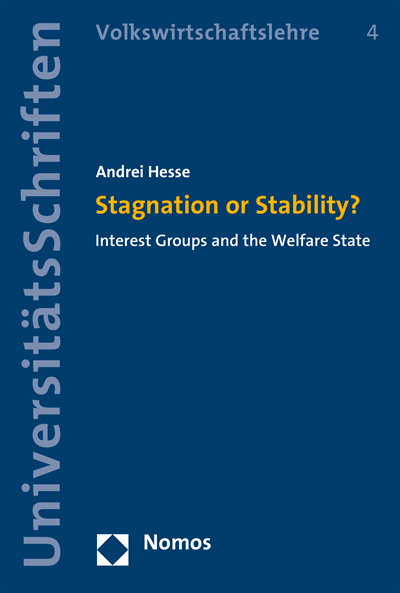
Stagnation or Stability?
Interest Groups and the Welfare State- Autor:innen:
- Reihe:
- Nomos Universitätsschriften - Volkswirtschaftslehre, Band 4
- Verlag:
- 2015
Zusammenfassung
Die Arbeit beschäftigt sich theoretisch und empirisch anhand der Fallstudien zu Schweden und Israel mit dem Paradigma der Institutionellen Sklerose, wonach Wohlfahrstaaten zu Stagnation, Inflation und zuletzt zu ökonomischem Verfall neigen, denen sie nicht entkommen können. Dieses Paradigma wird jedoch letztlich als obsolet verworfen.
Publikation durchsuchen
Bibliographische Angaben
- Auflage
- 1/2015
- Copyrightjahr
- 2015
- ISBN-Print
- 978-3-8487-2622-6
- ISBN-Online
- 978-3-8452-6742-5
- Verlag
- Nomos, Baden-Baden
- Reihe
- Nomos Universitätsschriften - Volkswirtschaftslehre
- Band
- 4
- Sprache
- Englisch
- Seiten
- 286
- Produkttyp
- Monographie
Inhaltsverzeichnis
KapitelSeiten
- Titelei/Inhaltsverzeichnis Kein Zugriff Seiten 1 - 12
- Introduction Kein Zugriff Seiten 13 - 22
- I. ‘The Rise and Decline of Nations’ - challenges to the welfare state Kein Zugriff
- II. Mancur Olson’s view on democracy and the rentseeking society Kein Zugriff
- III.a. A theory on the nature of interest groups and their organisation Kein Zugriff
- III.b. The acquisition of a public or collective good Kein Zugriff
- III.c. Importance and problems of ‘The Logic of Collective Action’ Kein Zugriff
- IV. The Rise and Decline of Nations Kein Zugriff
- IV.b. Empirical support in ‘The Rise and Decline of Nations’ Kein Zugriff
- IV.c. Importance and problems of ‘The Rise and Decline of Nations’ Kein Zugriff
- I. Empirical findings and case studies using Olson’s approach Kein Zugriff
- II. Research deviating from Olson’s methodology Kein Zugriff
- III. Interest groups and political volatility Kein Zugriff
- I. Why institutions exist Kein Zugriff
- II. Uncertainty and transaction costs Kein Zugriff
- III. Structure and enforcement of property rights Kein Zugriff
- IV. Organisations and stability Kein Zugriff
- I. Open societies, democracy, pluralism, or open access order Kein Zugriff
- II. Factors for stability Kein Zugriff
- III. Advancing the understanding of organisations and institutions Kein Zugriff
- IV. Pluralism and economic growth Kein Zugriff
- Stagnation or stability Kein Zugriff Seiten 109 - 130
- Pluralism – Stability and resilience through a quasi-indefinite regime outlook Kein Zugriff Seiten 131 - 134
- I.a. The early Swedish public policy Kein Zugriff
- I.b. Overcoming the Great Depression and the Second World War Kein Zugriff
- II.a. Policy beginnings Kein Zugriff
- II.b. Adapting the capital market Kein Zugriff
- III.a. Theoretical foundations Kein Zugriff
- III.b. Practical application Kein Zugriff
- IV. Transformation and traditions Kein Zugriff
- V.a. Economic factors Kein Zugriff
- V.b. Political factors Kein Zugriff
- V.c. Areas of policy conflict and international economic integration Kein Zugriff
- V.d. Why the Krona was defended Kein Zugriff
- VI. Return to the Swedish model Kein Zugriff
- VII. Conclusion and outlook Kein Zugriff
- I.a. From communitarian settlement to an ethnorepublican dirigisme Kein Zugriff
- I.b. The principles of the economic policy Kein Zugriff
- I.c. The financial market Kein Zugriff
- I.d. Investment policy Kein Zugriff
- I.e. Cost-of-living-allowances Kein Zugriff
- I.f. Politico-economic policy patterns Kein Zugriff
- I.g. The tax system Kein Zugriff
- I.h. The Histadrut state Kein Zugriff
- II.a. Stagnation, inflation, and policy volatility Kein Zugriff
- II.b. Reasons and policy agendas attributable to the decline Kein Zugriff
- III. Transaction costs of inflation Kein Zugriff
- IV.a. The Economic Emergency Plan of July 1985 Kein Zugriff
- IV.b. The re-invention of the Israeli politico-economic character Kein Zugriff
- V. How and why Israel overcame stagflation, price and wage rigidities Kein Zugriff
- VI. Conclusion and outlook Kein Zugriff
- Conclusion Kein Zugriff Seiten 271 - 276
- Bibliography Kein Zugriff Seiten 277 - 284
- Index Kein Zugriff Seiten 285 - 286
Literaturverzeichnis (100 Einträge)
Es wurden keine Treffer gefunden. Versuchen Sie einen anderen Begriff.
- Agell, Jonas; Englund, Peter; Södersten, Jan, Tax Reform of the Century – The Swedish Experiment, in: National Tax Journal, 49 (1996), 643-664. Google Scholar öffnen DOI: 10.5771/9783845267425
- Alchian, Armen A., Uncertainty, Evolution and Economic Theory, in: Journal of Political Economy, 58 (1950), 211-221. Google Scholar öffnen DOI: 10.5771/9783845267425
- Anderson, Karen Marie, The Welfare State in the Global Economy: The Politics of Social Insurance Retrenchment in Sweden 1990-1998, Ann Arbor/MI 1999. Google Scholar öffnen DOI: 10.5771/9783845267425
- Bank of Israel (BOI), Annual Reports, Jerusalem, archived at: Google Scholar öffnen DOI: 10.5771/9783845267425
- http://www.bankisrael.gov.il. Google Scholar öffnen DOI: 10.5771/9783845267425
- Bank of Israel, Statistics, archived at: Google Scholar öffnen DOI: 10.5771/9783845267425
- http://www.bankisrael.gov.il. Google Scholar öffnen DOI: 10.5771/9783845267425
- Barsky, Robert B.; Kilian, Lutz, Oil and the Macroeconomy Since the 1970s, in: Journal of Economic Perspectives, 18 (2004), 115-134. Google Scholar öffnen DOI: 10.5771/9783845267425
- Becker, Gary, A Theory of Competition Among Pressure Groups For Political Influence, in: Quarterly Journal of Economics, 98 (1983), 371-400. Google Scholar öffnen DOI: 10.5771/9783845267425
- Bengtsson, Tommy (ed.), Population, Economy, and Welfare in Sweden, Google Scholar öffnen DOI: 10.5771/9783845267425
- Heidelberg 1994. Google Scholar öffnen DOI: 10.5771/9783845267425
- Ber, Hedva; Ribon, Sigal, Market Power of Banks Against Large Firms – Google Scholar öffnen DOI: 10.5771/9783845267425
- What Has Changed With The Opening Of The Israeli Economy, in: Israel Economic Review, 3 (2005), 23-51. Google Scholar öffnen DOI: 10.5771/9783845267425
- Bernstein, Deborah S., Challenges to Separatism: Joint Action by Jewish Google Scholar öffnen DOI: 10.5771/9783845267425
- and Arab Workers in Jewish-Owned Industry in Mandatory Palastine, 17-42, in: Shafir, Gershon; Peled, Yoav, Peacemaking & Liberalization (eds.), Bolder/ CO 2000. Google Scholar öffnen DOI: 10.5771/9783845267425
- Blyth, Mark, The Transformation of the Swedish Model – Economic Ideas, Distributional Conflict, and Institutional Change, in: World Politics, 54 (2001), 1-26. Google Scholar öffnen DOI: 10.5771/9783845267425
- Boje, Thomas P.; Furåker, Bengt (eds.), Post-industrial Labour Markets: Profiles of North America and Scandinavia, London 2003. Google Scholar öffnen DOI: 10.5771/9783845267425
- Boje, Thomas P.; Lindquist, Rafael, Labour Movement and Industrial Relations, in: Boje, Thomas P.; Furåker, Bengt (eds.), Post-Industrial Labour Markets: Profiles of North America and Scandinavia, London 2003, 19-50. Google Scholar öffnen DOI: 10.5771/9783845267425
- Brenner, Mats, The Politics of Growth. Economic Regulation in Sweden 1930-1994, Lund 1997. Google Scholar öffnen DOI: 10.5771/9783845267425
- Bruno, Michael, Crisis, Stabilization, and Economic Reform–Therapy by Consensus, Oxford 1993. Google Scholar öffnen DOI: 10.5771/9783845267425
- Bruno, Michael, Generating A Sharp Disinflation: Israel 1985, in: NBER Working Paper Series, Working Paper No. 1822, Cambridge/MA 1986. Google Scholar öffnen DOI: 10.5771/9783845267425
- Buchanan, James M.; Tollison, Robert D.; Tullock, Gordon, Toward a Theory of the Rent-Seeking Society, College Station/TX 1980. Google Scholar öffnen DOI: 10.5771/9783845267425
- Bueno de Mesquita, Bruce; Smith, Alastair; Siverson, Randolph M.; Morrow, James D., The Logic of Political Survival, Cambridge/MA 2003. Google Scholar öffnen DOI: 10.5771/9783845267425
- Choi, Kwang, A Statistical Test of Olson’s model, in: Dennis C. Mueller (ed.), The Political Economy of Growth, New Haven/CO 1983, 57–78. Google Scholar öffnen DOI: 10.5771/9783845267425
- Coates, Dennis; Heckelman, Jac C.; Wilson, Bonnie, Democracy and Volatility: Do Special Interest-Groups Matter?, working paper, 2008, Google Scholar öffnen DOI: 10.5771/9783845267425
- http://papers.ssrn.com/sol3/papers.cfm?abstract_id=1202062, retrieved May 16th 2010. Google Scholar öffnen DOI: 10.5771/9783845267425
- Coates, Dennis; Heckelman, Jac C.; Wilson, Bonnie, Special Interest Groups and Growth, in: Public Choice, 147 (2011), 439-457. Google Scholar öffnen DOI: 10.5771/9783845267425
- Coates, Dennis; Heckelman, Jac C.; Wilson, Bonnie, The Determinants of Interest Group Formation, in: Public Choice, 133 (2007), 377-391. Google Scholar öffnen DOI: 10.5771/9783845267425
- Dahl, Robert, Who governs?, New Haven/CT 1962. Google Scholar öffnen DOI: 10.5771/9783845267425
- Edin, Per-Anders; Topel, Robert, Wage Policy and Restructuring: The Swedish Labour Market Since 1960, in:, Freeman, Richard B.; Topel, Robert; Swedenborg, Birgitta (eds.), The Welfare State in Transition: Reforming the Swedish Model, Chicago 1997, 155-202. Google Scholar öffnen DOI: 10.5771/9783845267425
- Elvander, Nils, Einkommenspolitik in Schweden und den übrigen nordischen Ländern, in: Riegler, Claudius H.; Schneider, Olaf (eds.), Schweden im Wandel – Entwicklungen, Probleme, Perspektiven, Berlin 1999, 231-243. Google Scholar öffnen DOI: 10.5771/9783845267425
- Elvander, Nils, Two Labour Market Regimes in Sweden. A Comparison Between the Saltsjöbaden Agreement of 1938 and the Industrial Agreement of 1997, in: The German Journal of Industrial Relations, 10 (2003), 146-159. Google Scholar öffnen DOI: 10.5771/9783845267425
- Erixon, Lennart, Das Rehn-Meidner-Modell: Ein dritter Weg zwischen Keynesianismus und Monetarismus, in: Riegler, Claudius H.; Schneider, Olaf (eds.), Schweden im Wandel – Entwicklungen, Probleme, Perspektiven, Berlin 1999, 51-84. Google Scholar öffnen DOI: 10.5771/9783845267425
- Eurostat, Directorate General of the European Commission, statistics database of the European Union, http://epp.eurostat.ec.europa.eu. Google Scholar öffnen DOI: 10.5771/9783845267425
- Freeman, Richard B.; Topel, Robert; Swedenborg, Birgitta (eds.), The Welfare State in Transition: Reforming the Swedish model, Chicago/IL 1997. Google Scholar öffnen DOI: 10.5771/9783845267425
- Grier, Kevin B.; Munger, Michael C., Democracy, Regime Duration and Economic Growth, working paper 2012, Google Scholar öffnen DOI: 10.5771/9783845267425
- http://polisci.duke.edu/uploads/media_items/ppe-working-paper-13-0425.original.pdf, retrieved June 5th 2013. Google Scholar öffnen DOI: 10.5771/9783845267425
- Gringberg, Lev Luis; Shafir, Gershon, Economic Liberalization and the Breakup of the Histadrut’s Domain, 103-127, in: Shafir, Gershon; Peled Yoav (eds.), Peacemaking & Liberalization, Bolder/CO 2000. Google Scholar öffnen DOI: 10.5771/9783845267425
- Harpaz, Itzhak, The State of Trade Unionism in Israel, in: Phelan, Craig (ed.), Trade Union Revitalisation: Trends and Prospects in 34 Countries, Oxford 2006, 445-460. Google Scholar öffnen DOI: 10.5771/9783845267425
- von Hayek, Friedrich August, The Constitution of Liberty, Chicago/IL 1960. Google Scholar öffnen DOI: 10.5771/9783845267425
- Heckelman, Jac C., Explaining the Rain: The Rise and Decline of Nations after 25 Years, in: Southern Economic Journal, 74 (2007), 18-31. Google Scholar öffnen DOI: 10.5771/9783845267425
- Heiner, Ronald, The Origins of Predictable Behavior, in: American Economic Review, 73 (1983), 227-262. Google Scholar öffnen DOI: 10.5771/9783845267425
- Helpman, Elhanan, Israel’s Economic Growth: An International Comparison, in: Israel Economic Review, 1 (2003), 1-10. Google Scholar öffnen DOI: 10.5771/9783845267425
- Heritage Foundation, 2013 Index of Economic Freedom, Washington, D.C. 2013. Google Scholar öffnen DOI: 10.5771/9783845267425
- Heston, Alan; Summers, Robert; Aten, Bettina, Penn World Table Version 6.2, Philadelphia 2006. Google Scholar öffnen DOI: 10.5771/9783845267425
- Hirschl, Ran, The Great Economic-Juridical Shift: The Legal Arena and the Transformation of Israel's Economic Order, in: Shafir, Gershon; Peled Yoav (eds.), Peacemaking & Liberalization, Bolder/CO 2000, 189-215. Google Scholar öffnen DOI: 10.5771/9783845267425
- Iverson, Torben, Capitalism, Democracy, and Welfare, Cambridge 2005. Google Scholar öffnen DOI: 10.5771/9783845267425
- Jeding, Carl, Liberalization and Control: Instruments and Strategies in the Regulatory Reform of Swedish Telecommunications, in: Magnusson, Lars; Ottoson, Jan (eds.), The State, Regulation and the Economy. An Historical perspective, Cheltenham 2001, 166-182. Google Scholar öffnen DOI: 10.5771/9783845267425
- Johannson, Anders L., Das Modell Schweden: Analyse einer umfassenden Konzeption, in: Riegler, Claudius H.; Schneider, Olaf (eds.), Schweden im Wandel – Entwicklungen, Probleme, Perspektiven, Berlin 1999, 23-49. Google Scholar öffnen DOI: 10.5771/9783845267425
- Jonung, Lars; Kiander, Jaako; Pentti, Vartia, The Great Financial Crisis in Finland and Sweden. The Dynamics of Boom, Bust and Recovery, 1985-2000, Brussels 2008. Google Scholar öffnen DOI: 10.5771/9783845267425
- Kleiman, Efraim, The Place of Manufacturing in the Growth of the Israeli Economy, in: Journal of Development Studies, 3 (1967), 226-248. Google Scholar öffnen DOI: 10.5771/9783845267425
- Klein, Nir, Political Cycles and Economic Policy in Israel, in: Israel Economic Review, 2 (2004), 55-67. Google Scholar öffnen DOI: 10.5771/9783845267425
- KPMG International Cooperative, Corporate and Indirect Tax Survey 2012, Amstelveen 2013. Google Scholar öffnen DOI: 10.5771/9783845267425
- Kramer, Gerald H., Short-Term Fluctuations in U.S. Voting Behavior, in: American Political Science Review, 65 (1971), 131-143. Google Scholar öffnen DOI: 10.5771/9783845267425
- Kullander, Mats, Sweden: Industrial Relations Profile, in: european industrial relations observatory on-line, eurofund, publisher id SE1201909Q, Google Scholar öffnen DOI: 10.5771/9783845267425
- http://www.eurofound.europa.eu/eiro/country/sweden.pdf, retrieved March 6th 2014. Google Scholar öffnen DOI: 10.5771/9783845267425
- Kullander, Mats; Björnberg, David, New Industrial Agreement to Strengthen Norm-Setting Role, in: European Industrial Relations Observatory, 08.07.2011, publisher id SE1105019I, Google Scholar öffnen DOI: 10.5771/9783845267425
- http://www.eurofound.europa.eu/eiro/2011/05/articles/se1105019i.htm, retrieved February 25th 2014. Google Scholar öffnen DOI: 10.5771/9783845267425
- Leidermann, Leonardo; Livitan Nissan, The 1985 Stabilization From The Perspective Of The 1990s, in: Israel Economic Review, 1 (2003), 103-131. Google Scholar öffnen DOI: 10.5771/9783845267425
- Magnusson, Lars; Ottoson, Jan (eds.), The State, Regulation and The Economy. An Historical perspective, Cheltenham 2001. Google Scholar öffnen DOI: 10.5771/9783845267425
- Mares, Isabela, The Politics of Social Risk: Business and Welfare State Development, Cambridge 2003. Google Scholar öffnen DOI: 10.5771/9783845267425
- Marshall, Monty G.; Jaggers, Keith, Polity IV project: Political Regime Characteristics and Transitions, 1800-2004, Arlington/VA 2005. Google Scholar öffnen DOI: 10.5771/9783845267425
- Marterbauer, Markus, Grenzen der Steuerungsfähigkeit: Die schwedische Fiskalpolitik im Konjunkturzyklus, in: Riegler, Claudius H.; Schneider, Olaf (eds.), Schweden im Wandel – Entwicklungen, Probleme, Perspektiven, Berlin 1999, 201-216. Google Scholar öffnen DOI: 10.5771/9783845267425
- McLean, Iain, Review Article: The Divided Legacy of Mancur Olson, in British Journal of Political Science, 30 (2000), 651-668. Google Scholar öffnen DOI: 10.5771/9783845267425
- Munck, Gerardo L.; Verkuilen, Jay, Conceptualizing and Measuring Democracy. Evaluating Alternative Indices, Comparative Political Studies, 35 (2002), 5-34. Google Scholar öffnen DOI: 10.5771/9783845267425
- North, Douglass C., Institutions, Institutional Change and Economic Performance, Cambridge 1990. Google Scholar öffnen DOI: 10.5771/9783845267425
- North, Douglass C., Understanding the Process of Economic Change, Princeton/NJ 2005. Google Scholar öffnen DOI: 10.5771/9783845267425
- North, Douglass C.; Wallis, John Joseph, Measuring the Transaction Sector in the American Economy, 1870-1970, in: Engermann, Stanley L.; Gallman, Robert E. (eds.), Long-Term Factors in American Economic Growth, Chicago 1986, 95-162. Google Scholar öffnen DOI: 10.5771/9783845267425
- North, Douglass C.; Wallis, John Joseph; Weingast, Barry R., Violence and Social Orders. A Conceptual Framework for Interpreting Recorded Human History, New York/NY 2009. Google Scholar öffnen DOI: 10.5771/9783845267425
- Oliver, Pamela E., Formal Models of Collective Action, in: Annual Review of Sociology, 19 (1993) 271-300. Google Scholar öffnen DOI: 10.5771/9783845267425
- Olson, Mancur, How Bright are the Northern Lights? Some Questions about Sweden, Lund 1990. Google Scholar öffnen DOI: 10.5771/9783845267425
- Olson, Mancur, Power and Prosperity: Outgrowing Communist and Capitalist Dictatorships, New York/NY 2001. Google Scholar öffnen DOI: 10.5771/9783845267425
- Olson, Mancur, The Logic of Collective Action. Public Goods and the Theory of Groups, Cambridge/MA 1965. Google Scholar öffnen DOI: 10.5771/9783845267425
- Olson, Mancur, The New Institutional Economics: The Collective Choice Approach to Economic Development, In: Clague, C. (ed.), Institutions and Economic Development: Growth and Governance in Less-Developed and Post-Socialist Countries, 1997. Google Scholar öffnen DOI: 10.5771/9783845267425
- Olson, Mancur, The Rise and Decline of Nations. Economic Growth, Stagflation and Social Rigidities, New Haven/CT 1982. Google Scholar öffnen DOI: 10.5771/9783845267425
- Olson, Mancur, The South Will Fall Again: The South as Leader and Laggard in Economic Growth, in: Southern Economic Journal, 49 (2003), 917-932. Google Scholar öffnen DOI: 10.5771/9783845267425
- Ostrom, Vincent, The Political Theory of a Compound Republic: A Reconstruction of the Logical Foundations of Democracy as Presented in the Federalist, Blacksburg/ VA 1971. Google Scholar öffnen DOI: 10.5771/9783845267425
- Plessner, Yakir, The Political Economy of Israel, Albany/ NY 1994. Google Scholar öffnen DOI: 10.5771/9783845267425
- Razin, Assaf; Sadka, Efraim, The Economy of Modern Israel. Malaise and Promise, Chicago 1993. Google Scholar öffnen DOI: 10.5771/9783845267425
- Rexed, Knut, Schwedische Steuerpolitk, in: Riegler, Claudius H.; Schneider, Olaf (eds.), Schweden im Wandel – Entwicklungen, Probleme, Perspektiven, Berlin 1999, 217-230. Google Scholar öffnen DOI: 10.5771/9783845267425
- Riegler, Claudius H., Schweden im Wandel: Eine Orientierung, in: Riegler, Claudius H.; Schneider, Olaf (eds.), Schweden im Wandel – Entwicklungen, Probleme, Perspektiven, Berlin 1999, 15-19. Google Scholar öffnen DOI: 10.5771/9783845267425
- Riegler, Claudius H.; Schneider, Olaf (eds.), Schweden im Wandel – Entwicklungen, Probleme, Perspektiven, Berlin 1999. Google Scholar öffnen DOI: 10.5771/9783845267425
- Riker, William H., Comments on Vincent Ostrom’s Paper, in: Public Choice, 27 (1976), 13-15. Google Scholar öffnen DOI: 10.5771/9783845267425
- Rivlin, Paul, The Israeli Economy from the Foundation of the State Through the 21st Century, Cambridge/NY, 2011. Google Scholar öffnen DOI: 10.5771/9783845267425
- Schön, Lennart, An Economic History of Modern Sweden, New York/ NY 2012. Google Scholar öffnen DOI: 10.5771/9783845267425
- Schumpeter, Jospeh A., Capitalism, Socialism, and Democracy, New York/ NY 1942. Google Scholar öffnen DOI: 10.5771/9783845267425
- Shafir, Gershon; Peled Yoav (eds.), Peacemaking & Liberalization, Bolder/CO 2000. Google Scholar öffnen DOI: 10.5771/9783845267425
- Shalev, Michael, Liberalization and the Transformation of the Political Economy, in: Shafir, Gershon; Peled Yoav (eds.), Peacemaking & Liberalization, Bolder/CO 2000, 129-160. Google Scholar öffnen DOI: 10.5771/9783845267425
- Sveriges Riksbank, Sveriges Riksbank Economic Reviews, Stockholm. Google Scholar öffnen DOI: 10.5771/9783845267425
- Truman, David, The Governmental Process, New York/NY 1952. Google Scholar öffnen DOI: 10.5771/9783845267425
- Tufte, Edward R., Political control over the economy, Princeton/NJ 1978. Google Scholar öffnen DOI: 10.5771/9783845267425
- U.S. Department of Labor, Bureau of Labor Statistics, Union Members 2013, News Release January 24th, 2014, USDL-14-0095, Google Scholar öffnen DOI: 10.5771/9783845267425
- http://www.bls.gov/news.release/pdf/union2.pdf, retrieved March 13th 2014. Google Scholar öffnen DOI: 10.5771/9783845267425
- Unger, Brigitte; van Waarden, Frans, Interest Associations and Economic Growth: A Critique of Mancur Olson’s Rise and Decline of Nations, in: Review of International Economy, 6 (1999), 425-467. Google Scholar öffnen DOI: 10.5771/9783845267425
- Van Waarden, Frans, European Harmonization of National Regulatory Styles?, in: Vervaele, John A. E. et al. (eds.), Compliance and Enforcement of European Community Law, Deventer 1999, 95-124. Google Scholar öffnen DOI: 10.5771/9783845267425
- Vedder, Richard; Galloway, Lowell, Rent Seeking, Distributional Coalitions, Taxes, Relative Prices and Growth, in: Public Choice, 51 (1986), 93–100. Google Scholar öffnen DOI: 10.5771/9783845267425
- Winter, Sidney G., Comments on Arrow and on Lucas, in: Hogarth, Robin M.; Reder, Melvin W. (eds.), The Behavioral Foundations of Economic Theory. Journal of Business (supplement), 59 (1986), 427-434. Google Scholar öffnen DOI: 10.5771/9783845267425
- World Intellectual Property Organization, IP Facts and Figures, 943 (2012). Google Scholar öffnen DOI: 10.5771/9783845267425
- World Intellectual Property Organization, World Intellectual Property Indicators, 941 (2012). Google Scholar öffnen DOI: 10.5771/9783845267425
- Zimmermann, Klaus; Horgos, Daniel, Interest Groups and Economic Performance: Some New Evidence, in: Public Choice, 138 (2009), 301-315. Google Scholar öffnen DOI: 10.5771/9783845267425