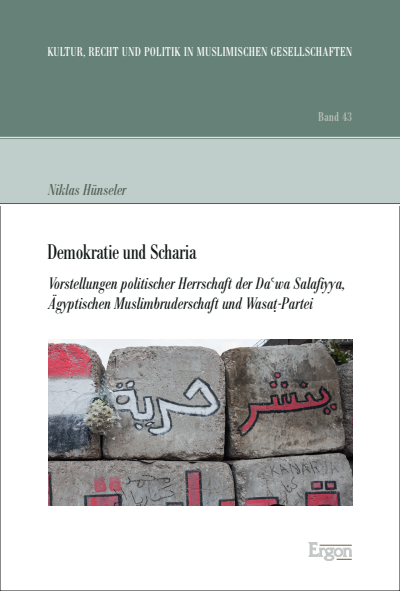
Demokratie und Scharia
Vorstellungen politischer Herrschaft der Daʿwa Salafiyya, Ägyptischen Muslimbruderschaft und Wasaṭ-Partei- Autor:innen:
- Reihe:
- Kultur, Recht und Politik in muslimischen Gesellschaften, Band 43
- Verlag:
- 2020
Zusammenfassung
Die Popularität und die Wahlerfolge islamistischer Gruppierungen im Arabischen Frühling haben die Bedeutung dieser als ,Big Player‘ im politischen System Ägyptens eindrucksvoll unterstrichen. Die im vorliegenden Buch untersuchten ägyptisch-islamistischen Gruppen, die Daᶜwa-Salafiyya, die Ägyptische Muslimbruderschaft und die Wasaṭ-Partei, hatten damit erstmals in ihrer Geschichte die Option, an allgemeinverbindlichen Entscheidungen mitzuwirken und ihre institutionellen Visionen graduell umzusetzen. Die divergierenden Vorstellungen islamisch (-demokratischer) Herrschaft unter den drei Gruppen werden in der vorliegenden Arbeit unter dem Einsatz interdisziplinärer Methoden einander vergleichend gegenübergestellt.
Publikation durchsuchen
Bibliographische Angaben
- Auflage
- 1/2020
- Copyrightjahr
- 2020
- ISBN-Print
- 978-3-95650-735-9
- ISBN-Online
- 978-3-95650-736-6
- Verlag
- Ergon, Baden-Baden
- Reihe
- Kultur, Recht und Politik in muslimischen Gesellschaften
- Band
- 43
- Sprache
- Deutsch
- Seiten
- 596
- Produkttyp
- Monographie
Inhaltsverzeichnis
- Titelei/Inhaltsverzeichnis Kein Zugriff Seiten 1 - 16
- 1.1 Einleitung Kein Zugriff
- 1.2 Untersuchungsgegenstand und Forschungsfrage – Warum Daʿwa Salafiyya, Muslimbruderschaft und Wasaṭ-Partei? Kein Zugriff
- 1.3 Quellen, Stand der Forschung Kein Zugriff
- 1.4 Interview-Methodik Kein Zugriff
- 1.5 Aufbau der Arbeit Kein Zugriff
- 2.1.1 Grundprobleme der Demokratiedefinition Kein Zugriff
- 2.1.2 Minimale/elektorale Demokratie Kein Zugriff
- 2.1.3 Liberale/anspruchsvolle Demokratie Kein Zugriff
- 2.1.4 Illiberale, defekte Demokratie/hybride Regime Kein Zugriff
- 2.1.5 Defizite und Fortentwicklungen aktueller Demokratie Kein Zugriff
- 2.2.1 ,Nicht-westliche‘ Demokratie als eigenständige Kategorie? Kein Zugriff
- 2.2.2 Säkularismus als notwendige Bedingung für Demokratie? Kein Zugriff
- 2.2.3 Islamische Demokratie – Eine Annäherung Kein Zugriff
- 2.2.4 Muslimische Diskurse über Demokratie Kein Zugriff
- 2.2.5 Vorstellungen über islamische Staatlichkeit und islamische Demokratie im politischen Islam Kein Zugriff
- 2.3.1 Konzeptualisierungen von Scharia und (hermeneutische) Zugänge zur Scharia Kein Zugriff
- 2.3.2 Verhältnis von Demokratie und Scharia Kein Zugriff
- 3.1.1 Anfänge der Organisation Kein Zugriff
- 3.1.2 Der Aufstand gegen Mubarak – Vorsichtig-opportunistisches Herantasten an eine neue politische Wirklichkeit Kein Zugriff
- 3.1.3 Proteste gegen Mursi – Die Daʿwa Salafiyya geht auf Distanz zur Muslimbruderschaft Kein Zugriff
- 3.1.4 Spaltung der Daʿwa Salafiyya als Folge eines ideologischen Richtungsstreits Kein Zugriff
- 3.2.1 Die frühe Muslimbruderschaft Kein Zugriff
- 3.2.2 Islamische Herrschaft gemäß al-Bannā und ʿAuda Kein Zugriff
- 3.2.3 Die Nachfolge al-Bannās: Al-Huḍaibī unter Nasser Kein Zugriff
- 3.2.4 Quṭbs revolutionär-avantgardistischer Radikalismus Kein Zugriff
- 3.2.5 Al-Huḍaibīs Antwort auf Quṭb Kein Zugriff
- 3.2.6 Renaissance der Muslimbruderschaft unter as-Sadat Kein Zugriff
- 3.2.7 Die Muslimbruderschaft unter Mubarak Kein Zugriff
- 3.2.8 Die mittlere Generation und eine ideologische Zäsur Kein Zugriff
- 3.2.9 Ideologische und realpolitische Lager innerhalb der Organisation Kein Zugriff
- 3.2.10 Der Aufstand gegen Mubarak und die erste legale Partei der Muslimbruderschaft Kein Zugriff
- 3.2.11 Vom Sieg bei den Präsidentschaftswahlen bis zum Sturz Mursis Kein Zugriff
- 3.2.12 Gründe für das Scheitern des Demokratisierungsprozesses Kein Zugriff
- 3.2.13 Die massivste Repression gegen die Muslimbruderschaft seit Nasser Kein Zugriff
- 3.2.14 Eine ideologische Neuausrichtung der Organisation? Kein Zugriff
- 3.3.1 Gründung der Wasaṭ-Partei – Strategischer Schritt oder Ergebnis eines Wertewandels? Kein Zugriff
- 3.3.2 Entstehung und Entwicklung der Wasaṭ-Partei aus der Perspektive Sulṭāns Kein Zugriff
- 3.3.3 Ideologische Verortung der Wasaṭ-Partei Kein Zugriff
- 3.3.4 Die Wasaṭ-Partei nach dem Sturz Mubaraks Kein Zugriff
- 4.1.1.1 Uneingeschränkte Ablehnung von Demokratie vor dem ,Arabischen Frühling‘ Kein Zugriff
- 4.1.1.2 Neubewertung von Demokratie nach dem Sturz Mubaraks? Kein Zugriff
- 4.1.1.3 Ablehnung eines differenzierteren Diskurses über Demokratie – Al-ʿAẓīm Kein Zugriff
- 4.1.2.1 Der zivile Staat mit islamischem Bezugsrahmen – Eine Antwort auf eine ,westlich-christliche‘ Projektion Kein Zugriff
- 4.1.2.2 Wesentliche Elemente von Demokratie als ursprünglich islamisch Kein Zugriff
- 4.1.2.3 Demokratie als säkulares, unislamisches Produkt Kein Zugriff
- 4.1.2.4 Die Wahlprogramme Kein Zugriff
- 4.1.3.1 Der zivile Staat Kein Zugriff
- 4.1.3.2 Der Islam als struktureller, aber nicht terminologischer Quell der Demokratie? Kein Zugriff
- 4.1.3.3 Das politische und soziale System eines islamischen Staates – Allgemeine islamische Grundsätze statt fiqh Kein Zugriff
- 4.1.3.4 Demokratie als antikolonialistisches Mittel Kein Zugriff
- Zwischenfazit Kap. 4.1 (Definition und Legitimation von Demokratie) Kein Zugriff
- 4.2.1.1 Fundamentale Unterschiede zwischen islamischer und demokratischer Herrschaft – Al-ʿAẓīm Kein Zugriff
- 4.2.1.2 Ein differenzierterer Diskurs über Demokratie? Kein Zugriff
- 4.2.1.3 Ahl al-ḥall wal-ʿaqd – Hin zur stärker akzentuierten Rolle der islamischen Gemeinschaft? Kein Zugriff
- 4.2.1.4 Islamisch-korrekte Herrschaft statt Volkswille Kein Zugriff
- 4.2.1.5 Kalifatsutopie vs. moderner (National-)Staat – Aš-Šaḥāt Kein Zugriff
- 4.2.2.1 Die programmatischen Schriften der Muslimbruderschaft – Frühislamische Praktiken als urdemokratische Mechanismen Kein Zugriff
- 4.2.2.2 Herrschaftsvertrag, Stellvertretung, Herrschaftsbeschränkung – Al-Wāʿī Kein Zugriff
- 4.2.2.3 Stellvertreterschaft, Voraussetzungen für das Herrscheramt – Ġuzlān Kein Zugriff
- 4.2.2.4 Islamische Führung – An-Naǧǧār Kein Zugriff
- 4.2.2.5 Gehorsamspflicht gegenüber den Herrschenden – Aṭ-Ṭaḥān Kein Zugriff
- 4.2.2.6 Öffnung des Präsidentenamtes für Frauen und Nichtmuslime? – Al-Futūḥ Kein Zugriff
- 4.2.3.1 Demokratische Machtübertragung, Machtrotation und Herrschaftsbegrenzung als islamische Werte Kein Zugriff
- 4.2.3.2 Besetzung von öffentlichen Ämtern Kein Zugriff
- 4.2.3.3 Gewaltenteilung und Verfassungsstaatlichkeit Kein Zugriff
- Zwischenfazit Kap. 4.2 (Machtübertragung, Machtrotation und Herrschaftsbegrenzung) Kein Zugriff
- 4.3.1.1 Wider den Volkswillen und demokratischen Mehrheitsentscheid Kein Zugriff
- 4.3.1.2 Die meritokratische Natur islamischer Beratung Kein Zugriff
- 4.3.1.3 Entscheidungsfindung als Aufgabenteilung zwischen Rechtsgelehrten, Experten und Mitgliedern des Šūrā-Rats Kein Zugriff
- 4.3.1.4 Kritik an der Interpretation des Schariabezugs durch das Verfassungsgericht Kein Zugriff
- 4.3.1.5 Die Relevanz von Artikel 219 Kein Zugriff
- 4.3.1.6 Das Schariaverständnis: Daʿwa Salafiyya vs. Muslimbruderschaft? Kein Zugriff
- 4.3.2.1 Šūrā – Der islamische Beratungsgedanke Kein Zugriff
- 4.3.2.2 Šūrā und Demokratie – Gemeinsamkeiten und Unvereinbarkeiten Kein Zugriff
- 4.3.2.3 Die Parteiprogramme der Muslimbruderschaft – Islamische Gesetzgebung auf institutioneller Ebene Kein Zugriff
- 4.3.2.4 Feste und bewegliche Normen Kein Zugriff
- 4.3.2.5 Der Schariabezug in der ägyptischen Verfassung – Interpretation und Interpretationsbefugnis Kein Zugriff
- 4.3.3.1 Šūrā – „Tiefergehender und weitreichender“ als Demokratie? Kein Zugriff
- 4.3.3.2 Religiöse/islamische Bezugsquelle? Kein Zugriff
- 4.3.3.3 Akzeptanz der Interpretation des Schariabezugs durch das Verfassungsgericht? Kein Zugriff
- 4.3.3.4 Grenzen des demokratischen Entscheids – Deutung des Schariabezugs – Feste und bewegliche Normen Kein Zugriff
- Zwischenfazit Kap. 4.3 (Entscheidungsfindung, Reichweite und Grenzen des Volkswillens) Kein Zugriff
- 4.4.1.1 Bewertung von politischer Partizipation und Parteien vor dem Sturz Mubaraks Kein Zugriff
- 4.4.1.2 Nach dem Sturz Mubaraks – Eine Neubewertung von Demokratie und Parteiarbeit? Kein Zugriff
- 4.4.1.3 Opposition im gegenwärtigen und (idealen) islamischen System Kein Zugriff
- 4.4.2.1 Politischer Pluralismus im islamischen Staat – Aṣ-Ṣāwī Kein Zugriff
- 4.4.2.2 Politischer Pluralismus in den programmatischen Schriften der Muslimbruderschaft Kein Zugriff
- 4.4.2.3 Begrenzte Akzeptanz von Parteienpluralismus – Al-Wāʿī Kein Zugriff
- 4.4.2.4 Unterschiedliche Positionen im Hinblick auf parteipolitische Aktivität Kein Zugriff
- 4.4.3.1 Der Islam kennt keine Minderheiten im ,westlichen Sinne‘ – Al-Karīm Kein Zugriff
- 4.4.3.2 Demokratie und Pluralismus im Rahmen der Werte der Umma und des Islam – Māḍī Kein Zugriff
- 4.4.3.3 Trennung von religiöser Mission und (partei-)politischer Aktivität Kein Zugriff
- Zwischenfazit Kap. 4.4 (Pluralismus, Streitkultur und Opposition) Kein Zugriff
- 4.5.1.1 ,Wahre und falsche Freiheit‘ – Al-ʿAẓīm Kein Zugriff
- 4.5.1.2 Realpolitische Zwänge und der an eine salafistische Klientel gerichtete Diskurs Kein Zugriff
- 4.5.1.3 Die Grenzstrafen einschließlich Apostasie Kein Zugriff
- 4.5.1.4 Freiheit in der ägyptischen Verfassung des Jahres 2012 Kein Zugriff
- 4.5.1.5 Islamische vs. westliche Menschenrechte Kein Zugriff
- 4.5.1.6 Freiheiten und Rechte aus der Perspektive der interviewten Führungsmitglieder Kein Zugriff
- 4.5.2.1 Rechte und Freiheiten in den programmatischen Schriften der Muslimbruderschaft Kein Zugriff
- 4.5.2.2 Islamisches und westliches Freiheitsverständnis – Naṣār Kein Zugriff
- 4.5.2.3 Der Islam als Quelle der Menschenrechte – Ġuzlān Kein Zugriff
- 4.5.2.4 Menschenrechte und Freiheiten auf der realpolitischen Ebene – Eine Kontextualisierung Kein Zugriff
- 4.5.2.5 Die offizielle Position der Muslimbruderschaft zu Grenzstrafen Kein Zugriff
- 4.5.2.6 Diskussion vor Repression? – Al-Futūḥ Kein Zugriff
- 4.5.2.7 Interviews mit Führungsmitgliedern der Muslimbruderschaft: Perspektiven zu Rechten und Freiheiten Kein Zugriff
- 4.5.3.1 Rechte und Freiheiten in den programmatischen Schriften der Partei Kein Zugriff
- 4.5.3.2 Apostasie – Ein Konsens mit der Muslimbruderschaft Kein Zugriff
- 4.5.3.3 Westlich-individualistisches Menschenrechtsverständnis vs. Gesellschaft – Māḍī Kein Zugriff
- 4.5.3.4 Menschenrechte und Freiheiten aus der Perspektive der interviewten Führungsmitglieder Kein Zugriff
- Zwischenfazit Kap. 4.5 (Rechte und Freiheiten) Kein Zugriff
- 4.6.1.1 Rolle und Rechte von ,Schutzbefohlenen‘ und Frauen vor dem Sturz Mubaraks Kein Zugriff
- 4.6.1.2 Nach dem Sturz Mubaraks – Spagat zwischen Öffentlichkeit und salafistischer Basis Kein Zugriff
- 4.6.1.3 Männer und Frauen – ,Gleiche Würde, jedoch unterschiedliche Rechte und Pflichten‘ Kein Zugriff
- 4.6.1.4 Von der Ablehnung zur Akzeptanz von weiblichen und nicht muslimischen Abgeordneten? Kein Zugriff
- 4.6.2.1 Die Charta von 1994 – Eine Zäsur im Hinblick auf Frauenrechte? Kein Zugriff
- 4.6.2.2 Keine progressive Entwicklung seit den Neunzigerjahren Kein Zugriff
- 4.6.2.3 Gleichstellung als Unrecht – Ġuzlān Kein Zugriff
- 4.6.2.4 Das Präsidentenamt ist Männern vorbehalten? Kein Zugriff
- 4.6.2.5 Nichtmuslime: Abkehr von der Glaubenssteuer und rechtliche Gleichstellung? Kein Zugriff
- 4.6.3.1 Eine apologetische Ablehnung der Glaubenssteuer – Māḍī Kein Zugriff
- 4.6.3.2 Die Parteiprogramme Kein Zugriff
- 4.6.3.3 Diskriminierung nicht-monotheistischer Religionen Kein Zugriff
- 4.6.3.4 Frauen – Politische Gleichstellung und vollkommene rechtliche Gleichbehandlung? Kein Zugriff
- Zwischenfazit Kap. 4.6 (Politisch-rechtliche Stellung des Individuums) Kein Zugriff
- Kapitel 5 – Fazit Kein Zugriff Seiten 545 - 562
- Quellen Kein Zugriff Seiten 563 - 596
Literaturverzeichnis (464 Einträge)
Es wurden keine Treffer gefunden. Versuchen Sie einen anderen Begriff.
- Abdul Latif, Umaima (2012): Case Analysis, Salafists and Politics in Egypt, Arab Center for Research & Policy Studies, January 2012 Google Scholar öffnen DOI: 10.5771/9783956507366
- Abou El Fadl, Khaled (2003): Islam and the Challenge of Democratic Commitment, in: Fordham International Law Journal, 4 (2003), S. 4–71 Google Scholar öffnen DOI: 10.5771/9783956507366
- Abromeit, Heidrun (2003): Nutzen und Risiken direktdemokratischer Instrumente, in: Offe, Claus (Hrsg.) (2003): Demokratisierung der Demokratie. Diagnosen und Reformvorschläge, Frankfurt am Main Google Scholar öffnen DOI: 10.5771/9783956507366
- Abū al-ʿAiyyinīn, Ibrāhīm (2012): Ad-dīmuqrāṭiyya al-ʿaǧība fī Miṣr, Ikhwanonline, 17.5.2012, http://www.ikhwanonline.com/New/print.aspx?ArtID=108914&SecID=393 (Stand: 12.10.2012). Google Scholar öffnen DOI: 10.5771/9783956507366
- Abū al-Futūḥ, ʿAbd al-Munʿim (2005): Muǧaddidūn lā mubaddidūn, Kairo Google Scholar öffnen DOI: 10.5771/9783956507366
- Abu Rumman, Mohammed/Abu Hanleh, Hassan (2010): Jordanian Salafism: A Strategy for the “Islamization of Society” and an Ambiguous Relationship with the State, Amman Google Scholar öffnen DOI: 10.5771/9783956507366
- Abū Zaid, Naṣr Ḥāmid (1992): Naqd al-ḫiṭāb ad-dīnī, Kairo Google Scholar öffnen DOI: 10.5771/9783956507366
- Ahl-alquran (2011): Burhāmī: Lan naqbala ad-dīmuqrāṭiyya allatī taqūlu inna l-ḥukm li-ġairi Llāh, Ahl-alquran, 25.12.2011, http://www.ahl-alquran.com/arabic/printage.php?doc_type=0&doc_id=21760 (Stand: 18.2.2014) Google Scholar öffnen DOI: 10.5771/9783956507366
- Ahram Online (2012): Coptic FJP leader and presidential advisor quits political life, Al-Ahram, 6.12.2012, http://english.ahram.org.eg/NewsContent/1/64/59931/Egypt/Politics-Coptic-FJP-leader-and-presidential-advisor-quits-p.aspx (Stand: 15.6.2020) Google Scholar öffnen DOI: 10.5771/9783956507366
- Ahram Online (2012): English text of Morsi’s Constitutional Declaration, Al-Ahram, 22.11.2012, http://english.ahram.org.eg/News/58947.aspx (Stand: 15.6.2020) Google Scholar öffnen DOI: 10.5771/9783956507366
- Ahram Online (2013a): Rebel campaign compares Morsi to Hitler in meeting with German FM, Al-Ahram, 1.8.2013, http://english.ahram.org.eg/NewsContent/1/64/77929/Egypt/Politics-/Rebel-campaign-compares-Morsi-to-Hitler-in-meeting.aspx (Stand: 15.6.2020) Google Scholar öffnen DOI: 10.5771/9783956507366
- Ahram Online (2013b): 11 Islamist parties launch ‘Legitimacy Support’ alliance, Al-Ahram, 28.6.2013, http://english.ahram.org.eg/NewsContent/1/64/75145/Egypt/Politics-/-Islamist-parties-launch-Legitimacy-Support-allian.aspx (Stand: 15.6.2020) Google Scholar öffnen DOI: 10.5771/9783956507366
- Ahram Online (2014): Islamist Al-Wasat Party says national unity trumps Brotherhood alliance, Al-Ahram, 28.8.2014, http://english.ahram.org.eg/News/109434.aspx, (Stand: 15.6.2020) Google Scholar öffnen DOI: 10.5771/9783956507366
- Akademie für Verfassungsschutz (2015): Yusuf al-Qaradawi und das Konzept der Wasatiya, Heimerzheim Google Scholar öffnen DOI: 10.5771/9783956507366
- Āl Raḥīm, Ḫālid (2015): Al-ḥizbiyya baina l-madḥ wa-ḏ-ḏamm, Anasalafy, 21.8.2015, http://www.anasalafy.com/play.php?catsmktba=58931 (Stand: 15.6.2020) Google Scholar öffnen DOI: 10.5771/9783956507366
- al-Anani, Khalil (2011): Egypt’s Freedom & Justice Party: to Be or Not to Be Independent, Carnegie Endowment of International Peace, 1.6.2011, http://carnegieendowment.org/sada/?fa=44324, (Stand: 15.6.2020) Google Scholar öffnen DOI: 10.5771/9783956507366
- al-Anani, Khalil (2017): Unpacking the Sacred Canopy. Egypt’s Salafis between Religion and Politics, in: Cavatorta, Francesco/Merone, Fabio (Hrsg.) (2017): Salafism After the Arab Awakening: Contending with People’s Power, Oxford Google Scholar öffnen DOI: 10.5771/9783956507366
- Al-Arabiya (2013): Egypt’s Islamists block access to Media Production City, Al-Arabiya, 25.3.2013, http://english.alarabiya.net/en/News/2013/03/25/Islamists-block-access-to-Egypt-Media-City.html (Stand: 15.6.2020) Google Scholar öffnen DOI: 10.5771/9783956507366
- Al-Awadi, Hisham (2004): In Pursuit of Legitimacy: The Muslim Brothers and Mubarak, 1982–2000, London, New York Google Scholar öffnen DOI: 10.5771/9783956507366
- al-Bannā, Ḥasan (2011): Maǧmūʿat ar-rasāʾil al-Imām aš-Šahīd Ḥasan al-Bannā, Kairo Google Scholar öffnen DOI: 10.5771/9783956507366
- al-Bašīr, Marwa (2012): ʿUlamāʾ ad-dīn: Taṭbīq mabādiʾ aš-šarīʿa yatanāsabu maʿa auḍāʿ Miṣr ar-rāhina, al-Ahram, 29.6.2012, ditital.ahram.org.eg/articles.aspx?Serial=946392&eid=2754 (Stand: 29.11.2012) Google Scholar öffnen DOI: 10.5771/9783956507366
- al-Bašīr, Marwa (2012): Haiʾa Kibār al-ʿUlamāʾ…taʿūdu li-l-ḥayāt, al-Ahram, 13.7.2012 Google Scholar öffnen DOI: 10.5771/9783956507366
- al-Bišrī, Ṭāriq (1987): Dirāsāt fī d-dīmuqrāṭiyya al-maṣriyya, Kairo Google Scholar öffnen DOI: 10.5771/9783956507366
- al-ʿAwwā, Muḥammad Salīm (2011): Fī n-niẓām as-siyāsī li-d-daula al-islāmiyya, Kairo Google Scholar öffnen DOI: 10.5771/9783956507366
- al-ʿIryān, ʿIṣām (2011a): Māḏā yurīdu al-Iḫwān al-Muslimūn?, Asharq al-Awsat, 11.2.2011, www.aawsat.com/leader.asp?section=3&article=607827&issueno=11763#.UW8zPrWhqPs (Stand: 18.4.2013) Google Scholar öffnen DOI: 10.5771/9783956507366
- al-ʿIryān, ʿIṣām (2011b): Al-Iḫwān al-Muslimīn wa-d-daula al-madaniyya, Kairo Google Scholar öffnen DOI: 10.5771/9783956507366
- al-ʿIryān, ʿIṣām (2011c): “Al-Iḫwān al-Muslimūn” wa-bināʾ ad-dīmuqrāṭiyya fī Miṣr, Daralhayat, 11.4.2011, http://www.daralhayat.com/print/254033 (Stand: 29.8.2011) Google Scholar öffnen DOI: 10.5771/9783956507366
- Aldiwan (2012): Qiyādī salafī: Taraššuḥ imraʾa li-riʾāsat al-Ḥurriyya wa-l-ʿAdāla lā yaǧūzu šarʿan, Aldiwan, http://www.aldiwan.org/news.php? (Stand: 7.10.2012) Google Scholar öffnen DOI: 10.5771/9783956507366
- al-Fath (o.D.): Ḥizb an-Nūr: Qānūn aṣ-ṣukūk al-ḥālī lā yaḥmī uṣūl ad-daula, al-Fath Google Scholar öffnen DOI: 10.5771/9783956507366
- al-Fišāwī, Aḥmad (2013): Al-Iḫwān wa-d-Daʿwa as-Salafiyya…mafāhim wa-muftaraq aṭ-ṭuruq, Anasalafy, 5.12.2013, http://www.anasalafy.com/play.php?catsmktba=44787 (Stand 15.6.2020) Google Scholar öffnen DOI: 10.5771/9783956507366
- al-Ġannūšī, Rāšid (1993): Al-ḥurriyyāt al-ʿāmma fī d-daula al-islāmiyya, Beirut Google Scholar öffnen DOI: 10.5771/9783956507366
- al-Ḫaṭīb, Muḥammad ʿAbdallāh (1999): Aš-šūrā fī l-Islām. Farīḍa – ʿibāda – niẓām, Kairo Google Scholar öffnen DOI: 10.5771/9783956507366
- Al-Houdaiby, Ibrahim (2008): Four decades after Sayyid Qutb’s execution, Ikhwanweb, 29.8.2008, http://ikhwanweb.com/article.php?id=17712 (Stand: 15.6.2020) Google Scholar öffnen DOI: 10.5771/9783956507366
- al-Iḫwān al-Muslimīn (1994a): Mūǧaz ʿan aš-šūrā fī l-Islām wa-taʿaddud al-aḥzāb fī l-muǧtamaʿ al-muslim Google Scholar öffnen DOI: 10.5771/9783956507366
- al-Iḫwān al-Muslimīn (1994b): Waṯīqat al-marʾa wa-š-šūrā Google Scholar öffnen DOI: 10.5771/9783956507366
- al-Iḫwān al-Muslimīn (2007a): Al-barnāmaǧ al-intiḫābī li-l-Iḫwān al-Muslimīn, maǧlis aš-šūrā 2007 Google Scholar öffnen DOI: 10.5771/9783956507366
- al-Iḫwān al-Muslimīn (2007b): Barnāmaǧ Ḥizb al-Iḫwān al-Muslimīn Google Scholar öffnen DOI: 10.5771/9783956507366
- al-Iḫwān al-Muslimīn (2010): Al-barnāmaǧ al-intiḫābī li-l-Iḫwān al-Muslimīn, intiḫābāt maǧlis aš-šaʿb 2010 Google Scholar öffnen DOI: 10.5771/9783956507366
- Al-Jazeera (2014): Ḥizb al-Wasaṭ al-maṣrī yansaḥibu min taḥāluf daʿm aš-šarʿiyya, Al-Jazeera, 29.8.2014, http://www.aljazeera.net/news/arabic/2014/8/28/%D8%AD%D8%B2%D8%A8-%D8%A7%D9%84%D9%88%D8%B3%D8%B7-%D8%A7%D9%84%D9%85%D8%B5%D8%B1%D9%8A-%D9%8A%D9%86%D8%B3%D8%AD%D8%A8-%D9%85%D9%86-%D8%AA%D8%AD%D8%A7%D9%84%D9%81-%D8%AF%D8%B9%D9%85-%D8%A7%D9%84%D8%B4%D8%B1%D8%B9%D9%8A%D8%A9 (Stand: 15.6.2020) Google Scholar öffnen DOI: 10.5771/9783956507366
- Aljazeera (2015): Taʿrif ʿalā ṣ-ṣuḥufiyyin al-muttahamīn bi-qaḍiyya “ġurfa ʿamaliyyāt rābiʿa”, Aljazeera, 3.12.2015, http://mubasher.aljazeera.net/news/تعرف-على-الصحفيين-المتهمين-بقضية-غرفة-عمليات-رابعة, (Stand: 15.6.2020). Google Scholar öffnen DOI: 10.5771/9783956507366
- al-Laǧna al-Farʿiyya li-ʿdād Mašrūʿ ad-Dustūr (2011): Musawwada min mašrūʿ ad-dustūr li-Ḥarakat an-Nahḍa, o.O. Google Scholar öffnen DOI: 10.5771/9783956507366
- Almasryalyoum (2011): Amīn “al-Ḥurriyya wa-l-ʿAdāla” fī l-Buḥaira: Manšūrāt “al-Nūr” tattahimunā bi-l-kufr wa-l-fuǧūr wa-l-zandaqa, Almasryalyoum, 21.12.2011, http://www.almasryalyoum.com/node/561551 (Stand: 15.6.2020) Google Scholar öffnen DOI: 10.5771/9783956507366
- al-Messīrī, ʿAbd al-Wahāb (2004): Afkār al-Wasaṭ – muqaddima d. ʿAbd al-Wahāb al-Messīrī, Arabphilosophers, 25.8.2004, http://www.arabphilosophers.com/Arabic/aphilosophers/acontemporary/ acontemporary-names/Abdl-Wahab%20Elmessiri/Material/AlWasat%20Party%20-%20Elmessiri_Introduction.htm (Stand: 15.6.2020) Google Scholar öffnen DOI: 10.5771/9783956507366
- Almogaz (2013): Nāʾib raʾīs “ad-Daʿwa as-Salafiyya” yadʿū š-šuyūḫ li-ʿtizāl as-siyāsa wa-t-tauba, Almogaz, 31.5.2013, http://almogaz.com/news/politics/2013/05/31/934177 (Stand: 15.6.2020) Google Scholar öffnen DOI: 10.5771/9783956507366
- Alnourparty (2012): Ḥattā lā nanḫadiʿu!! Al-farq baina (mabādiʾ) wa-(aḥkām) aš-šarīʿa!!, Alnourparty, 1.11.2012, www.alnourparty.org/blog/nasr_shakr (Stand: 30.11.2012). Google Scholar öffnen DOI: 10.5771/9783956507366
- al-Qāḍī, Muḥammad (2013a): Āfāq daʿwiyya: Al-farq baina l-ʿadl wa-l-musāwāt, al-Fath, 23.3.2013 Google Scholar öffnen DOI: 10.5771/9783956507366
- al-Qāḍī, Muḥammad (2013b): Āfāq daʿwiyya: ʿUlamāʾ al-umma: Al-Islām šaraʿa li-l-marʾa ḥuququhā.. wa-nisāʾ al-ġarb mā zalna asīrāt, al-Fath, 23.3.2013 Google Scholar öffnen DOI: 10.5771/9783956507366
- al-Qaraḍāwī, Yūsuf (1997): Min fiqh ad-daula fī l-Islām, Kairo Google Scholar öffnen DOI: 10.5771/9783956507366
- al-Qaraḍāwī, Yūsuf (2008): Dirāsa fī fiqh maqāṣid aš-šarīʿa, baina l-maqāṣid al-kulliyya wa-n-nuṣūṣ al-ǧuzʾiyya, Kairo Google Scholar öffnen DOI: 10.5771/9783956507366
- al-Qaraḍāwī, Yūsuf (2011): Aš-šarīʿa baina ṯ-ṯābit wa-l-mutaġayyir, Qaradawi.net, 20.12.2011, http://www.qaradawi.net/new/articles/4393-2011-12-21-10-11-29 (Stand: 30.10.2015) Google Scholar öffnen DOI: 10.5771/9783956507366
- al-Qaraḍāwī, Yūsuf (2015): Hal al-insān ḫalīfat Allāh fī l-arḍ?, Qaradawi.net, 26.7.2015, http://qaradawi.net/new/all-fatawa/6331-2015-07-26-05-15-00 (Stand 26.8.2015) Google Scholar öffnen DOI: 10.5771/9783956507366
- al-Wāʿī, Tawfīq Yūsuf (2007): Ar-ruʾya aš-šāmila li-tauǧīhāt al-Iḫwān al-Muslimīn al-iṣlāḥiyya, Hawalli Google Scholar öffnen DOI: 10.5771/9783956507366
- al-Wāʿī, Tawfīq Yūsuf (2011): Al-fikr as-siyāsī al-muʿāṣir ʿinda l-Iḫwān al-Muslimīn, Hawalli, Mansura Google Scholar öffnen DOI: 10.5771/9783956507366
- al-Waie (2012): Ḥizb an-Nūr: Ad-dīmuqrāṭiyya kufr fī aṣl fikratihā wa-lā māniʿ min al-istifāda min āliyyātihā, al-Waie, www.al-waie.org/issues/301/article.php?id=1085_0_83_0_C (Stand: 18.2.2014). Google Scholar öffnen DOI: 10.5771/9783956507366
- al-Wakīl, Ḥāzim (2013): Al-muttaḥadiṯ bi-sm ad-Daʿwa as-Salafiyya bi-l-Iskandariyya yadʿū li-taṭbīq “ad-dīmuqrāṭiyya al-islāmiyya”, Elwatan, 1.6.2013, www.elwatannews.com/news/details/192181 (Stand: 15.6.2020) Google Scholar öffnen DOI: 10.5771/9783956507366
- Aly, Abd al-Moneim Said /Wenner, Manfred W. (1982): Modern Islamic Reform Movements: The Muslim Brotherhood in Contemporary Egypt, in: Middle East Journal, Summer 1982, Vol. 36, No. 3, S. 336–361 Google Scholar öffnen DOI: 10.5771/9783956507366
- Amīn, Hāla (2012): Asūšiated Pres: Taršīḥ Ṣabāḥ as-Saqārī muḥāwala min al-Iḫwān li-taḥsīn ṣūratihā, Elsaba7, 7.10.2012, http://www.elsaba7.com/NewsDtl.aspx?id=26528 (Stand: 7.10.2012) Google Scholar öffnen DOI: 10.5771/9783956507366
- Amirpur, Katajun (2012): Das demokratische Potential der arabischen Welt, in: Neue Gesellschaft, Frankfurter Hefte, 1–2/2012, S. 39–41 Google Scholar öffnen DOI: 10.5771/9783956507366
- Amnesty International (o.D.): Alle 30 Artikel der Allgemeinen Erklärung der Menschenrechte, Amnesty International, https://www.amnesty.de/alle-30-artikel-der-allegemeinen-erklaerung-der-menschenrechte (Stand: 15.6.2020) Google Scholar öffnen DOI: 10.5771/9783956507366
- Anjum, Ovamir (2016): Salafis and Democracy: Doctrine and Context, in: The Muslim World, Vol. 106, Issue 3, S. 448–473 Google Scholar öffnen DOI: 10.5771/9783956507366
- An-Na’im, Abdullahi Ahmed (2009): Islam and the Secular State, Negotiating the Future of Shari’a, Cambridge, Massachusetts, London Google Scholar öffnen DOI: 10.5771/9783956507366
- an-Naǧǧār, Amīr Muḥammad Bassām (2011): Wa-yabqā l-Islām huwa l-ḥall, Kairo Google Scholar öffnen DOI: 10.5771/9783956507366
- ar-Rayyis, Muḥammad Ḍiyāʾ ad-Dīn (1976): Al-Islām wa-l-ḫilāfa fī l-ʿaṣr al-ḥadīṯ. Naqd kitāb al-Islām wa-uṣūl al-ḥukm, Kairo Google Scholar öffnen DOI: 10.5771/9783956507366
- Ashour, Omar (2012): Egypt’s Salafi Challenge, Brookings Report, 3.1.2012, https://www.brookings.edu/opinions/egypts-salafi-challenge/ (Stand: 15.6.2020) Google Scholar öffnen DOI: 10.5771/9783956507366
- aš-Šaḥāt, Aḥmad (2015): Al-marʾa wa-n-naṣārī fī l-barlamān al-qādim…ruʾya šarʿiyya, Anasalafy.com, 12.2.2015, http://www.anasalafy.com/play.php?catsmktba=54010 (Stand 15.6.2020) Google Scholar öffnen DOI: 10.5771/9783956507366
- aš-Šaḥāt, ʿAbd al-Munʿim (2006): Al-ʿilmāniyya wa-l-ʿinād, Salafvoice, 16.7.2006, www.salafvoice.com/article.php?a=95 (Stand: 30.11.2013) Google Scholar öffnen DOI: 10.5771/9783956507366
- aš-Šaḥāt, ʿAbd al-Munʿim (2010): Ḥiwār maʿa mauqiʿ “On Islām” maʿa š-šaiḫ ʿAbd al Munʿim aš-Šaḥāt, Salafvoice, 25.11.2010, www.salafvoice.com/print.php?a=4941 (Stand: 30.11.2013) Google Scholar öffnen DOI: 10.5771/9783956507366
- aš-Šaḥāt, ʿAbd al-Munʿim (2013a): Al-Islām wa-d-dīmuqrāṭiyya…mawāṭin al-ittifāq wa-mawāṭin al-iḫtilāf, al-Fatḥ, 21.3.2013 Google Scholar öffnen DOI: 10.5771/9783956507366
- aš-Šaḥāt, ʿAbd al-Munʿim (2013b): Manāhiǧ al-iṣlāḥ (6): Iṣlāḥ ad-daula fī ẓill an-nuẓum al-ḥadīṯa, Fath-News, 14.11.2013, www.fath-news.com/Art/51, (Stand: 20.2.2014) Google Scholar öffnen DOI: 10.5771/9783956507366
- aš-Šaḥāt, ʿAbd al-Munʿim (2013c): Manāhiǧ al-iṣlāḥ (5): Maʿālim ṣalāḥ ad-daula, Fath-news,7.11.2013, www.fath-news.com/Art/30 (Stand: 20.2.2014) Google Scholar öffnen DOI: 10.5771/9783956507366
- aš-Šaḥāt, ʿAbd al-Munʿim (2013d): Muqārana baina niẓām al-ḫilāfa wa-baina d-daula al-ḥadīṯa ḏāt al-marǧiʿiyya al-islāmiyya “1–2”, al-Fath, 19.4.2013 Google Scholar öffnen DOI: 10.5771/9783956507366
- aš-Šaḥāt, ʿAbd al-Munʿim (2013e): Muqārana baina niẓām al-ḫilāfa wa-baina d-daula al-ḥadīṯa ḏāt al-marǧiʿiyya al-islāmiyya (3), hal yarfaʿu iǧtihād ar-raʾīs al-ḫilāf fī l-masāʾil al-iǧtihādiyya?, al-Fath, 4.5.2013. Google Scholar öffnen DOI: 10.5771/9783956507366
- aš-Šaḥāt, ʿAbd al-Munʿim (2013f): (Aš-šūrā – šaffāfiyya) X (al-ifrāṭ fī ṯ-ṯiqa fī l-qiyāda – at-tabrīr), al-Fath, 10.5.2013 Google Scholar öffnen DOI: 10.5771/9783956507366
- aš-Šaḥāt, ʿAbd al-Munʿim (2013g): Munāqaša qānūn aṣ-ṣukūk al-islāmiyya, al-Fath, 15.3.2013 Google Scholar öffnen DOI: 10.5771/9783956507366
- aš-Šaḥāt, ʿAbd al-Munʿim (2013h): Al-māda aṯ-ṯāniyya wa-l-māda (219), al-Fath, 6.9.2013 Google Scholar öffnen DOI: 10.5771/9783956507366
- aš-Šaḥāt, ʿAbd al-Munʿim (2013i): Mauqif al-islāmiyyin min “al-māda aṯ-ṯāniyya” fī d-dustūr al-maṣrī “baʿda ṯaura” 25 yanāyir, Anasalafy, 26.12.2013, http://www.anasalafy.com/play.php?catsmktba=45328 (Stand: 15.6.2020) Google Scholar öffnen DOI: 10.5771/9783956507366
- aš-Šaḥāt, ʿAbd al-Munʿim (2013j): At-taṣnīf as-siyāsī li-“Ḥizb an-Nūr” wa-ʿalāqatuhu bi-“d-Daʿwa as-Salafiyya”, Salafvoice, 4.1.2013, www.salafvoice.com/article.php?a=6578 (Stand: 3.5.2013) Google Scholar öffnen DOI: 10.5771/9783956507366
- aš-Šaḥāt, ʿAbd al-Munʿim (2013k): Munṭalaqāt šarʿiyya li-d-Daʿwa as-Salafiyya, al-Fath, 14.6.2013 Google Scholar öffnen DOI: 10.5771/9783956507366
- aš-Šaḥāt, ʿAbd al-Munʿim (2013l): Inṣāf al-marʾa baina n-naẓariyya wa-t-taṭbīq, al-Fath. Google Scholar öffnen DOI: 10.5771/9783956507366
- aš-Šaḥāt, ʿAbd al-Munʿim (2013m): Al-wiṯāq al-umamiyya li-l-marʾa wa-ḥarb al-muṣṭalaḥāt wa-musāʿadāt, al-Fath, 23.3.2013 Google Scholar öffnen DOI: 10.5771/9783956507366
- as-Samān, Muḥammad (2012): Al-marǧiʿiyya al-islāmiyya li-Ḥizb al-Wasaṭ, Kairo Google Scholar öffnen DOI: 10.5771/9783956507366
- as-Sanhūrī, Muḥammad (2012): “Al-ʿUliyyā” tuʿlin natāʾiǧ qawāʾim aš-šaʿb…, Almasryalyoum, 21.1.2012, http://www.almasryalyoum.com/news/details/146347, (Stand: 15.6.2020) Google Scholar öffnen DOI: 10.5771/9783956507366
- aṣ-Ṣāwī, Ṣalāḥ (1992): At-taʿaddudiyya as-siyāsiyya fī d-daula al-islāmiyya, Kairo Google Scholar öffnen DOI: 10.5771/9783956507366
- as-Sayyid, Aḥmad (2012): Maʿāyīr al-iḫtiyār fī l-wilāyāt, Salafvoice, 5.5.2012, www.salafvoice.com/article.php?a=6204 (Stand: 3.5.2013) Google Scholar öffnen DOI: 10.5771/9783956507366
- aṭ-Ṭaḥān, Muṣṭafā Muḥammad (2002): Al-fikr al-islāmī al-muʿāṣir. Dirāsa fī fikr al-Iḫwān al-Muslimīn, Kairo Google Scholar öffnen DOI: 10.5771/9783956507366
- aṭ-Ṭanṭāwī, ʿAlī (1967): Al-ḥukm bi-l-qawānīn aš-šarʿiyya, al-Fath, 25.5.2013 Google Scholar öffnen DOI: 10.5771/9783956507366
- Auda, Jasser (2008): Maqasid al-Shariah as Philosophy of Islamic Law. A Systems Approach, Herndon/Richmond Google Scholar öffnen DOI: 10.5771/9783956507366
- Auda, Jasser (2011): A Maqāṣidī approach to contemporary application of the Sharī’ah, in: Intellectual Discourse, 19, S. 193–217 Google Scholar öffnen DOI: 10.5771/9783956507366
- Auda, Jasser (2015): Einführung in die islamischen Rechtszwecke Maqāṣid al-Šarīʿa, Berlin Google Scholar öffnen DOI: 10.5771/9783956507366
- Awad, Mokhtar (2014): The Salafi Dawa of Alexandria: The Politics of a Religious Movement, Hudson Institute, Current Trends in Islamist Ideology, 14.8.2014, https://www.hudson.org/research/10463-the-salafi-dawa-of-alexandria-the-politics-of-a-religious-movement- (Stand: 15.6.2020) Google Scholar öffnen DOI: 10.5771/9783956507366
- Awad, Mokhtar, Brown, Nathan J. (2015): Mutual escalation in Egypt, The Washington Post, 9.2.2015, https://www.washingtonpost.com/blogs/monkey-cage/wp/2015/02/09/mutual-escalation-in-egypt/, (Stand: 30.3.2016) Google Scholar öffnen DOI: 10.5771/9783956507366
- Ayubi, Nazih (2002): Politischer Islam. Religion und Politik in der arabischen Welt, Freiburg Google Scholar öffnen DOI: 10.5771/9783956507366
- Bader, Veit (1995): Citizenship and Exclusion, Radical Democracy, Community, and Justice. Or, What Is Wrong with Communitarism?, in: Political Theory, Vol. 23 No. 2, May 1995, S. 211–246 Google Scholar öffnen DOI: 10.5771/9783956507366
- Bader, Veit (2007): Secularism or Democracy? Associational Governance of Religious Diversity, Amsterdam Google Scholar öffnen DOI: 10.5771/9783956507366
- Badry, Roswitha (1998): Die zeitgenössische Diskussion um den islamischen Beratungsgedanken (šūrā), Stuttgart Google Scholar öffnen DOI: 10.5771/9783956507366
- Bakr, ʿAlāʾ (2011): Maḏāhib fikriyya fī l-mīzān. Muḥāḍarāt fī l-ġazw al-fikrī, Alexandria, Mansoura Google Scholar öffnen DOI: 10.5771/9783956507366
- Bayat, Asef (2007a): Islam and Democracy: What is the Real Question?, Amsterdam Google Scholar öffnen DOI: 10.5771/9783956507366
- Bayat, Asef (2007b): Making Islam Democratic, Social Movements and the Post-Islamist Turn, Stanford Google Scholar öffnen DOI: 10.5771/9783956507366
- BBC News Middle East (2013): Profile: Egypt’s Tamarod protest movement, BBC, 1.7.2013, http://www.bbc.com/news/world-middle-east-23131953 (Stand: 15.6.2020) Google Scholar öffnen DOI: 10.5771/9783956507366
- Bell, Daniel A. (2006): Beyond Liberal Democracy, Political Thinking for an East Asian Context, Princeton Google Scholar öffnen DOI: 10.5771/9783956507366
- Berg-Schlosser, Dirk (2008): Empirische Demokratietheorie, S. 87, in: Winter, Thomas/Mittendorf, Volker (Hrsg.) (2008): Perspektiven der politischen Soziologie im Wandel von Gesellschaft und Staatlichkeit, Wiesbaden Google Scholar öffnen DOI: 10.5771/9783956507366
- Berkes, Niyazi (1964): The Development of Secularism in Turkey, Montreal Google Scholar öffnen DOI: 10.5771/9783956507366
- Berlin, Isaiah (2002): Liberty, Oxford Google Scholar öffnen DOI: 10.5771/9783956507366
- Bin Nabīy, Mālik (1991): Ad-dīmuqrāṭiyya fi l-Islām, Beirut Google Scholar öffnen DOI: 10.5771/9783956507366
- Binder, Leonard (1988): Islamic Liberalism: A Critique of Development Ideologies, Chicago/London Google Scholar öffnen DOI: 10.5771/9783956507366
- Black, Anthony (2001): The History of Islamic Political Thought. From the Prophet to the Present, Edinburgh Google Scholar öffnen DOI: 10.5771/9783956507366
- Bleicken, Jochen (1995): Die athenische Demokratie, Stuttgart Google Scholar öffnen DOI: 10.5771/9783956507366
- Bobzin, Hartmut (2015): Der Koran, München Google Scholar öffnen DOI: 10.5771/9783956507366
- Bogner, Alexander/Menz, Wolfgang (2009): Das theoriegenerierende Experteninterview, Erkenntnisinteresse, Wissensformen, Interaktion, in: Bogner, Alexander/Littig, Beate/Menz, Wolfgang (Hrsg.) (2009): Experteninterviews, Theorien, Methoden, Anwendungsfehler, Wiesbaden Google Scholar öffnen DOI: 10.5771/9783956507366
- Bonnefoy, Laurent (2017): Quietist Salafis, the Arab Spring and the Politicisation Process, in: Cavatorta, Francesco/Merone, Fabio (Hrsg.) (2017): Salafism After the Arab Awakening: Contending with People’s Power, Oxford Google Scholar öffnen DOI: 10.5771/9783956507366
- Brocker, Manfred/Künkler, Mirjam (2013): Religious parties: Revisiting the inclusion-moderation hypothesis, in: Party Politics 19(2), S. 171–186 Google Scholar öffnen DOI: 10.5771/9783956507366
- Brooke, Steven (2015): The Muslim Brotherhood’s social outreach after the Egyptian coup, Brookings Institution, August 2015, http://www.brookings.edu/~/media/Research/Files/Reports/2015/07/rethinking-political-islam/Egypt_Brooke-FINALE.pdf?la=en (Stand: 15.6.2020) Google Scholar öffnen DOI: 10.5771/9783956507366
- Brown, Nathan J. (2013): Egypt’s Failed Transition, in: Journal of Democracy, 24 (4), S. 45–58 Google Scholar öffnen DOI: 10.5771/9783956507366
- Brown, Nathan J./Dunne, Michele (2015): Unprecedented Pressures, Uncharted Course for Egypt’s Muslim Brotherhood, Carnegie Endowment for International Peace, 29.7.2015, http://carnegieendowment.org/2015/07/29/unprecedented-pressures-uncharted-course-for-egypt-s-muslim-brotherhood/ifby, (Stand: 15.6.2020) Google Scholar öffnen DOI: 10.5771/9783956507366
- Brown, Nathan J./Hamzawy, Amr (2008): The Draft Party Platform of the Egyptian Muslim Brotherhood: Foray Into Political Integration or Retreat Into Old Positions? Carnegie Endowment for International Peace, 14.1.2008, http://carnegieendowment.org/2008/01/13/draft-party-platform-of-egyptian-muslim-brotherhood-foray-into-political-integration-or-retreat-into-old-positions-pub-19835 (Stand: 15.6.2020) Google Scholar öffnen DOI: 10.5771/9783956507366
- Buchstein, Hubertus (2009): Demokratie und Lotterie, Das Los als politisches Entscheidungsinstrument von der Antike bis zur EU, Frankfurt/Main Google Scholar öffnen DOI: 10.5771/9783956507366
- Buchstein, Hubertus/Jörke, Dirk (2003): Das Unbehagen an der Demokratietheorie, in: Leviathan, Vol. 31, No. 4 (Dezember 2003), S. 470–495 Google Scholar öffnen DOI: 10.5771/9783956507366
- Bukay, David (2007): Can there be Islamic Democracy?, in: Middle East Quarterly, Spring 2007, S. 71–79 Google Scholar öffnen DOI: 10.5771/9783956507366
- Bundesverfassungsgericht (2015): Ein pauschales Kopftuchverbot für Lehrkräfte in öffentlichen Schulen ist mit der Verfassung nicht vereinbar, Pressemitteilung Nr. 14/2015 vom 13. März 2015, Pressemitteilung des Bundesverfassungsgerichts, 13.3.2015, http://www.bundesverfassungsgericht.de/SharedDocs/Pressemitteilungen/DE/2015/bvg15-014.html (Stand: 15.6.2020). Google Scholar öffnen DOI: 10.5771/9783956507366
- Burhāmī, Yāsir (2007a): Ḥurriyyat al-adyān, Salafvoice, 18.4.2007, www.salafvoice.com/article.php?a=802 (Stand: 3.5.2013) Google Scholar öffnen DOI: 10.5771/9783956507366
- Burhāmī, Yāsir (2007b): Ḥukm al-qāʾil bi-bāḥat ar-ridda ʿan ad-dīn, Salafvoice, 10.12.2007, www.salafvoice.com/article.php?a=2007 (Stand: 3.5.2013) Google Scholar öffnen DOI: 10.5771/9783956507366
- Burhāmī, Yāsir (2009): Ḥurriyyat al-ʿaqīda wa-ḥuqūq al-muwāṭana wa-l-iḥtifāl bi-aʿyād al-mušrikīn šubuhāt wa-rudūd, Salafvoice, 22.8.2009, www.salafvoice.com/article.php?a=3548 (Stand: 3.5.2013) Google Scholar öffnen DOI: 10.5771/9783956507366
- Burhāmī, Yāsir (2010): Taraššuḥ al-marʾa li-ntiḫābāt maǧlis aš-šaʿb, Salafvoice, 17.10.2010, www.salafvoice.com/article.php?a=4821 (Stand: 11.4.2013) Google Scholar öffnen DOI: 10.5771/9783956507366
- Burhāmī, Yāsir (2011a): Ḥaula l-ittihām bi-taḥrīm ad-dīmuqrāṭiyya wa-r-riḍan bihā iḏā addat ilā taṭbīq aš-šarīʿa aw ǧāʾat bi-s-salafiyyin, Salafvoice, 10.12.2011, www.salafvoice.com/article.php?a=5859 (Stand: 3.5.2013) Google Scholar öffnen DOI: 10.5771/9783956507366
- Burhāmī, Yāsir (2011b): Istifsār ʿan baʿḍ al-ʿibārāt al-wārida fī barnāmaǧ Ḥizb an-Nūr, Salafvoice, 21.6.2011, www.salafvoice.com/article.php?a=5523 (Stand: 3.5.2013) Google Scholar öffnen DOI: 10.5771/9783956507366
- Burhāmī, Yāsir (2011c): Limāḏā taġayyara mauqif as-salafiyūn min al-mušāraka as-siyāsiyya?, Islamway.com, 7.4.2011, ar.islamway.net/article/7334/printable (Stand: 2.5.2013) Google Scholar öffnen DOI: 10.5771/9783956507366
- Burhāmī, Yāsir (2011d): Ḥaula taṣrīḥāt al-mutaḥaddiṯ ar-rasmī bi-sm “Ḥizb an-Nur” ʿan al-ǧizya, Salafvoice, 14.12.2011, www.salafvoice.com/article.php?a=5867&mode=r (Stand: 3.5.2013) Google Scholar öffnen DOI: 10.5771/9783956507366
- Burhāmī, Yāsir (2011e): Zaʿm suqūṭ al-ǧizya bi-l-mušāraka fī l-ǧaiš wa-d-difāʿ ʿan al-waṭan wa-šubuhāt ḥaula l-ǧihād wa-milk al-yamīn, Salafvoice, 26.6.2011, www.salafvoice.com/article.php?a=5462 (Stand: 3.5.2013) Google Scholar öffnen DOI: 10.5771/9783956507366
- Burhāmī, Yāsir (2011f): Šubuhāt ḥaula l-muʿāmala bi-l-miṯli maʿa ġairi l-muslimīn, Salafvoice, 8.12.2011, www.salafvoice.com/article.php?a=5856 (Stand: 3.5.2013) Google Scholar öffnen DOI: 10.5771/9783956507366
- Burhāmī, Yāsir (2011g): Ḥukm mušārakat al-marʾa fī l-maǧālis an-niyābiyya, Salafvoice, 5.10.2011, www.salafvoice.com/article.php?a=5710 (Stand: 30.4.2013) Google Scholar öffnen DOI: 10.5771/9783956507366
- Burhāmī, Yāsir (2012): Hal ar-raʾīs al-qādim taǧibu ṭāʿatuhu fī l-ʿusr wa-l-yusr wa-l-manšaṭ wa-l-makrah?, Salafvoice, 15.5.2012, www.salafvoice.com/article.php?a=6235 (Stand: 3.5.2013) Google Scholar öffnen DOI: 10.5771/9783956507366
- Burhāmī, Yāsir (2013a): Hal yanṭabiqu waṣf al-ḫalīfa wa-walī l-amr aš-šarʿī ʿalā raʾīs al-ǧumhūriyya?, Salafvoice, 21.3.2013, www.salafvoice.com/article.php?a=6727&mode=r (Stand: 3.5.2013) Google Scholar öffnen DOI: 10.5771/9783956507366
- Burhāmī, Yāsir (2013b): Limāḏā nuṣirru ʿalā māda (219)?, al-Fath, 6.9.2013 Google Scholar öffnen DOI: 10.5771/9783956507366
- Burhāmī, Yāsir (2015): ʿĀlamiyyat al-Islām wa-ḥuqūq al-insān, Fath-news, 26.4.2015, www.fath-news.com/art.php?id=882 (Stand: 15.8.2015) Google Scholar öffnen DOI: 10.5771/9783956507366
- Burhāmī, Yāsir (o.D.): As-salafiyya wa-manāhiǧ at-taġyīr, o.O. Google Scholar öffnen DOI: 10.5771/9783956507366
- ʿAbādī, Muḥammad/Nādī, Tāmir (2013): An-naṣāʾiḥ as-sabʿ li-bināʾ ad-daula al-islāmiyya al-qauwiyya, al-Fath, 29.3.2013 Google Scholar öffnen DOI: 10.5771/9783956507366
- ʿAbd al-ʿĀl, ʿAlī (2011): Ad-Daʿwa as-Salafiyya bi-l-Iskandariyya…an-našaʾa at-tārīḫiyya wa-ahamm al-malāmiḥ (1), Maganin, 3.9.2013, http://www.maganin.com/content.asp?contentid=18566 (Stand: 15.6.2020) Google Scholar öffnen DOI: 10.5771/9783956507366
- ʿAbd al-ʿĀl, ʿAlī (o.D. ,a): Aš-šaīḫ ad-duktūr Yāsir Burhāmī fī šahādatihi ʿan našʾat ad-Daʿwa as-Salafiyya fī l-Iskandariyya, Arabtimes, http://www.arabtimes.com/portal/article_display.cfm?ArticleID=13518 (Stand: 15.6.2020) Google Scholar öffnen DOI: 10.5771/9783956507366
- ʿAbd al-ʿĀl, ʿAlī (o.D. ,b): Aš-šaiḫ Yāsir Burhāmī: Ad-dīmuqrāṭiyya allatī qabalnā āliyyātihā munḍabiṭa bi-š-šarʿ, ArabTimesBlogs, www.arabtimes.com/portal/article_display.cfm?ArticleID=24878 (Stand: 15.6.2020) Google Scholar öffnen DOI: 10.5771/9783956507366
- ʿAbd al-ʿAẓīm, Saʿīd (1993): Ad-dīmuqrātiyya fī l-mīzān, Alexandria Google Scholar öffnen DOI: 10.5771/9783956507366
- ʿAbd al-ʿAẓīm, Saʿīd (2009): An-nahǧ ad-dīmuqrāṭī wa-ḥasm masāʾil aš-šarʿiyya, al-Fath.net, 14.3.2009, www.al-fath.net/artical.php?request=27 (Stand: 18.2.2014) Google Scholar öffnen DOI: 10.5771/9783956507366
- ʿAbd al-ʿAẓīm, Saʿīd (2010a): At-taḥazzub wa-bidʿa taqsīm an-nās ilā muʾayyidīn wa-muʿāridīn, al-Fath.net, 26.11.2010, http://www.al-fath.net/book.php?request=68 (Stand: 21.1.2017) Google Scholar öffnen DOI: 10.5771/9783956507366
- ʿAbd al-ʿAẓīm, Saʿīd (2010b): Ḥukm tuwallī l-marʾa al-manāṣib al-ʿāmma wa-ḥukm duḫūlihā fī l-intiḫābāt, al-Fath.net, 23.12.2010, www.al-fath.net/artical.php?request=250 (Stand: 18.2.2014) Google Scholar öffnen DOI: 10.5771/9783956507366
- ʿAbd al-ʿAẓīm, Saʿīd (2010c): Šumūliyyat aš-šarīʿa al-islāmiyya, al-Fath.net, www.al-fath.net/artical.php?request=126 (Stand: 18.2.2014) Google Scholar öffnen DOI: 10.5771/9783956507366
- ʿAbd al-ʿAẓīm, Saʿīd (2011a): Ḥaula l-mušāraka as-siyāsiyya li-d-Daʿwa as-Salafiyya, al-Fath.net, 14.4.2011, www.al-fath.net/artical.php.?request=421 (Stand: 18.2.2014) Google Scholar öffnen DOI: 10.5771/9783956507366
- ʿAbd al-ʿAẓīm, Saʿīd (2011b): Ḫuṭba muqtaraḥa…taṭbīq aš-šarīʿa, al-Fath.net, 2.10.2011, www.al-fath.net/artical.php.?request=348 (Stand: 18.2.2014). Google Scholar öffnen DOI: 10.5771/9783956507366
- ʿAbd al-ʿAẓīm, Saʿīd (2012): Irāda aš-šaʿbiyya, al-Fath.net, 18.7.2012, www.al-fath.net/artical.php?request=729 (Stand: 20.5.2014). Google Scholar öffnen DOI: 10.5771/9783956507366
- ʿAbd al-ʿAẓīm, Saʿīd (o.D.): Hal ad-dīmuqrāṭiyya hiya l-ḥall?, Alsalafway, http://www.alsalafway.com/cms/fatwa.php?action=fatwa&id=28 (Stand: 6.5.2015). Google Scholar öffnen DOI: 10.5771/9783956507366
- ʿAbd al-ʿAzīz, Ǧumʿa Amīn (2013): Ḫilāf fī ẓilāl al-ḥubb fī Llāh, Alaqeelabumostafa, 26.2.2013, www.alaqeelabumostafa.com/ideadetails_print.asp?essayID=12732 (Stand: 10.10.2014) Google Scholar öffnen DOI: 10.5771/9783956507366
- ʿAbd al-Hādī, ʿAlāʾ ad-Dīn (2011): Mauqif as-salafiyyin min al-ḥukām wa-wulāt al-umūr…al-ḥaqāʾiq wa-l-akāḏīb, Salafvoice, 24.10.2011, www.salafvoice.com/article.php?a=5750 (Stand: 3.5.2013) Google Scholar öffnen DOI: 10.5771/9783956507366
- ʿAbd al-Ḫāliq, Muḥammad (2012): Taškīl laǧna li-ḫtiyār aʿḍāʾ haiʾa kibār ʿulamāʾ al-Azhar, al-Ahram, 1.2.2012, gate.ahram.org.eg/News/167268.aspx (Stand 15.6.2020) Google Scholar öffnen DOI: 10.5771/9783956507366
- ʿAbd al-Karīm, Ṣalāḥ (1998): Awrāq Ḥizb al-Wasaṭ al-maṣrī, Kairo Google Scholar öffnen DOI: 10.5771/9783956507366
- ʿAbd al-Karīm, Usāma (2013): Fī malḥama kitābat ad-dustūr, al-Fath, 2.8.2013 Google Scholar öffnen DOI: 10.5771/9783956507366
- ʿAbd al-Qādir, ʿAbd al-Qādir Aḥmad (2011): Muškilat al-ʿalmāniyyin, Ikhwanonline, 18.6.2011, http://www.ikhwanonline.com/Section/86219/Default.aspx (Stand: 15.5.2012) Google Scholar öffnen DOI: 10.5771/9783956507366
- ʿAbd ar-Raḥman, Muḥammad (2005): Minhaǧ al-iṣlāḥ wa-t-taġyīr ʿinda Ǧamāʿat al-Iḫwān al-Muslimīn, dirāsa fī rasāʾil al-Imām al-Bannā, Kairo Google Scholar öffnen DOI: 10.5771/9783956507366
- ʿAbd ar-Rāziq, Alī (1925): Al-Islām wa-uṣūl al-ḥukm: Baḥṯ fī l-ḫilāfa wa-l-ḥukūma fī l-Islām, Beirut Google Scholar öffnen DOI: 10.5771/9783956507366
- ʿAbd as-Sitār, Šaʿbān (2011): Al-mutaḥaddiṯ bi-sm ad-Daʿwa as-Salafiyya bi-Miṣr li-“š-Šarq al-Awsaṭ”: Ad-dīmuqrāṭiyya ḫaṭir li-annahā taǧʿalu marǧiʿiyyat at-tašrīʿ li-š-šaʿb, Asharq al-Awsat, 18.4.2011, http://archive.aawsat.com/details.asp?section=4&article=617698&issueno=11829#.V5dtkhI-fqI (Stand: 15.6.2020) Google Scholar öffnen DOI: 10.5771/9783956507366
- ʿAbd at-Tawāb, Yāsir (2011): Kaifa tataʿāmalu al-umma maʿa ḥukāmihā?, Salafvoice, 11.5.2011, www.salafvoice.com/article.php?a=5345 (Stand: 4.8.2013) Google Scholar öffnen DOI: 10.5771/9783956507366
- ʿAbdallāh, Fauzī (2008): Ahl aḏ-ḏimma…mā lahum wa-mā ʿalaihim, Salafvoice, 13.8.2008, www.salafvoice.com/article.php?a=2624 (Stand: 3.5.2013) Google Scholar öffnen DOI: 10.5771/9783956507366
- Cairo-now (2012): Aš-Šaḥāt: Ad-dīmuqrāṭiyya tataṣādamu maʿa l-Islām wa-qabalnā bihā muḍṭarrīn…wa-sa-naʿmalu ʿalā “aslamat ad-dustūr”, Cairo-now, 3.6.2012, www.cairo-now.com/news-2-1914.html (Stand: 15.6.2020) Google Scholar öffnen DOI: 10.5771/9783956507366
- ʿĀlī, Saʿīd (2015): Ḥizb al-Wasaṭ: Qararnā taġyīr mawāqifunā munḏu ḫurūǧ Abū al-ʿAlā Māḍī min as-siǧn, Almasryalyoum, 15.9.2015, http://www.almasryalyoum.com/news/details/811313 (Stand: 15.6.2020) Google Scholar öffnen DOI: 10.5771/9783956507366
- ʿAmmāra, Muḥammad (1988): Ad-daula al-islāmiyya baina l-ʿalmāniyya wa-s-sulṭa ad-dīniyya, Kairo, Beirut Google Scholar öffnen DOI: 10.5771/9783956507366
- ʿAmmāra, Muḥammad (2009): Mafhūm al-ḥurriyya fī l-maḏāhib al-islāmiyyin, Kairo Google Scholar öffnen DOI: 10.5771/9783956507366
- Campagna, Joel (1995): From Accomodation to Confrontation: The Muslim Brotherhood in the Mubarak Years, in: Journal of International Affairs, Summer 1996, 50, no. 1, S. 278–304 Google Scholar öffnen DOI: 10.5771/9783956507366
- ʿArfa, Aḥmad (2015): Ḥizb al-Wasaṭ yadḫulu marḥala ǧadīda baʿda infiṣālihi ʿan al-Iḫwān…, Youm7, 14.9.2015, http://www.youm7.com/story/2015/9/14/%D8%AD%D8%B2%D8%A8-%D8%A7%D9%84%D9%88%D8%B3%D8%B7-%D9%8A%D8%AF%D8%AE%D9%84-%D9%85%D8%B1%D8%AD%D9%84%D8%A9-%D8%AC%D8%AF%D9%8A%D8%AF%D8%A9-%D8%A8%D8%B9%D8%AF-%D8%A7%D9%86%D9%81%D8%B5%D8%A7%D9%84%D9%87-%D8%B9%D9%86-%D8%A7%D9%84%D8%A5%D8%AE%D9%88%D8%A7%D9%86-%D9%88%D9%8A%D9%82%D8%A8%D9%84-%D8%A7%D8%B3%D8%AA%D9%82/2347412 (Stand: 15.6.2020) Google Scholar öffnen DOI: 10.5771/9783956507366
- ʿAwīs, ʿAbd al-Ḥalīm (2013): Baina l-ʿadāla wa-l-musāwāt, al-Fath, 31.3.2013 Google Scholar öffnen DOI: 10.5771/9783956507366
- Cesari, Jocelyne (2014): The Awakening of Muslim Democracy. Religion Modernity and the State, New York Google Scholar öffnen DOI: 10.5771/9783956507366
- Cifford, James (1980): Orientalism. Review Essay, in: History and Theory, Vol. 19, No. 2 (May 1980), S. 204–23 Google Scholar öffnen DOI: 10.5771/9783956507366
- ʿIṣām ad-Dīn, Ǧamāl (2012): Mustašār ar-raʾīs: Yaǧibu taḥdīd mafhūm mabādiʾ aš-šarīʿa…wa-ʿadam tarakuhā li-tafsīr “ad-Dustūriyya” al-ḫāṭiʾ, al-Ahram, 4.11.2012, gate.ahram.org.eg/NewsContent/13/70/268413/….aspx (Stand: 29.11.2012) Google Scholar öffnen DOI: 10.5771/9783956507366
- ʿIzzat, Hānī/Hawārī, Aḥmad (2012): Al-mutaḥaddiṯ bi-sm Ǧamāʿat al-Iḫwān al-Muslimīn fī ḥiwār maʿa l-Ahrām: Al-ḫilāfa al-islāmiyya ḥulminā…wa-sa-nasʿī lahā mahmā ṭāla az-zamān, al-Ahram, 11.2.2012, https://web.archive.org/web/20120422103735/http://www.ahram.org.eg/The-First/News/130360.aspx (Stand: 15.6.2020) Google Scholar öffnen DOI: 10.5771/9783956507366
- Cladis, Mark (2010): Religion, Secularism, and Democratic Culture, in: The Good Society, Volume 19, No. 2, S. 22–29 Google Scholar öffnen DOI: 10.5771/9783956507366
- Coppedge, Michael/Gerring, John/Altman, David/ Bernard, Michael/Fish, Steven/Hicken, Allen/Kroenig, Matthew/Lindberg, Staffan I./McMann, Kelly/Paxton, Pamela/Semetko, Holli A./Skaaning, Svend-Erik/Staton, Jeffrey/Teorell, Jan (2011): Conceptualizing and Measuring Democracy: A New Approach, in: Perspectives on Politics, Vol. 9, No. 2 (June 2011), S. 247–267 Google Scholar öffnen DOI: 10.5771/9783956507366
- Crane-Linn, Emily/Linn, Nicolas (2015): The Nour Party Goes Dim, Foreign Policy, 21.11.2015, http://foreignpolicy.com/2015/11/21/the-nour-party-goes-dim-egypt/ (Stand: 15.6.2020) Google Scholar öffnen DOI: 10.5771/9783956507366
- Crouch, Colin (2008): Postdemokratie, Frankfurt am Main Google Scholar öffnen DOI: 10.5771/9783956507366
- ʿUmar, Ḥasan (2013): Aš-šarīʿa qawāʿid wa-uṣūl, al-Fath, 30.8.2013 Google Scholar öffnen DOI: 10.5771/9783956507366
- ʿUṯmān, Ḥasan (2017): Siyāsiyyūn: Šiʿārāt „al-ʿaiš wa-l-ḥurriyya wa-l-ʿadāla al-iǧtimāʿiyya“… lā tazālu bāqiyya, Elwatannews, 24.1.2017, https://m.elwatannews.com/news/details/1809869 (Stand: 15.6.2020) Google Scholar öffnen DOI: 10.5771/9783956507366
- Dabaš, Ḥamdī (2014): „Burhāmī“: As-Sīsī mutadayyin wa-kufʾan li-qiyādat ad-daula…wa-lā ʿalāqa lahu bi-qatlī „rābaʿa“, Almasryalyoum, 26.1.2014, http://www.almasryaloum.com/news/details/382661 (Stand: 29.1.2016) Google Scholar öffnen DOI: 10.5771/9783956507366
- Dahl, Robert A. (1989): Democracy and Its Critics, Yale Google Scholar öffnen DOI: 10.5771/9783956507366
- Dahl, Robert A. (1998): On Democracy, Yale Google Scholar öffnen DOI: 10.5771/9783956507366
- Dahl, Robert A. (2006): Politische Gleichheit – ein Ideal?, Hamburg Google Scholar öffnen DOI: 10.5771/9783956507366
- Damir-Geilsdorf, Sabine (2003): Herrschaft und Gesellschaft: Der islamistische Wegbereiter Sayyid Quṭb und seine Rezeption, Würzburg Google Scholar öffnen DOI: 10.5771/9783956507366
- Damir-Geilsdorf, Sabine (2009): Buchstabe und Geist der Scharia. Rechtsgüter (maqasid al-sharia) in politisch-hermeneutischen Diskursen, in: Trumah – Zeitschrift der Hochschule für jüdische Studien Heidelberg, Band 19, S. 71–85 Google Scholar öffnen DOI: 10.5771/9783956507366
- Damir-Geilsdorf, Sabine (2018): Sayyid Qutb, Maʿalim fi t-tariq (1964), in: Brocker, Manfred (Hrsg.) (2018): Geschichte des politischen Denkens. Das 20. Jahrhundert, Berlin Google Scholar öffnen DOI: 10.5771/9783956507366
- Davis-Packard, Kent (2014): A Ripple Beneath The Surface: Trends in Salafi Political Thought – What they Mean for Egypt and U.S.-Egyptian Relations, Brookings Report, 22.9.2014, https://www.brookings.edu/research/a-ripple-beneath-the-surface-trends-in-salafi-political-thought-what-they-mean-for-egypt-and-u-s-egyptian-relations/ (Stand: 15.6.2020) Google Scholar öffnen DOI: 10.5771/9783956507366
- Deschamps-Laporte, Laurence (2014): From the Mosque to the Polls: The Emergence of the Al Nour Party in Post-Arab Spring Egypt, Brismes, New Middle Eastern Studies, 7.8.2014, http://www.brismes.ac.uk/nmes, 7.8.2014, http://www.brismes.ac.uk/nmes/archives/1350 (Stand: 15.6.2020) Google Scholar öffnen DOI: 10.5771/9783956507366
- Diamond, Larry (1999): Developing Democracy, Toward Consolidation, Baltimore Google Scholar öffnen DOI: 10.5771/9783956507366
- Diamond, Larry (2002): Elections Without Democracy – Thinking About Hybrid Regimes, in: Journal of Democracy, Volume 13, Number 2, April 2002, S. 21–35 Google Scholar öffnen DOI: 10.5771/9783956507366
- Diamond, Larry (2011): A Fourth Wave or False Start? Democracy After the Arab Spring, Foreign Affairs, 22.5.2011, https://www.foreignaffairs.com/articles/middle-east/2011-05-22/fourth-wave-or-false-start (Stand: 15.6.2020) Google Scholar öffnen DOI: 10.5771/9783956507366
- Dunn, John (2006): Democracy, A History, New York Google Scholar öffnen DOI: 10.5771/9783956507366
- Dusūqī, ʿAbduh Muṣṭafā (2011): Al-Iḫwān al-Muslimūn wa-l-intiḫābāt…baina š-šūrā wa-d-dīmuqrāṭiyya, Ikhwanwayonline, 1.12.2011, https://ikhwanwayonline.wordpress.com/2011/12/01/%D8%A7%D9%84%D8%A5%D8%AE%D9%88%D8%A7%D9%86-%D8%A7%D9%84%D9%85%D8%B3%D9%84%D9%85%D9%88%D9%86-%D9%88%D8%A7%D9%84%D8%A5%D9%86%D8%AA%D8%AE%D8%A7%D8%A8%D8%A7%D8%AA-%D8%A8%D9%8A%D9%86-%D8%A7%D9%84%D8%B4/, (Stand: 15.6.2020) Google Scholar öffnen DOI: 10.5771/9783956507366
- Ebert, Hans-Georg/Hefny, Assem (2010): Der Islam und die Grundlagen der Herrschaft. Übersetzung und Kommentar des Werkes von Alî Abd ar-Râziq, Frankfurt am Main Google Scholar öffnen DOI: 10.5771/9783956507366
- Eickelmann, Dale F./Piscatori, James (1996): Muslims Politics, Princeton Google Scholar öffnen DOI: 10.5771/9783956507366
- Ekinci, Ekrem Buǧra (2014): Muslims come first in the history of constitutions, Daily Sabah, 12.4.2014, www.dailysabah.com/feature/2014/04/12/muslims-come-first-in-the history-of-constitutions (Stand: 2.4.2016) Google Scholar öffnen DOI: 10.5771/9783956507366
- El Ashwal, Nagwan (2013): Egyptian Salafism between Religious Movement and Realpolitik, Adapting to the Demands of the Political Game, Stiftung Wissenschaft und Politik, SWP Comment 2013/C 27, August 2013, https://www.swp-berlin.org/en/publication/egypt-salafism-between-religion-and-realpolitik/ (Stand: 15.6.2020) Google Scholar öffnen DOI: 10.5771/9783956507366
- El Baradie, Adel (1983): Gottes-Recht und Menschen-Recht. Grundlagenprobleme der islamischen Strafrechtslehre, Baden-Baden Google Scholar öffnen DOI: 10.5771/9783956507366
- El Fegiery, Moataz (2016): Islamic Law and Human Rights: The Muslim Brotherhood in Egypt, Newcastle upon Tyne Google Scholar öffnen DOI: 10.5771/9783956507366
- El Masry, Sarah (2013): Egypt’s new constitution: A comparative overview, Daily News Egypt, http://www.dailynewsegypt.com/2013/12/08/egypts-new-constitution-a-comparative-overview/ (Stand: 15.6.2020) Google Scholar öffnen DOI: 10.5771/9783956507366
- Elbadil (2012): Saʿīd ʿAbd al-ʿAẓīm ʿuḍw “at-tāsīsiyya”: Ad-dīmuqrāṭiyya samm zuʿāf taftaḥu al-bāb li-ḥurriyyāt ʿafina minhā an yaḥkumu aš-šaʿb nafsuhu bi-nafsihi, Elbadil, 13.6.2012, http://elbadil.com/2012/06/13/50568/, (Stand: 18.2.2014) Google Scholar öffnen DOI: 10.5771/9783956507366
- El-Behairy, Nouran (2013): Morsi’s Syria speech angers opposition, Daily News Egypt, 16.6.2013, http://www.dailynewsegypt.com/2013/06/16/morsis-syria-speech-angers-opposition/ (Stand: 15.6.2020) Google Scholar öffnen DOI: 10.5771/9783956507366
- El-Garhi, Mohamed (2012): Al-Masry Al-Youm goes inside the Brotherhood’s torture chambers, Egypt Independent, 7.12.2012, http://www.egyptindependent.com/news/al-masry-al-youm-goes-inside-brotherhood-s-torture-chambers (Stand: 15.6.2020) Google Scholar öffnen DOI: 10.5771/9783956507366
- Elhachmi Hamdi, Mohamed (1998): The Politicisation of Islam, Colorado Google Scholar öffnen DOI: 10.5771/9783956507366
- El-Hennawy, Noha (2011): Egypt’s Muslim Brotherhood selects hawkish leaders, Egypt Independent, 30.4.2011, http://www.egyptindependent.com/news/egypt%E2%80%99s-muslim-brotherhood-selects-hawkish-leaders (Stand: 19.3.2016) Google Scholar öffnen DOI: 10.5771/9783956507366
- El-Sherif, Ashraf (2015): Egypt’s Salafists at a Crossroads, Carnegie Endowment for International Peace, 29.4.2015, http://carnegieendowment.org/2015/04/29/egfayypt-s-salafists-at-crossroads/iir4 (Stand: 15.6.2020) Google Scholar öffnen DOI: 10.5771/9783956507366
- Esposito, John/Voll, John O. (1996): Islam and Democracy, New York, Oxford Google Scholar öffnen DOI: 10.5771/9783956507366
- Essam El-Din, Gamal (2012): Egypt’s post-Mubarak legislative life begins amid tension and divisions, Al-Ahram, 23.1.2012, http://english.ahram.org.eg/NewsContent/33/100/32384/Elections-/News/Egypts-postMubarak-legislative-life-begins-amid-te.aspx (Stand: 15.6.2020) Google Scholar öffnen DOI: 10.5771/9783956507366
- Fahmi, Georges (2015): The Struggle for the Leadership of Egyptian’s Muslim Brotherhood, Carnegie Middle East Center, 14.7.2015, http://carnegieendowment.org/2015/07/14/struggle-for-leadership-of-egypt-s-muslim-brotherhood/idin, (Stand: 15.6.2020) Google Scholar öffnen DOI: 10.5771/9783956507366
- Fahmy, Ninette S. (1998): The Performance of the Muslim Brotherhood in the Egyptian Syndicates: An Alternative Formula for Reform?, in: The Middle East Journal, Autumn 1998, Vol. 52, No. 4, S. 551–562 Google Scholar öffnen DOI: 10.5771/9783956507366
- Farīd, Aḥmad (2012): Wuǧūb taṭbīq aš-šarīʿa al-islāmiyya, Kairo Google Scholar öffnen DOI: 10.5771/9783956507366
- Farīd, Aḥmad (2013): Ḫuṭūra al-madd aš-šīʿī, al-Fath Google Scholar öffnen DOI: 10.5771/9783956507366
- Farschid, Olaf (1989): ḥizbîya: Die Neuorientierung der Muslimbruderschaft Ägyptens in den Jahren 1984 bis 1989, in: Orient 30 (1989)1, S. 53–74 Google Scholar öffnen DOI: 10.5771/9783956507366
- Farschid, Olaf (2003): Staat und Gesellschaft in der Ideologie der ägyptischen Muslimbruderschaft, in: Bundesministerium des Inneren (Hrsg.) (2003): Islamismus, Berlin Google Scholar öffnen DOI: 10.5771/9783956507366
- Fatḥī, Aḥmad (2012): „Al-Ḥurriyya wa-l-ʿAdāla“: Iǧmāʿ ʿalā stimrār māda „mabādiʾ aš-šarīʿa“ dūna taʿdīl, Masress, 17.10.2012, www.masress.com/shorouk/589243 (Stand: 30.11.2012) Google Scholar öffnen DOI: 10.5771/9783956507366
- Feldman, Noah (2003): After Jihad. America and the Struggle for Islamic Democracy, New York Google Scholar öffnen DOI: 10.5771/9783956507366
- Finley, M.I. (1973): Democracy Ancient and Modern, London Google Scholar öffnen DOI: 10.5771/9783956507366
- Fleming, Daniel E. (2004): Democracy’s Ancient Ancestors, Mari and Early Collective Governance, Cambridge Google Scholar öffnen DOI: 10.5771/9783956507366
- Forstner, Martin (1988): Auf dem legalen Weg zur Macht? Zur politischen Entwicklung der Muslimbruderschaft Ägyptens, in: Orient 29 (1988)3, S. 386–422 Google Scholar öffnen DOI: 10.5771/9783956507366
- Fourest, Caroline (2013): France and Turkey: Between Democracy and Secularism, in: Turkish Policy Quarterly, Vol. 12, No. 3, S. 73–78 Google Scholar öffnen DOI: 10.5771/9783956507366
- Fox, Jonathan (2007): “Do Democracies Have Separation of Religion and State?”, in: Canadian Journal of Political Science, 40:1 (March/mars 2007), S. 1–25 Google Scholar öffnen DOI: 10.5771/9783956507366
- Freeden, Michael/Sargent, Lyman Tower/Stears, Marc (2013): The Oxford Handbook of Political Ideologies, Oxford Google Scholar öffnen DOI: 10.5771/9783956507366
- Freedom and Justice Party (2011): Election Programm, Parliamentary Elections 2011 Google Scholar öffnen DOI: 10.5771/9783956507366
- Fuchs, Dieter (2007): Demokratie, in: Fuchs, Dieter/Roller Edeltraud (Hrsg.): Lexikon Politik. Hundert Grundbegriffe, Stuttgart Google Scholar öffnen DOI: 10.5771/9783956507366
- Fuchs, Dieter/Roller, Edeltraut (2009): Die Konzeptualisierung der Qualität von Demokratie. Eine kritische Diskussion aktueller Ansätze, in: Brodocz, André/Llanque, Marcus/Schaal, Gary S. (2009): Bedrohungen der Demokratie, Wiesbaden Google Scholar öffnen DOI: 10.5771/9783956507366
- Fukuyama, Francis (1992): The End of History and the Last Man, New York Google Scholar öffnen DOI: 10.5771/9783956507366
- Gallup World Poll (2006): Islam and Democracy, The Gallup Organization, http://media.gallup.com/WorldPoll/PDF/GALLUPMUSLIMSTUDIESIslamandDemocracy030607.pdf (Stand: 15.6.2020) Google Scholar öffnen DOI: 10.5771/9783956507366
- Ǧamāl, Islām (2012): Burhāmī li-“Ḥayāt”: As-salafiyyūn yarfiḍūna taʿyyin qubṭī aw imraʾa nāʾibīn li-Mursī, Youm7, 4.7.2012, http://www.youm7.com/NewsPrint.asp?NewsID=722750&. (Stand: 15.6.2020) Google Scholar öffnen DOI: 10.5771/9783956507366
- Ghalwash Maha A./Philips Laurie (2017): The Nour Party: Weathering the Political Storm in Post-Revolutionary Egypt, in: Middle East Critique, 26:4, S. 315–330 Google Scholar öffnen DOI: 10.5771/9783956507366
- Ghannouchi, Rachid (2007): The Participation of Islamists in a Non-Islamic Government, in: Donohue, John J./Esposito, John L. (2007) Google Scholar öffnen DOI: 10.5771/9783956507366
- Gilbert, Leah, Mohseni, Payam (2011): Beyond Authoritarism: The Conceptualization of Hybrid Regimes, in: Studies in Comparative International Development, Volume 46, Issue 3, S. 270–297 Google Scholar öffnen DOI: 10.5771/9783956507366
- Gjorvad, Nicholas (2013): The Future of Al-Wasat Party, Daily News Egypt, 16.1.2013, http://www.dailynewsegypt.com/2013/01/16/the-future-of-al-wasat-party/ (Stand: 15.6.2020) Google Scholar öffnen DOI: 10.5771/9783956507366
- Gläser, Jochen/Laudel, Grit (2010): Experteninterviews und qualitative Inhaltsanalyse, Wiesbaden Google Scholar öffnen DOI: 10.5771/9783956507366
- Greven, Michael Th. (1998): Einführungsvortrag: Demokratie – eine Kultur des Westens?, in: Greven, Michael Th. (Hrsg.) (1998): Demokratie – eine Kultur des Westens?, Opladen Google Scholar öffnen DOI: 10.5771/9783956507366
- Gutman, Amy (1985): Communitarian Critics of Liberalism, in: Philosophy & Public Affairs, Vol. 14, No. 3 (Summer 1985), S. 308–322 Google Scholar öffnen DOI: 10.5771/9783956507366
- Ġuzlān, Maḥmūd (2006): Al-Iḫwān wa-d-dīmuqrāṭiyya, Kairo Google Scholar öffnen DOI: 10.5771/9783956507366
- Ġuzlān, Maḥmūd (2011): An-niẓām al-ʿālamī l-ǧadīd wa-qaḍāyā uḫrā, Kairo Google Scholar öffnen DOI: 10.5771/9783956507366
- Ġuzlān, Maḥmūd (2013a): Ḥuqūq al-insān fī l-Islām, Kairo Google Scholar öffnen DOI: 10.5771/9783956507366
- Ġuzlān, Maḥmūd (2013b): Ruʾyatunā fī qaḍāyā siyāsiyya muʿāṣira, Kairo Google Scholar öffnen DOI: 10.5771/9783956507366
- Hafez, Kai (2011): Eine neue Welle der Demokratisierung: Politische Umbrüche in der arabischen Welt. Bewegungen – Parteien – Medien, Vortrag Universität Marburg, Centrum Nah- und Mittelost-Studien 24. November 2011 Google Scholar öffnen DOI: 10.5771/9783956507366
- Ḥamdī, Aḥmad (2014): Ḥukm wilāyat al-marʾa wa-l-kuffār, Fath-news, 23.10.2014, http://www.fath-news.com/art.php?id=643 (Stand: 18.3.2015) Google Scholar öffnen DOI: 10.5771/9783956507366
- Ḥamdī, Šīmāʾ (2015): Aḥzāb maṣriyya tarfiḍu al-mušāraka fī l-intiḫabāt al-barlamāniyya…mā s-sabab?, Huffington Post Arabic, 17.9.2015, http://www.huffpostarabi.com/2015/09/17/story_n_8151990.html, (Stand: 4.5.2016) Google Scholar öffnen DOI: 10.5771/9783956507366
- Hamzawy, Amr/Brown, Nathan (2008): A Boone or a Bane for Democracy?, in: Journal of Democracy, Vol. 19, No. 3, July 2008, S. 49–54 Google Scholar öffnen DOI: 10.5771/9783956507366
- Ḥasan, ʿUmrū (2013): Ǧihādī min anṣār “al-Maʿzūl”: “Qiyādāt ad-Daʿwa as-Salafiyya kuffār murtaddūn wa-Ḥizb an-Nūr širkī!”, Fath-News, 4.12.2013, http://www.fath-news.com/cont/9552 (Stand: 29.1.2016) Google Scholar öffnen DOI: 10.5771/9783956507366
- Ḥasanayn, ʿIṣām (2013): At-taḥāyul ʿalā d-dustūr!!, al-Fath Google Scholar öffnen DOI: 10.5771/9783956507366
- Ḥasanayn, ʿIṣām (2014): Al-ḥizbiyya mā lahā wa-mā ʿalaihā, Anasalafy, 14.9.2014, http://www.anasalafy.com/play.php?catsmktba=50220 (Stand: 6.2.2017) Google Scholar öffnen DOI: 10.5771/9783956507366
- Ḥātim, ʿAlī (2013): As-samʿu wa-ṭ-ṭāʿatu li-man?, al-Fath, 23.8.2013 Google Scholar öffnen DOI: 10.5771/9783956507366
- Haykel, Bernard (2009): On the Nature of Salafi Thought and Action, in: Meijer, Roel (Hrsg.) (2009): Global Salafism: Islam’s New Religious Movement, Oxford Google Scholar öffnen DOI: 10.5771/9783956507366
- Hegghammer (2009): Jihadi-Salafis or Revolutionaries? On Religion and Politics in the Study of Militant Islam, in: Meijer, Roel (Hrsg.) (2009): Global Salafism: Islam’s New Religious Movement, Oxford Google Scholar öffnen DOI: 10.5771/9783956507366
- Held, David (1998): The Changing Contours of Political Community: Rethinking Democracy in the Context of Globalization, in: Greven, Michael Th. (Hrsg.) (1998): Demokratie – eine Kultur des Westens?, Opladen Google Scholar öffnen DOI: 10.5771/9783956507366
- Held, David (2006): Models of Democracy, Cambridge/Malden Google Scholar öffnen DOI: 10.5771/9783956507366
- Herndon, William H./ Welk, Jesse W. (1892): Abraham Lincoln: The True Story of A Great Life. Vol. II., New York Google Scholar öffnen DOI: 10.5771/9783956507366
- Ḥizb al-Ḥurriyya wa-l-ʿAdāla (2011): Al-barnāmaǧ Ḥizb al-Ḥurriyya wa-l-ʿAdāla Google Scholar öffnen DOI: 10.5771/9783956507366
- Ḥizb al-Ḥurriyya wa-l-ʿAdāla (2012): Al-barnāmaǧ ar-riʾāsī li-d-duktūr Muḥammad Mursi Google Scholar öffnen DOI: 10.5771/9783956507366
- Ḥizb al-Wasaṭ (2009): Ḥizb al-Wasaṭ – barnāmaǧ al-ḥizb, Alwasatparty, http://www.alwasatparty.com/%d8%a8%d8%b1%d9%86%d8%a7%d9%85%d8%ac-%d8%a7%d9%84%d8%ad%d8%b2%d8%a8/ (Stand: 15.6.2020) Google Scholar öffnen DOI: 10.5771/9783956507366
- Ḥizb al-Wasaṭ (o.D.): Alwasatparty Questions, Alwasatparty, http://www.alwasatparty.com/questions.php (Stand: 30.12.2014) Google Scholar öffnen DOI: 10.5771/9783956507366
- Ḥizb al-Wasaṭ (o.D.): Ruʿya Ḥizb al-Wasaṭ li-d-daula al-madaniyya Google Scholar öffnen DOI: 10.5771/9783956507366
- Ḥizb an-Nūr (2011): Ḥizb an-Nūr – al-barnāmaǧ Google Scholar öffnen DOI: 10.5771/9783956507366
- Hofmann, Murad (2007): Democracy or Shuracracy, in: Donohue, John J./Esposito, John L. (Hrsg.) (2007): Islam in Transition, Muslim Perspectives, New York Google Scholar öffnen DOI: 10.5771/9783956507366
- Høigilt, Jacob/Nome, Frida (2014): Egyptian Salafism in Revolution, in: Journal of Islamic Studies, 25:1, S. 33–54 Google Scholar öffnen DOI: 10.5771/9783956507366
- Hopf, Christel (2010): Qualitative Interviews – ein Überblick, in: Flick, Uwe/von Kardorff, Ernst/Steinke, Ines (Hrsg.) (2010): Qualitative Forschung, Ein Handbuch, Reinbek bei Hamburg Google Scholar öffnen DOI: 10.5771/9783956507366
- Hourani, Albert (1983): Arabic Thought in the Liberal Age, New York Google Scholar öffnen DOI: 10.5771/9783956507366
- Huget, Holger (2007): Demokratisierung der EU. Normative Demokratietheorie und Governance-Praxis im europäischen Mehrebenensystem, Wiesbaden Google Scholar öffnen DOI: 10.5771/9783956507366
- Hulsmann, Cornelius/Serôdio, Diana (2014): The 2014 Egyptian Constitution. Perspectives from Egypt, Baden-Baden Google Scholar öffnen DOI: 10.5771/9783956507366
- Human Rights Watch (2014): All According to Plan. The Rab’a Massacre and Mass Killings of Protesters in Egypt Google Scholar öffnen DOI: 10.5771/9783956507366
- Hünseler, Niklas (2011): Islamist and Democrat? Rachid al-Ghannouchi’s Concept of an ‘Islamic Democracy’ and his Perspectives in post-Ben Ali Tunisia, in: Orient III/2011, Vol. 52, S. 50–56 Google Scholar öffnen DOI: 10.5771/9783956507366
- Hünseler, Niklas (2012): Die Rolle der Scharia in der ägyptischen Verfassung, Kampf um Deutungshoheit, Qantara.de, 20.12.2012, http://de.qantara.de/content/die-rolle-der-scharia-der-agyptischen-verfassung-kampf-um-deutungshoheit (Stand: 15.6.2020) Google Scholar öffnen DOI: 10.5771/9783956507366
- Huntington, Samuel (1991): The Third Wave: Democratization in the Late Twentieth Century, Oklahoma Google Scholar öffnen DOI: 10.5771/9783956507366
- Huntington, Samuel (1996): The Clash of Civilizations and the Remaking of World Order, London Google Scholar öffnen DOI: 10.5771/9783956507366
- Ḥusain, Aḥmad (2011): Fī ḫuṭba ǧumʿa ad-Daʿwa as-Salafiyya: Ad-dīmuqrāṭiyya wa-l-ʿilmāniyya wa-l-lībrāliyya afkār natina wa-ḫabīṯa, Masress, 15.7.2011, www.masress.com/saiedonline/5595 (Stand: 15.6.2020) Google Scholar öffnen DOI: 10.5771/9783956507366
- Husain/Fradkin, Hillel (2008): Going Back to the Origins, in: Journal of Democracy, Vol. 19, No. 3, July 2008, S. 13–18 Google Scholar öffnen DOI: 10.5771/9783956507366
- Huwaidī, Fahmī (1985): Muwāṭinūn, lā ḏimmiyyūn, mauqiʿ ġairu l-muslimīn fī muǧtamaʿ al-muslimīn, Kairo Google Scholar öffnen DOI: 10.5771/9783956507366
- Ibrāhīm, Ayhāb (2012): An-niẓām al-qaḍāʾī wa-naẓariyyat al-ʿuqūba fī l-Islām, Salafvoice, 1.3.2012, www.salafvoice.com/article.php?a=6069 (Stand: 3.5.2013) Google Scholar öffnen DOI: 10.5771/9783956507366
- Ibrahim, Yasir S. (2014): An Examination of the Modern Discourse on Maqāṣid al-Sharī’a, in: The Journal of the Middle East and Africa, Vol. 5, 2014 – Issue 1, S. 39–60 Google Scholar öffnen DOI: 10.5771/9783956507366
- Ikhwanwiki (2001): Al-Iḫwān al-Muslimūn wa-d-dīmuqrāṭiyya, Ikhwanwiki, 21.7.2001, http://www.ikhwanwiki.com/index.php?title=%D8%A7%D9%84%D8%A5%D8%AE%D9%88%D8%A7%D9%86_%D8%A7%D9%84%D9%85%D8%B3%D9%84%D9%85%D9%88%D9%86_%D9%88%D8%A7%D9%84%D8%AF%D9%8A%D9%85%D9%82%D8%B1%D8%A7%D8%B7%D9%8A%D8%A9 (Stand: 15.6.2020) Google Scholar öffnen DOI: 10.5771/9783956507366
- Isakhan, Benjamin/Stockwell Stephen (2012): The Secret History of Democracy, Houndmills, Basingstoke, Hampshire Google Scholar öffnen DOI: 10.5771/9783956507366
- Islamist-movements (2017): Amīr Basām…wa-faḍḥ at-tanẓīm ad-daulī li-l-Iḫwān, Islamist-movements, 22.8.2017, www.islamist-movements.com/40855 (Stand: 15.6.2020) Google Scholar öffnen DOI: 10.5771/9783956507366
- Islammemo (2012): Al-Iḫwān: Nuʾayyidu mauqif al-Azhar bi-šaʾn mabādiʾ aš-šarīʿa bi-d-dustūr, Islammemo, 10.7.2012, www.islammemo.cc/akhbar/arab/2012/07/10/152923.html (Stand: 30.11.2012) Google Scholar öffnen DOI: 10.5771/9783956507366
- Islammemo (2015): Miṣr…”ad-Daʿwa as-Salafiyya” tastabʿidu “Saʿid ʿAbd al-ʿAẓīm” wa-“l-Muqaddam”, Islammemo, 26.7.2015, islammemo.cc/akhbar/locals-egypt/2015/07/26/256200.html (Stand: 29.1.2016) Google Scholar öffnen DOI: 10.5771/9783956507366
- Islamway (2010): Taʾammulāt ḥaula masʾalat al-iḫtiyār, Islamway.com, 11.11.2010, ar.islamway.net/article/6659/printable (Stand: 2.5.2013) Google Scholar öffnen DOI: 10.5771/9783956507366
- Islamway (2012a): Māḏā nurīdu fī r-raʾīs al-qādim?, Islamway.com, 28.2.2012, ar.islamway.net/article/9649/printable (Stand: 2.5.2013) Google Scholar öffnen DOI: 10.5771/9783956507366
- Islamway (2012b): Māḏā nurīdu fī d-dustūr?, Islamway, 30.4.2012, www.ar.islamway.net/article/10225/printable (Stand: 2.5.2013) Google Scholar öffnen DOI: 10.5771/9783956507366
- Ismāʿīl, Muḥammad (2015): Ḥizb al-Wasaṭ: Nudīnu taḥrīḍ al-Iḫwān ʿalā l-ʿunf…, Youm7, 10.2.2015, http://www.youm7.com/news/newsprint?newid=20 (Stand: 15.6.2020) Google Scholar öffnen DOI: 10.5771/9783956507366
- Ismāʿīl, Muḥammad/Ḥaǧāǧ, Muḥammad (2011): Nāʾib “as-Salafiyya”: Ad-dīmuqrāṭiyya ka-“ṣanam al-ʿaǧwa” iḏā ǧāʿa al-mušrik akalahu, Youm7,18.11.2011, www.youm7.com/NewsPrint.asp?NewsID=535258, (Stand: 15.6.2020) Google Scholar öffnen DOI: 10.5771/9783956507366
- Jerusalem Post (2015): Top Sunni Muslim Cleric al-Qaradawi Does About-Face, Opposes Suicide Bombings, Jerusalem Post, 29.7.2015, http://www.jpost.com/Middle-East/Top-Sunni-Muslim-cleric-al- Qaradawi-does-about-face-opposes-suicide-bombings-410483 (Stand: 15.6.2020) Google Scholar öffnen DOI: 10.5771/9783956507366
- Jestaedt, Matthias/Lespius, Oliver (Hrsg.) (2006): Hans Kelsen, Verteidigung der Demokratie, Aufsätze zur Demokratietheorie, Tübingen Google Scholar öffnen DOI: 10.5771/9783956507366
- Johnston, David (2004): A Turn in the Epistemology and Hermeneutics of Twentieth Century Uṣul al-Fiqh, in: Islamic Law and Society 11, 2, S. 233–282 Google Scholar öffnen DOI: 10.5771/9783956507366
- Johnston, David L. (2007): ,Maqāṣid al-Sharīʿa: Epistomology and Hermeneutics of Muslim Theologies of Human Rights, in: Die Welt des Islam 47, 2, S. 149–187 Google Scholar öffnen DOI: 10.5771/9783956507366
- Judis, John (2013): Egypt’s Liberals Are in Denial, Carnegie Endowment for International Peace, 16.7.2013, http://carnegieendowment.org/2013/07/16/egypt-s-liberals-are-in-denial/gfw1?reloadFlag=1 (Stand: 15.6.2020) Google Scholar öffnen DOI: 10.5771/9783956507366
- Kaiser, André/Seils, Eric (2005): Demokratie-Audits, Zwischenbilanz zu einem neuen Instrument der empirischen Demokratieforschung, in: Politische Vierteljahresschrift 46, S. 133–143 Google Scholar öffnen DOI: 10.5771/9783956507366
- Kamali, Mohammad Hashim (2011): In Focus, Maqāṣid al-Sharīʿah and Ijtihād as Instruments of Civilisational Renewal. A Methodological Perspective, in: Islam and Civilisational Renewal, Vol. 2, No. 2, S. 245–271 Google Scholar öffnen DOI: 10.5771/9783956507366
- Kamali, Mohammed Hashim (2009): Law and Ethics in Islam – The Role of the Maqāṣid, in: Vogt, Kari/Larsen, Lena/Moe, Christian (Hrsg.) (2009): New Directions in Islamic Thought, London/New York Google Scholar öffnen DOI: 10.5771/9783956507366
- Kāmil, Kāmil/Ismāʿīl, Muḥammad/ʿArfa, Aḥmad (2015): Muʾassisu ad-Daʿwa as-Salafiyya yadʿū “n-Nūr” li-taraka as-siyāsa wa-l-ʿauda li-l-masāǧid, youm7, 25.10.2015, http://www.youm7.com/story/2015/10/25/-/2406646 (Stand: 15.6.2020) Google Scholar öffnen DOI: 10.5771/9783956507366
- Kāmil, Zain al-ʿĀbidīn (2013): Miṣr fī ḫaṭar aš-šīʿa, al-Fath Google Scholar öffnen DOI: 10.5771/9783956507366
- Karagiannis, Emmanuel (2010): Political Islam in Central Asia: The Challenge of Hizb ut-Tahrir, Oxon, New York Google Scholar öffnen DOI: 10.5771/9783956507366
- Kedourie, Elie (1992): Democracy and Arab Political Culture, Washington Google Scholar öffnen DOI: 10.5771/9783956507366
- Kepel, Gilles (2002): Das Schwarzbuch des Dschihad. Aufstieg und Niedergang des Islamismus, München Google Scholar öffnen DOI: 10.5771/9783956507366
- Kermani, Navid (1996): Offenbarung als Kommunikation. Das Konzept Waḥy in Naṣr Ḥāmid Abū Zayds „Mafhūm an-naṣṣ“, Frankfurt/M., Berlin Google Scholar öffnen DOI: 10.5771/9783956507366
- Khadduri, Majid (2006): War and Peace in the Law of Islam, Clark Google Scholar öffnen DOI: 10.5771/9783956507366
- Khan, Muqtedar (2007): Demokratie und islamische Staatlichkeit, APuZ, 21.6.2007, www.bpd.de/publikationen/7FDCOI.html (Stand: 15.8 2015) Google Scholar öffnen DOI: 10.5771/9783956507366
- Khatab, Sayed/Bouma, Gary D. (2007): Democracy In Islam, Oxon Google Scholar öffnen DOI: 10.5771/9783956507366
- Kielmansegg, Peter Graf (1977): Volkssouveränität, Eine Untersuchung der Bedingungen demokratischer Legitimität, Stuttgart Google Scholar öffnen DOI: 10.5771/9783956507366
- Kingfaisalprize (1990): Shaikh Ali Al-Tantawi, Winner of the 1990 KFIP Prize for Service to Islam, Kingfaisalprize, www.kingfaisalprize.org/sheikh-ali-at-tantawi/ (Stand: 15.6.2020) Google Scholar öffnen DOI: 10.5771/9783956507366
- Kirkpatrick, David (2012): Named Egypt’s Winner, Islamist Makes History, The New York Times, 24.6.2012, http://www.nytimes.com/2012/06/25/world/middleeast/mohamed-morsi-of-muslim-brotherhood-declared-as-egypts-president.html?_r=0 (Stand: 20.2.2016) Google Scholar öffnen DOI: 10.5771/9783956507366
- Krämer, Gudrun (1997): Islamist Notions of Democracy, in: Beinin, Joel/Stork, Joe (1997): Political Islam. Essays from Middle East Report, London, New York Google Scholar öffnen DOI: 10.5771/9783956507366
- Krämer, Gudrun (1999): Gottes Staat als Republik. Reflexionen zeitgenössischer Muslime zu Islam, Menschenrechten und Demokratie, Baden-Baden Google Scholar öffnen DOI: 10.5771/9783956507366
- Krämer, Gudrun (2005): Geschichte des Islam, München Google Scholar öffnen DOI: 10.5771/9783956507366
- Krämer, Gudrun (2010): Hasan al-Banna, Oxford, New York Google Scholar öffnen DOI: 10.5771/9783956507366
- Krämer, Gudrun (2011): Demokratie im Islam. Der Kampf für Toleranz und Freiheit in der arabischen Welt, München Google Scholar öffnen DOI: 10.5771/9783956507366
- Kramer, Martin (1993): Islam vs. Democracy, in: Commentary, Jan 1993; 95; 1, S. 35–42 Google Scholar öffnen DOI: 10.5771/9783956507366
- Krawietz, Birgit (2014): Ibn Taymiyya, Vater des islamischen Fundamentalismus? Zur westlichen Rezeption eines mittelalterlichen Schariatsgelehrten, in: Schneiders, Thorsten Gerald (Hrsg.) (2014): Salafismus in Deutschland. Ursprünge und Gefahren einer islamisch-fundamentalistischen Bewegung, Bielefeld Google Scholar öffnen DOI: 10.5771/9783956507366
- Krawietz, Birgit (2014): Open Source Salafiyya. Zugriff auf die islamische Frühzeit durch Ibn Qayyim al-Dschauziyya, in: Schneiders, Thorsten Gerald (Hrsg.) (2014): Salafismus in Deutschland. Ursprünge und Gefahren einer islamisch-fundamentalistischen Bewegung, Bielefeld Google Scholar öffnen DOI: 10.5771/9783956507366
- Krieger, Mark (1998): Menschenrechte in arabo-islamischen Staaten, Frankfurt am Main Google Scholar öffnen DOI: 10.5771/9783956507366
- Kutb, Sayyid (2001): Milestones, New Delhi Google Scholar öffnen DOI: 10.5771/9783956507366
- Kymlicka, Will (1995): Multicultural Citizenship, New York Google Scholar öffnen DOI: 10.5771/9783956507366
- Lacroix, Stephane (2012): Sheikhs and Politicians. Inside the New Egyptian Salafism, Brookings Doha Center Publications, 11.6.2012, https://www.brookings.edu/research/sheikhs-and-politicians-inside-the-new-egyptian-salafism/ (Stand: 15.6.2020) Google Scholar öffnen DOI: 10.5771/9783956507366
- Lacroix, Stéphane (2016): Egypt’s Pragmatic Salafis. The Politics of Hizb al-Nour, Carnegie Endowment for International Peace, 1.11.2016, https://carnegieendowment.org/2016/11/01/egypt-s-pragmatic-salafis-politics-of-hizb-al-nour-pub-64902 (Stand: 15.6.2020) Google Scholar öffnen DOI: 10.5771/9783956507366
- Lane, Jan-Erik/Ersson, Svante (2003): Democracy, A comparative approach, London Google Scholar öffnen DOI: 10.5771/9783956507366
- Lauth, Hans-Joachim (2004): Demokratie und Demokratiemessung, Eine konzeptionelle Grundlegung für den interkulturellen Vergleich, Wiesbaden Google Scholar öffnen DOI: 10.5771/9783956507366
- Lewis, Bernard (1993): Islam and Liberal Democracy, The Atlantic Monthly, February 1993, https://www.theatlantic.com/magazine/archive/1993/02/islam-and-liberal-democracy/308509/ (Stand: 15.6.2020) Google Scholar öffnen DOI: 10.5771/9783956507366
- Lewis, Bernard (2002): Die politische Sprache des Islam, Hamburg Google Scholar öffnen DOI: 10.5771/9783956507366
- Lia, Brynjar (1998): The Society of the Muslim Brothers in Egypt: The Rise of an Islamic Mass Movement, 1928–1942, Reading Google Scholar öffnen DOI: 10.5771/9783956507366
- Lijpahrt, Arend (1999): Patterns of Democracy, Government Forms and Performance in Thirty-Six Countries, New Haven, London Google Scholar öffnen DOI: 10.5771/9783956507366
- Lombardi, Clark B./Brown, Nathan J. (2006): Do Constitutions Requiring Adherence to Sharia Threaten Human Rights?: How Egypt’s Constitutional Court Reconciles Islamic Law with the Liberal Rule of Law, in: American University International Law Review, Vol. 21 Issue 3 (2006), S. 379–435 Google Scholar öffnen DOI: 10.5771/9783956507366
- Lübben, Ivesa (2004): Nationalstaat und islamische umma bei Hassan al-Banna, Gründungsmythos und Annäherung an die gesellschaftliche Realität, in: Hartmann, Angelika/Damir-Geilsdorf, Sabine/Hendrich, Beatrice (Hrsg.) (2004): Geschichte und Erinnerung im Islam, Göttingen Google Scholar öffnen DOI: 10.5771/9783956507366
- Lübben, Ivesa (2006): Gamâl al-Bannâʾ: Gerechtigkeit für alle, in: Amirpur, Katajun/Ammann, Ludwig (Hrsg.) (2006): Der Islam am Wendepunkt, Liberale und konservative Reformer einer Weltreligion, Freiburg Google Scholar öffnen DOI: 10.5771/9783956507366
- Lübben, Ivesa (2008): Die ägyptische Muslimbruderschaft – Auf dem Weg zur politischen Partei?, in: Albrecht, Holger/Köhler, Kevin (Hrsg.) (2008): Politischer Islam im vorderen Orient – Zwischen Sozialbewegung, Opposition und Widerstand, Baden-Baden Google Scholar öffnen DOI: 10.5771/9783956507366
- Lübben, Ivesa (2015): Die ägyptische Muslimbruderschaft zwei Jahre nach der Amtsenthebung Mursis: Generationenumbrüche und Strategiedebatten, MENA direkt, Islamismus in Bewegung, Schriftenreihe des Fachgebiets Politik am Centrum für Nah- und Mittelost-Studien (CNMS), No. 8 – Oktober 2015 Google Scholar öffnen DOI: 10.5771/9783956507366
- Māḍī, Abū l-ʿAlā (2003): Šumūliyyat al-Islām lā yaʿnī šumūliyyat al-ḥaraka al-islāmiyya, Asharq al-Awsat, 10.12.2003 Google Scholar öffnen DOI: 10.5771/9783956507366
- Māḍī, Abū l-ʿAlā (2005): Ruʾyat al-Wasaṭ fī s-siyāsa wa-l-muǧtamaʿ, Kairo Google Scholar öffnen DOI: 10.5771/9783956507366
- Māḍī, Abū l-ʿAlā (2007a): Al-ḥizb ad-dīnī wa-l-marǧiʿiyya al-islāmiyya, Turess, 24.3.2007, http://www.turess.com/alwasat/4999 (Stand: 15.6.2020). Google Scholar öffnen DOI: 10.5771/9783956507366
- Māḍī, Abū l-ʿAlā (2007b): Al-masʾala al-qubṭiyya…wa-š-šarīʿa wa-ṣ-ṣaḥwa al-islāmiyya, Kairo Google Scholar öffnen DOI: 10.5771/9783956507366
- Māḍī, Abū l-ʿAlā (2007c): Al-muwāṭana fī š-šarīʿa, al-Maṣriyyūn, 26.3.2007 Google Scholar öffnen DOI: 10.5771/9783956507366
- Māḍī, Abū l-ʿAlā (2012): Al-fikr as-siyāsī al-islāmī fī mašrūʿ Ḥizb al-Wasaṭ, o.O. Google Scholar öffnen DOI: 10.5771/9783956507366
- Maggie, Michael/Gabriel, Tony G. (2013): Egypt Considers Legally Disbanding Muslim Brotherhood, Cabinet Spokesman Says, The World Post, 17.8.2013, http://www.huffingtonpost.com/2013/08/17/egyptdisbanding-muslim-brotherhood_n_3772508.html (Stand: 22.3.2016) Google Scholar öffnen DOI: 10.5771/9783956507366
- Māhir, Ḥazim ʿAlī (2011): Al-māda aṯ-ṯāniyya min ad-dustūr baina l-ilhāʾ wa-l-ilhām, Onislam, 13.3.2011, www.onislam.net/arabic/fiqha-tazkia/fiqh-papers/129551-20 (Stand: 10.10.2014) Google Scholar öffnen DOI: 10.5771/9783956507366
- Mancini, Susanna/Rosenfeld, Michel (2014): Constitutional Secularism in an Age of Religious Revival, Oxford Google Scholar öffnen DOI: 10.5771/9783956507366
- Manglapus, Raul S. (1987): Will of the People: Original Democracy in Non-Western Societies, Santa Barbera Google Scholar öffnen DOI: 10.5771/9783956507366
- Manṣūr, Muḥammad Ibrāhīm (2013a): Ṣirāʿ al-huwiyya wa-faṣl ad-dīn ʿan al-ḥayāt, al-Fath, 30.8.2013 Google Scholar öffnen DOI: 10.5771/9783956507366
- Manṣūr, Muḥammad Ibrāhīm (2013b): Mawādd al-huwiyya wa-l-irāda aš-šaʿbiyya, al-Fath, 2.8.2013 Google Scholar öffnen DOI: 10.5771/9783956507366
- Manṣūr, Muḥammad Ibrāhīm (2014): Mawāqif Ḥizb an-Nūr, waqāʾīʿ wa-kawālīs, Alexandria Google Scholar öffnen DOI: 10.5771/9783956507366
- Marzūq, Ṭalaʿt (2013a): Silsila ḥuqūq al-insān (1) Iʿlān al-ʿālamī li-ḥuqūq al-insān, al-Fath Google Scholar öffnen DOI: 10.5771/9783956507366
- Marzūq, Ṭalaʿt (2013b): Silsila ḥuqūq al-insān (4) Namāḏiǧ min al-ḥuqūq fī l-Qurʾān wa-s-sunna, al-Fath Google Scholar öffnen DOI: 10.5771/9783956507366
- Masoud, Tarek (2008): Are They Democrats? Does It Matter?, in: Journal of Democracy, Vol. 19, No. 3, July 2008, S. 19–24 Google Scholar öffnen DOI: 10.5771/9783956507366
- Massing, Peter/Breit, Gotthard (2004): Demokratietheorien von der Antike bis zur Gegenwart, Schwalbach Google Scholar öffnen DOI: 10.5771/9783956507366
- Maudūdī, Abul A’Lā (1983): First Principles of The Islamic State Google Scholar öffnen DOI: 10.5771/9783956507366
- Mawdudi, Abul A’la (1980): Human Rights in Islam, London Google Scholar öffnen DOI: 10.5771/9783956507366
- McTighe, Kristen (2014): The Salafi Nour Party in Egypt, Al Jazeera Center for Studies, 26.3.2014, http://studies.aljazeera.net/en/reports/2014/03/20143261283362726.htm (Stand 28.1.2016) Google Scholar öffnen DOI: 10.5771/9783956507366
- Mekkawi, Naglaa (2013): A love, hate relationship: Al-Nour and Egypt’s Muslim Brotherhood, Al-Arabiyya News, 22.8.2013, http://english.alarabiya.net/en/perspective/alarabiya-studies/2013/08/22/A-love-hate-relationship-Al-Nour-and-Egypt-s-Muslim-Brotherhood.html (Stand: 15.6.2020) Google Scholar öffnen DOI: 10.5771/9783956507366
- Merkel, Wolfgang (2003): Islam und Demokratie, Vortrag, Eurasisches Magazin, 25.10.2003, www.eurasischesmagazin.de/artikel/Islam-und-Demokratie/101603 (Stand: 30.3.2018) Google Scholar öffnen DOI: 10.5771/9783956507366
- Merkel, Wolfgang (2004): Embedded and Defective Democracies, in: Democratization, Vol. 11, No. 5, December 2004, S. 33–58 Google Scholar öffnen DOI: 10.5771/9783956507366
- Meuser, Michael/Nagel, Ulrike (2010): Experteninterviews – wissenssoziologische Voraussetzungen und methodische Durchführung, in: Friebertshäuser, Barbara/Langer, Antje/Prengel, Annedore (Hrsg.) (2010): Handbuch qualitative Forschungsmethoden in der Erziehungswissenschaft, Weinheim und München Google Scholar öffnen DOI: 10.5771/9783956507366
- Meyer, Elizabeth Ann (1999): Islam and Human Rights. Tradition and Politics, Colorado Google Scholar öffnen DOI: 10.5771/9783956507366
- Meyer, Thomas (2011): Theorie der sozialen Demokratie, Wiesbaden Google Scholar öffnen DOI: 10.5771/9783956507366
- Mitchell, Richard P. (1969): The Society of Muslim Brothers, New York Google Scholar öffnen DOI: 10.5771/9783956507366
- Mittermaier, Karl/Mair, Meinhard (1995): Demokratie, Die Geschichte einer politischen Idee von Platon bis heute, Darmstadt Google Scholar öffnen DOI: 10.5771/9783956507366
- Modood, Tariq (2010): Moderate Secularism, Religion as Identity and Respect for Religion, in: The Political Quarterly, Vol. 81, No. 1, S. 4–14 Google Scholar öffnen DOI: 10.5771/9783956507366
- Moeller, Jorgen/Skaaning, Svend-Erik (2011): Beyond the Radial Delusion: Conceptualizing and Measuring Democracy and Non-Democracy, in: International Political Science Review, 31 (3), S. 261–283 Google Scholar öffnen DOI: 10.5771/9783956507366
- Moheet (2012): Ittihāmāt mutabādala baina Ḥizb an-Nūr wa-l-Azhar bi-sabab al-māda aṯ-ṯāniyya min ad-dustūr, Moheet, 7.8.2012, moheet.com/2012/07/08/…. (Stand: 21.11.2012) Google Scholar öffnen DOI: 10.5771/9783956507366
- Möller, Hauke (2004): Die verfassungsgebende Gewalt des Volkes und die Schranken der Verfassungsrevision: Eine Untersuchung zu Art. 79 Abs. 3 GG und zur verfassungsgebenden Gewalt nach dem Grundgesetz, Berlin Google Scholar öffnen DOI: 10.5771/9783956507366
- Moller, Jorgen (2008): A Critical Note on ‘The Rise of Illiberal Democracy‘, in: Australian Journal of Political Science, Vol. 43, No. 3, September 2008, S. 555–561 Google Scholar öffnen DOI: 10.5771/9783956507366
- Montesquieu, Charles-Louis de Secondat (1748): De l’esprit des lois, in: Hoerster, Norbert (2004): Klassische Texte der Staatsphilosophie, München Google Scholar öffnen DOI: 10.5771/9783956507366
- Morlino, Leonardo (2009): Are there hybrid regimes? Or are they just an optical illusion?, in: European Political Science Review, Vol. 1, Issue 02, July 2009, S. 273–296 Google Scholar öffnen DOI: 10.5771/9783956507366
- Mousalli, Ahmad S. (2001): The Islamic Quest for Democracy, Pluralism, and Human Rights, Gainesville Google Scholar öffnen DOI: 10.5771/9783956507366
- Moustafa, Tamir (2000): Conflict and Cooperation between the State and Religious Institutions in Contemporary Egypt, in: International Journal of Middle East Studies, 32 (1), S. 3–22 Google Scholar öffnen DOI: 10.5771/9783956507366
- Muḥammad Maḥmūd Manṣūr (2011): Ad-daula al-islāmiyya madaniyya, Kairo Google Scholar öffnen DOI: 10.5771/9783956507366
- Muhlberger, Steven/Paine, Phil (1993): Democracy’s Place in World History, in: Journal of World History , Vol. 4 , No. 1, S. 23–45 Google Scholar öffnen DOI: 10.5771/9783956507366
- Müller, Lorenz (1996): Islam und Menschenrechte. Sunnitische Muslime zwischen Islamismus, Säkularismus und Modernismus, Hamburg Google Scholar öffnen DOI: 10.5771/9783956507366
- Munck, Geraldo L./Verkuilen, Jay (2002): Conceptualizing and Measuring Democracy. Evaluating Alternative Indices, in: Comparative Political Studies 35, S. 5–34 Google Scholar öffnen DOI: 10.5771/9783956507366
- Muno, Wolfgang (2009): Fallstudien und die vergleichende Methode, in: Pickel, Susanne/Pickel, Gert/Lauth, Hans-Joachim/Jahn, Detlef (Hrsg.) (2009): Methoden der vergleichenden Politik- und Sozialwissenschaft, Neue Entwicklungen und Anwendungen, Wiesbaden Google Scholar öffnen DOI: 10.5771/9783956507366
- Muslim Brotherhood (2004): Muslim Brotherhood Initiative on the General Principles of Reform in Egypt, Kairo Google Scholar öffnen DOI: 10.5771/9783956507366
- Nagel, Tilman (2009): Lukas Wick: Islam und Verfassungsstaat. Theologische Versöhnung mit der politischen Moderne?, Rezension, in: Göttingische Gelehrte Anzeigen, 261. Jahrgang, Nr. 3–4, S. 194¬–210 Google Scholar öffnen DOI: 10.5771/9783956507366
- Naṣār, Ǧamāl (2009): Ḥurriyyat al-insān fī t-taṣawwur al-islāmī, Kairo Google Scholar öffnen DOI: 10.5771/9783956507366
- Nasr, Vali (2005): The Rise of Muslim Democracy, in: Journal of Democracy, April 2005; 16, 2, S. 13–27 Google Scholar öffnen DOI: 10.5771/9783956507366
- New Wasat Party (2004): Programm of the New Wasat Party Google Scholar öffnen DOI: 10.5771/9783956507366
- Nolte, Paul (2012): Was ist Demokratie?, Geschichte und Gegenwart, München Google Scholar öffnen DOI: 10.5771/9783956507366
- Nozick, Robert (2013): Anarchy, State, and Utopia, New York Google Scholar öffnen DOI: 10.5771/9783956507366
- Nūr ad-Dīn, Usāma (2011): Ḥizb al-Ḥurriyya wa-l-ʿAdāla: Asʾila mauḍūʿiyya wa-iǧābāt ṣarīḥa, Kairo Google Scholar öffnen DOI: 10.5771/9783956507366
- Olimat, Muhamad (2011): The Fourth Wave: Revolution and Democratization in the Arab Middle East, in: Journal of International Women’s Studies, Vol. 12, Issue 13, S. 1–6 Google Scholar öffnen DOI: 10.5771/9783956507366
- Opwis, Felicitas (2005): Maṣlaḥa in Contemporary Islamic Legal Theory, in: Islamic Law and Society 12,2, S. 182–223 Google Scholar öffnen DOI: 10.5771/9783956507366
- Özsoy, Ömer (2004a): Erneuerungsprobleme zeitgenössischer Muslime und der Koran, in: Körner, Felix (Hrsg.) (2015): Alter Text – neuer Kontext. Koranhermeneutik in der Türkei heute, Freiburg Google Scholar öffnen DOI: 10.5771/9783956507366
- Özsoy, Ömer (2004b): Die Geschichtlichkeit der koranischen Rede und das Problem der ursprünglichen Bedeutung von geschichtlicher Rede, in: Körner, Felix (Hrsg.) (2015): Alter Text – neuer Kontext. Koranhermeneutik in der Türkei heute, Freiburg Google Scholar öffnen DOI: 10.5771/9783956507366
- Paçacı, Mehmet (2000): Der Koran und ich – wie geschichtlich sind wir?, in: Körner, Felix (Hrsg.) (2015): Alter Text – neuer Kontext. Koranhermeneutik in der Türkei heute, Freiburg Google Scholar öffnen DOI: 10.5771/9783956507366
- Palomino, Rafael (2012): Legal Dimensions of Secularism: Challenges and Problems, in: Contemporary Readings in Law and Social Justice, Volume 4 (2), 2012, S. 208–225 Google Scholar öffnen DOI: 10.5771/9783956507366
- Pargeter, Alison (2010): The Muslim Brotherhood. From Opposition to Power, London Google Scholar öffnen DOI: 10.5771/9783956507366
- Paz, Reuven (2006): Salafi-Jihadi Responses to the Hamas‘ Electoral Victory, Hudson Institute, Current Trends in Islamist Ideology, 1.11.2006, https://www.hudson.dorg/research/9837-salafi-jihadi-responses -to-hamas-electoral-victory (Stand: 11.2.2015) Google Scholar öffnen DOI: 10.5771/9783956507366
- Peters, Rudolph (1996): Jihad in Classical and Modern Islam: A Reader, Princeton Google Scholar öffnen DOI: 10.5771/9783956507366
- Pew Research Center (2012): Most Muslims Want Democracy, Personal Freedoms, and Islam in Political Life, Pew Research, 10.7.2012, www.pewglobal.org/files/2012/07/Pew-Global-Attitudes-Project-Arab-Spring-Report-FINAL-Tuesday-July-10-2012.pdf (Stand: 27.3.2018) Google Scholar öffnen DOI: 10.5771/9783956507366
- Popper, Karl (2011): The Open Society and Its Enemies, Oxon Google Scholar öffnen DOI: 10.5771/9783956507366
- Przeworski, Adam (1999): Minimalist Conception of Democracy: A Defense, in: Shapiro, Ian/Casiano-Hacker, Cordon (1999): Democracy’s Value, Cambridge Google Scholar öffnen DOI: 10.5771/9783956507366
- Rachid, Al-Ghannouchi (2002): Secularism in the Arab Maghreb, in: Esposito, John L./Tamimi, Azzam (2002): Islam and Secularism in the Middle East, London Google Scholar öffnen DOI: 10.5771/9783956507366
- Rāḍī, Ḥisām ad-Dīn/Hārūn, Sayyid (2013): Fītū..ḍidd waṯīqat al-Umam al-Muttaḥida li-l-marʾa, al-Fath, 22.3.2013 Google Scholar öffnen DOI: 10.5771/9783956507366
- Ramadan, Tariq (2005): An International call for Moratorium on corporal punishment, stoning and the death penalty in the Islamic World, Tariqramadan.com, 5.4.2005, http://tariqramadan.com/blog/2005/04/05/an-international-call-for-moratorium-on-corporal- punishment-stoning-and-the-death-penalty-in-the-islamic-world/ (Stand 1.9.2015) Google Scholar öffnen DOI: 10.5771/9783956507366
- Ramzī, Maḥmūd (2011): Muraššaḥū “n-Nūr”: Ad-dīmuqrāṭiyya “kufr” …wa-diʿāya “al-kutla” māsūniyya…wa-ʿalainā l-ʿauda li-l-“baiʿa”, Almasryalyoum, 12.8.2011, www.almasryalyoum.com/node/540556, (Stand: 15.6.2020) Google Scholar öffnen DOI: 10.5771/9783956507366
- Ranko, Annette (2015): The Muslim Brotherhood and its Quest for Hegemony in Egypt. State-Discourse and Islamist-Counter-Discourse, Wiesbaden Google Scholar öffnen DOI: 10.5771/9783956507366
- Rawls, John (1979): Eine Theorie der Gerechtigkeit, Frankfurt am Main Google Scholar öffnen DOI: 10.5771/9783956507366
- Reuss, Roland (2015): Freihandelsabkommen. Geheim geht gar nicht, FAZ, 19.2.2015, http://www.faz.net/aktuell/politik/staat-und-recht/freihandelsabkommen-ttip-geheime-verhandlungen-unstatthaft-13436237.html (Stand: 15.6.2020) Google Scholar öffnen DOI: 10.5771/9783956507366
- Reuters (2011): After 15-year wait, Egypt’s Wasat Party approved, Reuters, 19.2.2011, http://www.reuters.com/article/egypt-politics-party-idUSLDE71I06320110219 (Stand: 15.6.2020) Google Scholar öffnen DOI: 10.5771/9783956507366
- Rizk, Mariam/El Sharnoubi, Osman (2013): Egypt’s constitution 2013 vs. 2012: A comparison, Al-Ahram, 12.12.2013, http://english.ahram.org.eg/News/88644.aspx (Stand: 15.6.2020) Google Scholar öffnen DOI: 10.5771/9783956507366
- Rohe, Mathias (2011): Das islamische Recht. Geschichte und Gegenwart, München Google Scholar öffnen DOI: 10.5771/9783956507366
- Roll, Stefan (2012): The Military and the Muslim Brotherhood. Will a Power-sharing Agreement Be Reached in Egypt?, Stiftung Wissenschaft und Politik, SWP Comment 2012/C 04, February 2012, https://www.swp-berlin.org/en/publication/egypt-military-and-muslim-brotherhood/ (Stand: 15.6.2020) Google Scholar öffnen DOI: 10.5771/9783956507366
- Rorty, Richard (1991): Objectivity, Relativism, and Truth: Philosophical Papers, Cambridge Google Scholar öffnen DOI: 10.5771/9783956507366
- Rosefsky Wickham, Carrie (2004): The Path to Moderation: Strategy and Learning in the Formation of Egypt’s Wasat Party, in: Comparative Politics, Vol. 36, No. 2 (Jan, 2004), S. 205–228 Google Scholar öffnen DOI: 10.5771/9783956507366
- Rosefsky Wickham, Carrie (2013a): The Muslim Brotherhood. Evolution of an Islamist Movement, Princeton Google Scholar öffnen DOI: 10.5771/9783956507366
- Rosefsky Wickham, Carrie (2013b): The Muslim Brotherhood After Morsi: Can the Brothers Reboot?, Foreign Affairs, 11.7.2013, http://www.foreignaffairs.com/articles/139571/carrie-rosefsky-wickham/the-muslim-brotherhood-after-morsi (Stand: 15.6.2020) Google Scholar öffnen DOI: 10.5771/9783956507366
- Saage, Richard (2005): Demokratietheorien, Historischer Prozess – Theoretische Entwicklung – Soziotechnische Bedingungen, Wiesbaden Google Scholar öffnen DOI: 10.5771/9783956507366
- Sadiki, Larbi (2004): The Search for Arab Democracy, Discourses and Counter-Discourses, London Google Scholar öffnen DOI: 10.5771/9783956507366
- Said, Edward (1978): Orientalism: Western Conceptions of the Orient, London Google Scholar öffnen DOI: 10.5771/9783956507366
- Salafvoice (2012): Ad-Daʿwa as-Salafiyya wa-Ḥizb an-Nūr… wa-d-dustūr wa-š-šarīʿa, Salafvoice, 23.10.2012, www.salafvoice.com/article.php?a=6442 (Stand: 3.5.2013) Google Scholar öffnen DOI: 10.5771/9783956507366
- Šamāḫ, ʿĀmir (2011): Al-Iḫwān al-Muslimūn, man naḥnu?...wa-māḏā nurīdu?, Kairo Google Scholar öffnen DOI: 10.5771/9783956507366
- Šamāḫ, ʿĀmir (2013): Dalīlak ilā Ǧamāʿat al-Iḫwān al-Muslimīn, Kairo Google Scholar öffnen DOI: 10.5771/9783956507366
- Sartori, Giovanni (1997): Demokratietheorie, Darmstadt Google Scholar öffnen DOI: 10.5771/9783956507366
- Schaller, Günter (1985): Die ,Gemeindeordnung von Medina‘ – Darstellung eines politischen Instruments. Ein Beitrag zur gegenwärtigen Fundamentalismus-Diskussion im Islam, Augsburg Google Scholar öffnen DOI: 10.5771/9783956507366
- Schlumberger, Oliver (2001): Ein „Kampf der Kulturen“? Sind Islam und Demokratie vereinbar? Das schwierige Verhältnis von Religion und Staat, in: Der Bürger im Staat, Heft 4 (2001), S. 205–211 Google Scholar öffnen DOI: 10.5771/9783956507366
- Schmidt, Manfred G. (2000): Demokratietheorien, Opladen Google Scholar öffnen DOI: 10.5771/9783956507366
- Schmitter, Phillipe C. (2003): Wie könnte eine „postliberale“ Demokratie aussehen? Skizzenhafte Vermutungen und Vorschläge, in: Offe, Claus (Hrsg.) (2003): Demokratisierung der Demokratie. Diagnosen und Reformvorschläge, Frankfurt am Main Google Scholar öffnen DOI: 10.5771/9783956507366
- Schnell, Rainer/Hill, Paul B./Esser, Elke (1999): Methoden der empirischen Sozialforschung, München, Wien Google Scholar öffnen DOI: 10.5771/9783956507366
- Schubert, Sophia (2012): Zwischen Universalismus und Relativismus. Die multikulturalistische Demokratietheorie, in: Lembcke, Oliver W./Ritzi, Claudia, Schaal, Gary S. (Hrsg.) (2012): Zeitgenössische Demokratietheorie, Band 1: Normative Demokratietheorien, Wiesbaden Google Scholar öffnen DOI: 10.5771/9783956507366
- Schulze, Reinhard (2003): Geschichte der islamischen Welt im 20. Jahrhundert Google Scholar öffnen DOI: 10.5771/9783956507366
- Schumpeter, Joseph A. (2005): Kapitalismus, Sozialismus und Demokratie, Tübingen Google Scholar öffnen DOI: 10.5771/9783956507366
- Schwedler, Jillian (2011): Can Islamists Become Moderates? Rethinking the Inclusion-Moderation Hypothesis, in: World Politics 63, No. 2 (April 2011), S. 347–376 Google Scholar öffnen DOI: 10.5771/9783956507366
- Seitz, Jakob Stefan (2002): Hannah Arendts Kritik der politisch-philosophischen Tradition, München Google Scholar öffnen DOI: 10.5771/9783956507366
- Shukri, Muhammed (2012): Q&A: Egypt’s new constitutional declaration, BBC, 18.6.2012, http://www.bbc.com/news/world-europe-18494178 (Stand: 15.6.2020) Google Scholar öffnen DOI: 10.5771/9783956507366
- Soage, Ana Belen (2009): Islamism and Modernity: The Political Thought of Sayyid Qutb, in: Totalitarian Movements and Political Religions, Vol. 10, No. 2, S. 189–203 Google Scholar öffnen DOI: 10.5771/9783956507366
- Soage, Ana Belen/Franganillo, Jorge Fuentelsaz (2010): The Muslim Brothers in Egypt, in: Rubin, Barry (Hrsg.) (2010): The Muslim Brotherhood, The Organization and Policies of a Global Islamist Movement, New York Google Scholar öffnen DOI: 10.5771/9783956507366
- Soroush, Abdolkarim (2009): The changeable and the unchangeable, in: Vogt, Kari/Larsen, Lena/Moe, Christian (Hrsg.) (2009): New Directions in Islamic Thought, London/New York Google Scholar öffnen DOI: 10.5771/9783956507366
- Stacher, Joshua A. (2002): Post-Islamist Rumblings in Egypt: The Emergence of the Wasat Party, in: The Middle East Journal, Summer 2002, 56, 3, S. 415–432 Google Scholar öffnen DOI: 10.5771/9783956507366
- Stepan, Alfred/Linz, Juan J. (2013): Democratization Theory and the Arab Spring, in: Journal of Democracy, Vol. 24, No. 2 April 2013, S. 15–30 Google Scholar öffnen DOI: 10.5771/9783956507366
- Stilt, Kristen (2010): How is Islam the Solution?: Constitutional Visions of Contemporary Islamists, in: Texas International Law Journal, 46 (1), S. 73–108 Google Scholar öffnen DOI: 10.5771/9783956507366
- Šūbak, Muḥammad (2015): Nanšuru bayān Ḥizb al-Wasaṭ ḥaula mauqifihim min al-Iḫwān wa-l-ʿunf wa-l-intiḫabāt al-barlamāniyya, alborsanews, 14.9.2015, http://www.alborsanews.com/2015/09/14/%D9%86%D9%86%D8%B4%D8%B1-%D8%A8%D9%8A%D8%A7%D9%86-%D8%AD%D8%B2%D8%A8-%D8%A7%D9%84%D9%88%D8%B3%D8%B7-%D8%AD%D9%88%D9%84-%D9%85%D9%88%D9%82%D9%81%D9%87%D9%85-%D9%85%D9%86-%D8%A7%D9%84%D8%A5%D8%AE/ (Stand: 4.5.2016) Google Scholar öffnen DOI: 10.5771/9783956507366
- Sulaimān, Muḥammad (2011): “An-nāʾib” ʿAbd al-Munʿim aš-Šaḥāt: Ad-dīmuqrāṭiyya lā tazālu ḥarām, Masrawy, 1.12.2011, www.masrawy.com/news/egypt/politics/2011/december/1/4635898.aspx, (Stand: 20.2.2014) Google Scholar öffnen DOI: 10.5771/9783956507366
- Sulṭān, ʿIṣām (2009): Qiṣṣa Ḥizb al-Wasaṭ baina “l-waṭanā“ “wa-l-Iḫwān”, Youm7, 3.9.2009, http://www.youm7.com/story/2009/9/3/ (Stand:29.10.2014) Google Scholar öffnen DOI: 10.5771/9783956507366
- Tadros, Samuel (2012): EGYPT’S ELECTIONS: Why the Islamists Won, in: World Affairs, Vol. 174, No. 6 (MARCH/APRIL 2012), S. 29–36 Google Scholar öffnen DOI: 10.5771/9783956507366
- Tadros, Samuel (2013): What is a Constitution Anyway?, Hudson Institute, Current Trends in Islamist Ideology, 7.1.2013, https://www.hudson.org/research/9905-what-is-a-constitution-anyway- (Stand: 15.6.2020) Google Scholar öffnen DOI: 10.5771/9783956507366
- Tadros, Samuel (2015): The Brotherhood divided, Hudson Institute, Current Trends in Islamist Ideology, 20.8.2015, http://www.hudson.org/research/11530-the-brotherhood-divided (Stand: 15.6.2020) Google Scholar öffnen DOI: 10.5771/9783956507366
- Tadroz, Mariz (2012): The Muslim Brotherhood in Contemporary Egypt, Democracy redefined or confined?, Oxon, New York Google Scholar öffnen DOI: 10.5771/9783956507366
- Taha, Rana Muhammad (2013): Al-Wasat Youth criticise party policies, Daily News Egypt, 25.3.2013, http://www.dailynewsegypt.com/2013/03/25/al-wasat-youth-criticise-party-policies/ (Stand: 15.6.2020) Google Scholar öffnen DOI: 10.5771/9783956507366
- Tatar, Burhanettin (2001): Das Problem der Koranauslegung, in: Körner, Felix (Hrsg.) (2015): Alter Text – neuer Kontext. Koranhermeneutik in der Türkei heute, Freiburg Google Scholar öffnen DOI: 10.5771/9783956507366
- Taylor, Charles (2010): The Meaning of Secularism, in: The Hedgehog Review 12.3 (Fall 2010), S. 23–34 Google Scholar öffnen DOI: 10.5771/9783956507366
- Tezcür, Güneş Murat (2010): Muslim Reformers in Iran and Turkey. The Paradox of Moderation, Austin Google Scholar öffnen DOI: 10.5771/9783956507366
- The World Post (2012): Egypt President Mohamed Morsi Seizes New Powers, Called ‘Pharaoh’, The World Post, 23.11.2012, http://www.huffingtonpost.com/2012/11/23/egypt-mohamed-morsi_n_2176978.html (Stand: 15.6.2020) Google Scholar öffnen DOI: 10.5771/9783956507366
- Thipgen, Robert B./Downing, Lyle A. (1987): Liberalism and the Communitarian Critique, in: American Journal of Political Science, Vol. 31, No. 3, S. 637–655 Google Scholar öffnen DOI: 10.5771/9783956507366
- Thomas, Emily (2013): Canadian Police Approve Hijab Headscarf Uniform For Females, The Huffington Post, 10.12.2013, http://www.huffingtonpost.com/2013/12/10/canada-headscarf-police-uniform_n_4419846.html (Stand: 15.6.2020) Google Scholar öffnen DOI: 10.5771/9783956507366
- Tibi, Bassam (2008): Why They Can’t Be Democratic, in: Journal of Democracy, Vol. 19, No. 3, July 2008, S. 43–48 Google Scholar öffnen DOI: 10.5771/9783956507366
- Toth, James (2013): Sayyid Qutb: The Life and Legacy of a Radical Islamic Intellectual, New York Google Scholar öffnen DOI: 10.5771/9783956507366
- Trager, Eric/Shalabi, Marina (2015): Egypt’s Muslim Brotherhood Gets a Facelift, The Washington Institute for Near East Policy, http://www.washingtoninstitute.org/policy-analysis/view/egypts-muslim-brotherhood-gets-a-facelift, (Stand: 15.6.2020) Google Scholar öffnen DOI: 10.5771/9783956507366
- Trautsch, Matthias/Toepfer, Stefan (2015): Kritik nach BVerfG-Urteil „Kopftuch hat in der Schule nichts zu suchen“, FAZ, 17.3.2015, http://www.faz.net/aktuell/rhein-main/nach-bverfg-urteil-kein-kopftuch-in-der-schule-13487121.html (Stand: 15.6.2020) Google Scholar öffnen DOI: 10.5771/9783956507366
- Turkī, Ismāʿīl/ʿAbd al-ʿAzīz, Ǧumʿa Amīn (Hrsg.) (2010): Al-Iḫwān al-Muslimīn wa-l-intiḫābāt, Kairo Google Scholar öffnen DOI: 10.5771/9783956507366
- Utvik, Bjørn Olav (2005): Hizb al-Wasat and the Potential for Change in Egyptian Islamism, in: Middle East Critique, 14: 3, S. 293–306 Google Scholar öffnen DOI: 10.5771/9783956507366
- Varol, Ozan O. (2012): The Democratic Coup d’Etat, in: Harvard International Law Journal 2 (53), S. 338–356 Google Scholar öffnen DOI: 10.5771/9783956507366
- Voll, John O./ Esposito John L. (1994): Islam’s Democratic Essence, Middle East Quarterly, September 1994, www.meforum.org/151/islams-democratic-essence (Stand: 15.6.2020) Google Scholar öffnen DOI: 10.5771/9783956507366
- Vorländer, Hans (2003): Demokratie, Geschichte – Formen – Theorien, München Google Scholar öffnen DOI: 10.5771/9783956507366
- Vorländer, Hans (2009): Die Verfassung. Idee und Geschichte, München Google Scholar öffnen DOI: 10.5771/9783956507366
- Wahba, Deena (2013): Mass resignations at al-Wasat party, Daily News Egypt, 29.7.2013, https://wwww.dailynewssegypt.com/2013/06/29/mass-resignations-at-al-wasat-party/ (Stand: 15.6.2020) Google Scholar öffnen DOI: 10.5771/9783956507366
- Wehr, Hans (1985): Arabisches Wörterbuch für die Schriftsprache der Gegenwart, Wiesbaden. Google Scholar öffnen DOI: 10.5771/9783956507366
- Whitehead, Andrew (2011): Eric Hobsbawm on 2011: ‘It reminds me of 1848…‘, BBC, 23.12.2011, http://www.bbc.com/news/magazine-16217726 (Stand: 15.6.2020) Google Scholar öffnen DOI: 10.5771/9783956507366
- Wiktorowicz, Quintan (2006): Anatomy of the Salafi Movement, in: Studies in Conflict&Terrorism, 29, S. 207–239 Google Scholar öffnen DOI: 10.5771/9783956507366
- WIR online (2007): Islam, Scharia, Demokratie, Interview mit Gudrun Krämer, WIR online, 17.8.2007, http://www.fu-berlin.de/presse/ publikationen/alumnimagazin_wir/reden_ueber/islam_scharia_demokratie/index.html (Stand: 15.6.2020) Google Scholar öffnen DOI: 10.5771/9783956507366
- Youm7 (2009): Maktab al-Iršād li-l-Iḫwān al-Muslimīn yarfiḍu qānūn ḥadd ar-ridda, Youm7, 25.4.2009, http://www.youm7.com/news/newsprint?newid=92534 (Stand: 15.6.2020) Google Scholar öffnen DOI: 10.5771/9783956507366
- Youm7 (2012): Nādir Bakkār: Naqbalu taʿyyin masīḥī aw imraʾa ka-mustašārīn li-r-raʾīs, Youm7, 30.6.2012, http://www.youm7.com/NewsPrint.asp?NewsID=719403 (Stand: 15.6.2020) Google Scholar öffnen DOI: 10.5771/9783956507366
- Youssef, Abdel-Rahman/Hashem, Mostafa (2014): The Nour Party’s Precarious Future, Carnegie Endowment for International Peace, 9.2.2014, http://carnegieendowment.org/sada/?fa=55557 (Stand: 15.6.2020) Google Scholar öffnen DOI: 10.5771/9783956507366
- Youssef, Nariman (2012): Egypt’s draft constitution translated, Almasryalyoum, 2.12.2012, http://www.egyptindependent.com/node/1278681 (Stand: 10.12.2012) Google Scholar öffnen DOI: 10.5771/9783956507366
- Youtube (2011): Al-ḫabīṯ Nādir Bakkār: Al-kalām ʿan al-ǧizya al-ān lā yalīqu bi-daula ʿaṣriyya ḥadīṯa, Youtube, 15.12.2011, www.youtube.com/watch?v=me3dLm4NPAI (Stand: 10.4.2013) Google Scholar öffnen DOI: 10.5771/9783956507366
- Zahid, Mohammed (2010): The Muslim Brotherhood and Egypt’s Succession Crisis: The Politics of Liberalisation and Reform in the Middle East, London, New York Google Scholar öffnen DOI: 10.5771/9783956507366
- Zain, Aḥmad (2012): Taqrīr ḫāṣṣ: Al-Iḫwān al-Muslimūn baina ḥulm al-ḫilāfa al-qadīm wa ṣuʿūbat al-wāqiʿ, Alhurra, 15.8.2012, https://www.alhurra.com/a/muslim-brotherhood-between-old-califate-dream-and-difficult-reality/209286.html (Stand: 15.6.2020) Google Scholar öffnen DOI: 10.5771/9783956507366
- Zakaria, Fareed (1997): The Rise of Illiberal Democracy, in: Foreign Affairs, Vol. 76, No. 6, S. 22–43 Google Scholar öffnen DOI: 10.5771/9783956507366
- Zollner, Barbara H.E. (2009): The Muslim Brotherhood. Hasan al-Hudaybi and Ideology, Oxford, New York Google Scholar öffnen DOI: 10.5771/9783956507366