Monographie Open Access Vollzugriff
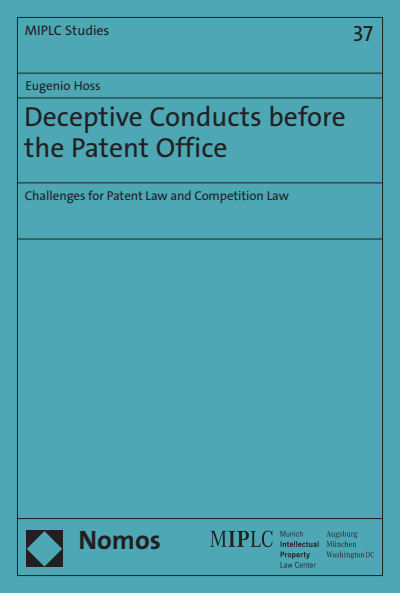
Deceptive Conducts before the Patent Office
Challenges for Patent Law and Competition Law- Autor:innen:
- Reihe:
- Munich Intellectual Property Law Center - MIPLC Studies, Band 37
- Verlag:
- 2019
Zusammenfassung

Publikation durchsuchen
Bibliographische Angaben
- Auflage
- 1/2019
- Copyrightjahr
- 2019
- ISBN-Print
- 978-3-8487-6134-0
- ISBN-Online
- 978-3-7489-0257-7
- Verlag
- Nomos, Baden-Baden
- Reihe
- Munich Intellectual Property Law Center - MIPLC Studies
- Band
- 37
- Sprache
- Englisch
- Seiten
- 335
- Produkttyp
- Monographie
Inhaltsverzeichnis
KapitelSeiten
- Titelei/InhaltsverzeichnisSeiten 1 - 24 Download Kapitel (PDF)
- 1. The Underlying Problem
- 2. Deceptive Behaviour in Patent Procedures and Available Remedies under Patent Law
- 3. The Patenting Procedure under the Spotlight of Competition Law. Yet another Angle for the IP v Competition Law Debate
- 4. Scope and Structure of this Work
- 1. General Framework
- A. Examination Process: an Ex Parte Procedure
- I. Description
- II. Claims
- III. Other Formal Requirements. Inventors and Priority
- I. Formal and Substantive Examination, Publication and Office Actions
- II. Amendments
- III. Divisional Applications and Unity of Invention
- IV. Grant, Publication and National Validation
- V. Third Party Observations
- I. Post-Grant Amendments, Ex Parte Reexamination and Supplemental Examination
- II. Third Party Intervention after Grant. Oppositions, Post-Grant Reviews and Inter-Partes Reviews
- a. SPCs in the EU
- b. Patent Term Extensions in the US
- IV. Patent Linkage and the Orange Book
- E. Alternative Procedures. PCT, Patent Prosecution Highway and the Use of Results from other Patent Offices
- F. The Role of Patent Agents
- A. The Origin of the Inequitable Conduct Doctrine. A Stroll down Memory Lane
- B. The Development of the Inequitable Conduct Doctrine and the Duty of Candour
- I. Intent
- II. Materiality
- III. Burden of Proof and the ‘Sliding Scale’
- I. Failure to Disclose the Prior Public Use of an Invention
- II. Failure to Cite Known Relevant Prior Art
- III. Submission of False Information
- IV. Other conducts
- E. Disciplinary and Criminal Sanctions
- I. Rule 42(1)(b) EPC as a Duty of Disclosure?
- II. The Duty of Disclosure in the Travaux Préparatoires
- III. Rule 141 EPC and the Limited Duty of Disclosure
- IV. The impact of AstraZeneca
- I. Germany
- II. United Kingdom
- III. Disciplinary and Criminal Sanctions
- I. Defining the Scope of the Obligation
- II. Practical Value
- III. Interest of Applicants Themselves to have All Prior Art Considered
- IV. Duty of Advocacy
- I. Evaluation of the inequitable conduct doctrine in the US
- II. Would it be advisable for European courts to implement a similar doctrine?
- 1. Goals of Competition Law
- A. Essential Pillars of the Competition Legal Framework
- i. Product and Geographical Markets. The Hypothetical Monopolist Test
- ii. Demand and Supply Substitution
- iii. Product and Technology Markets
- iv. Competition without markets. From Innovation Markets to Competition in Innovation
- i. Indirect Methods of Establishing Market Power. Market Shares, Entry Barriers and other Indicia
- ii. Is Market Definition Always Necessary? Direct Methods of Establishing Market Power
- a. Types of Anticompetitive Conducts: Exclusionary and Exploitative Behaviours
- b. The Importance of Timing: Dominance as a Prerequisite under EU Law. Differences with US’ Monopolisation and Attempt to Monopolise
- c. Causation: The Relationship between Market Power, Anticompetitive Conduct and Anticompetitive Effects
- d. The Role of Intent
- C. The Particular Case of § 5 FTC Act
- I. Social and Economic Functions of the Patent System
- II. Patents and Market Power
- III. Reciprocal Goals but Conflicting Means
- a. Evolution of the Interrelation between Antitrust and Intellectual Property
- b. Antitrust Immunity and the Noerr Doctrine
- c. The Patent Misuse Doctrine
- a. Existence v Exercise Dichotomy
- b. The Specific Subject-Matter Standard
- c. Current Stage of the Debate
- d. Is there a Petitioning Immunity Doctrine in Europe?
- a. The Walker Process decision
- b. The Walker Process Legacy
- c. The Handgards or ‘Bad Faith Litigation’ Antitrust Claim
- II. Orange Book Cases
- a. Market Definition and its Dominance
- b. The First Abuse
- c. The Second Abuse
- II. AstraZeneca’s Aftermath: Cases in EU Member States
- 3. Closing Remarks and Open Questions
- 1. Introduction
- I. Sanctions under Other Areas of Law
- II. Sham as an Antitrust Injury in US Case Law
- III. Vexatious Litigation in the EU
- I. Antitrust Injury
- a. Objective Baselessness or ‘Legal Inviability’
- b. Intent or ‘Economic Inviability’
- III. Individual vs Patterns of Anticompetitive Litigation
- IV. Litigation as part of a Broader Pattern of Conduct
- C. Wrapping-up: A Simple Genus-Species Relationship?
- I. The General Question under US Law
- II. The General Question under EU Law
- III. Can a Deceptive Conduct before the Patent Office be analysed as an Illegitimate Inducement of Government Action?
- I. Materiality and Causal Connection
- II. Conceptualisation of the Misconduct
- III. Ministerial Acts and Discretion of the Patent Office
- a. Exclusionary Effects of Improperly Granted Patents
- b. Scope of and Entitlement to the Patent
- c. Consumer Harm and Objective Justifications
- a. The Case under § 2 Sherman Act. Monopolisation and Attempt to Monopolise
- b. The Case under art 102 TFEU. Market Dominance as a Pre-requisite
- I. The Case under US Law and Walker Process’ Enforcement Requirement
- a. A case for Article 102(a) TFEU or duty to license?
- b. ‘Single and Continuous’ Abuses
- c. Ownership or Enforcement as Separate Exclusionary Abuses?
- A. The Scenario under US Law. A Strict Duty of Candour and the Inequitable Conduct Doctrine
- B. The Scenario under EU Law
- I. Extent of Patent Applicant’s Duties
- II. Legal Consequences of the Deceitful Conduct
- I. The Scenario in the US: Walker Process and its Progeny
- II. The Scenario in the EU: AstraZeneca
- B. Sham or Vexatious Litigation Distinguished
- I. The General Framework in the US and in the EU
- a. Causal Link
- b. Conceptualisation of the Misconduct
- c. Discretion of the Patent Office
- d. Anticompetitive Effects
- e. Market Power
- III. Ownership or Enforcement of Fraudulently Obtained Patents
- BibliographySeiten 319 - 335 Download Kapitel (PDF)
Literaturverzeichnis (308 Einträge)
Es wurden keine Treffer gefunden. Versuchen Sie einen anderen Begriff.
- — — Black’s Law Dictionary (9th edn, 2009). Google Scholar öffnen DOI: 10.5771/9783748902577
- — — ‘Deception as an Antitrust Violation’ (2012) 125 Harv L Rev 1235. Google Scholar öffnen DOI: 10.5771/9783748902577
- — — ‘EPO Round up: Part 2’ (IP Kat, 7 June 2005) <http://ipkitten.blogspot.de/2005/06/epo-round-up-part-2.html>. Google Scholar öffnen DOI: 10.5771/9783748902577
- — — ‘Is the Patent Misuse Doctrine Obsolete?’ (1997) 110 Harv L Rev 1922. Google Scholar öffnen DOI: 10.5771/9783748902577
- — — ‘Recent Legislation’ (2012) 125 Harv L Rev 1290. Google Scholar öffnen DOI: 10.5771/9783748902577
- — — Restatement (2d) of Torts (1977). Google Scholar öffnen DOI: 10.5771/9783748902577
- Abramowicz M and Duffy J F, ‘Intellectual Property for Market Experimentation’ (2008) 83 NYU L Rev 337. Google Scholar öffnen DOI: 10.5771/9783748902577
- Adelman M J, ‘The Relevant Market Paradox: Attempted and Completed Patent Fraud Monopolization’ (1977) 38 Ohio St L J 289. Google Scholar öffnen DOI: 10.5771/9783748902577
- Adelman M J, ‘The New World of Patents Created by the Court of Appeals for the Federal Circuit’ (1987) 20 U Mich J L Refom 979. Google Scholar öffnen DOI: 10.5771/9783748902577
- Akers N J, ‘The Referencing of Prior Art Documents in European Patents and Applications’ (2000) 22 World Patent Information 309. Google Scholar öffnen DOI: 10.5771/9783748902577
- Akman P, ‘Searching for the Long-Lost Soul of Article 82 EC’ (2009) 29 Oxford J Leg St 267 (2009). Google Scholar öffnen DOI: 10.5771/9783748902577
- Akman P, The Concept of Abuse in EU Competition Law: Law and Economic Approaches (Hart 2012). Google Scholar öffnen DOI: 10.5771/9783748902577
- Allison J R and Lemley M A, ‘The Growing Complexity of the United States Patent System’ (2002) 82 Bost U L Rev 77. Google Scholar öffnen DOI: 10.5771/9783748902577
- Ampollini D, ‘Looking for Sense in the Italian Antitrust Authority Decision in the Pfizer Xalatan Case’ [2012] Antitrust Chronicle vol 7(2) 1. Google Scholar öffnen DOI: 10.5771/9783748902577
- Anderman S D, ‘The Strategic Use of Patent Enforcement and Acquisition Methods and Competition Law’ in Govaere I and Ullrich H (eds), Intellectual Property, Market Power and the Public Interest (Peter Lang 2008) 171. Google Scholar öffnen DOI: 10.5771/9783748902577
- Anderman S D, ‘The IP and Competition Interface: New Developments’ in Anderman S D and Ezrachi A (eds), Intellectual Property and Competition Law: New Frontiers (OUP 2011) 6. Google Scholar öffnen DOI: 10.5771/9783748902577
- Anderman S D and Kallaugher J, Technology Transfer and the New EU Competition Rules: Intellectual Property Licensing after Modernisation (OUP 2006). Google Scholar öffnen DOI: 10.5771/9783748902577
- Andrews N, ‘Abuse of Process in English Civil Litigation’ in Taruffo M (ed), Abuse of Procedural Rights: Comparative Standards of Procedural Fairness (Kluwer 1999) 65. Google Scholar öffnen DOI: 10.5771/9783748902577
- Anenson T L, ‘Treating Equity Like Law: A Post-Merger Justification of Unclean Hands’ (2008) 45 Am Bus L J 455. Google Scholar öffnen DOI: 10.5771/9783748902577
- Areeda P E and Hovenkamp H, Antitrust Law: An Analysis of Antitrust Principles and Their Application (3rd edn, Aspen 2011). Google Scholar öffnen DOI: 10.5771/9783748902577
- Areeda P E and Hovenkamp H, Fundamentals of Antitrust Law (4th edn, Wolters Kluwer 2011). Google Scholar öffnen DOI: 10.5771/9783748902577
- Arena A, Bergmann B and Himes J L, ‘Two Bodies of Law Separated by a Common Mission: Unilateral Conduct by Dominant Firms at the IP/Antitrust Intersection in the EU and the US’ (2013) 9 Eur Comp J 623. Google Scholar öffnen DOI: 10.5771/9783748902577
- Arezzo E, ‘Is There a Role for Market Definition and Dominance in an Effects-Based Approach?’ in Mackenrodt M O, Conde Gallego B and Enchelmaier S (eds), Abuse of Dominant Position: New Interpretation, New Enforcement Mechanisms? (Springer 2008) 21. Google Scholar öffnen DOI: 10.5771/9783748902577
- Armitage E, ‘The New British Patent Legislation’ (1978) 9 IIC 207. Google Scholar öffnen DOI: 10.5771/9783748902577
- Arrow K J, ‘Economic Welfare and the Allocation of Resources for Invention’ in National Bureau of Economic Research (ed), The Rate and Direction of Inventive Activity: Economic and Social Factors (Princeton Univ Press 1962). Google Scholar öffnen DOI: 10.5771/9783748902577
- Balmer T A, ‘Sham Litigation and the Antitrust Laws’ (1980) 209 Buffalo L Rev 39. Google Scholar öffnen DOI: 10.5771/9783748902577
- Banks K and Marenco G, ‘Intellectual Property and the Community Rules on Free Movement: Discrimination Unearthed’ (1990) 15 E L Rev 224. Google Scholar öffnen DOI: 10.5771/9783748902577
- Batchelor B and Healy M, ‘CJEU AstraZeneca Judgment: Groping Towards a Test for Patent Office Dealings; (2013) 34 Eur Comp L Rev 171. Google Scholar öffnen DOI: 10.5771/9783748902577
- Beier F K, ‘Die Rechtsbehelfe des Patentanmelders und seiner Wettbewerber im Vergleich: Eine rechtsvergleichende Untersuchung zur Chancengleichheit im Patentverfahren [1989] GRUR Int 1. Google Scholar öffnen DOI: 10.5771/9783748902577
- Beier F K, ‘Industrial Property and the Free Movement of Goods in the Internal European Market (1990) 21 IIC 131. Google Scholar öffnen DOI: 10.5771/9783748902577
- Benkard G, Patentgesetz (Asendorf C D and others eds, 10th edn, Beck 2006). Google Scholar öffnen DOI: 10.5771/9783748902577
- Bensadon M, Ley de Patentes Comentada y Concordada con el ADPIC y el Convenio de Paris (LexisNexis 2007). Google Scholar öffnen DOI: 10.5771/9783748902577
- Bently L and Sherman B, Intellectual Property Law (4th edn, OUP 2014). Google Scholar öffnen DOI: 10.5771/9783748902577
- Berg W and Brankin S P,‘Das AstraZeneca-Urteil des Gerichts der Europäischen Union’ [2011] EuZW 91. Google Scholar öffnen DOI: 10.5771/9783748902577
- Bicknell G M, ‘To Disclose or not to Disclose: Duty of Candor Obligations of the United States and Foreign Patent Offices’ (2008) 83 Chi-Kent L Rev 425. Google Scholar öffnen DOI: 10.5771/9783748902577
- Bishop S and Walker M, The Economics of Competition Law: Concepts, Application and Measurement (3rd edn, Sweet & Maxwell 2010). Google Scholar öffnen DOI: 10.5771/9783748902577
- Blanco White T A, Patents for Inventions and the Protection of Industrial Designs (5th edn, Stevens & Sons 1983). Google Scholar öffnen DOI: 10.5771/9783748902577
- Bodenhausen G H C, Guide to the Application of the Paris Convention (BIRPI 1968). Google Scholar öffnen DOI: 10.5771/9783748902577
- Bohannan C, ‘IP Misuse as Foreclosure’ (2011) 96 Iowa L Rev 475. Google Scholar öffnen DOI: 10.5771/9783748902577
- Bohannan C, and Hovenkamp H, Creation without Restraint: Promoting Liberty and Rivalry in Innovation (OUP 2012). Google Scholar öffnen DOI: 10.5771/9783748902577
- Bork R H, The Antitrust Paradox: A Policy at War with Itself (Basic 1978). Google Scholar öffnen DOI: 10.5771/9783748902577
- Borrás S, ‘The Governance of the European Patent System: Effective and Legitimate?’ (2006) 35 Economy and Society 594. Google Scholar öffnen DOI: 10.5771/9783748902577
- Bostyn S and Petit N, ‘Patent=Monopoly: A Legal Fiction’ (2013) <http://ssrn.com/abstract=2373471>. Google Scholar öffnen DOI: 10.5771/9783748902577
- Bowman W S, Patent and Antitrust Law: A Legal and Economic Appraisal (Univ of Chicago Press 1973). Google Scholar öffnen DOI: 10.5771/9783748902577
- Brack H P, ‘Patent Infringement Warnings in a Common Law versus a Civil Law Jurisdiction - An Actionable Threat?’ (2006) 37 IIC 1. Google Scholar öffnen DOI: 10.5771/9783748902577
- Brophy D, ‘Rule 141 and further EPO obstructions’ (IP Kat, 12 August 2010) <http://ipkitten.blogspot.de/2010/08/rule-141-and-further-epo-obstructions.html>. Google Scholar öffnen DOI: 10.5771/9783748902577
- Brown A E L, Intellectual Property, Human Rights and Competition (Edward Elgar 2012). Google Scholar öffnen DOI: 10.5771/9783748902577
- Bushell G, ‘AstraZeneca v Commission: Advocate-General Mazak’s Opinion of 15 May 2012’ (Kluwer Competition Blog, 11 June 2012) <http://kluwercompetitionlawblog.com/2012/06/11/astrazeneca-v-commission-advocate-general-mazaks-opinion-of-15-may-2012>. Google Scholar öffnen DOI: 10.5771/9783748902577
- Caballero R J and Jaffe A B, ‘How High Are the Giants’ Shoulders: An Empirical Assessment of Knowledge Spillovers and Creative Destruction in a Model of Economic Growth’ in Blanchard O and Fischer S (eds), NBER Macroeconomics Annual 1993: Volume 8 (MIT Press 1993) 15. Google Scholar öffnen DOI: 10.5771/9783748902577
- Calkins S, ‘Developments in Antitrust and the First Amendment: the Disaggregation of Noerr’ (1988) 57 Antitrust L J 327. Google Scholar öffnen DOI: 10.5771/9783748902577
- Castillo de la Torre F, ‘State Action Defence in EC Competition Law’ (2005) 28 World Competition 407. Google Scholar öffnen DOI: 10.5771/9783748902577
- Chafee Z Jr, ‘Coming into Equity with Clean Hands’ (1949) 47 Mich L Rev 877. Google Scholar öffnen DOI: 10.5771/9783748902577
- Chandra A, ‘Antitrust Liability for Attempting to Enforce a Fraudulent Patent’ (1999) 81 J Pat & Trademark Off Soc’y 201. Google Scholar öffnen DOI: 10.5771/9783748902577
- Chiang T J, ‘The Upside Down Inequitable Conduct Defense’ (2013) 107 Northwest U L Rev 1243. Google Scholar öffnen DOI: 10.5771/9783748902577
- Chisum D S, Chisum on Patents (Lexis Nexis). Google Scholar öffnen DOI: 10.5771/9783748902577
- Clifford R D, ‘Is it Time for a Rule 11 for the Patent Bar?’ (2013) 53 IDEA 351. Google Scholar öffnen DOI: 10.5771/9783748902577
- Cole M, ‘Pharmaceuticals and Competition: First Strike to the Commission?’ (2013) 34 Eur Comp L Rev 227. Google Scholar öffnen DOI: 10.5771/9783748902577
- Cole P, ‘Patents and Scientific Integrity’ [2008(5)] CIPAJ 2. Google Scholar öffnen DOI: 10.5771/9783748902577
- Conde Gallego B, ‘Unilateral Refusal to License Indispensable Intellectual Property Rights – US and EU Approaches’ in Drexl J (ed), Research Handbook on Intellectual Property and Competition Law (Edward Elgar 2008) 215. Google Scholar öffnen DOI: 10.5771/9783748902577
- Conley N L, ‘Considerations in Patent Litigation Brought About by Walker Process Equipment, Inc v Food Machinery & Chemical Corp’ (1966) 9 S Tex L J 9. Google Scholar öffnen DOI: 10.5771/9783748902577
- Cooper J C and Kovacic W E, ‘U.S. Convergence with International Competition Norms: Antitrust Law and Public Restraints on Competition’ (2010) 90 Bost U L Rev 1555. Google Scholar öffnen DOI: 10.5771/9783748902577
- Cotropia C A, ‘Modernizing Patent Law’s Inequitable Conduct Doctrine’ (2009) 24 Berkeley Tech L J 723. Google Scholar öffnen DOI: 10.5771/9783748902577
- Cotropia C A and Lemley M A and Sampat B N, ‘Do Applicant Patent Citations Matter?’ (2013) 42 Research Policy 844. Google Scholar öffnen DOI: 10.5771/9783748902577
- Cotter T F, ‘An Economic Analysis of Patent Law’s Inequitable Conduct Doctrine’ (2011) 53 Az L Rev 735. Google Scholar öffnen DOI: 10.5771/9783748902577
- Cotter T F, ‘Four Questionable Rationales for the Patent Misuse Doctrine’ (2011) 12 Minn J L Sci & Tech 457. Google Scholar öffnen DOI: 10.5771/9783748902577
- Cornish W R, Llewelyn D and Aplin T F, Intellectual Property: Patents, Copyright, Trade Marks and Allied Rights (8th edn, Sweet & Maxwell 2013). Google Scholar öffnen DOI: 10.5771/9783748902577
- Costilo L B, ‘Antitrust’s Newest Quagmire: The Noerr-Pennington Defense’ (1967) 66 Mich L Rev 333. Google Scholar öffnen DOI: 10.5771/9783748902577
- Crane D A, ‘Judicial Review of Anticompetitive State Action: Two Models in Comparative Perspective (2013) 1 J Antitrust Enforcement 418. Google Scholar öffnen DOI: 10.5771/9783748902577
- Crawford B W and DeGiulio J V, ‘New (Limited) Duty of Candor in the EPO (Amended European Rule 141)’ (2010) 8[4] MBHB Snippets 13 (2010). Google Scholar öffnen DOI: 10.5771/9783748902577
- Creighton S A and others, ‘Cheap Exclusion’ (2005) 72 Antitrust L J 975. Google Scholar öffnen DOI: 10.5771/9783748902577
- Cremers K and others, ‘Invalid But Infringed? An Analysis of Germany’s Bifurcated Patent Litigation System’ (2014) Max Planck Institute for Innovation & Competition Research Paper 14/14 <http://ssrn.com/abstract=2504507>. Google Scholar öffnen DOI: 10.5771/9783748902577
- Crew E, ‘The Use of Patent Litigation to Violate the Antitrust Laws’ (2006) 11 Intell Prop L Bull 69. Google Scholar öffnen DOI: 10.5771/9783748902577
- Crouch D, ‘Supplemental Examination: Inequitable Conduct Amnesty and Beyond’ (Patently-O, 16 September 2012) <www.patentlyo.com/patent/2012/09/supplemental-examination-inequitable-conduct-amnesty-and-beyond.html>. Google Scholar öffnen DOI: 10.5771/9783748902577
- Crouch D, ‘Is the New Supplemental Examination a Complete Replacement for Owner Initiated Ex Parte Reexamination?’ (Patently-O, 3 October 2012) <www.patentlyo.com/patent/2012/10/is-the-new-supplemental-examination-a-complete-replacement-for-owner-initiated-ex-parte-reexamination.html>. Google Scholar öffnen DOI: 10.5771/9783748902577
- Czapracka K, Intellectual Property and the Limits of Antitrust: A Comparative Study of US and EU Approaches (Edward Elgar 2010). Google Scholar öffnen DOI: 10.5771/9783748902577
- Daniel B D, ‘Walker Process Proof: The Proper Prescription’ (2009) 41 Rutgers L J 105. Google Scholar öffnen DOI: 10.5771/9783748902577
- Davenport N, The United Kingdom Patent System: A Brief History (Mason 1979). Google Scholar öffnen DOI: 10.5771/9783748902577
- Davidow J, Patent-Related Misconduct Issues in US Litigation (OUP 2010). Google Scholar öffnen DOI: 10.5771/9783748902577
- de Saint-Georges M and van Pottelsberghe de la Potterie B, ‘A Quality Index for Patent Systems’ (2013) 42 Research Policy 704. Google Scholar öffnen DOI: 10.5771/9783748902577
- DeSanti S and Cohen W, ‘Competition to Innovate: Strategies for Proper Antitrust Assessments’ in Dreyfuss R C, Zimmerman D L and First H (eds), Expanding the Boundaries of Intellectual Property (OUP 2001) 317. Google Scholar öffnen DOI: 10.5771/9783748902577
- De Stefano G, ‘Tough Enforcement of Unilateral Conduct at the National Level: Italian Antitrust Authority Sanctions Bayer and Pfizer for Abuse of Dominant Position (aka AstraZeneca Ruling and Essential Facility Doctrine in Italian Sauce)’ (2012) 3 J Eur Comp L & Prac 396. Google Scholar öffnen DOI: 10.5771/9783748902577
- Dieny E, ‘The Pharmaceutical Industry and Competition Law between the Present and the Future’ (2007) 28 Eur Comp L Rev 223. Google Scholar öffnen DOI: 10.5771/9783748902577
- Dolak L A, ‘Inequitable Conduct: A Flawed Doctrine Worth Saving’ (2010) 11 Wake Forest Intell Prop L J 1. Google Scholar öffnen DOI: 10.5771/9783748902577
- Dolak L A, ‘America Invents the Supplemental Examination, but Retains the Duty of Candor: Questions and Implications’ (2012) 6 Akron Intell Prop J 147. Google Scholar öffnen DOI: 10.5771/9783748902577
- Drahos P, ‘“Trust Me”: Patent Offices in Developing Countries’ (2008) 34 Am J L & Med 151. Google Scholar öffnen DOI: 10.5771/9783748902577
- Drexl J, ‘Intellectual Property and Antitrust Law - IMS Health and Trinko: Antitrust Placebo for Consumers Instead of Sound Economics in Refusal-to-Deal Cases’ (2004) 35 IIC 788. Google Scholar öffnen DOI: 10.5771/9783748902577
- Drexl J, ‘Is There a “More Economic Approach” to Intellectual Property and Competition Law?’ in Drexl J (ed), Research Handbook on Intellectual Property and Competition Law (Edward Elgar 2008) 27. Google Scholar öffnen DOI: 10.5771/9783748902577
- Drexl J, ‘The Relationship Between the Legal Exclusivity and Economic Market Power: Links and Limits’ in Govaere I and Ullrich H (eds), Intellectual Property, Market Power and the Public Interest (Peter Lang 2008) 13. Google Scholar öffnen DOI: 10.5771/9783748902577
- Drexl J, ‘Deceptive Conduct in the Patent World: A Case for US Antitrust and EU Competition Law?’ in Prinz zu Waldeck und Pyrmont W and others (eds), Patents and Technological Progress in a Globalized World: Liber Amicorum for Joseph Straus (Springer 2009) 137. Google Scholar öffnen DOI: 10.5771/9783748902577
- Drexl J, ‘“Pay-for-Delay” and Blocking Patents: Targeting Pharmaceutical Companies under European Competition Law’ (2009) 40 IIC 751. Google Scholar öffnen DOI: 10.5771/9783748902577
- Drexl J, ‘Real Knowledge is to Know the Extent of One’s Own Ignorance: On the Consumer Harm Approach in Innovation-Related Competition Cases’ (2010) 76 Antitrust L J 677. Google Scholar öffnen DOI: 10.5771/9783748902577
- Drexl J, ‘Anticompetitive Stumbling Stones on the Way to a Cleaner World: Protecting Competition in Innovation Without a Market’ (2012) 8 J Comp L & Econ 507. Google Scholar öffnen DOI: 10.5771/9783748902577
- Drexl J, ‘AstraZeneca and the EU Sector Inquiry: When do Patent Filings Violate Competition Law?’ in f Drexl J and Lee N (eds), Pharmaceutical Innovation, Competition and Patent Law: A Trilateral Perspective (Edward Elgar 2013) 290. Google Scholar öffnen DOI: 10.5771/9783748902577
- Dreyfuss R C, ‘The Federal Circuit: A Case Study in Specialized Courts’ (1989) 64 NYU L Rev 1. Google Scholar öffnen DOI: 10.5771/9783748902577
- Eilmansberger T, ‘How to Distinguish Good From Bad Competition Under Article 82 EC: In Search of Clearer and More Coherent Standards for Anti-competitive Abuses’ (2005) 42 CML Rev 129. Google Scholar öffnen DOI: 10.5771/9783748902577
- Elhauge E, ‘Making Sense of Antitrust Petitioning Immunity’ (1992) 80 Cal L Rev 1177. Google Scholar öffnen DOI: 10.5771/9783748902577
- Elhauge E, ‘Defining Better Monopolization Standards’ (2003) 56 Stan L Rev 253. Google Scholar öffnen DOI: 10.5771/9783748902577
- Elhauge E and Geradin D, Global Antitrust Law and Economics, (2nd edn, Foundation Press 2011). Google Scholar öffnen DOI: 10.5771/9783748902577
- Erstling J, ‘Patent Law and the Duty of Candor: Rethinking The Limits of Disclosure’ (2011) 44 Creighton L Rev 329. Google Scholar öffnen DOI: 10.5771/9783748902577
- European Generic Medicines Association, ‘Patent-Related Barriers to Market Entry for Generic Medicines in the European Union: A Review of Weaknesses in the Current European Patent System and their Impact on the Market Access of Generic Medicines’ (2008). Google Scholar öffnen DOI: 10.5771/9783748902577
- Farrell J and Merges R P, ‘Incentives to Challenge and Defend Patents: Why Litigation Won’t Reliably Fix Patent Office Errors and Why Administrative Patent Review Might Help’ (2004) 19 Berkeley Tech L J 943. Google Scholar öffnen DOI: 10.5771/9783748902577
- Feldman R C, ‘The Insufficiency of Antitrust Analysis for Patent Misuse’ (2003) 55 Hastings L J 399. Google Scholar öffnen DOI: 10.5771/9783748902577
- Filmore S, ‘Defining the Misrepresentation Exception to the Noerr-Pennington Doctrine’ (2001) 49 Univ Kan L Rev 423. Google Scholar öffnen DOI: 10.5771/9783748902577
- Fischel D R, ‘Antitrust Liability for Attempts to Influence Government Action: The Basis and Limits of the Noerr-Pennington Doctrine’ (1977) 45 U Chi L Rev 80. Google Scholar öffnen DOI: 10.5771/9783748902577
- Fischmann F, «Reverse Payments» als Mittel zur Beilegung von Patentstreitigkeiten - Ein Verstoß gegen das Kartellrecht? (Stämpfli Verlag 2016). Google Scholar öffnen DOI: 10.5771/9783748902577
- Fisher F M, ‘Monopolization versus Abuse of Dominant Position: An Economist’s View’ in Hawk B (ed), International Antitrust Law & Policy: Fordham Corporate Law 2003 (Juris Publishing 2004) 157. Google Scholar öffnen DOI: 10.5771/9783748902577
- Flanagan A, Ghezzi F and Montagnani M L, ‘The Search of EU Boundaries: IPR Exercise and Enforcement as “Misuse”’ in Flanagan A and Montagnani M L (eds), Intellectual Property Law: Economic and Social Justice Perspectives (Edward Elgar 2010) 112. Google Scholar öffnen DOI: 10.5771/9783748902577
- Flores E S and Warren S E Jr, ‘Inequitable Conduct, Fraud, and Your License to Practice before the United States Patent and Trademark Office’ (2000) 8 Tex Intell Prop L J 299. Google Scholar öffnen DOI: 10.5771/9783748902577
- Floyd C D, ‘Antitrust Liability for the Anticompetitive Effects of Governmental Action Induced by Fraud’ (2001) 69 Antitrust L J 403. Google Scholar öffnen DOI: 10.5771/9783748902577
- Forrester I S, ‘The Interplay Between Standardization, IPR and Competition Law’ in Caggiano G, Muscolo G and Tavassi M (eds), Competition Law and Intellectual Property: A European Perspective (Wolters Kluwer 2012) 113. Google Scholar öffnen DOI: 10.5771/9783748902577
- Fox E M, ‘Monopolization and Dominance in the United States and the European Community: Efficiency Opportunity and Fairness’ (1986) 61 Notre Dame L Rev 981. Google Scholar öffnen DOI: 10.5771/9783748902577
- Fox E M, ‘We Protect Competition, You Protect Competitors’ (2003) 26 World Competition 149. Google Scholar öffnen DOI: 10.5771/9783748902577
- Fox E M and Healey D, ‘When the State Harms Competition: the Role for Competition Law’ (2014) 79 Antitrust L J 769. Google Scholar öffnen DOI: 10.5771/9783748902577
- Fuchs A, ‘Patent Ambush Strategies and Article 102 TFEU’ in Drexl J and others (eds), More Common Ground for International Competition Law (Edward Elgar 2011) 177. Google Scholar öffnen DOI: 10.5771/9783748902577
- Gallasch S, ‘AstraZeneca v the Walker Process – A Real EU-US Divergence or Just an Attempt to Compare Apples to Oranges?’ (2011) 7 Eur Comp J 505. Google Scholar öffnen DOI: 10.5771/9783748902577
- Galloway J, ‘Driving Innovation: A Case for Targeted Competition Policy in Dynamic Markets’ (2011) 34 World Competition 73. Google Scholar öffnen DOI: 10.5771/9783748902577
- Geradin D, ‘Limiting the Scope of Article 82 EC: What can the EU Learn From the US Supreme Court’s Judgment in Trinko in the Wake of Microsoft, IMS, and Deutsche Telekom?’ (2004) 41 CML Rev 1519. Google Scholar öffnen DOI: 10.5771/9783748902577
- Geradin D and others, ‘The Concept of Dominance in EC Competition Law’ (2005) GCLC Research Paper on the Modernization of Article 82 EC <http://ssrn.com/abstract=770144>. Google Scholar öffnen DOI: 10.5771/9783748902577
- Geradin D, ‘When Competition Law Analysis Goes Wrong – The Italian Pfizer/Pharmacia Case’ (2014) <http://ssrn.com/abstract=2393383>. Google Scholar öffnen DOI: 10.5771/9783748902577
- Gerber D J, Law and Competition in Twentieth Century Europe: Protecting Prometheus (OUP 2003). Google Scholar öffnen DOI: 10.5771/9783748902577
- Gervais M, The TRIPS Agreement: Drafting History and Analysis (4th edn, Sweet & Maxwell 2012). Google Scholar öffnen DOI: 10.5771/9783748902577
- Ghidini G, Innovation, Competition and Consumer Welfare in Intellectual Property Law (Edward Elgar 2010). Google Scholar öffnen DOI: 10.5771/9783748902577
- Gilbert R J and Sunshine S C, ‘Incorporating Dynamic Efficiency Concerns in Merger Analysis: The Use of Innovation Markets’ (1994) 63 Antitrust L J 569. Google Scholar öffnen DOI: 10.5771/9783748902577
- Glader M, Innovation Markets and Competition Analysis (Edward Elgar 2006). Google Scholar öffnen DOI: 10.5771/9783748902577
- Goldman R J, ‘Evolution of the Inequitable Conduct Defense in Patent Litigation’ (1993) 7 Harv J L & Tech 37. Google Scholar öffnen DOI: 10.5771/9783748902577
- Govaere I, The Use and Abuse of Intellectual Property Rights in EC Law (Sweet & Maxwell 1996). Google Scholar öffnen DOI: 10.5771/9783748902577
- Govaere I, ‘In Pursuit of an Innovation Policy Rationale: Stakes and Limits under Article 82 TEC’ (2008) 31 World Competition 541. Google Scholar öffnen DOI: 10.5771/9783748902577
- Guimarães de Lima e Silva V, ‘Sham Litigation in the Pharmaceutical Sector’ (2011) 7 Eur Comp J 455. Google Scholar öffnen DOI: 10.5771/9783748902577
- Gunther J P and Breuvart C, ‘Misuse of Patent and Drug Regulatory Approval Systems in the Pharmaceutical Industry: An Analysis of US And EU Converging Approaches’ (2005) 26 Eur Comp L Rev 669. Google Scholar öffnen DOI: 10.5771/9783748902577
- Hacon R, Concise European Patent Law (Hacon R and Pagenberg J eds, 2nd edn, Wolters Kluwer 2008). Google Scholar öffnen DOI: 10.5771/9783748902577
- Hall B H and Harhoff D, ‘Post-Grant Reviews in the U.S. Patent System ¬ Design Choices and Expected Impact’ (2004) 19 Berkeley Tech L J 989. Google Scholar öffnen DOI: 10.5771/9783748902577
- Hall B H and others, ‘Prospects for Improving U.S. Patent Quality via Postgrant Opposition’ in Jaffe A B, Lerner J and Stern S (eds), Innovation Policy and the Economy: Volume 4 (National Bureau of Economic Research 2004). Google Scholar öffnen DOI: 10.5771/9783748902577
- Handler M and De Sevo R A, ‘The Noerr Doctrine and Its Sham Exception’ (1984) 6 Cardozo L Rev 1. Google Scholar öffnen DOI: 10.5771/9783748902577
- Heald P J, ‘A Transaction Costs Theory of Patent Law’ (2005) 66 Ohio St L J 473. Google Scholar öffnen DOI: 10.5771/9783748902577
- Heinemann A, ‘The Contestability of IP-Protected Markets’ in Drexl J (ed), Research Handbook on Intellectual Property and Competition Law (Edward Elgar 2008). Google Scholar öffnen DOI: 10.5771/9783748902577
- Helsel S D, ‘Preventing Predatory Abuses in Litigation between Business Competitors: Focusing on a Litigant’s Reasons for Initiating the Litigation to Ensure a Balance between the Constitutional Right to Petition and the Sherman Acts Guarantee of Fair Competition in Business’ (1995) 36 Wm & Mary L Rev 1135. Google Scholar öffnen DOI: 10.5771/9783748902577
- Herper M, ‘The Cost of Creating a New Drug Now $5 Billion, Pushing Big Pharma to Change’ Forbes (New York, 11 August 2013) <www.forbes.com/sites/matthewherper/2013/08/11/how-the-staggering-cost-of-inventing-new-drugs-is-shaping-the-future-of-medicine>. Google Scholar öffnen DOI: 10.5771/9783748902577
- Herstein O J, ‘A Normative Theory of the Clean Hands Defense (2011) 17 Legal Theory 171. Google Scholar öffnen DOI: 10.5771/9783748902577
- Hess B, ‘Abuse of Procedure in Germany and Austria’ in Taruffo M (ed), Abuse of Procedural Rights: Comparative Standards of Procedural Fairness (Kluwer 1999). Google Scholar öffnen DOI: 10.5771/9783748902577
- Hricik D, ‘Where The Bodies Are: Current Exemplars of Inequitable Conduct and How to Avoid Them’ (2004) 12 Tex Intell Prop L J 287. Google Scholar öffnen DOI: 10.5771/9783748902577
- Hovenkamp H, ‘The Monopolization Offence’ (2000) 61 Ohio St L J 1035. Google Scholar öffnen DOI: 10.5771/9783748902577
- Hovenkamp H, The Antitrust Enterprise: Principle and Execution (Harvard Univ Press 2005). Google Scholar öffnen DOI: 10.5771/9783748902577
- Hovenkamp H, ‘IP and Antitrust Policy: A Brief Historical Overview’ (2005) Univ Iowa Legal Studies Research Paper 05/31 <http://ssrn.com/abstract=869417>. Google Scholar öffnen DOI: 10.5771/9783748902577
- Hovenkamp H, ‘The Walker Process Doctrine: Infringement Lawsuits as Antitrust Violations’ (2008) U Iowa Legal Studies Research Paper 08/36 <http://ssrn.com/abstract=1259877>. Google Scholar öffnen DOI: 10.5771/9783748902577
- Hovenkamp H, ‘Patent Exclusions and Antitrust after Therasense’ (2011) U Iowa Legal Studies Research Paper 11/39 <http://ssrn.com/abstract=1916074>. Google Scholar öffnen DOI: 10.5771/9783748902577
- Hovenkamp H, ‘Antitrust and the Patent System: A Reexamination’ (2014) U Iowa Legal Studies Research Paper 14/27 <http://ssrn.com/abstract=2486633>. Google Scholar öffnen DOI: 10.5771/9783748902577
- Hovenkamp H and others, IP and Antitrust: An Analysis of Antitrust Principles Applied to Intellectual Property Law (2nd edn Supp 2013, Wolters Kluwer). Google Scholar öffnen DOI: 10.5771/9783748902577
- Hughes J, ‘The Philosophy of Intellectual Property’ (1988) 77 Geo L J 287. Google Scholar öffnen DOI: 10.5771/9783748902577
- Hull D, ‘The AstraZeneca Judgment: Implications for IP and Regulatory Strategies’ (2010) 1 J Eur Comp L & Prac 500. Google Scholar öffnen DOI: 10.5771/9783748902577
- Hull D, ‘The Application of EU Competition Law in the Pharmaceutical Sector’ (2011) 2 J Eur Comp L & Prac 480. Google Scholar öffnen DOI: 10.5771/9783748902577
- Hull D, ‘The Application of EU Competition Law in the Pharmaceutical Sector’ (2012) 3 J Eur Comp L & Prac 473. Google Scholar öffnen DOI: 10.5771/9783748902577
- Hulme E W, ‘History of the Patent System under the Prerogative and at Common Law’ (1896) 12 LQR 141. Google Scholar öffnen DOI: 10.5771/9783748902577
- Institute for Applied Economic Research (IPEA Brasilia), ‘Study on the Anti-Competitive Enforcement of Intellectual Property (IP) Rights: Sham Litigation’ (Report for the WIPO Committee on Development and Intellectual Property CDIP/9/INF/6 REV, 2012). Google Scholar öffnen DOI: 10.5771/9783748902577
- Jacob R, ‘Patents and Pharmaceuticals: A Paper given on 29th November at the Presentation of the Directorate-General of Competition’s Preliminary Report of the Pharma-Sector Inquiry’ in Hansen H C (ed), Intellectual Property Law and Policy: Volume 12 (Hart 2013). Google Scholar öffnen DOI: 10.5771/9783748902577
- Jacob R, ‘Patent Thickets: A Paper for the European Patent Office Economic and Scientific Advisory Board Meeting’ (2013) 8 J Intell Prop L & Prac 203. Google Scholar öffnen DOI: 10.5771/9783748902577
- Janicke P M, ‘Do We Really Need So Many Mental and Emotional States in United States Patent Law?’ (2000) 8 Tex Intell Prop L J 279. Google Scholar öffnen DOI: 10.5771/9783748902577
- Janicke P M, ‘Overview of the New Patent Law of the United States’ (2013) 21 Tex Intell Prop L J 63. Google Scholar öffnen DOI: 10.5771/9783748902577
- Janis M D, ‘Transitions in IP and Antitrust’ (2002) 47 Antitrust Bull 253. Google Scholar öffnen DOI: 10.5771/9783748902577
- Jones A and Sufrin B, EU Competition Law (5th edn, OUP 2014). Google Scholar öffnen DOI: 10.5771/9783748902577
- Jones C A, ‘Patent Power and Market Power: Rethinking the Relationship Between Intellectual Property Rights and Market Power in Antitrust Analysis’ in Drexl J (ed), Research Handbook on Intellectual Property and Competition Law (Edward Elgar 2008). Google Scholar öffnen DOI: 10.5771/9783748902577
- Joshua J, ‘Single Continuous Infringement of Article 81 EC: Has the Commission Stretched the Concept beyond the Limit of its Logic?’ (2009) 5 Eur Comp J 451. Google Scholar öffnen DOI: 10.5771/9783748902577
- Käseberg T, Intellectual property, Antitrust and Cumulative Innovation in the EU and the US (Hart 2012). Google Scholar öffnen DOI: 10.5771/9783748902577
- Kallaugher J and Weitbrecht A, ‘Developments under Articles 101 and 102 TFEU in 2010’ (2011) 32 Eur Comp L Rev 333. Google Scholar öffnen DOI: 10.5771/9783748902577
- Kaplow L, ‘Why (Ever) Define Markets?’ (2010) 124 Harv L Rev 437. Google Scholar öffnen DOI: 10.5771/9783748902577
- Katz A, ‘Making Sense of Nonsense: Intellectual Property, Antitrust, and Market Power’ (2007) 49 Ariz L Rev 837. Google Scholar öffnen DOI: 10.5771/9783748902577
- Keeling D T, Intellectual Property Rights in EU Law Vol I: Free Movement and Competition Law (OUP 2003). Google Scholar öffnen DOI: 10.5771/9783748902577
- Kern B R, ‘Innovation Markets, Future Markets, or Potential Competition: How Should Competition Authorities Account for Innovation Competition in Merger Reviews?’ (2014) 37 World Competition 173. Google Scholar öffnen DOI: 10.5771/9783748902577
- Keyte J A and Stoll N R, ‘Markets? We Don’t Need no Stinking Markets! The FTC and Market Definition’ (2004) 49 Antitrust Bull 593. Google Scholar öffnen DOI: 10.5771/9783748902577
- Khan B Z and Sokoloff K L, ‘History Lessons: The Early Development of Intellectual Property Institutions in the United States’ (2001) 15 J Econ Perspectives 233. Google Scholar öffnen DOI: 10.5771/9783748902577
- Kitch E W, ‘The Nature and Function of the Patent System’ (1977) 20 J L & Econ 265. Google Scholar öffnen DOI: 10.5771/9783748902577
- Kjølbye L, ‘Article 82 EC as Remedy to Patent System Imperfections: Fighting Fire with Fire?’ (2009) 32 World Competition 163. Google Scholar öffnen DOI: 10.5771/9783748902577
- Klein C C, ‘Strategic Sham Litigation: Economic Incentives in the Context of the Case Law’ (1986) 6 Int’l Rev L & Econ 241. Google Scholar öffnen DOI: 10.5771/9783748902577
- Klein C C, ‘The Economics of Sham Litigation: Theory, Cases, and Policy’ (Bureau of Economics Staff Report to the FTC, April 1989) <www.ftc.gov/sites/default/files/documents/reports/economics-sham-litigation-theory-cases-and-policy/232158_0.pdf>. Google Scholar öffnen DOI: 10.5771/9783748902577
- Klein C C, ‘Predation in the Courts: Legal Versus Economic Analysis in Sham Litigation Cases’ (1990) 10 Int’l Rev L & Econ 29. Google Scholar öffnen DOI: 10.5771/9783748902577
- Klein C C, ‘Anticompetitive Litigation and Antitrust Liability’ (2007) Middle Tennessee State University, Department of Economics and Finance Working Paper 2007/13 <http://capone.mtsu.edu/berc/working/SHAM07WP.pdf>. Google Scholar öffnen DOI: 10.5771/9783748902577
- Kobak J B Jr, ‘Professional Real Estate Investors and the Future of Patent-Antitrust Litigation: Walker Process And Handgards Meet Noerr-Pennington’ (1994) 63 Antitrust L J 185. Google Scholar öffnen DOI: 10.5771/9783748902577
- Kobak J B Jr, ‘The Doctrine that Will Not Die: Nobelpharma, Walker Process, and the Patent-Antitrust Counterclaim’ (1998) 13 Antitrust 47. Google Scholar öffnen DOI: 10.5771/9783748902577
- Kobak J B Jr and Reznick R P, ‘Antitrust Liability for Statements about Intellectual Property: Unocal, Unitherm and New Uncertainty’ (2004) 19 Antitrust 87. Google Scholar öffnen DOI: 10.5771/9783748902577
- Korah V, ‘The Limitation of Copyright and Patents by the Rules for the Free Movement of Goods in the European Common Market’ (1982) 14 Case W Res J Int’l L 7. Google Scholar öffnen DOI: 10.5771/9783748902577
- Korah V, ‘The Interface Between Intellectual Property and Antitrust: The European Experience’ (2002) 69 Antitrust L J 801. Google Scholar öffnen DOI: 10.5771/9783748902577
- Korah V, Intellectual Property Rights and the EC Competition Rules (Hart 2006). Google Scholar öffnen DOI: 10.5771/9783748902577
- Korah V, An Introductory Guide to EC Competition Law and Practice (9th edn, Hart 2007). Google Scholar öffnen DOI: 10.5771/9783748902577
- Kovacic W E and Winerman M, ‘Competition Policy and the Application of Section 5 of the Federal Trade Commission Act’ (2010) 76 Antitrust L J 929. Google Scholar öffnen DOI: 10.5771/9783748902577
- Kraßer R, ‘Verpflichtung des Patentanmelders oder –inhabers zu Angaben über den Stand der Technik’ in Bruchhausen K and others (eds), Festschrift Für Rudolf Nirk zum 70. Geburtstag (Beck 1992). Google Scholar öffnen DOI: 10.5771/9783748902577
- Kraßer R and Bernhardt W, Patentrecht (6th edn, Beck 2009). Google Scholar öffnen DOI: 10.5771/9783748902577
- Krattenmaker T G, Lande R H and Salop S C, ‘Monopoly Power and Market Power in Antitrust Law’ (1987) 76 Geo L J 241. Google Scholar öffnen DOI: 10.5771/9783748902577
- Krauß J, ‘Equitable Doctrines in International Patent Laws’ in Toshiki Takenaka (ed), Intellectual Property in Common Law and Civil Law (Edward Elgar 2013). Google Scholar öffnen DOI: 10.5771/9783748902577
- Kuhn J M, ‘Information Overload at the U.S. Patent and Trademark Office: Reframing the Duty of Disclosure in Patent Law as a Search and Filter Problem’ (2010) 13 Yale J L and Tech 89. Google Scholar öffnen DOI: 10.5771/9783748902577
- Lande R H, ‘A Traditional and Textualist Analysis of the Goals of Antitrust: Efficiency, Preventing Theft from Consumers, and Consumer Choice’ (2013) 81 Fordham L Rev 2349. Google Scholar öffnen DOI: 10.5771/9783748902577
- Landes W M and Posner R A, ‘Market Power in Antitrust Cases’ (1981) 94 Harv L Rev 937. Google Scholar öffnen DOI: 10.5771/9783748902577
- Landes W M and Posner R A, The Economic Structure of Intellectual Property Law (Harvard Univ Press 2003). Google Scholar öffnen DOI: 10.5771/9783748902577
- Lao M, ‘Reforming the Noerr-Pennington Antitrust Immunity Doctrine’ (2003) 55 Rutgers L Rev 965. Google Scholar öffnen DOI: 10.5771/9783748902577
- Lao M, ‘Reclaiming a Role for Intent Evidence in Monopolization Analysis’ (2004) 54 Am Univ L Rev 151. Google Scholar öffnen DOI: 10.5771/9783748902577
- Lawrance S and Treacy P, ‘The Commission’s AstraZeneca Decision: Delaying Generic Entry is an Abuse of Dominant Position’ (2005) 1 J Intell Prop L & Prac 7. Google Scholar öffnen DOI: 10.5771/9783748902577
- Leaffer M, ‘Patent Misuse and Innovation’ (2010) 10 J High Tech L 142. Google Scholar öffnen DOI: 10.5771/9783748902577
- Lemley M A, ‘The Economic Irrationality of the Patent Misuse Doctrine’ (1990) 78 Cal L Rev 1599. Google Scholar öffnen DOI: 10.5771/9783748902577
- Lemley M A, ‘Antitrust Counterclaims in Patent and Copyright Infringement Cases’ (1994) 3 Tex Intell Prop L J 1. Google Scholar öffnen DOI: 10.5771/9783748902577
- Lemley M A, ‘Rational Ignorance at the Patent Office’ (2001) 95 Northwest U L Rev 1495. Google Scholar öffnen DOI: 10.5771/9783748902577
- Lemley M A, ‘The Myth of the Sole Inventor’ (2012) 110 Mich L Rev 709. Google Scholar öffnen DOI: 10.5771/9783748902577
- Lemley M A and Shapiro C, ‘Probabilistic Patents’ (2005) 19 J Econ Perspectives 75. Google Scholar öffnen DOI: 10.5771/9783748902577
- Lerner A P, ‘The Concept of Monopoly and the Measurement of Monopoly Power’ (1934) 1 Rev of Econ Stud 157. Google Scholar öffnen DOI: 10.5771/9783748902577
- Leslie C R, ‘The Anticompetitive Effects of Unenforced Invalid Patents’ (2006) 91 Minn L Rev 101. Google Scholar öffnen DOI: 10.5771/9783748902577
- Leslie C R, ‘Patents of Damocles’ (2008) 83 Ind L J 133. Google Scholar öffnen DOI: 10.5771/9783748902577
- Leslie C R, ‘Antitrust and Patent Law as Component Parts of Innovation Policy’ (2009) 34 Iowa J Corp L 1259. Google Scholar öffnen DOI: 10.5771/9783748902577
- Leslie C R, ‘Antitrust, Inequitable Conduct, and the Intent to Deceive the Patent Office’ (2011) 1 U C Irvine L Rev 323. Google Scholar öffnen DOI: 10.5771/9783748902577
- Lim D, Patent Misuse and Antitrust Law: Empirical, Doctrinal and Policy Perspectives (Edward Elgar 2013). Google Scholar öffnen DOI: 10.5771/9783748902577
- Lim D, ‘Revisiting the Patent Misuse Doctrine’ in Josef Drexl (ed), The Innovation Society and Intellectual Property (Edward Elgar, forthcoming). Google Scholar öffnen DOI: 10.5771/9783748902577
- Lipsky A B Jr, ‘Current Antitrust Division Views on Patent Licensing Practices’ (1981) 50 Antitrust L J 515. Google Scholar öffnen DOI: 10.5771/9783748902577
- Luterkort E, ‘Vexatious (Patent) Litigation & Art. 82 EC Following AstraZeneca: EC and US Converging Approaches?’ (Master thesis, University of Lund 2007). Google Scholar öffnen DOI: 10.5771/9783748902577
- Lynch J F, ‘An Argument for Eliminating the Defense of Patent Unenforceability Based on Inequitable Conduct’ (1988) 16 Am Intell Prop L Asso Q J 7. Google Scholar öffnen DOI: 10.5771/9783748902577
- Mabey W K Jr, ‘Deconstructing the Patent Application Backlog’ (2010) 92 J Pat & Trademark Off Soc’y 208. Google Scholar öffnen DOI: 10.5771/9783748902577
- Machlup F, ‘An Economic Review of the Patent System’ (Study No 15 of the Subcommittee on Patents, Trademarks, and Copyright of the Committee on the Judiciary of the US Senate, 85th Congress, 2nd Session, Washington, 1958). Google Scholar öffnen DOI: 10.5771/9783748902577
- Machlup F and Penrose E, ‘The Patent Controversy in the Nineteenth Century’ (1950) 10 J Econ Hist 1. Google Scholar öffnen DOI: 10.5771/9783748902577
- Mack K, ‘Reforming Inequitable Conduct to Improve Patent Quality: Cleansing Unclean Hands’ (2006) 21 Berkeley Tech L J 147. Google Scholar öffnen DOI: 10.5771/9783748902577
- Maggiolino M, Intellectual Property and Antitrust: A Comparative Economic Analysis of US and EU Law (Edward Elgar 2011). Google Scholar öffnen DOI: 10.5771/9783748902577
- Maggiolino M and Montagnani M L, ‘Astrazeneca’s Abuse of IPR-Related Procedures: A Hypothesis of Anti-Trust Offence, Abuse of Rights and IPR Misuse’ (2011) 34 World Competition 245. Google Scholar öffnen DOI: 10.5771/9783748902577
- Mammen C E, ‘Controlling the “Plague”: Reforming the Doctrine of Inequitable Conduct’ (2009) 24 Berkeley Tech L J 1329. Google Scholar öffnen DOI: 10.5771/9783748902577
- Manley M I and Wray A, ‘New Pitfall for the Pharmaceutical Industry’ (2006) 1 J Intell Prop L & Prac 266. Google Scholar öffnen DOI: 10.5771/9783748902577
- McFarland I G, ‘In the Wake of Therasense & Nisus Corp.: How Can Patent Attorneys Defend Themselves against Allegations of Inequitable Conduct?’ (2011) 78 Tenn L Rev 487. Google Scholar öffnen DOI: 10.5771/9783748902577
- McGowan D and Lemley M A, ‘Antitrust Immunity: State Action and Federalism, Petitioning and the First Amendment’ (1994) 17 Harv J L & Pub Pol’y 293. Google Scholar öffnen DOI: 10.5771/9783748902577
- Merges R P, ‘Reflections on Current Legislation Affecting Patent Misuse’ (1988) 70 J Pat & Trademark Off Soc’y 793. Google Scholar öffnen DOI: 10.5771/9783748902577
- Merges R P, ‘As Many as Six Impossible Patents Before Breakfast: Property Rights for Business Concepts and Patent System Reform’ (1999) 14 Berkeley Tech L J 577. Google Scholar öffnen DOI: 10.5771/9783748902577
- Merges R P and Duffy J F, Patent Law and Policy: Cases and Materials (6th edn, LexisNexis 2013). Google Scholar öffnen DOI: 10.5771/9783748902577
- Mes P, Patentgesetz, Gebrauchmustergesetz (3rd edn, Beck 2011). Google Scholar öffnen DOI: 10.5771/9783748902577
- Miege C, Gärtner A and Besen M, ‘Missbrauch einer marktbeherrschenden Stellung durch Irreführende Angaben bei Patentanmeldungen: Anmerkung zu EuG, Urt v 01.07.2010 – EUG 01.07.2010 – T-321/05’ (2010) 11 PharmR 586. Google Scholar öffnen DOI: 10.5771/9783748902577
- Monti G, EC Competition Law (Cambridge Univ Press 2007). Google Scholar öffnen DOI: 10.5771/9783748902577
- Motta M, Competition Policy: Theory and Practice (Cambridge Univ Press 2004). Google Scholar öffnen DOI: 10.5771/9783748902577
- Motta M and de Streel A, ‘Exploitative and Exclusionary Excessive Prices in EU Law’ in Ehlermann C D and Atanasiu I (eds), European Competition Law Annual 2003: What is an Abuse of a Dominant Position? (Hart 2006). Google Scholar öffnen DOI: 10.5771/9783748902577
- Moy R C, ‘The Effect of New Rule 56 on the Law of Inequitable Conduct’ (1992) 74 J Pat & Trademark Off Soc’y 257. Google Scholar öffnen DOI: 10.5771/9783748902577
- Mueller J M, Patent Law (4th edn, Wolters Kluwer 2013). Google Scholar öffnen DOI: 10.5771/9783748902577
- Müller-Graff J and Fischmann F, ‘Der Fall AstraZeneca: “Tool boxes” in Arzneimittelsektor – Wer hat die Bessere Werkzeuge und Welche sind Erlaubt? Zum Urteil des Gerichts der Europäischen Union vom 1. Juli 2010, Rs. T-321/05’ [2010] GRUR Int 2010 792. Google Scholar öffnen DOI: 10.5771/9783748902577
- Murphy F and Liberatore F, ‘Abuse of Regulatory Procedures: The AstraZeneca Case’ (2009) 30 Eur Comp L Rev 223. Google Scholar öffnen DOI: 10.5771/9783748902577
- Murphy N M, ‘Inequitable-Conduct Doctrine Reform: Is the Death Penalty for Patents Still Appropriate?’ (2009) 93 Minn L Rev 2274. Google Scholar öffnen DOI: 10.5771/9783748902577
- Myers G, ‘Antitrust and First Amendment Implications of Professional Real Estate Investors’ (1994) 51 Wash & Lee L Rev 1199. Google Scholar öffnen DOI: 10.5771/9783748902577
- National Research Council of the National Academies, A Patent System for the 21st Century (Merrill S A, Levin R C and Myers M B eds, National Academies Press 2004). Google Scholar öffnen DOI: 10.5771/9783748902577
- Negrinotti M, ‘Abuse of Regulatory Procedures in the Intellectual Property Context: The AstraZeneca Case’ in Govaere I and Ullrich H (eds), Intellectual Property, Market Power and the Public Interest (Peter Lang 2008). Google Scholar öffnen DOI: 10.5771/9783748902577
- Niro R P and Wigert J W Jr, ‘Patents, Fraud and the Antitrust Laws’ (1968) 37 Geo Wash L Rev 168. Google Scholar öffnen DOI: 10.5771/9783748902577
- Nolan-Stevaux K, ‘Inequitable Conduct Claims in the 21st Century: Combating the Plague’ (2005) 20 Berkeley Tech L J 147. Google Scholar öffnen DOI: 10.5771/9783748902577
- O’Connor S M, ‘Defusing the Atomic Bomb of Patent Litigation: Avoiding and Defending Against Allegations of Inequitable Conduct after McKesson Et Al’ (2009) 9 J Marshall Rev Intell Prop L 330. Google Scholar öffnen DOI: 10.5771/9783748902577
- O’Donnell S W, ‘Unified Theory of Antitrust Counterclaims in Patent Litigation’ (2004) 9(8) Va J L & Tech 1. Google Scholar öffnen DOI: 10.5771/9783748902577
- O’Donoghue R and Padilla A J, The Law and Economics of Article 102 TFEU (2nd edn, Hart 2013). Google Scholar öffnen DOI: 10.5771/9783748902577
- Ohlhausen M K, ‘Section 5 of the FTC Act: Principles of Navigation’ (2013) 1 J Antitrust Enforcement 1. Google Scholar öffnen DOI: 10.5771/9783748902577
- Ohly A and others, Gesetz gegen den unlauteren Wettbewerb (6th edn, Beck 2014). Google Scholar öffnen DOI: 10.5771/9783748902577
- Ottaviano I, ‘Industrial Property and Abuse of Dominant Position in the Pharmaceutical Market: Some Thoughts on the AstraZeneca Judgment of the EU General Court’ in Caggiano G, Muscolo G and Tavassi M (eds), Competition Law and Intellectual Property: A European Perspective (Wolters Kluwer 2012). Google Scholar öffnen DOI: 10.5771/9783748902577
- Ortiz Blanco L, Market Power in EU Antitrust Law (Hart 2012). Google Scholar öffnen DOI: 10.5771/9783748902577
- Peeperkorn L, ‘IP Licences and Competition Rules: Striking the Right Balance’ (2003) 26 World Competition 527. Google Scholar öffnen DOI: 10.5771/9783748902577
- Peritz R J R, ‘Competition Policy and its Implications for Intellectual Property Rights in the United States’ in Anderman S D (ed), The Interface Between Intellectual Property Rights and Competition Policy (Cambridge Univ Press 2007). Google Scholar öffnen DOI: 10.5771/9783748902577
- Peritz R J R, ‘Competition within Intellectual Property Regimes: the Instance of Patent Rights’ in Anderman S D and Ezrachi A (eds), Intellectual Property and Competition Law: New Frontiers (OUP 2011). Google Scholar öffnen DOI: 10.5771/9783748902577
- Petherbridge L, Rantanen J and Mojibi A, ‘The Federal Circuit and Inequitable Conduct: An Empirical Assessment’ (2011) 84 S Cal L Rev 1293. Google Scholar öffnen DOI: 10.5771/9783748902577
- Petit N, ‘Microsoft v Google – Karate Competition Law?’ (Chillin’ Competition, 7 April 2011) <http://chillingcompetition.com/2011/04/07/microsoft-v-google-karate-competition-law>. Google Scholar öffnen DOI: 10.5771/9783748902577
- Petrovčič U, ‘Patent Hold-Up and the Limits of Competition Law: A Trans-Atlantic Perspective’ (2013) 50 CML Rev 1363. Google Scholar öffnen DOI: 10.5771/9783748902577
- Phillips J, Charles Dickens and the ‘Poor Man’s Tale of a Patent’ (ESC 1984). Google Scholar öffnen DOI: 10.5771/9783748902577
- Picht P, Strategisches Verhalten bei der Nutzung von Patenten in Standardisierungsverfahren aus der Sicht des Europäischen Kartellrechts (Springer 2013). Google Scholar öffnen DOI: 10.5771/9783748902577
- Podszun R, ‘Can Competition Law Repair Patent Law and Administrative Procedures? AstraZeneca ’ (2014) 51 CML Rev 281. Google Scholar öffnen DOI: 10.5771/9783748902577
- Posner R A, ‘The Social Costs of Monopoly and Regulation’ (1975) 83 J Pol Econ 807. Google Scholar öffnen DOI: 10.5771/9783748902577
- Posner R A, Antitrust Law (2nd edn, Univ of Chicago Press 2001). Google Scholar öffnen DOI: 10.5771/9783748902577
- Priddis S and Constantine S, ‘The Pharmaceutical Sector, Intellectual Property Rights, and Competition Law in Europe’ in Anderman S D and Ezrachi A (eds), Intellectual Property and Competition Law: New Frontiers (OUP 2011). Google Scholar öffnen DOI: 10.5771/9783748902577
- Rai A K, ‘Growing Pains in the Administrative State: The Patent Office’s Troubled Quest for Managerial Control’ (2009) 157 U Pa L Rev 2051. Google Scholar öffnen DOI: 10.5771/9783748902577
- Rapp R T, ‘The Misapplication of the Innovation Market Approach to Merger Analysis’ (1995) 64 Antitrust L J 19. Google Scholar öffnen DOI: 10.5771/9783748902577
- Rato M and Petit N, ‘Abuse of Dominance in Technology-Enabled Markets: Established Standards Reconsidered?’ (2013) 9 ECJ 1. Google Scholar öffnen DOI: 10.5771/9783748902577
- Riziotis D, ‘Patent Misuse als Schnittstelle zwischen Patentrecht und Kartellrecht: Eine Rechtsvergleichende Darstellung’ [2004] GRUR Int 367. Google Scholar öffnen DOI: 10.5771/9783748902577
- Robinson A T, ‘The America Invents Act and the Best Mode Requirement: Where Do We Go From Here? (2012) 20 J Intell Prop L 179. Google Scholar öffnen DOI: 10.5771/9783748902577
- Röller L H, ‘Exploitative Abuses’ in Ehlermann C D and Marquis M (eds), European Competition Law Annual 2007: A Reformed Approach to Article 82 EC (Hart 2008). Google Scholar öffnen DOI: 10.5771/9783748902577
- Rousseva E and Marquis M, ‘Hell Freezes Over: A Climate Change for Assessing Exclusionary Conduct under Article 102 TFEU’ (2013) 4 J Eur Comp L & Prac 32. Google Scholar öffnen DOI: 10.5771/9783748902577
- Salop S C and Scheffman D T, ‘Raising Rivals’ Costs’ (1983) 73 Am Econ Rev 267. Google Scholar öffnen DOI: 10.5771/9783748902577
- Sampat B N, ‘Examining Patent Examination: An Analysis of Examiner and Applicant Generated Prior Art’ (Dphil thesis, University of Michigan 2004). Google Scholar öffnen DOI: 10.5771/9783748902577
- Sampat B N, ‘When Do Applicants Search for Prior Art?’ (2010) 53 J L & Econ 399. Google Scholar öffnen DOI: 10.5771/9783748902577
- Scellato G and others, ‘Study on the Quality of the Patent System in Europe’ (Report for the European Commission, DG Internal Market, 2011). Google Scholar öffnen DOI: 10.5771/9783748902577
- Schade J, ‘Synergies created by international cooperation in the patent area’ in Prinz zu Waldeck und Pyrmont W and others (eds), Patents and Technological Progress in a Globalized World (Springer 2009). Google Scholar öffnen DOI: 10.5771/9783748902577
- Schechter E R and Thomas J R, Principles of Patent Law (Thomson/West 2004). Google Scholar öffnen DOI: 10.5771/9783748902577
- Scherer F M and Ross D, Industrial Market Structure and Economic Performance (3rd edn, Houghton Mifflin 1990). Google Scholar öffnen DOI: 10.5771/9783748902577
- Schneck T, ‘The Duty to Search’ (2005) 87 J Pat & Trademark Off Soc’y 689. Google Scholar öffnen DOI: 10.5771/9783748902577
- Schumpeter J, Capitalism, Socialism and Democracy (Harper 1942). Google Scholar öffnen DOI: 10.5771/9783748902577
- Seidel D, Europäische Missbrauchsaufsicht nach AstraZeneca: Fallrelevante Problemkreise unter besonderer Berücksichtigung des Konfliktfeldes Immaterialgüter-/Wettbewerbsrecht (Shaker 2008). Google Scholar öffnen DOI: 10.5771/9783748902577
- Seitz C, ‘Klare Grenzlinie und Minenfeld: Die Marktmissbrauchskontrolle im Arzneimittelsektor nach dem AstraZeneca-Urteil des EuGH’ [2013] EuZW 377. Google Scholar öffnen DOI: 10.5771/9783748902577
- Shapiro C, ‘Competition and Innovation: Did Arrow Hit the Bull’s Eye?’ in Lerner J and Stern S (eds), The Rate and Direction of Inventive Activity Revisited (Univ of Chicago Press 2012). Google Scholar öffnen DOI: 10.5771/9783748902577
- Singer M and Stauder D (eds), The European Patent Convention: A Commentary (3rd edn, Sweet & Maxwell 2003) vols 1 and 2. Google Scholar öffnen DOI: 10.5771/9783748902577
- Siragusa M, ‘The EU Pharmaceutical Sector Inquiry: New Forms of Abuse and Article 102 TFEU’ in Caggiano G, Muscolo G and Tavassi M (eds), Competition Law and Intellectual Property: A European Perspective (Wolters Kluwer 2012). Google Scholar öffnen DOI: 10.5771/9783748902577
- Smith N A, ‘Fraud upon the Patent Office as a Violation of the Sherman Antitrust Law’ (1970) 14 Pat Trademark & Copyright J Res & Educ 507. Google Scholar öffnen DOI: 10.5771/9783748902577
- Spillmann A, ‘Transparency Obligation for Holders of EU IP Assets in the Pharmaceutical Industry’ (2014) 9 J Intell Prop L & Prac 125. Google Scholar öffnen DOI: 10.5771/9783748902577
- Spulber D F, ‘How Patents Provide the Foundation of the Market for Inventions’ (2014) Northwest L & Econ Research Paper 14/14 <http://ssrn.com/abstract=2487564>. Google Scholar öffnen DOI: 10.5771/9783748902577
- Steinman D R and Fitzpatrick D S, ‘Antitrust Counterclaims in Patent Infringement Cases: A Guide to Walker Process and Sham-Litigation Claims’ (2001) 10 Tex Intell Prop L J 95. Google Scholar öffnen DOI: 10.5771/9783748902577
- Stothers C and Ramondino M, ‘Aftermath of AstraZeneca and the Pharmaceutical Sector Inquiry: the Big Chill?’ (2011) 32 Eur Comp L Rev 591. Google Scholar öffnen DOI: 10.5771/9783748902577
- Strandburg K J, ‘What Does the Public Get: Experimental Use and the Patent Bargain’ [2004] Wis L Rev 81. Google Scholar öffnen DOI: 10.5771/9783748902577
- Straus J, ‘Patent Application: Obstacle for Innovation and Abuse of Dominant Position under Article 102 TFEU?’ (2010) 1 J Eur Comp L & Prac 189. Google Scholar öffnen DOI: 10.5771/9783748902577
- Straus J, ‘Can Antitrust Adequately Assess Patent Settlement Agreements Disconnected from Patent Law Relevant Facts? The Servier Case – Its Public Perception and its Underlying Facts’ (2016) 38 EIPR 533. Google Scholar öffnen DOI: 10.5771/9783748902577
- Taylor D O, ‘Patent Fraud’ (2010) 83 Temp L Rev 49. Google Scholar öffnen DOI: 10.5771/9783748902577
- Temple Lang J, ‘European Community Antitrust Law: Innovation Markets and High Technology Industries’ (1997) 20 Fordham Int’l L J 717. Google Scholar öffnen DOI: 10.5771/9783748902577
- Temple Lang J, ‘Reprisals and Overreaction by Dominant Companies as an Anti-competitive Abuse under Article 82(b)’ (2008) 29 Eur Comp L Rev 13. Google Scholar öffnen DOI: 10.5771/9783748902577
- Tom W K and Newberg J A, ‘Antitrust and Intellectual Property: From Separate Spheres to Unified Field’ (1997) 66 Antitrust L J 167. Google Scholar öffnen DOI: 10.5771/9783748902577
- Van Malleghem P A and Devroe W, ‘AstraZeneca: Court of Justice Upholds First Decision Fiding Abuse of Dominant Position in Pharmaceutical Sector’ (2013) 4 J Eur Comp L & Prac 228. Google Scholar öffnen DOI: 10.5771/9783748902577
- van Pottelsberghe de la Potterie B, ‘The Quality Factor in Patent Systems’ (2011) 20 Industrial and Corporate Change 1755. Google Scholar öffnen DOI: 10.5771/9783748902577
- Vezzoso S, ‘Towards an EU Doctrine of Anticompetitive IP-Related Litigation’ (2012) 3 J Eur Comp L & Prac 521. Google Scholar öffnen DOI: 10.5771/9783748902577
- Völcker S B, ‘Developments in EC Competition Law in 2005: An Overview’ (2006) 43 CML Rev 1409. Google Scholar öffnen DOI: 10.5771/9783748902577
- Vogelenzang P, ‘Abuse of a Dominant Position in Article 86: the Problem of Causality and Some Applications’ (1976) 13 CML Rev. 61. Google Scholar öffnen DOI: 10.5771/9783748902577
- Vossestein A J, ‘Corporate Efforts to Influence Public Authorities, and the EC Rules on Competition’ (2000) 37 CML Rev 1383. Google Scholar öffnen DOI: 10.5771/9783748902577
- Waelbroeck D, ‘Tough Competition: What is the Relevance of Intention in Article 82 cases?’ (2006) 5(8) Comp Law Insight 5. Google Scholar öffnen DOI: 10.5771/9783748902577
- Wallace J M, ‘Rambus v FTC in the Context of Standard-Setting Organizations, Antitrust, and the Patent Hold-Up Problem’ (2009) 24 Berkeley Tech L J 661. Google Scholar öffnen DOI: 10.5771/9783748902577
- Wainwright R and Bouquet A, ‘State Intervention and Action in EC Competition Law’ in Hawk B (ed), International Antitrust Law & Policy: Fordham Corporate Law 2003 (Juris Publishing 2004). Google Scholar öffnen DOI: 10.5771/9783748902577
- Wasserman M F, ‘Limiting the Inequitable Conduct Defense’ (2008) 13(7) Va J L & Tech 14. Google Scholar öffnen DOI: 10.5771/9783748902577
- Werden G J, ‘The 1982 Merger Guidelines and the Ascent of the Hypothetical Monopolist Paradigm’ (2003) 71 Antitrust L J 253. Google Scholar öffnen DOI: 10.5771/9783748902577
- Westin J, ‘Defining Relevant Market in the Pharmaceutical Sector in the Light of the Losec-Case: Just How Different is the Pharmaceutical Market?’ (2011) 32 Eur Comp L Rev 57. Google Scholar öffnen DOI: 10.5771/9783748902577
- Whish R, Competition Law (8th edn, OUP 2015). Google Scholar öffnen DOI: 10.5771/9783748902577
- Wilson B B, ‘Patent and Know-How License Agreements: Field of Use, Territorial, Price and Quantity Restrictions’ (Remarks Before the Fourth New England Antitrust Conference, 6 November 1970). Google Scholar öffnen DOI: 10.5771/9783748902577
- Wofford R, ‘Considering the “Pattern Litigation” Exception to the Noerr-Pennington Antitrust Defense’ (2003) 49 Wayne L Rev 95. Google Scholar öffnen DOI: 10.5771/9783748902577
- Wright J D, ‘Proposed Policy Statement Regarding Unfair Methods of Competition Under Section 5 of the FTC Act’ (19 June 2013) <www.ftc.gov/sites/default/files/documents/public_statements/statement-commissioner-joshua-d.wright/130619umcpolicystatement.pdf>. Google Scholar öffnen DOI: 10.5771/9783748902577
- Zbierska K, Application and Importance of Supplementary Protection Certificates for Medicinal Products in the European Union (Shaker 2012). Google Scholar öffnen DOI: 10.5771/9783748902577
- Zimmer D (ed), The Goals of Competition Law (Edward Elgar 2012). Google Scholar öffnen DOI: 10.5771/9783748902577