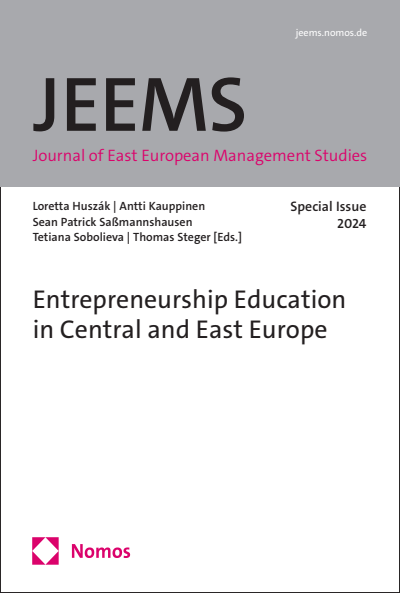
Entrepreneurship Education in Central and East Europe
Journal of East European Management Studies (JEEMS) – Special Issue 2024- Herausgeber:innen:
- | | | |
- Verlag:
- 2025
Zusammenfassung
Der Sonderband untersucht, wie Lehrende aus dem Bereich Entrepreneurship ihre Lehrmethoden, Kurse und Programme effektiv an die spezifischen Bedürfnisse der Gesellschaften in Mittel- und Osteuropa (MOE) anpassen können. Die Beiträge helfen dabei, die komplexen Einflussfaktoren (z.B. Alter, Generation, Denkweise, bevorzugte Lernmodelle und subjektive Kurserfahrungen usw.) zu berücksichtigen, die die Entwicklung unternehmerischer Fähigkeiten beeinflussen.Mit Beiträgen vonJelena Anđelković Labrović | Zorica Bogdanović | Slavica Cicvarić Kostić | Judit Csákné Filep | Marijana Despotović-Zrakić | Janez Gorenc | Milica Jovanović | Ivana Kužet | Miha Marič | Ana Miličević | Katarina Milosavljević | Milan Okanović | Jasna Petković | Igor Pihir | Jovana Rakićević | Zoran Rakićević | Milica Simić | Alenka Slavec Gomezel | Marko Suvajdžić | Anja Svetina Nabergoj | Ivan Todorović | Áron Szennay | Blaž Zupan
Schlagworte
Publikation durchsuchen
Bibliographische Angaben
- Auflage
- 1/2025
- Copyrightjahr
- 2025
- ISBN-Print
- 978-3-7560-2311-0
- ISBN-Online
- 978-3-7489-4960-2
- Verlag
- Nomos, Baden-Baden
- Sprache
- Englisch
- Seiten
- 207
- Produkttyp
- Sammelband
Inhaltsverzeichnis
- Titelei/InhaltsverzeichnisSeiten 1 - 6 Download Kapitel (PDF)
- Autor:innen: | | | |Download Kapitel (PDF)
- 1. Introduction: Designing Entrepreneurship Education Regionally
- 2. Danube Cup Initiative as an Initiator of this Special Issue
- 3. Interdisciplinary European Conferences on Entrepreneurship Research – the Missing Link between East and West
- 4. Contributions of This Special Issue
- Literature
- Autor:innen: | |Download Kapitel (PDF)
- Abstract
- 1. Introduction
- 2.1 Theory of planned behaviour and entrepreneurial intentions
- 2.2 Entrepreneurship Education Programs
- 2.3.1 Entrepreneurship Competence
- 2.3.2 Attitude towards entrepreneurship
- 2.3.3 Entrepreneurial self-efficacy
- 2.3.4 Proposed entrepreneurial intentions model
- 3.1 Research setting
- 3.2 Sample and data collection
- 3.3 Measures
- 3.4 Statistical procedures and data analysis
- 4. Results
- 5.1 Theoretical contributions
- 5.2 Practical contributions
- 5.3 Limitations
- 5.4 Future research
- 6. Conclusion
- Funding
- References
- Autor:innen: | |Download Kapitel (PDF)
- Abstract
- 1. Introduction
- 2.1 Social constructivist learning theory
- 2.2 Constructivist pedagogical methods
- 2.3 Early adolescents and entrepreneurship education
- 2.4 Entrepreneurship competence and EntreComp
- 2.5 Research questions
- 3.1 Sample
- 3.2 Entrepreneurship education programs
- 3.3 Interviews
- 3.4 Data Analysis
- 4. Results
- 5.1 Theoretical implications
- 5.2 Practical implications
- 5.3 Limitations and future research
- 6. Conclusion
- Funding
- References
- Autor:innen: |Download Kapitel (PDF)
- Abstract
- 1. Introduction
- 2. Literature review and hypothesis development
- 3. Methodology
- 4. Results & Discussion
- 5. Conclusion & Future Research Directions
- Acknowledgements
- References
- Autor:innen: | | | |Download Kapitel (PDF)
- Abstract
- 1. Introduction
- 2.1.1. Hackathons in Entrepreneurial Education
- 2.1.2. Project-based learning in entrepreneurial education
- 2.1.3. Entrepreneurial readiness in local startup ecosystem: navigating preparedness for professional environments
- 2.2. The role of teachers in cultivating stimulating learning environments
- 3.1. Research context
- 3.2. Assessing the impact of hackathons and project-based learning initiatives: A comparative analysis
- 3.3. Data collection and Instruments
- 3.4. Survey participants
- 4.1. RQ1: Empowering students with new tech and business knowledge and skills
- 4.2. RQ2: Students’ perception of the impact of hackathons and PBL on their entrepreneurial behaviour
- 4.3. RQ3: Students’ motivation and drivers of active engagement
- 4.4. RQ4: Teachers’ evaluation
- 5.1. Learning and skill acquisitions derived from hackathon and PBL
- 5.2. Learning outcomes of hackathon and PBL approaches for entrepreneurial behaviour
- 5.3. Motivational forces of student engagement in hackathons and PBL
- 5.4. Teachers' perspectives
- 5.5. Future work and challenges
- 5.6. Implications
- Acknowledgement
- References
- Autor:innen: | | | |Download Kapitel (PDF)
- Abstract
- 1. Introduction
- 2.1. Entrepreneurial Mindset
- 2.2. Sociodemographic Characteristics as the Predictors of Entrepreneurial Mindset
- 2.3. Entrepreneurial Mindset and Education
- 3.1. Entrepreneurial Mindset Measurement
- 3.2. Sample
- 4.1. Cross-country Comparative Analysis
- 4.2. Interdependence Analysis
- 5. Discussion
- 6.1. Limitations and directions for the future research
- References
- Autor:innen: | |Download Kapitel (PDF)
- Abstract
- I. Introduction
- II. Theoretical background
- A. Bibliometric analysis
- B. Systematic literature review
- IV. Discussion and conclusion
- V. Limitations and future directions
- References
- Autor:innen: | | |Download Kapitel (PDF)
- Abstract
- 1. Introduction
- 2.1 Entrepreneurial education
- 2.2 Entrepreneurial competencies, frameworks, and models
- 2.3. Competency development and the learning process
- 2.4. Developing entrepreneurial competencies in higher education
- 3. Methodology
- 4. Evaluation of students’ performance
- 5. Discussion
- 6. Conclusion
- References
- Autor:innen: |Download Kapitel (PDF)
- Abstract
- 1. Introduction
- 2. Design Thinking as a Teaching Method within Constructivist Learning Theory
- 3. Methodology
- 4.1 Meaningfulness
- 4.2.1 Experimentation Enhances Learning
- 4.2.2 User-centred Research Builds Emotional Connections with the Users
- 4.2.3 Fieldwork Drives Authentic Learning
- 4.2.4 Interdisciplinarity Boosts Creativity
- 4.3.1 Mentoring Enhances Entrepreneurial Learning
- 4.3.2 Tools and Spaces Spark Innovation
- 4.3.3 External Recognition Drives Motivation
- 4.4 Continuity Builds Real-World Impact
- 5. Discussion of results
- 6. Implications
- 7. Limitations and Future Research
- References