, um zu prüfen, ob Sie einen Vollzugriff auf diese Publikation haben.
Monographie Kein Zugriff
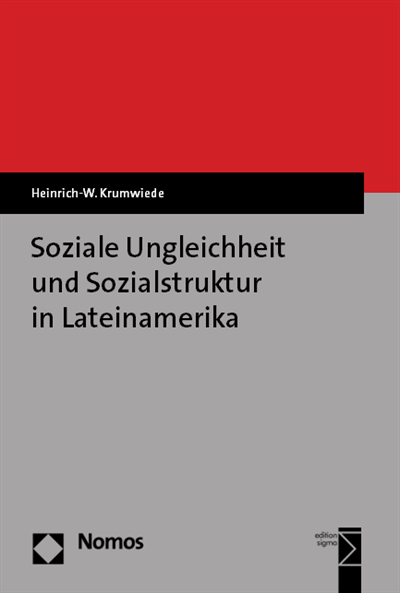
Soziale Ungleichheit und Sozialstruktur in Lateinamerika
- Autor:innen:
- Verlag:
- 2018
Zusammenfassung
Spezifikum des Buches ist die sorgfältige sozio-politische Untersuchung der Probleme sozialer Ungleichheit und Armut in Lateinamerika (insbesondere der am höchsten entwickelten Länder) in dezidiert komparativer Perspektive. So werden u.a. systematisch Daten und Informationen präsentiert, die Vergleiche mit Deutschland sowie den USA ermöglichen. Besonderes Interesse gilt der Analyse der komplexen lateinamerikanischen Unterschichtenwirklichkeit im Hinblick auf die Frage, inwieweit mehr Chancengleichheit durchgesetzt werden könnte. Gängige Thesen über die Entstehung von Mittelschichtgesellschaften in Lateinamerika werden kritisch diskutiert.
Publikation durchsuchen
Bibliographische Angaben
- Auflage
- 1/2018
- Copyrightjahr
- 2018
- ISBN-Print
- 978-3-8487-5199-0
- ISBN-Online
- 978-3-8452-9393-6
- Verlag
- Nomos, Baden-Baden
- Sprache
- Deutsch
- Seiten
- 268
- Produkttyp
- Monographie
Inhaltsverzeichnis
KapitelSeiten
- Titelei/Inhaltsverzeichnis Kein Zugriff Seiten 1 - 14
- Einleitung Kein Zugriff Seiten 15 - 24
- I. Überlegungen zum sozialen Ethos-Wandel in Lateinamerika Kein Zugriff Seiten 25 - 44
- 1. Materielle Ungleichheit: Einkommensungleichheit und Einkommensarmut Kein Zugriff
- 2. Informalität im Arbeitsleben (informeller Sektor, informelle Beschäftigung) als zentrales Strukturproblem Kein Zugriff
- 3. Fazit Kein Zugriff
- Klassenjustiz: Rechtliche Ungleichbehandlung nach sozialem Status Kein Zugriff
- Law and order-Defizite Kein Zugriff
- Sektorale Ausgliederung aus dem Rechtsstaat Kein Zugriff
- 2. Der lateinamerikanische Sozialstaat: traditionelle Defekte und neue Reformen Kein Zugriff
- IV. Zur Schichtungsstruktur Kein Zugriff Seiten 145 - 175
- V. Zum Klassenbewusstsein, der Interessenlage und der politischen Ressourcenschwäche der Unterschicht Kein Zugriff Seiten 176 - 212
- 1. Die extrem hohe Einkommenskonzentration ist in erster Linie Resultat eines sozial ungerechten Steuersystems Kein Zugriff
- 2. Die Rate absoluter Einkommens-Armut ist eindeutig niedriger geworden, die Amutsgefährdung ist aber ebenso eindeutig hoch geblieben. Kein Zugriff
- 3. Eine wichtige Ungleichheitsstruktur in den lateinamerikanischen Gesellschaften ist die zwischen den informales und den formales. Kein Zugriff
- 4. Auch im Rechtsbereich spielt die Problematik sozialer Ungleichheit eine dominierende Rolle Kein Zugriff
- 5. Der lateinamerikanische Sozialstaat ist traditionell sozial selektiv und ungerecht, weist seit neuestem aber Wandlungstendenzen auf Kein Zugriff
- . Trotz einiger positiver Wandlungen kann von einer durchgehenden Transformation der traditionellen lateinamerikanischen Klassengesellschaften in moderne Mittelschichtgesellschaften nicht die Rede sei... Kein Zugriff
- 7. Gerade bei der Analyse krasser sozialer Ungleichheit gilt es die Unterschicht-Wirklichkeit realistisch zur Kenntnis zu nehmen Kein Zugriff
- 8. Hinweis: Die mangelhafte ökonomische Produktivität bleibt ein Hauptproblem Kein Zugriff
- Literaturverzeichnis Kein Zugriff Seiten 237 - 256
- Anhang Kein Zugriff Seiten 257 - 268
Literaturverzeichnis (320 Einträge)
Es wurden keine Treffer gefunden. Versuchen Sie einen anderen Begriff.
- Acemoglu, Daron/Robinson, James A. 2013, Why Nations Fail. The Origins of Power, Prosperity and Poverty, London: Profile Books. Google Scholar öffnen DOI: 10.5771/9783845293936
- Adler Lomnitz, Larissa 1977, Networks and Marginality. Life in an Mexican Shantytown, New York/San Francisco/ London: Academic Press. Google Scholar öffnen DOI: 10.5771/9783845293936
- Ahmed, Azam/Schmitt, Eric 2016, “Mexico’s Military Takes Deadly Aim”, in: The New York Times International Weekly (in collaboration with Süddeutsche Zeitung), June 10, 1und 4. Google Scholar öffnen DOI: 10.5771/9783845293936
- Alber, Jens 2001, „Hat sich der Wohlfahrtsstaat als soziale Ordnung bewährt?“, in: Mayer, Karl Ulrich (Hg.), Die beste aller Welten? Martktliberalismus versus Wohlfahrtsstaat, Frankfurt/New York: Campus Verlag, 59-111. Google Scholar öffnen DOI: 10.5771/9783845293936
- Albert, Hans 1969, Traktat über kritische Vernunft, Tübingen: J.C.B.Mohr–Paul Siebeck. Google Scholar öffnen DOI: 10.5771/9783845293936
- Albert, Hans 1978, Traktat über rationale Praxis, Tübingen: J.C.B. Mohr (Paul Siebeck). Google Scholar öffnen DOI: 10.5771/9783845293936
- Alejo, Javier/Cruces, Guillermo/Parada, Cecilia 2015, „Desigualdad e informalidad en América Latina: el caso de Brasil“, in: Amarante, Veronica/Arim, Rodrigo (Hg.), Desigualdad e informalidad. Un análisis de cinco experiencias latinoamericanas, Santago de Chile: CEPAL, 129-162. Google Scholar öffnen DOI: 10.5771/9783845293936
- Altimir, Oscar 1998, “Inequality, Employment, and Poverty in Latin America: An Overview”, in: Tokman, Víctor E./O´Donnell, Guillermo (Hg.), Poverty and Inequality in Latin America, Notre Dame: University of Notre Dame Press, 3-35. Google Scholar öffnen DOI: 10.5771/9783845293936
- Alvaredo, Facundo/Piketty, Thomas 2010, “The Dynamics of Income Concentration in Developed and Developing Countries: A View from the Top”, in: López Calva, Luis F./Lustig, Nora (Hg.), Declining Inequality in Latin America. A Decade of Progress?, New York/Washington: United Development Programme and Brookings Institution Press, 72-99. Google Scholar öffnen DOI: 10.5771/9783845293936
- Amarante, Verónica /Arim, Rodrigo 2015 (Hg.), Desigualdad e informalidad. Un análisis de cinco experiencias latinoamericanas, Santiago de Chile: CEPAL. Google Scholar öffnen DOI: 10.5771/9783845293936
- Ames, Barry/Carreras, Miguel/Schwartz, Cassilde 2012, „What’s Next? Reflections on the Future of Latin American Politcal Science”, in: Kingstone, Peter/Yashar, Deborah J. (Hg.), Routledge Handbook of Latin American Politics, New York: Routledge, 485-511. Google Scholar öffnen DOI: 10.5771/9783845293936
- Anderson, Charles W., 1967, Politics and Economic Change in Latin America. The Governing of Restless Nations, Princeton: D. Van Nostrand Company. Google Scholar öffnen DOI: 10.5771/9783845293936
- Atkinson, Anthony B. 2015, Inequality. What Can be Done?, Cambridge: Harvard University Press. Google Scholar öffnen DOI: 10.5771/9783845293936
- Baer, Werner 2014, The Brazilian Economy, Growth and Development, Boulder: Lynn Rienner Publishers Google Scholar öffnen DOI: 10.5771/9783845293936
- Banco Interamericano de Desarrollo 2016, “Síntesis del del programa Bolsa Familia en Brazil”, in: Síntesis Programas de Transferencias Condicionadas. www.iadb.org/proteccionsocial. Google Scholar öffnen DOI: 10.5771/9783845293936
- Banerjee, Abhijit/Duflo, Esther 2012, Poor Economics. A Radical Rethinking of the Way to Fight Global Poverty, New York: Public Affairs. Google Scholar öffnen DOI: 10.5771/9783845293936
- Barraclough, Solon L./Domike, Arthur L. 1970, “Agrarian Structure in Seven Latin American Countries”, in: Stavenhagen, Rodolfo (Hg.), Agrarian Problems & Peasant Movements in Latin America, Garden City: Doubleday, 41-94. Google Scholar öffnen DOI: 10.5771/9783845293936
- Barozet, Emmanuelle/Espinoza,Vicente 2016, „Current Issues on the Political Representation of Middle Classes in Chile”, in: Journal of Politics in Latin America, 8(3), 95-123. Google Scholar öffnen DOI: 10.5771/9783845293936
- Beckert, Jens 2004, Unverdientes Vermögen. Soziologie des Erbrechts, Frankfurt/New York: Campus Verlag. Google Scholar öffnen DOI: 10.5771/9783845293936
- Beckert, Jens 2012, „Der Charakter eines Menschen zeigt sich beim Erben“, in: Süddeutsche Zeitung,3.August, 23. Google Scholar öffnen DOI: 10.5771/9783845293936
- Benda,Ernst, 1995 a, “Rechtsstaat”, in: Nohlen, Dieter (Hg.), Wörterbuch Staat und Politik, München: R. Piper. 632-635. Google Scholar öffnen DOI: 10.5771/9783845293936
- Benda, Ernst 1995 b, „Rechtsstaat“, in: Nohlen,Dieter/Schultze, Rainer-Olaf (Hg.), Lexikon der Politik Bd. 1: Politische Theorien, München: C.H. Beck, 515-519. Google Scholar öffnen DOI: 10.5771/9783845293936
- Bendel, Petra/Croissant, Aurel/Rüb, Friedbert W. (Hg.) 2002, Zwischen Demokratie und Diktatur. Zur Konzeption und Empirie demokratischer Grauzonen, Opladen: Leske + Budrich. Google Scholar öffnen DOI: 10.5771/9783845293936
- Berg, Janine/Christoph, Ernst/Auer, Peter 2006, Meeting the Employment Challenge. Argentina, Brazil, and Mexcico in the Global Economy, Geneva: International Labour Office: Lynne Rienner Publishers. Google Scholar öffnen DOI: 10.5771/9783845293936
- Bergman, Marcelo 2009, Tax Evasion and the Rule of Law in Latin America. The Political Culture of Cheating and Compliance in Argentina and Chile, University Park: The Pennsylvania State University Press. Google Scholar öffnen DOI: 10.5771/9783845293936
- Bernecker, Walther L. 2004, „Menschenrechte und Korruption zwischen Autoritarismus und Demokratie“, in: Bernecker, Walther L. /Braig, Marianne/Hölz, Karl/Zimmermann, Klaus (Hg.), Mexiko heute. Politik, Wirtschaft, Kultur, Frankfurt a.M.: Vervuert Verlag, 217-239. Google Scholar öffnen DOI: 10.5771/9783845293936
- Berryman, Phillip 1996, Religion in the Megacity. Catholic and Protestant Portraits from Latin America, New York: Orbis Books. Google Scholar öffnen DOI: 10.5771/9783845293936
- Bertelsmann Stiftung 2011, Soziale Gerechtigkeit in der OECD – Wo steht Deutschland? Sustainable Governance Indicators 2011, Gütersloh: Bertelsmann Stiftung. Google Scholar öffnen DOI: 10.5771/9783845293936
- Birdsall, Nancy/De La Torre, Augusto/ Menezes, Rachel 2008, Fair Growth. Economic Policies for Latin America’s Poor and Middle-Income Majority, Washington: Center for Global Development/Inter-American Dialog/Brookings Institution Press. Google Scholar öffnen DOI: 10.5771/9783845293936
- Birdsall, Nancy/Lustig, Nora/McLeod, Darryl 2012, “Declining Inequality in Latin America: Some Economics, Some Politics”, in: Kingstone, Peter/Yashar, Deborah J. (Hg.), Routledge Handbook of Latin American Politics, New York: Routledge, 158-180. Google Scholar öffnen DOI: 10.5771/9783845293936
- Birle, Peter/Mols, Manfred 1994, “Staat, Gewerkschaften und Unternehmer in Lateinamerika: Sozialpartner von morgen?”, in: Grewe, Hartmut/Mols, Manfred (Hg.), Staat und Gewerkschaften in Lateinamerika. Wandel im Zeichen von Demokratie und Marktwirtschaft, Paderborn: Ferdinand Schöningh, 11-39. Google Scholar öffnen DOI: 10.5771/9783845293936
- Bonnefoy, Pascale 2017, „Chileans Lash Out at Paltry Pensions“, in: The New York Times International Weekly (Beilage der Süddeutschen Zeitung), 23. September, 5. Google Scholar öffnen DOI: 10.5771/9783845293936
- Booth, John A. 1989, “Costa Rica: The Roots of Democratic Stability”, in: Diamond, Larry/Linz, Juan J./Lipset, Seymour Martin (Hg.), Democracy in Developing Countries. Latin America (Vol. IV), Boulder/London: Lynne Rienner Publishers/Adamantine Press, 387-422 Google Scholar öffnen DOI: 10.5771/9783845293936
- Borzutzky, Silvia/Sanhueza Riveros, Claudia/Sehnbruch, Kirsten 2014, “Reducing Poverty: Real or Rhetorical Success?”, in: Sehnbruch, Kirsten/Siavelis, Peter M. (Hg.), Democratic Chile. The Politics and Policies of a Historic Coalition 1990-2010, Boulder: Lynn Rienner Publishers. 221-241. Google Scholar öffnen DOI: 10.5771/9783845293936
- Brinks, Daniel M. 2008, The Judicial Response to Police Killings in Latin America. Inequality and the Rule of Law, Cambridge: Cambridge University Press. Google Scholar öffnen DOI: 10.5771/9783845293936
- Brinks, Daniel M. 2012, “A Tale of Two Cities”: The Judiciary and the Rule of Law in Latin America”, in: Kingstone, Peter/Yashar, Deborah J. (Hg.), Routledge Handbook of Latin American Politics, New York: Routledge, 61-75. Google Scholar öffnen DOI: 10.5771/9783845293936
- Brinks, Daniel/Botero, Sandra 2014, “Inequality and the Rule of Law: Ineffective Rights in Latin American Democracies”, in: Brinks, Daniel/Leiras, Marcelo/Mainwaring, Scott (Hg.), Reflections on Uneven Democracies. The Legacy of Guillermo 0’Donnell, Baltimore: Johns Hopkins University Press, 214-239. Google Scholar öffnen DOI: 10.5771/9783845293936
- Brodeur, Jean-Paul 1999, “ Comments on Chevigny”, in: Méndez,Juan E./O’Donnell, Guillermo/Pinheiro, Paulo Sérgio (Hg.), The (Un)Rule of Law and the Underprivileged in Latin America, Notre Dame: University of Notre Dame Press, 71-86. Google Scholar öffnen DOI: 10.5771/9783845293936
- Bruneau, Thomas C. 1974, The Political Transformation of the Brazilian Catholic Church, London/New York: Cambridge University Press. Google Scholar öffnen DOI: 10.5771/9783845293936
- Brusco, Elizabeth E. 1995, The Reformation of Machismo. Evangelical Conversion and Gender in Colombia, Austin: University of Texas Press. Google Scholar öffnen DOI: 10.5771/9783845293936
- Bulmer-Thomas, Victor 2003, The Ecomic History of Latin America Since Independence, Cambridge u.a.: Cambridge University Press. Google Scholar öffnen DOI: 10.5771/9783845293936
- Bundesministerium für Arbeit und Soziales 2013, Der vierte Reichtums- und Armutsbericht der Bundesregierung, Bonn: Bundesministerium für Arbeit und Soziales. Google Scholar öffnen DOI: 10.5771/9783845293936
- Burdick, John 1993, Looking for God in Brazil.The Progressive Catholic Church in Urban Brazil’s Religious Arena, Berkeley/Los Angeles/London: University of California Press. Google Scholar öffnen DOI: 10.5771/9783845293936
- Burdick, John/Hewitt, W.E. (Hg.) 2000, The Church at the Grassroots in Latin America. Perspectives on Thirty Years of Activism, Westport/London: Praeger (darin das “Afterword” von Burdick, S. 205-210). Google Scholar öffnen DOI: 10.5771/9783845293936
- Calcagnotto, Gilberto 1994, „Brasiliens Gewerkschaften zwischen Neoliberalismus und Neokorporatismus“, in: Grewe, Harmut/Mols, Manfred (Hg), Staat und Gewerkschaften in Lateinamerika. Wandel im Zeichen von Demokratie und Marktwirtschaft, Paderborn: Schöningh, 187- 298. Google Scholar öffnen DOI: 10.5771/9783845293936
- Carnes, Matthew E. 2014, Continuity despite Change. The Politics of Labor Regulation in Latin America, Stanford: Stanford University Press. Google Scholar öffnen DOI: 10.5771/9783845293936
- Busch, Alexander 2010, Wirtschaftsmacht Brasilien. Der grüne Riese erwacht, Bonn: Bundeszentrale für politische Bildung. Google Scholar öffnen DOI: 10.5771/9783845293936
- Cecchini, Simone/Filguera, Fernando/Martínez, Rodrigo/Rossel, Cecilia (Hg.) 2015, Instrumentos de protección social. Caminos latinoamericanos hacia la universalización, Santiago: Comisión Económica para América Latina y el Caribe (CEPAL). Google Scholar öffnen DOI: 10.5771/9783845293936
- Castellani. Francesca/Parent, Gwenn 2011, “Being ‘Middle Class’ in Latin America”, in: OECD Development Centre, Working Paper, 305. Google Scholar öffnen DOI: 10.5771/9783845293936
- Cecchini, Simone/Atuesta, Bernardo 2017, “Programas de transferencias condicionadas en América Latina y el Caribe”, in: Serie Políticas Sociales (CEPAL), 224. Google Scholar öffnen DOI: 10.5771/9783845293936
- CELAM (Consejo Episcopal Latinoamericano) 1955, I. Conferencia General del Episcopado Latinoamericano Rio de Janeiro 1955. Sobre las necesidades de América Latina, www.celam.org/conferencias_rio.phb Google Scholar öffnen DOI: 10.5771/9783845293936
- CELAM (Consejo Episcopal Latinoamericano) 1969, Segunda Conferencia General del Episcopado Latinoamericano Medellin 1968. Conclusiones: La Iglesia en la actual transformación de América Latina a la luz del Concilio, Bogotá: Secretariado General del CELAM. Google Scholar öffnen DOI: 10.5771/9783845293936
- CELAM (Consejo Episcopal Latinoamericano)1979, III. Conferencia General del Episcopado Latinoamericano Puebla 1979: La Evangelización en el Presente y en el Futuro de América Latina, www.celam.org/conferencias_puebla.phb. Google Scholar öffnen DOI: 10.5771/9783845293936
- CELAM (Consejo Episcopal Latinoamericano) 1992, IV. Conferencia General del Episcopado Latinoamericano Santo Domingo 1992: Nueva Evangelización, Promoción Humana, Cultura Cristiana, www.celam.org/confrencias_domingo.phb. Google Scholar öffnen DOI: 10.5771/9783845293936
- CELAM (Consejo Episcopal Latinoamericano) 2007, V. Conferencia General del Episcopado Latinoamericano Aparecida 2007: Documento Conclusivo, www.celam.org/conferencias_aparecida.phb. Google Scholar öffnen DOI: 10.5771/9783845293936
- CEPAL (Comisión Económica para América Latina y el Caribe) 2004, Una década de desarrollo social en América Latina, 1990-1999, Santiago:Naciones Unidas. Google Scholar öffnen DOI: 10.5771/9783845293936
- CEPAL (Comisión Económica para América Latina y el Caribe) 2009, Panorama Social de América Latina 2008, Santiago: Naciones Unidas Google Scholar öffnen DOI: 10.5771/9783845293936
- CEPAL (Comisión Económica para América Latina y el Caribe) 2012, Panorama Social de América Latina 2011, Santiago de Chile: Naciones Unidas. Google Scholar öffnen DOI: 10.5771/9783845293936
- CEPAL (Comisión Económica para América Latina y el Caribe) 2014, Panorama Social de América Latina 2014, Santiago: Naciones Unidas. Google Scholar öffnen DOI: 10.5771/9783845293936
- CEPAL (Comisión Económica para América Latina y el Caribe) 2015, Panorama Fiscal de América Latina y el Caribe 2015. Dilemas y espacios, Santiago: Naciones Unidas. Google Scholar öffnen DOI: 10.5771/9783845293936
- CEPAL (Comisión Económica para América Latina y el Caribe) 2016, Panorama Social de América Latina 2015, Santiago: Naciones Unidas. Google Scholar öffnen DOI: 10.5771/9783845293936
- CEPAL (Comisión Económica para América Latina y el Caribe) 2017, Panorama Social de América Latina 2016, Santiago: Naciones Unidas. Google Scholar öffnen DOI: 10.5771/9783845293936
- CEPAL (Comisión Económica para América Latina y el Caribe) 2017, Panorama Fiscal de América Latina y el Caribe 2017. La movilización de recursos para el financimiento del desarrollo sostenible, Santiago: Naciones Unidas. Google Scholar öffnen DOI: 10.5771/9783845293936
- CEPAL/OIT (Comisión para América Latina y el Caribe/Organización Internacional del Trabajo) 2014, “Los programas de transferencias condicionadas y el mercado laboral”, in: Conyuntura Laboral en América Latina y el Caribe, 10. Google Scholar öffnen DOI: 10.5771/9783845293936
- CEPAL/OIT (Comisión Económica para América Latinan y el Caribe/Organización Internacional del Trabajo) 2015, “La evolución del empleo en las empresas de menor tamaño entre 2003 y 2013: mejoras y desafíos”, in: Conyuntura Laboral en América Latina y el Caribe,13.. Google Scholar öffnen DOI: 10.5771/9783845293936
- Chestnut, R. Andrew 2003, Competitive Spirits. Latin America’s New Religious Economy, Oxford/New York u.a.: Oxford University Press. Google Scholar öffnen DOI: 10.5771/9783845293936
- Chevigny, Paul 1999, “Defining the Role of the Police in Latin America”, in: Méndez, Juan E./O’Donnell, Guillermo/Pinheiro, Paulo Sérgio (Hg.), The (Un)Rule of Law and the Underprivileged in Latin America, Notre Dame: University of Notre Dame Press, 49- 70. Google Scholar öffnen DOI: 10.5771/9783845293936
- Clark,Terry Nichols/Lipset, Seymour Martin (Hg.) 2001, The Breakdown of Class Politics. A Debate on Post-Industrial Stratification, Baltimore: Woodrow Wilson Center Press/The Johns Hopkins University Press. Google Scholar öffnen DOI: 10.5771/9783845293936
- Collier, Ruth Berins/Chambers-Ju, Christopher 2012, “Popular Representation in Contemporary Latin American Politics: An Agenda for Research”, in: Kingstone, Peter/Yashar, Deborah J. (Hg.), Routledge Handbook of Latin American Politics, New York and London: Routledge, 564-578. Google Scholar öffnen DOI: 10.5771/9783845293936
- Collier, Ruth Berins/Collier, David 1991, Shaping the Political Arena: Critical Junctures, the Labor Movement, and Regime Dynamics in Latin America, Princeton: Princeton University Press. Google Scholar öffnen DOI: 10.5771/9783845293936
- Collier, Ruth Berins/Handlin, Samuel (Hg.) 2009, Reorganizing Popular Politics:Participation and the New Interest Regime in Latin América, University Park: Pennsylvania State University Press. Google Scholar öffnen DOI: 10.5771/9783845293936
- Comblín, Jose, Brazil, “ Base Communities in the Northeast”, in: Cook, Guillermo (Hg.), The New Face of the Church in Latin America, Maryknoll/New York: Orbis Books. Google Scholar öffnen DOI: 10.5771/9783845293936
- Cook, Maria Lorena 2006, The Politics of Labor Reform in Latin America Between Flexibility and Rights, University Park: The Pennsylvania State University Press. Google Scholar öffnen DOI: 10.5771/9783845293936
- Corrales, Javier 2012, “Neoliberalism and Its Alternatives”, in: Kingstone, Peter/Yashar, Deborah J. (Hg.), Routledge Handbook of Latin American Politics, New York and London: Routledge, 133-157. Google Scholar öffnen DOI: 10.5771/9783845293936
- Cortés, Fernando/Escobar Latapí, Augustin 2005, “Movilidad social intergeneracional en el México urbano”, in: Revista de la CEPAL, 85(Abril), 149-167. Google Scholar öffnen DOI: 10.5771/9783845293936
- Cross, John C. 1998, Informal Politics. Street Vendors and the State in Mexico City, Stanford: Stanford University Press. Google Scholar öffnen DOI: 10.5771/9783845293936
- Dahl, Robert A. 1971, Polyarchy. Participation and Opposition, New Haven/London: Yale University Press. Google Scholar öffnen DOI: 10.5771/9783845293936
- Dahrendorf, Ralf 1965, Gesellschaft und Demokratie in Deutschland, München: Piper. Google Scholar öffnen DOI: 10.5771/9783845293936
- Dahrendorf, Ralf 1994, Der moderne soziale Konflikt. Essay zur Politik der Freiheit, München: Deutscher Taschenbuch Verlag. Google Scholar öffnen DOI: 10.5771/9783845293936
- DaMatta, Roberto 1987, “The Quest for Citizenship in a Relational Universe”, in: Wirth, John D./Oliveira Nunes, Edson de/Bogenschild, Thomas E. (Hg.), State and Society in Brazil. Continuity and Change, Boulder: Westview Press, 307-336. Google Scholar öffnen DOI: 10.5771/9783845293936
- DaMatta, Roberto 1991, Carnivals, Rogues, and Heroes. An Interpretation of the Brazilian Dilemma, Notre Dame, Indiana/London: University of Notre Dame Press. Google Scholar öffnen DOI: 10.5771/9783845293936
- DaMatta, Roberto 2014, “Vielfalt als Erfolgsmodell”, in: Brasilien Dossier online der BPB, http://www.bpb.de/internationales/amerika/brasilien/politik/185274/vielfalt-als-erfolgsmodell. Google Scholar öffnen DOI: 10.5771/9783845293936
- Daude, Christian/Iglesia, Juan R. de/Melguizo, Iglesia, Ángel 2015, “Covering the Uncovered: Labor Informality, Pensions and the Emerging Middle Class in Latin America”, in: Dayton-Johnson, Jeff (Hg.), Latin America´s Emerging Middle Classes. Economic Perspectives, Palgrave: Macmillan, 130-149. Google Scholar öffnen DOI: 10.5771/9783845293936
- Dayton-Johnson, Jeff (Hg.) 2015, Latin America´s Emerging Middle Classes. Economic Perspectives, Palgrave: MacMillan. Google Scholar öffnen DOI: 10.5771/9783845293936
- Della Cava, Ralph 1989, “The ‚People’s Church’, the Vatican, and Abertura”, in: Stepan, Alfred (Hg.), Democratizing Brazil. Problems of Transition and Consolidation, New York/Oxford: Oxford University Press, 143- 167. Google Scholar öffnen DOI: 10.5771/9783845293936
- DESAL 1969, Marginalidad en América Latina. Un ensayo diagnóstico, Santiago de Chile: DESAL/Herder. Google Scholar öffnen DOI: 10.5771/9783845293936
- Dietz, Henry 1998, Urban Poverty, Political Participation, and the State. Lima 1970-1990, Pittsburgh: University of Pittsburgh Press. Google Scholar öffnen DOI: 10.5771/9783845293936
- Doner, Richard/Schneider, Ben Ross 2016, „The Middle-Income Trap: More Politics than Economics”, in: World Politics, 68(4), 608-644. Google Scholar öffnen DOI: 10.5771/9783845293936
- Duarte, Jesús/Bos, Soledad María/Moreno, Martín 2010, „Inequity in School Achievement in Latin America. Multilevel Analysis of SERCE Results According to the Socioeconomic Status of Students, in: IDB Working Paper Series, 180. Google Scholar öffnen DOI: 10.5771/9783845293936
- Duhau, Emilio 2014, “The Informal City: An Enduring Slum or a Progressive Habitat?”, in: Fischer, Brodwyn/McCann/Ayero, Javier (Hg.), Cities from Scratch, Durham and London: Duke University Press. Google Scholar öffnen DOI: 10.5771/9783845293936
- ECLAC (Economic Commission for Latin America and the Caribbean) 2011, Social Panorama for Latin America 2011, Santiago: United Nations Publication. Google Scholar öffnen DOI: 10.5771/9783845293936
- Erikson,Robert/Goldthorp, John H. 1992, The Constant Flux. A Study of Class Mobility in Industrial Societies, Oxford: Clarendon Press. Google Scholar öffnen DOI: 10.5771/9783845293936
- Escobar Latapí, Agustín/Pedraza Espinoza, Laura Patricia 2010, “Clases medias en México: Transformación social, sujetos múltiples”, in: Franco, Rolando/Hopenhayn, Martín/León, Arturo (Hg.), Las clases medias en América Latina. Retrospectiva y nuevas tendencias, México: Siglo XXI/CEPAL, 355-408. Google Scholar öffnen DOI: 10.5771/9783845293936
- Escobar Latapí, Augustín/Roberts, Bryan R.1991,” Urban Stratification, the Middle Classes, and Economic Change in Mexico”, in: González de la Rocha, Mercedes/ Escobar Latapí, Augustín (Hg.), Social Responses to Mexico´s Economic Crisis of the 1980s, San Diego: Center for U.S.-Mexican Studies, University of California, 91-113. Google Scholar öffnen DOI: 10.5771/9783845293936
- Esser, Klaus 2004, “ Wirtschaftliche Spezialisierung und Aufbau eines modernen Nationalstaates in Chile: Nutzung der Globalisierungstendenz zu Lernprozessen”, in: Imbusch,Peter/Messner, Dirk/Nolte, Detlef (Hg.), Chile heute. Politik, Wirtschaft, Kultur, Frankfurt a.M.: Vervuert Verlag, 565-580. Google Scholar öffnen DOI: 10.5771/9783845293936
- Fajnzylber, Pablo/Lederman, David/Loaza, Norman 2002, “Inequality and Violent Crime”, in: Journal of Law and Economics, Vol. XLV (April), 1-40. Google Scholar öffnen DOI: 10.5771/9783845293936
- Ferreira, Francisco H.G/Messina, Julian/Rigolini, Jamele/ López-Calva, Luis-Felipe/Lugo, Maria Ana/Vakis, Renos 2013, Economic Mobility and the Rise of the Latin American Middle Class. Washington: World Bank Google Scholar öffnen DOI: 10.5771/9783845293936
- Filguera, Carlos 2001, “La actualidad de viejas temáticas : sobre los estudios de clase, estraficación y movilidad social en América Latina”, in : Serie Políticas Sociales (CEPAL), 51 Google Scholar öffnen DOI: 10.5771/9783845293936
- Filguera, Fernando 2015, “Modelos de desarrollo, matriz del Estado Social y herramientas de las políticas sociales latinoamericanas”, in: Cecchini, Simone/Filguera, Fernando/Rossel, Cecilia (Hg.), Instrumentos de protección social. Caminos latinoamericanos hacia la universalización, Santiago: Comisión Económica para América Latina y el Caribe (CEPAL), 49-84. Google Scholar öffnen DOI: 10.5771/9783845293936
- Focanti, Diego/Hallerberg, Mark/ Scartascini, Carlos 2016 “Tax Reforms in Latin America in an Era of Democracy“, in: Latin American Research Review, 51 (1), 132-158. Google Scholar öffnen DOI: 10.5771/9783845293936
- Follman, José Ivo 2000, “Progressive Catholics, and Left–Wing Party Politics in Brazil”, in: Burdick, John/Hewitt, W.E. (Hg.), The Church at the Grassroots in Latin America. Perspectives on Thirty Years of Activism, Westport/London, 53-67. Google Scholar öffnen DOI: 10.5771/9783845293936
- Fonseca, Ana/Lavinas, Lena 2014, “Coordinación institucional, protección social y mínimos sociales en Brasil”, in: Schwarzer, Helmut/Tessier, Lou/Gammage, Sarah (Hg.), Coordinación institucional y pisos de protección social. Experiencias de América Latina (Argentina, Brasil, Chile, México, Urugay), Genf: Oficina Internacional de Trabajo (ESS Documento), 51-78. Google Scholar öffnen DOI: 10.5771/9783845293936
- Fraenkel, Ernst 1962, Das amerikanische Regierungssystem, Köln/Opladen: Westdeutscher Verlag. Google Scholar öffnen DOI: 10.5771/9783845293936
- Franco, Rolando/Hopenhayn, Martín/León, Arturo (Hg.) 2010, Las clases medias en América Latina. Retrospectiva y nuevas tendencias, México : Siglo XXI/CEPAL. Google Scholar öffnen DOI: 10.5771/9783845293936
- Franco, Rolando/Hopenhayn/León, Arturo 2011, “Crece y cambia la clase media en América Latina: una puesta al día”, in: Revista CEPAL, 103, 7-26. Google Scholar öffnen DOI: 10.5771/9783845293936
- Freedome House 2016, Freedom in the World 2016, https://freedomhouse.org/reports Google Scholar öffnen DOI: 10.5771/9783845293936
- Freedom House 2017, Freedom in the World 2017, https://freedomhouse.org/reports Google Scholar öffnen DOI: 10.5771/9783845293936
- Gallup 2016, Confidence in Institutions/Gallup Historical Trends, www.gallup.com/poll/1597. Google Scholar öffnen DOI: 10.5771/9783845293936
- Fuente, Alejandro de la/Ortiz-Juárez, Eduardo/Rodríguez-Castelán, Carlos 2014, “Living on the edge: Vulnarability to poverty and public transfers in Mexico”, in: World Development Report 2014 Background Paper, https://openknowledge.worldbank.org/bitstream/handle/10986/16336. Google Scholar öffnen DOI: 10.5771/9783845293936
- Garzón Valdés, Ernesto, „Rechtsphilosophische Überlegungen über Verfassungsreformen in Lateinamerika“, in: Ahrens, Helen/Nolte, Detlef (Hg.), Rechtsreformen und Demokratieentwicklung in Lateinamerika, Frankfurt a.M.: Vervuert Verlag. Google Scholar öffnen DOI: 10.5771/9783845293936
- Geißler, Rainer 2006, Die Sozialstruktur Deutschlands. Zur gesellschaftlichen Entwicklung mit einer Bilanz zur Vereinigung, Wiesbaden: VS Verlag für Sozialwissenschaften. Google Scholar öffnen DOI: 10.5771/9783845293936
- Gilbert, Alan/Ward, Peter M. 1985, Housing, the State and the Poor. Policy and Practices in Three Latin American Cities, Cambridge u.a.: Cambridge University Press. Google Scholar öffnen DOI: 10.5771/9783845293936
- Gill, Anthony 1999, “The Struggle to be Soul Provider: Catholic Responses to Protestant Growth in Latin America”, in: Smith, Christian/Prokopy, Joshua (Hg.), Latin American Religion in Motion. New York/London: Routledge, 17-42. Google Scholar öffnen DOI: 10.5771/9783845293936
- Gómez Sabaíni, Juan C./Jiménez, Juan Pablo 2012, “Tax Structure and Tax Evasion in Latin America”, in: CEPAL: Serie Macroeconomía del Desarrollo, 118. Google Scholar öffnen DOI: 10.5771/9783845293936
- Gómez Sabaíni, Juan C./Morán, Dalmiro 2017, “El nivel y la estructura de la carga tributaria en los países de la región”, in: Gómez Sabaíni, Juan Carlos/Jiménez, Juan Pablo/Martner, Ricardo (Hg.), Consensos y conflictos en la política tributaria de América Latina, Santiago: Comisión Económica para América Latina y el Caribe (CEPAL), 35-65. Google Scholar öffnen DOI: 10.5771/9783845293936
- Gómez Sabaíni, Juan Carlos/Rossignolo, Darío 2015, “La tributación sobre las altas rentas en América Latina “, in: Jiménez, Juan Pablo (Hg.), Desigualdad, concentración del ingreso y tributación sobre las altas rentas en América Latina, Santiago de Chile: Comisión Económica para América Latina y el Caribe (CEPAL), 49-116. Google Scholar öffnen DOI: 10.5771/9783845293936
- Gómez-Sabaíni, Juan 2006, » Cohesión social, equidad y tributación. Análisis y perspectivas para América Latina », in: CEPAL: Serie Políticas Sociales, 127. Google Scholar öffnen DOI: 10.5771/9783845293936
- González de la Rocha, Mercedes 1994, The Resources of Poverty, Oxford/ Cambridge: Blackwell Publishers. Google Scholar öffnen DOI: 10.5771/9783845293936
- Grabke, Markus M. /Westermeier, Christian 2014, “Anhaltend hohe Vermögensungleichheit in Deutschland“, in: DIW Wochenbericht, 9, 151-146. Google Scholar öffnen DOI: 10.5771/9783845293936
- Grabendorff, Wolf 2003, „Lateinamerikas unsichere Zukunft“, in: Aus Politik und Zeitgeschichte, B 38-39, 3-5. Google Scholar öffnen DOI: 10.5771/9783845293936
- Gudmundson, Lowell 1986, Costa Rica Before Coffee. Society and Economy on the Eve of the Export Boom, Baton Rouge/London: Lousiana State University Press. Google Scholar öffnen DOI: 10.5771/9783845293936
- Haas, Liesl 1999, “The Catholic Church in Chile. New Political Alliances”, in: Smith, Christian/Prokopy, Joshua (Hg.), Latin American Religion in Motion, New York/London: Routledge, 43-66. Google Scholar öffnen DOI: 10.5771/9783845293936
- Haggard, Stephan/Kaufman, Robert R. 2008, Development, Democracy and Welfare States. Latin America, East Asia, and Eastern Europe, Princeton/ Oxford: Princeton University Press. Google Scholar öffnen DOI: 10.5771/9783845293936
- Hagopian, Frances 1996, Traditional Politics and Regime Change in Brazil, Cambrige et al.: Cambridge University Press. Google Scholar öffnen DOI: 10.5771/9783845293936
- Hagopian, Frances (Hg.) 2009, Religious Pluralism, Democracy, and the Catholic Church in Latin America, Notre Dame, Notre Dame: University of Notre Dame Press. Google Scholar öffnen DOI: 10.5771/9783845293936
- Hagopian, Frances 2009, “Introduction: The New Landscape”, in: dies. (Hg.), Religious Pluralism, Democracy, and the Catholic Church in Latin America, Notre Dame: University of Notre Dame Press, 1-64. Google Scholar öffnen DOI: 10.5771/9783845293936
- Happe, Barbara 2002, Favela und Politik – Politisches Denken und Handeln von Favelados in Brasilien, Mettingen: Brasilienkunde-Verlag. Google Scholar öffnen DOI: 10.5771/9783845293936
- Helmbke, Gretchen/Levitzky, Steven (Hg.) 2006, Informal Institutions and Democracy. Lessons from Latin America, Baltimore: The Johns Hopkins University Press. Google Scholar öffnen DOI: 10.5771/9783845293936
- Herrman, Boris 2017, “Der Triumpf des Teppichhändlers“, in: Süddeutsche Zeitung, 178, 4. August, 7. Google Scholar öffnen DOI: 10.5771/9783845293936
- Hilpert, Dagmar 2012, Wohlfahrtsstaat der Mittelschichten? Sozialpolitik und gesellschaftlicher Wandel in der Bundesrepublik Deutschland (1949-1975), Göttingen: Vandenhoeck & Ruprecht. Google Scholar öffnen DOI: 10.5771/9783845293936
- Hirschman, Albert O. 1971, “Inflation in Chile”, in ders.: Journeys Toward Progress. Studies of Economic Policy-Making in Latin America, New York: The Norton Library, 159-223. Google Scholar öffnen DOI: 10.5771/9783845293936
- Hirschman, Albert O. 1971, “The Search for Paradigms as a Hindrance to Understanding”, in ders.: A Bias for Hope. Essays on Development and Latin America, New Haven/London: Yale University Press, 342-360. Google Scholar öffnen DOI: 10.5771/9783845293936
- Hirschman, Albert O.1971,” The Political Economy of Import-Substituting Industrialization in Latin America”, in ders.: A Bias for Hope, New Haven/London: Yale University Press, 85-123. Google Scholar öffnen DOI: 10.5771/9783845293936
- Holland, Alisha C. 2016, „Forbearance“, in: American Political Science Review, 110(2), 232-246. Google Scholar öffnen DOI: 10.5771/9783845293936
- Holland, Alisha C. 2017, Forbearance as Redistribution. The Politics of Informal Welfare in Latin America, Cambridge: Cambridge University Press. Google Scholar öffnen DOI: 10.5771/9783845293936
- Holland, Alisha C./Schneider, Ben Ross 2017, „Easy and Hard Redistribution: The Political Economy of Welfare States in Latin America”, in: Perspectives on Politics, 15(4), 988-1006. Google Scholar öffnen DOI: 10.5771/9783845293936
- Hollenstein, Olivier 2013, „In eine andere Welt“, Süddeutsche Zeitung, 1./2. Juni, 36. Google Scholar öffnen DOI: 10.5771/9783845293936
- Hradil, Stefan 2001, Soziale Ungleichheit in Deutschland, Opladen: Leske und Budrich, UTB. Google Scholar öffnen DOI: 10.5771/9783845293936
- Huber, Evelyne/Stephens, John D. 2012, Democracy and the Left. Social Policy and Inequality in Latin America, Chicago/London: The University of Chicago Press. Google Scholar öffnen DOI: 10.5771/9783845293936
- Human Rights Watch 2015, World Report 2015, www.hrw.org/world-report. Google Scholar öffnen DOI: 10.5771/9783845293936
- Huneeus, Carlos 2014, La democracia semisoberana. Chile después de Pinochet, Providencia: Taurus. Google Scholar öffnen DOI: 10.5771/9783845293936
- Hunter, Wendy 2010, The Transformation of the Workers’ Party in Brazil, 1989-2009, Cambrige: Cambridge University Press. Google Scholar öffnen DOI: 10.5771/9783845293936
- Huntington, Samuel P. 1991, The Third Wave. Democratization in the Late Twentieth Century, Norman/London: University of Oklahoma Press. Google Scholar öffnen DOI: 10.5771/9783845293936
- ILO (International Labour Office) 2011, 2011 Labour Overview. Latin America and the Caribbean, Lima. ILO (Regional Office for Latin America and the Caribbean). Google Scholar öffnen DOI: 10.5771/9783845293936
- Institut für Demoskopie Allensbach 2014, „Großes Vertrauen in die deutsche Justiz. Eine Dokumentation des Beitrags von Prof. Renate Köcher in der Frankfurter Allgemeinen Zeitung, 192, 20. August”, www.ifd.allensbach.de. Google Scholar öffnen DOI: 10.5771/9783845293936
- Ireland, Rowan 1991, Kingdoms Come. Religion and Politics in Brazil, Pittsburgh: Pittsburgh University Press. Google Scholar öffnen DOI: 10.5771/9783845293936
- Jiménez, Juan Pablo/Podesta, Andrea 2017, “La tributación sobre la renta en América Latina: desafíos y perspectivas”, in: Gómez Sabaíni, Juan Carlos/Jiménez, Juan Pablo/Martner, Ricardo (Hg.), Consensos y conflíctos en la política tributaria de América Latina, Santiago: CEPAL, 67-91. Google Scholar öffnen DOI: 10.5771/9783845293936
- Kaelble, Hartmut 2007, Sozialgeschichte Europas 1945 bis zur Gegenwart, München: C.H. Beck. Google Scholar öffnen DOI: 10.5771/9783845293936
- Karl, Terry Lynn 2014, “Inequality and Democracy: Latin American Lessons for the United States”, in: Brinks, Daniel/ Leiras, Marcelo/Mainwaring, Scott (Hg.), Reflections on Uneven Democracies. The Legacy of Guillermo 0’Donnell, Baltimore: Johns Hopkins University Press, 121-146. Google Scholar öffnen DOI: 10.5771/9783845293936
- Karst, Kenneth L./Schwartz, Murray L./Schwartz, Audrey J 1973., The Evolution of Law in the Barrios of Caracas, Los Angeles: Latin American Center, University of California. Google Scholar öffnen DOI: 10.5771/9783845293936
- Kaufmann, Franz-Xaver 2003, Varianten des Wohlfahrtsstaates. Der deutsche Sozialstaat im internationalen Vergleich, Frankfurt a.M. : Edition Suhrkamp. Google Scholar öffnen DOI: 10.5771/9783845293936
- Kaufmann, Franz-Xaver 2008, „Der Kapitalismus ist ein großes Abenteuer“, in: Frankfurter Allgemeine Sonntagszeitung, 51, 21.12., 37. Google Scholar öffnen DOI: 10.5771/9783845293936
- Keck, Margareth E. 1992, The Workers’ Party and Democratization in Brazil, New Haven/London: Yale University Press. Google Scholar öffnen DOI: 10.5771/9783845293936
- Kingstone, Peter R./Power, Timothy J. (Hg.) 2017, Democratic Brazil Divided, Pittsburgh: University of Pittsburg Press. Google Scholar öffnen DOI: 10.5771/9783845293936
- Kingstone, Peter R./Power, Timothy J. 2017, “Introduction: A Fourth Decade of Brazilian Democracy”, in: dies. (Hg.), Democratic Brazil Divided, Pittsburgh: University of Pittsburgh Press, 3-27. Google Scholar öffnen DOI: 10.5771/9783845293936
- Klein, Emilio/Tokman, Víctor 2000, “La estratificación social bajo tensión en la era de la globalización”, in: Revista de la CEPAL, 72, 7-30. Google Scholar öffnen DOI: 10.5771/9783845293936
- Krennerich, Michael 1999,“ Wahlen in Lateinamerika: eine demokratische Routine“, in: Brennpunkt Lateinamerika (Institut für Iberoamerika-Kunde Hamburg), 18, 151- 161. Google Scholar öffnen DOI: 10.5771/9783845293936
- Krugman, Paul 2007, The Conscience of a Liberal: Reclaming America from the Right, London: Allen Lane Penguin Books. Google Scholar öffnen DOI: 10.5771/9783845293936
- Kuhn, Peter/Márquez, Gustavo 2005, “The Economic Effects of Unions in Latin America”, in: dies. (Hg.), What Difference Do Unions Make? Their Impact on Productivity and Wages in Latin América, Washington: Inter-American Development Bank, 1-12. Google Scholar öffnen DOI: 10.5771/9783845293936
- Landsberger, Henry A. 1967, „The Labor Elite: Is It Revolutionary?”, in: Lipset, Seymour Martin/Solari, Aldo (Hg.), Elites in Latin America, London, Oxford: Oxford University Press, 256-300. Google Scholar öffnen DOI: 10.5771/9783845293936
- Larraña, Osvaldo/Huepe, Mariana/Rodríguez, María Eugenia 2014, “Las pensiones solidarias: análisis de una reforma exitosa”, in: Programa de las Naciones Unidas para el Desarrollo – Chile Área de Reducción de la Pobreza y la Desigualdad: Documento de Trabajo, Diciembre. Google Scholar öffnen DOI: 10.5771/9783845293936
- Lamounier, Bolívar/Muszynski, Judith 1993, “Brasilien”, in: Nohlen, Dieter (Hg.), Handbuch der Wahldaten Lateinamerikas und der Karibik, Opladen: Leske+Budrich, 127-173. Google Scholar öffnen DOI: 10.5771/9783845293936
- Latinobarómetro, Informes 1995, 20005, 2008, 2010, 2015, www.latinobarómetro.org. Google Scholar öffnen DOI: 10.5771/9783845293936
- Lationobarómetro 2016, Informe 1995-2015, www.latinobarómetro.org. Google Scholar öffnen DOI: 10.5771/9783845293936
- Latinobarómetro 2017, Informe 2017, www.latinobarómetro.org. Google Scholar öffnen DOI: 10.5771/9783845293936
- Lay, Jann/Schotte, Simone 2013, “Lateinamerikas neue Mittelschicht: nachhaltiger Aufstieg?”, in: Giga Focus, 8. Google Scholar öffnen DOI: 10.5771/9783845293936
- Lenin, W.I. 1946,“Was tun?”, in: ders.: Ausgewählte Werke in zwei Bänden, Bd. 1,. Moskau: Verlag für fremdsprachliche Literatur, 175-324. Google Scholar öffnen DOI: 10.5771/9783845293936
- León, Arturo/Espíndola, Ernesto/Sémbler, Camilo 2010, „Clases medias en América Latina : Una visión de sus cambios en las dos últimas décadas“, in : Franco, Rolando/Hopenhayn, Martín/León, Arturo (Hg.), Las clases medias en América Latina. Retrospectiva y nuevas tendencias, Mexico: Siglo XXI/CEPAL, 43-116. Google Scholar öffnen DOI: 10.5771/9783845293936
- Lepsius, M. Rainer 1990, „Soziale Ungleichheit und Klassenstrukturen in der Bundesrepublik Deutschland“, in: ders., Interessen, Ideen und Institutionen, Opladen: Westdeutscher Verlag, 117- 152 (erstmals 1979 veröffentlicht) Google Scholar öffnen DOI: 10.5771/9783845293936
- Levitsky, Steven 2012 “Informal Institutions and Politics in Latin America”, in: Kingstone, Peter/Yashar, Deborah J. (Hg.), Routledge Handbook of Latin American Politics, New York: Routledge, 88-100. Google Scholar öffnen DOI: 10.5771/9783845293936
- Levitsky, Steven 2003, Transforming Labor-Based Parties in Latin America. Argentine Peronism in Comparative Perspective, Cambridge: Cambridge University Press. Google Scholar öffnen DOI: 10.5771/9783845293936
- Levitsky, Steven/Roberts,Kenneth M. (Hg.) 2011, The Resurgence of the Latin American Left, Baltimore: The Johns Hopkins University Press. Google Scholar öffnen DOI: 10.5771/9783845293936
- Levy, Santiago 2008, Good Intentions, Bad Outcomes. Social Policy, Informality, and Economic Growth in Mexico, Washington, D.C. Brooking Institution Press. Google Scholar öffnen DOI: 10.5771/9783845293936
- Lindelow, Magnus/Araujo, Edson C. (World Bank Group: Japan-World Bank Partnership for Universal Health Coverage) 2014, Universal Health Coverage for Inclusive and Sustainable Development: Country Summary Report for Brazil. World Bank Group Report September: Health, Nutrition and Population Global Practice. Google Scholar öffnen DOI: 10.5771/9783845293936
- Linz, Juan J. 1994, “Presidential or Parliamentary Democracy; Does It Make a Difference?”, in: Linz, Juan J./Valenzuela, Arturo (Hg.), The Failure of Presidential Democracy. The Case of Latin America, Baltimore and London: The Johns Hopkins University Press, 3-87. Google Scholar öffnen DOI: 10.5771/9783845293936
- Linz, Juan J. 1978, “The Breakdown of Democratic Regimes. Crisis, Breakdown, & Reequilibration”, in: Linz, Juan J./Stepan, Alfred (Hg.), The Breakdown of Democratic Regimes, Baltimore/London: The Johns Hopkins University Press. Google Scholar öffnen DOI: 10.5771/9783845293936
- Linz, Juan J./Stepan, Alfred 1996, Problems of Democratic Transition and Consolidation. Southern Europe, South America, and Post-Communist Europe, Baltimore/London: The Johns Hopkins University Press. Google Scholar öffnen DOI: 10.5771/9783845293936
- Lipset, Seymoure Martin 1966, “Economic Development and Democracy”, in: Political Man, London: Mercury Books, 45-76. Google Scholar öffnen DOI: 10.5771/9783845293936
- Lipset, Seymoure Martin 1979, The First New Nation. The United States in Historical & Comparative Perspective, New York: W.W. Norton. Google Scholar öffnen DOI: 10.5771/9783845293936
- Lipset, Seymour Martin 1996, American Exceptionalism. A Double-Edged Sword, New York/London: W.W. Norton & Company. Google Scholar öffnen DOI: 10.5771/9783845293936
- Lipset, Seymoure Martin/Marks, Gary 2000, It Didn’t’t Happen Here. Why Socialism Failed in the United States, New York/London: W.W. Norten. Google Scholar öffnen DOI: 10.5771/9783845293936
- Lomnitz, Larissa 1991, “Mecanismos de articulación entre el sector informal y el sector formal urbano”, in: Tokman, Víctor E. (Hg.), El sector informal en América Latina. Dos décadas de análisis, México: Consejo Nacional para la Cultura y las Artes, 501-530. Google Scholar öffnen DOI: 10.5771/9783845293936
- Lomnitz, Larissa/Melnik, Ana 1991, Chile´s Middle Class: a Struggle for Survival in the Face of Neoliberalism, Boulder: Lynne Rienner. Google Scholar öffnen DOI: 10.5771/9783845293936
- López Calva, Luis F./Lustig,Nora 2010, “Explaining the Decline in Inequality in Latin America: Technological Change, Educational Upgrading, and Democracy”, in: López, Luis F./Lustig, Nora (Hg.), Declining Inequality in Latin America. A Decade of Progress, New York and Washington: United Development Programme and Brookings Institution Press, 1-24. Google Scholar öffnen DOI: 10.5771/9783845293936
- López-Calva, Luis F./Lustig, Nora (Hg) 2010, Declining Inequality in Latin America. A Decade of Progress, Baltimore: Brookings Institution Press. Google Scholar öffnen DOI: 10.5771/9783845293936
- Lustig, Nora 2017, “El impacto del sistema tributario y el gasto social en la distribución del ingreso y la pobreza en América Latina. Una aplicación del marco metodológico del proyecto Compromiso con la Equidad (CEQ)”, in: CEQ Documento de Trabajo, 62 www.commitmenttoequity.org. Google Scholar öffnen DOI: 10.5771/9783845293936
- Maddison, Angus 2001, The World Economy. A Millenial Perspective, Paris:OECD Google Scholar öffnen DOI: 10.5771/9783845293936
- Maggi, Claudio/Messner, Dirk 2004, „Chile ein Modellfall? Herausforderungen an der Schwelle zum 21. Jahrhundert“, in: Imbusch, Peter/Messner, Dirk/Nolte, Detlef (Hg.), Chile heute. Politik, Wirtschaft, Kultur, Frankfurt am Main: Vervuert Verlag, 501-524. Google Scholar öffnen DOI: 10.5771/9783845293936
- Mahoney, James 2010, Colonialism and Postcolonial Development. Spanish America in Comparative Perspective, Cambridge/New York u.a. :Cambridge University Press. Google Scholar öffnen DOI: 10.5771/9783845293936
- Mainwaring, Scott 1986, The Catholic Church and Politics in Brazil, 1916-1985, Stanford: Stanford University Press. Google Scholar öffnen DOI: 10.5771/9783845293936
- Mainwaring, Scott/Shugart, Matthew S. 1998, “Juan Linz, Presidentialism, and Democracy: A Critical Appraisal”, in: Mainwaring, Scott/Valenzuela, Arturo (Hg.), Politics, Society, and Democracy, Boulder: Westview Press, 141 -169. Google Scholar öffnen DOI: 10.5771/9783845293936
- Mainwaring, Scott 1999, Rethinking Party Systems in the Third Wave of Democratization: The Case of Brazil, Stanford: Stanford University Press. Google Scholar öffnen DOI: 10.5771/9783845293936
- Mainwaring, Scott/Pérez-Liñán, Aníbal 2013, Democracies and Dictatorships in Latin America. Emergence, Survival, and Fall, New York: Cambridge University Press. Google Scholar öffnen DOI: 10.5771/9783845293936
- Maloney, William F., 2009, “Mexican Labor Markets: Protection, Productivity, and Power”, in: Levy, Santiago/Walton, Michael (Hg.), No Growth without Equity? Inequality, Interests, and Competition in Mexico, Washington: Palgrave Macmillan/World Bank, 245-281. Google Scholar öffnen DOI: 10.5771/9783845293936
- Mariz, Cecília Loreta 1994, Coping with Poverty. Pentecostals, and Christian Base Communities in Brazil, Philadelphia: Temple University Press. Google Scholar öffnen DOI: 10.5771/9783845293936
- Marshall, T.H 1977, “Citizenship and Social Class”, in: ders., Class, Citizenship and Social Development, Chicago/London: The University of Chicago Press, 71-134 (ursprünglich Vortrag von 1949). Google Scholar öffnen DOI: 10.5771/9783845293936
- Martin, David 1990, Tongues of Fire. The Explosion of Protestantism in Latin America, Oxford/Cambridge: Basil Blackwell. Google Scholar öffnen DOI: 10.5771/9783845293936
- Martín, Maria Pía 2014 “La práctica de los mecanismos de coordinación interinstitucional de los pisos de proteción social: el caso de Chile”, in: Schwarzer, Helmut/Tessier, Lou/Gammage/Sarah (Hg.), Coordinación institucional y pisos de protección social. Experiencias de América Latina (Argentina, Brasil, Chile, México, Uruguay), Genf: Oficina Internacional de Trabajo (ESS Documento). Google Scholar öffnen DOI: 10.5771/9783845293936
- Martínez-Aguilar, Sandra/Fuchs, Alan/Ortiz-Juarez, Eduardo/Carmen, Giselle 2017 “The Impact of Fiscal Policy on Inequality and Poverty in Chile”, in: CEQ Working Paper, 46 www.commitmenttoequity.org. Google Scholar öffnen DOI: 10.5771/9783845293936
- McGuire, James W. 2010, Wealth, Health, and Democracy in East Asia and Latin America, Cambridge/New York u.a. : Cambridge University Press. Google Scholar öffnen DOI: 10.5771/9783845293936
- McGuire, James W. 2012, “Social Policies in Latin America: Causes, Characteristics, and Consequences”, in: Kingstone, Peter/Yashar, Deborah J. Yashar (Hg.), Routledge Handbook of Latin American Politics, New York: Routledge, 200-223. Google Scholar öffnen DOI: 10.5771/9783845293936
- Méndez, Juan E./O’Donnell, Guillermo/Pinheiro, Paulo Sérgio (Hg.), The (Un)Rule of Law and the Underprivileged in Latin America, Notre Dame:University of Notre Dame Press. Google Scholar öffnen DOI: 10.5771/9783845293936
- Menzel, Ulrich/Senghaas, Dieter 1986, Europas Entwicklung und die Dritte Welt. Eine Bestandsaufnahme, Frankfurt a.M. :Suhrkamp Verlag. Google Scholar öffnen DOI: 10.5771/9783845293936
- Merkel, Wolfgang/Puhle, Hans-Jürgen/Croissant, Aurel/Eicher, Claudia/Thiery, Peter 2003, Defekte Demokratie. Band 1:Theorie, Opladen: Leske+Budrich. Google Scholar öffnen DOI: 10.5771/9783845293936
- Mesa-Lago, Carmelo 2008, Reassembling Social Security. A Survey of Pensions and Health Care Reforms in Latin America, Oxford u.a.: Oxford University Press. Google Scholar öffnen DOI: 10.5771/9783845293936
- Middlebrook, Kevin J. 1995, The Paradox of Revolution. Labor, the State, and Authoritarianism in Mexico, Baltimore/London: The Johns Hopkins University Press. Google Scholar öffnen DOI: 10.5771/9783845293936
- Ministério da Fazenda/Secretaria de Política Econômica 2005, Orçamento social do governo federal 2001-2004, Brasília (April). Google Scholar öffnen DOI: 10.5771/9783845293936
- Moore, Barrington 1978, Injustice. The Social Bases of Obedience and Revolt, White Plains: M.E. Sharpe. Google Scholar öffnen DOI: 10.5771/9783845293936
- Mogrovejo, Norma 1997, "Relatos de vida de mujeres de las colonias populares. La otra cara de la ciudad“, in: Schteingart, Martha (Hg.), Pobreza, condiciones de vida y salud en la Ciudad de México, México : El Colegio de México, 717-780. Google Scholar öffnen DOI: 10.5771/9783845293936
- Morenilla, Juan, 24.1.2015, “América Latina ha desaprovechado diez años de crecimiento económico”, in: El País (http://economía.elpais.com/economia/2015/01/24/actualidad/1422). Google Scholar öffnen DOI: 10.5771/9783845293936
- Murtin, Fabrice/d’Ercole, Marco 2015, “Household Wealth Inequality across OECD Countries: New OECD Evidence”, in: OECD Statistics Brief, 21. Google Scholar öffnen DOI: 10.5771/9783845293936
- Nohlen, Dieter 1993, “Chile“, in: ders. (Hg.), Handbuch der Wahldaten Lateinamerikas und der Karibik, Opladen: Leske+Budrich, 175-219. Google Scholar öffnen DOI: 10.5771/9783845293936
- Nohlen, Dieter/ Nolte, Detlef 1992, “Chile”, in: Nohlen, Dieter/Nuscheler, Franz (Hg.),Handbuch der Dritten Welt 2 Südamerika, Bonn: Verlag J.W. Dietz Nachf., 277-337. Google Scholar öffnen DOI: 10.5771/9783845293936
- Noll, Heinz-Herbert 1999, “Subjektive Schichteinstufung“, in: Glatzer, Wolfgang/Ostner, Ilona (Hg.), Deutschland im Wandel. Sozialstrukturelle Analysen (Sonderband von GEGENWARTSKUNDE), Opladen: Leske und Budrich, 147-162. Google Scholar öffnen DOI: 10.5771/9783845293936
- Nolte, Dettlef, 2009, “Verfassungspopulismus und Verfassungswandel in Lateinamerika”, in: Giga Focus, 2. Google Scholar öffnen DOI: 10.5771/9783845293936
- Nolte, Paul/Hilpert, Dagmar 2007, “Wandel und Selbstbehauptung. Die gesellschaftliche Mitte in historischer Perspektive“, in: Herbert-Quandt-Stiftung (Hg.), Zwischen Erosion und Erneuerung. Die gesellschaftliche Mitte in Deutschland. Ein Lagebericht, Bad Homburg: Societas-Verlag, 11-101. Google Scholar öffnen DOI: 10.5771/9783845293936
- O’Donnell, Guillermo 1984, “ ¿ Y a mí, que me importa? Notas sobre sociabilidad y política en Argentina y Brasil”, Kellog Institute, Working Paper, 9. Google Scholar öffnen DOI: 10.5771/9783845293936
- O’Donnell, Guillermo 1998, “Poverty and Inequality in Latin America: Some Political Reflections”, in: Tokman,Víctor E. Tokman/O’Donnell, Guillermo (Hg.), Poverty and Inequality in Latin America. Issues and New Challenges, Notre Dame: University of Notre Dame Press, 49-71. Google Scholar öffnen DOI: 10.5771/9783845293936
- O’Donnell, Guillermo/Schmitter, Philippe C./Whitehead, Laurence 1986, Transition from Authoritarian Rule. Prospects for Democracy, Baltimore/London: The Johns Hopkins University Press. Google Scholar öffnen DOI: 10.5771/9783845293936
- 0’Dougherty, Maureen 2002, Consumption Intensified. The Politics of Middle-Class Daily Life in Brazil, Durham: Duke University Press. Google Scholar öffnen DOI: 10.5771/9783845293936
- OECD (Organisation for Economic Co-operation and Development) 2016, Education at a Glance2016: OECD Indicators, Paris: OECD Publishing. Google Scholar öffnen DOI: 10.5771/9783845293936
- OECD (Organisation for Economic Co-operation and Development) 2017, Education at a Glance 2017: OECD Indicators, Paris: OECD Publishing. Google Scholar öffnen DOI: 10.5771/9783845293936
- OECD (Organisation for Econmic Co-operation and Development) 2017, Internet-Recherche im September der Income Distribution Database, der Revenue Statistics Database und der Wealth Distribution Database. Google Scholar öffnen DOI: 10.5771/9783845293936
- OECD/ECLAC/CIAT/IDB 2017, Revenue Statistics in Latin América and the Caribbean 2017, Paris: OECD Publishing. Google Scholar öffnen DOI: 10.5771/9783845293936
- OIT (Oficina Internacional del Trabajo) 2008, Panorama Laboral. América Latina y el Caribe 2008, Lima:OIT Google Scholar öffnen DOI: 10.5771/9783845293936
- OIT (Oficina Internacional del Trabajo) 2010, La contribución de la OIT a la Reforma Previsional de Chile, Santiago: OIT. Google Scholar öffnen DOI: 10.5771/9783845293936
- OIT (Oficina Internacional del Trabajo) 2011, Panorama Laboral. América Latina y el Caribe 2011, Lima: OIT. Google Scholar öffnen DOI: 10.5771/9783845293936
- OIT (Oficina Internacional del Trabajo) 2013, Panorama Laboral 2013. América Latina y el Caribe, Lima: OIT. Google Scholar öffnen DOI: 10.5771/9783845293936
- OIT (Oficina Internacional del Trabajo) 2014, Panorama Laboral. América Latina y el Caribe 2014, Lima: OIT. Google Scholar öffnen DOI: 10.5771/9783845293936
- OIT (Oficina Internacional del Trabajo) 2015, Panorama Laboral Temático. Pequeñas empresas, grandes brechas. Empleo y condiciones de trabajo en las MYPE de América Latina y el Caribe, Lima: OIT. Google Scholar öffnen DOI: 10.5771/9783845293936
- OIT (Organización Internacional del Trabajo) 2014, “El empleo informal en México: situación actual, políticas y desafíos”, in: FORLAC: Notas sobre formalización. Google Scholar öffnen DOI: 10.5771/9783845293936
- OIT (Oficina Internacional del Trabajo) 2016, “Desarrollo productivo, formalización laboral y normas del trabajo”, in: Informes Técnicos, 4. Google Scholar öffnen DOI: 10.5771/9783845293936
- OIT (Organización Internacional del Trabajo) 2017, Panorama Laboral 2017 de América Latina y el Caribe, Lima: OIT. Google Scholar öffnen DOI: 10.5771/9783845293936
- Oliveira, Fabiana Luci de 2010, “Movilidad social y económica en Brazil: Una nueva clase media?”, in: Franco, Rolando/Hopenhayn, Martín/León,Arturo (Hg.), Las clases medias en América Latina. Retrospectiva y nuevas tendencias. Mexico: Siglo XXI/CEPAL, 168-229. Google Scholar öffnen DOI: 10.5771/9783845293936
- Olson, Mancur, The Logic of Collective Action, Cambridge: Harvard University Press. Google Scholar öffnen DOI: 10.5771/9783845293936
- Owensby, Brian P. 1999, Intimate Ironies. Modernity and the Making of Middle-Class Lives in Brazil, Stanford: Stanford University Press. Google Scholar öffnen DOI: 10.5771/9783845293936
- Pagés, Carmen (Hg.) 2010, The Age of Productivity. Transforming Economies from the Bottom Up, New York: Inter-American Development Bank/Palgrave MacMillan. Google Scholar öffnen DOI: 10.5771/9783845293936
- Paige, Jeffery M. 1997, Coffee and Power. Revolution and the Rise of Democracy in Central America, Cambridge/London: Harvard University Press. Google Scholar öffnen DOI: 10.5771/9783845293936
- Perlman, Janice E. 1976, The Myth of Marginality. Urban Poverty and Politics in Rio de Janeiro, Berkeley/Los Angeles/London: University of California Press. Google Scholar öffnen DOI: 10.5771/9783845293936
- Perlman, Janice, 2010, Favela. Four Decades of Living on the Edge in Rio de Janeiro, Oxford: Oxford University Press. Google Scholar öffnen DOI: 10.5771/9783845293936
- Perlman, Janice E. 2016, “The Formalization of Informal Real Estate Transactions in Rio´s Favelas”, in: Birch, Eugenie L./Chattaraj, Shahana/Wachter, Susan M. (Hg.), Slums. How Informal Real Estate Markets Work, Philadelphia: University of Pennsylvania Press, 58-82. Google Scholar öffnen DOI: 10.5771/9783845293936
- Perry, Guillermo E u.a. 2007, Informality: Exit and Exclusion, Washington:The World Bank. Google Scholar öffnen DOI: 10.5771/9783845293936
- Piketty, Thomas 2015, Das Kapital im 21. Jahrhundert, München: C.H. Beck. Google Scholar öffnen DOI: 10.5771/9783845293936
- PNUD (Programa de las Naciones Unidas para el Desarrollo) 2013, Informe Regional de Desarrollo Humano 2013-2014. Seguridad Ciudadana con rostro humano: diagnóstico y propuestas para América Latina, New York: PNUD. Google Scholar öffnen DOI: 10.5771/9783845293936
- Portes, Alejandro 1976, “Occupation and Lower Class Political Orientation in Chile”, in:, Valenzuela, Arturo/Valenzuela, J. Samuel (Hg.), Chile: Politics and Society, New Brunswick: Transaction Books, 201- 237. Google Scholar öffnen DOI: 10.5771/9783845293936
- Portes, Alejandro, “Latin American Class Structures: Their Composition and Change during the Last Decades” 1985, in: Latin American Research Review, 20(3), 7-39. Google Scholar öffnen DOI: 10.5771/9783845293936
- Portes, Alejandro/Schauffler, Richard 1996, “Competing Perspectives on the Latin American Informal Sector”, in: Pattnayak,Satya R. (Hg.), Globalization, Urbanisation, and the State, Lanham/New York/London: University Press of America), 145-177. Google Scholar öffnen DOI: 10.5771/9783845293936
- Portes, Alejandro/Haller, William 2004, “La economía informal”, in: Serie políticas sociales (CEPAL), 100. Google Scholar öffnen DOI: 10.5771/9783845293936
- Portes, Alejandro/Hoffman, Kelly 2003, “Latin American Class Structures: Their Composition and Change during the Neoliberal Era”, in: Latin American Research Review, 38(1), 41-82. Google Scholar öffnen DOI: 10.5771/9783845293936
- Pribble, Jennifer 2013, Welfare and Party Politics in Latin America, Cambridge: Cambridge University Press. Google Scholar öffnen DOI: 10.5771/9783845293936
- Prillaman, William C. 2000, The Judiciary and Democratic Decay in Latin America. Declining Confidence in the Rule of Law, Westport/London: Praeger. Google Scholar öffnen DOI: 10.5771/9783845293936
- Przeworski, Adam 1986, “ Some Problems in the Study of the Transition to Democracy”, in: O’Donnell, Guillermo/Schmitter, Philippe C. /Whitehead, Laurence (Hg.), Transitions from Authoritarian Regimes. Prospect for Democracy, Baltimore/London: The Johns Hopkins University Press, Part III (Comparative Perspectives), 47-63, 168-170 Google Scholar öffnen DOI: 10.5771/9783845293936
- Puhle, Hans-Jürgen 1992, „Soziale Schichtung und Klassenbildung in den USA und Lateinamerika, In: Waldman, Peter/Reinhard, Wolfgang (Hg.), Nord und Süd in Amerika. Gemeinsamkeiten, Gegensätze, Europäischer Hintergrund, Freiburg: Rombach Verlag, 364-382. Google Scholar öffnen DOI: 10.5771/9783845293936
- Stöllinger, Yesko 2013, „Brasilien: Sozialer Fortschritt, demokratische Unruhe und internationaler Gestaltungsanspruch“, in: APUZ Aus Politik und Zeitgeschichte 63, 50-51. Google Scholar öffnen DOI: 10.5771/9783845293936
- Puryear, Jeffrey M. 1994, Thinking Politics. Intellectuals and Democracy in Chile, 1973-1988. Baltimore/London: The Johns Hopkins University Press. Google Scholar öffnen DOI: 10.5771/9783845293936
- Ramm, Thilo, „Die sozialen Gundrechte im Verfassungsgefüge“, in: Böckenförde,Ernst-Wolfgang/Jekewitz, Jürgen/Ramm, Thilo (Hg.) 1981, Soziale Grundrechte, Heidelberg/Karlsruhe : C.F. Müller Juristischer Verlag), 17-34 Google Scholar öffnen DOI: 10.5771/9783845293936
- Rawls, John 1971, A Theory of Justice, Cambridge: BelknapPress/Harvard University Press. Google Scholar öffnen DOI: 10.5771/9783845293936
- Real Academia Española 1970, Diccionario de la lengua española, Madrid: Editorial Espasa-Calpe. Google Scholar öffnen DOI: 10.5771/9783845293936
- Reyes Novaes, Regina/Campello do A.Mello, Cecilia 2003, “Jovens do Rio. Circuitos, crencas e acessos”, in: Comunicacoes do ISER, 57. Google Scholar öffnen DOI: 10.5771/9783845293936
- Roberts, Kenneth M. 1998, Deepening Democracy? The Modern Left and Social Movements in Chile and Peru, Stanford: Stanford University Press. Google Scholar öffnen DOI: 10.5771/9783845293936
- Roberts, Kenneth M. 2016, “(Re)Politicizing Inequalities: Movements, Parties, and Social Citizenship in Chile”, in: Journal of Politics in Latin America, 8(3), 125-154. Google Scholar öffnen DOI: 10.5771/9783845293936
- Robles, Marcos/Rubio, Marcela G./Stampini, Marco (Hg.: Banco Interamericano de Desarrollo) 2015, “Las transferencias monetarias han sido capaces de llegar a los pobres de América Latina y el Caribe?”Resumen de Políticas IDB-PS-246, http://iadb.org/ProtecciónSocial. Google Scholar öffnen DOI: 10.5771/9783845293936
- Rödl & Partner (ohne Jahresangabe), Chancen ergreifen. Arbeitsrecht in Brasilien, www.roedl.de.1006/de-DE/de/medien/broschueren/Dokuments/Arbeitsrecht. Google Scholar öffnen DOI: 10.5771/9783845293936
- Rossel, Cecilia/Filguera, Fernando 2015, “Etapa activa y reproductiva”, in: Cecchini, Simone/Filguera, Fernando/Martínez, Fernando/Rossel, Cecilia (Hg.),Instrumentos de protección social. Caminos latinoamericanos hacia la universalización, Santiago: Comisión Económica para América Latina y el Caribe(CEPAL), 171-224. Google Scholar öffnen DOI: 10.5771/9783845293936
- Sanches Corréa, Diego 2015,“Conditional Cash Transfer Programs, the Economy, and Presidential Elections in Latin America”, in: Latin American Research Review, 50 (2), 63-85. Google Scholar öffnen DOI: 10.5771/9783845293936
- Sangmeister, Hartmut 2001, „Entwicklung – mehr als nur Wirtschaftswachstum“, in: Brennpunkt Lateinamerika (Institut für Iberoamerika-Kunde Hamburg), No.11, 109-120. Google Scholar öffnen DOI: 10.5771/9783845293936
- Schelsky, Helmut 1965, „Die Bedeutung des Klassenbegriffes für die Analyse unserer Gesellschaft, in: ders., Auf der Suche nach Wirklichkeit, Düsseldorf-Köln : Eugen Diederichs Verlag, 352-388 (zuerst 1961) Google Scholar öffnen DOI: 10.5771/9783845293936
- Schlozman, Kay Lehman/Verba, Sidney/Brady, Henry E. (Hg.) 2012, The Unheavenly Chorus. Unequal Political Voice and the Broken Promise of American Democracy, Princeton: Princeton University Press. Google Scholar öffnen DOI: 10.5771/9783845293936
- Schmidt, Manfred G. 2003, Ausgaben für Bildung im internationalen Vergleich“, in: Aus Politik und Zeitgeschichte, B 21-22, 6-11. Google Scholar öffnen DOI: 10.5771/9783845293936
- Schmidt, Manfred G. 2005, Sozialpolitik in Deutschland. Historische Entwicklung und internationaler Vergleich, Wiesbaden: VS Verlag für Sozialwissenschaften. Google Scholar öffnen DOI: 10.5771/9783845293936
- Schmitter, Philippe C. 1971, Interest Conflict and Political Change in Brazil, Stanford: Stanford University Press. Google Scholar öffnen DOI: 10.5771/9783845293936
- Schneider, Ben Ross 2016, “Introduction: Brazil in Historical, Comparative, and Theoretical Perspective”, in: ders. (Hg.), New Order and Progress. Development and Democracy in Brazil, Oxfor/New York: Oxford University Press, 1-23. Google Scholar öffnen DOI: 10.5771/9783845293936
- Schwabe, Jürgen (Hg.) 1991, Entscheidungen des Bundesverfassungsgerichts. Studienauswahl (Band 1-83), Hamburg: Rechtshaus. Google Scholar öffnen DOI: 10.5771/9783845293936
- Schwarzer, Helmut 201O, “El piso de protección social: Desarrollo conceptual y aplicación en América Latina”, in: OIT (Organización Internacional del Trabajo), Panorama laboral 2010 América Latina y el Caribe, Lima: OIT(Oficina Regional para América Latina y el Caribe), 75-91. Google Scholar öffnen DOI: 10.5771/9783845293936
- Schwarzer, Helmut/Tesser, Lou/Gammage, Sarah 2014, “Coordinación institucional y pisos de protección social en América Latina: una introducción”, in: Schwarzer, Helmut/Tessir, Lou/Gammage, Sarah (Hg.), Coordinación institutional y pisos de protección social. Experiencias de América Latina (Argentina, Brasil, Chile, México, Urugay), Genf: Oficina Internacional de Trabajo (ESS Documento), 1-16. Google Scholar öffnen DOI: 10.5771/9783845293936
- Scott, James C., Weapons of the Weak. Everyday Forms of Peasant Resistance, New Haven/London (Yale University Press) 1985. Google Scholar öffnen DOI: 10.5771/9783845293936
- Scott, James C. 1990, Domination and the Arts of Resistance. Hidden Transcripts, New Haven/London: Yale University Press. Google Scholar öffnen DOI: 10.5771/9783845293936
- Segura-Ubiergo, Alex 2007, The Political Economy of the Welfare State in Latin America. Globalization, Democracy, and Development, Cambridge: Cambridge University Press. Google Scholar öffnen DOI: 10.5771/9783845293936
- Sehnbruch, Kirsten 2006, The Chilean Labor Market. A Key to Understanding Latin American Labor Markets, New York: Palgrave Macmillan. Google Scholar öffnen DOI: 10.5771/9783845293936
- Sen, Amartya 1999, Development as Freedom, New York: Alfred A. Knopf. Google Scholar öffnen DOI: 10.5771/9783845293936
- Shugart, Matthew Soberg/Mainwaring, Scott 1997, „ Presidentialism and Democracy in Latin America: Rethinking the Terms of the Debate”, in: Mainwaring, Scott/Shugart, Matthew Soberg (Hg.), Presidentialism and Democracy in Latin America, Cambridge: Cambridge University Press, 12-54. Google Scholar öffnen DOI: 10.5771/9783845293936
- Singer, Matthew M. 2016, “Informal Sector Work and Evaluations of the Incumbent: The Electoral Effect of Vulnerability on Economic Voting”, in: Latin American Politics and Society, 58(2), 49-73. Google Scholar öffnen DOI: 10.5771/9783845293936
- Smith, Brian H. 1998, Religious Politics in Latin America. Pentecostal vs. Catholic, Notre Dame, Indiana: University of Notre Dame Press. Google Scholar öffnen DOI: 10.5771/9783845293936
- Somma, Nicolás M./Bargsted, Matías A./Valenzuela, Eduardo 2017, “Mapping Religious Change in Latin America”, in: Latin American Politics and Society, 59(1), 58-142. Google Scholar öffnen DOI: 10.5771/9783845293936
- Soto, Hernando de 1989, The Other Path : The Invisible Revolution in the Third World, New York et al. Google Scholar öffnen DOI: 10.5771/9783845293936
- Statista, 2016, Umfrage zu Vertrauen in die Justiz und das Rechtssystem, http://de.statista.com. Google Scholar öffnen DOI: 10.5771/9783845293936
- Stiglitz, Joseph E. 2013, The Price of Inequality. How Today’s Divided Society Endangers Our Future, New York/London: W.W. Norton. Google Scholar öffnen DOI: 10.5771/9783845293936
- Stoll, David 1990, Is Latin America Turning Protestant? The Politics of Evangelical Growth, Berkeley/Los Angeles/Oxford: University of California Press. Google Scholar öffnen DOI: 10.5771/9783845293936
- Sunkel, Guillermo 2006, “El papel de la familia en la protección social en América Latina”, in: Serie Políticas Sociales (CEPAL), 120. Google Scholar öffnen DOI: 10.5771/9783845293936
- Telles, Edward E. 2004, Race in Another America. The Significance of Skin Color in Brazil, Princeton: Princeton University Press. Google Scholar öffnen DOI: 10.5771/9783845293936
- Tepperman, Jonathan 2016, “Brazil’s Antipoverty Breakthrough. The Surprising Success of Bolsa Familia”, in: Foreign Affairs, 95(1), 34-44. Google Scholar öffnen DOI: 10.5771/9783845293936
- Ter-Minassian, Teresa 2012,“More than Revenue: Main Challenges for Taxation in Latin America and the Caribbean”, in: Inter-American Development Bank Policy Brief, 175. Google Scholar öffnen DOI: 10.5771/9783845293936
- Thome, Helmut/Birkel, Christoph 2007, Sozialer Wandel und Gewaltkriminalität. Deutschland, England und Schweden im Vergleich, 1950 bis 2000, Wiesbaden:VS Verlag für Sozialwissenschaften/GWV Fachverlage). Google Scholar öffnen DOI: 10.5771/9783845293936
- Tokman, Víctor E. 1991, “Introdución : dos décadas de sector informal de América Latina”, in : ders. (Hrsg.), El sector informal en América Latina. Dos décadas de análisis, México: Consejo Nacional para la Cultura y las Artes, 13-30. Google Scholar öffnen DOI: 10.5771/9783845293936
- Tokman, Víctor E. 2004, Una voz en el camino. Empleo y equidad en América Latina : 40 años de búsqueda, México : Fondo de Cultura Económica. Google Scholar öffnen DOI: 10.5771/9783845293936
- Torche, Florencia/Wormald, Guillermo 2004, “ Estratificación y movilidad social en Chile : entre la adscripción y el logro “, in : Serie Políticas Sociales (CEPAL), 98. Google Scholar öffnen DOI: 10.5771/9783845293936
- Tornarolli, Leopoldo et al. 2014, “Exploring Trends in Labor Informality in Latin America, 1990-2010”, in: CEDLAS Documentos de Trabajo, 159. Google Scholar öffnen DOI: 10.5771/9783845293936
- Ullmann, Heidi/Maldonado Valera, Carlos/Nieves Rico, María 2014, „La evolución de las estructuras familiares en América Latina, 1990-2010. Los retos de pobreza, la vulnerabilidad y el cuido”, in: Serie Políticas Sociales (CEPAL), 193. Google Scholar öffnen DOI: 10.5771/9783845293936
- UNDOC (United Nations Office on Drugs and Crime) 2013, Global Study on Homocide 2013, Wien: UNDOC. Google Scholar öffnen DOI: 10.5771/9783845293936
- UNDP (United Nations Development Programme) 2011, Human Development Report 2011: Sustainability and Equity:A Better Future for All, New York:UNDP. Google Scholar öffnen DOI: 10.5771/9783845293936
- UNDP (United Nations Development Programme) 2016, Human Development Report 2016: Human Development for Everyone, New York: UNDP Google Scholar öffnen DOI: 10.5771/9783845293936
- Valenzuela, Julio Samuel 1976, “The Chilean Labor Movement: The Institutionalization of Conflict”, in: Valenzuela, Arturo/Valenzuela, J. Samuel (Hg.), Chile: Politics and Society, New Brunswick: Transaction Books, 135-171. Google Scholar öffnen DOI: 10.5771/9783845293936
- Valle Silva, Nelson do 2004, “Cambios sociales y estratificación en el Brasil contemporáneo (1945-1999)”, in: Serie Políticas Sociales (CEPAL), 89. Google Scholar öffnen DOI: 10.5771/9783845293936
- Véliz, Claudio 1980, The Centralist Tradition of Latin America, Princeton: Princeton University Press. Google Scholar öffnen DOI: 10.5771/9783845293936
- Vidal Luna, Francisco/Klein, Herbert S. 2006, Brazil Since 1980, Cambrige u.a.; Cambridge University Press. Google Scholar öffnen DOI: 10.5771/9783845293936
- Waldmann, Peter 2002, Der anomische Staat. Über Recht, öffentliche Sicherheit und Alltag in Lateinamerika, Opladen: Leske + Budrich. Google Scholar öffnen DOI: 10.5771/9783845293936
- Ward, Peter M. 1999, Colonias and Public Policy in Texas and Mexico. Urbanization by Stealth, Austin: University of Texas Press. Google Scholar öffnen DOI: 10.5771/9783845293936
- Weber, Max 1969, “Die protestantische Ethik und der Geist des Kapitalismus”, in: ders., Die protestantische Etik I. Eine Aufsatzsammlung hrsgg. von Johannes Winkelmann, München: Siebenstern Taschenbuch Verlag. Google Scholar öffnen DOI: 10.5771/9783845293936
- Weber, Max 1972, Wirtschaft und Gesellschaft, Tübingen: J.C.B. Mohr –Paul Siebeck. Google Scholar öffnen DOI: 10.5771/9783845293936
- Wehler, Hans-Ulrich 1995, Deutsche Gesellschaftsgeschichte 1849-1914, München: C.H. Beck. Google Scholar öffnen DOI: 10.5771/9783845293936
- Weissmüller, Laura 2014, „Favelas sind die Lösung. Ein Gespräch mit der Anthropologin Janice Perlman über die Probleme und das Potenzial von Slums in Großstädten“, in: Süddeutsche Zeitung, 10. Januar, 11. Google Scholar öffnen DOI: 10.5771/9783845293936
- Weltalmanach 2017, Der neue Fischer Weltalmanach 2018. Zahlen, Daten, Fakten, Frankfurt a.M.: Fischer Taschenbuch. Google Scholar öffnen DOI: 10.5771/9783845293936
- Werz, Nikolaus 1999, „Das Konzept der «clase media» und die Mittelschichten in Lateinamerika“, in: Becker, Bert/Rüland, Jürgen/Werz, Nikolaus (Hg.), Mythos Mittelschichten. Zur Wiederkehr eines Paradigmas der Demokratieforschung, Bonn:Bouvier Verlag, 96-119. Google Scholar öffnen DOI: 10.5771/9783845293936
- Weyland, Kurt/Madrid, Raúl L./Hunter, Wendy (Hg.) 2010, Leftist Governments in Latin America. Sucesses and Shortcomings. Cambridge: Cambrige University Press. Google Scholar öffnen DOI: 10.5771/9783845293936
- Weyland, Kurt 2011, “The Left: Destroyer or Savior of the Market Model?”, in: Levitsky, Steven/Roberts, Kenneth M. (Hg.), The Resurgence of the Latin American Left, Baltimore: The Johns Hopkins University Press, 71-92. Google Scholar öffnen DOI: 10.5771/9783845293936
- Whiteford, Andrew Hunter 1977, An Andean City at Mid-Century. A Traditional Urban Society, East Lansing: Michigan State University. Google Scholar öffnen DOI: 10.5771/9783845293936
- Wiarda, Howard J. 2001, The Soul of Latin America. The Cultural and Political Tradition, New Haven/London: Yale University Press. Google Scholar öffnen DOI: 10.5771/9783845293936
- Wulff Gobetti, Sérgio/Oriar, Rodrigo Octávio 2017, “Taxation and distribution of income in Brazil: new evidence from personal income tax data”, in: Brazilian Journal of Political Economy, 37(2), 267-286. Google Scholar öffnen DOI: 10.5771/9783845293936
- Yashar, Deborah J. 2011, “The Left and Citizenship Rights”, in: Levitsky, Stephen/Roberts, Kenneth M. (Hg.), The Resurgence of the Latin American Left, Baltimore: The Johns Hopkins University Press, 184-210. Google Scholar öffnen DOI: 10.5771/9783845293936
- Zapf, Wolfgang 1990, „Modernisierung und Modernisierungstheorien“, in: ders. (Hg.), Die Modernisierung moderner Gesellschaften (Verhandlungen des 25. Deutschen Soziologentages in Frankfurt am Main 1990), Frankfurt/New York: Campus Verlag, 23-39. Google Scholar öffnen DOI: 10.5771/9783845293936