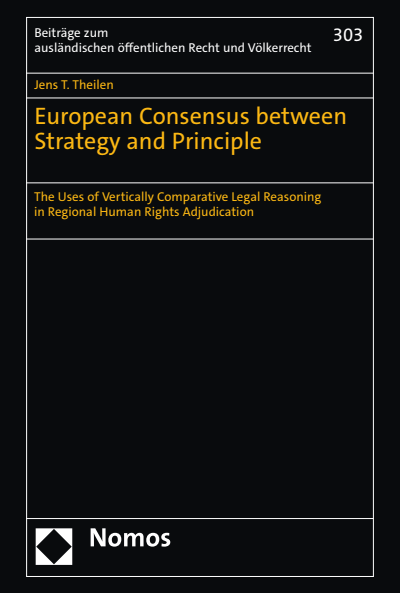
European Consensus between Strategy and Principle
The Uses of Vertically Comparative Legal Reasoning in Regional Human Rights Adjudication- Autor:innen:
- Reihe:
- Beiträge zum ausländischen öffentlichen Recht und Völkerrecht, Band 303
- Verlag:
- 2021
Zusammenfassung
Dieses Werk analysiert die Argumentationsstrukturen des Europäischen Gerichtshofs für Menschenrechte, insbesondere dessen Verweise auf einen Europäischen Konsensus. Es verbindet kritische Menschenrechtstheorie mit einer eingehenden Analyse der Rechtsprechung des Gerichtshofs.
Während der Europäische Konsensus oft als objektives Element innerhalb der Argumentation des Gerichtshofs angesehen wird, legt diese Studie dar, dass er Teil der argumentativer Strukturen bildet, die zur Unbestimmtheit von Menschenrechten führen. Konsensus und die Legitimität des Gerichtshofs zu betonen, dient der Verankerung des Status Quo. Der Autor schlägt alternative Ansätze vor, um Menschenrechte als Instrument sozialer Transformation denken zu können.
Schlagworte
Publikation durchsuchen
Bibliographische Angaben
- Auflage
- 1/2021
- Copyrightjahr
- 2021
- ISBN-Print
- 978-3-8487-8091-4
- ISBN-Online
- 978-3-7489-2509-5
- Verlag
- Nomos, Baden-Baden
- Reihe
- Beiträge zum ausländischen öffentlichen Recht und Völkerrecht
- Band
- 303
- Sprache
- Englisch
- Seiten
- 497
- Produkttyp
- Monographie
Inhaltsverzeichnis
- Titelei/InhaltsverzeichnisSeiten 1 - 14 Download Kapitel (PDF)
- I. Human Rights Adjudication: High Stakes and Little Guidance
- II. Introducing European Consensus
- III. Key Characteristics of European Consensus
- 1. Different Perspectives on Consensus: Structuralist Methodology
- 2. Human Rights between Apology and Utopia
- 3. Morality-focussed and Ethos-focussed Perspectives
- 4. Strategic Considerations and Consensus as Legitimacy-Enhancement
- 5. The Indeterminacy of Processes of Justification
- V. Outline of the Following Chapters
- I. Introduction
- 1. Minority Rights and the Tyranny of the Majority
- 2. Regional Human Rights Law and Distrust of States
- 3. The Is-Ought Distinction and Strict Normativity
- III. Ambivalent Morality-focussed Perspectives on the Spur Effect
- IV. Interim Reflections: Tackling Prejudice
- I. Introduction
- II. Against the Morality-focussed Perspective: Differing Epistemologies
- III. National Ethe: From Traditions to Democratic Procedures
- 1. Lack of Regional Democracy and Human Rights as a Cooperative Venture
- 2. The Democratic Credentials of European Consensus
- 3. From National Ethe to a Pan-European Ethos
- 4. Implications of Harmonisation: Human Rights and European Integration
- V. Interim Reflections: Vestiges of Homogeneity
- I. Introduction
- 1. European Consensus as Collective Wisdom
- 2. The Spur Effect and the Similarity Condition
- 3. The Rein Effect and Bias Across States
- 1. Persistent Tensions Due to Differing Epistemologies and Idealisations
- 2. From Tensions to Oscillation: The Example of Core Rights
- 3. Instrumental Allegiances
- IV. Interim Reflections: Against Naturalisation
- I. Introduction
- II. Consensus as Reasonable Agreement: But What Is Reasonable?
- 1. The Conventional Account: Asymmetry in Favour of the Rein Effect
- 2. The Ethos-focussed Perspective versus Consensus-Agnostic Middle Ground
- 3. The Ethos-focussed Perspective versus the Epistemic Approach
- IV. Morality-focussed Elements: Trends and Directionality
- V. Interim Reflections: Statistical and Ideal Majorities
- I. Introduction
- II. European Consensus and Systemic Integration
- III. Ethos-focussed and Morality-focussed Perspectives on International Law
- 1. Taxonomies of International Law References
- 2. Law of the European Union
- 3. Council of Europe Materials
- 4. Global International Law
- 5. Soft Law
- 6. Non-Representative Documents
- V. Consensus based on International Law versus Consensus based on Domestic Law
- VI. Interim Reflections: International Law as Grounded Yet Aspirational
- I. Introduction
- II. Levels of Generality in the Court’s Use of European Consensus
- 1. Different Constellations within Triangular Tensions
- 2. Shifting Levels of Generality as a Search for Reflective Equilibrium
- IV. Interim Reflections: Beyond the Goldilocks Level of Generality
- I. Introduction
- II. Autonomous Concepts
- 1. Two Concepts of the Margin of Appreciation – and of Consensus?
- 2. Contextualising the Rein Effect
- 3. Contextualising the Spur Effect
- IV. Interim Reflections: Instable Oscillations and Doctrinal Connotations
- I. Introduction
- 1. Investing Sociological Legitimacy with Normativity
- 2. The Background Assumption: Overcoming a “Legitimacy Crisis”
- 3. The States Parties as Agents of Legitimacy
- 4. European Consensus as the Basis of Incremental Development
- 5. The Court as the Object of Legitimacy: Strategic Implications
- III. The Practical Limitations of Consensus as Legitimacy-Enhancement
- IV. Interim Reflections: Abstract Strategizing
- I. Introduction
- II. Non-Ideal Theory: The Dilemma of Strategic Concessions
- 1. Different Perspectives on Consensus within Non-Ideal Theory
- 2. Consensus and an Impression of Objectivity
- 3. The Normalisation of a Strategic Approach to Consensus
- IV. Interim Reflections: Rethinking the Role of the Court
- I. Pulling Together the Threads: Beyond Consensus as Compromise
- II. Indeterminacy and the Motivation for Critique
- III. The Role of Human Rights Courts
- 1. The Indeterminacy Thesis in the Judicial Context
- 2. European Consensus and the Perpetuation of Current Power Structures
- 3. A More Openly Political Court?
- 4. Vertically Comparative Law as a Reflective Disruption of Equilibrium
- V. Outlook: Future Articulations of Human Rights
- Table of CasesSeiten 450 - 460 Download Kapitel (PDF)
- BibliographySeiten 461 - 497 Download Kapitel (PDF)
Literaturverzeichnis (592 Einträge)
Es wurden keine Treffer gefunden. Versuchen Sie einen anderen Begriff.
- Vvan Aaken, Anne, and Iulia Motoc, eds. The European Convention on Human Rights and General International Law. Oxford: Oxford University Press, 2018. Google Scholar öffnen DOI: 10.5771/9783748925095
- Ackerly, Brooke A. Universal Human Rights in a World of Difference. Cambridge: Cambridge University Press, 2008. Google Scholar öffnen DOI: 10.5771/9783748925095
- Adamo, Silvia. “Protecting International Civil Rights in a National Context: Danish Law and Its Discontents.” Nordic Journal of International Law 85 (2016): 119-145. Google Scholar öffnen DOI: 10.5771/9783748925095
- Agamben, Giorgio. Potentialities. Collected Essays in Philosophy. Translated by Daniel Heller-Roazen. Stanford: Stanford University Press, 2000. Google Scholar öffnen DOI: 10.5771/9783748925095
- Ahmed, Sara. Living a Feminist Life. Durham and London: Duke University Press, 2017. Google Scholar öffnen DOI: 10.5771/9783748925095
- Ahmed, Sara. The Promise of Happiness. Durham and London: Duke University Press, 2010. Google Scholar öffnen DOI: 10.5771/9783748925095
- Ahmed, Sara. Queer Phenomenology. Durham and London: Duke University Press, 2006. Google Scholar öffnen DOI: 10.5771/9783748925095
- Ahmed, Sara. “Uses of Use. Diversity, Utility and the University.” 2018. Available at <https://www.youtube.com/watch?v=avKJ2w1mhnghttps://www.youtube.com/watch?v=avKJ2w1mhng>. Google Scholar öffnen DOI: 10.5771/9783748925095
- Alexy, Robert. Theorie der Grundrechte. Frankfurt: Suhrkamp, 1994. Google Scholar öffnen DOI: 10.5771/9783748925095
- Alexy, Robert. Theorie der juristischen Argumentation. 7th ed. Frankfurt a.M.: Suhrkamp, 2012. Google Scholar öffnen DOI: 10.5771/9783748925095
- Allott, Philip. Eutopia. New Philosophy and New Law for a Troubled World. Cheltenham: Edward Elgar, 2016. Google Scholar öffnen DOI: 10.5771/9783748925095
- Allott, Philip. “The Will to Know and the Will to Power. Theory and Moral Responsibility.” In The Health of Nations. Society and Law beyond the State, 3-35. Cambridge: Cambridge University Press, 2002. Google Scholar öffnen DOI: 10.5771/9783748925095
- Allott, Philip, and others. “Thinking Another World: ‘This Cannot Be How the World Was Meant to Be’.” European Journal of International Law 16 (2005): 255-297. Google Scholar öffnen DOI: 10.5771/9783748925095
- Alter, Karen J. Establishing the Supremacy of European Law. The Making of an International Rule of Law in Europe. Oxford: Oxford University Press, 2001. Google Scholar öffnen DOI: 10.5771/9783748925095
- Altwicker, Tilmann, and Oliver Diggelmann. “How is Progress Constructed in International Legal Scholarship?”. European Journal of International Law 25 (2014): 425-444. Google Scholar öffnen DOI: 10.5771/9783748925095
- Ambrus, Mónika. “Comparative Law Method in the Jurisprudence of the European Court of Human Rights in the Light of the Rule of Law.” Erasmus Law Review 2 (2009): 353-371. Google Scholar öffnen DOI: 10.5771/9783748925095
- Amos, Merris. “Can European Consensus Encourage Acceptance of the European Convention on Human Rights in the United Kingdom?”. In Building Consensus on European Consensus: Judicial Interpretation of Human Rights in Europe and Beyond, edited by Panos Kapotas and Vassilis Tzevelekos, 258-282. Cambridge: Cambridge University Press, 2019. Google Scholar öffnen DOI: 10.5771/9783748925095
- Amos, Merris. “The Value of the European Court of Human Rights to the United Kingdom.” European Journal of International Law 28 (2017): 763-785. Google Scholar öffnen DOI: 10.5771/9783748925095
- Anagnostou, Dia, and Alina Mungiu-Pippidi. “Domestic Implementation of Human Rights Judgments in Europe: Legal Infrastructure and Government Effectiveness Matter.” European Journal of International Law 25 (2014): 205-227. Google Scholar öffnen DOI: 10.5771/9783748925095
- Arai-Takahashi, Yutaka. The Margin of Appreciation Doctrine and the Principle of Proportionality in the Jurisprudence of the ECHR. Antwerp et al.: Intersentia, 2002. Google Scholar öffnen DOI: 10.5771/9783748925095
- Arai-Takahashi, Yutaka. “The Margin of Appreciation Doctrine: A Theoretical Analysis of Strasbourg’s Variable Geometry.” In Constituting Europe. The European Court of Human Rights in a National, European and Global Context, edited by Andreas Føllesdal, Birgit Peters and Geir Ulfstein, 62-105. Cambridge: Cambridge University Press, 2013. Google Scholar öffnen DOI: 10.5771/9783748925095
- Arnardóttir, Oddný Mjöll. Equality and Non-Discrimination under the European Convention on Human Rights. The Hague: Martinus Nijhoff, 2003. Google Scholar öffnen DOI: 10.5771/9783748925095
- Arnardóttir, Oddný Mjöll. “The ‘Procedural Turn’ under the European Convention on Human Rights and Presumptions of Convention Compliance.” International Journal of Constitutional Law 15 (2017): 9-35. Google Scholar öffnen DOI: 10.5771/9783748925095
- Arnardóttir, Oddný Mjöll. “Rethinking the Two Margins of Appreciation.” European Constitutional Law Review 12 (2016): 27-53. Google Scholar öffnen DOI: 10.5771/9783748925095
- Vvon Arnauld, Andreas. “Rechtsangleichung durch allgemeine Rechtsgrundsätze? - Europäisches Gemeinschaftsrecht und Völkerrecht im Vergleich.” In Rechtsangleichung: Grundlagen, Methoden und Inhalte, edited by Karl Riesenhuber and Kanako Takayama, 247-262. Berlin: de Gruyter, 2006. Google Scholar öffnen DOI: 10.5771/9783748925095
- Vvon Arnauld, Andreas. Rechtssicherheit: Perspektivische Annäherungen an eine “idée directrice” des Rechts. Tübingen: Mohr Siebeck, 2006. Google Scholar öffnen DOI: 10.5771/9783748925095
- Vvon Arnauld, Andreas. “Zur Rhetorik der Verhältnismäßigkeit.” In Verhältnismäßigkeit, edited by Matthias Jestaedt and Oliver Lepsius, 276-292. Tübingen: Mohr Siebeck, 2015. Google Scholar öffnen DOI: 10.5771/9783748925095
- Vvon Arnauld, Andreas, and Jens T. Theilen. “Rhetoric of Rights: A Topical Perspective on the Functions of Claiming a ‘Human Right to …’.” In Cambridge Handbook of New Human Rights. Recognition, Novelty, Rhetoric, edited by Andreas von Arnauld, Kerstin von der Decken and Mart Susi, 34-49. Cambridge: Cambridge University Press, 2020. Google Scholar öffnen DOI: 10.5771/9783748925095
- Arvan, Marcus. “First Steps Toward a Nonideal Theory of Justice.” Ethics & Global Politics 7 (2014): 95-117. Google Scholar öffnen DOI: 10.5771/9783748925095
- Dd’Aspremont, Jean. “Martti Koskenniemi, the Mainstream, and Self-Reflectivity.” Leiden Journal of International Law 29 (2016): 625-639. Google Scholar öffnen DOI: 10.5771/9783748925095
- Dd’Aspremont, Jean. “Softness in International Law: A Self-Serving Quest for New Legal Materials.” European Journal of International Law 19, no. 5 (2008): 1075-1093. Google Scholar öffnen DOI: 10.5771/9783748925095
- Dd’Aspremont, Jean. “Three international lawyers in a hall of mirrors.” Leiden Journal of International Law 32, no. 3 (2019): 367-381. Google Scholar öffnen DOI: 10.5771/9783748925095
- Authers, Benjamin, and Hilary Charlesworth. “The Crisis and the Quotidian in International Human Rights Law.” Netherlands Yearbook of International Law 44 (2013): 19-39. Google Scholar öffnen DOI: 10.5771/9783748925095
- Bakircioglu, Onder. “The Application of the Margin of Appreciation Doctrine in Freedom of Expression and Public Morality Cases.” German Law Journal 8 (2007): 711-734. Google Scholar öffnen DOI: 10.5771/9783748925095
- Balkin, Jack M. “A Night in the Topics: The Reason of Legal Rhetoric and the Rhetoric of Legal Reason.” In From Law’s Stories: Narrative and Rhetoric in the Law, edited by Peter Brooks and Paul Gewirtz, 211-224. New Haven: Yale University Press, 1996. Google Scholar öffnen DOI: 10.5771/9783748925095
- Barry, Brian. Political Argument. London: Routledge & Kegan Paul, 1965. Google Scholar öffnen DOI: 10.5771/9783748925095
- Bassok, Or. “The European Consensus Doctrine and the ECtHR Quest for Public Confidence.” In Building Consensus on European Consensus. Judicial Interpretation of Human Rights in Europe and Beyond, edited by Panos Kapotas and Vassilis Tzevelekos, 236-257. Cambridge: Cambridge University Press, 2019. Google Scholar öffnen DOI: 10.5771/9783748925095
- Bates, Ed. “Activism and Self-Restraint: The Margin of Appreciation’s Strasbourg Career… Its ‘Coming of Age’?”. Human Rights Law Journal 36 (2016): 261-276. Google Scholar öffnen DOI: 10.5771/9783748925095
- Bates, Ed. “Analysing the Prisoner Voting Saga and the British Challenge to Strasbourg.” Human Rights Law Review 14 (2014): 503-540. Google Scholar öffnen DOI: 10.5771/9783748925095
- Bates, Ed. “Consensus in the Legitimacy-Building Era of the European Court of Human Rights.” In Building Consensus on European Consensus. Judicial Interpretation of Human Rights in Europe and Beyond, edited by Panos Kapotas and Vassilis Tzevelekos, 42-70. Cambridge: Cambridge University Press, 2019. Google Scholar öffnen DOI: 10.5771/9783748925095
- Baxi, Upendra. The Future of Human Rights. 3rd ed. New Delhi: Oxford University Press, 2008. Google Scholar öffnen DOI: 10.5771/9783748925095
- Beauchamp, Toby. “Artful Concealment and Strategic Visibility: Transgender Bodies and U.S. State Surveillance After 9/11.” Surveillance & Society 6, no. 4 (2009): 356-366. Google Scholar öffnen DOI: 10.5771/9783748925095
- Beitz, Charles R. The Idea of Human Rights. Oxford: Oxford University Press, 2009. Google Scholar öffnen DOI: 10.5771/9783748925095
- Bellamy, Richard. “The Democratic Legitimacy of International Human Rights Conventions: Political Constitutionalism and the European Convention on Human Rights.” European Journal of International Law 25 (2014): 1019-1042. Google Scholar öffnen DOI: 10.5771/9783748925095
- Bellamy, Richard. “Republicanism, Democracy, and Constitutionalism.” In Republicanism and Political Theory, edited by Cécile Laborde and John Maynor, 159-189. Malden, Mass.: Blackwell, 2008. Google Scholar öffnen DOI: 10.5771/9783748925095
- Ben-Naftali, Orna. “Sentiment, Sense and Sensibility in the Genesis of Utopian Traditions.” European Journal of International Law 23, no. 4 (2012): 1133-1142. Google Scholar öffnen DOI: 10.5771/9783748925095
- Bengoetxea, Joxerramon, Neil MacCormick, and Leonor Moral Soriano. “Integration and Integrity in the Legal Reasoning of the European Court of Justice.” In The European Court of Justice, edited by Gráinne de Búrca and J.H.H. Weiler, 43-85. Oxford: Oxford University Press, 2001. Google Scholar öffnen DOI: 10.5771/9783748925095
- Benhabib, Seyla. “Another Universalism: On the Unity and Diversity of Human Rights.” In Dignity in Adversity: Human Rights in Troubled Times, 57-76. Cambridge: Polity Press, 2011. Google Scholar öffnen DOI: 10.5771/9783748925095
- Benhabib, Seyla. “Introduction: Cosmopolitanism without Illusions.” In Dignity in Adversity: Human Rights in Troubled Times, 1-19. Cambridge: Polity Press, 2011. Google Scholar öffnen DOI: 10.5771/9783748925095
- Benhabib, Seyla. “Is There a Human Right to Democracy? Beyond Interventionism and Indifference.” In Dignity in Adversity: Human Rights in Troubled Times, 77-93. Cambridge: Polity Press, 2011. Google Scholar öffnen DOI: 10.5771/9783748925095
- Bentham, Jeremy. “Nonsense upon Stilts, or Pandora’s Box Opened.” In The Collected Works of Jeremy Bentham, edited by Philip Schofield, Catherine Pease-Watkins and Cyprian Blamires. Oxford: Oxford University Press, 2002. Google Scholar öffnen DOI: 10.5771/9783748925095
- Benvenisti, Eyal. “Margin of Appreciation, Consensus, and Universal Standards.” New York University Journal of International Law and Politics 31 (1999): 843-854. Google Scholar öffnen DOI: 10.5771/9783748925095
- Benvenisti, Eyal. “The Margin of Appreciation, Subsidiarity and Global Challenges to Democracy.” Journal of International Dispute Settlement 9 (2018): 240-253. Google Scholar öffnen DOI: 10.5771/9783748925095
- Besson, Samantha. “The Authority of International Law - Lifting the State Veil.” Sydney Law Review 31 (2009): 343-380. Google Scholar öffnen DOI: 10.5771/9783748925095
- Besson, Samantha. “The ‘Erga Omnes’ Effect of the European Court of Human Rights.” In The European Court of Human Rights after Protocol 14: Preliminary Assessment and Perspectives, edited by Samantha Besson, 125-175. Geneva: Schulthess, 2011. Google Scholar öffnen DOI: 10.5771/9783748925095
- Besson, Samantha. “European Human Rights, Supranational Judicial Review and Democracy - Thinking Outside the Judicial Box.” In Human Rights Protection in the European Legal Orders: Interaction Between European Courts and National Courts, edited by Patricia Popelier, Catherine Van de Heyning and Piet Van Nuffel, 97-145. Cambridge: Intersentia, 2011. Google Scholar öffnen DOI: 10.5771/9783748925095
- Besson, Samantha. “Human Rights Adjudication as Transnational Adjudication: A Peripheral Case of Domestic Courts as International Law Adjudicators.” In International Law and… Select Proceedings of the European Society of International Law, Vol. 5, edited by August Reinisch, Mary E. Footer and Christina Binder, 43-65. Oxford: Hart, 2016. Google Scholar öffnen DOI: 10.5771/9783748925095
- Besson, Samantha. “Human Rights and Democracy in a Global Context: Decoupling and Recoupling.” Ethics & Global Politics 4 (2011): 19-50. Google Scholar öffnen DOI: 10.5771/9783748925095
- Besson, Samantha. “Human Rights: Ethical, Political… or Legal? First Steps in a Legal Theory of Human Rights.” In The Role of Ethics in International Law, edited by Donald Earl Childress, 211-245. Cambridge: Cambridge University Press, 2012. Google Scholar öffnen DOI: 10.5771/9783748925095
- Besson, Samantha. “The Legitimate Authority of International Human Rights. On the Reciprocal Legitimation of Domestic and International Human Rights.” In The Legitimacy of International Human Rights Regimes. Legal, Political and Philosophical Perspectives, edited by Andreas Føllesdal, Johan Karlsson Schaffer and Geir Ulfstein, 32-83. Cambridge: Cambridge University Press, 2013. Google Scholar öffnen DOI: 10.5771/9783748925095
- Besson, Samantha. The Morality of Conflict. Reasonable Disagreement and the Law. Oxford: Hart, 2005. Google Scholar öffnen DOI: 10.5771/9783748925095
- Besson, Samantha. “State Consent and Disagreement in International Law-Making. Dissolving the Paradox.” Leiden Journal of International Law 29 (2016): 289-316. Google Scholar öffnen DOI: 10.5771/9783748925095
- Besson, Samantha. “Subsidiarity in International Human Rights Law - What is Subsidiary about Human Rights?”. The American Journal of Jurisprudence 61 (2016): 69-107. Google Scholar öffnen DOI: 10.5771/9783748925095
- Besson, Samantha, and Anne-Laurence Graf-Brugère. “Le droit de vote des expatriés, le consensus européen et la marge d’appréciation des États.” Revue Trimestrielle des Droits de l’Homme 25 (2014): 937-958. Google Scholar öffnen DOI: 10.5771/9783748925095
- Besson, Samantha, and José Luis Martí. “Introduction.” In Deliberative Democracy and its Discontents, edited by Samantha Besson and José Luis Martí, xiii-xxxi. Aldershot: Ashgate, 2006. Google Scholar öffnen DOI: 10.5771/9783748925095
- Besson, Samantha, and José Luis Martí. “Law and Republicanism: Mapping the Issues.” In Legal Republicanism: National and International Perspectives, edited by Samantha Besson and José Luis Martí, 3-36. Oxford: Oxford University Press, 2009. Google Scholar öffnen DOI: 10.5771/9783748925095
- Besson, Samantha, and Alain Zysset. “Human Rights Theory and Human Rights History: A Tale of Two Odd Bedfellows.” Ancilla Iuris (2012): 204-219. Google Scholar öffnen DOI: 10.5771/9783748925095
- Bhuta, Nehal. “Two Concepts of Religious Freedom in the European Court of Human Rights.” The South Atlantic Quarterly 113, no. 1 (2014): 9-35. Google Scholar öffnen DOI: 10.5771/9783748925095
- Bickel, Alexander. The Least Dangerous Branch. The Supreme Court at the Bar of Politics. New Haven and London: Yale University Press, 1986. Google Scholar öffnen DOI: 10.5771/9783748925095
- Bjorge, Eirik. “Been There, Done That: The Margin of Appreciation and International Law.” Cambridge Journal of International and Comparative Law 4, no. 1 (2015): 181-190. Google Scholar öffnen DOI: 10.5771/9783748925095
- Bjorge, Eirik. Domestic Application of the ECHR: Courts as Faithful Trustees. Oxford: Oxford University Press, 2015. Google Scholar öffnen DOI: 10.5771/9783748925095
- Blackburn, Simon. “Can Philosophy Exist?”. In Méta-Philosophie: Reconstructing Philosophy?, edited by Jocelyne Couture and Kai Nielsen, 83-105. Calgary: University of Calgary Press, 1993. Google Scholar öffnen DOI: 10.5771/9783748925095
- Bloch, Ernst. Das Prinzip Hoffnung. 10th ed. Frankfurt a.M.: Suhrkamp, 2016. Google Scholar öffnen DOI: 10.5771/9783748925095
- Vvan Bockel, Bas. “A Court Divided: Discord and Disagreement in Rola v. Slovenia”. Strasbourg Observers, 2019. Available at <https://strasbourgobservers.com/2019/07/09/a-court-divided-discord-and-disagreement-in-rola-v-slovenia/#more-4365https://strasbourgobservers.com/2019/07/09/a-court-divided-discord-and-disagreement-in-rola-v-slovenia/#more-4365>. Google Scholar öffnen DOI: 10.5771/9783748925095
- Bodansky, Daniel M. “The Legitimacy of International Governance: A Coming Challenge for International Environmental Law?”. American Journal of International Law 93 (1999): 596-624. Google Scholar öffnen DOI: 10.5771/9783748925095
- Vvon Bogdandy, Armin, and Ingo Venzke. “In Whose Name? An Investigation of International Courts’ Public Authority and Its Democratic Justification.” European Journal of International Law 23 (2012): 7-41. Google Scholar öffnen DOI: 10.5771/9783748925095
- Bothe, Michael. “Die Bedeutung der Rechtsvergleichung in der Praxis internationaler Gerichte.” Zeitschrift für ausländisches öffentliches Recht und Völkerrecht 36 (1976): 280-299. Google Scholar öffnen DOI: 10.5771/9783748925095
- Bourdieu, Pierre. Pascalian Meditations. Translated by Richard Nice. Stanford: Stanford University Press, 2000. Google Scholar öffnen DOI: 10.5771/9783748925095
- Bouwhuis, Stephen. “Revisiting Philip Alston’s Human Rights and Quality Control.” European Human Rights Law Review, no. 5 (2016): 475-483. Google Scholar öffnen DOI: 10.5771/9783748925095
- Bowring, Bill. “Does Russia Have a Human Rights Future in the Council of Europe and OSCE?”. In Shifting Power and Human Rights Diplomacy: Russia, edited by Doutje Lettinga and Lars van Troost: Amnesty International Netherlands, 2017. Google Scholar öffnen DOI: 10.5771/9783748925095
- Bowring, Bill. “Russia and the European Convention (or Court) of Human Rights: The End?”. Revue québécoise de droit international hors-série (2020): 201-218. Google Scholar öffnen DOI: 10.5771/9783748925095
- Boylan, Michael. Natural Human Rights. A Theory. Cambridge: Cambridge University Press, 2014. Google Scholar öffnen DOI: 10.5771/9783748925095
- Bratza, Nicolas. “The Relationship between the UK Courts and Strasbourg.” European Human Rights Law Review (2011): 505-512. Google Scholar öffnen DOI: 10.5771/9783748925095
- Brauch, Jeffrey A. “The Dangerous Search for an Elusive Consensus: What the Supreme Court Should Learn from the European Court of Human Rights.” Howard Law Journal 52 (2009): 277-318. Google Scholar öffnen DOI: 10.5771/9783748925095
- Brauch, Jeffrey A. “The Margin of Appreciation and the Jurisprudence of the European Court of Human Rights: Threat to the Rule of Law.” Columbia Journal of European Law 11 (2004-2005): 113-150. Google Scholar öffnen DOI: 10.5771/9783748925095
- Brems, Eva. “Enemies or Allies? Feminism and Cultural Relativism as Dissident Voices in Human Rights Discourse.” Human Rights Quarterly 19 (1997): 136-164. Google Scholar öffnen DOI: 10.5771/9783748925095
- Brems, Eva. “Human Rights: Minimum and Maximum Perspectives.” Human Rights Law Review 9 (2009): 349-372. Google Scholar öffnen DOI: 10.5771/9783748925095
- Brems, Eva. Human Rights: Universality and Diversity. The Hague et al.: Martinus Nijhoff, 2001. Google Scholar öffnen DOI: 10.5771/9783748925095
- Brems, Eva. “The Margin of Appreciation Doctrine in the Case-Law of the European Court of Human Rights.” Zeitschrift für ausländisches öffentliches Recht und Völkerrecht 56 (1996): 240-314. Google Scholar öffnen DOI: 10.5771/9783748925095
- Brems, Eva. “Procedural Protection. An Examination of Procedural Safeguards Read into Substantive Convention Rights.” In Shaping Rights in the ECHR. The Role of the European Court of Human Rights in Determining the Scope of Human Rights, edited by Eva Brems and Janneke Gerards, 137-161. Cambridge: Cambridge University Press, 2013. Google Scholar öffnen DOI: 10.5771/9783748925095
- Brems, Eva, and Laurens Lavrysen. “Procedural Justice in Human Rights Adjudication: The European Court of Human Rights.” Human Rights Quarterly 35 (2013): 176-200. Google Scholar öffnen DOI: 10.5771/9783748925095
- Brest, Paul. “The Substance of Process.” Ohio State Law Journal 42 (1981): 131-142. Google Scholar öffnen DOI: 10.5771/9783748925095
- Breuer, Marten. “Establishing Common Standards and Securing the Rule of Law.” In The Council of Europe. Its Laws and Policies, edited by Stefanie Schmahl and Marten Breuer, 639-670. Oxford: Oxford University Press, 2017. Google Scholar öffnen DOI: 10.5771/9783748925095
- Breuer, Marten. “Impact of the Council of Europe on National Legal Systems.” In The Council of Europe. Its Laws and Policies, edited by Stefanie Schmahl and Marten Breuer, 801-873. Oxford: Oxford University Press, 2017. Google Scholar öffnen DOI: 10.5771/9783748925095
- Bribosia, Emmanuelle, Isabelle Rorive, and Laura Van den Eynde. “Same-Sex Marriage: Building an Argument before the European Court of Human Rights in Light of the US Experience.” Berkeley Journal of International Law 32 (2014): 1-43. Google Scholar öffnen DOI: 10.5771/9783748925095
- Brown, Wendy. “‘The Most We Can Hope For…’: Human Rights and the Politics of Fatalism.” The South Atlantic Quarterly 103 (2004): 451-463. Google Scholar öffnen DOI: 10.5771/9783748925095
- Buchanan, Allen. The Heart of Human Rights. Oxford: Oxford University Press, 2013. Google Scholar öffnen DOI: 10.5771/9783748925095
- Dde Búrca, Gráinne. “The Language of Rights and European Integration.” In New Legal Dynamics of European Union, edited by Josephine Shaw and Gillian More. Oxford: Clarendon Press, 1995. Google Scholar öffnen DOI: 10.5771/9783748925095
- Vvan der Burg, Wibren, and Theo van Willigenburg. “Introduction.” In Reflective Equilibrium: Essays in Honour of Robert Heeger, edited by Wibren van der Burg and Theo van Willigenburg, 1-25. Dordrecht: Springer, 1998. Google Scholar öffnen DOI: 10.5771/9783748925095
- Burke, Karen C. “Secret Surveillance and the European Convention on Human Rights.” Stanford Law Review 33 (1980-1981): 1113-1140. Google Scholar öffnen DOI: 10.5771/9783748925095
- Burstein, Mike. “The Will to Enforce: An Examination of the Political Constraints upon a Regional Court of Human Rights.” Berkeley Journal of International Law 24 (2006): 423-443. Google Scholar öffnen DOI: 10.5771/9783748925095
- Butler, Judith. “Beside Oneself: On the Limits of Sexual Autonomy.” In Undoing Gender, 17-39. New York and London: Routledge, 2004. Google Scholar öffnen DOI: 10.5771/9783748925095
- Butler, Judith. “Gender Regulations.” In Undoing Gender, 40-56. New York and London: Routledge, 2004. Google Scholar öffnen DOI: 10.5771/9783748925095
- Butler, Judith. Gender Trouble. Feminism and the Subversion of Identity. New York and London: Routledge, 1999. Google Scholar öffnen DOI: 10.5771/9783748925095
- Butler, Judith, and William Connolly. “Politics, Power and Ethics: A Discussion Between Judith Butler and William Connolly.” Theory & Event 4, no. 2 (2000). Google Scholar öffnen DOI: 10.5771/9783748925095
- Çalı, Başak. “Specialized Rules of Treaty Interpretation: Human Rights.” In The Oxford Guide to Treaties, edited by Duncan B. Hollis, 525-548. Oxford: Oxford University Press, 2012. Google Scholar öffnen DOI: 10.5771/9783748925095
- Çalı, Başak, Anne Koch, and Nicola Bruch. "The Legitimacy of the European Court of Human Rights: The View from the Ground." Strasbourg, 2011. Google Scholar öffnen DOI: 10.5771/9783748925095
- Çalı, Başak, and Saladin Meckled-García. “Human Rights Legalized - Defining, Interpreting, and Implementing an Ideal.” In The Legalization of Human Rights. Multidisciplinary Perspectives on Human Rights and Human Rights Law, edited by Saladin Meckled-García and Başak Çalı, 1-8. London and New York: Routledge, 2006. Google Scholar öffnen DOI: 10.5771/9783748925095
- Carothers, Thomas. “Empirical Perspectives on the Emerging Norm of Democracy in International Law.” Proceedings of the American Society of International Law (1992): 261-267. Google Scholar öffnen DOI: 10.5771/9783748925095
- Carozza, Paolo G. “Subsidiarity as a Structural Principle of International Human Rights Law.” American Journal of International Law 97 (2003): 38-79. Google Scholar öffnen DOI: 10.5771/9783748925095
- Carozza, Paolo G. “Uses and Misuses of Comparative Law in International Human Rights: Some Reflections on the Jurisprudence of the European Court of Human Rights.” Notre Dame Law Review 73 (1998): 1217-1237. Google Scholar öffnen DOI: 10.5771/9783748925095
- Carrubba, Clifford James, and Matthew Joseph Gabel. “Courts, Compliance, and the Quest for Legitimacy in International Law.” Theoretical Inquiries in Law 14 (2013): 505-541. Google Scholar öffnen DOI: 10.5771/9783748925095
- Cebada Romero, Alicia. “The European Court of Human Rights and Religion: Between Christian Neutrality and the Fear of Islam.” New Zealand Journal of Public and International Law 11 (2013): 75-101. Google Scholar öffnen DOI: 10.5771/9783748925095
- Charlesworth, Hilary, Christine Chinkin, and Shelley Wright. “Feminist Approaches to International Law.” American Journal of International Law 85, no. 4 (1991): 613-645. Google Scholar öffnen DOI: 10.5771/9783748925095
- Charlesworth, Hilary, Gina Heathcote, and Emily Jones. “Feminist Scholarship on International Law in the 1990s and Today: An Inter-Generational Conversation.” Feminist Legal Studies 27 (2019): 79-93. Google Scholar öffnen DOI: 10.5771/9783748925095
- Cheah, Pheng. Inhuman Conditions. On Cosmopolitanism and Human Rights. Cambridge, Mass.: Harvard University Press, 2006. Google Scholar öffnen DOI: 10.5771/9783748925095
- Chimni, B.S. “Third World Approaches to International Law: A Manifesto.” International Community Law Review 8 (2006): 3-27. Google Scholar öffnen DOI: 10.5771/9783748925095
- Clément, Dominique. “Human Rights or Social Justice? The Problem of Rights Inflation.” International Journal of Human Rights 22, no. 2 (2018): 155-169. Google Scholar öffnen DOI: 10.5771/9783748925095
- Cohen, Joshua. “An Epistemic Conception of Democracy.” Ethics 97 (1986): 26-38. Google Scholar öffnen DOI: 10.5771/9783748925095
- Condorcet, Marquis de. “On the Emancipation of Women. On giving Women the Right of Citizenship.” In Condorcet: Political Writings, edited by Steven Lukes and Nadia Urbinati, 156-162. Cambridge: Cambridge University Press, 2012. Google Scholar öffnen DOI: 10.5771/9783748925095
- Conway, Gerard. “Levels of Generality in the Legal Reasoning of the European Court of Justice.” European Law Journal 14 (2008): 787-805. Google Scholar öffnen DOI: 10.5771/9783748925095
- Cooper, Davina. Everyday Utopias. The Conceptual Life of Promising Spaces. Durham and London: Duke University Press, 2014. Google Scholar öffnen DOI: 10.5771/9783748925095
- Cooper, Sarah Lucy. “Marriage, Family, Discrimination & Contradiction: An Evaluation of the Legacy and Future of the European Court of Human Rights’ Jurisprudence on LGBT Rights.” German Law Journal 12 (2011): 1746-1763. Google Scholar öffnen DOI: 10.5771/9783748925095
- Costa, Jean-Paul. “On the Legitimacy of the European Court of Human Rights’ Judgments.” European Constitutional Law Review 7 (2011): 173-182. Google Scholar öffnen DOI: 10.5771/9783748925095
- Costa, Jean-Paul. “The Relationship between the European Court of Human Rights and the National Courts.” European Human Rights Law Review (2013): 264-274. Google Scholar öffnen DOI: 10.5771/9783748925095
- Cover, Robert M. “The Supreme Court 1982 Term. Foreword: Nomos and Narrative.” Harvard Law Review 97 (1983): 4-68. Google Scholar öffnen DOI: 10.5771/9783748925095
- Cover, Robert M. “Violence and the Word.” Yale Law Journal 95 (1986): 1601-1629. Google Scholar öffnen DOI: 10.5771/9783748925095
- Cowan, Sharon. "The Scottish Feminist Judgments Project: A New Frontier." In Oñati Socio-legal Series, v. 8, n. 9 - Feminist Judgments: Comparative Socio-Legal Perspectives on Judicial Decision Making and Gender Justice, 2018. Available at <https://papers.ssrn.com/sol3/papers.cfm?abstract_id=3249609https://papers.ssrn.com/sol3/papers.cfm?abstract_id=3249609>. Google Scholar öffnen DOI: 10.5771/9783748925095
- Cox, Robert W. “Social Forces, States and World Orders: Beyond International Relations Theory.” Millennium: Journal of International Studies 10, no. 2 (1981): 126-155. Google Scholar öffnen DOI: 10.5771/9783748925095
- Cram, Ian. “Protocol 15 and Articles 10 and 11 ECHR - The Partial Triumph of Political Incumbency Post-Brighton?”. International and Comparative Law Quarterly 67 (2018): 477-503. Google Scholar öffnen DOI: 10.5771/9783748925095
- Craven, Matthew. “Legal Differentiation and the Concept of the Human Rights Treaty in International Law.” European Journal of International Law 11, no. 3 (2000): 489-519. Google Scholar öffnen DOI: 10.5771/9783748925095
- Craven, Matthew, Gerry Simpson, Susan Marks, and Ralph Wilde. “We Are Teachers of International Law.” Leiden Journal of International Law 17, no. 2 (2004): 363-374. Google Scholar öffnen DOI: 10.5771/9783748925095
- Crenshaw, Kimberle. “Demarginalizing the Intersection of Race and Sex: A Black Feminist Critique of Antidiscrimination Doctrine, Feminist Theory and Antiracist Politics.” University of Chicago Legal Forum, no. 1 (1989): 139-167. Google Scholar öffnen DOI: 10.5771/9783748925095
- Crenshaw, Kimberle. “Mapping the Margins: Intersectionality, Identity Politics, and Violence Against Women of Color.” Stanford Law Review 43, no. 6 (1991): 1241-1299. Google Scholar öffnen DOI: 10.5771/9783748925095
- Dahlberg, Maija. “‘The Lack of Such a Common Approach’ - Comparative Argumentation by the European Court of Human Rights.” Finnish Yearbook of International Law 23 (2012-2013): 73-111. Google Scholar öffnen DOI: 10.5771/9783748925095
- Danius, Sara, Stefan Jonsson, and Gayatri Chakravorty Spivak. “An Interview with Gayatri Chakravorty Spivak.” boundary 2 20 (1993): 24-50. Google Scholar öffnen DOI: 10.5771/9783748925095
- Dann, Philipp, Maxim Bönnemann, and Tanja Herklotz. “Of Apples and Mangoes. Comparing the European Union and India.” Indian Yearbook of Comparative Law (2016): 3-20. Google Scholar öffnen DOI: 10.5771/9783748925095
- Davis, Angela Y. Women, Race & Class. New York: Random House, 1983. Google Scholar öffnen DOI: 10.5771/9783748925095
- Dembour, Marie-Benedicte. Who Believes in Human Rights? Reflections on the European Convention. Cambridge: Cambridge University Press, 2006. Google Scholar öffnen DOI: 10.5771/9783748925095
- Devlin, Patrick. “Democracy and Morality.” In The Enforcement of Morals, 86. Indianapolis: Liberty Fund, 2009. Google Scholar öffnen DOI: 10.5771/9783748925095
- Devlin, Patrick. “Morals and the Criminal Law.” In The Enforcement of Morals, 1-25. Indianapolis: Liberty Fund, 2009. Google Scholar öffnen DOI: 10.5771/9783748925095
- Dietz, Chris. “Governing Legal Embodiment: On the Limits of Self-Declaration.” Feminist Legal Studies 26, no. 2 (2018): 185-204. Google Scholar öffnen DOI: 10.5771/9783748925095
- Dijn, Annelien de. “Rousseau and Republicanism.” Political Theory (2015): 1-22. Google Scholar öffnen DOI: 10.5771/9783748925095
- Djeffal, Christian. “Consensus, Stasis, Evolution: Reconstructing Argumentative Patterns in Evolutive ECHR Jurisprudence.” In Building Consensus on European Consensus. Judicial Interpretation of Human Rights in Europe and Beyond, edited by Panos Kapotas and Vassilis Tzevelekos, 71-95. Cambridge: Cambridge University Press, 2019. Google Scholar öffnen DOI: 10.5771/9783748925095
- Donnelly, Jack. Universal Human Rights. 3rd ed. Ithaca and London: Cornell University Press, 2013. Google Scholar öffnen DOI: 10.5771/9783748925095
- Donoho, Douglas Lee. “Autonomy, Self-Governance, and the Margin of Appreciation: Developing a Jurisprudence of Diversity Within Universal Human Rights.” Emory International Law Review 15 (2001): 391-466. Google Scholar öffnen DOI: 10.5771/9783748925095
- Dörr, Oliver. “Article 31.” In Vienna Convention on the Law of Treaties. A Commentary, edited by Oliver Dörr and Kirsten Schmalenbach, 559-616. Berlin: Springer, 2018. Google Scholar öffnen DOI: 10.5771/9783748925095
- Dothan, Shai. “Comparative Views on the Right to Vote in International Law: The Case of Prisoners’ Disenfranchisement.” In Comparative International Law, edited by Anthea Roberts, Paul B. Stephan, Pierre-Hugues Verdier and Mila Versteeg, 379-395. Oxford: Oxford University Press, 2018. Google Scholar öffnen DOI: 10.5771/9783748925095
- Dothan, Shai. “How International Courts Enhance Their Legitimacy.” Theoretical Inquiries in Law 14 (2013): 455-478. Google Scholar öffnen DOI: 10.5771/9783748925095
- Dothan, Shai. “In Defence of Expansive Interpretation in the European Court of Human Rights.” Cambridge Journal of International and Comparative Law 3 (2014): 508-531. Google Scholar öffnen DOI: 10.5771/9783748925095
- Dothan, Shai. “Judicial Deference Allows European Consensus to Emerge.” Chicago Journal of International Law (2017): 393-419. Google Scholar öffnen DOI: 10.5771/9783748925095
- Dothan, Shai. “Judicial Tactics in the European Court of Human Rights.” Chicago Journal of International Law 12 (2011-2012): 115-142. Google Scholar öffnen DOI: 10.5771/9783748925095
- Dothan, Shai. “Margin of Appreciation and Democracy: Human Rights and Deference to Political Bodies.” Journal of International Dispute Settlement 9 (2018): 145-153. Google Scholar öffnen DOI: 10.5771/9783748925095
- Dothan, Shai. “The Optimal Use of Comparative Law.” Denver Journal of International Law and Policy 43 (2014): 21-44. Google Scholar öffnen DOI: 10.5771/9783748925095
- Dothan, Shai. “Three Interpretive Constraints on the European Court of Human Rights.” In The Rule of Law at the National and International Levels. Contestations and Deference, edited by Machiko Kanetake and André Nollkaemper, 227-245. Oxford and Portland: Hart, 2016. Google Scholar öffnen DOI: 10.5771/9783748925095
- Douglas-Scott, Sionaidh. “Borges’ Pierre Menard, Author of the Quixote and the Idea of a European Consensus.” In Building Consensus on European Consensus. Judicial Interpretation of Human Rights in Europe and Beyond, edited by Panos Kapotas and Vassilis Tzevelekos, 167-186. Cambridge: Cambridge University Press, 2019. Google Scholar öffnen DOI: 10.5771/9783748925095
- Douglas-Scott, Sionaidh. “A Tale of Two Courts: Luxembourg, Strasbourg and the Growing European Human Rights Acquis.” Common Market Law Review 43 (2006): 629-665. Google Scholar öffnen DOI: 10.5771/9783748925095
- Douzinas, Costas. "Adikia: On Communism and Rights." Critical Legal Thinking, 2010. Available at <http://criticallegalthinking.com/2010/11/30/adikia-on-communism-and-rightshttp://criticallegalthinking.com/2010/11/30/adikia-on-communism-and-rights/>. Google Scholar öffnen DOI: 10.5771/9783748925095
- Douzinas, Costas. The End of Human Rights. Oxford: Hart, 2000. Google Scholar öffnen DOI: 10.5771/9783748925095
- Draghici, Carmen. “The Strasbourg Court between European and Local Consensus: Anti-democratic or Guardian of Democratic Process?”. Public Law (2017): 11-29. Google Scholar öffnen DOI: 10.5771/9783748925095
- Dworkin, Ronald. “Can Rights be Controversial?”. In Taking Rights Seriously, 335-348. London: Bloomsbury, 2013. Google Scholar öffnen DOI: 10.5771/9783748925095
- Dworkin, Ronald. “Constitutional Cases.” In Taking Rights Seriously, 163-184. London: Bloomsbury, 2013. Google Scholar öffnen DOI: 10.5771/9783748925095
- Dworkin, Ronald. “The Forum of Principle.” New York University Law Review 56 (1981): 469. Google Scholar öffnen DOI: 10.5771/9783748925095
- Dworkin, Ronald. “Hard Cases.” In Taking Rights Seriously, 105-162. London: Bloomsbury, 2013. Google Scholar öffnen DOI: 10.5771/9783748925095
- Dworkin, Ronald. “Justice and Rights.” In Taking Rights Seriously, 185-222. London: Bloomsbury, 2013. Google Scholar öffnen DOI: 10.5771/9783748925095
- Dworkin, Ronald. Justice for Hedgehogs. Cambridge, Mass.: Belknap Press of Harvard University Press, 2011. Google Scholar öffnen DOI: 10.5771/9783748925095
- Dworkin, Ronald. Law’s Empire. Oxford: Hart, 1986. Google Scholar öffnen DOI: 10.5771/9783748925095
- Dworkin, Ronald. “Liberty and Moralism.” In Taking Rights Seriously, 289-310. London: Bloomsbury, 2013. Google Scholar öffnen DOI: 10.5771/9783748925095
- Dworkin, Ronald. “The Model of Rules II.” In Taking Rights Seriously, 65-103. London: Bloomsbury, 2013. Google Scholar öffnen DOI: 10.5771/9783748925095
- Dworkin, Ronald. “A New Philosophy for International Law.” Philosophy & Public Affairs 41 (2013): 2-30. Google Scholar öffnen DOI: 10.5771/9783748925095
- Dworkin, Ronald. “Objectivity and Truth: You’d Better Believe It.” Philosophy & Public Affairs 25 (1996): 87-139. Google Scholar öffnen DOI: 10.5771/9783748925095
- Dworkin, Ronald. “Reverse Discrimination.” In Taking Rights Seriously, 269-288. London: Bloomsbury, 2013. Google Scholar öffnen DOI: 10.5771/9783748925095
- Dworkin, Ronald. “Rights as Trumps.” In Theories of Rights, edited by Jeremy Waldron, 153-167. Oxford: Oxford University Press, 1984. Google Scholar öffnen DOI: 10.5771/9783748925095
- Dworkin, Ronald. “Taking Rights Seriously.” In Taking Rights Seriously, 223-247. London: Bloomsbury, 2013. Google Scholar öffnen DOI: 10.5771/9783748925095
- Dzehtsiarou, Kanstantsin. “Book Review of Shai Dothan, Reputation and Judicial Tactics. A Theory of National and International Courts.” Human Rights Law Review 15 (2015): 391-406. Google Scholar öffnen DOI: 10.5771/9783748925095
- Dzehtsiarou, Kanstantsin. “Does Consensus Matter? Legitimacy of European Consensus in the Case Law of the European Court of Human Rights.” Public Law (2011): 534-553. Google Scholar öffnen DOI: 10.5771/9783748925095
- Dzehtsiarou, Kanstantsin. “European Consensus and the Evolutive Interpretation of the European Convention on Human Rights.” German Law Journal 12 (2011): 1730-1745. Google Scholar öffnen DOI: 10.5771/9783748925095
- Dzehtsiarou, Kanstantsin. European Consensus and the Legitimacy of the European Court of Human Rights. Cambridge: Cambridge University Press, 2015. Google Scholar öffnen DOI: 10.5771/9783748925095
- Dzehtsiarou, Kanstantsin. “European Consensus: New Horizons.” In Building Consensus on European Consensus. Judicial Interpretation of Human Rights in Europe and Beyond, edited by Panos Kapotas and Vassilis Tzevelekos, 29-41. Cambridge: Cambridge University Press, 2019. Google Scholar öffnen DOI: 10.5771/9783748925095
- Dzehtsiarou, Kanstantsin. “What Is Law for the European Court of Human Rights?”. Georgetown Journal of International Law 49 (2017): 89-134. Google Scholar öffnen DOI: 10.5771/9783748925095
- Dzehtsiarou, Kanstantsin, and Alan Greene. “Legitimacy and the Future of the European Court of Human Rights: Critical Perspectives from Academia and Practitioners.” German Law Journal 12 (2011): 1707-1715. Google Scholar öffnen DOI: 10.5771/9783748925095
- Dzehtsiarou, Kanstantsin, and Vasily Lukashevich. “Informed Decision-Making: The Comparative Endeavours of the Strasbourg Court.” Netherlands Quarterly of Human Rights 30 (2012): 272-298. Google Scholar öffnen DOI: 10.5771/9783748925095
- Dzehtsiarou, Kanstantsin, and Pavel Repyeuski. “European Consensus and the EU Accession to the ECHR.” In The EU Accession to the ECHR, edited by Vasiliki Kosta, Nikos Skoutaris and Vassilis P. Tzevelekos, 309-323. Oxford and Portland: Hart, 2014. Google Scholar öffnen DOI: 10.5771/9783748925095
- Easton, David. A Systems Analysis of Political Life. New York: Wiley, 1965. Google Scholar öffnen DOI: 10.5771/9783748925095
- Eisenberg, Avigail. Reasons of Identity. A Normative Guide to the Political & Legal Assessment of Identity Claims. Oxford: Oxford University Press, 2009. Google Scholar öffnen DOI: 10.5771/9783748925095
- Ely, John Hart. Democracy and Distrust. A Theory of Judicial Review. Cambridge, Mass.: Harvard University Press, 1980. Google Scholar öffnen DOI: 10.5771/9783748925095
- Ely, John Hart. “Professor Dworkin’s External/Personal Preference Distinction.” Duke Law Journal (1983): 959-986. Google Scholar öffnen DOI: 10.5771/9783748925095
- Engle, Karen. “Anti-Impunity and the Turn to Criminal Law in Human Rights.” Cornell Law Review 100 (2015): 1069-1127. Google Scholar öffnen DOI: 10.5771/9783748925095
- Engle, Karen. “International Human Rights and Feminism: When Discourses Meet.” Michigan Journal of International Law 13 (1992): 517-610. Google Scholar öffnen DOI: 10.5771/9783748925095
- Enright, Máiréad. “Symphysiotomies and an Overlooked Violation of Article 3 ECHR” Irish Centre for Human Rights, 2021. Available at <https://ichrgalway.wordpress.com/2020/12/21/symphysiotomies-and-an-overlooked-violation-of-article-3-echrhttps://ichrgalway.wordpress.com/2020/12/21/symphysiotomies-and-an-overlooked-violation-of-article-3-echr/> Google Scholar öffnen DOI: 10.5771/9783748925095
- Epstein, Lee, and Jack Knight. “Toward a Strategic Revolution in Judicial Politics: A Look Back, A Look Ahead.” Political Research Quarterly 53 (2000): 625-661. Google Scholar öffnen DOI: 10.5771/9783748925095
- Erdman, Joanna N. “The Deficiency of Consensus in Human Rights Protection: A Case Study of Goodwin v. United Kingdom and I. v. United Kingdom.” Journal of Law and Equality 2 (2003): 318-347. Google Scholar öffnen DOI: 10.5771/9783748925095
- Estlund, David M. “Democratic Theory and the Public Interest: Condorcet and Rousseau Revisited.” The American Political Science Review 83 (1989): 1317-1322. Google Scholar öffnen DOI: 10.5771/9783748925095
- Eynde, Laura Van den. “The Consensus Argument in NGOs’ Amicus Curiae Briefs: Defending Minorities through a Creatively Used Majoritarian Argument.” In Building Consensus on European Consensus. Judicial Interpretation of Human Rights in Europe and Beyond, edited by Panos Kapotas and Vassilis Tzevelekos, 96-119. Cambridge: Cambridge University Press, 2019. Google Scholar öffnen DOI: 10.5771/9783748925095
- Fallon, Richard H., Jr. “Legitimacy and the Constitution.” Harvard Law Review 118 (2005): 1789-1853. Google Scholar öffnen DOI: 10.5771/9783748925095
- Fenwick, Helen. “Same-sex Unions at the Strasbourg Court in a Divided Europe: Driving Forward Reform or Protecting the Court’s Authority via Consensus Analysis?”. European Human Rights Law Review (2016): 248-272. Google Scholar öffnen DOI: 10.5771/9783748925095
- Fenwick, Helen, and Daniel Fenwick. “Finding ‘East’/‘West’ Divisions in Council of Europe States on Treatment of Sexual Minorities: The Response of the Strasbourg Court and the Role of Consensus Analysis.” European Human Rights Law Review, no. 3 (2019): 247-273. Google Scholar öffnen DOI: 10.5771/9783748925095
- Féron, Henri. “Human Rights and Faith: A ‘World-wide Secular Religion’?”. Ethics & Global Politics 7, no. 4 (2014): 181-200. Google Scholar öffnen DOI: 10.5771/9783748925095
- Finnemore, Martha, and Kathryn Sikkink. “International Norm Dynamics and Political Change.” International Organization 52 (1998): 887-917. Google Scholar öffnen DOI: 10.5771/9783748925095
- Finnis, John. Natural Law & Natural Rights. 2nd ed. Oxford: Oxford University Press, 2011. Google Scholar öffnen DOI: 10.5771/9783748925095
- Fischl, Richard Michael. “The Question that Killed Critical Legal Studies.” Law and Social Inquiry 17 (1992): 779-820. Google Scholar öffnen DOI: 10.5771/9783748925095
- Fleig-Goldstein, Rachel M. “The Russian Constitutional Court versus the European Court of Human Rights: How the Strasbourg Court Should Respond to Russia’s Refusal to Execute ECtHR Judgments.” Columbia Journal of Transnational Law 56 (2017): 172-218. Google Scholar öffnen DOI: 10.5771/9783748925095
- Føllesdal, Andreas. “A Better Signpost, Not a Better Walking Stick: How to Evaluate the European Consensus Doctrine.” In Building Consensus on European Consensus. Judicial Interpretation of Human Rights in Europe and Beyond, edited by Panos Kapotas and Vassilis Tzevelekos, 189-209. Cambridge: Cambridge University Press, 2019. Google Scholar öffnen DOI: 10.5771/9783748925095
- Føllesdal, Andreas. “The Legitimacy Deficits of the Human Rights Judiciary: Elements and Implications of a Normative Theory.” Theoretical Inquiries in Law 14 (2013): 339-360. Google Scholar öffnen DOI: 10.5771/9783748925095
- Forowicz, Magdalena. The Reception of International Law in the European Court of Human Rights. Oxford: Oxford University Press, 2010. Google Scholar öffnen DOI: 10.5771/9783748925095
- Franck, Thomas M. “Legitimacy in the International System.” American Journal of International Law 82 (1988): 705-759. Google Scholar öffnen DOI: 10.5771/9783748925095
- Frankenberg, Günter. “Critical Comparisons: Re-thinking Comparative Law.” Harvard International Law Journal 26, no. 2 (1985): 411-455. Google Scholar öffnen DOI: 10.5771/9783748925095
- Frankenberg, Günter. “Tocqueville’s Question. The Role of a Constitution in the Process of Integration.” Ratio Juris 13, no. 1 (2000): 1-30. Google Scholar öffnen DOI: 10.5771/9783748925095
- Fredman, Sandra. “Foreign Fads or Fashions? The Role of Comparativism in Human Rights Law.” International and Comparative Law Quarterly 64 (2015): 631-660. Google Scholar öffnen DOI: 10.5771/9783748925095
- Fredman, Sandra. “From Dialogue to Deliberation: Human Rights Adjudication and Prisoners’ Rights to Vote.” Public Law (2013): 292-311. Google Scholar öffnen DOI: 10.5771/9783748925095
- French, Duncan. “Treaty Interpretation and the Incorporation of Extraneous Legal Rules.” International and Comparative Law Quarterly 55 (2006): 281-314. Google Scholar öffnen DOI: 10.5771/9783748925095
- Ganshof Van der Meersch, W.J. “La référence au droit interne des Etats contractants dans la jurisprudence de la Cour européenne des droits de l’homme.” Revue internationale de droit comparé 32 (1980): 317-335. Google Scholar öffnen DOI: 10.5771/9783748925095
- Gearty, Conor. “Building Consensus on European Consensus.” In Building Consensus on European Consensus. Judicial Interpretation of Human Rights in Europe and Beyond, edited by Panos Kapotas and Vassilis Tzevelekos, 448-467. Cambridge: Cambridge University Press, 2019. Google Scholar öffnen DOI: 10.5771/9783748925095
- Gerards, Janneke. “Diverging Fundamental Rights Standards and the Role of the European Court of Human Rights.” In Constructing European Constitutional Law, edited by M. Claes and M. De Visser. Oxford: Hart. Available at <https://papers.ssrn.com/sol3/papers.cfm?abstract_id=2344626https://papers.ssrn.com/sol3/papers.cfm?abstract_id=2344626>. Google Scholar öffnen DOI: 10.5771/9783748925095
- Gerards, Janneke. “The European Court of Human Rights and the National Courts: Giving Shape to the Notion of ‘Shared Responsibility’.” In Implementation of the European Convention on Human Rights and of the Judgments of the ECtHR in National Case-Law. A Comparative Analysis, edited by Janneke Gerards and Joseph Fleuren, 13-93. Cambridge et al.: Intersentia, 2014. Google Scholar öffnen DOI: 10.5771/9783748925095
- Gerards, Janneke. General Principles of the European Convention on Human Rights. Cambridge: Cambridge University Press, 2019. Google Scholar öffnen DOI: 10.5771/9783748925095
- Gerards, Janneke. “Judicial Deliberations in the European Court of Human Rights.” In The Legitimacy of Highest Courts’ Rulings, edited by Nick Huls, Maurice Adams and Jacco Bomhoff, 407-436. The Hague: T.M.C. Asser Press, 2009. Google Scholar öffnen DOI: 10.5771/9783748925095
- Gerards, Janneke. “Margin of Appreciation and Incrementalism in the Case Law of the European Court of Human Rights.” Human Rights Law Review (2018): 495-515. Google Scholar öffnen DOI: 10.5771/9783748925095
- Gerards, Janneke. “Pluralism, Deference and the Margin of Appreciation Doctrine.” European Law Journal 17 (2011): 80-120. Google Scholar öffnen DOI: 10.5771/9783748925095
- Gerards, Janneke, and Sarah Lambrecht. “The Final Copenhagen Declaration: Fundamentally Improved With a Few Remaining Caveats”. Strasbourg Observers, 2018. Available at <https://strasbourgobservers.com/2018/04/18/the-final-copenhagen-declaration-fundamentally-improved-with-a-few-remaining-caveatshttps://strasbourgobservers.com/2018/04/18/the-final-copenhagen-declaration-fundamentally-improved-with-a-few-remaining-caveats/>. Google Scholar öffnen DOI: 10.5771/9783748925095
- Gilabert, Pablo, and Holly Lawford-Smith. “Political Feasibility: A Conceptual Exploration.” Political Studies 60 (2012): 809-825. Google Scholar öffnen DOI: 10.5771/9783748925095
- Glas, Lize R. “The European Court of Human Rights’ Use of Non-Binding and Standard-Setting Council of Europe Documents.” Human Rights Law Review 17 (2017): 97-125. Google Scholar öffnen DOI: 10.5771/9783748925095
- Glendon, Mary Ann. Rights Talk. The Impoverishment of Political Discourse. New York: The Free Press, 1991. Google Scholar öffnen DOI: 10.5771/9783748925095
- Gless, Sabine, and Jeannine Martin. “The Comparative Method in European Courts: A Comparison Between the CJEU and ECtHR?”. Bergen Journal of Criminal Law and Criminal Justice 1 (2013): 36-52. Google Scholar öffnen DOI: 10.5771/9783748925095
- Golder, Ben. “Beyond Redemption? Problematising the Critique of Human Rights in Contemporary International Legal Thought.” London Review of International Law 2, no. 1 (2014): 77-114. Google Scholar öffnen DOI: 10.5771/9783748925095
- Golder, Ben. “On the Varieties of Universalism in Human Rights Discourse.” In Human Rights Between Law and Politics: The Margin of Appreciation in Post-National Contexts, edited by Petr Agha, 37-54. London: Hart, 2017. Google Scholar öffnen DOI: 10.5771/9783748925095
- Goldston, James A. “The Struggle for Roma Rights: Arguments that Have Worked.” Human Rights Quarterly 32 (2010): 311-325. Google Scholar öffnen DOI: 10.5771/9783748925095
- Goldston, James A., and Shirley Pouget. “The Copenhagen Declaration: How Not to “Reform” the European Court of Human Rights.” European Human Rights Law Review, no. 3 (2018): 208-210. Google Scholar öffnen DOI: 10.5771/9783748925095
- Gonzalez-Salzberg, Damian A. “The Accepted Transsexual and the Absent Transgender: A Queer Reading of the Regulation of Sex/Gender by the European Court of Human Rights.” American University International Law Review 29 (2014): 797-829. Google Scholar öffnen DOI: 10.5771/9783748925095
- Gonzalez-Salzberg, Damian A. “Confirming (the Illusion of) Heterosexual Marriage: Hämäläinen v Finland.” Journal of International and Comparative Law 2, no. 1 (2015): 173-186. Google Scholar öffnen DOI: 10.5771/9783748925095
- Gonzalez-Salzberg, Damian A. “An Improved Protection for the (Mentally Ill) Trans Parent: A Queer Reading of AP, Garçon and Nicot v France.” Modern Law Review 81, no. 3 (2018): 526-538. Google Scholar öffnen DOI: 10.5771/9783748925095
- Grabenwarter, Christoph, and Katharina Pabel. Europäische Menschenrechtskonvention. 6th ed. München: Beck, 2016. Google Scholar öffnen DOI: 10.5771/9783748925095
- Gragl, Paul. The Accession of the European Union to the European Convention on Human Rights. Oxford: Hart, 2013. Google Scholar öffnen DOI: 10.5771/9783748925095
- Grear, Anna. “Challenging Corporate ‘Humanity’: Legal Disembodiment, Embodiment and Human Rights.” Human Rights Law Review 7, no. 3 (2007): 511-543. Google Scholar öffnen DOI: 10.5771/9783748925095
- Green, Jeffrey Edward. “On the Co-originality of Liberalism and Democracy: Rationalist vs. Paradoxicalist Perspectives.” Law, Culture and the Humanities 11 (2015): 198-217. Google Scholar öffnen DOI: 10.5771/9783748925095
- Greenhouse, Carol J. A Moment’s Notice. Time Politics across Cultures. Ithaca: Cornell University Press, 1996. Google Scholar öffnen DOI: 10.5771/9783748925095
- Greer, Steven. The Margin of Appreciation: Interpretation and Discretion under the European Convention on Human Rights. Strasbourg: Council of Europe Publishing, 2000. Google Scholar öffnen DOI: 10.5771/9783748925095
- Griffin, James. On Human Rights. Oxford: Oxford University Press, 2008. Google Scholar öffnen DOI: 10.5771/9783748925095
- Grofman, Bernard, and Scott L. Feld. “Rousseau’s General Will: A Condorcetian Perspective.” The American Political Science Review 82 (1988): 567-576. Google Scholar öffnen DOI: 10.5771/9783748925095
- Grofman, Bernard, Guillermo Owen, and Scott L. Feld. “Thirteen Theorems in Search of the Truth.” Theory and Decision 15 (1983): 261-278. Google Scholar öffnen DOI: 10.5771/9783748925095
- Gross, Aeyal. “Sex, Love, and Marriage: Questioning Gender and Sexuality Rights in International Law.” Leiden Journal of International Law 21 (2008): 235-253. Google Scholar öffnen DOI: 10.5771/9783748925095
- Grossman, Nienke. “Legitimacy and International Adjudicative Bodies.” George Washington International Law Review 41 (2009): 107-180. Google Scholar öffnen DOI: 10.5771/9783748925095
- Gutmann, Amy. “Introduction.” In Michael Ignatieff, Human Rights as Politics and Idolatry, edited by Amy Gutmann, vii-xxviii. Princeton and Oxford: Princeton University Press, 2001. Google Scholar öffnen DOI: 10.5771/9783748925095
- Habermas, Jürgen. Between Facts and Norms. Translated by William Rehg. Cambridge: Polity Press, 1996. Google Scholar öffnen DOI: 10.5771/9783748925095
- Habermas, Jürgen. “Der europäische Nationalstaat - Zu Vergangenheit und Zukunft von Souveränität und Staatsbürgerschaft.” In Die Einbeziehung des Anderen. Studien zur politischen Theorie, 128-153. Frankfurt a.M.: Suhrkamp, 1999. Google Scholar öffnen DOI: 10.5771/9783748925095
- Habermas, Jürgen. “Inklusion - Einbeziehen oder Einschließen? Zum Verhältnis von Nation, Rechtsstaat und Demokratie.” In Die Einbeziehung des Anderen. Studien zur politischen Theorie, 154-184. Frankfurt a.M.: Suhrkamp, 1999. Google Scholar öffnen DOI: 10.5771/9783748925095
- Habermas, Jürgen. “On Law and Disagreement. Some Comments on ‘Interpretative Pluralism’.” Ratio Juris 16 (2003): 187-194. Google Scholar öffnen DOI: 10.5771/9783748925095
- Habermas, Jürgen. “Über den internen Zusammenhang von Rechtsstaat und Demokratie.” In Die Einbeziehung des Anderen. Studien zur politischen Theorie, 293-308. Frankfurt a.M.: Suhrkamp, 1999. Google Scholar öffnen DOI: 10.5771/9783748925095
- Habermas, Jürgen. “Versöhnung durch öffentlichen Vernunftgebrauch.” In Die Einbeziehung des Anderen. Studien zur politischen Theorie, 65-94. Frankfurt a.M.: Suhrkamp, 1999. Google Scholar öffnen DOI: 10.5771/9783748925095
- Habermas, Jürgen. “Volkssouveränität als Verfahren.” In Faktizität und Geltung. Beiträge zur Diskurstheorie des Rechts und des demokratischen Rechtsstaats, 600-631. Frankfurt a.M.: Suhrkamp, 2014. Google Scholar öffnen DOI: 10.5771/9783748925095
- Hallström, Pär. “Balance or Clash of Legal Orders - Some Notes on Margin of Appreciation.” In Human Rights in Contemporary European Law, edited by Joakim Nergelius and Eleonor Kristoffersson, 59-73. Oxford: Hart, 2015. Google Scholar öffnen DOI: 10.5771/9783748925095
- Hamilton, Frances. “Same-Sex Marriage, Consensus, Certainty and the European Court of Human Rights.” European Human Rights Law Review (2018): 33-45. Google Scholar öffnen DOI: 10.5771/9783748925095
- Harasym, Sarah, ed. Gayatri Chakravorty Spivak: The Post-Colonial Critic. Interviews, Strategies, Dialogues. New York and London: Routledge, 1990. Google Scholar öffnen DOI: 10.5771/9783748925095
- Hare, R.M. “Rawls’ Theory of Justice.” In Reading Rawls: Critical Studies on Rawls’ ‘A Theory of Justice’, edited by Norman Daniels, 81-107. Stanford: Stanford University Press, 1989. Google Scholar öffnen DOI: 10.5771/9783748925095
- Hart, H.L.A. “Between Utility and Rights.” Columbia Law Review 79 (1979): 828-846. Google Scholar öffnen DOI: 10.5771/9783748925095
- Hart, H.L.A. “Immorality and Treason.” In Morality and the Law, edited by Richard A. Wasserstrom. Belmont: Wadsworth Publishing, 1971. Google Scholar öffnen DOI: 10.5771/9783748925095
- Hart, H.L.A. Law, Liberty, and Morality. Stanford: Stanford University Press, 1963. Google Scholar öffnen DOI: 10.5771/9783748925095
- Hartmann, Jacques. “A Danish Crusade for the Reform of the European Court of Human Rights”. EJIL:Talk!, 2017. Available at <https://www.ejiltalk.org/a-danish-crusade-for-the-reform-of-the-european-court-of-human-rightshttps://www.ejiltalk.org/a-danish-crusade-for-the-reform-of-the-european-court-of-human-rights/>. Google Scholar öffnen DOI: 10.5771/9783748925095
- Haslett, D.W. “What Is Wrong with Reflective Equilibria?”. The Philosophical Quarterly 37 (1987): 305-311. Google Scholar öffnen DOI: 10.5771/9783748925095
- Hathaway, Oona A. “Treaties’ End: The Past, Present, and Future of International Lawmaking in the United States.” Yale Law Journal 117 (2008): 1236-1372. Google Scholar öffnen DOI: 10.5771/9783748925095
- Hauser, Gerard A. “The Moral Vernacular of Human Rights Discourse.” Philosophy & Rhetoric 41 (2008): 440-466. Google Scholar öffnen DOI: 10.5771/9783748925095
- Helfer, Laurence R. “The Burdens and Benefits of Brighton”. ESIL Reflections Vol. 1, issue 1 (2012). Available at <http://esil-sedi.eu/node/138http://esil-sedi.eu/node/138>. Google Scholar öffnen DOI: 10.5771/9783748925095
- Helfer, Laurence R. “Consensus, Coherence and the European Convention on Human Rights.” Cornell International Law Journal 26 (1993): 133-165. Google Scholar öffnen DOI: 10.5771/9783748925095
- Helfer, Laurence R. "Populism and International Human Rights Institutions: A Survival Guide." In iCourts Working Paper Series, No. 133, 2018. Available at <https://papers.ssrn.com/sol3/papers.cfm?abstract_id=3202633https://papers.ssrn.com/sol3/papers.cfm?abstract_id=3202633>. Google Scholar öffnen DOI: 10.5771/9783748925095
- Helfer, Laurence R. “Redesigning the European Court of Human Rights: Embeddedness as a Deep Structural Principle of the European Human Rights Regime.” European Journal of International Law 19 (2008): 125-159. Google Scholar öffnen DOI: 10.5771/9783748925095
- Helfer, Laurence R., and Karen J. Alter. “Legitimacy and Lawmaking: A Tale of Three International Courts.” Theoretical Inquiries in Law 14 (2013): 479-503. Google Scholar öffnen DOI: 10.5771/9783748925095
- Helfer, Laurence R., and Anne-Marie Slaughter. “Toward a Theory of Effective Supranational Adjudication.” Yale Law Journal 107 (1997): 273-391. Google Scholar öffnen DOI: 10.5771/9783748925095
- Helfer, Laurence R., and Anne-Marie Slaughter. “Why States Create International Tribunals: A Response to Professors Posner and Yoo.” California Law Review 93 (2005): 899-956. Google Scholar öffnen DOI: 10.5771/9783748925095
- Helfer, Laurence R., and Erik Voeten. “International Courts as Agents of Legal Change: Evidence from LGBT Rights in Europe.” International Organization 68 (2014): 1-34. Google Scholar öffnen DOI: 10.5771/9783748925095
- Henrard, Kristin. “How the ECtHR’s Use of European Consensus Considerations Allows Legitimacy Concerns to Delimit Its Mandate.” In Building Consensus on European Consensus. Judicial Interpretation of Human Rights in Europe and Beyond, edited by Panos Kapotas and Vassilis Tzevelekos, 141-166. Cambridge: Cambridge University Press, 2019. Google Scholar öffnen DOI: 10.5771/9783748925095
- Henrard, Kristin. “How the European Court of Human Rights’ Concern Regarding European Consensus Tempers the Effective Protection of Freedom of Religion.” Oxford Journal of Law and Religion 4 (2015): 398-420. Google Scholar öffnen DOI: 10.5771/9783748925095
- Heringa, Aalt Willem. “The ‘Consensus Principle’: The Role of ‘Common Law’ in the ECHR Case Law.” Maastricht Journal of European and Comparative Law 3 (1996): 108-145. Google Scholar öffnen DOI: 10.5771/9783748925095
- Hodson, Loveday. “A Marriage by Any Other Name? Schalk and Kopf v Austria.” Human Rights Law Review 11 (2011): 170-179. Google Scholar öffnen DOI: 10.5771/9783748925095
- Hoffmann, Leonard. “The Universality of Human Rights.” Law Quarterly Review 125 (2009): 416-432. Google Scholar öffnen DOI: 10.5771/9783748925095
- Hollinger, David A. “Debates with the PTA and Others.” In Michael Ignatieff: Human Rights as Politics and Idolatry, edited by Amy Gutmann, 117-126. Princeton: Princeton University Press, 2001. Google Scholar öffnen DOI: 10.5771/9783748925095
- Hume, David. “A Treatise of Human Nature.” In Hume. The Essential Philosophical Works. Ware: Wordsworth, 2011. Google Scholar öffnen DOI: 10.5771/9783748925095
- Hurd, Ian. “Torture and the Politics of Legitimation in International Law.” In The Legitimacy of International Human Rights Regimes. Legal, Political and Philosophical Perspectives, edited by Andreas Føllesdal, Johan Karlsson Schaffer and Geir Ulfstein, 165-189. Cambridge: Cambridge University Press, 2013. Google Scholar öffnen DOI: 10.5771/9783748925095
- Hutchinson, Michael R. “The Margin of Appreciation Doctrine in the European Court of Human Rights.” International and Comparative Law Quarterly 48 (1999): 638-650. Google Scholar öffnen DOI: 10.5771/9783748925095
- Hwang, Shu-Perng. “Grundrechtsschutz unter der Voraussetzung des europäischen Grundkonsenses?”. Europarecht (2013): 307-322. Google Scholar öffnen DOI: 10.5771/9783748925095
- Iglesias Vila, Marisa. “Subsidiarity, Margin of Appreciation and International Adjudication within a Cooperative Conception of Human Rights.” International Journal of Constitutional Law 15 (2017): 393-413. Google Scholar öffnen DOI: 10.5771/9783748925095
- Ignatieff, Michael. Human Rights as Politics and Idolatry. Princeton: Princeton University Press, 2001. Google Scholar öffnen DOI: 10.5771/9783748925095
- Janik, Ralph. “How Many Divisions Does the European Court of Human Rights Have? Compliance and Legitimacy in Times of Crisis.” Austrian Review of International and European Law 20 (2015): 125-144. Google Scholar öffnen DOI: 10.5771/9783748925095
- Johns, Fleur. “Critical International Legal Theory.” In International Legal Theory: Foundations and Frontiers, edited by Jeffrey L. Dunoff and Mark A. Pollack. Cambridge: Cambridge University Press, forthcoming. Available at <https://papers.ssrn.com/sol3/papers.cfm?abstract_id=3224013https://papers.ssrn.com/sol3/papers.cfm?abstract_id=3224013>. Google Scholar öffnen DOI: 10.5771/9783748925095
- Johnson, Paul. Homosexuality and the European Court of Human Rights. Abingdon: Routledge, 2013. Google Scholar öffnen DOI: 10.5771/9783748925095
- Kagiaros, Dimitrios. “When to Use European Consensus: Assessing the Differential Treatment of Minority Groups by the European Court of Human Rights.” In Building Consensus on European Consensus. Judicial Interpretation of Human Rights in Europe and Beyond, edited by Panos Kapotas and Vassilis Tzevelekos, 283-310. Cambridge: Cambridge University Press, 2019. Google Scholar öffnen DOI: 10.5771/9783748925095
- Kakouris, C.N. “Use of the Comparative Method by the Court of Justice of the European Communities.” Pace International Law Review 6 (1994): 267-283. Google Scholar öffnen DOI: 10.5771/9783748925095
- Kant, Immanuel. “Grundlegung zur Metaphysik der Sitten.” In Die Kritiken, 641-705. Frankfurt a.M.: Zweitausendeins, 2008. Google Scholar öffnen DOI: 10.5771/9783748925095
- Kapotas, Panos, and Vassilis Tzevelekos. “How (Difficult Is It) to Build Consensus on (European) Consensus?”. In Building Consensus on European Consensus. Judicial Interpretation of Human Rights in Europe and Beyond, edited by Panos Kapotas and Vassilis Tzevelekos, 1-26. Cambridge: Cambridge University Press, 2019. Google Scholar öffnen DOI: 10.5771/9783748925095
- Kapur, Ratna. Gender, Alterity and Human Rights. Cheltenham: Edward Elgar, 2018. Google Scholar öffnen DOI: 10.5771/9783748925095
- Kapur, Ratna. “Human Rights in the 21st Century: Take a Walk on the Dark Side.” Sydney Law Review 28 (2006): 665-687. Google Scholar öffnen DOI: 10.5771/9783748925095
- Kelsen, Hans. Allgemeine Staatslehre. Berlin: Julius Springer, 1925. Google Scholar öffnen DOI: 10.5771/9783748925095
- Kelsen, Hans. General Theory of Law and State. Translated by Anders Wedberg. Cambridge, Mass.: Harvard University Press, 1945. Google Scholar öffnen DOI: 10.5771/9783748925095
- Kelsen, Hans. “Natural Law Doctrine and Legal Positivism.” Translated by Wolfgang Herbert Kraus. In General Theory of Law and State, 389-446. Cambridge, Mass.: Harvard University Press, 1945. Google Scholar öffnen DOI: 10.5771/9783748925095
- Kelsen, Hans. Reine Rechtslehre. 2nd ed. Vienna: Deuticke, 1960. Google Scholar öffnen DOI: 10.5771/9783748925095
- Kennedy, David. The Dark Sides of Virtue. Reassessing International Humanitarianism. Princeton and Oxford: Princeton University Press, 2004. Google Scholar öffnen DOI: 10.5771/9783748925095
- Kennedy, David. “The International Human Rights Regime: Still Part of the Problem.” In Examining Critical Perspectives on Human Rights, edited by Rob Dickinson, Elena Katselli, Colin Murray and Ole W. Pedersen, 19-34. Cambridge: Cambridge University Press, 2013. Google Scholar öffnen DOI: 10.5771/9783748925095
- Kennedy, David. “New Approaches to Comparative Law: Comparativism and International Governance.” Utah Law Review (1997): 545-637. Google Scholar öffnen DOI: 10.5771/9783748925095
- Kennedy, David. “A New World Order: Yesterday, Today, and Tomorrow.” Transnational Law and Contemporary Problems 4 (1994): 329-375. Google Scholar öffnen DOI: 10.5771/9783748925095
- Kennedy, David. “Turning to Market Democracy: A Tale of Two Architectures.” Harvard International Law Journal 32, no. 2 (1991): 373-396. Google Scholar öffnen DOI: 10.5771/9783748925095
- Kennedy, David, and Chris Tennant. “New Approaches to International Law: A Bibliography.” Harvard International Law Journal 35, no. 2 (1994): 417-460. Google Scholar öffnen DOI: 10.5771/9783748925095
- Kennedy, Duncan. A Critique of Adjudication (fin de siècle). Cambridge, Mass.: Harvard University Press, 1997. Google Scholar öffnen DOI: 10.5771/9783748925095
- Kennedy, Duncan. “A Semiotics of Critique.” Cardozo Law Review 22 (2001): 1147-1189. Google Scholar öffnen DOI: 10.5771/9783748925095
- Klabbers, Jan. The Concept of Treaty in International Law. The Hague et al.: Kluwer, 1996. Google Scholar öffnen DOI: 10.5771/9783748925095
- Klabbers, Jan. “Towards a Culture of Formalism? Martti Koskenniemi and the Virtues.” Temple International and Comparative Law Journal 27, no. 2 (2013): 417-435. Google Scholar öffnen DOI: 10.5771/9783748925095
- Kleinlein, Thomas. “Consensus and Contestability: The ECtHR and the Combined Potential of European Consensus and Procedural Rationality Control.” European Journal of International Law 28 (2017): 871-893. Google Scholar öffnen DOI: 10.5771/9783748925095
- Klocke, Daniel Matthias. “Die dynamische Auslegung der EMRK im Lichte der Dokumente des Europarats.” Europarecht (2015): 148-169. Google Scholar öffnen DOI: 10.5771/9783748925095
- Knox, Robert. “Strategy and Tactics.” Finnish Yearbook of International Law 21 (2010): 193-229. Google Scholar öffnen DOI: 10.5771/9783748925095
- Koch, Ida Elisabeth, and Jens Vedsted-Hansen. “International Human Rights and National Legislatures - Conflict or Balance?”. Nordic Journal of International Law 75 (2006): 3-28. Google Scholar öffnen DOI: 10.5771/9783748925095
- Korhonen, Outi. “New International Law: Silence, Defence or Deliverance?”. European Journal of International Law 7, no. 1 (1996): 1-28. Google Scholar öffnen DOI: 10.5771/9783748925095
- Koskenniemi, Martti. “Constitutionalism as Mindset: Reflections on Kantian Themes About International Law and Globalization.” Theoretical Inquiries in Law 8 (2006): 9-36. Google Scholar öffnen DOI: 10.5771/9783748925095
- Koskenniemi, Martti. “The Effect of Rights on Political Culture.” In The Politics of International Law, 133-152. Oxford: Hart, 2011. Google Scholar öffnen DOI: 10.5771/9783748925095
- Koskenniemi, Martti. “Epilogue. To Enable and Enchant - on the Power of Law.” In The Law of International Lawyers. Reading Martti Koskenniemi, edited by Wouter Werner, Marieke de Hoon and Alexis Galán, 393-412. Cambridge: Cambridge University Press, 2017. Google Scholar öffnen DOI: 10.5771/9783748925095
- Koskenniemi, Martti. From Apology to Utopia: The Structure of International Legal Argument. Cambridge: Cambridge University Press, 2005. Google Scholar öffnen DOI: 10.5771/9783748925095
- Koskenniemi, Martti. “Human Rights Mainstreaming as a Strategy for Institutional Power.” Humanity 1 (2010): 47-58. Google Scholar öffnen DOI: 10.5771/9783748925095
- Koskenniemi, Martti. “Human Rights, Politics and Love.” In The Politics of International Law, 153-167. Oxford: Hart, 2011. Google Scholar öffnen DOI: 10.5771/9783748925095
- Koskenniemi, Martti. “International Law and Hegemony: A Reconfiguration.” Cambridge Review of International Affairs 17 (2004): 197-218. Google Scholar öffnen DOI: 10.5771/9783748925095
- Koskenniemi, Martti. “International Law as Therapy: Reading The Health of Nations.” European Journal of International Law 16 (2005): 329-341. Google Scholar öffnen DOI: 10.5771/9783748925095
- Koskenniemi, Martti. “‘Intolerant Democracies’: A Reaction.” Harvard International Law Journal 37 (1996): 231-234. Google Scholar öffnen DOI: 10.5771/9783748925095
- Koskenniemi, Martti. “Law, Teleology and International Relations: An Essay in Counterdisciplinarity.” International Relations 26 (2011): 3-34. Google Scholar öffnen DOI: 10.5771/9783748925095
- Koskenniemi, Martti. “Legitimacy, Rights and Ideology: Notes Towards a Critique of the New Moral Internationalism.” Associations 7 (2003): 349-373. Google Scholar öffnen DOI: 10.5771/9783748925095
- Koskenniemi, Martti. “Letter to the Editors of the Symposium.” American Journal of International Law 93 (1999): 351-361. Google Scholar öffnen DOI: 10.5771/9783748925095
- Koskenniemi, Martti. “The Pull of the Mainstream.” Michigan Law Review 88 (1989-1990): 1946-1962. Google Scholar öffnen DOI: 10.5771/9783748925095
- Koskenniemi, Martti. “What is Critical Research in International Law? Celebrating Structuralism.” Leiden Journal of International Law 29 (2016): 727-735. Google Scholar öffnen DOI: 10.5771/9783748925095
- Kotiaho, Paavo. “A Return to Koskenniemi, or the Disconcerting Co-optation of Rupture.” German Law Journal 13, no. 5 (2012): 483-496. Google Scholar öffnen DOI: 10.5771/9783748925095
- Kovler, Anatoly, Vladimiro Zagrebelsky, Lech Garlicki, Dean Spielmann, Renate Jaeger, and Roderick Liddell. "The Role of Consensus in the System of the European Court of Human Rights." In Dialogue between judges, European Court of Human Rights, 11-19, 2008. Google Scholar öffnen DOI: 10.5771/9783748925095
- Kratochvíl, Jan. “The Inflation of the Margin of Appreciation by the European Court of Human Rights.” Netherlands Quarterly of Human Rights 29 (2011): 324-357. Google Scholar öffnen DOI: 10.5771/9783748925095
- Krisch, Nico. Beyond Constitutionalism: The Pluralist Structure of Postnational Law. Oxford: Oxford University Press, 2010. Google Scholar öffnen DOI: 10.5771/9783748925095
- Kukavica, Jaka. “National Consensus and the Eigth Amendment: Is There Something to Be Learned from the United States Supreme Court?”. In Building Consensus on European Consensus. Judicial Interpretation of Human Rights in Europe and Beyond, edited by Panos Kapotas and Vassilis Tzevelekos, 364-391. Cambridge: Cambridge University Press, 2019. Google Scholar öffnen DOI: 10.5771/9783748925095
- Künkler, Mirjam, and Tine Stein. “State, Law, and Constitution. Ernst-Wolfgang Böckenförde’s Political and Legal Thought in Context.” In Ernst-Wolfgang Böckenförde: Constitutional and Political Theory. Selected Writings, edited by Mirjam Künkler and Tine Stein, 1-35. Oxford: Oxford University Press, 2017. Google Scholar öffnen DOI: 10.5771/9783748925095
- Laborde, Cécile, and John Maynor. “The Republican Contribution to Contemporary Political Theory.” In Republicanism and Political Theory, edited by Cécile Laborde and John Maynor, 1-28. Malden, Mass.: Blackwell, 2008. Google Scholar öffnen DOI: 10.5771/9783748925095
- Lafont, Cristina. “Is the Ideal of a Deliberative Democracy Coherent?”. In Deliberative Democracy and its Discontents, edited by Samantha Besson and José Luis Martí, 3-25. Aldershot: Ashgate, 2006. Google Scholar öffnen DOI: 10.5771/9783748925095
- Lalor, Kay. “Making Different Differences: Representation and Rights in Sexuality Activism.” Feminist Legal Studies 23 (2015): 7-25. Google Scholar öffnen DOI: 10.5771/9783748925095
- Lambert Abdelgawad, Elisabeth. “The Execution of the Judgments of the European Court of Human Rights: Towards a Non-coercive and Participatory Model of Accountability.” Zeitschrift für ausländisches öffentliches Recht und Völkerrecht 69 (2009): 471-506. Google Scholar öffnen DOI: 10.5771/9783748925095
- Landemore, Hélène. Democratic Reason. Politics, Collective Intelligence, and the Rule of the Many. Princeton and Oxford: Princeton University Press, 2013. Google Scholar öffnen DOI: 10.5771/9783748925095
- Lau, Holning. “Rewriting Schalk and Kopf: Shifting the Locus of Deference.” In Diversity and European Human Rights. Rewriting Judgments of the ECHR, edited by Eva Brems, 243-264. Cambridge: Cambridge University Press, 2012. Google Scholar öffnen DOI: 10.5771/9783748925095
- Legg, Andrew. The Margin of Appreciation in International Human Rights Law: Deference and Proportionality. Oxford: Oxford University Press, 2012. Google Scholar öffnen DOI: 10.5771/9783748925095
- Leijten, Ingrid. Core Socio-Economic Rights and the European Court of Human Rights. Cambridge: Cambridge University Press, 2018. Google Scholar öffnen DOI: 10.5771/9783748925095
- Lenaerts, Koen. “Interlocking Legal Orders in the European Union and Comparative Law.” International and Comparative Law Quarterly 52 (2003): 873-906. Google Scholar öffnen DOI: 10.5771/9783748925095
- Lenaerts, Koen, and José A. Gutiérrez-Fons. “The Constitutional Allocation of Powers and General Principles of EU Law.” Common Market Law Review 47 (2010): 1629-1669. Google Scholar öffnen DOI: 10.5771/9783748925095
- Letsas, George. “The ECHR as a Living Instrument: Its Meaning and Legitimacy.” In Constituting Europe. The European Court of Human Rights in a National, European and Global Context, edited by Andreas Føllesdal, Birgit Peters and Geir Ulfstein, 106-141. Cambridge: Cambridge University Press, 2013. Google Scholar öffnen DOI: 10.5771/9783748925095
- Letsas, George. “No Human Right to Adopt?”. UCL Human Rights Review 1 (2008): 135-154. Google Scholar öffnen DOI: 10.5771/9783748925095
- Letsas, George. “Strasbourg’s Interpretive Ethic: Lessons for the International Lawyer.” European Journal of International Law 21 (2010): 509-541. Google Scholar öffnen DOI: 10.5771/9783748925095
- Letsas, George. A Theory of Interpretation of the European Convention on Human Rights. Oxford: Oxford University Press, 2007. Google Scholar öffnen DOI: 10.5771/9783748925095
- Letsas, George. “The Truth in Autonomous Concepts: How To Interpret the ECHR.” European Journal of International Law 15 (2004): 279-305. Google Scholar öffnen DOI: 10.5771/9783748925095
- Letsas, George. “Two Concepts of the Margin of Appreciation.” Oxford Journal of Legal Studies 26 (2006): 705-732. Google Scholar öffnen DOI: 10.5771/9783748925095
- Lewis, Tom. “Animal Defenders International v United Kingdom: Sensible Dialogue or a Bad Case of Strasbourg Jitters?”. Modern Law Review 77 (2014): 460-492. Google Scholar öffnen DOI: 10.5771/9783748925095
- Lewis, Tom. “What not to Wear: Religious Rights, the European Court, and the Margin of Appreciation.” International and Comparative Law Quarterly 56 (2007): 395-414. Google Scholar öffnen DOI: 10.5771/9783748925095
- Linderfalk, Ulf. “Who Are ‘the Parties’? Article 31, Paragraph 3(C) of the 1969 Vienna Convention and the ‘Principle of Systemic Integration’ Revisited.” Netherlands International Law Review 55 (2008): 343-364. Google Scholar öffnen DOI: 10.5771/9783748925095
- List, Christian, and Robert E. Goodin. “Epistemic Democracy: Generalizing the Condorcet Jury Theorem.” The Journal of Political Philosophy 9 (2001): 277-306. Google Scholar öffnen DOI: 10.5771/9783748925095
- Little, Daniel. “Reflective Equilibrium and Justification.” The Southern Journal of Philosophy 22, no. 3 (1984): 373-387. Google Scholar öffnen DOI: 10.5771/9783748925095
- Lixinski, Lucas. “The Inter-American Court of Human Rights’ Tentative Search for Latin American Consensus.” In Building Consensus on European Consensus. Judicial Interpretation of Human Rights in Europe and Beyond, edited by Panos Kapotas and Vassilis Tzevelekos, 337-363. Cambridge: Cambridge University Press, 2019. Google Scholar öffnen DOI: 10.5771/9783748925095
- Lock, Tobias. “The Influence of EU Law on Strasbourg Doctrines.” European Law Review 41 (2016): 804-825. Google Scholar öffnen DOI: 10.5771/9783748925095
- Dde Londras, Fiona. “When the European Court of Human Rights Decides Not to Decide: The Cautionary Tale of A, B & C v. Ireland and Referendum-Emergent Constitutional Provisions.” In Building Consensus on European Consensus. Judicial Interpretation of Human Rights in Europe and Beyond, edited by Panos Kapotas and Vassilis Tzevelekos, 311-333. Cambridge: Cambridge University Press, 2019. Google Scholar öffnen DOI: 10.5771/9783748925095
- Dde Londras, Fiona, and Kanstantsin Dzehtsiarou. “Grand Chamber of the European Court of Human Rights: A, B & C v Ireland, Decision of 17 December 2010.” International and Comparative Law Quarterly 62 (2013): 250-262. Google Scholar öffnen DOI: 10.5771/9783748925095
- Dde Londras, Fiona, and Kanstantsin Dzehtsiarou. “Managing Judicial Innovation in the European Court of Human Rights.” Human Rights Law Review 15 (2015): 523-547. Google Scholar öffnen DOI: 10.5771/9783748925095
- Lovett, Frank. “Can Justice Be Based on Consent?”. The Journal of Political Philosophy 12 (2004): 79-101. Google Scholar öffnen DOI: 10.5771/9783748925095
- Luban, David. “Human Rights Pragmatism and Human Dignity.” In Philosophical Foundations of Human Rights, edited by Rowan Cruft, S. Matthew Liao and Massimo Renzo, 263-278. Oxford: Oxford University Press, 2015. Google Scholar öffnen DOI: 10.5771/9783748925095
- Lübbe-Wolff, Gertrude. “Homogenes Volk - Über Homogenitätspostulate und Integration.” Zeitschrift für Ausländerrecht und Ausländerpolitik 27 (2007): 121-127. Google Scholar öffnen DOI: 10.5771/9783748925095
- Luca, Zoé. “Case of Lautsi v Italy. Religious Symbols in Public Schools and the (Lack of) Margin of Appreciation.” Maastricht Journal of European and Comparative Law 17 (2010): 98-104. Google Scholar öffnen DOI: 10.5771/9783748925095
- Lugato, Monica. “The ‘Margin of Appreciation’ and Freedom of Religion: Between Treaty Interpretation and Subsidiarity.” Journal of Catholic Legal Studies 52 (2013): 49-70. Google Scholar öffnen DOI: 10.5771/9783748925095
- Luhmann, Niklas. Recht und Automation in der öffentlichen Verwaltung. Eine verwaltungswissenschaftliche Untersuchung. Berlin: Duncker & Humblot, 1966. Google Scholar öffnen DOI: 10.5771/9783748925095
- Lupu, Yonatan. “International Judicial Legitimacy: Lessons from National Courts.” Theoretical Inquiries in Law 14 (2013): 437-454. Google Scholar öffnen DOI: 10.5771/9783748925095
- Lyon, Arabella. Deliberative Acts. Democracy, Rhetoric, and Rights. University Park, PA: Pennsylvania State University Press, 2013. Google Scholar öffnen DOI: 10.5771/9783748925095
- Lyons, David. “Nature and Soundness of the Contract and Coherence Arguments.” In Reading Rawls: Critical Studies on Rawls’ ‘A Theory of Justice’, edited by Norman Daniels, 141-167. Stanford: Stanford University Press, 1989. Google Scholar öffnen DOI: 10.5771/9783748925095
- MacCormick, Neil. Legal Reasoning and Legal Theory. Oxford: Clarendon Press, 1978. Google Scholar öffnen DOI: 10.5771/9783748925095
- MacCormick, Neil. Rhetoric and the Rule of Law. A Theory of Legal Reasoning. Oxford: Oxford University Press, 2005. Google Scholar öffnen DOI: 10.5771/9783748925095
- Macdonald, R. St. J. “The Margin of Appreciation.” In The European System for the Protection of Human Rights, edited by R. St. J. Macdonald, Franz Matscher and Herbert Petzold, 83-124. Dordrecht: Nijhoff, 1993. Google Scholar öffnen DOI: 10.5771/9783748925095
- Maciejewski, Tim, and Jens T. Theilen. “Temporal Aspects of the Interaction between National Law and European Union Law: Reintroducing the Protection of Legitimate Expectations.” European Law Review (2017): 706-721. Google Scholar öffnen DOI: 10.5771/9783748925095
- Madsen, Mikael Rask. “The Protracted Institutionalization of the Strasbourg Court: From Legal Diplomacy to Integrationist Jurisprudence.” In The European Court of Human Rights between Law and Politics, edited by Jonas Christoffersen and Mikael Rask Madsen, 43-60. Oxford: Oxford University Press, 2011. Google Scholar öffnen DOI: 10.5771/9783748925095
- Madsen, Mikael Rask. “Rebalancing European Human Rights: Has the Brighton Declaration Engendered a New Deal on Human Rights in Europe?”. Journal of International Dispute Settlement 9 (2018): 199-222. Google Scholar öffnen DOI: 10.5771/9783748925095
- Madsen, Mikael Rask, Pola Cebulak, and Micha Wiebusch. “Backlash Against International Courts: Explaining the Forms and Patterns of Resistance to International Courts.” International Journal of Law in Context 14 (2018): 197-220. Google Scholar öffnen DOI: 10.5771/9783748925095
- Madsen, Mikael Rask, Pola Cebulak, and Micha Wiebusch. “Resistance to International Courts. Introduction and Conclusion.” International Journal of Law in Context 14 (2018): 193-196. Google Scholar öffnen DOI: 10.5771/9783748925095
- Maduro, Miguel Poiares. We The Court: The European Court of Justice and The European Economic Constitution. A Critical Reading of Article 30 of the EC Treaty. Oxford: Hart, 1998. Google Scholar öffnen DOI: 10.5771/9783748925095
- Mahoney, Paul. “Judicial Activism and Judicial Self-Restraint in the European Court of Human Rights: Two Sides of the Same Coin.” Human Rights Law Journal 11 (1990): 57-88. Google Scholar öffnen DOI: 10.5771/9783748925095
- Mahoney, Paul. “Marvellous Richness of Diversity or Invidious Cultural Relativism?”. Human Rights Law Journal 19 (1998): 1-6. Google Scholar öffnen DOI: 10.5771/9783748925095
- Mahoney, Paul, and Rachael Kondak. “Common Ground. A Starting Point or Destination for Comparative-Law Analysis by the European Court of Human Rights?”. In Courts and Comparative Law, edited by Mads Andenas and Duncan Fairgrieve, 119-140. Oxford: Oxford University Press, 2015. Google Scholar öffnen DOI: 10.5771/9783748925095
- Makaza, Dorothy. “Towards Afrotopia: The AU Withdrawal Strategy Document, the ICC, and the Possibility of Pluralistic Utopias.” German Yearbook of International Law 60 (2017): 485-517. Google Scholar öffnen DOI: 10.5771/9783748925095
- Mälksoo, Lauri. “Concluding Observations. Russia and European Human-Rights Law: Margins of the Margin of Appreciation.” In Russia and European Human-Rights Law: The Rise of the Civlizational Argument, edited by Lauri Mälksoo, 217-227. Leiden: Brill, 2014. Google Scholar öffnen DOI: 10.5771/9783748925095
- Mälksoo, Lauri. “Russia’s Constitutional Court Defies the European Court of Human Rights.” European Constitutional Law Review 12 (2016): 377-395. Google Scholar öffnen DOI: 10.5771/9783748925095
- Mann, Roni. “Non-ideal Theory of Constitutional Adjudication.” Global Constitutionalism 7 (2018): 14-53. Google Scholar öffnen DOI: 10.5771/9783748925095
- Marks, Susan. “False Contingency.” Current Legal Problems 62 (2009): 1-21. Google Scholar öffnen DOI: 10.5771/9783748925095
- Marks, Susan. “International Judicial Activism and the Commodity-Form Theory of International Law.” European Journal of International Law 18, no. 1 (2007): 199-211. Google Scholar öffnen DOI: 10.5771/9783748925095
- Marks, Susan. The Riddle of All Constitutions. International Law, Democracy, and the Critique of Ideology. Oxford: Oxford University Press, 2000. Google Scholar öffnen DOI: 10.5771/9783748925095
- Marochkin, Sergei Yu. “A Russian Approach to International Law in the Domestic Legal Order: Basics, Development and Perspectives.” Italian Yearbook of International Law XXVI (2016): 15-40. Google Scholar öffnen DOI: 10.5771/9783748925095
- Martens, Paul. "Perplexity of the National Judge Faced with the Vagaries of European Consensus." In Dialogue between judges, European Court of Human Rights, 53-65, 2008. Google Scholar öffnen DOI: 10.5771/9783748925095
- Martí, José Luis. “The Epistemic Conception of Deliberative Democracy Defended: Reasons, Rightness and Equal Political Autonomy.” In Deliberative Democracy and its Discontents, edited by Samantha Besson and José Luis Martí, 27-56. Aldershot: Ashgate, 2006. Google Scholar öffnen DOI: 10.5771/9783748925095
- Martini, Stefan. Vergleichende Verfassungsrechtsprechung. Praxis, Viabilität und Begründung rechtsvergleichender Argumentation durch Verfassungsgerichte. Berlin: Duncker & Humblot, 2018. Google Scholar öffnen DOI: 10.5771/9783748925095
- Marx, Karl. “Thesen über Feuerbach.” In Karl Marx: Thesen über Feuerbach, edited by Georges Labica. Hamburg and Berlin: Argument-Verlag, 1998. Google Scholar öffnen DOI: 10.5771/9783748925095
- Maus, Ingeborg. Menschenrechte, Demokratie und Frieden. Perspektiven globaler Organisation. Frankfurt a.M.: Suhrkamp, 2015. Google Scholar öffnen DOI: 10.5771/9783748925095
- Mavronicola, Natasa. “Taking Life and Liberty Seriously: Reconsidering Criminal Liability Under Article 2 of the ECHR.” Modern Law Review 80, no. 6 (2017): 1026-1051. Google Scholar öffnen DOI: 10.5771/9783748925095
- Mayer, Franz C. “Constitutional Comparativism in Action. The Example of General Principles of EU Law and How They Are Made - A German Perspective.” International Journal of Constitutional Law 11 (2013): 1003-1020. Google Scholar öffnen DOI: 10.5771/9783748925095
- McCrudden, Christopher. “Using Comparative Reasoning in Human Rights Adjudication: The Court of Justice of the European Union and the European Court of Human Rights Compared.” Cambridge Yearbook of European Legal Studies 15 (2012-2013): 383-. Google Scholar öffnen DOI: 10.5771/9783748925095
- McGinnis, John O., and Michael Rappaport. “The Condorcet Case for Supermajority Rules.” Supreme Court Economic Review 16, no. 1 (2008): 67-115. Google Scholar öffnen DOI: 10.5771/9783748925095
- McGoldrick, Dominic. “A Defence of the Margin of Appreciation and an Argument for its Application by the Human Rights Committee.” International and Comparative Law Quarterly 65 (2016): 21-60. Google Scholar öffnen DOI: 10.5771/9783748925095
- McHarg, Aileen. “Reconciling Human Rights and the Public Interest: Conceptual Problems and Doctrinal Uncertainty in the Jurisprudence of the European Court of Human Rights.” Modern Law Review 62 (1999): 671-696. Google Scholar öffnen DOI: 10.5771/9783748925095
- McLachlan, Campbell. “The Principle of Systemic Integration and Article 31(3)(C) of the Vienna Convention.” International and Comparative Law Quarterly 54 (2005): 279-320. Google Scholar öffnen DOI: 10.5771/9783748925095
- McNeilly, Kathryn. “After the Critique of Rights: For a Radical Democratic Theory and Practice of Human Rights.” Law and Critique 27 (2016): 269-288. Google Scholar öffnen DOI: 10.5771/9783748925095
- McNeilly, Kathryn. Human Rights and Radical Social Transformation: Futurity, Alterity, Power. London and New York: Routledge, 2018. Google Scholar öffnen DOI: 10.5771/9783748925095
- Meckled-García, Saladin. “Specifying Human Rights.” In Philosophical Foundations of Human Rights, edited by Rowan Cruft, S. Matthew Liao and Massimo Renzo, 300-315. Oxford: Oxford University Press, 2015. Google Scholar öffnen DOI: 10.5771/9783748925095
- Meckled-García, Saladin, and Başak Çalı. “Lost in Translation. The Human Rights Ideal and International Human Rights Law.” In The Legalization of Human Rights. Multidisciplinary Perspectives on Human Rights and Human Rights Law, edited by Saladin Meckled-García and Başak Çalı, 11-31. London and New York: Routledge, 2006. Google Scholar öffnen DOI: 10.5771/9783748925095
- Medda-Windischer, Roberta. “Dismantling Segregating Education and the European Court of Human Rights. D.H. and Others vs. Czech Republic: Towards an Inclusive Education?”. European Yearbook of Minority Issues 7 (2007/8): 19-55. Google Scholar öffnen DOI: 10.5771/9783748925095
- Mégret, Frédéric. “The Apology of Utopia: Some Thoughts on Koskenniemian Themes, with Particular Emphasis on Massively Institutionalized International Human Rights Law.” Temple International and Comparative Law Journal 27 (2013): 455-497. Google Scholar öffnen DOI: 10.5771/9783748925095
- Mégret, Frédéric. “Where Does the Critique of International Human Rights Stand? An Exploration in 18 Vignettes.” In New Approaches to International Law: The European and American Experiences, edited by José María Beneyto and David Kennedy, 3-40. The Hague: T.M.C. Asser Press, 2012. Google Scholar öffnen DOI: 10.5771/9783748925095
- Meier, Severin. “The Influence of Utopian Projects on the Interpretation of International Law and the Healthy Myth of Objectivity.” German Yearbook of International Law 60 (2017): 519-542. Google Scholar öffnen DOI: 10.5771/9783748925095
- Mena Parras, Francisco Javier. “Democracy, Diversity and the Margin of Appreciation: A Theoretical Analysis from the Perspective of the International and Constitutional Functions of the European Court of Human Rights.” Revista Electrónica de Estudios Internacionales 29 (2015): 1-18. Google Scholar öffnen DOI: 10.5771/9783748925095
- Merkouris, Panos. Article 31(3)(c) VCLT and the Principle of Systemic Integration. Leiden and Boston: Brill, 2015. Google Scholar öffnen DOI: 10.5771/9783748925095
- Merrills, J.G. The Development of International Law by the European Court of Human Rights. Manchester: Manchester University Press, 1988. Google Scholar öffnen DOI: 10.5771/9783748925095
- Milanovic, Marko. “On Realistic Utopias and Other Oxymorons: An Essay on Antonio Cassese’s Last Book.” European Journal of International Law 23 (2012): 1033-1048. Google Scholar öffnen DOI: 10.5771/9783748925095
- Miles, Cameron A. “Indeterminacy.” In Concepts for International Law. Contributions to Disciplinary Thought, edited by Jean d’Aspremont and Sahib Singh, 447-458. Cheltenham: Edward Elgar, 2019. Google Scholar öffnen DOI: 10.5771/9783748925095
- Mill, John Stuart. “De Tocqueville on Democracy in America [II].” In The Collected Works of John Stuart Mill, Volume XVIII - Essays on Politics and Society, edited by John M. Robson, 153-204. Toronto: University of Toronto Press, 1977. Google Scholar öffnen DOI: 10.5771/9783748925095
- Mill, John Stuart. “On Liberty.” In On Liberty and Other Essays, 1-128. Oxford: Oxford University Press, 1991. Google Scholar öffnen DOI: 10.5771/9783748925095
- Miller, David. “Republicanism, National Identity, and Europe.” In Republicanism and Political Theory, edited by Cécile Laborde and John Maynor, 133-158. Malden, Mass.: Blackwell, 2008. Google Scholar öffnen DOI: 10.5771/9783748925095
- Momirov, Aleksandar, and Andria Naudé Fourie. “Vertical Comparative Law Methods: Tools for Conceptualising the International Rule of Law.” Erasmus Law Review 2, no. 3 (2009): 291-309. Google Scholar öffnen DOI: 10.5771/9783748925095
- Moravcsik, Andrew. “The Origins of Human Rights Regimes: Democratic Delegation in Postwar Europe.” International Organization 54, no. 2 (2000): 217-252. Google Scholar öffnen DOI: 10.5771/9783748925095
- Morawa, Alexander. “The ‘Common European Approach’, ‘International Trends’, and the Evolution of Human Rights Law. A Comment on Goodwin and I v. the United Kingdom.” German Law Journal 3 (2002). Google Scholar öffnen DOI: 10.5771/9783748925095
- Mouffe, Chantal. The Democratic Paradox. London and New York: Verso, 2005. Google Scholar öffnen DOI: 10.5771/9783748925095
- Mouffe, Chantal. “The Limits of John Rawls’s Pluralism.” Politics, Philosophy & Economics 4 (2005): 221-231. Google Scholar öffnen DOI: 10.5771/9783748925095
- Mowbray, Alastair. “The Creativity of the European Court of Human Rights.” Human Rights Law Review 5, no. 1 (2005): 57-79. Google Scholar öffnen DOI: 10.5771/9783748925095
- Moyn, Samuel. The Last Utopia. Human Rights in History. Cambridge, Mass.: Belknap Press of Harvard University Press, 2012. Google Scholar öffnen DOI: 10.5771/9783748925095
- Moyn, Samuel. Not Enough. Human rights in an Unequal World. Cambridge, Mass.: Belknap Press of Harvard University Press, 2018. Google Scholar öffnen DOI: 10.5771/9783748925095
- Murray, John L. "Consensus: Concordance, or Hegemony of the Majority?" In Dialogue between judges, European Court of Human Rights, 25-48, 2008. Google Scholar öffnen DOI: 10.5771/9783748925095
- Mutua, Makau. “Savages, Victims, and Saviors: The Metaphor of Human Rights.” Harvard International Law Journal 42, no. 1 (2001): 201-245. Google Scholar öffnen DOI: 10.5771/9783748925095
- Myjer, Egbert. “The Succes[s] Story of the European Court: The Times They Are A-Changin’?”. Netherlands Quarterly of Human Rights 30, no. 3 (2012): 264-271. Google Scholar öffnen DOI: 10.5771/9783748925095
- Neuman, Gerald L. “Import, Export, and Regional Consent in the Inter-American Court of Human Rights.” European Journal of International Law 19 (2008): 101-123. Google Scholar öffnen DOI: 10.5771/9783748925095
- Nic Shuibhne, Niamh. “Consensus as Challenge and Retraction of Rights: Can Lessons Be Drawns from - and for - EU Citizenship Law?”. In Building Consensus on European Consensus. Judicial Interpretation of Human Rights in Europe and Beyond, edited by Panos Kapotas and Vassilis Tzevelekos, 421-447. Cambridge: Cambridge University Press, 2019. Google Scholar öffnen DOI: 10.5771/9783748925095
- Nickel, James W. Making Sense of Human Rights. Malden: Blackwell, 2007. Google Scholar öffnen DOI: 10.5771/9783748925095
- Nicola, Fernanda G. “National Legal Traditions at Work in the Jurisprudence of the Court of Justice of the European Union.” American Journal of Comparative Law 64 (2016): 865-889. Google Scholar öffnen DOI: 10.5771/9783748925095
- Nielsen, Kai. “Grounding Rights and a Method of Reflective Equilibrium.” Inquiry 25, no. 3 (1982): 277-306. Google Scholar öffnen DOI: 10.5771/9783748925095
- Nollkaemper, André. “International Adjudication of Global Public Goods: The Intersection of Substance and Procedure.” European Journal of International Law 23 (2012): 769-791. Google Scholar öffnen DOI: 10.5771/9783748925095
- Nolte, Georg. “Jurisprudence under Special Regimes Relating to Subsequent Agreements and Subsequent Practice.” In Treaties and Subsequent Practice, edited by Georg Nolte, 210-306. Oxford: Oxford University Press, 2013. Google Scholar öffnen DOI: 10.5771/9783748925095
- Nowlin, Christopher. “The Protection of Morals Under the European Convention for the Protection of Human Rights and Fundamental Freedoms.” Human Rights Quarterly 24 (2002): 264-286. Google Scholar öffnen DOI: 10.5771/9783748925095
- Nozawa, Junko. “Drawing the Line: Same-sex adoption and the jurisprudence of the ECtHR on the application of the “European consensus” standard under Article 14.” Merkourios 29 (2013): 66-75. Google Scholar öffnen DOI: 10.5771/9783748925095
- Nussbaum, Martha C. From Disgust to Humanity. Sexual Orientation & Constitutional Law. Oxford: Oxford University Press, 2010. Google Scholar öffnen DOI: 10.5771/9783748925095
- Nussbaum, Martha C. Frontiers of Justice. Disability, Nationality, Species Membership. Cambridge, Mass.: Belknap Press of Harvard University Press, 2006. Google Scholar öffnen DOI: 10.5771/9783748925095
- Nußberger, Angelika. “Auf der Suche nach einem europäischen Konsens – zur Rechtsprechung des Europäischen Gerichtshofs für Menschenrechte.” Zeitschrift für rechtswissenschaftliche Forschung 3 (2012): 197-211. Google Scholar öffnen DOI: 10.5771/9783748925095
- Nußberger, Angelika. “Hard Law or Soft Law - Does it Matter? Distinction Between Different Sources of International Law in the Jurisprudence of the ECtHR.” In The European Convention on Human Rights and General International Law, edited by Anne van Aaken and Iulia Motoc, 41-58. Oxford: Oxford University Press, 2018. Google Scholar öffnen DOI: 10.5771/9783748925095
- Nussberger, Angelika. The European Court of Human Rights. Oxford: Oxford University Press, 2020. Google Scholar öffnen DOI: 10.5771/9783748925095
- O’Boyle, Michael. “The Future of the European Court of Human Rights.” German Law Journal 12 (2011): 1862-1877. Google Scholar öffnen DOI: 10.5771/9783748925095
- O’Cinneide, Colm. “Rights under Pressure.” European Human Rights Law Review (2017): 43-48. Google Scholar öffnen DOI: 10.5771/9783748925095
- O’Connell, Paul. “Human Rights: Contesting the Displacement Thesis.” Northern Ireland Legal Quarterly 69, no. 1 (2018): 19-35. Google Scholar öffnen DOI: 10.5771/9783748925095
- O’Connell, Paul. “On the Human Rights Question.” Human Rights Quarterly 40, no. 4 (2018): 962-988. Google Scholar öffnen DOI: 10.5771/9783748925095
- Odermatt, Jed. “Patterns of Avoidance: Political Questions Before International Courts.” International Journal of Law in Context 14 (2018): 221-236. Google Scholar öffnen DOI: 10.5771/9783748925095
- O’Hara, Claerwen. “Consensus, Difference and Sexuality: Que(e)rying the European Court of Human Rights’ Concept of ‘European Consensus’.” Law and Critique (2020). Google Scholar öffnen DOI: 10.5771/9783748925095
- Oomen, B.M. “A Serious Case of Strasbourg-Bashing? An Evaluation of the Debates on the Legitimacy of the European Court of Human Rights in the Netherlands.” International Journal of Human Rights 20 (2016): 407-425. Google Scholar öffnen DOI: 10.5771/9783748925095
- Orakhelashvili, Alexander. The Interpretation of Acts and Rules in Public International Law. Oxford: Oxford University Press, 2008. Google Scholar öffnen DOI: 10.5771/9783748925095
- Orford, Anne. “Embodying Internationalism: The Making of International Lawyers.” Australian Yearbook of International Law 19 (1998): 1-34. Google Scholar öffnen DOI: 10.5771/9783748925095
- Örücü, Esin. “Whither Comparativism in Human Rights Cases?”. In Judicial Comparativism in Human Rights Cases, edited by Esin Örücü, 229-242. London: UKNCCL, 2003. Google Scholar öffnen DOI: 10.5771/9783748925095
- Ost, François. “The Original Canons of Interpretation of the European Court of Human Rights.” In The European Convention for the Protection of Human Rights. International Protection versus National Restrictions, edited by Mireille Delmas-Marty, 283-318. Dordrecht et al.: Kluwer, 1992. Google Scholar öffnen DOI: 10.5771/9783748925095
- Ostrovsky, Aaron A. “What’s So Funny About Peace, Love, and Understanding? How the Margin of Appreciation Doctrine Preserves Core Human Rights within Cultural Diversity and Legitimises International Human Rights Tribunals.” Hanse Law Review 1 (2005): 47-64. Google Scholar öffnen DOI: 10.5771/9783748925095
- Otto, Dianne. “Lost in Translation: Re-scripting the Sexed Subjects of International Human Rights Law.” In International Law and its Others, edited by Anne Orford, 318-356. Cambridge: Cambridge University Press, 2006. Google Scholar öffnen DOI: 10.5771/9783748925095
- Otto, Dianne. “Queering Gender [Identity] in International Law.” Nordic Journal of Human Rights 33 (2015): 299-318. Google Scholar öffnen DOI: 10.5771/9783748925095
- Paczolay, Péter. "Consensus and Discretion: Evolution or Erosion of Human Rights Protection?" In Dialogue between judges, European Court of Human Rights, 69-79, 2008. Google Scholar öffnen DOI: 10.5771/9783748925095
- Pascual-Vives, Francisco. Consensus-Based Interpretation of Regional Human Rights Treaties. Leiden and Boston: Brill, 2019. Google Scholar öffnen DOI: 10.5771/9783748925095
- Peat, Daniel. Comparative Reasoning in International Courts and Tribunals. Cambridge: Cambridge University Press, 2019. Google Scholar öffnen DOI: 10.5771/9783748925095
- Peroni, Lourdes. “Challenging Culturally Dominant Conceptions in Human Rights Law: The Cases of Property and Family.” Human Rights and International Legal Discourse 4, no. 2 (2010): 241-264. Google Scholar öffnen DOI: 10.5771/9783748925095
- Peroni, Lourdes. “Religion and Culture in the Discourse of the European Court of Human Rights: The Risks of Stereotyping and Naturalising.” International Journal of Law in Context 10, no. 2 (2014): 195-221. Google Scholar öffnen DOI: 10.5771/9783748925095
- Peroni, Lourdes, and Alexandra Timmer. “Vulnerable Groups: The Promise of an Emerging Concept in European Human Rights Convention Law.” International Journal of Constitutional Law 11, no. 4 (2013): 1056-1085. Google Scholar öffnen DOI: 10.5771/9783748925095
- Perrone, Roberto. “Public Morals and the European Convention on Human Rights.” Israel Law Review 47 (2014): 361-378. Google Scholar öffnen DOI: 10.5771/9783748925095
- Peters, Birgit. “The Rule of Law Dimensions of Dialogues Between National Courts and Strasbourg.” In The Rule of Law at the National and International Levels. Contestations and Deference, edited by Machiko Kanetake and André Nollkaemper, 201-225. Oxford and Portland: Hart, 2016. Google Scholar öffnen DOI: 10.5771/9783748925095
- Petkova, Bilyana. “The Notion of Consensus as a Route to Democratic Adjudication.” Cambridge Yearbook of European Legal Studies 14 (2011-2012): 663-695. Google Scholar öffnen DOI: 10.5771/9783748925095
- Pildes, Richard H. “Supranational Courts and The Law of Democracy: The European Court of Human Rights.” Journal of International Dispute Settlement 9 (2018): 154-179. Google Scholar öffnen DOI: 10.5771/9783748925095
- Pinto de Albuquerque, Paulo. “Plaidoyer for the European Court of Human Rights.” European Human Rights Law Review, no. 2 (2018): 119-133. Google Scholar öffnen DOI: 10.5771/9783748925095
- Pitea, Cesare. “Interpretation and Application of the European Convention on Human Right[s] in the Broader Context of International Law: Myth or Reality?”. In Human Rights and Civil Liberties in the 21st Century, edited by Yves Haeck and Eva Brems, 1-14. Dordrecht: Springer, 2014. Google Scholar öffnen DOI: 10.5771/9783748925095
- Polakiewicz, Jörg. “Alternatives to Treaty-Making and Law-Making by Treaty and Expert Bodies in the Council of Europe.” In Developments of International Law in Treaty Making, edited by Rüdiger Wolfrum and Volker Röben, 245-290. Heidelberg et al.: Springer, 2005. Google Scholar öffnen DOI: 10.5771/9783748925095
- Polakiewicz, Jörg, and Irene Suominen-Picht. “Aktuelle Herausforderungen für Europarat und EMRK: Die Erklärung von Kopenhagen (April 2018), das Spannungsverhältnis zwischen EMRK und nationalen Verfassungen und die Beteiligung der EU an dem europäischen Menschenrechtskontrollmechanismus.” Europäische Grundrechte-Zeitschrift (2018): 383-390. Google Scholar öffnen DOI: 10.5771/9783748925095
- Popelier, Patricia. “Legitimate Expectations and the Law Maker in the Case Law of the European Court of Human Rights.” European Human Rights Law Review, no. 1 (2006): 10-24. Google Scholar öffnen DOI: 10.5771/9783748925095
- Popelier, Patricia, and Catherine Van de Heyning. “Procedural Rationality: Giving Teeth to the Proportionality Analysis.” European Constitutional Law Review 9 (2013): 230-262. Google Scholar öffnen DOI: 10.5771/9783748925095
- Posner, Eric A., and Cass R. Sunstein. “The Law of Other States.” Stanford Law Review 59 (2006): 131-179. Google Scholar öffnen DOI: 10.5771/9783748925095
- Posner, Eric A., and John C. Yoo. “Judicial Independence in International Tribunals.” California Law Review 93 (2005): 1-74. Google Scholar öffnen DOI: 10.5771/9783748925095
- Posner, Richard A. “The Supreme Court 2004 Term. Foreword: A Political Court.” Harvard Law Review 119 (2005): 32-102. Google Scholar öffnen DOI: 10.5771/9783748925095
- Rachovitsa, Adamantia. “Fragmentation of International Law Revisited: Insights, Good Practices, and Lessons to be Learned from the Case Law of the European Court of Human Rights.” Leiden Journal of International Law 28 (2015): 863-885. Google Scholar öffnen DOI: 10.5771/9783748925095
- Rachovitsa, Adamantia. “The Principle of Systemic Integration in Human Rights Law.” International and Comparative Law Quarterly 66 (2017): 557-588. Google Scholar öffnen DOI: 10.5771/9783748925095
- Radačić, Ivana. “The Margin of Appreciation, Consensus, Morality and the Rights of the Vulnerable Groups.” Zb. Prav. fak. Rij. 31 (2010): 599-616. Google Scholar öffnen DOI: 10.5771/9783748925095
- Rajagopal, Balakrishnan. “International Law and Social Movements: Challenges of Theorizing Resistance.” Columbia Journal of Transnational Law 41 (2003): 397-433. Google Scholar öffnen DOI: 10.5771/9783748925095
- Rajagopal, Balakrishnan. International Law from Below. Development, Social Movements and Third World Resistance. Cambridge: Cambridge University Press, 2003. Google Scholar öffnen DOI: 10.5771/9783748925095
- Dde la Rasilla del Moral, Ignacio. “The Increasingly Marginal Appreciation of the Margin-of-Appreciation Doctrine.” German Law Journal 7 (2006): 611-624. Google Scholar öffnen DOI: 10.5771/9783748925095
- Rawls, John. “The Independence of Moral Theory.” In John Rawls: Collected Papers, edited by Samuel Freeman, 286-302. Cambridge, Mass.: Harvard University Press, 1999. Google Scholar öffnen DOI: 10.5771/9783748925095
- Rawls, John. Justice as Fairness: A Restatement. Cambridge, MA: Harvard University Press, 2001. Google Scholar öffnen DOI: 10.5771/9783748925095
- Rawls, John. The Law of Peoples. Cambridge, Mass.: Harvard University Press, 1999. Google Scholar öffnen DOI: 10.5771/9783748925095
- Rawls, John. “Outline of a Decision Procedure for Ethics.” In John Rawls: Collected Papers, edited by Samuel Freeman, 1-19. Cambridge, Mass.: Harvard University Press, 1999. Google Scholar öffnen DOI: 10.5771/9783748925095
- Rawls, John. Political Liberalism: Expanded Edition. New York: Columbia University Press, 2005. Google Scholar öffnen DOI: 10.5771/9783748925095
- Rawls, John. A Theory of Justice: Revised Edition. Cambridge, Mass.: Belknap Press of Harvard University Press, 1999. 1971. Google Scholar öffnen DOI: 10.5771/9783748925095
- Raz, Joseph. “The Claims of Reflective Equilibrium.” Inquiry 25 (1982): 307-330. Google Scholar öffnen DOI: 10.5771/9783748925095
- Raz, Joseph. “On the Authority and Interpretation of Cosntitutions: Some Preliminaries.” In Constitutionalism: Philosophical Foundations, edited by Larry Alexander. Cambridge: Cambridge University Press, 1998. Google Scholar öffnen DOI: 10.5771/9783748925095
- Rees, Madeleine, and Christine Chinkin. “Exposing the Gendered Myth of Post Conflict Transition: The Transformative Power of Economic and Social Rights.” New York University Journal of International Law and Politics 48 (2016): 1211-1226. Google Scholar öffnen DOI: 10.5771/9783748925095
- Regan, Daniel. “‘European Consensus’: A Worthy Endeavour for the European Court of Human Rights?”. Trinity College Law Review 14 (2011): 51-76. Google Scholar öffnen DOI: 10.5771/9783748925095
- Rietiker, Daniel. “The Principle of ‘Effectiveness’ in the Recent Jurisprudence of the European Court of Human Rights: Its Different Dimensions and Its Consistency with Public International Law - No Need for the Concept of Treaty Sui Generis.” Nordic Journal of International Law 79 (2010): 245-277. Google Scholar öffnen DOI: 10.5771/9783748925095
- Roberts, Anthea, Paul B. Stephan, Pierre-Hugues Verdier, and Mila Versteeg. “Comparative International Law: Framing the Field.” American Journal of International Law 109 (2015): 467-474. Google Scholar öffnen DOI: 10.5771/9783748925095
- Robinson, William I. Promoting Polyarchy: Globalization, US Intervention and Hegemony. Cambridge: Cambridge University Press, 1996. Google Scholar öffnen DOI: 10.5771/9783748925095
- Rousseau, Jean-Jacques. The Social Contract. Translated by G.D.H. Cole. Milton Keynes: Jiahu Books, 2013. Google Scholar öffnen DOI: 10.5771/9783748925095
- Rozakis, Christos L. “The Accession of the EU to the ECHR and the Charter of Fundamental Rights: Enlarging the Field of Protection of Human Rights in Europe.” In The EU Accession to the ECHR, edited by Vasiliki Kosta, Nikos Skoutaris and Vassilis P. Tzevelekos, 327-331. Oxford and Portland: Hart, 2014. Google Scholar öffnen DOI: 10.5771/9783748925095
- Rozakis, Christos L. “The European Judge as Comparatist.” Tulane Law Review 80 (2005): 257-279. Google Scholar öffnen DOI: 10.5771/9783748925095
- Rozakis, Christos L. “Through the Looking Glass: An “Insider”’s View of the Margin of Appreciation.” In La conscience des droits: Mélanges en l’honneur de Jean-Paul Costa, 527-537. Paris: Dalloz, 2011. Google Scholar öffnen DOI: 10.5771/9783748925095
- Rudolf, Beate. “European Court of Human Rights: Legal status of postoperative transsexuals.” International Journal of Constitutional Law 1 (2003): 716-721. Google Scholar öffnen DOI: 10.5771/9783748925095
- Ryan, Clare. “Europe’s Moral Margin: Parental Aspirations and the European Court of Human Rights.” Columbia Journal of Transnational Law 56 (2018): 467-529. Google Scholar öffnen DOI: 10.5771/9783748925095
- Sadurski, Wojciech. Constitutionalism and the Enlargement of Europe. Oxford: Oxford University Press, 2012. Google Scholar öffnen DOI: 10.5771/9783748925095
- Said, Edward W. Orientalism. London: Penguin Books, 2003. Google Scholar öffnen DOI: 10.5771/9783748925095
- Sandholtz, Wayne. “Expanding Rights: Norm Innovation in the European and Inter-American Courts.” In Expanding Human Rights. 21st Century Norms and Governance, edited by Alison Brysk and Michael Stohl, 156-176. Cheltenham: Edward Elgar, 2017. Google Scholar öffnen DOI: 10.5771/9783748925095
- Sandland, Ralph. “Crossing and Not Crossing: Gender, Sexuality and Melancholy in the European Court of Human Rights.” Feminist Legal Studies 11 (2003): 191-209. Google Scholar öffnen DOI: 10.5771/9783748925095
- Saul, Matthew. “The European Court of Human Rights’ Margin of Appreciation and the Processes of National Parliaments.” Human Rights Law Review 15 (2015): 745-774. Google Scholar öffnen DOI: 10.5771/9783748925095
- Scalia, Antonin. “Keynote Address: Foreign Legal Authority in the Federal Courts.” Proceedings of the American Society of International Law 98 (2004): 305-310. Google Scholar öffnen DOI: 10.5771/9783748925095
- Scanlon, T.M. “Rawls on Justification.” In The Cambridge Companion to Rawls, edited by Samuel Freeman, 139-167. Cambridge: Cambridge University Press, 2003. Google Scholar öffnen DOI: 10.5771/9783748925095
- Scanlon, T.M. What We Owe to Each Other. Cambridge, Mass.: Belknap Press of Harvard University Press, 1998. Google Scholar öffnen DOI: 10.5771/9783748925095
- Schaffer, Johan Karlsson, Andreas Føllesdal, and Geir Ulfstein. “International Human Rights and the Challenge of Legitimacy.” In The Legitimacy of International Human Rights Regimes, edited by Andreas Føllesdal, Johan Karlsson Schaffer and Geir Ulfstein, 1-31. Cambridge: Cambridge University Press, 2014. Google Scholar öffnen DOI: 10.5771/9783748925095
- Schlag, Pierre. “‘Le hors de texte, c’est moi’ - The Politics of Form and the Domestication of Deconstruction.” Cardozo Law Review 11 (1990): 1631-1674. Google Scholar öffnen DOI: 10.5771/9783748925095
- Schliesky, Utz. Souveränität und Legitimität von Herrschaftsgewalt. Die Weiterentwicklung von Begriffen der Staatslehre und des Staatsrechts im europäischen Mehrebenensystem. Tübingen: Mohr Siebeck, 2004. Google Scholar öffnen DOI: 10.5771/9783748925095
- Schlüter, Alix. “Beweisrechtliche Implikationen der margin of appreciation-Doktrin.” Archiv des Völkerrechts 54 (2016): 41-66. Google Scholar öffnen DOI: 10.5771/9783748925095
- Schmitt, Carl. Der Begriff des Politischen. Berlin: Duncker & Humblot, 2009. Google Scholar öffnen DOI: 10.5771/9783748925095
- Schwöbel-Patel, Christine. “Populism, International Law and the End of Keep Calm and Carry on Lawyering.” Netherlands Yearbook of International Law (2018): 97-121. Google Scholar öffnen DOI: 10.5771/9783748925095
- Sedgwick, Eve Kosofsky. “Paranoid Reading and Reparative Reading, or, You’re So Paranoid, You Probably Think This Essay Is About You.” In Touching Feeling: Affect, Pedagogy, Performativity, 123-151. Durham: Duke University Press, 2002. Google Scholar öffnen DOI: 10.5771/9783748925095
- Seibert-Fohr, Anja. “The Effect of Subsequent Practice on the European Convention on Human Rights: Considerations from a General International Law Perspective.” In The European Convention on Human Rights and General International Law, edited by Anne van Aaken and Iulia Motoc, 61-82. Oxford: Oxford University Press, 2018. Google Scholar öffnen DOI: 10.5771/9783748925095
- Sen, Amartya. “Elements of a Theory of Human Rights.” Philosophy & Public Affairs 32 (2004): 315-356. Google Scholar öffnen DOI: 10.5771/9783748925095
- Sen, Amartya. The Idea of Justice. London: Penguin Books, 2010. Google Scholar öffnen DOI: 10.5771/9783748925095
- Senden, Hanneke. Interpretation of Fundamental Rights in a Multilevel Legal System. Cambridge: Intersentia, 2011. Google Scholar öffnen DOI: 10.5771/9783748925095
- Seyr, Sibylle. “Verfassungsgerichte und Verfassungsvergleichung. Der EuGH.” Journal für Rechtspolitik 18 (2010): 230-239. Google Scholar öffnen DOI: 10.5771/9783748925095
- Shahid, Masuma. “The Right to Same-Sex Marriage: Assessing the European Court of Human Rights’ Consensus-Based Analysis in Recent Judgments Concerning Equal Marriage Rights.” Erasmus Law Review, no. 3 (2017): 184-198. Google Scholar öffnen DOI: 10.5771/9783748925095
- Shany, Yuval. “All Roads Lead to Strasbourg?: Application of the Margin of Appreciation Doctrine by the European Court of Human Rights and the UN Human Rights Committee.” Journal of International Dispute Settlement 9 (2018): 180-198. Google Scholar öffnen DOI: 10.5771/9783748925095
- Shany, Yuval. “Assessing the Effectiveness of International Courts: A Goal-Based Approach.” American Journal of International Law 106 (2012): 225-270. Google Scholar öffnen DOI: 10.5771/9783748925095
- Shany, Yuval. “Toward a General Margin of Appreciation Doctrine in International Law?”. European Journal of International Law 16 (2006): 907-940. Google Scholar öffnen DOI: 10.5771/9783748925095
- Shelton, Dinah. “The Boundaries of Human Rights Jurisdiction in Europe.” Duke Journal of Comparative and International Law 13 (2003): 95-153. Google Scholar öffnen DOI: 10.5771/9783748925095
- Siedentop, Larry. Inventing the Individual. The Origins of Western Liberalism. London: Penguin, 2015. Google Scholar öffnen DOI: 10.5771/9783748925095
- Simmons, A. John. “Ideal and Nonideal Theory.” Philosophy & Public Affairs 38 (2010): 5-36. Google Scholar öffnen DOI: 10.5771/9783748925095
- Simmons, Beth A. Mobilizing for Human Rights. International Law in Domestic Politics. Cambridge: Cambridge University Press, 2009. Google Scholar öffnen DOI: 10.5771/9783748925095
- Simpson, Gerry. “Imagination.” In Concepts for International Law. Contributions to Disciplinary Thought, edited by Jean d’Aspremont and Sahib Singh, 413-421. Cheltenham: Edward Elgar, 2019. Google Scholar öffnen DOI: 10.5771/9783748925095
- Singer, Peter. “Sidgwick and Reflective Equilibrium.” The Monist 58 (1974): 490-517. Google Scholar öffnen DOI: 10.5771/9783748925095
- Singh, Sahib. “Koskenniemi’s Images of the International Lawyer.” Leiden Journal of International Law 29 (2016): 699-726. Google Scholar öffnen DOI: 10.5771/9783748925095
- Skouteris, Thomas. “Fin de NAIL: New Approaches to International Law and its Impact on Contemporary International Legal Scholarship.” Leiden Journal of International Law 10, no. 3 (1997): 415-420. Google Scholar öffnen DOI: 10.5771/9783748925095
- Slaughter, Anne-Marie. “A Typology of Transnational Communication.” University of Richmond Law Review 29 (1994): 99-137. Google Scholar öffnen DOI: 10.5771/9783748925095
- Soley, Ximena, and Silvia Steininger. “Parting Ways or Lashing Back? Withdrawals, Backlash and the Inter-American Court of Human Rights.” International Journal of Law in Context 14 (2018): 237-257. Google Scholar öffnen DOI: 10.5771/9783748925095
- Spade, Dean. “Documenting Gender.” Hastings Law Journal 59 (2008): 731-842. Google Scholar öffnen DOI: 10.5771/9783748925095
- Spano, Robert. “Universality or Diversity of Human Rights? Strasbourg in the Age of Subsidiarity.” Human Rights Law Review 14 (2014): 487-502. Google Scholar öffnen DOI: 10.5771/9783748925095
- Spiekermann, Kai, and Robert E. Goodin. “Courts of Many Minds.” British Journal of Political Science 42 (2011): 555-571. Google Scholar öffnen DOI: 10.5771/9783748925095
- Spielmann, Dean. “Allowing the Right Margin: The European Court of Human Rights and the National Margin of Appreciation Doctrine. Waiver or Subsidiarity of European Review?”. Cambridge Yearbook of European Legal Studies 14 (2012): 381-418. Google Scholar öffnen DOI: 10.5771/9783748925095
- Spielmann, Dean. "The European Court of Human Rights: Master of the Law but not of the Facts?" In Speech to the British Institute of International and Comparative Law, 2014. Google Scholar öffnen DOI: 10.5771/9783748925095
- Spielmann, Dean. “Whither the Margin of Appreciation?”. Current Legal Problems 67 (2014): 49-65. Google Scholar öffnen DOI: 10.5771/9783748925095
- Spivak, Gayatri Chakravorty. In Other Worlds. Essays in Cultural Politics. Abingdon: Routledge, 1998. Google Scholar öffnen DOI: 10.5771/9783748925095
- Steiner, Henry, and Philip Alston. International Human Rights in Context: Law, Politics, and Morals. 1st ed. Oxford: Oxford University Press, 1996. Google Scholar öffnen DOI: 10.5771/9783748925095
- Stone Sweet, Alec, and Thomas L. Brunell. “Trustee Courts and the Judicialization of International Regimes: The Politics of Majoritarian Activism in the European Convention on Human Rights, the European Union, and the World Trade Organization.” Journal of Law and Courts 1 (2013): 61-88. Google Scholar öffnen DOI: 10.5771/9783748925095
- Sweeney, James A. “A ‘Margin of Appreciation’ in the Internal Market: Lessons from the European Court of Human Rights.” Legal Issues of Economic Integration 34 (2007): 27-52. Google Scholar öffnen DOI: 10.5771/9783748925095
- Tedeschini, Michele. “The Politics of International Lawyers: Whose Legacy Is at Stake? Reflections on Martti Koskenniemi’s Series on ‘The Politics of International Law’.” Critical Legal Thinking, 2019. Available at <http://criticallegalthinking.com/2019/07/15/politics-of-international-lawyers-whose-legacy-is-at-stake-martti-koskenniemihttp://criticallegalthinking.com/2019/07/15/politics-of-international-lawyers-whose-legacy-is-at-stake-martti-koskenniemi/>. Google Scholar öffnen DOI: 10.5771/9783748925095
- Theilen, Jens T. “Beyond the Gender Binary: Rethinking the Right to Legal Gender Recognition.” European Human Rights Law Review, no. 3 (2018): 249-257. Google Scholar öffnen DOI: 10.5771/9783748925095
- Theilen, Jens T. “Depathologisation of Transgenderism and International Human Rights Law.” Human Rights Law Review 14 (2014): 327-342. Google Scholar öffnen DOI: 10.5771/9783748925095
- Theilen, Jens T. “The Inflation of Human Rights: A Deconstruction.” Leiden Journal of International Law 34 (2021): forthcoming. Google Scholar öffnen DOI: 10.5771/9783748925095
- Theilen, Jens T. “Levels of Generality in the Comparative Reasoning of the European Court of Human Rights and the European Court of Justice: Towards Judicial Reflective Equilibrium.” In Building Consensus on European Consensus: Judicial Interpretation of Human Rights in Europe and Beyond, edited by Panos Kapotas and Vassilis Tzevelekos, 392-420. Cambridge: Cambridge University Press, 2019. Google Scholar öffnen DOI: 10.5771/9783748925095
- Theilen, Jens T. “The Long Road to Recognition: Transgender Rights and Transgender Reality in Europe.” In Transsexualität in Theologie und Neurowissenschaften. Ergebnisse, Kontroversen, Perspektiven, edited by Gerhard Schreiber, 373-390. Berlin, Boston: de Gruyter, 2016. Google Scholar öffnen DOI: 10.5771/9783748925095
- Theilen, Jens T. “Of Wonder and Changing the World: Philip Allott’s Legal Utopianism.” German Yearbook of International Law 60 (2017): 337-367. Google Scholar öffnen DOI: 10.5771/9783748925095
- Theilen, Jens T. “Pre-existing Rights and Future Articulations: Temporal Rhetoric in the Struggle for Trans Rights.” In Cambridge Handbook of New Human Rights. Recognition, Novelty, Rhetoric, edited by Andreas von Arnauld, Kerstin von der Decken and Mart Susi, 207-214. Cambridge: Cambridge University Press, 2020. Google Scholar öffnen DOI: 10.5771/9783748925095
- Theilen, Jens T. “Towards Acceptance of Religious Pluralism: The Federal Constitutional Court’s Second Judgment on Muslim Teachers Wearing Headscarves.” German Yearbook of International Law 58 (2015): 503-520. Google Scholar öffnen DOI: 10.5771/9783748925095
- Theilen, Jens T., Isabelle Hassfurther, and Wiebke Staff. “Towards Utopia - Rethinking International Law.” German Yearbook of International Law 60 (2017): 315-335. Google Scholar öffnen DOI: 10.5771/9783748925095
- Thienel, Tobias. “The Burden and Standard of Proof in the European Court of Human Rights.” German Yearbook of International Law 50 (2007): 543-588. Google Scholar öffnen DOI: 10.5771/9783748925095
- Timmer, Alexandra. “Toward an Anti-Stereotyping Approach for the European Court of Human Rights.” Human Rights Law Review 11, no. 4 (2011): 707-738. Google Scholar öffnen DOI: 10.5771/9783748925095
- Dde Tocqueville, Alexis. Democracy in America: Historical-Critical Edition of De la démocratie en Amérique. Translated by James T. Schleifer. Indianapolis: Liberty Fund, 2010. Google Scholar öffnen DOI: 10.5771/9783748925095
- Tulkens, Françoise. "Execution and Effects of the Judgments of the European Court of Human Rights. The Role of the Judiciary." In Dialogue between judges, European Court of Human Rights, 8-14, 2006. Google Scholar öffnen DOI: 10.5771/9783748925095
- Tushnet, Mark. Taking the Constitution Away from the Courts. Princeton, N.J.: Princeton University Press, 1999. Google Scholar öffnen DOI: 10.5771/9783748925095
- Tzevelekos, Vassilis. “The Use of Article 31(3)(C) of the VCLT in the Case Law of the ECtHR: An Effective Anti-Fragmentation Tool or a Selective Loophole for the Reinforcement of Human Rights Teleology?”. Michigan Journal of International Law 31 (2010): 621-690. Google Scholar öffnen DOI: 10.5771/9783748925095
- Tzevelekos, Vassilis, and Kanstantsin Dzehtsiarou. “International Custom Making and the ECtHR’s European Consensus Method of Interpretation.” European Yearbook on Human Rights (2016): 313-343. Google Scholar öffnen DOI: 10.5771/9783748925095
- Tzevelekos, Vassilis, and Panos Kapotas. “Book review of Dzehtsiarou, ‘European Consensus’.” Common Market Law Review 53 (2016): 1145-1148. Google Scholar öffnen DOI: 10.5771/9783748925095
- Tzouvala, Ntina. Capitalism as Civilisation. A History of International Law. Cambridge: Cambridge University Press, 2020. Google Scholar öffnen DOI: 10.5771/9783748925095
- Tzouvala, Ntina. “New Approaches to International Law: The History of a Project.” European Journal of International Law 27, no. 1 (2016): 215-233. Google Scholar öffnen DOI: 10.5771/9783748925095
- Ulfstein, Geir. “Evolutive Interpretation in the Light of Other International Instruments: Law and Legitimacy.” In The European Convention on Human Rights and General International Law, edited by Anne van Aaken and Iulia Motoc, 83-94. Oxford: Oxford University Press, 2018. Google Scholar öffnen DOI: 10.5771/9783748925095
- Vvon Ungern-Sternberg, Antje. “Anmerkung zu S.A.S. ./. Frankreich - Burkaverbot.” MenschenrechtsMagazin (2015): 61-63. Google Scholar öffnen DOI: 10.5771/9783748925095
- Vvon Ungern-Sternberg, Antje. “Die Konsensmethode des EGMR. Eine kritische Bewertung mit Blick auf das völkerrechtliche Konsens- und das innerstaatliche Demokratieprinzip.” Archiv des Völkerrechts 51 (2013): 312-338. Google Scholar öffnen DOI: 10.5771/9783748925095
- Valentine, David. Imagining Transgender. An Ethnography of a Category. Durham and London: Duke University Press, 2007. Google Scholar öffnen DOI: 10.5771/9783748925095
- Van Drooghenbroeck, Sébastien. La Proportionnalité dans le Droit de la Convention Européenne des Droits de l’Homme. Bruxelles: Bruylant, 2001. Google Scholar öffnen DOI: 10.5771/9783748925095
- Větrovský, Jaroslav. “Determining the Content of the European Consenus Concept: The Hidden Role of Language.” In Building Consensus on European Consensus. Judicial Interpretation of Human Rights in Europe and Beyond, edited by Panos Kapotas and Vassilis Tzevelekos, 120-140. Cambridge: Cambridge University Press, 2019. Google Scholar öffnen DOI: 10.5771/9783748925095
- Vogiatzis, Nikos. “The Relationship Between European Consensus, the Margin of Appreciation and the Legitimacy of the Strasbourg Court.” European Public Law 25, no. 3 (2019): 445-480. Google Scholar öffnen DOI: 10.5771/9783748925095
- Waldron, Jeremy. “The Core of the Case Against Judicial Review.” Yale Law Journal 115 (2005-2006): 1346-1406. Google Scholar öffnen DOI: 10.5771/9783748925095
- Waldron, Jeremy. “Democratic Theory and the Public Interest: Condorcet and Rousseau Revisited.” The American Political Science Review 83 (1989): 1322-1328. Google Scholar öffnen DOI: 10.5771/9783748925095
- Waldron, Jeremy. “Foreign Law and the Modern Ius Gentium.” Harvard Law Review 119 (2005): 129-147. Google Scholar öffnen DOI: 10.5771/9783748925095
- Waldron, Jeremy. Law and Disagreement. Oxford: Oxford University Press, 1999. Google Scholar öffnen DOI: 10.5771/9783748925095
- Waldron, Jeremy. “Rights and Majorities: Rousseau Revisited.” Nomos 32 (1990): 44-75. Google Scholar öffnen DOI: 10.5771/9783748925095
- Wasserstrom, Richard A. The Judicial Decision. Toward a Theory of Legal Justification. Stanford: Stanford University Press, 1961. Google Scholar öffnen DOI: 10.5771/9783748925095
- Weber, Cynthia. Queer International Relations. Sovereignty, Sexuality and the Will to Knowledge. Oxford: Oxford University Press, 2016. Google Scholar öffnen DOI: 10.5771/9783748925095
- Weber, Max. Wirtschaft und Gesellschaft. Grundriss der verstehenden Soziologie. 5th ed. Tübingen: Mohr Siebeck, 1972. Google Scholar öffnen DOI: 10.5771/9783748925095
- Weil, Prosper. “Towards Relative Normativity in International Law?”. American Journal of International Law 77 (1983): 413-442. Google Scholar öffnen DOI: 10.5771/9783748925095
- Weiler, J.H.H. “Does Europe Need a Constitution? Demos, Telos and the German Maastricht Decision.” European Law Journal 1 (1995): 219-258. Google Scholar öffnen DOI: 10.5771/9783748925095
- Wheatley, Steven. “Minorities under the ECHR and the Construction of a ‘Democratic Society’.” Public Law (2007): 770-792. Google Scholar öffnen DOI: 10.5771/9783748925095
- Wheatley, Steven. “On the Legitimate Authority of International Human Rights Bodies.” In The Legitimacy of International Human Rights Regimes. Legal, Political and Philosophical Perspectives, edited by Andreas Føllesdal, Johan Karlsson Schaffer and Geir Ulfstein, 84-116. Cambridge: Cambridge University Press, 2013. Google Scholar öffnen DOI: 10.5771/9783748925095
- Wildhaber, Luzius, Arnaldur Hjartarson, and Stephen Donnelly. “No Consensus on Consensus? The Practice of the European Court of Human Rights.” Human Rights Law Journal 33 (2013): 248-263. Google Scholar öffnen DOI: 10.5771/9783748925095
- Wintemute, Robert. "Consensus Is the Right Approach for the European Court of Human Rights." The Guardian, 12 August 2010. Google Scholar öffnen DOI: 10.5771/9783748925095
- Wittinger, Michaela. Der Europarat: Die Entwicklung seines Rechts und der “europäischen Verfassungswerte”. Baden-Baden: Nomos, 2005. Google Scholar öffnen DOI: 10.5771/9783748925095
- Yildiz, Ezgi. “A Court with Many Faces: Judicial Characters and Modes of Norm Development in the European Court of Human Rights.” European Journal of International Law 31 (2020): 73-99. Google Scholar öffnen DOI: 10.5771/9783748925095
- Yoshino, Kenji. “Of Stranger Spaces.” In Law and the Stranger, edited by Austin Sarat, Lawrence Douglas and Martha Merrill Umphrey, 211-234. Palo Alto: Stanford University Press, 2010. Google Scholar öffnen DOI: 10.5771/9783748925095
- Yourow, Howard Charles. The Margin of Appreciation Doctrine in the Dynamics of the European Human Rights Jurisprudence. The Hague: Martinus Nijhoff Publishers, 1996. Google Scholar öffnen DOI: 10.5771/9783748925095
- Zemanek, Karl. “Court Generated State Practice?”. Austrian Review of International and European Law 20 (2015): 3-14. Google Scholar öffnen DOI: 10.5771/9783748925095
- Ziemele, Ineta. “Customary International Law in the Case Law of the European Court of Human Rights - The Method.” The Law and Practice of International Courts and Tribunals 12 (2013): 243-252. Google Scholar öffnen DOI: 10.5771/9783748925095
- Ziemele, Ineta. “European Consensus and International Law.” In The European Convention on Human Rights and General International Law, edited by Anne van Aaken and Iulia Motoc, 23-40. Oxford: Oxford University Press, 2018. Google Scholar öffnen DOI: 10.5771/9783748925095
- Ziyadov, Nazim. “From Justice to Injustice: Lowering the Threshold of European Consensus in Oliari and Others versus Italy.” Indiana Journal of Global Legal Studies 26, no. 2 (2019): 631-672. Google Scholar öffnen DOI: 10.5771/9783748925095
- Zoethout, Carla M. “The Dilemma of Constitutional Comparativism.” Zeitschrift für ausländisches öffentliches Recht und Völkerrecht 71 (2011): 787-806. Google Scholar öffnen DOI: 10.5771/9783748925095
- Zürn, Michael. “Perspektiven des demokratischen Regierens und die Rolle der Politikwissenschaft im 21. Jahrhundert.” Politische Vierteljahresschrift 52 (2011): 603-635. Google Scholar öffnen DOI: 10.5771/9783748925095
- Zwart, Tom. “More Human Rights Than Court: Why the Legitimacy of the European Court of Human Rights is in Need of Repair and How It Can Be Done.” In The European Court of Human Rights and Its Discontents: Turning Criticism Into Strength, edited by Spyridon Flogaitis, Tom Zwart and Julie Fraser, 71-95. Cheltenham: Edward Elgar, 2013. Google Scholar öffnen DOI: 10.5771/9783748925095
- Zysset, Alain. The ECHR and Human Rights Theory: Reconciling the Moral and Political Conceptions. Abington: Routledge, 2017. Google Scholar öffnen DOI: 10.5771/9783748925095