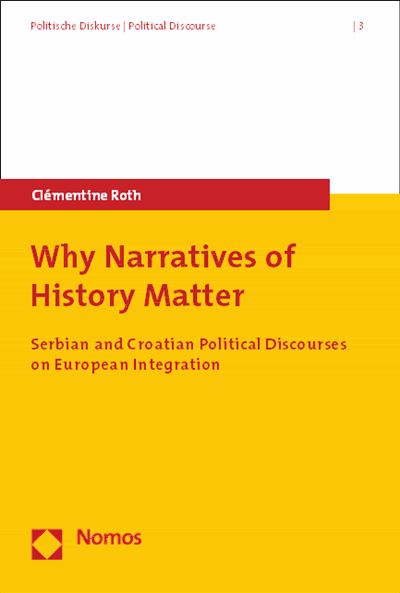
Why Narratives of History Matter
Serbian and Croatian Political Discourses on European Integration- Autor:innen:
- Reihe:
- Diskursforschung / Discourse Analysis, Band 3
- Verlag:
- 2018
Zusammenfassung
Anhand einer komparativen Analyse von Serbien und Kroatien untersucht dieses Buch die Rolle von Narrativen im Integrationsprozess von EU-Beitrittskandidaten. Für die Analyse der Struktur und der politischen Verwendung von Narrativen entwickelt dieses Buch ein innovatives theoretisches Modell, welches die Konzepte von Narrativen und Topoi kombiniert und eine tiefergehende und detailliertere Analyse ermöglicht. Darüber hinaus ist das Modell auch auf andere Fragestellungen übertragbar. Narrative können dazu benutzt werden, neue politische Optionen zu schaffen, oder bis dato bestehende Optionen unmöglich werden zu lassen.
Der empirische Teil der Untersuchung basiert hauptsächlich auf einer Diskursanalyse politischer Dokumente, wie Parlamentsdebatten über den EU-Integrationsprozess, politischen Reden sowie persönlichen Interviews mit Experten. Die Autorin hat in Politikwissenschaft an der BIGSSS promoviert und arbeitet mittlerweile als Projektleiterin für das Steinbeis-Europa-Zentrum in Karlsruhe.
Publikation durchsuchen
Bibliographische Angaben
- Auflage
- 1/2018
- Copyrightjahr
- 2018
- ISBN-Print
- 978-3-8487-4996-6
- ISBN-Online
- 978-3-8452-9100-0
- Verlag
- Nomos, Baden-Baden
- Reihe
- Diskursforschung / Discourse Analysis
- Band
- 3
- Sprache
- Englisch
- Seiten
- 372
- Produkttyp
- Monographie
Inhaltsverzeichnis
- Titelei/Inhaltsverzeichnis Kein Zugriff Seiten 1 - 24
- Context and research question Kein Zugriff
- The argument Kein Zugriff
- Case selection, methods and data Kein Zugriff
- Outline of the book Kein Zugriff
- 1.1. Literature on EU enlargement Kein Zugriff
- 1.2. Social memory studies Kein Zugriff
- 1.3. Narratives in political sciences Kein Zugriff
- 2.1. Narratives Kein Zugriff
- 2.2. Topoi Kein Zugriff
- 2.3. Bringing narratives and topoi together Kein Zugriff
- 2.4. Who is speaking…? The political actors behind the narratives Kein Zugriff
- 2.5. Battle of narratives: Competing over meaning Kein Zugriff
- 3.1. Research design Kein Zugriff
- 3.2.1. Discourse analysis Kein Zugriff
- 3.2.2. Document analysis Kein Zugriff
- 3.2.3. Interviews with experts Kein Zugriff
- 3.3.1. Coding the data and drawing patterns of meaning Kein Zugriff
- 3.3.2. Metaphors and analogies Kein Zugriff
- 3.3.3. Linguistic issues Kein Zugriff
- 4.1.1 Conditionality: Clarifying who can join the EU and how Kein Zugriff
- 4.1.2 Integration policy: The power of the EU Kein Zugriff
- 4.2.1 Western Balkans: A political term Kein Zugriff
- 4.2.2 The Stabilization and Association Process Kein Zugriff
- 4.3 Croatia’s EU and Euro-Atlantic integration: A desired package Kein Zugriff
- 4.4 Serbia’s integration process: EU yes, NATO no Kein Zugriff
- 4.5 Conclusion Kein Zugriff
- 5.1. Croatian political system and parties Kein Zugriff
- 5.2.1. Croatian governments between 2000 and 2015 Kein Zugriff
- 5.2.2. Croatia’s foreign policy: Clear and unidirectional Kein Zugriff
- 5.2.3. The major bumps on the EU road were of political nature Kein Zugriff
- 5.3.1. Declining popular support and increasing Euroscepticism Kein Zugriff
- 5.3.2. European identification means distancing the Balkans Kein Zugriff
- 5.4. Conclusion Kein Zugriff
- 6.1. Serbian political system and parties Kein Zugriff
- 6.2.1. Serbian cabinets between 2000 and 2018 Kein Zugriff
- 6.2.2. Serbia’s foreign policy: Blurry, contrasting and bidirectional Kein Zugriff
- 6.2.3. Major issues blocking Serbia’s road to the EU Kein Zugriff
- 6.3.1. Pragmatic support of Serbian citizens toward EU integration Kein Zugriff
- 6.3.2. Europeanization Kein Zugriff
- 6.4. Conclusion Kein Zugriff
- 7.1.1. Croatia Kein Zugriff
- 7.1.2. Serbia Kein Zugriff
- 7.1.1. Croatia Kein Zugriff
- 7.1.1. Serbia Kein Zugriff
- 7.3.1. Croatia Kein Zugriff
- 7.3.2. Serbia Kein Zugriff
- 7.4. The influence of political culture on debates and narratives Kein Zugriff
- 7.5. Conclusion Kein Zugriff
- 8.1.1. Once upon a time, Croatia became part of the Western civilization Kein Zugriff
- 8.1.2. Croatian quest: Returning home Kein Zugriff
- 8.1.3. Epilogue Kein Zugriff
- 8.2.1. Serbia at the edge of European civilization Kein Zugriff
- 8.2.2. Serbian quest: (Why) join this Europe? Kein Zugriff
- 8.2.3. Epilogue Kein Zugriff
- 8.3. Confronting the findings Kein Zugriff
- 9.1. Croatia: Seeking shelter in the EU Kein Zugriff
- 9.2.1. EU-critical narrative: Resisting the European empire Kein Zugriff
- 9.2.2. Pro-EU narrative: Joining modernity Kein Zugriff
- 9.3. The EU and Serbia’s territorial uncertainty Kein Zugriff
- 9.4. Confronting the findings Kein Zugriff
- 10.1.1. The Homeland War and cooperation with the ICTY Kein Zugriff
- 10.1.2. Regional integration Kein Zugriff
- 10.1.3. EU conditionality Kein Zugriff
- 10.2.1. EU conditionality Kein Zugriff
- 10.2.2. Kosovo Kein Zugriff
- 10.2.3. Cooperation with the ICTY Kein Zugriff
- 10.2.4. NATO membership Kein Zugriff
- 10.3. Confronting the findings Kein Zugriff
- Synthesis of findings Kein Zugriff
- Generalizability of findings Kein Zugriff
- Appendix 1: My narrative model compared to Greimas’ actantial model Kein Zugriff Seiten 333 - 334
- Appendix 2: Selected history textbooks from Croatia and Serbia Kein Zugriff Seiten 335 - 336
- Appendix 3: List of interviewees Kein Zugriff Seiten 337 - 338
- Appendix 4: Coding scheme and coding strategy Kein Zugriff Seiten 339 - 348
- Bibliography Kein Zugriff Seiten 349 - 372
Literaturverzeichnis (430 Einträge)
Es wurden keine Treffer gefunden. Versuchen Sie einen anderen Begriff.
- Adler, E. (2002). Constructivism and International Relations. In W. Carlsnaes, T. Risse & B. Simmons A. (Eds.), Handbook of International Relations (pp. 95-118). London, Thousand Oaks, New Dehli: SAGE Publications. Google Scholar öffnen DOI: 10.5771/9783845291000
- Agence France Presse. (March 9, 2016). Slovenia and Croatia ban transit of refugees to other European countries. The Guardian; Google Scholar öffnen DOI: 10.5771/9783845291000
- Allcock, J. B. (2000). Explaining Yugoslavia. London: Hurst & Company. Google Scholar öffnen DOI: 10.5771/9783845291000
- Anastasakis, O., & Bojicic-Dzelilovic, V. (2002). Balkan regional cooperation and European integration. The Hellenic Observatory – LSE. Google Scholar öffnen DOI: 10.5771/9783845291000
- Anckar, C. (2008). On the applicability of the most similar systems design and the most different systems design in comparative research. International Journal of Social Research Methodology, 11(5), 389-401. Google Scholar öffnen DOI: 10.5771/9783845291000
- Anderson, B. (2006). Imagined communities: Reflections on the origin and spread of nationalism. London [u.a.]: Verso. Google Scholar öffnen DOI: 10.5771/9783845291000
- Andrews, M., Squire, C., & Tamboukou, M. (2008). Doing narrative research. London [u.a.]: Sage. Google Scholar öffnen DOI: 10.5771/9783845291000
- Arat-Koç, S. (June 2010). Contesting or affirming ‛Europe’? European enlargement, aspirations for ‛Europeanness’ and new identities in the margins of Europe. Journal of Contemporary European Studies, 18(2), 181-191. Google Scholar öffnen DOI: 10.5771/9783845291000
- Assmann, J., & Czaplicka, J. (1995). Collective memory and cultural identity. New German Critique, (65), 125-133. Google Scholar öffnen DOI: 10.5771/9783845291000
- Austin, J. L., Urmson, J. O., & Sbisà, M. (Eds.). (1976). How to do things with words: The William James lectures delivered at Harvard University in 1955 (Second edition). London, Oxford, New York: Oxford University Press. Google Scholar öffnen DOI: 10.5771/9783845291000
- Azaryahu, M. (2011). The critical turn and beyond: The case of commemorative street naming. ACME: An International E-Journal for Critical Geographies, 10(1), 28-33. Google Scholar öffnen DOI: 10.5771/9783845291000
- B92. (November 12, 2014). Serbia now has 100 registered political parties. B92. Google Scholar öffnen DOI: 10.5771/9783845291000
- B92. (March 2, 2016). EU accession ‟closely linked to normalization with Kosovo”. B92. Google Scholar öffnen DOI: 10.5771/9783845291000
- Bakhtin, M. M. (1986). The problem of speech genres, 1952-53. In C. Emerson, & M. Holquist (Eds.), Speech genres and other late essays (pp. 60-102). Austin: University of Texas Press. Google Scholar öffnen DOI: 10.5771/9783845291000
- Bakić-Hayden, M. (Winter 1995). Nesting orientalism: The case of former Yugoslavia. Slavic Review, 54(4), 917-931. Google Scholar öffnen DOI: 10.5771/9783845291000
- Bakić-Hayden, M., & Hayden, R.,M. (Spring 1992). Orientalist variations on the theme ‟Balkans”: Symbolic geography in recent Yugoslav cultural politics. Slavic Review, 51(1), 1-15. Google Scholar öffnen DOI: 10.5771/9783845291000
- Bandović, I., & Vujačić, M. (2014). The European question in Serbia’s party politics. In C. Stratulat (Ed.), EU integration and party politics in the Balkans (EPC Issue Paper n°77, pp. 47-67) European Policy Centre. Google Scholar öffnen DOI: 10.5771/9783845291000
- Banjeglav, T. (2012). Conflicting memories, competing narratives and contested histories in Croatia’s post-war commemorative practices. Politička Misao, 49(5), 7-31. Google Scholar öffnen DOI: 10.5771/9783845291000
- Barahona de Brito, A., Gonzaléz-Enríquez, C., & Aguilar, P. (Eds.). (2001). The politics of memory: Transitional justice in democratizing societies. Oxford: Oxford University Press. Google Scholar öffnen DOI: 10.5771/9783845291000
- Barbé, E., Herranz-Surrallés, A., & Natorski, M. (2015). Contending metaphors of the European Union as a global actor: Norms and power in the European discourse on multilateralism. Journal of Language and Politics, 14(1), 18-40. Google Scholar öffnen DOI: 10.5771/9783845291000
- Barlovac, B. (2010). Poll: Serbia support for joining EU, NATO declines. Retrieved from www.balkaninsight.com/en/article/poll-serbia-support-for-joining-eu-nato-declines. Google Scholar öffnen DOI: 10.5771/9783845291000
- Bartlett, W. (2003). Croatia: Between Europe and the Balkans. London & New York: Routledge. Google Scholar öffnen DOI: 10.5771/9783845291000
- Bartolini, S. (1993). On time and comparative research. Journal of Theoretical Politics, 5(2), 131-167. Google Scholar öffnen DOI: 10.5771/9783845291000
- Batt, J., & Obradovic-Wochnik, J. (2009). In Dimitrijević V., Hartmann F., Jović D. and Memišević T. (Eds.), War crimes, conditionality and EU integration in the Western Balkans. Paris: European Union Institute for Security Studies. Google Scholar öffnen DOI: 10.5771/9783845291000
- Bayer, J. (2005). EU accession and Hungarian politics. In A. Skuhra (Ed.), The Eastern enlargement of the European Union: Efforts and obstacles on the way to membership (pp. 53-74). Google Scholar öffnen DOI: 10.5771/9783845291000
- Beauchamp, Z. (September 18, 2015). Why is Hungary so awful to refugees. Vox. Google Scholar öffnen DOI: 10.5771/9783845291000
- Beaumont, P. (09.03.2008). Serbia in crisis as PM quits over Kosovo. The Guardian. Google Scholar öffnen DOI: 10.5771/9783845291000
- Bebić, L. (7-10.10.2011). Govor predsjednika hrvatskoga Sabora Luke Bebića na sastanku parlamentarne skupštine organizacije za europsku sigurnost i suradnju s temom ‟regionalni razvoj u jugoistočnoj europi: Izazovi, mogućnosti i perspektive”, dubrovnik. Google Scholar öffnen DOI: 10.5771/9783845291000
- Bellamy, A.,J. (2003). The formation of Croatian national identity: A centuries-old dream? Manchester & New York: Manchester University Press. Google Scholar öffnen DOI: 10.5771/9783845291000
- Benford, R. D., & Snow, D. A. (2000). Framing processes and social movements: An overview and assessment. Annual Review of Sociology, 26, 611-639. Google Scholar öffnen DOI: 10.5771/9783845291000
- Berezina, M., & Díez Medrano, J. (2008). Distance matters: Place, political legitimacy and popular support for European integration. Comparative European Politics, 6, 1-32. Google Scholar öffnen DOI: 10.5771/9783845291000
- Berg, B. L. (2009). Qualitative research methods for the social sciences. Boston [u.a.]: Allyn & Bacon. Google Scholar öffnen DOI: 10.5771/9783845291000
- Berger, P. L., & Luckmann, T. (1967). The social construction of reality : A Treatise in the Sociology of Knowledge. London: Penguin Press. Google Scholar öffnen DOI: 10.5771/9783845291000
- Beširević, N. (2015). Contextual and institutional characteristics of Croatian accession to the European Union. In P. Maldini, & D. Pauković (Eds.), Croatia and the European Union: Changes and development (Southeast European Studies, pp. 139-157). London & New York: Routledge. Google Scholar öffnen DOI: 10.5771/9783845291000
- Biegoń, D. (2014). Narrative der Marktlegitimation: Eine Erfolgsgeschichte? In F. Nullmeier, D. Biegoń, J. Gronau, S. Haunss, F. Lenke, H. Schmidtke & S. Schneider (Eds.), Marktwirtschaft in der Legitimationskrise? Ein internationaler Vergleich (pp. 171-196) Campus. Google Scholar öffnen DOI: 10.5771/9783845291000
- Biegoń, D., & Nullmayer, F. (2014). Narrationen über Narrationen. Stellenwert und Methodologie der Narrationsanalyse. In F. Gadinger, S. Jarzebski & T. Yildiz (Eds.), Politische Narrative: Konzepte – Analysen – Forschungspraxis (pp. 39-66). Wiesbaden: Springer VS. Google Scholar öffnen DOI: 10.5771/9783845291000
- Blanuša, N. (2011). Euroskepticizam u Hrvatskoj. In I. Šiber (Ed.), Hrvatska i Europa: Strahovi i Nade [Croatia and Europe: Fears and Hopes]. (Faculty of Political Sciences, pp. 11-46). Zagreb. Google Scholar öffnen DOI: 10.5771/9783845291000
- Blanuša, N. (2013). Internal memory divided: Conspiratorial thinking, ideological and historical cleavages in Croatia. Lessons for Europe. European Quarterly of Political Attitudes and Mentalities – EQPAM, 2(4), 16-33. Google Scholar öffnen DOI: 10.5771/9783845291000
- Blanuša, N. (2014). Political unconscious of Croatia and the EU: Tracing the Yugoslav syndrome through Fredric Jameson’s lenses. Journal of Balkan and Near Eastern Studies, 16(2), 196-222. Google Scholar öffnen DOI: 10.5771/9783845291000
- Blanuša, N. (2015). Croatia between the ‟return” to Europe and the ‟remaining” in the Balkans. In P. Maldini, & D. Pauković (Eds.), Croatia and the European Union: Changes and development (Southeast European Studies, pp. 69-92). London & New York: Routledge. Google Scholar öffnen DOI: 10.5771/9783845291000
- Bliesemann de Guevara, B. (Ed.). (2016). Myth and narrative in international politics: Interpretive approaches to the study of IR. London: Palgrave Macmillan. Google Scholar öffnen DOI: 10.5771/9783845291000
- Blumer, H. (1969). Symbolic interactionism: Perspective and method. Englewood Cliffs, NJ: Prentice-Hall. Google Scholar öffnen DOI: 10.5771/9783845291000
- Bochsler, D. (2010). Political parties in Serbia. In V. Stojarová, & P. Emerson (Eds.), Party politics in the Western Balkans (pp. 99-118). London: Routledge. Google Scholar öffnen DOI: 10.5771/9783845291000
- Bogner, A., Littig, B., Menz, W., & Kittel, B. (2009). Interviewing experts. Houndmills [u.a.]: Palgrave Macmillan. Google Scholar öffnen DOI: 10.5771/9783845291000
- Bowen, G. A. (2009). Document analysis as a qualitative research method. Qualitative Research Journal, 9(2), 27-40. Google Scholar öffnen DOI: 10.5771/9783845291000
- Braudel, F. (Ed.). (1988). La Méditerranée. Paris: Arts et Métiers Graphiques. Google Scholar öffnen DOI: 10.5771/9783845291000
- Brubaker, R., & Cooper, F. (2000). Beyond “identity”. Theory and Society, 29, 1-47. Google Scholar öffnen DOI: 10.5771/9783845291000
- Bruner, J. (Ed.). (1990). Acts of meaning. Cambridge, London: Harvard University Press. Google Scholar öffnen DOI: 10.5771/9783845291000
- Bruner, J. (1991). The narrative construction of reality. Critical Inquiry, 18(1), 1-21. Google Scholar öffnen DOI: 10.5771/9783845291000
- Bucher, B. (2014). Acting abstractions: Metaphors, narrative structures, and the eclipse of agency. European Journal of International Relations, 20(3), 742-765. Google Scholar öffnen DOI: 10.5771/9783845291000
- Burke, P. (1997). Varieties of cultural history. Cambridge: Polity Press [u.a.]. Google Scholar öffnen DOI: 10.5771/9783845291000
- Byford, J. (2011). The collaborationist administration and the treatment of the Jews in nazi-occupied Serbia. In S. P. Ramet, & O. Listhaug (Eds.), Serbia and the Serbs in World War Two (pp. 109-127). Houndmills and New York: Palgrave Macmillan. Google Scholar öffnen DOI: 10.5771/9783845291000
- Caratan, B. (2009). The European Union, South-Eastern Europe and the Europeanization of Croatia. Politička Misao, 46(5), 171-180. Google Scholar öffnen DOI: 10.5771/9783845291000
- Carey, S. (2002). Undivided loyalties: Is national identity an obstacle to European integration? European Union Politics, 3(4), 387-413. Google Scholar öffnen DOI: 10.5771/9783845291000
- Carta, C. (2014). Use of metaphors and international discourse: The EU as an idiot power, a deceptive Pangloss and a Don Juan in his infancy. Cooperation and Conflict, 49(3), 334-345. Google Scholar öffnen DOI: 10.5771/9783845291000
- Chandler, D. (2007). EU statebuilding: Securing the liberal peace through EU enlargement. Global Society, 21(4), 593-607. Google Scholar öffnen DOI: 10.5771/9783845291000
- Checkel, J. T. (1998). The constructivist turn in international relations theory. World Politics, 50(2), 324-348. Google Scholar öffnen DOI: 10.5771/9783845291000
- Checkel, J. T. (1999). Norms, institutions, and national identity in contemporary Europe. International Studies Quarterly, 43(1), 83-114. Google Scholar öffnen DOI: 10.5771/9783845291000
- Checkel, J. T. (2001). Why comply? Social learning and European identity change. International Organization, 55(03), 553. Google Scholar öffnen DOI: 10.5771/9783845291000
- Checkel, J. T., & Moravcsik, A. (2001). A constructivist research program in EU studies? European Union Politics, 2(2), 219-249. Google Scholar öffnen DOI: 10.5771/9783845291000
- Closa, C., & Maatsch, A. (2014). In a spirit of solidarity? Justifying the European Financial Stability Facility (EFSF) in national parliamentary debates. JCMS: Journal of Common Market Studies, 52(4), 826-842. Google Scholar öffnen DOI: 10.5771/9783845291000
- Čolović, I. (2002). In Hurst & Company (Ed.), The politics of symbol in Serbia: Essays in political anthropology [Politika Simbola] (C. Hawkesworth Trans.). London. Google Scholar öffnen DOI: 10.5771/9783845291000
- Connerton, P. (1989). How societies remember. Cambridge [u.a.]: Cambridge University Press. Google Scholar öffnen DOI: 10.5771/9783845291000
- Cottey, A., & Averre, D. (2002). Introduction: Thinking about Security in Postcommunist Europe. In A. Cottey, & D. Averre (Eds.), New security challenges in Postcommunist Europe: Securing Europe’s East (pp. 1-25). Manchester & New York: Manchester University Press. Google Scholar öffnen DOI: 10.5771/9783845291000
- Creswell, J. W. (2014). Research design; qualitative, quantitative and mixed method approaches (4th edition). Los Angeles, London, New Dehli, Singapore, Washington DC: SAGE. Google Scholar öffnen DOI: 10.5771/9783845291000
- Crnobrnja, M., & Trbovich, A. S. (Eds.). (2008). Relations between Serbia and the European Union: History and prospects. Belgrade: Faculty of Economics, Finance and Administration. Google Scholar öffnen DOI: 10.5771/9783845291000
- Croatia Airlines. (Winter 2017/2018). Croatia – inflight magazine. Google Scholar öffnen DOI: 10.5771/9783845291000
- Crotty, M. (2009). The foundations of social research: Meaning and perspective in the research process (2nd edition). London, California, New Dehli, Singapore: SAGE. Google Scholar öffnen DOI: 10.5771/9783845291000
- Cruz, C. (2000). Identity and persuasion: How nations remember their pasts and make their futures. World Politics, 52(03), 275. Google Scholar öffnen DOI: 10.5771/9783845291000
- Čular, G. (2004). Organisational development of parties and internal party democracy in Croatia. Politička Misao, XLI(5), 28-51. Google Scholar öffnen DOI: 10.5771/9783845291000
- Čulić, M. (2016). Sukob na desnici. Retrieved from www.h-alter.org/vijesti/sukob-na-desnici. Google Scholar öffnen DOI: 10.5771/9783845291000
- Curtius, E. R. (2013 [1953]). European Literature and the Latin Middle Ages. Princeton, New Jersey: Princeton University Press. Google Scholar öffnen DOI: 10.5771/9783845291000
- Cvijic, S. (2008). ‟Blocked political system”: Serbia 2000-2008. Balkanologie, XI(1-2), 2-19. Google Scholar öffnen DOI: 10.5771/9783845291000
- Dakowska, D., & Neumayer, L. (2008). Élargissement. In C. Belot, P. Magnette & S. Saurugger (Eds.), Science politique de l’Union européenne (pp. 355-374). Paris: Economica. Google Scholar öffnen DOI: 10.5771/9783845291000
- Dakowska, D., & Rowell, J. (2011). Temporality and historical experience in attitudes towards Europe: Is there a nationality effect? In N. Hubé, J. Rowell & D. Gaxie (Eds.), Perceptions of Europe: A comparative sociology of European attitudes (pp. 101-117). Colchester: ECPR Press. Google Scholar öffnen DOI: 10.5771/9783845291000
- Dayre, J., Deanović, M., & Maixner, R. (1996). Dictionnaire croate français – hrvatsko-francuski rječnik (Nediljko Dominović ed.). Zagreb. Google Scholar öffnen DOI: 10.5771/9783845291000
- Delevic, M. (2007). Regional cooperation in the Western Balkans. Paris: European Union Institute for Security Studies. Google Scholar öffnen DOI: 10.5771/9783845291000
- Della Porta, D. (2012). Comparative analysis: Case-oriented versus variable-oriented research. In D. Della Porta, & M. Keating (Eds.), Approaches and methodologies in the social sciences: A pluralist perspective (pp. 198-222). Cambridge: Cambridge University Press. Google Scholar öffnen DOI: 10.5771/9783845291000
- Demokratska opozicija Srbije. (2000). Program za demokratsku Srbiju. Google Scholar öffnen DOI: 10.5771/9783845291000
- Dérens, J., & Geslin, L. (2010). Comprendre les Balkans: Histoire, société, perspective (second edition). Paris: non-lieu. Google Scholar öffnen DOI: 10.5771/9783845291000
- Díez Medrano, J. (2003). Framing Europe: Attitudes to European integration in Germany, Spain, and the United Kingdom. Princeton, NJ [u.a.]: Princeton University Press. Google Scholar öffnen DOI: 10.5771/9783845291000
- Diez, T. (1999). Speaking ‛Europe’: The politics of integration discourse. Journal of European Public Policy, 6(4), 598-613. Google Scholar öffnen DOI: 10.5771/9783845291000
- Diez, T. (2004). Europe’s others and the return of geopolitics. Cambridge Review of International Affairs, 17(2), 319-335. Google Scholar öffnen DOI: 10.5771/9783845291000
- Dimitrijević, V. (2009). The concept of national interest and the international position of Serbia. In D. Vujadinović, & V. Goati (Eds.), Between authoritarianism and democracy: Serbia at the political crossroads (vol. III, pp. 31-47). Belgrade: Friedrich Ebert Stiftung & Center for Democratic Transition. Google Scholar öffnen DOI: 10.5771/9783845291000
- Dimou, A. (Ed.). (2009). ‟Transition” and the politics of history education in Southeast Europe. Göttingen: V & R Unipress. Google Scholar öffnen DOI: 10.5771/9783845291000
- Dosse, F. (1998). Entre histoire et mémoire: Une histoire sociale de la mémoire. Raison Présente, 4ème trimestre (septembre) (128), 5-24. Google Scholar öffnen DOI: 10.5771/9783845291000
- Dragović-Soso, J. (2002). Saviours of the nation: Serbia’s intellectual opposition and the revival of nationalism. London: Hurst. Google Scholar öffnen DOI: 10.5771/9783845291000
- Drulák, P. (2006). Motion, container and equilibrium: Metaphors in the discourse about European integration. European Journal of International Relations, 12(4), 499-531. Google Scholar öffnen DOI: 10.5771/9783845291000
- Dryzek, J. S., & Niemeyer, S. (2008). Discursive representation. The American Political Science Review, 102(4), 481-493. Google Scholar öffnen DOI: 10.5771/9783845291000
- Duby, G. (1973). Le dimanche de Bouvines: 27 juillet 1214. S.l.: Gallimard. Google Scholar öffnen DOI: 10.5771/9783845291000
- Dupuch, S., Jennequin, H., & Milan, C. (Janvier 2002). Union européenne: Quelles conséquences économiques et sociales de l’élargissement de l’UE aux pays d’Europe de l’Est? Google Scholar öffnen DOI: 10.5771/9783845291000
- Đurašković, S. (2016). National identity-building and the ‟Ustaša-Nostalgia” in Croatia: The past that will not pass. Nationalities Papers: The Journal of Nationalism and Ethnicity, 1-17. Google Scholar öffnen DOI: 10.5771/9783845291000
- Dutceac Segesten, A. (2010). Europe at the margins: How Europe appears in history textbooks from Serbia and Romania. United in Visual Diversity / Benjamin Drechsel; Claus Leggewie (Eds.), 131-142. Google Scholar öffnen DOI: 10.5771/9783845291000
- Dutceac Segesten, A. (2011). Myth, identity and conflict: A comparative analysis of Romanian and Serbian textbooks. Lexington Books. Google Scholar öffnen DOI: 10.5771/9783845291000
- Elster, J. (2007). Explaining social behavior: More nuts and bolts for the social sciences. Cambridge [u.a.]: Cambridge University Press. Google Scholar öffnen DOI: 10.5771/9783845291000
- Emerson, M., Aydin, S., De Clerck-Sachsse, J., & Noutcheva, G. (September 2006). Just what is this ‛absorption capacity’ of the European Union? Google Scholar öffnen DOI: 10.5771/9783845291000
- Entman, R. M. (1993). Framing: Toward clarification of a fractured paradigm. Journal of Communication, 43(4), 51-58. Google Scholar öffnen DOI: 10.5771/9783845291000
- Epstein, R. A. (2008). The social context in conditionality: Internationalizing finance in Postcommunist Europe. Journal of European Public Policy, 15(6), 880-898. Google Scholar öffnen DOI: 10.5771/9783845291000
- Epstein, R. A., & Sedelmeier, U. (2008). Beyond conditionality: International institutions in Post-Communist Europe after Enlargement. Journal of European Public Policy, 15(6), 795-805. Google Scholar öffnen DOI: 10.5771/9783845291000
- European Commission. (2000). Zagreb Summit 24 November 2000: Final Declaration. Google Scholar öffnen DOI: 10.5771/9783845291000
- European Commission. (Autumn 2004). Eurobarometer 62 – javno mnijenje u Europskoj uniji – nacionalni izvještaj – Republika Hrvatska Google Scholar öffnen DOI: 10.5771/9783845291000
- European Commission. (2005). The Stabilisation and Association Agreement with Croatia enters into force today. Google Scholar öffnen DOI: 10.5771/9783845291000
- European Commission. (Autumn 2006). Eurobarometer 66 – javno mnijenje u Europskoj uniji – nacionalni izvještaj – Hrvatska. Google Scholar öffnen DOI: 10.5771/9783845291000
- European Commission. (Autumn 2010). Eurobarometer 74 – javno mnijenje u Europskoj uniji – nacionalni izvještaj – Hrvatska. Google Scholar öffnen DOI: 10.5771/9783845291000
- European Commission. (Spring 2013). Standard Eurobarometer 79 – Public pinion in the European Union – report Google Scholar öffnen DOI: 10.5771/9783845291000
- European Commission. (Spring 2015). Standard Eurobarometer 83 – the key indicators – the Republic of Serbia. Google Scholar öffnen DOI: 10.5771/9783845291000
- European Commission. (Autumn 2015). Standard Eurobarometer 84 – the key indicators – the Republic of Serbia. Google Scholar öffnen DOI: 10.5771/9783845291000
- European Commission. (Spring 2016). Standard Eurobarometer 85 – the key indicators – the Republic of Serbia. Google Scholar öffnen DOI: 10.5771/9783845291000
- European Commission. (2016a). European Commission – Enlargement – Acquis. Retrieved from http://ec.europa.eu/neighbourhood-enlargement/policy/glossary/terms/acquis_en. Google Scholar öffnen DOI: 10.5771/9783845291000
- European Commission. (2016b). European neighbourhood policy and enlargement negotiations – Croatia. Retrieved from http://ec.europa.eu/neighbourhood-enlargement/countries/detailed-country-information/croatia_en. Google Scholar öffnen DOI: 10.5771/9783845291000
- European Commission. (2016c). European Neighbourhood Policy and Enlargement Negotiations – the former Yugoslav Republic of Macedonia. Retrieved from http://ec.europa.eu/neighbourhood-enlargement/countries/detailed-country-information/former-yugoslav-republic-of-macedonia_en. Google Scholar öffnen DOI: 10.5771/9783845291000
- European Commission. (January 2017). Serbia: Response to the refugee crisis. Google Scholar öffnen DOI: 10.5771/9783845291000
- European Commission. (Spring 2017). Standard Eurobarometer 87 – the key indicators – the Republic of Serbia. Google Scholar öffnen DOI: 10.5771/9783845291000
- European Commission. (Autumn 2017a). Standard Eurobarometer 88 – the key indicators – the Republic of Serbia. Google Scholar öffnen DOI: 10.5771/9783845291000
- European Commission. (Autumn 2017b). Standardni Eurobarometar 88 – javno mnijenje u Europskoj uniji – nacionalni izvještaj – Hrvatska. Google Scholar öffnen DOI: 10.5771/9783845291000
- European Commission. (2018). A credible enlargement perspective for and enhanced EU engagement with the Western Balkans. Strasbourg. Google Scholar öffnen DOI: 10.5771/9783845291000
- European Council. (June 1993). European Council in Copenhagen 21-22 June 1993: Conclusions of the Presidency. Google Scholar öffnen DOI: 10.5771/9783845291000
- European Council. (June 1999). Cologne European Council – 3-4 June 1999: Conclusions of the Presidency. Google Scholar öffnen DOI: 10.5771/9783845291000
- European Council. (December 1999). Helsinki European Council 10-11 December 1999: Presidency conclusions. Google Scholar öffnen DOI: 10.5771/9783845291000
- European Council. (June 2003a). EU – Western Balkans Summit, ‟Declaration”. Thessaloniki: European Council. Google Scholar öffnen DOI: 10.5771/9783845291000
- European Council. (June 2003b). The Thessaloniki Agenda for the Western Balkans – moving towards European integration. Google Scholar öffnen DOI: 10.5771/9783845291000
- European Parliament. (2003). The European Parliament in the Enlargement process – an overview. Retrieved from www.europarl.europa.eu/enlargement_new/positionep/ep_role_en.htm. Google Scholar öffnen DOI: 10.5771/9783845291000
- European Stability Initiative. (16.09.2015). Teaching war: How Croatian schoolbooks changed and why it matters. Berlin-Zagreb-Vienna. Google Scholar öffnen DOI: 10.5771/9783845291000
- European Union. (February 7, 1992). Treaty on European Union (consolidated version), Treaty of Maastricht. Google Scholar öffnen DOI: 10.5771/9783845291000
- European Union. (March 25, 1957). Treaty establishing the European Economic Community (consolidated version), Treaty of Rome. Google Scholar öffnen DOI: 10.5771/9783845291000
- Ewick, P., & Silbey, S.,S. (1995). Subversive stories and hegemonic tales: Toward a sociology of narrative. Law and Society Review, 29(2), 197-226. Google Scholar öffnen DOI: 10.5771/9783845291000
- Fierke, K. M. (2002). Links across the abyss: Language and logic in international relations. International Studies Quarterly, 46(3), 331-354. Google Scholar öffnen DOI: 10.5771/9783845291000
- Filep, B. (2009). Interview and translation strategies: Coping with multilingual settings and data. Social Geography, Special Issue(4), 59-70. Google Scholar öffnen DOI: 10.5771/9783845291000
- Fink-Hafner, D. (2008). Europeanization and party system mechanics: Comparing Croatia, Serbia and Montenegro. Journal of Southern Europe and the Balkans Online, 10(2), 167-181. Google Scholar öffnen DOI: 10.5771/9783845291000
- Finnemore, M. (1996). Norms, culture, and world politics: Insights from sociology’s institutionalism. International Organization, 50(2), 325-347. Google Scholar öffnen DOI: 10.5771/9783845291000
- Finnemore, M., & Sikkink, K. (1998). International norm dynamics and political change. International Organization, 52(4), 887-917. Google Scholar öffnen DOI: 10.5771/9783845291000
- Finnemore, M., & Sikkink, K. (2001). Taking stock: The constructivist research program in international relations and comparative politics. Annual Review of Political Science, 4, 391-416. Google Scholar öffnen DOI: 10.5771/9783845291000
- Fisher, W. R. (1984). Narration as a human communication paradigm: The case of public moral argument. Communication Monographs, 51(1), 1-22. Google Scholar öffnen DOI: 10.5771/9783845291000
- Flick, U. (2011). Qualitative Sozialforschung: Eine Einführung. Reinbek bei Hamburg: Rowohlt-Taschenbuch-Verlag. Google Scholar öffnen DOI: 10.5771/9783845291000
- Flood, C. (2002). Political myth: A theoretical introduction. New York, London: Routledge. Google Scholar öffnen DOI: 10.5771/9783845291000
- Foucault, M. (1975). Surveiller et punir: Naissance de la prison. Paris: Gallimard. Google Scholar öffnen DOI: 10.5771/9783845291000
- Foucault, M. (1976). Histoire de la sexualité. 1, la volonté de savoir. Paris: Gallimard. Google Scholar öffnen DOI: 10.5771/9783845291000
- Freyburg, T., & Richter, S. (2010). National identity matters: The limited impact of EU political conditionality in the Western Balkans. Journal of European Public Policy, 17(2), 263-281. Google Scholar öffnen DOI: 10.5771/9783845291000
- Fridman, O. (2015). Alternative calendars and memory work in Serbia: Anti-war activism after Milošević. Memory Studies, 8(2), 212-226. Google Scholar öffnen DOI: 10.5771/9783845291000
- Fridman, O., & Rácz, K. (2016). Memories and narratives of the 1999 NATO bombings in Serbia. Südosteuropa: Journal of Politics and Society, 64(4), 433-437. Google Scholar öffnen DOI: 10.5771/9783845291000
- G17 Plus. (March 2004). Program G17 plus. Belgrade. Google Scholar öffnen DOI: 10.5771/9783845291000
- Gadinger, F., Jarzebski, S., & Yildiz, T. (Eds.). (2014a). Politische Narrative: Konzepte – Analysen – Forschungspraxis. Wiesbaden: Springer VS. Google Scholar öffnen DOI: 10.5771/9783845291000
- Gadinger, F., Jarzebski, S., & Yildiz, T. (2014b). Politische Narrative. Konturen einer politikwissenschaftlichen Erzähltheorie. In F. Gadinger, S. Jarzebski & T. Yildiz (Eds.), Politische Narrative: Konzepte – Analysen – Forschungspraxis (pp. 3-38). Wiebaden: Springer VS. Google Scholar öffnen DOI: 10.5771/9783845291000
- Gamson, W. A. (1992). Talking politics. Cambridge [u.a.]: Cambridge University Press. Google Scholar öffnen DOI: 10.5771/9783845291000
- Garde, P. (2010). Les Balkans: Héritages et évolutions. Paris: Flammarion. Google Scholar öffnen DOI: 10.5771/9783845291000
- Gattig, A., & Maatsch, S. (2008). Technical coding guidelines for comparative print media/text analysis using ATLAS.ti computer software. (RECON WP No. 26). Google Scholar öffnen DOI: 10.5771/9783845291000
- Gavrilović, D. (2010). Myths about borders and the reconciliation moment. Suvremene Teme, 3(1), 63-73. Google Scholar öffnen DOI: 10.5771/9783845291000
- Geertz, C. (1973). The interpretation of cultures: Selected essays (Basic Books edition). New York: Library of Congress. Google Scholar öffnen DOI: 10.5771/9783845291000
- General Secretariat of the Council. (2018). EU enlargement. Retrieved from www.consilium.europa.eu/en/policies/enlargement/. Google Scholar öffnen DOI: 10.5771/9783845291000
- Giddens, A. (1984). The constitution of society: Outline of the theory of structuration. Polity Press. Google Scholar öffnen DOI: 10.5771/9783845291000
- Glissant, E., & Dash, J. M. (1999). Caribbean discourse: Selected essays [Le discours antillais] (3. paperback print). Charlottesville: University Press of Virginia. Google Scholar öffnen DOI: 10.5771/9783845291000
- Goati, V. (2009). State interest through the prism of the commitments of ruling parties. In D. Vujadinovic, & V. Goati (Eds.), Between authoritarianism and democracy: Serbia at the political crossroads (pp. 283-302). Belgrade: FES / CEDET. Google Scholar öffnen DOI: 10.5771/9783845291000
- Goffman, E. (1974). Frame analysis: An essay on the organization of experience. Cambridge: Harvard University Press. Google Scholar öffnen DOI: 10.5771/9783845291000
- Goldstein, I. (1999). Croatia: A history. London: Hurst & Company. Google Scholar öffnen DOI: 10.5771/9783845291000
- Grabbe, H. (2001). How does Europeanization affect CEE governance? Conditionality, diffusion and diversity. Journal of European Public Policy, 8(6), 1013-1031. Google Scholar öffnen DOI: 10.5771/9783845291000
- Grabbe, H. (2002). European Union conditionality and the acquis communautaire. International Political Science Review, 23(3), 249-268. Google Scholar öffnen DOI: 10.5771/9783845291000
- Grabbe, H. (2014). Six lessons of Enlargement ten years on: The EU’s transformative power in retrospect and prospect. Journal of Common Market Studies, 52(Annual Review), 40-56. Google Scholar öffnen DOI: 10.5771/9783845291000
- Grabuschnig, R. (2015). Shifting the balance: The effects of wartime Serb migration on multiculturalism in Vojvodina. Der Donauraum, 55(3/4), 147-153. Google Scholar öffnen DOI: 10.5771/9783845291000
- Gravier, M. (2013). Imperial administration: Comparing the Byzantine Empire and the EU. In N. Parker (Ed.), Empire and international order (pp. 41-68). London, New York: Routledge. Google Scholar öffnen DOI: 10.5771/9783845291000
- Greenawalt, A. (2001). Kosovo myths: Karadžić, Njegoš, and the transformation of Serb memory. Spaces of Identity, 1(3), 49-65. Google Scholar öffnen DOI: 10.5771/9783845291000
- Greimas, A. J. (1966). Éléments pour une théorie de l’interprétation du récit mythique. Communications, 8(1), 28-59. Google Scholar öffnen DOI: 10.5771/9783845291000
- Greimas, A. J. (1995). Sémantique structurale: Recherche de méthode. Paris: Presses universitaires de France. Google Scholar öffnen DOI: 10.5771/9783845291000
- Grubiša, D. (2000). The Zagreb Summit and Croatian Foreign Policy. Croatian International Relations Review, 6(20), 17-21. Google Scholar öffnen DOI: 10.5771/9783845291000
- Guillaume, X. (2002). Foreign policy and the politics of alterity: A dialogical understanding of international relations. Millennium: Journal of International Studies, 31(1), 1-26. Google Scholar öffnen DOI: 10.5771/9783845291000
- Hajer, M. A. (1993). Discourse coalitions and the institutionalization of practice: The case of acid rain in Great Britain. In F. Fischer, & J. Forester (Eds.), The argumentative turn in policy analysis and planning. Durham: Duke University Press. Google Scholar öffnen DOI: 10.5771/9783845291000
- Hajer, M. A. (1995). The politics of environmental discourse: Ecological modernization and the policy process. Oxford: Oxford University Press. Google Scholar öffnen DOI: 10.5771/9783845291000
- Hajer, M. A. (2002). Discourse analysis and the study of policy making. European Political Science, 61-65. Google Scholar öffnen DOI: 10.5771/9783845291000
- Halbwachs, M. (1925). Les cadres sociaux de la mémoire. Paris: Librairie Felix Alcan. Google Scholar öffnen DOI: 10.5771/9783845291000
- Hart, J. (1992). Cracking the code: Narrative and political mobilization in the Greek resistance. Social Science History, 16(4), 631-668. Google Scholar öffnen DOI: 10.5771/9783845291000
- Hartmann, F. (2009). The ICTY and EU conditionality. In J. Batt, & J. Obradovic-Wochnik (Eds.), War crimes, conditionality and EU integration in the Western Balkans (pp. 67-82). Paris: European Union Institute for Security Studies. Google Scholar öffnen DOI: 10.5771/9783845291000
- Herschinger, E., & Nonhoff, M. (2014). Diskursforschung in der Politikwissenschaft. In M. Reisigl, J. Wedl, D. Wrana & A. Ziem (Eds.), Diskursforschung ein interdisziplinäres Handbuch. band I: Theorien, Methodologien und Kontroversen (pp. 192-207). Bielefeld: Transcript. Google Scholar öffnen DOI: 10.5771/9783845291000
- Hloušek, V., & Strmiska, M. (Automn 1999). The predominant party system in the Post-Communist Croatia. Some remarks. Central European Political Studies Review, Part I (Volume 1). Google Scholar öffnen DOI: 10.5771/9783845291000
- Hoare, M. A. (2011). The Partisans and the Serbs. In S. P. Ramet, & O. Listhaug (Eds.), Serbia and the Serbs in World War Two (pp. 201-221). Houndmills and New York: Palgrave Macmillan. Google Scholar öffnen DOI: 10.5771/9783845291000
- Hobsbawm, E. J. (1972). The social function of the past: Some questions. Past & Present, (55), 3-17. Google Scholar öffnen DOI: 10.5771/9783845291000
- Hobsbawm, E. J. (2008). The invention of tradition. Cambridge [u.a.]: Cambridge University Press. Google Scholar öffnen DOI: 10.5771/9783845291000
- Hooghe, L. (2003). Europe divided? Elites vs. public opinion on European integration. European Union Politics, 4(3), 281-304. Google Scholar öffnen DOI: 10.5771/9783845291000
- Hooghe, L., & Marks, G. (2004). Does identity or economic rationality drive public opinion on European integration? Political Science and Politics, 37(3), 415-420. Google Scholar öffnen DOI: 10.5771/9783845291000
- Hrvatski Sabor. (04.04.2001). Izvješće o dosadašnjem tijeku pregovora o sporazumu o stabilizaciji i pridruživanju s Europskom unijom i Izvješće o drugom krugu pregovora o sporazumu o stabilizaciji i pridruživanju s europskom unijom. Google Scholar öffnen DOI: 10.5771/9783845291000
- Hrvatski Sabor. (18.12.2002). 1. prijedlog nacionalnog programa republike hrvatske za pridruživanje europskoj uniji – 2003. godina – saziv: IV, sjednica: 27. Google Scholar öffnen DOI: 10.5771/9783845291000
- Hrvatski Sabor. (2014 [1990]). Constitution of the Republic of Croatia [ustav Republike Hrvatske]. Google Scholar öffnen DOI: 10.5771/9783845291000
- Hrvatski Sabor. (2017). About the parliament. Retrieved from www.sabor.hr/Default.aspx?sec=713. Google Scholar öffnen DOI: 10.5771/9783845291000
- Hubé, N., Rowell, J., & Gaxie, D. (2011). Perceptions of Europe: A comparative sociology of European attitudes. Colchester: ECPR Press. Google Scholar öffnen DOI: 10.5771/9783845291000
- Hughes, J., Sasse, G., & Gordon, C. E. (2004). Europeanization and regionalization in the EU’s enlargement to Central and Eastern Europe: The myth of conditionality. Houndmills, Basingstoke, Hampshire [u.a.]: Palgrave Macmillan. Google Scholar öffnen DOI: 10.5771/9783845291000
- Hülsse, R. (2003). Metaphern der EU-Erweiterung als Konstruktionen europäischer Identität. Baden-Baden: Nomos Verlagsgesellschaft. Google Scholar öffnen DOI: 10.5771/9783845291000
- Hülsse, R. (2006). Imagine the EU: The metaphorical construction of a supra-nationalist identity. Journal of International Relations and Development, 9, 396-451. Google Scholar öffnen DOI: 10.5771/9783845291000
- Huntington, S. P. (1996). The Clash of Civilizations and the Remaking of World Order. New York: Touchstone. Google Scholar öffnen DOI: 10.5771/9783845291000
- Huszka, B. (2017). Eurosceptic yet pro-enlargement: The paradoxes of Hungary’s EU policy. Southeast European and Black Sea Studies, 17(4), 591-609. Google Scholar öffnen DOI: 10.5771/9783845291000
- Huyssen, A. (2000). Present pasts: Media, politics, amnesia. Public Culture, 12(1), 21-38. Google Scholar öffnen DOI: 10.5771/9783845291000
- International and Security Affairs Centre. (2011). Conference material: Neutrality in the XXI century: Lessons for Serbia – 1st and 2nd December 2011. Google Scholar öffnen DOI: 10.5771/9783845291000
- International Commission on the Balkans. (April 2005). The Balkans in Europe’s future: Report of the international commission on the Balkans. Sofia: Robert Bosch Stiftung, King Baudouin Foundation, German Marshall Fund of the United States, Charles Stewart Mott Foundation. Google Scholar öffnen DOI: 10.5771/9783845291000
- International Encyclopedia of the Social Sciences. Political culture. Retrieved from www.encyclopedia.com/social-sciences/applied-and-social-sciences-magazines/political-culture-0. Google Scholar öffnen DOI: 10.5771/9783845291000
- Inter-Parliamentary Union. (2016). Croatia – Hrvatski Sabor (croatian parliament) – electoral system. Retrieved from www.ipu.org/parline-e/reports/2077_B.htm Google Scholar öffnen DOI: 10.5771/9783845291000
- IPSOS. (2009). Public perception in Serbia of the ICTY and the national courts dealing with war crimes. Google Scholar öffnen DOI: 10.5771/9783845291000
- Jansen, S. (2002). The violence of memories: Local narratives of the past after ethnic cleansing in Croatia. Rethinking History, 6(1), 77-93. Google Scholar öffnen DOI: 10.5771/9783845291000
- Jareb, M. (2011). Allies or foes? Mihailović’s Chetniks during the Second World War. Serbia and the Serbs in World War Two (pp. 155-174). Houndmills and New York: Palgrave Macmillan. Google Scholar öffnen DOI: 10.5771/9783845291000
- Jelavich, C. (1983). Serbian textbooks: Toward Greater Serbia or Yugoslavia? Slavic Review, 42(4), 601-619. Google Scholar öffnen DOI: 10.5771/9783845291000
- Jezernik, B. (June 2007). Europe and its Other (i.e. the Balkans). Perifèria, 6, 1-17. Google Scholar öffnen DOI: 10.5771/9783845291000
- Josipović, I. (January 14, 2011). Govor predsjednika Josipovića na prijemu za predstavnike diplomatskog zbora u prigodi Božića i nove godine. Google Scholar öffnen DOI: 10.5771/9783845291000
- Jovanović, V. (2014). Serbia and the symbolic (re)construction of the nation. In P. Kolstø (Ed.), Strategies of symbolic nation-building in South Eastern Europe (Southeast European Studies, pp. 87-114). Farnam & Burlington: Ashgate. Google Scholar öffnen DOI: 10.5771/9783845291000
- Jović, D. (2004). ‛Official memories’ in post-authoritarianism: An analytical framework. Journal of Southern Europe and the Balkans Online, 6(2), 97-108. Google Scholar öffnen DOI: 10.5771/9783845291000
- Jović, D. (2006). Croatia and the European Union: A long delayed journey. Journal of Southern Europe and the Balkans Online, 8(1), 85-103. Google Scholar öffnen DOI: 10.5771/9783845291000
- Jović, D. (2009a). Croatia after Tudjman: The ICTY and issues of transitional justice. In J. Batt, & J. Obradovic-Wochnik (Eds.), War crimes, conditionality and EU integration in the Western Balkans (pp. 13-28) Institute for Security Studies. Google Scholar öffnen DOI: 10.5771/9783845291000
- Jović, D. (2009b). Yugoslavia: A state that withered away. Purdue University Press. Google Scholar öffnen DOI: 10.5771/9783845291000
- Jović, D. (2011). Hrvatska vanjska politika pred izazovima članstva u Europskoj uniji. [Croatian Foreign Policy Facing the Challenges of Membership in the European Union] Politička Misao, 48(2), 7-36. Google Scholar öffnen DOI: 10.5771/9783845291000
- Jović, D. (2012a). Hrvatski referendum o članstvu u Europskoj uniji i njegove posljedice za smanjeni zapadni Balkan. Anali Hrvatskog Politološkog Društva, God. 9, 163-182. Google Scholar öffnen DOI: 10.5771/9783845291000
- Jović, D. (2012b). The war that is not allowed to be forgotten: Nationalist discourse on the Homeland War (1991-1995) in contemporary Croatia. Südosteuropa Mitteilungen, 52(3), 52-69. Google Scholar öffnen DOI: 10.5771/9783845291000
- Jović, D. (2014, November 13, 2014). Lični stav: Iskustva iz komšiluka. Vreme. Google Scholar öffnen DOI: 10.5771/9783845291000
- Judah, T. (2009). Yugoslavia is dead: Long live the Yugosphere. Good news from the Western Balkans. London: LSSE – Research on South Eastern Europe. Google Scholar öffnen DOI: 10.5771/9783845291000
- Kaplan, T. (1993). Reading policy narratives: Beginnings, middles, and ends. In F. Fischer, & J. Forester (Eds.), The argumentative turn in policy analysis and planning. (pp. 167-185). Durham / London: Duke University Press. Google Scholar öffnen DOI: 10.5771/9783845291000
- Karačić, D., Banjeglav, T., & Govedarica, N. (2012). Re:Vizija prošlosti: Službene politike sjećanja u Bosni i Hercegovini, Hrvatskoj i Srbiji of 1990. godine. Sarajevo: Asocijacija Alumni Centra za interdisciplinarne postdiplomske studije (ACIPS) & Friedrich Ebert Stiftung (FES). Google Scholar öffnen DOI: 10.5771/9783845291000
- Katzenstein, P. J., & Byrnes, T. A. (2006). Transnational religion in an expanding Europe. Perspectives on Politics, 4(4), 679-694. Google Scholar öffnen DOI: 10.5771/9783845291000
- Keil, S., & Stahl, B. (2014). The foreign policies of post-Yugoslav states: From Yugoslavia to Europe. Basingstoke, Hampshire [u.a.]: Palgrave Macmillan. Google Scholar öffnen DOI: 10.5771/9783845291000
- Kelley, J. (2004). International actors on the domestic scene: Membership conditionality and socialization by international institutions. International Organization, 58(3), 425-457. Google Scholar öffnen DOI: 10.5771/9783845291000
- Kenneweg, A. C. (2008). Modi der Verwendung des Antemurale Christianitis-Topos in Kroatien seit 1990. Zeitschrift Für Ostmitteleuropa-Forschung, 57(3), 346-361. Google Scholar öffnen DOI: 10.5771/9783845291000
- Keohane, R. O., & Goldstein, J. S. (1993). Ideas and foreign policy: Beliefs, institutions, and political change. Ithaca [u.a.]: Cornell University Press. Google Scholar öffnen DOI: 10.5771/9783845291000
- Ker-Lindsay, J., Armakolas, I., Balfour, R., & Stratulat, C. (2018). The national politics of EU enlargement in the Western Balkans. Southeast European and Black Sea Studies, 1-12. Google Scholar öffnen DOI: 10.5771/9783845291000
- Kim, T. (2002). Vom Aktantenmodell zur Semiotik der Leidenschaften: Eine Studie zur narrativen Semiotik von Algirdas J. Greimas. Tübingen: Narr. Google Scholar öffnen DOI: 10.5771/9783845291000
- Kimmel, M. (2009). Metaphors of the EU constitutional debate – ways of charting discourse coherence in a complex metaphor field. Metaphorik, 17, 49-100. Google Scholar öffnen DOI: 10.5771/9783845291000
- Kolstø, P. (2011a). Strategies of symbolic nation-building in West Balkan states: Intents and results – Croatia. Google Scholar öffnen DOI: 10.5771/9783845291000
- Kolstø, P. (2011b). Strategies of symbolic nation-building in West Balkan states: Intents and results – Serbia. Google Scholar öffnen DOI: 10.5771/9783845291000
- Kolstø, P. (Ed.). (2014). Strategies of symbolic nation-building in South Eastern Europe (Southeast European Studies ed.). Farnham, Burlington: Ashgate. Google Scholar öffnen DOI: 10.5771/9783845291000
- Kolstø, P. (2005). In Kostø P. (Ed.), Myths and boundaries in South-Eastern Europe. London: Hurst & Company. Google Scholar öffnen DOI: 10.5771/9783845291000
- Konitzer, A. (2011). Serbia between East and West. Russian History, 38(1), 103-124. Google Scholar öffnen DOI: 10.5771/9783845291000
- Konitzer, A. (2014). Croatia’s party system – from Tuđmanism to EU membership. In C. Stratulat (Ed.), EU integration and party politics in the Balkans (pp. 13-29) European Policy Centre. Google Scholar öffnen DOI: 10.5771/9783845291000
- Koselleck, R. (1979). Vergangene Zukunft: Zur Semantik geschichtlicher Zeiten. Frankfurt am Main: Suhrkamp. Google Scholar öffnen DOI: 10.5771/9783845291000
- Kostovicova, D. (2004). Post-socialist identity, territoriality and European integration: Serbia’s return to Europe after Milošević. GeoJournal, 61, 23-30. Google Scholar öffnen DOI: 10.5771/9783845291000
- Kratochvíl, P., & Tulmets, E. (2010). Constructivism and rationalism as analytical lenses: The case of the European Neighbourhood Policy. Politics in Central Europe, 6(1), 22-40. Google Scholar öffnen DOI: 10.5771/9783845291000
- Kregar, J. (2010). Croatia 2010: The remains of prosperity. Heinrich Böll Stiftung. Google Scholar öffnen DOI: 10.5771/9783845291000
- Kuckartz, U. (2007). Einführung in die computergestützte Analyse qualitativer Daten (2. aktualisierte und erweiterte Auflage). Wiesbaden: VS Verlag für Sozialwissenschaften. Google Scholar öffnen DOI: 10.5771/9783845291000
- Kurelić, Z. (2015). No carrot and no stick: Croatia’s simulated democracy and the EU. In B. Neuss (Ed.), Kroatien in der EU: Stand und Perspektiven (Chemnitzer Schriften zur Europäischen und internationalen Politik (Band 8)), pp. 47-64. Hamburg: Verlag Dr. Kovač. Google Scholar öffnen DOI: 10.5771/9783845291000
- Kurzweil, E. (1980). The age of structuralism: Lévi-Strauss to Foucault. New York: Columbia University Press. Google Scholar öffnen DOI: 10.5771/9783845291000
- Kuus, M. (2004). Europe’s Eastern expansion and the reinscription of Otherness in East-Central Europe. Progress in Human Geography, 28(4), 472-489. Google Scholar öffnen DOI: 10.5771/9783845291000
- Kuus, M. (2007a). Geopolitics reframed: Security and identity in Europe’s Eastern Enlargement. New York [u.a.]: Palgrave Macmilllan. Google Scholar öffnen DOI: 10.5771/9783845291000
- Kuus, M. (2007b). Intellectuals and geopolitics: The ‛cultural politicians’ of Central Europe. Geoforum, 38, 241-251. Google Scholar öffnen DOI: 10.5771/9783845291000
- Kuus, M. (2008). The ritual of listening to foreigners: Appropriating geopolitics in Central Europe. In N. Parker (Ed.), The Geopolitics of Europe’s Identity: Centers, boundaries, and margins (pp. 177-193). New York & Houndmills: Palgrave Macmillan. Google Scholar öffnen DOI: 10.5771/9783845291000
- Kuzmanovic, J. (July 29, 2015). Croatia exits border arbitration with Slovenia, defying EU. Bloomberg. Google Scholar öffnen DOI: 10.5771/9783845291000
- Lakoff, G., & Johnson, M. (1996). Metaphors we live by. Chicago, Ill. [u.a.]: University of Chicago Press. Google Scholar öffnen DOI: 10.5771/9783845291000
- Landripet, I. (2015). Public support for European integration in Croatia: Utilitarian, identity-based, institutionally driven or all of the above? In P. Maldini, & D. Pauković (Eds.), Croatia and the European Union: Changes and development (Southeast European Studies, pp. 93-115). London & New York: Routledge. Google Scholar öffnen DOI: 10.5771/9783845291000
- Le Blond, J. (2017). Refugees brave Serbia’s cold in hope of better future. UNHCR. Google Scholar öffnen DOI: 10.5771/9783845291000
- Leko, J. (June 29, 2013). Govor predsjednika hrvatskoga Sabora Josipa Leke na svečanoj sjednici hrvatskoga sabora povodom ulaska Republike Hrvatske u Europsku uniju. Google Scholar öffnen DOI: 10.5771/9783845291000
- Lévi-Strauss, C. (1964). Mythologiques / Claude Lévi-Strauss: T1 le cru et le cuit. Paris: Plon. Google Scholar öffnen DOI: 10.5771/9783845291000
- Lévi-Strauss, C. (1987 [1950]). Introduction to the work of Marcel Mauss. London: Routledge. Google Scholar öffnen DOI: 10.5771/9783845291000
- Liberalno demokratska partija. (February 2009). Drugačija Srbija. Google Scholar öffnen DOI: 10.5771/9783845291000
- Lincoln, Y. S., & Guba, E. G. (2006). Naturalistic inquiry. Newbury Park [u.a.]: Sage. Google Scholar öffnen DOI: 10.5771/9783845291000
- Lindstrom, N. (2003). Between Europe and the Balkans: Mapping Slovenia and Croatia’s ‟return to Europe” in the 1990s. Dialectical Anthropology, 27(3-4), 313-329. Google Scholar öffnen DOI: 10.5771/9783845291000
- Lindstrom, N. (2008). Boundary-making in Europe’s Southeastern margin: Balkan/Europe discourse in Croatia and Slovenia. In N. Parker (Ed.), The Geopolitics of Europe’s identity: Centers, boundaries and margins (pp. 195-206). New York & Houndmills: Palgrave Macmillan. Google Scholar öffnen DOI: 10.5771/9783845291000
- Lindstrom, N. (2015). The politics of Europeanization and post-socialist transformations. London: Palgrave Pivot. Google Scholar öffnen DOI: 10.5771/9783845291000
- Litavski, J. (August 2012). The controversies of military neutrality of Serbia. The New Century, 1-7. Google Scholar öffnen DOI: 10.5771/9783845291000
- Liu, J. H., & Hilton, D. J. (2005). How the past weighs on the present: Social representations of history and their role in identity politics. British Journal of Social Psychology, 44, 537-556. Google Scholar öffnen DOI: 10.5771/9783845291000
- Lowenthal, D. (1985). The past is a foreign country. Cambridge: Cambridge University Press. Google Scholar öffnen DOI: 10.5771/9783845291000
- Lüthy, H. (1968). What’s the point of history? Journal of Contemporary History, 3(2), 3-22. Google Scholar öffnen DOI: 10.5771/9783845291000
- Maatsch, A. (2013). Watch-dogs that cannot bite? New national parliamentary control mechanisms under the Lisbon Treaty. In U. Liebert, A. Gattig & T. Evas (Eds.), Democratising the EU from below? Citizenship, civil society and the public sphere (pp. 115-133). Ashgate. Google Scholar öffnen DOI: 10.5771/9783845291000
- Mälksoo, M. (2010). The politics of becoming European: A study of Polish and Baltic Post-Cold War security imaginaries. London & New York: Routledge Taylor & Francis Ltd. Google Scholar öffnen DOI: 10.5771/9783845291000
- March, J. G., & Olsen, J. P. (1998). The institutional dynamics of international political orders. International Organization, 52(4), 943-969. Google Scholar öffnen DOI: 10.5771/9783845291000
- Marktler, T. (2006). The power of the Copenhagen criteria. Croatian Yearbook of European Law and Policy, 2(2), 343-363. Google Scholar öffnen DOI: 10.5771/9783845291000
- Massari, M. (2005). Do all roads lead to Brussels? Analysis of the different trajectories of Croatia, Serbia-Montenegro and Bosnia-Herzegovina. Cambridge Review of International Affairs, 18(2), 259-273. Google Scholar öffnen DOI: 10.5771/9783845291000
- Matijević, B. (2015). Posljednjih pet godina osnovane 63 stranke. Retrieved from www.vecernji.hr/hrvatska/posljednjih-pet-godina-osnovane-63-stranke-999747. Google Scholar öffnen DOI: 10.5771/9783845291000
- Mayring, P. (2007). On generalization in qualitatively oriented research. Forum Qualitative Sozialforschung (FQS), 8(3). Google Scholar öffnen DOI: 10.5771/9783845291000
- McLaren, L. M. (2006). Identity, interests and attitudes to European integration. Basingstoke, Hampshire [u.a.]: Palgrave Macmillan. Google Scholar öffnen DOI: 10.5771/9783845291000
- McTaggart, A. (2005). Croatia eyes the prize. Retrieved from http://iwpr.net/report-news/croatia-eyes-prize. Google Scholar öffnen DOI: 10.5771/9783845291000
- Medjak, V. (2004). Twin-track approach towards Serbia-Montenegro: A recipe for faster EU integration? Google Scholar öffnen DOI: 10.5771/9783845291000
- Mesić, S. (30.12.2003). Čestitka predsjednika Mesića. Google Scholar öffnen DOI: 10.5771/9783845291000
- Mesić, S. (December 30, 2002). Novogodišnja čestitka predsjednika Mesića. Google Scholar öffnen DOI: 10.5771/9783845291000
- Milliken, J. (1999). The study of discourse in international relations: A critique of research and methods. European Journal of International Relations, 5(2), 225-254. Google Scholar öffnen DOI: 10.5771/9783845291000
- Minchev, O. (2010). The Western Balkans: Between the economic crisis and the European perspective. Sofia: Institute for Regional and International Studies. Google Scholar öffnen DOI: 10.5771/9783845291000
- Moravcsik, A., & Vachudova, M. A. (2003). National interests, state power, and EU enlargement. East European Politics & Societies, 17(1), 42-57. Google Scholar öffnen DOI: 10.5771/9783845291000
- Moscovici, S. (1988). Notes towards a description of social representations. European Journal of Social Psychology, 18, 211-250. Google Scholar öffnen DOI: 10.5771/9783845291000
- Moussa, S. (1996). La tradition de l’amour courtois dans De L’amour et dans La Chartreuse de Parme de stendhal. Persée, Romantisme (91), 53-65. Google Scholar öffnen DOI: 10.5771/9783845291000
- Münch, S. (2010). Integration durch Wohnungspolitik? Zum Umgang mit ethnischer Segregation im europäischen Vergleich. Wiesbaden: VS Verlag. Google Scholar öffnen DOI: 10.5771/9783845291000
- Münch, S. (2016a). Beyond national policymaking: Conceptions of myth in interpretative policy analysis and their value for IR. In B. Bliesemann de Guevara (Ed.), Myth and narrative in international politics: Interpretive approaches to the study of IR (pp. 47-66). London: Palgrave Macmillan. Google Scholar öffnen DOI: 10.5771/9783845291000
- Münch, S. (2016b). Interpretative Policy-Analyse: Eine Einführung. Wiesbaden: Springer VS. Google Scholar öffnen DOI: 10.5771/9783845291000
- Münkler, H. (2005). Imperien: Die Logik der Weltherrschaft – vom alten Rom bis zu den Vereinigten Staaten. Berlin: Rowohlt. Google Scholar öffnen DOI: 10.5771/9783845291000
- Najbar-Agičić, M., & Agičić, D. (2007). The use and misuse of history teaching in 1990s Croatia. In S. P. Ramet, & D. Matić (Eds.), Democratic transition in Croatia: Value transformation, education & media (pp. 193-223). Texas A&M University Press. Google Scholar öffnen DOI: 10.5771/9783845291000
- Narodna skupština Republike Srbije. (03.09.2008). Četvrto vanredno zasedanje – Predlozi zakona o potvrđivanju sporazuma o stabilizaciji i pridruživanju i prelazni sporazum o trgovini. Google Scholar öffnen DOI: 10.5771/9783845291000
- Narodna skupština Republike Srbije. (09.09.2008). Glasanje o tačkama četvrtog vanrednog zasedanja (2008). Google Scholar öffnen DOI: 10.5771/9783845291000
- Narodna skupština Republike Srbije. (2006). Constitution of the Republic of Serbia [ustav Republike Srbije]. Google Scholar öffnen DOI: 10.5771/9783845291000
- Narodna skupština Republike Srbije. (December 2007). Rezolucija o zaštiti suvereniteta, teritorijalnog integriteta i ustavnog poretka Republike Srbije. Belgrade. Google Scholar öffnen DOI: 10.5771/9783845291000
- Narodna skupština Republike Srbije. (July 28, 2010). Rules of procedures of the national assembly. Google Scholar öffnen DOI: 10.5771/9783845291000
- Nelsen, B. F., Guth, J. L., & Fraser, C. R. (2001). Does religion matter? Christianity and public support for the European Union. European Union Politics, 2(2), 191-217. Google Scholar öffnen DOI: 10.5771/9783845291000
- Nelsen, B. F., Guth, J. L., & Highsmith, B. (2010). Does religion still matter? Religion and public attitudes toward integration in Europe. Politics and Religion, 1-26. Google Scholar öffnen DOI: 10.5771/9783845291000
- Neumann, I. B. (1999). Uses of the other: ‟The East” in European identity formation. Minneapolis: University of Minnesota Press. Google Scholar öffnen DOI: 10.5771/9783845291000
- Nguyen, E. S. (2008). Drivers and brakemen: State decisions on the road to European integration. European Union Politics, 9(2), 269-293. Google Scholar öffnen DOI: 10.5771/9783845291000
- Nikolić, T. (27.01.2017). Predsednik Nikolić: Prošlo je vreme priznavanja Kosova. Google Scholar öffnen DOI: 10.5771/9783845291000
- Nora, P. (1984). Les lieux de mémoire. I. la république. Paris: Gallimard. Google Scholar öffnen DOI: 10.5771/9783845291000
- Norman, A. P. (1991). Telling it like it was: Historical narratives on their own terms. History and Theory, 30(2), 119-135. Google Scholar öffnen DOI: 10.5771/9783845291000
- North Atlantic Treaty Organisation. (2012). NATO’s relations with Croatia. Retrieved from www.nato.int/cps/en/natohq/topics_31803.htm. Google Scholar öffnen DOI: 10.5771/9783845291000
- Noutcheva, G. (2012). European foreign policy and the challenges of Balkan accession : Conditionality, legitimacy and compliance. London: Routledge. Google Scholar öffnen DOI: 10.5771/9783845291000
- Obradovic-Wochnik, J. (2009). Strategies of denial: Resistance to ICTY cooperation in Serbia. In J. Batt, & J. Obradovic-Wochnik (Eds.), War crimes, conditionality and EU integration in the Western Balkans (pp. 29-47). Paris: European Union Institute for Security Studies. Google Scholar öffnen DOI: 10.5771/9783845291000
- Obradovic-Wochnik, J., & Wochnik, A. (2012). Europeanising the ‘Kosovo question’: Serbia’s policies in the context of EU integration. West European Politics, 35(5), 1158-1181. Google Scholar öffnen DOI: 10.5771/9783845291000
- O'Brennan, J. (2008). The EU in the Western Balkans: Enlargement as empire? A response to David Chandler. Global Society, 22(4), 507-518. Google Scholar öffnen DOI: 10.5771/9783845291000
- Olick, J. K. (1999). Collective memory: The two cultures. Sociological Theory, 17(3), 333-348. Google Scholar öffnen DOI: 10.5771/9783845291000
- Olick, J. K., & Levy, D. (1997). Collective memory and cultural constraint: Holocaust myth and rationality in German politics. American Sociological Review, 62(6), 921-936. Google Scholar öffnen DOI: 10.5771/9783845291000
- Olick, J. K., & Robbins, J. (1998). Social memory studies: From ‟Collective memory” to the historical sociology of mnemonic practices. Annual Review of Sociology, 24(1), 105-140. Google Scholar öffnen DOI: 10.5771/9783845291000
- Onuf, N. G. (2013). Making sense, making worlds: Constructivism in social theory and international relations. London [u.a.]: Routledge. Google Scholar öffnen DOI: 10.5771/9783845291000
- Oppermann, K., & Spencer, A. (2013). Thinking alike? Salience and metaphor analysis as cognitive approaches to foreign policy analysis. Foreign Policy Analysis, 9, 39-56. Google Scholar öffnen DOI: 10.5771/9783845291000
- Orlović, S. (2008). Parties and the party system of Serbia and European integrations. Journal of Southern Europe and the Balkans Online, 10(2), 205-222. Google Scholar öffnen DOI: 10.5771/9783845291000
- Pace, M. (2008). Notions of ‟Europe”: Where does Europe’s Southern margin lie? In N. Parker (Ed.), The Geopolitics of Europe’s identity: Centers, boundaries, and margins (pp. 159-175). New York & Houndmills: Palgrave Macmillan. Google Scholar öffnen DOI: 10.5771/9783845291000
- Pantelić, B. (2011). Memories of a time forgotten: The myth of the perennial nation. Nations and Nationalism, 17(2), 443-464. Google Scholar öffnen DOI: 10.5771/9783845291000
- Pantelić, Ž. (2010). Early warnings to Serbia about Kosovo may come true. Retrieved from https://euobserver.com/news/30632. Google Scholar öffnen DOI: 10.5771/9783845291000
- Parker, N. (Ed.). (2008a). The Geopolitics of Europe’s identity: Centers, boundaries and margins. New York & Houndmills: Palgrave Macmillan. Google Scholar öffnen DOI: 10.5771/9783845291000
- Parker, N. (2008b). A theoretical introduction: Spaces, centers, and margins. In N. Parker (Ed.), The Geopolitics of Europe’s identity: Centers, boundaries and margins (pp. 3-23). New York & Houndmills: Palgrave Macmillan. Google Scholar öffnen DOI: 10.5771/9783845291000
- Patterson, M., & Monroe, K. R. (1998). Narrative in political science. Annual Review of Political Science, 1, 315-331. Google Scholar öffnen DOI: 10.5771/9783845291000
- Patton, M. Q. (2002). Qualitative research & evaluation methods (3rd edition). Thousand Oaks, London, New Dehli: SAGE Publications. Google Scholar öffnen DOI: 10.5771/9783845291000
- Pauković, D. (2015). The discourse on Europe: From the return to Europe and the escape from the Balkans to the European Union as a solution of all national problems. In P. Maldini, & D. Pauković (Eds.), Croatia and the European Union: Changes and development (Southeast European Studies, pp. 53-68). London & New York: Routledge. Google Scholar öffnen DOI: 10.5771/9783845291000
- Pavasović Trošt, T. (2012). Dealing with the past: History and identity in Serbia and Croatia. (Unpublished Doctoral Dissertation). Harvard University, Google Scholar öffnen DOI: 10.5771/9783845291000
- Pavelic, B. (October 8, 2012). Croatian president wants serb refugees to return. Balkan Insight. Google Scholar öffnen DOI: 10.5771/9783845291000
- Pavlaković, V. (2014). Fulfilling the thousand-year-old dream: Strategies of symbolic nation-building in Croatia. In P. Kolstø (Ed.), Strategies of symbolic nation-building in South Eastern Europe (Southeast European Studies, pp. 19-49). Farnham & Burlington: Ashgate. Google Scholar öffnen DOI: 10.5771/9783845291000
- Pavlaković, V. (2015). Remembering war the European way: Croatia’s commemorative culture on the eve of EU membership. In P. Maldini, & D. Pauković (Eds.), Croatia and the European Union: Changes and Development (Southeast European Studies, pp. 117-137). London & New York: Routledge. Google Scholar öffnen DOI: 10.5771/9783845291000
- Pavlović, D. (2009). Symbolic and distributional cleavages in Serbia after 2000. In W. Petritsch, G. Svilanović & C. Solioz (Eds.), Serbia matters: Domestic reforms and European integration (Southeast European Integration Perspectives, pp. 165-178). Baden-Baden: Nomos Verlagsgesellschaft. Google Scholar öffnen DOI: 10.5771/9783845291000
- Pérez-Solórzano Borragán, N., & Juncos, A.,E. (2013). Enlargement. In M. Cini, & N. Pérez-Solórzano Borragán (Eds.), European Union Politics (Fourth edition, pp. 226-239). Oxford: Oxford University Press. Google Scholar öffnen DOI: 10.5771/9783845291000
- Permanent Court of Arbitration. (30.06.2016). In the matter of an arbitration under the arbitration agreement between the government of the Republic of Croatia and the Republic of Slovenia, signed on 4 November 2009 – partial award. Google Scholar öffnen DOI: 10.5771/9783845291000
- Peskin, V., & Bodusziński, M. P. (2003). International justice and domestic politics: Post-Tudjman Croatia and the International Criminal Tribunal for the former Yugoslavia. Europe-Asia Studies, 55(7), 1117-1142. Google Scholar öffnen DOI: 10.5771/9783845291000
- Petrovic, M., & Ross Smith, N. (2013). In Croatia’s slipstream or on an alternative road? Assessing the objective case for the remaining Western Balkan states acceding into the EU. Southeast European and Black Sea Studies, 13(4), 553-573. Google Scholar öffnen DOI: 10.5771/9783845291000
- Plavšak, K. (2001). Coming home to Europe: The reconstruction of Slovene national identity in relation to Europe. In P. Drulák (Ed.), National and European identities in EU enlargement: Views from Central and Eastern Europe. Prague: Prague Institute of International Relations. Google Scholar öffnen DOI: 10.5771/9783845291000
- Pollack, M. A. (2007). Rational choice and EU politics. In K. E. Jørgensen, M. A. Pollack & B. Rosamond (Eds.), Handbook of European Union Politics (pp. 31-55). London [u.a.]: Sage Publications. Google Scholar öffnen DOI: 10.5771/9783845291000
- Poslovni dnevnik. (2010). Kosor: U 2011. afirmirat ćemo pravnu državu, izaći iz recesije i završiti pregovore s EU. Google Scholar öffnen DOI: 10.5771/9783845291000
- Propp, V. (1970). Morphologie du conte [Morfologija skazki] (M. Derrida Trans.). Paris: Editions du Seuil. Google Scholar öffnen DOI: 10.5771/9783845291000
- Radaelli, C. (2002). The domestic impact of European Union public policy: Notes on concepts, methods, and the challenge of empirical research. Politique européenne, 5(1), 105-136. Google Scholar öffnen DOI: 10.5771/9783845291000
- Ramet, S. P. (2006). The Three Yugoslavias: State-building and legitimation, 1918-2005. Washington D.C. & Bloomington: The Wilson Center Press & Indiana University Press. Google Scholar öffnen DOI: 10.5771/9783845291000
- Ramet, S. P. (2007). The denial syndrome and its consequences: Serbian political culture since 2000. Communist and Post-Communist Studies, 40(1), 41-58. Google Scholar öffnen DOI: 10.5771/9783845291000
- Ramet, S. P. (2009). Albania – then and now. European History Quarterly, 39(1), 106-116. Google Scholar öffnen DOI: 10.5771/9783845291000
- Ramet, S. P. (2011a). Croatia and Serbia since 1991: An assessment of their similarities and differences. Journal of Communist Studies and Transition Politics, 27(2), 263-290. Google Scholar öffnen DOI: 10.5771/9783845291000
- Ramet, S. P. (2011b). Dead kings and national myths: Why myths of founding and martyrdom are important. In O. Listhaug, S. P. Ramet & D. Dulić (Eds.), Civic and uncivic values: Serbia in the post-Milošević era (pp. 267-298). Central European University Press. Google Scholar öffnen DOI: 10.5771/9783845291000
- Ramet, S. P., & Coffin, L. (2001). German foreign policy toward the Yugoslav successor states, 1991-1999. Problems of Post-Communism, 48(1), 48-64. Google Scholar öffnen DOI: 10.5771/9783845291000
- Raos, V. (2015). Transformation of the Croatian party system in the process of EU accession. In P. Maldini, & D. Pauković (Eds.), Croatia and the European Union: Changes and Development (Southeast European Studies, pp. 159-175). London & New York: Routledge. Google Scholar öffnen DOI: 10.5771/9783845291000
- Razsa, M., & Lindstrom, N. (2004). Balkan is beautiful: Balkanism in the political discourse of Tuđman’s Croatia. East European Politics & Societies, 18(4), 628-650. Google Scholar öffnen DOI: 10.5771/9783845291000
- Rein, M., & Schön, D. (1993). Reframing policy discourse. In F. Fischer, & J. Forester (Eds.), The argumentative turn in policy analysis and planning (pp. 145-166). Durham/London: Duke University Press. Google Scholar öffnen DOI: 10.5771/9783845291000
- Reljić, D. (Juli 2016). Russland stellt Serbien vor die Wahl: Satellit oder Faustpfand. In S. Fischer, & M. Klein (Eds.), Denkbare Überraschungen: Elf Entwicklungen, die Russlands Außenpolitik nehmen könnte (pp. 27-32). Berlin: SWP. Google Scholar öffnen DOI: 10.5771/9783845291000
- Renner, J., & Horelt, M. (2008). ‟Of heroes and villains”: Competing identity-constructions in post-war Croatia. Munich Working Papers in IR, (1), 1-28. Google Scholar öffnen DOI: 10.5771/9783845291000
- Ricoeur, P. (2000). L’écriture de l’histoire et la représentation du passé. Annales. Histoire, Sciences Sociales, 4 (Jul-Aug), 731-747. Google Scholar öffnen DOI: 10.5771/9783845291000
- Risse, T. (2000). ‟Let’s argue!”: Communicative action in world politics. International Organization, 54(1), 1-39. Google Scholar öffnen DOI: 10.5771/9783845291000
- Risse, T. (2010). A community of Europeans? Transnational identities and public spheres. Ithaca, NY: Cornell University Press. Google Scholar öffnen DOI: 10.5771/9783845291000
- Ristic, I. (2007). Serbian identity and the concept of Europeanness. Panoeconomicus, 2, 185-195. Google Scholar öffnen DOI: 10.5771/9783845291000
- Ristic, M. (2013, January 20, 2013). Serbia’s wartime refugees still awaiting new homes. Balkan Insight. Google Scholar öffnen DOI: 10.5771/9783845291000
- Roberts, G. (2006). History, theory and the narrative turn in IR. Review of International Studies, 32(4), 703-714. Google Scholar öffnen DOI: 10.5771/9783845291000
- Rohlfing, I. (2012). Case studies and causal inference: An integrative framework (Research Method Series). Palgrave Macmillan UK. Google Scholar öffnen DOI: 10.5771/9783845291000
- Roselle, L., Miskimmon, A., & O'Loughlin, B. (2014). Strategic narrative: A new means to understand soft power. Media, War & Conflict, 7(1), 70-84. Google Scholar öffnen DOI: 10.5771/9783845291000
- Roter, P., & Bojinović, A. (2005). Croatia and the European Union: A troubled relationship. Mediterranean Politics, 10(3), 447-454. Google Scholar öffnen DOI: 10.5771/9783845291000
- Sabatier, P. A. (1988). An advocacy coalition framework of policy change and the role of policy-oriented learning therein. Policy Sciences, 21(2/3), 129-168. Google Scholar öffnen DOI: 10.5771/9783845291000
- Said, E. W. (2003 [1978]). Orientalism. London [u.a.]: Penguin Books. Google Scholar öffnen DOI: 10.5771/9783845291000
- Samardžić, S. (2015). Evolution of the relations between Serbia and the European Union. Stosunki Międzynarodowe, 51(1), 141-152. Google Scholar öffnen DOI: 10.5771/9783845291000
- Sanader, I. (1999). Croatia’s course of action to achieve EU membership. Bonn: Zentrum für Europäische Integrationsforschung. Google Scholar öffnen DOI: 10.5771/9783845291000
- Šarić, L. (2005). Metaphorical models in EU discourse in the Croatian media. Jezikoslovlje, 6(2), 133-158. Google Scholar öffnen DOI: 10.5771/9783845291000
- Schimmelfennig, F. (2001). The Community Trap: Liberal Norms, Rhetorical Action, and the Eastern Enlargement of the European Union. International Organization, 55(01), 47-80. Google Scholar öffnen DOI: 10.5771/9783845291000
- Schimmelfennig, F. (2003). The EU, NATO and the integration of Europe : Rules and rhetoric. Cambridge: Cambridge University Press. Google Scholar öffnen DOI: 10.5771/9783845291000
- Schimmelfennig, F. (2005). Strategic calculation and international socialization: Membership incentives, party constellations, and sustained compliance in Central and Eastern Europe. International Organization, 59(04), 827. Google Scholar öffnen DOI: 10.5771/9783845291000
- Schimmelfennig, F., & Sedelmeier, U. (2004). Governance by conditionality: EU rule transfer to the candidate countries of Central and Eastern Europe. Journal of European Public Policy, 11(4), 661-679. Google Scholar öffnen DOI: 10.5771/9783845291000
- Schinkel, A. (2005). Imagination as a cateogry of history: An essay concerning Koselleck's concepts of Erfahrungsraum and Erwartungshorizont. History and Theory, 44(1), 42-54. Google Scholar öffnen DOI: 10.5771/9783845291000
- Schmidt, V. A. (2010). Taking ideas and discourse seriously: Explaining change through discursive institutionalism as the fourth ‛new institutionalism’. European Political Science Review, 2(1), 1-25. Google Scholar öffnen DOI: 10.5771/9783845291000
- Schubert, G. (Ed.). (2008). Serbien in Europa: Leitbilder der Moderne in der Diskussion (Band 3). Wiesbaden: Harrassowitz Verlag. Google Scholar öffnen DOI: 10.5771/9783845291000
- Schudson, M. (1989). The present in the past versus the past in the present. Communication, 11(2), 105-113. Google Scholar öffnen DOI: 10.5771/9783845291000
- Schwandt, T. A. (1997). Qualitative inquiry: A dictionary of terms. Thousand Oaks, London, New Dehli: SAGE Publications. Google Scholar öffnen DOI: 10.5771/9783845291000
- Schwartz, B. (1996). Memory as a cultural system: Abraham Lincoln in World War II. American Sociological Review, 61(5), 908-927. Google Scholar öffnen DOI: 10.5771/9783845291000
- Schwartz, B. (1997). Collective memory and history: How Abraham Lincoln became a symbol of racial equality. The Sociological Quarterly, 38(3), 469-496. Google Scholar öffnen DOI: 10.5771/9783845291000
- Searle, J. R. (1995). The construction of social reality. London: Allen Lane The Penguin Press. Google Scholar öffnen DOI: 10.5771/9783845291000
- Šedo, J. (2010). The party system of Croatia. In V. Stojarová, & P. Emerson (Eds.), Party politics in the Western Balkans (pp. 73-84). London: Routledge. Google Scholar öffnen DOI: 10.5771/9783845291000
- Seidendorf, S. (2010). Contesting Europe: The constitutive impact of discursive dynamics on national referendum campaigns. European Political Science Review, 2(3), 423-450. Google Scholar öffnen DOI: 10.5771/9783845291000
- Šeks, V. (October 7, 2004). Speech by the speaker of the croatian parliament Mr. Vladimir Šeks at the ceremonial session of the croatian parliament on the occasion of the day of independence of the Republic of Croatia. Zagreb. Google Scholar öffnen DOI: 10.5771/9783845291000
- Šelo Šabić, S. (2013). Back to the Balkans – Croatia’s foreign policy after the EU accession. Google Scholar öffnen DOI: 10.5771/9783845291000
- Šelo Šabić, S. (2014). Croatia’s fast-forward foreign policy: From Yugoslavia to the EU. In S. Keil, & B. Stahl (Eds.), The foreign policies of post-Yugoslav states: From Yugoslavia to Europe (pp. 69-93). Basingstoke, Hampshire [u.a.]: Palgrave Macmillan. Google Scholar öffnen DOI: 10.5771/9783845291000
- Serbian European Integration Office. (December 2015). Serbian citizens’ attitude towards EU – public opinion poll. Google Scholar öffnen DOI: 10.5771/9783845291000
- Serbian Ministry of European Integration. (December 2017a). European orientation of Serbian citizens – public opinion poll. Google Scholar öffnen DOI: 10.5771/9783845291000
- Serbian Ministry of European Integration. (December 2017b). Serbian citizens’ attitude towards EU – public opinion poll 22. Google Scholar öffnen DOI: 10.5771/9783845291000
- Šiber, I. (Ed.). (2011). Hrvatska i Europa: Strahovi i Nade [Croatia and Europe: Fears and Hopes]. Zagreb: Faculty of Political Sciences. Google Scholar öffnen DOI: 10.5771/9783845291000
- Slapin, J. B., & Proksch, S. (2014). Words as data : Content analysis in legislative studies. In K. W. Strøm, S. Martin & T. Saalfeld (Eds.), Handbook of legislative studies; legislative studies (pp. 126-144). Oxford University Press. Google Scholar öffnen DOI: 10.5771/9783845291000
- Socijalistička partija Srbije. (January 2003). Deklaracija seštog kongresa socijalističke partije Srbije [Declaration of the sixth Congress of the Socialist Party of Serbia]. Google Scholar öffnen DOI: 10.5771/9783845291000
- Somers, M. R., & Gibson, G. D. (1994). Reclaiming the epistemological ‛Other’: Narrative and the social constitution of identity. In C. J. Calhoun (Ed.), Social theory and the politics of identity (pp. 37-99). Oxford, UK [u.a.]: Blackwell. Google Scholar öffnen DOI: 10.5771/9783845291000
- Spellman, B. A., & Holyoak, K. J. (1992). If Saddam is Hitler then who is George Bush? Analogical mapping between systems of social roles. Journal of Personality and Social Psychology, 62(6), 913-933. Google Scholar öffnen DOI: 10.5771/9783845291000
- Spoerri, M. (2008). US policy towards ultranationalist political parties in Serbia: The policy of non-engagement examined. CEU Political Science Journal, 3(1), 25-48. Google Scholar öffnen DOI: 10.5771/9783845291000
- Srpska napredna stranka. (October 2011). Bela knjiga ‟programom do promena”. Google Scholar öffnen DOI: 10.5771/9783845291000
- Srpska radikalna stranka. (October 2009). Program srpske radikalne stranke. Belgrade. Google Scholar öffnen DOI: 10.5771/9783845291000
- Stahl, B. (2008). Serbiens Geisterfahrt nach Europa. Internationale Politik und Gesellschaft, 3, 76-85. Google Scholar öffnen DOI: 10.5771/9783845291000
- Stahl, B. (2013). Another ‟strategic accession”? The EU and Serbia (2000-2010). Nationalities Papers: The Journal of Nationalism and Ethnicity, 41(3), 447-468. Google Scholar öffnen DOI: 10.5771/9783845291000
- Stake, R. E. (2008). Qualitative case studies. In N. K. Denzin, & Y. S. Lincoln (Eds.), Strategies of qualitative inquiry (3rd edition, pp. 119-149). Los Angeles, London, New Dehli, Singapore: Sage. Google Scholar öffnen DOI: 10.5771/9783845291000
- Statistical Office of the Republic of Serbia. (2011). 2011 Census of population, households and dwellings in the republic of Serbia. Belgrade. Google Scholar öffnen DOI: 10.5771/9783845291000
- Steindorff, L. (2001). Kroatien (Ost- und Südosteuropa). Regensburg: Verlag Friedrich Pustet. Google Scholar öffnen DOI: 10.5771/9783845291000
- Stern, S. J. (2004). Remembering Pinochet’s Chile: On the eve of London 1998. Durham: Duke University Press. Google Scholar öffnen DOI: 10.5771/9783845291000
- Stojanović, D. (2001). History textbooks and the creation of national identity. In C. Koulouri (Ed.), Teaching the history of Southeastern Europe (pp. 27-30). Thessaloniki: Center for Democracy and Reconciliation in Southeast Europe. Google Scholar öffnen DOI: 10.5771/9783845291000
- Stojić, M. (2011). The changing nature of Serbian political parties’ attitudes towards Serbian EU membership. (SEI Working Paper n°122). Sussex: Sussex European Institute (SEI) & European Parties Elections and Referendums Network (EPERN). Google Scholar öffnen DOI: 10.5771/9783845291000
- Stojić, M. (May 17, 2010). Election briefing n°50: Europe and the Serbian parliamentary election of May 2008 (European Parties Elections and Referendum Network (EPERN) ed.) Google Scholar öffnen DOI: 10.5771/9783845291000
- Stone, D. A. (1989). Causal stories and the formation of policy agenda. Political Science Quarterly, 104(2), 281-300. Google Scholar öffnen DOI: 10.5771/9783845291000
- Stone, D. A. (2006). Reframing the social disparities issue for state governments. Journal of Health Politics, Policy and Law, 31(1), 127-152. Google Scholar öffnen DOI: 10.5771/9783845291000
- Stratulat, C. (Ed.). (2014). EU integration and party politics in the Balkans (EPC Issue Paper n°77) European Policy Center. Google Scholar öffnen DOI: 10.5771/9783845291000
- Subotić, J. (2009). Hijacked justice: Dealing with the past in the Balkans. Ithaca [u.a.]: Cornell University Press. Google Scholar öffnen DOI: 10.5771/9783845291000
- Subotić, J. (2011). Europe is a state of mind: Identity and Europeanization in the Balkans. International Studies Quarterly, 55(2), 309-330. Google Scholar öffnen DOI: 10.5771/9783845291000
- Subotić, J. (2013). Stories states tell: Identity, and human rights in the Balkans. Slavic Review, 72(2), 306-326. Google Scholar öffnen DOI: 10.5771/9783845291000
- Subotić, J. (2015a). Genocide narratives as narratives-in-dialogue. Journal of Regional Security, 10(2), 177-198. Google Scholar öffnen DOI: 10.5771/9783845291000
- Subotić, J. (2015b). Narrative, ontological security and foreign policy change. Foreign Policy Analysis, 1-18. Google Scholar öffnen DOI: 10.5771/9783845291000
- Suganami, H. (1999). Agents, structure, narratives. European Journal of International Relations, 5(3), 365-386. Google Scholar öffnen DOI: 10.5771/9783845291000
- Sundhaussen, H. (2007). Geschichte Serbiens: 19.-21. Jahrhundert. Wien, Köln, Weimar: Böhlau Verlag. Google Scholar öffnen DOI: 10.5771/9783845291000
- Swidler, A. (1986). Culture in action: Symbols and strategies. American Sociological Review, 51(2), 273-286. Google Scholar öffnen DOI: 10.5771/9783845291000
- Swoboda, H. (2009). Serbia and European integration. In W. Petritsch, G. Svilanović & C. Solioz (Eds.), Serbia matters: Domestic reforms and European integration (Southeast European Integration Perspectives, pp. 33-40). Baden-Baden: Nomos Verlagsgesellschaft. Google Scholar öffnen DOI: 10.5771/9783845291000
- Telegraf.rs. (November 21, 2015). Vučić sa tuskom: Ako Slovenija, Hrvatska i Mađarska ne primaju ekonomske migrante, neće ni Srbija. Telegraf.Rs. Google Scholar öffnen DOI: 10.5771/9783845291000
- Temple, B., & Edwards, R. (2002). Interpreters/translators and cross-language research: Reflexivity and border crossings. International Journal of Qualitative Methods, 1(2), 1-12. Google Scholar öffnen DOI: 10.5771/9783845291000
- Timmins, G., & Jović, D. (2006). Introduction: The next wave of enlargement: The European Union and Southeast Europe after 2004. Journal of Southern Europe and the Balkans Online, 8(1), 1-5. Google Scholar öffnen DOI: 10.5771/9783845291000
- TNS Medium Gallup. (February 2014). Public opinion on the EU and European integrations. Belgrade. Google Scholar öffnen DOI: 10.5771/9783845291000
- TNS Medium Gallup. (March 2015). Attitudes of Serbian citizens towards EU integrations – public opinion poll. Belgrade. Google Scholar öffnen DOI: 10.5771/9783845291000
- Todorova, M. (1994). The Balkans: From discovery to invention. Slavic Review, 53(2), 453-482. Google Scholar öffnen DOI: 10.5771/9783845291000
- Todorova, M. (2009). Imagining the Balkans (Updated edition). Oxford [u.a.]: Oxford University Press. Google Scholar öffnen DOI: 10.5771/9783845291000
- Topalovic, D., & Krleza, M. (1996). Croatia and Central Europe – the geopolitical relationship. GeoJournal, 38(4), 399-405. Google Scholar öffnen DOI: 10.5771/9783845291000
- Tzifakis, N. (2007). EU’s region-building and boundary-drawing policies: The European approach to the Southern Mediterranean and the Western Balkans. Journal of Southern Europe and the Balkans Online, 9(1), 47-64. Google Scholar öffnen DOI: 10.5771/9783845291000
- Vachudova, M. A. (2005). Europe undivided: Democracy, leverage, and integration after communism. Oxford: Oxford University Press. Google Scholar öffnen DOI: 10.5771/9783845291000
- Vachudova, M. A. (2008). Tempered by the EU? Political parties and party systems before and after accession. Journal of European Public Policy, 15(6), 861-879. Google Scholar öffnen DOI: 10.5771/9783845291000
- Vachudova, M. A. (2014). EU leverage and national interests in the Balkans: The puzzles of Enlargement ten years on. JCMS: Journal of Common Market Studies, 52(1), 122-138. Google Scholar öffnen DOI: 10.5771/9783845291000
- Van Gorp, B. (2007). The constructionist approach to framing: Bringing culture back in. Journal of Communication, 57(1), 60-78. Google Scholar öffnen DOI: 10.5771/9783845291000
- Vasiljević, J. (2011). Citizenship and belonging in Serbia: In the crossfire of changing nationhood narratives. CITSEE Working Paper Series, (17), 1-32. Google Scholar öffnen DOI: 10.5771/9783845291000
- Vennesson, P. (2012). Case studies and process tracing: Theories and practices. In D. Della Porta, & M. Keating (Eds.), Approaches and methodologies in the social sciences: A pluralist perspective (pp. 223-239). Cambridge: Cambridge University Press. Google Scholar öffnen DOI: 10.5771/9783845291000
- Viehöver, W. (2014). Erzählungen im Feld der Politik, Politik durch Erzählungen. Überlegung zur Rolle der Narrationen in den politischen Wissenschaften. In F. Gadinger, S. Jarzebski & T. Yildiz (Eds.), Politische Narrative: Konzepte – Analysen – Forschungspraxis (pp. 67-92). Wiesbaden: Springer VS. Google Scholar öffnen DOI: 10.5771/9783845291000
- Viehöver, W., Arnold, M., & Dressel, G. (2012). Erzählungen im Öffentlichen : Über die Wirkung narrativer Diskurse. Wiesbaden: Springer VS. Google Scholar öffnen DOI: 10.5771/9783845291000
- Vukomanović, D. (1998). Antagonistička akulturacija Srba i Crnogoraca–Samospoznaja etničkog identiteta kao elemenat političke kulture. Fragmenti Političke Kulture, 303-341. Google Scholar öffnen DOI: 10.5771/9783845291000
- Wagenaar, H., & Hajer, M. A. (2003). Deliberative policy analysis: Understanding governance in the network society. Cambridge [u.a.]: Cambridge Universiy Press. Google Scholar öffnen DOI: 10.5771/9783845291000
- Wall, M. (2012). Electoral system change in Europe since 1945: Croatia (Electoral System Change in Europe (ESCE) since 1945). Google Scholar öffnen DOI: 10.5771/9783845291000
- Wanner, C. (1998). Burden of dreams: History and identity in Post-Soviet Ukraine. University Park, PA: Penn State University Press. Google Scholar öffnen DOI: 10.5771/9783845291000
- Weldes, J., & Saco, D. (1996). Making state action possible: The United States and the discursive construction of the ‛Cuban problem’, 1960-1994. Millennium: Journal of International Studies, 25(2), 361-395. Google Scholar öffnen DOI: 10.5771/9783845291000
- Wendt, A. (1987). The agent-structure problem in international relations theory. International Organization, 41(3), 335-370. Google Scholar öffnen DOI: 10.5771/9783845291000
- Wendt, A. (1995). Constructing international politics. International Security, 20(1), 71-81. Google Scholar öffnen DOI: 10.5771/9783845291000
- Wendt, A. (2009). Social theory of international politics. Cambridge [u.a.]: Cambridge University Press. Google Scholar öffnen DOI: 10.5771/9783845291000
- Wertsch, J. V. (2008). The narrative organization of collective memory. Ethos, 36(1), Troubling the Boundary between Psychology and Anthropology: Jerome Bruner and His Inspiration, 120-135. Google Scholar öffnen DOI: 10.5771/9783845291000
- White, H. (1984). The question of narrative in contemporary historical theory. History and Theory, 23(1), 1-33. Google Scholar öffnen DOI: 10.5771/9783845291000
- Yanow, D. (2000). Conductive interpretive policy analysis. Thousand Oaks: Sage. Google Scholar öffnen DOI: 10.5771/9783845291000
- Yanow, D. (2003). Interpretive empirical political science: What makes this not a subfield of qualitative methods. Qualitative Methods Section (APSA) Newsletter, 2nd issue, Fall 2003. Google Scholar öffnen DOI: 10.5771/9783845291000
- Yanow, D. (2007). Interpretation in policy analysis: On methods and practice. Critical Policy Analysis, 1(1), 110-122. Google Scholar öffnen DOI: 10.5771/9783845291000
- Yin, R. K. (2009). Case study research: Design and methods. Los Angeles [u.a.]: Sage. Google Scholar öffnen DOI: 10.5771/9783845291000
- Young, A., Allcock, J. B. & Lampe, J. R. (2016). Kosovo. Retrieved from www.britannica.com/place/Kosovo. Google Scholar öffnen DOI: 10.5771/9783845291000
- Zakošek, N. (1998). Ideološki rascjepi i stranačke preferencije hrvatskih birača. In M. Kasapović, I. Šiber & N. Zakošek (Eds.), Birači i demokracija. Utjecaj ideoloških rascjepa na politički život (pp. 11-50). Zagreb: Alinea. Google Scholar öffnen DOI: 10.5771/9783845291000
- zastupnički dom hrvatskoga državnog sabora. (October 13, 2000). Deklaracija o domovinskom ratu. Google Scholar öffnen DOI: 10.5771/9783845291000
- Zbierska-Sawala, A. (2004). The conceptualisation of the European Union in Polish public discourse, 2002–2003. Journal of Multilingual and Multicultural Development, 25(5-6), 408-423. Google Scholar öffnen DOI: 10.5771/9783845291000
- Zerubavel, E. (1996). Social memories: Steps to a sociology of the past. Qualitative Sociology, 19(3), 283-299. Google Scholar öffnen DOI: 10.5771/9783845291000
- Zielonka, J. (2007). Europe as Empire: The nature of the enlarged European Union. Oxford: Oxford University Press. Google Scholar öffnen DOI: 10.5771/9783845291000
- Zielonka, J. (2008). Europe as a global actor: Empire by example? International Affairs, 84(3), 471-484. Google Scholar öffnen DOI: 10.5771/9783845291000