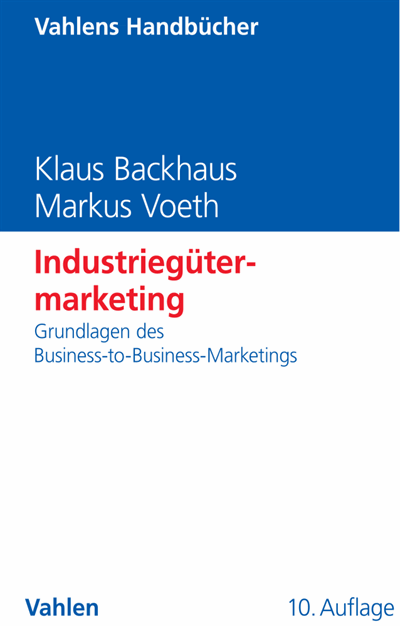
Industriegütermarketing
- Autor:innen:
- |
- Verlag:
- 2014
Zusammenfassung
Das Industriegütermarketing beschäftigt sich mit der Vermarktung von Produkten und Dienstleistungen an Unternehmen. Das didaktisch schlüssig aufbereitete, durchgehend zweifarbig gestaltete Werk befasst sich neben den Grundlagen insbesondere mit den Schwerpunkten:
- Besonderheiten des Industriegütermarketings
- Bestimmung der Wettbewerbsposition: Organisationales Beschaffungsverhalten, relative Konkurrenz- und Ressourcenanalyse
- Geschäftstypenspezifisches Marketing im Produkt-, Projekt-, System- und Integrationsgeschäft
- Geschäftstypenwahl und -wechsel
Diese Auflage ist vollständig überarbeitet und durchgängig aktualisiert, um zahlreiche neue aktuelle Beispiele angereichert und insgesamt sehr leserfreundlich gestaltet. Insbesondere sind die Kapitel zum Organisationalen Beschaffungsverhalten, zum Brand Management sowie die Ausführungen zu den Geschäftstypen überarbeitet und erweitert. Ein Kapitel zur Geschäftstypenwahl wurde ergänzt. Damit spiegelt diese Auflage den aktuellen Forschungsstand zum Industriegütermarketing wider.
Publikation durchsuchen
Bibliographische Angaben
- Auflage
- 10/2014
- Copyrightjahr
- 2014
- ISBN-Print
- 978-3-8006-4763-7
- ISBN-Online
- 978-3-8006-4764-4
- Verlag
- Vahlen, München
- Reihe
- Vahlens Handbücher der Wirtschafts- und Sozialwissenschaften
- Sprache
- Deutsch
- Seiten
- 732
- Produkttyp
- Monographie
Inhaltsverzeichnis
- Titelei/Inhaltsverzeichnis Kein Zugriff Seiten 1 - 19
- Kapitel A: Bedeutung und Abgrenzung des Industriegütermarketings Kein Zugriff Seiten 20 - 25
- Kapitel B: Besonderheiten des Industriegütermarketings Kein Zugriff Seiten 25 - 29
- I. Netto-Nutzen, Kundenvorteil, USP, Value Proposition, Wettbewerbsvorteil oder KKV? Kein Zugriff Seiten 29 - 41
- II. Elemente des KKVs Kein Zugriff Seiten 41 - 46
- III. Zusammenfassende Definition des Industriegütermarketings Kein Zugriff Seiten 46 - 49
- IV. Die Institutionalisierung des Marketings im Unternehmen Kein Zugriff Seiten 49 - 51
- Kapitel D: Zum Aufbau dieses Buches Kein Zugriff Seiten 51 - 52
- I. Der industrielle Kunde: Individuum und Gruppe Kein Zugriff Seiten 52 - 144
- II. Die Konkurrenz: eine relative Perspektive Kein Zugriff Seiten 144 - 168
- III. Der Anbieter: Ressourcenausstattung und strategische Orientierung Kein Zugriff Seiten 168 - 176
- I. Der Informationsgewinnungsprozess Kein Zugriff Seiten 176 - 185
- II. Abbildung der KKV-Position Kein Zugriff Seiten 185 - 208
- I. Systematik von Typologien Kein Zugriff Seiten 208 - 224
- II. Der „Vier-Typenansatz“ als Basis für die Entwicklung von Marketing-Programmen Kein Zugriff Seiten 224 - 233
- I. Merkmale und Vermarktungsbesonderheiten des Produktgeschäfts Kein Zugriff Seiten 233 - 238
- II. Vermarktungsmaßnahmen im Produktgeschäft Kein Zugriff Seiten 238 - 364
- I. Charakteristika und Vermarktungsbesonderheiten des Projektgeschäfts Kein Zugriff Seiten 364 - 368
- II. Marketing im Projektgeschäft: Ein phasenspezifischer Ansatz Kein Zugriff Seiten 368 - 462
- I. Charakteristika und Vermarktungsbesonderheiten des Systemgeschäfts Kein Zugriff Seiten 462 - 479
- II. Der Vermarktungsansatz im Systemgeschäft Kein Zugriff Seiten 479 - 534
- I. Charakteristika des Integrationsgeschäfts Kein Zugriff Seiten 534 - 539
- II. Phasenspezifisches Management von Geschäftsbeziehungen im Integrationsgeschäft Kein Zugriff Seiten 539 - 607
- I. Geschäftstypenwahlentscheidungen Kein Zugriff Seiten 607 - 609
- II. Geschäftstypenwechsel Kein Zugriff Seiten 609 - 649
- Literaturverzeichnis Kein Zugriff Seiten 649 - 721
- Sachverzeichnis Kein Zugriff Seiten 721 - 732
- Impressum Kein Zugriff Seiten 732 - 732
Literaturverzeichnis (1605 Einträge)
Es wurden keine Treffer gefunden. Versuchen Sie einen anderen Begriff.
- Aaker, D.A. (1988), Kriterien zur Identifikation dauerhafter Wettbewerbsvorteile, in: Simon, H. (Hrsg.), Wettbewerbsvorteile und Wettbewerbsfähigkeit, Stuttgart 1988, S. 37– 46. Google Scholar öffnen DOI: 10.15358/9783800647644
- Aaker, D.A. (1991), Managing Brand Equity. Capitalizing on the Value of a Brand Name, New York 1991. Google Scholar öffnen DOI: 10.15358/9783800647644
- Aaker, D.A. (2007), Strategic Market Management, 8. Aufl., New York 2007. Google Scholar öffnen DOI: 10.15358/9783800647644
- Aaker, J.L. (1997), Dimensions of Brand Personality, in: Journal of Marketing Research, 34. Jg., Nr.8, 1997, S. 347–356. Google Scholar öffnen DOI: 10.15358/9783800647644
- Abeele, P.V./Butaye, I. (1980), Pretesting the Effectiveness of Industrial Advertising, in: Industrial Marketing Management, 9. Jg., 1980, S.75–83. Google Scholar öffnen DOI: 10.15358/9783800647644
- Abell, D.F. (1978), Strategic Windows, in: Journal of Marketing, 42. Jg., Nr.3, 1978, S.21–26. Google Scholar öffnen DOI: 10.15358/9783800647644
- Abend, J.M. (1992), Strukturwandel in der Automobilindustrie und strategische Optionen mittelständischer Zulieferer: eine explorative Studie, München 1992. Google Scholar öffnen DOI: 10.15358/9783800647644
- Abernathy, W.J./Utterback, J.M. (1978), Patterns of Industrial Innovation, in: Technology Review, 80. Jg., Nr.7, June/July, 1978, S. 40–47. Google Scholar öffnen DOI: 10.15358/9783800647644
- Abratt, R. (1986), Industrial Buying in High-Tech Markets, in: Industrial Marketing Management, 15. Jg., 1986, S. 293 –298. Google Scholar öffnen DOI: 10.15358/9783800647644
- Achrol, R.S./Etzel, M.J. (2003), The structure of reseller goals and performance in mar rrketing channels, in: Journal of the Academy of Marketing Science, 31. Jg., Nr. 2, 2003, S. 146–163. Google Scholar öffnen DOI: 10.15358/9783800647644
- Adam, D. (1997), Planung und Entscheidung: Modelle – Ziele – Methoden. Mit Fallstudien und Lösungen, 4. Aufl., Wiesbaden 1997. Google Scholar öffnen DOI: 10.15358/9783800647644
- Adam, D. (2001), Produktionsmanagement, 9. Aufl., Wiesbaden 2001. Google Scholar öffnen DOI: 10.15358/9783800647644
- Adam, D./Backhaus, K./Thonemann, U./Voeth, M. (2004), Allgemeine Betriebswirtschaftslehre – Koordination betrieblicher Entscheidungen, 3. Aufl., Berlin et al. 2004. Google Scholar öffnen DOI: 10.15358/9783800647644
- Adam, D./Johannwille, U. (1998), Die Komplexitätsfalle, in: Adam, D. (Hrsg.), Komplexitätsmanagement, Wiesbaden 1998, S. 5–28. Google Scholar öffnen DOI: 10.15358/9783800647644
- Adams, W.J./Yellen, J.L. (1976), Commodity Bundling and the Burden of Monopoly, in: Quarterly Journal of Economics, Nr. 90, 1976, S. 475–488. Google Scholar öffnen DOI: 10.15358/9783800647644
- Adler, J. (2003), Anbieter- und Vertragstypenwechsel: Eine nachfragerorientierte Analyse auf der Basis der Neuen Institutionenökonomik, Wiesbaden 2003. Google Scholar öffnen DOI: 10.15358/9783800647644
- Adler, J. (2005), Ermittlung der Zahlungsbereitschaft für value added Commodities, in: Enke, M./Reimann, M. (Hrsg.), Commodity Marketing, Wiesbaden 2005, S. 121–149. Google Scholar öffnen DOI: 10.15358/9783800647644
- Adler, J./Klein, A. (2004), Internationales Industriegütermarketing, in: Backhaus, K./Voeth, M. (Hrsg.), Handbuch Industriegütermarketing, Wiesbaden 2004. Google Scholar öffnen DOI: 10.15358/9783800647644
- Adolf Würth GmbH & Co. KG (2013), http://eshop.wuerth.de/is-bin/INTERSHOP.enfinity/ WFS/1401-B1-Site/de_DE/-/EUR/Default-Start#, Abruf am 31.10.2013. Google Scholar öffnen DOI: 10.15358/9783800647644
- Adolphs, B. (1997), Stabile und effiziente Geschäftsbeziehungen: Eine Betrachtung von vertikalen Koordinationsstrukturen in der deutschen Automobilindustrie, Köln et al. 1997. Google Scholar öffnen DOI: 10.15358/9783800647644
- Ahlert, D. (1996), Distributionspolitik: Das Management des Absatzkanals, 3. Aufl., Stuttgart 1996. Google Scholar öffnen DOI: 10.15358/9783800647644
- Ahlert, D./Hesse, J. (2003), Das Multikanalphänomen – viele Wege führen zum Kunden, in: Ahlert, D./Hesse, J., et al. (Hrsg.), Multikanalstrategien: Konzepte – Methoden und Erfahrungen, Wiesbaden 2003, S. 23–58. Google Scholar öffnen DOI: 10.15358/9783800647644
- Ahlert, D./Hesse, J./Jullens, J./Smend, P. (2003), Multikanalstrategien: Konzepte, Methoden und Erfahrungen, Wiesbaden 2003. Google Scholar öffnen DOI: 10.15358/9783800647644
- Ahmad, I. (1990), Decision-Support System for Modeling Bid/No-Bid Decision Problem, in: Journal of Construction Engineering and Management, 116. Jg., Nr. 4, 1990, S. 595–608. Google Scholar öffnen DOI: 10.15358/9783800647644
- Airbus (2012), Navigating the Future. Global Market Forecast 2012–2031, http://www.airbus. Google Scholar öffnen DOI: 10.15358/9783800647644
- com/com-pany/market/forecast/, Zugriff am 22.03.2014. Google Scholar öffnen DOI: 10.15358/9783800647644
- Ajzen, I. (1988), Attitudes, personality, and behavior, 2.Aufl., Chicago 1988. Google Scholar öffnen DOI: 10.15358/9783800647644
- Ajzen, I. (1991), Attitudes, personality, and behavior, 3. Aufl., Milton Keynes 1991. Google Scholar öffnen DOI: 10.15358/9783800647644
- AKA (2014a), AKA-Ausfuhrkreditgesellschaft mbH 2014, https://www.akabank.de/deutsch/ produkte/besteller/grund-zuege.html, Abruf am 02.04.2014. Google Scholar öffnen DOI: 10.15358/9783800647644
- AKA (2014b), AKA-Ausfuhrkreditgesellschaft mbH 2014, https://www.akabank.de/deutsch/ faq.html, Abruf am 03.04.2014. Google Scholar öffnen DOI: 10.15358/9783800647644
- Al-Zu’bi, Z.M.F./Tsinopoulos C. (2012), Suppliers versus Lead Users: Examining Their Relative Impact on Product Variety, in: Journal of Product Innovation Management, 29. Jg., Nr.4, S.667–680. Google Scholar öffnen DOI: 10.15358/9783800647644
- Alajoutsijärvi,K./Möller, K./Tähtinen, J. (2000), Beautiful exit: how to leave your business partner, in: European Journal of Marketing, 34. Jg. (11/12), 2000, S.1270–1290. Google Scholar öffnen DOI: 10.15358/9783800647644
- Albach, H. (1980), Vertrauen in der ökonomischen Theorie, in: Zeitschrift für die gesamte Staatswissenschaft, 136. Jg., Nr.1, 1980, S.2–11. Google Scholar öffnen DOI: 10.15358/9783800647644
- Albach, H. (1992), Strategische Allianzen, strategische Gruppen und strategische Familien, in: Zeitschrift für Betriebswirtschaft, 62. Jg., Nr. 6, 1992, S.663–670. Google Scholar öffnen DOI: 10.15358/9783800647644
- Albaum, G./Richardson, F.L.W. (1967), Human Interaction: Key to Sales Success, in: Arizona Review, 16. Jg., Nr.4, 1967, S.1–3. Google Scholar öffnen DOI: 10.15358/9783800647644
- Albers, S. (1989), Entscheidungshilfen für den persönlichen Verkauf, Berlin 1989. Google Scholar öffnen DOI: 10.15358/9783800647644
- Albers, S. (1995), Optimales Verhältnis zwischen Festgehalt und erfolgsabhängiger Entlohnung bei Verkaufsaußendienstmitarbeitern, in: Zeitschrift für betriebswirtschaftliche Forschung, 47. Jg., Nr.2, 1995, S.124–142. Google Scholar öffnen DOI: 10.15358/9783800647644
- Albers, S./Eggert, K. (1988), Kundennähe, Strategie oder Schlagwort? in: Marketing – Zeitschrift für Forschung und Praxis, 10. Jg., Nr. 1, 1988, S. 5–16. Google Scholar öffnen DOI: 10.15358/9783800647644
- Albers, S./Krafft, M. (2000), Regeln zur Bestimmung des fast-optimalen Angebotsaufwandes, in: Zeitschrift für Betriebswirtschaft, 70. Jg., Nr. 10, 2000, S.1083–1107. Google Scholar öffnen DOI: 10.15358/9783800647644
- Albers, S./Söhnchen, F. (2005), Akquisitionsmanagement im industriellen Projektgeschäft, in: Zeitschrift für Betriebswirtschaft, Nr.2 (Sonderheft), 2005, S. 59–80. Google Scholar öffnen DOI: 10.15358/9783800647644
- Alchian, A.A. (1984), Specifity, Specialization and Coalitions, in: Journal of Institutional and Theoretical Economics, 140. Jg., Nr. 1, 1984, S. 34–49. Google Scholar öffnen DOI: 10.15358/9783800647644
- Alejandro, T.B./Kowalkowski, C./da Silva Freire Ritter, J.G./Marchetti, R.Z./Prado, P.H. (2011), Information search in complex industrial buying: Empirical evidence from Brazil, in: Industrial Marketing Management, 40. Jg., Nr.1, S.17–27. Google Scholar öffnen DOI: 10.15358/9783800647644
- Ali, A. (1994), Pioneering versus incremental innovation: Review and research propositions, in: Journal of Product Innovation Management, 11. Jg., Nr. 1, 1994, S.46–61. Google Scholar öffnen DOI: 10.15358/9783800647644
- Allen, T. (1967), Communications in the Research and Development Laboratory, in: Technology Review, 70. Jg., Nr. 1, Oct./Nov., 1967, S. 31–37. Google Scholar öffnen DOI: 10.15358/9783800647644
- Allianz Arena München Stadion GmbH H (2014), Gastro & Events, http://www.allianz-arena. Google Scholar öffnen DOI: 10.15358/9783800647644
- de/de/fan-gastronomie/, Zugriff am 20.03.2014. Google Scholar öffnen DOI: 10.15358/9783800647644
- Altuntas, M./Berry-Stölzle, T. (2010), Geschäftsstrategien deutscher Pensionsfonds: Eine Analyse strategischer Gruppen, in: Zeitschrift für die gesamte Versicherungswirtschaft, 99. Jg., Nr.2, S.185–210. Google Scholar öffnen DOI: 10.15358/9783800647644
- American Marketing Association (2004), What are the definitions of marketing and marketing research?, http://www.marketingpower.com/content4620.php, Abruf am 15.08.2006. Google Scholar öffnen DOI: 10.15358/9783800647644
- Anderson, H. (2006), Creating a parallel universe for trade shows, in: Trade Show Executive, Oktober, S. 16–17. Google Scholar öffnen DOI: 10.15358/9783800647644
- Anderson, E./Chu, W./Weitz, B. (1987), Industrial Purchasing: An Empirical Exploration of the Buyclass Framework, in: Journal of Marketing, 51. Jg., July, 1987, S.71–86. Google Scholar öffnen DOI: 10.15358/9783800647644
- Anderson, E./Coughlan, A. (1987), International Market Entry and Expansion Via Independent or Integrated Channels of Distribution, in: The Journal of Marketing, 51. Jg., Nr. 1, 1987, S. 71–82. Google Scholar öffnen DOI: 10.15358/9783800647644
- Anderson, J.C./Jain, D./Chintagunta, P.A. (1993), Customer Value Assessment in Business Markets: A State-of-Practice Study, in: Journal of Business-to-Business Marketing, 1. Jg., Nr.1, 1993, S.3–29. Google Scholar öffnen DOI: 10.15358/9783800647644
- Anderson, J.C./Narus, J.A. (1990), A Model of Distributor Firm and Manufacturing Firm Working Relationships, in: Journal of Marketing, Jg. 54, Nr.1, S.42–58. Google Scholar öffnen DOI: 10.15358/9783800647644
- Anderson, J.C./Narus, J.A./Narayandas, D. (2009), Business Market Management: Understanding, Creating and Delivering Value, 3.Aufl., Upper Saddle River, New Jersey 2009. Google Scholar öffnen DOI: 10.15358/9783800647644
- Anderson, P.F./Chambers, T.M. (1985), A Reward/Measurement Model of Organizational Buying Behavior, in: Journal of Marketing, 49. Jg., 1985, S.7–23. Google Scholar öffnen DOI: 10.15358/9783800647644
- Ansorge, D. (1987), Die Risiken des Exporteurs bei langfristig finanzierten Anlagengeschäften, in: Backhaus, K./Siepert, H.-M. (Hrsg.), Auftragsfinanzierung im industriellen Anlagengeschäft, Stuttgart 1987, S. 22–38. Google Scholar öffnen DOI: 10.15358/9783800647644
- Apostolopoulou, A./Papadimitriou, D.(2004), Welcome Home: Motivations and Objectives of the 2004 Grand National Olympic Sponsors, in: Sport Marketing Quarterly, 13. Jg., Nr.4, 2004, S. 180–192. Google Scholar öffnen DOI: 10.15358/9783800647644
- App, U. (2006), „Scheinbar nicht logisch“. Avaya und T-Systems nutzen ihr FIFA-Sponsoring zur B-to-B-Kommunikation, in: werben&verkaufen, Nr. 21, 2006, S. 30. Google Scholar öffnen DOI: 10.15358/9783800647644
- Appelfeller, W./Buchholz, W. (2011), Strategie Organisation und IT des modernen Beschaf f ffungsmanagements, 2. Aufl., Wiesbaden 2011. Google Scholar öffnen DOI: 10.15358/9783800647644
- Arbeitskreis „Internes-Rechnungswesen“ der Schmalenbach-Gesellschaft (1991), Beiträge zur Betriebswirtschaft des Anlagenbaus, in: Zeitschrift für betriebswirtschaftliche For r rschung, 43. Jg., Nr.28, 1991. Google Scholar öffnen DOI: 10.15358/9783800647644
- Arbeitskreis „Marketing in der Investitionsgüterindustrie“ der Schmalenbach-Gesellschaft (1975), Systems Selling, in: Zeitschrift für betriebswirtschaftliche Forschung, 27. Jg., Nr.12, 1975, S.753–769. Google Scholar öffnen DOI: 10.15358/9783800647644
- Arbeitskreis „Marketing in der Investitionsgüterindustrie“ der Schmalenbach-Gesellschaft (1978), Einige Besonderheiten der Preisbildung im Seriengeschäft und Anlagengeschäft, in: Zeitschrift für betriebswirtschaftliche Forschung, 30. Jg., Nr. 1, 1978, S. 248. Google Scholar öffnen DOI: 10.15358/9783800647644
- Argouslidis, P.C. (2004), An Empirical Investigation into the Alternative Strategies to Implement the Elemination of Financial Services, in: Journal of World Business, 39. Jg., Nr.4, S. 393–413. Google Scholar öffnen DOI: 10.15358/9783800647644
- Aribarg, A./Arora, N./Bodur, H.O. (2002), Understanding the Role of Preference Revision and Concession in Group Decisions, in: Journal of Marketing Research, 39. Jg., Nr.3, S. 336–349. Google Scholar öffnen DOI: 10.15358/9783800647644
- Aribarg, A./Arora, N./Kang, M.Y. (2010) Predicting Joint Choice Using Individual Data, in: Marketing Science, 29. Jg., S.139–157. Google Scholar öffnen DOI: 10.15358/9783800647644
- Arlt, V./Backhaus, K. (1977), LISTECO – Libya Steel Corporation – Fallstudien zum Investitionsgüter-Marketing, München 1977. Google Scholar öffnen DOI: 10.15358/9783800647644
- Arndt, H. (2013), Supply Chain Management. Optimierung logistischer Prozesse, 6. Aufl., Wiesbaden 2013. Google Scholar öffnen DOI: 10.15358/9783800647644
- Arnold, U. (1982), Strategische Beschaffungspolitik, Frankfurt a. M. et al. 1982. Google Scholar öffnen DOI: 10.15358/9783800647644
- Arnold, U. (1996), Gemeinschaftsbeschaffung in Einkaufskooperationen: Ergebnisse des Verbundprojektes, in: Beschaffung aktuell, Nr. 4, 1996, S.50–51. Google Scholar öffnen DOI: 10.15358/9783800647644
- Arnold, U. (1997), Beschaffungsmanagement, 2. Aufl., Stuttgart 1997. Google Scholar öffnen DOI: 10.15358/9783800647644
- Arnold, U. (2002), Global Sourcing: Strategiedimensionen und Strukturanalyse, in: Hahn, D./Kaufmann, L. (Hrsg.), Handbuch Industrielles Beschaffungsmanagement, 2. Aufl., Wiesbaden 2002, S.201–220. Google Scholar öffnen DOI: 10.15358/9783800647644
- Arnold, U. (2004), Beschaffungskooperationen und Netzwerke, in: Backhaus, K./Voeth, M. (Hrsg.), Handbuch Industriegütermarketing, Wiesbaden 2004, S. 287–322. Google Scholar öffnen DOI: 10.15358/9783800647644
- Arnolds, H./Heege, F./Röh, C./Tussing, W. (2013), 12. Aufl., Wiesbaden 2013. Google Scholar öffnen DOI: 10.15358/9783800647644
- Asanuma, B. (1989), Manufacturer-Supplier Relationships in Japan and the Concept of Relation-Specific Skill, in: Journal of Japanese and International Economics, 3. Jg., Nr.1, 1989, S. 1–30. Google Scholar öffnen DOI: 10.15358/9783800647644
- Athreye, S./Godley, A. (2009), Internationalization and technological leapfrogging in the pharmaceutical industry, in: Industrial and Corporate Change, 18. Jg., Nr.2, S.295–323. Google Scholar öffnen DOI: 10.15358/9783800647644
- Atuahene-Gima, K. (2005), Resolving the Capability – Rigidity Paradox in New Product Innovation, in: Journal of Marketing, 69. Jg., Nr. 4, Oktober 2005, S.61–83. Google Scholar öffnen DOI: 10.15358/9783800647644
- Axelsson, B./Easton, G. (1992), Industrial networks: a new view of reality, London 1992. Google Scholar öffnen DOI: 10.15358/9783800647644
- AUMA (2013a), AUMA_MesseTrend 2013, http://www.auma.de/de/DownloadsPublikationen/PublikationDownloads/AUMA_MesseTrend2013.pdf, Abruf am 03.09.2013. Google Scholar öffnen DOI: 10.15358/9783800647644
- AUMA (2013b), http://www.auma.de/de/Messemarkt/MessemaerkteAusland/Laenderberichte/Nordafrika/Seiten/Libyen .aspx, Abruf am 22.10.2013. Google Scholar öffnen DOI: 10.15358/9783800647644
- Baaken, T./Simon, D. (1987), Abnehmerqualifizierung als Instrument des TechnologieMarketing, Berlin 1987. Google Scholar öffnen DOI: 10.15358/9783800647644
- Babbar, S./Rai, A. (1993), Competitive Intelligence for International Business, in: Long Range Planning, 26. Jg., Nr.3, 1993, S.103–113. Google Scholar öffnen DOI: 10.15358/9783800647644
- Bacharach, S. B./Lawler, E.J. (1980), Power and Politics in Organizations, San Francisco 1980. Google Scholar öffnen DOI: 10.15358/9783800647644
- Bachem, C. (2004), Multichannel-Marketing – eine Einführung, in: Merx, O./Bachem, C. (Hrsg.): Multichannel- Marketing-Handbuch, Berlin 2004, S. 29–64. Google Scholar öffnen DOI: 10.15358/9783800647644
- Backhaus, K. (1974), Direktvertrieb in der Investitionsgüterindustrie, Wiesbaden 1974. Google Scholar öffnen DOI: 10.15358/9783800647644
- Backhaus, K. (1977), Bestimmungsfaktoren der Lieferantenauswahl als Basis einer Marktsegmentierung im internationalen Anlagengeschäft, in: Engelhardt, W.H./Laßmann, G. (Hrsg.), Anlagen-Marketing, Opladen 1977, S. 57–72. Google Scholar öffnen DOI: 10.15358/9783800647644
- Backhaus, K. (1979), Preisgleitklauseln als risikopolitisches Instrument bei langfristigen Fertigungs- und Absatzprozessen, in: Zeitschrift für betriebswirtschaftliche Forschung – Kontaktstudium, 31. Jg., Nr.1, 1979, S.3–11. Google Scholar öffnen DOI: 10.15358/9783800647644
- Backhaus, K. (1980), Auftragsplanung im industriellen Anlagengeschäft, Stuttgart 1980. Google Scholar öffnen DOI: 10.15358/9783800647644
- Backhaus, K. (1982), Investitionsgüter-Marketing, München 1982. Google Scholar öffnen DOI: 10.15358/9783800647644
- Backhaus, K. (1983), Der entscheidungs- und verhaltensorientierte Ansatz in der Investitionsgüter-Werbung, in: Rost, D./Strothmann, K.H. (Hrsg.), Handbuch der Werbung für Investitionsgüter, Wiesbaden 1983, S.41–64. Google Scholar öffnen DOI: 10.15358/9783800647644
- Backhaus, K. (1984), Die Bedeutung der Besonderheiten industrieller Einkaufsentscheidungen für das Investitionsgütermarketing, in: o. V. (Hrsg.), Protokoll des 22. Würzburger Werbefachgespräches, Würzburg 1984, S. 7–18. Google Scholar öffnen DOI: 10.15358/9783800647644
- Backhaus, K. (1985), Portfolio-Modelle in der strategischen Unternehmens- und Marketingplanung, in: o. V. (Hrsg.), Protokoll des 23. Würzburger Werbefachgespräches, Würzburg 1985, S. 7–18. Google Scholar öffnen DOI: 10.15358/9783800647644
- Backhaus, K. (1986), Industrial Marketing – State of the Art in Germany, in: Backhaus, K./ Wilson, D.T. (Hrsg.), Industrial Marketing – A German-American Perspective, Berlin 1986, S.3–14. Google Scholar öffnen DOI: 10.15358/9783800647644
- Backhaus, K. (1988), Grundbegriffe des Industrieanlagen- und Systemgeschäfts, 2. Aufl., Münster et al. 1988. Google Scholar öffnen DOI: 10.15358/9783800647644
- Backhaus, K. (1990), Investitionsgütermarketing, 2.Aufl., München 1990. Google Scholar öffnen DOI: 10.15358/9783800647644
- Backhaus, K. (1992a), Investitionsgütermarketing – Theorieloses Konzept mit Allgemeinheitsanspruch? in: Zeitschrift für betriebswirtschaftliche Forschung, 44. Jg., Nr. 9, 1992, S. 1–21. Google Scholar öffnen DOI: 10.15358/9783800647644
- Backhaus, K. (1992b), Investitionsgütermarketing, 3. Aufl., Münster et al. 1992. Google Scholar öffnen DOI: 10.15358/9783800647644
- Backhaus, K. (1993), Geschäftstypenspezifisches Investitionsgütermarketing, in: Droege, W./Backhaus, K./Weiber, R. (Hrsg.), Strategien für Investitionsgütermärkte, Antworten auf neue Herausforderungen, Landsberg/Lech 1993, S. 100–109. Google Scholar öffnen DOI: 10.15358/9783800647644
- Backhaus, K. (1999), Happy Engineering, in: Manager Magazin, Nr. 8, 1999, S.130–133. Google Scholar öffnen DOI: 10.15358/9783800647644
- Backhaus, K. (2006), Vom Kundenvorteil über die Value Proposition zum KKV, in: Thexis, Nr.3, 2006, S.7–10. Google Scholar öffnen DOI: 10.15358/9783800647644
- Backhaus, K./Becker, J./Beverungen, D./Frohs, M./Knackstedt, R./Müller, O./Steiner, M./ Weddeling, M. (2010), Vermarktung hybrider Leistungsbündel – Das ServPay-Konzept, Berlin 2010. Google Scholar öffnen DOI: 10.15358/9783800647644
- Backhaus, K./Bröker, O./Brüne, P./Gausling, P. (2013b), Digitale Medien in B2B-Beschaf f ffungsprozessen – eine explorative Untersuchung, Institut für Anlagen und Systemtechnologien, Westfälische Wilhelms-Universität Münster, Arbeitspapier Nr.52, Münster 2013. Google Scholar öffnen DOI: 10.15358/9783800647644
- Backhaus, K./Adolphs, B./Büschken, J. (1996), The Paradox of Unsatisfying but Stable Ver r rtical Relationships – A Look at German Car Suppliers, in: Journal of Business Research, Vol. 46, Nr. 3, 1999, S.245–257. Google Scholar öffnen DOI: 10.15358/9783800647644
- Backhaus, K. (2013), Hindernislauf Marketing, Wiesbaden 2013. Google Scholar öffnen DOI: 10.15358/9783800647644
- Backhaus, K./Aufderheide, D./Späth, G.-M. (1994a), Marketing für Systemtechnologien, Stuttgart 1994. Google Scholar öffnen DOI: 10.15358/9783800647644
- Backhaus, K./Bonus, T./Sabel, T. (2004), Industriegütermarketing im Spiegel der internationalen Lehrbuchliteratur, in: Backhaus, K./Voeth, M. (Hrsg.), Handbuch Industriegütermarketing, Wiesbaden 2004, S. 23–46. Google Scholar öffnen DOI: 10.15358/9783800647644
- Backhaus, K./Brüne, P.-A./Wiegand, N. (2013d), Auftragsfinanzierung und Financial Engineering, in: Kleinaltenkamp, M./Plinke, W./Geiger, I. (Hrsg.): Auftrags- und Projektmanagement. Mastering Business Markets, Berlin et al. 2013, S.137–172. Google Scholar öffnen DOI: 10.15358/9783800647644
- Backhaus, K./Budt, M./Lügger, K. (2012), Direkter oder indirekter Vertrieb?: vertriebsstrukturelle Entscheidungen in Auslandsmärkten, in: Binckebanck, L./Belz, C. (Hrsg.), Internationaler Vertrieb: Grundlagen, Konzepte und Best Practices für Erfolg im globalen Geschäft, Wiesbaden 2012, S. 439–467. Google Scholar öffnen DOI: 10.15358/9783800647644
- Backhaus, K./Budt, M./Neun, H. (2011), Strategisches Vertriebsmanagement, in: Homburg, C./Wieseke, J. (Hrsg.), Handbuch Vertriebsmanagement, Wiesbaden 2011, S. 35–55. Google Scholar öffnen DOI: 10.15358/9783800647644
- Backhaus, K./Büschken, J. (1997a), Organisationales Kaufverhalten, in: Tietz, B./Köhler, R./Zentes, J. (Hrsg.), Handwörterbuch des Marketing, Stuttgart 1997, S. 1954–1966. Google Scholar öffnen DOI: 10.15358/9783800647644
- Backhaus, K./Büschken, J. (1997b), What do we know about Business-to-Business Interactions? – A Synopsis of Empirical Research on Buyer-Seller Interactions, in: Relationships and Networks in International Markets, 1997, S.13–36. Google Scholar öffnen DOI: 10.15358/9783800647644
- Backhaus, K./Büschken, J./Voeth, M. (2003), Internationales Marketing, 5. Aufl., Stuttgart 2003. Google Scholar öffnen DOI: 10.15358/9783800647644
- Backhaus, K./Dringenberg, H. (1984), Anfragenselektion, in: Backhaus, K. (Hrsg.), Planung im industriellen Anlagengeschäft, Düsseldorf 1984, S. 53–42. Google Scholar öffnen DOI: 10.15358/9783800647644
- Backhaus, K./Erichson, B./Plinke, W./Weiber, R. (2011a), Multivariate Analysemethoden: eine anwendungsorientierte Einführung, 12.Aufl., Berlin et al. 2011. Google Scholar öffnen DOI: 10.15358/9783800647644
- Backhaus, K./Erichson, B./Weiber, R. (2013a), Fortgeschrittene Multivariate Analysemethoden. Eine anwendungsorientierte Einführung, 2. Aufl., Berlin/Heidelberg 2013. Google Scholar öffnen DOI: 10.15358/9783800647644
- Backhaus, K./Funke, S. (1995), Auswirkungen steigender Fixkosten auf die Marktver r rhaltensweisen mittelständischer Investitionsgüterhersteller – Kostenstrukturanalyse, Münster 1995. Google Scholar öffnen DOI: 10.15358/9783800647644
- Backhaus, K./Funke, S. (1996), Auf dem Weg zur fixkostenintensiven Unternehmung? in: Zeitschrift für betriebswirtschaftliche Forschung, 48. Jg., Nr. 2, 1996, S. 95–129. Google Scholar öffnen DOI: 10.15358/9783800647644
- Backhaus, K./Frohs, M./Weddeling, M. (2007b), Produktbegleitende Dienstleistungen zwischen Anspruch und Wirklichkeit, Arbeitspapier Nr.2 in der Reihe „ServPay – Zahlungsbereitschaften für Geschäftsmodelle produktbegleitender Dienstleistungen“, Münster 2007. Google Scholar öffnen DOI: 10.15358/9783800647644
- Backhaus, K./Gausling P. (2014), Markenrelevanz auf Industriegütermärkten, in: Back k khaus, K.; Voeth, M. (Hrsg.): Handbuch Industriegütermarketing. Strategien – Instrumente – Anwendungen, 2. Aufl., Wiesbaden 2014. Google Scholar öffnen DOI: 10.15358/9783800647644
- Backhaus, K./Geiger, I./Wilken, R. (2006), Success Factors in Business-to-Business Marketing Negotiations: Empirical Evidence and a Comprehensive Framework, unveröffentlichtes Manuskript, Münster 2006. Google Scholar öffnen DOI: 10.15358/9783800647644
- Backhaus, K./Gnam, P. (1999), Vertragsmanagement im internationalen Anlagengeschäft, Hektographiertes Manuskript, Berlin 1999. Google Scholar öffnen DOI: 10.15358/9783800647644
- Backhaus, K./Günter, B. (1976), A Phase-Differential Interaction Approach to Industrial Marketing Decisions, in: Industrial Marketing Management, 5. Jg., 1976, S.255–270. Google Scholar öffnen DOI: 10.15358/9783800647644
- Backhaus, K./Herbst, U./Voeth, M./Wilken, R. (2009), Allgemeine Betriebswirtschaftslehre – Koordination betrieblicher Entscheidungen, 4. Aufl., Berlin et al. 2009. Google Scholar öffnen DOI: 10.15358/9783800647644
- Backhaus, K./Hilker, J. (1994), Die Triade als Absatzmarkt des deutschen Maschinenbaus, in: Die Betriebswirtschaft, 54. Jg., Nr.2, 1994, S.175–192. Google Scholar öffnen DOI: 10.15358/9783800647644
- Backhaus, K./Kleikamp, C. (2001), Marketing von investiven Dienstleistungen, in: Bruhn, M. (Hrsg.), Handbuch Dienstleistungsmanagement: von der strategischen Konzeption zur praktischen Umsetzung, 2.Aufl., Wiesbaden 2001, S. 73–101. Google Scholar öffnen DOI: 10.15358/9783800647644
- Backhaus, K./Koch, M./Mühlfeld, K./Witt, S. (2013c), Kundenbindung im Industriegütermarketing, in: Bruhn, M./Homburg, C. (Hrsg.), Handbuch Kundenbindungsmanagement – Strategien und Instrumente für ein erfolgreiches CRM, 8. Aufl., Wiesbaden 2013, S. 235–272. Google Scholar öffnen DOI: 10.15358/9783800647644
- Backhaus, K./Köhl, T. (2001), Projektfinanzierung, in: Gerke, W./Steiner, M. (Hrsg.), Handbuch des Bank- und Finanzwesens, Stuttgart 2001, S. 1715–1735. Google Scholar öffnen DOI: 10.15358/9783800647644
- Backhaus, K./Köhl, T./Werthschulte, H. (2000), Weniger Wettbewerbsverzerrungen durch Vereinheitlichung der staatlichen Exportkreditversicherungssysteme? in: Zeitschrift für Betriebswirtschaft, 70. Jg., Nr.7 7 7/8, 2000, S. 828–841. Google Scholar öffnen DOI: 10.15358/9783800647644
- Backhaus, K./Mell, S./Sabel, T. (2007a), Business-to-Business Marketing Textbooks: A Comparative Review, in: Journal of Business-to-Business Marketing, 14. Jg., Nr. 4, 2007, S.11–65. Google Scholar öffnen DOI: 10.15358/9783800647644
- Backhaus, K./Molter, W. (1984a), Auswirkungen verwirkter Pönale – Finanzielle Konsequenzen alternativer interner Haftungsregelungen bei konsortial errichteten Industrieanlagen, in: Zeitschrift für betriebswirtschaftliche Forschung, 36. Jg., Nr. 3, 1984, S. 183–199. Google Scholar öffnen DOI: 10.15358/9783800647644
- Backhaus, K./Molter, W. (1984b), Risikomanagement im internationalen Großanlagenbau, in: Harvard Manager, 6. Jg., Nr.2, 1984, S.36–43. Google Scholar öffnen DOI: 10.15358/9783800647644
- Backhaus, K./Molter, W. (1989), Auftragsfinanzierung, internationale, in: Macharzina, K./Welge, M.K. (Hrsg.), Handwörterbuch Export und internationale Unternehmung, Stuttgart 1989, S. 49–67. Google Scholar öffnen DOI: 10.15358/9783800647644
- Backhaus, K./Mühlfeld, K. (2004), Geschäftstypen im Industriegütermarketing, in: Backhaus, K./Voeth, M. (Hrsg.), Handbuch Industriegütermarketing, Wiesbaden 2004, S.231–263. Google Scholar öffnen DOI: 10.15358/9783800647644
- Backhaus, K./Mühlfeld, K. (2005), Strategy dynamics in industrial marketing: a business types perspective, in: Management Decision, 43. Jg., Nr. 1, 2005, S. 38–55. Google Scholar öffnen DOI: 10.15358/9783800647644
- Backhaus, K./Plinke, W. (1986), Rechtseinflüsse auf betriebswirtschaftliche Entscheidungen, Stuttgart 1986. Google Scholar öffnen DOI: 10.15358/9783800647644
- Backhaus, K./Reinkemeier, C./Voeth, M. (1994b), Nachfragestrukturen und -bedürfnisse im Markt für Geographische Informationssysteme, Projektbericht Nr.94–6 aus dem Betriebswirtschaftlichen Institut für Anlagen und Systemtechnologien, Münster 1994. Google Scholar öffnen DOI: 10.15358/9783800647644
- Backhaus, K./Sabel, T. (2004), Markenrelevanz auf Industriegütermärkten, in: Backhaus, K./Voeth, M. (Hrsg.), Handbuch Industriegütermarketing, Wiesbaden 2004, S. 779–797. Google Scholar öffnen DOI: 10.15358/9783800647644
- Backhaus, K./Schneider, H. (2009), Strategisches Marketing, 2. Aufl., Stuttgart 2009. Google Scholar öffnen DOI: 10.15358/9783800647644
- Backhaus, K./Späth, G.-M. (1994), Preispolitische Beziehungsstrukturen bei Kritische-Masse-Systemen, in: Backhaus, K./Diller, H. (Hrsg.), Dokumentation des 1. Workshops der Arbeitsgruppe „Beziehungsmanagement“ der wissenschaftlichen Kommission für Mar r rketing im Verband der Hochschullehrer für Betriebswirtschaftslehre vom 27.–28.09.1993 in Frankfurt a. M., Münster 1994. Google Scholar öffnen DOI: 10.15358/9783800647644
- Backhaus, K./Steiner, M./Lügger, K. (2011b), To invest, or not to invest, in brands? Drivers of brand relevance in B2B markets, in: Industrial Marketing Management, 40. Jg., Nr. 7, 2011, S. 1082–1092. Google Scholar öffnen DOI: 10.15358/9783800647644
- Backhaus, K./Uekermann, H. (1990), Projektfinanzierung – Eine Methode zur Finanzierung von Großprojekten, in: Wirtschaftswissenschaftliches Studium, 19. Jg., Nr. 3, 1990, S.106–112. Google Scholar öffnen DOI: 10.15358/9783800647644
- Backhaus, K./Van Doorn, J./Wilken, R. (2008), The Impact of Team Characteristics on the Course and Outcome of Intergroup Price Negotiations, in: Journal of Business-toBusiness Marketing, 15. Jg., Nr.4, S 365–396. Google Scholar öffnen DOI: 10.15358/9783800647644
- Backhaus, K./Van Doorn, J./Wilken, R./Voeth, M./Herbst, U. (2005a), Preisverhandlungen im B2B-Marketing, in: Diller, H. (Hrsg.), Pricing-Forschung in Deutschland, 8.Aufl., Nürnberg 2005, S.1–15. Google Scholar öffnen DOI: 10.15358/9783800647644
- Backhaus, K./Voeth, M. (1995), Internationales Investitionsgütermarketing, in: Hermanns, A./Wissmeier, K.K. (Hrsg.), Internationales Marketing-Management, München 1995, S. 387–409. Google Scholar öffnen DOI: 10.15358/9783800647644
- Backhaus, K./Voeth, M. (2004), Besonderheiten des Industriegütermarketings, in: Backhaus, K./Voeth, M. (Hrsg.), Handbuch Industriegütermarketing, Wiesbaden 2004, S.3–21. Google Scholar öffnen DOI: 10.15358/9783800647644
- Backhaus, K./Voeth, M. (2005), Industriegütermarketing – Bewährte Erkenntnisse und innovative Perspektiven, in: Haas, A./Ivens, B.S. (Hrsg.), Innovatives Marketing: Entscheidungsfelder – Management – Instrumente, Wiesbaden 2005, S. 501–522. Google Scholar öffnen DOI: 10.15358/9783800647644
- Backhaus, K./Voeth, M., Internationales Marketing, 6. Aufl., Stuttgart 2010. Google Scholar öffnen DOI: 10.15358/9783800647644
- Backhaus, K./Voeth, M./Sichtmann, C./Wilken, R. (2005b), Conjoint-Analyse versus Direkte Preisabfrage zur Erhebung von Zahlungsbereitschaften – Eine modifizierte Replikationsstudie, in: Die Betriebswirtschaft, 65. Jg., Nr.5, 2005, S. 439–457. Google Scholar öffnen DOI: 10.15358/9783800647644
- Backhaus, K./Weiber, R. (1986), Marktsegmentierungsprobleme in sich verändernden Märkten, in: VDI-Gesellschaft (Hrsg.), VDI-Bericht Nr. 616, Wege zur Branchenspitze, Probleme Konzepte Methoden Lösungen, Düsseldorf 1986, S. 139–155. Google Scholar öffnen DOI: 10.15358/9783800647644
- Backhaus, K./Weiber, R. (1987), Systemtechnologien – Herausforderungen des Investitionsgütermarketings, in: Harvard Manager, 9. Jg., Nr. 4, 1987, S.70–80. Google Scholar öffnen DOI: 10.15358/9783800647644
- Backhaus, K./Weiber, R. (1988), Technologieintegration und Marketing, Arbeitspapier Nr.10 des Betriebswirtschaftlichen Instituts für Anlagen und Systemtechnologien, Münster 1988. Google Scholar öffnen DOI: 10.15358/9783800647644
- Backhaus, K./Weiber, R. (1989), Entwicklung einer Marketingkonzeption mit SPSS/PC+, Berlin et al. 1989. Google Scholar öffnen DOI: 10.15358/9783800647644
- Baird, C./Parasnis, G. (2011), Getting closer to customers, in: IBM Global Business Services (Hrsg.), From social media to Social CRM, http://www.ibm.com/common/ssi/cgi-bin/ ssialias?infotype=PM&subtype=XB&appname=GBSE_GB_TI _USEN&htmlfid=GBE 03391USEN&attachment=GBE03391USEN.PDF, Abruf am 22.10.2013. Google Scholar öffnen DOI: 10.15358/9783800647644
- Balderjahn, I. (2003), Erfassung der Preisbereitschaft, in: Diller, H./Herrmann, A. (Hrsg.), Handbuch Preispolitik, Wiesbaden 2003, S. 387–404. Google Scholar öffnen DOI: 10.15358/9783800647644
- Balderjahn, I./Mennicken, C./Berger, M./Minx, E.P.W. (1996), Neuprodukt-Marketing: Ein phasenintegrierendes und methodengestütztes Konzept, in: Ahsen, A. von/Czenskowsky, T. (Hrsg.), Marketing und Marktforschung: Entwicklungen, Erweiterungen und Schnittstellen im nationalen und internationalen Kontext, Hamburg 1996, S. 299–317. Google Scholar öffnen DOI: 10.15358/9783800647644
- Balderjahn, I./Schnurrenberger, B. (2005), Virtuelle Integration im Innovationsprozess, in: Amelingmeyer, J./Harland, P.E. (Hrsg.), Technologiemanagement & Marketing, Wiesbaden 2005, S. 415–432. Google Scholar öffnen DOI: 10.15358/9783800647644
- Baldwin, C./Clark, K. (1998), Modularisierung: Ein Konzept wird universell, in: Harvard Business Manager, 20. Jg., 1998, S. 39–48. Google Scholar öffnen DOI: 10.15358/9783800647644
- Balocco, R./Perego, A./Perotti, S. (2010), B2b eMarketplaces – A classification framework to analyse business models and critical success factors, in: Industrial Management & Data Systems, 110. Jg. (8–9), 2010, S. 1117–1137. Google Scholar öffnen DOI: 10.15358/9783800647644
- Bals, L./Hartmann, E./Ritter, T. (2009), Barriers of purchasing departments’ involvement in marketing service procurement, in: Industrial Marketing Management, 38. Jg., Nr.8, S. 892–902. Google Scholar öffnen DOI: 10.15358/9783800647644
- Banks, S./Altendorf, D./Greene, J./Cody, M. (1987), Ab Examination of Relationship Disagreement: Perceptions, Breakup Strategies and Outcomes, in: The Western Journal of Speech Communication, 51 Jg., Nr. 1, S.19–41. Google Scholar öffnen DOI: 10.15358/9783800647644
- Bänsch, A. (2001), Preisargumentation, in: Diller, H. (Hrsg.), Vahlens großes Marketing Lexikon, 2. Aufl., München 2001, S. 1291–1293. Google Scholar öffnen DOI: 10.15358/9783800647644
- Barczak, G./Griffin, A./Kahn, K. (2009): Perspective: Trends and drivers of success in NPD practices: Results of the 2003 PDMA Best Practices study, in: The Journal of Product Innovation Management, 26. Jg., Nr. 1, 2009, S.3. Google Scholar öffnen DOI: 10.15358/9783800647644
- Bard Offshore (2014), BARD – Energy, Competence, Offshore, http://www.bard-offshore. Google Scholar öffnen DOI: 10.15358/9783800647644
- de/projekte/offshore/bard-offshore-1.html, Abruf am 03.04.2014. Google Scholar öffnen DOI: 10.15358/9783800647644
- Barrmeyer, M.-C. (1982), Die Angebotsplanung bei Submission, Münster 1982. Google Scholar öffnen DOI: 10.15358/9783800647644
- Bartelt, A. (2002), Vertrauen in Zuliefernetzwerken: eine theoretische und empirische Analyse am Beispiel der Automobilindustrie, Wiesbaden 2002. Google Scholar öffnen DOI: 10.15358/9783800647644
- Barry, B./Friedman, R.A. (1998), Bargainers Characteristics in Distributive and Integrative Negotiation, in: Journal of Personality and Social Psychology, 74. Jg., Nr. 2, 1998, S.345–359. Google Scholar öffnen DOI: 10.15358/9783800647644
- BASF (2012), E-Solutions – the easy way to do business, http://www.basf.com/group/corporate/de_DE/function/ conversions:/publishdownload/content/e-business/Documents/ESolutions_full_version_german.pdf, Abruf am 20.03.2014. Google Scholar öffnen DOI: 10.15358/9783800647644
- BASF (2013), http://www.basf.com/group/produkte-und-branchen/index, Abruf am 13.11.2013. Google Scholar öffnen DOI: 10.15358/9783800647644
- Bastian, N.P. (2002), Lieferantenfinanzierung im Telekommunikationsmarkt: Analyse aus Sicht eines informationsökonomisch fundierten Marketing, Diss., Wiesbaden 2002. Google Scholar öffnen DOI: 10.15358/9783800647644
- Basu, A.K./Lal, R./Srinivasan, V./Staelin, R. (1985), Salesforce Compensation Plans: An Agency Theoretic Perspective, in: Marketing Science, 4. Jg., Nr.4, Fall, 1985, S. 267–292. Google Scholar öffnen DOI: 10.15358/9783800647644
- Batelle-Institut (1967), Probleme und Methoden des Marketing in der Produktions- und Investitionsgüterindustrie, Frankfurt a.M. 1967. Google Scholar öffnen DOI: 10.15358/9783800647644
- Bauer, H.H. (1986), Das Erfahrungskurvenkonzept. Möglichkeiten und Problematik der Ableitung strategischer Handlungsalternativen, in: Wirtschaftswissenschaftliches Studium, 15. Jg., Nr.1, 1986, S.1–10. Google Scholar öffnen DOI: 10.15358/9783800647644
- Bauer, H.H. (1989), Marktabgrenzung: Konzeption und Problematik von Ansätzen und Methoden zur Abgrenzung und Strukturierung von Märkten unter besonderer Berück k ksichtigung marketingtheoretischer Verfahren, Berlin 1989. Google Scholar öffnen DOI: 10.15358/9783800647644
- Bauer, H.H. (1991), Unternehmensstrategie und Strategische Gruppen, in: Kistner, K.P./ Schmidt, R. (Hrsg.), Unternehmensdynamik: Horst Albach zum 60. Geburtstag, Wiesbaden 1991, S.389–416. Google Scholar öffnen DOI: 10.15358/9783800647644
- Baumeister, C. (2000), Nachfragebündelung als Instrument der Preisdifferenzierung, Köln 2000. Google Scholar öffnen DOI: 10.15358/9783800647644
- Baumgarth, C. (1998a), Vertikale Marketingstrategien im Investitionsgüterbereich: dargestellt am Beispiel von Einsatzstoffen, Frankfurt a. M. et al. 1998. Google Scholar öffnen DOI: 10.15358/9783800647644
- Baumgarth, C. (1998b), Ingredient Branding – Begriff, State of the Art & Empirische Ergebnisse, Arbeitspapier des Lehrstuhls für Marketing der Universität-GH-Siegen, Siegen 1998. Google Scholar öffnen DOI: 10.15358/9783800647644
- Baumgarth, C. (2001), Markenpolitik im Business-to-Business-Bereich, in: Weidner, L.E. (Hrsg.), Kommunikationspraxis, Loseblattausgabe inkl. 33. Nachlieferung März 2001, Teil D/III/3, Landsberg/Lech 2001, S. 1–23. Google Scholar öffnen DOI: 10.15358/9783800647644
- Baumgarth, C. (2004), Markenführung von B-to-B-Marken, in: Backhaus, K./Voeth, M. (Hrsg.), Handbuch Industriegütermarketing, Wiesbaden 2004, S. 799–823. Google Scholar öffnen DOI: 10.15358/9783800647644
- Baumgarth, C. (2008), Markenpolitik: Markenwirkungen – Markenführung – Markencontrolling, 3.Aufl., Wiesbaden 2008. Google Scholar öffnen DOI: 10.15358/9783800647644
- Baxter, L.A. (1984), Trajectories of Relationship Disengagement, in: Journal of Social and Personal Relationships, 1. Jg., Nr.1, 1984, S. 29–48. Google Scholar öffnen DOI: 10.15358/9783800647644
- Baxter, L.A. (1985), Accomplishing relationship disagreement, in: Duck, Steve (Hrsg.), Understanding personal relationships: an interdisciplinary approach, London et al. 1985, S.243–265. Google Scholar öffnen DOI: 10.15358/9783800647644
- Baxter, L.A./Philpott, J. (1982), Attribution-based strategies for initiating and terminating friendships, in: Communication Quarterly, 30. Jg., Nr. 3, 1982, S.217–224. Google Scholar öffnen DOI: 10.15358/9783800647644
- Bay, L./Schaal, S. (2012), Wie Rückrufe die Autobauer belasten, in: Handelsblatt online, http://www.handelsblatt.com/unternehmen/industrie/pannen-wie-rueckrufe-die-autobauer-belasten/6507146.html, Abruf am 09.09.2013. Google Scholar öffnen DOI: 10.15358/9783800647644
- Bazermann, M.H./Caroll, J.S. (1987), Negotiator Cognition, in: Staw, B./Cummings, L.L. (Hrsg.), Research in Organizational Behavior, Greenwich 1987, S. 246–288. Google Scholar öffnen DOI: 10.15358/9783800647644
- Becker, G.M./DeGroot, M.H./Marschak, J. (1964), Measuring Utility by a Single-Response Sequential Method, in: Behavioral Science, 9. Jg., 1964, S.226–232. Google Scholar öffnen DOI: 10.15358/9783800647644
- Becker, J. (1992), Konstruktionsbegleitende Kalkulation als CIM-Baustein, in: Männel, W. (Hrsg.), Handbuch Kostenrechnung, Wiesbaden 1992, S. 552–562. Google Scholar öffnen DOI: 10.15358/9783800647644
- Becker, J. (1993), CIM aus Sicht der Informationswirtschaft, in: Frisch, W./Taudes, A. (Hrsg.), Informationswirtschaft: Aktuelle Entwicklung und Perspektiven, Heidelberg 1993, S.345–384. Google Scholar öffnen DOI: 10.15358/9783800647644
- Becker, J. (1998), Die Architektur von Handelsinformationssystemen, in: Ahlert, D. (Hrsg.), Informationssysteme für das Handelsmanagement, Berlin et al. 1998, S. 65–108. Google Scholar öffnen DOI: 10.15358/9783800647644
- Becker, J. (2013), Marketing-Konzeption: Grundlagen des ziel-strategischen und operativen Marketing-Managements, 10.Aufl., München 2013. Google Scholar öffnen DOI: 10.15358/9783800647644
- Becker, P.S. (2000), Absatzfinanzierung im Anlagengeschäft – eine Analyse aus netzwerk k ktheoretischer Perspektive, Berlin 2000. Google Scholar öffnen DOI: 10.15358/9783800647644
- Behrenbeck, K./Menges, S./Roth, S./Warschun, M. (2000), B2B-Geschäftsmodelle im Konsumgütersektor, in: Absatzwirtschaft, 43. Jg., Nr.11, 2000, S.38–47. Google Scholar öffnen DOI: 10.15358/9783800647644
- Beinlich, G. (1998), Geschäftsbeziehungen in der Vermarktung von Systemtechnologien, Aachen 1998. Google Scholar öffnen DOI: 10.15358/9783800647644
- Bekmeier-Feuerhahn, S./Weinberg, P. (2004), Unternehmen vor öffentlichen Auseinandersetzungen: Öffentlichkeitsarbeit als Erfolgsfaktor in der B2B-Kommunikation, in: Marketing – Zeitschrift für Forschung und Praxis, 26. Jg., Nr. 4, 2004, S. 331–344. Google Scholar öffnen DOI: 10.15358/9783800647644
- Bell, J. (1995), WestLB Extends Horizons in Structured Finance, in: World News, 7. Jg., Sept. 136–137, 1995, S.13–14. Google Scholar öffnen DOI: 10.15358/9783800647644
- Bell, M.J. (1979), Marketing, 3.Aufl., Boston/Mass., 1979. Google Scholar öffnen DOI: 10.15358/9783800647644
- Bellizzi, J.A. (1979), Product Type and the Relative Influence of Buyers Commercial Construction, 8. Aufl., 1979. Google Scholar öffnen DOI: 10.15358/9783800647644
- Bellizzi, J.A./McVey, P. (1983), How Valid is the Buygrid Model, in: Industrial Marketing Management, 12. Jg., 1983, S. 57–62. Google Scholar öffnen DOI: 10.15358/9783800647644
- Belz, C. (1988), Profilierung durch Leistungssysteme im Wettbewerb, in: Der Markt, 27. Jg., Nr.2, 1988, S.60–68. Google Scholar öffnen DOI: 10.15358/9783800647644
- Belz, C. (1993), Management von Geschäftsbeziehungen, in: Thexis, Nr. 3, 1993, S.23–27. Google Scholar öffnen DOI: 10.15358/9783800647644
- Belz, C. (1995), Dynamische Marktsegmentierung, Thexis-Fachbericht für Marketing, Nr.2, St. Gallen 1995. Google Scholar öffnen DOI: 10.15358/9783800647644
- Belz, C. (1997), Industrie als Dienstleister r r, Sankt Gallen 1997. Google Scholar öffnen DOI: 10.15358/9783800647644
- Belz, C. (1999), Verkaufskompetenz: Chancen in umkämpften Märkten, Konzepte und Innovationen, Kunden- und Leistungskriterien, Organisation und Führung, 2. Aufl., Wien 1999. Google Scholar öffnen DOI: 10.15358/9783800647644
- Belz, C./Birchner, B./Büsser, M./Hillen, H./Schlegel, H.J./Willée, C. (1991), Erfolgreiche Leistungssysteme, Stuttgart 1991. Google Scholar öffnen DOI: 10.15358/9783800647644
- Belz, C./Reinhold, M. (1999), Internationales Vertriebsmanagement für Industriegüter: Kernkompetenz Vertrieb, Länderselektion und Differenzierung, Minimalmarketing, Benchmarks, St. Gallen 1999. Google Scholar öffnen DOI: 10.15358/9783800647644
- Belz, C./Reinhold, M. (2012), Internationaler Industrievertrieb, in: Binckebanck, L./Belz, C. (Hrsg.), Internationaler Vertrieb: Grundlagen, Konzepte und Best Practices für Erfolg im globalen Geschäft, Wiesbaden 2012, S. 3–222. Google Scholar öffnen DOI: 10.15358/9783800647644
- Bendixen, M./Bukasa, K.A./Abratt, R. (2004), Brand equity in the business-to-business market, in: Industrial Marketing Management, 33. Jg., Nr. 5, S.371–380. Google Scholar öffnen DOI: 10.15358/9783800647644
- Bennett, R.C./Cooper, R.G. (1981), The Misuse of Marketing: An American Tragedy, in: Business Horizons, 24. Jg., Nr. 6, Nov./Dez., 1981, S. 51–61 Bennett, R./Härtel, C./McColl-Kennedy, E.J./Janet, R. (2005), Experience as a Moderator of Involvement and Satisfaction on Brand Loyality in a Business-to-Business Setting, in: Industrial Marketing Management, 34. Jg., Nr.1, S.97–107. Google Scholar öffnen DOI: 10.15358/9783800647644
- Berchtold, R. (1990), Strategische Unternehmensplanung: Instrumente zur Umweltanalyse im Rahmen Strategischer Unternehmensplanung, Augsburg 1990. Google Scholar öffnen DOI: 10.15358/9783800647644
- Berekoven, L./Eckert, W./Ellenrieder, P. (2009), Marktforschung: Methodische Grundlagen und praktische Anwendung, 12. Aufl., Wiesbaden 2009. Google Scholar öffnen DOI: 10.15358/9783800647644
- Berens, W./Rieper, B./Witte, T. (Hrsg.) (1996), Betriebswirtschaftliches Controlling: Planung, Entscheidung, Organisation, Wiesbaden 1996. Google Scholar öffnen DOI: 10.15358/9783800647644
- Berman, B. (2012): 3-D printing: The new industrial revolution, Business Horizon, 55 Jg., S. 155–162. Google Scholar öffnen DOI: 10.15358/9783800647644
- Berndt, R. (1988), Marketing für öffentliche Aufträge, München 1988. Google Scholar öffnen DOI: 10.15358/9783800647644
- Bernecker, T./Präuer, A. (2006), Risiken und Risikomanagement in Zuliefernetzwerken, in: Die Unternehmung, 60. Jg., Nr.1, 2006, S.25–42. Google Scholar öffnen DOI: 10.15358/9783800647644
- Beßlich, J./Lumbe, H.J. (1994a), Erster Schritt: Bestandsaufnahme der Material- und Lieferantenstruktur, in: Beschaffung aktuell, Nr. 10, 1994, S. 22–25. Google Scholar öffnen DOI: 10.15358/9783800647644
- Beßlich, J./Lumbe, H.J. (1994b), Wertschöpfungspartnerschaft statt einseitiger Preisdiskussion, in: Beschaffung aktuell, Nr. 9, 1994, S.26–30. Google Scholar öffnen DOI: 10.15358/9783800647644
- Beuermann, M. (1976), Die Marketingbasis der Hannover-Messe, in: Messe-Nachrichten Hannover, Jan., 1976, S. 3–5. Google Scholar öffnen DOI: 10.15358/9783800647644
- Beuermann, M. (1978), Messen haben gute Chance, in: Marketin Journal, 11. Jg., Nr.3, 1978, S. 112–115. Google Scholar öffnen DOI: 10.15358/9783800647644
- Beverland et al. (2010), Exploring Consumer Conflict Management in Service Encounters, in: Journal of the Academy of Marketing Science, 38. Jg., Nr. 5, 2010, S. 617–633. Google Scholar öffnen DOI: 10.15358/9783800647644
- Beyer, M. (2007), Servicediversifikation in Industrieunternehmen: Kompetenztheoretische Untersuchung der Determinanten nachhaltiger Wettbewerbsvorteile, Wiesbaden 2007. Google Scholar öffnen DOI: 10.15358/9783800647644
- Biesalski, A./Peters, K. (2013), Wie viel Dehnung verträgt die Marke?, in: Absatzwirtschaft, 56. Jg., Nr.9, S. 40–42. Google Scholar öffnen DOI: 10.15358/9783800647644
- Bingham, F.G. (1998), Business Marketing Management, 2. Aufl., Homewood/Ill. 1998. Google Scholar öffnen DOI: 10.15358/9783800647644
- Birkigt, K. (1971), Relaunch, Revival – oder was sonst? in: Marketing Journal, 4. Jg., Nr. 4, 1971, S.286–287. Google Scholar öffnen DOI: 10.15358/9783800647644
- Bitcom (2012), Social Media in deutschen Unternehmen, Berlin 2012. Google Scholar öffnen DOI: 10.15358/9783800647644
- Bliemel, F./Eggert, A. (1998), Kundenbindung – die neue Sollstrategie? in: Marketing – Zeitschrift für betriebswirtschaftliche Forschung, Nr.1, 1998, S.37–46. Google Scholar öffnen DOI: 10.15358/9783800647644
- Blocker, C.P./Flint, D.J. (2007), Customer segments as moving targets: integrating customer value dynamism into segment instability logic, in: Industrial Marketing Management, 36. Jg., Nr.6, 2007, S. 810–822. Google Scholar öffnen DOI: 10.15358/9783800647644
- Blois, K.J. (1977), Problems in Applying Organizational Theory to Industrial Marketing, in: Industrial Marketing Management, 6. Jg., 1977, S. 273–280. Google Scholar öffnen DOI: 10.15358/9783800647644
- Blomeyer, K./Kuttner, K. (1992), Exportfinanzierung: Nachschlagewerk für die Praxis, 3.Aufl., Wiesbaden 1992. Google Scholar öffnen DOI: 10.15358/9783800647644
- Blumenröther, C. (1993), Gestalten der externen Abnehmer-Zulieferer-Beziehungen in der Automobilindustrie, Arbeitsbericht Nr. 45, Seminar für Allgemeine Betriebswirtschaftslehre, Industriebetriebslehre und Produktionswirtschaft, Köln 1993. Google Scholar öffnen DOI: 10.15358/9783800647644
- BMEcat (2003), http://www.bmecat.org, Abruf am 09.05.2003. Google Scholar öffnen DOI: 10.15358/9783800647644
- BMW (2014), http://www.bmw.com/com/de/insights/technology/technology_guide/articles/ car_key_memory.html, Zugriff am 18.03.2014. Google Scholar öffnen DOI: 10.15358/9783800647644
- BMZ Z (2012), Wege der bilateralen Zusammenarbeit: Finanzielle Zusammenarbeit, http:// www.bmz.de/de/was_wir_machen/wege/bilaterale_ez/zwischenstaatliche_ez/finanz_zusammenarbeit/index.html, Abruf am 09.04.2014. Google Scholar öffnen DOI: 10.15358/9783800647644
- Böcker, F. (1981), Computergestrickte Sparprogramme, in: Absatzwirtschaft, 24. Jg., Nr.4, 1981, S. 98–103. Google Scholar öffnen DOI: 10.15358/9783800647644
- Böcker, J. (1995), Marketing für Leistungssysteme, Wiesbaden 1995. Google Scholar öffnen DOI: 10.15358/9783800647644
- Boeing (2005), http://www.boeing.de, Abruf am 18.10.2005. Google Scholar öffnen DOI: 10.15358/9783800647644
- Böhler, H. (2004), Marktforschung, in: Diller, H./Köhler, R. (Hrsg.), Edition Marketing, 3.Aufl., Stuttgart 2004. Google Scholar öffnen DOI: 10.15358/9783800647644
- Bohumovsky, H. (1977), Besondere Zahlungsformen im Ostwestgeschäft, in: Lange-Prollius, H. (Hrsg.), Praxis des Ostwesthandels, Düsseldorf et al. 1977, S. 348–371. Google Scholar öffnen DOI: 10.15358/9783800647644
- Boissevain, J. (1978), Friends of Friends, Networks, Manipulators and Coalitions, Oxford 1978. Google Scholar öffnen DOI: 10.15358/9783800647644
- Bongartz, U. (1998), Unternehmensspezifische Ressourcen und strategische Gruppen im US-Luftverkehrsmarkt, in: Zeitschrift für Betriebswirtschaft, 68. Jg., Nr. 4, 1998, S.381–407. Google Scholar öffnen DOI: 10.15358/9783800647644
- Bonoma, T.V. (1982), Major Sales: Who Really Does the Buying? in: Harvard Business Review, 60. Jg., May/June, 1982, S. 111–119. Google Scholar öffnen DOI: 10.15358/9783800647644
- Bonoma, T.V./Shapiro, B.P. (1992), How to Segment Industrial Markets, in: Strategic Mar r rketing Management, 1992, S.156–167. Google Scholar öffnen DOI: 10.15358/9783800647644
- Bopp, T. (1992), Vertragsstrukturen internationaler Kompensationsgeschäfte, Stuttgart 1992. Google Scholar öffnen DOI: 10.15358/9783800647644
- Borders, A.L./Johnston, W.J./Rigdon, E.E. (2001), Beyond the Dyad: Electronic Commerce and Network Perspectives in Industrial Marketing Management, in: Industrial Marketing Management, 30. Jg., 2001, S. 199–205. Google Scholar öffnen DOI: 10.15358/9783800647644
- Bornheim, E./Stockmann, R. (1995), Die neuen Vergabevorschriften – Sind auch private Auftraggeber zur europaweiten Vergabe von Bauaufträgen verpflichtet? in: Der BetriebsBerater, Nr. 12, 1995, S.577–581. Google Scholar öffnen DOI: 10.15358/9783800647644
- Bornstedt, M. (2007), Kaufentscheidungsbasierte Nutzensegmentierung: Entwicklung und empirische Überprüfung von Segmentierungsansätzen auf Basis von individualisierten Limit Conjoint-Analysen, Diss., Göttingen 2007. Google Scholar öffnen DOI: 10.15358/9783800647644
- Borowicz, F. (2001), Strategien im Wettbewerb um Kompatibilitätsstandards, Frankfurt et al. 2001. Google Scholar öffnen DOI: 10.15358/9783800647644
- Borowicz, F./Scherm, E. (2001), Standardisierungsstrategien: Eine erweiterte Betrachtung des Wettbewerbs auf Netzeffektmärkten, in: Zeitschrift für betriebswirtschaftliche Forschung, 53. Jg., Nr.6, 2001, S. 391–416. Google Scholar öffnen DOI: 10.15358/9783800647644
- Böttcher, J. (2012), Möglichkeiten einer Projektfinanzierung bei CSP-Vorhaben, Schriften zur empirischen Wirtschaftsforschung Bd. 20, Frankfurt am Main 2012. Google Scholar öffnen DOI: 10.15358/9783800647644
- Böttcher, J./Blattner, P. (2006), Projektfinanzierung, München 2006. Google Scholar öffnen DOI: 10.15358/9783800647644
- Brand, G.T. (1972), The industrial buying decision: implications for the sales approach in industrial marketing, Institute of Marketing Industrial Marketing Research, New York 1972. Google Scholar öffnen DOI: 10.15358/9783800647644
- Brandtner, M. (2008), Die Marke im b2b-Verkauf. Warum Branding im b2b-Marketing noch wichtiger ist als im b2c-Marketing, http://www.michaelbrandtner.com/pdf/DieMar r rkeimB2BVerkauf.pdf, Abruf am 13.11.2013. Google Scholar öffnen DOI: 10.15358/9783800647644
- Brankamp, K. (1975), Leitfaden zur Leistungssteigerung in der Konstruktion, Düsseldorf 1975. Google Scholar öffnen DOI: 10.15358/9783800647644
- Brass, D.J./Burkhardt, M.E. (1993), Potential Power Use: An Investigation of Structure and Behavior, in: Academy of Management Journal, 36. Jg., Nr.3, 1993, S.441–470. Google Scholar öffnen DOI: 10.15358/9783800647644
- Brauckschulze, U. (1983), Die Produktelimination – Ein Vorschlag zur Gestaltung des Produktidentifikations- und Entscheidungsprozesses, Münster 1983. Google Scholar öffnen DOI: 10.15358/9783800647644
- Brealey, R./Myers, S./Allen, F. (2008), Principles of Corporate Finance, 9. Aufl., New York 2008. Google Scholar öffnen DOI: 10.15358/9783800647644
- Breuer, W. (1994), Dynamisches Segment-Management auf Hochtechnologiemärkten, Wiesbaden 1994. Google Scholar öffnen DOI: 10.15358/9783800647644
- Brezski, E. (1993), Konkurrenzforschung im Marketing, Wiesbaden 1993. Google Scholar öffnen DOI: 10.15358/9783800647644
- Brierty, E.G./Eckles, R.W./Reeder, R.R. (1998), Business Marketing, 3. Aufl., Upper Saddle River/N.J. 1998. Google Scholar öffnen DOI: 10.15358/9783800647644
- Brinkmann, J. (2006), Buying Center-Analyse auf der Basis von Vertriebsinformationen, Diss., Wiesbaden 2006. Google Scholar öffnen DOI: 10.15358/9783800647644
- Brinkmann, J./Voeth, M. (2007), An analysis of buying center decisions through the salesforce, in: Industrial Marketing Management, 36. Jg., 2007, S.998–1009. Google Scholar öffnen DOI: 10.15358/9783800647644
- Bristor, J.M. (1987), Buying Networks: A Model of positional Influence in Organizational Buying, Ann Arbor/Mi. 1987. Google Scholar öffnen DOI: 10.15358/9783800647644
- Bristor, J.M. (1988), Coalitions in Organizational Buying, in: Advances in Consumer Research, 15. Jg., 1988, S. 563–568. Google Scholar öffnen DOI: 10.15358/9783800647644
- Bristor, J.M. (1993), Influence Strategies in Organizational Buying: The Importance of Connections to the Right People in the Right Place, in: Journal of Business-to-Business Marketing, 1. Jg., Nr.1, 1993, S.63–48. Google Scholar öffnen DOI: 10.15358/9783800647644
- Bristor, J.M./Ryan, M.J. (1987), The Buying Center is Dead, Long live the Buying Center, in: Advances in Consumer Research, 14. Jg., 1987, S. 255–258. Google Scholar öffnen DOI: 10.15358/9783800647644
- Brockhoff, K. (1999), Produktpolitik, 4.Aufl., Stuttgart 1999. Google Scholar öffnen DOI: 10.15358/9783800647644
- Brockhoff, K. (2001), Positionierung (Mapping), in: Diller, H. (Hrsg.), Vahlens großes Marketinglexikon, 2. Aufl., München 2001, S. 1275–1276. Google Scholar öffnen DOI: 10.15358/9783800647644
- Brockhoff, K. (2005), Konflikte bei der Einbeziehung von Kunden in die Produktentwick k klung, in: Zeitschrift für Betriebswirtschaft, 75. Jg., Nr. 9, 2005, S. 859–877. Google Scholar öffnen DOI: 10.15358/9783800647644
- Bröker, E.W. (1993), Erfolgsrechnung im industriellen Anlagengeschäft – ein dynamischer Ansatz auf Zahlungsgrößen, Wiesbaden 1993. Google Scholar öffnen DOI: 10.15358/9783800647644
- Brossard, H.L. (1998), Information Sources Used by an Organization During a Complex Decision Process – An Exploratory Study, in: Industrial Marketing Management, 27. Jg., 1998, S.41–50. Google Scholar öffnen DOI: 10.15358/9783800647644
- Brown, B.P./Zablah, A.R./Bellenger, D.N./Johnston, W.J. (2011), When do B2B brands influence the decision making of organizational buyers? An examination of the relationship between purchase risk and brand sensitivity, in: International Journal of Research in Marketing, 28. Jg., Nr.3, S.194–204. Google Scholar öffnen DOI: 10.15358/9783800647644
- Brown, B.P./Zablah, A.R./Bellenger, D.N./Donthu, N. (2012), What factors influence buying center brand sensitivity?, in: Industrial Marketing Management, 41. Jg., Nr.3, S. 508–520. Google Scholar öffnen DOI: 10.15358/9783800647644
- Bruhn, M. (1994), Markenbegriffe, Markentheorie, Markeninformationen, Markenstrategien, in: Bruhn, M. (Hrsg.), Handbuch Markenartikel: Anforderungen an die Markenpolitik aus Sicht von Wissenschaft und Praxis, Stuttgart 1994. Google Scholar öffnen DOI: 10.15358/9783800647644
- Bruhn, M. (1999a), Internes Marketing: Integration der Kunden- und Mitarbeiterorientierung, 2. Aufl., Wiesbaden 1999. Google Scholar öffnen DOI: 10.15358/9783800647644
- Bruhn, M. (2000), Das Zufriedenheitskonzept, in: Herrmann, A (Hrsg.), Kundenorientierte Produktgestaltung, München 2000, S. 121–141. Google Scholar öffnen DOI: 10.15358/9783800647644
- Bruhn, M. (2004), Kommunikationspolitik für Industriegüter, in: Backhaus, K./Voeth, M. (Hrsg.), Handbuch Industriegütermarketing, Wiesbaden 2004, S. 697–721. Google Scholar öffnen DOI: 10.15358/9783800647644
- Bruhn, M. (2005), Unternehmens- und Marketing- Kommunikation. Handbuch für ein integriertes Kommunikationsmanagement, 2. Aufl., München 2011. Google Scholar öffnen DOI: 10.15358/9783800647644
- Bruhn, M. (2010), Marketing, Grundlagen für Studium und Praxis, 10. Aufl., Wiesbaden 2010. Google Scholar öffnen DOI: 10.15358/9783800647644
- Bruhn, M. (2012a), Marketing: Grundlagen für Studium und Praxis, 11. Aufl., Wiesbaden 2012. Google Scholar öffnen DOI: 10.15358/9783800647644
- Bruhn, M. (2012b), Relationship Marketing: das Management von Kundenbeziehungen, 3.Aufl., München 2012. Google Scholar öffnen DOI: 10.15358/9783800647644
- Bruhn, M. (2013), Kommunikationspolitik: Systematischer Einsatz der Kommunikation für Unternehmen, 7. Aufl., München 2013. Google Scholar öffnen DOI: 10.15358/9783800647644
- Bruhn, M./Lucco, A./Wyss, S. (2008), Beendigung von Kundenbeziehungen aus Anbietersicht : Wirkung der wahrgenommenen Gerechtigkeit auf die Zufriedenheit und Verbundenheit ehemaliger Kunden in unterschiedlichen Beendigungsszenarien, in: Marketing: Zeitschrift für Forschung und Praxis, 30. Jg., Nr. 4, 2008, S.221–237. Google Scholar öffnen DOI: 10.15358/9783800647644
- Bruhn, M./Meffert, H. (2012), Dienstleistungsmarketing: Grundlage – Konzepte – Methoden, 7. Aufl., Wiesbaden 2012. Google Scholar öffnen DOI: 10.15358/9783800647644
- Bullinger, H.-J./Niemeier, J. (1991), Informationsmanagement und Computer Integrated Business – Eine Einführung, in: Bullinger, H.-J. (Hrsg.), Handbuch des Informationsmanagements im Unternehmen: Technik, Organisation, Recht, Perspektiven, München 1991, S.23–46. Google Scholar öffnen DOI: 10.15358/9783800647644
- Bundesverband Digitale Wirtschaft t (2011), Einsatz von Social Media in Unternehmen, in: http://bvdw.org/fileadmin/bvdw-shop/bvdw_leitfaden_social_media_in_unternehmen. Google Scholar öffnen DOI: 10.15358/9783800647644
- pdf, Abruf am 22.10.2013. Google Scholar öffnen DOI: 10.15358/9783800647644
- Bunn, D./Thomas, H. (1978), A Decisions Analysis Approach to Repetitive Competitive Bidding, in: European Journal of Marketing, 12. Jg., 1978, S.517–527. Google Scholar öffnen DOI: 10.15358/9783800647644
- Bunn, M.D. (1993b), Taxonomy of Buying Decision Approaches, in: Journal of Marketing, 57. Jg., 1993, S. 38–56. Google Scholar öffnen DOI: 10.15358/9783800647644
- Burgtorf, R. (2006), Standardisierungspfade – kritische Analyse anhand eines ausgewählten Beispiels, Diplomarbeit an der Technischen Universität, Berlin 2006. Google Scholar öffnen DOI: 10.15358/9783800647644
- Burkhardt, A.(2012), Positionierungsansätze für B2B-Marken, http://www.taikn.com/TAIKN/downloads/Positionierungenf rB2BMarken.pdf, Abruf am 13.11.2013. Google Scholar öffnen DOI: 10.15358/9783800647644
- Burmann, C. (2005), Aufbau immaterieller Unternehmensfähigkeiten als wichtige Treiber des Unternehmenswerts, in: Hungenberg, H./Meffert, J. (Hrsg.), Handbuch Strategisches Management, 2. Aufl., Wiesbaden 2005, S. 975–998. Google Scholar öffnen DOI: 10.15358/9783800647644
- Burmann, C./Halaszovich, T./Hemmann, F. (2012), Identitätsbasierte Markenführung. Google Scholar öffnen DOI: 10.15358/9783800647644
- Grundlagen – Strategie – Umsetzung – Controlling, Wiesbaden 2012. Google Scholar öffnen DOI: 10.15358/9783800647644
- Burmann, C./Meffert, H. (2005), Gestaltung von Markenarchitekturen, in: Meffert, H./ Burmann, C./Koers, M. (Hrsg.), Markenmanagement, 2. Aufl., Wiesbaden 2005. Google Scholar öffnen DOI: 10.15358/9783800647644
- Burmann, C./Nitschke, A.(2005), Profilierung von Marken mit Sponsoring und Events, in: Meffert, H./Burmann, C./Koers, M. (Hrsg.), Markenmanagement. Identitätsorientierte Markenführung und praktische Umsetzung, 2.Aufl., Wiesbaden, S. 387–410. Google Scholar öffnen DOI: 10.15358/9783800647644
- Burt, D. (1990), Hersteller helfen ihren Lieferanten auf die Sprünge, in: Harvard Manager, 12. Jg., Nr.1, 1990, S.72–79. Google Scholar öffnen DOI: 10.15358/9783800647644
- Busch, P./Wilson, D.T. (1976), An Experimental Analysis of a Salesman’s Expert and Referent Bases of Social Power in the Buyer-Seller Dyad, in: Journal of Marketing Research, 13. Jg., 1976, S.3–11. Google Scholar öffnen DOI: 10.15358/9783800647644
- Büschken, J. (1994), Multipersonale Kaufentscheidungen: empirische Analyse zur Operationalisierung von Einflußbeziehungen im Buying Center, Wiesbaden 1994. Google Scholar öffnen DOI: 10.15358/9783800647644
- Büschken, J. (1997a), Welche Rollen spielen Investgüter-Marken? in: Absatzwirtschaft, Sonderausgabe Okt., 1997, S. 192–193. Google Scholar öffnen DOI: 10.15358/9783800647644
- Büschken, J. (1997b), Sequentielle nicht-lineare Tarife, Wiesbaden 1997. Google Scholar öffnen DOI: 10.15358/9783800647644
- Büschken, J. (2003a), Wann neue Produkte ankündigen? in: Zeitschrift für betriebswirtschaftliche Forschung, Nr. 1, 2003, S.3–22. Google Scholar öffnen DOI: 10.15358/9783800647644
- Büschken, J. (2003b), Nicht-lineare Tarife, in: Diller, H./Herrmann, A. (Hrsg.), Handbuch Preispolitik, Wiesbaden 2003, S.521–533. Google Scholar öffnen DOI: 10.15358/9783800647644
- Büschken, J. (2005), Higher Profits through Customer Lock-In: A Roadmap, Ohio 2005. Google Scholar öffnen DOI: 10.15358/9783800647644
- Büschken, J. (2007), Pricing im Systemgeschäft, in: Büschken, J./Voeth, M./Weiber, R. (Hrsg.), Innovationen für das Industriegütermarketing, Stuttgart 2007, S. 443–457. Google Scholar öffnen DOI: 10.15358/9783800647644
- Büschken, J./Voeth, M./Weiber, R. (2007), Aktuelle und zukünftige Forschungslinien für das Industriegütermarketing, in: Büschken, J./Voeth, M./Weiber, R. (Hrsg.), Innovationen für das Industriegütermarketing, Stuttgart, 2007, S. 3–20. Google Scholar öffnen DOI: 10.15358/9783800647644
- Busse von Colbe, W./Hammann, P./Laßmann, G. (1992), Betriebswirtschaftstheorie, Bd. 2, Absatztheorie, 4.Aufl., Berlin et al. 1992. Google Scholar öffnen DOI: 10.15358/9783800647644
- Büter, C. (2007), Außenhandel: Grundlagen globaler und innergemeinschaftlicher Handelsbeziehungen, Heidelberg 2007. Google Scholar öffnen DOI: 10.15358/9783800647644
- Butler, P./Hall, T.W./Hanna, A.M./Mendonca, L./Auguste, B./Manyika, J./Sahay, A. (1997), A revolution in interaction, 1997. Google Scholar öffnen DOI: 10.15358/9783800647644
- Buttle, F.A./Ahmad, R./Aldlaigan, A. (2002), The theory and practice of customer bonding, in: Journal of Business-to-Business Marketing, 9. Jg., Nr. 2, 2002, S.3–27. Google Scholar öffnen DOI: 10.15358/9783800647644
- Butzer-Strothmann, K. (1998), Den Abbruch von Geschäftsbeziehungen verhindern, in: Absatzwirtschaft, 41. Jg., Nr.2, 1998, S.70–74. Google Scholar öffnen DOI: 10.15358/9783800647644
- Butzer-Strothmann, K. (1999), Krisen in Geschäftsbeziehungen, Wiesbaden 1999. Google Scholar öffnen DOI: 10.15358/9783800647644
- Buxmann, P. (2001), Standardisierung und Netzeffekte, in: Das Wirtschaftsstudium (WISU), Nr.4, 2001, S. 544–558. Google Scholar öffnen DOI: 10.15358/9783800647644
- Buxmann, P. (2002), Strategien von Standardsoftware-Anbietern: Eine Analyse auf der Basis von Netzeffekten, in: Zeitschrift für betriebswirtschaftliche Forschung, 54. Jg., Nr. 8, 2002, S.442–456. Google Scholar öffnen DOI: 10.15358/9783800647644
- Buyun, I. (2013), Kundenelimination und negatives Word-of-Mouth auf BtoB-Märkten, Hamburg 2013. Google Scholar öffnen DOI: 10.15358/9783800647644
- Buzzell, R.D./Gale, B.T. (1989), Das PIMS-Programm – Strategien und Unternehmenserfolg, Wiesbaden 1989. Google Scholar öffnen DOI: 10.15358/9783800647644
- Calamius, G. (1994), Netzwerkansätze im Investitionsgütermarketing – Eine Weiterentwicklung multi-organisationaler Interaktionsansätze? in: Kleinaltenkamp, M./Schubert, K. (Hrsg.), Netzwerkansätze im Business-to-Business Marketing – Beschaffung, Absatz und Implementierung neuer Technologien, Wiesbaden 1994, S. 93–124. Google Scholar öffnen DOI: 10.15358/9783800647644
- Camp, R.C. (1994), Benchmarking, München et al. 1994. Google Scholar öffnen DOI: 10.15358/9783800647644
- Campbell, N.C.G. (1985a), An Interaction Approach to Organizational Buying Behavior, in: Journal of Business Research, 13. Jg., Nr. 1, 1985, S. 35–48. Google Scholar öffnen DOI: 10.15358/9783800647644
- Campbell, N.C.G. (1985b), Buyer/Seller Relationships in Japan and Germany: An Interaction Approach, in: European Journal of Marketing, 19. Jg., Nr. 3, 1985, S.57–66. Google Scholar öffnen DOI: 10.15358/9783800647644
- Caniato, F./Longoni, A./Moretto, A. (2012), Effective eProcurement implementation process, in: Productions Planning & Control, 23. Jg., Nr.12, 935–949. Google Scholar öffnen DOI: 10.15358/9783800647644
- Cannon, J.P./Homburg, C. (2001), Buyer-Supplier Relationships and Customer Firm Costs, in: Journal of Marketing, 65. Jg., Nr.1, 2001, S.29–43. Google Scholar öffnen DOI: 10.15358/9783800647644
- Carman, J.U. (1968), Evaluation of Trade Show Exhibitions, in: California Management Review, 11. Jg., Nr.2, 1968, S.35–44. Google Scholar öffnen DOI: 10.15358/9783800647644
- Carnevale, P.J./Probst, T.M. (1997), Conflict on the internet, in: Kiesler, S. (Hrsg.), Culture of the internet, New Jersey 1997, S.233–255. Google Scholar öffnen DOI: 10.15358/9783800647644
- Carter, D.E./Baker, B.S. (1992), CE: concurrent engineering: the product development environment for the 1990s, Reading/Mass. 1992. Google Scholar öffnen DOI: 10.15358/9783800647644
- Carter, C.R./Jennings, M.M. (2004), The Role Of Purchasing In Corporate Social Responsibility: A Structural Equation Analysis, in: Journal of Business Logistics, 25. Jg., Nr. 1, S. 145–186. Google Scholar öffnen DOI: 10.15358/9783800647644
- Caspar, M./Hecker, A./Sabel, T. (2002), Markenrelevanz in der Unternehmensführung – Messung, Erklärung und empirische Befunde für B2B-Märkte, in: Backhaus, K./Mef fffert, H., et al. (Hrsg.), MCM/McKinsey-Reihe zur Markenpolitik, Arbeitspapier Nr. 4, Münster 2002. Google Scholar öffnen DOI: 10.15358/9783800647644
- Chakrabarti, A.K. (1974), The Role of Champions in Product Innovation, in: California Management Review, 17. Jg., Nr. 2, 1974, S.58–62. Google Scholar öffnen DOI: 10.15358/9783800647644
- Chen, Y.M./Su, Y.F./Lin, F.J. (2011), Country-of-origin effects and antecedents of industrial brand equity, in: Journal of Business Research, 64. Jg., Nr. 11, S.1234–1238. Google Scholar öffnen DOI: 10.15358/9783800647644
- Chmielewicz, K. (1968), Grundlagen der industriellen Produktgestaltung, Berlin 1968. Google Scholar öffnen DOI: 10.15358/9783800647644
- Choffray, J.-M./Lilien, G.L. (1976), Models of the Multiperson Choice Process with Application to the Adaption of Industrial Products, M.I.T. Sloan School of Management, Working Paper Nr.861–76, June, 1976. Google Scholar öffnen DOI: 10.15358/9783800647644
- Choffray, J.-M./Lilien, G.L. (1978), Assessing Response to Industrial Marketing Strategy, in: Journal of Marketing, 42. Jg., Nr.2, 1978, S. 20–31. Google Scholar öffnen DOI: 10.15358/9783800647644
- Choffray, J.-M./Lilien, G.L. (1980), Industrial Market Segmentation by the Structure of Purchasing Process, in: Industrial Marketing Management, 9. Jg., 1980, S. 331–342. Google Scholar öffnen DOI: 10.15358/9783800647644
- Chur, W./Riesner, J. (2004), Marketing in der Automobilzuliefererindustrie, in: Backhaus, K./Voeth, M. (Hrsg.), Handbuch Industriegütermarketing, Wiesbaden 2004, S. 1143–1170. Google Scholar öffnen DOI: 10.15358/9783800647644
- Clark, B.H. (2011), Managerial identification of competitors: accuracy and performance consequences, in: Journal of Strategic Marketing, 19. Jg., Nr. 3, S.209–227. Google Scholar öffnen DOI: 10.15358/9783800647644
- Clark, K.B./Montgomery, D.B. (1999), Managerial Identification of Competitors, in: Journal of Marketing, 63. Jg., July, 1999, S.67–83. Google Scholar öffnen DOI: 10.15358/9783800647644
- Clausen, E. (2000), Mehr Erfolg auf Messen: effektiv planen und durchführen; Ergebnisse messen; mit Checklisten und Formularen auf Diskette; mit Last-Minute-Guide kurz vor der Messe, 2.Aufl., Landsberg/Lech 2000. Google Scholar öffnen DOI: 10.15358/9783800647644
- Clow, K.E./Baack, D. (2005), Concise encyclopedia of advertising, New York 2005. Google Scholar öffnen DOI: 10.15358/9783800647644
- Coenenberg, A.G./Fischer, T.M./Günther, T T T. (2012), Kostenrechnung und Kostenanalyse, 8. Aufl., Stuttgart 2012. Google Scholar öffnen DOI: 10.15358/9783800647644
- Consoli, D./Musso, F. (2010), Marketing 2.0: A new marketing strategy, in: Journal of International Scientific Publications: Economy & Business , 4. Jg., Nr. 2, 2010, S. 315–325. Google Scholar öffnen DOI: 10.15358/9783800647644
- Cooper, R.B. (1988), Winning at new products, London 1988. Google Scholar öffnen DOI: 10.15358/9783800647644
- Corey, E.R. (1991), Industrial Marketing, Cases and Concepts, 4.Aufl., Englewood Cliffs/ N.J. 1991. Google Scholar öffnen DOI: 10.15358/9783800647644
- Corfman, K.P./Lehmann, D.R. (1987), Models of Cooperative Group Decision-Making and relative Influence: An Experimental Investigation of Family Purchase Decision, in: Journal of Consumer Research, 14. Jg., Nr. 6, 1987, S. 1–13. Google Scholar öffnen DOI: 10.15358/9783800647644
- Coughlan, A.T./Sen, S. K. (1989), Salesforce Compensation: Theory and Managerial Implications, in: Marketing Science, 8. Jg., Nr.4 (Fall), 1989, S.324–342. Google Scholar öffnen DOI: 10.15358/9783800647644
- Cova, B./Ghauri, P.N./Salle, R. (2002), Project marketing: beyond competitive bidding, New York 2002. Google Scholar öffnen DOI: 10.15358/9783800647644
- Cova, B./Holstius, K. (1993), How to create competitive advantage in project business, in: Journal of Marketing Management, 9. Jg., Nr. 2, 1993, S.105–121. Google Scholar öffnen DOI: 10.15358/9783800647644
- Cowdell, P./Hyde, D./Watson, A. (2000), Finance of International Trade, 7. Aufl., Basildon/ Essex 2000. Google Scholar öffnen DOI: 10.15358/9783800647644
- Cox, D.F. (1967), Risk Handling in Consumer Behavior – an Intensive Study of two Cases, in: Cox, D.F. (Hrsg.), Risk Taking and Information Handling in Consumer Behavior, Boston/Mass. 1967, S.37–81. Google Scholar öffnen DOI: 10.15358/9783800647644
- Crane, E. (1965), Marketing Communications: A Behavioral Approach to Men, Messages and Media, New York City/N.J. 1965. Google Scholar öffnen DOI: 10.15358/9783800647644
- Crittenden, V./Scott, C./Moriarty, R. (1987), The Role of Prior Product Experience in Or r rganizational Buying Behaviour, in: Anderson, P.F./Wallendorf, M. (Hrsg.), Advances in Consumer Research, 14. Aufl., 1987. Google Scholar öffnen DOI: 10.15358/9783800647644
- Cunningham, M.T./Culligan, K.L. (1988), Competition and Competitive Groupings: An Exploratory Study in Information Technology Markets, in: Journal of Marketing Management, 4. Jg., 1988, S. 148–174. Google Scholar öffnen DOI: 10.15358/9783800647644
- Dadzie, K./Johnston, W./Dadzie, E./Yoo, B. (1999), Influence in the Organizational Buying Center and Logistics Automation Technology Adoption, in: Journal of Business & Industrial Marketing, 14. Jg., Nr.5–6, 1999, S.433–444. Google Scholar öffnen DOI: 10.15358/9783800647644
- Daft, R.L./Lengel, R.H. (1986), Organizational Requirements – Media Richness and Structural Design, in: Management Science, 32. Jg., Nr. 5, 1986, S. 554–571. Google Scholar öffnen DOI: 10.15358/9783800647644
- Dahlke, B. (2001), Einzelkundenorientierung im Business-to-Business-Bereich: Konzeptionalisierung und Operationalisierung, Wiesbaden 2001. Google Scholar öffnen DOI: 10.15358/9783800647644
- Darby, M.R./Karni, E. (1973), Free Competition and the optimal Amount of Fraud, in: The Journal of Law and Economics, 16. Jg., 1973, S. 67–88. Google Scholar öffnen DOI: 10.15358/9783800647644
- Darmon, R. (2007), Leading the sales force: a dynamic management process, Cambridge 2007. Google Scholar öffnen DOI: 10.15358/9783800647644
- Daudel, S./Vialle, G. (1992), Yield-Management – Erträge optimieren durch nachfrageorientierte Angebotssteuerung, Frankfurt et al. 1992. Google Scholar öffnen DOI: 10.15358/9783800647644
- David, P.A. (1985), Clio and the Economics of QWERTY, 1985. Google Scholar öffnen DOI: 10.15358/9783800647644
- Dawes, P.L./Dowling, G.R./Patterson, P.G. (1992), Factors Affecting the Structure of Buying Centers for the Purchase of Professional Advisory Services, in: International Journal of Research in Marketing, 9. Jg., 1992, S.269–279. Google Scholar öffnen DOI: 10.15358/9783800647644
- Dawes, P.L./Dowling, G.R./Patterson, P.G. (1993), Determinants of Pre-Purchase Information Service, in: Journal of Business-to-Business Marketing, 1. Jg., Nr. 4, 1993, S.31–62. Google Scholar öffnen DOI: 10.15358/9783800647644
- Dawes, P.L./Lee, D.Y./Dowling, G.R. (1998), Information Control and Influence in Emergent Buying Centers, in: Journal of Marketing, 62. Jg., 1998, S. 55–68. Google Scholar öffnen DOI: 10.15358/9783800647644
- Day, G.S. (1994), The Capabilities of Market- Driven Organizations, in: Journal of Marketing, 58. Jg., Nr. 4, 1994, S.37–52. Google Scholar öffnen DOI: 10.15358/9783800647644
- Day, G.S. (1999), Misconceptions about Market Orientation, in: Journal of Market-Focused Management, 4. Jg., June, 1999, S. 5–16. Google Scholar öffnen DOI: 10.15358/9783800647644
- Day, G.S./Wensley, A. A. (1988), A Framework for Diagnosing Competitive Superiority, in: Journal of Marketing, 52. Jg., Nr.2, 1988, S.1–20. Google Scholar öffnen DOI: 10.15358/9783800647644
- De Zoeten, R./Hasenböhler, R./Ammann, P. (1999), Industrial Marketing: Praxis des Business-to-Business-Geschäfts, Stuttgart 1999. Google Scholar öffnen DOI: 10.15358/9783800647644
- Deg, R. (2009), Basiswissen Public Relations. Professionelle Presse- und Öffentlichkeitsarbeit, 2.Aufl., Wiesbaden 2009. Google Scholar öffnen DOI: 10.15358/9783800647644
- Deiß, M. (1997), Partnerschaften kooperieren, in: QZ – Qualität und Zuverlässigkeit, 42. Jg., Nr.8, 1997, S.868–871. Google Scholar öffnen DOI: 10.15358/9783800647644
- Deiß, M./Döhl, V. (1992), Von der Lieferbeziehung zum Produktionsnetzwerk – Internationale Tendenzen in der Reorganisation der zwischenbetrieblichen Arbeitsteilung, in: Deiß, M./Döhl, V. (Hrsg.), Vernetzte Produktion. Automobilzulieferer zwischen Kontrolle und Autonomie, Frankfurt a. M. et al. 1992. Google Scholar öffnen DOI: 10.15358/9783800647644
- Dellaert, B.G./Prodigalidad, M./Louviere, J.J. (1998), Family Members’ Projections of Each Other’s Preference and Influence: A Two-Stage Conjoint Approach, in: Marketing Letters, 9. Jg., Nr.2, 1998, S.135–145. Google Scholar öffnen DOI: 10.15358/9783800647644
- Dempsey, W.A. (1978), Vendor Selection and the Buying Process, in: Industrial Marketing Management, 7. Jg., 1978, S. 257–267. Google Scholar öffnen DOI: 10.15358/9783800647644
- Deutsche Bahn AG (2014), http://www.bahn.de, Abruf am 03.04.2014. Google Scholar öffnen DOI: 10.15358/9783800647644
- Deutsche Messe Interactive (2012): Information und Kommunikation im Kaufprozess von B2B Unternehmen, Münster (2012). Google Scholar öffnen DOI: 10.15358/9783800647644
- Deutsche Post (2013), Dialog Marketing Deutschland 2013, Dialog Marketing Monitor 2013 Studie 25. Google Scholar öffnen DOI: 10.15358/9783800647644
- Deutsches Institut für Normung e. V V V (1998), DIN: 820-3: Normungsarbeit – Begriffe, Berlin 1998. Google Scholar öffnen DOI: 10.15358/9783800647644
- Deysson, C. (1990), Subtile Gehirnwäsche, in: Wirtschaftswoche, 44. Jg., Nr. 5, 1990, S. 110–112. Google Scholar öffnen DOI: 10.15358/9783800647644
- Dibb, S./Simkin, L. (1996), The Market Segmentation Workbook: Target Marketing for Marketing Managers, New York et al. 1996. Google Scholar öffnen DOI: 10.15358/9783800647644
- Dichtl, E. (1989), Produktauslegung und Fertigungstiefe als Determinanten der Wertschöpfung, in: Specht, G./Silberer, G./Engelhardt, W.H. (Hrsg.), Marketing-Schnittstellen, Stuttgart 1989, S. 87–102. Google Scholar öffnen DOI: 10.15358/9783800647644
- Dichtl, E. (1994), Strategische Optionen im Marketing – Durch Kompetenz und Kundennähe zu Konkurrenzvorteilen, 3. Aufl., München 1994. Google Scholar öffnen DOI: 10.15358/9783800647644
- Diederich, H. (1974), Öffentliche Aufträge, in: Grochla, E./Wittmann, W. (Hrsg.), Handwörterbuch der Betriebswirtschaft, Stuttgart 1974, S.298–310. Google Scholar öffnen DOI: 10.15358/9783800647644
- Diehl, H. (1977), Probleme der Preisfindung im industriellen Anlagengeschäft, in: Zeitschrift für betriebswirtschaftliche Forschung, 29. Jg., Nr.7, 1977, S. 173–184. Google Scholar öffnen DOI: 10.15358/9783800647644
- Diehl, H. (2000), Marketing für betriebswirtschaftliche Standardanwendungssoftware: Bewältigung von Unsicherheit und Spezifität im Systemgeschäft, Diss., Wiesbaden 2000. Google Scholar öffnen DOI: 10.15358/9783800647644
- Dikmen, I./Birgonul, M.T./Budayan, C. (2009), Strategic Group Analysis in the Construction Industry, in: Journal if Construction Engineering & Management, 135. Jg., Nr. 4, S.288–297. Google Scholar öffnen DOI: 10.15358/9783800647644
- Diller, H. (1993), Preisbaukästen als preispolitische Option, in: Wirtschaftswissenschaftliches Studium, 22. Jg., Nr. 6, 1993, S.270–275. Google Scholar öffnen DOI: 10.15358/9783800647644
- Diller, H. (1994a), Bestandsaufnahme und Entwicklungsperspektiven des Beziehungsmanagement, in: Meffert, H./Wagner, H./Backhaus, K. (Hrsg.), Dokumentation des Work k kshops „Beziehungsmarketing – neue Wege zur Kundenbindung“, Münster 1994, S. 6–30. Google Scholar öffnen DOI: 10.15358/9783800647644
- Diller, H. (1994b), Ergebnisse der Metaplan-Diskussion „Beziehungsmanagement“, in: Backhaus, K./Diller, H. (Hrsg.), Beziehungsmanagement, Dokumentation des 1. Work k kshops vom 27.–29.09.1993 in Frankfurt a.M., Münster/Nürnberg 1994b, S.1–7. Google Scholar öffnen DOI: 10.15358/9783800647644
- Diller, H. (1995), Beziehungsmarketing, in: Wirtschaftswissenschaftliches Studium, 24. Jg., Nr.9, 1995, S.442–447. Google Scholar öffnen DOI: 10.15358/9783800647644
- Diller, H. (1996), Kundenbindung als Marketingziel, in: Marketing-Zeitschrift für For r rschung und Praxis, 18. Jg., Nr. 2, 1996, S.81–94. Google Scholar öffnen DOI: 10.15358/9783800647644
- Diller, H. (1997a), Beziehungsmanagement, in: Die Betriebswirtschaft, 57. Jg., Nr. 4, 1997, S.572–575. Google Scholar öffnen DOI: 10.15358/9783800647644
- Diller, H. (2003), Beziehungsmarketing und CRM erfolgreich realisieren, Nürnberg 2003. Google Scholar öffnen DOI: 10.15358/9783800647644
- Diller, H. (2008), Preispolitik, 4. Aufl., Stuttgart 2008. Google Scholar öffnen DOI: 10.15358/9783800647644
- Diller, H./Haas, A./Ivens, B. (2005), Verkauf und Kundenmanagement, Stuttgart 2005. Google Scholar öffnen DOI: 10.15358/9783800647644
- Diller, H./Kossmann, J. (2007), Prozessorientiertes Pricing im Business-to-Business Geschäft, in: Diller, H. (Hrsg.), Innovatives Industriegütermarketing, Nürnberg 2007. Google Scholar öffnen DOI: 10.15358/9783800647644
- Diller, H./Kusterer, M. (1988a), Beziehungsmanagement – Theoretische Grundlagen und explorative Befunde, in: Marketing – Zeitschrift für Forschung und Praxis, 10. Jg., Nr. 3, 1988, S.211–220. Google Scholar öffnen DOI: 10.15358/9783800647644
- Diller, H./Kusterer, M. (1988b), Beziehungsmanagement – Theoretische Grundlagen und explorative Befunde, Arbeitspapier Nr.22 des Instituts für Marketing, Universität der Bundeswehr Hamburg, Hamburg 1988. Google Scholar öffnen DOI: 10.15358/9783800647644
- Diller, H./Haas, A./Ivens, B. (2005), Verkauf und Kundenmanagement: eine prozessorientierte Konzeption, Stuttgart 2005. Google Scholar öffnen DOI: 10.15358/9783800647644
- DIN 820, Teil 3, Anhang A, in: Deutsches Institut für Normung e.V V V (1998) Dion, P./Easterling, D./Hiller, S. J. (1995), What is really necessary in successful buyer/ seller relationship? in: Industrial Marketing Management, 24. Jg., 1995, S.1–10. Google Scholar öffnen DOI: 10.15358/9783800647644
- Dittler, T. (1995), Das Systemgeschäft – worauf es ankommt, in: Harvard Business Manager, Nr.4, 1995, S. 29–34. Google Scholar öffnen DOI: 10.15358/9783800647644
- DMG MORI I (2014), DMG Marketplace, https://www.dmgmarketplace.com/portal/, Abruf am 03.04.2014. Google Scholar öffnen DOI: 10.15358/9783800647644
- Dobbs, I. (2002a), Demand, Cost Elasticities and Pricing Benchmarks in the Hypothetical Monopoly Test: The Consequences of a Simple SSNIP, Newcastle 2002. Google Scholar öffnen DOI: 10.15358/9783800647644
- Dobbs, I. (2002b), The Assessment of Market Power and Market Boundaries Using the Hypothetical Monopoly Test, Newcastle 2002. Google Scholar öffnen DOI: 10.15358/9783800647644
- Domsch, M./Gerpott, H./Gerpott, T.J. (1989), Technologische Gatekeeper in der industriellen F&E, Stuttgart 1989. Google Scholar öffnen DOI: 10.15358/9783800647644
- Doney, P.M./Cannon, J.P. (1997), An Examination of the Nature of Trust in Buyer-Seller Relationships, in: Journal of Marketing, 61. Jg., April, 1997, S. 35–51. Google Scholar öffnen DOI: 10.15358/9783800647644
- Douglas, A. (1962), Industrial Peacemaking, New York 1962. Google Scholar öffnen DOI: 10.15358/9783800647644
- Doyle, P./Woodside, A.G./Michell, P. (1979), Organizational Buying in New Task and Rebuy Situations, in: Industrial Marketing Management, 8. Jg., 1979, S.7–11. Google Scholar öffnen DOI: 10.15358/9783800647644
- Dozzi, S. P./AbouRizk, S. M./Schroeder, S. L. (1996), Utility-Theory Model for Bid Markup Decisions, in: Journal of Construction Engineering and Management, 122. Jg., Nr. 2, 1996, S. 119–124. Google Scholar öffnen DOI: 10.15358/9783800647644
- Droege, W./Backhaus, K./Weiber, R. (1993), Strategien für Investitionsgütermärkte, Antworten auf neue Herausforderungen, Landsberg/Lech 1993. Google Scholar öffnen DOI: 10.15358/9783800647644
- Duncker, C. (2012), Sind Unternehmensmarken automatisch Dachmarken?, in: Absatzwirtschaft, 55. Jg., Nr.6, S.46–48. Google Scholar öffnen DOI: 10.15358/9783800647644
- Dünnweber, I. (1984), Vertrag zur Erstellung einer schlüsselfertigen Industrieanlage im internationalen Wirtschaftsverkehr, Berlin/New York 1984. Google Scholar öffnen DOI: 10.15358/9783800647644
- Dwyer, F.R./Tanner, J.F. (2009), Business Marketing: Connecting Strategy, Relationships, and Learning, 4. Aufl., Boston/Mass. 2009. Google Scholar öffnen DOI: 10.15358/9783800647644
- Dyer, J.H. (1996), How Chrysler created an American Keiretsu, in: Harvard Business Review, 74. Jg., July/Aug., 1996, S. 42–56. Google Scholar öffnen DOI: 10.15358/9783800647644
- Easton, G. (1988), Competition and marketing strategy, in: European Journal of Marketing, 22. Jg., 1988, S.31–49. Google Scholar öffnen DOI: 10.15358/9783800647644
- Easton, G. (1992), Industrial Networks: a review, in: Axelsson, B./Easton, G. (Hrsg.), Industrial Networks – A New View of Reality, London 1992, S.89–104. Google Scholar öffnen DOI: 10.15358/9783800647644
- Easton, G./Håkansson, H. (1996), Markets as Networks: Editorial introduction, in: Inter r rnational Journal of Research in Marketing, 13. Jg., 1996, S. 407–413. Google Scholar öffnen DOI: 10.15358/9783800647644
- Eckhoff, A. (2001), Einführung innovativer Systemgeschäfte, Wiesbaden 2001. Google Scholar öffnen DOI: 10.15358/9783800647644
- Eckles, R.W. (1990), Business Marketing Management, Marketing of Business Products and Services, Englewood Cliffs/N.J. 1990. Google Scholar öffnen DOI: 10.15358/9783800647644
- Edelman, F. (1965), Art and science of competitive bidding, in: Harvard Business Review, 43. Jg., Juli/Aug., 1965, S.53–66. Google Scholar öffnen DOI: 10.15358/9783800647644
- Eggers, F./Sattler, H. (2009), Hybrid individualized two-level choice-based conjoint (HITCBC): A new method for measuring preference structures with many attribute levels, in: International Journal of Research in Marketing, 26. Jg., Nr.2, S.108–118. Google Scholar öffnen DOI: 10.15358/9783800647644
- Eicke, H. von/Femerling, C. (1991), Modular-Sourcing: Ein Konzept zur Neugestaltung der Beschaffungslogistik, München 1991. Google Scholar öffnen DOI: 10.15358/9783800647644
- Eisenberg, I. (2011), Lead-User Research For Breakthrough Innovation, in: Research Technology Management, 54. Jg., Nr. 1, S.50–58. Google Scholar öffnen DOI: 10.15358/9783800647644
- ELAXY GmbH (2013), http://www.elaxy.com/de/loesungen/beratung/finanzmanager/1008meldungen/1720-sparkasse-iserlohn-erfolgreich-mit-elaxy-finanzplanung, Abruf am 31.10.2013. Google Scholar öffnen DOI: 10.15358/9783800647644
- Emrich, C. (1990), Maschinen aus dem Modulbaukasten, in: IBM-Nachrichten, Nr. 40, 1990, S.28–31. Google Scholar öffnen DOI: 10.15358/9783800647644
- Engel, H.-G. (1987), Die Finanzierung von Anlagenexporten aus der Sicht des Bestellers, in: Backhaus, K./Siepert, H.-M. (Hrsg.), Auftragsfinanzierung im industriellen Anlagengeschäft, Stuttgart 1987, S. 178–193. Google Scholar öffnen DOI: 10.15358/9783800647644
- Engelhardt, W.H. (1977), Grundlagen des Anlagen-Marketing, in: Zeitschrift für betriebswirtschaftliche Forschung, 29. Jg., Nr.7: Anlagen-Marketing, 1977, S. 9–37. Google Scholar öffnen DOI: 10.15358/9783800647644
- Engelhardt, W.H. (1997), Investitionsgütermarketing, in: Tietz, B./Köhler, R./Zentes, J. (Hrsg.), Handwörterbuch des Marketing, 1997, S.1056–1067. Google Scholar öffnen DOI: 10.15358/9783800647644
- Engelhardt, W.H./Günter, B. (1981), Investitionsgütermarketing, Stuttgart 1981. Google Scholar öffnen DOI: 10.15358/9783800647644
- Engelhardt, W.H./Kleinaltenkamp, M. (1995), Analyse der Erfolgspotentiale, in: Kleinaltenkamp, M./Plinke, W. (Hrsg.), Technischer Vertrieb: Grundlagen, Berlin et al. 1995, S.195–286. Google Scholar öffnen DOI: 10.15358/9783800647644
- Engelhardt, W.H./Kleinaltenkamp, M./Reckenfelderbäumer, M. (1993), Leistungsbündel als Absatzobjekte: Ein Ansatz zur Überwindung der Dichotomie von Sach- und Dienstleistungen, in: Zeitschrift für betriebswirtschaftliche Forschung, 45. Jg., Nr. 5, 1993, S. 395–426. Google Scholar öffnen DOI: 10.15358/9783800647644
- Engelhardt, W.H./Reckenfelderbäumer, M. (1999), Industrielles Servicemanagement, in: Kleinaltenkamp, M./Plinke, W. (Hrsg.), Markt- und Produktionsmanagement, Berlin 1999, S. 181–280. Google Scholar öffnen DOI: 10.15358/9783800647644
- Engelhardt, W.H./Schuster, F. (1980), Kompensationsgeschäfte – Erscheinungsformen und Marketing-Probleme, in: Zeitschrift für betriebswirtschaftliche Forschung, 32. Jg., Nr. 2, 1980, S. 103–120. Google Scholar öffnen DOI: 10.15358/9783800647644
- Engelsleben, T. (1999), Marketing für Systemanbieter: Ansätze zu einem Relationship Marketing-Konzept für das logistische Kontraktgeschäft, Wiesbaden 1999. Google Scholar öffnen DOI: 10.15358/9783800647644
- Enke, M./Reimann, M./Geigenmüller, A. (2011), Commodity Marketing – Eine Einführung, in: Enke, M./Reimann, M. (Hrsg.), Commodity Marketing, 2. Aufl., Wiesbaden 2011, S.3–31. Google Scholar öffnen DOI: 10.15358/9783800647644
- Erdmann, B. (1993), Bericht über die Betriebsvergleichsergebnisse des Großhandels im Jahre 1992, in: Müller-Hagedorn, L. (Hrsg.), Mitteilungen des Instituts für Handelsfor r rschung an der Universität zu Köln, 45. Aufl., Köln 1993, S. 161–172. Google Scholar öffnen DOI: 10.15358/9783800647644
- Erevelles, S./Stevenson, T.H./Srinivasan, S./Fukawa, N. (2008), An analysis of B2B ingredient co-branding relationships, in: Industrial Marketing Management, 37. Jg., Nr.8, 2008, S. 940–952. Google Scholar öffnen DOI: 10.15358/9783800647644
- Erichson, B. (2007), Prüfung von Produktideen und -konzepten, in: Albers, S./Herrmann, A. (Hrsg.), Handbuch Produktmanagement: Strategieentwicklung – Produktplanung – Organisation – Kontrolle, 3. Aufl., Wiesbaden 2007, S. 395–420. Google Scholar öffnen DOI: 10.15358/9783800647644
- Erichsson, S. K. (1994), User Groups im Systemgeschäft: Ansatzpunkte für das Systemmarketing, Wiesbaden 1994. Google Scholar öffnen DOI: 10.15358/9783800647644
- Ernst, H. (2011), Neuproduktentwicklungsmanagement, in: Albers, S./Gassmann, O. (Hrsg.), Handbuch Technologie- und Innovationsmanagement, 2. Aufl., Wiesbaden 2011, S.237–257. Google Scholar öffnen DOI: 10.15358/9783800647644
- Esch, F.-R. (2005), Moderne Markenführung, 4. Aufl., Wiesbaden 2005. Google Scholar öffnen DOI: 10.15358/9783800647644
- Esch, F.-R. (2012), Strategie und Technik der Markenführung, 7. Aufl., München 2012. Google Scholar öffnen DOI: 10.15358/9783800647644
- Esser, E. (1993), Angebotspreisbestimmung für das kundenindividuelle Projektgeschäft, Heidelberg 1993. Google Scholar öffnen DOI: 10.15358/9783800647644
- Esser, K.R. (1987), Ersatzteilschiene via Satellit: Datenaustausch verkürzt die Auftragsentwicklung, in: VDI Nachrichten, Nr. 40, 1987, S.30. Google Scholar öffnen DOI: 10.15358/9783800647644
- Esty, B.C. (2004), Modern project finance : a casebook, Hoboken 2004. Google Scholar öffnen DOI: 10.15358/9783800647644
- European Commission (2008), PRAG Handbuch, http://ec.europa.eu/europeaid/prag/document.do;jsessionid=yCqnRTFPfRnJJ9NnkNL2jvFRPT8G7T65yT0QrYLMnfNBLWHn kp8 l!1885495295, Abruf: 28.04.2013. Google Scholar öffnen DOI: 10.15358/9783800647644
- Evans, F.B. (1963), Selling as a Dyadic Relationship – A New Approach, in: The American Behavioral Scientist, 65. Jg., 1963, S.76–79. Google Scholar öffnen DOI: 10.15358/9783800647644
- Eversheim, W./Minolla, W./Fischer, W. (1977), Angebotskalkulation mit Kostenfunktionen, Berlin et al. 1977. Google Scholar öffnen DOI: 10.15358/9783800647644
- Fabozzi, F.J./de Nahlik, C.F. (2012), Project Financing, 8.Aufl., London. Google Scholar öffnen DOI: 10.15358/9783800647644
- Fahrholz, B. (1998), Neue Formen der Unternehmensfinanzierung – Unternehmensübernahmen, Big ticket-Leasing, Asset Backed- und Projektfinanzierungen, München. Google Scholar öffnen DOI: 10.15358/9783800647644
- Fahrholz, B./Röver, J.-H./Schulte, J. (2014), Neue Formen der Unternehmensfinanzierung. Google Scholar öffnen DOI: 10.15358/9783800647644
- Provate-Equity-Transaktionen, Akquisitions-, Asset Backed- und Projektfinanzierungen, 2.Aufl., München 2014. Google Scholar öffnen DOI: 10.15358/9783800647644
- Fandel, G./Francois, P. (1989), Just-in-Time-Produktion und -Beschaffung, Funktionsweise, Einsatzvoraussetzungen und Grenzen, in: Zeitschrift für Betriebswirtschaft, 59. Jg., Nr.5, 1989, S. 531–545. Google Scholar öffnen DOI: 10.15358/9783800647644
- Farrell, J./Saloner, G. (1985), Standardization, compatibility, and innovation, in: RAND Journal of Economics, 16. Jg., 1985, S. 70–83. Google Scholar öffnen DOI: 10.15358/9783800647644
- Farrell, J./Saloner, G. (1987), Competition, compatibility, and standards: The economics of horses, penguins and lemmings, in: Product standardization and competitive strategy, 1987, S.1–21. Google Scholar öffnen DOI: 10.15358/9783800647644
- F F Farrell, J./Saloner, G. (1988), Coordination through committees and markets, in: RAND Journal of Economics, 19. Jg., Nr.2, 1988, S. 235–252. Google Scholar öffnen DOI: 10.15358/9783800647644
- Fassnacht, M./Möller, S. (2004), Neuere Entwicklungen im organisationalen Beschaf f ffungsverhalten, in: Backhaus, K./Voeth, M. (Hrsg.), Handbuch Industriegütermarketing, Wiesbaden 2004, S. 375–398. Google Scholar öffnen DOI: 10.15358/9783800647644
- FAZ-Online (2004), Zulieferer setzen die Automobilindustrie unter Druck, 21.04.2004, http://www.faz.net/aktuell/ wirtschaft/unternehmen/automobile-zulieferer-setzen-dieautomobilindustrie-unter-druck-1159065.html, Zugriff am 18.03.2014. Google Scholar öffnen DOI: 10.15358/9783800647644
- Fearne, A./Martinez, M.G./Dent, B. (2012), Dimensions of sustainable value chains: implications for value chain analysis, in: Supply Chain Management: An International Journal, 17. Jg., Nr.6, S.575–581. Google Scholar öffnen DOI: 10.15358/9783800647644
- Feller, A.H. (1992), Kalkulation in der Angebotsphase mit dem selbständig abgeleiteten Erfahrungswissen der Arbeitsplanung, Karlsruhe 1992. Google Scholar öffnen DOI: 10.15358/9783800647644
- Fennell, G./Allenby, G.M. (2003), Specifying Your Market’s Boundaries, in: Marketing Research, 15. Jg., Nr. 2, 2003, S.32–37. Google Scholar öffnen DOI: 10.15358/9783800647644
- Fennell, G./Allenby, G.M. (2004), An Integrated Approach, Market Definition, Market Segmentation and Brand Positioning, in: Marketing Research, 16. Jg., 2004, S. 28–34. Google Scholar öffnen DOI: 10.15358/9783800647644
- Ferguson, J.L./Johnston, W.J. (2011), Customer response to dissatisfaction: A synthesis of literature and conceptual framework, in: Industrial Marketing Management, 40. Jg., Nr. 1, S. 118–127. Google Scholar öffnen DOI: 10.15358/9783800647644
- Feuerbaum, E./Witte, K. (1977), Steuerung der Auftragsabwicklung im Großanlagenbau durch Bildschirm-Dialogverkehr, in: IBM-Nachrichten, 27. Jg., 1977, S. 153–160. Google Scholar öffnen DOI: 10.15358/9783800647644
- Fieten, R. (1985), Financial Engineering. Komponente des industriellen Großanlagengeschäfts, in: Macharzina, K. (Hrsg.), Finanz- und bankwirtschaftliche Probleme bei internationaler Unternehmenstätigkeit, Stuttgart 1985, S. 163–194. Google Scholar öffnen DOI: 10.15358/9783800647644
- Fieten, R. (1989), Position stärken durch Innovation, Kooperation und Diversifizierung, in: Handelsblatt v. 28.02.1989, 1989, S. 20. Google Scholar öffnen DOI: 10.15358/9783800647644
- Fieten, R. (1991), Erfolgsstrategien für Zulieferer – Von der Abhängigkeit zur Partnerschaft, Automobil- und Informationsindustrie, Wiesbaden 1991. Google Scholar öffnen DOI: 10.15358/9783800647644
- Fieten, R. (1994b), Wertschöpfungspartner Zulieferer/Abnehmer, in: Beschaffungs-Markt, 1994, S. 23–24. Google Scholar öffnen DOI: 10.15358/9783800647644
- Fieten, R./Friedrich, W./Lagemann, B. (1997), Globalisierung der Märkte – Herausforderungen und Optionen für kleine und mittlere Unternehmen, insbesondere für Zulieferer, Stuttgart 1997. Google Scholar öffnen DOI: 10.15358/9783800647644
- Finkelstein, W./Guertin, R.I. A. (1988), Integrated Logistics Support – The Design Engineering Link, Berlin et al. 1988. Google Scholar öffnen DOI: 10.15358/9783800647644
- Finnerty, J.D. (2013), Project Financing: Asset-based Financial Engineering, New York 2013. Google Scholar öffnen DOI: 10.15358/9783800647644
- Fischer, M./Hieronimus, F./Kranz, M. (2002), Markenrelevanz in der Unternehmensführung – Messung, Erklärung und empirische Befunde für B2C-Märkte, in: Backhaus, K./Meffert, H., et al. (Hrsg.), MCM/McKinsey-Reihe zur Markenpolitik, Arbeitspapier Nr.1, Münster 2002. Google Scholar öffnen DOI: 10.15358/9783800647644
- Fischer, T.M. (1993), Kostenmanagement strategischer Erfolgsfaktoren – Instrumente zur operativen Steuerung der strategischen Schlüsselfaktoren Qualität, Flexibilität und Schnelligkeit, München 1993. Google Scholar öffnen DOI: 10.15358/9783800647644
- Fitz Roy, P.T./Mandry, G.D. (1975), The New Role for the Salesman-Manager, in: Industrial Marketing Management, 4. Jg., 1975, S.37–43. Google Scholar öffnen DOI: 10.15358/9783800647644
- Fitzgerald, R.L. (1989), Investitionsgütermarketing auf Basis industrieller Beschaffungsentscheidungen, Wiesbaden 1989. Google Scholar öffnen DOI: 10.15358/9783800647644
- Fixson/Marion (2012), Back-loading: A Potential Side Effect of Employing Digital Design Tools in New Product Development, in: Journal of Product Innovation Management, 29. Jg., Nr.6, 2012, S.140–156. Google Scholar öffnen DOI: 10.15358/9783800647644
- Fließ, S. (1994), Messeselektion: Entscheidung für Investitionsgüteranbieter, Wiesbaden 1994. Google Scholar öffnen DOI: 10.15358/9783800647644
- Fließ, S. (2000), Industrielles Kaufverhalten, in: Kleinaltenkamp, M./Plinke, W. (Hrsg.), Technischer Vertrieb: Grundlagen des Business-to-Business Marketing, 2. Aufl., Berlin et al. 2000, S.251–370. Google Scholar öffnen DOI: 10.15358/9783800647644
- Fließ, S. (2006), Persönlicher Verkauf, in: Kleinaltenkamp, M./Plinke, W./Jacob, F./Söllner, A. (Hrsg.), Markt- und Produktmanagement: die Instrumente des Business-to-BusinessMarketing, Wiesbaden 2006, S.549–627. Google Scholar öffnen DOI: 10.15358/9783800647644
- Fließ, S. (2006a), Vertriebsmanagement, in: Kleinaltenkamp, M./Plinke, W./Jacob, F./ Söllner, A. (Hrsg.), Markt- und Produktmanagement: die Instrumente des technischen Vertriebs, Berlin et al. 2006, S.369–494. Google Scholar öffnen DOI: 10.15358/9783800647644
- Fließ, S. (2006b), Messeplanung und -kontrolle, in: Kleinaltenkamp, M./Plinke, W./Jacob, W./Söllner, A. (Hrsg.), Markt- und Produktmanagement: die Instrumente des technischen Vertriebs, Berlin et al. 2006, S.629–706. Google Scholar öffnen DOI: 10.15358/9783800647644
- Fließ, S./Kleinaltenkamp, M./Jacob, F. (1996), Customer Integration – Von der Kundenorientierung zur Kundenintegration, Wiesbaden 1996. Google Scholar öffnen DOI: 10.15358/9783800647644
- Flik, M./Heering, C./Kampf, H./Staengel, D. (1998), Neugestaltung des Entwicklungsprozesses bei einem Automobilzulieferer: Prozeßorientierte Reorganisation, Quality Function Deployment und Target Costing, in: Zeitschrift für betriebswirtschaftliche Forschung, 50. Jg., Nr.3, 1998, S. 289–305. Google Scholar öffnen DOI: 10.15358/9783800647644
- Flint, D.J./Woodruff, R.B./Gardial, S. F. (1997), Customer Value Change in Industrial Mar r rketing Relationships: A Call for New Strategies and Research, in: Industrial Marketing Management, Nr. 2, 1997, S.163–176. Google Scholar öffnen DOI: 10.15358/9783800647644
- Flocke, H.-J. (1986), Risiken beim Internationalen Anlagenvertrag: Hinweise zu ihrer Bewertung sowie Möglichkeiten der Risikobeschränkung durch Vertragsgestaltung, Heidelberg 1986. Google Scholar öffnen DOI: 10.15358/9783800647644
- Focus-Online (2012), Stiftung Warentest: Wie gut Fremdpatronen für Drucker wirklich sind, http://www.focus.de/digital/computer/stiftung-warentest-wie-gut-fremdpatronenfuer-drucker-wirklich-sind_aid_830520.html, Zugriff am 20.03.2014. Google Scholar öffnen DOI: 10.15358/9783800647644
- Fombrun, C. (1983), Attributions of Power Across a Social Network, in: Human Relations, 36. Jg., Nr.6, 1983, S. 493–508. Google Scholar öffnen DOI: 10.15358/9783800647644
- FONIC GmbH H (2013), https://www.fonic.de/fonic-tarife-handy-smartphone-mobiles-internet, Abruf am 31.10.2013. Google Scholar öffnen DOI: 10.15358/9783800647644
- Ford, D./Ryan, C. (1981), Taking Technology to Market, in: Harvard Business Review, 59. Jg., March/April, 1981, S. 117–126. Google Scholar öffnen DOI: 10.15358/9783800647644
- Ford, I.D. (1984), Buyer/seller relationships in international industrial markets, in: Industrial Marketing Management, 13. Jg., 1984, S.101–113. Google Scholar öffnen DOI: 10.15358/9783800647644
- Ford, I.D./Håkansson, H./Johanson, J. (1986), How do companies interact? Department of Business Administration, University of Uppsala, Uppsala 1986. Google Scholar öffnen DOI: 10.15358/9783800647644
- Forzi, T./Lang, P./Kara, S. Z. (2002), Elektronische Marktplätze in Deutschland und Europa: Übersicht und Handlungsleitfaden, in: Forschungsinstitut für Rationalisierung (FIR) an der RWTH Aachen (Hrsg.), Aachen 2002. Google Scholar öffnen DOI: 10.15358/9783800647644
- Francis, D. (1987), The countertrade handbook, Cambridge/Mass. 1987. Google Scholar öffnen DOI: 10.15358/9783800647644
- Frank, R./Massy, W.F./Wind, Y. (1972), Market Segmentation, Englewood Cliffs/N.J. 1972. Google Scholar öffnen DOI: 10.15358/9783800647644
- Franke, H. (1988), Qualitätssicherung von Zulieferungen, in: Masing, W. (Hrsg.), Handbuch der Qualitätssicherung, 2. Aufl., München, Wien 1988, S. 439–453. Google Scholar öffnen DOI: 10.15358/9783800647644
- Franke, N. (2003), Toolkits for User Innovation: Die Einbindung des Kunden in den Innovationsprozess, in: Hoffmann, W.H./Grün, O. (Hrsg.), Die Gestaltung der Organisationsdynamik. Konfiguration und Evolution, Festschrift für Oskar Grün zum 65. Geburtstag, Stuttgart 2003, S.357–381. Google Scholar öffnen DOI: 10.15358/9783800647644
- Freiling, J. (1992), Zulieferer am Scheideweg: Das Strategische Zuliefer-Marketing vor dem Hintergrund des Verdrängungswettbewerbs, Arbeitsbericht Nr. 51 des Instituts für Unternehmensführung und Unternehmensforschung an der Ruhr-Universität Bochum, Bochum 1992. Google Scholar öffnen DOI: 10.15358/9783800647644
- Freiling, J. (1995), Die Abhängigkeit der Zulieferer – Ein strategisches Problem, Wiesbaden 1995. Google Scholar öffnen DOI: 10.15358/9783800647644
- Freiling, J. (1998), Rüstzeug für den Ressourcen-Check-up, in: Absatzwirtschaft, 41. Jg., Nr.4, 1998, S. 70–76. Google Scholar öffnen DOI: 10.15358/9783800647644
- Freiling, J. (2001), Resource-Based View und Ökonomische Theorie, Wiesbaden 2001. Google Scholar öffnen DOI: 10.15358/9783800647644
- Freiling, J. (2002), Der Wandel vom industriellen Produkt- zum Dienstleistungsgeschäft – dargestellt am Beispiel der Umsetzung von Betreibermodellen im mitteleuropäischen Maschinenbau, in: Mühlbacher, H./Thelen, E. (Hrsg.), Neue Entwicklungen im Dienstleistungsmarketing, Wiesbaden 2002, S. 203–222. Google Scholar öffnen DOI: 10.15358/9783800647644
- Freiling, J./Sieger, C. (1999), Insourcing als räumliche Lieferantenintegration, Arbeitsbericht Nr.75 des Instituts für Unternehmensführung und Unternehmensforschung, Universität Bochum, 1999. Google Scholar öffnen DOI: 10.15358/9783800647644
- French, S./Raven, B. (1978), The Bases of Social Power, in: Studies in social power, Institute for Social Research, 1978, S. 150–167. Google Scholar öffnen DOI: 10.15358/9783800647644
- Frenzen, H./Krafft, M. (2004), Vertriebssteuerung, in: Backhaus, K./Voeth, M. (Hrsg.), Handbuch Industriegütermarketing, Wiesbaden 2004, S. 863–890. Google Scholar öffnen DOI: 10.15358/9783800647644
- Frese, E./Lehnen, M./Valcàrel, S. (1999), Leistungsindividualisierung im Maschinenbau, in: Zeitschrift für betriebswirtschaftliche Forschung, 51. Jg., Nr.9, 1999, S.883–403. Google Scholar öffnen DOI: 10.15358/9783800647644
- Freter, H. (2001a), Marktsegmentierung, in: Diller, H. (Hrsg.), Vahlens großes Marketinglexikon, 2. Aufl., München 2001, S. 1069–1073. Google Scholar öffnen DOI: 10.15358/9783800647644
- Freter, H. (2001b), Marktsegmentierungsmerkmale, in: Diller, H. (Hrsg.), Vahlens Großes Marketinglexikon, 2.Aufl., München 2001, S. 1074–1076. Google Scholar öffnen DOI: 10.15358/9783800647644
- Freter, H. (2004), Ingredient Branding, in: Bruhn, M. (Hrsg.), Handbuch Markenführung, Wiesbaden 2004, S. 211–234. Google Scholar öffnen DOI: 10.15358/9783800647644
- Freter, H./Baumgarth, C. (2005), Ingredient Branding – Begriff und theoretische Begründung, in: Esch, F.-R. (Hrsg.), Moderne Markenführung, 4. Aufl., Wiesbaden 2005. Google Scholar öffnen DOI: 10.15358/9783800647644
- Friedman, L. (1956), A Competitive-Bidding Strategy, in: Operations Research, 4. Jg., 1956, S. 104–122. Google Scholar öffnen DOI: 10.15358/9783800647644
- Friege, C. (1995), Preispolitik für Leistungsverbunde im Business-to-Business-Marketing, Wiesbaden 1995. Google Scholar öffnen DOI: 10.15358/9783800647644
- Fritsch, D. (1996), 3D-Datenerfassung für Geo-Informations-Systeme, in: Geo-Informations-Systeme, 9. Jg., Nr.4, 1996, S.1–3. Google Scholar öffnen DOI: 10.15358/9783800647644
- Fritz, W. (1992), Marktorientierte Unternehmensführung und Unternehmenserfolg: Grundlagen und Ergebnisse einer empirischen Untersuchung, Stuttgart 1992. Google Scholar öffnen DOI: 10.15358/9783800647644
- Fritz, W. (2004), Internet-Marketing und Electronic Commerce, 3.Aufl., Wiesbaden 2004. Google Scholar öffnen DOI: 10.15358/9783800647644
- Fritz, W./Wagner, U. (2001), Preismanagement im Electronic Commerce, in: Wirtschaftswissenschaftliches Studium, 30. Jg., S. 17–21. Google Scholar öffnen DOI: 10.15358/9783800647644
- Fry, L.W. (1985), The Effect of Dyad Machiavellianism and Visual Access on Integrative Bargaining Outcomes, in: Personal and Social Psychology Bulletin, 11. Jg., Nr. 1, S.51–62. Google Scholar öffnen DOI: 10.15358/9783800647644
- Fröhlich-Glantsching, E. (1997), Der Entscheidungsprozeß wird transparent, in: Beschaf f ffung aktuell, Nr.6, 1997, S. 32–34. Google Scholar öffnen DOI: 10.15358/9783800647644
- Fu, X./Zhang, J. (2011), Technology transfer, indigenous innovation and leapfrogging in green technology: the solar-PV industry in China and India, in: Journal of Chinese Economic and Business Studies, 9. Jg., Nr. 4, S.329–347. Google Scholar öffnen DOI: 10.15358/9783800647644
- Füller, J./Matzler, K. (2007), Virtual Product Experience and Customer Participation – A Chance for Customer-Centred, Really New Products, in: Technovation, 27. Jg., 2007, S. 378–387. Google Scholar öffnen DOI: 10.15358/9783800647644
- Funke, S. (1995), Angebotskalkulation bei Einzelfertigung, in: Controlling, 7. Jg., Nr. 2, 1995, S. 82–89. Google Scholar öffnen DOI: 10.15358/9783800647644
- Gaeth, G.J./Levin, I.P. (1990), Consumer Evaluation of Multi-Product Bundles: An Infor r rmation Integration Analysis, in: Marketing Letters, 2. Jg., Nr.1, 1990, S. 47–57. Google Scholar öffnen DOI: 10.15358/9783800647644
- Gaitanides, M. (1997), Integrierte Belieferung – Eine ressourcenorientierte Erklärung der Entstehung von Systemlieferanten in der Automobilzulieferindustrie, in: Zeitschrift für Betriebswirtschaft, 67. Jg., Nr.7, 1997, S.737–757. Google Scholar öffnen DOI: 10.15358/9783800647644
- Gaitanides, M./Westphal, J. (1991), Strategische Gruppen und Unternehmenserfolg – Ergebnisse einer empirischen Studie, in: Zeitschrift für Planung, Nr. 3, 1991, S.247–266. Google Scholar öffnen DOI: 10.15358/9783800647644
- Garrido, M.J./Gutiérrez, A./San José, R. (2011), Online Information Tools in Industrial Purchasing: An Exploratory Analysis of the Process of Business-Service, in: Journal of Organizational Computing and Electronic Commerce, 21. Jg., Nr. 1, S.50–70. Google Scholar öffnen DOI: 10.15358/9783800647644
- Garrido-Samaniego, M.J./Gutiérrez-Cillán, J. (2004), Determinants of Influence and Participation in the Buying Center. An Analysis of Spanish Industrial Companies, in: Journal of Business & Industrial Marketing, 19. Jg., Nr.5, 2004, S.320–336. Google Scholar öffnen DOI: 10.15358/9783800647644
- Garrido-Samaniego, M.J./Gutiérrez-Arranz, A.M./San José-Cabezudo, R. (2010), Assessing the impact of e-procurement on the structure of the buying centre, in: International Journal of Information Management, 30. Jg., Nr.2, S.135–143. Google Scholar öffnen DOI: 10.15358/9783800647644
- Gausemeier, J. (2004), Leitfaden für das Modellieren von Geschäftsprozessen mit OMEGA, Paderborn 2004. Google Scholar öffnen DOI: 10.15358/9783800647644
- Gausemeier, J./Ebbesmeyer, P./Kallmeyer, F. (2001), Produktinnovation: Strategische Planung und Entwicklung der Produkte von morgen, München/Wien 2001. Google Scholar öffnen DOI: 10.15358/9783800647644
- Gawantka, A. (2006), Anbieterzufriedenheit in industriellen Geschäftbeziehungen – das Beispiel Automobilindustrie, Diss., Wiesbaden 2006. Google Scholar öffnen DOI: 10.15358/9783800647644
- Gedenk, K. (2002), Verkaufsförderung, München 2002. Google Scholar öffnen DOI: 10.15358/9783800647644
- Geigenmüller, A. (2010), The role of virtual trade fairs in relationship value creation, in: Journal of Business & Industrial Marketing, 25. Jg., Nr.4, S.284–292. Google Scholar öffnen DOI: 10.15358/9783800647644
- Geiger, I./Krüger, S. (2013), Anfragenbewertung und Angebotserstellung, in: Kleinaltenkamp, M./Plinke, W./Geiger, I. (Hrsg.), Auftrags- und Projektmanagement, Wiesbaden 2013, S.59–89. Google Scholar öffnen DOI: 10.15358/9783800647644
- Gemünden, H.G. (1980), Effiziente Interaktionsstrategien im Investitionsgütermarketing, in: Marketing – Zeitschrift für Forschung und Praxis, 2. Jg., Nr.1, 1980, S. 21–32. Google Scholar öffnen DOI: 10.15358/9783800647644
- Gemünden, H.G. (1981), Innovationsmarketing, Interaktionsbeziehungen zwischen Hersteller und Verwender innovativer Investitionsgüter, Tübingen 1981. Google Scholar öffnen DOI: 10.15358/9783800647644
- Gemünden, H.G. (1985a), Wahrgenommenes Risiko und Informationsnachfrage, in: Marketing – Zeitschrift für Forschung und Praxis, 7. Jg., Nr. 1, 1985, S. 27–38. Google Scholar öffnen DOI: 10.15358/9783800647644
- Gemünden, H.G. (1985b), Der Interaktionsansatz im Investitionsgütermarketing, Technischer Vertrieb (TV) Lehrbrief der Projektgruppe Technischer Vertrieb an der FU Berlin, Nr. IK 021, Berlin 1985. Google Scholar öffnen DOI: 10.15358/9783800647644
- Gemünden, H.G. (1998), Promotoren – Schlüsselpersonen für Entwicklung und Marketing innovativer Industriegüter, in: Hauschildt, J./Gemünden, H.G. (Hrsg.), Promotoren: Champions der Innovation, Wiesbaden 1998, S. 43–64. Google Scholar öffnen DOI: 10.15358/9783800647644
- Gemünden, H.G./Walter, A. (1994), Der Einfluß von Beziehungspromotoren auf den Erfolg von Technologie-Transfer-Projekten, Karlsruhe 1994. Google Scholar öffnen DOI: 10.15358/9783800647644
- Gemünden, H.G./Walter, A. (1995), Der Beziehungspromotor: Schlüsselperson für interor r rganisationale Innovationsprozesse, in: Zeitschrift für Betriebswirtschaft, 65. Jg., Nr. 9, 1995, S.971–986. Google Scholar öffnen DOI: 10.15358/9783800647644
- Gemünden, H.G./Walter, A. (1996), Förderung des Technologietransfers durch Beziehungspromotoren, in: Zeitschrift Führung und Organisation, 65. Jg., 1996, S. 237–245. Google Scholar öffnen DOI: 10.15358/9783800647644
- General Electric (2012), http://www.ge.com/de/ge-in-germany/ge-in-geraeuscharm.html, Abruf am 03.09.2013. Google Scholar öffnen DOI: 10.15358/9783800647644
- Genis-Gruber, A./Tas, B.K.O. (2011), Does National Culture Affect E-Procurement Implementations? Analysis of Differences through a Unified Model, in: Journal of Electronic Commerce in Organizations, 9. Jg., Nr. 3, S.20–38. Google Scholar öffnen DOI: 10.15358/9783800647644
- Gerpott, T. (1999), Strategisches Technologie- und Innovationsmanagement: eine konzentrierte Einführung, Stuttgart 1999. Google Scholar öffnen DOI: 10.15358/9783800647644
- Geschka, H./Hahnenwald, H./Schwarz-Geschka, M. (2011), Szenariotechnik, in: Gassmann, O./Sutter, P. (Hrsg.), Praxiswissen Innovationsmanagement: Von der Idee zum Markterfolg, München 2011, S.109–125. Google Scholar öffnen DOI: 10.15358/9783800647644
- Geschka, H./Verhagen, M./Winckler-Ruß, B. (1998), Scenarios for Innovation Strategies, in: Szakonyi, R. (Hrsg.), Technology-Management, Boca Raton/Fl. 1998. Google Scholar öffnen DOI: 10.15358/9783800647644
- Gesellschaft zur freiwilligen Kontrolle von Messen und Ausstellungszahlen (2012), Zertifizierte Messedaten 2012, http://www.fkm.de/klcms2/mediathek/files/downloadbereich/ fkm_bericht2012.pdf, Abruf am 03.09.2013. Google Scholar öffnen DOI: 10.15358/9783800647644
- Ghingold, M./Wilson, D. (1988), Buying Center Structure: An Extended Framework for Research, in: Spelman, R. (Hrsg.), A Strategic Approach to Business Markets, Chicago 1988, S. 180–193. Google Scholar öffnen DOI: 10.15358/9783800647644
- Gierl, H./Gehrke, G. (2004), Kundenbindung in industriellen Zuliefer-Abnehmer-Beziehungen, in: Schmalenbachs Zeitschrift für betriebswirtschaftliche Forschung, 56. Jg., Nr. 3, 2004, S.203–236. Google Scholar öffnen DOI: 10.15358/9783800647644
- DMG Mori Seiki AG (2014), http://de.dmgmori.com, Abruf am 10.04.2014. Google Scholar öffnen DOI: 10.15358/9783800647644
- Gilkey, R./Greenhalgh, L. (1984), Developing effective negotiation approaches among professional women in organizations. Paper presented at the Conference on Women and Organizations, Simmons College, Boston 1984. Google Scholar öffnen DOI: 10.15358/9783800647644
- Gilibert, P.L./Steinherr, A. (1994), Private Finance for Public Infrastructures, 1994. Google Scholar öffnen DOI: 10.15358/9783800647644
- Gilliland, D.I./Johnston, W.J. (1997), Towards a Model of Business-to-Business Marketing Communications Effects, in: Industrial Marketing Management, 26. Jg., 1997, S. 15–29. Google Scholar öffnen DOI: 10.15358/9783800647644
- Gilmore, G.W. (1919), Animism, Boston 1919. Google Scholar öffnen DOI: 10.15358/9783800647644
- Glismann, H.H./Horn, E.J. (1984), Tarifäre und nicht-tarifäre Handelshemmnisse, in: Dichtl, E./Issing, O. (Hrsg.), Exporte als Herausforderung für die deutsche Wirtschaft, Köln 1984, S. 73–103. Google Scholar öffnen DOI: 10.15358/9783800647644
- Glock, C. (2010), Koordination von Zuliefernetzwerken, in: Bogaschewsky, R./Eßig, M./ Lasch, R./Stölzle, W. (Hrsg.): Supply Management Research – Aktuelle Forschungsergebnisse 2010, Wiesbaden 2010, S. 95–120. Google Scholar öffnen DOI: 10.15358/9783800647644
- Gloger, A. (1999), Mit eigenem Nachrichtendienst die Konkurrenz beobachten, in: Frank k kfurter Allgemeine Zeitung v. 02.08.1999, 1999, S.24. Google Scholar öffnen DOI: 10.15358/9783800647644
- GMK Markenberatung/Rat für Formgebung (2011), Monitor Markenführung 2011, in: http://www.german-design-council.de/fileadmin/Studie/Studie_MMF2011.pdf, Abruf am 09.11.2013. Google Scholar öffnen DOI: 10.15358/9783800647644
- Goehrmann, K.E. (1984), Verkaufsmanagement, Stuttgart 1984. Google Scholar öffnen DOI: 10.15358/9783800647644
- Gonzáles-Benito, J./Reis da Rocha, D./Queiruga, D. (2010), The environment as a determining factor of purchasing and supply strategy: An empirical analysis of Brazilian firms, in: International Journal of Production Economics, 124. Jg., Nr. 1, S.1–10. Google Scholar öffnen DOI: 10.15358/9783800647644
- Goodman, D./Baurmeister, H. (1976), A Computational Algorithm for 2 Multi-Contract Bidding under Constraints, in: MS, 22. Jg., 1976, S.788–798. Google Scholar öffnen DOI: 10.15358/9783800647644
- Gopalakrishna, S./Lilien, G.R. (2011), Trade shows in the business marketing communications mix, in: Lilien, G.L./Grewal, R. (Hrsg.), Handbook of Business-to-Business Marketing, Northampton 2011. Google Scholar öffnen DOI: 10.15358/9783800647644
- Göpfert, J. (1998), Modulare Produktentwicklung, Wiesbaden 1998. Google Scholar öffnen DOI: 10.15358/9783800647644
- Goshal, S./Westney, E. (2005), Organization theory and the multinational corporation, 2. Aufl., New York 2005. Google Scholar öffnen DOI: 10.15358/9783800647644
- Goslar, H.-J. (1996), Kaizen-Erfahrung in der Praxis, in: Mehdorn, H./Allaire, P.A. (Hrsg.), Besser – schneller – schlanker: TQM-Konzepte in der Unternehmenspraxis, 2. Aufl., Neuwied et al. 1996, S.285–319. Google Scholar öffnen DOI: 10.15358/9783800647644
- Götz, O./Hoyer, W.D./Krafft, M./Reinartz, W.J. (2006), Der Einsatz von Customer Relationship Management zur Steuerung von Kundenzufriedenheit, in: Homburg, C. (Hrsg.), Kundenzufriedenheit: Konzepte – Methoden – Erfahrungen, Wiesbaden 2012, S. 369– 394. Google Scholar öffnen DOI: 10.15358/9783800647644
- Götz, P. (1995), Key-Account-Management im Zuliefergeschäft: eine theoretische und empirische Untersuchung, Berlin 1995. Google Scholar öffnen DOI: 10.15358/9783800647644
- Gräbener, W. (1981), Die Messepolitik als Marketinginstrument – dargestellt am Beispiel von Investitionsgüterproduzenten, Göttingen 1981. Google Scholar öffnen DOI: 10.15358/9783800647644
- Grabowski, H./Kambartel, K.-H. (1978), Rationelle Angebotsbearbeitung in Unternehmen mit Auftragsfertigung, Essen 1978. Google Scholar öffnen DOI: 10.15358/9783800647644
- Grabs, A./Bannour, K. (2011), Follow me!Erfolgreiches Social Media Marketing mit Facebook, Twitter und Co, Bonn 2011. Google Scholar öffnen DOI: 10.15358/9783800647644
- Graevenitz, H./Würgler, A. (1983), Langfristige Strukturveränderungen – geschäftspolitische Rahmendaten, in: Töpfer, A./Afheld, H. (Hrsg.), Praxis der strategischen Unternehmensplanung, Frankfurt a. M. 1983, S.107–124. Google Scholar öffnen DOI: 10.15358/9783800647644
- Grafers, H.W. (1974), Anfragen- und Angebotsanalyse als Kontrollinstrument der betrieblichen Absatzpolitik, in: Betriebswirtschaftliche Forschung und Praxis, 26. Jg., 1974, S. 197–211. Google Scholar öffnen DOI: 10.15358/9783800647644
- Green, P.E./Tull, D.S./Albaum, G. (1988), Research For Marketing Decisions, 5.Aufl., Englewood Cliffs/N.J. 1988. Google Scholar öffnen DOI: 10.15358/9783800647644
- Gregan-Paxton, J./Roedder John, D. (1997), Consumer Learning by Analogy: A Model of Internal Knowledge Transfer, in: Journal of Consumer Research, 24. Jg., Nr. 8, 1997, S.266–284. Google Scholar öffnen DOI: 10.15358/9783800647644
- Griffith, R.L./Pol, L.G. (1994), Segmenting Industrial Markets, in: Industrial Marketing Management, 23. Jg., 1994, S. 39–46. Google Scholar öffnen DOI: 10.15358/9783800647644
- Grill-Kiefer, G. (2000), Dienstleistungen im industriellen Anlagengeschäft, Wiesbaden 2000. Google Scholar öffnen DOI: 10.15358/9783800647644
- Grimm, U. (1983), Analyse strategischer Faktoren. Ein Beitrag zur Theorie der strategischen Unternehmensplanung, Wiesbaden 1983. Google Scholar öffnen DOI: 10.15358/9783800647644
- Grinyer, P./Whittaker, J. (1973), Managerial Judgement in a Competitive Bidding Model, in: Operational Research Quarterly, 24. Jg., 1973, S. 181–191. Google Scholar öffnen DOI: 10.15358/9783800647644
- Gröne, A. (1977), Marktsegmentierung bei Investitionsgütern, Wiesbaden 1977. Google Scholar öffnen DOI: 10.15358/9783800647644
- Grønhaug, K. (1977), Exploring a Complex Organizational Buying Decision, in: Industrial Marketing Management, 6. Jg., 1977, S.436–438. Google Scholar öffnen DOI: 10.15358/9783800647644
- Grönroos, C. (1980), Industrial Marketing Under Employee Participation, in: European Journal of Marketing, 14. Jg., Nr.8, 1980, S. 451–457. Google Scholar öffnen DOI: 10.15358/9783800647644
- Grönroos, C. (2011), A service perspective on business relationships: The value creation, interaction and marketing interface, in: Industrial Marketing Management, 40. Jg., Nr. 2, S.240–247. Google Scholar öffnen DOI: 10.15358/9783800647644
- Große-Oetringhaus, W.F. (1990), Das Geheimnis des strategischen Verkaufens, in: Harvard Business Manager, 12. Jg., Nr. 3, 1990, S.93–101. Google Scholar öffnen DOI: 10.15358/9783800647644
- Große-Oetringhaus, W.F. (1996), Strategische Identität – Orientierung im Wandel, Berlin 1996. Google Scholar öffnen DOI: 10.15358/9783800647644
- Grotendorst, J. (2013), Von der Vergangenheit lernen, http://www.springerprofessional.de/ von-der-vergangenheit-lernen/4015960.html, Abruf am 31.10.2013. Google Scholar öffnen DOI: 10.15358/9783800647644
- Groth, C. (1992), Determinanten der Veranstaltungspolitik von Messegesellschaften, in: Strothmann, K.H./Busche, M. (Hrsg.), Handbuch Messemarketing, Wiesbaden 1992, S. 157–178. Google Scholar öffnen DOI: 10.15358/9783800647644
- Gruner, K. (1992), Der Bindungseffekt im Systemgeschäft – Das Beispiel CIM, unveröf f ffentlichtes Manuskript, Betriebswirtschaftliches Institut für Anlagen und Systemtechnologien, Münster 1992. Google Scholar öffnen DOI: 10.15358/9783800647644
- Gruner, K.E. (1997), Kundeneinbindung in den Produktinnovationsprozeß: Bestandsauf ffnahme, Determinanten und Erfolgsauswirkungen, Wiesbaden 1997. Google Scholar öffnen DOI: 10.15358/9783800647644
- Guild, I./Harris, R. (1988), Forfaitierung: Die Alternative in der Außenhandelsfinanzierung, Wiesbaden 1988. Google Scholar öffnen DOI: 10.15358/9783800647644
- Guillet de Monthoux, P.B. L. (1975), Organizational marketing and industrial marketing conservatism – Some reasons why industrial marketing managers resist marketing theory, in: Industrial Marketing Management, 4. Jg., 1975, S.25–36. Google Scholar öffnen DOI: 10.15358/9783800647644
- Guiltinan, J.P. (1987), The Price Bundling of Services: A Normative Framework, in: Journal of Marketing, 51. Jg., 1987, S.259–279. Google Scholar öffnen DOI: 10.15358/9783800647644
- Gündling, C. (1997), Maximale Kundenorientierung: Instrumente – individuelle Problemlösungen-Erfolgsstories, in: Reihe der WirtschaftsWoche, Stuttgart, 1997. Google Scholar öffnen DOI: 10.15358/9783800647644
- Günter, B. (1977), Anbieterkoalitionen bei der Vermarktung von Anlagegütern – Organisationsformen und Entscheidungsprobleme, in: Zeitschrift für betriebswirtschaftliche Forschung, 29. Jg., Nr.7: Anlagen-Marketing, 1977, S. 155–172. Google Scholar öffnen DOI: 10.15358/9783800647644
- Günter, B. (1979a), Die Referenzanlage als Marketing-Instrument, in: Zeitschrift für betriebswirtschaftliche Forschung – Kontaktstudium, 31. Jg., 1979, S.145–151. Google Scholar öffnen DOI: 10.15358/9783800647644
- Günter, B. (1979b), Das Marketing von Großanlagen – Strategieprobleme des System Selling, Bochum 1979. Google Scholar öffnen DOI: 10.15358/9783800647644
- Günter, B. (1990), Markt- und Kundensegmentierung in dynamischer Betrachtungswiese, in: Kliche, M. (Hrsg.), Investitionsgütermarketing: Positionsbestimmung und Perspektiven – Karl-Heinz Strothmann zum 60. Geburtstag, Wiesbaden 1990, S. 113–130. Google Scholar öffnen DOI: 10.15358/9783800647644
- Günter, B. (1993), Organisationelles Beschaffungsverhalten, in: Berndt, R./Hermanns, A. (Hrsg.), Handbuch Marketing-Kommunikation – Strategien, Instrumente, Perspektiven: Werbung, sales promotions, public relations, corporate identity, sponsoring, product placement, Messen, persönlicher Verkauf, Wiesbaden 1993, S. 193–208. Google Scholar öffnen DOI: 10.15358/9783800647644
- Günter, B. (2013), Projektkooperationen, in: Kleinaltenkamp, M./Plinke, W./Geiger, I. (Hrsg.), Auftrags- und Projektmanagement, Wiesbaden 2013, S. 383–425. Google Scholar öffnen DOI: 10.15358/9783800647644
- Günter, B./Bonaccorsi, A. (1996), Project Marketing and Systems Selling: In Search of Frameworks and Insights, in: International Business Review, 5. Jg., Nr. 6, 1996, S.531–538. Google Scholar öffnen DOI: 10.15358/9783800647644
- Günter, B./Helm, S. (2006), Kundenwert: Grundlagen – innovative Konzepte – praktische Grundlagen, 3. Aufl., Wiesbaden 2006. Google Scholar öffnen DOI: 10.15358/9783800647644
- Günter, B./Kuhl, M. (2000), Industrielles Beschaffungsmanagement, in: Kleinaltenkamp, M./Plinke, W. (Hrsg.), Technischer Vertrieb: Grundlagen des Business-to-BusinessMarketing, 2. Aufl., Berlin et al. 2000, S.371–450. Google Scholar öffnen DOI: 10.15358/9783800647644
- Guserl, R. (1996a), Risiko-Management im industriellen Anlagengeschäft, in: Zeitschrift für Betriebswirtschaft, 66. Jg., Nr.5, 1996, S.519–535. Google Scholar öffnen DOI: 10.15358/9783800647644
- Guserl, R. (1996b), Controllingsystem im industriellen Anlagengeschäft, in: Die Betriebswirtschaft, 56. Jg., Nr.6, 1996, S.827–844. Google Scholar öffnen DOI: 10.15358/9783800647644
- Gutenberg, E. (1984), Grundlagen der Betriebswirtschaftslehre, Bd. 2, Der Absatz, 17. Aufl., Berlin et al. 1984. Google Scholar öffnen DOI: 10.15358/9783800647644
- Gutmannsthal-Krizanits, H. (1994), Risikomanagement von Anlagenprojekten: Analyse, Gestaltung und Controlling aus Contractor-Sicht, Wiesbaden 1994. Google Scholar öffnen DOI: 10.15358/9783800647644
- Gygax, J.E. (1988), Zulieferer-Marketing in der Automobilindustrie, in: Thexis, 5. Jg., Nr. 2, 1988, S.22–25. Google Scholar öffnen DOI: 10.15358/9783800647644
- H H Haas, R.W. (1992), Business marketing management: an organizational approach; Text and Cases, 5. Aufl., Boston/Mass. 1992. Google Scholar öffnen DOI: 10.15358/9783800647644
- Haas, R.W. (1995), Business Marketing: A Managerial Approach, 6. Aufl., Boston/Mass. 1995. Google Scholar öffnen DOI: 10.15358/9783800647644
- Häberle, S.G. (2002), Handbuch der Außenhandelsfinanzierung, R. Aufl., München 2002. Google Scholar öffnen DOI: 10.15358/9783800647644
- Hadjikhani, A./Håkansson, H. (1996), Political actions in business networks: a Swedish case, in: International Journal of Research in Marketing, 13. Jg., 1996, S. 431–447. Google Scholar öffnen DOI: 10.15358/9783800647644
- Hahn, D. (2006), Zweck und Entwicklung der Portfolio-Konzepte in der strategischen Unternehmensplanung, in: Hahn, D./Taylor, B. (Hrsg.), Strategische Unternehmensplanung – Strategische Unternehmensführung, 9. Aufl., Berlin et al. 2006, S.215–248. Google Scholar öffnen DOI: 10.15358/9783800647644
- Hahn, D./Kaufmann, L. (2002), Handbuch Industrielles Beschaffungsmanagement, 2. Aufl., Wiesbaden 2002. Google Scholar öffnen DOI: 10.15358/9783800647644
- Håkansson, H. (1982), International Marketing and Purchasing of Industrial Goods: An Introduction Approach, Chichester et al. 1982. Google Scholar öffnen DOI: 10.15358/9783800647644
- Håkansson, H. (1989), Corporate technological behaviour: co-operation and networks, London 1989. Google Scholar öffnen DOI: 10.15358/9783800647644
- Håkansson, H./Snehota, I. (1995), Developing Relationships in Business Networks, London 1995. Google Scholar öffnen DOI: 10.15358/9783800647644
- Håkansson, H./Snehota, I. (1997), No Business is an Island, in: Understanding business markets: interaction, relationships and networks, 1997, S.136–150. Google Scholar öffnen DOI: 10.15358/9783800647644
- Håkansson, H./Wootz, B. (1975), Supplier Selection in an International Environment – An Experimental Study, in: Journal of Marketing Research, 12. Jg., Nr. 1, 1975, S. 46–51. Google Scholar öffnen DOI: 10.15358/9783800647644
- Håkansson, H./Wootz, B. (1979), A Framework of Industrial Buying and Selling, in: Industrial Marketing Management, 8. Jg., 1979, S.28–39. Google Scholar öffnen DOI: 10.15358/9783800647644
- Halbach, A.J./Osterkamp, R. (1988), Die Rolle des Tauschhandels für die Entwicklungsländer, Köln 1988. Google Scholar öffnen DOI: 10.15358/9783800647644
- Halfmann, C./Holzmann, H. (2003), Adaptive Modelle für die Kraftfahrzeugdynamik, Berlin/Heidelberg 2003. Google Scholar öffnen DOI: 10.15358/9783800647644
- Hamel, G./Prahalad, C.K. (2000), Competing for the future, 7. Aufl., Boston/Mass. 2000. Google Scholar öffnen DOI: 10.15358/9783800647644
- Hamer, E. (1989), Wie Autozulieferer diskriminiert warden, in: Frankfurter Allgemeine Zeitung v. 26.09.1989, 1989, S. 18. Google Scholar öffnen DOI: 10.15358/9783800647644
- Hammann, P./Lohrberg, W. (1986), Beschaffungsmarketing, Stuttgart 1986. Google Scholar öffnen DOI: 10.15358/9783800647644
- Hammer r (2005), International Framework Agreements: Global Industrial Relations between Rights and Bargaining, in: European Review of Labour and Research, 11. Jg., Nr. 4, 2005, S.511–530. Google Scholar öffnen DOI: 10.15358/9783800647644
- Hanan, M./Karp, P. (1991), Customer Satisfaction: How to Maximize, Measure, and Market Your Company’s „Ultimate Product“, New York/N.Y. 1991. Google Scholar öffnen DOI: 10.15358/9783800647644
- Hannaford, W.J. (1976), System Selling: Problems and Benefits for Buyer and Seller, in: Industrial Marketing Management, 5. Jg., 1976, S.139–145. Google Scholar öffnen DOI: 10.15358/9783800647644
- Hannig, U. (1993), Die Entwicklung wettbewerbsorientierter Marketingstrategien auf Basis des Konzepts der strategischen Gruppen: dargestellt am Beispiel der Hersteller von Hochleistungs-PCs und PC-Standardsoftware, Frankfurt a. M. 1993. Google Scholar öffnen DOI: 10.15358/9783800647644
- Hansen, D.R. et al. (2009), Cost Management: Accounting and Control, Nashville, TN 2009. Google Scholar öffnen DOI: 10.15358/9783800647644
- Hanssens, D.M./Weitz, B.A. (1980), The Effectiveness of Industrial Print Advertisements Across Product Categories, in: Journal of Marketing Research, 17. Jg., Aug., 1980, S. 294–306. Google Scholar öffnen DOI: 10.15358/9783800647644
- H H Hardenacke, J. (2005), Die Etablierung neuer Technologien auf Netzeffektmärkten. Eine objektorientierte Simulation mit Hilfe genetischer Algorithmen, Hamburg 2005. Google Scholar öffnen DOI: 10.15358/9783800647644
- Harting, D. (1994), Lieferanten-Wertanalyse, Schriften zum Marketing, Reihe Absatzwirtschaft, Bd. 11, Stuttgart 1994. Google Scholar öffnen DOI: 10.15358/9783800647644
- Hartmann, H. (1992), Anforderungsfaktoren – ein Überblick, in: Hartmann, H./Pahl, H.J./ Spohrer, H. (Hrsg.), Lieferantenbewertung – aber wie? Praxisreihe Einkauf Materialwirtschaft, Bd. 2, Gernsbach 1992. Google Scholar öffnen DOI: 10.15358/9783800647644
- Hartmann, H. (2005), Wie kalkuliert Ihr Lieferant? Ratgeber für erfolgreiche Preisverhandlungen im Einkauf, Praxisreihe Einkauf Materialwirtschaft, Bd. 12, Gernsbach 2005. Google Scholar öffnen DOI: 10.15358/9783800647644
- Hartmann, K.D. (1982), Der Verkaufsvorgang als Interaktionsprozeß, in: Fischer, G.H. (Hrsg.), Verkaufsprozesse mit Interaktion, Gernsbach 1982, S. 249–278. Google Scholar öffnen DOI: 10.15358/9783800647644
- Hartshorn, T./Busink, N. (1987), Projektfinanzierung, in: Backhaus, K./Siepert, H.-M. (Hrsg.), Auftragsfinanzierung im industriellen Anlagengeschäft, Stuttgart 1987, S. 224– 246. Google Scholar öffnen DOI: 10.15358/9783800647644
- Hatten, K.J./Hatten, M.L. (1987), Strategic Groups, Asymmetrical Mobility Barriers and Contestability, in: Long Range Planning, 20. Jg., Nr. 4, 1987, S.329. Google Scholar öffnen DOI: 10.15358/9783800647644
- Hauschildt, J. (1998), Promotoren – Antriebskräfte der Innovation, Klagenfurt 1998. Google Scholar öffnen DOI: 10.15358/9783800647644
- Hauschildt, J./Chakrabarti, A.K. (1988), Arbeitsteilung im Innovationsmanagement, in: Zeitschrift Führung und Organisation, 57. Jg., 1988, S. 378–388. Google Scholar öffnen DOI: 10.15358/9783800647644
- Hauschildt, J./Kirchmann, E. (1997), Zur Existenz und Effizienz von Prozeßpromotoren, in: Zeitschrift Führung und Organisation, 66. Jg., 1997, S. 68–73. Google Scholar öffnen DOI: 10.15358/9783800647644
- Hauschildt, J./Salomo, S. (2010), Innovationsmanagement, 5. Aufl., München 2010. Google Scholar öffnen DOI: 10.15358/9783800647644
- Hauschildt, J./Schewe, G. (1997), Gatekeeper und Promotoren: Schlüsselpersonenkonzepte in Innovationsprozessen in statischer und dynamischer Perspektive, in: Die Betriebswirtschaft, 57. Jg., Nr. 4, 1997, S. 506–616. Google Scholar öffnen DOI: 10.15358/9783800647644
- Hauschildt, J./Schewe, G. (1999), Gatekeeper und Prozeßpromotoren, in: Hauschildt, J./ Gemünden, H.G. (Hrsg.), Promotoren, 2.Aufl., Wiesbaden 1999, S.159–176. Google Scholar öffnen DOI: 10.15358/9783800647644
- Havelock, R.G. (1982), The change agent’s guide to innovation in education, Englewood Cliffs/N.J. 1982. Google Scholar öffnen DOI: 10.15358/9783800647644
- Hayes, H.M./Jenster, P.V./Aaby, N.-E. (2004), Business Marketing: A Global Perspective, 2.Aufl., Chicago 2004. Google Scholar öffnen DOI: 10.15358/9783800647644
- Hedley, B. (1997), A Fundamental Approach to Strategy Development, in: Hahn, D./Taylor, B. (Hrsg.), Strategische Unternehmensführung: Stand und Entwicklungstendenzen, 7. Aufl., Heidelberg 1997, S. 327–341. Google Scholar öffnen DOI: 10.15358/9783800647644
- Heesen, M. (2009), Innovationsportfoliomanagement, Wiesbaden 2009. Google Scholar öffnen DOI: 10.15358/9783800647644
- Heger, G. (1984), Das Rollenverhalten des Akquisiteurs im industriellen Anlagengeschäft, in: Marketing – Zeitschrift für Forschung und Praxis, 6. Jg., Nr.4, 1984, S. 235–244. Google Scholar öffnen DOI: 10.15358/9783800647644
- Heger, G. (1988), Anfragenbewertung im industriellen Anlagengeschäft, Berlin 1988. Google Scholar öffnen DOI: 10.15358/9783800647644
- Heger, G. (1998), Anfragenbewertung, in: Kleinaltenkamp, M./Plinke, W. (Hrsg.), Auftragsund Projektmanagement, Berlin et al. 1998, S. 69–115. Google Scholar öffnen DOI: 10.15358/9783800647644
- Heide, J.B. (1994), Interorganizational Governance in Marketing Channels, in: Journal of Marketing, 58. Jg., 1994, S.71–85. Google Scholar öffnen DOI: 10.15358/9783800647644
- Heide, J.B./Stump, R.L. (1995), Performance implications of buyer-supplier relationships in industrial markets, in: Journal of business research, 32. Jg., Nr.1, 1995, S. 57–66. Google Scholar öffnen DOI: 10.15358/9783800647644
- Heide, J.B./Weiss, A.M. (1995), Vendor Consideration and Switching Behavior for Buyers in High-Technology Markets, in: Journal of Marketing, Nr.59, 1995, S.30–43. Google Scholar öffnen DOI: 10.15358/9783800647644
- Heidemann, H. (1980), Währungsrisiken im Außenhandel und ihre Abwehr: Entwicklung eines computergestützten Informationssystems zur Identifizierung und Eliminierung der Währungsrisiken im Außenhandel, Frankfurt a. M. 1980. Google Scholar öffnen DOI: 10.15358/9783800647644
- Heigl, J. (2014), Qualität vertriebsseitiger Marktforschungsinformationen – Messung und Einflussfaktoren, unveröffentlichte Diss., Stuttgart 2014. Google Scholar öffnen DOI: 10.15358/9783800647644
- Heinen, E. (1992), Einführung in die Betriebswirtschaftslehre, Wiesbaden 1992. Google Scholar öffnen DOI: 10.15358/9783800647644
- Heinen, E. (1997), Unternehmenskultur als Gegenstand der Betriebswirtschaftslehre, in: Heinen, E./Fank, M. (Hrsg.), Unternehmenskultur: Perspektiven für Wissenschaft und Praxis, München et al. 1997. Google Scholar öffnen DOI: 10.15358/9783800647644
- Heinemann, G. (2011), Cross-Channel-Management: Integrationserfordernisse im MultiChannel-Handel, 3. Aufl., Wiesbaden 2011. Google Scholar öffnen DOI: 10.15358/9783800647644
- Heiner, V. (1995), EDI im Kommen, in: Beschaffung aktuell, Nr. 3, 1995, S.56. Google Scholar öffnen DOI: 10.15358/9783800647644
- Heinisch, R./Günter, B. (1987), Erkennen Sie die Entscheider! in: Absatzwirtschaft, 30. Jg., Nr.10, 1987, S. 100–109. Google Scholar öffnen DOI: 10.15358/9783800647644
- Heismann, G. (1986), Das Jahr der Angepaßten, in: Manager Magazin, 16. Jg., Nr. 10, 1986, S. 211–220. Google Scholar öffnen DOI: 10.15358/9783800647644
- Helm, R. (2001), Planung und Vermarktung von Innovationen: die Präferenz von Konsumenten für verschiedene Innovationsumfänge unter Berücksichtigung des optimalen Simulationsniveaus und marktbezogener Einflussfaktoren, Stuttgart 2001. Google Scholar öffnen DOI: 10.15358/9783800647644
- Helm, R. (2009), Marketing: strategische Analyse und marktorientierte Umsetzung, 8. Aufl., Stuttgart 2009. Google Scholar öffnen DOI: 10.15358/9783800647644
- Helmstädter, E. (1991), Mikroökonomische Theorie, München 1991. Google Scholar öffnen DOI: 10.15358/9783800647644
- Hellwig, A. (2008), Lernen in Standardisierungsprozessen, Wiesbaden 2008. Google Scholar öffnen DOI: 10.15358/9783800647644
- Henderson, B.D. (1984), Die Erfahrungskurve in der Unternehmensstrategie, Frankfurt a.M. 1984. Google Scholar öffnen DOI: 10.15358/9783800647644
- Henneberg, S.C./Mouzas, S./Naudé, P. (2009), Going Beyond Customers – A Business Segmentation Approach Using Network Pictures to Identify Network Segments, in: Journal of Business Market Management, 3. Jg., Nr. 2, 2009, S.91–113. Google Scholar öffnen DOI: 10.15358/9783800647644
- Henniger, K. (1978), Die verflixte Deckungsbeitragsrechnung, in: Frankfurter Allgemeine Zeitung v. 01.02.1978, 1978, S. 11. Google Scholar öffnen DOI: 10.15358/9783800647644
- Herbst, U. (2007), Präferenzmessung in industriellen Verhandlungen, Diss., Wiesbaden 2007. Google Scholar öffnen DOI: 10.15358/9783800647644
- Herbst, U./Austen, V. (2011), Spielt die „Entscheidungshistorie“ bei organisationalen Kauf f fentscheidungen eine Rolle?, in: Die Betriebswirtschaft, 71. Jg., Nr.6, S. 515–539. Google Scholar öffnen DOI: 10.15358/9783800647644
- Herbst, U./Barisch, S./Voeth, M. (2007), Mystery Shopping as a Tool for Advanced Inter r raction Quality in Business Relationships – an Exploratory Study, in: Proceedings of the IMP Group Conference 2007, Manchester, England, August 2007. Google Scholar öffnen DOI: 10.15358/9783800647644
- Herbst, U./Barisch, S./Voeth, M. (2008), International Buying Center Analysis – The Status Quo of Research, in: Journal of Business Market Management, 2. Jg., , Nr. 3, 2008, S. 123–140. Google Scholar öffnen DOI: 10.15358/9783800647644
- Herbst, U./Merz, M.A. (2011), The industrial brand personality scale: Building strong business-to-business brands, in: Industrial Marketing Management, 40. Jg., Nr. 7, S. 1072– 1081. Google Scholar öffnen DOI: 10.15358/9783800647644
- Herbst, U./Voeth, M. (2009), Markenpersönlichkeitsmessung von B-to-B-Marken, in: Baumgarth, C. (Hrsg.), Handbuch B-to-B-Marken. Google Scholar öffnen DOI: 10.15358/9783800647644
- Hermanns, A. (1997), Sponsoring, 2. Aufl., München 1997. Google Scholar öffnen DOI: 10.15358/9783800647644
- Hermanns, A./Marwitz, C. (2008), Sponsoring, 3. Aufl., München 2008. Google Scholar öffnen DOI: 10.15358/9783800647644
- Hermanns, A./Püttmann, M. (1992), Grundlagen, Wirkung und Management des Sponsoring, in: Die Betriebswirtschaft, 52. Jg., Nr.2, 1992, S.185–199. Google Scholar öffnen DOI: 10.15358/9783800647644
- Hermes Kreditversicherungs AG (1998), AGA-Report Nr. 71, Hamburg 1998. Google Scholar öffnen DOI: 10.15358/9783800647644
- Herrmann, A./Homburg, C. (2000), Marktforschung: Methoden, Anwendungen, Praxisbeispiele, Wiesbaden 2000. Google Scholar öffnen DOI: 10.15358/9783800647644
- Herrmann, A./Huber, F. (2009), Produktmanagement, 2. Aufl., Wiesbaden 2009. Google Scholar öffnen DOI: 10.15358/9783800647644
- Herrmann, A./Peine, K. (2007), Variantenmanagement, in: Albers, S./Herrmann, A. (Hrsg.), Handbuch Produktmanagement, Wiesbaden 2007, S. 647–677. Google Scholar öffnen DOI: 10.15358/9783800647644
- Herstatt, C./Hippel, E. von (1992), From Experience: Developing New Product Concepts Via the Lead User Method, in: The Journal of Product Innovation Management, 9. Jg., 1992, S. 213–221. Google Scholar öffnen DOI: 10.15358/9783800647644
- Herstatt, C./Lüthje, C. (2011), Quellen für Neuproduktideen, in: Albers, S./Gassmann, O. (Hrsg.), Handbuch Technologie- und Innovationsmanagement, 2. Aufl., Wiesbaden 2011, S.261–278. Google Scholar öffnen DOI: 10.15358/9783800647644
- Heß, G. (1991), Marktsignale und Wettbewerbsstrategie, Stuttgart 1991. Google Scholar öffnen DOI: 10.15358/9783800647644
- Heß, G. (1993), Kampf um den Standard, Stuttgart 1993. Google Scholar öffnen DOI: 10.15358/9783800647644
- Heß, G. (1992), Private Finanzierung öffentlicher Bauvorhaben, in: Schriftenreihe des Bayrischen Bauindustrieverbandes, 1992, S. 12. Google Scholar öffnen DOI: 10.15358/9783800647644
- Hewlett Packard (2005), http://www.hp.com, Abruf am 24.11.2005. Google Scholar öffnen DOI: 10.15358/9783800647644
- Heydebreck, P. (1996), Technologische Verflechtung: ein Instrument zum Erreichen von Produkt- und Prozeßinnovationserfolg, Frankfurt a. M. 1996. Google Scholar öffnen DOI: 10.15358/9783800647644
- Hieronimus, F. (2003), Persönlichkeitsorientiertes Markenmanagement: eine empirische Untersuchung zur Messung, Wahrnehmung und Wirkung der Markenpersönlichkeit, Frankfurt a. M. et al. 2003. Google Scholar öffnen DOI: 10.15358/9783800647644
- Hildebrandt, V. (1997), Individualisierung als strategische Option der Marktbearbeitung, Wiesbaden 1997. Google Scholar öffnen DOI: 10.15358/9783800647644
- Hildebrand, D. (2009), The Role of Economic Analysis in the EC Competition-Rules, 3.Aufl., The Hague 2009. Google Scholar öffnen DOI: 10.15358/9783800647644
- Hinderer, H./Kirchhof, A./Fleckstein, T. (2002), Trendanalyse: Elektronische Marktplätze, in: Bullinger, H.-J./Ott, S. (Hrsg.), Fraunhofer-Institut für Arbeitswirtschaft und Organisation IAO und TNS emnid, Stuttgart 2002. Google Scholar öffnen DOI: 10.15358/9783800647644
- Hintze, M. (1998), Betreibermodelle bei bautechnischen und maschinellen Anlagenprojek k kten – Beurteilung und Umsetzung aus Auftraggeber- und Projektträgersicht, Gießen 1998. Google Scholar öffnen DOI: 10.15358/9783800647644
- Hippe, A. (1996), Betrachtungsebenen und Erkenntnisziele in strategischen Unternehmensnetzwerken, in: Bellmann, K./Hippe, A. (Hrsg.), Management von Unternehmensnetzwerken, Wiesbaden 1996, S. 21–55. Google Scholar öffnen DOI: 10.15358/9783800647644
- Hippel, E. von (1982), Get new Products from Customers, in: Harvard Business Review, 60. Jg., March/April, 1982, S. 117–122. Google Scholar öffnen DOI: 10.15358/9783800647644
- Hippel, E. von (1986), Lead Users: A Source of Novel Product Concepts, in: Management Science, 32. Jg., Nr.7, 1986, S. 791–805. Google Scholar öffnen DOI: 10.15358/9783800647644
- Hippel, E. von (1988), The Sources of Innovation, New York/N.Y. 1988. Google Scholar öffnen DOI: 10.15358/9783800647644
- Hochschule Hamm-Lippstadt (2013), Neue Materialien für intelligente Scheinwerfer, http:// www.hshl.de/assist-its-owl, Abruf am 16.05.2013. Google Scholar öffnen DOI: 10.15358/9783800647644
- Hoffmann, C. (2002), Schaffung von weltweiter Kompatibilität – eine kritische Analyse der Entwicklung der dritten Generation von Mobilfunksystemen, Münster 2002. Google Scholar öffnen DOI: 10.15358/9783800647644
- Hoffmann, J. (1986), Die Konkurrenz-Erkenntnisse für die strategische Führung und Planung, in: Töpfer, A./Afheld, H. (Hrsg.), Praxis der strategischen Unternehmensplanung, 2. Aufl., Frankfurt a.M. 1986, S. 183–205. Google Scholar öffnen DOI: 10.15358/9783800647644
- Hofman, K. (2007), Patentrechtstreit entschieden. Pelikan muss Kopien von HP-Druckerpatronen aus dem Handel nehmen, http://www.it-business.de/hersteller/unternehmensmeldungen/rechtsstreitigkeiten/articles/89506/, Abruf am 20.03.2014. Google Scholar öffnen DOI: 10.15358/9783800647644
- Hofman, A. (2012), Benchmarking, in: Klaus, P./Krieger, W./Krupp, M. (Hrsg.), Gabler Lexikon Logistik. Management logistischer Netzwerke und Flüsse, 5. Aufl., Wiesbaden 2012, S.48–53. Google Scholar öffnen DOI: 10.15358/9783800647644
- Höfner, K. (1966), Der Markttest für Konsumgüter in Deutschland, Stuttgart 1966. Google Scholar öffnen DOI: 10.15358/9783800647644
- Hombach, H./Kockelkorn, G./Molter, W. (1987), Einführung in die Auftragsfinanzierung, in: Backhaus, K./Siepert, H.-M. (Hrsg.), Auftragsfinanzierung im industriellen Anlagengeschäft, Stuttgart 1987, S. 3–21. Google Scholar öffnen DOI: 10.15358/9783800647644
- Homburg, C. (1995), Single Sourcing, Double Sourcing, Multiple Sourcing? Ein ökonomischer Erklärungsansatz, in: Zeitrschrift für Betriebswirtschaft, 65. Jg., Nr. 8, S. 813–834. Google Scholar öffnen DOI: 10.15358/9783800647644
- Homburg, C. (2012), Marketingmanagement, 4. Aufl., Wiesbaden 2012. Google Scholar öffnen DOI: 10.15358/9783800647644
- Homburg, C./Bornemann, T./Totzek, D. (2009), Preannouncing pioneering versus follower products: what should the message be?, in: Journal of the Academy of Marketing Science, 37. Jg., Nr.3, S.310–327. Google Scholar öffnen DOI: 10.15358/9783800647644
- Homburg, C./Daum, D. (1997), Marktorientiertes Kostenmanagement – Kosteneffizienz und Kundennähe verbinden, Frankfurt a. M. 1997. Google Scholar öffnen DOI: 10.15358/9783800647644
- Homburg, C./Garbe, B. (1996), Industrielle Dienstleistungen, in: Zeitschrift für Betriebswirtschaft, 66. Jg., Nr. 3. Google Scholar öffnen DOI: 10.15358/9783800647644
- Homburg, C./Jensen, O. (2004), Kundenbindung im Industriegütergeschäft, in: Backhaus, K./Voeth, M. (Hrsg.), Handbuch Industriegütermarketing, Wiesbaden 2004, S. 481–520. Google Scholar öffnen DOI: 10.15358/9783800647644
- Homburg, C./Klarmann, M./Schmitt, J. (2010), Brand awareness in business markets: When is it related to firm performance?, in: International Journal of Research in Marketing, 27. Jg., Nr. 3, S.201–212. Google Scholar öffnen DOI: 10.15358/9783800647644
- Homburg, C./Krohmer, H./Cannon, J.P./Kiedaisch, I. (2002), Customer Satisfaction in Transnational Buyer-Supplier Relationships, in: Journal of International Marketing, 10. Jg., Nr.4, 2002, S.1–29. Google Scholar öffnen DOI: 10.15358/9783800647644
- Homburg, C./Kühlborn, S./Stock, R. (2005), Erfolgsauswirkungen von Systemanbieterstrategien: Eine transaktionskostentheoretische Betrachtung, in: Die Unternehmung, 59. Jg., Nr.5, 2005, S. 385–405. Google Scholar öffnen DOI: 10.15358/9783800647644
- H H Homburg, C./Küster, S. (2001), Towards an Improved Understanding of Industrial Buying Behavior: Determinants of the Number of Suppliers, in: Journal of Business-to-Business Marketing, 8. Jg., Nr.2, 2001, S.5–33. Google Scholar öffnen DOI: 10.15358/9783800647644
- Homburg, C./Schäfer, H./Schneider, J. (2012), Sales Excellence: Vertriebsmanagement mit System, 7. Aufl., Wiesbaden 2012. Google Scholar öffnen DOI: 10.15358/9783800647644
- Homburg, C./Schäfer, H./Scholl, M. (2002), Wie viele Absatzkanäle kann sich ein Unter r rnehmen leisten? in: Absatzwirtschaft, 45. Jg., Nr.3, 2002, S.38–41. Google Scholar öffnen DOI: 10.15358/9783800647644
- Homburg, C./Stock-Homburg, R. (2012), Theoretische Perspektiven zur Kundenzufriedenheit, in: Homburg, C. (Hrsg.), Kundenzufriedenheit: Konzepte – Methoden – Erfahrungen, 8. Aufl., Wiesbaden 2012, S.17–52. Google Scholar öffnen DOI: 10.15358/9783800647644
- Homburg, C./Sütterlin, S. (1992), Strategische Gruppen: Ein Survey, in: Zeitschrift für Betriebswirtschaft, 62. Jg., Nr.6, 1992, S. 635–662. Google Scholar öffnen DOI: 10.15358/9783800647644
- Homburg, C./Werner, H. (1998), Situative Determinanten relationalen Beschaffungsverhaltens, in: Zeitschrift für betriebswirtschaftliche Forschung, 50. Jg., Nr.11, 1998, S.979–1009. Google Scholar öffnen DOI: 10.15358/9783800647644
- Hopkins, N./Henderson, G./Iacobucci, D. (1995), Actor Equivalence in Networks: The Business Ties that Bind, in: Journal of Business-to-Business Marketing, 2. Jg., Nr. 1, 1995, S.3–31. Google Scholar öffnen DOI: 10.15358/9783800647644
- Horst, B. (1988), Ein mehrdimensionaler Ansatz zur Segmentierung von Investitionsgüter r rmärkten, Köln 1988. Google Scholar öffnen DOI: 10.15358/9783800647644
- Hotchkiss, G./Steve, J./Jasra, M-/Wilson, D. (2004): The Role of Search in Business to Business Buying Decisions. A Summary of Research Conducted, Working Paper, Enquiro Search Solutions, Kelowna 2004. Google Scholar öffnen DOI: 10.15358/9783800647644
- Houston, F.S. (1986), The Marketing Concept: What It Is and What It Is Not, in: Journal of Marketing, 50. Jg., April, 1986, S. 81–87. Google Scholar öffnen DOI: 10.15358/9783800647644
- Hovell, P.J. (1986), The Marketing Concept and Corporate Strategy: A Will-o-the Wisp Relationship? in: Management Decision, 17. Jg., Nr. 5, 1986, S. 157–167. Google Scholar öffnen DOI: 10.15358/9783800647644
- Huber, V.L./Neale, M.A. (1986), Effects of cognitive heuristics and goals on negotiator performance and subsequent goal setting, in: Organizational Behavior and Human Decision Processes, 38. Jg., Nr. 3, 1986, S. 342–365. Google Scholar öffnen DOI: 10.15358/9783800647644
- Hunt, K./Keaveney, S. M./Lee, M. (1995), Attributions, Involvement, and Consumer Responses to Rebates, in: Journal of Business and Psychology, 9. Jg., Nr. 3, 1995, S. 273–297. Google Scholar öffnen DOI: 10.15358/9783800647644
- Hunt, M.S. (1972), Competition in the Major Home Applience Industry, unpubl. Diss., Cambridge/Mass. 1972. Google Scholar öffnen DOI: 10.15358/9783800647644
- Hunter, L.M./Kasouf, C.J./Celuch, K.G./Curry K.A. (2004), A Classification of Businessto-Business Buying Decisions: Risk Importance and Probability as a Framework for E-Business Benefits, in: Industrial Marketing Management, 33. Jg., Nr. 2, S.145–154. Google Scholar öffnen DOI: 10.15358/9783800647644
- Hupe, M. (1995), Steuerung und Kontrolle internationaler Projektfinanzierungen, Frankfurt a.M. 1995. Google Scholar öffnen DOI: 10.15358/9783800647644
- H H Huth, W.-D. (1988), Der interorganisationale Beschaffungsentscheidungsprozeß – Ein operationales Modell, Mainz 1988. Google Scholar öffnen DOI: 10.15358/9783800647644
- Hutt, M.D./Johnston, W./Ronchetto jr., J.R. (1985), Selling Centers and Buying Centers: Formulating Strategic Exchange Patterns, in: Journal of Personal Selling and Sales Management, 5. Jg., Nr.1, 1985, S.33–40. Google Scholar öffnen DOI: 10.15358/9783800647644
- Hutt, M.D./Speh, T.W. (2004), Business marketing management: a strategic view of industrial and organizational markets, 8. Aufl., London et al. 2004. Google Scholar öffnen DOI: 10.15358/9783800647644
- Hutt, M.D./Speh, T.W. (2012), Business Marketing Management, Stamford/Ct. 2012. Google Scholar öffnen DOI: 10.15358/9783800647644
- Huffaker, D.A./Swaab, R./Diermeier, D. (2011), The Language of Coalition Formation in Online Multiparty Negotiations, in: Journal of Language & Social Psychology, 30. Jg., Nr. 1, S.66–81. Google Scholar öffnen DOI: 10.15358/9783800647644
- Hüffmeier, J./Freund, A./Zerres, A./Backhaus, K./Hertel, G. (2011), Being Tough or Being Nice? A Meta-Analysis on the Impact of Hard- and Softline Strategies in Distributive Negotiations, in: Journal of Management, 2011, Online verfügbar. Google Scholar öffnen DOI: 10.15358/9783800647644
- Hüttel, K. (1998), Produktpolitik, Ludwigshafen 1998. Google Scholar öffnen DOI: 10.15358/9783800647644
- Hypko, P./Tilebein, M./Gleich, R. (2010a), Clarifying the Concept of Performance-based Contracting in Manufacturing Industries: A Research Synthesis, in: Journal of Service Management, 21. Jg., Nr.5, S.625–655. Google Scholar öffnen DOI: 10.15358/9783800647644
- Hypko, P./Tilebein, M./Gleich, R. (2010b), Benefits and Uncertainties of PerformanceBased Contracting in Manufacturing Industry: An Agency Theory Perspective, in: Journal of Service Management, 21. J., Nr. 4, S.460–489. Google Scholar öffnen DOI: 10.15358/9783800647644
- Iacobucci, D. (1996), The quality improvement customers didn’t want, in: Harvard Business Review, 74. Jg., Jan./Feb., 1996, S. 20–39. Google Scholar öffnen DOI: 10.15358/9783800647644
- Iacobucci, D./Hopkins, N. (1992), Modeling Dyadic Interactions and Networks in Marketing, in: Journal of Marketing Research, 29. Jg., Nr.1, 1992, S.5–17. Google Scholar öffnen DOI: 10.15358/9783800647644
- ifo Institut t (2011), https://www.cesifo-group.de/de/ifoHome/publications/docbase/details. Google Scholar öffnen DOI: 10.15358/9783800647644
- html?docId=17206135, Zugriff am 09.04.2014. Google Scholar öffnen DOI: 10.15358/9783800647644
- Imkamp-Schiffers, B. (1999), Die Messung von Kommunikationswirkungen im Industriegütermarketing – Eine Bestandsaufnahme, Arbeitspapier Nr. 26 des Betriebswirtschaftlichen Instituts für Anlagen und Systemtechnologien, Münster 1999. Google Scholar öffnen DOI: 10.15358/9783800647644
- Ind, N. (1997), The Corporate Brand, New York 1997. Google Scholar öffnen DOI: 10.15358/9783800647644
- Innovationstechnik (Hrsg.) (2007), Zuverlässigkeits- und Ergiebigkeitsstudie – Original HP Tintendruckpatronen im Vergleich zu wiederbefüllten Patronen, Bremen 2007. Google Scholar öffnen DOI: 10.15358/9783800647644
- Interbrand d (2013), Best Global Brands 2012, in: http://www.interbrand.com/de/best-globalbrands/2012/Best-Global-Brands-2012.aspx, Abruf am 09.11.2013. Google Scholar öffnen DOI: 10.15358/9783800647644
- Isselstein, T./Schaum, F. (1998), Auftragsfinanzierung und Financial Engineering, in: Kleinaltenkamp, M./Plinke, W. (Hrsg.), Auftrags- und Projektmanagement, Berlin et al. 1998, S.161–226. Google Scholar öffnen DOI: 10.15358/9783800647644
- Ivaldi, M./Lörincz, S. (2011), Implementing Relevant Market Tests in Antitrust Policy: Application to Computer Servers, in: Review of Law & Economics, 7. Jg., S. 32–73. Google Scholar öffnen DOI: 10.15358/9783800647644
- IW Köln/BITKOM M (2013): Wirtschaft digitalisiert. Welche Rolle spielt das Internet für die deutsche Industrie und Dienstleister?, Berlin 2013. Google Scholar öffnen DOI: 10.15358/9783800647644
- Jackson, B.B. (1985a), Winning and keeping industrial Customers, Lexington 1985. Google Scholar öffnen DOI: 10.15358/9783800647644
- Jackson, B.B. (1985b), Build Customer Relationships that last, in: Harvard Business Review, 63. Jg., Nr.6, 1985, S. 120–128. Google Scholar öffnen DOI: 10.15358/9783800647644
- Jackson, B.B. (1988), Winning and keeping industrial customers: the dynamics of customer Relationships, Lexington/Mass. 1988. Google Scholar öffnen DOI: 10.15358/9783800647644
- Jackson, J.H./Sciglimpaglia, D. (1974), Towards a Role Model of the Organizational Role Process, in: Journal of Purchasing, 10. Jg., May, 1974, S. 68–75. Google Scholar öffnen DOI: 10.15358/9783800647644
- Jackson jr., D.W./Keith, J.E./Burdick, R.K. (1984), Purchasing Agents-Perceptions of Industrial Buying Center Influence – A Situational Approach, in: Journal of Marketing, 48. Jg., Fall, 1984, S.75–83. Google Scholar öffnen DOI: 10.15358/9783800647644
- Jacob, F. (1993), Produktindividualisierung als spezielle Form des Dienstleistungsmarketing im Business-to-Business-Bereich, in: Kleinaltenkamp, M. (Hrsg.), Dienstleistungsmar r rketing, Wiesbaden 1995, S. 193–223. Google Scholar öffnen DOI: 10.15358/9783800647644
- Jacob, F. (1995), Produktindividualisierung: ein Ansatz zur innovativen Leistungsgestaltung im Business-to-Business-Bereich, Wiesbaden 1995. Google Scholar öffnen DOI: 10.15358/9783800647644
- Jacob, F. (2002), Geschäftsbeziehungen und die Institutionen des marktlichen Austausches, Wiesbaden 2002. Google Scholar öffnen DOI: 10.15358/9783800647644
- Jacob, F. (2007), Zukünftige Entwicklungslinien der Kundenintegrationsforschung im Zuliefergeschäft, in: Büschken, J./Voeth, M./Weiber, R. (Hrsg.), Innovationen für das Industriegütermarketing, Stuttgart 2007, S. 459–477. Google Scholar öffnen DOI: 10.15358/9783800647644
- Jacob, F./Kleinaltenkamp, M. (1995), Gestaltung des Leistungsprogramms, in: Kleinaltenkamp, M./Plinke, W. (Hrsg.), Technischer Vertrieb – Grundlagen, Berlin et al. 1995, S.703–744. Google Scholar öffnen DOI: 10.15358/9783800647644
- Jacob, F./Kleinaltenkamp, M. (2004), Leistungsindividualisierung und -standardisierung, in: Backhaus, K./Voeth, M. (Hrsg.), Handbuch Industriegütermarketing, Wiesbaden 2004, S.602–623. Google Scholar öffnen DOI: 10.15358/9783800647644
- Jahn, H. (2000), Der Letter of Intent, Frankfurt a. M. 2000. Google Scholar öffnen DOI: 10.15358/9783800647644
- Jain, S. C. (1985), An Integrated Approach of Competitive Analysis, in: Spekman, R.E./Wilson, D.T. (Hrsg.), A Strategic Approach to Business Marketing, Chicago 1985, S. 9–16. Google Scholar öffnen DOI: 10.15358/9783800647644
- Jain, S. C./Laric, M.V. (1979), A Framework for Strategic Industrial Pricing, in: Industrial Marketing Management, 8. Jg., 1979, S. 201–206. Google Scholar öffnen DOI: 10.15358/9783800647644
- Janetzko, C. (1977), Sales promotions by Agents – Wie man Verkaufsreisen organisiert, Wiesbaden 1977. Google Scholar öffnen DOI: 10.15358/9783800647644
- Jansen (2008), Mergers and Acquisitions: Unternehmensakquisitionen und -kooperationen. Google Scholar öffnen DOI: 10.15358/9783800647644
- Eine strategische, organisatorische und kapitalmarkttheoretische Einführung, Wiesbaden 2008. Google Scholar öffnen DOI: 10.15358/9783800647644
- Jap, S.D. (2001), Perspectives on Joint Competitive Advantages in Buyer-Supplier Relationships, in: International Journal of Research in Marketing, 18. Jg., 2001, S. 19–35. Google Scholar öffnen DOI: 10.15358/9783800647644
- Jary, M./Schneider, D./Wileman, A. (1999), Marken-Power: warum Aldi, Ikea, H&M und Co. so erfolgreich sind, Wiesbaden 1999. Google Scholar öffnen DOI: 10.15358/9783800647644
- Joas, A. (1990), Konkurrenzforschung als Erfolgspotential im strategischen Marketing, Augsburg 1990. Google Scholar öffnen DOI: 10.15358/9783800647644
- John, S. (2010), Integration von Lieferanten in die Produktentwicklung – Risiken und Risikomanagement in vertikalen Entwicklungskooperationen. Eine konzeptionelle und empirische Untersuchung, München 2010. Google Scholar öffnen DOI: 10.15358/9783800647644
- Johnson, M.P. (1982), Social and cognitive Features of the Dissolution of Commitment to Relationships, in: Duck, S. (Hrsg.), Personal Relationships, London 1982, S. 51–73. Google Scholar öffnen DOI: 10.15358/9783800647644
- Johnson, N.A./Cooper, R.B. (2009), Power and Concession in Computer-Mediated Negotiations: An Examination of First Offers, in: MIS Quarterly, 33. Jg., Nr. 1, S.147–170. Google Scholar öffnen DOI: 10.15358/9783800647644
- Johnson, M.R./Orme, B.K. (2007), A New Approach to Adaptive CBC, Sawtooth Software Research Paper Series, Sequim 2007. Google Scholar öffnen DOI: 10.15358/9783800647644
- Johnston, W.J./Bonoma, T.V. (1977), Reconceptualizing Industrial Buying Behavior: Towards Improved Research Approaches, in: Educators Proceeding of the AMA, 1977, S.247–251. Google Scholar öffnen DOI: 10.15358/9783800647644
- Johnston, W.J./Bonoma, T.V. (1981a), The Buying Center: Structure and Interaction Patterns, in: Journal of Marketing, 45. Jg., Summer, 1981, S. 143–156. Google Scholar öffnen DOI: 10.15358/9783800647644
- Johnston, W.J./Bonoma, T.V. (1981b), Purchase Process for Capital Equipment and Services, in: Industrial Marketing Management, 10. Jg., 1981, S. 253–264. Google Scholar öffnen DOI: 10.15358/9783800647644
- Johnston, W.J./Kim, K. (1994), Performance, attribution, and expectance linkages in personal selling, in: Journal of Marketing, 58. Jg., Nr. 4, 1994, S.68–81. Google Scholar öffnen DOI: 10.15358/9783800647644
- Johnston, W.J./Lewin, J.E. (1996), Organizational buying behavior: Towards an integrative framework, in: Journal of Business Research, 35. Jg., Nr. 1, 1996, S.1–16. Google Scholar öffnen DOI: 10.15358/9783800647644
- Johnston, W.J./McQuiston, D.H. (1984), The Buying Center Concept, Fact or Fiction, in: AMA Proceedings 1984, 1984, S. 141–144. Google Scholar öffnen DOI: 10.15358/9783800647644
- Joseph, K./Krafft, M. (2001), Delegating Pricing Authority to the Sales Force: Why less be more, Arbeitspapier der Universität Kansas, 2001. Google Scholar öffnen DOI: 10.15358/9783800647644
- Joshi, A.W./Arnold, S. J. (1998), How Relational Norms Affect Compliance in Industrial Buying, in: Journal of Business Research, 41. Jg., Nr. 2, 1998, S.105–114. Google Scholar öffnen DOI: 10.15358/9783800647644
- Joshi, A.W./Campbell, A.J. (2003), Effect of environmental dynamism on relational governance in manufacturer-supplier relationships: A contingency framework and an empirical test, in: Journal of the Academy of Marketing Science, 31. Jg., Nr.2, 2003, S.176–188. Google Scholar öffnen DOI: 10.15358/9783800647644
- Joskow, P.J. (1988), Asset Specifity and the Structure of Vertical Relationships: Empirical Evidence, in: Journal of Law, Economics, and Organization, 4. Jg., Nr. 1, 1988, S. 95–117. Google Scholar öffnen DOI: 10.15358/9783800647644
- Joussen, P. (1996), Der Industrieanlagen-Vertrag, 2.Aufl., Heidelberg 1996. Google Scholar öffnen DOI: 10.15358/9783800647644
- Junkers (2014), App – JunkersHome. Mobiler Wärmekomfort, http://www.junkers.com/ fachkunde/interaktiv/ apps/junkershome/junkershome, Zugriff am 18.03.2014. Google Scholar öffnen DOI: 10.15358/9783800647644
- Kaas, K.P. (1991), Kontraktgütermarketing als Kooperation zwischen Prinzipalen und Agenten, Arbeitspapier Nr. 12 der Johann Wolfgang von Goethe-Universität Frankfurt a.M., Frankfurt a. M. 1991. Google Scholar öffnen DOI: 10.15358/9783800647644
- Kaas, K.P. (1992a), Kontraktgütermarketing als Kooperation zwischen Prinzipalen und Agenten, in: Zeitschrift für betriebswirtschaftliche Forschung, 44. Jg., Nr. 10, 1992, S. 884–901. Google Scholar öffnen DOI: 10.15358/9783800647644
- Kaas, K.P. (1992b), Marketing und Neue Institutionenlehre, Arbeitspapier Nr. 1 aus dem Forschungsprojekt Marketing und ökonomische Theorie der Johann Wolfgang von Goethe-Universität Frankfurt a.M., Frankfurt a. M. 1992. Google Scholar öffnen DOI: 10.15358/9783800647644
- Kaas, K.P. (1995a), Marketing zwischen Markt und Hierarchie, in: Zeitschrift für betriebswirtschaftliche Forschung, 47. Jg., Nr.35, 1995, S.19–42. Google Scholar öffnen DOI: 10.15358/9783800647644
- Kaas, K.P. (1995b), Kontrakte, Geschäftsbeziehungen, Netzwerke: Marketing und Neue Institutionenökonomie, Düsseldorf 1995. Google Scholar öffnen DOI: 10.15358/9783800647644
- Kaas, K.P./Lautenschläger, U. (1989), ESAS – Ein entscheidungsunterstützendes System zur Auftragskalkulation bei Submission, in: Information Management, 4. Jg., Nr. 3, 1989, S.58–65. Google Scholar öffnen DOI: 10.15358/9783800647644
- Kaas, K.P./Ruprecht, H. (2006), Are the Vickrey auction and the BDM- mechanism really incentive compatible? Empirical results and optimal bidding strategies in the case of uncertain willingness-to-pay., in: Schmalenbach Business Review, 58. Jg., 2006, S. 37–55. Google Scholar öffnen DOI: 10.15358/9783800647644
- Kaldor, A.G. (1971), Imbricative Marketing, in: Journal of Marketing, 35. Jg., April, 1971, S.19–25. Google Scholar öffnen DOI: 10.15358/9783800647644
- Kaluza, B. (1982), Das Promotoren-Modell, in: Wirtschaftswissenschaftliches Studium, 11. Jg., Nr.11, 1982, S.408–412. Google Scholar öffnen DOI: 10.15358/9783800647644
- Kambartel, K.-H. (1973), Systematische Angebotsplanung in Unternehmen der Auftragsfertigung: Möglichkeiten zur Rationalisierung der Angebotserstellung auf der Grundlage definierter Angebotsformen, Diss., Aachen 1973. Google Scholar öffnen DOI: 10.15358/9783800647644
- Kapitza, R. (1987), Interaktionsprozesse im Investitionsgüter-Marketing, Eine empirische Untersuchung am Beispiel von Werkzeugmaschinen, Würzburg 1987. Google Scholar öffnen DOI: 10.15358/9783800647644
- Kapitza, R. (2004), Erfolgreiches Marketing im Werkzeugmaschinenbau, in: Backhaus, K./ Voeth, M. (Hrsg.), Handbuch Industriegütermarketing, Wiesbaden 2004, S. 1103–1122. Google Scholar öffnen DOI: 10.15358/9783800647644
- Karpinski, R. (2006), Virtual trade shows stage a comeback, in: BtoB: The Magazine for Marketing Strategists, 11. September. Google Scholar öffnen DOI: 10.15358/9783800647644
- Katrichis, J.M./Ryan, M.J. (1998), An Interactive Power Activation Approach to Departmental Influence in Organizational Purchasing Decisions, in: Industrial Marketing Management, 27. Jg., 1998, S. 469–482. Google Scholar öffnen DOI: 10.15358/9783800647644
- Katz, R./Tushman, M.J. (1981), An Investigation into the Managerial Roles and Career Paths of Gatekeepers and Project Supervisors in a Major R&D Facility, in: R&D Management, 11. Jg., 1981, S.103–110. Google Scholar öffnen DOI: 10.15358/9783800647644
- Kauffmann, R.G. (1996), Organizational buying choice processes: future research directions, in: The Journal of Business and Industrial Marketing, 11. Jg., Nr.3/4, 1996, S.94–107. Google Scholar öffnen DOI: 10.15358/9783800647644
- Kaufmann, L. (1995), Strategisches Sourcing, in: Zeitschrift für betriebswirtschaftliche Forschung, 47. Jg., Nr.3, 1995, S.275–296. Google Scholar öffnen DOI: 10.15358/9783800647644
- Kawlath, A. (1969), Theoretische Grundlagen der Qualitätspolitik, Wiesbaden 1969. Google Scholar öffnen DOI: 10.15358/9783800647644
- Keller, U. (1975), Die Bedeutung des Handels für den Investitionsgüterabsatz, Göttingen 1975. Google Scholar öffnen DOI: 10.15358/9783800647644
- Keller, K.L. (1993), Conceptualizing, Measuring and Managing Customer-Based Brand Equity, in: Journal of Marketing, 57. Jg., Nr.1, S.1–22. Google Scholar öffnen DOI: 10.15358/9783800647644
- Kelly, J.P. (1974), Functions Performed in Industrial Purchase Decisions with Implications for Marketing Strategy, in: Journal of Business Research, 2. Jg., Nr.4, 1974, S. 421–433. Google Scholar öffnen DOI: 10.15358/9783800647644
- Kelman, H.C. (1961), Processes of Opinion Change, 1961. Google Scholar öffnen DOI: 10.15358/9783800647644
- Kemper, A.C. (1997), Ingredient Branding, in: Die Betriebswirtschaft, 57. Jg., Nr.2, 1997, S.271–274. Google Scholar öffnen DOI: 10.15358/9783800647644
- Kemper, A.C. (2000), Strategische Markenpolitik im Investitionsgüterbereich, Diss., Köln et al. 2000. Google Scholar öffnen DOI: 10.15358/9783800647644
- Kemper, A.C./Bacher, M.R. (2004), Industriegüter-Marketing II: Strategien für starke Mar r rken, in: Absatzwirtschaft, 47. Jg., Nr.9, S. 102–103. Google Scholar öffnen DOI: 10.15358/9783800647644
- Kern, E. (1987), Der Interaktionsansatz im Investitionsgütermarketing, Arbeitspapier Nr.9 des Betriebswirtschaftlichen Instituts für Anlagen und Systemtechnologien, Münster 1987. Google Scholar öffnen DOI: 10.15358/9783800647644
- Kern, E. (1990), Der Interaktionsansatz im Investitionsgütermarketing, Berlin 1990. Google Scholar öffnen DOI: 10.15358/9783800647644
- Kern, W. (1996), Handwörterbuch der Produktionswirtschaft, 2. Aufl., Stuttgart 1996. Google Scholar öffnen DOI: 10.15358/9783800647644
- Kernan, J.B./Sommers, M.S. (1966), The Behavioral Matrix: A closer Look at the Industrial Buyer, in: Business Horizons, 9. Jg., Summer, 1966, S. 59–72. Google Scholar öffnen DOI: 10.15358/9783800647644
- Kersten, W. (2001), Geschäftsmodelle und Perspektiven des industriellen Einkaufs im Electronic Business, in: Zeitschrift für Betriebswirtschaft, 71. Jg., Nr. 3: E-BusinessManagement mit E-Technologien, 2001, S. 21–37. Google Scholar öffnen DOI: 10.15358/9783800647644
- Keßler, H.J. (1996), Internationale Handelsfinanzierung: Strategien für Auslandsfinanzierungen und Handel, Wiesbaden 1996. Google Scholar öffnen DOI: 10.15358/9783800647644
- KfW (2011): Jahresbericht über die Zusammenarbeit mit Entwicklungsländern 2010, https:// www.kfw.de/Download-Center/Finanzpublikationen/PDF-Dokumente-Berichte-etc./2_ Jahresberichte/KfW-Jahresbericht-2010-DE.pdf, Abruf: 26.04.2013. Google Scholar öffnen DOI: 10.15358/9783800647644
- KfW-IPEX (2011): Volle Kraft voraus, in: Daten, Fakten, Hintergründe. Themendienst für die Pressestelle. KfW Bankengruppe, S. 8–9. Google Scholar öffnen DOI: 10.15358/9783800647644
- Kiel, G. (1984), Technology and Marketing: The Magic Mix? in: Business Horizons, 27. Jg., Nr.3, Mai/Juni, 1984, S. 7–14. Google Scholar öffnen DOI: 10.15358/9783800647644
- Kieser, A./Walgenbach, P. (2010), Organisation, 6. Aufl., Stuttgart 2010. Google Scholar öffnen DOI: 10.15358/9783800647644
- Kimble, C./Wang, H. (2012), Transistors, electric vehicles and leapfrogging in China and Japan, in: Journal of Business Strategy, 33. Jg., Nr. 3, S.22–29. Google Scholar öffnen DOI: 10.15358/9783800647644
- King, A. (1992), Die erste globale Revolution: Ein Bericht des Rates des Club of Rome, Frankfurt a. M. 1992. Google Scholar öffnen DOI: 10.15358/9783800647644
- Kinnarps GmbH H (2014), http://www.kinnarps.de/index.php, Abruf am 20.03.2014. Google Scholar öffnen DOI: 10.15358/9783800647644
- Kirchgeorg, M. (2005), Characteristics and forms of trade shows, in: Kirchgeorg, M./ Dornscheidt, W., et al. (Hrsg.), Trade Show Management: Planning, Implementing and Controlling of Tradeshows, Conventions and Events, Wiesbaden 2005, S. 33–55. Google Scholar öffnen DOI: 10.15358/9783800647644
- Kirsch, W. (1976), Entscheidungsverhalten und Handhabung von Problemen, München 1976. Google Scholar öffnen DOI: 10.15358/9783800647644
- Kirsch, W./Kutschker, M. (1978), Das Marketing von Investitionsgütern – Theoretische und empirische Perspektiven eines Interaktionsansatzes, Wiesbaden 1978. Google Scholar öffnen DOI: 10.15358/9783800647644
- Kirsch, W./Kutschker, M./Lutschewitz, H. (1980), Ansätze und Entwicklungstendenzen im Investitionsgütermarketing, 2. Aufl., Stuttgart 1980. Google Scholar öffnen DOI: 10.15358/9783800647644
- Kleimann, P. (1994), Unternehmensphilosophie am Standort Deutschland, in: Mehdorn, H./Töpfer, A. (Hrsg.), Besser – schneller – schlanker: TQM-Konzepte in der Unternehmenspraxis, Berlin 1994, S.65–79. Google Scholar öffnen DOI: 10.15358/9783800647644
- Klein-Bölting, U. (1989), Die Auswahl internationaler Messe- und Ausstellungsplätze – Eine Marketingentscheidung, Münster 1989. Google Scholar öffnen DOI: 10.15358/9783800647644
- Klein, A. (2004), Der Einflussfaktor Bündelungskosten bei Nachfragerbündelungen: Konzeptualisierung und Messung, Wiesbaden 2004. Google Scholar öffnen DOI: 10.15358/9783800647644
- Klein, A. (2011), Nachfragerbündelungen als Vermarktungsansatz im Commodity Geschäft, in: Enke, M./Reimann, M. (Hrsg.), Commodity Marketing, Wiesbaden 20011, S. 261–284. Google Scholar öffnen DOI: 10.15358/9783800647644
- Klein, B./Crawford, R.G./Alchian, A. (1978), Vertical Integration, Appropriable Rents, and the Competitive Contracting Process, in: The Journal of Law and Economics, 21. Jg., 1978, S. 297–326. Google Scholar öffnen DOI: 10.15358/9783800647644
- Klein, B./Leffler, K.B. (1981), The Role of Market Forces in Assuring Contractual Perfor r rmance, in: Journal of Political Economy, Jg. 89, 1981, S. 615–641. Google Scholar öffnen DOI: 10.15358/9783800647644
- Klein, J.S./Hiscocks, P.G. (2000), Competence-based Competition: A Practical Toolkit, in: Hamel, G./Heene, A. (Hrsg.), Competence based competition, Chichester et al. 2000. Google Scholar öffnen DOI: 10.15358/9783800647644
- Klein, S. (1996), Informationstechnologie und Unternehmensnetzwerke, in: Bellmann, K./ Hippe, A. (Hrsg.), Management von Unternehmensnetzwerken – Interorganisationale Konzepte und praktische Umsetzung, Wiesbaden 1996, S. 157–190. Google Scholar öffnen DOI: 10.15358/9783800647644
- Kleinaltenkamp, M. (1988), Marketing-Strategien des Produktionsverbindungshandels, in: Thexis, 5. Jg., Nr.5, 1988, S. 38–43. Google Scholar öffnen DOI: 10.15358/9783800647644
- Kleinaltenkamp, M. (1991), Der Einfluß der Normung und Standardisierung auf die Diffusion technischer Innovationen, Arbeitspapier des SFB 187 „Neue Informationstechnologien und flexible Arbeitssysteme: Entwicklung und Bewertung von CIM-Systemen auf der Basis teilautonomer flexibler Fertigungsstrukturen“ an der Ruhr-Universität Bochum, 2.Aufl., Bochum 1991. Google Scholar öffnen DOI: 10.15358/9783800647644
- Kleinaltenkamp, M. (1992), Investitionsgüter-Marketing aus informationsökonomischer Sicht, in: Zeitschrift für betriebswirtschaftliche Forschung, 44. Jg., Nr.9, 1992, S.809– 829. Google Scholar öffnen DOI: 10.15358/9783800647644
- Kleinaltenkamp, M. (1993a), Standardisierung und Marktprozeß, Wiesbaden 1993. Google Scholar öffnen DOI: 10.15358/9783800647644
- Kleinaltenkamp, M. (1993b), Institutionenökonomische Begründung der Geschäftsbeziehung, in: Backhaus, K./Diller, H. (Hrsg.), Dokumentation des 1. Workshops „Beziehungsmanagement“ vom 27.–28.9.1993 in Frankfurt a. M., Frankfurt a. M. 1993, S.8–39. Google Scholar öffnen DOI: 10.15358/9783800647644
- Kleinaltenkamp, M. (1994a), Hemmnisse des Einsatzes Neuer Technologien – Eine Analyse organisationalen Beschaffungs- und Implementierungsverhaltens, in: Kleinaltenkamp, M./Schubert, K. (Hrsg.), Netzwerkansätze im Business-to-Business Marketing – Beschaf f ffung, Absatz und Implementierung Neuer Technologien, Wiesbaden 1994, S. 155–182. Google Scholar öffnen DOI: 10.15358/9783800647644
- Kleinaltenkamp, M. (1994b), Typologien von Business-to-Business-Transaktionen – Kritische Würdigung und Weiterentwicklung, in: Marketing – Zeitschrift für Forschung und Praxis, 16. Jg., Nr.2, 1994, S.77–88. Google Scholar öffnen DOI: 10.15358/9783800647644
- Kleinaltenkamp, M. (1995), Marktsegmentierung, in: Kleinaltenkamp, M./Plinke, W. (Hrsg.), Technischer Vertrieb: Grundlagen, Berlin et al. 1995, S. 663–702. Google Scholar öffnen DOI: 10.15358/9783800647644
- Kleinaltenkamp, M. (1996), Customer Integration: von der Kundenorientierung zur Kundenintegration, Wiesbaden 1996. Google Scholar öffnen DOI: 10.15358/9783800647644
- Kleinaltenkamp, M. (1997), Kundenintegration, in: Wirtschaftswissenschaftliches Studium, 26. Jg., Nr.7, 1997, S. 350–354. Google Scholar öffnen DOI: 10.15358/9783800647644
- Kleinaltenkamp, M. (2001), Business-to-Business-Marketing, in: Gabler (Hrsg.), Gabler Wirtschafts-Lexikon CD-Rom, 15. Aufl., Wiesbaden 2001. Google Scholar öffnen DOI: 10.15358/9783800647644
- Kleinaltenkamp, M. (2006), Auswahl von Vertriebswegen, in: Kleinaltenkamp, M./Plinke, W./Jacob, F./Söllner, A. (Hrsg.), Markt- und Produktmanagement: die Instrumente des technischen Vertriebs, Berlin et al. 2006, S.321–367. Google Scholar öffnen DOI: 10.15358/9783800647644
- Kleinaltenkamp, M. (2011), Geschäftsbeziehungsmanagement: Konzepte, Methoden, Instrumente, 2.Aufl., Wiesbaden 2011. Google Scholar öffnen DOI: 10.15358/9783800647644
- Kleinaltenkamp, M./Ehret, M. (2006), The value added by specific investments: a framework for managing relationships in the context of value networks, in: Journal of Business and Industrial Marketing, 21. Jg., Nr.2, Special Issue „Relationship Theory and Business Markets“, 2006, S.65–71. Google Scholar öffnen DOI: 10.15358/9783800647644
- Kleinaltenkamp, M./Fließ, S./Jacob, F. (1996), Customer Integration: Von der Kundenorientierung zur Kundenintegration, Wiesbaden 1996. Google Scholar öffnen DOI: 10.15358/9783800647644
- Kleinaltenkamp, M./Kühne, B. (2003), Asymmetrische Bindungen in Geschäftsbeziehungen des Business-to-Business-Bereichs, in: Rese, M./Söllner, A./Utzig, B.P. (Hrsg.), Relationship Marketing, Berlin et al. 2003, S.11–44. Google Scholar öffnen DOI: 10.15358/9783800647644
- Kleinaltenkamp, M./Plinke, W. (2002), Strategisches Business-to-Business-Marketing, 2.Aufl., Berlin 2002. Google Scholar öffnen DOI: 10.15358/9783800647644
- Kleinaltenkamp, M./Plinke, W./Geiger, L./Jacob, F./Söllner, A. (Hrsg.) (2011), Geschäftsbeziehungsmanagement, 2. Aufl., Wiesbaden 2011. Google Scholar öffnen DOI: 10.15358/9783800647644
- Kleinaltenkamp, M./Plötner, O. (1994), Business-to-Business Kommunikation – Die Sicht der Wissenschaft, in: Werbeforschung&Praxis, 39. Jg., Nr. 5, 1994, S.130–137. Google Scholar öffnen DOI: 10.15358/9783800647644
- Kleinaltenkamp, M./Plötner, O./Zedler, C. (2004), Industrielles Servicemanagement, in: Backhaus, K./Voeth, M. (Hrsg.), Handbuch Industriegütermarketing, Wiesbaden 2004, S. 627–648. Google Scholar öffnen DOI: 10.15358/9783800647644
- Kleinaltenkamp, M./Schmäh, M. (1995), Be- und Verarbeitungsleistungen des Technischen Handels – Ergebnisse einer empirischen Untersuchung, in: Kleinaltenkamp, M. (Hrsg.), Arbeitspapier Nr.5 der Berliner Reihe Business-to-Business-Marketing, Berlin 1995. Google Scholar öffnen DOI: 10.15358/9783800647644
- Kleinaltenkamp, M./Weigt, M. (1997), Interrelations between interorganizational and intraorganizational networks, in: Interaction, Relationships and Networks in Business Markets – Competitive Papers, Proceedings of the 13th International Conference on Industrial Marketing and Purchase in Lyon (France), 4.-6. September 1997, S. 333–355. Google Scholar öffnen DOI: 10.15358/9783800647644
- Kleinschmidt, E./Geschka, H./Cooper, R. (1996), Erfolgsfaktor Markt: Kundenorientierte Produktinnovation, Berlin 1996. Google Scholar öffnen DOI: 10.15358/9783800647644
- Klewenhagen, L. (2001), Vernetzte Kommunikation. Eine verstrickte Sache, in: Sponsors, 6. Jg., Nr.5, S.14–22. Google Scholar öffnen DOI: 10.15358/9783800647644
- Kleyn, N./Abratt, R./Chipp, K./Goldman, M. (2012), Building a Strong Corporate Ethical Identity: Key Findings from Suppliers, in: California Management Review, 54. Jg., Nr. 3, S.61–76. Google Scholar öffnen DOI: 10.15358/9783800647644
- Klinkers, M. (2001), Quality Level Agreement: Reduzierung von Qualitätsunsicherheit in Kundenintegrationsprozessen, Diss., Wiesbaden 2001. Google Scholar öffnen DOI: 10.15358/9783800647644
- Kloock, J./Sabel, H./Schuhmann, W. (1987), Die Erfahrungskurve in der Unternehmenspolitik, in: Zeitschrift für Betriebswirtschaft, Ergänzungsheft 2, 1987, S. 3–51. Google Scholar öffnen DOI: 10.15358/9783800647644
- Klöter, R. (1995), Widerstände gegen innovative Beschaffungsentscheidungen, in: Kleinaltenkamp, M. (Hrsg.), Arbeitspapier Nr.7 der Berliner Reihe Business-to-BusinessMarketing, Berlin 1995. Google Scholar öffnen DOI: 10.15358/9783800647644
- Klöter, R. (1997), Opponenten im organisationalen Beschaffungsprozeß, Diss., Wiesbaden 1997. Google Scholar öffnen DOI: 10.15358/9783800647644
- Klöter, R./Stuckstette, M. (1994), Vom Buying Center zum Buying Network? in: Kleinaltenkamp, M./Schubert, K. (Hrsg.), Netzwerkansätze im Business-to-Business Mar r rketing – Beschaffung, Absatz und Implementierung Neuer Technologien, Wiesbaden 1994, S.125–154. Google Scholar öffnen DOI: 10.15358/9783800647644
- Klümper, P. (1969), Die Organisation von Entscheidungsprozessen zum Kauf von Industrieanlagen, Mannheim 1969. Google Scholar öffnen DOI: 10.15358/9783800647644
- Knoke, D./Kuklinski, J.H. (1999), Network analysis, Beverly Hills/Ca. et al. 1999. Google Scholar öffnen DOI: 10.15358/9783800647644
- Kobe, G. (2002), Cost Choppers, in: Automotive Industries, 182. Jg., 2002, S.30–33. Google Scholar öffnen DOI: 10.15358/9783800647644
- Koch, F.-K. (1987), Verhandlungen bei der Vermarktung von Investitionsgütern, Diss., Mainz 1987. Google Scholar öffnen DOI: 10.15358/9783800647644
- Koebel, M-N./Ladwein, R. (1999), L’échelle de personnalité de la marque de Jennifer L. Google Scholar öffnen DOI: 10.15358/9783800647644
- Aaker: Adaptation au contexte français, in: Décisions Marketing, Nr. 16, 1999, S.81–88. Google Scholar öffnen DOI: 10.15358/9783800647644
- Koelbel, H./Schulze, J. (1970), Der Absatz in der chemischen Industrie, Berlin 1970. Google Scholar öffnen DOI: 10.15358/9783800647644
- Koeszegi, S. T./Srnka, K.T./Pesendorfer, E.-M. (2006), Electronic Negotiations – A comparison of Different Support Systems, in: Die Betriebswirtschaft, 66. Jg., Nr. 4, 2006, S.441–463. Google Scholar öffnen DOI: 10.15358/9783800647644
- Köhl, T. (2000), Claim-Management im internationalen Anlagengeschäft, Diss., Wiesbaden 2000. Google Scholar öffnen DOI: 10.15358/9783800647644
- Köhler, R./Horst, B./Huxold, S. (1990), Aufbau und praktische Nutzung von Früherkennungssystemen für die Produktinnovationsplanung, Arbeitspapier des Instituts für Marktund Distributionsforschung der Universität zu Köln, Köln 1990. Google Scholar öffnen DOI: 10.15358/9783800647644
- Kohli, A.K./Jaworski, B.J. (1990), Market Orientation: The construct, research proposition and managerial implications, in: Journal of Marketing, 54. Jg., April, 1990, S. 1–20. Google Scholar öffnen DOI: 10.15358/9783800647644
- Kohli, A.K./Zaltman, C. (1988), Measuring Multiple Buying Influences, in: Industrial Marketing Management, 17. Jg., 1988, S. 197–204. Google Scholar öffnen DOI: 10.15358/9783800647644
- König, N. (1982), Ausgeprägte Multinationalität im Anlagenbau, in: Die Bank, Nr. 4, 1982, S.165–171. Google Scholar öffnen DOI: 10.15358/9783800647644
- Königshausen, H./Spannagel, F. (2004), Marketing im internationalen Anlagenbau, in: Backhaus, K./Voeth, M. (Hrsg.), Handbuch Industriegütermarketing, Wiesbaden 2004, S. 1123–1142. Google Scholar öffnen DOI: 10.15358/9783800647644
- Koppelmann, U. (2004), Beschaffungsmarketing, 4. Aufl., Berlin 2004. Google Scholar öffnen DOI: 10.15358/9783800647644
- Kossmann, J. (2008), Die Implementierung der Preispolitik in Business-to-Business-Unternehmen: eine prozessorientierte Konzeption, Nürnberg 2008. Google Scholar öffnen DOI: 10.15358/9783800647644
- Kothandaraman, P./Agnihotri, R./Anderson, R.E. (2011), The salesperson’s role in CRM success: Exploring the value of salespersons‘ mapping of buying center structure, in: The Marketing Review, 11. Jg., Nr.3, S.249–261. Google Scholar öffnen DOI: 10.15358/9783800647644
- Kotler, P. (2000), Marketing Management: analysis, planning, implementation and control, 10.Aufl., Englewood Cliffs/N.J. 2000. Google Scholar öffnen DOI: 10.15358/9783800647644
- Kotler, P. (2002), Marketing Management Millenium Edition, Boston 2002. Google Scholar öffnen DOI: 10.15358/9783800647644
- Kotler, P. et al. (2012), Marketing Management, 2. Aufl., Harlow 2012. Google Scholar öffnen DOI: 10.15358/9783800647644
- Kotler, P./Armstrong, G./Saunders, J./Wong, V. (2011), Grundlagen des Marketings, 5. Aufl., München 2011. Google Scholar öffnen DOI: 10.15358/9783800647644
- Kotler, P./Pförtsch, W. (2006), B2B Brand Management, Berlin et al. 2006. Google Scholar öffnen DOI: 10.15358/9783800647644
- Krafft, M. (1995), Außendienstentlohnung im Licht der Neuen Institutionenlehre, Wiesbaden 1995. Google Scholar öffnen DOI: 10.15358/9783800647644
- Krämer, A./Bongaerts, R./Weber, A. (2003), Rabattsysteme und Bonusprogramme, in: Diller, H./Herrmann, A. (Hrsg.), Handbuch Preispolitik: Strategien – Planung – Organisation – Umsetzung, Wiesbaden 2003. Google Scholar öffnen DOI: 10.15358/9783800647644
- Krampf, P. (2000), Strategisches Beschaffungsmanagement in industriellen Großunternehmen, Lohmar 2000. Google Scholar öffnen DOI: 10.15358/9783800647644
- Krapfel jr., R.E. (1982), An Extended Interpersonal Influence Model of Organizational Buyer Behavior, in: Journal of Business Research, 10. Jg., Nr. 2, 1982, S.147–157. Google Scholar öffnen DOI: 10.15358/9783800647644
- Krapfel jr., R.E. (1985), An Advocacy Behavior Model of Organizational Buyers’ Vendor Choice, in: Journal of Marketing, 49. Jg., 1985, S.51–59. Google Scholar öffnen DOI: 10.15358/9783800647644
- Kratz, J. (1975), Der Interaktionsprozeß beim Kauf von einzeln gefertigten Investitionsgütern, Diss., Bochum 1975. Google Scholar öffnen DOI: 10.15358/9783800647644
- Kraus, A. (1975), Interaktionsprozesse bei der Vermarktung von Investitionsgütern – eine Analyse am Beispiel von Verdichtungsgeräten, Diss., Mainz 1975. Google Scholar öffnen DOI: 10.15358/9783800647644
- Kreikebaum, H./Gilbert, D.U./Behnam, M. (2011), Strategisches Management, 7. Aufl., Stuttgart 2011. Google Scholar öffnen DOI: 10.15358/9783800647644
- Kreilkamp, E. (1987), Strategisches Management und Marketing, Berlin et al. 1987. Google Scholar öffnen DOI: 10.15358/9783800647644
- Kreuz, W. (1997), Kosten-Benchmarking: Konzept und Praxisbeispiel, in: Franz, K.-P./ Kajüter, P. (Hrsg.), Kostenmanagement: Wettbewerbsvorteile durch systematische Kostensteuerung, Stuttgart 1997, S. 277–291. Google Scholar öffnen DOI: 10.15358/9783800647644
- Kritzler-Picht, M./Preisner, A. (2011), Lexikon Dienstleistungen: Normgerechte Definitionen, Berlin 2011. Google Scholar öffnen DOI: 10.15358/9783800647644
- Kroeber-Riel, W. (1977), Werbung mit Emotionen – auch für Investitionsgüter, in: Rationalisierung, 28. Jg., Nr.10, 1977, S.207–210. Google Scholar öffnen DOI: 10.15358/9783800647644
- Kroeber-Riel, W./Gröppel-Klein, A. (2013), Konsumentenverhalten, 10. Aufl., München 2013. Google Scholar öffnen DOI: 10.15358/9783800647644
- KSB AG (2014), https://easyselect.ksb.com/camosHtml/camosHtmlServlet, Abruf am 10.04.2014. Google Scholar öffnen DOI: 10.15358/9783800647644
- Kuhl, M. (1999), Wettbewerbsvorteile durch kundenorientiertes Supply Management, Wiesbaden 1999. Google Scholar öffnen DOI: 10.15358/9783800647644
- Kühlborn, S. (2004), Systemanbieterstrategien im Industriegütermarketing – eine Erfolgsfaktorenanalyse, Mannheim 2004. Google Scholar öffnen DOI: 10.15358/9783800647644
- Kuhlmann, E. (2001), Industrielles Vertriebsmanagement, München 2001. Google Scholar öffnen DOI: 10.15358/9783800647644
- Kunkel, R. (1977), Vertikales Marketing im Herstellerbereich: Bestimmungsfaktoren und Gestaltungselemente stufenübergreifender Marketing-Konzeption, München 1977. Google Scholar öffnen DOI: 10.15358/9783800647644
- Kunstek, R. (2013), Forecasting Competitors‘ Market Share Using Multivariate Linear Time Series Analysis, in: IUP Journal of Marketing Management, 12. Jg., Nr.2, S.7–22. Google Scholar öffnen DOI: 10.15358/9783800647644
- Küpper, H.-U./Friedl, G./Hofmann, C./Hofmann, Y./Pedell, B. (2013), Controlling: Konzeption, Aufgaben und Instrumente, 6. Aufl., Stuttgart 2013. Google Scholar öffnen DOI: 10.15358/9783800647644
- Kuß, A. (1977), Competitive Bidding-Modelle, in: Zeitschrift für betriebswirtschaftliche Forschung – Kontaktstudium, 29. Jg., 1977, S.63–70. Google Scholar öffnen DOI: 10.15358/9783800647644
- Kutschker, M. (1972), Verhandlungen als Elemente eines verhaltenswissenschaftlichen Bezugsrahmens des Investitionsgütermarketing, Diss., Mannheim 1972. Google Scholar öffnen DOI: 10.15358/9783800647644
- Kutschker, M./Roth, K. (1975), Das Informationsverhalten vor industriellen Beschaffungsentscheidungen, Veröffentlichung aus dem Sonderforschungsbereich 24 der Universität Mannheim, Mannheim 1975. Google Scholar öffnen DOI: 10.15358/9783800647644
- Kutschker, M./Schmid, S. (2008), Internationales Management, München 2008. Google Scholar öffnen DOI: 10.15358/9783800647644
- Kuttner, K. (1995), Mittel- und langfristige Exportfinanzierung: besondere Erscheinungsformen in der Außenhandelsfinanzierung, Wiesbaden 1995. Google Scholar öffnen DOI: 10.15358/9783800647644
- La Forge, M.C./Stone, L.H. (1989), An Analysis of the Industrial Buying Process by Means of Buying Center Communications, in: The Journal of Business and Industrial Marketing, 4. Jg., Nr.1, 1989, S. 29–36. Google Scholar öffnen DOI: 10.15358/9783800647644
- Lagrosen, Y./Lagrosen, S. (2005), The Effects of Quality Management – A Survey of Swedish Quality Professionals, in: International Journal of Operations & Production Management, 25. Jg., Nr.10, 2005, S.940–952. Google Scholar öffnen DOI: 10.15358/9783800647644
- Laker, M. (1996), Millionengrab Preislisten, in: Absatzwirtschaft, 39. Jg., Nr. 3, 1996, S.48–55. Google Scholar öffnen DOI: 10.15358/9783800647644
- Lambrecht, A. (2005), Tarifwahl bei Internetzugang: Existenz, Ursachen und Konsequenzen von Tarifwahl-Biases, Wiesbaden 2005. Google Scholar öffnen DOI: 10.15358/9783800647644
- Lang, A. (1993), Baubetriebliche Probleme bei Bauverzögerungen und Leistungsänderungen in: Motzel, E. (Hrsg.), Projektmanagement in der Baupraxis bei industriellen und öffentlichen Bauprojekten, Berlin 1993. Google Scholar öffnen DOI: 10.15358/9783800647644
- Lange, B. (1984), Die Erfahrungskurve: Eine kritische Beurteilung, in: Zeitschrift für betriebswirtschaftliche Forschung, 36. Jg., Nr.3, 1984, S. 229–245. Google Scholar öffnen DOI: 10.15358/9783800647644
- Lange, V. (1994), Technologische Konkurrenzanalyse zur Früherkennung von Wettbewerbsinnovationen bei deutschen Großunternehmen, Wiesbaden 1994. Google Scholar öffnen DOI: 10.15358/9783800647644
- Langner, H. (2004), Marktforschung und Informationsbeschaffung auf Industriegütermärk k kten, in: Backhaus, K./Voeth, M. (Hrsg.), Handbuch Industriegütermarketing, Wiesbaden 2004. Google Scholar öffnen DOI: 10.15358/9783800647644
- Langner, T. (2003), Integriertes Branding: Baupläne zur Gestaltung erfolgreicher Marken, Wiesbaden 2003. Google Scholar öffnen DOI: 10.15358/9783800647644
- LaPlaca, P.J. (2009), The impact of outsourcing on B2B marketing, in: Industrial Marketing Management, 38 Jg., Nr.4, S.373–375. Google Scholar öffnen DOI: 10.15358/9783800647644
- La Placa, P.J./Katrichis, J.M. (2009), Relative presence of business-to-business research in the marketing literature, in: Journal of Business to Business Marketing, 16. Jg., Nr.1, 2009, S.1–22. Google Scholar öffnen DOI: 10.15358/9783800647644
- Lasserre, P./Schütte, H. (2005), Strategies for Asia Pacific: Building the business in Asia, 3. Aufl., Basingstroke 2005. Google Scholar öffnen DOI: 10.15358/9783800647644
- Laubscher, H. (1987), Internationale Projektfinanzierung, in: Technologie und Management, 36. Jg., Nr.3, 1987, S. 22–29. Google Scholar öffnen DOI: 10.15358/9783800647644
- Lee, C.K. C./Marshall, R. (1998), Measuring Influence in the Family Decision Making Process Using an Observational Method, in: Qualitative Market Research: An International Journal, 1. Jg., Nr.2, 1998, S.88–98. Google Scholar öffnen DOI: 10.15358/9783800647644
- Lee-Kelley, L./Gilbert, D./ Al-Shehabi, N.F. (2004), Virtual exhibitions: an exploratory study of Middle East exhibitors’ dispositions, in: International Marketing Review, 21. Jg., Nr.6, S.634–644. Google Scholar öffnen DOI: 10.15358/9783800647644
- Leek, S./Christodoulides, G. (2011), A literature review and future agenda for B2B branding: Challenges of branding in a B2B context, in: Industrial Marketing Management, 40. Jg., Nr.6, S. 830–837. Google Scholar öffnen DOI: 10.15358/9783800647644
- Lees, G./Wright, M. (2004), The Effect of Concept Formulation on Concept Test Scores, in: Journal Of Product Innovation Management, 21. Jg., Nr. 6, 2004, S. 389–400. Google Scholar öffnen DOI: 10.15358/9783800647644
- Leimeister, J.M. et al. (2009), Leveraging Crowdsourcing: Activation-Supporting Components for IT-Based Ideas Competition, in: Journal of Management Information Systems, 26. Jg., Nr.1, 2009, S.197–224. Google Scholar öffnen DOI: 10.15358/9783800647644
- Leker, J./Herzog, P. (2004), Marketing in der chemischen Industrie, in: Backhaus, K./Voeth, M. (Hrsg.), Handbuch Industriegütermarketing, Wiesbaden 2004, S. 1171–1193. Google Scholar öffnen DOI: 10.15358/9783800647644
- Leuthesser, L. (1997), Supplier Relational Behavior: An Empirical Assessment, in: Industrial Marketing Management, 26. Jg., 1997, S.245–254. Google Scholar öffnen DOI: 10.15358/9783800647644
- Levitt, T. (1960), Marketing Myopia, in: Harvard Business Review, 38. Jg., July/Aug., 1960, S. 45–56. Google Scholar öffnen DOI: 10.15358/9783800647644
- Levitt, T. (1965), Industrial Purchasing Behavior: A Study of Communications Effects, Boston/Mass. 1965. Google Scholar öffnen DOI: 10.15358/9783800647644
- Lewicki, R.J./Hiam, A./Olander, K.W. (1998), Verhandeln mit Strategie: Das große Handbuch der Verhandlungstechniken, St. Gallen 1998. Google Scholar öffnen DOI: 10.15358/9783800647644
- Lewicki, R.J./Saunders, D.M./Barry, B. (2006), Negotiation, 5. Aufl., Bosten 2006. Google Scholar öffnen DOI: 10.15358/9783800647644
- Lewicki, R.J./Saunders, D.M./Minton, J.W. (2009), Negotiation, 6. Aufl., Boston 2009. Google Scholar öffnen DOI: 10.15358/9783800647644
- Lewin, J.E./Donthu, N. (2005), The influence of purchase situation on buying center structure and involvement: a select meta-analysis of organizational buying behavior research, in: Journal of Business Research, 58. Jg., Nr. 10, S.1381–1390. Google Scholar öffnen DOI: 10.15358/9783800647644
- Li, Z.G./Dant, R.P. (1997), An Exploratory Study of Exclusive Dealing in Channel Relationships, in: Journal of Marketing Science, 25. Jg., Nr.3, 1997, S.201–213. Google Scholar öffnen DOI: 10.15358/9783800647644
- Lichtenstein, D.R./Drumwright, M.E./Braig, B.M. (2004), The Effect of Corporate Social Responsibiliy on Customer Donations to Corporate-Supported Nonprofits, in: Journal of Marketing, 68. Jg., Nr.4, S. 16–32. Google Scholar öffnen DOI: 10.15358/9783800647644
- Lichtenthal, D.J./Shani, D. (2000), Fostering Client-Agency Relationships in Business Markets, in: Journal of Marketing Research, 36. Jg., Nr.3, 2000, S.213–228. Google Scholar öffnen DOI: 10.15358/9783800647644
- Liebowitz, S. J. (1995), Path dependence, lock-in, and history, 1995. Google Scholar öffnen DOI: 10.15358/9783800647644
- Liebowitz, S. J./Margolis, S. E. (1990), The fable of the keys, in: Journal of Law and Economics, Jg. XXXIII., 1990, S. 1–25. Google Scholar öffnen DOI: 10.15358/9783800647644
- Liebowitz, S. J./Margolis, S. E. (1994), Network Externality: An Un-common Tragedy, 1994. Google Scholar öffnen DOI: 10.15358/9783800647644
- Liebowitz, S. J./Margolis, S. E. (1995), Are Network Externalities A New Source of Market Failure?, 1995. Google Scholar öffnen DOI: 10.15358/9783800647644
- Liehr, M. (2005), Die Adoption von Kritische-Masse-Systemen, Wiesbaden 2005. Google Scholar öffnen DOI: 10.15358/9783800647644
- Lilien, G.L./Kotler, P. (1983), Marketing Decision Making, A Model Building Approach, New York/N.Y. 1983. Google Scholar öffnen DOI: 10.15358/9783800647644
- Lilien, G.L./Little, J.D. C. (1976), The ADVISOR Project: A Study of Industrial Marketing Budgets, in: Sloan Management Review, 17. Jg., Nr. 3, 1976, S. 17–32. Google Scholar öffnen DOI: 10.15358/9783800647644
- Lilien, G.L./Wong, M.A. (1984), An Exploratory Investigation of the Structure of the Buying Center in the Metalworking Industry, in: Journal of Marketing Research, 21. Jg., Feb., 1984, S. 1–12. Google Scholar öffnen DOI: 10.15358/9783800647644
- Lilly, B./Walters, R. (1997), Toward a Model of New Product Preannouncement Timing, in: Journal of Product Innovation Management, 14. Jg., Nr. 1, 1997, S. 4–20. Google Scholar öffnen DOI: 10.15358/9783800647644
- Lim, S. G.-S./Murninghan, J.K. (1994), Phases, Deadlines and the Bargaining Process, in: Organizational Behaviour and Human Decision Processes, 58. Jg., 1994, S. 153–171. Google Scholar öffnen DOI: 10.15358/9783800647644
- Lindeiner-Wildau, K. von (1986), Risiko und Risikomanagement im Anlagenbau, in: Zeitschrift für betriebswirtschaftliche Forschung, 38. Jg., Nr. 20 (Sonderheft), 1986, S. 21–37. Google Scholar öffnen DOI: 10.15358/9783800647644
- Linden, F.A./Rüßmann, K.H. (1988), KFZ-Zulieferer: Die Faust im Nacken, in: Manager Magazin, 18. Jg., Nr. 8, 1988, S. 89–109. Google Scholar öffnen DOI: 10.15358/9783800647644
- Lindgreen, A./Swaen, V./Johnston, W.J. (2009), Corporate Social Responsibility: An Empirical Investigation of U.S. Organizations, in: Journal of Business Ethics, 85. Jg., Nr. 2, S. 303–323. Google Scholar öffnen DOI: 10.15358/9783800647644
- Lindgreen, A./Swaen, V. (2010), Corporate Social Responsobility, in: International Journal of Management Reviews, 12. Jg., Nr. 1, S. 1–7. Google Scholar öffnen DOI: 10.15358/9783800647644
- Lingenfelder, M./Schneider, W. (1991), Die Kundenzufriedenheit. Bedeutung, Meßkonzepte und empirische Befunde, in: Marketing – Zeitschrift für Forschung und Praxis, 13. Jg., Nr. 2, 1991, S. 109–119. Google Scholar öffnen DOI: 10.15358/9783800647644
- Link, J./Gerth, N. (2002), Entwicklungsstufen des Interactive Electronic Selling, in: Weiber, R. (Hrsg.), Handbuch Electronic Business, Wiesbaden 2002, S. 733–748. Google Scholar öffnen DOI: 10.15358/9783800647644
- Link, J./Hildebrandt, V. (1994), Verbreitung und Einsatz des Database Marketing und CAS, München 1994. Google Scholar öffnen DOI: 10.15358/9783800647644
- Linke, R. (2006), Kundenbindung durch spezifische Investitionen, Wiesbaden 2006. Google Scholar öffnen DOI: 10.15358/9783800647644
- Löber, G./Schröder, H. (1987), Euro-Finanzierungen, in: Backhaus, K./Siepert, H.-M. (Hrsg.), Auftragsfinanzierung im industriellen Anlagengeschäft, Stuttgart 1987, S. 211– 223. Google Scholar öffnen DOI: 10.15358/9783800647644
- Loew, T./Ankele, K./Braun, S./Clausen, J. (2004), Bedeutung der internationalen CSRDiskussion für Nachhaltigkeit und die sich daraus ergebenden Anforderungen an Unter rnehmen mit Fokus Berichterstattung, Berlin et al., 2004. Google Scholar öffnen DOI: 10.15358/9783800647644
- Lohtia, R./Johnston, W.J./Aab, L. (1995), Business-to-Business Advertising, in: Industrial Marketing Management, 24. Jg., 1995, S. 369–378. Google Scholar öffnen DOI: 10.15358/9783800647644
- Lombard, G.F. (1955), Behavior in a Selling Group. A Case Study of Interpersonal Relations in a Department Store. Division of Research, Graduate School of Business Administration Harvard, Boston/Mass. 1955. Google Scholar öffnen DOI: 10.15358/9783800647644
- Luthardt, S. (2003), In-Supplier versus Out-Supplier – Determinanten des Wechselverhaltens industrieller Nachfrager, Wiesbaden 2003. Google Scholar öffnen DOI: 10.15358/9783800647644
- Lutter, M. (1998), Der Letter of Intent: zur rechtlichen Bedeutung von Absichtserklärungen, 3. Aufl., Köln 1998. Google Scholar öffnen DOI: 10.15358/9783800647644
- Lutzner, P. (1998), Strategisches Projektcontrolling im industriellen Anlagengeschäft: ein Ansatz zur Gestaltung der Schnittstelle zwischen operativer und strategischer Führung, Nürnberg 1998. Google Scholar öffnen DOI: 10.15358/9783800647644
- Lügger, K./Geiger, I./Neun, H./Backhaus, K. (2014), When East meets West at the bargaining table: adaptation, behavior and outcomes in intra- and intercultural German–Chinese business negotiations, in: Journal of Business Economics, 2014 (Online verfügbar). Google Scholar öffnen DOI: 10.15358/9783800647644
- Lüthje, C. (2000), Kundenorientierung im Innovationsprozess: Eine Untersuchung der Kunden-Hersteller-Interaktion in Konsumgütermärkten, Wiesbaden 2000. Google Scholar öffnen DOI: 10.15358/9783800647644
- Lüthje, C. (2007), Methoden zur Sicherstellung von Kundenorientierung in den frühen Phasen des Innovationsprozesses, in: Herstatt, C./Verworn, B. (Hrsg.), Management der frühen Innovationsphasen, Wiesbaden 2007, S. 39–60. Google Scholar öffnen DOI: 10.15358/9783800647644
- Lynch, J./De Chernatony, L. (2004), The power of emotion: Brand communication in business-to-business markets, in: Journal of Brand Management, 11. Jg., Nr. 5, S. 403–419. Google Scholar öffnen DOI: 10.15358/9783800647644
- McCabe, J./Stern, P. (2009), Stochastic modelling and industrial networks – complementary views of organizational buying behavior, in: Journal of the Academy of Marketing Science, 37. Jg., Nr. 2, S. 204–214. Google Scholar öffnen DOI: 10.15358/9783800647644
- MacKenna, R. (1986), Dynamisches Marketing: Positionierungsstrategien für technologieorientierte Unternehmen, Landsberg/Lech 1986. Google Scholar öffnen DOI: 10.15358/9783800647644
- Mäder, R. (2005), Messung und Steuerung der Markenpersönlichkeit, Wiesbaden 2005. Google Scholar öffnen DOI: 10.15358/9783800647644
- Maffai, R.B. (1960), Planning Advertising Expenditures by Dynamic Programming Methods, 1960. Google Scholar öffnen DOI: 10.15358/9783800647644
- Magna International Inc. (2013), http://www.magna.com/capabilities, Abruf am 13.11.2013. Google Scholar öffnen DOI: 10.15358/9783800647644
- Maier, M. (1989), CAD-Marktübersicht 1989 – CAD-Einsatz nimmt rapide zu, in: FB/ IE – Zeitschrift für Unternehmensentwicklung und Industrial Engineering, Nr. 3, 1989, S. 148–159. Google Scholar öffnen DOI: 10.15358/9783800647644
- Maignan, I./Hillebrand, B./McAllister, D. (2002), Managing Socially-Responsible Buying: How to Integrate Non-economic Criteria into the Purchasing Process, in: European Management Journal, 20. Jg., Nr. 6, S. 641–648. Google Scholar öffnen DOI: 10.15358/9783800647644
- Manager Magazin (2013): Wie 3D-Drucker ganze Branchen verändern können, 2013 (Online verfügbar, http://www.manager-magazin.de/unternehmen/it/a-900285.html). Google Scholar öffnen DOI: 10.15358/9783800647644
- Männel, W. (1974), Mengenrabatte in der entscheidungsorientierten Erlösrechnung, Opladen 1974. Google Scholar öffnen DOI: 10.15358/9783800647644
- Markham, S. K. (1998), A Longitudinal Examination of How Champions Influence Others to Support Their Projects, in: Journal of Product Innovation Management, 15. Jg., 1998, S. 490–504. Google Scholar öffnen DOI: 10.15358/9783800647644
- Marra, A. (1999), Standardisierung und Individualisierung im Marktprozeß, Diss., Wiesbaden 1999. Google Scholar öffnen DOI: 10.15358/9783800647644
- Marshall, A. (1961), Principles of Economics, 1. Jg., 9. Aufl., Nachdruck v. 1890, London 1961. Google Scholar öffnen DOI: 10.15358/9783800647644
- Marwell, G./Ratcliff, K./Schmitt, D. (1969), Minimizing Differences in a Maximizing Dif f fference Game, in: Journal of Personality and Social Psychology, 12. Jg., 1969, S. 158–163. Google Scholar öffnen DOI: 10.15358/9783800647644
- Marwell, G./Schmitt, D.R. (1972), Cooperation in a Three-Person Prisoner’s Dilemma, in: Journal of Social Psychology, 21. Jg., 1972, S. 376–383. Google Scholar öffnen DOI: 10.15358/9783800647644
- Marzouk, M./Moselhi, O. (2003), A decision support tool for construction bidding, in: Construction Innovation, 3. Jg., Nr. 2, 2003, S. 111–124. Google Scholar öffnen DOI: 10.15358/9783800647644
- Mascarenhas, B./Aaker, D. (1989), Mobility barriers and strategic groups, in: Strategic Management Journal, 10. Jg., Nr. 5, 1989, S. 475–485. Google Scholar öffnen DOI: 10.15358/9783800647644
- Mathews, H.L./Wilson, D.T./Backhaus, K. (1977), Selling to the Computer-Assisted Buyer, in: Industrial Marketing Management, 6. Jg., 1977, S. 307–315. Google Scholar öffnen DOI: 10.15358/9783800647644
- Mathews, H.L./Wilson, D.T./Monokry, J.F. j. (1972), Bargaining Behavior in a Buyer-SellerDyad, in: Journal of Marketing Research, 9. Jg., 1972, S. 103–105. Google Scholar öffnen DOI: 10.15358/9783800647644
- Matschke, M.J./Olbricht, M. (2000), Internationale und Außenhandelsfinanzierung, München 2000. Google Scholar öffnen DOI: 10.15358/9783800647644
- Matthyssens, P./Faes, W. (1985), OEM Buying Process for New Components: Purchasing and Marketing Implications, in: Industrial Marketing Management, 14. Jg., 1985, S. 145– 157. Google Scholar öffnen DOI: 10.15358/9783800647644
- Mattson, M.R. (1988), How to determine the Composition and Influence of a Buying Center, in: Industrial Marketing Management, 17. Jg., 1988, S. 205–214. Google Scholar öffnen DOI: 10.15358/9783800647644
- Mattsson, L.-G. (1973), Systems selling as a strategy on industrial markets, in: Industrial Marketing Management, 3. Jg., Nr. 3, 1973, S. 107–120. Google Scholar öffnen DOI: 10.15358/9783800647644
- Mattsson, L.-G. (2004), Industrial Marketing – The Network Perspective, in: Backhaus, K./Voeth, M. (Hrsg.), Handbuch Industriegütermarketing, Wiesbaden 2004, S. 175–201. Google Scholar öffnen DOI: 10.15358/9783800647644
- Mayer, H. (1994), Workshop 1: Rationalität vs. Emotionalität in der Business-to-BusinessKommunikation, in: Werbeforschung & Praxis, 39. Jg., Nr. 4, 1994, S. 167. Google Scholar öffnen DOI: 10.15358/9783800647644
- Mayer, R. (1993), Strategien erfolgreicher Produktgestaltung, Individualisierung und Standardisierung, Wiesbaden 1993. Google Scholar öffnen DOI: 10.15358/9783800647644
- Mayer, R.U. (1984), Produkt-Positionierung, Köln 1984. Google Scholar öffnen DOI: 10.15358/9783800647644
- McDowell Mudambi, S./Doyle, P./Wong, V. (1997), An Exploration of Branding in Industrial Markets, 1997. Google Scholar öffnen DOI: 10.15358/9783800647644
- McKenna, R. (1991), Relationship marketing: successful strategies for the age of the customer, Reading, 1991. Google Scholar öffnen DOI: 10.15358/9783800647644
- McNeil, T. (1974), The Many Futures of Contract, 1974. Google Scholar öffnen DOI: 10.15358/9783800647644
- McQuiston, D.H. (1989), Novelty, Complexity, and Importance as Causal Determinants of Industrial Buyer Behavior, in: Journal of Marketing, 53. Jg., Nr. 2, 1989, S. 66–79. Google Scholar öffnen DOI: 10.15358/9783800647644
- McQuiston, D.H. (1991), Novelty, Complexity, and Importance as Causal Determinants of Industrial Buying Behavior, in: Journal of Marketing, 53. Jg., April, 1991, S. 66–79. Google Scholar öffnen DOI: 10.15358/9783800647644
- McQuiston, D.H./Dickson, P.R. (1991), The Effect of perceived Personal Consequences on Participation and Influence in Organizational Buying, in: Journal of Business Research, 23. Jg., Nr. 2, 1991, S. 159–177. Google Scholar öffnen DOI: 10.15358/9783800647644
- McTavish, R./Maitland, A. (1980), Industrial Marketing, London 1980. Google Scholar öffnen DOI: 10.15358/9783800647644
- McWilliams, R.D./Naumann, E./Scott, S. (1992), Determining Buying Center Size, in: Industrial Marketing Management, 21. Jg., 1992, S. 43–49. Google Scholar öffnen DOI: 10.15358/9783800647644
- Meadows, D.L. (2000), Die Grenzen des Wachstums: Bericht des Club of Rome zur Lage der Menschheit, Club of Rome, 17. Aufl., Stuttgart 2000. Google Scholar öffnen DOI: 10.15358/9783800647644
- Meffert, H. (1988), Strategische Unternehmensführung und Marketing, Wiesbaden 1988. Google Scholar öffnen DOI: 10.15358/9783800647644
- Meffert, H. (1992), Marketingforschung und Käuferverhalten, 2. Aufl., Wiesbaden 1992. Google Scholar öffnen DOI: 10.15358/9783800647644
- Meffert, H. (1994a), Marketing-Management: Analyse-Strategie-Implementierung, Wiesbaden 1994. Google Scholar öffnen DOI: 10.15358/9783800647644
- Meffert, H. (1994b), Erfolgreiches Marketing in der Rezession: Strategien und Maßnahmen in engeren Märkten, Wien 1994. Google Scholar öffnen DOI: 10.15358/9783800647644
- Meffert, H. (2002), Von der Absatzlehre zur Marketingwissenschaft – Was hat die Marktorientierung gebracht?, Dokumentation der Abschliedsvorlesung von Prof. Dr. Dr.h. c. Google Scholar öffnen DOI: 10.15358/9783800647644
- mult. Heribert Meffert, Arbeitspapier Nr. 159, Universität Münster. Google Scholar öffnen DOI: 10.15358/9783800647644
- Meffert, H./Bongartz, M. (2000), Marktorientierte Unternehmensführung an der Jahrtausendwende aus Sicht der Wirtschaft und Unternehmenspraxis – eine empirische Untersuchung, in: Backhaus, K. (Hrsg.), Deutschsprachige Marketingforschung: Bestandsauf f fnahme und Perspektiven, Stuttgart 2000, S. 381–406. Google Scholar öffnen DOI: 10.15358/9783800647644
- Meffert, H./Bruhn, M. (2012), Dienstleistungsmarketing: Grundlagen – Konzepte – Methoden, 7. Aufl., Wiesbaden 2012. Google Scholar öffnen DOI: 10.15358/9783800647644
- Meffert, H./Burmann, C./Kirchgeorg (2008), Marketing: Grundlagen marktorientierter Unternehmensführung; Konzepte – Instrumente – Praxisbeispiele, 10. Aufl., Wiesbaden 2008. Google Scholar öffnen DOI: 10.15358/9783800647644
- Meffert, H./Burmann, C./Kirchgeorg, M. (2012), Marketing: Grundlagen marktorientierter Unternehmensführung. Konzepte – Instrumente – Praxisbeispiele, 11. Aufl., Wiesbaden 2012. Google Scholar öffnen DOI: 10.15358/9783800647644
- Meffert, H./Dahlhoff, H.D. (1980), Kollektive Kaufentscheidungen und Kaufwahrscheinlichkeiten – Analysen und methodische Ergebnisse zu Basisproblemen der Käuferver r rhaltensforschung, in: Gruner & Jahr AG & Co. (Hrsg.), Hamburg 1980. Google Scholar öffnen DOI: 10.15358/9783800647644
- Meffert, J./Schneider, H./Krummenerl, M. (2004), Direktmarketing im Industriegüterbereich, in: Backhaus, K./Voeth, M. (Hrsg.), Handbuch Industriegütermarketing, Wiesbaden 2004, S. 723–748. Google Scholar öffnen DOI: 10.15358/9783800647644
- Meier, H. et al. (2005), Hybride Leistungsbündel – Nutzenorientiertes Produktverständnis durch interferierende Sach- und Dienstleistungen, in: Werkstatttechnik online, 95.Jg., Nr. 7/8, 2005, S. 528–533. Google Scholar öffnen DOI: 10.15358/9783800647644
- Meinig, W. (1995), SSI 1995 – Die Zufriedenheit von Zulieferunternehmen der deutschen Automobilindustrie – eine empirische Analyse, Bamberg 1995. Google Scholar öffnen DOI: 10.15358/9783800647644
- Melzer-Ridinger, R. (2007), Supply Chain Management: Prozess- und unternehmensübergreifendes Management von Qualität, Kosten und Liefertreue, München 2007. Google Scholar öffnen DOI: 10.15358/9783800647644
- Merbold, C. (1991), Marken-Wirkungen bei Investitionsgütern – psychologische Effizienz bei Kaufentscheidungen, in: Marktforschung & Management, 35. Jg., Nr. 3, 1991, S. 109–112. Google Scholar öffnen DOI: 10.15358/9783800647644
- Merbold, C. (1995), Die Investitionsgüter-Marke, in: Markenartikel, 57. Jg., Nr. 9, 1995, S. 414–417. Google Scholar öffnen DOI: 10.15358/9783800647644
- Mercedes-Benz AG (1995), Die Instrumente, in: Tandem-Journal, Nr. 1, 1. Quartal, 1995, S. 7. Google Scholar öffnen DOI: 10.15358/9783800647644
- Mertens, P./Bissantz, N./Hagedorn, J. (1997), Data Mining im Controlling – Überblick und erste Praxiserfahrungen, in: Zeitschrift für Betriebswirtschaft, 67. Jg., Nr. 2, 1997, S. 179–201. Google Scholar öffnen DOI: 10.15358/9783800647644
- Merz, A. (1992), Qualitätssicherungsvereinbarungen: Zulieferverträge, Vertragstypologie, Risikoverteilung, AGB-Kontrolle, Köln 1992. Google Scholar öffnen DOI: 10.15358/9783800647644
- Metschies, U. (1995), Rausholen was geht, in: Wirtschaftswoche, 49. Jg., Nr. 51, 1995, S. 110–112. Google Scholar öffnen DOI: 10.15358/9783800647644
- Meyer, M. (1996), Effektivität und Effizienz von industriellen Netzwerken, in: Marktfor r rschung & Management, 40. Jg., Nr. 3, 1996, S. 90–95. Google Scholar öffnen DOI: 10.15358/9783800647644
- Meyer, M./Bartelt, A. (1999), Ökonomische Analyse von Vertrauen in Zuliefernetzwerken der Automobilindustrie, Arbeitspapier des Lehrstuhls für BWL und Marketing der Bayerischen Julius-Maximilians-Universität Würzburg, Würzburg 1999. Google Scholar öffnen DOI: 10.15358/9783800647644
- Meyer, M./Kern, E./Diehl, H. (1998), Geschäftstypologien im Investitionsgütermarketing – Ein Integrationsversuch, in: Büschken, J./Meyer, A./Weiber, R. (Hrsg.), Entwicklungen des Investitionsgütermarketing, Wiesbaden 1998, S. 117–178. Google Scholar öffnen DOI: 10.15358/9783800647644
- Michell, P./King, J./Reast, J. (2001), Brand Values Related to Industrial Products, in: Industrial Marketing Management, 30. Jg., Nr. 5, S. 415–425. Google Scholar öffnen DOI: 10.15358/9783800647644
- Milewski, M. (2009), Bewegung unter einem Dach, in: Absatzwirtschaft, Sonderausgabe zum Marken-Award 2009, S. 88–91. Google Scholar öffnen DOI: 10.15358/9783800647644
- Milgrom, P./Roberts, J. (1992), Economics, Organization and Management, Englewood Cliffs/N.J. 1992. Google Scholar öffnen DOI: 10.15358/9783800647644
- Mises, L. von (1940), Nationalökonomie: Theorie des Handelns und Wirtschaftens, Genf 1940. Google Scholar öffnen DOI: 10.15358/9783800647644
- Mitchell V.-W./Wilson D.F. (1998), Balancing Theory and Practice – A Global Perspective, in: Industrial Marketing Management, 27. Jg., Nr. 5, S. 429–445. Google Scholar öffnen DOI: 10.15358/9783800647644
- Möhringer, S. (1998), Kompetenzkommunikation im Anlagengeschäft, Aachen 1998. Google Scholar öffnen DOI: 10.15358/9783800647644
- Möhrle, M. (1995), Prämarketing: Zur Markteinführung neuer Produkte, Wiesbaden 1995. Google Scholar öffnen DOI: 10.15358/9783800647644
- Möller, K./Wilson, D.T. (1995), Interaction and Network Approach to Business Marketing: A Review and Evaluation, in: Business Marketing: An Interaction and Network Perspective, 1995, S. 587–613. Google Scholar öffnen DOI: 10.15358/9783800647644
- Möller, K.E. (1981), Industrial Buying Behavior of Production Materials: A Conceptual Model and Analysis, Publications of the Helsinki School of Economics, Series B-54, Helsinki 1981. Google Scholar öffnen DOI: 10.15358/9783800647644
- Molter, W. (1986), Verzugsrisiken im Industrieanlagengeschäft – Risikoverteilung in Anbieterkonsortien, Berlin 1986. Google Scholar öffnen DOI: 10.15358/9783800647644
- Monse, K./Reimers, K. (1997), Interorganisationale Informationssysteme des elektronischen Geschäftsverkehrs (EDI) – Konstellationen und institutionelle Strukturen, in: Sydow, J. (Hrsg.), Management interorganisationaler Beziehungen: Vertrauen, Kontrolle und Informationstechnik, Opladen 1997, S. 71–92. Google Scholar öffnen DOI: 10.15358/9783800647644
- Moon, J./Tikoo, S. (2002), Buying decision approaches of organizational buyers and users, in: Journal of Business Research, 55. Jg., Nr. 4, 2002, S. 293–299. Google Scholar öffnen DOI: 10.15358/9783800647644
- Moorthy, K.S. (1985), Using Game Theory to Model Competition, in: Journal of Marketing Research, 22. Jg., Nr. 12, 1985, S. 26–282. Google Scholar öffnen DOI: 10.15358/9783800647644
- Moosmüller, A. (1997), Kulturen in Interaktion. Deutsche und US-amerikanische Firmenentsandte in Japan, Münster 1997. Google Scholar öffnen DOI: 10.15358/9783800647644
- Moriarty, R.T. (1980), Conceptual models of organizational buying behavior, Harvard Business School Working Papers, Boston/Mass. 1980. Google Scholar öffnen DOI: 10.15358/9783800647644
- Moriarty, R.T./Spekman, R.E. (1984), An Empirical Investigation of the Information Sources Used During the Industrial Buying Process, in: Journal of Marketing Research, 21. Jg., 1984, S. 137–147. Google Scholar öffnen DOI: 10.15358/9783800647644
- Morrill, J.E. (1964), Charting the Pay-off of Industrial Ads, in: Industrial Marketing, 49. Jg., 1964, S. 67–70. Google Scholar öffnen DOI: 10.15358/9783800647644
- Morrill, J.E. (1965), The Ultimate Judgement, Sales pay-off in Advertising, in: Industrial Marketing, 50. Jg., 1965, S. 87–91. Google Scholar öffnen DOI: 10.15358/9783800647644
- Morrill, J.E. (1970), Industrial Advertising Pays Off, in: Harvard Business Review, 48. Jg., March/April, 1970. Google Scholar öffnen DOI: 10.15358/9783800647644
- Morris, M.H./Berthon, P./Pitt, L.F. (1999), Assessing the Structure of Industrial Buying Centers with Multivariate Tools, in: Industrial Marketing Management, 28. Jg., 1999, S. 263–276. Google Scholar öffnen DOI: 10.15358/9783800647644
- Morris, M.H./Freedman, S. M. (1984), Coalitions in Organizational Buying, in: Industrial Marketing Management, 13. Jg., 1984, S. 123–132. Google Scholar öffnen DOI: 10.15358/9783800647644
- Moser, R./Topritzhofer, E. (1978), Gegengeschäfte – ein Systematisierungsversuch, in: Journal für Betriebswirtschaft, 28. Jg., Nr. 4, 1978, S. 190–195. Google Scholar öffnen DOI: 10.15358/9783800647644
- Mudambi, S. (2002), Branding importance in business-to-business markets – Three buyer clusters, in: Industrial Marketing Management, 31. Jg., 2002, S. 525–533. Google Scholar öffnen DOI: 10.15358/9783800647644
- Mühlfeld, K.S. (2004), Strategic Shifts between business types: A transaction cost theory – based approach supported by dyad simulation, Wiesbaden 2004. Google Scholar öffnen DOI: 10.15358/9783800647644
- Mühlfeld, K. (2007), Geschäftstypendynamik, in: Büschken, J./Voeth, M./Weiber, R. (Hrsg.), Innovationen für das Industriegütermarketing, Stuttgart 2007, S. 315–336. Google Scholar öffnen DOI: 10.15358/9783800647644
- Müller, E. (2004), Milliardengrab Einkauf, in: Manager Magazin, 34. Jg., Nr. 8, 2004, S. 54–59. Google Scholar öffnen DOI: 10.15358/9783800647644
- Müller, M.E. (1992), Wie steht’s mit Partnerschaft und Marktmacht, in: Beschaffung Ak k ktuell, Nr. 3, 1992, S. 23–28. Google Scholar öffnen DOI: 10.15358/9783800647644
- Müller, N. (1995), Marketingstrategien in High-Tech-Märkten: Typologisierung, Ausgestaltungsformen und Einflußfaktoren auf der Grundlage strategischer Gruppen, Frankfurt a. M. 1995. Google Scholar öffnen DOI: 10.15358/9783800647644
- Müller, U. (1985), Messen und Ausstellungen als expansive Dienstleistungen, Ifo-Sonderheft Nr. 141, Berlin 1985. Google Scholar öffnen DOI: 10.15358/9783800647644
- Naccarato, J.L./Neuendorf, K.A. (1998), Content Analysis as a Predictive Methodology: Recall, Readership, and Evaluations of Business-to-Business Print Advertising, 1998. Google Scholar öffnen DOI: 10.15358/9783800647644
- Nagel, B. (1992), Zulieferbeziehungen der Automobilindustrie und Wettbewerbsrecht der EG, in: Wirtschaft und Wettbewerb, Nr. 10, 1992, S. 818–829. Google Scholar öffnen DOI: 10.15358/9783800647644
- Nagel, K./Rasner, C. (1998), Herausforderung Kunde: neue Dimensionen der kunden- und marktorientierten Unternehmensführung, 3. Aufl., Landsberg/Lech 1998. Google Scholar öffnen DOI: 10.15358/9783800647644
- Nagl, A. (2014), Der Businessplan: Geschäftspläne professionell erstellen. Mit Checklisten und Fallbeispielen, 7. Aufl., Wiesbaden 2014. Google Scholar öffnen DOI: 10.15358/9783800647644
- Narayandas, D. (2005), Building Loyalty in Business Markets, in: Harvard Business Review, 83. Jg., Nr. 9, 2005, S. 131–139. Google Scholar öffnen DOI: 10.15358/9783800647644
- Naumann, E./Lincoln, D./McWillians, R. (1984), The Purchase of Components: Functional Areas of Influence, in: Industrial Marketing Management, 13. Jg., 1984, S. 186–199. Google Scholar öffnen DOI: 10.15358/9783800647644
- Neale, M.A./Northcraft, G.B. (1991), Behavioral Negotiation, in: Bazerman, M.H./Lewicki, R.J./Sheppard, B.H. (Hrsg.), Research on Negotiation in Organizations, 3. Aufl., London 1991, S. 203–230. Google Scholar öffnen DOI: 10.15358/9783800647644
- Nelson, P. (1970), Information and Consumer Behaviour, in: Journal of Political Economy, 78. Jg., 1970, S. 116–320. Google Scholar öffnen DOI: 10.15358/9783800647644
- Nelson, P. (1974), Advertising as Information, in: Journal of Political Economy, 82. Jg., 1974, S. 729–753. Google Scholar öffnen DOI: 10.15358/9783800647644
- Neuburger, R. (1997), Auswirkungen von EDI auf die zwischenbetriebliche Arbeitsteilung und Koordination – Eine transaktionskostentheoretische Analyse, in: Sydow, J. (Hrsg.), Management interorganisationaler Beziehungen: Vertrauen, Kontrolle und Informationstechnik, Opladen 1997, S. 49–70. Google Scholar öffnen DOI: 10.15358/9783800647644
- Nicklisch, F. (1984), Risiken bei Bau- und Anlagenverträgen aus rechtlicher Sicht – Besondere Vertragsstrukturen mit speziellen Risiken, in: Nicklisch, F. (Hrsg.), Bau- und Anlagenverträge – Risiken, Haftung, Streitbeilegung, Heidelberg 1984, S. 41–58. Google Scholar öffnen DOI: 10.15358/9783800647644
- Niedbal, M. (2005), Vorankündigung von Produktinnovationen, Wiesbaden 2005. Google Scholar öffnen DOI: 10.15358/9783800647644
- Niederauer, C.M. (2009), Messung von Zahlungsbereitschaften bei industriellen Dienstleistungen, Diss., Wiesbaden 2009. Google Scholar öffnen DOI: 10.15358/9783800647644
- Niederdrenk, R. (1996), Key Account-Manager sind in ihrer Arbeit oft auf sich alleine gestellt, in: Blick durch die Wirtschaft, 1996, S. 9. Google Scholar öffnen DOI: 10.15358/9783800647644
- Niederdrenk, R. (2001), Strategien für Zulieferunternehmen: Optionen für den Mittelstand, Wiesbaden 2001. Google Scholar öffnen DOI: 10.15358/9783800647644
- Nieschlag, R./Dichtl, E./Hörschgen, H. (2002), Marketing, 19. Aufl., Berlin 2002. Google Scholar öffnen DOI: 10.15358/9783800647644
- Niestroy, W. (2000), Kundenbindung im vertikalen Marketing: Das Beispiel der Tetra Pak GmbH, in: Bruhn, M./Homburg, C. (Hrsg.), Handbuch Kundenbindungsmanagement, 3. Aufl., Wiesbaden 2000, S. 711–733. Google Scholar öffnen DOI: 10.15358/9783800647644
- Nietsch, T. (1996), Erfahrungswissen in der computergestützten Angebotsbearbeitung, Wiesbaden 1996. Google Scholar öffnen DOI: 10.15358/9783800647644
- Nippa, M. (2005), Geschäftserfolg produktbegleitender Dienstleistungen durch ganzheitliche Gestaltung und Implementierung, in: Lay, G./Nippa, M. (Hrsg.), Management produktbegleitender Dienstleistungen: Konzepte und Praxisbeispiele für Technik, Organisation und Personal in serviceorientierten Industriebetrieben, Heidelberg 2005, S. 1–18. Google Scholar öffnen DOI: 10.15358/9783800647644
- Norris, D.G./McNeilly, K.M. (1995), The impact of environmental uncertainty and asset specificity on the degree of buyer-supplier commitment, in: Journal of Business-toBusiness Marketing, 2. Jg., Nr. 2, 1995, S. 59–85. Google Scholar öffnen DOI: 10.15358/9783800647644
- Nowak, M./Buhmann, M. (2001), E-Procurement-Strategien, in: Information Management& Consulting, 16. Jg., Nr. 4, 2001, S. 7–13. Google Scholar öffnen DOI: 10.15358/9783800647644
- Nusser, B. (2012), Kia-Chef: „VW-Händler wären froh über diese Rendite“, in: Der Handel vom 26.05.2012, http://www.derhandel.de/news/auto/pages/Autohandel-Kia-Chef-VWHaendler-waeren-froh-ueber-diese-Rendite-8601.html, Abruf am 06.08.2013. Google Scholar öffnen DOI: 10.15358/9783800647644
- OECD (2011), Arrangement on Officially Supported Export Credits, 2011 (Online verfügbar unter: http://www.oecd.org/tad/xcred/theexportcreditsarrangementtext.htm). Google Scholar öffnen DOI: 10.15358/9783800647644
- OECD (2013), Glossary of statistical terms – Grant element definition, 2013 (Online ver r rfügbar unter: http://stats.oecd.org/glossary/detail.asp?ID=3799). Google Scholar öffnen DOI: 10.15358/9783800647644
- o. V. (1973), Mediainformationen Fachzeitschriften, o.O. 1973. Google Scholar öffnen DOI: 10.15358/9783800647644
- o. V. (1978), Großanlagenbau, Vertriebsstrategie und ihre Kosten, in: Absatzwirtschaft, 21. Jg., Nr. 3, 1978, S. 36–44. Google Scholar öffnen DOI: 10.15358/9783800647644
- o. V. (1983), IBM’s Personal Computer Swans and Industry, 1983. Google Scholar öffnen DOI: 10.15358/9783800647644
- o. V. (1984), Die Flucht nach vorn ergreifen, in: Wirtschaftswoche, 38. Jg., Nr. 15, 1984, S. 84–88. Google Scholar öffnen DOI: 10.15358/9783800647644
- o. V. (1987), PC-Software-Welt bleibt weiter offen, in: Computerwoche, Nr. 15, 1987, S. 7. Google Scholar öffnen DOI: 10.15358/9783800647644
- o. V. (1988), Der Anwender will Kommunikation in offenen Systemen, in: Handelsblatt v. 04.10.1988, 1988, S. 22. Google Scholar öffnen DOI: 10.15358/9783800647644
- o. V. (1989a), Iranische Wirtschaftsbeziehung bedroht, in: Frankfurter Allgemeine Zeitung v. 15.03.1989, 1989, S. 17. Google Scholar öffnen DOI: 10.15358/9783800647644
- o. V. (1989b), Keinen Zuschuß für Iran-Messe, in: Frankfurter Allgemeine Zeitung v. 16.03.1989, 1989, S. 17. Google Scholar öffnen DOI: 10.15358/9783800647644
- o. V. (1991a), Partner zwischen Produzent und Markt, in: Die Berliner Wirtschaft v. 15.02.1991, 1991, S. 19–21. Google Scholar öffnen DOI: 10.15358/9783800647644
- o. V. (1991b), Farbig, kabellos und leistungsfähiger, in: PC Magazin, Nr. 51/52, 1991, S. 59– 66. Google Scholar öffnen DOI: 10.15358/9783800647644
- o. V. (1992), Compaq heizt der Konkurrenz ein: 36 Monate Garantie als Lockmittel für PCKunden, in: PC-Woche, Nr. 51/52, 1992, S. 17. Google Scholar öffnen DOI: 10.15358/9783800647644
- o. V. (1993), Der Teiletausch verdoppelt sich, in: Automobil-Produktion, Nr. 9, 1993, S. 28– 34. Google Scholar öffnen DOI: 10.15358/9783800647644
- o. V. (1994), Messen sind ein gutes Stimmungsbarometer, in: Die Wirtschaft, 43. Jg., Nr. 14, 1994, S. 24. Google Scholar öffnen DOI: 10.15358/9783800647644
- o. V. (1995), 13 mittelständische Unternehmen: Verbundprojekt „Einkaufskooperation“ war erfolgreich, in: Beschaffung aktuell, Nr. 11, 1995, S. 4. Google Scholar öffnen DOI: 10.15358/9783800647644
- o. V. (1996), Auf den Spuren der Zukunft, in: Manager Magazin, 26. Jg., 1996, S. 280–296. Google Scholar öffnen DOI: 10.15358/9783800647644
- o. V. (1997a), Automatisiertes Bestellwesen, in: Computerwoche, Nr. 14, 1997, S. 18. Google Scholar öffnen DOI: 10.15358/9783800647644
- o. V. (1997b), Ende der Kostenspirale in der Automatisierung, in: Beschaffung aktuell, Nr. 2, 1997, S. 60–61. Google Scholar öffnen DOI: 10.15358/9783800647644
- o. V. (1997c), Intelligente Zulieferstrategien werden zur Überlebensfrage, in: Handelsblatt v. 22.08.1997, 1997, S. 1. Google Scholar öffnen DOI: 10.15358/9783800647644
- o. V. (1998a), Blitz und Donner, in: Manager Magazin, 28. Jg., Nr. 10, 1998, S. 51–57. Google Scholar öffnen DOI: 10.15358/9783800647644
- o. V. (1998b), Verkehrte Welt, in: Der Spiegel, Nr. 26, 1998, S. 84–85. Google Scholar öffnen DOI: 10.15358/9783800647644
- o. V. (2005a), Günstig drucken, in: Color Foto, Nr. 10, 2005, S. 50–53. Google Scholar öffnen DOI: 10.15358/9783800647644
- o. V. (2005b), Mercedes-Benz ruft 1,3 Millionen Autos zurück, in: Frankfurter Allgemeine Zeitung, 2005, S. 13. Google Scholar öffnen DOI: 10.15358/9783800647644
- o. V. (2005c), Airbus aussortiert, http://www.manager-magazin.de, Abruf am 06.01.2005. Google Scholar öffnen DOI: 10.15358/9783800647644
- o. V.(2006), T-Com zeichnet Zulieferer aus, http://www.connect.de/home connect/ news/ t com zeichnet zulieferer aus.76247.htm, Abruf am 08.06.2006. Google Scholar öffnen DOI: 10.15358/9783800647644
- o. V. (2008a), Hintergrund: Thema Middleware rückt zurück ins Rampenlicht, http://www. handelsblatt.com/technologie/it-internet/thema-middleware-rueckt-zurueck-ins-rampenlicht;1378230, Abruf am 24.07.2009. Google Scholar öffnen DOI: 10.15358/9783800647644
- o. V. (2008b), Hewlett-Packard: Übernahme wirbelt IT-Service-Markt durcheinander, http:// www.handelsblatt.com/unternehmen/it-medien/uebernahme-wirbelt-it-service-marktdurcheinander;1429855, Abruf am 24.07.2009. Google Scholar öffnen DOI: 10.15358/9783800647644
- o. V. (2009a), Britain’s lonely high-flier, in: The Economist v. 10. Januar 2009, S. 58–60. Google Scholar öffnen DOI: 10.15358/9783800647644
- o. V. (2009b), Infrastruktur für Applikationen: Oracle stellt Fusion Middleware 11 g vor, http://www.channelpartner.de/unternehmenundmaerkte/2020116/, Abruf am 24,07.2009. Google Scholar öffnen DOI: 10.15358/9783800647644
- o. V. (2013), Junkers: Auch unterwegs den Kunden ganz nah, http://www.shk-journal.de/ index.php?id =19&tx_ttnews[tt_news] =19674&tx_ttnews[backPid]=9&cHash=e31d8d 152171b6d75882b2db32895f79, Abruf am 03.09.2013. Google Scholar öffnen DOI: 10.15358/9783800647644
- Oess, A. (1994), Total Quality Management: die ganzheitliche Qualitätsstrategie, 3. Aufl., Nachdruck v. 1993, 1994. Google Scholar öffnen DOI: 10.15358/9783800647644
- Ogilvie, R.G. (1987), Strategische Marketingplanung im Investitionsgüterbereich, Landsberg/Lech 1987. Google Scholar öffnen DOI: 10.15358/9783800647644
- Ohmae, K. (2006), Macht der Triade, Sonderausgabe, Heidelberg 2006. Google Scholar öffnen DOI: 10.15358/9783800647644
- Oliveira Gomes, O.D. (1987), Angebotspreisfindung bei der konsortialen Vermarktung von Industrieanlagen, Diplomarbeit am Institut für Anlagen und Systemtechnologien, Münster 1987. Google Scholar öffnen DOI: 10.15358/9783800647644
- Ossadnik, W./Dorenkamp, A./Ellinghorst, A. (2001), Transaktionskosten bei Zulieferbeziehungen in der Automobilindustrie, in: Zeitschrift für Betriebswirtschaft, 71. Jg., Nr. 8, 2001, S. 869–891. Google Scholar öffnen DOI: 10.15358/9783800647644
- Osterloh, M./Frost, J. (2006), Prozessmanagement als Kernkompetenz, 5. Aufl., Wiesbaden 2006. Google Scholar öffnen DOI: 10.15358/9783800647644
- Owusu, R.A./Welch, C. (2007), The buying network in international project business: A comparative case study of development projects, in: Industrial Marketing Management, 36. Jg., Nr. 2, S. 147–157. Google Scholar öffnen DOI: 10.15358/9783800647644
- Oxenfeldt, A.R. (1966), Executive Action of Costs for Price Decision, in: Industrial Marketing Management, 6. Jg., 1966, S. 83–40. Google Scholar öffnen DOI: 10.15358/9783800647644
- Oxenfeldt, A.R. (1979), The Differential Method of Pricing, in: European Journal of Mar r rketing, 13. Jg., 1979, S. 199–212. Google Scholar öffnen DOI: 10.15358/9783800647644
- Pabst, R. (2010), Präferenzmessung bei inkrementellen Innovationen: Entwicklung neuartiger Aufwärmphasen auf Basis der Erkenntnisse der Adoptions- und Präferenzforschung, Hamburg 2010. Google Scholar öffnen DOI: 10.15358/9783800647644
- Paliwoda, S. J./Bonaccorsi, A.J. (1993), Systems selling in the aircraft industry, in: Industrial Marketing Management, 22. Jg., Nr. 2, 1993, S. 155–160. Google Scholar öffnen DOI: 10.15358/9783800647644
- Pampel, J. (1993), Kooperation mit Zulieferern, Wiesbaden 1993. Google Scholar öffnen DOI: 10.15358/9783800647644
- Parasuraman, A. (1981), Hang On to the Marketing Concept! in: Business Horizons, 23. Jg., Sept./Oct., 1981, S. 38–40. Google Scholar öffnen DOI: 10.15358/9783800647644
- Parkinson, S. T. (1985), Factors Influencing Buyer-Seller Relationships in the Market for High Technology Products, in: Journal of Business Research, 13. Jg., Nr. 1, 1985, S. 49–60. Google Scholar öffnen DOI: 10.15358/9783800647644
- Parkinson, S. T./Baker, M.J. (1986), Organizational Buying Behavior: Purchasing and Marketing Management Implications, Houndsmills 1986. Google Scholar öffnen DOI: 10.15358/9783800647644
- Patchen, M. (1974), The Locus and Basis of Influence on Organizational Decisions, 1974. Google Scholar öffnen DOI: 10.15358/9783800647644
- Patton, W.E. I. (1997), Individual and Joint Decision-Making in Industrial Vendor Selection, in: Journal of Business Research, 38. Jg., Nr. 2, 1997, S. 115–122. Google Scholar öffnen DOI: 10.15358/9783800647644
- Pechtl, H. (2003), Logik von Preissystemen, in: Diller, H./Herrmann, A. (Hrsg.), Handbuch Preispolitik, Wiesbaden 2003, S. 69–91. Google Scholar öffnen DOI: 10.15358/9783800647644
- Pennington, A.L. (1968), Customer-Salesman Bargaining Behavior in Retail Transactions, in: Journal of Marketing Research, 5. Jg., 1968, S. 255–262. Google Scholar öffnen DOI: 10.15358/9783800647644
- Pepels, W. (1998), Kompaktlexikon Servicemanagement, Köln 1998. Google Scholar öffnen DOI: 10.15358/9783800647644
- Pepels, W. (1999), Geschäftsarten im Business-to-Business-Marketing, in: Pepels, W. (Hrsg.), Business-to-Business-Marketing, Neuwied 1999, S. 159–175. Google Scholar öffnen DOI: 10.15358/9783800647644
- Pepels, W. (2008), Marke und Identität im B2B-Geschäft, in: Pepels, W. (Hrsg.), B2BHandbuch General Management. Unternehmen marktorientiert steuern, 2. Aufl., Düsseldorf 2008, S. 135–162. Google Scholar öffnen DOI: 10.15358/9783800647644
- Pepels, W. (2013), Produktmanagement: Produktinnovation – Markenpolitik – Programmplanung, 6. Aufl., München 2013. Google Scholar öffnen DOI: 10.15358/9783800647644
- Perridon, L./Steiner, M./Rathgeber, A. (2012), Finanzwirtschaft der Unternehmung, 16. Aufl., München 2012. Google Scholar öffnen DOI: 10.15358/9783800647644
- Persson, N. (2010), An exploratory investigation of the elements of B2B brand image and its relationship to price, in: Industrial Marketing Management, 39. Jg., Nr. 8, S. 1269–1277. Google Scholar öffnen DOI: 10.15358/9783800647644
- Peters, M.P./Venkatesan, M. (1973), Exploration of Variables Inherent in Adopting an Industrial Product, in: Journal of Marketing Research, 10. Jg., 1973, S. 312–315. Google Scholar öffnen DOI: 10.15358/9783800647644
- Pettigrew, A.M. (1975), The Industrial Purchasing Decision as a Political Process, in: European Journal of Marketing, 9. Jg., 1975, S. 4–19. Google Scholar öffnen DOI: 10.15358/9783800647644
- Peukert, J./Sahr, K. (2010), Sustainability in the chemical and pharmaceutical industry – results of a benchmark analysis, in: Journal of Business Chemistry, 7. Jg., Nr. 2, S. 97–106. Google Scholar öffnen DOI: 10.15358/9783800647644
- Pfeiffer, W. (1965), Absatzpolitik bei Investitionsgütern der Einzelfertigung, Stuttgart 1965. Google Scholar öffnen DOI: 10.15358/9783800647644
- Pfeiffer, W./Bischof, P. (1974), Investitionsgüterabsatz, in: Tietz, B. (Hrsg.), Handwörterbuch der Absatzwirtschaft, Stuttgart 1974, S. 918–938. Google Scholar öffnen DOI: 10.15358/9783800647644
- Pflaum, D./Piepenstock, K. (1997), Öffentlichkeitsarbeit in der Unternehmung, Landsberg/ Lech 1997. Google Scholar öffnen DOI: 10.15358/9783800647644
- Pfohl, H.-C. (2000), Logistiksysteme: betriebswirtschaftliche Grundlagen, 6. Aufl., Berlin et al. 2000. Google Scholar öffnen DOI: 10.15358/9783800647644
- Pfohl, H.-C. (2010), Logistiksysteme: Betriebswirtschaftliche Grundlagen, 8. Aufl., Berlin u. a. 2010. Google Scholar öffnen DOI: 10.15358/9783800647644
- Pförtsch, W./Godefroid, P. (2013), Business-to-Business-Marketing, 5. Aufl., Herne 2013. Google Scholar öffnen DOI: 10.15358/9783800647644
- Pförtsch, W./Müller, I. (2006), Die Marke in der Marke – Bedeutung und Macht des Ingredient Branding, Stuttgart et al. 2006. Google Scholar öffnen DOI: 10.15358/9783800647644
- Pförtsch, W./Schmid, M. (2005), B2B-Markenmanagement, München 2005. Google Scholar öffnen DOI: 10.15358/9783800647644
- Picot, A./Buttermann, A./Heger, D.K. (2001), Elektronischer Handel – Wandel unter Marktorganisations- und Wettbewerbsgesichtpunkten, in: Donges, J.B./Eekhoff, J. (Hrsg.), E-Commerce und Wirtschaftspolitik, Stuttgart 2001, S. 9–27. Google Scholar öffnen DOI: 10.15358/9783800647644
- Picot, A./Dietl, H. (1990), Transaktionskostentheorie, in: Wirtschaftswissenschaftliches Studium, 19. Jg., Nr. 4, 1990, S. 178–184. Google Scholar öffnen DOI: 10.15358/9783800647644
- Picot, A./Reichwald, R./Nippa, M. (1988), Zur Bedeutung der Entwicklungsaufgabe für die Entwicklungszeit – Ansätze für die Entwicklungszeitgestaltung, in: Zeitschrift für betriebswirtschaftliche Forschung, 40. Jg., Nr. 23 (Sonderheft), 1988, S. 112–137. Google Scholar öffnen DOI: 10.15358/9783800647644
- Pigou, A.C. (1962), The Economics of Welfare, London 1962. Google Scholar öffnen DOI: 10.15358/9783800647644
- Piller, F.T. (2003), Individualisierung ist nicht genug, in: Piller, F./Stotko, C.M. (Hrsg.), Mass Customization und Kundenintegration – Neue Wege zum innovativen Produkt, Düsseldorf, S. 29–42. Google Scholar öffnen DOI: 10.15358/9783800647644
- Piller, F.T. (2006), Mass Customization. Ein wettbewerbsstrategisches Konzept im Infor r rmationszeitalter, 4. Aufl., Wiesbaden 2006. Google Scholar öffnen DOI: 10.15358/9783800647644
- Pilling, B.K./Crosby, L.A./Jackson, D.W. (1994), Relational Bonds in Industrial Exchange: An Experimental Test of the Transaction Cost Economic Framework, in: Journal of Business Research, 30. Jg., Nr. 3, 1994, S. 237–251. Google Scholar öffnen DOI: 10.15358/9783800647644
- Pinkley, R. (1990), Dimensions of conflict frame: Disputant interpretations of conflict, in: Journal of Applied Psychology, 75. Jg., 1990, S. 117–126. Google Scholar öffnen DOI: 10.15358/9783800647644
- Pinnells, J./Eversberg, A. (2009), Internationale Kaufverträge optimal gestalten: Leitfaden mit zahlreichen Musterklauseln, 3. Aufl., Wiesbaden 2009. Google Scholar öffnen DOI: 10.15358/9783800647644
- Piontek, J. (1997), Global sourcing, München 1997. Google Scholar öffnen DOI: 10.15358/9783800647644
- Piore, M.J./Sabel, C.F. (1989), Das Ende der Massenproduktion: Studie über die Requalifizierung der Arbeit und die Rückkehr der Ökonomie in der Gesellschaft, Frankfurt a. M. 1989. Google Scholar öffnen DOI: 10.15358/9783800647644
- Platzek, T. (1998), Selektion von Informationen über Kundenzufriedenheit, Diss., Wiesbaden 1998. Google Scholar öffnen DOI: 10.15358/9783800647644
- Pleschak, F./Sabisch, H. (1996), Innovationsmanagement, Stuttgart 1996. Google Scholar öffnen DOI: 10.15358/9783800647644
- Plinke, W. (1986a), Information Processing Behavior in Industrial Selling, in: Backhaus, K./Wilson, D. (Hrsg.), Industrial Marketing. A German-American Perspective, Berlin et al. 1986, S. 71–87. Google Scholar öffnen DOI: 10.15358/9783800647644
- Plinke, W. (1986b), Erlösplanung im industriellen Anlagengeschäft, Wiesbaden 1986. Google Scholar öffnen DOI: 10.15358/9783800647644
- Plinke, W. (1989), Die Geschäftsbeziehung als Investition, in: Specht, G./Silberer, G./Engelhardt, W.H. (Hrsg.), Marketing-Schnittstellen, Stuttgart 1989, S. 305–326. Google Scholar öffnen DOI: 10.15358/9783800647644
- Plinke, W. (1991), Investitionsgütermarketing, in: Marketing – Zeitschrift für Forschung und Praxis, 13. Jg., Nr. 3, 1991, S. 172–177. Google Scholar öffnen DOI: 10.15358/9783800647644
- Plinke, W. (1992a), Fallgruben der Kundenorientierung überspringen, in: Absatzwirtschaft, 35. Jg., Nr. 3, 1992, S. 97–101. Google Scholar öffnen DOI: 10.15358/9783800647644
- Plinke, W. (1992b), Ausprägungen der Marktorientierung im Investitionsgüter-Marketing, in: Zeitschrift für betriebswirtschaftliche Forschung, 44. Jg., Nr. 9, 1992, S. 830–846. Google Scholar öffnen DOI: 10.15358/9783800647644
- Plinke, W. (1995), Kundenanalyse, in: Tietz, B./Köhler, R./Zentes, J. (Hrsg.), Geschäftsbeziehungsmanagement, Stuttgart 1995, S. 1328–1340. Google Scholar öffnen DOI: 10.15358/9783800647644
- Plinke, W. (1997a), Grundlagen des Geschäftsbeziehungsmanagements, in: Plinke, W./ Kleinaltenkamp, M. (Hrsg.), Geschäftsbeziehungsmanagement im Technischen Vertrieb, Berlin et al. 1997, S. 1–62. Google Scholar öffnen DOI: 10.15358/9783800647644
- Plinke, W. (1997b), Bedeutende Kunden, in: Kleinaltenkamp, M./Plinke, W. (Hrsg.), Geschäftsbeziehungsmanagement im Technischen Vertrieb, Berlin et al. 1997, S. 113–158. Google Scholar öffnen DOI: 10.15358/9783800647644
- Plinke, W. (1999), Grundzüge des industriellen Marketing, unveröffentlichtes Manuskript, Berlin 1999. Google Scholar öffnen DOI: 10.15358/9783800647644
- Plinke, W. (2000a), Grundlagen des Marktprozesses, in: Kleinaltenkamp, M./Plinke, W. (Hrsg.), Technischer Vertrieb: Grundlagen des Business-to-Business Marketing, 2. Aufl., Berlin et al. 2000, S. 3–100. Google Scholar öffnen DOI: 10.15358/9783800647644
- Plinke, W. (2000b), Grundkonzeption des industriellen Marketing-Managements, in: Kleinaltenkamp, M./Plinke, W. (Hrsg.), Technischer Vertrieb: Grundlagen des Business-toBusiness Marketing, 2. Aufl., Berlin et al. 2000, S. 101–170. Google Scholar öffnen DOI: 10.15358/9783800647644
- Plinke, W./Fließ, S. (1986), Das industrielle Kaufverhalten I+II, Technischer Vertrieb (TV) Lehrbrief, Projektgruppe Technischer Vertrieb an der FU Berlin, Berlin 1986. Google Scholar öffnen DOI: 10.15358/9783800647644
- Plinke, W./Heger, G. (1983), Das Rollenverhalten des Akquisiteurs im industriellen Anlagengeschäft, in: Arbeitspapier zum Investitionsgüter-Marketing, Heft 5, Hannover. Google Scholar öffnen DOI: 10.15358/9783800647644
- Plinke, W./Söllner, A. (2006), Preisgestaltung im Produktgeschäft, in: Kleinaltenkamp, M. (Hrsg.), Markt- und Produktmanagement, 2. Aufl., Wiesbaden et al. 2006, S. 709–770. Google Scholar öffnen DOI: 10.15358/9783800647644
- Plinke, W./Claßen, M. (2013), Erlösgestaltung im Projektgeschäft, in: Kleinaltenkamp, M./Plinke, W./Geiger, I. (Hrsg.), Auftrags- und Projektmanagement, Wiesbaden 2013, S. 91–136. Google Scholar öffnen DOI: 10.15358/9783800647644
- Plötner, O. (1992), Bedeutung des Kundenvertrauens im Systemmarketing, in: Marktfor r rschung & Management, 36. Jg., Nr. 1, 1992, S. 75–79. Google Scholar öffnen DOI: 10.15358/9783800647644
- Plötner, O. (1995), Das Vertrauen des Kunden – Relevanz, Aufbau und Steuerung auf industriellen Märkten, Wiesbaden 1995. Google Scholar öffnen DOI: 10.15358/9783800647644
- Pohl, A. (1996), Leapfrogging bei der Adoption technologischer Innovationen: Ein Erklärungsansatz auf Basis der Theorie des wahrgenommenen Risikos, Trier 1996. Google Scholar öffnen DOI: 10.15358/9783800647644
- Porter, M.E. (1980), Competitive Strategy. Techniques for Analyzing Industries and Competitors, New York 1980. Google Scholar öffnen DOI: 10.15358/9783800647644
- Porter, M.E. (2013), Wettbewerbsstrategie: Methoden zur Analyse von Branchen und Konkurrenten (Competitive Strategy), 12. Aufl., Frankfurt a. M./New York 2013. Google Scholar öffnen DOI: 10.15358/9783800647644
- Porter, M.E. (2014), Wettbewerbsvorteile: Spitzenleistungen erreichen und behaupten, 8. Aufl., Frankfurt/New York 2014. Google Scholar öffnen DOI: 10.15358/9783800647644
- Postma, T.J. B.M./Broekhuizen, T.L. J./van den Bosch, F. (2012), The Contribution of Scenario Analysis to the Front-End of New Product Development, in: Futures, 44. Jg., Nr. 6, 2012, S. 642–654. Google Scholar öffnen DOI: 10.15358/9783800647644
- Pott, P. (1984), Kofinanzierung der Weltbank mit Geschäftsbanken, in: Die Bank, Nr. 45, 1984, S. 304–311. Google Scholar öffnen DOI: 10.15358/9783800647644
- Preißler, P.R. (2007), Controlling: Lehrbuch und Intensivkurs, 13. Aufl., München et al. 2007. Google Scholar öffnen DOI: 10.15358/9783800647644
- Preß, B. (1997), Kaufverhalten in Geschäftsbeziehungen, in: Kleinaltenkamp, M./Plinke, W. (Hrsg.), Geschäftsbeziehungsmanagement, Berlin/Heidelberg 1997, S. 63–111. Google Scholar öffnen DOI: 10.15358/9783800647644
- Preukschat, U.D. (1993), Vorankündigung von Neuprodukten, Wiesbaden 1993. Google Scholar öffnen DOI: 10.15358/9783800647644
- Priemer, V. (2000), Bundling im Marketing: Potentiale – Strategien – Käuferverhalten, Frankfurt a. M. 2000. Google Scholar öffnen DOI: 10.15358/9783800647644
- Priemer, V. (2003), Preisbündelungen, in: Diller, H./Herrmann, A. (Hrsg.), Handbuch Preispolitik, Wiesbaden 2003, S. 503–519. Google Scholar öffnen DOI: 10.15358/9783800647644
- Priemer, W. (1970), Produktvariation als Instrument des Marketing, 1970. Google Scholar öffnen DOI: 10.15358/9783800647644
- Prigge, J.-K. (2008), Gestaltung und Auswirkungen von Produkteliminationen im Business-to-Business-Umfeld: Eine empirische Betrachtung aus Anbieter- und Kundensicht, Wiesbaden 2008. Google Scholar öffnen DOI: 10.15358/9783800647644
- Pritchard, D. (1984), Swap financing techniques, 1984. Google Scholar öffnen DOI: 10.15358/9783800647644
- Pruitt, D.G. (1981), Negotiation Behavior, New York et al. 1981. Google Scholar öffnen DOI: 10.15358/9783800647644
- Pruitt, D.G./Drews, J.L. (1969), The Effect of Time Pressure, Time Elapsed, and the Opponent’s Concession Rate on Behavior in Negotiation, in: Journal of Experimental Social Psychology, 5. Jg., Nr. 1, 1969, S. 43–60. Google Scholar öffnen DOI: 10.15358/9783800647644
- Puri, S. J./Korgaonkar, P. (1991), Couple the Buying and Selling Teams, in: Industrial Marketing Management, 20. Jg., 1991, S. 311–318. Google Scholar öffnen DOI: 10.15358/9783800647644
- Puschmann, T./Alt, R./Österle, H. (2001), Best Practices im E-Procurement, in: Information Management&Consulting, 16. Jg., Nr. 4, 2001, S. 20–30. Google Scholar öffnen DOI: 10.15358/9783800647644
- Putnam, L.L./Jones, T.S. (1982), Reciprocity in Negotiations: An Analyses of Bargaining Interaction, in: Communication Monographs, 49. Jg., 1982, S. 171–191. Google Scholar öffnen DOI: 10.15358/9783800647644
- Putnoki, H. (2000), Grundlagen der Außenhandelsfinanzierung, München 2000. Google Scholar öffnen DOI: 10.15358/9783800647644
- Püttmann, M. (1993), Das Management von Sponsoring, in: Berndt, R./Hermanns, A. (Hrsg.), Handbuch der Marketing-Kommunikation, Wiesbaden 1993, S. 649–669. Google Scholar öffnen DOI: 10.15358/9783800647644
- Putzmeister AG (2006), http://www.putzmeister.de, Abruf am 03.07.2006. Google Scholar öffnen DOI: 10.15358/9783800647644
- Raff, T. (2000), Systemgeschäft und Integralqualitäten: Informationsökonomische Fundierung und empirische Prüfung am Beispiel der Fertigungsautomatisierung, Diss., Wiesbaden 2000. Google Scholar öffnen DOI: 10.15358/9783800647644
- Raiffa, H. (1982), The Art and Science of Negotiation, Cambridge 1982. Google Scholar öffnen DOI: 10.15358/9783800647644
- Raiffa, H./Richardson, J./Metcalfe, D. (2007), Negotiation Analysis: The Science and Art of Collaborative Decision Making, Harvard University Press 2007. Google Scholar öffnen DOI: 10.15358/9783800647644
- Ram, S. (1987), A model of innovation resistance, in: Advances in Consumer Research, 14. Jg., 1987, S. 208–212. Google Scholar öffnen DOI: 10.15358/9783800647644
- Rasche, C./Wolfrum, B. (1994), Ressourcenorientierte Unternehmensführung, in: Die Betriebswirtschaftslehre, 54. Jg., Nr. 4, 1994, S. 501–517. Google Scholar öffnen DOI: 10.15358/9783800647644
- Rau, H. (1996), Benchmarking: Die Fehler in der Praxis, in: Harvard Business Manager, 18. Jg., Nr. 4, 1996, S. 21–25. Google Scholar öffnen DOI: 10.15358/9783800647644
- Rayport, J.F./Sviokla, J.J. (1996), Die virtuelle Wertschöpfungskette – kein fauler Zauber, in: Harvard Business Manager, 18. Jg., Nr. 2, 1996, S. 104 -113. Google Scholar öffnen DOI: 10.15358/9783800647644
- Reckenfelderbäumer, M. (2004), Prozessmanagement bei industriellen Dienstleistungen, in: Backhaus, K./Voeth, M. (Hrsg.), Handbuch Industriegütermarketing. Strategien – Instrumente – Anwendungen, Wiesbaden 2004, S. 649–676. Google Scholar öffnen DOI: 10.15358/9783800647644
- Reckenfelderbäumer, M. (2007), Kostenbasierte Preisfindung im Anlagengeschäft, in: Büschken, J./Voeth, M./Weiber, R. (Hrsg.), Innovationen für das Industriegütermarketing, Stuttgart 2007, S. 425–441. Google Scholar öffnen DOI: 10.15358/9783800647644
- Reeder, R.R./Brierty, E.G./Reeder, B.H. (1991), Industrial Marketing. Analysis, Planning, and Control, 2. Aufl., Englewood Cliffs/N.J. 1991. Google Scholar öffnen DOI: 10.15358/9783800647644
- Reeves, R. (1963), Werbung ohne Mythos – Reality in Advertising? München 1963. Google Scholar öffnen DOI: 10.15358/9783800647644
- Rehder, R.R. (1965), Communication and Opinion Formation in a Medical Community. Google Scholar öffnen DOI: 10.15358/9783800647644
- The Signature of the Detail Man, in: Alpe Adria Microbiology Journal, 8. Jg., Nr. 4, 1965, S. 282–291. Google Scholar öffnen DOI: 10.15358/9783800647644
- Reichheld, F.F./Sasser, W.E. (1990), Zero Defections: Quality comes to Services, in: Har r rvard Business Review, 68. Jg., Nr. 5, 1990, S. 105–111. Google Scholar öffnen DOI: 10.15358/9783800647644
- Reichmann, T. (2011), Controlling mit Kennzahlen: Die systemgestützre ControllingKonzeption mit Analyse- und Reportinginstrumenten, 8. Aufl., München 2011. Google Scholar öffnen DOI: 10.15358/9783800647644
- Reinartz, W./Krafft, M. (2001), Überprüfung des Zusammenhangs von Kundenbindungsdauer und Kundenertragswert, in: Zeitschrift für Betriebswirtschaft, Nr. 11, 2001, S. 1263–1281. Google Scholar öffnen DOI: 10.15358/9783800647644
- Reinecke, S./Tomczak, T. (1994), Kostenmanagement in der Marktforschung, in: Tomczak, T./Reinecke, S. (Hrsg.), Marktforschung, St. Gallen 1994, S. 42–52. Google Scholar öffnen DOI: 10.15358/9783800647644
- Reinelt, G.R. (2002), Multimediale Beschaffungsmarktforschung, in: Hahn, D./Kaufmann, L. (Hrsg.), Handbuch Industrielles Beschaffungsmanagement, 2. Aufl., Wiesbaden 2002, S. 453–474. Google Scholar öffnen DOI: 10.15358/9783800647644
- Reiner, N. (2002), Preismanagement im Anlagengeschäft – ein entscheidungsorientierter Ansatz zur Angebotspreisbestimmung, Wiesbaden 2002. Google Scholar öffnen DOI: 10.15358/9783800647644
- Reinkemeier, C. (1998), Systembindungseffekte bei der Beschaffung von Informationstechnologien. Der Markt für PPS-Systeme, Wiesbaden 1998. Google Scholar öffnen DOI: 10.15358/9783800647644
- Reinmuth, J./Barnes, J. (1975), A Strategic Competitive Bidding Approach to Pricing Decisions for Petroleum Industry Doiling Contractors, in: Journal of Marketing Research, 12. Jg., 1975, S. 363–365. Google Scholar öffnen DOI: 10.15358/9783800647644
- Reiß, M. (1992), Unternehmensübergreifende Integration, in: Zeitschrift für betriebswirtschaftliche Forschung, 44. Jg., Nr. 30 (Sonderheft), 1992, S. 119–147. Google Scholar öffnen DOI: 10.15358/9783800647644
- Remmel, M. (1993), Veränderungen behutsam vollziehen, in: Automobil-Produktion, Nr. 4, 1993, S. 40. Google Scholar öffnen DOI: 10.15358/9783800647644
- Remy, W. (1994), Risiko-Management als Instrument im internationalen Anlagen-Marketing, in: Die Betriebswirtschaft, 54. Jg., Nr. 1, 1994, S. 25–40. Google Scholar öffnen DOI: 10.15358/9783800647644
- Rese, M. (1999), Anbietergruppen in Märkten: Eine ökonomische Analyse, Berlin 1999. Google Scholar öffnen DOI: 10.15358/9783800647644
- Ricardo, D. (2006), Über die Grundsätze der Politischen Ökonomie und der Besteuerung; vollständige deutsche Fassung der englischen Standardausgabe aus dem Jahr 1819, in: Krurz, H.D./Gehrke, C. (Hrsg.), 2. Aufl., Marburg 2006. Google Scholar öffnen DOI: 10.15358/9783800647644
- Richter, H.-P. (2001), Investitionsgütermarketing: Business-to-Business-Marketing von Industriegüterunternehmen, München 2001. Google Scholar öffnen DOI: 10.15358/9783800647644
- Richter, W. (1992), Die kombinierte Auslagerungs- und Verbundstrategie im industriellen Zulieferwesen, Köln 1992. Google Scholar öffnen DOI: 10.15358/9783800647644
- Richter, V.E. (2008), Der Einbezug von Kunden in den Innovationsprozess: Eine Untersuchung am Beispiel der Branche Medizintechnik unter Berücksichtigung der Informationsökonomie, Hamburg 2008. Google Scholar öffnen DOI: 10.15358/9783800647644
- Riebel, P. (1964), Die Preiskalkulation auf der Grundlage von „Selbstkosten“ oder von relativen Einzelkosten und Deckungsbeiträgen, in: Zeitschrift für betriebswirtschaftliche Forschung, 16. Jg., 1964, S. 549–612. Google Scholar öffnen DOI: 10.15358/9783800647644
- Riebel, P. (1965), Typen der Markt- und Kundenproduktion in produktions- und absatzwirtschaftlicher Sicht, in: Zeitschrift für betriebswirtschaftliche Forschung, 17. Jg., 1965, S. 663–685. Google Scholar öffnen DOI: 10.15358/9783800647644
- Riebel, P. (1974), Systemimmanente und anwendungsbedingte Gefahren von Differenzkosten und Deckungsbeitragsrechnung, in: Betriebswirtschaftliche Forschung und Praxis, 26. Jg., 1974, S. 493–529. Google Scholar öffnen DOI: 10.15358/9783800647644
- Rieken, L. (1995), Die situative Gestaltung des Materialflusses zwischen Zulieferer und Abnehmer: dargestellt am Beispiel der deutschen Automobilindustrie, Köln 1995. Google Scholar öffnen DOI: 10.15358/9783800647644
- Ries, A./Trout, J. (2001), Positioning: the battle for your mind, 20. Aufl., New York/N.Y. 2001. Google Scholar öffnen DOI: 10.15358/9783800647644
- Righetti, C. (1997), Das Ehrenberg-Modell zur Prognose des Wiederkäuferverhaltens: eine empirische Überprüfung bei Produkten des täglichen Bedarfs, Giessen 1997. Google Scholar öffnen DOI: 10.15358/9783800647644
- Riordan, E.A./Oliver, R.L./Donnely, J.H. (1977), The Unsold Prospect: Dyadic and Attitudinal Determinants, in: Journal of Marketing, 59. Jg., Nr. 1, 1977, S. 83–47. Google Scholar öffnen DOI: 10.15358/9783800647644
- Robert Bosch GmbH (2014), Einkaufs- und Logistikleitlinien der Bosch-Gruppe, http:// purchasing.bosch.com/de/start/Allgemeines/GemeinsameLeitlinien/fl_index.htm, Abruf am 09.04.2014. Google Scholar öffnen DOI: 10.15358/9783800647644
- Robinson, P.J./Faris, C.W./Wind, Y. (1967), Industrial Buying and Creative Marketing, Boston/Mass. 1967. Google Scholar öffnen DOI: 10.15358/9783800647644
- Robinson, P.J./Stidsen, B. (1967), Personal Selling in a Modern Perspective, Boston/Mass. 1967. Google Scholar öffnen DOI: 10.15358/9783800647644
- Rocha, M. (2012), Brand Valuation – A versatile strategic tool for business, in: Interbrand (Hrsg.), Best Indian Brands 2013. A definitive guide to India’s 30 most valuable brands, http://www.interbrand.com/Libraries/Branding_Studies/Best_Indian_Brands_2013.sflb. Google Scholar öffnen DOI: 10.15358/9783800647644
- ashx?download=true, Abruf am 09.11.2013, S. 8–11. Google Scholar öffnen DOI: 10.15358/9783800647644
- Rode, P. (2013), Virtuelle Stimuli Für Kundentests Im Innovationsprozess, Wiesbaden 2013. Google Scholar öffnen DOI: 10.15358/9783800647644
- Rohde, H.H. (1994), System-Marketing für CIM, Frankfurt a. M. 1994. Google Scholar öffnen DOI: 10.15358/9783800647644
- Rolfes, L. (2007): Die Rolle des Verwenders im Buying-Center: das Beispiel der Beschaf f ffung und Vermarktung biotechnologischer Verbrauchsprodukte, Wiesbaden 2007. Google Scholar öffnen DOI: 10.15358/9783800647644
- Rolls-Royce plc (2014), http://www.rolls-royce.com/civil/products/largeaircraft/trent_900/ index.jsp, Abruf am 10.04.2014. Google Scholar öffnen DOI: 10.15358/9783800647644
- Römhild, W. (1997), Preisstrategien bei Ausschreibungen, Berlin 1997. Google Scholar öffnen DOI: 10.15358/9783800647644
- Ronacher, E. (1978), Gegengeschäfte, unveröffentlichte Diplomarbeit an der Wirtschaftsuniversität Wien, Wien 1978. Google Scholar öffnen DOI: 10.15358/9783800647644
- Ronchetto, J.R./Hutt, M.D./Reingen, P.H. (1989), Embedded Influence Patterns on Organizational Buying Systems, in: Journal of Marketing, 53. Jg., Oct., 1989, S. 51–62. Google Scholar öffnen DOI: 10.15358/9783800647644
- Rose, C. (2012), Tablets als Zeitsparer, in: Lead Digital, Heft 14, 2012, S. 16–19. Google Scholar öffnen DOI: 10.15358/9783800647644
- Rosenberg, L.J. (1981), Marketing, 2. Aufl., Englewood Cliffs/N.J. 1981. Google Scholar öffnen DOI: 10.15358/9783800647644
- Rosenstiel, L. von (2011), Grundlagen der Organisationspsychologie, 7. Aufl., Stuttgart 2011. Google Scholar öffnen DOI: 10.15358/9783800647644
- Rössl, D. (1996), Selbstverpflichtung als alternative Koordinationsform von komplexen Austauschbeziehungen, in: Zeitschrift für betriebswirtschaftliche Forschung, 48. Jg., Nr. 4, 1996, S. 311–334. Google Scholar öffnen DOI: 10.15358/9783800647644
- Roth, G.D. (1981), Messen und Ausstellungen verkaufswirksam planen und durchführen, Landsberg/Lech 1981. Google Scholar öffnen DOI: 10.15358/9783800647644
- Röttgen, W.-A. (1980), Produktvariation als Marketing-Strategie zur Erhaltung des Angebotserfolges, Köln 1980. Google Scholar öffnen DOI: 10.15358/9783800647644
- Röver, J.-H. (2001), Projektfinanzierung, in: Siebel, U.R. (Hrsg.), Handbuch Projekte und Projektfinanzierung, München 2001, S. 153–250. Google Scholar öffnen DOI: 10.15358/9783800647644
- Roy, S./Sivakumar, K. (2012), Global Outsourcing Relationships and Innovation: A Conceptual Framwork and Research Propositions, in: Journal of Product Innovation Management, 29. Jg., Nr. 4, S. 513–530. Google Scholar öffnen DOI: 10.15358/9783800647644
- Rudolph, B. (1998), Kundenzufriedenheit im Industriegüterbereich, Diss., Wiesbaden 1998. Google Scholar öffnen DOI: 10.15358/9783800647644
- Rudolph, M. (1989), Mehrstufiges Marketing für Einsatzstoffe: Anwendungsvoraussetzungen und Strategietypen, Frankfurt a. M. et al. 1989. Google Scholar öffnen DOI: 10.15358/9783800647644
- Runia, P./Wahl, F./Geyer, O./Thewißen, C. (2011), Marketing: Eine prozess- und praxisorientierte Einführung, 3. Aufl., München 2011. Google Scholar öffnen DOI: 10.15358/9783800647644
- Rust, R.T./Espinoza, F. (2006), How technology advances influence business research and marketingstrategy, in: Journal of Business Research, 59. Jg., S. 1072–1078. Google Scholar öffnen DOI: 10.15358/9783800647644
- Saab, S. (2007), Commitment in Geschäftsbeziehungen, Diss., Wiesbaden 2007. Google Scholar öffnen DOI: 10.15358/9783800647644
- Saatweber, J. (1998), Kundenorientierung durch Quality Function Deployment: Systematisches Entwickeln von Produkten und Dienstleistungen, München 1998. Google Scholar öffnen DOI: 10.15358/9783800647644
- Sabisch, H. (1994), Ständige Verbesserung von Marketingprozessen durch Benchmarking, in: Belz, C./Schögel, M./Kramo, M. (Hrsg.), Fachbuch für Marketing, Thexis: Lean Management und Lean Marketing, St. Gallen 1994. Google Scholar öffnen DOI: 10.15358/9783800647644
- Sabisch, H./Tintelnot, C. (1997), Integriertes Benchmarking für Produkte und Produktentwicklungsprozesse, Berlin 1997. Google Scholar öffnen DOI: 10.15358/9783800647644
- Sachs, W.S./Benson, G. (1978), Is It Time to Discard the Marketing Concept? in: Business Horizons, 21. Jg., Aug., 1978, S. 68–74. Google Scholar öffnen DOI: 10.15358/9783800647644
- Salminen, R.T./Möller, K. (2006), Role of References in Business Marketing – Towards a Normative Theory of Referencing, in: Journal of Business-to-Business-Marketing, 13. Jg., Nr. 1, 2006. Google Scholar öffnen DOI: 10.15358/9783800647644
- Sandig, C. (1966), Betriebswirtschaftspolitik, 2. Aufl., Stuttgart 1966. Google Scholar öffnen DOI: 10.15358/9783800647644
- Sandstede, C. (2009), Verhandlungen unter Unsicherheit auf Industriegütermärkten, unveröffentlichte Diss., Stuttgart 2009. Google Scholar öffnen DOI: 10.15358/9783800647644
- Sandstede, C. (2010), Verhandlungen unter Unsicherheit auf Industriegütermärkten, Wiesbaden 2010. Google Scholar öffnen DOI: 10.15358/9783800647644
- Sandulescu, S. (2007), Hemnisse bei Nachfragerbündelungen auf Business-to-ConsumerMärkten, Diss., Hamburg 2007. Google Scholar öffnen DOI: 10.15358/9783800647644
- SAP (2014), Passende Anwendungen OnDemand nutzen: mit Cloud-Software von SAP, http://global.sap.com/germany/-solutions/technology/cloud/overview/solutions.epx, Abruf am 20.03.2014. Google Scholar öffnen DOI: 10.15358/9783800647644
- Sartoris, F. (1986), Exportmotor, in: Industriemagazin extra, 1986, S. 45–46. Google Scholar öffnen DOI: 10.15358/9783800647644
- Sattler, H./Nitschke, T. (2003), Ein empirischer Vergleich von Instrumenten zur Erhebung von Zahlungsbereitschaften, in: Zeitschrift für betriebswirtschaftliche Forschung, 55. Jg., Nr. 6, 2003, S. 364–381. Google Scholar öffnen DOI: 10.15358/9783800647644
- Sattler, H./PriceWaterhouseCoopers (2001), Praxis von Markenbewertung und Markenmanagement in Deutschen Unternehmen, in: PriceWaterHouseCoopers (Hrsg.), Industriestudie, 2. Aufl., Frankfurt 2001, S. 1–19. Google Scholar öffnen DOI: 10.15358/9783800647644
- Sawhney, M.S. (1998), Commentary on Leveraged High-Variety Strategies: From Portfolio Thinking to Platform Thinking, in: Journal of the Academy of Marketing Science, 26. Jg., Nr. 1, 1998, S. 54–61. Google Scholar öffnen DOI: 10.15358/9783800647644
- Schade, C./Schott, E. (1993), Instrumente des Kontraktgütermarketing, in: Die Betriebswirtschaft, 53. Jg., Nr. 4, 1993, S. 491–511. Google Scholar öffnen DOI: 10.15358/9783800647644
- Schaumann, U.W. (1987), Schwache Produkte im Sortiment – was tun? Zürich 1987. Google Scholar öffnen DOI: 10.15358/9783800647644
- Schein, E.H. (1995), Unternehmenskultur – Ein Handbuch für Führungskräfte, Frankfurt a. M. et al. 1995. Google Scholar öffnen DOI: 10.15358/9783800647644
- Schenk, M. (1984), Soziale Netzwerke und Kommunikation, Tübingen 1984. Google Scholar öffnen DOI: 10.15358/9783800647644
- Schenk, M. (1995), Soziale Netzwerke und Massenmedien: Untersuchungen zum Einfluß der persönlichen Kommunikation, Tübingen 1995. Google Scholar öffnen DOI: 10.15358/9783800647644
- Scherer, K./Grinewitschus, V. (2002), Das intelligente Haus: neue Nutzeffekte durch integrierende Vernetzung im Bereich Wohnen und Arbeiten, in: NetWorlds, VDE Kongress 2002, Band 1, S. 153–159. Google Scholar öffnen DOI: 10.15358/9783800647644
- Scheuch, F. (1975), Investitionsgüter-Marketing, Opladen 1975. Google Scholar öffnen DOI: 10.15358/9783800647644
- Schinzer, H./Thome, R. (1999), Extensible Markup Language, in: Das Wirtschaftsstudium (WISU), 28. Jg., Nr. 2, 1999, S. 208–215. Google Scholar öffnen DOI: 10.15358/9783800647644
- Schirm, K./Sattler, H. (1999), Der Einfluss von Marken auf die Glaubwürdigkeit von Produkt- Vorankündigungen. Ein internationaler empirischer Vergleich, in: Zeitschrift für Betriebswirtschaft, Nr. 2, 1999, S. 63–87. Google Scholar öffnen DOI: 10.15358/9783800647644
- Schlippe, O. (2013), Markendehnung: Triumph oder Abstieg, in: http://www.springerprofessional.de/markendehnung-triumph-oder-abstieg/4369748.html, Abruf am 09.11.2013. Google Scholar öffnen DOI: 10.15358/9783800647644
- Schmäh, M. (1999), Anarbeitungsleistung als Marketinginstrumente im Technischen Handel, Wiesbaden 1999. Google Scholar öffnen DOI: 10.15358/9783800647644
- Schmäh, M./Erdmeier, P. (1997), Sechs Jahre „Intel inside“, in: Absatzwirtschaft, 40. Jg., Nr. 11, 1997, S. 122–129. Google Scholar öffnen DOI: 10.15358/9783800647644
- Schmalensee, R. (1984), Gaussian Demand and Commodity Bundling, in: Journal of Business, 57. Jg., Nr. 1, 1984, S. 211–230. Google Scholar öffnen DOI: 10.15358/9783800647644
- Schmauß, A. (1997), Konzepte zur Anfragenselektion – ein kritischer Vergleich, Diplomarbeit am Betriebswirtschaftlichen Institut für Anlagen und Systemtechnologien, Münster 1997. Google Scholar öffnen DOI: 10.15358/9783800647644
- Schmelzer, H.J./Buttermilch, K.-H. (1988), Reduzierung der Entwicklungszeiten in der Produktentwicklung als ganzheitliches Problem, in: Zeitschrift für betriebswirtschaftliche Forschung, 40. Jg., Nr. 23 (Sonderheft), 1988, S. 43–73. Google Scholar öffnen DOI: 10.15358/9783800647644
- Schmid, K.-H. (1996), Verträge, die den Rahmen bilden, in: Beschaffung aktuell, Nr. 4, 1996, S. 23–25. Google Scholar öffnen DOI: 10.15358/9783800647644
- Schmidt, G. (2013), Globalisierungstendenzen als Herausforderung für die Automobilindustrie, ebook 2013. Google Scholar öffnen DOI: 10.15358/9783800647644
- Schmidt, D./Krafft, M. (2005), Delegation von Preiskompetenz an Verkaufsaußendienstmitarbeiter, in: Diller, H. (Hrsg.), Pricing- Forschung in Deutschland, Nürnberg 2005, S. 17–28. Google Scholar öffnen DOI: 10.15358/9783800647644
- Schmidt, I./Eßler, S. (1992), Die Rolle des Markenartikels im marktwirtschaftlichen System, in: Dichtl, E./Eggers, W. (Hrsg.), Marke und Markenartikel als Instrumente des Wettbewerbs, München 1992, S. 47–69. Google Scholar öffnen DOI: 10.15358/9783800647644
- Schmidt, W. (1997), Referenzanlagen in Deutschland fehlen, in: Handelsblatt v. 09.04.1997, 1997, S. B11. Google Scholar öffnen DOI: 10.15358/9783800647644
- Schmitt, R./Pfeifer, T. (2010), Qualitätsmanagement: Strategien, Methoden, Techniken, 4. Aufl., München/Wien 2010. Google Scholar öffnen DOI: 10.15358/9783800647644
- Schmitz, C. (2006), Internationales Vertriebsmanagement für Industriegüter: Handlungsimplikationen aus dem Blickwinkel internationaler Tochtergesellschaften und Vertretungen, Wiesbaden 2006. Google Scholar öffnen DOI: 10.15358/9783800647644
- Schmitz-Hübsch, E. (1992), Computer Aided Selling, Landsberg/Lech 1992. Google Scholar öffnen DOI: 10.15358/9783800647644
- Schnaars, S.P. (1987), How to Develop and Use Scenarios, in: Long Range Planning, 20. Jg., Nr. 1, 1987, S. 105–114. Google Scholar öffnen DOI: 10.15358/9783800647644
- Schneider, D. (2001), Marketing 2.0: Absatzstrategien für turbulente Zeiten, Wiesbaden 2001. Google Scholar öffnen DOI: 10.15358/9783800647644
- Schneider, D. (2002), Multi-Kanal-Management: Der Kunde im Netzwerk der Handelsunternehmung, in: Ahlert, D./Becker, J., et al. (Hrsg.), Customer Relationship Management im Handel: Strategien – Konzepte – Erfahrungen, Berlin et al. 2002, S. 31–44. Google Scholar öffnen DOI: 10.15358/9783800647644
- Schneider, D.J. G./Müller, R.U. (1989), Datenbankgestützte Marktselektion – Eine methodische Basis für Internationalisierungsstrategien, Stuttgart 1989. Google Scholar öffnen DOI: 10.15358/9783800647644
- Schneider, U. (2003), Preisänderung und Repositionierung, in: Diller, H./Herrmann, A. (Hrsg.), Handbuch Preispolitik, Wiesbaden 2003, S. 93–114. Google Scholar öffnen DOI: 10.15358/9783800647644
- Schober, P.M. (1988), Messen&Ausstellungen: Teilnehmen oder wegbleiben? Eine kleine Entscheidungs-Hilfe, in: Marketing Journal, 21. Jg., Nr. 4, 1988, S. 400–402. Google Scholar öffnen DOI: 10.15358/9783800647644
- Schoch, R. (1969), Der Verkaufsvorgang als sozialer Interaktionsprozeß: Eine theoretische und empirische Untersuchung des Verhaltens von Käufern und Verkäufern in der Verkaufssituation, dargestellt am Beispiel des Verkaufs eines Investitionsgutes (Registrier r rkassen), Winterthur 1969. Google Scholar öffnen DOI: 10.15358/9783800647644
- Schoemaker, P.J. H. (1995), Scenario Planning: A Tool for Strategic Thinking, in: Sloan Management Review, 36. Jg., Nr. 2, 1995, S. 25–40. Google Scholar öffnen DOI: 10.15358/9783800647644
- Schoenherr, T./Mabert, V.A. (2011), A comparison of online and offline Procurement in B2B markets: results from a large-scale survey, in: International Journal of Production Research, 49. Jg., Nr. 3, S. 827–846. Google Scholar öffnen DOI: 10.15358/9783800647644
- Schögel, M. (2001), Multichannel Marketing – Erfolgreich in mehreren Vertriebswegen, Zürich 2001. Google Scholar öffnen DOI: 10.15358/9783800647644
- Schögel, M./Sauer, A./Schmidt, I. (2002), Multichannel Marketing – Fokus auf Kunden und Kanäle, in: Thexis, 19. Jg., Nr. 2, 2002, S. 34–38. Google Scholar öffnen DOI: 10.15358/9783800647644
- Schögel, M./Sauer, A./Schmidt, I. (2004), Multichannel-Management – Vielfalt in der Distribution, in: Merx, O./Bachem, C. (Hrsg.), Multichannel-Marketing-Handbuch, Berlin 2004, S. 1–27. Google Scholar öffnen DOI: 10.15358/9783800647644
- Schon, D.A. (1963), Champions for Radical New Inventions, in: Harvard Business Review, 41. Jg., 1963, S. 77–86. Google Scholar öffnen DOI: 10.15358/9783800647644
- Schoop, M./Köhne, F./Ostertag, K. (2008), Communication Quality in Business Negotiations, in: Group Decision and Negotiation (online), http://springerlink.metapress.com/ content/133366u388568529, veröffentlicht am 12.08.2008. Google Scholar öffnen DOI: 10.15358/9783800647644
- Schoop, M./Köhne, F./Staskiewicz, D. (2006), An Empirical Study on the Use of Communication Media in Electronic Negotiations, Proceedings of the Group Decision and Negotiation Conference, Karlsruhe 2006. Google Scholar öffnen DOI: 10.15358/9783800647644
- Schoop, M./Quix, C. (2001), Dot.Com: A Framework for Effective Negotiation Support in Electronic Marketplaces, in: Computer Networks, Nr. 37, 2001, S. 153–170. Google Scholar öffnen DOI: 10.15358/9783800647644
- Schranner, M. (2007a), Der Verhandlungsführer: Strategien und Taktiken, die zum Erfolg führen, 3. Aufl., München 2007. Google Scholar öffnen DOI: 10.15358/9783800647644
- Schranner, M. (2007b), Verhandeln im Grenzbereich: Strategien und Taktiken für schwierige Fälle, 7. Aufl., München 2007. Google Scholar öffnen DOI: 10.15358/9783800647644
- Schubert, B. (1991), Entwicklung von Konzepten für Produktinnovationen mittels Conjointanalyse, Stuttgart 1991. Google Scholar öffnen DOI: 10.15358/9783800647644
- Schulte-Althoff, M. (1992), Projektfinanzierung: ein kooperatives Finanzierungsverfahren aus Sicht der Anreiz-Beitrags-Theorie und der Neuen Institutionenökonomik, Münster et al. 1992. Google Scholar öffnen DOI: 10.15358/9783800647644
- Schulze, P. (2005), Marketing hat ein Image-Problem, in: Absatzwirtschaft, 48. Jg., Nr. 4, 2005, S. 70–71. Google Scholar öffnen DOI: 10.15358/9783800647644
- Schumann, J./Meyer, U./Ströbele, W. (1999), Grundzüge der mikroökonomischen Theorie, 7. Aufl., Berlin et al. 1999. Google Scholar öffnen DOI: 10.15358/9783800647644
- Schumann, J./Meyer, U./Ströbele, W W W. (2011), Grundzüge der mikroökonomischen Theorie, 9. Aufl., Berlin et al. 2011. Google Scholar öffnen DOI: 10.15358/9783800647644
- Schuster, F. (1979), Gegen- und Kompensationsgeschäfte als Marketing-Instrument im Investitionsgüterbereich, Berlin 1979. Google Scholar öffnen DOI: 10.15358/9783800647644
- Schuster, F. (1988), Countertrade professionell, Barter-, Offset- und Switchgeschäfte im globalen Markt, Wiesbaden 1988. Google Scholar öffnen DOI: 10.15358/9783800647644
- Schütze, R. (1994), Kundenzufriedenheit: After-Sales-Marketing auf industriellen Märkten, Wiesbaden 1994. Google Scholar öffnen DOI: 10.15358/9783800647644
- Schwanfelder, W. (1989), Internationale Anlagengeschäfte, Wiesbaden 1989. Google Scholar öffnen DOI: 10.15358/9783800647644
- Schweiger, G./Schrattenecker, G. (2013), Werbung: eine Einführung, 8. Aufl., Stuttgart 2013. Google Scholar öffnen DOI: 10.15358/9783800647644
- Schwetje, G./Vaseghi, S. (2006), Der Businessplan, 2. Aufl., Berlin et al. 2006. Google Scholar öffnen DOI: 10.15358/9783800647644
- Sebastian, K.-H./Elste, R. (2010), Markenartikler am Erfolg von Handelsmarken schuld, in: Frankfurter Allgemeine Zeitung, Nr. 123 vom 31.05.2010, S. 12. Google Scholar öffnen DOI: 10.15358/9783800647644
- Seewöster, T. (2006), Controlling von Life Cycle Cost- Verträgen produzierender Dienstleister, Münster 2006. Google Scholar öffnen DOI: 10.15358/9783800647644
- Sei, S. (1992), Kontrolle von Qualität und Kosten in japanischen Abnehmer-ZuliefererBeziehungen – Ein Vergleich zu westlichen Ländern, in: Deiß, M./Döhl, V. (Hrsg.), Vernetzte Produktion: Automobilzulieferer zwischen Kontrolle und Autonomie, Institut für Sozialwissenschaftliche Forschung, München 1992, S. 441–471. Google Scholar öffnen DOI: 10.15358/9783800647644
- Seidenschwarz, W. (2003), Target Costing, in: Diller, H./Herrmann, A. (Hrsg.), Handbuch Preispolitik, Wiesbaden 2003, S. 437–453. Google Scholar öffnen DOI: 10.15358/9783800647644
- Seidenschwarz, W./Niemand, S. (1994), Zuliefererintegration im marktorientierten Zielkostenmanagement, in: Controlling, 6. Jg., Nr. 5, 1994, S. 262–271. Google Scholar öffnen DOI: 10.15358/9783800647644
- Seifert, H./Steiner, M. (1995), F+E: Schneller, schneller, schneller, in: Harvard Business Manager, 17. Jg., Nr. 2, 1995, S. 16–22. Google Scholar öffnen DOI: 10.15358/9783800647644
- Sekuler, R./Blake, R. (1985), Perception, New York/N.Y. 1985. Google Scholar öffnen DOI: 10.15358/9783800647644
- Selinski, H./Sperling, U.A. (1995), Marketinginstrument Messe: Arbeitsbuch für Studium und Praxis, Köln 1995. Google Scholar öffnen DOI: 10.15358/9783800647644
- Selinski, H. (2002), Markenpolitik im Dienstleistungsbereich der Messebauunternehmen, in: Baaken, T. (Hrsg.), Business-to-Business-Kommunikation. Neue Entwicklungen im B2B-Marketing, Berlin 2002, S. 69–90. Google Scholar öffnen DOI: 10.15358/9783800647644
- Selnes, F./Grønhaug, K. (2000), Effects of Supplier Reliability and Benevolence in Business Marketing, in: Journal of Business Research, 49. Jg., Nr. 3, 2000, S. 259–271. Google Scholar öffnen DOI: 10.15358/9783800647644
- Senn, E. (1997), Schindler – Wandel vom Maschinenbauer zum Dienstleistungsunternehmen, in: Belz, C. (Hrsg.), Industrie als Dienstleister, St. Gallen 1997, S. 282–283. Google Scholar öffnen DOI: 10.15358/9783800647644
- Shapiro, B.P. (1988), What the Hell is ‚Market Oriented‘? in: Harvard Business Review, 66. Jg., Nov./Dez., 1988, S. 119–125. Google Scholar öffnen DOI: 10.15358/9783800647644
- Shapiro, B.P./Jackson, B.B. (1978), Industrial pricing to meet customer needs, in: Harvard Business Review, 56. Jg., Nov./Dez., 1978, S. 119–127. Google Scholar öffnen DOI: 10.15358/9783800647644
- Sharma, A./Iyer, G.R. (2011), Are Pricing Policies an Impediment to the Success of Customer Solutions?, in: Industrial Marketing Management, 40. Jg., Nr. 5, 2011, S. 723–729. Google Scholar öffnen DOI: 10.15358/9783800647644
- Sheth, J.N. (1975), Buyer-Seller Interaction: A Conceptual Framework, in: Advances in Consumer Research, 3. Jg., 1975, S. 382–386. Google Scholar öffnen DOI: 10.15358/9783800647644
- Sheth, J.N. (1996), Development, Management and Governance of Relationship, HumboldtUniversität, Berlin 1996. Google Scholar öffnen DOI: 10.15358/9783800647644
- Sheth, J.N./Sharma, A. (1973), A Model of Industrial Buyer Behavior, in: Journal of Mar r rketing, 37. Jg., Oct., 1973, S. 50–56. Google Scholar öffnen DOI: 10.15358/9783800647644
- Sheth, J.N./Sharma, A. (1997), Supplier Relationships: Emerging Issues and Challenges, in: Industrial Marketing Management, 26. Jg., 1997, S. 91–100. Google Scholar öffnen DOI: 10.15358/9783800647644
- Sibbel, R./Hartmann, F. (2002), Potenziale elektronischer Marktplätze für das Beschaf fffungsmanagement, in: Wirtschaftswissenschaftliches Studium, 31. Jg., Nr. 9, 2002, S. 497–503. Google Scholar öffnen DOI: 10.15358/9783800647644
- Sichtmann, C. (2005), Erwartungsmanagement bei innovativen Kommunikationsdiensten: Eine institutionenökonomische Analyse, Wiesbaden 2005. Google Scholar öffnen DOI: 10.15358/9783800647644
- Siebel, U.R. (2001), Einleitung, in: Siebel, U.R. (Hrsg.), Handbuch Projekte und Projektfinanzierung, München 2001, S. 1–22. Google Scholar öffnen DOI: 10.15358/9783800647644
- Sieben, F. (2001), Customer Relationship Management als Schlüssel zur Kundenzufriedenheit, in: Homburg, C. (Hrsg.), Kundenzufriedenheit. Konzepte – Methoden – Erfahrungen, 4. Aufl., Wiesbaden 2001, S. 295–314. Google Scholar öffnen DOI: 10.15358/9783800647644
- Siegwart, H. (1974), Produktentwicklung in der industriellen Unternehmung, Bern 1974. Google Scholar öffnen DOI: 10.15358/9783800647644
- Siems, F. (2009), Preismanagement: Konzepte, Strategien, Instrumente, München 2009. Google Scholar öffnen DOI: 10.15358/9783800647644
- Siepert, H.-M. (1987), Multinationale Anbietergemeinschaften in der Exportfinanzierung, in: Backhaus, K./Siepert, H.-M. (Hrsg.), Auftragsfinanzierung im industriellen Anlagengeschäft, Stuttgart 1987, S. 145–162. Google Scholar öffnen DOI: 10.15358/9783800647644
- Signal Iduna Park k (2014), Event-Räume, http://www.signal-iduna-park.de/Ihr-Event-Raeume-Detail/20.htm, Zugriff am 20.03.2014. Google Scholar öffnen DOI: 10.15358/9783800647644
- Simon, H. (1988), Schaffung und Verteidigung von Wettbewerbsvorteilen, in: Simon, H. (Hrsg.), Wettbewerbsvorteile und Wettbewerbsfähigkeit, Stuttgart 1988, S. 1–17. Google Scholar öffnen DOI: 10.15358/9783800647644
- Simon, H. (1989), Markteintrittsbarrieren, in: Macharzina, K./Welge, M.K. (Hrsg.), Handwörterbuch Export und internationale Unternehmung, Stuttgart 1989, S. 1441–1453. Google Scholar öffnen DOI: 10.15358/9783800647644
- Simon, H. (1992), Preisbündelung, in: Zeitschrift für Betriebswirtschaft, 62. Jg., Nr. 11, 1992, S. 1213–1236. Google Scholar öffnen DOI: 10.15358/9783800647644
- Simon, H./Dolan, R. (1997), Profit Power Pricing, Frankfurt a. M. et al. 1997. Google Scholar öffnen DOI: 10.15358/9783800647644
- Simon, H/Fassnacht, M. (2009), Preismanagement: Strategie, Analyse, Entscheidung, Umsetzung, 3. Aufl., Wiesbaden 2009. Google Scholar öffnen DOI: 10.15358/9783800647644
- Simon, H./Sebastian, K.-H. (1995), Reift ein junger Markentypus? in: Absatzwirtschaft, 38. Jg., Nr. 6, 1995, S. 42–48. Google Scholar öffnen DOI: 10.15358/9783800647644
- Simon, H./Tacke, G. (1992), Mit nichtlinearer Preisbildung zu höherem Gewinn, in: Harvard Business Manager, 14. Jg., Nr. 4, 1992, S. 48–62. Google Scholar öffnen DOI: 10.15358/9783800647644
- Simon, H./Tacke, G./Buchwald, G. (2003), Kundenbindung durch Preispolitik, in: Bruhn, M./Homburg, C. (Hrsg.), Handbuch Kundenbindungsmanagement, 4. Aufl., Wiesbaden 2003, S. 337–253. Google Scholar öffnen DOI: 10.15358/9783800647644
- Simon, W. (1977), Probleme der Absatzplanung im langfristigen Anlagengeschäft, dargestellt am Beispiel der Energietechnik, in: Zeitschrift für betriebswirtschaftliche Forschung, 29. Jg., Nr. 7, 1977, S. 103–116. Google Scholar öffnen DOI: 10.15358/9783800647644
- Sinclair, S. A./Seward, K.E. (1988), Effectiveness of Branding a Commodity Product, in: Industrial Marketing Management, 17. Jg., 1988, S. 23–33. Google Scholar öffnen DOI: 10.15358/9783800647644
- Sipahi, S./Timor, M. (2010), The Analytic Hierarchy Process and Analytic Network Process: An Overview of Applications, in: Management Decision, 48. Jg., Nr. 5, 2010, S. 775–808. Google Scholar öffnen DOI: 10.15358/9783800647644
- Skaates, M.A./Tikkanen, H. (2003), International project marketing: an introduction to the INPM approach, in: International Journal of Project Management, 21. Jg., Nr. 7, 2003, S. 503–510. Google Scholar öffnen DOI: 10.15358/9783800647644
- Skiera, B. (1997), Deckungsbeitragsmaximale Verkaufsgebietseinteilung: Mehr herausholen, in: Absatzwirtschaft, 40. Jg., Nr. 9, 1997, S. 62–73. Google Scholar öffnen DOI: 10.15358/9783800647644
- Skiera, B./Revenstorff, I. (1999), Auktionen als Instrument zur Erhebung von Zahlungsbereitschaften, in: Zeitschrift für betriebswirtschaftliche Forschung, 51. Jg., Nr. 3, 1999, S. 224–242. Google Scholar öffnen DOI: 10.15358/9783800647644
- Skiera, B./Wiswede, G./Diller, H. (2001), Yield Management, in: Diller, H. (Hrsg.), Vahlens großes Marketinglexikon, 2. Aufl., München 2001, S. 1921–1923. Google Scholar öffnen DOI: 10.15358/9783800647644
- Slaghuis, B. (2005), Vertragsmanagement für Investitionsprojekte: Quantitative Projektplanung zur Unterstützung des Contract Managements unter Berücksichtigung von Informationsasymmetrie, Frankfurt a. M. et al. 2005. Google Scholar öffnen DOI: 10.15358/9783800647644
- Smit, E.G./van den Berge, E./Franzen, G. (2002), Brands Are Just Like People! – The Development of SWOCC’s Brand Personality Scale, in: Hansen, F./Christensen, L.B. (Hrsg.), Branding and Advertising, Kopenhagen 2002, S. 22–43. Google Scholar öffnen DOI: 10.15358/9783800647644
- Söllner, A. (1993), Commitment in Geschäftsbeziehungen – Das Beispiel Lean Production, Wiesbaden 1993. Google Scholar öffnen DOI: 10.15358/9783800647644
- Song, Y./Su, Q./Liu, Q./Wang, T. (2012), Impact of business relationship functions in relationship qualitiy and buyer’s performance, in: Journal of Business & Industrial Marketing, 27. Jg., Nr. 4, S. 286–298. Google Scholar öffnen DOI: 10.15358/9783800647644
- Specht, G./Beckmann, C./Amelingmeyer, J. (2002), F&E-Management: Kompetenz im Innovationsmanagement, 2. Aufl., Stuttgart 2002. Google Scholar öffnen DOI: 10.15358/9783800647644
- Specht, G./Fritz, W. (2005), Distributionsmanagement, 4. Aufl., Stuttgart 2005. Google Scholar öffnen DOI: 10.15358/9783800647644
- Spekman, R.E. (1978), An Alternative Framework for Examining the Industrial Buying Process, in: Organizational Buying Behavior, 1978, S. 84–90. Google Scholar öffnen DOI: 10.15358/9783800647644
- Spekman, R.E. (1979), Influence and Information: An Exploratory Investigation of Boundary Role Person’s Basis of Power, in: Academy of Management Journal, 22. Jg., Nr. 1, 1979, S. 104–117. Google Scholar öffnen DOI: 10.15358/9783800647644
- Spekman, R.E./Strauss, D. (1986), An Exploratory Investigation of Strategic Vulnerability and Its Impact on Buyer-Seller Relationships, in: Backhaus, K./Wilson, D.T. (Hrsg.), Industrial Marketing. A German-American Perspective, Berlin et al. 1986, S. 115–133. Google Scholar öffnen DOI: 10.15358/9783800647644
- Spiegel-Online (2011), Künftiger Lkw-Gigant: EU erlaubt Volkswagen Übernahme von MAN, http://www.spiegel.de/wirtschaft/unternehmen/kuenftiger-lkw-gigant-eu-erlaubtvolkswagen-uebernahme-von-man-a-788514.html, Abruf am 06.08.2013. Google Scholar öffnen DOI: 10.15358/9783800647644
- Spiegel-Online (2012), „Bloomberg-Bericht“: Apple soll Abschied von Intel prüfen, http://www.spiegel.de/netzwelt/gadgets/prozessoren-apple-soll-intel-abschied-pruefena-865501.html, Zugriff am 19.03.2014 Spiegel Online (2013), Chaos-Baustelle BER: Mehdorn erwartet Kostenschub bei Hauptstadtflughafen, http://www.spiegel.de/wirtschaft/soziales/ber-mehdorn-erwartet-kostenvon-mehr-als-fuenf-milliarden-euro-a-898241.html, Zugriff am 09.04.2014. Google Scholar öffnen DOI: 10.15358/9783800647644
- Spiegel-Verlag (1982), Der Entscheidungsprozeß bei Investitionsgütern, Beschaffung, Entscheidungskompetenzen, Informationsverhalten, Hamburg 1982. Google Scholar öffnen DOI: 10.15358/9783800647644
- Spies, S. (1994), Management von Automobilentwicklungen, Bamberg 1994. Google Scholar öffnen DOI: 10.15358/9783800647644
- Stadie, E. (1998), Medial gestützte Limit Conjoint-Analyse als Innovationstest für technologische Basisinnovationen – Eine explorative Analyse, Münster 1998. Google Scholar öffnen DOI: 10.15358/9783800647644
- Staehle, W.H./Conrad, P./Sydow, J. (2014), Management: eine verhaltenswissenschaftliche Perspektive, 9. Aufl., München 2014. Google Scholar öffnen DOI: 10.15358/9783800647644
- Stark, H. (1988), Zuliefer-Marketing in Know-How- und Logistik-Verbund von Zulieferer und Abnehmer, in: Thexis, 5. Jg., Nr. 2, 1988, S. 16–20. Google Scholar öffnen DOI: 10.15358/9783800647644
- Stark, H. (1991), Beziehungsmanagement im industriellen Einkauf – Ansatzpunkte zur Gestaltung von Zuliefer-Abnehmer-Partnerschaften, in: von Hauff, M. (Hrsg.), Moderne Industriegesellschaft, Berlin 1991, S. 295–311. Google Scholar öffnen DOI: 10.15358/9783800647644
- Stark, H. (1994), Single Sourcing und Lieferantenselektion, in: Thexis, 11. Jg., Nr. 1, 1994, S. 46–50. Google Scholar öffnen DOI: 10.15358/9783800647644
- Stark, R. (1971), Competitive Bidding: A Comprehensive Bibliography, in: Operations Research, 19. Jg., 1971, S. 484–490. Google Scholar öffnen DOI: 10.15358/9783800647644
- Statistisches Bundesamt (2005), Statistisches Jahrbuch 2005, Wiesbaden, 2005. Google Scholar öffnen DOI: 10.15358/9783800647644
- Statistisches Bundesamt (2012), https://www.destatis.de/DE/ZahlenFakten/Wirtschaftsbereiche/IndustrieVerarbeitendesGewerbe/IndustrieVerarbeitendesGewerbe.html, Zugriff am 10.01.2014. Google Scholar öffnen DOI: 10.15358/9783800647644
- Stauss, B. (2000), Internes Marketing als personalorientierte Qualitätspolitik, in: Bruhn, M. (Hrsg.), Dienstleistungsqualität: Konzepte – Methoden – Erfahrungen, 3. Aufl., Wiesbaden 2000, S. 203–222. Google Scholar öffnen DOI: 10.15358/9783800647644
- Steffenhagen, H. (2003), Konditionensysteme, in: Diller, H./Herrmann, A. (Hrsg.), Handbuch Preispolitik, Wiesbaden 2003, S. 575–596. Google Scholar öffnen DOI: 10.15358/9783800647644
- Stiegenroth, H. (2000), Bedarfsspezifizierung bei individuellen Investitionsgütern: Interak k ktionsprozess zwischen Anbietern und Nachfragern, Diss., Wiesbaden 2000. Google Scholar öffnen DOI: 10.15358/9783800647644
- Stiftung Warentest t (2012), Druckertinte, in: test, Heft 10/2012. Google Scholar öffnen DOI: 10.15358/9783800647644
- Stigler, G.J. (1998), Competition, in: The new Palgrave dictionary of economics, Jg. 1 (A to D), 1998, S. 531–536. Google Scholar öffnen DOI: 10.15358/9783800647644
- Stingel, S. (2008), Tarifwahlverhalten im Business-to-Business-Bereich, Wiesbaden 2008. Google Scholar öffnen DOI: 10.15358/9783800647644
- Stolzenburg, G. (1992), Die staatliche Exportkreditversicherung, Köln 1992. Google Scholar öffnen DOI: 10.15358/9783800647644
- Sträter, D. (2008), Prozessbezogene Kundenzufriedenheitsanalysen im internationalen Maschinen- und Anlagenbau – Empirische Emic-Etic-Studien in drei internationalen Märkten, Diss., Dortmund 2008. Google Scholar öffnen DOI: 10.15358/9783800647644
- Strebinger, A. (2010), Markenarchitekturstrategie im B2B-Bereich am Beispiel Magna International, in: Transfer – Werbeforschung und Praxis, 56. Jg., Nr. 3, S. 34–42. Google Scholar öffnen DOI: 10.15358/9783800647644
- Stremersch et al. (2001), The Purchasing of Full-Service Contracts: An Exploratory Study within the Industrial Maintenance Market, in: Industrial Marketing Management, 30. Jg., Nr. 1, 2001, S. 1–12. Google Scholar öffnen DOI: 10.15358/9783800647644
- Stremersch, S./Tellis, G.J. (2002), Strategic Bundling of Products and Prices: A New Systhesis for Marketing, in: Journal of Marketing, 66. Jg., Nr. 1, 2002, S. 55–72. Google Scholar öffnen DOI: 10.15358/9783800647644
- Strohmeier, M./Siebert, J. (2013), Der Wandel von SAP R/3 zu mySAP ERP, http://www. fico-forum.de/grundlagen/015_Kapitel 1.php, Abruf am 31.10.2013. Google Scholar öffnen DOI: 10.15358/9783800647644
- Strothmann, K.H. (1979), Investitionsgütermarketing, München 1979. Google Scholar öffnen DOI: 10.15358/9783800647644
- Strothmann, K.H. (1992), Segmentorientierte Messepolitik, in: Strothmann, K.H./Busche, M. (Hrsg.), Handbuch Messemarketing, Wiesbaden 1992, S. 99–114. Google Scholar öffnen DOI: 10.15358/9783800647644
- Strothmann, K.H. (1993a), Investitionsgüter-Marktforschung heute, in: Planung&Analyse, Nr. 4, 1993, S. 42–47. Google Scholar öffnen DOI: 10.15358/9783800647644
- Strothmann, K.H. (1993b), Ursachen der Verletzbarkeit von Geschäftsbeziehungen, in: Backhaus, K./Diller, H. (Hrsg.), Arbeitsgruppe „Beziehungsmanagement“ der wissenschaftlichen Kommission für Marketing im Verband der Hochschullehrer für Betriebswirtschaftslehre, Dokumentation des 1. Workshops vom 27.–28.09.1993, Frankfurt a. M. Google Scholar öffnen DOI: 10.15358/9783800647644
- 1993, S. 107–122. Google Scholar öffnen DOI: 10.15358/9783800647644
- Strothmann, K.H./Kliche, M. (1989a), Innovationsmarketing – Markterschließung für Systeme der Bürokommunikation und Fertigungsautomation, Wiesbaden 1989. Google Scholar öffnen DOI: 10.15358/9783800647644
- Strothmann, K.H./Kliche, M. (1989b), Marktsegmentierung für High-Tech-Anbieter, in: Marktforschung & Management, 33. Jg., Nr. 3, 1989, S. 82–88. Google Scholar öffnen DOI: 10.15358/9783800647644
- Stulz, B. (1988), Marktforschung im Systemgeschäft, in: Marktforschung & Management, 4. Jg., 1988, S. 111–115. Google Scholar öffnen DOI: 10.15358/9783800647644
- Stump, R.L./Heide, J.B. (1996), Controlling Supplier Opportunism in Industrial Relationships, in: Journal of Marketing Research, 33. Jg., Nov., 1996, S. 431–441. Google Scholar öffnen DOI: 10.15358/9783800647644
- Su, C.J./Yen, B.P.-C./Zhang, X. (1998), An internet-based virtual exhibition system: conceptual design and infrastructure, Computers and Engineering, 35. Jg., Nr. 3/4, S. 61–618. Google Scholar öffnen DOI: 10.15358/9783800647644
- Sundhoff, E./Pietsch, G. (1964), Die Lieferantenstruktur industrieller Großunternehmungen, Göttingen 1964. Google Scholar öffnen DOI: 10.15358/9783800647644
- Sweeney, T.W./Mathews, H.L./Wilson, D.T. (1973), An Analysis of Industrial Buyers Risk Reducing Behavior: Some Personality Correlates, in: AMA Proceedings, 1973, S. 217– 221. Google Scholar öffnen DOI: 10.15358/9783800647644
- Sydow, J. (1992), Strategische Netzwerke, Wiesbaden 1992. Google Scholar öffnen DOI: 10.15358/9783800647644
- Sydow, J./Windeler, A. (1997), Über Netzwerke, virtuelle Integration und Interorganisationsbeziehungen, in: Sydow, J./Windeler, A. (Hrsg.), Management interorganisationaler Beziehungen: Vertrauen, Kontrolle und Informationstechnik, Opladen 1997, S. 1–21. Google Scholar öffnen DOI: 10.15358/9783800647644
- Taboada, L.R. (2010), Las DefinicionesAlternativas de Grupo Estratégico y su Valor Explicativo de las Diferencias en Resultados, in: Revista Brasileira de Gestão de Negócios, 12. Jg., Nr. 34, S. 73–99. Google Scholar öffnen DOI: 10.15358/9783800647644
- Tacke, G. (1989), Nichtlineare Preisbildung: höhere Gewinne durch Differenzierung, Wiesbaden 1989. Google Scholar öffnen DOI: 10.15358/9783800647644
- Täger, U.C./Ziegler, R. (1984), Die Bedeutung von Messen und Ausstellungen in der Bundesrepublik Deutschland für den Inlands- und Auslandsabsatz in ausgewählten Branchen. Google Scholar öffnen DOI: 10.15358/9783800647644
- Studien zu Handels- und Dienstleistungsfragen Nr. 25 des Ifo-lnstituts für Wirtschaftsforschung e. V., München 1984. Google Scholar öffnen DOI: 10.15358/9783800647644
- Tai, Y.-M./Ho, C.-F./Wu, W.-H. (2010), The performance impact of implementing Webbased e-procurement systems, in: International Journal of Production Research, 48. Jg., Nr. 18, S. 5397–5414. Google Scholar öffnen DOI: 10.15358/9783800647644
- Taprogge, C. (1991), Countertrade-Management, Frankfurt a. M. et al. 1991. Google Scholar öffnen DOI: 10.15358/9783800647644
- Tauberger, A./Wartenberg, W. (1992), Serviceleistungen von Messegesellschaften, in: Strothmann, K.H./Busche, M. (Hrsg.), Handbuch Messemarketing, Wiesbaden 1992, S. 235–248. Google Scholar öffnen DOI: 10.15358/9783800647644
- Taylor, J.L./Woodside, A.G. (1982), Effects on Buying Behavior of References to Expert and Referent Power, in: Journal of Social Psychology, 117. Jg., 1982, S. 25–31. Google Scholar öffnen DOI: 10.15358/9783800647644
- Teece, D.J./Pizanno, G./Shuen, A. (1997), Dynamic Capabilities and Strategic Management, in: Strategic Management Journal, 18. Jg., 1997, S. 509–533. Google Scholar öffnen DOI: 10.15358/9783800647644
- Theile, G. (2004), Internationale Interaktionsprozesse im Industriegütermarketing, Hamburg 2004. Google Scholar öffnen DOI: 10.15358/9783800647644
- Thibout, J.W./Kelley, H.N. (1959), The Social Psychology of Groups, New York et al. 1959. Google Scholar öffnen DOI: 10.15358/9783800647644
- Thiel, M. (1982), Kommunikationsplanung für neue Investitionsgüter, Bonn 1982. Google Scholar öffnen DOI: 10.15358/9783800647644
- Thomke, S./Hippel, E. von (2002), Customer as innovators: a new way to create value, in: Harvard Business Review, 80. Jg., Nr. 4, 2002, S. 74–81. Google Scholar öffnen DOI: 10.15358/9783800647644
- Thompson, L. (2005), The mind and the heart of the negotiator, 3. Aufl., Wiesbaden. Google Scholar öffnen DOI: 10.15358/9783800647644
- Thompson, K./Mitchell, H./Knox, S. (1998), Organisational Buying Behaviour in Changing Times, in: European Management Journal, 16. Jg., Nr. 6, 1998, S. 698–704. Google Scholar öffnen DOI: 10.15358/9783800647644
- Thompson, L. (2012), The Mind and Heart of the Negotiator, 5. Aufl., Upper Saddle River, New Jersey 2012. Google Scholar öffnen DOI: 10.15358/9783800647644
- Thompson, L./Hastie, R. (1990), Social perceptions in negotiation, in: Organizational Behavior and Human Decision Processes, 47. Jg., Nr. 1, 1990, S. 98–123. Google Scholar öffnen DOI: 10.15358/9783800647644
- Thompson, L./Nadler, J. (2002), Negotiating via information technology: Theory and application, in: Journal of Social Issues, 58. Jg., Nr. 1, 2002, S. 109–124. Google Scholar öffnen DOI: 10.15358/9783800647644
- Thorelli, H.B. (1986), Networks: Between Markets and Hierarchies, in: Strategic Management Journal, 7. Jg., Nr. 1, 1986, S. 37–51. Google Scholar öffnen DOI: 10.15358/9783800647644
- Tichy, N.M./Tushman, M.J./Fombrun, C. (1979), Social Network Analysis for Organizations, in: Academy of Management Review, 4. Jg., Nr. 4, 1979, S. 507–519. Google Scholar öffnen DOI: 10.15358/9783800647644
- Tillmann, D./Simon, H. (2004), Preisbündelungen bei Investitionsgütern, in: Backhaus, K./ Voeth, M. (Hrsg.), Handbuch Industriegütermarketing, Wiesbaden 2004, S. 999–1014. Google Scholar öffnen DOI: 10.15358/9783800647644
- TNS Infratest t (2012), Herausforderungen 2013 der Marketingentscheider in B2B Unternehmen, Industriemarktforschung B2B, Bielefeld 2012. Google Scholar öffnen DOI: 10.15358/9783800647644
- Tobies, I. (2009), Akzeptanz von Preismodellen im Systemgeschäft, Diss., Wiesbaden 2009. Google Scholar öffnen DOI: 10.15358/9783800647644
- Töpfer, A./Mann, A. (1997), Benchmarking: Lernen von den Besten, in: Töpfer, A. (Hrsg.), Benchmarking: Der Weg zur Best Practice, Berlin 1997, S. 31–75. Google Scholar öffnen DOI: 10.15358/9783800647644
- Torvatn, T./Janson, J.-F./Pedersen, A.-C. (1995), Industrial Structures and the Paradox of Change – A paper presented on the 5th Nordic Workshop on Interorganisational Research in 1995. Google Scholar öffnen DOI: 10.15358/9783800647644
- Toubia, O./de Jong, M.G./Stieger, D./Füller, J. (2012), Measuring Consumer Preferences Using Conjoint Poker, in: Marketing Science, 31. Jg., Nr. 4, 2012, S. 138–156. Google Scholar öffnen DOI: 10.15358/9783800647644
- Trechsler, F. (1978), Produkt/Markt-Strategie: Kernstücke jeder Unternehmensstrategie, in: Management-Zeitschrift, 47. Jg., Nr. 9, 1978, S. 383–387. Google Scholar öffnen DOI: 10.15358/9783800647644
- Trianel l (2014), http://www.trianel-luenen.de/de/kraftwerk.html, Abruf am 20.03.2014. Google Scholar öffnen DOI: 10.15358/9783800647644
- Trommen, A. (2002), Mehrstufige Kundenintegration in Wertschöpfungssystemen: Ableitung einer Marketingstrategie für Lieferanten, Diss., Berlin 2002. Google Scholar öffnen DOI: 10.15358/9783800647644
- Trumpf f (2013), https://www.mytrumpf.com/index_de.html, Abruf am 03.09.2013. Google Scholar öffnen DOI: 10.15358/9783800647644
- Tucker, S. H. (1966), Pricing for Higher Profit: Criteria, Methods, Applications, New York et al. 1966. Google Scholar öffnen DOI: 10.15358/9783800647644
- Tucker, W.T. (1964), The Social Context of Economic Behavior, New York/N.Y. 1964. Google Scholar öffnen DOI: 10.15358/9783800647644
- Turnbull, P.W./Ford, D./Cunningham, M.T. (1996), Interaction, Relationships and Networks in Business Markets: An Evolving Perspective, in: Journal of Business and International Marketing, 11. Jg., Nr. 3/4, 1996. Google Scholar öffnen DOI: 10.15358/9783800647644
- Turnbull, P.W./Valla, J.-P. (1989), Strategies for international industrial marketing: the management of customer relationships in European industrial markets, London 1989. Google Scholar öffnen DOI: 10.15358/9783800647644
- Tytko, D. (1999), Grundlagen der Projektfinanzierung, Stuttgart 1999. Google Scholar öffnen DOI: 10.15358/9783800647644
- Uhlmann, L. (1977), Der Innovationsprozeß in westeuropäischen Industrieländern – der Ablauf industrieller Innovationsprozesse, Berlin et al. 1977. Google Scholar öffnen DOI: 10.15358/9783800647644
- Urban, G.L./Hippel, E. von (1988), Lead User Analysis for the Development of New Industrial Products, in: Management Science, 34. Jg., Nr. 5, 1988, S. 569–582. Google Scholar öffnen DOI: 10.15358/9783800647644
- Vahs, D./Burmester, R. (2005), Innovationsmanagement: Von der Produktidee zur erfolgreichen Vermarktung, 3. Aufl., Stuttgart 2005. Google Scholar öffnen DOI: 10.15358/9783800647644
- Valkov, T. (2006), From Theory to Practice: Real-World Applications of Scientific Pricing Across Different Industries, in: Journal of Revenue and Pricing Management, 5. Jg., Nr. 2, 2006, S. 143–151. Google Scholar öffnen DOI: 10.15358/9783800647644
- Valley, K.L./Moag, J./Bazerman, M.H. (1998), A Matter of trust: Effects of communication on the efficiency and distribution of outcomes, in: Journal of Economic Behavior and Organization, 34. Jg., 1998, S. 211–238. Google Scholar öffnen DOI: 10.15358/9783800647644
- Van der Valk, W./Rozemeijer, F. (2009), Buying business services: towards a structured service purchasing process, in: Journal of Services Research, 23. Jg., Nr. 1, S. 3–10. Google Scholar öffnen DOI: 10.15358/9783800647644
- Van Doorn, J. (2004), Zufriedenheitsdynamik: Eine Panelanalyse bei industriellen Dienstleistungen, Diss., Wiesbaden 2004. Google Scholar öffnen DOI: 10.15358/9783800647644
- Van Riel, A.C.R./de Mortanges, C.P./Streukens, S. (2005), Marketing antecedents of industrial brand equity: An empirical investigation in specialty chemicals, in: Industrial Marketing Management, 34. Jg., Nr. 8, S. 841–847. Google Scholar öffnen DOI: 10.15358/9783800647644
- Vargo, S.L./Lusch, R.F. (2004), Evolving to a New Dominant Logic in Marketing, in: Journal of Marketing, 68. Jg., Nr. 1, S. 1–17. Google Scholar öffnen DOI: 10.15358/9783800647644
- VDA (2001), Gemeinsam zum Erfolg: Grundsätze zur Partnerschaft zwischen den Automobilherstellern und ihren Zulieferern, in: Verband der Automobilindustrie e. V. (Hrsg.), 2001. Google Scholar öffnen DOI: 10.15358/9783800647644
- VDA (2008), Auto Jahresbericht 2008, Frankfurt a. M. 2008. Google Scholar öffnen DOI: 10.15358/9783800647644
- VDA (2014), http://www.vda.de/de/verband/fachabteilungen/kfz/infos/anlage2.html?requested_lang=en&substitute_lang =de, Zugriff am 18.03.2014. Google Scholar öffnen DOI: 10.15358/9783800647644
- VDI Gesellschaft Konstruktion & Entwicklung (1983), Angebotserstellung in der Investitionsgüterindustrie, Düsseldorf 1983. Google Scholar öffnen DOI: 10.15358/9783800647644
- VDI Gesellschaft Konstruktion & Entwicklung (1991), Projektkooperation beim internationalen Vertrieb von Maschinen und Anlagen: Entscheidungshilfen, Organisationsformen, Vertragskonzepte, Düsseldorf 1991. Google Scholar öffnen DOI: 10.15358/9783800647644
- VDI Gesellschaft Konstruktion & Entwicklung (1998), Angebotsbearbeitung – Schnittstelle zwischen Kunden und Lieferanten, Berlin et al. 1998. Google Scholar öffnen DOI: 10.15358/9783800647644
- VDMA (1996), Kommunikationsdefizite bei Investitionsentscheidungen, Reihe: Entscheidungshilfen Marktkommunikation, Nr. 2, Frankfurt a. M. 1996. Google Scholar öffnen DOI: 10.15358/9783800647644
- Venable, B.T./Rose, G.M./Bush, V.D./Gilbert, F.G. (2005), The Role of Brand Personality in Charitable Giving: An Assessment and Validation, in: Journal of the Academy of the Marketing Science, 33. Jg., Nr. 3, 2005, S. 295–312. Google Scholar öffnen DOI: 10.15358/9783800647644
- Veloutsou, C./Taylor, C.S. (2012), The role of the brand as a person in business to business brands, in: Industrial Marketing Management, 41. Jg., Nr. 6, S. 898–907. Google Scholar öffnen DOI: 10.15358/9783800647644
- Verani, S. (2012), Financing Constraints, Firm Dynamics, and International Trade, Washington, DC 2012. Google Scholar öffnen DOI: 10.15358/9783800647644
- Verband Deutsche Fachpresse (2006), Wirkungs-Analyse Fachmedien 2006, Berlin et al. 2006. Google Scholar öffnen DOI: 10.15358/9783800647644
- Verband Deutsche Fachpresse (2010), B2B-Entscheideranalyse 2010. Informationsverhalten und Mediennutzung Professioneller Entscheider, Berlin et al. 2010. Google Scholar öffnen DOI: 10.15358/9783800647644
- Villeda, I.V./Völckner, F./Sattler, H./Drewes, F. (2012), Fremdgehen in Markenallianzen, in: Absatzwirtschaft, 55. Jg., Nr. 12, S. 40–42. Google Scholar öffnen DOI: 10.15358/9783800647644
- Voeth, M. (2000), Nutzenmessung in der Kaufverhaltensforschung: die Hierarchische Individualisierte Limit-Conjoint-Analyse, Wiesbaden 2000. Google Scholar öffnen DOI: 10.15358/9783800647644
- Voeth, M. (2002a), Variantenmanagement mit Hilfe eines Marktlabors, in: Wirtschaftswissenschaftliches Studium, 31. Jg., Teil I: Problemstellung, Nr. 5, S. 297–299; Teil II: Lösung, Nr. 6, S. 357–360. Google Scholar öffnen DOI: 10.15358/9783800647644
- Voeth, M. (2002b), Nachfragebündelung, in: Zeitschrift für betriebswirtschaftliche For r rschung, 54. Jg., Nr. 3, 2002, S. 113–127. Google Scholar öffnen DOI: 10.15358/9783800647644
- Voeth, M. (2003), Gruppengütermarketing, München 2003. Google Scholar öffnen DOI: 10.15358/9783800647644
- Voeth, M. (2004), Analyse multipersonaler Kaufentscheidungen mit mehrstufigen LimitConjoint-Analysen, in: Zeitschrift für Betriebswirtschaft, 74. Jg., Nr. 8, 2004, S. 719–741. Google Scholar öffnen DOI: 10.15358/9783800647644
- Voeth, M. (2007a), Empirische Forschung im Rahmen von Geschäftstypenansätzen, in: Büschken, J./Voeth, M./Weiber, R. (Hrsg.), Innovationen für das Industriegütermarketing, Stuttgart 2007, S. 337–357. Google Scholar öffnen DOI: 10.15358/9783800647644
- Voeth, M. (2007b), Servicepolitik, in: Köhler, R./Küpper, H.-U./Pfingsten, A. (Hrsg.), Handwörterbuch der Betriebswirtschaft, Stuttgart 2007, Sp. 1605–1614. Google Scholar öffnen DOI: 10.15358/9783800647644
- Voeth, M./Austen, V./Becker, T. (2013), Social Media für B2B-Services – ein „Allheilmittel“?, in: Bruhn, M./Hadwich, K. (Hrsg.), Dienstleistungsmanagement und Social Media, Wiesbaden 2013, S. 305 – 317. Google Scholar öffnen DOI: 10.15358/9783800647644
- Voeth, M./Barisch, S. (2008), Analysis of the Hierachical Structure of Negotiation Teams, in: Proceedings of the 3rd International Conference on Business Marketing Management, St. Gallen (Switzerland) 2008. Google Scholar öffnen DOI: 10.15358/9783800647644
- Voeth, M./Barisch, S./Loos, J. (2009b), Messe-Controlling. Ergebnisse einer empirischen Studie, in: Hohenheimer Arbeits- und Projektberichte zum Marketing, Arbeitspapier Nr. 10, Stuttgart 2009. Google Scholar öffnen DOI: 10.15358/9783800647644
- Voeth, M./Barisch, S./Müller, M. (2009d), Messezufriedenheit im B2B-Bereich: Eine konzeptionelle und empirische Analyse, Hohenheimer Arbeits- und Projektberichte zum Marketing, Arbeitspapier Nr. 13, Stuttgart 2009. Google Scholar öffnen DOI: 10.15358/9783800647644
- Voeth, M./Bornstedt, M. (2006), HILCA oder ACA? – ein empirischer Vergleich von computergestützten Verfahren der multiattributiven Nutzenmessung, unveröffentlichtes Manuskript, Stuttgart 2006. Google Scholar öffnen DOI: 10.15358/9783800647644
- Voeth, M./Brinkmann, J. (2004), Abbildung multipersonaler Kaufentscheidungen, in: Backhaus, K./Voeth, M. (Hrsg.), Handbuch Industriegütermarketing, Wiesbaden 2004. Google Scholar öffnen DOI: 10.15358/9783800647644
- Voeth, M./Brinkmann, J. (2006), Der Planungsprozess des Direktmarketings auf Industriegütermärkten, in: Wirtz, B./Burmann, C. (Hrsg.), Ganzheitliches Direktmarketing, Wiesbaden 2006, S. 281–296. Google Scholar öffnen DOI: 10.15358/9783800647644
- Voeth, M./Gawantka, A. (2004), Produkt- und Programmpolitik im Export: Die Perspektive der Industriegüterhersteller, in: Zentes, J./Moschett, D./Schramm-Klein, H. (Hrsg.), Handbuch Außenhandel: Marketingstrategien und Managementkonzepte, Wiesbaden 2004, S. 391–406. Google Scholar öffnen DOI: 10.15358/9783800647644
- Voeth, M./Gawantka, A. (2005a), Produktbegleitende Dienstleistungen auf Industriegüter r rmärkten: ein empiriegestützte Untersuchung, in: Amelingmeyer, J./Harland, P.E. (Hrsg.), Technologiemanagement & Marketing, Wiesbaden 2005, S. 469–486. Google Scholar öffnen DOI: 10.15358/9783800647644
- Voeth, M./Gawantka, A. (2005b), Zufriedenheit von Zulieferern in der Automobilindustrie – eine empirische Bestandsaufnahme, in: Hohenheimer Arbeits- und Projektberichte zum Marketing, Projektbericht Nr. 12, Stuttgart 2005. Google Scholar öffnen DOI: 10.15358/9783800647644
- Voeth, M./Rabe, C./Gawantka, A. (2004), Produktbegleitende Dienstleistungen, in: Die Betriebswirtschaft, 64. Jg., Nr. 6, S. 773–776. Google Scholar öffnen DOI: 10.15358/9783800647644
- Voeth, M./Hahn, C. (1998), Limit-Conjoint-Analyse, in: Marketing Zeitschrift für For rrschung und Praxis, 20. Jg., Nr. 2, 1998, S. 119–132. Google Scholar öffnen DOI: 10.15358/9783800647644
- Voeth, M./Herbst, U. (2006a), Phase Specific Communication Patterns in Electronic Price Negotiations, in: Finanza marketing e produzione, Band 3–2005, 2006, S. 25–32. Google Scholar öffnen DOI: 10.15358/9783800647644
- Voeth, M./Herbst, U. (2006b), Supply-chain Pricing – A New Perspective On Pricing in Industrial Markets, in: Industrial Marketing Management, 35. Jg., 2006, S. 83–40. Google Scholar öffnen DOI: 10.15358/9783800647644
- Voeth, M./Herbst, U. (2008a), Eine Werkzeugmaschine ist kein Schokoriegel, in: VDI Nachrichten, 06.06.2008. Google Scholar öffnen DOI: 10.15358/9783800647644
- Voeth, M./Herbst, U. (2008b), Interaktives Marketing und Industriegütermarketing, in: Belz, C./Schögel, M. (Hrsg.), Interaktives Marketing: Neue Wege im Dialog zum Kunden, Wiesbaden 2008, S. 353–366. Google Scholar öffnen DOI: 10.15358/9783800647644
- Voeth, M./Herbst, U. (2009), Verhandlungsmanagement: Planung, Steuerung und Analyse, Stuttgart 2009. Google Scholar öffnen DOI: 10.15358/9783800647644
- Voeth, M./Herbst, U. (2011a), Preisverhandlungen, in: Homburg, C./Totzek, D. (Hrsg.): Preismanagement auf Business-to-Business-Märkten: preisstrategie – Preisbestimmung – Preisdurchsetzung, Wiesbaden, 2011. Google Scholar öffnen DOI: 10.15358/9783800647644
- Voeth, M./Herbst, U. (2011b), Preisverhandlungen auf Commodity-Märkten, in: Enke, M./ Geigenmüller, A. (Hrsg.), Commodity Marketing. Grundlagen – Besonderheiten – Er r rfahrungen, 2. Aufl., Wiesbaden 2011. Google Scholar öffnen DOI: 10.15358/9783800647644
- Voeth, M./Herbst, U. (2013), Marketing-Management. Grundlagen, Konzeption und Umsetzung, Stuttgart 2013. Google Scholar öffnen DOI: 10.15358/9783800647644
- Voeth, M./Herbst, U./Barisch, S. (2008b), Verdeckte Ermittlungen am Messestand, in: Absatzwirtschaft, Nr. 1, 2008, S. 30–33. Google Scholar öffnen DOI: 10.15358/9783800647644
- Voeth, M./Herbst, U./Barisch, S./Loos, J. (2009a), Messe-Controlling: Messeerfolg sichern und ausbauen, in: Prof. Voeth & Partner (Hrsg.), Management Informationen, Nr. 2, Stuttgart 2009. Google Scholar öffnen DOI: 10.15358/9783800647644
- Voeth, M./Herbst, U./Sipos, P./Preuß, M. (2014a), Investitionsgütermessen – Aktuelle Trends und Entwicklungen aus der Perspektive von ausstellenden Unternehmen, in: Förderverein für Marketing e. V. (Hrsg.), Hohenheimer Arbeits- und Projektberichte, Projektbericht Nr. 26, April 2014. Google Scholar öffnen DOI: 10.15358/9783800647644
- Voeth, M./Herbst, U./Preuß, M./Sipos, P. (2014b), Investitionsgütermessen – Aktuelle Trends und Entwicklungen aus der Perspektive von Messebesuchern, in: Förderverein für Marketing e. V. (Hrsg.), Hohenheimer Arbeits- und Projektberichte, Projektbericht Nr. 25, April 2014. Google Scholar öffnen DOI: 10.15358/9783800647644
- Voeth, M./Niederauer, C.M. (2008), Der Einsatz von Testimonials in der Business-toBusiness-Kommunikation, in: Transfer – Werbeforschung & Praxis, 2. Jg., Nr. 2, 2008, S. 8–17. Google Scholar öffnen DOI: 10.15358/9783800647644
- Voeth, M./Niederauer, C./Schwartz, M. (2006a), Akzeptanzanalyse für Hospitality-Angebote von Fußball-Bundesligavereinen bei Industriegüterunternehmen, in: Hohenheimer Arbeits- und Projektberichte zum Marketing, Projektbericht Nr. 14, 2006. Google Scholar öffnen DOI: 10.15358/9783800647644
- Voeth, M./Niederauer, C M./Tobies, I. (2006b), Sportsponsoring bei der „FIFA WM 2006“ – Empirische Ergebnisse und Implikationen, in: Hohenheimer Arbeits- und Projektberichte zum Marketing, Projektbericht Nr. 15, 2006. Google Scholar öffnen DOI: 10.15358/9783800647644
- Voeth, M./Rabe, C. (2004), Preisverhandlungen auf Industriegütermärkten, in: Backhaus, K./Voeth, M. (Hrsg.), Handbuch für Industriegütermarketing: Strategie – Instrumente – Anwendungen, Wiesbaden 2004, S. 1015–1038. Google Scholar öffnen DOI: 10.15358/9783800647644
- Voeth, M./Rentner, B./Niederauer, C.M. (2007), Angebot und Relevanz von produktbegleitenden Dienstleistungen in der Bauindustrie: Ergebnisse einer empirischen Studie, in: Baumarkt + Bauwirtschaft, 107. Jg., Nr. 4, 2008, S. 42–44. Google Scholar öffnen DOI: 10.15358/9783800647644
- Voeth, M./Rentner, B./Niederauer, C.M. (2008a), Nachfragerakzeptanz bei produktbegleitenden Dienstleistungen, in: Controlling, 20. Jg., Nr. 8/9, 2008, S. 459–466. Google Scholar öffnen DOI: 10.15358/9783800647644
- Voeth, M./Sandulescu, S. (2006), Preiskoordination im internationalen Multichannel-Mar r rketing: Berücksichtigung von Rückkoppelungen bei länderübergreifender Geschäftstätigkeit, in: Wirtz, B. (Hrsg.), Handbuch Multi Channel Marketing, Wiesbaden 2006. Google Scholar öffnen DOI: 10.15358/9783800647644
- Voeth, M./Tagieva, V./Treiber, S. (2009c), Messeabstinenz: Auswirkungen für Unternehmen – Ergebnisse einer empirischen Studie, in: Hohenheimer Arbeits- und Projektberichte zum Marketing, Arbeitspapier Nr. 12, Stuttgart 2009. Google Scholar öffnen DOI: 10.15358/9783800647644
- Voeth, M./Weißbacher, R. (2006a), The Influence of Time Pressure and Agreement Constraint on the Negotiation Process – Results of an Empirical Experiment, in: Finanza marketing e produzione, Band 3–2005, 2006, S. 116–123. Google Scholar öffnen DOI: 10.15358/9783800647644
- Voeth, M./Weißbacher, R. (2006b), Nachfragerbündelungen als Marketinginstrument: Eine modellgestützte Analyse, in: Zeitschrift für betriebswirtschaftliche Forschung, 58 Jg., Nr. 11, S. 864–888. Google Scholar öffnen DOI: 10.15358/9783800647644
- Vögele-Ebering, T. (2004), Industrielle Dienstleistungen: Mittelstand muss Potenziale des Wachstumsmarktes ausschöpfen. Eine pfiffige Service-Strategie zahlt sich auf Heller und Pfennig aus, in: Industrieanzeiger, Nr. 9, 2004, S. 18. Google Scholar öffnen DOI: 10.15358/9783800647644
- Voigt, H./Müller, D. (1996), Handbuch der Exportfinanzierung, 4. Aufl., Frankfurt a. M. 1996. Google Scholar öffnen DOI: 10.15358/9783800647644
- Wacker, P.-A. (1980), Die Erfahrungskurve in der Unternehmensplanung: Analyse und empirische Überprüfung, München 1980. Google Scholar öffnen DOI: 10.15358/9783800647644
- Wagner, G.R. (1978), Die zeitliche Disaggregation von Beschaffungsentscheidungsprozessen aus der Sicht des Investitionsgütermarketings, in: Zeitschrift für betriebswirtschaftliche Forschung, 30. Jg., 1978, S. 266–289. Google Scholar öffnen DOI: 10.15358/9783800647644
- Wagner, R. (2001), Multiple Wettbewerbsreaktionen im Produktmanagement, Wiesbaden 2001. Google Scholar öffnen DOI: 10.15358/9783800647644
- Walter, A. (1998), Der Beziehungspromotor, Wiesbaden 1998. Google Scholar öffnen DOI: 10.15358/9783800647644
- Walter, A./Mörmann, P. (1999), Verkaufen ist nicht alles! in: Absatzwirtschaft, 42. Jg., Nr. 1, 1999, S. 74–78. Google Scholar öffnen DOI: 10.15358/9783800647644
- Walton, R.E./McKersie, R.B. (1965), A Behavioral Theory of Labor Negotiations: An Analysis of a Social Interaction System, New York 1965. Google Scholar öffnen DOI: 10.15358/9783800647644
- Watson, G.H. (1993), Benchmarking – Vom Besten lernen, Landsberg/Lech 1993. Google Scholar öffnen DOI: 10.15358/9783800647644
- WebProspector (2012): WebProspector B2B-Studie 2012. Einfluss des Internets auf das Informations- und Kaufverhalten von Unternehmen, 2012. Google Scholar öffnen DOI: 10.15358/9783800647644
- Webster, F.E. jr. (1965), Modeling the Industrial Buying Process, in: Journal of Marketing Research, 2. Jg., Nr. 4, 1965, S. 370–376. Google Scholar öffnen DOI: 10.15358/9783800647644
- Webster, F.E. jr. (1992), The Changing Role of Marketing in the Corporation, in: Journal of Marketing, 56. Jg., Oct., 1992, S. 1–17. Google Scholar öffnen DOI: 10.15358/9783800647644
- Webster, F.E. jr. (1995), Industrial Marketing Strategy, 3. Aufl., New York 1995. Google Scholar öffnen DOI: 10.15358/9783800647644
- Webster, F.E. jr./Wind, Y. (1972a), Organizational Buying Behavior, in: 1972. Google Scholar öffnen DOI: 10.15358/9783800647644
- Webster, F.E. jr./Wind, Y. (1972b), A General Model of Organizational Buying Behavior, in: Journal of Marketing, 36. Jg., April, 1972, S. 12–14. Google Scholar öffnen DOI: 10.15358/9783800647644
- Wecht, C.H. (2006), Frühe aktive Kundenintegration in den Innovationsprozess, Wiesbaden 2006. Google Scholar öffnen DOI: 10.15358/9783800647644
- Weddeling, M. (2010), Performance Contracting für hybride Produkte: Eine konzeptionelle und empirische Analyse des investiven Nachfragerverhaltens, Hamburg 2010. Google Scholar öffnen DOI: 10.15358/9783800647644
- Weiber, R. (1992), Diffusion von Telekommunikation: Problem der Kritischen Masse, Wiesbaden 1992. Google Scholar öffnen DOI: 10.15358/9783800647644
- Weiber, R. (1994), Leapfrogging-Behavior: Herausforderungen für das Marketing-Management neuer Technologien, in: Zahn, E. (Hrsg.), Technologiemanagement und Technologien für das Management, Stuttgart 1994, S. 333–368. Google Scholar öffnen DOI: 10.15358/9783800647644
- Weiber, R. (1997), Das Management von Geschäftsbeziehungen im Systemgeschäft, in: Kleinaltenkamp, M./Plinke, W. (Hrsg.), Geschäftsbeziehungsmanagement, Berlin et al. 1997, S. 277–349. Google Scholar öffnen DOI: 10.15358/9783800647644
- Weiber, R./Adler, J. (1995a), Informationsökonomisch begründete Typologisierung von Kaufprozessen, in: Zeitschrift für betriebswirtschaftliche Forschung, 47. Jg., Nr. 1, 1995, S. 43–65. Google Scholar öffnen DOI: 10.15358/9783800647644
- Weiber, R./Adler, J. (1995b), Positionierung von Kaufprozessen im informationsökonomischen Dreieck, in: Zeitschrift für betriebswirtschaftliche Forschung, 47. Jg., Nr. 2, 1995, S. 99–123. Google Scholar öffnen DOI: 10.15358/9783800647644
- Weiber, R./Beinlich, G. (1994), Die Bedeutung der Geschäftsbeziehung im Systemgeschäft, in: Marktforschung&Management, 38. Jg., Nr. 3, 1994, S. 120–127. Google Scholar öffnen DOI: 10.15358/9783800647644
- Weiber, R./Jacob, F. (2000), Kundenbezogene Informationsgewinnung, in: Kleinaltenkamp, M. (Hrsg.), Technischer Vertrieb: Grundlagen des Business-to-Business Marketing, 2. Aufl., Berlin 2000, S. 523–612. Google Scholar öffnen DOI: 10.15358/9783800647644
- Weiber, R./ / /Kleinaltenkamp, M. (2013), Business- und Dienstleistungsmarketing: Die Vermarktung integrativ erstellter Leistungsbündel, Stuttgart 2013. Google Scholar öffnen DOI: 10.15358/9783800647644
- Weiber, R./Kollmann, T./Pohl, A. (2006), Das Management technologischer Innovationen, in: Kleinaltenkamp, M. (Hrsg.), Markt- und Produktmanagement, 2. Aufl., Wiesbaden 2006, S. 83–207. Google Scholar öffnen DOI: 10.15358/9783800647644
- Weiber, R./Pohl, A. (1996a), Das Phänomen der Nachfrage-Verschiebung – Informationssucher, Kostenreagierer und Leapfrogger, in: Zeitschrift für Betriebswirtschaft, 66. Jg., Nr. 6, 1996, S. 675–696. Google Scholar öffnen DOI: 10.15358/9783800647644
- Weiber, R./Pohl, A. (1996b), Leapfrogging-Behavior – ein adoptionstheoretischer Erklärungsansatz, in: Zeitschrift für Betriebswirtschaft, 66. Jg., Nr. 10, 1996, S. 1203–1222. Google Scholar öffnen DOI: 10.15358/9783800647644
- Weigand, R.E. (1991), Buy In-Follow On Strategies for Profit, in: Sloan Management Review, 32. Jg., Nr. 3, 1991, S. 29–38. Google Scholar öffnen DOI: 10.15358/9783800647644
- Weinberg, T./Pahrmann, C./Ladwig, W. (2012), Social Media Marketing – Strategien für Twitter, Facebook & Co, 3. Aufl., Köln. Google Scholar öffnen DOI: 10.15358/9783800647644
- Weinhardt, C./Krause, R./Herchenhein, S. (2002), Informationstechnologische Perspek k ktiven für die Beschaffung, in: Hahn, D./Kaufmann, L. (Hrsg.), Handbuch Industrielles Beschaffungsmanagement, 2. Aufl., Wiesbaden 2002, S. 913–927. Google Scholar öffnen DOI: 10.15358/9783800647644
- Weinhold-Stünzi, H. (1994), Marketing in zwanzig Lektionen: Ein Lehrwerk für das Marketing an Hochschulen, höheren Lehranstalten, Seminarien für Marketingleiter, Verkaufsmanager und Werbeleiter sowie für das Selbststudium, Zürich 1994. Google Scholar öffnen DOI: 10.15358/9783800647644
- Weis, C. (2009), Verkaufsmanagement, 7. Aufl., Ludwigshafen 2009. Google Scholar öffnen DOI: 10.15358/9783800647644
- Weis, H.C. (1983), Marketingkommunikation in der Investitionsgüterindustrie, Frankfurt a. M. 1983. Google Scholar öffnen DOI: 10.15358/9783800647644
- Weißbacher, R. (2006), Nachfragerbündelungen als Marketinginstrument, Diss., Wiesbaden 2006. Google Scholar öffnen DOI: 10.15358/9783800647644
- Wemhoff, C. (1998), Das Management eliminationsverdächtiger Produkte, Frankfurt a. M. 1998. Google Scholar öffnen DOI: 10.15358/9783800647644
- Wendt, O./von Westarp, F. (2000), Determinants of diffusion in network effect markets, Anchorage 2000. Google Scholar öffnen DOI: 10.15358/9783800647644
- Wertenbroch, K./Skiera, B. (2002), Measuring Consumer’s Willingness to Pay at the Point of Purchase, in: Journal of Marketing Research, 39. Jg., Nr. 2, 2002, S. 228–241. Google Scholar öffnen DOI: 10.15358/9783800647644
- Westphalen, F. Graf von (1987), Rechtsprobleme der Exportfinanzierung, Heidelberg 1987. Google Scholar öffnen DOI: 10.15358/9783800647644
- Wey, C. (1999), Marktorganisation durch Standardisierung, Berlin 1999. Google Scholar öffnen DOI: 10.15358/9783800647644
- Widmaier, U. (2000), Das NIFA-Panel und der deutsche Maschinen- und Anlagenbau, in: ders. (Hrsg.), Der deutsche Maschinenbau in den neunziger Jahren, Frankfurt a. M. Google Scholar öffnen DOI: 10.15358/9783800647644
- 2000, S. 23–42. Google Scholar öffnen DOI: 10.15358/9783800647644
- Widmann, A.J. (1977), Handbuch des Investitionsgüter- und Industrieanlagen-Export, München 1977. Google Scholar öffnen DOI: 10.15358/9783800647644
- Wiegand, N. (2014), Platform Adoption in System Markets: Empirical Insights into the Drivers of Network Effects and their Impact on Consumer Choice, Hamburg 2014. Google Scholar öffnen DOI: 10.15358/9783800647644
- Wielenberg, S. (1999), Investitionen in Outsourcing-Beziehungen, Wiesbaden 1999. Google Scholar öffnen DOI: 10.15358/9783800647644
- Wildemann, H. (1994), Prozeßkosten senken ist gemeint und nicht Preisdrückerei, in: Beschaffung aktuell, Nr. 4, 1994, S. 26–33. Google Scholar öffnen DOI: 10.15358/9783800647644
- Wildemann, H. (1995), Produktionssynchrone Beschaffung: Einführungsleitfaden, München 1995. Google Scholar öffnen DOI: 10.15358/9783800647644
- Wilding, U. (2011), Moderne Markenführung im Industriegütersektor, in: Transfer – Wer r rbeforschung und Praxis, 57. Jg., Nr. 4, S. 53–59. Google Scholar öffnen DOI: 10.15358/9783800647644
- Wilhelm, H. (1992), Produktdifferenzierung, in: Tietz, B. (Hrsg.), Handwörterbuch der Absatzwirtschaft, Stuttgart 1992, S. 1706–1716. Google Scholar öffnen DOI: 10.15358/9783800647644
- Wilken, R./Cornelissen, M./Backhaus, K./Schmitz, C. (2010), Steering sales reps through cost information: An investigation into the black box of cognitive references and negotiation behavior, in: International Journal of Research in Marketing, 2010, forthcoming. Google Scholar öffnen DOI: 10.15358/9783800647644
- Williamson, O.E. (1985), The Economic Institutions of Capitalism, Firms, Markets, Relational Contracting, New York/N.Y. 1985. Google Scholar öffnen DOI: 10.15358/9783800647644
- Williamson, O.E. (1990), Die Ökonomischen Institutionen des Kapitalismus, Tübingen 1990. Google Scholar öffnen DOI: 10.15358/9783800647644
- Willrodt, K. (2005), Strategische Anbieterkompetenzen – Ergebnisse einer empirischen Untersuchung zum industriellen Beschaffungsmanagement, Darmstadt 2005. Google Scholar öffnen DOI: 10.15358/9783800647644
- Wilson, D.T. (1971), Industrial Buyers’ Decision-Making Styles, in: Journal of Marketing Research, 8. Jg., 1971, S. 433–436. Google Scholar öffnen DOI: 10.15358/9783800647644
- Wilson, D.T./Mummalaneni, V. (1986), Bonding and commitment in buyer-seller relationships: a preliminary conceptualisation, in: Journal of Industrial Marketing and Purchasing, 1. Jg., Nr. 3, 1986, S. 44–58. Google Scholar öffnen DOI: 10.15358/9783800647644
- Wilson, E.J./Woodside, A.G. (1995), The Relative Importance of Choice Criteria in Organizational Buying: Implications for Adaptive Selling, in: Journal of Business-to-Business Marketing, 2. Jg., Nr. 1, 1995, S. 33–57. Google Scholar öffnen DOI: 10.15358/9783800647644
- Wilson, R. (1993), Nonlinear Pricing, New York 1993. Google Scholar öffnen DOI: 10.15358/9783800647644
- Wind, Y. (1978), The Boundaries of Buying Decision Centers, in: Journal of Purchasing and Materials Management, 14. Jg., Summer, 1978, S. 23–29. Google Scholar öffnen DOI: 10.15358/9783800647644
- Wind, Y./Cardozo, R.N. (1974), Industrial Market Segmentation, in: Industrial Marketing Management, 3. Jg., 1974, S. 153–166. Google Scholar öffnen DOI: 10.15358/9783800647644
- Wind, Y./Robertson, T.S. (1982), The Linking Pin Role in Organizational Buying Centers, in: Journal of Business Research, 10. Jg., Nr. 2, 1982, S. 169–184. Google Scholar öffnen DOI: 10.15358/9783800647644
- Winkelmann, P. (2000), Vertriebskonzeption und Vertriebssteuerung: Die Instrumente des integrierten Kundenmanagements – CRM, München 2000. Google Scholar öffnen DOI: 10.15358/9783800647644
- Winkelmann, P. (2008), Vertriebskonzeption und Vertriebssteuerung, 4. Aufl., München 2008. Google Scholar öffnen DOI: 10.15358/9783800647644
- Winkelmann, P. (2010), Marketing und Vertrieb: Fundamente für die marktorientierte Unternehmensführung, 7. Aufl., München 2010. Google Scholar öffnen DOI: 10.15358/9783800647644
- Winkelmann, P. (2012), Vertriebskonzeption und Vertriebssteuerung: die Instrumente des integrierten Kundenmanagements – CRM, 5. Aufl., München 2012. Google Scholar öffnen DOI: 10.15358/9783800647644
- Winnen, R./Beuster, A. (1992), Kontrolle des Messeerfolges, in: Strothmann, K.H./Busche, M. (Hrsg.), Handbuch Messemarketing, Wiesbaden 1992, S. 365–378. Google Scholar öffnen DOI: 10.15358/9783800647644
- Wirtz, B. (2002), So binden Sie Ihre Kunden auf den richtigen Kanälen, in: Absatzwirtschaft, 45. Jg., Nr. 4, 2002, S. 48–53. Google Scholar öffnen DOI: 10.15358/9783800647644
- Wirtz, B. (2005), Integriertes Direktmarketing: Grundlagen – Instrumente – Prozesse, Wiesbaden 2005. Google Scholar öffnen DOI: 10.15358/9783800647644
- Wirtz, B. (2008), Multi-Channel-Marketing: Grundlagen, Instrumente, Prozesse, Wiesbaden 2008. Google Scholar öffnen DOI: 10.15358/9783800647644
- Wirtz, B. (2013), Electronic Business, 4. Aufl., Wiesbaden 2013. Google Scholar öffnen DOI: 10.15358/9783800647644
- Witcher, B.J. (1990), Total Marketing: Total Quality and The Marketing Concept, 1990. Google Scholar öffnen DOI: 10.15358/9783800647644
- Witte, E. (1973), Organisation für Innovationsentscheidungen – Das Promotorenmodell, Göttingen 1973. Google Scholar öffnen DOI: 10.15358/9783800647644
- Witte, E. (1976), Kraft und Gegenkraft im Entscheidungsprozeß, in: Zeitschrift für Betriebswirtschaft, 46. Jg., Nr. 4/5, 1976, S. 319–326. Google Scholar öffnen DOI: 10.15358/9783800647644
- Witte, E. (1999), Das Promotoren-Modell, in: Hauschildt, J./Gemünden, H.G. (Hrsg.), Promotoren: Champions der Innovation, 2. Aufl., Wiesbaden 1999, S. 11–41. Google Scholar öffnen DOI: 10.15358/9783800647644
- Wittmann, R.G./Reuter, M.P./Magerl, R. (2007), Unternehmensstrategie und Businessplan, 2. Aufl., Heidelberg 2007. Google Scholar öffnen DOI: 10.15358/9783800647644
- Wolf, B. et al. (2011), Strukturierte Finanzierungen: Grundlagen des Corporate Finance, Technik der Projekt- und Buy-out-Finanzierung, Asset-Backed-Strukturen, 2. Aufl., Stuttgart 2011. Google Scholar öffnen DOI: 10.15358/9783800647644
- Wood, J.A. (2005), Organizational configuration as an antecedent to buying centers’ size and structure, in: Journal of Business & Industrial Marketing, 20. Jg., Nr. 6, S. 263–275. Google Scholar öffnen DOI: 10.15358/9783800647644
- Woodside, A.G. (1996), Theory of rejecting superior, new technologies, in: Journal of Business and Industrial Marketing, 11. Jg., Nr. 3/4, 1996, S. 25–43. Google Scholar öffnen DOI: 10.15358/9783800647644
- Woodside, A.G./Davenport, J.W. (1974), The Effect of Salesman Similarity and Expertise on Consumer Purchasing Behavior, in: Journal of Marketing Research, Nr. 11, 1974, S. 198–202. Google Scholar öffnen DOI: 10.15358/9783800647644
- Wübker, G. (1998), Preisbündelung. Formen, Theorie, Messung und Umsetzung, Wiesbaden 1998. Google Scholar öffnen DOI: 10.15358/9783800647644
- Wüthrich, H.A./Phillip, A./Frentz, M.H. (1997), Vorsprung durch Virtualisierung: Lernen von virtuellen Pionierunternehmen, Wiesbaden 1997. Google Scholar öffnen DOI: 10.15358/9783800647644
- Wuyts, S./Geyskens I. (2004), The Formation of Buyer-Supplier Relationships: Detailed Contract Drafting and Close Partner Selection, in: Journal of Marketing, 69. Jg., Nr. 4, S. 103–117. Google Scholar öffnen DOI: 10.15358/9783800647644
- Xenagos (2012), Vertriebsfachkräfte: Tablets noch größere Hilfe als Smartphones, http:// www.xenagos.de/ de/presse/archiv/2012/vertriebsfachkraefte-tablets-noch-groesserehilfe-als-smartphones.html, Abruf am 20.07.2013. Google Scholar öffnen DOI: 10.15358/9783800647644
- Xu, Y./Bernard, A. (2010), Knowledge value chain: an effective tool to measure knowledge value, in: International Journal of Computer Integrated Manufacturing, 23. Jg., Nr. 11, S. 957–967. Google Scholar öffnen DOI: 10.15358/9783800647644
- Yang, J./Mattfeld, D.C. (2007), Entscheidungsunterstützung für die Ressourcenallokation im internationalen Großanlagenbau, in: Günther, H.-O., Mattfeld, D.C., Suhl, L. (Hrsg.), Management logistischer Netzwerke, Heidelberg 2007, S. 137–155. Google Scholar öffnen DOI: 10.15358/9783800647644
- Yang, J./Alejandro, T.G.B./Boles, J.S. (2011), The role of social capital and knowledge transfer in selling center performance, in: Journal of Business & Industrial Marketing, 26. Jg., Nr. 3, 2011, S. 152–161. Google Scholar öffnen DOI: 10.15358/9783800647644
- Yescombe, E.R. (2013), Principles of Project Finance, 2. Aufl., San Diego 2013. Google Scholar öffnen DOI: 10.15358/9783800647644
- Zablah, A.R./Brown, B.P./Donthu, N. (2010), The relative importance of brands in modified rebuy purchase situations, in: International Journal of Research in Marketing, 27. Jg., Nr. 3, S. 248–260. Google Scholar öffnen DOI: 10.15358/9783800647644
- Zandi, F./Tavana, M. (2012), A fuzzy e-negotiation support system for inter-firm collaborative product development, in: International Journal of Computer Integrated Manufacturing, 25. Jg., Nr. 8, S. 671–688. Google Scholar öffnen DOI: 10.15358/9783800647644
- Zeithaml, V.A./Varadarajan, P./Zeithaml, C.P. (1988), The Contingency Approach: Its Foundations and Relevance to Theory Building and Research in Marketing, in: European Journal of Marketing, 22. Jg., Nr. 7, 1988, S. 37–64. Google Scholar öffnen DOI: 10.15358/9783800647644
- Zerdick, A./Picot, A./Schrape, K. et al. (2001), Die Internet-Ökonomie – Strategien für die digitale Wirtschaft, 3. Aufl., Berlin et al. 2001. Google Scholar öffnen DOI: 10.15358/9783800647644
- Zernial, P. (2007), Technology Roadmap Deployment: Eine Methodik zur Unterstützung der integrierten strategischen Planung technologischer Innovationen, Diss., Aachen 2007. Google Scholar öffnen DOI: 10.15358/9783800647644
- Zerres, A./Hüffmeier, J. (2011), Too many cooks spoil the soup, in: Die Betriebswirtschaft, 71 Jg., Nr. 6, 2011, S. 559–575. Google Scholar öffnen DOI: 10.15358/9783800647644
- Zerres A./Hüffmeier, J./Freund, A./Backhaus, K. (2013), Does It Take Two to Tango? Longitudinal Effects of Unilateral and Bilateral Integrative Negotiation Training, in: Journal Of Applied Psychology, 98. Jg., Nr. 3, 2013, S. 478–491. Google Scholar öffnen DOI: 10.15358/9783800647644
- Ziegler, M. (1997), Finanzierungsmodelle im Anlagenbau, Frankfurt a. M. 1997. Google Scholar öffnen DOI: 10.15358/9783800647644
- Zimmer; S./Klumpp; M./Abidi, H. (2012), Industry Project Evaluation with the Analytic Hierarchy Process, Institute for Logistics and Service Management, Essen 2012. Google Scholar öffnen DOI: 10.15358/9783800647644
- Zimmermann, A. (1987), High-Tech-Marketing, eine neue Dimension, in: Thexis, 4. Jg., Nr. 1, 1987, S. 17–18. Google Scholar öffnen DOI: 10.15358/9783800647644
- Zimmermann, R./Knütel, R./Heinke, J.P. (2000), Rechtsgeschichte und Privatrechtsdogmatik, Heidelberg 2000. Google Scholar öffnen DOI: 10.15358/9783800647644
- Zoller, M.A. (2001), Marktbearbeitung im internationalen Anlagengeschäft aufgezeigt am Beispiel von Infrastrukturanlagen für Ver- und Entsorgung, Schesslitz 2001. Google Scholar öffnen DOI: 10.15358/9783800647644
- Zuber, H. (1977), Die Öffentliche Hand als Nachfrager im industriellen Anlagengeschäft, in: Zeitschrift für betriebswirtschaftliche Forschung, 29. Jg., Sonderheft Nr. 7: AnlagenMarketing, 1977, S. 139–154. Google Scholar öffnen DOI: 10.15358/9783800647644
- Zupancic, D./Belz, C. (2004), Internationales Key Account Management, in: Backhaus, K./Voeth, M. (Hrsg.), Handbuch Industriegütermarketing, Wiesbaden 2004, S. 577–596. Google Scholar öffnen DOI: 10.15358/9783800647644