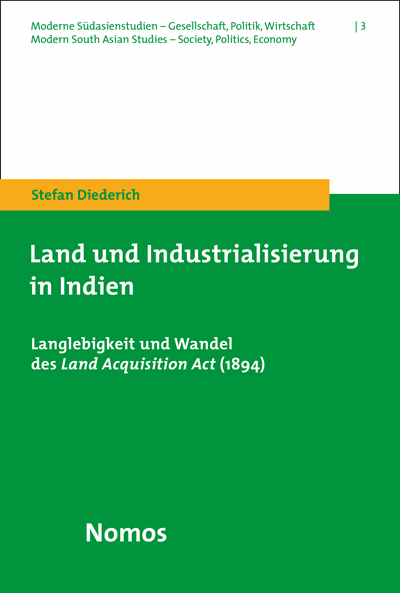
Land und Industrialisierung in Indien
Langlebigkeit und Wandel des Land Acquisition Act (1894)- Autor:innen:
- Reihe:
- Moderne Südasienstudien - Modern South Asian Studies, Band 3
- Verlag:
- 2015
Zusammenfassung
Die Bereitstellung von Land für große Industrie- und Infrastrukturprojekte hat sich in den vergangenen Jahren zu einem Schlüsselproblem der indischen Wirtschaft und Gesellschaft entwickelt. Die erbittert ausgeführten, teils gewaltsamen Konflikten um Land und das Scheitern großer Projekte haben die Frage nach der Legitimität der staatlichen Praxis der Landenteignungen aufgeworfen.
Die Arbeit widmet sich der zentralen Institution in diesem Bereich, dem aus der Kolonialzeit stammenden Land Acquisition Act (1894). Dieser ist nach der indischen Unabhängigkeit in Kraft geblieben und wurde im Jahre 2013 durch ein neues Gesetz ersetzt.
Der Fokus der Arbeit liegt auf den historischen Entwicklungen, die zu der Langlebigkeit des Gesetzes beigetragen haben. Zudem wird der politische Prozess, der zu der neuen Gesetzgebung geführt hat, im Detail untersucht.
Publikation durchsuchen
Bibliographische Angaben
- Auflage
- 1/2015
- Copyrightjahr
- 2015
- ISBN-Print
- 978-3-8487-2630-1
- ISBN-Online
- 978-3-8452-6747-0
- Verlag
- Nomos, Baden-Baden
- Reihe
- Moderne Südasienstudien - Modern South Asian Studies
- Band
- 3
- Sprache
- Deutsch
- Seiten
- 310
- Produkttyp
- Monographie
Inhaltsverzeichnis
- Titelei/Inhaltsverzeichnis Kein Zugriff Seiten 1 - 16
- 1.1 Fragestellung und Begriffsdefinition Kein Zugriff
- 1.2.1 Konflikte um Landenteignungen Kein Zugriff
- 1.2.2 Puzzle: Institutioneller Wandel nach 119 Jahren Kein Zugriff
- 1.3.1 Institutionen, Akteure und der Land Acquisition Act (1894) Kein Zugriff
- 1.3.2.1 Analytische Aufteilung I: Drei Ebenen der Eminent-Domain-Doktrin Kein Zugriff
- 1.3.2.2 Analytische Aufteilung II: Drei historische Phasen Kein Zugriff
- 1.3.3.1 Abgrenzung des Politikfelds Land Acquisition Policy Kein Zugriff
- 1.3.3.2 Politikfeldanalyse und der Advocacy-Koalitionen-Ansatz Kein Zugriff
- 1.4.1 Abhängige und unabhängige Variablen Kein Zugriff
- 1.4.2 Hypothesen Kein Zugriff
- 1.5 Aufbau der Arbeit Kein Zugriff
- 2.1 Literaturüberblick und Forschungsstand Kein Zugriff
- 2.2.1 Eminent Domain und das Holdout-Problem Kein Zugriff
- 2.2.2 Eminent Domain, Informationsdefizite und eine große Anzahl von Eigentümern Kein Zugriff
- 2.2.3 Eminent Domain und ‚idiosynkratische‘ Landeigentümer Kein Zugriff
- 2.2.4 Eminent Domain, unklare Rechtsverhältnisse und Fragmentierung von Landeigentum Kein Zugriff
- 2.2.5 Problematische Annahmen der Eminent-Domain-Doktrin Kein Zugriff
- 3.1.1 Privateigentum an Land Kein Zugriff
- 3.1.2 Gewohnheitsrecht und bürokratisches Recht Kein Zugriff
- 3.1.3 Zamindar und District Collector Kein Zugriff
- 3.1.4 Der Land Acquisition Act von 1894 und dessen Vorgänger Kein Zugriff
- 3.2.1 Die Constituent Assembly Debates und die Verfassung von 1950 Kein Zugriff
- 3.2.2.1 Der gebende und nehmende Staat: Landreformen und Industrialisierung Kein Zugriff
- 3.2.2.2 Der zehnte Bericht der Law Commission von 1958 Kein Zugriff
- 3.2.3 Bullock Capitalists und Adivasis Kein Zugriff
- 3.2.4 Zwischenfazit Kein Zugriff
- 3.3.1 Indira Gandhi und der Report des Land Acquisition Review Committee von 1970 Kein Zugriff
- 3.3.2 Die 44. Verfassungsänderung von 1978 Kein Zugriff
- 3.3.3 Der Land Acquisition (Amendment) Act von 1984 Kein Zugriff
- 3.3.4 Zwischenfazit Kein Zugriff
- 3.3.5 Konkretisierung der zweiten Hypothese Kein Zugriff
- 4.1.1 Die Diversität regionaler Land Acquisition Policies Kein Zugriff
- 4.1.2 Strukturelle Beschränkungen der Landesregierungen Kein Zugriff
- 4.2.1 Konfliktstruktur und Mobilisierungsmöglichkeiten Kein Zugriff
- 4.2.2.1 Ad-hoc-Koalitionen Kein Zugriff
- 4.2.2.2 Die Institutionalisierung der wandelorientierten Advocacy-Koalition (AK II) Kein Zugriff
- 4.2.3 Zwischenfazit Kein Zugriff
- 4.3.1 Landenteignungen als wedge issue in Wahlen Kein Zugriff
- 4.3.2 Landenteignungen als sicherheitspolitisches Problem Kein Zugriff
- 4.4.1 Die Argumentationstradition des wohlwollenden, planenden, Land gebenden und nehmenden Staates (AT 1) Kein Zugriff
- 4.4.2 Die Argumentationstradition des sich selbst beschränkenden Staates (AT 2) Kein Zugriff
- 4.4.3 Der Staat als Garant eines Landmarktes (AT 3) Kein Zugriff
- 4.4.4 Der Staat als Werkzeug des Kapitals (AT 4) Kein Zugriff
- 4.4.5 Policy-Output: Der sich selbst beschränkende Staat der AT 2 als Teilerfolg der AK II Kein Zugriff
- 4.5 Zwischenfazit: Zwei Advocacy-Koalitionen kristallisieren sich heraus Kein Zugriff
- 5. Schlussbetrachtung und Ausblick Kein Zugriff Seiten 277 - 284
- 6. Literaturverzeichnis Kein Zugriff Seiten 285 - 308
- Appendix Kein Zugriff Seiten 309 - 310
Literaturverzeichnis (290 Einträge)
Es wurden keine Treffer gefunden. Versuchen Sie einen anderen Begriff.
- Government of India, Department of Revenue, Comptroller and Auditor General of India: „Report No. 21: Performance of Special Economic Zones (SEZs)”, 2014, siehe online: <http://www.saiindia.gov.in/english/index.html>. Google Scholar öffnen DOI: 10.5771/9783845267470
- Government of India, Ministry of Agriculture, Department of Agriculture and Co-operation, Agriculture Census Division: Agriculture Census 2010-11: All India Report on Number and Area of Operational Holdings, 2014, online: <http://agcensus.nic.in/document/agcensus2010/completereport.pdf>. Google Scholar öffnen DOI: 10.5771/9783845267470
- Government of India, Ministry of Commerce & Industry, National Manufacturing Policy, 25.11.2011, online: <http://pib.nic.in/newsite/erelease.aspx?relid=76843>. Google Scholar öffnen DOI: 10.5771/9783845267470
- Government of India, Ministry of Commerce & Industry, Department of Industrial Policy & Promotion (DIPP), Industrial Policy Resolution 1956, Kapitel 1, online: <http://eaindustry.nic.in/handbk/chap001.pdf>. Google Scholar öffnen DOI: 10.5771/9783845267470
- Government of India, Ministry of Finance: Economic Survey 2013–14, online: <http://indiabudget.nic.in/survey.asp>. Google Scholar öffnen DOI: 10.5771/9783845267470
- Government of India, Ministry of Finance, Updated Harmonised Master List of Infrastructure Sub-Sectors, online: <http://finmin.nic.in/the_ministry/dept_eco_affairs/infrastructure_div/harmonisedmasterlist_infrastructure.pdf>. Google Scholar öffnen DOI: 10.5771/9783845267470
- Government of India, Ministry of Food, Agriculture, Community Development and Cooperation, Department of Agriculture: Report of the Land Acquisition Review Committee on the Land Acquisition Act, 1894, New Delhi, 1970. Google Scholar öffnen DOI: 10.5771/9783845267470
- Government of India, Ministry of Law and Justice: The Constitution of India, online: <http://lawmin.nic.in/olwing/coi/coi-english/coi-indexenglish.htm>. Google Scholar öffnen DOI: 10.5771/9783845267470
- Government of India: Government of India Act 1935, online: <www.opsi.gov.uk/acts/acts1935/pdf/ukpga_19350002_en.pdf>. Google Scholar öffnen DOI: 10.5771/9783845267470
- Government of India, Ministry of Law, Law Commission of India: „Tenth Report on the Law of Acquisition and Requisitioning of Land”, 1958, online: <http://www.lawcommissionofindia.nic.in/1-50/Report10.pdf>. Google Scholar öffnen DOI: 10.5771/9783845267470
- Government of India, Ministry of Rural Development: „Draft National Policy for Rehabilitation of Persons: Displaced as a Consequence of Acquisition of Land”, in: Economic and Political Weekly, Band 31, Heft 24, 1996, S. 1541-1545. Google Scholar öffnen DOI: 10.5771/9783845267470
- Government of India, Ministry of Rural Development (Department of Land Resources), Standing Committee on Rural Development (2011-2012), Fifteenth Lok Sabha: „The Land Acquisition, Rehabilitation and Resettlement Bill, 2011: 31. Report”, Lok Sabha Secretariat, New Delhi, Mai 2012, online: <http://www.dolr.nic.in/dolr/downloads/pdfs/Land%20Acquisition,%20Rehabilitation%20and%20Resettlement%20Bill%202011%20-%20SC(RD)'s%2031st%20Report.pdf>. Google Scholar öffnen DOI: 10.5771/9783845267470
- Government of India, Ministry of Rural Development (Department of Land Resources): Overview of The Right to Fair Compensation and Transparency in Land Acquisition, Rehabilitation and Resettlement Act, 2013, online: <http://www.dolr.nic.in/dolr/downloads/pdfs/RTTFC_in_LARR2013.pdf>. Google Scholar öffnen DOI: 10.5771/9783845267470
- Government of India, Ministry of Rural Development (Department of Land Resources): The Land Acquisition Act 1894, online: <http://dolr.nic.in/hyperlink/acq.htm>. Google Scholar öffnen DOI: 10.5771/9783845267470
- Government of India, Ministry of Rural Development (Department of Land Resources): The Right to Fair Compensation and Transparency in Land Acquisition, Rehabilitation and Resettlement Act, 2013, online: <http://indiacode.nic.in/acts-in-pdf/302013.pdf>. Google Scholar öffnen DOI: 10.5771/9783845267470
- Government of India, Ministry of Rural Development (Department of Land Resources), National Land Records Modernization Programme, online: <http://nlrmp.nic.in/>. Google Scholar öffnen DOI: 10.5771/9783845267470
- Government of India, Ministry of Rural Development, National Institute of Rural Development (NIRD): „Proceedings: National Consultation on the Draft National Land Acquisition and Rehabilitation & Resettlement Bill, 2011”, Konferenzbericht, Hyderabad, Oktober 2011. Google Scholar öffnen DOI: 10.5771/9783845267470
- Government of India, Ministry of Tribal Affairs: Scheduled Tribes and Other Traditional Forest Dwellers (Recognition of Forest Rights) Act, 2006, online: <http://www.tribal.nic.in/Content/ForestRightActOtherLinks.aspx>. Google Scholar öffnen DOI: 10.5771/9783845267470
- Government of India, Report of an Expert Group to Planning Commission: Development Challenges in Extremist Affected Areas, New Delhi, 2008, online: <http://www.planningcommission.nic.in/reports/publications/rep_dce.pdf>. Google Scholar öffnen DOI: 10.5771/9783845267470
- Parliament of India, Lok Sabha, Discussion on the motion for consideration of the Land Acquisition, Rehabilitation and Resettlement Bill, 2011, 29.08.2013, online: <http://164.100.47.132/LssNew/psearch/Result15.aspx?dbsl=10604>. Google Scholar öffnen DOI: 10.5771/9783845267470
- Parliament of India, Lok Sabha, Discussion on the motion for consideration of the Amendments made by Rajya Sabha to the Right to Fair Compensation and Transparency in Land Acquisition, Rehabilitation and Resettlement Bill, 2013 (Amendments Made By Rajya Sabha), Rehabilitation and Resettlement Bill, 2011, 05.09.2013, online: <http://164.100.47.132/LssNew/psearch/Result15.aspx?dbsl=10414>. Google Scholar öffnen DOI: 10.5771/9783845267470
- Parliament of India, Lok Sabha, Constituent Assembly Debates (Proceedings), online: <http://164.100.47.132/LssNew/cadebatefiles/cadebates.html>. Google Scholar öffnen DOI: 10.5771/9783845267470
- Parliament of India, Rajya Sabha, Debate on Right to Fair Compensation and Transparency in Land Acquisition, Rehabilitation and Resettlement Bill, 2013, 04.09.2013, online: <http://164.100.47.5/debatenew/newshow.aspx?arch=229>. Google Scholar öffnen DOI: 10.5771/9783845267470
- United Service Institution of India, National security: rise of naxalism, National and Global Security Architecture: Emerging Issues, Neu Delhi, 2007. Google Scholar öffnen DOI: 10.5771/9783845267470
- United Nations Environment Programme (UNEP): GEO5: Global Environmental Outlook. Environment for the future we want, Progress Press, Valletta, 2012, online: <http://www.unep.org/geo/GEO5_ebook/index.html>. Google Scholar öffnen DOI: 10.5771/9783845267470
- 3i Network and Infrastructure Development Finance Company (IDFC): Land: A Critical Resource for Infrastructure, Serie: India Infrastructure Report, Oxford University Press, New Delhi, 2009. Google Scholar öffnen DOI: 10.5771/9783845267470
- Aggarwala, Om Prakash: Compulsory Acquisition of Land in India: Commentary on the Land Acquisition Act, I of 1894, 6. Edition, University Book Agency, Allahabad, 1991. Google Scholar öffnen DOI: 10.5771/9783845267470
- Alexander, Gregory S.: „Eminent Domain and Secondary Rent-Seeking”, New York University Journal of Law & Liberty, Band 1, 2005, S. 958-966. Google Scholar öffnen DOI: 10.5771/9783845267470
- Alexander, P.C.: Industrial Estates in India, Asia Publishing House, London, 1963. Google Scholar öffnen DOI: 10.5771/9783845267470
- Anderson, Perry: Lineages of the Absolutist State, NLB, London, 1974. Google Scholar öffnen DOI: 10.5771/9783845267470
- Asher, Manshi: „The Entrepreneur’s Paradise and the Land of the Farmer”, in: Jenkins, Rob, Kennedy, Loraine und Mukhopadhyay, Partha (Hg.): Power, policy, and protest: the politics of India's special economic zones, Oxford University Press, New Delhi, 2014, S. 137-169. Google Scholar öffnen DOI: 10.5771/9783845267470
- Austin, Granville: The Indian Constitution: cornerstone of a nation, Clarendon Press, Oxford, 1966. Google Scholar öffnen DOI: 10.5771/9783845267470
- Austin, Granville: Working a Democratic Constitution: The Indian Experience, Oxford University Press, Oxford et. al., 1999. Google Scholar öffnen DOI: 10.5771/9783845267470
- Bachrach, Peter und Baratz, Morton S.: „Two Faces of Power“, in: The American Political Science Association, Band 56, Heft 4, 1962, S. 947-952. Google Scholar öffnen DOI: 10.5771/9783845267470
- Baden-Powell, Baden H.: The Land Systems of British India, Band II, Clarendon Press, Oxford, 1894. Google Scholar öffnen DOI: 10.5771/9783845267470
- Badgaiyan, S.D.: „Tribal worker in colonial industry”, in: Mishra, S.N. und Singh, Bhupinder (Hg.): Tribal Area Development, Society for the Study of Regional Disparities, Neu Delhi, 1983, S. 83-109. Google Scholar öffnen DOI: 10.5771/9783845267470
- Bandyopadhyay, D.: „Tebhaga Movement in Bengal: A Retrospect”, in: Economic and Political Weekly, Band 36, Heft 41, 2011, S. 3901-3903;3905-3907. Google Scholar öffnen DOI: 10.5771/9783845267470
- Bandyopadhyay, D.: „Foreword”, in: Mehrotra, Santosh (Hg.): Countering Naxalism with Development: Challenges of Social Justice and State Security, SAGE, Neu Delhi et. al., 2014, xi-xvi. Google Scholar öffnen DOI: 10.5771/9783845267470
- Banerjee, Partha Sarathi und Roy, Dayabati: „Behind the Present Peasant Unrest in West Bengal”, in: Economic and Political Weekly, Band 42, Heft 22, 2007, S. 2048-2050. Google Scholar öffnen DOI: 10.5771/9783845267470
- Banerjee, Partha Sarathi: „The SEZ Imbroglio”, in: Jenkins, Rob, Kennedy, Loraine und Mukhopadhyay, Partha (Hg.): Power, policy, and protest: the politics of India's special economic zones, Oxford University Press, New Delhi, 2014, S. 272-303. Google Scholar öffnen DOI: 10.5771/9783845267470
- Banerjee, Rahul: „Adivasis and Unjust Laws”, in Economic and Political Weekly, Band 42, Heft 39, 2007, S. 4010-4011. Google Scholar öffnen DOI: 10.5771/9783845267470
- Banerjee, Sumanta: India’s Simmering Revolution: The Naxalite Uprising, Zed Books, London, 1984. Google Scholar öffnen DOI: 10.5771/9783845267470
- Banerjee, Sumanta: „A Political Cul-de-Sac: CPI(M)'s Tragic Denouement”, in: Economic and Political Weekly, Band 43, Heft 42, 2008, S. 12-15. Google Scholar öffnen DOI: 10.5771/9783845267470
- Bardhan, Pranab: „Private property as a growth constraint in a hydraulic economy”, in: Land labor and rural poverty: essays in development economics, Columbia University Press, New Delhi und New York, 1984, S. 212-219. Google Scholar öffnen DOI: 10.5771/9783845267470
- Baru, Sanjaya: The Accidental Prime Minister: the making and unmaking of Manmohan Singh, Penguin, Neu Delhi, 2014. Google Scholar öffnen DOI: 10.5771/9783845267470
- Bates, Robert H. et. al.: Analytic Narratives, Princeton University Press, Princeton, New Jersey, 1998. Google Scholar öffnen DOI: 10.5771/9783845267470
- Baviskar, Amita: In the Belly of the River: Tribal Conflicts over Development in the Narmada Valley, Oxford University Press, New Delhi et. al., 1995. Google Scholar öffnen DOI: 10.5771/9783845267470
- Bedi, Heather P.: „Special Economic Zones: national land challenges, localized protest”, in: Contemporary South Asia, Band 21, Heft 1, 2013, S. 38-51. Google Scholar öffnen DOI: 10.5771/9783845267470
- Benson, Bruce L. (Hg.): Property Rights: Eminent Domain and Regulatory Takings Re-Examined, Palgrave Macmillan, New York, 2010 Google Scholar öffnen DOI: 10.5771/9783845267470
- Beverwijk, Jasmin, Goedegebuure, Leo und Huisman, Jeroen: „Policy change in nascent subsystems: Mozambican higher education policy 1993-2003”, in: Policy Sciences, Band 41, Heft 4, 2008, S. 357-377. Google Scholar öffnen DOI: 10.5771/9783845267470
- Beyer, Jürgen: „Pfadabhängigkeit ist nicht gleich Pfadabhängigkeit! Wider den impliziten Konservatismus eines gängigen Konzepts“, in: Zeitschrift für Soziologie, Jahrgang 34, Heft 1, 2005, S. 5-21. Google Scholar öffnen DOI: 10.5771/9783845267470
- Bhattacharyya, Harihar: „Communist Party of India (Marxist): From Rebellion To Governance”, in: Mitra, Subrata, Enskat, Mike und Spieß, Clemens (Hg.): Political Parties in South Asia, Praeger Publishers, Westport und London, 2004, S. 76-102. Google Scholar öffnen DOI: 10.5771/9783845267470
- Birkland, Thomas A.: „Focusing Events, Mobilization, and Agenda Setting”, in: Journal of Public Policy, Band 18, Heft 1, 1998, S. 53-74. Google Scholar öffnen DOI: 10.5771/9783845267470
- Blum, Sonja und Schubert, Klaus: Politikfeldanalyse (2. Auflage), VS Verlag für Sozialwissenschaften, Wiesbaden, 2011. Google Scholar öffnen DOI: 10.5771/9783845267470
- Bose, Deb Kumar: „Land Acquisition in West Bengal”, in: Economic and Political Weekly, Band 42, Heft 17, 2007, S. 1574-1575. Google Scholar öffnen DOI: 10.5771/9783845267470
- Brady, Henry E. und Collier, David (Hg.): Rethinking Social Inquiry: Diverse Tools, Shared Standards, Rowman & Littlefield Publishers, Lanham et. al., 2004. Google Scholar öffnen DOI: 10.5771/9783845267470
- Capoccia, Giovanni and Kelemen, R. Daniel: „The Study of Critical Junctures: Theory, Narrative, and Counterfactuals in Historical Institutionalism”, in: World Politics, Band 59, Heft 3, 2007, 341-69. Google Scholar öffnen DOI: 10.5771/9783845267470
- Cernea, Michael M.: „The Risk and Reconstruction Model for Resettling Displaced Populations”, in: World Development, Band 25, Heft 10, 1997, S. 1569-1587. Google Scholar öffnen DOI: 10.5771/9783845267470
- Cernea, Michael M. und Mathur, Hari Mohan (Hg.): Can compensation prevent impoverishment? reforming resettlement through investments and benefit-sharing, Oxford University Press, New Delhi, 2008. Google Scholar öffnen DOI: 10.5771/9783845267470
- Chakrabarty, Bidyut: Indian Politics and Society since Independence - Events, Processes and Ideology, Routledge, London und New York, 2008. Google Scholar öffnen DOI: 10.5771/9783845267470
- Chakrabarty, Bidyut: „The Left Front’s 2009 Lok Sabha Poll Debacle in West Bengal, India: Prospective Causes and Future Implications”, in: Asian Survey, Band 51, Heft 2, 2011, S. 290-310. Google Scholar öffnen DOI: 10.5771/9783845267470
- Chakravorty, Sanjoy und Lall, Somik V.: Made in India: The Economic Geography and Political Economy of Industrialization, Oxford University Press, Neu Delhi, 2007. Google Scholar öffnen DOI: 10.5771/9783845267470
- Chakravorty, Sanjoy: „A Lot of Scepticism and Some Hope”, in: Economic and Political Weekly, Band 46, Heft 41, 2011, S. 29-31. Google Scholar öffnen DOI: 10.5771/9783845267470
- Chakravorty, Sanjoy: The Price of Land: Acquisition, Conflict, Consequence, Oxford University Press, New Delhi, 2013. Google Scholar öffnen DOI: 10.5771/9783845267470
- Chandra, Nirmal Kumar: „Tata Motors in Singur: A Step towards Industrialisation or Pauperisation?” in: Economic and Political Weekly, Band 43, Heft 50, 2008, S. 36, 41-51. Google Scholar öffnen DOI: 10.5771/9783845267470
- Chaturvedi, P. und Dalal, A.: Law of Special Economic Zone: National and International Perspective, Eastern Law House, Kolkata, 2009. Google Scholar öffnen DOI: 10.5771/9783845267470
- Choudhary, Tarun: „Use of Eminent Domain: Process and Its Critique”, in: 3i Network and Infrastructure Development Finance Company (IDFC): Land: A Critical Resource for Infrastructure, Serie: India Infrastructure Report, Oxford University Press, New Delhi, 2009, S. 73-79. Google Scholar öffnen DOI: 10.5771/9783845267470
- Claus, Martina und Hartig, Sebastian: Verraten und verkauft in Rourkela: Zeitzeugen berichten von der Enteignung durch das deutsch-indische Stahlwerksprojekt Rourkela, Adivasi-Koordination in Deutschland e.V., Draupadi Verlag, Heidelberg, 2011. Google Scholar öffnen DOI: 10.5771/9783845267470
- Cohn, Bernard S.: Colonialism and its forms of knowledge: The British in India, Princeton University Press, Princeton, 1996. Google Scholar öffnen DOI: 10.5771/9783845267470
- Compston, Hugh: Policy Networks and Policy Change: Putting Policy Network Theory to the Test, Palgrave Macmillan, Basingstoke et. al., 2009. Google Scholar öffnen DOI: 10.5771/9783845267470
- Congost, Rosa: „Property Rights and Historical Analysis: What Rights? What History?” in: Past & Present, Heft 181, 2003, S. 73-106. Google Scholar öffnen DOI: 10.5771/9783845267470
- Conrad, Dieter: Zwischen den Traditionen: Probleme des Verfassungsrechts und der Rechtskultur in Indien und Pakistan: Gesammelte Aufsätze aus den Jahren 1970-1990, Franz Steiner Verlag, Stuttgart, 1999. Google Scholar öffnen DOI: 10.5771/9783845267470
- Conrad, Dieter: „Rechtssystem und Verfassung”, in: Rothermund, Dietmar (Hg.): Indien: Kultur, Geschichte, Politik, Wirtschaft, Umwelt: Ein Handbuch, C.H. Beck, München, 1995, S. 409-417. Google Scholar öffnen DOI: 10.5771/9783845267470
- Conrad, Dieter: „Administrative jurisdiction and the civil courts in the regime of land-law in India“, in: de Moor, Jap und Rothermund, Dietmar (Hg.): Our Laws, Their Lands: Land Laws and Land Use in Modern Colonial Societies, LIT Verlag, Münster und Hamburg, 1994, S.134-154. Google Scholar öffnen DOI: 10.5771/9783845267470
- Corbridge, Stuart und Harriss, John: Reinventing India: Liberalization, Hindu Nationalism and Popular Democracy, Polity Press, Malden, 2000. Google Scholar öffnen DOI: 10.5771/9783845267470
- Dahl, Robert A.: Who governs: democracy and power in an American city, Yale University Press, New Haven et. al., 1961. Google Scholar öffnen DOI: 10.5771/9783845267470
- Dasgupta, Ajit Kumar: A history of Indian economic thought, Routledge history of economic thought series Routledge, London et. al., 1993. Google Scholar öffnen DOI: 10.5771/9783845267470
- Deo, Nandini und Mc Duie-Ra, Duncan: The Politics of Collective Advocacy in India: Tools and Traps, Kumarian Press, Sterling, 2011. Google Scholar öffnen DOI: 10.5771/9783845267470
- Desai, Mihir: „Land Acquisition Law and the Proposed Changes“, in: Economic and Political Weekly, Band 46, Heft 46&27, 2011, S. 95-100. Google Scholar öffnen DOI: 10.5771/9783845267470
- Dharampal: Essays on Tradition, Band V, Recovery and Freedom, Other India Press, Mapusa, 2000. Google Scholar öffnen DOI: 10.5771/9783845267470
- Dohrmann, Jona Aravind: Directive principles of state policy in der indischen Verfassung unter Berücksichtigung der Staatszielbestimmungen des deutschen Grundgesetzes, Ergon Verlag, Würzburg, 2002. Google Scholar öffnen DOI: 10.5771/9783845267470
- Dye, Thomas R.: Policy Analysis: What governments do, why they do it, and what difference it makes, The University of Alabama Press, Tuscaloosa, 1976. Google Scholar öffnen DOI: 10.5771/9783845267470
- Enskat, Mike: Indiens wirtschaftspolitische Reformen nach 1991: Eine Fallstudie des Stromsektors, Inaugural-Dissertation, Universität Heidelberg, 2001. Google Scholar öffnen DOI: 10.5771/9783845267470
- Epstein, Richard A.: Takings - Private Property and the Power of Eminent Domain, Harvard University Press, Cambridge und London, 1985. Google Scholar öffnen DOI: 10.5771/9783845267470
- Evans, Peter B.: Embedded Autonomy: States and Industrial Transformation, Princeton University Press, Princeton, 1995. Google Scholar öffnen DOI: 10.5771/9783845267470
- Fernandes, Walter, Menon, Geeta und Viegas, Philip: Forests, Environment and Tribal Economy: Deforestation, Impoverishment and Marginalization in Orissa, Indian Social Institute, Neu Delhi, 1988. Google Scholar öffnen DOI: 10.5771/9783845267470
- Fernandes, Walter und Thukral, Enakshi Ganguly (Hg.): Development, displacement and rehabilitation: issues for a national debate, Indian Social Institute, Neu Delhi, 1989. Google Scholar öffnen DOI: 10.5771/9783845267470
- Fernandes, Walter (Hg.): The Land Acquisition (Amendmenrt) Bill 1998: For Liberalisation or for the Poor? Indian Social Institute, New Delhi, 1999. Google Scholar öffnen DOI: 10.5771/9783845267470
- Fernandes, Walter: „Rehabilitation as a Right: Where is the Policy?” in: Social Action, Band 55, Heft 2, 2005, S. 123-137. Google Scholar öffnen DOI: 10.5771/9783845267470
- Fernandes, Walter: „India’s Forced Displacement Policy and Practice: Is Compensation up to its Functions?” in: Cernea, Michael M. und Mathur, Hari Mohan (Hg.): Can compensation prevent impoverishment? Reforming resettlement through investments and benefit-sharing, Oxford University Press, New Delhi, 2008, S. 180-207. Google Scholar öffnen DOI: 10.5771/9783845267470
- Fernandes, Walter: „India’s Half Century Search for a Resettlement Policy and the Right to Livelihood”, in: Modi, Renu (Hg.): Beyond Relocation: The Imperative of Sustainable Resettlement, SAGE, Neu Delhi, et. al., 2009, S. 102-126. Google Scholar öffnen DOI: 10.5771/9783845267470
- Fischer, Frank und Forester, John (Hg.): The argumentative turn in policy analysis and planning, Duke University Press, Durham et. al., 1993. Google Scholar öffnen DOI: 10.5771/9783845267470
- Fischer, Frank: Reframing public policy: discursive politics and deliberative practices, Oxford University Press, Oxford et. al., 2003. Google Scholar öffnen DOI: 10.5771/9783845267470
- Fischer, Frank, Miller, Gerald J. und Sidney, Mara S.: Handbook of public policy analysis: theory, politics, and methods, CRC Press, Boca Raton et. al., 2007. Google Scholar öffnen DOI: 10.5771/9783845267470
- Frankel, Francine R.: India's Political Economy 1947-2004: The Gradual Revolution, 2. Edition, Oxford University Press, New Delhi, 2005. Google Scholar öffnen DOI: 10.5771/9783845267470
- Gadgil, Madhav und Guha, Ramachandra: This Fissured Land: An Ecological History of India, Oxford University Press, New Delhi, 1992. Google Scholar öffnen DOI: 10.5771/9783845267470
- Ghatak, Maitreesh und Mookherjee, Dilip: „Land Acquisition for Industrialization and Compensation of Displaced Farmers”, in: Journal of Development Economics, Band 110, 2014, S. 303-312. Google Scholar öffnen DOI: 10.5771/9783845267470
- Ghatak, Maitreesh und Ghosh, Parikshit: „India’s new Land Acquisition Act: A lost opportunity”, online: <http://blogs.lse.ac.uk/indiaatlse/2013/10/23/indias-new-land-acquisition-act-a-lost-opportunity/>. Google Scholar öffnen DOI: 10.5771/9783845267470
- Gonsalves, Colin: „Judicial Failure on Land Acquisition for Corporations”, in Economic and Political Weekly, Band 45, Heft 32, 2010, S. 37-42. Google Scholar öffnen DOI: 10.5771/9783845267470
- Guha, Abhijit: „Land Acquisition in a West Bengal District”, in: Economic and Political Weekly, Band 39, Heft 42, 2004, S. 4620-4623. Google Scholar öffnen DOI: 10.5771/9783845267470
- Guha, Abhijit: Land, law and the left: the saga of disempowerment of the peasantry in the era of globalization, Concept Publishing Company, New Delhi, 2007. Google Scholar öffnen DOI: 10.5771/9783845267470
- Guha, Ramachandra: „Adivasis, Naxalites and Indian Democracy”, in: Economic and Political Weekly, Band 42, Heft 32, 2007, S. 3305-3312. Google Scholar öffnen DOI: 10.5771/9783845267470
- Guha, Ramachandra: The Unquiet Woods: Ecological Change and Peasant Resistance in the Himalaya, 20. Anniversary Edition, Permanent Black, Ranikhet, 2010. Google Scholar öffnen DOI: 10.5771/9783845267470
- Gupta, Priya: „The peculiar circumstances of eminent domain in India”, in: Osgoode Hall Law Journal, Band 49, Heft 3, 2012, S. 445-489. Google Scholar öffnen DOI: 10.5771/9783845267470
- Gurr, Ted Robert: Why Men Rebel, Princeton University Press, Princeton, 1970. Google Scholar öffnen DOI: 10.5771/9783845267470
- Habib, Irfan: The Agrarian System of Mughal India 1556-1707, 3. Edition, Oxford University Press, New Delhi, 2014. Google Scholar öffnen DOI: 10.5771/9783845267470
- Hajer, M.A.: „Discourse analysis and the study of policy making”, in: European Political Science 2(1), S. 61–65, online: <http://www.maartenhajer.nl/upload/Hajer%20EPS.pdf>. Google Scholar öffnen DOI: 10.5771/9783845267470
- Hall, Peter A., Taylor und Rosemary, C. R.: „Political science and the three new institutionalisms”, in: Max-Planck-Institut für Gesellschaftsforschung (MPIFG), discussion paper, Köln, 1996. Google Scholar öffnen DOI: 10.5771/9783845267470
- Hancock, M. Donald: „Comparative Public Policy: An Assessment“, in: Finifter, Ada (Hg.), Political Science: The State of the Discipline, Washington DC, American Political Science Association, 1983, S. 283-308. Google Scholar öffnen DOI: 10.5771/9783845267470
- Hardgrave, Robert L. und Kochanek, Stanley A.: India: Government and Politics in a Developing Nation, 7. Edition, Thomson Wadsworth, Boston, 2008. Google Scholar öffnen DOI: 10.5771/9783845267470
- Hillygus, D. Sunshine und Shields, Todd G.: The Persuadable Voter: Wedge Issues in Presidential Campaigns, Princeton University Press, Princeton und Oxford, 2008. Google Scholar öffnen DOI: 10.5771/9783845267470
- Huntington, Samuel P.: Political order in changing societies, Yale University Press, New Haven et. al., 1969. Google Scholar öffnen DOI: 10.5771/9783845267470
- Heclo, Hugh: „Issue Networks and the Executive Establishment”, in: King, Anthony (Hg.): The New American Political System, American Enterprise Institute, Washington, 1978, S. 87-124. Google Scholar öffnen DOI: 10.5771/9783845267470
- Immergut, Ellen M.: Health Politics - Interests and Institutions in Western Europe, Cambridge University Press, Cambridge 1992. Google Scholar öffnen DOI: 10.5771/9783845267470
- Iyer, Ramaswamy R.: „Towards a Just Displacement and Rehabilitation Policy”, in: Economic and Political Weekly, Band 42, Heft 39, 2007, S. 3103-3107. Google Scholar öffnen DOI: 10.5771/9783845267470
- Jain, H.M.: Right to property under the Indian constitution, Chaitanya, Allahabad, 1968. Google Scholar öffnen DOI: 10.5771/9783845267470
- Jain, M.P.: „The Supreme Court and Fundamental Rights“, in: Verma, S.K. (Hg.): Fifty Years of the Supreme Court of India: Its Grasp and Reach, Indian Law Institute, Oxford University Press, Oxford, 2000, S. 1-100. Google Scholar öffnen DOI: 10.5771/9783845267470
- Jalal, Ayesha: Democracy and Authoritarianism in South Asia: A Comparative and Historical Perspective, Cambridge University Press, Cambridge et. al., 1995. Google Scholar öffnen DOI: 10.5771/9783845267470
- Janning, Frank et. al.: Politiknetzwerke: Modelle, Anwendungen und Visualisierungen, VS Verlag für Sozialwissenschaften, Wiesbaden, 2009. Google Scholar öffnen DOI: 10.5771/9783845267470
- Jellinek, Georg: Allgemeine Staatsleere, 3. Auflage, Springer Verlag, Berlin und Heidelberg, 1921. Google Scholar öffnen DOI: 10.5771/9783845267470
- Jenkins, Rob: Democratic Politics and Economic Reform in India, Cambridge University Press, Cambridge, 1999. Google Scholar öffnen DOI: 10.5771/9783845267470
- Jenkins, Rob: „Land, Rights and Reform in India”, in Pacific Affairs, Band 86, Heft 3, 2013, S. 591-612. Google Scholar öffnen DOI: 10.5771/9783845267470
- Jenkins, Rob, Kennedy, Loraine und Mukhopadhyay, Partha (Hg.): Power, policy, and protest: the politics of India's special economic zones, Oxford University Press, New Delhi, 2014. Google Scholar öffnen DOI: 10.5771/9783845267470
- John, Peter: „Is There Life After Policy Streams, Advocacy Coalitions, and Punctuations: Using Evolutionary Theory to Explain Policy Change?” in: Policy Studies Journal, Band 31, Heft 4, 2003, S. 481-498. Google Scholar öffnen DOI: 10.5771/9783845267470
- Katzenstein, Mary, Kothari, Smitu und Mehta, Uday: „Social movement politics in India: institutions, interests, and identities”, in: Kohli, Atul (Hg.): The Success of India’s Democracy, Cambridge University Press, Cambridge et. al., 2001, S. 242-269. Google Scholar öffnen DOI: 10.5771/9783845267470
- Kelly, Daniel B.: „Acquiring Land Through Eminent Domain: Justifications, Limitations, and Alternatives”, in: Ayotte, Kenneth and Smith, Henry E. (Hg.): Research Handbook on the Economic Analysis of Property Law, Edward Elgar Publishing, 2011, siehe online: <http://papers.ssrn.com/sol3/papers.cfm?abstract_id=1671693>. Google Scholar öffnen DOI: 10.5771/9783845267470
- Kennedy, Loraine: „Beyond the Rural-Urban Divide”, in: Jenkins, Rob, Kennedy, Loraine und Mukhopadhyay, Partha (Hg.): Power, policy, and protest: the politics of India's special economic zones, Oxford University Press, New Delhi, 2014, S.170-202. Google Scholar öffnen DOI: 10.5771/9783845267470
- King, Gary, Keohane, Robert O. und Verba, Sidney: Designing Social Inquiry: Scientific Inference in Qualitative Research, Princeton University Press, Princeton, 1994. Google Scholar öffnen DOI: 10.5771/9783845267470
- Kitay, Michael G.: Land Acquisition in Developing Countries: Policies and Procedures for the Public Sector, Oelgeschlager, Gunn & Hain in association with the Lincoln Institute of Land Policy, Boston, 1985. Google Scholar öffnen DOI: 10.5771/9783845267470
- Kohli, Atul: The State and Poverty in India: The Politics of Reform, Cambridge University Press, Cambridge et. al., 1987. Google Scholar öffnen DOI: 10.5771/9783845267470
- Kohli, Atul: State-Directed Development: Political Power and Industrialization in the Global Periphery, Cambridge University Press, Cambridge et. al., 2004. Google Scholar öffnen DOI: 10.5771/9783845267470
- Kujur, Joseph Marianus: „Development, displacement and rehabilitation: The context of tribes in central India”, in: Somayaji, Sakarama und Talwar, Smrithi (Hg.): Development-induced displacement, rehabilitation and resettlement in India, Routledge, London, 2011, S. 134-150. Google Scholar öffnen DOI: 10.5771/9783845267470
- Kothari, Rajni: State against Democracy: In Search of Humane Governance, Ajanta Publications, Neu Delhi, 1989. Google Scholar öffnen DOI: 10.5771/9783845267470
- Kothari, Rajni: „The Congress 'System' in India”, in: Asian Survey, Band 4, Heft 12, 1964, S. 1161-1173 Google Scholar öffnen DOI: 10.5771/9783845267470
- Kulke, Hermann und Rothermund, Dietmar: A History of India, 3. Edition, Routledge, London & New York, 1998. Google Scholar öffnen DOI: 10.5771/9783845267470
- Kulke, Hermann und Rothermund, Dietmar: A History of India, 4. Edition, Routledge, London & New York, 2004. Google Scholar öffnen DOI: 10.5771/9783845267470
- Kumar, Dharma: Colonialism, property and the state, Oxford University Press, New Delhi et. al., 1998. Google Scholar öffnen DOI: 10.5771/9783845267470
- Levi, Margaret: „A Model, a Method, and a Map: Rational Choice in Comparative and Historical Analysis”, in: Lichbach, Mark I. und Zuckerman, Alan S.: Comparative Politics: Rationality, Culture, and Structure, Cambridge, Cambridge University Press, 1997, S. 19-41. Google Scholar öffnen DOI: 10.5771/9783845267470
- Levien, Michael: „India's Double-Movement: Polanyi and the National Alliance of People's Movements”, in: Berkeley Journal of Sociology, Band 51, 2007, S. 119-149. Google Scholar öffnen DOI: 10.5771/9783845267470
- Levien, Michael: „Regimes of Dispossession: From Steel Towns to Special Economic Zones”, in: Development and Change, Band 44, Heft 2, 2013 (a), S. 381-407. Google Scholar öffnen DOI: 10.5771/9783845267470
- Levien, Michael: „The Politics of Dispossession: Theorizing India’s ‘Land Wars’”, in: Politics & Society, Band 41, Heft 3, 2013 (b), S. 351-394. Google Scholar öffnen DOI: 10.5771/9783845267470
- Lipsky, Michael: „Street-Level Bureaucracy. Dilemmas of the Individual in Public Services”, in: Handel, Michael J. (Hg.): The Sociology of Organizations. Classic, Contemporary, and Critical Readings, Sage Publications, Thousand Oaks, London et. al., 2003, S. 503-518. Google Scholar öffnen DOI: 10.5771/9783845267470
- Lobo, Lancy und Kumar, Shashikant: Land acquisition, displacement and resettlement in Gujarat: 1947-2004, SAGE, New Delhi, 2009. Google Scholar öffnen DOI: 10.5771/9783845267470
- Locke, John: Second Treatise of Government, mit einer Einleitung von C.B. Macpherson, Hackett Publishing Company, Indianapolis und Cambridge, 1980 (im Original 1690). Google Scholar öffnen DOI: 10.5771/9783845267470
- Lütt, Jürgen: Das moderne Indien 1498 bis 2004, Oldenbourg Verlag, München, 2012. Google Scholar öffnen DOI: 10.5771/9783845267470
- Lukes, Steven: Power: A Radical View, 2. Edition, Palgrave Macmillan, Basingstoke, 2005. Google Scholar öffnen DOI: 10.5771/9783845267470
- Malloy, Robin Paul (Hg.): Private Property, Community Development, and Eminent Domain, Ashgate, Hampshire und Burlington, 2008. Google Scholar öffnen DOI: 10.5771/9783845267470
- March, James G.: „Bounded Rationality, Ambiguity, and the Engineering of Choice”, in: The Bell Journal of Economics, Band 9, Heft 2, 1978, S. 587-608. Google Scholar öffnen DOI: 10.5771/9783845267470
- Marx, Karl: Das Kapital, Band I, Kritik der politischen Ökonomie, Der Produktionsprozeß des Kapitals, online: <http://www.mlwerke.de/me/me23/me23_000.htm>. Google Scholar öffnen DOI: 10.5771/9783845267470
- Marx, Karl: „Land Tenure in India”, in: New York Daily Tribune, 7. Juni 1858, in: Avineri, Shlomo (Hg.): Karl Marx on Colonialism & Modernization, Anchor Books, Garden City, New York, 1969. Google Scholar öffnen DOI: 10.5771/9783845267470
- Mathur, G.C. und Ramachandran, V.G. (Hg.): The Law of Land Acquisition and Compensation, 8. Edition, Eastern Book Company, Lucknow, 1995. Google Scholar öffnen DOI: 10.5771/9783845267470
- Mathur, Hari Mohan: „Gender Biases in Resettlement Planning“, in: Mehta, Lyla (Hg.): Displaced by development: confronting marginalisation and gender injustice, SAGE, New Delhi et. al., 2009, S. 166-193. Google Scholar öffnen DOI: 10.5771/9783845267470
- Mathur, Hari Mohan: Displacement and Resettlement in India: The human cost of development, Routledge, London und New York, 2013. Google Scholar öffnen DOI: 10.5771/9783845267470
- Mearns, Robin: “Access to Land in Rural India”, Policy Research Working Paper 2123, The World Bank, South Asia Region, Rural Development Sector Unit Washington, 1999, online: <http://www-wds.worldbank.org/external/default/WDSContentServer/IW3P/IB/1999/09/14/000094946_99060905321228/Rendered/PDF/multi_page.pdf>. Google Scholar öffnen DOI: 10.5771/9783845267470
- Mehta, Lyla (Hg.): Displaced by development: confronting marginalisation and gender injustice, SAGE, New Delhi et. al., 2009. Google Scholar öffnen DOI: 10.5771/9783845267470
- Merillat, H.C.L.: Land and the Constitution in India, Columbia University Press, New York und London, 1970. Google Scholar öffnen DOI: 10.5771/9783845267470
- Metcalf, Thomas R.: Ideologies of the Raj, Cambridge University Press, Cambridge, 1995. Google Scholar öffnen DOI: 10.5771/9783845267470
- Metcalf, Barbara D. und Metcalf, Thomas R.: A concise history of modern India, 2. Edition, Cambridge University Press, Cambridge, 2006. Google Scholar öffnen DOI: 10.5771/9783845267470
- Meyer, Renate und Hammerschmid, Gerhard: „Die Mikroperspektive des Neo-Institutionalismus: Konzeption und Rolle des Akteurs“, in: Senge, Konstanze (Hg.): Einführung in den Neo- Institutionalismus, VS Verlag für Sozialwissenschaften, Wiesbaden, 2006. Google Scholar öffnen DOI: 10.5771/9783845267470
- Miceli, Thomas J.: The Economic Theory of Eminent Domain: Private Property, Public Use, Cambridge University Press, Cambridge und New York, 2011. Google Scholar öffnen DOI: 10.5771/9783845267470
- Miller, Robert J. et.al (Hg.): Discovering indigenous lands - the doctrine of discovery in the English colonies, Oxford University Press, Oxford, 2010. Google Scholar öffnen DOI: 10.5771/9783845267470
- De Moor, Jap und Rothermund, Dietmar (Hg.): Our Laws, Their Lands: Land Laws and Land Use in Modern Colonial Societies, LIT Verlag, Münster, 1994. Google Scholar öffnen DOI: 10.5771/9783845267470
- Mishra, S.N.: „Tribal economic formations based upon settled agriculture and their modes of dissolution”, in: Mishra, S.N. und Singh, Bhupinder (Hg.): Tribal Area Development, Society for the Study of Regional Disparities, Neu Delhi, 1983, S. 66-79. Google Scholar öffnen DOI: 10.5771/9783845267470
- Mishra, Banikanta und Nayak, Birendra Kumar: „Paan or POSCO?“, in: Economic and Political Weekly, Band 46, Heft 26&27, 2011, S. 12-13. Google Scholar öffnen DOI: 10.5771/9783845267470
- Mitra, Subrata K: „Room to Maneuver in the Middle: Local Elites, Political Action, and the State in India”, in: World Politics, Band 43, Heft 3, 1991, S. 390-413. Google Scholar öffnen DOI: 10.5771/9783845267470
- Mitra, Subrata K.: Power, protest and participation: local elites and the politics of development in India, Routledge, London et. al., 1992. Google Scholar öffnen DOI: 10.5771/9783845267470
- Mitra, Subrata K.: The Puzzle of India's Governance: Culture, context and comparative theory, Routledge, New York, 2006. Google Scholar öffnen DOI: 10.5771/9783845267470
- Mitra, Subrata K. und Singh, V.B.: When Rebels Become Stakeholders: Democracy, Agency and Social Change in India, SAGE, New Delhi et. al., 2009. Google Scholar öffnen DOI: 10.5771/9783845267470
- Mitra, Subrata K.: Politics in India: structure, process and policy, Routledge, London und New York, 2011. Google Scholar öffnen DOI: 10.5771/9783845267470
- Mitra, Subrata K.: „How Exceptional is India's Democracy? Path Dependence, Political Capital, and Context in South Asia”, in: India Review, Band 12, Heft 4, 2013, S. 227-244. Google Scholar öffnen DOI: 10.5771/9783845267470
- Mody, Anjali: „The Primacy of the Local”, in: Jenkins, Rob, Kennedy, Loraine und Mukhopadhyay, Partha (Hg.): Power, policy, and protest: the politics of India's special economic zones, Oxford University Press, New Delhi, 2014, S. 203-238. Google Scholar öffnen DOI: 10.5771/9783845267470
- Moore, Barrington: Social Origins of Dictatorship and Democracy: Lord and Peasant in the Making of the Modern World, Penguin University Books, Harmondsworth, 1966. Google Scholar öffnen DOI: 10.5771/9783845267470
- Morris, Sebastian und Pandey, Ajay: „Land Markets in India: Distortions and Issues”, in: 3i Network and Infrastructure Development Finance Company (IDFC): Land: A Critical Resource for Infrastructure, Serie: India Infrastructure Report, Oxford University Press, New Delhi, 2009, S. 13-19. Google Scholar öffnen DOI: 10.5771/9783845267470
- Mujumdar, Rohit und Menezes, Benita: „Institutional Politics and the Framing of Resistance”, in: Jenkins, Rob, Kennedy, Loraine und Mukhopadhyay, Partha (Hg.): Power, policy, and protest: the politics of India's special economic zones, Oxford University Press, New Delhi, 2014, S. 239-271. Google Scholar öffnen DOI: 10.5771/9783845267470
- Mukherjee, Hena: The Early History of the East Indian Railway: 1845-1879, Firma KLM Private Limited, Kolkata, 1994. Google Scholar öffnen DOI: 10.5771/9783845267470
- Mukherji, Rahul: „The State, Economic Growth, and Development in India”, in: India Review, Band 8, Heft 1, 2009, S. 81-106. Google Scholar öffnen DOI: 10.5771/9783845267470
- Mukhopadhyay, Bhaskar: „Introduction”, in: Mukhopadhyay, Bhaskar und Marriott, John (Hg.): Britain in India: 1765-1905, Band 2, Land Revenue and Trade, Pickering & Chatto, London, 2006. Google Scholar öffnen DOI: 10.5771/9783845267470
- Munch, Patricia: „An Economic Analysis of Eminent Domain”, in: Journal of Political Economy, Band 84, Heft 3, 1976, S. 473-498. Google Scholar öffnen DOI: 10.5771/9783845267470
- Myrdal, Gunnar: Asian Drama: an inquiry into the poverty of nations, Penguin Books, Harmondsworth, 1968. Google Scholar öffnen DOI: 10.5771/9783845267470
- Nakamura, Robert T.: „The Textbook Policy Process and Implementation Research”, in: Policy Studies Review, Band 7, Heft 1, 1987, S. 142-154. Google Scholar öffnen DOI: 10.5771/9783845267470
- Nallathiga, Ramakrishna: „An Assessment of Land Acquisition under Hyderabad outer Ring Road Project”, in: Indian Journal of Transport Management, Band 38, Heft 2, 2014, S. 124-137. Google Scholar öffnen DOI: 10.5771/9783845267470
- National Alliance of People’s Movements (NAPM): „Development planning, minimum displacement and just rehabilitation policy (A preliminary draft prepared by NAPM and others)”, in: Social Change, Band 38, Heft 1, 2008, S. 119-152. Google Scholar öffnen DOI: 10.5771/9783845267470
- Nehru, Jawaharlal: Selected works of Jawaharlal Nehru / Series 2; Band 32, Jawaharlal Nehru Memorial Fund, New Delhi, 2003 (im Orginal 1956). Google Scholar öffnen DOI: 10.5771/9783845267470
- McNulty, William: „Eminent Domain in Continental Europe”, in: The Yale Law Journal, Band 21, Heft 8, 1912, S. 555-570. Google Scholar öffnen DOI: 10.5771/9783845267470
- Nilsen, Alf Gunvald: Dispossession and Resistance in India: The river and the rage, Routledge, London und New York, 2010. Google Scholar öffnen DOI: 10.5771/9783845267470
- Nielsen, Kenneth Bo: „Contesting India’s Development? Industrialisation, Land Acquisition and Protest in West Bengal”, in: Forum for Development Studies, Band 37, Heft 2, 2010, S. 145-170. Google Scholar öffnen DOI: 10.5771/9783845267470
- North, Douglass C.: Institutions, institutional change and economic performance, Cambridge University Press, Cambridge et. al., 1990. Google Scholar öffnen DOI: 10.5771/9783845267470
- Osterhammel, Jürgen: Kolonialismus: Geschichte, Formen, Folgen, C.H. Beck Verlag, München, 1995. Google Scholar öffnen DOI: 10.5771/9783845267470
- Ostrom, Elinor: „Institutional Rational Choice: An Assessment of the Institutional Analysis and Development Framework”, in: Sabatier, Paul A. (Hg.): Theories of the Policy Process, Westview Press, Boulder, 2007, S. 21-65. Google Scholar öffnen DOI: 10.5771/9783845267470
- Pai, Sudha und Kumar, Avinash: „Contrasting Cases from the National Capital Region“, in: Jenkins, Rob, Kennedy, Loraine und Mukhopadhyay, Partha (Hg.): Power, policy, and protest: the politics of India's special economic zones, Oxford University Press, New Delhi, 2014, S. 332-361. Google Scholar öffnen DOI: 10.5771/9783845267470
- Palit, Amitendu und Bhattacharjee, Subhomoy: Special Economic Zones in India: Myths and Realities, Anthem Press, London et. al., 2008 Google Scholar öffnen DOI: 10.5771/9783845267470
- Panagariya, Arvind: India: The Emerging Giant, Oxford University Press, New York, 2006. Google Scholar öffnen DOI: 10.5771/9783845267470
- Parry, Jonathan und Struempell, Christian: „On the Desecration of Nehru's 'Temples': Bhilai and Rourkela Compared“, in: Economic and Political Weekly, Band 43, Heft 19, 2008, S. 47-57. Google Scholar öffnen DOI: 10.5771/9783845267470
- Patnaik, Utsa: „Agrarian Distress and Land Acquisition”, 2011, online: <http://mrzine.monthlyreview.org/2011/patnaik130611.html>. Google Scholar öffnen DOI: 10.5771/9783845267470
- Pfetsch, Frank R.: Theoretiker der Politik: von Platon bis Habermas, Nomos Verlag, Baden-Baden, 2012. Google Scholar öffnen DOI: 10.5771/9783845267470
- Pierson, Paul: „Increasing Returns, Path Dependence, and the Study of Politics”, in: The American Political Science Review, Band 94, Heft 2, 2000, S. 251-267. Google Scholar öffnen DOI: 10.5771/9783845267470
- Polanyi, Karl: The Great Transformation: The Political and Economic Origins of Our Time, Beacon Press, Boston, 2011 (im Orginal 1944). Google Scholar öffnen DOI: 10.5771/9783845267470
- Porwal, Vivek Kumar und Singh, Shashi Ratnaker: „Land Acquisition and determination of land price: A critical appraisal of the existing and proposed normative framework as applied in Singrauli District, Madhya Pradesh“, in: Somayaji, Sakarama und Talwar, Smrithi (Hg.): Development-induced displacement, rehabilitation and resettlement in India, Routledge, London, 2011, S. 61-74. Google Scholar öffnen DOI: 10.5771/9783845267470
- Prakash, Amit: Politics and Internal Security, Popular Prakashan, Neu Delhi, 2005. Google Scholar öffnen DOI: 10.5771/9783845267470
- Ram Mohan, M.P. und Shiju, M.V.: „Land Acquisition Act, 1894: historical overview of judicial interpretation”, in: Somayaji, Sakarama und Talwar, Smrithi (Hg.): Development-induced displacement, rehabilitation and resettlement in India, Routledge, London, 2011, S. 13-22. Google Scholar öffnen DOI: 10.5771/9783845267470
- Ramanathan, Swati: „Security of Title to Land in Urban Areas”, in: 3i Network and Infrastructure Development Finance Company (IDFC): Land: A Critical Resource for Infrastructure, Serie: India Infrastructure Report, Oxford University Press, New Delhi, 2009, S. 20-28. Google Scholar öffnen DOI: 10.5771/9783845267470
- Ramanathan, Usha: „A Word on Eminent Domain”, in: Mehta, Lyla (Hg.): Displaced by development: confronting marginalisation and gender injustice, SAGE, New Delhi et. al., 2009, S. 133-145. Google Scholar öffnen DOI: 10.5771/9783845267470
- Ramanathan, Usha: „On Eminent Domain and Souvereignty”, in: Seminar Magazine, Heft 613, 2010, S. 71 ff., online: <http://india-seminar.com/semsearch.htm>. Google Scholar öffnen DOI: 10.5771/9783845267470
- Ramanathan, Usha: „Land Acquisition, Eminent Domain and the 2011 Bill”, in: Economic and Political Weekly, Band 46, Heft 44+45, 2011, S. 10-14. Google Scholar öffnen DOI: 10.5771/9783845267470
- Ray, Sanjukta und Patra, Shreemoyee: „Evolution of Political Economy of Land Acquisition“, in: 3i Network and Infrastructure Development Finance Company (IDFC): Land: A Critical Resource for Infrastructure, Serie: India Infrastructure Report, Oxford University Press, New Delhi, 2009, S. 41-43. Google Scholar öffnen DOI: 10.5771/9783845267470
- Reynolds, Susan: Before Eminent Domain: Toward a History of Expropriation of Land for the Common Good, The University of North Carolina Press, Chapel Hill, 2010. Google Scholar öffnen DOI: 10.5771/9783845267470
- Robb, Peter: A History of India, Palgrave Macmillan, Houndsmills et. al., 2002. Google Scholar öffnen DOI: 10.5771/9783845267470
- Rothermund, Dietmar: Government, Landlord and Peasant in India: Agrarian Relations under British Rule 1865-1935, Franz Steiner Verlag, Wiesbaden, 1978. Google Scholar öffnen DOI: 10.5771/9783845267470
- Rothermund, Dietmar: An economic history of India: from pre-colonial times to 1991, 2. Edition, Routledge, London und New York, 1993. Google Scholar öffnen DOI: 10.5771/9783845267470
- Rothermund, Dietmar: „Land-revenue law and land records in British India”, in: De Moor, Jap und Rothermund, Dietmar (Hg.): Our Laws, Their Lands: Land Laws and Land Use in Modern Colonial Societies, LIT Verlag, Münster, 1994, S. 120-133. Google Scholar öffnen DOI: 10.5771/9783845267470
- Rothermund, Dietmar: Indien: Aufstieg einer asiatischen Weltmacht, C.H. Beck, München, 2008. Google Scholar öffnen DOI: 10.5771/9783845267470
- Roy, Dayabati: „A Narrative of Peasant Resistance: Land, Party and the State“, in: Roy, Dayabati: Rural Politics in India, Cambridge University Press, Cambridge, 2014. Google Scholar öffnen DOI: 10.5771/9783845267470
- Roy, Srirupa: Beyond Belief: India and the Politics of Postcolonial Nationalism, Duke University Press, Durham und London, 2007. Google Scholar öffnen DOI: 10.5771/9783845267470
- Rudolph, Susanne Hoeber und Rudolph, Lloyd I.: In pursuit of Lakshmi: the political economy of the Indian state, University of Chicago Press, Chicago et. al., 1987. Google Scholar öffnen DOI: 10.5771/9783845267470
- Rudolph, Susanne Hoeber und Rudolph, Lloyd I.: „The Iconization of Chandrababu: Sharing Sovereignty in India's Federal MArket Economy”, in: Economic and Political Weekly, Band 36, Heft 18, 2001, S. 1541-1551. Google Scholar öffnen DOI: 10.5771/9783845267470
- Ryskamp, John: The Eminent Domain Revolt - Changing Perceptions in a New Constitutional Epoch, Algora Publishing, New York, 2007. Google Scholar öffnen DOI: 10.5771/9783845267470
- Sabatier, Paul A.: „An Advocacy Coalition Framework of Policy Change and the Role of Policy-Oriented Learning Therein”, in: Policy Sciences, Band 21, Heft 2/3, 1988, S. 129-168. Google Scholar öffnen DOI: 10.5771/9783845267470
- Sabatier, Paul A. und Jenkins-Smith, Hank C. (Hg.): Policy change and learning: an advocacy coalition approach, Westview Press, Boulder, 1993. Google Scholar öffnen DOI: 10.5771/9783845267470
- Sabatier, Paul A. und Jenkins-Smith, Hank C.: „Evaluating the Advocacy Coalition Framework”, in. Journal of Public Policy, Band 14, Heft 2, 1994, S. 175-203. Google Scholar öffnen DOI: 10.5771/9783845267470
- Sabatier, Paul A. und Jenkins-Smith, Hank C.: „The Advocacy Coalition Framework: An Assessment”, in: Sabatier, Paul A. (Hg.): Theories of the Policy Process, Westview Press, Boulder, 1999, S. 117-166. Google Scholar öffnen DOI: 10.5771/9783845267470
- Sabatier, Paul A. und Weible, Christopher M.: „The Advocacy Coalition Framework: Innovations and Clarifications”, in: Sabatier, Paul A. (Hg.): Theories of the Policy Process, Westview Press, Boulder, 2007, S. 189-222. Google Scholar öffnen DOI: 10.5771/9783845267470
- Sarangi, Debendranath: „Infrastructure development: a public–private partnership in India”, in: International Social Science Journal, Band 54, Heft 172, 2002, S. 267-271. Google Scholar öffnen DOI: 10.5771/9783845267470
- Sarkar, Sumit: Modern India: 1885-1947, Macmillan, New Delhi, 1983. Google Scholar öffnen DOI: 10.5771/9783845267470
- Sarkar, Runa: „Land Markets in India”, in: 3i Network and Infrastructure Development Finance Company (IDFC): Land: A Critical Resource for Infrastructure, Serie: India Infrastructure Report, Oxford University Press, New Delhi, 2009, S. 2-3. Google Scholar öffnen DOI: 10.5771/9783845267470
- Sarkar, Smritikumar: „Land Acquisition for the Railways in Bengal, 1850–62”, in: Studies in History, Band 26, Heft 2, 2010, S. 103-142. Google Scholar öffnen DOI: 10.5771/9783845267470
- Sarkar, Swagato: „The Impossibility of Just Land Acquisition”, in: Economic and Political Weekly, Band 46, Heft 41, 2011, S. 35-38. Google Scholar öffnen DOI: 10.5771/9783845267470
- Sarkar, Abhirup: „Development, Displacement, and Food Security: Land Acquisition in India”, in: Ghate, Chetan (Hg.): The Oxford Handbook of The Indian Economy, Oxford University Press, Oxford et.al., 2012 (a), S. 311-340. Google Scholar öffnen DOI: 10.5771/9783845267470
- Sarkar, P.K.: Law of Acquisition of Land in India, 3. Edition, Eastern Law House, Kolkata und New Delhi, 2012 (b). Google Scholar öffnen DOI: 10.5771/9783845267470
- Sathe, S.P.: Judicial activism in India: transgressing borders and enforcing limits, Oxford University Press, Neu Delhi et. al., 2004. Google Scholar öffnen DOI: 10.5771/9783845267470
- Sathe, Dhanmanjiri: „Political Economy of Land and Development in India”: in: Economic and Political Weekly, Band 46, Heft 29, 2011, S. 151-155. Google Scholar öffnen DOI: 10.5771/9783845267470
- Sathe, Dhanmanjiri: „Vicissitudes in the Acquisition of Land: A Case Study”, in: Economic and Political Weekly, Band 49, Heft 7, 2014, S. 74-77. Google Scholar öffnen DOI: 10.5771/9783845267470
- Sauer, Stefan: Eigentumsschutz und Verfassungsstruktur in Indien, Peter Lang Verlag, Frankfurt am Main et. al., 2003. Google Scholar öffnen DOI: 10.5771/9783845267470
- Savyasaachi: Tribal Forest-Dwellers and Self-Rule: The Constituent Assembly Debates on the Fifth and Sixth Schedules, Indian Social Institute, Neu Delhi, 1998. Google Scholar öffnen DOI: 10.5771/9783845267470
- Saxena, K.B.: „Land Acquisition and Peasant Resistance: Critique of Policy Interventions”, in: Haque, T. (Hg.): Land Policies for Inclusive Growth, Concept Publishing, Neu Delhi, 2012 (a), S. 439-479. Google Scholar öffnen DOI: 10.5771/9783845267470
- Saxena, K.B.: „Land Acquisition and Peasant Resistance: Disappointment with the Proposed Changes in Law”, in: Social Action, Band 62, 2012 (b), S. 115-136. Google Scholar öffnen DOI: 10.5771/9783845267470
- Scharff, Robert L.: „A Common Tragedy: Condemnation and the Anticommons”, in: Natural Resources Journal, Band 47, Heft 1, S. 165-193. Google Scholar öffnen DOI: 10.5771/9783845267470
- Schlager, Edella und Weible, Christopher M.: „New Theories of the Policy Process”, in: Policy Studies Journal, Band 41, Heft 3, S. 389-396. Google Scholar öffnen DOI: 10.5771/9783845267470
- Schmidt, Vivien A.: „Discursive institutionalism: The explanatory power of discourse”, in: Annual Review of Political Science, Band 11, Heft 1, 2008, S. 303–326. Google Scholar öffnen DOI: 10.5771/9783845267470
- Schmidt, Vivien A.: „Taking ideas and discourse seriously: explaining change through discursive institutionalism as the fourth ‘new institutionalism’”, in: European Political Science Review, Band 2, Heft 1, 2010, S. 1-25. Google Scholar öffnen DOI: 10.5771/9783845267470
- Schultz, David: Evicetd! Property Rights and Eminent Domain in America, ABC CLIO, Santa Barbara et. al., 2010. Google Scholar öffnen DOI: 10.5771/9783845267470
- Sen, Jai: „National Rehabilitation Policy: A Critique”, in: Economic and Political Weekly, Band 30, Heft 5, 1995, S. 241-244. Google Scholar öffnen DOI: 10.5771/9783845267470
- Senft, Gerhard (Hg.): Land und Freiheit: zum Diskurs über das Eigentum an Grund und Boden in der Moderne, Promedia, Verein „Kritische Geographie“, Wien, 2013. Google Scholar öffnen DOI: 10.5771/9783845267470
- Senge, Konstanze: Das Neue am Neo-Institutionalismus: Der Neo-Institutionalismus im Kontext der Organisationswissenschaft, VS Verlag für Sozialwissenschaften, Wiesbaden, 2011. Google Scholar öffnen DOI: 10.5771/9783845267470
- Shah, Ghanshyam: Social Movements in India: A Review of the Literature, Sage Publications, Neu Delhi et. al., 1990. Google Scholar öffnen DOI: 10.5771/9783845267470
- Sharma, B.D.: Unbroken History of Broken Promises: Indian State and the Tribal People, Freedom Press & Sahyog Pustak Kuteer, Neu Delhi, 2010. Google Scholar öffnen DOI: 10.5771/9783845267470
- Sharma, R.N. und Singh, Shashi R.: „Displacement in Singrauli Region: Entitlements and Rehabilitation”, in: Economic and Political Weekly, Band 44, Heft 51, 2009, S. 62-69. Google Scholar öffnen DOI: 10.5771/9783845267470
- Shiva, Vandana et. al.: The great Indian land grab, Navdanya / Research Foundation for Science, Technology and Ecology, New Delhi, 2011. Google Scholar öffnen DOI: 10.5771/9783845267470
- Shukla, S.P.: „A Note on the Neo-liberal Threat to the Survival of Adivasis”, in: Saxena, K.B., Mohanty, Manoranjan, Chakravartty, Sumit (Hg.): A Fistful of Dry Rice – Land, Equity and Democracy: Essays in Honour of D. Bandyopadhyay, Aakar Books, New Delhi, 2012, S. 311-315. Google Scholar öffnen DOI: 10.5771/9783845267470
- Da Silva, Solano Jose Savio: „The Dynamics of Reversal”, in: Jenkins, Rob, Kennedy, Loraine und Mukhopadhyay, Partha (Hg.): Power, policy, and protest: the politics of India's special economic zones, Oxford University Press, New Delhi, 2014, S. 108-136. Google Scholar öffnen DOI: 10.5771/9783845267470
- Simmons, John: The Lockean Theory of Rights, Princeton University Press, Princeton, 1992. Google Scholar öffnen DOI: 10.5771/9783845267470
- Simon, Herbert A.: „Theories of Decision-Making in Economics and Behavioral Science”, in: The American Economic Review, Band 49, Heft 3, 1959, S. 253-283. Google Scholar öffnen DOI: 10.5771/9783845267470
- Sinha, Aseema: „Rethinking the Developmental State Model: Divided Leviathan and Subnational Comparisons in India”, in: Comparative Politics, Band 35, Heft 4, 2003, S. 459-476. Google Scholar öffnen DOI: 10.5771/9783845267470
- Sinha, Aseema: „Ideas, Interests, and Institutions in Policy Change: A Comparison of West Bengal and Gujarat”, in: Jenkins, Rob (Hg.): Regional Reflections - Comparing Politics across India’s States, Oxford University Press, Neu Delhi, 2004, S. 66-109 Google Scholar öffnen DOI: 10.5771/9783845267470
- Sinha, Aseema: The Regional Roots of Developmental Politics in India: A Divided Leviathan, Indiana University Press, Bloomington und Indianapolis, 2005. Google Scholar öffnen DOI: 10.5771/9783845267470
- Singh, Bhupinder: „Industrialization in Tribal Areas”, in: Mishra, S.N. und Singh, Bhupinder (Hg.): Tribal Area Development, Society for the Study of Regional Disparities, Neu Delhi, 1983, S. 97-109. Google Scholar öffnen DOI: 10.5771/9783845267470
- Singh, Jaivir: (Un)Constituting Property: The Destruction of the ‘Right to Property’ in India, Working Paper Series, Centre for the Study of Law and Governance, Jawaharlal Nehru University, Neu Delhi, 2004. Google Scholar öffnen DOI: 10.5771/9783845267470
- Singh, Ram: „Inefficiency and Abuse of Compulsory Land Acquisition: An Enquiry into the Way Forward”, in: Economic and Political Weekly, Band 47, Heft 19, 2012, S. 46-53. Google Scholar öffnen DOI: 10.5771/9783845267470
- Sinha, B.K.: „Draft National Policy for Rehabilitation: Objectives and Principles”, in: Economic and Political Weekly, Band 31, Heft 24, 1996, S. 1453-1460. Google Scholar öffnen DOI: 10.5771/9783845267470
- Somayaji, Sakarama und Talwar, Smrithi (Hg.): Development-induced displacement, rehabilitation and resettlement in India, Routledge, London, 2011. Google Scholar öffnen DOI: 10.5771/9783845267470
- Srinivasulu, Karli: „Land Acquisition and Popular Resistance”, in: Jenkins, Rob, Kennedy, Loraine und Mukhopadhyay, Partha (Hg.): Power, policy, and protest: the politics of India's special economic zones, Oxford University Press, New Delhi, 2014, S. 72-107. Google Scholar öffnen DOI: 10.5771/9783845267470
- Steinmo, Sven, Thelen, Kathleen A. und Longstreth, Frank: Structuring politics: historical institutionalism in comparative analysis, Cambridge University Press, Cambridge et. al., 1992. Google Scholar öffnen DOI: 10.5771/9783845267470
- Steinmo, Sven: „Historical Institutionalism”, in: Della Porta, Donatella und Keating, Michael (Hg.): Approaches and methodologies in the social sciences: a pluralist perspective, Cambridge University Press, Cambridge et. al, 2008, S. 118-138. Google Scholar öffnen DOI: 10.5771/9783845267470
- Steinmo, Sven und Lewis, Orion: „Taking evolution seriously in political science”, in: Theory in biosciences, Band 129, Heft 2-3, 2010, S. 235-245 Google Scholar öffnen DOI: 10.5771/9783845267470
- Stokes, Eric: The English Utilitarians and India, Clarendon Press, Oxford, 1959. Google Scholar öffnen DOI: 10.5771/9783845267470
- Stokes, Eric: The Peasant and the Raj: Studies in agrarian society and peasant rebellion in colonial India, Cambridge University Press, Cambridge et.al., 1978. Google Scholar öffnen DOI: 10.5771/9783845267470
- Sud, Nikita: „From Land to the Tiller to Land Liberalisation: The Political Economy of Gujarat's Shifting Land Policy”, in: Modern Asian Studies, Band 41, Heft 3, 2007, S. 603-637. Google Scholar öffnen DOI: 10.5771/9783845267470
- Sud, Nikita: „Narrowing possibilities of stateness: The case of land in Gujarat”, QEH Working Paper Series, Working Paper Number 163, 2008. Google Scholar öffnen DOI: 10.5771/9783845267470
- Sud, Nikita: Liberalization, Hindu Nationalism and the State: A Biography of Gujarat, Oxford University Press, Neu Delhi, 2012. Google Scholar öffnen DOI: 10.5771/9783845267470
- Sud, Nikita: „Governing India’s Land”, in: World Development, Band 60, 2014, S. 43-56. Google Scholar öffnen DOI: 10.5771/9783845267470
- Swain, Ashok: Struggle Against the State: Social Network and Protest Mobilization in India, Ashgate, Farnham & Burlington, 2010. Google Scholar öffnen DOI: 10.5771/9783845267470
- Tarrow, Sidney: Power in Movement: social movements and contentious politics, 1. Edition, Cambridge University Press, Cambridge et. al., 1994. Google Scholar öffnen DOI: 10.5771/9783845267470
- Tarrow, Sidney: Power in Movement: social movements and contentious politics, 2. Edition, Cambridge University Press, Cambridge et. al., 1998. Google Scholar öffnen DOI: 10.5771/9783845267470
- Thelen, Kathleen A.: „Historical Institutionalism in Comparative Politics”, in: Annual Review of Political Science, Band 2, Heft 1, 1999, S. 369-404. Google Scholar öffnen DOI: 10.5771/9783845267470
- Thelen, Kathleen A.: How institutions evolve: the political economy of skills in Germany, Britain, the United States, and Japan, Cambridge studies in comparative politics, Cambridge University Press, Cambridge et. al., 2004. Google Scholar öffnen DOI: 10.5771/9783845267470
- Thorner, Daniel und Thorner, Alice: Land and Labour in India, Asia Publishing House, London, 1962. Google Scholar öffnen DOI: 10.5771/9783845267470
- Thorner, Daniel: „Marx on India and the Asiatic Mode of Production”, in: Contributions to Indian Sociology, Heft 9, 1966, S. 33-66. Google Scholar öffnen DOI: 10.5771/9783845267470
- Unger, Roberto Mangabeira: Law in modern society: toward a criticism of social theory, Free Press, Collier Macmillan, London, 1977. Google Scholar öffnen DOI: 10.5771/9783845267470
- Vollmer, Franz-Josef: Eigentumsbeschränkungen in Indien, Steiner Verlag, Wiesbaden, 1975. Google Scholar öffnen DOI: 10.5771/9783845267470
- Vijayabaskar, M.: „The Politics of Silence“, in: Jenkins, Rob, Kennedy, Loraine und Mukhopadhyay, Partha (Hg.): Power, policy, and protest: the politics of India's special economic zones, Oxford University Press, New Delhi, 2014, S. 304-331. Google Scholar öffnen DOI: 10.5771/9783845267470
- Wahi, Namita: „Land acquisition, development and the constitution“, in: Seminar Magazine, Heft 642, 2013, S. 49-54. Google Scholar öffnen DOI: 10.5771/9783845267470
- Weber, Max: Politik als Beruf, Verlag von Duncker & Humblot, München und Leipzig, 1919, online: <http://de.wikisource.org/wiki/Politik_als_Beruf>. Google Scholar öffnen DOI: 10.5771/9783845267470
- Weible, Christopher M., Sabatier Paul A. und McQueen, Kelly: „Themes and Variations: Taking Stock of the Advocacy Coalition Framework”, in: Policy Studies Journal, Band 37, Heft 1, 2009, S. 121-140. Google Scholar öffnen DOI: 10.5771/9783845267470
- Whitehead, Judy: „Submerged and Submerging Voices: Hegemony and the Decline of the Narmada Bachao Andolan in Gujarat 1998-2001”, in: Critical Asian Studies, Band 39, Heft 3, 2007, S. 399-421. Google Scholar öffnen DOI: 10.5771/9783845267470
- Whitehead, Judy: „Space, Place and Primitive Accumulation in Narmada Valley and Beyond”, in: Economic and Political Weekly, Band 38, Heft 40, 2003, S. 4224-4230. Google Scholar öffnen DOI: 10.5771/9783845267470
- Wilcox, John: „Eminent Domain”, in: American Business Law Journal, Band 5, Heft 2, 1967, S. 143-154. Google Scholar öffnen DOI: 10.5771/9783845267470
- Wilson, Jon E.: Anxieties of Distance: „Codification in Early Colonial Bengal”, in: Modern Intellectual History, Band 4, Heft 1, 2007, S. 7-23. Google Scholar öffnen DOI: 10.5771/9783845267470
- Wittfogel, Karl A.: Oriental Despotism: Comparative Study of Total Power, Yale University Press, New Haven und London, 1963. Google Scholar öffnen DOI: 10.5771/9783845267470
- Wörlen, Rainer, Balleis, Kristina und Angress, Alexandra: Introduction to English Civil Law for German-Speaking Lawyers and Law Students, Band 2, Verlag Alpmann und Schmidt, Münster, 2011. Google Scholar öffnen DOI: 10.5771/9783845267470
- Zachariah, Benjamin: Nehru, Routledge, London und New York, 2004. Google Scholar öffnen DOI: 10.5771/9783845267470
- Zingel, Wolfgang-Peter: „Bodenrecht in Indien”, in: entwicklung + ländlicher raum, Beiträge zur internationalen Zusammenarbeit, Heft 29, 1995, S. 7-10. Google Scholar öffnen DOI: 10.5771/9783845267470