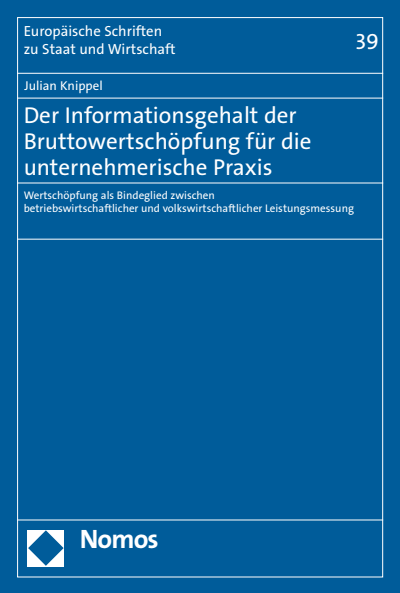
Der Informationsgehalt der Bruttowertschöpfung für die unternehmerische Praxis
Wertschöpfung als Bindeglied zwischen betriebswirtschaftlicher und volkswirtschaftlicher Leistungsmessung- Autor:innen:
- Reihe:
- Europäische Schriften zu Staat und Wirtschaft, Band 39
- Verlag:
- 2015
Zusammenfassung
Das Werk befasst sich mit der Bruttowertschöpfung als betriebswirtschaftlichem Indikator der Unternehmensgröße und Leistungsfähigkeit. Hierzu wurde erstmals der Informationsgehalt der Bruttowertschöpfung empirisch untersucht und ihre Überlegenheit gegenüber dem Umsatz als traditionelle Rechnungslegungsgröße dokumentiert.
Die Analyse zeigt, dass die Bruttowertschöpfung ein überlegener Querschnittsindikator der Unternehmensgröße ist, gekennzeichnet durch einen engen Zusammenhang zur Ertragskraft und der Wahrnehmung eines Unternehmens durch den Kapitalmarkt. Auch wertschöpfungsbezogene Verhältniskennzahlen liefern neue Aspekte zur Charakterisierung von Unternehmen und damit innovative Möglichkeiten zur internen Steuerung und Kontrolle.
Die Erkenntnisse der empirischen Auswertung führen zu der klaren Empfehlung einer stärkeren Integration der Bruttowertschöpfung in das betriebliche Controlling sowie der dauerhaften Aufnahme der Kenngröße in die unternehmerische Finanzberichterstattung.
Publikation durchsuchen
Bibliographische Angaben
- Auflage
- 1/2015
- Copyrightjahr
- 2015
- ISBN-Print
- 978-3-8487-2395-9
- ISBN-Online
- 978-3-8452-6553-7
- Verlag
- Nomos, Baden-Baden
- Reihe
- Europäische Schriften zu Staat und Wirtschaft
- Band
- 39
- Sprache
- Deutsch
- Seiten
- 288
- Produkttyp
- Monographie
Inhaltsverzeichnis
- Titelei/Inhaltsverzeichnis Kein Zugriff Seiten 1 - 22
- Ausgangslage und Hintergrund Kein Zugriff Seiten 23 - 26
- Theoretische Grundlagen zur Analyse des Informationsgehalts der Bruttowertschöpfung Kein Zugriff Seiten 27 - 88
- Die Bruttowertschöpfung und die Wertschöpfungsrechnung in der wissenschaftlichen Diskussion Kein Zugriff Seiten 89 - 146
- Empirische Auswertung des Informationsgehalts der Bruttowertschöpfung und wertschöpfungsbasierter Verhältniskennzahlen auf unternehmerischer Ebene Kein Zugriff Seiten 147 - 214
- Der Informationsgehalt der Bruttowertschöpfung und der Wertschöpfungsrechnung zur Prognose des Gewinns Kein Zugriff Seiten 215 - 252
- Schlussfolgerungen und Ausblick Kein Zugriff Seiten 253 - 258
- Anhang Kein Zugriff Seiten 259 - 274
- Literaturverzeichnis Kein Zugriff Seiten 275 - 288
Literaturverzeichnis (190 Einträge)
Es wurden keine Treffer gefunden. Versuchen Sie einen anderen Begriff.
- Accounting Standards Steering Committee (1975): The Corporate Report. London 1975. Google Scholar öffnen DOI: 10.5771/9783845265537
- Acedo, F.J./Barroso, C./Galan J.L. (2006): The Resource-Based Theory: Dissemination and Main Trends. In: Strategic Management Journal 27(2006), S. 621-636. Google Scholar öffnen DOI: 10.5771/9783845265537
- Albrecht, D. (2008): Management von Stakeholderbeziehungen mit dem EFQM-Modell: Untersuchung im Rahmen der Erarbeitung einer Nachhaltigkeitsstrategie der ABB Deutschland. Lüneburg 2008. Google Scholar öffnen DOI: 10.5771/9783845265537
- Aldama, L. P./Zicari, A. (2012): Value-added reporting as a tool for sustainability: A Latin American experience. In: Corporate Governance 12(2012)4, S. 485-498. Google Scholar öffnen DOI: 10.5771/9783845265537
- Amrein, A. (2005): Wertschöpfungsrechnung – wertvolle Ergänzung des Geschäftsberichtes. In: Information der Internationalen Treuhand AG Basel (2005), S. 29-32. Google Scholar öffnen DOI: 10.5771/9783845265537
- Arangies, G./Mlambo, C./Hamman, W. D./Steyn-Bruwer, B. W. (2008): The value-added statement: An appeal for standardization. In: Management Dynamics 17(2008)1, S. 31-43. Google Scholar öffnen DOI: 10.5771/9783845265537
- Bain, J. (1956): Barriers to New Competition. Cambridge M.A. 1956. Google Scholar öffnen DOI: 10.5771/9783845265537
- Bain, J. (1968): Industrial Organization. New York 1968. Google Scholar öffnen DOI: 10.5771/9783845265537
- Ball, R. J. (1968): The-Use of Value Added in Measuring Managerial Efficiency. In: Business Ratios (1968), S. 5-11. Google Scholar öffnen DOI: 10.5771/9783845265537
- Ball, R./Brown, P. (1968): An Empirical Evaluation of Accounting Income Numbers. In: Journal of Accounting Research 6(1968)2, S. 159-178. Google Scholar öffnen DOI: 10.5771/9783845265537
- Ballester, M./Livnat, J./Sinha, N. (2002): Labor Costs and Investments in Human Capital. In: Journal of Accounting, Auditing & Finance 17(2002), S. 351-373. Google Scholar öffnen DOI: 10.5771/9783845265537
- Bamberger, I./Wrona, T. (1996): Der Ressourcenansatz und seine Bedeutung für die strategische Unternehmensführung. In: Zeitschrift für Betriebswirtschaftliche Forschung 48(1996)2, S. 130-153. Google Scholar öffnen DOI: 10.5771/9783845265537
- Bannister, J. W./Riahi-Belkaoui, A. (1991): Value Added and Corporate Control in the U.S. In: Journal of International Financial Management and Accounting 3(1991)3, S. 241-257. Google Scholar öffnen DOI: 10.5771/9783845265537
- Bao, B.-H./Bao, D.-H. (1989): An Empirical Investigation of the Association between Productivity and Firm Value. In: Journal of Business Finance & Accounting, 16(1989)5, S. 699-717. Google Scholar öffnen DOI: 10.5771/9783845265537
- Barbee, W. C./Mukherji, Jr. S./Raines, G. A. (1996): Do Sales-Price and Debt-Equity Explain Stock Returns Better than Book-Market and Firm Size? In: Financial Analysts Journal 52(1996)2, S. 56-60. Google Scholar öffnen DOI: 10.5771/9783845265537
- Barney, J. (1991): Firm Resources and Sustained Competitive Advantage. In: Journal of Management 17(1991)1, S. 99-120. Google Scholar öffnen DOI: 10.5771/9783845265537
- Bayer AG (2014): Geschäftsbericht 2013: Erweiterte Fassung. Leverkusen 2014. Google Scholar öffnen DOI: 10.5771/9783845265537
- BC - Zeitschrift für Bilanzierung, Rechnungswesen und Controlling (2004): Erfolgskennziffer EBIT. Google Scholar öffnen DOI: 10.5771/9783845265537
- Beaver, W. H. (1968): The Information Content of Annual Earnings Announcements. In: Journal of Accounting Research 6(1968), S. 67-92. Google Scholar öffnen DOI: 10.5771/9783845265537
- Beaver, W. H. (1998): Financial Reporting: An Accounting Revolution. 3. Auflage, Upper Saddle (New Jersey) 1998. Google Scholar öffnen DOI: 10.5771/9783845265537
- Becker, W./Dietz, J. (2004): R&D cooperation and innovation activities of firms – evidence for the German manufacturing industry. In: Research Policy 33(2004), S. 209-223. Google Scholar öffnen DOI: 10.5771/9783845265537
- Beisland, L. A. (2009): A Review of the Value Relevance Literature. In: The Open Business Journal 2(2009), S. 7-27. Google Scholar öffnen DOI: 10.5771/9783845265537
- Berzkalne, I./Zelgalve, E. (2014): Intellectual capital and company value. In: Procedia - Social and Behavioral Sciences 110(2014), S. 887-896. Google Scholar öffnen DOI: 10.5771/9783845265537
- Biddle, G. C./Seow, G. S./Siegel, A. F. (1995): Relative versus Incremental Information Content. In: Contemporary Accounting Research 12(1995)1, S. 1-23. Google Scholar öffnen DOI: 10.5771/9783845265537
- BIS – Department for Business, Innovation & Skills (2009a): The 2009 Value Added Scoreboard – The top 800 UK and 750 European companies by Value Added: Commentary & Analysis. Google Scholar öffnen DOI: 10.5771/9783845265537
- BIS – Department for Business, Innovation & Skills (2009b): The 2009 Value Added Scoreboard – The top 800 UK and 750 European companies by Value Added: Company Data. Google Scholar öffnen DOI: 10.5771/9783845265537
- BMW AG (2014): Geschäftsbericht 2013. München 2014. Google Scholar öffnen DOI: 10.5771/9783845265537
- Bode, A. (2009): Wettbewerbsvorteile durch internationale Wertschöpfung: Eine empirische Untersuchung deutscher Unternehmen in China. Wiesbaden 2009. Google Scholar öffnen DOI: 10.5771/9783845265537
- Bowman, E. H./Singh H./Thomas H. (2002): The Domain of Strategic Management: History and Evolution. In: Pettigrew A./Thomas H./Whittington R. (Hrsg.): Handbook of Strategy and Management. London 2002, S. 31-51. Google Scholar öffnen DOI: 10.5771/9783845265537
- Boyd, B. K./Gove, S./Hitt, M. A. (2005): Construct Measurement in Strategic Management Research: Illusion or Reality? In: Strategic Management Journal (2005)26, S. 239-257. Google Scholar öffnen DOI: 10.5771/9783845265537
- Braakmann, A. (2013): Revidierte Konzepte für Volkswirtschaftliche Gesamtrechnungen: System of National Accounts 2008 und Europäisches System Volkswirtschaftlicher Gesamtrechnungen 2010. In: Wirtschaft und Statistik August(2013), S. 521-527. Google Scholar öffnen DOI: 10.5771/9783845265537
- Bracker, J. (1980): The historical Development of the Strategic Management Concept. In: Academy of Management Review 5(1980)2, S. 219-224. Google Scholar öffnen DOI: 10.5771/9783845265537
- Branzei, O./Vertinsky, I. (2006): Strategic pathways to product innovation capabilities in SMEs. In: Journal of Business Venturing 21(2006), S. 75-105. Google Scholar öffnen DOI: 10.5771/9783845265537
- Brümmerhoff, D./Grömling, M. (2014): VGR-Revision 2014: Was bedeuten die höheren Investitionen für die ökonomische Analyse? In: Thünen-Series of Applied Economic Theory (2014)133, S. 1-16. Google Scholar öffnen DOI: 10.5771/9783845265537
- Bryant, J. (1989): Assessing Company Strength Using Added Value. In: Long Range Planning 22(1989)3, S. 34-44. Google Scholar öffnen DOI: 10.5771/9783845265537
- Bundeszentrale für politische Bildung (2013): Das Lexikon der Wirtschaft – Wertschöpfung. Verfügbar: http://www.bpb.de/nachschlagen/lexika/lexikon-der-wirtschaft/21123/wertschoepfung (Zugriff am 30.04.2014). Google Scholar öffnen DOI: 10.5771/9783845265537
- Burchell, S./Clubb, C./Hopwood, A. G. (1985): Accounting in its Social Context: Towards a History of Value Added in the United Kingdom. In: Accounting, Organizations and Society 10(1985)4, S. 381-413. Google Scholar öffnen DOI: 10.5771/9783845265537
- Chen, G./Firth, M./Gao, D. N. (2011): The Information Content of Earnings Components: Evidence from the Chinese Stock Market. In: European Accounting Review 20(2011)4, S. 669-692. Google Scholar öffnen DOI: 10.5771/9783845265537
- Christensen, J. F. (1995): Asset profiles for technological innovation. In: Research Policy 24(1995), S. 727-745. Google Scholar öffnen DOI: 10.5771/9783845265537
- Cleff, T. (2011): Deskriptive Statistik und moderne Datenanalyse: Eine computergestützte Einführung mit Excel, PASW (SPSS) und STATA. 2. Auflage, Wiesbaden 2011. Google Scholar öffnen DOI: 10.5771/9783845265537
- Czarnitzki, D./Thorwarth, S. (2012): Productivity effects of basic research in low-tech and high-tech industries. In: Research Policy 41(2012), S. 1555-1564. Google Scholar öffnen DOI: 10.5771/9783845265537
- Dang, C./Li, Z. (2014): Measuring Firm Size in Empirical Corporate Finance. Google Scholar öffnen DOI: 10.5771/9783845265537
- Dichev, I. D./Tang, V. W. (2009): Earnings volatility and earnings predictability. In: Journal of Accounting and Economics 47(2009), S. 160-181. Google Scholar öffnen DOI: 10.5771/9783845265537
- Donaldson, T./Preston, L. E. (1995): The Stakeholder Theory of the Corporation: Concepts, Evidence, and Implications. In: The Academy of Management Review 20(1995)1, S. 65-91. Google Scholar öffnen DOI: 10.5771/9783845265537
- Drucker, P. F. (1991): Reckoning with the Pension Fund Revolution. In: Harvard Business Review (March-April 1991), S. 106-114. Google Scholar öffnen DOI: 10.5771/9783845265537
- Druckman, P. (2013): Ein neues Rahmenkonzept für eine integrierte Berichterstattung. In: Die Wirtschaftsprüfung 11(2013), S. 1. Google Scholar öffnen DOI: 10.5771/9783845265537
- Duden (2013): Wörterbuch – Wertschöpfung. Verfügbar: http://www.duden.de/node/767257/revisions/1139100/view (Zugriff am 30.04.2014). Google Scholar öffnen DOI: 10.5771/9783845265537
- Dyer, J. H./Singh, H. (1998): The Relational View: Cooperative Strategy and Sources of Interorganizational Competitive Advantage. In: Academy of Management Review 23(1998)4, S. 660-679. Google Scholar öffnen DOI: 10.5771/9783845265537
- Egginton, D. A. (1984): In Defense of Profit Measurement: Some Limitations of Cash Flow and Value Added Data as Performance Measures for External Reporting. In: Accounting and Business Research 14(1984)54, S. 32-43. Google Scholar öffnen DOI: 10.5771/9783845265537
- Ellert, G./Schafmeister, G./Bünemann, K. (2011): Wertschöpfung in der Medienbranche: Theoriegeleitete Überlegungen zur Entwicklung der Branche. In: Abstract Manual DGPuK AK Medienökonomie (2011), S. 29-32. Google Scholar öffnen DOI: 10.5771/9783845265537
- Erasmus, P. (2008): Value Based Financial Performance Measures: An Evaluation of relative and incremental Information Content. In: Corporate Ownership & Control 6(2008)1, S. 66-77. Google Scholar öffnen DOI: 10.5771/9783845265537
- European Commission (2013): European Competitiveness Report 2013: Towards knowledge driven reindustrialisation. Luxemburg 2013. Google Scholar öffnen DOI: 10.5771/9783845265537
- Evraert, S./Riahi-Belkaoui, A. (1998): Usefulness of Value Added Reporting: A Review and Synthesis of the Literature. In: Managerial Finance 24(1998)11, S. 1-15. Google Scholar öffnen DOI: 10.5771/9783845265537
- Falk, M. (2007): R&D spending in the high-tech sector and economic growth. In: Research in Economics 61(2007), S. 140-147. Google Scholar öffnen DOI: 10.5771/9783845265537
- FAZ (2013): Rangliste: Die größten Unternehmen 2013. Verfügbar: http://www.faz.net/aktuell/wirtschaft/unternehmen/rangliste-die-groessten-unternehmen-2013-12267817.html (Zugriff am 06.06.2014). Google Scholar öffnen DOI: 10.5771/9783845265537
- Finger, C. A. (1994): The Ability of Earnings to Predict Future Earnings and Cash Flow. In: Journal of Accounting Research 32(1994)2, S. 210-223. Google Scholar öffnen DOI: 10.5771/9783845265537
- Fließ, S. (2009): Dienstleistungsmangement – Kundenintegration gestalten und steuern. Wiesbaden 2009. Google Scholar öffnen DOI: 10.5771/9783845265537
- Forbes (2014): Global 2000. Verfügbar: http://www.forbes.com/global2000/list/ (Zugriff am 06.06.2014). Google Scholar öffnen DOI: 10.5771/9783845265537
- Fortune (2014): Fortune 500. Verfügbar: http://fortune.com/fortune500/ (Zugriff am 06.06.2014). Google Scholar öffnen DOI: 10.5771/9783845265537
- Francis, J./LaFond, R./Olsson P. M./Schipper, K. (2004): Costs of Equity and Earnings Attributes. In: The Accounting Review 79(2004)4, S. 967-1010. Google Scholar öffnen DOI: 10.5771/9783845265537
- Freeman, R. E./Reed, D. L. (1983): Stockholders and Stakeholders: A New Perspective on Corporate Governance. In: California Management Review 25(1983)3, S. 88-106. Google Scholar öffnen DOI: 10.5771/9783845265537
- Freiling, J./Gersch, M./Goeke, C. (2008): On the Path towards a Competence-based Theory of the Firm. In: Organization Studies 29(2008), S. 1143-1164. Google Scholar öffnen DOI: 10.5771/9783845265537
- Fresenius SE & Co. KGaA (2014): Geschäftsbericht 2013. Neckarbischofsheim 2014. Google Scholar öffnen DOI: 10.5771/9783845265537
- Gallizo, J. L./Gargallo, P./Salvador, M. (2002): Sharing Wealth: Evidence from Financial Ratios in Spain. In: Journal of International Financial Management and Accounting 13(2002)3, S. 214-234. Google Scholar öffnen DOI: 10.5771/9783845265537
- Gilchrist, R. R. (1971): Managing for Profit: The Value Added Concept. London 1971. Google Scholar öffnen DOI: 10.5771/9783845265537
- Global Reporting Initiative (2013a): G4 – Leitlinien zur Nachhaltigkeitsberichterstattung: Berichterstattungsgrundsätze und Standardangaben. Amsterdam 2013. Google Scholar öffnen DOI: 10.5771/9783845265537
- Global Reporting Initiative (2013b): G4 – Leitlinien zur Nachhaltigkeitsberichterstattung: Umsetzungsanleitung. Amsterdam 2013. Google Scholar öffnen DOI: 10.5771/9783845265537
- Global Reporting Initiative (2014): About GRI. Verfügbar: https://www.globalreporting.org/information/about-gri/Pages/default.aspx (Zugriff am 14.06.2014). Google Scholar öffnen DOI: 10.5771/9783845265537
- Graham, R. C./King, R. D. (2000): Accounting Practices and the Market Valuation of Accounting Numbers: Evidence from Indonesia, Korea, Malaysia, the Philippines, Taiwan, and Thailand. In: The International Journal of Accounting 35(2000)4, S. 445-470. Google Scholar öffnen DOI: 10.5771/9783845265537
- Grant, R. (1991): The Resource-based Theory of Competitive Advantage: Implications for Strategy Formulation. In: California Management Review 33(1991)3, S. 114-135. Google Scholar öffnen DOI: 10.5771/9783845265537
- Guan, J. C./Yam, R. C. M./Mok, C. K./Ma, N. (2006): A study of the relationship between competitive-ness and technological innovation capability based on DEA models. In: European Journal of Operational Research 170(2006), S. 971-986. Google Scholar öffnen DOI: 10.5771/9783845265537
- Gupta, V. K./Kumar, P. V. V. (2013): Value-Based Accounting: A Performance Analysis of Indian Industry. In: The IUP Journal of Accounting Research & Audit Practices, 12(2013)1, S. 7-20. Google Scholar öffnen DOI: 10.5771/9783845265537
- Hahn, T./Figge, F./Liesen, A./Barkenmeyer, R. (2007): Nachhaltig erfolgreich Wirtschaften: Eine Untersuchung der Nachhaltigkeitsleistung deutscher Unternehmen mit dem Sustainable-Value-Ansatz – Langversion. Google Scholar öffnen DOI: 10.5771/9783845265537
- Hail, L. (2002): Kennzahlenanalyse – Beurteilung von Abschlussinformationen mit Hilfe finanzieller Kennzahlen und Kennzahlensysteme. In: Der Schweizer Treuhänder (2012)2, S. 53-66. Google Scholar öffnen DOI: 10.5771/9783845265537
- Haller, A. (1997): Wertschöpfungsrechnung – Ein Instrument zur Steigerung der Aussagefähigkeit von Unternehmensabschlüssen im internationalen Kontext. Stuttgart 1997. Google Scholar öffnen DOI: 10.5771/9783845265537
- Haller, A./Fuhrmann, C. (2013): Die Lageberichterstattung deutscher Unternehmen im Lichte des "Integrated Reporting": Erste empirische Erkenntnisse. In: KoR: Internationale und kapitalmarktorientierte Rechnungslegung; IFRS 13(2013)5, S. 243-251. Google Scholar öffnen DOI: 10.5771/9783845265537
- Haller, A./Stolowy, H. (1998): Value Added in financial accounting a comparative study between Germany and France. In: Advances in International Accounting (1998), S. 1-15. Google Scholar öffnen DOI: 10.5771/9783845265537
- Haller, A./Zellner, P. (2014): Integrated Reporting Framework – eine neue Basis für die Weiterentwicklung der Unternehmensberichterstattung. In: Der Betrieb (2014)6, S. 253-258. Google Scholar öffnen DOI: 10.5771/9783845265537
- Hatzichronoglou, T. (1997): Revision of the High-Technology Sector and Product Classification. In: OECD Science, Technology and Industry Working Papers (1997)02, S. 1-25. Google Scholar öffnen DOI: 10.5771/9783845265537
- Haw, I.-M./Qi, D./Wu, W. (2001): The nature of information in accruals and cash flows in an emerging capital market: The case of China. In: The International Journal of Accounting 36(2001), S. 391-406. Google Scholar öffnen DOI: 10.5771/9783845265537
- Heeger, D. (2013): Quantitative Analyse der ökonomischen Bedeutung eines Unternehmens: Vor dem Hintergrund neuer Herausforderungen der Industriepolitik. Frankfurt am Main 2013. Google Scholar öffnen DOI: 10.5771/9783845265537
- Henke, K.-D./Neumann, K./Schneider, M. et al. (2010): Erstellung eines Satellitenkontos für die Gesundheitswirtschaft in Deutschland. Baden-Baden 2010. Google Scholar öffnen DOI: 10.5771/9783845265537
- Henke, K.-D. (2014): EU-Haushalt: BNE-„Steuer“ zur Finanzierung? In: Wirtschaftsdienst 3(2014), S. 156-157. Google Scholar öffnen DOI: 10.5771/9783845265537
- Hill, C. W. L./Jones, T. M. (1992): Stakeholder-Agency Theory. In: Journal of Management Studies 29(1992)2, S. 131-154. Google Scholar öffnen DOI: 10.5771/9783845265537
- Hill, T./Westbrook, R. (1997): SWOT Analysis: It’s Time for a Product Recall. In: Long Range Planning 30(1997)1, S. 46-52. Google Scholar öffnen DOI: 10.5771/9783845265537
- Hofer, C. W./Schendel, D. (1978): Strategy Formulation: Analytical Concepts. St. Paul. 1978. Google Scholar öffnen DOI: 10.5771/9783845265537
- Huff, P. L./Laiss, B./Laine, E. F. (1999): Measuring Company Size in Empirical Research: The use of three suggested composite measures. Google Scholar öffnen DOI: 10.5771/9783845265537
- Hult, G. T. M./Hurley, R. F./Knight, G. A. (2004): Innovativeness: Its antecedents and impact on business performance. In: Industrial Marketing Management 33(2004), S. 429-438. Google Scholar öffnen DOI: 10.5771/9783845265537
- Hurley, R. F./Hult, G. T. M. (1998): Innovation, Market Orientation, and Organizational Learning: An Integration and Empirical Examination. In: Journal of Marketing 62(1998), S. 42-54. Google Scholar öffnen DOI: 10.5771/9783845265537
- Ianniello, G. (2010): The voluntary disclosure of the value added statement in annual reports of Italian listed companies. In: Agricultural Economics - Czech 56(2010)8, S. 368-378. Google Scholar öffnen DOI: 10.5771/9783845265537
- ICB (2010): Industry Classification Benchmark (ICB). Verfügbar: http://www.icbenchmark.com/ (Zugriff am 24.09.2014). Google Scholar öffnen DOI: 10.5771/9783845265537
- IIRC (2013): The International <IR> Framework. Verfügbar: http://www.theiirc.org/international-ir-framework/ (Zugriff am 13.06.2014). Google Scholar öffnen DOI: 10.5771/9783845265537
- Jankauskas, V./Šeputienė, J. (2007): The Relation between Social Capital, Governance and Economic Performance in Europe. In: Business: Theory and Practice VIII(2007)3, S. 131-138. Google Scholar öffnen DOI: 10.5771/9783845265537
- Jemison D. B. (1981): The Contributions of Administrative Behavior to Strategic Management. In: Academy of Management Review 6(1981)4, S. 633-642. Google Scholar öffnen DOI: 10.5771/9783845265537
- Johnson, R. C/Noguera, G. (2012): Accounting for intermediates: Production sharing and trade in value added. In: Journal of International Economics 86(2012), S. 224-236. Google Scholar öffnen DOI: 10.5771/9783845265537
- Kaplan, R. S. (1983): Measuring Manufacturing Performance: A New Challenge for Managerial Accounting Research. In: The Accounting Review 58(1983)4, S. 686-705. Google Scholar öffnen DOI: 10.5771/9783845265537
- Karpik, P./Riahi-Belkaoui, A. (1990): The Relative Relationship Between Systematic Risk and Value Added Variables. In: Journal of International Financial Management and Accounting 1(1990)3, S. 259-276. Google Scholar öffnen DOI: 10.5771/9783845265537
- Khoshkoo, O. I./Fahim, S. R. S. N./ Mokhtari, M. (2013): The impact of net value added on predicting the earnings and operating cash flow: An empirical study based on Tehran Stock Exchange. In: Management Science Letters 3(2013), S. 2923-2932. Google Scholar öffnen DOI: 10.5771/9783845265537
- Knippel, J. (2011): Modellentwicklung für die Formierungsphase der Innovationskooperation. Darmstadt 2011. Google Scholar öffnen DOI: 10.5771/9783845265537
- Kor, Y.Y./Mahoney J.T. (2004): Edith Penrose’s (1959) Contributions to the Resource-based View of Strategic Management. In: Journal of Management Studies 41(2004)1, S. 183-191. Google Scholar öffnen DOI: 10.5771/9783845265537
- Kordlar, A. E./Mashayekhi, B./Ziviyar, F. (2006): Information Content of Value Added Data: An Empirical Evidence from IRAN. In: Irainan Accounting & Auditing Review (2006)46, S. 44-69. Google Scholar öffnen DOI: 10.5771/9783845265537
- KPMG (2012): KPMG-Handbuch zur Nachhaltigkeitsberichterstattung – Update 2011. Verfügbar: http://www.kpmg.de/docs/Nachhaltigkeit_06-2012__sec.pdf (Zugriff am 14.06.2014). Google Scholar öffnen DOI: 10.5771/9783845265537
- Kuckartz, U./Rädiker, S./Ebert, T./Schehl, J. (2013): Statistik – Eine verständliche Einführung. 2. Auflage, Wiesbaden 2013. Google Scholar öffnen DOI: 10.5771/9783845265537
- Lee, C. M. C. (1999): Accounting-Based Valuation: Impact on Business Practices and Research. In: Accounting Horizons 13(1999)4, S. 413-425. Google Scholar öffnen DOI: 10.5771/9783845265537
- Lipe, R. (1990): The Relation between Stock Returns and Accounting Earnings Given Alternative Information. In: The Accounting Review 65(1990)1, S. 49-71. Google Scholar öffnen DOI: 10.5771/9783845265537
- Malgwi, C.A./Purdy, D. E. (2009): A Study of the Financial Reporting Dichotomy of Managers’ Perceived Usefulness of the Value Added Statement. In: Business and Society Review 114(2009)2, S. 253-272. Google Scholar öffnen DOI: 10.5771/9783845265537
- Mandal, N./Goswami, S. (2008): Value Added Statement (VAS) – A Critical Analysis: A case study of Bharat Heavy Electricals Limited. In: Great Lakes Herald 2(2008)2, S. 98-120. Google Scholar öffnen DOI: 10.5771/9783845265537
- Maunders, K. T. (1985): The Decision Relevance of Value Added Reports. In: Choi, F. D./Mueller, G. G. (Hrsg.): Frontiers of International Accounting: An Anthology. Ann Arbor 1985, S. 225-245. Google Scholar öffnen DOI: 10.5771/9783845265537
- McLead, C. C. (1984): Use of Value Added. In: Bests Review (January 1984), S. 80-84. Google Scholar öffnen DOI: 10.5771/9783845265537
- McLeay, S. (1983): Value Added: A Comparative Study. In: Accounting, Organizations and Society 8(1983)1, S. 31-56. Google Scholar öffnen DOI: 10.5771/9783845265537
- McSweeney, B. (1985): Irish Answer to Value Added Reports. In: Choi, F. K./Mueller, G. G. (Hrsg.): Frontiers of International Accounting: An Anthology. Ann Arbor 1985, S. 225-245. Google Scholar öffnen DOI: 10.5771/9783845265537
- Meek, G./Gray, S. (1988): The value added statement: an innovation for US companies? In: Accounting Horizons (1988), S. 73-81. Google Scholar öffnen DOI: 10.5771/9783845265537
- Meyer-Merz, A. (1985): Die Wertschöpfungsrechnung in Theorie und Praxis. Zürich 1985. Google Scholar öffnen DOI: 10.5771/9783845265537
- Miroschedji, S.A. (2002): Globale Unternehmens- und Wertschöpfungsnetzwerke. Wiesbaden 2002. Google Scholar öffnen DOI: 10.5771/9783845265537
- Morley, M. F. (1978): The Value Added Statement: A British Innovation. In: The Chartered Accountant Magazine (May 1978), S. 31-34. Google Scholar öffnen DOI: 10.5771/9783845265537
- Morley, M. F. (1979): The Value Added Statement in Britain. In: The Accounting Review 54(1979)3, S. 618-629. Google Scholar öffnen DOI: 10.5771/9783845265537
- Morley, M. F. (1981): Value Added Reporting. In: Thomas, A. L. (Hrsg.): Developments on Financial Reporting. London, S. 251-269. Google Scholar öffnen DOI: 10.5771/9783845265537
- Nag, R./Hambrick, D.C./Chen, M.-J. (2007): What is Strategic Management, Really? Inductive Derivation of a Consensus Definition of the Field. In: Strategic Management Journal 28(2007), S. 935-955. Google Scholar öffnen DOI: 10.5771/9783845265537
- Nandi, K.C. (2011): Performance Measures: An Application of Value Added Statement. In: The IUP Journal of Operations Management 10(2011)3, S. 39-61. Google Scholar öffnen DOI: 10.5771/9783845265537
- Nichols, D. C./Wahlen, J. M. (2004): How Do Earnings Numbers Relate to Stock Returns? A Review of Classic Accounting Research with Updated Evidence. In: Accounting Horizons 18(2004)4, S. 263-286. Google Scholar öffnen DOI: 10.5771/9783845265537
- Noodt, A./Grede, J. (2013): Die Welt ändert sich – die Rechnungslegung auch – Der Weg zur integrierten Berichterstattung. In: Der Betrieb (2013)14, S. 714-717. Google Scholar öffnen DOI: 10.5771/9783845265537
- OECD (2003): OECD Science, Technology and Industry Scoreboard. Paris 2003. Google Scholar öffnen DOI: 10.5771/9783845265537
- OECD (2011): ISIC Rev. 3 Technology Intensity Definition – Classification of manufacturing industries into categories based on R&D intensities. Google Scholar öffnen DOI: 10.5771/9783845265537
- Ortega-Argilés, R./Piva, M./Potters, L./Vivarelli, M. (2009): Is corporate R&D Investment in High-tech Sectors more effective? In: Contemporary Economic Policy 28(2010)3, S. 353-365. Google Scholar öffnen DOI: 10.5771/9783845265537
- Ostwald, D. A./Henke, K.-D./Kim, Z.-G. et al. (2014): Weiterentwicklung des deutschen Gesundheitssatellitenkontos zu einer Gesundheitswirtschaftlichen Gesamtrechnung. Baden-Baden 2014. Google Scholar öffnen DOI: 10.5771/9783845265537
- Otte, C./Ostwald, D. A./Henke, K.-D. (2013): Studie – „Ökonomischer Fußabdruck“ ausgewählter Unternehmen der industriellen Gesundheitswirtschaft für den deutschen Wirtschaftsstandort: Ergebnisbericht. Berlin 2013. Google Scholar öffnen DOI: 10.5771/9783845265537
- Pong, C./Mitchell, F. (2005): Accounting for a Disappearance: A Contribution to the History of the Value Added Statement in the UK. In: Accounting Historians Joumal 32(2005)2, S. 173-199. Google Scholar öffnen DOI: 10.5771/9783845265537
- Porter, M.E. (1981): The Contributions of Industrial Organization to Strategic Management. In: The Academy of Management Review 6(1981)4, S. 609-620. Google Scholar öffnen DOI: 10.5771/9783845265537
- Porter, M. E. (1990): The Competitive Advantage of Nations. In: Harvard Business Review March-April(1990), S. 73-93. Google Scholar öffnen DOI: 10.5771/9783845265537
- Porter, M.E. (1997): Competitive Strategy. In: Measuring Business Excellence 1(1997)2, S. 12-17. Google Scholar öffnen DOI: 10.5771/9783845265537
- Porter, M. E. (2004): Competitive Advantage – Creating and Sustaining Superior Performance. New York 2004. Google Scholar öffnen DOI: 10.5771/9783845265537
- Powers, W. (2012): The Value of Value Added - Measuring global engagement with gross and value-added trade. In: World Economics 13(2012)4, S. 19-37. Google Scholar öffnen DOI: 10.5771/9783845265537
- Prahalad, C.K./Hamel, G. (1990): The Core Competence of the Corporation. In: Harvard Business Review (1990), S. 79-91. Google Scholar öffnen DOI: 10.5771/9783845265537
- Prasad, M. S. V./Sheela, P./Rao, S. S. P. (2012): Value-Added Accounting: An Empirical Illustration with Reference to the Port of Visakhapatnam. In: The IUP Journal of Accounting Research & Audit Practices 11(2012)2, S. 33-57. Google Scholar öffnen DOI: 10.5771/9783845265537
- PwC (2014): Global top 100. Verfügbar: http://www.pwc.com/gx/en/audit-services/capital-market/publications/top100-market-capitalisation.jhtml (Zugriff am 06.06.2014). Google Scholar öffnen DOI: 10.5771/9783845265537
- Rahman, M. Z.: The Local Value Added Statement: A Reporting Requirement for Multinationals in Developing Host Countries. In: International Journal of Accounting (February 1990), S. 87-98. Google Scholar öffnen DOI: 10.5771/9783845265537
- Riahi-Belkaoui, A. (1992): Value Added Reporting: The Lessons for the United States. Westport 1992. Google Scholar öffnen DOI: 10.5771/9783845265537
- Riahi-Belkaoui, A. (1996): Performance Results in Value Added Reporting. Westport 1996. Google Scholar öffnen DOI: 10.5771/9783845265537
- Riahi-Belkaoui, A. (1999a): Productivity, Profitability, and Firm Value. In: Journal of International Financial Management and Accounting 10(1999)3, S. 188-201. Google Scholar öffnen DOI: 10.5771/9783845265537
- Riahi-Belkaoui, A. (1999b): Net Value Added and Earnings Determination. In: Review of Quantitative Finance and Accounting 13(1999), S. 393-399. Google Scholar öffnen DOI: 10.5771/9783845265537
- Riahi-Belkaoui, A. (1999c): Value added reporting and research: state of the art. Westport 1999. Google Scholar öffnen DOI: 10.5771/9783845265537
- Riahi-Belkaoui, A. (2003): Intellectual capital and firm performance of US multinational firms: A study of the resource-based and stakeholder views. In: Journal of Intellectual Capital 4(2003)2, S. 215-226. Google Scholar öffnen DOI: 10.5771/9783845265537
- Riahi-Belkaoui, A./Fekrat, M. A. (1994): The Magic in Value Added: Merits of Derived Accounting Indicator Numbers. In: Managerial Finance 20(1994)9, S. 3-15. Google Scholar öffnen DOI: 10.5771/9783845265537
- Riahi-Belkaoui, A./Picur, R. D. (1994): Explaining Market Returns: Earnings Versus Value Added Data. In: Managerial Finance 20(1994)9, S. 44-55. Google Scholar öffnen DOI: 10.5771/9783845265537
- Riahi-Belkaoui, A./Picur, R. D. (1999): The Substitution of Net Value Added for Earnings in Equity Valuation. In: Managerial Finance 25(1999)12, S. 66-78. Google Scholar öffnen DOI: 10.5771/9783845265537
- Ritter, T./Gemünden, H. G. (2004): The impact of a company’s business strategy on its technological competence, network competence and innovation success. In: Journal of Business Research 57(2004), S. 548-556. Google Scholar öffnen DOI: 10.5771/9783845265537
- Romijn, H./Albaladejo, M. (2002): Determinants of innovation capability in small electronics and software firms in southeast England. In: Research Policy 31(2002), S. 1053-1067. Google Scholar öffnen DOI: 10.5771/9783845265537
- Rutherford, B. A. (1981): Five Fallacies About Value Added. In: Management Accountant (September 1981), S. 31-33. Google Scholar öffnen DOI: 10.5771/9783845265537
- Sachverständigenrat zur Begutachtung der gesamtwirtschaftlichen Entwicklung (2010): Wirtschaftsleistung, Lebensqualität und Nachhaltigkeit: Ein umfassendes Indikatorensystem. Paderborn 2011. Google Scholar öffnen DOI: 10.5771/9783845265537
- Schäfer, T. (2010): Statistik I - Deskriptive und Explorative Datenanalyse. Wiesbaden 2010. Google Scholar öffnen DOI: 10.5771/9783845265537
- Schendel, D./Hofer, C. W. (1979): Strategic management: A New View of Business Policy and Planning. Boston 1979. Google Scholar öffnen DOI: 10.5771/9783845265537
- Schiemann, F./Guenther, T. (2013): Earnings Predictability, Value Relevance, and Employee Expenses. In: The International Journal of Accounting 48(2013), S. 149-172. Google Scholar öffnen DOI: 10.5771/9783845265537
- Schmeisser, W./Schindler, F./Schütz, K. (2007): Wertschöpfungsrechnungen als Instrumente für finanzorientierte Erfolgskomponenten und Personalanalysen im Rahmen des Berliner Balanced Scorecard Ansatzes. In: Schmeisser, W. u.a. (Hrsg.): Einführung in die finanz- und kapitalmarktorientierte Personalwirtschaft. Mering 2007, S. 49-63. Google Scholar öffnen DOI: 10.5771/9783845265537
- Schneider et al. (2013): Messung der Produktivitätsentwicklung der Gesundheitswirtschaft. Wiesbaden 2014. Google Scholar öffnen DOI: 10.5771/9783845265537
- Shrivastava, P. (1987): Rigor and Practical Usefulness of Research in Strategic Management. In: Strategic Management Journal 8(1987), S. 77-92. Google Scholar öffnen DOI: 10.5771/9783845265537
- Simon-Heckroth, E. (2014): Nachhaltigkeitsberichterstattung und Integrated Reporting - Neue Anforderungen an den Berufsstand. In: Die Wirtschaftsprüfung 6(2014), S. 311-325. Google Scholar öffnen DOI: 10.5771/9783845265537
- Sinha, G. (1983): Value Added Income. Kolkata 1983. Google Scholar öffnen DOI: 10.5771/9783845265537
- Spanos, Y. E./Lioukas, S. (2001): An Examination into the Causal Logic of Rent Generation: Con-trasting Porter’s Competitive Strategy Framework and the Resource-Based Perspective. In: Strategic Management Journal 22(2001)10, S. 907-934. Google Scholar öffnen DOI: 10.5771/9783845265537
- Springer Gabler Verlag (2014): Gabler Wirtschaftslexikon, Stichwort: strategisches Management. Verfügbar: http://wirtschaftslexikon.gabler.de/Archiv/56410/strategisches-management-v7.html (Zugriff am 30.04.2014). Google Scholar öffnen DOI: 10.5771/9783845265537
- Stabell, C.B./Fjeldstad Ø. D. (1998): Configuring Value for Competitive Advantage: On Chains, Shops, and Networks. In: Strategic Management Journal 19(1998), S. 413-437. Google Scholar öffnen DOI: 10.5771/9783845265537
- Statistisches Bundesamt (2007a): Volkswirtschaftliche Gesamtrechnungen: Inlandsprodukt nach ESVG 1995 – Methoden und Grundlagen. Fachserie 18 Reihe S.22. Google Scholar öffnen DOI: 10.5771/9783845265537
- Statistisches Bundesamt (2007b): Produzierendes Gewerbe: Kostenstruktur der Unternehmen des Verarbeitenden Gewerbes sowie des Bergbaus und der Gewinnung von Steinen und Erden – Fachserie 4 Reihe 4.3 – 2005. Wiesbaden 2007. Google Scholar öffnen DOI: 10.5771/9783845265537
- Statistisches Bundesamt (2013): Volkswirtschaftliche Gesamtrechnungen – Inlandsproduktsberechnung – Detaillierte Jahresergebnisse – Fachserie 18 Reihe 1.4 - 2012. Wiesbaden 2013. Google Scholar öffnen DOI: 10.5771/9783845265537
- Statistisches Bundesamt (2014a): Begriffserläuterungen für den Bereich Volkswirtschaftliche Gesamtrechnungen. Verfügbar: https://www.destatis.de/DE/ZahlenFakten/GesamtwirtschaftUmwelt/VGR/Begriffserlaeuterungen/Bruttowertschoepfung.html (Zugriff am 30.04.2014). Google Scholar öffnen DOI: 10.5771/9783845265537
- Statistisches Bundesamt (2014b): Volkswirtschaftliche Gesamtrechnungen: Wichtige Zusammenhänge im Überblick – 2013. Wiesbaden 2014. Google Scholar öffnen DOI: 10.5771/9783845265537
- Statistisches Bundesamt (2014c): Produzierendes Gewerbe: Kostenstruktur der Unternehmen des Verarbeitenden Gewerbes sowie des Bergbaus und der Gewinnung von Steinen und Erden – Fachserie 4 Reihe 4.3 – 2012. Wiesbaden 2014. Google Scholar öffnen DOI: 10.5771/9783845265537
- Statistisches Bundesamt (2014d): Umweltökonomische Gesamtrechnungen: Nachhaltige Entwicklung in Deutschland – Indikatoren zu Umwelt und Ökonomie. Wiesbaden 2014 Google Scholar öffnen DOI: 10.5771/9783845265537
- Subramaniam, M./Youndt, M. A. (2005): The Influence of Intellectual Capital on the Types of Innovative Capabilities. In: Academy of Management Journal 48(2005)3, S. 450-463. Google Scholar öffnen DOI: 10.5771/9783845265537
- Suojanen, W. W. (1954): Accounting Theory and the large Corporation. In: The Accounting Review 29(1954)3, S. 391-398. Google Scholar öffnen DOI: 10.5771/9783845265537
- Teece, D. J. (1990): Contributions and Impediments of Economic Analysis to the Study of Strategic Management. In: Fredrickson, J. W. (Hrsg.): Perspectives on Strategic Management. New York 1990, S. 39-80. Google Scholar öffnen DOI: 10.5771/9783845265537
- Thompson, J. D. (2007): Organizations in Action: Social Science Bases of Administrative Theory. 5. Auflage, New Brunswick 2007. Google Scholar öffnen DOI: 10.5771/9783845265537
- Tonkin, D. J. (1989): World Survey of Published Accounts: An Analysis of 200 Annual Reports from the World’s Leading Companies. London 1989. Google Scholar öffnen DOI: 10.5771/9783845265537
- Torres-Reyna, O. (2007): Panel Data Analysis: Fixed and Random Effects using Stata. Verfügbar: http://dss.princeton.edu/training/Panel101.pdf (Zugriff am 15.09.2014). Google Scholar öffnen DOI: 10.5771/9783845265537
- United Nations et al. (2009): System of National Accounts 2008. Google Scholar öffnen DOI: 10.5771/9783845265537
- Vaessen, M. (2013): Die Zukunft der Unternehmensberichterstattung. In: Die Wirtschaftsprüfung 10(2013), S. 1. Google Scholar öffnen DOI: 10.5771/9783845265537
- Vafei, A./Taylor, D./Ahmed, K. (2011): The value relevance of intellectual capital disclosures. In: Journal of Intellectual Capital 12(2011)3, S. 407-429. Google Scholar öffnen DOI: 10.5771/9783845265537
- van Staden, C. J. (1998): The Usefulness of the Value Added Statement in South Africa. In: Managerial Finance 24(1998)11, S. 44-59. Google Scholar öffnen DOI: 10.5771/9783845265537
- van Staden, C. J./Haller, A./Landis, C. (2013): Value Added information as part of Sustainability reporting – initial international insights. Google Scholar öffnen DOI: 10.5771/9783845265537
- Volkswagen AG (2014): Geschäftsbericht 2013. Bad Oeynhausen 2014. Google Scholar öffnen DOI: 10.5771/9783845265537
- von Auer, L. (2007): Ökonometrie – Eine Einführung. 4. Auflage, Heidelberg 2007. Google Scholar öffnen DOI: 10.5771/9783845265537
- Vruwink, D. R./Quirin, J. J./O’Bryan, D. (2007): A Modified Price-Sales Ratio: A Useful Tool For Investors? In: Journal of Business & Economics Research 5(2007)12, S. 31-40. Google Scholar öffnen DOI: 10.5771/9783845265537
- Wang, D. H.-M./Yu, T. H.-K./Liu, H.-Q. (2013): Heterogeneous effect of high-tech industrial R&D spending on economic growth. In: Journal of Business Research 66(2013), S. 1990-1993. Google Scholar öffnen DOI: 10.5771/9783845265537
- Weber, H. K. (1980): Wertschöpfungsrechnung. Stuttgart 1980. Google Scholar öffnen DOI: 10.5771/9783845265537
- Welge, M. K./Al-Laham, A. (2012): Strategisches Management: Grundlagen – Prozess – Implementierung. 6. Auflage, Wiesbaden 2012. Google Scholar öffnen DOI: 10.5771/9783845265537
- Wernerfelt, B. (1984): A Resource-based View of the Firm. In: Strategic Management Journal 5(1984)2, S. 171-180. Google Scholar öffnen DOI: 10.5771/9783845265537
- Wöhrl, R./Hüsig, S./Dowling, M. (2009): The interaction of R&D intensity and firm age: Empirical evidence from technology-based growth companies in the German “Neuer Markt”. In: Journal of High Technology Management Research 20(2009), S. 19-30. Google Scholar öffnen DOI: 10.5771/9783845265537
- Wooldridge, J. M. (2002): Econometric Analysis of Cross Section and Panel Data. London 2002. Google Scholar öffnen DOI: 10.5771/9783845265537
- Yam, R. C. M./Guan, J. C./Pun, K. F./Tang, E. P. Y. (2004): An audit of technological innovation capabilities in chinese firms: some empirical findings in Beijing, China. In: Research Policy 33(2004), S. 1123-1140. Google Scholar öffnen DOI: 10.5771/9783845265537
- Zéghal, D./Maaloul, A. (2010): Analysing value added as an indicator of intellectual capital and its consequences on company performance. In: Journal of Intellectual Capital 11(2010)1, S. 39-60. Google Scholar öffnen DOI: 10.5771/9783845265537
- Zimmermann, H./Henke, K.-D./Broer, M. (2012): Finanzwissenschaft – Eine Einführung in die Lehre von der öffentlichen Finanzwirtschaft. 11. Aufl., München 2012. Google Scholar öffnen DOI: 10.5771/9783845265537