, to see if you have full access to this publication.
Monograph No access
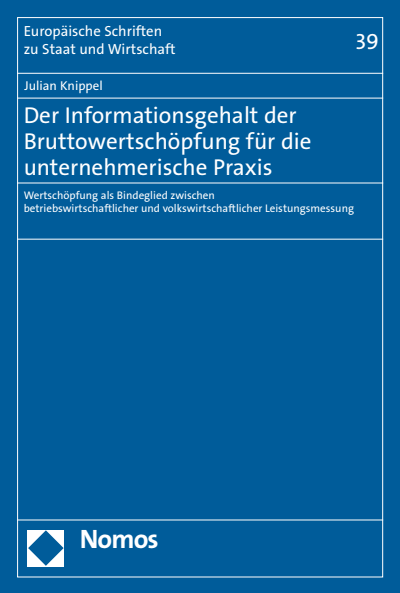
Der Informationsgehalt der Bruttowertschöpfung für die unternehmerische Praxis
Wertschöpfung als Bindeglied zwischen betriebswirtschaftlicher und volkswirtschaftlicher Leistungsmessung- Authors:
- Series:
- Europäische Schriften zu Staat und Wirtschaft, Volume 39
- Publisher:
- 2015
Search publication
Bibliographic data
- Edition
- 1/2015
- Copyright Year
- 2015
- ISBN-Print
- 978-3-8487-2395-9
- ISBN-Online
- 978-3-8452-6553-7
- Publisher
- Nomos, Baden-Baden
- Series
- Europäische Schriften zu Staat und Wirtschaft
- Volume
- 39
- Language
- German
- Pages
- 288
- Product Type
- Monograph
Table of contents
ChapterPages
- Titelei/Inhaltsverzeichnis No access Pages 1 - 22
- Ausgangslage und Hintergrund No access Pages 23 - 26
- Theoretische Grundlagen zur Analyse des Informationsgehalts der Bruttowertschöpfung No access Pages 27 - 88
- Die Bruttowertschöpfung und die Wertschöpfungsrechnung in der wissenschaftlichen Diskussion No access Pages 89 - 146
- Empirische Auswertung des Informationsgehalts der Bruttowertschöpfung und wertschöpfungsbasierter Verhältniskennzahlen auf unternehmerischer Ebene No access Pages 147 - 214
- Der Informationsgehalt der Bruttowertschöpfung und der Wertschöpfungsrechnung zur Prognose des Gewinns No access Pages 215 - 252
- Schlussfolgerungen und Ausblick No access Pages 253 - 258
- Anhang No access Pages 259 - 274
- Literaturverzeichnis No access Pages 275 - 288
Bibliography (190 entries)
No match found. Try another term.
- Accounting Standards Steering Committee (1975): The Corporate Report. London 1975. Open Google Scholar DOI: 10.5771/9783845265537
- Acedo, F.J./Barroso, C./Galan J.L. (2006): The Resource-Based Theory: Dissemination and Main Trends. In: Strategic Management Journal 27(2006), S. 621-636. Open Google Scholar DOI: 10.5771/9783845265537
- Albrecht, D. (2008): Management von Stakeholderbeziehungen mit dem EFQM-Modell: Untersuchung im Rahmen der Erarbeitung einer Nachhaltigkeitsstrategie der ABB Deutschland. Lüneburg 2008. Open Google Scholar DOI: 10.5771/9783845265537
- Aldama, L. P./Zicari, A. (2012): Value-added reporting as a tool for sustainability: A Latin American experience. In: Corporate Governance 12(2012)4, S. 485-498. Open Google Scholar DOI: 10.5771/9783845265537
- Amrein, A. (2005): Wertschöpfungsrechnung – wertvolle Ergänzung des Geschäftsberichtes. In: Information der Internationalen Treuhand AG Basel (2005), S. 29-32. Open Google Scholar DOI: 10.5771/9783845265537
- Arangies, G./Mlambo, C./Hamman, W. D./Steyn-Bruwer, B. W. (2008): The value-added statement: An appeal for standardization. In: Management Dynamics 17(2008)1, S. 31-43. Open Google Scholar DOI: 10.5771/9783845265537
- Bain, J. (1956): Barriers to New Competition. Cambridge M.A. 1956. Open Google Scholar DOI: 10.5771/9783845265537
- Bain, J. (1968): Industrial Organization. New York 1968. Open Google Scholar DOI: 10.5771/9783845265537
- Ball, R. J. (1968): The-Use of Value Added in Measuring Managerial Efficiency. In: Business Ratios (1968), S. 5-11. Open Google Scholar DOI: 10.5771/9783845265537
- Ball, R./Brown, P. (1968): An Empirical Evaluation of Accounting Income Numbers. In: Journal of Accounting Research 6(1968)2, S. 159-178. Open Google Scholar DOI: 10.5771/9783845265537
- Ballester, M./Livnat, J./Sinha, N. (2002): Labor Costs and Investments in Human Capital. In: Journal of Accounting, Auditing & Finance 17(2002), S. 351-373. Open Google Scholar DOI: 10.5771/9783845265537
- Bamberger, I./Wrona, T. (1996): Der Ressourcenansatz und seine Bedeutung für die strategische Unternehmensführung. In: Zeitschrift für Betriebswirtschaftliche Forschung 48(1996)2, S. 130-153. Open Google Scholar DOI: 10.5771/9783845265537
- Bannister, J. W./Riahi-Belkaoui, A. (1991): Value Added and Corporate Control in the U.S. In: Journal of International Financial Management and Accounting 3(1991)3, S. 241-257. Open Google Scholar DOI: 10.5771/9783845265537
- Bao, B.-H./Bao, D.-H. (1989): An Empirical Investigation of the Association between Productivity and Firm Value. In: Journal of Business Finance & Accounting, 16(1989)5, S. 699-717. Open Google Scholar DOI: 10.5771/9783845265537
- Barbee, W. C./Mukherji, Jr. S./Raines, G. A. (1996): Do Sales-Price and Debt-Equity Explain Stock Returns Better than Book-Market and Firm Size? In: Financial Analysts Journal 52(1996)2, S. 56-60. Open Google Scholar DOI: 10.5771/9783845265537
- Barney, J. (1991): Firm Resources and Sustained Competitive Advantage. In: Journal of Management 17(1991)1, S. 99-120. Open Google Scholar DOI: 10.5771/9783845265537
- Bayer AG (2014): Geschäftsbericht 2013: Erweiterte Fassung. Leverkusen 2014. Open Google Scholar DOI: 10.5771/9783845265537
- BC - Zeitschrift für Bilanzierung, Rechnungswesen und Controlling (2004): Erfolgskennziffer EBIT. Open Google Scholar DOI: 10.5771/9783845265537
- Beaver, W. H. (1968): The Information Content of Annual Earnings Announcements. In: Journal of Accounting Research 6(1968), S. 67-92. Open Google Scholar DOI: 10.5771/9783845265537
- Beaver, W. H. (1998): Financial Reporting: An Accounting Revolution. 3. Auflage, Upper Saddle (New Jersey) 1998. Open Google Scholar DOI: 10.5771/9783845265537
- Becker, W./Dietz, J. (2004): R&D cooperation and innovation activities of firms – evidence for the German manufacturing industry. In: Research Policy 33(2004), S. 209-223. Open Google Scholar DOI: 10.5771/9783845265537
- Beisland, L. A. (2009): A Review of the Value Relevance Literature. In: The Open Business Journal 2(2009), S. 7-27. Open Google Scholar DOI: 10.5771/9783845265537
- Berzkalne, I./Zelgalve, E. (2014): Intellectual capital and company value. In: Procedia - Social and Behavioral Sciences 110(2014), S. 887-896. Open Google Scholar DOI: 10.5771/9783845265537
- Biddle, G. C./Seow, G. S./Siegel, A. F. (1995): Relative versus Incremental Information Content. In: Contemporary Accounting Research 12(1995)1, S. 1-23. Open Google Scholar DOI: 10.5771/9783845265537
- BIS – Department for Business, Innovation & Skills (2009a): The 2009 Value Added Scoreboard – The top 800 UK and 750 European companies by Value Added: Commentary & Analysis. Open Google Scholar DOI: 10.5771/9783845265537
- BIS – Department for Business, Innovation & Skills (2009b): The 2009 Value Added Scoreboard – The top 800 UK and 750 European companies by Value Added: Company Data. Open Google Scholar DOI: 10.5771/9783845265537
- BMW AG (2014): Geschäftsbericht 2013. München 2014. Open Google Scholar DOI: 10.5771/9783845265537
- Bode, A. (2009): Wettbewerbsvorteile durch internationale Wertschöpfung: Eine empirische Untersuchung deutscher Unternehmen in China. Wiesbaden 2009. Open Google Scholar DOI: 10.5771/9783845265537
- Bowman, E. H./Singh H./Thomas H. (2002): The Domain of Strategic Management: History and Evolution. In: Pettigrew A./Thomas H./Whittington R. (Hrsg.): Handbook of Strategy and Management. London 2002, S. 31-51. Open Google Scholar DOI: 10.5771/9783845265537
- Boyd, B. K./Gove, S./Hitt, M. A. (2005): Construct Measurement in Strategic Management Research: Illusion or Reality? In: Strategic Management Journal (2005)26, S. 239-257. Open Google Scholar DOI: 10.5771/9783845265537
- Braakmann, A. (2013): Revidierte Konzepte für Volkswirtschaftliche Gesamtrechnungen: System of National Accounts 2008 und Europäisches System Volkswirtschaftlicher Gesamtrechnungen 2010. In: Wirtschaft und Statistik August(2013), S. 521-527. Open Google Scholar DOI: 10.5771/9783845265537
- Bracker, J. (1980): The historical Development of the Strategic Management Concept. In: Academy of Management Review 5(1980)2, S. 219-224. Open Google Scholar DOI: 10.5771/9783845265537
- Branzei, O./Vertinsky, I. (2006): Strategic pathways to product innovation capabilities in SMEs. In: Journal of Business Venturing 21(2006), S. 75-105. Open Google Scholar DOI: 10.5771/9783845265537
- Brümmerhoff, D./Grömling, M. (2014): VGR-Revision 2014: Was bedeuten die höheren Investitionen für die ökonomische Analyse? In: Thünen-Series of Applied Economic Theory (2014)133, S. 1-16. Open Google Scholar DOI: 10.5771/9783845265537
- Bryant, J. (1989): Assessing Company Strength Using Added Value. In: Long Range Planning 22(1989)3, S. 34-44. Open Google Scholar DOI: 10.5771/9783845265537
- Bundeszentrale für politische Bildung (2013): Das Lexikon der Wirtschaft – Wertschöpfung. Verfügbar: http://www.bpb.de/nachschlagen/lexika/lexikon-der-wirtschaft/21123/wertschoepfung (Zugriff am 30.04.2014). Open Google Scholar DOI: 10.5771/9783845265537
- Burchell, S./Clubb, C./Hopwood, A. G. (1985): Accounting in its Social Context: Towards a History of Value Added in the United Kingdom. In: Accounting, Organizations and Society 10(1985)4, S. 381-413. Open Google Scholar DOI: 10.5771/9783845265537
- Chen, G./Firth, M./Gao, D. N. (2011): The Information Content of Earnings Components: Evidence from the Chinese Stock Market. In: European Accounting Review 20(2011)4, S. 669-692. Open Google Scholar DOI: 10.5771/9783845265537
- Christensen, J. F. (1995): Asset profiles for technological innovation. In: Research Policy 24(1995), S. 727-745. Open Google Scholar DOI: 10.5771/9783845265537
- Cleff, T. (2011): Deskriptive Statistik und moderne Datenanalyse: Eine computergestützte Einführung mit Excel, PASW (SPSS) und STATA. 2. Auflage, Wiesbaden 2011. Open Google Scholar DOI: 10.5771/9783845265537
- Czarnitzki, D./Thorwarth, S. (2012): Productivity effects of basic research in low-tech and high-tech industries. In: Research Policy 41(2012), S. 1555-1564. Open Google Scholar DOI: 10.5771/9783845265537
- Dang, C./Li, Z. (2014): Measuring Firm Size in Empirical Corporate Finance. Open Google Scholar DOI: 10.5771/9783845265537
- Dichev, I. D./Tang, V. W. (2009): Earnings volatility and earnings predictability. In: Journal of Accounting and Economics 47(2009), S. 160-181. Open Google Scholar DOI: 10.5771/9783845265537
- Donaldson, T./Preston, L. E. (1995): The Stakeholder Theory of the Corporation: Concepts, Evidence, and Implications. In: The Academy of Management Review 20(1995)1, S. 65-91. Open Google Scholar DOI: 10.5771/9783845265537
- Drucker, P. F. (1991): Reckoning with the Pension Fund Revolution. In: Harvard Business Review (March-April 1991), S. 106-114. Open Google Scholar DOI: 10.5771/9783845265537
- Druckman, P. (2013): Ein neues Rahmenkonzept für eine integrierte Berichterstattung. In: Die Wirtschaftsprüfung 11(2013), S. 1. Open Google Scholar DOI: 10.5771/9783845265537
- Duden (2013): Wörterbuch – Wertschöpfung. Verfügbar: http://www.duden.de/node/767257/revisions/1139100/view (Zugriff am 30.04.2014). Open Google Scholar DOI: 10.5771/9783845265537
- Dyer, J. H./Singh, H. (1998): The Relational View: Cooperative Strategy and Sources of Interorganizational Competitive Advantage. In: Academy of Management Review 23(1998)4, S. 660-679. Open Google Scholar DOI: 10.5771/9783845265537
- Egginton, D. A. (1984): In Defense of Profit Measurement: Some Limitations of Cash Flow and Value Added Data as Performance Measures for External Reporting. In: Accounting and Business Research 14(1984)54, S. 32-43. Open Google Scholar DOI: 10.5771/9783845265537
- Ellert, G./Schafmeister, G./Bünemann, K. (2011): Wertschöpfung in der Medienbranche: Theoriegeleitete Überlegungen zur Entwicklung der Branche. In: Abstract Manual DGPuK AK Medienökonomie (2011), S. 29-32. Open Google Scholar DOI: 10.5771/9783845265537
- Erasmus, P. (2008): Value Based Financial Performance Measures: An Evaluation of relative and incremental Information Content. In: Corporate Ownership & Control 6(2008)1, S. 66-77. Open Google Scholar DOI: 10.5771/9783845265537
- European Commission (2013): European Competitiveness Report 2013: Towards knowledge driven reindustrialisation. Luxemburg 2013. Open Google Scholar DOI: 10.5771/9783845265537
- Evraert, S./Riahi-Belkaoui, A. (1998): Usefulness of Value Added Reporting: A Review and Synthesis of the Literature. In: Managerial Finance 24(1998)11, S. 1-15. Open Google Scholar DOI: 10.5771/9783845265537
- Falk, M. (2007): R&D spending in the high-tech sector and economic growth. In: Research in Economics 61(2007), S. 140-147. Open Google Scholar DOI: 10.5771/9783845265537
- FAZ (2013): Rangliste: Die größten Unternehmen 2013. Verfügbar: http://www.faz.net/aktuell/wirtschaft/unternehmen/rangliste-die-groessten-unternehmen-2013-12267817.html (Zugriff am 06.06.2014). Open Google Scholar DOI: 10.5771/9783845265537
- Finger, C. A. (1994): The Ability of Earnings to Predict Future Earnings and Cash Flow. In: Journal of Accounting Research 32(1994)2, S. 210-223. Open Google Scholar DOI: 10.5771/9783845265537
- Fließ, S. (2009): Dienstleistungsmangement – Kundenintegration gestalten und steuern. Wiesbaden 2009. Open Google Scholar DOI: 10.5771/9783845265537
- Forbes (2014): Global 2000. Verfügbar: http://www.forbes.com/global2000/list/ (Zugriff am 06.06.2014). Open Google Scholar DOI: 10.5771/9783845265537
- Fortune (2014): Fortune 500. Verfügbar: http://fortune.com/fortune500/ (Zugriff am 06.06.2014). Open Google Scholar DOI: 10.5771/9783845265537
- Francis, J./LaFond, R./Olsson P. M./Schipper, K. (2004): Costs of Equity and Earnings Attributes. In: The Accounting Review 79(2004)4, S. 967-1010. Open Google Scholar DOI: 10.5771/9783845265537
- Freeman, R. E./Reed, D. L. (1983): Stockholders and Stakeholders: A New Perspective on Corporate Governance. In: California Management Review 25(1983)3, S. 88-106. Open Google Scholar DOI: 10.5771/9783845265537
- Freiling, J./Gersch, M./Goeke, C. (2008): On the Path towards a Competence-based Theory of the Firm. In: Organization Studies 29(2008), S. 1143-1164. Open Google Scholar DOI: 10.5771/9783845265537
- Fresenius SE & Co. KGaA (2014): Geschäftsbericht 2013. Neckarbischofsheim 2014. Open Google Scholar DOI: 10.5771/9783845265537
- Gallizo, J. L./Gargallo, P./Salvador, M. (2002): Sharing Wealth: Evidence from Financial Ratios in Spain. In: Journal of International Financial Management and Accounting 13(2002)3, S. 214-234. Open Google Scholar DOI: 10.5771/9783845265537
- Gilchrist, R. R. (1971): Managing for Profit: The Value Added Concept. London 1971. Open Google Scholar DOI: 10.5771/9783845265537
- Global Reporting Initiative (2013a): G4 – Leitlinien zur Nachhaltigkeitsberichterstattung: Berichterstattungsgrundsätze und Standardangaben. Amsterdam 2013. Open Google Scholar DOI: 10.5771/9783845265537
- Global Reporting Initiative (2013b): G4 – Leitlinien zur Nachhaltigkeitsberichterstattung: Umsetzungsanleitung. Amsterdam 2013. Open Google Scholar DOI: 10.5771/9783845265537
- Global Reporting Initiative (2014): About GRI. Verfügbar: https://www.globalreporting.org/information/about-gri/Pages/default.aspx (Zugriff am 14.06.2014). Open Google Scholar DOI: 10.5771/9783845265537
- Graham, R. C./King, R. D. (2000): Accounting Practices and the Market Valuation of Accounting Numbers: Evidence from Indonesia, Korea, Malaysia, the Philippines, Taiwan, and Thailand. In: The International Journal of Accounting 35(2000)4, S. 445-470. Open Google Scholar DOI: 10.5771/9783845265537
- Grant, R. (1991): The Resource-based Theory of Competitive Advantage: Implications for Strategy Formulation. In: California Management Review 33(1991)3, S. 114-135. Open Google Scholar DOI: 10.5771/9783845265537
- Guan, J. C./Yam, R. C. M./Mok, C. K./Ma, N. (2006): A study of the relationship between competitive-ness and technological innovation capability based on DEA models. In: European Journal of Operational Research 170(2006), S. 971-986. Open Google Scholar DOI: 10.5771/9783845265537
- Gupta, V. K./Kumar, P. V. V. (2013): Value-Based Accounting: A Performance Analysis of Indian Industry. In: The IUP Journal of Accounting Research & Audit Practices, 12(2013)1, S. 7-20. Open Google Scholar DOI: 10.5771/9783845265537
- Hahn, T./Figge, F./Liesen, A./Barkenmeyer, R. (2007): Nachhaltig erfolgreich Wirtschaften: Eine Untersuchung der Nachhaltigkeitsleistung deutscher Unternehmen mit dem Sustainable-Value-Ansatz – Langversion. Open Google Scholar DOI: 10.5771/9783845265537
- Hail, L. (2002): Kennzahlenanalyse – Beurteilung von Abschlussinformationen mit Hilfe finanzieller Kennzahlen und Kennzahlensysteme. In: Der Schweizer Treuhänder (2012)2, S. 53-66. Open Google Scholar DOI: 10.5771/9783845265537
- Haller, A. (1997): Wertschöpfungsrechnung – Ein Instrument zur Steigerung der Aussagefähigkeit von Unternehmensabschlüssen im internationalen Kontext. Stuttgart 1997. Open Google Scholar DOI: 10.5771/9783845265537
- Haller, A./Fuhrmann, C. (2013): Die Lageberichterstattung deutscher Unternehmen im Lichte des "Integrated Reporting": Erste empirische Erkenntnisse. In: KoR: Internationale und kapitalmarktorientierte Rechnungslegung; IFRS 13(2013)5, S. 243-251. Open Google Scholar DOI: 10.5771/9783845265537
- Haller, A./Stolowy, H. (1998): Value Added in financial accounting a comparative study between Germany and France. In: Advances in International Accounting (1998), S. 1-15. Open Google Scholar DOI: 10.5771/9783845265537
- Haller, A./Zellner, P. (2014): Integrated Reporting Framework – eine neue Basis für die Weiterentwicklung der Unternehmensberichterstattung. In: Der Betrieb (2014)6, S. 253-258. Open Google Scholar DOI: 10.5771/9783845265537
- Hatzichronoglou, T. (1997): Revision of the High-Technology Sector and Product Classification. In: OECD Science, Technology and Industry Working Papers (1997)02, S. 1-25. Open Google Scholar DOI: 10.5771/9783845265537
- Haw, I.-M./Qi, D./Wu, W. (2001): The nature of information in accruals and cash flows in an emerging capital market: The case of China. In: The International Journal of Accounting 36(2001), S. 391-406. Open Google Scholar DOI: 10.5771/9783845265537
- Heeger, D. (2013): Quantitative Analyse der ökonomischen Bedeutung eines Unternehmens: Vor dem Hintergrund neuer Herausforderungen der Industriepolitik. Frankfurt am Main 2013. Open Google Scholar DOI: 10.5771/9783845265537
- Henke, K.-D./Neumann, K./Schneider, M. et al. (2010): Erstellung eines Satellitenkontos für die Gesundheitswirtschaft in Deutschland. Baden-Baden 2010. Open Google Scholar DOI: 10.5771/9783845265537
- Henke, K.-D. (2014): EU-Haushalt: BNE-„Steuer“ zur Finanzierung? In: Wirtschaftsdienst 3(2014), S. 156-157. Open Google Scholar DOI: 10.5771/9783845265537
- Hill, C. W. L./Jones, T. M. (1992): Stakeholder-Agency Theory. In: Journal of Management Studies 29(1992)2, S. 131-154. Open Google Scholar DOI: 10.5771/9783845265537
- Hill, T./Westbrook, R. (1997): SWOT Analysis: It’s Time for a Product Recall. In: Long Range Planning 30(1997)1, S. 46-52. Open Google Scholar DOI: 10.5771/9783845265537
- Hofer, C. W./Schendel, D. (1978): Strategy Formulation: Analytical Concepts. St. Paul. 1978. Open Google Scholar DOI: 10.5771/9783845265537
- Huff, P. L./Laiss, B./Laine, E. F. (1999): Measuring Company Size in Empirical Research: The use of three suggested composite measures. Open Google Scholar DOI: 10.5771/9783845265537
- Hult, G. T. M./Hurley, R. F./Knight, G. A. (2004): Innovativeness: Its antecedents and impact on business performance. In: Industrial Marketing Management 33(2004), S. 429-438. Open Google Scholar DOI: 10.5771/9783845265537
- Hurley, R. F./Hult, G. T. M. (1998): Innovation, Market Orientation, and Organizational Learning: An Integration and Empirical Examination. In: Journal of Marketing 62(1998), S. 42-54. Open Google Scholar DOI: 10.5771/9783845265537
- Ianniello, G. (2010): The voluntary disclosure of the value added statement in annual reports of Italian listed companies. In: Agricultural Economics - Czech 56(2010)8, S. 368-378. Open Google Scholar DOI: 10.5771/9783845265537
- ICB (2010): Industry Classification Benchmark (ICB). Verfügbar: http://www.icbenchmark.com/ (Zugriff am 24.09.2014). Open Google Scholar DOI: 10.5771/9783845265537
- IIRC (2013): The International <IR> Framework. Verfügbar: http://www.theiirc.org/international-ir-framework/ (Zugriff am 13.06.2014). Open Google Scholar DOI: 10.5771/9783845265537
- Jankauskas, V./Šeputienė, J. (2007): The Relation between Social Capital, Governance and Economic Performance in Europe. In: Business: Theory and Practice VIII(2007)3, S. 131-138. Open Google Scholar DOI: 10.5771/9783845265537
- Jemison D. B. (1981): The Contributions of Administrative Behavior to Strategic Management. In: Academy of Management Review 6(1981)4, S. 633-642. Open Google Scholar DOI: 10.5771/9783845265537
- Johnson, R. C/Noguera, G. (2012): Accounting for intermediates: Production sharing and trade in value added. In: Journal of International Economics 86(2012), S. 224-236. Open Google Scholar DOI: 10.5771/9783845265537
- Kaplan, R. S. (1983): Measuring Manufacturing Performance: A New Challenge for Managerial Accounting Research. In: The Accounting Review 58(1983)4, S. 686-705. Open Google Scholar DOI: 10.5771/9783845265537
- Karpik, P./Riahi-Belkaoui, A. (1990): The Relative Relationship Between Systematic Risk and Value Added Variables. In: Journal of International Financial Management and Accounting 1(1990)3, S. 259-276. Open Google Scholar DOI: 10.5771/9783845265537
- Khoshkoo, O. I./Fahim, S. R. S. N./ Mokhtari, M. (2013): The impact of net value added on predicting the earnings and operating cash flow: An empirical study based on Tehran Stock Exchange. In: Management Science Letters 3(2013), S. 2923-2932. Open Google Scholar DOI: 10.5771/9783845265537
- Knippel, J. (2011): Modellentwicklung für die Formierungsphase der Innovationskooperation. Darmstadt 2011. Open Google Scholar DOI: 10.5771/9783845265537
- Kor, Y.Y./Mahoney J.T. (2004): Edith Penrose’s (1959) Contributions to the Resource-based View of Strategic Management. In: Journal of Management Studies 41(2004)1, S. 183-191. Open Google Scholar DOI: 10.5771/9783845265537
- Kordlar, A. E./Mashayekhi, B./Ziviyar, F. (2006): Information Content of Value Added Data: An Empirical Evidence from IRAN. In: Irainan Accounting & Auditing Review (2006)46, S. 44-69. Open Google Scholar DOI: 10.5771/9783845265537
- KPMG (2012): KPMG-Handbuch zur Nachhaltigkeitsberichterstattung – Update 2011. Verfügbar: http://www.kpmg.de/docs/Nachhaltigkeit_06-2012__sec.pdf (Zugriff am 14.06.2014). Open Google Scholar DOI: 10.5771/9783845265537
- Kuckartz, U./Rädiker, S./Ebert, T./Schehl, J. (2013): Statistik – Eine verständliche Einführung. 2. Auflage, Wiesbaden 2013. Open Google Scholar DOI: 10.5771/9783845265537
- Lee, C. M. C. (1999): Accounting-Based Valuation: Impact on Business Practices and Research. In: Accounting Horizons 13(1999)4, S. 413-425. Open Google Scholar DOI: 10.5771/9783845265537
- Lipe, R. (1990): The Relation between Stock Returns and Accounting Earnings Given Alternative Information. In: The Accounting Review 65(1990)1, S. 49-71. Open Google Scholar DOI: 10.5771/9783845265537
- Malgwi, C.A./Purdy, D. E. (2009): A Study of the Financial Reporting Dichotomy of Managers’ Perceived Usefulness of the Value Added Statement. In: Business and Society Review 114(2009)2, S. 253-272. Open Google Scholar DOI: 10.5771/9783845265537
- Mandal, N./Goswami, S. (2008): Value Added Statement (VAS) – A Critical Analysis: A case study of Bharat Heavy Electricals Limited. In: Great Lakes Herald 2(2008)2, S. 98-120. Open Google Scholar DOI: 10.5771/9783845265537
- Maunders, K. T. (1985): The Decision Relevance of Value Added Reports. In: Choi, F. D./Mueller, G. G. (Hrsg.): Frontiers of International Accounting: An Anthology. Ann Arbor 1985, S. 225-245. Open Google Scholar DOI: 10.5771/9783845265537
- McLead, C. C. (1984): Use of Value Added. In: Bests Review (January 1984), S. 80-84. Open Google Scholar DOI: 10.5771/9783845265537
- McLeay, S. (1983): Value Added: A Comparative Study. In: Accounting, Organizations and Society 8(1983)1, S. 31-56. Open Google Scholar DOI: 10.5771/9783845265537
- McSweeney, B. (1985): Irish Answer to Value Added Reports. In: Choi, F. K./Mueller, G. G. (Hrsg.): Frontiers of International Accounting: An Anthology. Ann Arbor 1985, S. 225-245. Open Google Scholar DOI: 10.5771/9783845265537
- Meek, G./Gray, S. (1988): The value added statement: an innovation for US companies? In: Accounting Horizons (1988), S. 73-81. Open Google Scholar DOI: 10.5771/9783845265537
- Meyer-Merz, A. (1985): Die Wertschöpfungsrechnung in Theorie und Praxis. Zürich 1985. Open Google Scholar DOI: 10.5771/9783845265537
- Miroschedji, S.A. (2002): Globale Unternehmens- und Wertschöpfungsnetzwerke. Wiesbaden 2002. Open Google Scholar DOI: 10.5771/9783845265537
- Morley, M. F. (1978): The Value Added Statement: A British Innovation. In: The Chartered Accountant Magazine (May 1978), S. 31-34. Open Google Scholar DOI: 10.5771/9783845265537
- Morley, M. F. (1979): The Value Added Statement in Britain. In: The Accounting Review 54(1979)3, S. 618-629. Open Google Scholar DOI: 10.5771/9783845265537
- Morley, M. F. (1981): Value Added Reporting. In: Thomas, A. L. (Hrsg.): Developments on Financial Reporting. London, S. 251-269. Open Google Scholar DOI: 10.5771/9783845265537
- Nag, R./Hambrick, D.C./Chen, M.-J. (2007): What is Strategic Management, Really? Inductive Derivation of a Consensus Definition of the Field. In: Strategic Management Journal 28(2007), S. 935-955. Open Google Scholar DOI: 10.5771/9783845265537
- Nandi, K.C. (2011): Performance Measures: An Application of Value Added Statement. In: The IUP Journal of Operations Management 10(2011)3, S. 39-61. Open Google Scholar DOI: 10.5771/9783845265537
- Nichols, D. C./Wahlen, J. M. (2004): How Do Earnings Numbers Relate to Stock Returns? A Review of Classic Accounting Research with Updated Evidence. In: Accounting Horizons 18(2004)4, S. 263-286. Open Google Scholar DOI: 10.5771/9783845265537
- Noodt, A./Grede, J. (2013): Die Welt ändert sich – die Rechnungslegung auch – Der Weg zur integrierten Berichterstattung. In: Der Betrieb (2013)14, S. 714-717. Open Google Scholar DOI: 10.5771/9783845265537
- OECD (2003): OECD Science, Technology and Industry Scoreboard. Paris 2003. Open Google Scholar DOI: 10.5771/9783845265537
- OECD (2011): ISIC Rev. 3 Technology Intensity Definition – Classification of manufacturing industries into categories based on R&D intensities. Open Google Scholar DOI: 10.5771/9783845265537
- Ortega-Argilés, R./Piva, M./Potters, L./Vivarelli, M. (2009): Is corporate R&D Investment in High-tech Sectors more effective? In: Contemporary Economic Policy 28(2010)3, S. 353-365. Open Google Scholar DOI: 10.5771/9783845265537
- Ostwald, D. A./Henke, K.-D./Kim, Z.-G. et al. (2014): Weiterentwicklung des deutschen Gesundheitssatellitenkontos zu einer Gesundheitswirtschaftlichen Gesamtrechnung. Baden-Baden 2014. Open Google Scholar DOI: 10.5771/9783845265537
- Otte, C./Ostwald, D. A./Henke, K.-D. (2013): Studie – „Ökonomischer Fußabdruck“ ausgewählter Unternehmen der industriellen Gesundheitswirtschaft für den deutschen Wirtschaftsstandort: Ergebnisbericht. Berlin 2013. Open Google Scholar DOI: 10.5771/9783845265537
- Pong, C./Mitchell, F. (2005): Accounting for a Disappearance: A Contribution to the History of the Value Added Statement in the UK. In: Accounting Historians Joumal 32(2005)2, S. 173-199. Open Google Scholar DOI: 10.5771/9783845265537
- Porter, M.E. (1981): The Contributions of Industrial Organization to Strategic Management. In: The Academy of Management Review 6(1981)4, S. 609-620. Open Google Scholar DOI: 10.5771/9783845265537
- Porter, M. E. (1990): The Competitive Advantage of Nations. In: Harvard Business Review March-April(1990), S. 73-93. Open Google Scholar DOI: 10.5771/9783845265537
- Porter, M.E. (1997): Competitive Strategy. In: Measuring Business Excellence 1(1997)2, S. 12-17. Open Google Scholar DOI: 10.5771/9783845265537
- Porter, M. E. (2004): Competitive Advantage – Creating and Sustaining Superior Performance. New York 2004. Open Google Scholar DOI: 10.5771/9783845265537
- Powers, W. (2012): The Value of Value Added - Measuring global engagement with gross and value-added trade. In: World Economics 13(2012)4, S. 19-37. Open Google Scholar DOI: 10.5771/9783845265537
- Prahalad, C.K./Hamel, G. (1990): The Core Competence of the Corporation. In: Harvard Business Review (1990), S. 79-91. Open Google Scholar DOI: 10.5771/9783845265537
- Prasad, M. S. V./Sheela, P./Rao, S. S. P. (2012): Value-Added Accounting: An Empirical Illustration with Reference to the Port of Visakhapatnam. In: The IUP Journal of Accounting Research & Audit Practices 11(2012)2, S. 33-57. Open Google Scholar DOI: 10.5771/9783845265537
- PwC (2014): Global top 100. Verfügbar: http://www.pwc.com/gx/en/audit-services/capital-market/publications/top100-market-capitalisation.jhtml (Zugriff am 06.06.2014). Open Google Scholar DOI: 10.5771/9783845265537
- Rahman, M. Z.: The Local Value Added Statement: A Reporting Requirement for Multinationals in Developing Host Countries. In: International Journal of Accounting (February 1990), S. 87-98. Open Google Scholar DOI: 10.5771/9783845265537
- Riahi-Belkaoui, A. (1992): Value Added Reporting: The Lessons for the United States. Westport 1992. Open Google Scholar DOI: 10.5771/9783845265537
- Riahi-Belkaoui, A. (1996): Performance Results in Value Added Reporting. Westport 1996. Open Google Scholar DOI: 10.5771/9783845265537
- Riahi-Belkaoui, A. (1999a): Productivity, Profitability, and Firm Value. In: Journal of International Financial Management and Accounting 10(1999)3, S. 188-201. Open Google Scholar DOI: 10.5771/9783845265537
- Riahi-Belkaoui, A. (1999b): Net Value Added and Earnings Determination. In: Review of Quantitative Finance and Accounting 13(1999), S. 393-399. Open Google Scholar DOI: 10.5771/9783845265537
- Riahi-Belkaoui, A. (1999c): Value added reporting and research: state of the art. Westport 1999. Open Google Scholar DOI: 10.5771/9783845265537
- Riahi-Belkaoui, A. (2003): Intellectual capital and firm performance of US multinational firms: A study of the resource-based and stakeholder views. In: Journal of Intellectual Capital 4(2003)2, S. 215-226. Open Google Scholar DOI: 10.5771/9783845265537
- Riahi-Belkaoui, A./Fekrat, M. A. (1994): The Magic in Value Added: Merits of Derived Accounting Indicator Numbers. In: Managerial Finance 20(1994)9, S. 3-15. Open Google Scholar DOI: 10.5771/9783845265537
- Riahi-Belkaoui, A./Picur, R. D. (1994): Explaining Market Returns: Earnings Versus Value Added Data. In: Managerial Finance 20(1994)9, S. 44-55. Open Google Scholar DOI: 10.5771/9783845265537
- Riahi-Belkaoui, A./Picur, R. D. (1999): The Substitution of Net Value Added for Earnings in Equity Valuation. In: Managerial Finance 25(1999)12, S. 66-78. Open Google Scholar DOI: 10.5771/9783845265537
- Ritter, T./Gemünden, H. G. (2004): The impact of a company’s business strategy on its technological competence, network competence and innovation success. In: Journal of Business Research 57(2004), S. 548-556. Open Google Scholar DOI: 10.5771/9783845265537
- Romijn, H./Albaladejo, M. (2002): Determinants of innovation capability in small electronics and software firms in southeast England. In: Research Policy 31(2002), S. 1053-1067. Open Google Scholar DOI: 10.5771/9783845265537
- Rutherford, B. A. (1981): Five Fallacies About Value Added. In: Management Accountant (September 1981), S. 31-33. Open Google Scholar DOI: 10.5771/9783845265537
- Sachverständigenrat zur Begutachtung der gesamtwirtschaftlichen Entwicklung (2010): Wirtschaftsleistung, Lebensqualität und Nachhaltigkeit: Ein umfassendes Indikatorensystem. Paderborn 2011. Open Google Scholar DOI: 10.5771/9783845265537
- Schäfer, T. (2010): Statistik I - Deskriptive und Explorative Datenanalyse. Wiesbaden 2010. Open Google Scholar DOI: 10.5771/9783845265537
- Schendel, D./Hofer, C. W. (1979): Strategic management: A New View of Business Policy and Planning. Boston 1979. Open Google Scholar DOI: 10.5771/9783845265537
- Schiemann, F./Guenther, T. (2013): Earnings Predictability, Value Relevance, and Employee Expenses. In: The International Journal of Accounting 48(2013), S. 149-172. Open Google Scholar DOI: 10.5771/9783845265537
- Schmeisser, W./Schindler, F./Schütz, K. (2007): Wertschöpfungsrechnungen als Instrumente für finanzorientierte Erfolgskomponenten und Personalanalysen im Rahmen des Berliner Balanced Scorecard Ansatzes. In: Schmeisser, W. u.a. (Hrsg.): Einführung in die finanz- und kapitalmarktorientierte Personalwirtschaft. Mering 2007, S. 49-63. Open Google Scholar DOI: 10.5771/9783845265537
- Schneider et al. (2013): Messung der Produktivitätsentwicklung der Gesundheitswirtschaft. Wiesbaden 2014. Open Google Scholar DOI: 10.5771/9783845265537
- Shrivastava, P. (1987): Rigor and Practical Usefulness of Research in Strategic Management. In: Strategic Management Journal 8(1987), S. 77-92. Open Google Scholar DOI: 10.5771/9783845265537
- Simon-Heckroth, E. (2014): Nachhaltigkeitsberichterstattung und Integrated Reporting - Neue Anforderungen an den Berufsstand. In: Die Wirtschaftsprüfung 6(2014), S. 311-325. Open Google Scholar DOI: 10.5771/9783845265537
- Sinha, G. (1983): Value Added Income. Kolkata 1983. Open Google Scholar DOI: 10.5771/9783845265537
- Spanos, Y. E./Lioukas, S. (2001): An Examination into the Causal Logic of Rent Generation: Con-trasting Porter’s Competitive Strategy Framework and the Resource-Based Perspective. In: Strategic Management Journal 22(2001)10, S. 907-934. Open Google Scholar DOI: 10.5771/9783845265537
- Springer Gabler Verlag (2014): Gabler Wirtschaftslexikon, Stichwort: strategisches Management. Verfügbar: http://wirtschaftslexikon.gabler.de/Archiv/56410/strategisches-management-v7.html (Zugriff am 30.04.2014). Open Google Scholar DOI: 10.5771/9783845265537
- Stabell, C.B./Fjeldstad Ø. D. (1998): Configuring Value for Competitive Advantage: On Chains, Shops, and Networks. In: Strategic Management Journal 19(1998), S. 413-437. Open Google Scholar DOI: 10.5771/9783845265537
- Statistisches Bundesamt (2007a): Volkswirtschaftliche Gesamtrechnungen: Inlandsprodukt nach ESVG 1995 – Methoden und Grundlagen. Fachserie 18 Reihe S.22. Open Google Scholar DOI: 10.5771/9783845265537
- Statistisches Bundesamt (2007b): Produzierendes Gewerbe: Kostenstruktur der Unternehmen des Verarbeitenden Gewerbes sowie des Bergbaus und der Gewinnung von Steinen und Erden – Fachserie 4 Reihe 4.3 – 2005. Wiesbaden 2007. Open Google Scholar DOI: 10.5771/9783845265537
- Statistisches Bundesamt (2013): Volkswirtschaftliche Gesamtrechnungen – Inlandsproduktsberechnung – Detaillierte Jahresergebnisse – Fachserie 18 Reihe 1.4 - 2012. Wiesbaden 2013. Open Google Scholar DOI: 10.5771/9783845265537
- Statistisches Bundesamt (2014a): Begriffserläuterungen für den Bereich Volkswirtschaftliche Gesamtrechnungen. Verfügbar: https://www.destatis.de/DE/ZahlenFakten/GesamtwirtschaftUmwelt/VGR/Begriffserlaeuterungen/Bruttowertschoepfung.html (Zugriff am 30.04.2014). Open Google Scholar DOI: 10.5771/9783845265537
- Statistisches Bundesamt (2014b): Volkswirtschaftliche Gesamtrechnungen: Wichtige Zusammenhänge im Überblick – 2013. Wiesbaden 2014. Open Google Scholar DOI: 10.5771/9783845265537
- Statistisches Bundesamt (2014c): Produzierendes Gewerbe: Kostenstruktur der Unternehmen des Verarbeitenden Gewerbes sowie des Bergbaus und der Gewinnung von Steinen und Erden – Fachserie 4 Reihe 4.3 – 2012. Wiesbaden 2014. Open Google Scholar DOI: 10.5771/9783845265537
- Statistisches Bundesamt (2014d): Umweltökonomische Gesamtrechnungen: Nachhaltige Entwicklung in Deutschland – Indikatoren zu Umwelt und Ökonomie. Wiesbaden 2014 Open Google Scholar DOI: 10.5771/9783845265537
- Subramaniam, M./Youndt, M. A. (2005): The Influence of Intellectual Capital on the Types of Innovative Capabilities. In: Academy of Management Journal 48(2005)3, S. 450-463. Open Google Scholar DOI: 10.5771/9783845265537
- Suojanen, W. W. (1954): Accounting Theory and the large Corporation. In: The Accounting Review 29(1954)3, S. 391-398. Open Google Scholar DOI: 10.5771/9783845265537
- Teece, D. J. (1990): Contributions and Impediments of Economic Analysis to the Study of Strategic Management. In: Fredrickson, J. W. (Hrsg.): Perspectives on Strategic Management. New York 1990, S. 39-80. Open Google Scholar DOI: 10.5771/9783845265537
- Thompson, J. D. (2007): Organizations in Action: Social Science Bases of Administrative Theory. 5. Auflage, New Brunswick 2007. Open Google Scholar DOI: 10.5771/9783845265537
- Tonkin, D. J. (1989): World Survey of Published Accounts: An Analysis of 200 Annual Reports from the World’s Leading Companies. London 1989. Open Google Scholar DOI: 10.5771/9783845265537
- Torres-Reyna, O. (2007): Panel Data Analysis: Fixed and Random Effects using Stata. Verfügbar: http://dss.princeton.edu/training/Panel101.pdf (Zugriff am 15.09.2014). Open Google Scholar DOI: 10.5771/9783845265537
- United Nations et al. (2009): System of National Accounts 2008. Open Google Scholar DOI: 10.5771/9783845265537
- Vaessen, M. (2013): Die Zukunft der Unternehmensberichterstattung. In: Die Wirtschaftsprüfung 10(2013), S. 1. Open Google Scholar DOI: 10.5771/9783845265537
- Vafei, A./Taylor, D./Ahmed, K. (2011): The value relevance of intellectual capital disclosures. In: Journal of Intellectual Capital 12(2011)3, S. 407-429. Open Google Scholar DOI: 10.5771/9783845265537
- van Staden, C. J. (1998): The Usefulness of the Value Added Statement in South Africa. In: Managerial Finance 24(1998)11, S. 44-59. Open Google Scholar DOI: 10.5771/9783845265537
- van Staden, C. J./Haller, A./Landis, C. (2013): Value Added information as part of Sustainability reporting – initial international insights. Open Google Scholar DOI: 10.5771/9783845265537
- Volkswagen AG (2014): Geschäftsbericht 2013. Bad Oeynhausen 2014. Open Google Scholar DOI: 10.5771/9783845265537
- von Auer, L. (2007): Ökonometrie – Eine Einführung. 4. Auflage, Heidelberg 2007. Open Google Scholar DOI: 10.5771/9783845265537
- Vruwink, D. R./Quirin, J. J./O’Bryan, D. (2007): A Modified Price-Sales Ratio: A Useful Tool For Investors? In: Journal of Business & Economics Research 5(2007)12, S. 31-40. Open Google Scholar DOI: 10.5771/9783845265537
- Wang, D. H.-M./Yu, T. H.-K./Liu, H.-Q. (2013): Heterogeneous effect of high-tech industrial R&D spending on economic growth. In: Journal of Business Research 66(2013), S. 1990-1993. Open Google Scholar DOI: 10.5771/9783845265537
- Weber, H. K. (1980): Wertschöpfungsrechnung. Stuttgart 1980. Open Google Scholar DOI: 10.5771/9783845265537
- Welge, M. K./Al-Laham, A. (2012): Strategisches Management: Grundlagen – Prozess – Implementierung. 6. Auflage, Wiesbaden 2012. Open Google Scholar DOI: 10.5771/9783845265537
- Wernerfelt, B. (1984): A Resource-based View of the Firm. In: Strategic Management Journal 5(1984)2, S. 171-180. Open Google Scholar DOI: 10.5771/9783845265537
- Wöhrl, R./Hüsig, S./Dowling, M. (2009): The interaction of R&D intensity and firm age: Empirical evidence from technology-based growth companies in the German “Neuer Markt”. In: Journal of High Technology Management Research 20(2009), S. 19-30. Open Google Scholar DOI: 10.5771/9783845265537
- Wooldridge, J. M. (2002): Econometric Analysis of Cross Section and Panel Data. London 2002. Open Google Scholar DOI: 10.5771/9783845265537
- Yam, R. C. M./Guan, J. C./Pun, K. F./Tang, E. P. Y. (2004): An audit of technological innovation capabilities in chinese firms: some empirical findings in Beijing, China. In: Research Policy 33(2004), S. 1123-1140. Open Google Scholar DOI: 10.5771/9783845265537
- Zéghal, D./Maaloul, A. (2010): Analysing value added as an indicator of intellectual capital and its consequences on company performance. In: Journal of Intellectual Capital 11(2010)1, S. 39-60. Open Google Scholar DOI: 10.5771/9783845265537
- Zimmermann, H./Henke, K.-D./Broer, M. (2012): Finanzwissenschaft – Eine Einführung in die Lehre von der öffentlichen Finanzwirtschaft. 11. Aufl., München 2012. Open Google Scholar DOI: 10.5771/9783845265537