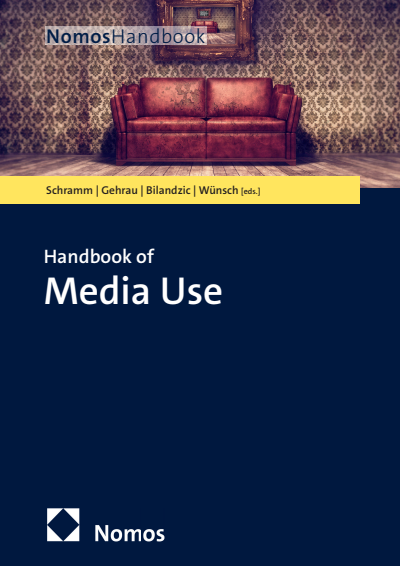
Handbook of Media Use
- Herausgeber:innen:
- | | |
- Reihe:
- NomosHandbuch
- Verlag:
- 2026
Zusammenfassung
Das Handbuch bietet in 37 Beiträgen namhafter Rezeptionsforscherinnen und -forscher einen umfassenden Überblick über die Gegenstände und Theorien der Rezeptionsforschung. Es wird jeweils der aktuelle theoretische und empirische Forschungsstand präsentiert und aus einer kommunikationswissenschaftlichen Perspektive reflektiert. Das Handbuch befasst sich in vier Teilen: (1) mit Grundlagen der Medienrezeption, (2) mit Fragen der Zuwendung und Selektion, (3) mit spezifischen Phänomenen und Erlebnisweisen und (4) mit den wichtigsten Kontexten der Medienrezeption. Moderne Medienwirkungstheorien kommen ohne die Betrachtung von Rezeptionsprozessen nicht mehr aus. Im Handbuch werden daher die Prozesse vor und während der Mediennutzung im Detail betrachtet. Zielgruppe des Handbuchs ist das breite Fachpublikum der Kommunikationswissenschaft und angrenzender Fächer wie Soziologie, Psychologie, Politikwissenschaft, Erziehungswissenschaft sowie fortgeschrittene Studierende.
Mit Beiträgen von Stefanie Averbeck-Lietz | Anna Bartsch | Helena Bilandzic | Marco Dohle | Andreas Fahr | Luisa Gehle | Volker Gehrau | Alicia Gilbert | Uli Gleich | Anne Haage | Maren Hartmann | Uwe Hasebrink | Matthias R. Hastall | Andreas Hepp | Viktoria Heyer | Sarah Juricek | Anja Kalch | Veronika Karnowski | Christoph Klimmt | Thomas Koch | Anna Sophie Kümpel | Klara Langmann | Sophie Lecheler | Nicole Liebers-Trappe | Christine Linke | Merja Mahrt | Jörg Matthes | Fabian Mayer | Teresa K. Naab | Brigitte Naderer | Stephan Niemand | Magdalena Obermaier | Özen Odağ | Zoe Olbermann | Daniel Possler | Elizabeth Prommer | Leonard Reinecke | Diana Rieger | Simon Sax | Svenja Schäfer | Christian Schemer | Daniela Schlütz | Anna Schnauber-Stockmann | Holger Schramm | Stephan Schwan | Ulrike Schwertberger | Philip Sinner | Denise Sommer | Monika Suckfüll | Freya Sukalla | Ralph Weiß | Werner Wirth | Carsten Wünsch | Tim Wulf
Publikation durchsuchen
Bibliographische Angaben
- Auflage
- 1/2026
- Copyrightjahr
- 2026
- ISBN-Print
- 978-3-7560-3317-1
- ISBN-Online
- 978-3-7489-6251-9
- Verlag
- Nomos, Baden-Baden
- Reihe
- NomosHandbuch
- Sprache
- Englisch
- Seiten
- 740
- Produkttyp
- Sammelband
Inhaltsverzeichnis
- Preface to the expanded and revised 2nd edition of the English version of the handbook Kein Zugriff
- Preface to the expanded and revised 2nd edition of the German version of the handbook Kein Zugriff
- Preface to the 1st edition of the German version of the handbook Kein Zugriff
- Autor:innen: |
- 1 Introduction: Why do we deal with cognition? Kein Zugriff
- 2.1 Definition of cognition Kein Zugriff
- 2.2 Basic Model of the Cognitive System Kein Zugriff
- 3.1 Perception Kein Zugriff
- 3.2 Attention Kein Zugriff
- 4.1 Memory as an associative network Kein Zugriff
- Functions of schemata Kein Zugriff
- Changes to schemata Kein Zugriff
- 4.3 Connectionist models Kein Zugriff
- 4.4 Mental models Kein Zugriff
- 4.5 Memory, retrieval and forgetting Kein Zugriff
- 4.6 Memory measurement in media research Kein Zugriff
- 5. Summary: Resource allocation in media usage Kein Zugriff
- References Kein Zugriff
- Autor:innen:
- 1. The cultural history of emotions Kein Zugriff
- 2. Definition and conceptualisation of emotions Kein Zugriff
- 3. Emotion theories Kein Zugriff
- 4.1 Are emotion theories incompatible? Kein Zugriff
- 4.2 How many emotions are there? Kein Zugriff
- 4.3 How conscious are emotional processes? Kein Zugriff
- 4.4 How situation-specific are emotions? Kein Zugriff
- 4.5 Emotion, meta-emotion and emotion regulation Kein Zugriff
- 5. Affect research in reception and impact research Kein Zugriff
- References Kein Zugriff
- Autor:innen: |
- 1. Action as a basic sociological category Kein Zugriff
- 2. Definition: Action and behaviour Kein Zugriff
- 3.1.1 Expectancy-value theories Kein Zugriff
- 3.1.2 Theories of action control Kein Zugriff
- 3.1.3 Specific determinants of media behaviour Kein Zugriff
- 3.2.1 Approaches to selection behaviour Kein Zugriff
- 3.2.2 Theories of interpretation and interpretation behaviour Kein Zugriff
- 3.2.3 Context-orientated approaches Kein Zugriff
- 3.3 Integration of theoretical approaches and methodological implications Kein Zugriff
- 4. Conclusion Kein Zugriff
- References Kein Zugriff
- Autor:innen: | |
- 1. Introduction Kein Zugriff
- 2. Definition of interactivity Kein Zugriff
- 3. Interactive media use as a process of continuous selection Kein Zugriff
- 4.1 Cognition: Interactivity and information processing Kein Zugriff
- 4.2 Motivation: Interactivity and intrinsic motivation Kein Zugriff
- 4.3 Affect: Interactivity as an elicitor and amplifier of emotional processes Kein Zugriff
- 4.4 Effects of interactivity: Situational and synergistic interaction of cognitive, motivational, and affective processes Kein Zugriff
- 5. Conclusion and outlook: Interactivity as an opportunity and challenge for media use research Kein Zugriff
- References Kein Zugriff
- Autor:innen:
- 1. Introduction Kein Zugriff
- 2. Media reception as part of the routines of everyday life Kein Zugriff
- 3. Media reception in the mode of routines of perception and habits of feeling Kein Zugriff
- 4. Media reception in the shaping of social relationships and identities Kein Zugriff
- 5. Conclusion: Everyday life – A ferment of reception research Kein Zugriff
- References Kein Zugriff
- Autor:innen: |
- 1. Introduction Kein Zugriff
- 2.1 Context in which the approach arose Kein Zugriff
- 2.2 Underlying assumptions and lines of discussion in diffusion research Kein Zugriff
- 2.3 Exemplary findings on the diffusion of media technologies Kein Zugriff
- 3.1 Context in which the approach arose Kein Zugriff
- 3.2 Basic assumptions and lines of discussion in domestication research Kein Zugriff
- 3.3 Exemplary findings on the domestication of media technologies Kein Zugriff
- 4.1 Balance sheet: Connections and differences Kein Zugriff
- 4.2 Reflections on combining diffusion and domestication Kein Zugriff
- 4.3 Potential to connect the two approaches in empirical research using the example of inequality and participation Kein Zugriff
- 5. Conclusion Kein Zugriff
- References Kein Zugriff
- Autor:innen:
- 1. What is motivation? Kein Zugriff
- 2. Motivation in the context of media choice Kein Zugriff
- 3.1 Motives and their systematisation Kein Zugriff
- 3.2 Examples of motive studies and gratification catalogues Kein Zugriff
- 3.3 Benefits and problems Kein Zugriff
- 4.1 Basic assumptions Kein Zugriff
- 4.2.1 Discrepancy Model Kein Zugriff
- 4.2.2 Expectancy-Value Model Kein Zugriff
- 5.1 Social Cognitive Theory Kein Zugriff
- 5.2 Theory of Planned Behaviour Kein Zugriff
- 5.3 Informational Utility Kein Zugriff
- 6. Conclusion Kein Zugriff
- References Kein Zugriff
- Autor:innen:
- 1. Introduction Kein Zugriff
- 2. Concept and definition of attitudes and values Kein Zugriff
- 3. Measurement of attitudes and values Kein Zugriff
- 4. Attitudes and behaviour Kein Zugriff
- 5.1 The history of selective exposure research Kein Zugriff
- 5.2 Intervening factors Kein Zugriff
- 5.3 Discussion on the significance of the Theory of Cognitive Dissonance Kein Zugriff
- 5.4 Selective exposure in digital contexts Kein Zugriff
- 5.5 Values and selective exposure Kein Zugriff
- 5.6 Attitudes towards media and media content Kein Zugriff
- 6. Outlook Kein Zugriff
- References Kein Zugriff
- Autor:innen:
- 1. Introduction Kein Zugriff
- 2.1 Theoretical cornerstones and positioning of Mood Management Theory Kein Zugriff
- 2.2 Key points of Mood Management Theory Kein Zugriff
- 3.1 Instrumental and eudaimonic driven media choice Kein Zugriff
- 3.2 Mood-congruent and -incongruent media choice Kein Zugriff
- 3.3 Peri-receptive mood regulation and media choice Kein Zugriff
- 4. Conclusion Kein Zugriff
- References Kein Zugriff
- Autor:innen:
- 1. Introduction: What is personality? Kein Zugriff
- 2. Central personality factors Kein Zugriff
- 3. Research perspectives: Motivation, selection, exposure, impact Kein Zugriff
- 4.1 Relationship and functional relationship between personality and media messages Kein Zugriff
- Neuroticism/psychoticism Kein Zugriff
- Extraversion Kein Zugriff
- Openness to experience Kein Zugriff
- Agreeableness Kein Zugriff
- Conscientiousness Kein Zugriff
- Sensation Seeking Kein Zugriff
- 5. Outlook Kein Zugriff
- References Kein Zugriff
- Autor:innen: | |
- 1. Introduction Kein Zugriff
- 2.1 Definition of judgements and evaluations Kein Zugriff
- Cognitive, affective and conative judgement components Kein Zugriff
- Judgements by subject area Kein Zugriff
- Network presentation of judgement formation Kein Zugriff
- Activation and availability of judgements Kein Zugriff
- Cognitively complex judgement formation Kein Zugriff
- Cognitively superficial judgement formation Kein Zugriff
- Selected factors influencing the formation of judgements Kein Zugriff
- 3.2 Criticism of judgement models Kein Zugriff
- 4. Conclusion and outlook Kein Zugriff
- References Kein Zugriff
- Autor:innen: |
- 1. Introduction Kein Zugriff
- 2.1 Origins of the theory Kein Zugriff
- 2.2 Definitions: Frames, framing, framing effects Kein Zugriff
- 2.3 Framing as a process Kein Zugriff
- 3.1 Creation of media frames Kein Zugriff
- 3.2 Audience frames and individual selection Kein Zugriff
- 4.1 The development of the Frame Processing Model Kein Zugriff
- 4.2 Accessibility, availability, and belief content Kein Zugriff
- 4.3 Emotions in the framing process Kein Zugriff
- 5. Conclusion and outlook Kein Zugriff
- References Kein Zugriff
- Autor:innen: |
- 1. Introduction Kein Zugriff
- 2. Preferences and media use: Selective use of political media content Kein Zugriff
- 3.1.1 Basics Kein Zugriff
- 3.1.2 The dissonance motivation as a motivational cue Kein Zugriff
- Affective reactions in the Motivated Reasoning Approach Kein Zugriff
- Motivated reasoning and the use of political media content Kein Zugriff
- Motivated reasoning and false information Kein Zugriff
- 3.2.2 Lay epistemology Kein Zugriff
- 3.2.3 Motivation in the Heuristic-Systematic Model (HSM) Kein Zugriff
- 4.1 The role of pre-existing attitudes in filter bubbles and echo chambers Kein Zugriff
- 4.2 Fragmentation and polarisation as a result of echo chambers and filter bubbles Kein Zugriff
- 5. Conclusion Kein Zugriff
- References Kein Zugriff
- Autor:innen:
- 1. Introduction Kein Zugriff
- 2. Comprehension as a motive for media use Kein Zugriff
- 3.1 Comprehension as re-experiencing Kein Zugriff
- 3.2 Comprehension as formation of a situation model Kein Zugriff
- 3.3 Dimensions of the situation model Kein Zugriff
- 3.4 Representation conventions as aids to comprehension Kein Zugriff
- 3.5 The “deeper meaning” Kein Zugriff
- 4.1 Comprehension processes in multimedia programmes Kein Zugriff
- 4.2 Comprehension of multiple documents Kein Zugriff
- 5. Summary Kein Zugriff
- References Kein Zugriff
- Autor:innen: |
- 1. Introduction Kein Zugriff
- Joy Kein Zugriff
- Hope Kein Zugriff
- Affection Kein Zugriff
- Fear Kein Zugriff
- Sadness Kein Zugriff
- Anger Kein Zugriff
- 3.1 Emotional flow Kein Zugriff
- 3.2 The influence of cognitive processes on emotions Kein Zugriff
- 3.3 Influence of emotions on cognitive processing Kein Zugriff
- 4.1 Mixed emotions Kein Zugriff
- 4.2 Meta-emotions Kein Zugriff
- 4.3 Eudaimonic experiences Kein Zugriff
- 5. Summary Kein Zugriff
- References Kein Zugriff
- Autor:innen:
- 1. Theories on the influence of individual life experiences and memories on media reception Kein Zugriff
- 2.1 Psychological foundations of nostalgia Kein Zugriff
- 2.2 Media-induced nostalgia Kein Zugriff
- 3.1 Individual effects of media-induced nostalgia Kein Zugriff
- 3.2 Collective effects of media-induced nostalgia Kein Zugriff
- 4. Summary and outlook Kein Zugriff
- References Kein Zugriff
- Autor:innen:
- 1. Introduction Kein Zugriff
- 2.1 Understandings of suspense Kein Zugriff
- 2.2 Types of suspense Kein Zugriff
- 3.1 Uncertainty and probability Kein Zugriff
- Moral judgements about characters Kein Zugriff
- Identification, affective dispositions and perspective-taking Kein Zugriff
- 3.3 Hope and fear Kein Zugriff
- 3.4 Biophysiological aspects of suspense experience Kein Zugriff
- 3.5 Attention Kein Zugriff
- 3.6 Suspense-promoting media characteristics Kein Zugriff
- 4.1 Zillmann: Affective Disposition Theory Kein Zugriff
- 4.2 Brewer: Structural Affect Theory Kein Zugriff
- 4.3 Mellmann: Suspense as a side effect of experiencing emotions Kein Zugriff
- 4.4 Further approaches Kein Zugriff
- 5. Measurement of suspense experience Kein Zugriff
- 6. Selection and enjoyment of suspenseful media content Kein Zugriff
- 7.1 Gender Kein Zugriff
- 7.2 Intra-individual differences Kein Zugriff
- 7.3 Personality predispositions Kein Zugriff
- 8. Outlook Kein Zugriff
- References Kein Zugriff
- Autor:innen:
- 1. Introduction Kein Zugriff
- 2. What is inspiration? Kein Zugriff
- 3.1 Hedonic and eudaimonic entertainment experience Kein Zugriff
- 3.2 Inspiring (self-transcendent) entertainment experiences Kein Zugriff
- 4.1 Modelling concepts Kein Zugriff
- 4.2 Evocation: Contact with inspiring content and triggers Kein Zugriff
- 4.3 Transcendence: Reactions to 'inspiring' media content Kein Zugriff
- 4.4 Motivation: Effects Kein Zugriff
- 5. Conclusion and outlook Kein Zugriff
- References Kein Zugriff
- Autor:innen:
- 1. Introduction Kein Zugriff
- 2. The history of psychological aesthetics Kein Zugriff
- 3. Perspectives of psychological aesthetics Kein Zugriff
- 4.1 The Motivational Psychological Approach Kein Zugriff
- 4.2 The Cognitive Psychological Approach Kein Zugriff
- 5. Operationalisation of aesthetic emotions Kein Zugriff
- 6. Aesthetic experience in the processing of film stimuli Kein Zugriff
- 7. The function of aesthetic experiences Kein Zugriff
- 8. Conclusion/Outlook Kein Zugriff
- References Kein Zugriff
- Autor:innen:
- 1. Introduction Kein Zugriff
- 2.1 Definition Kein Zugriff
- 2.2 Mechanisms of the flow Kein Zugriff
- 2.3 Flow in media activities Kein Zugriff
- 3.1 Definition Kein Zugriff
- 3.2 Theoretical models Kein Zugriff
- 3.3 Factors and mechanisms of narrative engagement Kein Zugriff
- 4.1 Definition Kein Zugriff
- 4.2 Theoretical models Kein Zugriff
- 4.3 Factors and mechanisms of presence Kein Zugriff
- 5. Conclusion Kein Zugriff
- References Kein Zugriff
- Autor:innen: | |
- 1. Introduction Kein Zugriff
- 2. Conceptualisations of involvement – Origins and context of application Kein Zugriff
- 3.1 (Ego-) Involvement as a situation-unspecific personality trait Kein Zugriff
- 3.2 Involvement as situation (in)specific personal relevance Kein Zugriff
- 3.3 Involvement as a situation-specific mode of reception Kein Zugriff
- 4. Conclusion and outlook Kein Zugriff
- References Kein Zugriff
- Autor:innen: |
- 1. Introduction Kein Zugriff
- 2.1 Parasocial phenomena Kein Zugriff
- 2.2 Facets of parasocial phenomena Kein Zugriff
- 2.3 Related and neighbouring constructs Kein Zugriff
- 3.1 Circular Process Model and Two-Level Model of Parasocial Interaction Kein Zugriff
- 3.2 Relationship Level Model Kein Zugriff
- 4.1 Common measurement instruments for recording parasocial interactions Kein Zugriff
- 4.2 Investigation of parasocial interactions as a function of prereceptive relationships Kein Zugriff
- 4.3 Investigation of parasocial interactions over time Kein Zugriff
- 5.1 Predictors of parasocial interactions Kein Zugriff
- 5.2 Parasocial interactions in the context of the entertainment experience Kein Zugriff
- 5.3 Parasocial interactions in persuasive contexts Kein Zugriff
- 6. Conclusion Kein Zugriff
- References Kein Zugriff
- Autor:innen:
- 1. Introduction Kein Zugriff
- 2.1 Basics of empathy Kein Zugriff
- 2.2 Measuring empathy Kein Zugriff
- 2.3 Empathy with media characters Kein Zugriff
- Media enjoyment Kein Zugriff
- Violent content and aggression Kein Zugriff
- Persuasion Kein Zugriff
- Influence of media use on empathic abilities Kein Zugriff
- 3.1 Basics of identification Kein Zugriff
- 3.2 Wishful identification Kein Zugriff
- 3.3 Measuring identification Kein Zugriff
- Persuasion Kein Zugriff
- Media enjoyment Kein Zugriff
- 4.1 Basics of social comparison Kein Zugriff
- 4.2 Measuring social comparison Kein Zugriff
- 4.3 Social comparison with media characters Kein Zugriff
- Selective attention and processing Kein Zugriff
- Reception experience and enjoyment Kein Zugriff
- Effects on self-image, self-esteem and mental health Kein Zugriff
- 5. Conclusion Kein Zugriff
- References Kein Zugriff
- Autor:innen:
- 1. Introduction Kein Zugriff
- 2. References to reality in fiction, non-fiction and hybrid formats Kein Zugriff
- 3. Audience credibility expectations and the construction of disbelief Kein Zugriff
- 4. Perceived reality and realism Kein Zugriff
- 5. Trends and desiderata in realism research Kein Zugriff
- References Kein Zugriff
- Autor:innen: |
- 1. Introduction Kein Zugriff
- 2. From credibility research to trust research in media reception Kein Zugriff
- 3. Trust in the media Kein Zugriff
- 4.1 Media-related influences on trust in the media Kein Zugriff
- 4.2 Social and political influences on trust in the media Kein Zugriff
- 4.3 Trust in media as a moderating influence during media use Kein Zugriff
- 5. Conclusion Kein Zugriff
- References Kein Zugriff
- Autor:innen: |
- 1. The Theory of Psychological Reactance Kein Zugriff
- 2. Boomerang effect Kein Zugriff
- 3. Reactance as a situational and attitudinal variable Kein Zugriff
- 4.1 Reactance in media use Kein Zugriff
- 4.2 Reactance in advertising communication Kein Zugriff
- 4.3 Reactance in health communication Kein Zugriff
- 4.4 Reactance in environmental communication Kein Zugriff
- 5. Conclusion/outlook Kein Zugriff
- References Kein Zugriff
- Autor:innen: |
- 1. Introduction Kein Zugriff
- 2. Content creation options Kein Zugriff
- 3. The imagined audience Kein Zugriff
- 4.1 Elaboration in anticipation of content generation Kein Zugriff
- 4.2 Elaboration during the composition of media content Kein Zugriff
- 4.3 Processes after publication Kein Zugriff
- 4.4 Feedback effects Kein Zugriff
- 5. Conclusion Kein Zugriff
- References Kein Zugriff
- Autor:innen:
- 1. Introduction Kein Zugriff
- 2. Definition and concept specification Kein Zugriff
- 3.1 Motives Kein Zugriff
- 3.2 Reception experience and effects Kein Zugriff
- 4.1 Methods of data collection Kein Zugriff
- 4.2 Approaches to operationalisation Kein Zugriff
- 5. Conclusion and desiderata Kein Zugriff
- References Kein Zugriff
- Autor:innen:
- 1. Subject area of international comparative research on media use Kein Zugriff
- 2. Fundamentals and approaches of international comparative social research Kein Zugriff
- 3.1 Technical reach and access Kein Zugriff
- 3.2.1 Frequency and duration of use of various media Kein Zugriff
- 3.2.2 Selection of foreign or transcultural media offerings Kein Zugriff
- 3.2.3 News use Kein Zugriff
- 3.3 Meanings of media usage Kein Zugriff
- 4. Conclusion and outlook on perspectives for international comparative research on media use Kein Zugriff
- References Kein Zugriff
- Autor:innen: |
- 1. Introduction Kein Zugriff
- 2. How community building relates to media practices Kein Zugriff
- 3.1 Interpretive communities Kein Zugriff
- 3.2 Families Kein Zugriff
- 3.3 Circles of friends, peer groups, and cliques Kein Zugriff
- 4.1 Nation and geopolitical region Kein Zugriff
- 4.2 Diasporas, fan communities, social movements, and religious communities Kein Zugriff
- 4.3 Online communities Kein Zugriff
- 5. Current research perspectives: Polymedia, platform collectivities, and technology-related communities Kein Zugriff
- References Kein Zugriff
- Autor:innen: |
- 1. History of media use as a research desideratum Kein Zugriff
- 2.1 Practices of (viewing) and (pre-)reading in the 17th to 20th centuries Kein Zugriff
- 2.2.1 The cinema Kein Zugriff
- 2.2.2. The radio Kein Zugriff
- 2.2.3 Early radio research as a source Kein Zugriff
- 2.2.4 Television Kein Zugriff
- 3.1 NS state Kein Zugriff
- 3.2 GDR Kein Zugriff
- 4. Convergent media use in the 21st century as an unfinished development Kein Zugriff
- 5. Conclusion Kein Zugriff
- References Kein Zugriff
- Autor:innen: |
- 1. Introduction Kein Zugriff
- 2.1 Theoretical perspectives and basic concepts on age and life phases Kein Zugriff
- 2.2 Studies on media use in certain phases of life of ageing Kein Zugriff
- 2.3 Adolescence and media Kein Zugriff
- 2.4 Seniors and media Kein Zugriff
- 3.1 Biographical trajectories, the transformation of media repertoires and media practices Kein Zugriff
- 3.2 Fractions and inflection points Kein Zugriff
- 3.3 Changes in media use and life cycles Kein Zugriff
- 4. Conclusion Kein Zugriff
- References Kein Zugriff
- Autor:innen:
- 1. Introduction Kein Zugriff
- 2.1 Digital disability divide Kein Zugriff
- 2.2 Understanding disability and consequences for media use research Kein Zugriff
- 3.1 Hearing impairment/deafness Kein Zugriff
- 3.2 Visual impairment/blindness Kein Zugriff
- 3.3 Cognitive impairments, learning difficulties Kein Zugriff
- 3.4 Physical and motor impairments Kein Zugriff
- 3.5 Other impairments Kein Zugriff
- 4.1 Visual impairment, age and barriers in the media Kein Zugriff
- 4.2 People in segregated institutions Kein Zugriff
- 4.3 Hearing loss and low education Kein Zugriff
- 4.4 Older people with disabilities and online media Kein Zugriff
- 4.5 Facilitating factors: Education, younger age and digital media Kein Zugriff
- 5. Conclusion Kein Zugriff
- References Kein Zugriff
- Autor:innen:
- 1. Introduction Kein Zugriff
- 2.1 Psychological foundations of media use in groups Kein Zugriff
- 2.2 Social foundations of media use in groups Kein Zugriff
- 2.3 Communicative foundations of media use in group Kein Zugriff
- 3.1 Television viewing in groups Kein Zugriff
- 3.2 Media use in families or small groups Kein Zugriff
- 3.4 Media use as an event with many people Kein Zugriff
- 4.1 Model of Media Use in Groups Kein Zugriff
- 4.2 Future directions Kein Zugriff
- References Kein Zugriff
- Autor:innen:
- 1. Introduction Kein Zugriff
- 2.1 A brief history of the evolution of mobile communication Kein Zugriff
- 2.2 What are mobile media? Kein Zugriff
- 2.3 Adoption of mobile devices Kein Zugriff
- 2.4 Appropriation and integration into everyday life Kein Zugriff
- 2.5 Situational context Kein Zugriff
- 3.1 Mobile media and political participation Kein Zugriff
- 3.2 Couple and family communication Kein Zugriff
- 3.3 Free time, working hours and mobile devices Kein Zugriff
- 3.4 Empowerment through mobile devices Kein Zugriff
- 4. Outlook Kein Zugriff
- References Kein Zugriff
- Autor:innen: |
- 1. Introduction: Permanent connectedness Kein Zugriff
- 2.1 Technological changes Kein Zugriff
- 2.2 Behavioural changes Kein Zugriff
- 2.3 Cognitive and motivational changes Kein Zugriff
- 3.1 Cognitive effects Kein Zugriff
- 3.2 Emotional and motivational effects Kein Zugriff
- 3.3 Social impact Kein Zugriff
- 4. Conclusion and outlook: Implications and research desiderata Kein Zugriff
- References Kein Zugriff
- Autor:innen:
- 1. Introduction Kein Zugriff
- 2.1 Definitions: Algorithms and algorithmic media environments Kein Zugriff
- 2.2 Functions: What algorithms do in the context of media use Kein Zugriff
- 2.3 Relevance: Media use in algorithmic environments Kein Zugriff
- 3.1 Algorithmic awareness Kein Zugriff
- 3.2 Algorithmic sensemaking Kein Zugriff
- 3.3 Algorithmic literacy Kein Zugriff
- 4.1 Implications of media use in algorithmic environments Kein Zugriff
- 4.2 Development and methodological challenges Kein Zugriff
- References Kein Zugriff
- List of authors Kein Zugriff Seiten 725 - 730
- Index Kein Zugriff Seiten 731 - 740