, um zu prüfen, ob Sie einen Vollzugriff auf diese Publikation haben.
Monographie Kein Zugriff

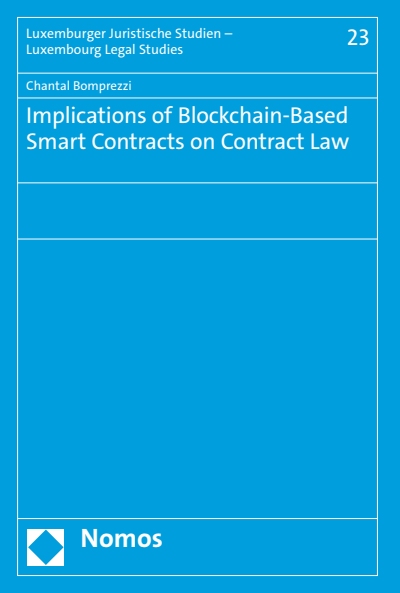
Implications of Blockchain-Based Smart Contracts on Contract Law

Autor:innen:
Verlag:
 19.11.2021

Zusammenfassung

Dieses Werk bietet eine eingehende Analyse der wichtigsten Debatten über Blockchain-basierte intelligente Verträge und Vertragsrecht. Nach einer detaillierten Beschreibung der Technologie werden die bestehenden Regeln zu Technologie und Verträgen - von Automaten bis hin zu berechenbaren Verträgen - untersucht und auf ihre Anwendbarkeit auf Blockchain-basierte Smart Contracts überprüft. Der Schwerpunkt liegt dabei auf den Auswirkungen von Blockchain-basierten intelligenten Verträgen auf das Zustandekommen des Vertrages, die Vertragserfüllung und das anwendbare Recht sowie die Gerichtsbarkeit.

Schlagworte


Publikation durchsuchen


Bibliographische Angaben

Copyrightjahr
2021
Erscheinungsdatum
19.11.2021
ISBN-Print
978-3-8487-8592-6
ISBN-Online
978-3-7489-3006-8
Verlag
Nomos, Baden-Baden
Reihe
Luxemburger Juristische Studien - Luxembourg Legal Studies
Band
23
Sprache
Englisch
Seiten
266
Produkttyp
Monographie

Inhaltsverzeichnis

KapitelSeiten
  1. Titelei/Inhaltsverzeichnis Kein Zugriff Seiten 1 - 10
    1. I. Background Kein Zugriff
    2. II. Research problem Kein Zugriff
    3. III. Research objective and question Kein Zugriff
    4. IV. Methodology Kein Zugriff
    5. V. Structure of the book. Kein Zugriff
    1. 1. Definition and functioning of blockchain. Kein Zugriff
    2. 2. Properties of blockchain. Kein Zugriff
    3. 3. Origins. Kein Zugriff
    4. 4. Evolution. Kein Zugriff
    5. 5. Typologies. Kein Zugriff
    6. 6. False myths surrounding blockchains. Kein Zugriff
    7. 7. Smart contracts. Kein Zugriff
    8. 8. Limitations of pre-existing blockchain platforms versus smart contracting platforms. Kein Zugriff
    9. 9. Ethereum. Kein Zugriff
    10. 10. Use cases. Kein Zugriff
    1. 1. Smart contract: a misleading expression. Kein Zugriff
    2. 2. ‘Smart contract code’ versus ‘smart legal contracts’. Kein Zugriff
    3. 3. Nick Szabo’s theories. Kein Zugriff
    4. 4. Characteristics of smart legal contracts. Kein Zugriff
    5. 5. Summary of existing legal literature. Kein Zugriff
    6. 6. Applicable form of regulation. Kein Zugriff
    7. 7. Types of contract. Kein Zugriff
    8. 8. Concrete scenarios. Kein Zugriff
    1. 1. The historical impact of technology on contracts. Kein Zugriff
        1. 2.1.1. Conclusion of contracts through software agents. Kein Zugriff
        2. 2.1.2. Digital identity in electronic commerce. Kein Zugriff
        3. 2.1.3. Defects of consent: the mistake. Kein Zugriff
        4. 2.1.4. Form requirements. Kein Zugriff
      1. 2.2. Contract performance: contractual and non-contractual liability. Kein Zugriff
      2. 2.3. Jurisdiction and applicable law. Kein Zugriff
    1. 1. Are smart contracts ‘contracts’? Kein Zugriff
      1. 2.1. Time of conclusion of the contract. Kein Zugriff
      2. 2.2. Revocation of offer and acceptance. Kein Zugriff
      1. 3.1. Contractual intention. Kein Zugriff
      2. 3.2. The mistake. Kein Zugriff
      1. 4.1. Acknowledgement of receipt. Kein Zugriff
    2. 5. Form. Kein Zugriff
    3. 6. Smart contracts concluded ‘smart’. Kein Zugriff
    4. 7. Smart contract code as a mean to express contracts or to perform already existing contracts? Kein Zugriff
    5. 8. Findings and conclusions. Kein Zugriff
    1. PART 1: BREACH OF CONTRACT Kein Zugriff
    2. 1. Introduction. Kein Zugriff
    3. 2. Potential cases of violation of the contract. Kein Zugriff
    4. 3. Clarifications on the meaning of ‘decentralisation’. Kein Zugriff
    5. 4. Clarifications on the meaning of ‘validation’ and ‘execution’. Kein Zugriff
    6. 5. Analysis of the scenarios. Kein Zugriff
    7. 6. Application of existing rules on breach of contract. Kein Zugriff
    8. 7. Third-party service providers. Kein Zugriff
    9. 8. Identification of the liable party. Kein Zugriff
    10. 9. Findings and conclusions. Kein Zugriff
    1. 1. Introduction. Kein Zugriff
    2. 2. Immutability of blockchain. Kein Zugriff
      1. 3.1. Termination. Kein Zugriff
      2. 3.2. Rescission. Kein Zugriff
      3. 3.3. Withdrawal. Kein Zugriff
      4. 3.4. Renegotiation. Kein Zugriff
    3. 4. The proposed technical solutions. Kein Zugriff
      1. 5.1. The false myth of decentralisation. Kein Zugriff
      2. 5.2. Identification of the obliged party. Kein Zugriff
      1. 6.1. Termination. Kein Zugriff
      2. 6.2. Rescission. Kein Zugriff
      3. 6.3. Withdrawal. Kein Zugriff
      4. 6.4. Renegotiation. Kein Zugriff
      5. 6.5. Limitations to contractual autonomy. Kein Zugriff
    4. 7. Findings and conclusions. Kein Zugriff
    1. 1. Introduction. Kein Zugriff
    2. 2. Blockchain and the Internet. Kein Zugriff
      1. 3.1. Location of contract performance. Kein Zugriff
      2. 3.2. Place of residence, domicile, business, and administration. Kein Zugriff
      1. 4.1. Blockchain and ODR. Kein Zugriff
    3. 5. Findings and conclusions. Kein Zugriff
    1. 1. Summary of preceding conclusions. Kein Zugriff
    2. 2. False myths surrounding blockchain and smart contracts. Kein Zugriff
    3. 3. Applicability of existing rules. Kein Zugriff
    4. 4. Open issues. Kein Zugriff
    5. 5. Research question answers. Kein Zugriff
  2. BIBLIOGRAPHY Kein Zugriff Seiten 241 - 266

Ähnliche Veröffentlichungen

aus dem Schwerpunkt "Europarecht & Internationales Recht & Rechtsvergleichung"
Cover des Buchs: Der Volkseinwand
Monographie Kein Zugriff
Florian Feigl
Der Volkseinwand
Cover des Buchs: Wie fördert die EU Menschenrechte in Drittstaaten?
Monographie Kein Zugriff
Dennis Traudt
Wie fördert die EU Menschenrechte in Drittstaaten?
Cover des Buchs: Future-Proofing in Public Law
Sammelband Kein Zugriff
Nicole Koblenz LL.M., Nicholas Otto, Gernot Sydow
Future-Proofing in Public Law