, um zu prüfen, ob Sie einen Vollzugriff auf diese Publikation haben.
Sammelband Kein Zugriff
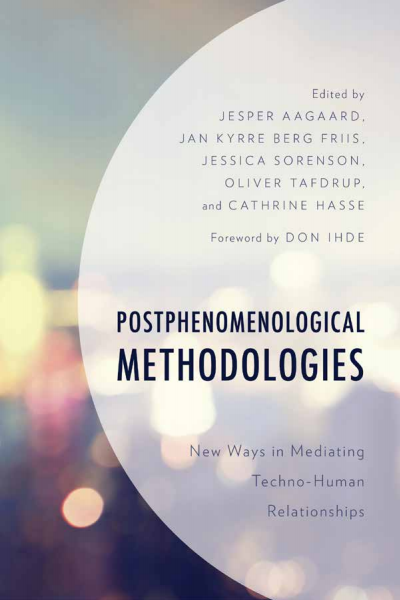
Postphenomenological Methodologies
New Ways in Mediating Techno-Human Relationships
Herausgeber:innen:
| | | |
Verlag:
2018
Zusammenfassung
This edited volume is the first publication to tackle the issue of researching human-technology relations from a methodological postphenomenological perspective. While the ‘traditional’ phenomenology of the 20th century, with figures like Husserl, Heidegger and Merleau-Ponty, provided valuable insights into the formal structures of essence, being and embodiment, etc. their mode of philosophizing mostly involved abstract ‘pure’ thinking. Although rooted in this tradition, the postphenomenological approach to the study of human-technology relations emphasizes the “empirical turn” and interdisciplinary work in the field of philosophy – and reaches out to other disciplines like anthropology, education, media studies, and science and technology studies (STS).
The contributors discuss what it means for the field of postphenomenology to be empirically based and what kind of methodology is required in order for researchers to go out and study human-technology relations in this perspective. In many disciplines, methodology refers to the analytical approach taken – e.g. the analytical concepts you employ to make an analysis; in postphenomenology, these might include concepts such as multistability, variation, or mediation. In a discipline like anthropology, it also refers to reflections over the methods researchers use to approach an empirical field. Methods can include interviews of different kinds, participant observations, surveys, and auto-ethnography. Furthermore, methodology can include ethical issues tied to doing research in an empirical field. These practical aspects are not separate from, but rather connected to, theoretical approaches. This book ties together the methods, ethics, and theories of postphenomenology in a groundbreaking volume on methodology. With postphenomenological studies of education, digital media, biohacking, health, robotics, and skateboarding as points of reference, the authors of this volume, in twelve chapters, provide new perspectives on what a comprehensive postphenomenological research methodology must consist of.
Schlagworte
Publikation durchsuchen
Bibliographische Angaben
Auflage
1/2018
Copyrightjahr
2018
ISBN-Print
978-1-4985-4523-5
ISBN-Online
978-1-4985-4524-2
Verlag
Lexington, Lanham
Sprache
Englisch
Seiten
268
Produkttyp
Sammelband
Inhaltsverzeichnis
KapitelSeiten
Contents Kein Zugriff
Foreword Kein Zugriff
An Introduction toPostphenomenological Methodologies Kein Zugriff
Chapter 1 Kein Zugriff
Chapter 2 Kein Zugriff
Chapter 3 Kein Zugriff
Chapter 4 Kein Zugriff
Chapter 5 Kein Zugriff
Chapter 6 Kein Zugriff
Chapter 7 Kein Zugriff
Chapter 8 Kein Zugriff
Introduction Kein Zugriff Seiten 151 - 168
Chapter 9 Kein Zugriff
Chapter 10 Kein Zugriff
Chapter 11 Kein Zugriff
Chapter 12 Kein Zugriff
Introduction Kein Zugriff Seiten 241 - 258
Index Kein Zugriff Seiten 259 - 264
List of Contributors Kein Zugriff Seiten 265 - 268
Ähnliche Veröffentlichungen
aus dem Schwerpunkt "Bildung allgemein"
Sammelband Kein Zugriff
Amina Kielblock, Stephan Kielblock, Christoph Bülau, Anna- Maria Seemann