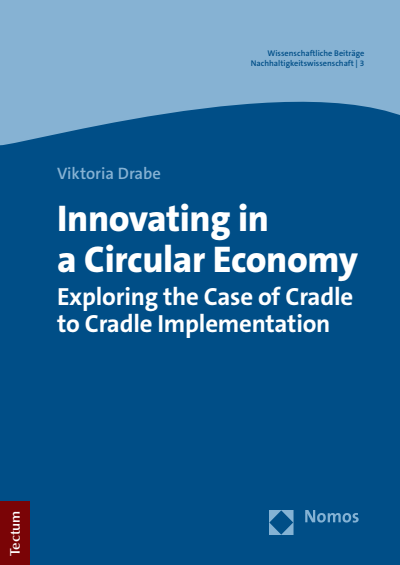
Innovating in a Circular Economy
Exploring the Case of Cradle to Cradle Implementation- Autor:innen:
- Verlag:
- 2022
Zusammenfassung
Mit einem Vorwort von Univ. Prof. Dr. Dr. h.c. Cornelius Herstatt.
Angesichts der zunehmenden Verknappung begrenzter Ressourcen, erhöhten Preisvolatilität und sich ändernden Kundenansprüchen in Bezug auf Produktnachhaltigkeit ist die Circular Economy (CE) ein alternatives Paradigma zum derzeitigen "Take-Make-Waste"-Wirtschaftssystem, das von linearen Materialflüssen geprägt ist.
Diese Arbeit untersucht qualitativ und quantitativ, warum und wie Unternehmen bei der Umstellung auf CE erfolgreich sein können, wobei die Cradle to Cradle (C2C) Zertifizierung als Beispiel dient. Basierend auf den Ergebnissen der Interviewreihe und statistischen Analysen werden Implikationen für Theorie und Praxis abgeleitet, um ein Unternehmensumfeld gestalten zu können, das CE-Innovationen fördert.
Schlagworte
Publikation durchsuchen
Bibliographische Angaben
- Copyrightjahr
- 2022
- ISBN-Print
- 978-3-8288-4742-2
- ISBN-Online
- 978-3-8288-7842-6
- Verlag
- Nomos, Baden-Baden
- Reihe
- Wissenschaftliche Beiträge aus dem Tectum Verlag: Nachhaltigkeitswissenschaft
- Band
- 3
- Sprache
- Englisch
- Seiten
- 176
- Produkttyp
- Monographie
Inhaltsverzeichnis
- Titelei/Inhaltsverzeichnis Kein Zugriff Seiten I - XVI
- 1.1 Research relevance Kein Zugriff
- 1.2 Research objectives and contribution Kein Zugriff
- 1.3 Structure of the thesis Kein Zugriff
- 2.1 Brief perspective on the historical development of sustainable innovations Kein Zugriff
- 2.2.1 Main principles and core ideas Kein Zugriff
- 2.2.2 Critical discussion of the CE concept Kein Zugriff
- 2.2.3 The CE as an imperative for future business Kein Zugriff
- 2.3.1 Origin and development of C2C Kein Zugriff
- 2.3.2 Main characteristics of C2C Kein Zugriff
- 2.3.3 C2C on the organizational level: the certification program Kein Zugriff
- 2.3.4 Challenges of C2C implementation Kein Zugriff
- 2.4 Interim summary and derivation of methodological approach Kein Zugriff
- 3.1.1 Method and interview structure Kein Zugriff
- 3.1.2 Sample selection Kein Zugriff
- 3.2 Analysing interview results Kein Zugriff
- 3.3 Deriving propositions for further analysis Kein Zugriff
- 4.1.1 General research framework and operationalization of variables Kein Zugriff
- 4.1.2 Development of an online survey Kein Zugriff
- 4.2.1 Data review and cleansing Kein Zugriff
- 4.2.2 Evaluation of missing Data Kein Zugriff
- 4.3.1 Company profiles Kein Zugriff
- 4.3.2 Respondent profiles Kein Zugriff
- 4.3.3 Descriptive analysis of main variables Kein Zugriff
- 4.4.1 Testing underlying assumptions Kein Zugriff
- 4.4.2 Extraction and factor rotation Kein Zugriff
- 4.4.3 Results of analysis Kein Zugriff
- 4.5.1 Research framework Kein Zugriff
- 4.5.2 Underlying assumptions for the multiple regression analysis Kein Zugriff
- 4.5.3 Results of multiple regression analysis Kein Zugriff
- 5.1.1 Driving forces for implementation Kein Zugriff
- 5.1.2 Organizational context and the implementation process Kein Zugriff
- 5.2 Building an organizational environment to foster CE innovations Kein Zugriff
- 6.1 Implications for theory Kein Zugriff
- 6.2 Implications for practice Kein Zugriff
- 6.3 Limitations and avenues for future research Kein Zugriff
- 7 References Kein Zugriff Seiten 145 - 160
- 8.1 Appendix A: Online survey Kein Zugriff
- 8.2 Appendix B: Descriptive results on responding companies Kein Zugriff
- 8.3 Appendix C: Inter-item correlation tables Kein Zugriff
Literaturverzeichnis (217 Einträge)
Es wurden keine Treffer gefunden. Versuchen Sie einen anderen Begriff.
- Abele, E., Anderl, R. and Birkhofer, H. (Eds.) (2005), Environmentally-Friendly Product Development: Methods and Tools, Springer, London. Google Scholar öffnen DOI: 10.5771/9783828878426
- Abernathy, W.J. and Clark, K.B. (1985), “Innovation: Mapping the winds of creative destruction”, Research Policy, 14: 3–22. Google Scholar öffnen DOI: 10.5771/9783828878426
- Adams, R., Jeanrenaud, S., Bessant, J., Denyer, D. and Overy, P. (2018), “Sustainability-oriented innovation: A systematic review”, International Journal of Management Reviews, 18 (2): 180–205. Google Scholar öffnen DOI: 10.5771/9783828878426
- Armstrong, J.S. and Overton, T.S. (1977), “Estimating Nonresponse Bias in Mail Surveys”, Journal of Marketing Research, 14 (3): 396–402. Google Scholar öffnen DOI: 10.5771/9783828878426
- Backhaus, K., Erichson, B., Plinke, W. and Weiber, R. (2016), Multivariate Analysemethoden: Eine anwendungsorientierte Einführung, 14th ed., Springer, Berlin, Heidelberg. Google Scholar öffnen DOI: 10.5771/9783828878426
- Bakker, C.A., Wever, R., Teoh, C. and De Clercq, S. (2010), “Designing cradle-to-cradle products: a reality check”, International Journal of Sustainable Engineering, 3 (1): 2–8. Google Scholar öffnen DOI: 10.5771/9783828878426
- Bamberger, P. and Ang, S. (2016), “The Quantitative Discovery. What is it and How to Get it Published”, Academy of Management Discoveries, 2 (1): 1–6. Google Scholar öffnen DOI: 10.5771/9783828878426
- Bansal, P. and Clelland, I. (2004), “Talking Trash: Legitimacy, impression management, and unsystematic risk in the context of the natural environment”, Academy of Management Journal, 47 (1): 93–103. Google Scholar öffnen DOI: 10.5771/9783828878426
- Bansal, P. and Roth, K. (2000), “Why Companies Go Green: A Model of Ecological Responsiveness”, Academy of Management, 43 (4): 717–736. Google Scholar öffnen DOI: 10.5771/9783828878426
- Baruch, Y. and Holtom, B.C. (2008), “Survey response rate levels and trends in organizational research”, Human Relations, 61 (8): 1139–1160. Google Scholar öffnen DOI: 10.5771/9783828878426
- Basu, K. and Palazzo, G. (2008), “Corporate Social Responsibility: A Process Model of Sensemaking”, Academy of Management Review, 33 (1): 122–136. Google Scholar öffnen DOI: 10.5771/9783828878426
- Becker, K. (2008), “Unlearning as a driver of sustainable change and innovation: three Australian case studies”, International Journal of Technology Management, 42 (1–2): 89–106. Google Scholar öffnen DOI: 10.5771/9783828878426
- Benyus, J.M. (1998), Biomimicry: Innovation Inspired by Nature, Quill William Morrow, New York. Google Scholar öffnen DOI: 10.5771/9783828878426
- Berkhout, F. (2011), “Eco-innovation: reflections on an evolving research agenda”, International Journal of Technology, Policy and Management, 11 (3–4): 191–197. Google Scholar öffnen DOI: 10.5771/9783828878426
- Bernard, H.R. (2013), Social research methods: Qualitative and quantitative approaches, Sage Publications Inc., Thousand Oaks. Google Scholar öffnen DOI: 10.5771/9783828878426
- Berry, M.A. and Rondinelli, D.A. (1998), “Proactive corporate environmental management: A new industrial revolution”, Academy of Management Executive, 12 (2): 38–50. Google Scholar öffnen DOI: 10.5771/9783828878426
- Berry, W.D. (1993), Understanding Regression Assumptions, Quantitative Applications in the Social Sciences, Vol. 92, Sage University Papers, Newbury Park. Google Scholar öffnen DOI: 10.5771/9783828878426
- Birkinshaw, J., Hamel, G. and Mol, Michael, J. (2008), “Management Innovation”, Academy of Management Review, 33 (4): 825–845. Google Scholar öffnen DOI: 10.5771/9783828878426
- Bjørn, A. and Hauschild, M.Z. (2013), “Absolute versus Relative Environmental Sustainability. What can the Cradle-to-Cradle and Eco-efficiency Concepts Learn from Each Other?”, Journal of Industrial Ecology, 17 (2): 321–332. Google Scholar öffnen DOI: 10.5771/9783828878426
- Blind, K. and Mangelsdorf, A. (2016), “Motives to standardize: Empirical evidence from Germany”, Technovation, 48: 13–24. Google Scholar öffnen DOI: 10.5771/9783828878426
- Blomsma, F. and Brennan, G. (2017), “The Emergence of Circular Economy. A New Framing Around Prolonging Resource Productivity”, Journal of Industrial Ecology, 21 (3): 603–614. Google Scholar öffnen DOI: 10.5771/9783828878426
- Bocken, N.M.P., Farracho, M., Bosworth, R. and Kemp, R. (2014), “The front-end of eco-innovation for eco-innovative small and medium sized companies”, Journal of Engineering and Technology Management, 31: 43–57. Google Scholar öffnen DOI: 10.5771/9783828878426
- Bocken, N.M.P., Ritala, P. and Huotari, P. (2017), “The Circular Economy. Exploring the Introduction of the Concept Among S&P 500 Firms”, Journal of Industrial Ecology, 21 (3): 487–490. Google Scholar öffnen DOI: 10.5771/9783828878426
- Boons, F. and Lüdeke-Freund, F. (2013), “Business models for sustainable innovation: State of the art and steps towards a research agenda”, Journal of Cleaner Production, 45: 9–19. Google Scholar öffnen DOI: 10.5771/9783828878426
- Bozdogan, K., Deyst, J., Hoult, D. and Lucas, M. (1998), “Architectural innovation in product development through early supplier integration”, R&D Management, 28 (3): 163–173. Google Scholar öffnen DOI: 10.5771/9783828878426
- Braungart, M. and McDonough, W. (Eds.) (2011), Die nächste industrielle Revolution: Die Cradle to Cradle-Community, 3rd ed., CEP Europäische Verlagsanstalt, Leipzig. Google Scholar öffnen DOI: 10.5771/9783828878426
- Braungart, M., McDonough, W. and Bollinger, A. (2007), “Cradle-to-cradle design: creating healthy emissions – a strategy for eco-effective product and system design”, Journal of Cleaner Production, 15 (13–14): 1337–1348. Google Scholar öffnen DOI: 10.5771/9783828878426
- Breusch, T.S. and Pagan, A.R. (1979), “A simple test for heteroscedasticity and random coefficient variation”, Econometrica, 47 (5): 1287–1294. Google Scholar öffnen DOI: 10.5771/9783828878426
- Bryman, A. and Bell, E. (2015), Business Research Methods, 4th ed., Oxford Univ. Press, Oxford. Google Scholar öffnen DOI: 10.5771/9783828878426
- Büschgens, T., Bausch, A. and Balkin, D.B. (2013), “Organizational Culture and Innovation: A Meta-Analytic Review”, Journal of Product Innovation Management, 30 (4): 763–781. Google Scholar öffnen DOI: 10.5771/9783828878426
- Caiado, R.G.G., Freitas Dias, R. De, Mattos, L.V., Quelhas, O.L.G. and Leal Filho, W. (2017), “Towards sustainable development through the perspective of eco-efficiency – A systematic literature review”, Journal of Cleaner Production, 165: 890–904. Google Scholar öffnen DOI: 10.5771/9783828878426
- Carrillo-Hermosilla, J., Del Río, P. and Könnölä, T. (2010), “Diversity of eco-innovations: Reflections from selected case studies”, Journal of Cleaner Production, 18 (10–11): 1073–1083. Google Scholar öffnen DOI: 10.5771/9783828878426
- Carroll, A.B. (1998), “The Four Faces of Corporate Citizenship”, Business and Society Review, 100 (1): 1–7. Google Scholar öffnen DOI: 10.5771/9783828878426
- Carroll, A.B. (1999), “Corporate Social Responsibility. Evolution of a Definitional Construct”, Business & Society, 38 (3): 268–295. Google Scholar öffnen DOI: 10.5771/9783828878426
- Carroll, A.B. and Shabana, K.M. (2010), “The Business Case for Corporate Social Responsibility: A Review of Concepts, Research and Practice”, International Journal of Management Reviews, 12 (1): 85–105. Google Scholar öffnen DOI: 10.5771/9783828878426
- Chandy, R.K. and Tellis, G.J. (1998), “Organizing for Radical Product Innovation: The Overlooked Role of Willingness to Cannibalize”, Journal of Marketing Research, XXXV: 474–487. Google Scholar öffnen DOI: 10.5771/9783828878426
- Chappin, M.M.H., Cambré, B., Vermeulen, P.A.M. and Lozano, R. (2015), “Internalizing sustainable practices: a configurational approach on sustainable forest management of the Dutch wood trade and timber industry”, Journal of Cleaner Production, 107: 760–774. Google Scholar öffnen DOI: 10.5771/9783828878426
- Chen, Y.-S. (2008), “The Driver of Green Innovation and Green Image – Green Core Competence”, Journal of Business Ethics, 81 (3): 531–543. Google Scholar öffnen DOI: 10.5771/9783828878426
- Chesbrough, H.W. (2003), Open Innovation: The New Imperative for Creating and Profiting from Technology, Harvard Business School Press, Boston. Google Scholar öffnen DOI: 10.5771/9783828878426
- Child, J. (1973), “Predicting and Understanding Organization Structure”, Administrative Science Quarterly, 1973: 168–185. Google Scholar öffnen DOI: 10.5771/9783828878426
- Christensen, C.M. (1992), “Exploring the Limits of the Technology S-Curve. Part I: Component Technologies”, Production and Operations Management, 1 (4): 334–357. Google Scholar öffnen DOI: 10.5771/9783828878426
- Christmann, P. and Taylor, G. (2006), “Firm self-regulation through international certifiable standards: Determinants of symbolic versus substantive implementation”, Journal of International Business Studies, 36 (6): 863–878. Google Scholar öffnen DOI: 10.5771/9783828878426
- Chun, R. and Davies, G. (2006), “The Influence of Corporate Character on Customers and Employees: Exploring Similarities and Differences”, Journal of the Academy of Marketing Science, 34 (2): 138–146. Google Scholar öffnen DOI: 10.5771/9783828878426
- Cohen, J., Cohen, P., West, S.G. and Aiken, L.S. (2003), Applied Multiple Regression/ Correlation Analysis for the Behavioral Sciences, 3rd ed., Lawrence Erlbaum Associates, Inc., Mahwah, New Jersey. Google Scholar öffnen DOI: 10.5771/9783828878426
- Cohen, W.M. and Levinthal, D.A. (1990), “Absorptive Capacity: A New Perspective on Learning and Innovation”, Administrative Science Quarterly, 35 (1): 128–152. Google Scholar öffnen DOI: 10.5771/9783828878426
- Conway, J.M. and Huffcutt, A.I. (2003), “A Review and Evaluation of Exploratory Factor Analysis Practices in Organizational Research”, Organizational Research Methods, 6 (2): 147–168. Google Scholar öffnen DOI: 10.5771/9783828878426
- Cooper, R.G. (1988), “Predevelopment activities determine new product success”, Industrial Marketing Management, 17 (3): 237–247. Google Scholar öffnen DOI: 10.5771/9783828878426
- Cooper, R.G. and Kleinschmidt, E.J. (1987), “New products: What separates winners from losers?”, Journal of Product Innovation Management, 4 (3): 169–184. Google Scholar öffnen DOI: 10.5771/9783828878426
- Cooper, R.G. and Kleinschmidt, E.J. (1991), “New product processes at leading industrial firms”, Industrial Marketing Management, 20 (2): 137–147. Google Scholar öffnen DOI: 10.5771/9783828878426
- Cradle to Cradle Products Innovation Institute (2013), Innovations Stories, C2C PII. Google Scholar öffnen DOI: 10.5771/9783828878426
- Cradle to Cradle Products Innovation Institute (2014), Pilot study: Impacts of the Cradle to Cradle certified products program. Technical Report, C2C PII, available at: https://www.c2ccertified.org/impact-study#:~:text=Rethinking %20production %20and %20design %20processes,water %20and %20energy %20efficiency %20improvements (accessed 19 April 2019) Google Scholar öffnen DOI: 10.5771/9783828878426
- Cradle to Cradle Products Innovation Institute (2019a), “C2C Certified Products Registry”, available at: https://www.c2ccertified.org/products/registry (accessed 19 April 2019). Google Scholar öffnen DOI: 10.5771/9783828878426
- Cradle to Cradle Products Innovation Institute (2019b), “Find an Assessor”, available at: https://www.c2ccertified.org/get-certified/find-an-assessor (accessed 19 April 2019). Google Scholar öffnen DOI: 10.5771/9783828878426
- Cradle to Cradle Products Innovation Institute (2019c), “Resources”, available at: https://www.c2ccertified.org/resources/detail/cradle-to-cradle-certified-fees-schedule (accessed 3 April 2019). Google Scholar öffnen DOI: 10.5771/9783828878426
- Cradle to Cradle Products Innovation Institute (2020), “How to certify”, available at: https://www.c2ccertified.org/get-certified/product-certification-process (accessed 20 December 2020). Google Scholar öffnen DOI: 10.5771/9783828878426
- Creswell, J.W. (2009), Research Design: Qualitative, Quantitative, and Mixed Methods Approaches, 3rd ed., Sage Publications Inc, Thousand Oaks. Google Scholar öffnen DOI: 10.5771/9783828878426
- Crilly, D., Zollo, M. and Hansen, M.T. (2012), “Faking It or Muddling Through? Understanding Decoupling in Response to Stakeholder Pressures”, Academy of Management Journal, 55 (6): 1429–1448. Google Scholar öffnen DOI: 10.5771/9783828878426
- Cronbach, L.J. (1951), “Coefficient alpha and the internal structure of tests”, Psychometrika, 16 (3): 297–334. Google Scholar öffnen DOI: 10.5771/9783828878426
- Daly, H.E. (1997), Beyond Growth: The economics of sustainable development, Beacon Press, Boston. Google Scholar öffnen DOI: 10.5771/9783828878426
- Damanpour, F. (1992), “Organizational Size and Innovation”, Organization Studies, 13 (3): 375–402. Google Scholar öffnen DOI: 10.5771/9783828878426
- Danneels, E. (2008), “Organizational antecedents of second-order competences”, Strategic Management Journal, 29 (5): 519–543. Google Scholar öffnen DOI: 10.5771/9783828878426
- Danneels, E. and Kleinschmidt, E.J. (2001), “Product innovativeness from the firm’s perspective: Its dimensions and their relation with project selection and performance”, Journal of Product Innovation Management, 18: 357–373. Google Scholar öffnen DOI: 10.5771/9783828878426
- Dawson, J.F. (2014), “Moderation in Management Research: What, Why, When, and How”, Journal of Business and Psychology, 29 (1): 1–19. Google Scholar öffnen DOI: 10.5771/9783828878426
- De Pauw, I.C., Karana, E. and Kandachar, P. (2013), “Cradle to Cradle in Product Development: A Case Study of Closed-Loop Design”, in Nee A., Song B. and Ong S. K. (Eds.), Re-engineering Manufacturing for Sustainability, Springer, Singapore: 47–52. Google Scholar öffnen DOI: 10.5771/9783828878426
- Del Río, P., Carrillo-Hermosilla, J. and Könnölä, T. (2010), “Policy Strategies to Promote Eco-Innovation”, Journal of Industrial Ecology, 14 (4): 541–557. Google Scholar öffnen DOI: 10.5771/9783828878426
- Delmas, M.A. and Burbano, V.C. (2011), “The Drivers of Greenwashing”, California Management Review, 54 (1): 64–87. Google Scholar öffnen DOI: 10.5771/9783828878426
- Delmas, M.A., Nairn-Birch, N. and Balzarova, M. (2013), “Choosing the Right Eco-Label for Your Product”, MIT Sloan Management Review, 54 (4): 10–12. Google Scholar öffnen DOI: 10.5771/9783828878426
- Den Hollander, M.C., Bakker, C.A. and Hultink, E.J. (2017), “Product Design in a Circular Economy. Development of a Typology of Key Concepts and Terms”, Journal of Industrial Ecology, 21 (3): 517–523. Google Scholar öffnen DOI: 10.5771/9783828878426
- Diaz Lopez, F.J., Bastein, T. and Tukker, A. (2018), “Business Model Innovation for Resource-efficiency, Circularity and Cleaner Production. What 143 Cases Tell Us”, Ecological Economics, 155: 20–35. Google Scholar öffnen DOI: 10.5771/9783828878426
- Doty, D.H. and Glick, W.H. (1998), “Common Methods Bias: Does Common Methods Variance Really Bias Results?”, Organizational Research Methods, 1 (4): 374–406. Google Scholar öffnen DOI: 10.5771/9783828878426
- Dziuban, C.D. and Shirkey, E.C. (1974), “When is a correlation matrix appropriate for factor analysis? Some decision rules”, Psychological Bulletin, 81 (6): 358–361. Google Scholar öffnen DOI: 10.5771/9783828878426
- Edmondson, A.C. and McManus, S.E. (2007), “Methodological Fit in Management Field Research”, Academy of Management Review, 32 (4): 1155–1179. Google Scholar öffnen DOI: 10.5771/9783828878426
- Ehrenfeld, J.R. (1997), “Industrial ecology: a framework for product and process design”, Journal of Cleaner Production, 5 (1–2): 87–95. Google Scholar öffnen DOI: 10.5771/9783828878426
- Elkington, J. (1994), “Towards the Sustainable Corporation: Win-Win-Win Business Strategies for Sustainable Development”, California Management Review: 90–100. Google Scholar öffnen DOI: 10.5771/9783828878426
- Elkington, J. (1997), Cannibals with Forks: The Triple Bottom Line of 21st Century Business, Capstone Publishing Ltd, Oxford. Google Scholar öffnen DOI: 10.5771/9783828878426
- Ellen MacArthur Foundation (2012), Towards a Circular Economy: Economic and business rationale for an accelerated transition, Ellen MacArthur Foundation. Google Scholar öffnen DOI: 10.5771/9783828878426
- Ellen MacArthur Foundation (2013), Towards the Circular Economy: Opportunities for the consumer goods sector, Ellen MacArthur Foundation. Google Scholar öffnen DOI: 10.5771/9783828878426
- Ellen MacArthur Foundation (2015a), Growth Within: A Circular Economy Vision for a Competitive Europe, Ellen MacArthur Foundation. Google Scholar öffnen DOI: 10.5771/9783828878426
- Ellen MacArthur Foundation (2015b), Towards a Circular Economy: Business Rationale for an accelerated transition, Ellen MacArthur Foundation. Google Scholar öffnen DOI: 10.5771/9783828878426
- Ellen MacArthur Foundation (2016a), “Our Story”, available at: https://www.ellenmacarthurfoundation.org/our-story/mission (accessed 13 January 2016). Google Scholar öffnen DOI: 10.5771/9783828878426
- Ellen MacArthur Foundation (2016b), Intelligent Assets: Unlocking the Circular Economy Potential. Google Scholar öffnen DOI: 10.5771/9783828878426
- Esty, D.C. and Porter, M.E. (1998), “Industrial Ecology and Competitiveness. Strategic Implications for the Firm”, Journal of Industrial Ecology, 2 (1): 35–43. Google Scholar öffnen DOI: 10.5771/9783828878426
- European Commission (2020), “Circular economy”, available at: https://ec.europa.eu/environment/circular-economy/first_circular_economy_action_plan.html (accessed 22 November 2020). Google Scholar öffnen DOI: 10.5771/9783828878426
- Evanschitzky, H., Eisend, M., Calantone, R.J. and Jiang, Y. (2012), “Success Factors of Product Innovation. An Updated Meta-Analysis”, Journal of Product Innovation Management, 29 (3): 21–37. Google Scholar öffnen DOI: 10.5771/9783828878426
- Fink, A. (2013), How to conduct surveys: A step-by-step guide, 5th ed., Sage Publications Inc., Thousand Oaks. Google Scholar öffnen DOI: 10.5771/9783828878426
- Foster, R.N. (1986), Innovation: The Attacker’s Advantage, Simon and Schuster, New York. Google Scholar öffnen DOI: 10.5771/9783828878426
- Fuller, C.M., Simmering, M.J., Atinc, G., Atinc, Y. and Babin, B.J. (2016), “Common methods variance detection in business research”, Journal of Business Research, 69 (8): 3192–3198. Google Scholar öffnen DOI: 10.5771/9783828878426
- Geissdoerfer, M., Savaget, P., Bocken, N.M.P. and Hultink, E.J. (2016), “The Circular Economy – A new sustainability paradigm?”, Journal of Cleaner Production, 143: 757–768. Google Scholar öffnen DOI: 10.5771/9783828878426
- Geng, V. and Herstatt, C. (2014), “The cradle-to-cradle (C2C) paradigm in the context of innovation management and driving forces for implementation”, Technology and Innovations Management Working Paper No. 79. Google Scholar öffnen DOI: 10.5771/9783828878426
- Gerbing, D.W. and Anderson, J.C. (1988), “An Updated Paradigm for Scale Development Incorporating Unidimentionality and its Assessment”, Journal of Marketing Research, 25: 186–192. Google Scholar öffnen DOI: 10.5771/9783828878426
- Ghisellini, P., Cialani, C. and Ulgiati, S. (2016), “A review on circular economy: The expected transition to a balanced interplay of environmental and economic systems”, Journal of Cleaner Production, 114: 11–32. Google Scholar öffnen DOI: 10.5771/9783828878426
- Gioia, D.A., Corley, K.G. and Hamilton, A.L. (2013), “Seeking Qualitative Rigor in Inductive Research: Notes on the Gioia Methodology”, Organizational Research Methods, 16 (1): 15–31. Google Scholar öffnen DOI: 10.5771/9783828878426
- Golden, B.R. (1992), “The past is the past - Or is it? The use of retrospective accounts as indicators of past strategy”, Academy of Management Journal, 35 (4): 848–860. Google Scholar öffnen DOI: 10.5771/9783828878426
- Gray, R., Kouhy, R. and Lavers, S. (1995), “Corporate social and environmental reporting. A review of the literature and a longitudinal study of UK disclosure”, Accounting, Auditing & Accountability Journal, 8 (2): 47–77. Google Scholar öffnen DOI: 10.5771/9783828878426
- Greening, L.A., Greene, D.L. and Difiglio, C. (2000), “Energy efficiency and consumption - the rebound effect – a survey”, Energy Policy, 28: 389–401. Google Scholar öffnen DOI: 10.5771/9783828878426
- Guide, V.D.R.J. and Van Wassenhove, L.N. (2009), “The Evolution of Closed-Loop Supply Chain Research”, Operations Research, 57 (1): 10–18. Google Scholar öffnen DOI: 10.5771/9783828878426
- Hahn, T., Preuss, L., Pinkse, J. and Figge, F. (2015), “Cognitive frames in corporate sustainability: Managerial sensemaking with paradoxical and business case frames”, Academy of Management Review, 39 (4): 18–42. Google Scholar öffnen DOI: 10.5771/9783828878426
- Hair, J.F., Black, W.C., Babin, B.J. and Anderson, R.E. (2014), Multivariate Data Analysis, 7th ed., Pearson Education Limited, Harlow. Google Scholar öffnen DOI: 10.5771/9783828878426
- Hall, J. and Vredenburg, H. (2003), “The Challenges of Innovating for Sustainable Development.”, MIT Sloan Management Review, Fall: 61–68. Google Scholar öffnen DOI: 10.5771/9783828878426
- Hannan, T.H. and McDowell, J.M. (1984), “The determinants of technology adoption: The case of the banking firm”, The RAND Journal of Economics, 1984: 328–335. Google Scholar öffnen DOI: 10.5771/9783828878426
- Hansen, E. G., Grosse-Dunker, F. and Reichwald, R. (2009), “Sustainability Innovation Cube. A framework to evaluate sustainability-oriented innovations”, International Journal of Innovation Management, 13 (4): 683–713. Google Scholar öffnen DOI: 10.5771/9783828878426
- Hansen, E. G. and Schaltegger, S. (2016), “The Sustainability Balanced Scorecard. A Systematic Review of Architectures”, Journal of Business Ethics, 133 (2): 193–221. Google Scholar öffnen DOI: 10.5771/9783828878426
- Hansen, E. G. and Schmitt, J. (2020), “Orchestrating Cradle-to-Cradle Innovation Across the Value Chain: Overcoming Barriers through Innovation Communities, Collaboration Mechanisms, and Intermediation”, Journal of Industrial Ecology, 21 (4): 938–952. Google Scholar öffnen DOI: 10.5771/9783828878426
- Hansen, E. G., Wicki, S. and Schaltegger, S. (2018), “Structural ambidexterity, transition processes, and integration trade-offs: a longitudinal study of failed exploration”, R&D Management, 49 (4): 484–508. Google Scholar öffnen DOI: 10.5771/9783828878426
- Hart, S. (1993), “Dimensions of Success in New Product Development: an Exploratory Investigation”, Journal of Marketing Management, 9 (1): 23–41. Google Scholar öffnen DOI: 10.5771/9783828878426
- Hayes, A.F. (2013), Introduction to mediation, moderation, and conditional process analysis: A regression-based approach, The Guilford Press, New York. Google Scholar öffnen DOI: 10.5771/9783828878426
- Helms, W.S., Oliver, C. and Webb, K. (2012), “Antecedents of settlement on a new institutional practice: Negotiation of the ISO 26000 standard on social responsibility”, Academy of Management Journal, 55 (5): 1120–1145. Google Scholar öffnen DOI: 10.5771/9783828878426
- Henderson, R.M. and Clark, K.B. (1990), “Architectural Innovation. The reconfiguration of existing product technologies and the failure of established firms”, Administrative Science Quarterly, 35: 9–30. Google Scholar öffnen DOI: 10.5771/9783828878426
- Henson, R.K. (2006), “Use of Exploratory Factor Analysis in Published Research: Common Errors and Some Comment on Improved Practice”, Educational and Psychological Measurement, 66 (3): 393–416. Google Scholar öffnen DOI: 10.5771/9783828878426
- Hirsch, P.M. and Levin, D.Z. (1999), “Umbrella Advocates Versus Validity Police: A Life-Cycle Model”, Organization Science, 10 (2): 199–212. Google Scholar öffnen DOI: 10.5771/9783828878426
- Horbach, J., Rammer, C. and Rennings, K. (2012), “Determinants of eco-innovations by type of environmental impact. The role of regulatory push/pull, technology push and market pull”, Ecological Economics, 78: 112–122. Google Scholar öffnen DOI: 10.5771/9783828878426
- Huber, J. (1995), Nachhaltige Entwicklung: Strategien für eine ökologische und soziale Erdpolitik, Ed. Sigma, Berlin. Google Scholar öffnen DOI: 10.5771/9783828878426
- Hurley, A.E., Scandura, T.A., Schriesheim, C.A., Brannick, M.T., Seers, A., Vandenberg, R.J. and Williams, L.J. (1997), “Exploratory and confirmatory factor analysis: guidelines, issues, and alternatives”, Journal of Organizational Behavior, 18: 667–683. Google Scholar öffnen DOI: 10.5771/9783828878426
- Iarossi, G. (2006), The Power of Survey Design: A User’s Guide for Managing Surveys, Interpreting Results, and Influencing Respondents, World Bank, Washington, D.C. Google Scholar öffnen DOI: 10.5771/9783828878426
- Jayaraman, V. and Luo, Y. (2007), “Creating Competitive Advantages through new value creation: A reverse logistics perspective”, Academy of Management Perspectives, 21 (2): 56–73. Google Scholar öffnen DOI: 10.5771/9783828878426
- Jennrich, R.I. (2006), “Rotation to Simple Loadings Using Component Loss Functions: The Oblique Case”, Psychometrika, 71 (1): 173–191. Google Scholar öffnen DOI: 10.5771/9783828878426
- Johansson, G. (2002), “Success factors for integration of ecodesign in product development. A review of state of the art”, Environmental Management and Health, 13 (1): 98–107. Google Scholar öffnen DOI: 10.5771/9783828878426
- Kaiser, H.F. and Rice, J. (1974), “Little Jiffy, Mark IV”, Educational and Psychological Measurement, 34: 111–117. Google Scholar öffnen DOI: 10.5771/9783828878426
- Kalogerakis, K., Drabe, V., Paramasivam, M. and Herstatt, C. (2015), “Closed-Loop Supply Chains for Cradle to Cradle Products”, in Kersten, W., Blecker, T. and Ringle, C.M. (Eds.), Sustainability in Logistics and Supply Chain Management: New Designs and Strategies, Techn. Univ. Hamburg-Harburg Univ. Bibl; Epubli, Hamburg, Berlin: 3–34. Google Scholar öffnen DOI: 10.5771/9783828878426
- Kausch, M.F. and Klosterhaus, S. (2015), “Response to ‘Are Cradle to Cradle certified products environmentally preferable? Analysis from an LCA approach’”, Journal of Cleaner Production, 113: 715–716. Google Scholar öffnen DOI: 10.5771/9783828878426
- Kennedy, M.T. and Fiss, P.C. (2009), “Institutionalization, framing, and diffusion: The logic of TQM adoption and implementation decisions among U.S. hospitals”, Academy of Management Journal, 52 (5): 897–918. Google Scholar öffnen DOI: 10.5771/9783828878426
- Ketata, I., Sofka, W. and Grimpe, C. (2015), “The role of internal capabilities and firms environment for sustainable innovation: evidence for Germany”, R&D Management, 45 (1): 60–75. Google Scholar öffnen DOI: 10.5771/9783828878426
- Kimberly, J.R. (1976), “Organizational Size and the Structuralist Perspective: A Review, Critique, and Proposal”, Administrative Science Quarterly, 21 (December): 571–597. Google Scholar öffnen DOI: 10.5771/9783828878426
- Kirchherr, J., Piscicelli, L., Bour, R., Kostense-Smit, E., Muller, J., Huibrechtse-Truijens, A. and Hekkert, M. (2018), “Barriers to the Circular Economy: Evidence From the European Union (EU)”, Ecological Economics, 150 (2018): 264–272. Google Scholar öffnen DOI: 10.5771/9783828878426
- Kirchherr, J., Reike, D. and Hekkert, M. (2017), “Conceptualizing the circular economy. An analysis of 114 definitions”, Resources, Conservation and Recycling, 127: 221–232. Google Scholar öffnen DOI: 10.5771/9783828878426
- Kobayashi, Y., Kobayashi, H., Hongu, A. and Sanehira, K. (2006), “A Practical Method for Quantifying Eco-efficiency Using Eco-design Support Tools”, Journal of Industrial Ecology, 9 (4): 131–144. Google Scholar öffnen DOI: 10.5771/9783828878426
- Koen, P.A., Ajamian, G., Boyce, S., Clamen, A., Fisher, E., Fountoulakis, S., Johnson, A., Pushpinder, P. and Seibert, R. (2002), “Fuzzy Front End: Effective Methods, Tools and Techniques”, in Belliveau, P., Griffin, A. and Somermeyer S. (Eds), The PDMA Toolbook for New Product Development, John Wiley & Sons, New York. Google Scholar öffnen DOI: 10.5771/9783828878426
- Kotter, J.P. (1995), “Leading Change: Why transformation efforts fail”, Harvard Business Review, 1995 (March-April): 59–87. Google Scholar öffnen DOI: 10.5771/9783828878426
- Kuckartz, U., Ebert, T., Rädiker, S. and Stefer, C. (2009), Evaluation online: Internetgestützte Befragung in der Praxis, VS Verlag für Sozialwissenschaften, Wiesbaden. Google Scholar öffnen DOI: 10.5771/9783828878426
- Kumar, N., Stern, L.W. and Anderson, J.C. (1993), “Conducting interorganizational research using key informants”, Academy of Management Journal, 36 (6): 1633–1651. Google Scholar öffnen DOI: 10.5771/9783828878426
- Ladhari, R. (2010), “Developing e-service quality scales. A literature review”, Journal of Retailing and Consumer Services, 17 (6): 464–477. Google Scholar öffnen DOI: 10.5771/9783828878426
- LeGwin, J. (2000), “A Theoretical Foundation for Life-Cycle Assessment”, Journal of Industrial Ecology, 4 (1): 13–28. Google Scholar öffnen DOI: 10.5771/9783828878426
- Lieder, M. and Rashid, A. (2016), “Towards Circular Economy implementation: A comprehensive review in context of manufacturing industry”, Journal of Cleaner Production, 115: 36-51. Google Scholar öffnen DOI: 10.5771/9783828878426
- Little, R.J.A. and Rubin, D.B. (2002), Statistical analysis with missing data, Wiley Series in Probability and Statistics, 2nd ed., Wiley, Hoboken. Google Scholar öffnen DOI: 10.5771/9783828878426
- Llorach-Massana, P., Farreny, R. and Oliver-Solà, J. (2015), “Are Cradle to Cradle certified products environmentally preferable? Analysis from an LCA approach”, Journal of Cleaner Production, 93: 243–250. Google Scholar öffnen DOI: 10.5771/9783828878426
- Lynn, G.S., Abel, K.D., Valentine, W.S. and Wright, R.C. (1999), “Key Factors in Increasing Speed to Market and Improving New Product Success Rates”, Industrial Marketing Management, 28 (4): 319–326. Google Scholar öffnen DOI: 10.5771/9783828878426
- MacCallum, R.C. and Widaman, K.F. (1999), “Sample Size in Factor Analysis”, Psychological Methods, 4 (1): 84–99. Google Scholar öffnen DOI: 10.5771/9783828878426
- Margolis, J.D. and Walsh, J.P. (2003), “Misery Loves Companies: Rethinking Social Initiatives by Business”, Administrative Science Quarterly, 48: 268–305. Google Scholar öffnen DOI: 10.5771/9783828878426
- Martín-Peña, M.L., Díaz-Garrido, E. and Sánchez-López, J.M. (2014), “Analysis of benefits and difficulties associated with firms’ Environmental Management Systems. The case of the Spanish automotive industry”, Journal of Cleaner Production, 70: 220–230. Google Scholar öffnen DOI: 10.5771/9783828878426
- McDonough Braungart Design Chemistry, LLC (2012), “Overview of the Cradle to Cradle Certified Product Standard”, available at: https://www.c2ccertified.org/images/uploads/ C2CCertified_V3_Overview_121113.pdf (accessed 4 June 2014). Google Scholar öffnen DOI: 10.5771/9783828878426
- McDonough, W. and Braungart, M. (2002a), “Design for the Triple Top Line: New Tools for Sustainable Commerce”, Corporate Environmental Strategy, 9 (3): 251–258. Google Scholar öffnen DOI: 10.5771/9783828878426
- McDonough, W. and Braungart, M. (2002b), Remaking the way we make things: Cradle to cradle, North Point Press, New York. Google Scholar öffnen DOI: 10.5771/9783828878426
- McDonough, W. and Braungart, M. (2012), Celebrating 20 years: The Hannover Principles: Design for Sustainability, available at: https://mcdonough.com/wp-content/uploads/2013/03/Hannover-Principles-1992.pdf (accessed 22 January 2015) Google Scholar öffnen DOI: 10.5771/9783828878426
- McDonough, W. and Braungart, M. (2013), The Upcycle: Beyond Sustainability – Designing for Abundance, Melcher Media, New York. Google Scholar öffnen DOI: 10.5771/9783828878426
- McDonough, W., Braungart, M., Anastas, P.T. and Zimmerman, J.B. (2003), “Applying the Principles of Green Engineering to Cradle-to-Cradle Design”, Environmental Science & Technology, 2003: 434–441. Google Scholar öffnen DOI: 10.5771/9783828878426
- Mendoza, J.M.F., Sharmina, M., Gallego-Schmid, A., Heyes, G. and Azapagic, A. (2017), “Integrating Backcasting and Eco-Design for the Circular Economy. The BECE Framework”, Journal of Industrial Ecology, 21 (3): 526–544. Google Scholar öffnen DOI: 10.5771/9783828878426
- Miles, M.B. and Huberman, A.M. (1994), Qualitative Data Analysis, 2nd ed., Sage Publications Inc., Thousand Oaks. Google Scholar öffnen DOI: 10.5771/9783828878426
- Miles, M.B., Huberman, A.M. and Saldana, J. (2014), Qualitative Data Analysis: A Methods Sourcebook, 3rd ed., Sage Publications Inc., Thousand Oaks. Google Scholar öffnen DOI: 10.5771/9783828878426
- Morana, R. and Seuring, S. (2007), “End-of-life returns of long-lived products from end customer—insights from an ideally set up closed-loop supply chain”, International Journal of Production Research, 45 (18–19): 4423–4437. Google Scholar öffnen DOI: 10.5771/9783828878426
- Neutzling, D.M., Land, A., Seuring, S. and Nascimento, L.F.M.d. (2018), “Linking sustainability-oriented innovation to supply chain relationship integration”, Journal of Cleaner Production, 172: 3448–3458. Google Scholar öffnen DOI: 10.5771/9783828878426
- Nidumolu, R., Prahalad C.K. and Rangaswami, M.R. (2009), “Why Sustainability Is Now the Key Driver of Innovation”, Harvard Business Review, 87 (9): 56–64. Google Scholar öffnen DOI: 10.5771/9783828878426
- Niero, M., Hauschild, M.Z., Hoffmeyer, S.B. and Olsen, S.I. (2017), “Combining Eco-Efficiency and Eco-Effectiveness for Continuous Loop Beverage Packaging Systems. Lessons from the Carlsberg Circular Community”, Journal of Industrial Ecology, 21 (3): 742–753. Google Scholar öffnen DOI: 10.5771/9783828878426
- Nunnally, J. and Bernstein, I. (1994), Psychometric Theory, 3rd ed., McGraw-Hill, New York. Google Scholar öffnen DOI: 10.5771/9783828878426
- Östlin, J., Sundin, E. and Björkman, M. (2008), “Importance of closed-loop supply chain relationships for product remanufacturing”, International Journal of Production Economics, 115 (2): 336–348. Google Scholar öffnen DOI: 10.5771/9783828878426
- Paramanathan, S., Farrukh, C., Phaal, R. and Probert, D. (2004), “Implementing industrial sustainability: the research issues in technology management”, R&D Management, 34 (5): 527–537. Google Scholar öffnen DOI: 10.5771/9783828878426
- Pavlou, P.A., Liang, H. and Xue, Y. (2007), “Understanding and mitigating uncertainty in online exchange relationships: A principal-agent perspective”, MIS Quarterly, 31 (1): 105–136. Google Scholar öffnen DOI: 10.5771/9783828878426
- Petersen, M. and Brockhaus, S. (2017), “Dancing in the dark. Challenges for product developers to improve and communicate product sustainability”, Journal of Cleaner Production, 161: 345–354. Google Scholar öffnen DOI: 10.5771/9783828878426
- Peterson, R.A. (2000), Constructing effective questionnaires, Sage Publications Inc., Thousand Oaks. Google Scholar öffnen DOI: 10.5771/9783828878426
- Podsakoff, P.M., MacKenzie, S.B., Lee, J.-Y. and Podsakoff, N.P. (2003), “Common method biases in behavioral research. A critical review of the literature and recommended remedies”, The Journal of Applied Psychology, 88 (5): 879–903. Google Scholar öffnen DOI: 10.5771/9783828878426
- Podsakoff, P.M., MacKenzie, S.B. and Podsakoff, N.P. (2012), “Sources of method bias in social science research and recommendations on how to control it”, Annual Review of Psychology, 63: 539–569. Google Scholar öffnen DOI: 10.5771/9783828878426
- Porter, M.E. (1985), Competitive Advantage: Creating and Sustaining Superior Performance, The Free Press, New York. Google Scholar öffnen DOI: 10.5771/9783828878426
- Porter, M.E. and Kramer, M.R. (2006), “Strategy and Society: The Link Between Competitive Advantage and Corporate Social Responsibility”, Harvard Business Review, 84 (12): 78–94. Google Scholar öffnen DOI: 10.5771/9783828878426
- Porter, M.E. and Van der Linde, C. (1995), “Toward a New Conception of the Environment-Competitiveness Relationship”, Journal of Economic Perspectives, 9 (4): 97–118. Google Scholar öffnen DOI: 10.5771/9783828878426
- Potthoff, R.F. (1964), “On the Johnson-Neyman technique and some extensions thereof”, Psychometrika, 29 (3): 241–256. Google Scholar öffnen DOI: 10.5771/9783828878426
- Punch, K.F. (2014), Introduction to social research: quantitative and qualitative approaches, 3rd ed., Los Angeles. Google Scholar öffnen DOI: 10.5771/9783828878426
- Reay, S.D., McCool, J.R. and Withell, A. (2011), “Exploring the Feasibility of Cradle to Cradle (Product) Design: Perspectives from New Zealand Scientists”, Journal of Sustainable Development, 4 (1): 36–44. Google Scholar öffnen DOI: 10.5771/9783828878426
- Reijnders, L. (1998), “The Factor X Debate: Setting Targets for Eco-Efficiency”, Journal of Industrial Ecology, 2 (1): 13–22. Google Scholar öffnen DOI: 10.5771/9783828878426
- Reijnders, L. (2008), “Are emissions or wastes consisting of biological nutrients good or healthy?”, Journal of Cleaner Production, 16 (10): 1138–1141. Google Scholar öffnen DOI: 10.5771/9783828878426
- Rindfleisch, A. and Moorman, C. (2001), “The Acquisition and Utilization of Information in New Product Alliances: A Strength-of-Ties Perspective”, Journal of Marketing, 65 (2): 1–18. Google Scholar öffnen DOI: 10.5771/9783828878426
- Robinson, J.P., Shaver, P.R. and Wrightsman, L.S. (1991), “Criteria for Scale Selection and Evaluation”, in Robinson, J.P. (Ed.), Measures of personality and social psychological attitudes, Measures of social psychological attitudes, Academic Press, San Diego: 1–16. Google Scholar öffnen DOI: 10.5771/9783828878426
- Rossi, M., Charon, M., Wing, G. and Ewell, J. (2006), “Design for the Next Generation: Incorporating Cradle to Cradle Design into Herman Miller Products”, Journal of Industrial Ecology, 10 (4): 193–210. Google Scholar öffnen DOI: 10.5771/9783828878426
- Rubik, F., Scheer, D. and Iraldo, F. (2008), “Eco-labelling and product development: potentials and experiences”, International Journal of Product Development, 6 (3–4): 393–419. Google Scholar öffnen DOI: 10.5771/9783828878426
- Saldana, J. (2013), The Coding Manual for Qualitative Researchers, 2nd ed., Sage Publications Inc, London. Google Scholar öffnen DOI: 10.5771/9783828878426
- Schaltegger, S., Beckmann, M. and Hansen, E. G. (2013), “Transdisciplinarity in Corporate Sustainability. Mapping the Field”, Business Strategy and the Environment, 22 (4): 219–229. Google Scholar öffnen DOI: 10.5771/9783828878426
- Schaltegger, S. and Hörisch, J. (2017), “In Search of the Dominant Rationale in Sustainability Management. Legitimacy- or Profit-Seeking?”, Journal of Business Ethics, 145 (2): 259–276. Google Scholar öffnen DOI: 10.5771/9783828878426
- Schaltegger, S. and Synnestvedt, T. (2002), “The link between ‘green’ and economic success: environmental management as the crucial trigger between environmental and economic performance”, Journal of Environmental Management, 65 (4): 339–346. Google Scholar öffnen DOI: 10.5771/9783828878426
- Schein, E.H. (2010), Organizational Culture and Leadership, 4th ed., Jossey-Bass, San Francisco. Google Scholar öffnen DOI: 10.5771/9783828878426
- Schiederig, T., Tietze, F. and Herstatt, C. (2012), “Green innovation in technology and innovation management an exploratory literature review”, R&D Management, 42 (2): 180–192. Google Scholar öffnen DOI: 10.5771/9783828878426
- Schmidheiny, S. (1992), Changing course: A global business perspective on development and the environment, MIT press, Cambridge, Massachusetts. Google Scholar öffnen DOI: 10.5771/9783828878426
- Schmitt, J. and Hansen, E. G. (2017), “Promoting circular innovation through innovation networks: the case of cradle to cradle certified products”, paper presented at PLATE conference, 8-10 November 2017, Amsterdam. Google Scholar öffnen DOI: 10.5771/9783828878426
- Schmitt, J. and Hansen, E. G. (2018), “Circular Innovation Processes from an Absorptive Capacity Perspective. The Case of Cradle to Cradle”, Academy of Management Proceedings, 2018: 1–40. Google Scholar öffnen DOI: 10.5771/9783828878426
- Schons, L. and Steinmeier, M. (2016), “Walk the Talk? How Symbolic and Substantive CSR Actions Affect Firm Performance Depending on Stakeholder Proximity”, Corporate Social Responsibility and Environmental Management, 23 (6): 358–372. Google Scholar öffnen DOI: 10.5771/9783828878426
- Seebode, D., Jeanrenaud, S. and Bessant, J. (2012), “Managing innovation for sustainability”, R&D Management, 42 (3): 195–206. Google Scholar öffnen DOI: 10.5771/9783828878426
- Seidler, J. (1974), “On Using Informants: A Technique for Collecting Quantitative Data and Controlling for Measurement Error in Organization Analysis”, American Sociological Review, 39: 816–831. Google Scholar öffnen DOI: 10.5771/9783828878426
- Sekaran, U. and Bougie, R. (2010), Research Methods for Business: A Skill Building Approach, 5th ed., John Wiley & Sons. Google Scholar öffnen DOI: 10.5771/9783828878426
- Senge, P. (Ed.) (2008), The necessary revolution: Working together to create a sustainable world, Broadway Books, New York. Google Scholar öffnen DOI: 10.5771/9783828878426
- Simpson, D., Power, D. and Klassen, R. (2012), “When One Size Does Not Fit All. A Problem of Fit Rather than Failure for Voluntary Management Standards”, Journal of Business Ethics, 110 (1): 85–95. Google Scholar öffnen DOI: 10.5771/9783828878426
- Smits, A., Drabe, V. and Herstatt, C. (2020), “Beyond motives to adopt. Implementation configurations and implementation extensiveness of a voluntary sustainability standard”, Journal of Cleaner Production, 251: 1–15. Google Scholar öffnen DOI: 10.5771/9783828878426
- Song, M. and Montoya-Weiss, M.M. (2001), “The effect of perceived technological uncertainty on Japanese New Product Development”, Academy of Management Journal, 44 (1): 61–80. Google Scholar öffnen DOI: 10.5771/9783828878426
- Spector, P.E. (2006), “Method Variance in Organizational Research. Truth or Urban Legend?”, Organizational Research Methods, 9 (2): 221–232. Google Scholar öffnen DOI: 10.5771/9783828878426
- Stahel, W.R. (1982), The Product-Life Factor, Series: 1982 Mitchell Prize Papers, NARC: 72–96. Google Scholar öffnen DOI: 10.5771/9783828878426
- Stahel, W.R. (2010), The Performance Economy, Palgrave Macmillan, Basingstoke. Google Scholar öffnen DOI: 10.5771/9783828878426
- Statista (2020a), “Global market value of plastic”, available at: https://www.statista.com/statistics/1060583/global-market-value-of-plastic/(accessed 22 November 2020). Google Scholar öffnen DOI: 10.5771/9783828878426
- Statista (2020b), “Plastic waste in Europe”, available at: https://www.statista.com/topics/5141/plastic-waste-in-europe/= (accessed 22 November 2020). Google Scholar öffnen DOI: 10.5771/9783828878426
- Stevens, J. (2002), Applied multivariate statistics for the social sciences, 4th ed., Lawrence Erlbaum Associates, Inc., Mahwah, New Jersey. Google Scholar öffnen DOI: 10.5771/9783828878426
- Stock, T., Obenaus, M., Slaymaker, A. and Seliger, G. (2017), “A Model for the Development of Sustainable Innovations for the Early Phase of the Innovation Process”, Procedia Manufacturing, 8: 215–222. Google Scholar öffnen DOI: 10.5771/9783828878426
- Tollin, K. and Vej, J. (2012), “Sustainability in business: understanding meanings, triggers and enablers”, Journal of Strategic Marketing, 20 (7): 625–641. Google Scholar öffnen DOI: 10.5771/9783828878426
- Tourangeau, R., Rips, L.J. and Rasinski, K. (2000), The Psychology of Survey Response, Cambridge University Press, Cambridge. Google Scholar öffnen DOI: 10.5771/9783828878426
- Toxopeus, M.E., De Koeijer, B.L.A. and Meij, A.G.G.H. (2015), “Cradle to Cradle. Effective Vision vs. Efficient Practice?”, Procedia CIRP, 29: 384–389. Google Scholar öffnen DOI: 10.5771/9783828878426
- Tracy, S.J. (2013), Qualitative Research Methods: Collecting evidence, crafting analysis, communicating impact, Wiley-Blackwell, Hoboken, New Jersey. Google Scholar öffnen DOI: 10.5771/9783828878426
- Tukker, A. (2004), “Eight types of product–service system: eight ways to sustainability? Experiences from SusProNet”, Business Strategy and the Environment, 13 (4): 246–260. Google Scholar öffnen DOI: 10.5771/9783828878426
- Tukker, A. (2015), “Product services for a resource-efficient and circular economy – a review”, Journal of Cleaner Production, 97: 76–91. Google Scholar öffnen DOI: 10.5771/9783828878426
- United Nations (1987), Report of the World Commission on Environment and Development: Our Common Future, World Commission on Environment and Development. Google Scholar öffnen DOI: 10.5771/9783828878426
- Vaccaro, I.G., Jansen, J.J.P., Van den Bosch, F.A.J. and Volberda, H.W. (2012), “Management Innovation and Leadership. The Moderating Role of Organizational Size”, Journal of Management Studies, 49 (1): 28–51. Google Scholar öffnen DOI: 10.5771/9783828878426
- Van de Ven, A.H. and Polley, D. (1992), “Learning while innovating”, Organization Science, 3 (1): 92–116. Google Scholar öffnen DOI: 10.5771/9783828878426
- Van Marrewijk, M. and Werre, M. (2003), “Multiple Levels of Corporate Sustainability”, Journal of Business Ethics, 44: 107–119. Google Scholar öffnen DOI: 10.5771/9783828878426
- Vanpoucke, E., Vereecke, A. and Wetzels, M. (2014), “Developing supplier integration capabilities for sustainable competitive advantage. A dynamic capabilities approach”, Journal of Operations Management, 32 (7–8): 446–461. Google Scholar öffnen DOI: 10.5771/9783828878426
- Verworn, B. (2004), Die frühen Phasen der Produktentwicklung: Eine empirische Analyse in der Mess-, Steuer- und Regelungstechnik, Deutscher Universitätsverlag, Wiesbaden. Google Scholar öffnen DOI: 10.5771/9783828878426
- Weiber, R. and Mühlhaus, D. (2014), Strukturgleichungsmodellierung: Eine anwendungsorientierte Einführung in die Kausalanalyse mit Hilfe von AMOS, SmartPLS und SPSS, Springer-Lehrbuch, 2nd ed., Springer Gabler, Berlin. Google Scholar öffnen DOI: 10.5771/9783828878426
- Wheelwright, S.C. and Clark, K.B. (1992), “Creating project plans to focus product development”, Harvard Business Review, 1992: 70–82. Google Scholar öffnen DOI: 10.5771/9783828878426
- Wheelwright, S.C. and Clark, K.B. (1995), Leading Product Development: The Senior Manager’s Guide to Creating and Shaping the Enterprise, The Free Press, New York. Google Scholar öffnen DOI: 10.5771/9783828878426
- Williams, B., Brown, T. and Onsman, A. (2010), “Exploratory factor analysis: A five-step guide for novices”, Journal of Emergency Primary Health Care, 8 (3): 1–13. Google Scholar öffnen DOI: 10.5771/9783828878426
- Wolff, H.-G. and Bacher, J. (Eds.) (2010), Hauptkomponentenanalyse und explorative Faktorenanalyse, VS Verlag für Sozialwissenschaften, Wiesbaden. Google Scholar öffnen DOI: 10.5771/9783828878426
- Wolfinbarger, M. and Gilly, M.C. (2003), “eTailQ: dimensionalizing, measuring and predicting etail quality”, Journal of Retailing, 79 (3): 183–198. Google Scholar öffnen DOI: 10.5771/9783828878426
- World Economic Forum (2020), “Circular Economy and Material Value Chains”, available at: https://www.weforum.org/projects/circular-economy (accessed 22 November 2020). Google Scholar öffnen DOI: 10.5771/9783828878426
- Zahra, S.A. and George, G. (2002), “Absorptive Capacity: A review, reconceptualization, and extension”, Academy of Management Review, 27 (2): 185–203. Google Scholar öffnen DOI: 10.5771/9783828878426
- Zink, T. and Geyer, R. (2017), “Circular Economy Rebound”, Journal of Industrial Ecology, 21 (3): 593–602. Google Scholar öffnen DOI: 10.5771/9783828878426