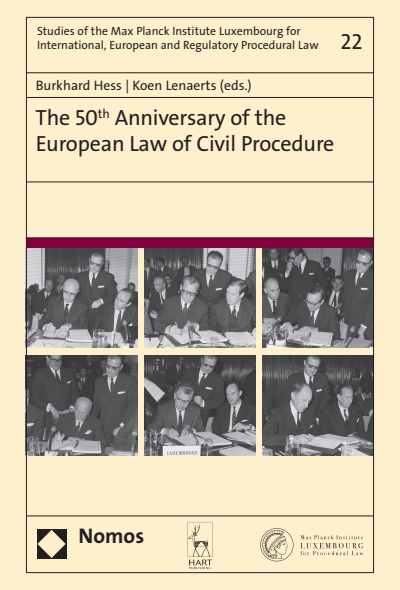
The 50th Anniversary of the European Law of Civil Procedure
- Herausgeber:innen:
- |
- Reihe:
- Studies of the Max Planck Institute Luxembourg for International, European and Regulatory Procedural Law, Band 22
- Verlag:
- 2020
Zusammenfassung
Am 27. September 1968 unterzeichneten die sechs EG-Mitgliedstaaten das Brüsseler Übereinkommen über die gerichtliche Zuständigkeit und Vollstreckung gerichtlicher Entscheidungen in Zivil- und Handelssachen. Anlässlich des 50. Jubiläums dieses Meilensteins veranstalteten der Europäischen Gerichtshof und das Max-Planck-Institut Luxemburg eine internationale Konferenz zu den wichtigsten Entwicklungen, Errungenschaften und Herausforderungen des europäischen Zivilprozessrechts. Dieses Buch beinhaltet Beiträge von Mitgliedern des Europäischen Gerichtshofes, etablierten Wissenschaftlern und jungen Forschern über das Brüsseler Regime. Es dient zur Veranschaulichung des Dialogs zwischen dem EuGH und den nationalen Gerichten über die Auslegung des europäischen Zivilprozessrechts, sowie dessen Einfluss auf die Europäisierung des internationalen Privatrechts. Es thematisiert Überlegungen zur Zukunft des europäischen Zivilprozessrechts und der Eignung des Brüsseler Regimes in der heutigen Zeit.
Publikation durchsuchen
Bibliographische Angaben
- Auflage
- 1/2020
- Copyrightjahr
- 2020
- ISBN-Print
- 978-3-8487-6944-5
- ISBN-Online
- 978-3-7489-1061-9
- Verlag
- Nomos, Baden-Baden
- Reihe
- Studies of the Max Planck Institute Luxembourg for International, European and Regulatory Procedural Law
- Band
- 22
- Sprache
- Englisch
- Seiten
- 558
- Produkttyp
- Sammelband
Inhaltsverzeichnis
- Titelei/Inhaltsverzeichnis Kein Zugriff Seiten 1 - 10
- Autor:innen:
- 1. Introduction Kein ZugriffAutor:innen:
- Autor:innen:
- 2.1. The Brussels Convention (1973–1980) Kein ZugriffAutor:innen:
- 2.2. Cross-border Proceedings in the Internal Market (1980–1998) Kein ZugriffAutor:innen:
- 2.3. Judicial Co-operation under the Treaty of Amsterdam (1999–2009) Kein ZugriffAutor:innen:
- 2.4. Consolidation and Challenges under the Lisbon Treaty (2009 until today) Kein ZugriffAutor:innen:
- Autor:innen:
- 3.1. Autonomous Interpretation Kein ZugriffAutor:innen:
- 3.2. Jurisdiction: Access to Justice and Legal Certainty Kein ZugriffAutor:innen:
- 3.3. Protection of the Rights of Defence Kein ZugriffAutor:innen:
- 3.4. Free Movement of Judgments Kein ZugriffAutor:innen:
- Autor:innen:
- 4.1. Mutual Trust – a Transversal Principle of the Area of Freedom, Security and Justice Kein ZugriffAutor:innen:
- 4.2. The Growing Role of the Charter of Fundamental Rights Kein ZugriffAutor:innen:
- 4.3. The Interplay of the Instruments on Civil Co-operation Kein ZugriffAutor:innen:
- 4.4. EU Procedural Law and National Procedures Kein ZugriffAutor:innen:
- Autor:innen:
- 5.1. Interaction between Rules and Principles Kein ZugriffAutor:innen:
- 5.2. Comparative Law in the Brussels Regime Kein ZugriffAutor:innen:
- 5.3. Complementary Roles of the Court and the EU Lawmaker Kein ZugriffAutor:innen:
- 6. Conclusion Kein ZugriffAutor:innen:
- Autor:innen:
- 1. Introduction Kein ZugriffAutor:innen:
- 2. Évolution du principe de confiance mutuelle : de sa naissance dans la logique d’un marché commun à sa consolidation avec l’abolition de l’exequatur Kein ZugriffAutor:innen:
- Autor:innen:
- 3.1. Le principe de confiance mutuelle et la reconnaissance des décisions Kein ZugriffAutor:innen:
- 3.2. Le principe de confiance mutuelle dans l’administration de la justice et la notion de « juridiction » Kein ZugriffAutor:innen:
- 4. Conclusion Kein ZugriffAutor:innen:
- Autor:innen: |
- 1. Introduction Kein ZugriffAutor:innen: |
- Autor:innen: |
- 2.1. L’ordre public (procédural) Kein ZugriffAutor:innen: |
- 2.2. Les défauts de notification Kein ZugriffAutor:innen: |
- 3. Procéduralisation du refus d’exécution sous les auspices de la CJUE Kein ZugriffAutor:innen: |
- 4. Vers un contrôle strict des conditions du procès équitable? Kein ZugriffAutor:innen: |
- Autor:innen:
- 1. Introduction Kein ZugriffAutor:innen:
- 2. The consistency of the scopes of application Kein ZugriffAutor:innen:
- 3. The consistency of the solutions Kein ZugriffAutor:innen:
- Autor:innen:
- 1. Introduction Kein ZugriffAutor:innen:
- 2. Le régime Bruxelles et le système : conception et littéralité des instruments. Kein ZugriffAutor:innen:
- Autor:innen:
- 3.1. Absence d’impératif de cohérence? Kein ZugriffAutor:innen:
- Autor:innen:
- 3.2.1. Argument décisif (et à suivre) Kein ZugriffAutor:innen:
- 3.2.2. Argument décisif (pour en dévier) Kein ZugriffAutor:innen:
- Autor:innen:
- 3.3.1. Une « fausse » mention? Kein ZugriffAutor:innen:
- Autor:innen:
- 3.3.2.1. Le cumul d’arguments Kein ZugriffAutor:innen:
- 3.3.2.2. Les références « de basse intensité » Kein ZugriffAutor:innen:
- 3.3.3. Au-delà : le raisonnement (en apparence ?) indépendant Kein ZugriffAutor:innen:
- Autor:innen:
- 3.4.1. Les précédents Kein ZugriffAutor:innen:
- 3.4.2. Le régime Bruxelles à travers les avocats généraux Kein ZugriffAutor:innen:
- 4. Conclusions Kein ZugriffAutor:innen:
- Autor:innen:
- 1. Mutual Recognition of Judgments, the Fundamental Objective Kein ZugriffAutor:innen:
- Autor:innen:
- 2.1. The Objective of Proximity Kein ZugriffAutor:innen:
- 2.2. The Objective of Protection Kein ZugriffAutor:innen:
- 3. Impact on Characterization and Interpretation of Common Notions Kein ZugriffAutor:innen:
- 4. Potential Influence of Policies in Favour of Non-Judicial Dispute Settlement Mechanisms Kein ZugriffAutor:innen:
- 5. Towards an Integrative Approach Kein ZugriffAutor:innen:
- Autor:innen:
- 1. Introduction Kein ZugriffAutor:innen:
- 2. Brussels I as an Integration Instrument Kein ZugriffAutor:innen:
- 3. Brussels I as a Trailblazer for the Europeanization of Private International Law Kein ZugriffAutor:innen:
- Autor:innen:
- 4.1. Brussels I, Private International Law and Fundamental Rights Protection Kein ZugriffAutor:innen:
- 4.2. Brussels I, Private International Law and the Principles of Mutual Trust and Mutual Recognition Kein ZugriffAutor:innen:
- 5. The Challenge ahead – a Future Brussels Iter Regulation as the Necessary Next Step towards Further Europeanization and Constitutionalization Kein ZugriffAutor:innen:
- Autor:innen:
- 1. Introduction Kein ZugriffAutor:innen:
- 2. The Preliminary Ruling Procedure as an Instrument of Cooperation between the CJEU and the National Judges Kein ZugriffAutor:innen:
- Autor:innen:
- 3.1. Granarolo, C-196/15, 14 July 2016 Kein ZugriffAutor:innen:
- 3.2. Austro-Mechana, C-572/14, 21 April 2016 Kein ZugriffAutor:innen:
- 3.3. Hanse Yachts AG, C-29/16, 4 May 2017 Kein ZugriffAutor:innen:
- 3.4. Nogueira and Others, C-168/16 and C-169/16, 14 September 2017 Kein ZugriffAutor:innen:
- 3.5. Bolagsupplysningen and Ilsjan, C-194/16, 17 October 2017 Kein ZugriffAutor:innen:
- 3.6. Concurrence SARL, C-618/15, 21 December 2016 Kein ZugriffAutor:innen:
- 4. Conclusion Kein ZugriffAutor:innen:
- Autor:innen:
- 1. The Early Reception of the Brussels Convention in Germany Kein ZugriffAutor:innen:
- 2. The Halting Dialogue between the Court of Justice and German Courts Kein ZugriffAutor:innen:
- 3. The Dialogue and the Promotion of European Civil Procedure Kein ZugriffAutor:innen:
- Autor:innen: |
- 1. Introduction Kein ZugriffAutor:innen: |
- Autor:innen: |
- 2.1. Europeanization of Civil Procedure: Goals and State of Affairs Kein ZugriffAutor:innen: |
- 2.2. The European Civil Justice Patchwork: Legislative Disparities and the Role of the Courts Kein ZugriffAutor:innen: |
- Autor:innen: |
- 3.1. Cooperation at the Centre of the EU Legal System Kein ZugriffAutor:innen: |
- 3.2. Europeanization of National Judicial Practice Kein ZugriffAutor:innen: |
- 3.3. Variable Use of the Reference Procedure in the Civil Justice Area Kein ZugriffAutor:innen: |
- 3.4. National Civil Judges as European Judges Kein ZugriffAutor:innen: |
- 3.5. (Re)formulating the Questions Kein ZugriffAutor:innen: |
- 3.6. Applying CJEU Judgments in National Cases Kein ZugriffAutor:innen: |
- 3.7. Resistance to CJEU Authority Kein ZugriffAutor:innen: |
- Autor:innen: |
- 4.1. Measures at the National Level Kein ZugriffAutor:innen: |
- 4.2. Measures at the EU level Kein ZugriffAutor:innen: |
- 5. Concluding Remarks and Outlook Kein ZugriffAutor:innen: |
- Autor:innen:
- Autor:innen:
- 1.1. Origine de l’autonomie procédurale des Etats membres Kein ZugriffAutor:innen:
- 1.2. Limites de l’autonomie procédurale des Etats membres Kein ZugriffAutor:innen:
- Autor:innen:
- 2.1. Autonomie procédurale et rapports de systèmes Kein ZugriffAutor:innen:
- 2.2. Autonomie procédurale et structures du droit Kein ZugriffAutor:innen:
- Autor:innen:
- Autor:innen:
- 1.1. La définition initiale des limites à l’autonomie procédurale nationale : la jurisprudence classique opérant un double contrôle d’équivalence et d’effectivité Kein ZugriffAutor:innen:
- Autor:innen:
- 1.2.1. L’intégration du contrôle au titre de la Charte au contrôle du respect du principe d’effectivité : la jurisprudence opérant un double contrôle d’équivalence et d’effectivité renforcé par la Cha... Kein ZugriffAutor:innen:
- 1.2.2. La substitution du contrôle au titre de la Charte au contrôle du respect du principe d’effectivité : la jurisprudence opérant un double contrôle d’équivalence et au titre de la Charte Kein ZugriffAutor:innen:
- 1.2.3. La juxtaposition du contrôle au titre de la Charte et du contrôle du respect des principes d’équivalence et d’effectivité : la jurisprudence opérant un triple contrôle d’équivalence, d’effectiv... Kein ZugriffAutor:innen:
- 2. La substitution du contrôle au titre de la Charte au contrôle traditionnel de l’effectivité : une approche exceptionnelle pour des cas particuliers? la jurisprudence supprimant le contrôle d’équiva... Kein ZugriffAutor:innen:
- 3. Propos conclusifs Kein ZugriffAutor:innen:
- The Brussels Convention: 50 Years of Contribution to European Integration1 Kein Zugriff Seiten 249 - 258Autor:innen:
- Autor:innen:
- Autor:innen:
- Autor:innen:
- 1.1.1. Forum actoris through forum delicti (art. 5.3/7.2) Kein ZugriffAutor:innen:
- 1.1.2. Forum actoris through derived jurisdiction Kein ZugriffAutor:innen:
- 1.1.3. Low standard of proof at the jurisdictional stage Kein ZugriffAutor:innen:
- 1.1.4. Forum actoris in the specific realm of personal data protection Kein ZugriffAutor:innen:
- Autor:innen:
- 1.2.1. The traditional explanation: localization Kein ZugriffAutor:innen:
- 1.2.2. Favouring the plaintiff? Kein ZugriffAutor:innen:
- Autor:innen:
- 2.1. Reasons to Replace the Forum Delicti by a Forum Victimae Kein ZugriffAutor:innen:
- 2.2. Regime of the Forum Victimae Kein ZugriffAutor:innen:
- Autor:innen:
- 1. Introduction Kein ZugriffAutor:innen:
- Autor:innen:
- 2.1. The Same Situation of Fact and Law: An Early “Rigorous” Approach Kein ZugriffAutor:innen:
- 2.2. The Evolution of the Concept of “Same Situation of Fact and Law” Kein ZugriffAutor:innen:
- 2.3. The Confirmation of the Extensive Approach in Patent and Design Cases Kein ZugriffAutor:innen:
- 2.4. The Position of the CJEU on Cartels Kein ZugriffAutor:innen:
- 2.5. An Interim Conclusion Kein ZugriffAutor:innen:
- Autor:innen:
- 3.1. Abuse and Real Claims: How to Apportion the Burden of Proof? Kein ZugriffAutor:innen:
- 4. Some Final Remarks Kein ZugriffAutor:innen:
- Autor:innen:
- 1. Introduction Kein ZugriffAutor:innen:
- 2. The Horizontal Approach: Common Principles for Collective Redress Kein ZugriffAutor:innen:
- 3. The Sectoral Approach: Specific Rules for Collective Redress in Specific Policies Kein ZugriffAutor:innen:
- 4. The Jurisdictional Regime for Cross-Border Collective Redress Kein ZugriffAutor:innen:
- 5. Concluding Remarks Kein ZugriffAutor:innen:
- Autor:innen:
- 1. Introduction Kein ZugriffAutor:innen:
- Autor:innen:
- 2.1. The Legal and Political Framework of Collective Redress and its PIL Dimensions Kein ZugriffAutor:innen:
- Autor:innen:
- 2.2.1. The Austrian system Kein ZugriffAutor:innen:
- 2.2.2. The Belgium system Kein ZugriffAutor:innen:
- 2.2.3. The Dutch system Kein ZugriffAutor:innen:
- 2.2.4. The system adopted in England and Wales Kein ZugriffAutor:innen:
- 2.3. Three Models of Collective Redress Kein ZugriffAutor:innen:
- 3. Towards a Harmonised Approach? The 2018 Proposal of the European Commission Kein ZugriffAutor:innen:
- 4. The Characteristics of the Representative Action Model Advanced by the Commission Kein ZugriffAutor:innen:
- 5. The Intended Means of Operation of the Representative Action Mechanism Kein ZugriffAutor:innen:
- 6. Founding Jurisdiction in Cross-Border Collective Redress Kein ZugriffAutor:innen:
- 7. The Default Approach of Brussels I bis – To the Courts of the Defendant’s Domicile Kein ZugriffAutor:innen:
- 8. A (First) Rule of Special Jurisdiction for Contracts Kein ZugriffAutor:innen:
- 9. Protective Jurisdiction: Collective Redress and Consumer Protection Kein ZugriffAutor:innen:
- 10. A (Second) Rule of Special Jurisdiction for Torts Kein ZugriffAutor:innen:
- 11. Preliminary Conclusions on Jurisdiction Kein ZugriffAutor:innen:
- Autor:innen:
- Autor:innen:
- 1.1. Collective Redress and the Jurisdiction Rules of the Brussels Ibis Regulation Kein ZugriffAutor:innen:
- 1.2. Relevance of the Issue of Public Policy in the Reform Debate Kein ZugriffAutor:innen:
- 1.3. Argument and Plan Kein ZugriffAutor:innen:
- Autor:innen:
- 2.1. Standard of Review Kein ZugriffAutor:innen:
- 2.2. National Concept Kein ZugriffAutor:innen:
- 2.3. Increasing Europeanisation of Public Policy Based on a Common Procedural Model Kein ZugriffAutor:innen:
- Autor:innen:
- 3.1. The Litigation Model of the Brussels Regime Kein ZugriffAutor:innen:
- 3.2. Collective Redress, European Procedural Culture and Mutual Trust Kein ZugriffAutor:innen:
- 3.3. Research Questions Kein ZugriffAutor:innen:
- Autor:innen:
- 4.1. No per se Refusal of Representative Remedial Collective Redress Decisions Kein ZugriffAutor:innen:
- Autor:innen:
- 4.2.1. Different opinions on the compatibility of an opt-out system with the right to a fair trial Kein ZugriffAutor:innen:
- Autor:innen:
- 4.2.2.1. Full information about proceedings Kein ZugriffAutor:innen:
- 4.2.2.2. Participation in adversarial proceedings Kein ZugriffAutor:innen:
- 4.2.3. A need for appropriate safeguards Kein ZugriffAutor:innen:
- Autor:innen:
- 5.1. General Kein ZugriffAutor:innen:
- Autor:innen:
- 5.2.1. In relation to individual group members Kein ZugriffAutor:innen:
- 5.2.2. In relation to the defendant Kein ZugriffAutor:innen:
- Autor:innen:
- 5.3.1. Notification measures Kein ZugriffAutor:innen:
- 5.3.2. The ability to influence proceedings Kein ZugriffAutor:innen:
- 5.3.3. Judicial supervision Kein ZugriffAutor:innen:
- 6. Public Policy and the Application of Procedural Safeguards Kein ZugriffAutor:innen:
- Autor:innen:
- 7.1. Introduction Kein ZugriffAutor:innen:
- 7.2. US Courts Kein ZugriffAutor:innen:
- 7.3. Amsterdam Court of First Instance – Ahold Class Settlement Kein ZugriffAutor:innen:
- 7.4. Ghent Court of Appeal – Lernout and Hauspie Class Settlement Kein ZugriffAutor:innen:
- 7.5. German Bundesverfassungsgericht – US Class Action Notices under the Hague Convention Kein ZugriffAutor:innen:
- 7.6. A Number of Common Lines Kein ZugriffAutor:innen:
- 8. Concluding Remarks Kein ZugriffAutor:innen:
- Autor:innen:
- 1. Introduction: the Technology-Neutral Brussels Framework Kein ZugriffAutor:innen:
- Autor:innen:
- Autor:innen:
- 2.1.1. The starting point: Bier & Shevill Kein ZugriffAutor:innen:
- 2.1.2. The regime for online infringements of personality rights: eDate & Bolagsupplysningen Kein ZugriffAutor:innen:
- 2.1.3. The regime for other online torts: Wintersteiger, Pinckney, Hejduk & Concurrence Kein ZugriffAutor:innen:
- 2.2. The Bad: a Mosaic of Jurisdictions Kein ZugriffAutor:innen:
- Autor:innen:
- 2.3.1. Limited availability of centre-of-interests jurisdiction Kein ZugriffAutor:innen:
- 2.3.2. ‘Full’ and ‘partial’ jurisdiction Kein ZugriffAutor:innen:
- 2.3.3. Divisible and indivisible remedies Kein ZugriffAutor:innen:
- 3. Fit for New Challenges? Kein ZugriffAutor:innen:
- Autor:innen:
- 1. Introduction Kein ZugriffAutor:innen:
- 2. Access to Justice and ICT Kein ZugriffAutor:innen:
- 3. The European Uniform Procedures Kein ZugriffAutor:innen:
- Autor:innen:
- 4.1. e-Justice Portal Kein ZugriffAutor:innen:
- 4.2. e-CODEX Kein ZugriffAutor:innen:
- 4.3. Integrating e-Communication Solutions within the EU Kein ZugriffAutor:innen:
- Autor:innen:
- 5.1. Interrelating Technical and Procedural Requirements Kein ZugriffAutor:innen:
- 5.2. National Technical and Organisational Infrastructures Kein ZugriffAutor:innen:
- 5.3. Interplay between National and European Rules Kein ZugriffAutor:innen:
- 5.4. Language and Legal Semantics Kein ZugriffAutor:innen:
- 5.5. Reaching the Critical Level of Knowledge and Users Kein ZugriffAutor:innen:
- 6. In Search of Simplicity: Towards a Different Approach to e-Justice? Kein ZugriffAutor:innen:
- 7. Concluding remarks Kein ZugriffAutor:innen:
- Autor:innen:
- 1. Introduction Kein ZugriffAutor:innen:
- 2. The Principle of Mutual Trust as a Normative Cornerstone of the AFSJ Kein ZugriffAutor:innen:
- 3. Loss of Mutual Trust as a Ground for Non-Recognition Kein ZugriffAutor:innen:
- Autor:innen:
- 4.1. A “Court” Within the Meaning of EU Law Kein ZugriffAutor:innen:
- 4.2. Developments in the Polish Judiciary in 2015–2020 Kein ZugriffAutor:innen:
- 5. Conclusion Kein ZugriffAutor:innen:
- Table of cases Kein Zugriff Seiten 547 - 550
- Index Kein Zugriff Seiten 551 - 558