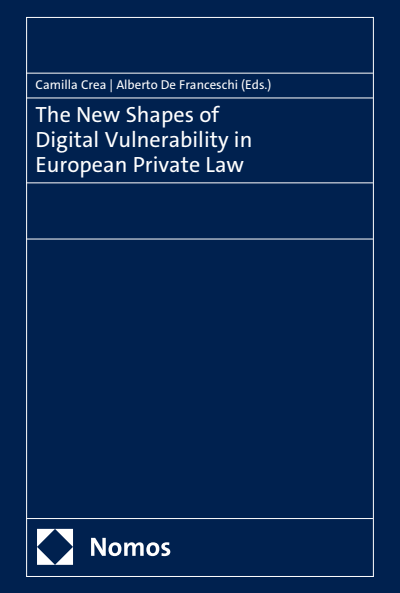
The New Shapes of Digital Vulnerability in European Private Law
Prefaces by Frank Pasquale and Oreste Pollicino- Herausgeber:innen:
- |
- Verlag:
- 2024
Zusammenfassung
Der Band analysiert, ob und wie der aktuelle Rechtsrahmen den persönlichen Bedingungen, unter denen sich digitale Technologien als besonders störend erweisen könnten, angemessen gerecht wird. Darüber hinaus wird untersucht, wie die bestehenden Policies und Regeln neu interpretiert, neu konzipiert und umgestaltet werden könnten. Dabei bietet es eine bemerkenswerte Symbiose zwischen politikorientierter rechtswissenschaftlicher Arbeit und eher theoretischer und philosophischer Forschung. Insbesondere verleiht dieses Buch dem fließenden Konzept der digitalen Vulnerabilität eine konkretere Bedeutung; es identifiziert persönliche und situationsbezogene Faktoren; es identifiziert wirksame Maßnahmen/Abhilfemaßnahmen, um den größtmöglichen Schutz derjenigen zu gewährleisten, die digital verwundbar sein könnten, vor neu auftretenden technologischen Bedrohungen; es hilft, traditionelle privatrechtliche Mikro- und Makrokategorien, die sich um den Begriff der digitalen Vulnerabilität drehen, zu überdenken und stellt traditionelle rechtliche Taxonomien in Frage. Mit Beiträgen vonCamilla Crea | Alberto De Franceschi | Frank Pasquale | Oreste Pollicino | Catalina Goanta | Giovanni De Gregorio | Gerasimos Spanakis | Fabrizio Esposito | Emilia Mišćenić | Mateja Durovic | Eleni Kaprou | Niti Chatterjee | Gianclaudio Malgieri | Shabahang Arian | Mateusz Grochowski | Irina Domurath | Teresa Rodríguez de las Heras Ballell | Jura Golub | Gérardine Goh Escolar 吴美姗 | Federica Casarosa | Hans-W. Micklitz | Piotr Tereszkiewicz | Katarzyna Południak-Gierz | Patryk Walczak | Alessandra Pera | Sara Rigazio | Denise Amram | Isabelle Wildhaber | Isabel Laura Ebert | Léa Stiefel | Alain Sandoz | Reiner Schulze
Schlagworte
Publikation durchsuchen
Bibliographische Angaben
- Auflage
- 1/2024
- Copyrightjahr
- 2024
- ISBN-Print
- 978-3-7560-1632-7
- ISBN-Online
- 978-3-7489-4091-3
- Verlag
- Nomos, Baden-Baden
- Sprache
- Englisch
- Seiten
- 536
- Produkttyp
- Sammelband
Inhaltsverzeichnis
- Titelei/InhaltsverzeichnisSeiten 1 - 8 Download Kapitel (PDF)
- Authors’ profilesSeiten 9 - 16 Download Kapitel (PDF)
- ‘Digital Vulnerability in European Private Law’ – Towards Digital Fairness Seiten 17 - 18Autor:innen: |Download Kapitel (PDF)
- Enforcing and Expanding Legal Protections for Vulnerable SubjectsSeiten 21 - 24Autor:innen:Download Kapitel (PDF)
- Autor:innen: | |Download Kapitel (PDF)
- A. Introduction
- B. Digital vulnerability and structural asymmetry affecting European consumers
- 1. A brief introduction to monetisation
- 2. Monetising conspiracy channels
- 3. Relevance for the digital vulnerability debate
- 4. Contextual vulnerability: technical solutions for complex social media consumer harms?
- II. Revisiting the harmonisation debate through judicial interpretations of European consumer protection
- D. Synthesis and conclusion: digital vulnerability and the need for systems-thinking
- Autor:innen:Download Kapitel (PDF)
- A. Overview
- 1. What is harm?
- 2. What causes harm?
- 3. Scenarios of harm
- 1. Reverse-engineering and coherence
- 2. Interpretation, integration and policy proposals
- I. A first approximation
- 1. The benchmark
- 2. The lemon
- 3. Divide et impera
- 4. The bottom
- 5. On the relationship between the scenarios
- I. Shopping between hidden traps and hidden gems as the new normal?
- II. The naïve consumers’ right to transparent contract terms
- I. Hyper-engaging practices: capturing and retaining user attention
- II. Hyper-engaging practices plausibly violate the Unfair Commercial Practices Directive
- I. The economic preconditions of exploitative price personalization
- II. An information duty that would work?
- G. Conclusions
- Autor:innen:Download Kapitel (PDF)
- A. Introduction: consumer legislation in the digital age – fit for purpose?
- B. What is going on in the EU legislative arena?
- C. From an average to a vulnerable consumer in the digital environment
- I. Information duties
- II. CJEU case law
- E. The relation between information and transparency in the digital environment
- F. The relation between transparency and fairness in the digital environment
- G. Closing remarks and proposals
- Autor:innen: |Download Kapitel (PDF)
- A. Introduction
- B. Consumers and the digital age
- C. EU digital environment
- D. Digital and consumer vulnerability
- E. Related terms
- F. The common elements of consumer vulnerability and digital divide
- G. Conceptualising digital vulnerability
- H. Categories of vulnerable consumers
- I. The façade of the average consumer
- L. An appeal to recognise the vulnerability of consumers
- M. Conclusive remarks
- Autor:innen: |Download Kapitel (PDF)
- A. Introduction
- a) AR Technology
- b) VR Technology
- 2. Sensors in AR/VR Technology
- 3. Emotion Recognition in AR/VR Devices
- 1. Conceptualizing Vulnerability
- 2. Vulnerability vis-à-vis Digital Consumption
- a) Amplification of Existing Vulnerabilities
- b) Inducement of New Vulnerabilities
- 4. Broader impact on end-users
- III. Conclusion and input for policy remarks
- Autor:innen:Download Kapitel (PDF)
- A. Metaverse: new frontier of digital life
- I. Virtual product placement (VPPs)
- II. Virtual spokes people (VSPs)
- C. Persuasion vs manipulation in the metaverse
- D. Layers of vulnerability in the metaverse
- I. EU Data Protection Law and profiling
- II. Manipulative business practice in the metaverse
- III. Children as vulnerable users in the metaverse
- F. Conclusions
- Autor:innen:Download Kapitel (PDF)
- A. Why digital vulnerability?
- B. Open-edged economic imaginary
- I. Digital post-consumption and consumer harm
- II. Deficits of the legal framework
- I. Digital vulnerability: the overall origins
- II. The architecture of post-consumer vulnerability
- III. Digital vulnerability: towards a comprehensive concept
- E. The way ahead: bridging consumer law and platform regulation
- Autor:innen:Download Kapitel (PDF)
- A. Introduction
- I. Static, personal, exceptional
- 1. Influence of intersectionality: vulnerability as relational
- 2. Two definitions
- a) Autonomy
- b) Hypo-autonomy: lack of power of consumers
- c) Hyper-autonomy: structural power of companies
- III. Interim conclusion 1
- I. The value of privacy
- II. Thin privacy in EU Law: control rights
- III. Thick privacy: substantive dimensions
- IV. Privacy and autonomy
- V. Interim conclusion 2
- D. Conclusion: digital vulnerability and thick privacy
- Autor:innen:Download Kapitel (PDF)
- I. Defining algorithmic contracts
- II. Mapping algorithmic contracting scenarios
- I. A rule of legal recognition
- II. Attribution rules
- C. Decoding digital vulnerability in algorithmic contracting: a two-sided interplay
- D. Rethinking paradigms to address digital vulnerability: towards a notion of algorithmic or ADM-related vulnerability
- Autor:innen:Download Kapitel (PDF)
- A. Introduction
- B. Setting the scene of smart contracts
- C. Do smart consumer contracts fall within the framework of EU PIL?
- D. International jurisdiction for disputes related to smart consumer contracts
- I. Choice of law (lex autonomiae)
- II. The consumer's habitual residence (lex residentiae habitualis)
- III. Consent and material validity of smart consumer contracts
- IV. Formal validity of smart consumer contracts
- V. (In)capacity of the consumer
- F. Concluding remarks
- Autor:innen:Download Kapitel (PDF)
- A. Introduction
- B. Digital vulnerability in the context of private international law
- I. Distributed storage mechanisms
- II. Digital currencies and cross-border payments
- III. The tokenised economy
- IV. Digital platforms
- V. Artificial intelligence and automated contracting
- VI. Immersive technologies and the cloud economy
- VII. Decentralised governance structures
- D. Conclusion
- Autor:innen: |Download Kapitel (PDF)
- A. Introduction
- I. Access to justice
- II. ADR in the European legal framework
- III. The notion of ODR in the European legal framework
- I. Vulnerabilities in universal service obligations
- II. Vulnerabilities in the UCPD
- III. Vulnerabilities in ADR and ODR
- I. Vulnerabilities in the AIA, the DSA and the Data Act
- II. Dispute resolution in the AIA, the DSA and the Data Act
- III. The EC digital fairness initiative
- E. Challenges for further research
- Autor:innen: | |Download Kapitel (PDF)
- A. Introduction
- B. Digital distribution of insurance and personalisation of insurance contracts
- I. Lawfulness of data processing under GDPR
- II. GDPR and automated individual decision-making
- III. Information duties on data processing under GDPR
- D. Personalised pricing of insurance products under Unfair Commercial Practices Directive
- E. Infringement of GDPR as an unfair commercial practice?
- F. Conclusions
- Autor:innen: |Download Kapitel (PDF)
- A. Introduction
- B. Vulnerability as a multidimensional concept
- I. The case studies
- D. Case subsumption and use of taxonomies
- E. Institutional policies and responses
- F. Ways forward and conclusions
- Autor:innen:Download Kapitel (PDF)
- A. Introduction: digital vulnerabilities and the digitization of vulnerabilities
- I. Harms in the digital environment
- II. Policies, guidelines, and standards
- I. Vulnerabilities in digitalised emergency, outpatient, and surgical services
- D. The interplay of technical and organisational standards to protect users
- Autor:innen: |Download Kapitel (PDF)
- A. Introduction
- I. Results from a quantitative survey in Swiss companies
- 1. Information
- 2. Consultation
- 3. Data protection law as a buffer against the inappropriate use of ADM systems
- 4. Attribution of responsibility and exercise of power
- 5. Communication as a means to engage employees
- 6. Learning culture vs. sanctioning culture
- 7. Acceptance of ADM systems
- I. National legal foundations
- II. International legal foundations
- I. Strengthening collective participation
- II. Continuously enabling employee objections
- III. Structures for oversight and control/enforcement
- IV. Solutions empowering social partnerships
- 1. Deep Insights into privacy and possible monitoring of employee activities
- 2. Timing of information and consultation
- 3. Data competence / data literacy
- 4. Data transparency
- 5. Clarification about the scope of application of the ADM systems
- 6. Avoiding «black box systems»
- 1. Identify and assess impacts to assess the nature and extent of human rights
- 2. Act to prevent and reduce human rights risks, also through integration into internal functions and processes
- 3. Track the effectiveness of risk reduction measures over time
- 4. Appropriate communication of the measures with a view to dealing with human rights impacts
- F. Conclusions
- Autor:innen: |Download Kapitel (PDF)
- A. Introduction
- B. Context
- C. Definitions and conceptual framework
- D. Methods and materials
- I. Barto: a service platform on top of a centralized database
- II. ADA: a peer-to-peer platform for authorized data transmission
- F. Discussion
- G. Conclusions
- Autor:innen:Download Kapitel (PDF)
- A. Introduction
- B. A new challenge for European Private Law
- C. Concept and cross-cutting nature of digital vulnerability
- I. The multilevel dimension
- II. Interaction with public law
- III. Consumer protection and protection of Internet users
- E. Further tasks for legislation and research