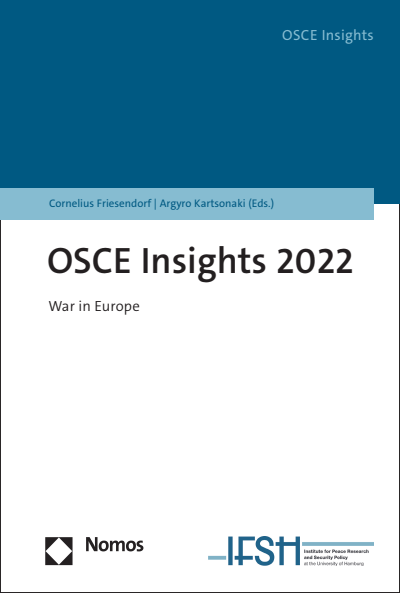
OSCE Insights 2022
War in Europe- Herausgeber:innen:
- |
- Verlag:
- 2022
Zusammenfassung
Die russische Invasion der Ukraine am 24. Februar 2022 stellt die Zukunft kooperativer Sicherheit und das Überleben der OSZE in Frage. Die Jahrgangsausgabe 2022 von OSCE Insights untersucht die Folgen des Krieges für die OSZE. Die Autorinnen und Autoren analysieren Lehren aus der Geschichte der KSZE/OSZE, die zeigen, wie die Organisation mit einer Situation umgehen kann, in der ein Teilnehmerstaat fundamentale OSZE-Prinzipien verletzt. Beiträge untersuchen auch, was die OSZE von anderen internationalen Organisationen lernen kann, die ähnliche Krisen erlebt haben. Andere Themen sind OSZE-Planungskapazitäten und die Rolle der OSZE in Zentralasien – insbesondere in Turkmenistan. Mit Beiträgen vonLuca Anceschi | Jelena Cupać | Mette Eilstrup-Sangiovanni | Cornelius Friesendorf | William H. Hill | Argyro Kartsonaki | Walter Kemp | Andrei Zagorski | Wolfgang Zellner
Schlagworte
Publikation durchsuchen
Bibliographische Angaben
- Copyrightjahr
- 2022
- ISBN-Print
- 978-3-8487-7512-5
- ISBN-Online
- 978-3-7489-3362-5
- Verlag
- Nomos, Baden-Baden
- Sprache
- Englisch
- Seiten
- 80
- Produkttyp
- Sammelband
Inhaltsverzeichnis
- Titelei/InhaltsverzeichnisSeiten 1 - 6 Download Kapitel (PDF)
- Cornelius Friesendorf, Argyro Kartsonaki Download Kapitel (PDF)
- Can the OSCE still offer value to participating States and societies?
- How can governments deal with Russia within the OSCE?
- How can the OSCE be preserved and its vitality increased?
- Acknowledgements
- William H. Hill Download Kapitel (PDF)
- Introduction
- Why did the CSCE/OSCE come into being?
- The CSCE and the end of the Cold War
- The debate over the European security architecture
- The present and future OSCE
- What can and should the OSCE do?
- Walter Kemp Download Kapitel (PDF)
- Introduction
- Dialogue without strategy
- The need for a more strategic approach
- A strategy: Everybody’s got one
- Recommendations: An iterative co-operative security agenda
- Mette Eilstrup-Sangiovanni Download Kapitel (PDF)
- Introduction
- Budget crisis
- Hiding from harm: Great power conflict and institutional retrenchment
- Exploiting a flexible mandate
- Harnessing institutional complexity
- Conclusions and recommendations
- Luca Anceschi Download Kapitel (PDF)
- Introduction
- Setting the rules of engagement: Turkmen-OSCE relations in the Niyazov era
- Human dimension co-operation as a box-ticking exercise
- The limits of field engagement: The OSCE Centre in Ashgabat
- Baby steps at thirty: What is the OSCE actually doing in Turkmenistan?
- Conclusion and recommendations
- Wolfgang Zellner Download Kapitel (PDF)
- Introduction
- Three factors shaping the future of the OSCE
- Overcoming the “consensus trap”
- Elements of an OSCE interim agenda: Recommendations
- Andrei Zagorski Download Kapitel (PDF)
- Introduction
- Asymmetric bargaining
- The process
- A flexible agenda and balanced progress
- Elaborating on commitments
- Conclusions and recommendations
- Jelena Cupać Download Kapitel (PDF)
- Introduction
- International organizations as forums
- The changing purpose of the OSCE’s forum function
- Normative messaging and signaling
- Keeping Russia engaged
- Planning the future