, um zu prüfen, ob Sie einen Vollzugriff auf diese Publikation haben.
Monographie Kein Zugriff
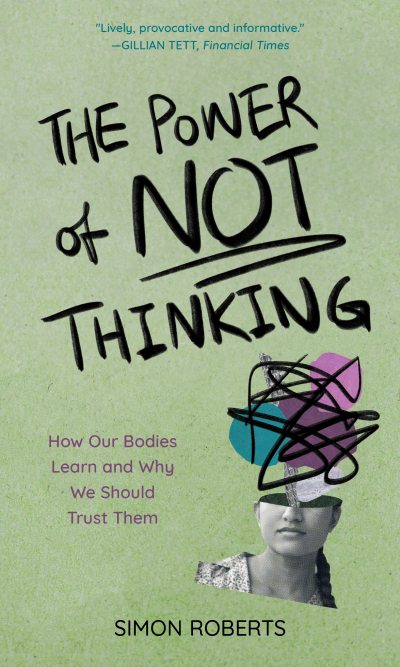
The Power of Not Thinking
How Our Bodies Learn and Why We Should Trust Them
Autor:innen:
Verlag:
2022
Zusammenfassung
Details the role our body plays in how we learn and how we can tap into our body’s knowledge to excel in all facets of life.
Ask someone to point to the part of their body responsible for their intelligence and it is highly likely that they will point at their head. This assumption is understandable, given that, for centuries, from Descartes’ “cogito ergo sum” to the computer age, this is what we have been told to think.
And yet we all share common experiences that have revealed the incomparable power of “not thinking”. Have you ever struggled to remember your pin number only to hold your fingers out and type it correctly with your hands, played the piano without focusing on remembering the correct notes or listened to your gut feeling when under the pressure of a big decision? All these instances prove that it is time to stop neglecting the role the body plays in our acquisition of knowledge and to explore how it is that brain and body combine to deliver what we view as uniquely human intelligence. You never forgot how to ride a bike did you?
In this unique new book, social and business anthropologist Simon Roberts looks at the pivotal role that our body plays in how we learn and reminds us of why we should learn to listen to it more often. Drawing upon an incredible range of cutting-edge science, real-life examples and personal experience, Roberts explores the complexity of even the simplest of tasks that humans perform every day and goes on to explain how, with a greater awareness of the processes at work, we can tap into our full potential and excel in any area of our lives.
His proposition isn’t the antidote to big data, cold rationalism, and reductionism. But, as embodied knowledge emerges from our engagement and interaction with the world, the author underlines why intelligence does not solely reside in our brains. If there’s a single, practical message to be taken from it, it is that we should give more credit to the role of the body as a resource for learning about and understanding the world. That means a more ‘sleeves rolled up’, engaged and practical way of ‘learning by doing’ not by rational detachment.
Schlagworte
Publikation durchsuchen
Bibliographische Angaben
Copyrightjahr
2022
ISBN-Print
978-1-5381-6775-5
ISBN-Online
978-1-5381-6776-2
Verlag
Rowman & Littlefield, Lanham
Sprache
Englisch
Seiten
328
Produkttyp
Monographie
Inhaltsverzeichnis
KapitelSeiten
CONTENTS Kein Zugriff
INTRODUCTION Kein Zugriff Seiten 1 - 24
1. DESCARTES’S MECHANICAL DAUGHTER Kein Zugriff
2. MEASURING THE WORLD Kein Zugriff
3. EXPERIENCING THE WORLD Kein Zugriff
4. OBSERVATION Kein Zugriff
5. PRACTICE Kein Zugriff
6. IMPROVISATION Kein Zugriff
7. EMPATHY Kein Zugriff
8. RETENTION Kein Zugriff
9. WHY EMBODIED KNOWLEDGE MATTERS Kein Zugriff
10. EMBODIED BUSINESS Kein Zugriff
11. EMBODIED POLICY MAKING AND POLITICS Kein Zugriff
12. EMBODIED CREATIVITY AND DESIGN Kein Zugriff
13. ARTIFICIAL INTELLIGENCE AND ROBOTS Kein Zugriff
ACKNOWLEDGMENTS Kein Zugriff Seiten 303 - 306
REFERENCES Kein Zugriff Seiten 307 - 328
Ähnliche Veröffentlichungen
aus dem Schwerpunkt "Bildung allgemein"
Sammelband Vollzugriff
Christoph T. Burmeister, Thorsten Hertel, Sophia Richter