Zeitschrift für Osmanistik, Türkei- und Nahostforschung – Journal of Ottoman, Turkish and Middle Eastern Studies
Editors:
Prof. Dr. Yavuz Köse | Jun.-Prof. Dr. Hülya Çelik | Dr. Élise Massicard | Dr. Astrid Menz | Prof. Dr. Christoph K. Neumann | Prof. Dr. Maurus Reinkowski | Prof. Dr. Julian Rentzsch | PD Dr. Gül Şen
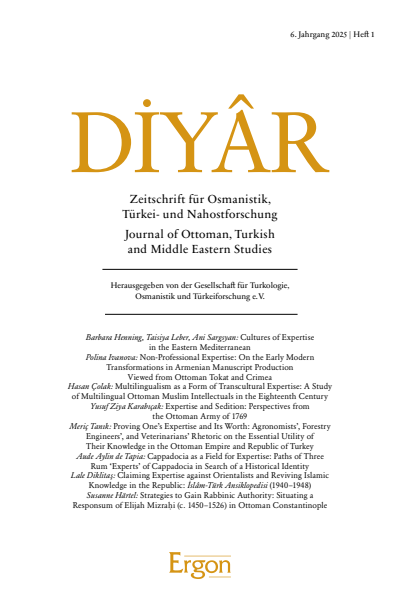
In the last decades of the Ottoman Empire, literature in the Greek alphabet, namely in Greek and in Karamanli-Turkish, experienced an important increase in terms of the number of publications as well as the proliferation of published topics and the...
Debates in the 1940s surrounding the state-sponsored translation into Turkish of a central orientalist reference work, the Encyclopaedia of Islam, gave marginalized ulema and their supporters the opportunity to (re)claim interpretive authority over...
This paper examines the letters of the Ottoman Grand Vizier and commander-in-chief of the 1769 campaign, Yağlıkçızâde Mehmed Emin Pasha, in order to advance the understanding of Ottoman notions of expertise. Military expertise has always been...
The Ottoman Empire is often presented as a space in which a myriad of people using different languages coexisted. However, scholars have often taken multilingualism in the Ottoman world for granted and, despite some valuable exceptions, they have...
In the late sixteenth and early seventeenth century, the widespread destruction and population displacements caused by the Ottoman-Safavid wars and the Celali revolts plunged Armenian communities of Anatolia and the Caucasus into a profound crisis....
How do members of a novel profession gain recognition for their expertise and negotiate its value? This article examines this historically rooted yet persistently relevant question by focusing on the experiences of agronomists, forestry engineers,...
In this essay, I seek to illustrate the workings of rabbinic authority by means of a concrete historical example, a decision taken by Rabbi Elijah Mizraḥi (c. 1450–1526) in a particular constellation in Ottoman Constantinople around 1500. The...
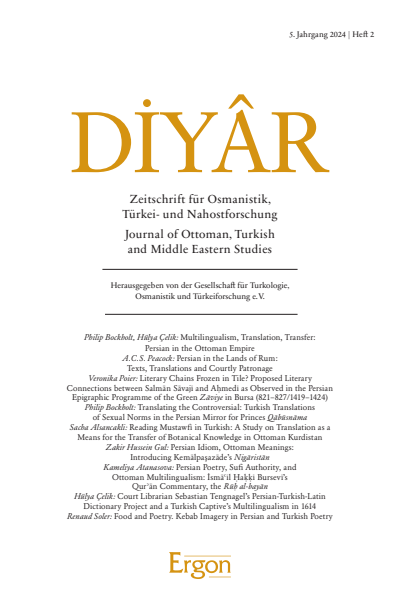
The manuscript Vienna, Cod. A. F. 26, Luġat-i Emīr Ḥüseyin al-Ayāsī is what we today would call a draft copy of a Persian-Turkish-Latin dictionary. The Viennese court librarian Sebastian Tengnagel (d. 1636) had access to a Turkish...
This article traces the history of kebab imagery in Persian and Turkish poetry, from its earliest attestations in Firdawsī’s Shāhnāma, to its demise in the early twentieth century. Until now, this metaphor has been little studied by literary...
The layers of Arabic and Persian epigraphy in the Green Complex (821–827/1419–1424) in the Western Anatolian town of Bursa, built for Meḥmed I (r. 816–824/1413–1421), are indicative of the literary horizon at this time. I argue that the...
Although Kemālpaşazāde (875–940/1468–1534) is recently being rediscovered for his works on lexicography and orthodox Sunnism in its Ottoman iteration, the strictly ‘literary’ output of the early modern polymath has not yet received its...
This paper explores the functions of Persian poetry in Ottoman Sufi İsmāʿīl Ḥaḳḳī Bursevī’s most well-known work, his encyclopaedic tafsīr, the Rūḥ al-bayān fī tafsīr al-Qurʾān (The Spirit of Elucidation in Qurʾānic...
Persian texts composed in Anatolia both in the pre-Ottoman and Ottoman periods have received scant scholarly attention, and Persian remains perceived as an alien language. This article presents an overview of Persian in Anatolia and the Ottoman...
This article examines a mid-seventeenth century Turkish translation of the Persian encyclopaedic work Nuzhat al-Qulūb by Ilkhanid historian Ḥamdallāh Mustawfī Qazvīnī (d. after 744/1344). Composed in the Kurdish emirate of Bidlīs,...
The Qābūsnāma is a well-known mirror for princes dating back to the Ziyārid ruler Kay Kāvūs, who ruled over a principality of regional importance on the south-east coast of the Caspian Sea in the mid-eleventh century. The Qābūsnāma, written...