Biobased and biodegradable printing materials become increasingly significant in additive manufacturing. Applying enzymes during material preparation allows for making targeted modifications to enhance the printing properties of materials. This...
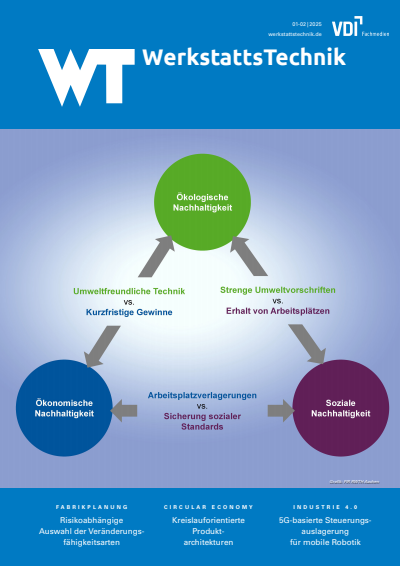
When implementing measures to improve sustainability in companies, trade-offs between different aspects of sustainability are inevitable. To date, there is no practical method for resolving trade-offs and dealing with interactions and conflicting...
Private 5G campus networks offer a reliable communication solution for Autonomous Mobile Robots (AMRs), particularly due to high upload rates and low latencies. This article explores offloading the compute- and energy-intensive control processes of...
Intralogistics offers a promising domain for applying artificial intelligence (AI). This article presents the findings of an empirical online survey on AI in intralogistics. The survey focuses on the current status of use cases, the selection of AI...
Traceability systems are playing an increasingly important role in managing internal and external expectations in global supply chains. At the same time, the complexity of this task is increasing due to more complex and dynamic supply chains....
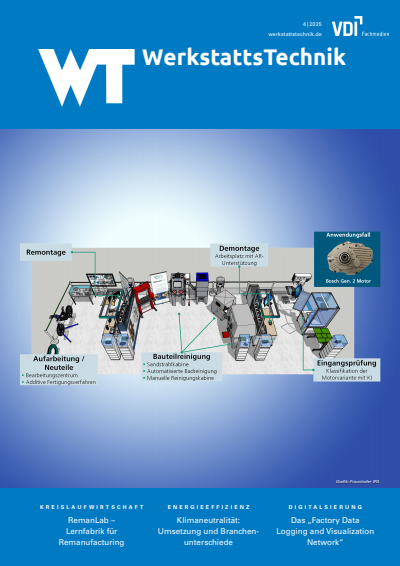
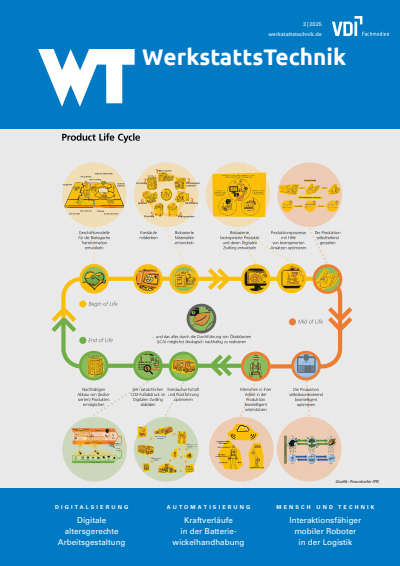
The transition from linear economy to circular economy is necessary to counteract climate change and ensure a more efficient use of resources. The design of factories is not only faced with new challenges and requirements but also needs to comply...
A core element of the upgrade circular economy is the re-assembly, which focuses on integrating new functionalities into the product after the user cycle, allowing it to enter a new lifecycle. However, re-assembly entails inherent uncertainties that...
The increasing demand for customized products in the automotive industry generates new requirements for the complexity of tools and offers new fields of application for additive manufacturing processes. Hybrid additive manufacturing using laser...
When initially implementing and further developing Shopfloor-Management, standardized KPIs are lacking. Selecting, sifting through, and specifying relevant KPIs at the shopfloor level involves significant time and personnel effort. To reduce this...
To be able to address the challenges of climate change and resource scarcity it is necessary to establish methods for circular economy products. Existing product architectures complicate circular economy, which is why new ideas for design and...
Long set-up times impair CNC tool production due to reduced flexibility, lower machine utilization and increased planning effort, which promotes delivery delays and production bottlenecks. Economically, they tie up capital, increase production...
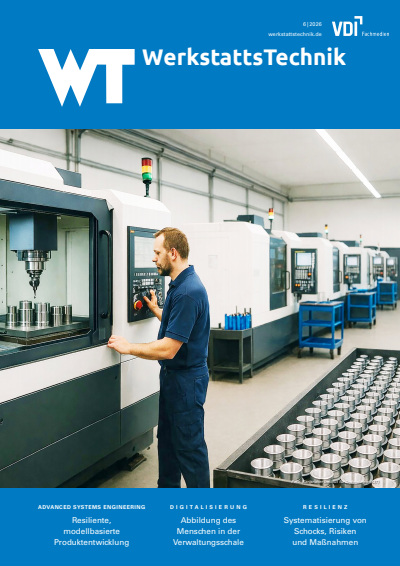
The volatile market environment in which manufacturing companies currently operate requires a resilient production and supply chain system to enable an economic operation. Co-production offers manufacturing companies great potential for increasing...
Manufacturing companies are facing growing challenges. The Upgrade Circular Economy, in particular re-assembly, offers great potential for reducing costs and emissions. This article presents Re-X assessment as an approach to evaluate the upgrade...
Manufacturing companies must continuously adapt in the dynamic VUCA world in order to remain competitive. The types of changeability flexibility, robustness, resilience and transformability support factory systems in this. So far, however, these...
Organisational resilience is becoming increasingly important in the face of global uncertainties. To be able to react quickly to external changes and crises, companies need to flexibly adapt their processes and structures – and therefore also the...
Businesses are under increasing pressure to operate sustainably. Social expectations, strict legal regulations, and economic constraints lead to conflicting goals, such as economic versus environmental sustainability. This article defines the...
Businesses need to develop innovations. The pressure to accelerate market entry requires an early assessment of their economic value. This article introduces a quantitative method for evaluating sustainable value drivers applied to the innovation...
Manual assembly offers considerable flexibility and therefore remains an indispensable aspect of production, when automation is not economically viable, particularly when the intricacies of the processes involved render it unfeasible. Consequently,...
The realization of the potential of Artificial Intelligence (AI) in companies faces significant challenges. To ensure a trustworthy and transparent implementation, companies should involve employees in the development and implementation process and...
Research data management (RDM) has been gaining in importance for years. However, the goal of preparing data sustainably and reusing existing data instead of laboriously collecting it from scratch is rarely pursued by researchers in the German...
Current challenges in production, such as shortage of skilled workers, increase the need to automate processes and increase productivity. Multi-modal foundation models address this automation demand for a variety of applications by deriving...
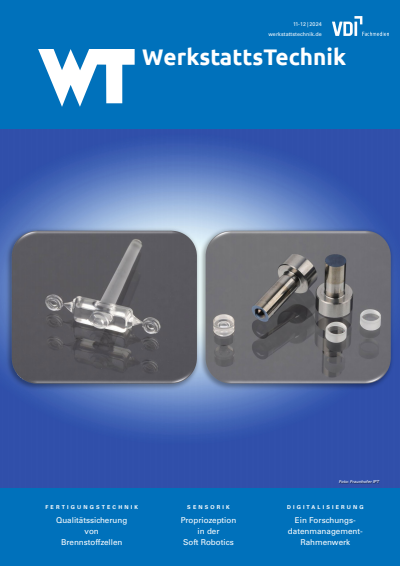
Accurate characterization of miniaturized glass lenses is essential due to the link between performance and geometrical properties. This article explores using optical coherence tomography (OCT) for miniaturized glass lens characterization. OCT...
Soft robots consist of a soft actuator, which is characterized by its highly elastic deformability, and a corresponding sensor system for position determination. Conventional strain gauges are manufactured on a carrier substrate and can, however,...
Reference components with defect characteristics are essential for evaluating test methods in the quality assurance of fuel cell production. Due to the poor accessibility of defective bipolar plates, this article presents a solution approach in...
Achieving tight tolerances is a challenge when turning thin-walled workpieces. Due to the low stiffness of thin-walled workpieces, high workpiece deformations can occur even when clamping forces are low. Currently, the clamping force is adjusted in...
Shear cutting is a widely applied process for chipless separation in industry. However, multiple disruptive factors such as ram displacement reduce the shear cutting quality. A system of pneumatic cylinders and pressure accumulators compensates for...