, to see if you have full access to this publication.
Edited Book No access
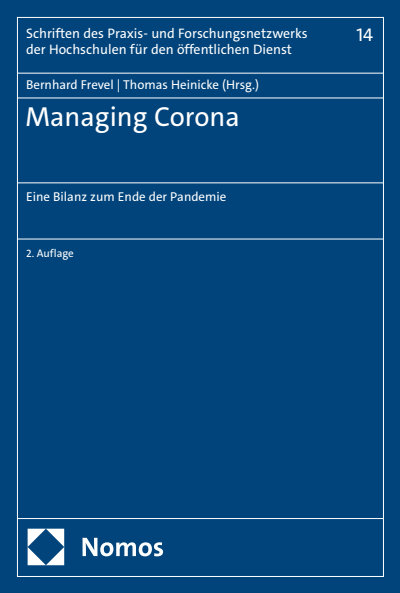
Managing Corona
Eine verwaltungswissenschaftliche Zwischenbilanz- Editors:
- |
- Series:
- Schriften des Praxis- und Forschungsnetzwerks der Hochschulen für den öffentlichen Dienst, Volume 7
- Publisher:
- 2021
Search publication
Bibliographic data
- Edition
- 1/2021
- Copyright year
- 2021
- ISBN-Print
- 978-3-8487-6833-2
- ISBN-Online
- 978-3-7489-0932-3
- Publisher
- Nomos, Baden-Baden
- Series
- Schriften des Praxis- und Forschungsnetzwerks der Hochschulen für den öffentlichen Dienst
- Volume
- 7
- Language
- German
- Pages
- 371
- Product type
- Edited Book
Table of contents
ChapterPages
- Titelei/Inhaltsverzeichnis No access Pages 1 - 10
- Editorial: »Die größte Krise seit dem Zweiten Weltkrieg«(UN-Generalsekretär António Guterres) No access Pages 11 - 22Authors:
- Authors:
- Abstract No accessAuthors:
- 1. Einleitung No accessAuthors:
- Authors:
- 2.1. Die Gemeinsamkeiten No accessAuthors:
- 2.2. Die Unterschiede No accessAuthors:
- Authors:
- 3.1. Vorliegen einer gesetzlichen Handlungsermächtigung No accessAuthors:
- Authors:
- 3.2.1. Die personenbezogene Allgemeinverfügung als Problemfall No accessAuthors:
- 3.3. Die Corona-Pandemie als Regelungsanlass No accessAuthors:
- Authors:
- Abstract No accessAuthors:
- 1. Die Krise im Verfassungsstaat No accessAuthors:
- 2. Die Pandemiebekämpfung durch die Exekutive No accessAuthors:
- 3. Das Parlament in der Krise? No accessAuthors:
- 4. Bedarf für eine Nachjustierung: Krise als gemeinschaftliche Aufgabe No accessAuthors:
- Authors: |
- Abstract No accessAuthors: |
- Authors: |
- 1.1. Grundrechtseingriffe No accessAuthors: |
- 1.2. Infektionsschutzgesetz No accessAuthors: |
- 2. Verhältnismäßigkeitsgrundsatz No accessAuthors: |
- 3. Fazit und Ausblick No accessAuthors: |
- Authors:
- Abstract No accessAuthors:
- Authors:
- 1.1. Gesetzgebungszuständigkeit No accessAuthors:
- 1.2. Strafvorschriften durch Rechtsverordnung No accessAuthors:
- 1.3. Systematik, Übermaßverbot No accessAuthors:
- 1.4. Zusammenfassung No accessAuthors:
- Authors:
- 2.1. § 74 IfSG No accessAuthors:
- Authors:
- 2.2.1. Tatbestandsmäßigkeit No accessAuthors:
- 2.2.2. Blanketttatbestand No accessAuthors:
- 2.2.3. Rechtsgüterschutz, Strafrecht als »ultima ratio« No accessAuthors:
- 2.2.4. Vorverlagerung der Strafbarkeit, Schuldprinzip No accessAuthors:
- 2.2.5. Erlaubtes Risiko No accessAuthors:
- 2.2.6. Gesetzesänderung No accessAuthors:
- 3. Resümee No accessAuthors:
- Authors:
- Abstract No accessAuthors:
- 1. Einleitung No accessAuthors:
- 2. Die Bedeutung der Versammlungsfreiheit im demokratischen Rechtsstaat No accessAuthors:
- 3. Zeit des Zögerns und Abwartens – die Rolle von Exekutive und Judikative in der Anfangszeit No accessAuthors:
- 4. Die Zeit des Hinschauens – die Judikative als Korrektiv der Entscheidungen der Exekutive No accessAuthors:
- 5. Fazit und Ausblick No accessAuthors:
- Authors:
- Abstract No accessAuthors:
- 1. Einleitung No accessAuthors:
- 2. Begriff der Solidarität No accessAuthors:
- Authors:
- 3.1. Besonderer Schutz von Risikogruppen No accessAuthors:
- 3.2. „Privilegierungen“ bei Immunität No accessAuthors:
- 3.3. Gleichheit durch Recht No accessAuthors:
- Authors:
- 4.1. Alle für einen No accessAuthors:
- 4.2. Einzelne für alle No accessAuthors:
- 5. Eigenverantwortung und Rücksichtnahme No accessAuthors:
- 6. Solidarität im Recht No accessAuthors:
- Authors:
- Abstract No accessAuthors:
- Authors:
- 1.1. § 5 Abs. 12 IfSG No accessAuthors:
- Authors:
- 1.2.1. Recht auf informationelle Selbstbestimmung No accessAuthors:
- 1.2.2. Geschützte Daten und Eingriffstiefe No accessAuthors:
- 2. »Geben ist seliger denn Nehmen« – die schöne neue Welt der freiwilligen Nutzung der Corona-Warn-App No accessAuthors:
- 3. Fazit No accessAuthors:
- Authors:
- Abstract No accessAuthors:
- 1. Beschluss des BVerfG zur Triage No accessAuthors:
- Authors:
- 2.1. Ursprung und Bedeutung No accessAuthors:
- Authors:
- 2.2.1. Empfehlungen der medizinischen Fachgesellschaften No accessAuthors:
- 2.2.2. Kritik an den Empfehlungen der Fachgesellschaften No accessAuthors:
- 2.2.3. Konsequenz: Umarbeitung und Überführung der Empfehlungen in eine S1 Leitlinie No accessAuthors:
- 2.3. Status quo mit Blick auf Entscheidungsfindung No accessAuthors:
- Authors:
- 3.1. Wesentlichkeitsgrundsatz No accessAuthors:
- Authors:
- 3.2.1. Art. 2 II 1 GG: Recht auf Leben No accessAuthors:
- 3.2.2. Art. 2 I GG: Allgemeine Handlungsfreiheit No accessAuthors:
- Authors:
- 4.1. Die parlamentarische Grundlage der Allokationsentscheidung No accessAuthors:
- 4.2. Rechtlich relevante Besonderheiten bei der Verteilung intensivmedizinscher Ressourcen No accessAuthors:
- Authors:
- Abstract No accessAuthors:
- Authors:
- 1.1. Katastrophenrecht im bundesstaatlichen Kompetenzgefüge No accessAuthors:
- 1.2. Aufgabenwahrnehmung im Katastrophenschutz No accessAuthors:
- Authors:
- 2.1. Außerordentliche Gefahrenlage? No accessAuthors:
- 2.2. Überforderung regulärer Zuständigkeit und Koordinierungsbedürfnis? No accessAuthors:
- 3. Fazit No accessAuthors:
- Authors:
- Abstract No accessAuthors:
- Authors:
- 1.1. Bedeutung des stationären Einzelhandels in der räumlichen Gesamtplanung No accessAuthors:
- 1.2. Auswirkungen der Corona-Pandemie auf den stationären Einzelhandel No accessAuthors:
- Authors:
- 2.1. Mess- und Quantifizierbarkeit der Auswirkungen des Online-Handels auf den stationären Einzelhandel No accessAuthors:
- 2.2. Kritik an den Prämissen der aktuellen raumplanerischen Konzepte No accessAuthors:
- 2.3. Alternativen No accessAuthors:
- 3. Fazit No accessAuthors:
- Authors:
- Abstract No accessAuthors:
- 1. COVID-19 und das Zivilrecht No accessAuthors:
- Authors:
- 2.1. Das »Gesetz zur Abmilderung der Folgen der COVID-19-Pandemie im Zivil-, Insolvenz- und Strafverfahrensrecht« No accessAuthors:
- 2.2. Das »Gesetz zur Abmilderung der Folgen der Covid-19-Pandemie im Veranstaltungsvertragsrecht« No accessAuthors:
- 2.3. Das »Gesetz zur Abmilderung der Folgen der COVID-19-Pandemie im Pauschalreisevertragsrecht« No accessAuthors:
- 2.4. Bewertung No accessAuthors:
- Authors:
- 3.1. Der Wegfall der Leistungspflicht nach § 275 als »Königsweg«? No accessAuthors:
- 3.2. Die »Störung der Geschäftsgrundlage« als Korrektiv? No accessAuthors:
- 3.3. Gelten zusätzlich die Regelungen zu Sach- und Rechtsmängeln? No accessAuthors:
- 3.4. Die Leistungsverzögerung als »Auffangbecken«? No accessAuthors:
- 3.5. Störungen auf Seiten des Leistungsempfängers No accessAuthors:
- 3.6. Bewertung No accessAuthors:
- 4. Eine Zwischenbilanz: Steine statt Brot…? No accessAuthors:
- Authors:
- Abstract No accessAuthors:
- 1. Einleitung No accessAuthors:
- Authors:
- 2.1. Online-Lehre als Dienstpflicht von Hochschullehrern No accessAuthors:
- 2.2. Datenschutzrechtliche Anforderungen an Online-Lehrangebote No accessAuthors:
- 3. Rechtliche Anforderungen an Prüfungen unter Corona-Bedingungen No accessAuthors:
- 4. Rechtliche Anforderungen an Berufungsverfahren unter Corona-Bedingungen No accessAuthors:
- 5. Fazit und Ausblick No accessAuthors:
- Authors:
- Abstract No accessAuthors:
- 1. Einleitung No accessAuthors:
- 2. Formen der Telearbeit und Begrifflichkeiten No accessAuthors:
- 3. Voraussetzungen der Telearbeit No accessAuthors:
- Authors:
- 4.1. Arbeitsschutz No accessAuthors:
- 4.2. Arbeitszeit No accessAuthors:
- 4.3. Einrichtung des Arbeitsplatzes und Kosten No accessAuthors:
- 4.4. Datenschutz No accessAuthors:
- 4.5. Unfallversicherungsschutz No accessAuthors:
- 5. Tatsächliche Anwendung der Telearbeit in der Corona-Krise No accessAuthors:
- 6. Ausblick und Empfehlungen für die Zukunft No accessAuthors:
- Authors:
- Abstract No accessAuthors:
- 1. Nudging – Theorie, Konzept und Praxis No accessAuthors:
- 2. Public Nudging und Corona-Management No accessAuthors:
- 3. Fazit und Ausblick No accessAuthors:
- Authors:
- Abstract No accessAuthors:
- 1. Intro No accessAuthors:
- Authors:
- 2.1. Kategorisierung No accessAuthors:
- 2.2. Verschwörungstheorie versus Verschwörungsideologie No accessAuthors:
- Authors:
- 3.1. Überblick No accessAuthors:
- 3.2. Rechtsextremisten No accessAuthors:
- 3.3. »Ärzte für Aufklärung« und Dr. med. Bodo Schiffmann No accessAuthors:
- Authors:
- 4.1. Sachverhalt No accessAuthors:
- 4.2. Klassifikation-Interaktion-Reaktion No accessAuthors:
- 5. Prävention – Intervention – Sanktion No accessAuthors:
- 6. Fazit No accessAuthors:
- Authors:
- Abstract No accessAuthors:
- 1. Corona im sozialen Brennpunkt No accessAuthors:
- 2. Der Stadtteil Mannheim-Jungbusch No accessAuthors:
- 3. Forschen im komplexen, dynamischen Feld No accessAuthors:
- Authors:
- 4.1. Beobachtungen vom 15. bis 20. März 2020 No accessAuthors:
- 4.2. Beobachtungen vom 20. März bis Anfang April 2020 No accessAuthors:
- 4.3. Beobachtungen von Anfang bis Ende April 2020 No accessAuthors:
- 4.4. Beobachtungen von Mai bis November 2020 No accessAuthors:
- 4.5. Beobachtungen Anfang November 2020 No accessAuthors:
- 5. Fazit: Managing Corona im sozialen Brennpunkt No accessAuthors:
- Authors:
- Abstract No accessAuthors:
- 1. Das Politikfeld Migration und Integration No accessAuthors:
- 2. Integrationspolitische Probleme und Herausforderungen durch die Corona-Pandemie No accessAuthors:
- Authors:
- 3.1. Bundesebene No accessAuthors:
- 3.2. Die Ebene der Bundesländer – Beispiel Nordrhein-Westfalen No accessAuthors:
- 3.3. Die kommunale Ebene mit Beispielen aus Nordrhein-Westfalen No accessAuthors:
- 4. Strategien im Politikfeld – Empfehlungen No accessAuthors:
- 5. Fazit No accessAuthors:
- Authors:
- Abstract No accessAuthors:
- 1. Einleitung No accessAuthors:
- Authors:
- 2.1. Erschwerter Kontakt zu verletzlichen Kindern No accessAuthors:
- 2.2. Konfligierende Vorgehensweisen zum Schutz verletzlicher Personen No accessAuthors:
- Authors:
- 3.1. Verantwortungsversagen aufgrund von Hyperresponsivität No accessAuthors:
- 3.2. Verantwortung für verletzliche Personen angesichts von Konflikten No accessAuthors:
- 4. Grenzen der Verantwortung für verletzliche Kinder in Zeiten von Corona No accessAuthors:
- Authors: |
- Abstract No accessAuthors: |
- 1. Ökonomische Folgen der Coronakrise No accessAuthors: |
- 2. Psychische Folgen, Belastungen der Sozialsysteme und frühere Krisen No accessAuthors: |
- 3. Konsequenzen und Handlungsempfehlungen No accessAuthors: |
- Authors: |
- Abstract No accessAuthors: |
- 1. Einleitung No accessAuthors: |
- 2. Entscheidungen unter Unsicherheit No accessAuthors: |
- 3. Verfügbarkeitsheuristik, Prospect Theorie, Reaktanz und Rückschaufehler No accessAuthors: |
- 4. Interpretation von Statistiken und Exponentialfunktionen No accessAuthors: |
- 5. Konformität und soziale Identität No accessAuthors: |
- 6. Elaboration Likelihood Model No accessAuthors: |
- Authors:
- Abstract No accessAuthors:
- 1. Problematik und Themenrelevanz No accessAuthors:
- 2. Kultur als Wirtschaftsfaktor No accessAuthors:
- 3. Interviews mit Kulturschaffenden No accessAuthors:
- 4. Ausblick – oder Zwischenruf? No accessAuthors:
- Authors: |
- Abstract No accessAuthors: |
- 1. Kultur und Sport in den Zeiten von Corona No accessAuthors: |
- Authors: |
- 3.1. BTHVN2020 No accessAuthors: |
- 3.2. Kölner Stadtachter-Regatta No accessAuthors: |
- 4. Die Perspektiven des Wandels No accessAuthors: |
- 5. Manager des Private und Public Sectors als Gestalter des Wandels No accessAuthors: |
- Authors: |
- Abstract No accessAuthors: |
- 1. Einleitung No accessAuthors: |
- 2. Der Bevölkerungsschutz als Sonderstellung in einer komplexen Sicherheitsarchitektur No accessAuthors: |
- 3. Schwachstellenanalyse der Krisenbewältigung – vorhersehbares Übel: Pandemie? No accessAuthors: |
- Authors: |
- 4.1. Bundesregierung vs. Landesregierungen No accessAuthors: |
- 4.2. Improvisiertes Krisenmanagement als Folge einer hochdynamischen Lage No accessAuthors: |
- 4.3. Rolle der Privatwirtschaft im föderalen Krisenmanagement No accessAuthors: |
- 4.4. Schlussfolgerungen No accessAuthors: |
- 5. Fazit: Schaffung einer »Health Security« No accessAuthors: |
- Authors: | |
- Abstract No accessAuthors: | |
- 1. Einleitung No accessAuthors: | |
- 2. Theoretische Erklärungsansätze No accessAuthors: | |
- Authors: | |
- 3.1. Kriminalitätsphänomene mit direktem Coronabezug No accessAuthors: | |
- 3.2. Wohnungseinbruchdiebstahl No accessAuthors: | |
- 3.3. Häusliche Gewalt No accessAuthors: | |
- 3.4. Cyberkriminalität No accessAuthors: | |
- 4. Fazit No accessAuthors: | |
- Authors: | |
- Abstract No accessAuthors: | |
- 1. Einführung No accessAuthors: | |
- 2. Ökonomische Auswirkungen der Corona-Rezession und bisherige Gegenmaßnahmen No accessAuthors: | |
- Authors: | |
- 3.1. Produktion und Wertschöpfung No accessAuthors: | |
- 3.2. Arbeitsmarkt No accessAuthors: | |
- 3.3. Kommunalfinanzen No accessAuthors: | |
- 4. Fazit und Ausblick No accessAuthors: | |
- Authors:
- Abstract No accessAuthors:
- 1 Problemlage No accessAuthors:
- 2. Für nationales Handeln wichtige Regeln und Maßnahmen der EU No accessAuthors:
- Authors:
- 3.1. Direkte Markteingriffe auf Bundesebene No accessAuthors:
- Authors:
- 3.2.1. Open-House-Verfahren No accessAuthors:
- 3.2.2. Rahmenverträge zur Produktion in Deutschland No accessAuthors:
- 3.3. Vergleich der Ergebnisse der angewandten Beschaffungsverfahren No accessAuthors:
- 4. Fazit No accessAuthors:
- Authors:
- Abstract No accessAuthors:
- Authors:
- 1.1. Der Stand der Dinge No accessAuthors:
- 1.2. Der digitale Weg zum Bürger No accessAuthors:
- 1.3. #stayathome: Homeoffice macht es möglich No accessAuthors:
- Authors:
- 2.1. Digitale Prozesse in den Gesundheitsämtern? No accessAuthors:
- 2.2. Die Corona-App No accessAuthors:
- 2.3. Die Digitalisierung der Schulen No accessAuthors:
- 3. Digitalisierung – Chance verpasst? No accessAuthors: