, to see if you have full access to this publication.
Edited Book No access
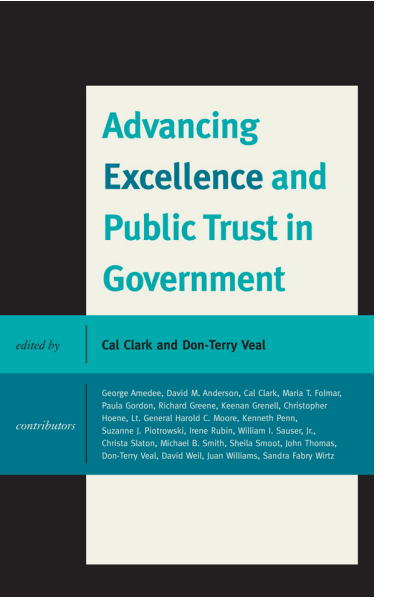
Advancing Excellence and Public Trust in Government
Editors:
Publisher:
2011
Summary
Over the last four decades the public trust in government in the United States has fallen dramatically due to a 'perfect storm' of contributing factors, such as a seemingly never ending string of political scandals, partisan polarization and toxic attack politics, and miserable failures to respond to natural disasters or the devastation of the Great Recession. This book contains the academic presentations that were made at the Symposium on Advancing Excellence and Public Trust in Government that was held at the National Press Club in Washington D.C. on September 17, 2007. In particular, the Symposium focused upon how improving transparency in governmental operations could be used to assuage some of the popular doubts about and hostility toward America's governments. There was certainly a very broad consensus at the Symposium that transparency in government is extremely desirable, needs to be improved, will bring reform and improvement to the public sector, and should make a major contribution to the restoration of the public trust in the United States. Indeed, support for improved transparency can be found across the political spectrum, as both conservatives and liberals believe that more openness in government will promote parts of their very different policy agendas. Truly, transparency appears to be an all-American issue. The discussion at the Symposium revolved around three broad themes. The first concerned transparency about government operations per se, such as how decisions were made and what detailed budgets are. A second and somewhat broader theme concerned greater transparency of 'performance measures' which tell us what the effects of specific policies are and how effective or efficient government agencies are. Third and even more broadly, some of the participants argued that general questions of governance provide the key for a renewal of public trust among our citizenry. This book of presentations at the Symposium is organized into four parts based on this distinction. Part I contains two challenges to America to restore the public trust. Parts II to IV then cover transparency, performance measures, and broader issues about general governance.
Keywords
Search publication
Bibliographic data
Edition
1/2011
Copyright Year
2011
ISBN-Print
978-0-7391-4544-9
ISBN-Online
978-0-7391-4546-3
Publisher
Lexington, Lanham
Language
English
Pages
116
Product Type
Edited Book
Table of contents
ChapterPages
Contents No access
Introduction: Advancing Excellence and Public Trust in Government No access Pages 1 - 6
1 The Challenge of Resurrecting the Public Trust No access
2 Serving the Public to Restore the Public Trust No access
3 Promoting Transparency in Local Governments No access
4 Bringing Transparency to Public Budgeting No access
5 Using the Internet to Create Transparency for State Budgets No access
6 Transparency in the Contracting Process No access
7 Higher Education as Transparency Challenged No access
8 Transparency and Cleaning Up Local Governments No access
9 Measuring Government Performance and Officials’ Qualifications No access
10 A “Bottom-Up” Approach to State Transparency No access
11 Issues in Transparency and Restoring the Public Trust No access
12 Measuring Government Performance to Promote Transparency No access
13 Transparency and Measuring What Governments Do No access
14 Targeted Transparency No access
15 Transparency in the Broader Context of Governance and Civic Engagement No access
16 Making a Difference in People’s Lives to Regain the Public Trust No access
17 The Need to Establish the Purpose of Government No access
18 Civic Engagement and Transparency for Regaining the Public Trust No access