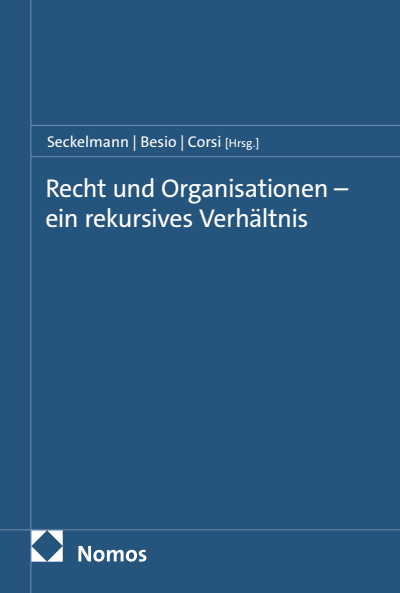
Recht und Organisationen – ein rekursives Verhältnis
- Editors:
- | |
- Publisher:
- 2026
Summary
The book analyzes the recursive relationship between law and organizations (administrations, companies, NGOs). Legal norms help shape organizations and are intended to provide them with a stable framework for action. At the same time, organizations implement laws and help shape norms through compliance, legal interpretation, or even useful illegality. They are also actively involved in the development of legislation, for example through lobbying and consulting. Using examples from the fields of energy transition and digitalization, we show how law and organizations influence each other in iterative loops in such a way that organizational change is shaped by legal norms and the development of law is influenced by organizations. This title is also available as Open Access.
Keywords
Search publication
Bibliographic data
- Edition
- 1/2026
- Copyright Year
- 2026
- ISBN-Print
- 978-3-7560-3279-2
- ISBN-Online
- 978-3-7489-6664-7
- Publisher
- Nomos, Baden-Baden
- Language
- German
- Pages
- 274
- Product Type
- Edited Book
Table of contents
- Titelei/InhaltsverzeichnisPages 1 - 6 Download chapter (PDF)
- Recht und Organisationen – ein rekursives Verhältnis? Pages 7 - 18Authors: | |Download chapter (PDF)
- Authors: |Download chapter (PDF)
- Abstract
- 1. Einführung
- 2. Der Begriff des Interesses
- 3. Interessenabwägung
- 4. Risikobewältigung
- 5. Der Rechtscode jenseits der Politik?
- 6. Recht, Organisationen und Weltgesellschaft im 21. Jahrhundert
- Authors:Download chapter (PDF)
- Zusammenfassung
- 1. Einleitung
- 2. „Selbstbindung der Verwaltung“ und die Beziehung zwischen Organisation und Recht
- 3. Zwei Beispiele aus dem Bereich des Windenergieausbaus
- 4. Ein praxistheoretisches Konzept kollektiver Selbstbindung
- 5.1. Die Typik organisationaler Selbstbindung
- 5.2.1. Grundlage: Verwaltungen in einer praxistheoretischen Staatstheorie
- 5.2.2. Selbstbindungen und Verwaltungsorganisation
- 6. Diskussion und Fazit
- Authors: | | |Download chapter (PDF)
- Abstract
- 1. Introduction
- 2.1. Organisational respecification and recombination
- 2.2. Beyond organisational boundaries: the societal impact of recombination
- 2.3. Conceptualising law and digitalisation
- 3. Method
- 4. Tensions between law and digitalisation in the Bundeswehr
- 5.1. Experimental spaces as a form of loose decoupling
- 5.2. Translation through prioritisation
- 6. Discussion: Organisational and supra-organisational consequences
- 7. Concluding remarks
- Authors:Download chapter (PDF)
- Abstract
- 1. Introduction
- 2.1. RECs in the European framework
- 2.2. RECs in the socio-technical energy system
- 3.1. The methodological tool: a comparative gesture
- 3.2. The comparison: unfolding the conditions of socio-technical change
- 4.1. Community energy in Germany
- 4.2. Community energy in Italy
- 4.3. Introducing the gap: differences in community energy between Germany and Italy
- 5. Final discussion
- 6. Concluding remarks
- Authors:Download chapter (PDF)
- Abstract
- 1. Introduction
- 2. Legal and managerial rationale
- 3. Useful illegality in the practice of Italian public administrations
- 4.1. Legislative tolerance
- 4.2. Useful illegality of legislative origin
- 5. Differences between the two forms of useful illegality
- 6. Similarities between the two forms of useful illegality
- Authors:Download chapter (PDF)
- Zusammenfassung
- 1.1. Zur Zulässigkeit des Widerstandsrechts im demokratischen Verfassungsstaat
- 1.2. Ist ziviler Ungehorsam verfassungskonform?
- 1.3. Führt ziviler Ungehorsam zur Überwindung des staatlichen Gewaltmonopols?
- 2. Klimaschutz und besonderes Verwaltungsrecht, insbesondere Polizeirecht
- 3. Ziviler Ungehorsam aus strafrechtlicher Perspektive
- 4. Legaler Protest von Klimaaktivisten vor den Zivilgerichten
- 5. Rückenwind für Klimaaktivisten durch den Klima-Beschluss des Bundesverfassungsgerichts
- 6. Der internationale Dialog der Gerichtshöfe
- 7. Resumé: Auf dem Weg zu mehr Generationengerechtigkeit?
- Authors:Download chapter (PDF)
- Zusammenfassung
- 1. Über eine besondere Organisation – Einleitung
- 2.1. Korruption im Vatikan: Verdrängung des Ökonomischen
- 2.2. Versetzungspraxis missbrauchender Priester im katholischen Feld: Verdrängung des Sexuellen
- 2.3. Von der Verdrängung über die Tabuisierung zum fehlenden Vokabular
- 3. Vom Besonderen zum Allgemeinen – eine Heuristik
- Authors:Download chapter (PDF)
- 1. Problemstellung
- 2. Theoretischer Bezugsrahmen
- 3. Bessere Rechtsetzung
- 4.1. Formale Anforderungen an die Ausgestaltung von Entwürfen
- 4.2. Formale Anforderungen an die Ausgestaltung des Verfahrens
- 5.1. Vorphase
- 5.2. Hausinternes Abstimmungsverfahren
- 5.3. Ressortabstimmung
- 5.4. Beteiligung der Länder und kommunalen Spitzenverbände
- 5.5. Verbändebeteiligung
- 5.6. Weitere Beteiligung
- 5.7. Kabinettvorlage und Kabinettbeschluss
- 6. Fazit
- Authors: |Download chapter (PDF)
- Zusammenfassung
- 1. Einleitung
- 2. Normenbildung in der Energiewende
- 3.1. Reflexive Selbstreferenz
- 3.2. Re-Spezifikation und Re-Kombination: Die organisationale Verarbeitung rechtlicher Erwartungen
- 3.3. Rekursivität: Zur Wechselwirkung von Recht und Organisation
- 4.1. Methodologische Anmerkungen
- 4.2. Genossenschaften, „Strohmänner“ und der Erhalt der Akteursvielfalt in der Windenergie
- 5. Schlussbemerkungen
- Verzeichnis der Herausgebenden und BeitragendenPages 273 - 274 Download chapter (PDF)