, to see if you have full access to this publication.
Monograph No access
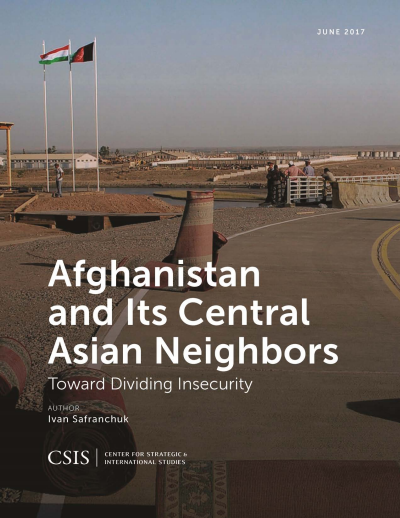
Afghanistan and Its Central Asian Neighbors
Toward Dividing Insecurity
Authors:
Publisher:
2017
Summary
The general trend in Afghanistan is clear-cut: the overall security situation has consistently deteriorated since 2009, worsening dramatically since 2014. However, in the provinces of Afghanistan adjacent to Central Asia, the security situation has deteriorated even further than in Afghanistan as a whole. This report considers the range of options available to the Central Asian neighbors of Afghanistan (Tajikistan, Turkmenistan, and Uzbekistan) in responding to this growing threat, both unilaterally and in their bilateral engagement with actors in Afghanistan. Furthermore, it considers how decision making processes in Central Asia will be affected by future developments in Afghanistan by assessing options and likely outcomes under a set of security scenarios in Afghanistan itself.
Search publication
Bibliographic data
Edition
1/2017
Copyright Year
2017
ISBN-Print
978-1-4422-8017-5
ISBN-Online
978-1-4422-8018-2
Publisher
Rowman & Littlefield, Lanham
Language
English
Pages
31
Product Type
Monograph
Table of contents
ChapterPages
Contents No access
Acknowledgments No access
Executive Summary No access
The Border with Tajikistan (Northeastern Afghanistan) No access
The Border with Turkmenistan (Northwestern and Western Afghanistan) No access
The Border with Uzbekistan (Northern Afghanistan) No access
The “Backyard” Provinces No access
The Taliban’s Quest for Parallel Rule No access
Threat A: Smuggling by Militants No access
Threat B: Infiltration of Militants No access
Threat C: Direct Attack by the Taliban on Central Asian Borders No access
Threat D: Flow of Refugees into Central Asia No access
Threat E: Indirect Involvement in Conflict No access
Synthesis of Threats B and C: Fresh Blood to Underground Cells in Central Asiaand the Prospect of Hybrid War by Taliban No access
Relying on ANDSF No access
Sealing the Border with Afghanistan No access
Creating a Military Buffer Zone No access
Creating a Nonmilitary Buffer Zone No access
Making Deals with the Taliban No access
Synthesizing the Available Responses No access
The “Gray Zone” Discrepancy between Security Threats and the Ability to Respond No access