, to see if you have full access to this publication.
Monograph No access
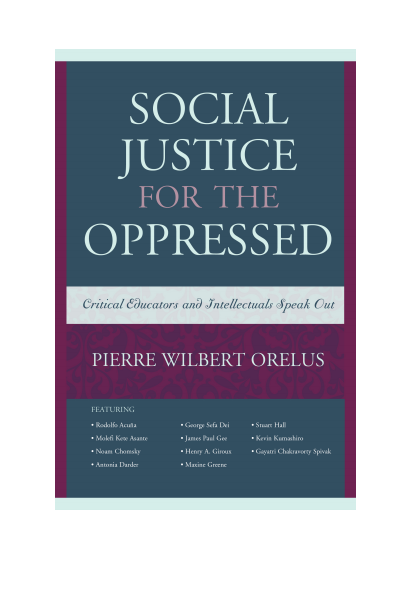
Social Justice for the Oppressed
Critical Educators and Intellectuals Speak Out
Authors:
Publisher:
2017
Summary
This book draws from interviews conducted with prominent social justice educators and activist intellectuals, such as Noam Chomsky, Gayatri Spivak, Stuart Hall, Henry Giroux, Antonia Darder, Molefi Asante, and Maxine Greene, to examine various forms of social inequities occurring in schools and society perpetrated by those in power. These educators and intellectuals use examples drawn from both personal and professional experiences and relevant literature to point out the manner in which multiple forms of oppression intersect, in both hidden and visible ways, to affect the lives of oppressed groups and disfranchised communities. This book seeks to shed light on various manifestations of social injustices aiming to inspire critical, radical thoughts for socio-political action leading to educational and social change.
Keywords
Search publication
Bibliographic data
Copyright Year
2017
ISBN-Print
978-1-4758-0447-8
ISBN-Online
978-1-4758-0449-2
Publisher
Rowman & Littlefield, Lanham
Language
English
Pages
148
Product Type
Monograph
Table of contents
ChapterPages
Contents No access
Foreword No access
Acknowledgments No access
Introduction No access
Chapter One: Re-envisioning Social Justice and Democracy No access
Chapter Two: Questioning the Essentializing Convenience of Generalizations No access
Chapter Three: Institutional Racism and White Hegemony No access
Chapter Four: Interrogating Class, Racism, and Inequality No access
Chapter Five: Re-envisioning the Life of Youth in the Age of Western Neoliberalism No access
Chapter Six: Rethinking Literacy and Schooling in a Capitalist Society No access
Chapter Seven: Rethinking Schooling in a Neoliberal Economy No access
Chapter Eight: Redefining Blackness in the Twenty-First Century No access
Chapter Nine: Taking a Stance for Equity and Fairness No access
Chapter Ten: Anticolonial Thought and Indigenous Ways of Knowing and Doing No access
Chapter Eleven: The Politics of Representation No access
Conclusion No access Pages 137 - 140
About the Author No access Pages 141 - 142
About the Interviewees No access Pages 143 - 148
Similar publications
from the topics "Bildung allgemein"
Edited Book No access
Amina Kielblock, Stephan Kielblock, Christoph Bülau, Anna- Maria Seemann