, to see if you have full access to this publication.
Monograph No access
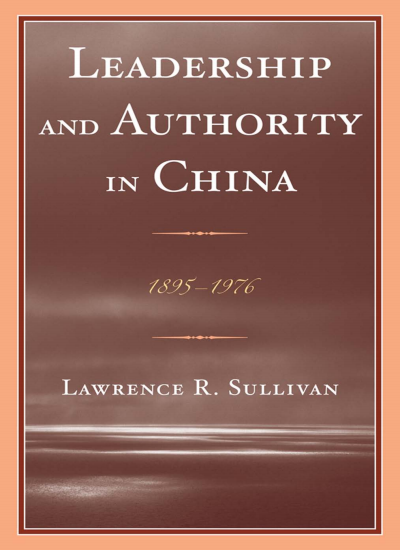
Leadership and Authority in China
1895–1978
Authors:
Publisher:
2012
Summary
This volume presents elite conflicts and political controversies in China from 1895 to 1978 as rooted in two diametrically opposed visions of leadership and political authority: a radical, charismatic model that instills absolute authority in the single leader whose "will" guides the polity and whose "word" is the basis of policy formulation, versus an institutional model in which authority inheres in organization and where “collective” leadership and decision-making govern the political realm. The former model in modern Chinese history entailed a "leader principle" and personality cult that began with Sun Yatsen and Chiang Kaishek in the Nationalist Party (KMT) and reached its peak with the leadership cult of Chinese Communist Party (CCP) Chairman Mao Zedong, especially during the 1966-1976 Great Proletarian Cultural Revolution. The latter model with its emphasis on “collective leadership” (jiti lingdao) and "administrative rationalism" began as a reaction among early members of the CCP against the promotion of the Sun and Chiang leadership cults and became a central governing principle in the Communist Party that served as official leadership doctrine beginning with the formation of the Party in 1921.
While tensions over leadership issues were relatively muted in the pre-1949 period and early 1950s of CCP history as an apparent "compromise" was reached in which from 1943 onward a cult of the leader was promoted for propaganda purposes but with collegial decision-making governing inner Party decision-making, the mid-to-late 1950s saw this "compromise" among the top leadership come under increasing strain and finally break down. Devoted to a fundamentally different vision of a "socialist" China from other top leaders on a number of economic, social, and political fronts, Mao Zedong pushed his domination of the policy process that ultimately provoked a wholesale assault on the CCP apparatus throughout the country while the leader cult reached mythic proportions during the Cultural Revolution. Confronted by the possibility of civil war and generally opposed to the takeover of the polity by the radical Gang of Four led by his wife Jiang Qing, by the mid-1970s the aging great leader acquiesced to the rebuilding of the CCP along traditional, "institutional" lines.
Search publication
Bibliographic data
Edition
1/2012
Copyright Year
2012
ISBN-Print
978-0-7391-7154-7
ISBN-Online
978-0-7391-7155-4
Publisher
Lexington, Lanham
Language
English
Pages
315
Product Type
Monograph
Table of contents
ChapterPages
Contents No access
List of Abbreviations No access
Foreword No access
Acknowledgments No access
Introduction No access
1 The Problem of “Feudal Despotism” in Marx and China No access Pages 1 - 6
2 Intellectual and Political Controversies Over Authority: 1895-1922 No access Pages 7 - 41
3 Political Authority in the Chinese Communist Party, Theory and Practice: 1921-1949 No access Pages 43 - 130
4 The Struggle Over Leadership and Authority in the CCP, I: 1949-1959 No access Pages 131 - 190
5 The Struggle Over Leadership and Authority in the CCP, II: 1959-1976 No access Pages 191 - 264
6 Epilogue: On the “Question of Mao” No access Pages 265 - 271