, to see if you have full access to this publication.
Monograph No access
The Will and Its Brain
An Appraisal of Reasoned Free Will
Authors:
|
Publisher:
2012
Summary
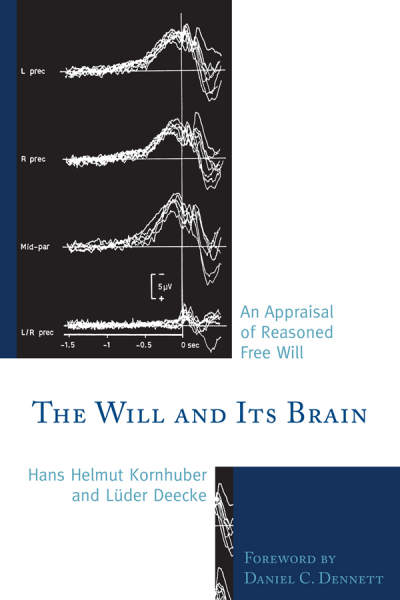
In 1964–1965, Hans Helmut Kornhuber and Lüder Deecke achieved a scientific breakthrough with the discovery of the Bereitschaftspotential (BP), or readiness potential. In The Will and its Brain, Kornhuber and Deecke present evidence that proves we can record activity from the human brain occurring prior to our volitional movements or actions. Such preparatory activity is generated by specific brain regions, particularly by the supplementary motor area (SMA) of the frontal lobe, which lies on the inner surface of the brain between the hemispheres. The primary (precentral) motor cortex (MI) later becomes activated in preparing for action. Consequently, the authors discriminate between two components of the preparatory activity of the Bereitschaftspotential: an early SMA-generated BP1 and a late MI-derived BP2. Between BP1 and BP2, the intentional activity runs over the so-called motor loop via the basal ganglia. Kornhuber and Deecke discuss these and other brain processing systems while focusing on the concept of free will. They claim that we, indeed, have free will. It may not be absolutely free, but free in terms of degrees. We can take efforts to increase our degrees of freedom through self-improvement, but we can also lose degrees of freedom through self-mismanagement.
Search publication
Bibliographic data
Edition
1/2012
Copyright Year
2012
ISBN-Print
978-0-7618-5856-0
ISBN-Online
978-0-7618-5857-7
Publisher
Hamilton Books, Lanham
Language
English
Pages
116
Product Type
Monograph
Table of contents
ChapterPages
Contents No access
List of Figures No access
Key Words No access
Foreword No access
Preface No access
Preface to the German Edition No access
Introduction: What Is the Will? No access Pages 1 - 4
Chapter One. The Will: History and Transcultural Aspects No access Pages 5 - 9
Chapter Two. The Will: Its Association with Freedom No access Pages 10 - 12
Chapter Three. The Will and Psychiatry/Psychology No access Pages 13 - 16
Chapter Four. The Will and Neurophysiology/Brain Research No access Pages 17 - 23
Chapter Five. The Will and New Psychology Schools No access Pages 24 - 28
Chapter Six. The Will and the Real Function of the Frontal Lobe: Commander, Delegator, Supervisor and Rater No access Pages 29 - 39
Chapter Seven. The Will and the Evolution of Man: Creativeness and Cooperation—Common Will No access Pages 40 - 44
Chapter Eight. The Will and Dream Sleep, Feelings, Drives, Meaning-Happiness, Beauty, Love, Empathy and Theory of Mind No access Pages 45 - 49
Chapter Nine. The Will and the Limbic System, the Hypothalamus, the Arousal System, Circadian Rhythm, the Endocrine System, Fatigue and Impetus No access Pages 50 - 51
Chapter Ten. The Will Is Not Strictly Coupled with Consciousness: There Are Conscious and Unconscious Agendas in the Brain and Both Are Important No access Pages 52 - 64
Chapter Eleven. The Will: Is It Grounded upon Freedom or upon Total Determinism? No access Pages 65 - 75
Chapter Twelve. The Will: Its Freedom Is Not a Priori Granted: We Have to Do Something for It—Actively Increasing Our Degrees of Freedom No access Pages 76 - 78