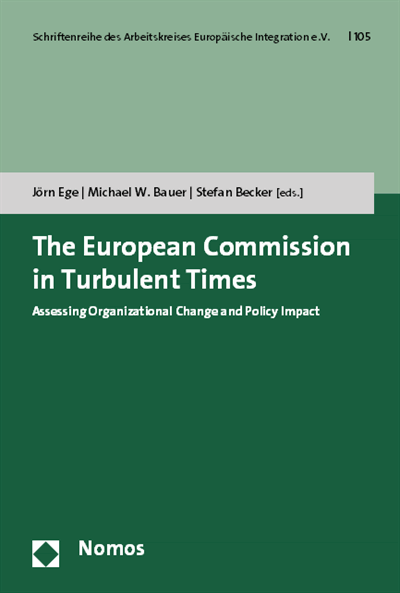
The European Commission in Turbulent Times
Assessing Organizational Change and Policy Impact- Editors:
- | |
- Series:
- Schriftenreihe des Arbeitskreises Europäische Integration e.V., Volume 105
- Publisher:
- 2018
Summary
Die Europäische Union durchlebt turbulente Zeiten. Die Auswirkungen der Banken- und Staatsschuldenkrisen, die aktuellen Migrationsbewegungen sowie der Austritt Großbritanniens sind nur einige der Herausforderungen, die den Zusammenhalt der Europäischen Union gegenwärtig auf eine harte Probe stellen. Vor diesem Hintergrund analysieren die Wissenschaftlerinnen und Wissenschaftler in diesem Band die Europäische Kommission. Ziel ist eine Bestandaufnahme und Neubewertung ihrer Rolle im politischen System der EU, ihrer internen Organisationsstrukturen und Prozesse sowie ihrer Politikgestaltungs- und Implementationsfunktionen. Der Band kommt dabei zu dem Ergebnis, dass die Kommission trotz der zahlreichen Herausforderungen nach wie vor entscheidenden Einfluss auf das Integrationsgeschehen hat. Die Gründe dafür liegen dabei sowohl in den absichtsvollen Entscheidungen der Mitgliedsstaaten, als auch im politischen Aktivismus der Kommission selbst.
Mit Beiträgen von
Prof. Dr. Wolfgang Wessels, Marieke Eckhardt, Prof. Dr. Andreas Maurer, Michael C. Wolf, Dr. Christian Adam, Prof. Dr. Miriam Hartlapp, Dipl.-Jur. Robert Böttner, Prof. Dr. Ingeborg Tömmel, Prof. Dr. Sandra Eckert, Prof. Dr. Michèle Knodt, Prof. Dr. Marc Ringel, Prof. Dr. Hussein Kassim, Prof. Dr. Sara Connolly, Prof. Dr. Michael W. Bauer, Dr. Jörn Ege, Stefan Becker, M.A..
Search publication
Bibliographic data
- Edition
- 1/2018
- Copyright Year
- 2018
- ISBN-Print
- 978-3-8487-4514-2
- ISBN-Online
- 978-3-8452-8756-0
- Publisher
- Nomos, Baden-Baden
- Series
- Schriftenreihe des Arbeitskreises Europäische Integration e.V.
- Volume
- 105
- Language
- English
- Pages
- 254
- Product Type
- Edited Book
Table of contents
- Titelei/Inhaltsverzeichnis No access Pages 1 - 8
- Authors: | |
- 1. The European Commission in Turbulent Times No accessAuthors: | |
- Authors: | |
- 2.1 The Commission within the Institutional System of the EU No accessAuthors: | |
- 2.2 The Commission as an Organization – Internal Structures, Processes and Leadership No accessAuthors: | |
- 2.3 Policy-Making and Implementation No accessAuthors: | |
- 3. Outlook and Avenues for Future Research on the European Commission No accessAuthors: | |
- References No accessAuthors: | |
- Authors: |
- 1. Introduction: Discussing a Complex and in-flux Relationship No accessAuthors: |
- 2. The Study of Principal Agent Relations: Models for the Relationship between the European Council and the Commission? No accessAuthors: |
- Authors: |
- 3.1 Model 1: The Commission as a Secretariat to the European Council No accessAuthors: |
- 3.2 Model 2: The Commission as a Hidden Principal No accessAuthors: |
- 3.3 Model 3: The Commission and the European Council as Specific Partners No accessAuthors: |
- Authors: |
- 4.1 Actor Constellations in the Legislative Process and Policy Initiation No accessAuthors: |
- 4.2 Fiscal Surveillance: Limited Powers of Supranational Surveillance No accessAuthors: |
- 4.3 The Commission’s Autonomy as a Function of Control Mechanisms by the European Council? No accessAuthors: |
- 5. Conclusion and Perspectives: an influx Inter-Institutional Relationship No accessAuthors: |
- References No accessAuthors: |
- Authors: |
- 1. Introduction No accessAuthors: |
- 2. Theory No accessAuthors: |
- 3. Channels of Indirect Initiatives No accessAuthors: |
- Authors: |
- 4.1 Non-Legislative Own-Initiative Reports (INI) No accessAuthors: |
- 4.2 Legislative Own-Initiative Reports (INL) No accessAuthors: |
- Authors: |
- 5.1 State of Research No accessAuthors: |
- 5.2 Quantitative Analysis of INI and INL Reports No accessAuthors: |
- Authors: |
- 5.3.1 Impact on the European Commission’s Legislative Agenda (INI) No accessAuthors: |
- 5.3.2 Translating Information and Consultation into Agenda-Shaping: INI-Reports and the EU’s Trade Policy No accessAuthors: |
- 5.3.3 Impact on the European Commission’s Legislative Agenda (INL) No accessAuthors: |
- 5.4 Empirical Conclusions No accessAuthors: |
- 6. Conclusion No accessAuthors: |
- References No accessAuthors: |
- Authors: | |
- 1. Introduction No accessAuthors: | |
- 2. Annulment Litigation and Conflict over Policy Application No accessAuthors: | |
- Authors: | |
- 3.1 Creative Agency by the Commission No accessAuthors: | |
- 3.2 Inept Application by Agent Governments No accessAuthors: | |
- 3.3 Heterogeneous Preferences in the Council No accessAuthors: | |
- 3.4 Interrupted Relationship No accessAuthors: | |
- 4. Data and Methods No accessAuthors: | |
- 5. Empirical Evidence No accessAuthors: | |
- 6. Conclusion No accessAuthors: | |
- References No accessAuthors: | |
- Authors:
- 1. Development of the Size of the European Commission No accessAuthors:
- 2. For and Against the “one Member State, one Commissioner” Rule No accessAuthors:
- Authors:
- 3.1 Design of the Project Teams No accessAuthors:
- 3.2 Legal Foundation for the Establishment of Project Teams No accessAuthors:
- 3.3 Legal Limits for the Establishment of Project Teams No accessAuthors:
- 4. Conclusion No accessAuthors:
- References No accessAuthors:
- Authors:
- 1. Introduction No accessAuthors:
- 2. Commission Presidents as Political Leaders – some Theoretical Insights No accessAuthors:
- 3. Commission President Juncker as a Political Leader – an Analytical Framework No accessAuthors:
- Authors:
- 4.1 Setting the Agenda I: Basic Goals and Policy Projects No accessAuthors:
- 4.2 Setting the Agenda II: Proposals for the Reform of the EU No accessAuthors:
- 4.3 Setting the Agenda III: Strengthening the Commission and the Supranational Dimension of the EU No accessAuthors:
- 4.4 Managing Procedures for Decision-Making I: Reorganising the College of Commissioners and Allocating Portfolios No accessAuthors:
- 4.5 Managing Procedures for Decision-Making II: Shaping Inter-Institutional Proceedings No accessAuthors:
- 5. Conclusions: Assessing Juncker's Performance: What Kind of Leadership? No accessAuthors:
- References No accessAuthors:
- Authors:
- 1. Introduction No accessAuthors:
- 2. The European Commission’s Powers in Negotiations No accessAuthors:
- Authors:
- 3.1 The Commission’s Procedural Role No accessAuthors:
- 3.2 Mobilising other Powers No accessAuthors:
- Authors:
- 4.1 Internal Negotiations: a Special Deal for the UK No accessAuthors:
- 4.2 Negotiating with Third Countries – Swiss Demands No accessAuthors:
- 5. A Leap in the Dark – Brexit Negotiations No accessAuthors:
- 6. Conclusions No accessAuthors:
- References No accessAuthors:
- Authors: |
- 1. Introduction No accessAuthors: |
- 2. The Role of the Commission in Soft Governance No accessAuthors: |
- 3. Analytical Framework and Methods No accessAuthors: |
- 4. Harder Soft Governance in the Proposed Governance Regulation 2016 No accessAuthors: |
- Authors: |
- 5.1 Limited Formal Competences for the Commission and No National Binding Targets No accessAuthors: |
- 5.2 Dialogic Structures as Informal Organisation of Politics No accessAuthors: |
- 5.3 High Degree of Politicisation Due to a Deep Cleavage Between Member States No accessAuthors: |
- 5.4 Linking International Agreement to Enhance the Legitimacy of the Commission’s Policy No accessAuthors: |
- 5.5 The Institutional Self-Interest of the Commission to Establish a Harder Soft Governance No accessAuthors: |
- 6. The Commission as a Policy Shaper Through Harder Soft Governance No accessAuthors: |
- References No accessAuthors: |
- Authors:
- 1. Introduction No accessAuthors:
- 2. Engineering the Europe 2020 Strategy No accessAuthors:
- 3. Coupling Hard and Soft Economic Governance in the European Semester No accessAuthors:
- 4. Shifting the Thematic Emphasis of Country-specific Recommendations No accessAuthors:
- 5. Directing the Delivery of Country-specific Recommendations No accessAuthors:
- 6. Discussion and Outlook No accessAuthors:
- References No accessAuthors:
- Authors: |
- 1. Introduction No accessAuthors: |
- 2. The European Commission in an inter-institutional setting No accessAuthors: |
- 3. Organizational No accessAuthors: |
- 4. Policy No accessAuthors: |
- 5. Research on the European Commission: widening the perspective No accessAuthors: |
- 6. Conclusion No accessAuthors: |
- References No accessAuthors: |
- Short Biographies No access Pages 251 - 254