Book Titles Open Access Full access
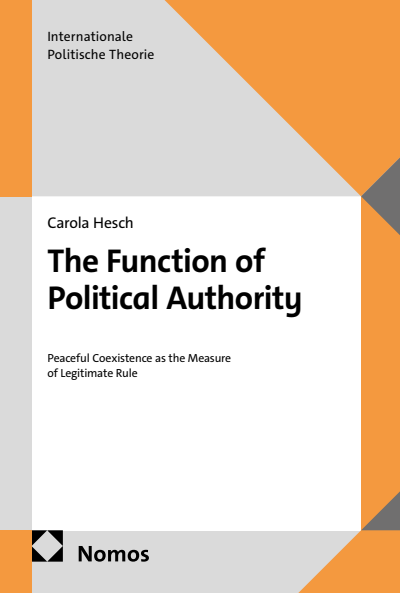
The Function of Political Authority
Peaceful Coexistence as the Measure of Legitimate Rule- Authors:
- Series:
- Internationale Politische Theorie, Volume 11
- Publisher:
- 2026
Summary
Political authority is more than brute power insofar as it is rooted within the institution of a legal order. As social constructs, however, institutions may lack legitimacy. This book suggests a normatively individualistic and functional conception of legitimacy. On this account, political authority can be legitimate because its function, administering peaceful coexistence in a state, allows for all individuals to benefit. For a regime to be legitimate, however, individuals must also be protected against governmental overreach by means of liberal fundamental rights and the rule of law. Although the functional approach does not envision any ideal state, it provides guidelines for designing and reforming constitutions.
Keywords
Search publication
Bibliographic data
- Copyright year
- 2026
- ISBN-Print
- 978-3-7560-3597-7
- ISBN-Online
- 978-3-7489-6752-1
- Publisher
- Nomos, Baden-Baden
- Series
- Internationale Politische Theorie
- Volume
- 11
- Language
- English
- Pages
- 244
- Product type
- Book Titles
Table of contents
ChapterPages
- Preface
- 1 Opening Remarks: The Need to Justify Political RulePages 11 - 26 Download chapter (PDF)
- 2.1 Introduction
- 2.2.1 Practical Authority
- 2.2.2 Power
- 2.2.3 De Jure and De Facto Authority
- 2.3.1 The Social Thesis
- 2.3.2 The Reasons Rationale
- 2.3.3 The Rules of the Game
- 2.4.1 Structure
- 2.4.2 Function
- 2.4.3 Stability
- 2.4.4 Origin
- 2.5.1 Moral Rights and Duties
- 2.5.2 Legal Rights and Obligations
- 2.5.3 Political Authority and Obligation
- 2.6 Summary
- 3.1 Introduction
- 3.2.1 A Functional Conception of Legitimacy
- 3.2.2 The Participation Constraint
- 3.2.3 The Principle of Legitimacy
- 3.3.1 The Notion of the Social Contract
- 3.3.2 Functional Legitimacy as a Contractarian Approach
- 3.4.1 Fair Play
- 3.4.2 Voluntariness
- 3.4.3 Action-Guidingness
- 3.5 Summary
- 4.1 Introduction
- 4.2.1 The Benefits of Peaceful Coexistence
- 4.2.2 The Incompatibility of Autonomy and Authority
- 4.2.3 The Role of Property Rights for Political Legitimacy
- 4.3.1 Individual Exposure
- 4.3.2 The Case for Limited Government
- 4.4.1 A Constitutional Choice Situation
- 4.4.2 Artificial Consensus under the Veil of Uncertainty
- 4.4.3 Functionality as a Minimum Criterion
- 4.5 Summary
- 5.1 Introduction
- 5.2.1 A Procedural Form of Governance
- 5.2.2 The Case of Persistent Minorities
- 5.2.3 Protecting Intense Minorities
- 5.3.1 The Arbitrariness of the Status Quo
- 5.3.2 The Justifiable Size of the Public Budget
- 5.4.1 The Costs of Diversity
- 5.4.2 The Problem of Local Minorities
- 5.4.3 The Potential of Exit for Homogeneity
- 5.4.4 The Possibility of Non-Territorial Parallel Law
- 5.5 Summary
- 6 Conclusion: Answering the AnarchistPages 223 - 230 Download chapter (PDF)
- ReferencesPages 231 - 244 Download chapter (PDF)