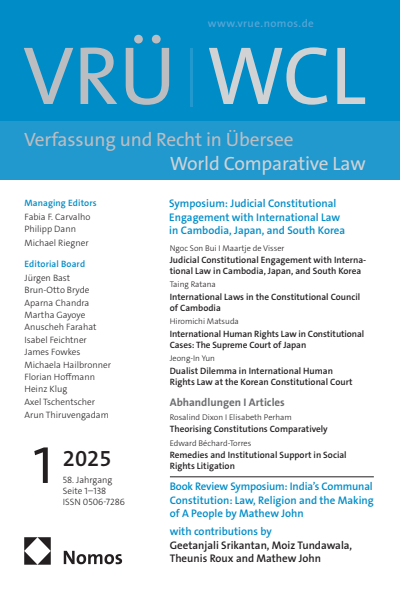
"Law and Politics in Africa, Asia and Latin America" analyses legal and constitutional developments in all states or regions outside of Europe as well as their regional and international integration. Founded in 1968 and inspired by decolonization and the idea of a cooperative new beginning, the Journal also promotes a special interest in contributions on 'Law and development'. The journal aims to provide a forum for a variety of perspectives on these fields of interest, be they focused on one country or comparative, theoretical or methodological in nature. Next to extensive articles, the journal publishes shorter reports about current events or conferences as well as book reviews. As a special service, each issue of "Law and Politics in Africa, Asia and Latin America" contains an international bibliography of relevant publications from around the world. This is compiled in cooperation with the Leibniz-Institute for Global and Regional Studies in Hamburg (GIGA). "Law and Politics" addresses authors and readers on all continents and aims to serve as a forum of mutual exchange. The journal is open for contributions from legal and social sciences as well as for analyses from practitioners. The journal is published quarterly and welcomes contributions in German, English, Spanish and French. Website: www.vrue.nomos.de
Possibly more so than ever before, postcolonial states in Africa are pushing back against the hegemony of the liberal democratic model. Such arguments have explained how liberal democracy does not centre socioeconomic rights and group rights enough...
Democracy, as a political system that promotes the participation of all in public management, is implemented in ways that are coloured by the historical and political cultures of the peoples to whom it is to be applied. Cultural and ethnic mosaic,...
In Africa, the persistence of post-electoral crises despite national legal and political solutions necessitates an exploration of alternative remedies. The African Court on Human and Peoples’ Rights (ACHPR) presents a credible and serious...
By replicating the French Constitution at the time of independence, the constitutions of sub-Saharan African states emerging from French colonization incorporated its model of nationhood. Consequently, they largely disregarded the existence of...
This article investigates the enduring impact of colonialism on gender equality in post-colonial Commonwealth nations, focusing specifically on examples from West Africa and the Caribbean. It focuses on discriminatory provisions embedded in the...
In midst of unpredictable geopolitical changes accompanying the end of the post-Cold War convergence around liberal-democratic-capitalist ideas, it is difficult to predict what the next global order would look like. What is however very likely is...
Following a series of disputes between the Judiciary and Legislative branches in Brazil, and in the face of yet another myriad of lawsuits focusing on a range of issues regarding indigenous lands, the Brazilian Supreme Court set up a conciliation...
Adherence to the Rule of Law is one of the fundamental principles of the East African Community (EAC), anchored in the Treaty establishing the Community. The main judicial organ of the EAC—the East African Court of Justice (EACJ)—and the Supreme...