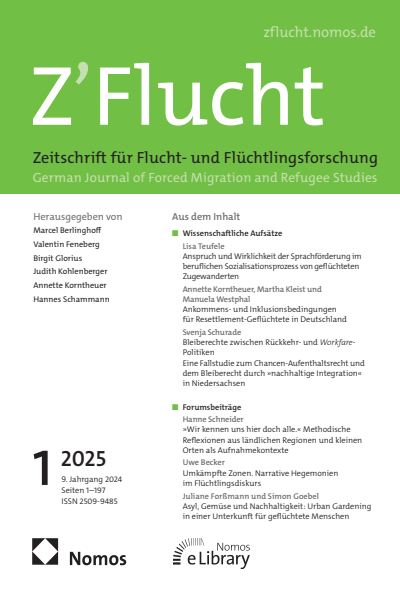
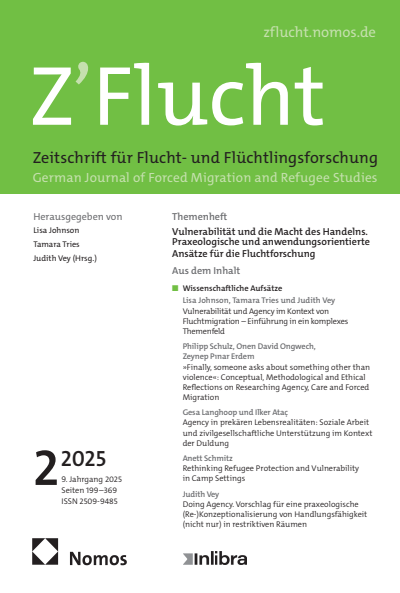
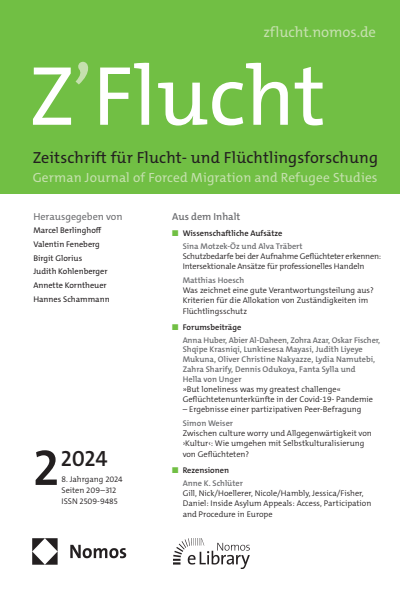
Zeitschrift für Flüchtlingsforschung, The German Journal for Refugee Studies (Z’Flucht) is a new peer-reviewed journal which publishes academic works from diverse disciplines on questions related to forced migration and refugee studies. The journal is published twice a year by Nomos publishing house in association with the German Refugee Research Network (Netzwerk Flüchtlingsforschung) and is edited by Marcel Berlinghoff, J. Olaf Kleist, Ulrike Krause and Jochen Oltmer. Z’Flucht provides a forum for exchange in the field of forced migration and refugee studies through empirical studies, theoretical reflections and methodological discussions. By means of international, regional or national studies, scholar may tackle questions related to the conditions, forms and consequences of forced migration and displacement, protection of refugees and efforts towards durable solutions, such as (re)integration or resettlement. Moreover, refugees’ activities and strategies utilized to contend with their experiences may be analysed. The journal includes all categories of people who have been forcibly displaced or who have fled from their homes due to violence and examines related debates, discourses, practices and concepts. As such topics can be explored from diverse perspectives, the journal places special emphasis on interdisciplinary discussions and comprises various disciplines, including law, sociology, history, politics, philosophy, ethnology, psychology, geography and economics, linguistics and literary studies. As displacement and forced migration not only represent a growing field of research but also a broad political and practical area, this journal aims to promote the exchange between academia and practice. Z’Flucht publishes works in three categories: academic articles, forum articles and literature reviews. Academic articles present research findings on specific questions related to forced migration and refugees which are methodically and theoretically reflected, and consider and further the current state of research in this field. These articles undergo a double-blind peer review and are limited to 80,000 characters (including spaces). Forum articles can include shorter (field) research reports, address theoretical, methodological, conceptual and ethical questions of research or relate to current discussions in forced migration and refugee studies. Manuscripts from practitioners are welcome. The editors of the journal review all forum articles, which are limited to 35,000 characters (including spaces). Literature reviews can relate to individual or a number of new publications from the last two years which discuss aspects of forced migration and refugee studies. In view of the journal’s interdisciplinary focus, publications which cover several fields are preferred. Individual reviews are limited to 6,000 characters (including spaces), while multiple books reviews should be no longer than 20,000 characters (including spaces). The journal predominantly publishes works written in German, but studies written in English and French may be considered.
Although the shortage of skilled workers represents one of the major economic challenges for politics and society, it should also be noted that the job-related socialization process of refugee immigrants is progressing very slowly and existing...
The mixed-method study InclusiveRE investigates the arrival and inclusion of resettled refugees in Germany. Our theoretical framework refers to inclusion as the structural facilitation of equal participation and critique of intersectional...
Based on an empirical case study in the context of the research project MORE, this article examines integration-based right-to-stay regulations against the backdrop of the effects of return-oriented policies. Beyond the legal framework, the analysis...
The field of forced migration research is increasingly conducted in non-urban areas, including small towns and rural communities. The context of rural areas has been identified as a significant factor affecting both the reception and integration of...
Current European refugee policy is characterized by efforts towards more effective isolation, increased control and systematic rejection of refugees. In recent years, the media discourse has generated dominant narratives that support this policy....
Refugees usually live in precarious social, economic and health situations. At the same time, they have various resources at their disposal, but these are generally hardly recognized in the host society. In an urban gardening project in a...
The International Migration Conference 2024 in Mexico City brought together scholars, activists, policymakers, and journalists to discuss current challenges, perspectives, and potential solutions in the field of (forced) migration. This conference...
This contribution examines the legal framework and the practice of accommodating refugees in the 16 German federal states (as of May 2025). The overview serves as a knowledge base and can inspire future research.