, to see if you have full access to this publication.
Edited Book No access
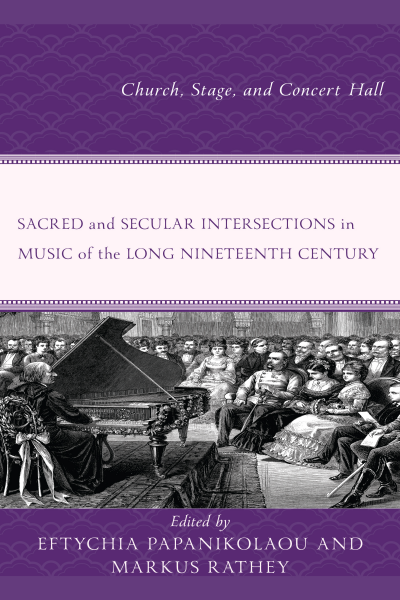
Sacred and Secular Intersections in Music of the Long Nineteenth Century
Church, Stage, and Concert Hall
Editors:
|
Publisher:
2022
Summary
Sacred and Secular Intersections in Music of the Long Nineteenth Century: Church, Stage, and Concert Hall explores interconnections of the sacred and the secular in music and aesthetic debates of the long nineteenth century. The essays in this volume view the category of the sacred not as a monolithic attribute that applies only to music written for and performed in a religious ritual. Rather, the “sacred” is viewed as a functional as well as a topical category that enhances the discourse of cross-pollination of musical vocabularies between sacred and secular compositions, church and concert music. Using a variety of methodological approaches, the contributors articulate how sacred and religious identities coalesce, reconcile, fuse, or intersect in works from the long nineteenth century that traverse an array of genres and compositional styles.
Keywords
Search publication
Bibliographic data
Edition
1/2022
Copyright Year
2022
ISBN-Print
978-1-6669-0604-2
ISBN-Online
978-1-6669-0605-9
Publisher
Lexington, Lanham
Language
English
Pages
430
Product Type
Edited Book
Table of contents
ChapterPages
Contents No access
Introduction No access Pages 1 - 10
Chapter 1: Music for the “Cultured Despisers” of Religion: Schleiermacher on Singing in Church and Beyond No access
Chapter 2: The Cross and the Wanderer: From the Sacred to the Secular in the Early Nineteenth Century No access
Chapter 3: The Sacred Looking Glass: Imaginative Children’s Music as Syncretic Nexus No access
Chapter 4: Reassessing Robert Schumann’s Motivations for Composing a Mass and Requiem No access
Chapter 5: Spirituality and the Fugal Topos in the Secular Dramatic Works of Robert Schumann No access
Chapter 6: Hieratic Iconoclasm: Liszt, Hanslick, and the Graner Festmesse No access
Chapter 7: Sacred Moments in the Secular Dramatic Works of Arthur Sullivan No access
Chapter 8: Redeeming Chamber Music: Experiencing Solace in Mendelssohn’s Late Chamber Music No access
Chapter 9: Felix Mendelssohn’s Lobgesang: “Imaginary Church Music” or a Sublime Symphony? No access
Chapter 10: The Italian Reception in Bach’s Keyboard Works and Passions: Intersections of the Sacred and the Secular No access
Chapter 11: “The Habit Does Not Make the Monk”: Rethinking Anti-Clericalism in French Revolutionary Opéras-Comiques No access
Chapter 12: Biblical Boulevards: Sounding the Ralliement on Parisian Popular Stages No access
Chapter 13: Debussy’s Religion of Art in His Trois mélodies de Verlaine No access
Chapter 14: “Old 100th,” Militarization, and Nostalgia during the American Civil War No access
Chapter 15: Mourning, Judgment, and Resurrection: Christian Imagery in Reconstruction Sheet Music No access
Chapter 16: Spirituals Share the Stage with Mozart and Beethoven: The Germany Tour of the Fisk Jubilee Singers in 1877/78 and the Responses of the German Press No access
Chapter 17: Veiled Allusions to the Sacred: Secular Music during the Partitions of Poland No access
Chapter 18: Futurist Constructions of the Sacred: The Ballets Russes, Liturgie, and the Problem of a Musical Score No access
Chapter 19: (Re)constructing Medieval Rus’ in Kastalsky’s Furnace Rite No access