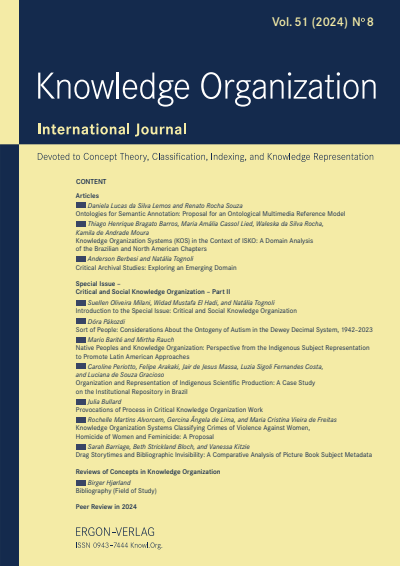
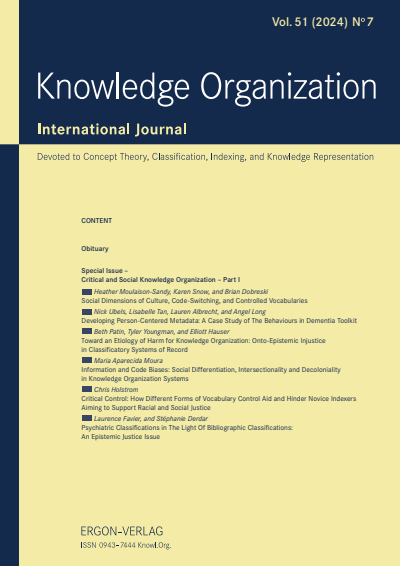
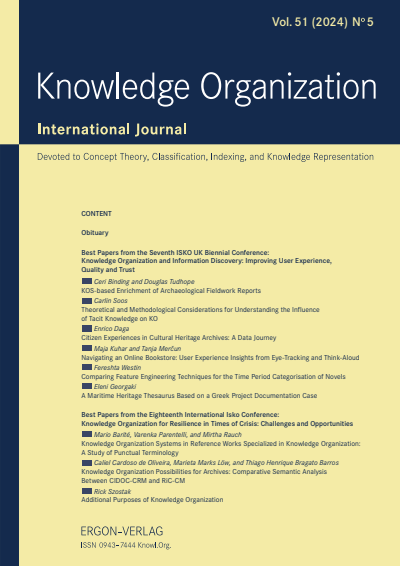
KNOWLEDGE ORGANIZATION is a forum for all those interested in the organization of knowledge on a universal or a domain-specific scale, using concept-analytical or concept-synthetical approaches, as well as quantitative and qualitative methodologies. KNOWLEDGE ORGANIZATION also addresses the intellectual and automatic compilation and use of classification systems and thesauri in all fields of knowledge, with special attention being given to the problems of terminology.KNOWLEDGE ORGANIZATION publishes original articles, reports on conferences and similar communications, as well as book reviews, letters to the editor, and an extensive annotated bibliography of recent classification and indexing literature.KNOWLEDGE ORGANIZATION should therefore be available at every university and research library of every country, at every information center, at colleges and schools of library and information science, in the hands of everybody interested in the fields mentioned above and thus also at every office for updating information on any topic related to the problems of order in our information-flooded times.
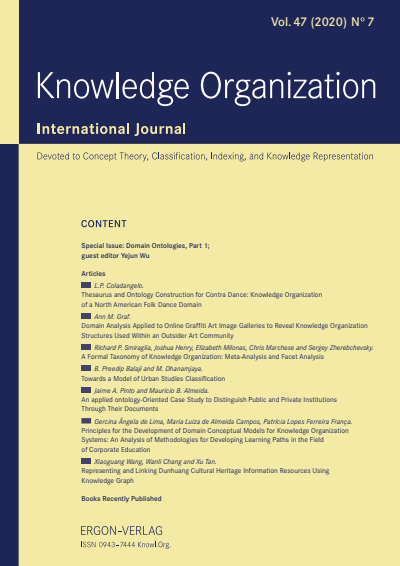
This case study aims to preserve and disseminate cultural heritage information about the North American community folk dance tradition of contra dance through development of a thesaurus of choreographic terms and a domain ontology. A survey of dance...
Domain analysis is useful for examination of individual spheres of intellectual activity, both academic and otherwise, and has been used in the knowledge organization (KO) literature to explore specific communities and uses, including web...
Nearly fifty years after the incorporation of the International Society for Knowledge Organization and the introduction of its formal scientific journal Knowledge Organization, a comprehensive encyclopedia of the domain appeared. The practice of...
Evolution of cities is a subject of research for over a hundred years in the organization of urban knowledge systems. Locating five key methodological approaches used by urban scholars and practitioners, this paper demonstrates different...
The institutions we create shape many of the activities we engage insofar as they are pervasive entities in our society. In an era full of new technologies, including the semantic web, there is a movement toward sound conceptual modeling for...
This article presents a set of principles for knowledge modeling in knowledge organization systems in specific domains. It discusses the representational problem, comparing the abstraction mechanisms present in the theories related to representation...
This study employs a knowledge graph approach to realize the representation and association of information resources, promote the research, teaching, and dissemination of Dunhuang cultural heritage (CH). The Dunhuang Mogao Grottoes is a UNESCO world...